
Visas, Belonging, Unaffiliated fans, and the 2026 World Cup
Julia Lisco, Researcher at American University’s Center for Latin American & Latino Studies and the Immigration Lab, International Affairs Policy Analysis in Global Migration MA candidate
With exorbitant prices required to attend the matches due to dynamic pricing and the extensive immigration bans instituted by the US, many fans were unable to make the expensive pilgrimage to witness their national team compete in the 2026 FIFA World Cup.
Of the 48 participating countries, only a handful had a 100% success rate for fan visa applications, disproportionately excluding smaller and poorer nations. Canada was also extremely strict when issuing visas for both players and fans. While soccer may not be the most popular sport in the U.S., it does have something that made it uniquely equipped to welcome the world: vast and diverse diaspora communities. In fact, it was largely diaspora communities that filled the stands and made up the heart of the tournament.
Many diaspora communities have complex relationships with their homeland; often separated by generations, political ostracism, or forced relocation, bringing with it a host of complex emotions. As Daniel Alarcón discussed on The Athletic’s “Pablo Torre Finds Out” podcast in June 2026, supporting one’s national team is often a less emotionally complicated way for diaspora members to connect with their homeland without the socio-political baggage that comes with other attachments and the history they carry.
The homeland relationship is complicated, but diasporas overwhelmingly brought their hearts to the tournament and made every team feel like they had a bit of home with them. But it wasn’t just diaspora members and local fans filling the stands.
As was the nature of ticket sales for this tournament, many fans, eager to pay the cheapest rate, committed to matches not knowing who would be playing, only the time and location of the match. This led to significant portions of every stadium being made up of observers who held no particular affinity or affiliation with either nation. Some would select a side to support for the day, letting themselves get wrapped up in the energy, while others, refusing to wear a jersey for any other nation, would wear their team’s shirt to the match, despite them not playing.
Ecuador v Côte d’Ivoire
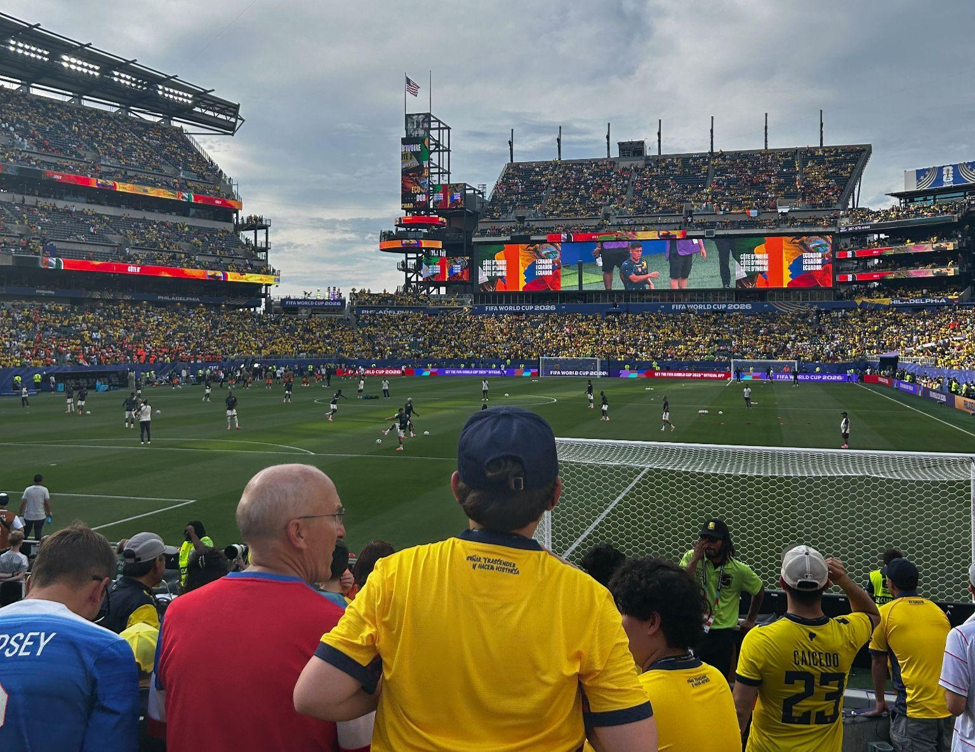
I was one of the many fans who secured tickets to a match without knowing who would play. That game ended up being the June 14th, 2026, Ecuador v Côte d’Ivoire game. I didn’t have any loyalty toward either team, and, not wanting to spend a small fortune on a jersey for either, I wore the Scottish Women’s new alternative shirt to the game. Once in my seat, directly in front of me was a group of men in various USA jerseys. Throughout the stadium, I also noticed many people wearing Colombia jerseys, which look extremely similar to the Ecuador shirts, both sharing a similar solid yellow base. Once I saw one, I saw many, and I was nowhere near the only person in a non-represented team’s jersey.
On the way to the stadium, which was, by my estimation, roughly 85% (at least) filled with Ecuadorian fans, we were swept up in their songs on the subway. Once in the stadium, during the national anthem (as for all matches), the lyrics are displayed on the jumbotrons, and my family, surrounded by Ecuadorian fans, joined right in in their joyous rendition of Salve, Oh Patria, pulled into the expression of their passion for their country and team.
This is not to say that there weren’t many genuine Ecuadorian fans in the stadium, while Côte d’Ivoire supporters made up a passionate minority. The disparity in the stadium between the number of fans for this match is twofold. The Ecuadorian diaspora is one of the largest in the New York metro area, and Philadelphia Stadium (more commonly known as Lincoln Financial Field when it’s not being rented by FIFA), where the match was played, is an easy day trip for the passionate community, drawing significant numbers of genuine Ecuadorian fans.
The second factor contributing to disproportionate attendance is visa restrictions. At the time of the tournament, Côte d’Ivoire had been subject to a visa ban since December 16, 2025, severely limiting possible entry for fans from the small African nation, even if they were able to secure tickets. Meanwhile, Ecuador has not been subject to any country-specific visa restrictions under the Trump administration.
France v Senegal.
One of the most anticipated matches of the tournament was France v Senegal on June 16, 2026, largely due to their shared long colonial history. Senegal was one of the many countries affected by the immigration restrictions; meanwhile, France was one of the few whose fans faced no specific legal restrictions, yet this could not be felt in the stadium.
Unlike the Ecuador match, I was in the stadium as an on-field Pre-Match Ceremony volunteer, standing along the edge of the Senegalese flag on the pitch while more than 80,000 people passionately sang the French and Senegalese national anthems. The stadium was overwhelmingly decked in blue France jerseys (with most unaffiliated fans backing the 2018 World Cup champions, and large Francophile diasporas in the New York Metro area populating the stadium), but when the national anthems were being sung, that discrepancy completely melted away, with Senegalese fans singing just as loudly as the French fans.
I’ve never seen such expressions of pure joy and excitement as than I did at the matches I got to attend as a fan and as a volunteer. National identity and pride are complicated concepts for many to reconcile within themselves, but when applied to sport, much of the weight of history is lessened, and for a moment people get to embrace the joy, whether it’s for their country or for the love of the game.


