
Anthems as Political Battlegrounds
Julia Lisco, Researcher at American University’s Center for Latin American & Latino Studies and the Immigration Lab, International Affairs Policy Analysis in Global Migration MA candidate
In his book, Imagined Communities (1983), Benedict Anderson discusses the power and practice of “unisonance” (p. 145) that emerges when communities sing their national anthems. He elaborates that nations are built on words, and that regardless of the “banality” of national anthems’ lyrics and melodies (p. 145), it is the history and community that these songs create among groups of individuals.
In sports, national pride is not just a consequence of international play but an integral part of the 2026 FIFA World Cup. Before every match, there is a moment where this national identity is explicitly highlighted: the Pre-Match Ceremony in which the national flags of both teams are presented. Players walk onto the pitch behind their flag, and tens of thousands of people sing their national anthem in unison. This ceremony happened 104 times over the course of the tournament, and despite any outside or historical tensions between teams, and the vitriol that politics has embraced in recent decades, only two matches saw any form of disrespect during this process. For a few minutes, all outside noise was put aside 102 times, and instead stadiums full of people from all over the world gathered and basked in their love and pride for their team. Meanwhile, their opponents respectfully stood by and shared in their excitement for the match to begin.
The two games where this ceremony played out abnormally were Iran’s opening match against New Zealand on June 15, 2026, and England vs Argentina’s semifinal clash on July 15, 2026. These were two very different instances of “unsportsmanlike behavior”
Islamic Republic of Iran v New Zealand
Tensions around the Iranian national team were already high prior to a single ball being kicked due to the conflict between the USA, one of the three host nations, and Iran, preceding the opening ceremonies. Donald Trump threatened to prevent the team’s entry to the U.S. altogether, and ultimately forced the team to move their headquarters from the U.S. to Tijuana, Mexico, and made them leave the country directly after the conclusion of their games; a requirement no other team faced, and which significantly interrupted player recovery processes.
By match day, sentiments surrounding the Iranian team resembled a powder keg. Diaspora groups who, due to immigration bans, made up most of the in-person supporters were divided in their support for the team. This was largely informed by their families’ experience with the Iranian Revolution and the regime that followed. CNN interviewed an Iranian community soccer team in California, where the Iranian team’s World Cup campaign would begin, and they said they did not feel “represented” by the team.
Inside the stadium, strict rules were in place to prevent the presentation of political materials, including the use of pre-revolutionary flags and imagery. It’s extremely common for fans to bring national flags to national team football games, blanketing themselves and the stadium in their country’s colors. Despite guidance suggesting otherwise, several pre-revolutionary flags made their way into the stadium, with some fans reporting it was easy to get them in.
When the national anthem was played and the current regime’s flag was unfurled, it was largely Iranian fans brandishing pre-revolutionary flags who expressed discontent, not the opposing New Zealand fans. Rather than an action of intercultural conflict and disrespect, this was instead a political protest by a disenfranchised section of the diaspora taking the opportunity to make their voice heard globally, and by their homeland’s government.
England v Argentina
Fittingly, two of the most hated teams in international football met in the semi-final. Tensions were high, and not only do they share a soccer rivalry, but they also share a tense geopolitical history. When the national anthems were projected into the stadium prior to kick-off, boos and other acts of disrespect were littered amongst the prideful singing of both national anthems, and echoes of the Falklands War (a brief conflict in 1982 between the two nations over the long-contested sovereignty of the archipelago 300 miles off the eastern coast of Argentina, that took the lives of about 650 Argentinians and 255 British military personnel) and a decades-long sporting rivalry hung over the match.
Despite FIFA’s prohibition of political flags or signs from entering the stadiums, some Argentinian fans managed to sneak in a sheet with the words “Las Malvinas son Argentinas” (The Falklands are Argentine) painted on it. After Argentina beat England 2-1, several players paraded around the pitch with the flag, celebrating while pridefully dancing with it on international TV. These actions, combined with the physical altercations following the final a few days later, resulted in a $321,000 fine.
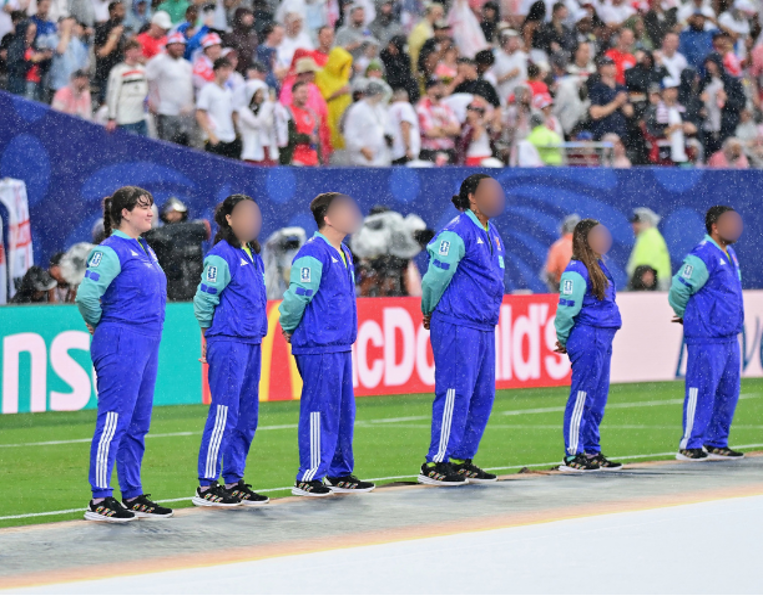
I had the honor of participating in the tournament as an on-field Pre-Match Ceremony volunteer for six matches, playing a critical role in the execution of the flag presentation for the national anthems. The events of these matches are not representative of the whole tournament and the love that filled the pre-match ceremonies of every other game. Soccer is already an emotional sport, so it is only natural that emotions like these seep into these moments of passion. I got to feel this firsthand from the field of play, and there is nothing like it. Sport does not happen in a vacuum, but for 98% of the tournament, national anthems remained a sacred space of love and national pride.


