The U.S. Supreme Court Immigration Rulings: Citizenship, Asylum, Metering, and TPS

By Ernesto Castañeda

American University
By Ernesto Castañeda

In recent weeks, the conservative majority in the U.S. Supreme Court has issued several rulings affecting the U.S. immigration system. One of these rulings states that people cannot seek asylum in the United States until they are physically inside U.S. territory. This has significant implications for people arriving—especially at the U.S.-Mexico border—who were requesting entry at the border wall or at ports of entry, turning themselves over to immigration agents to ask for admission with the stated goal of seeking asylum. Now, according to the Supreme Court, the U.S. government will view them as being in Mexico, and since they will largely be denied entry, they cannot apply for asylum while still outside U.S. territory. That is, the Court treated people waiting on the Mexican side of the border as not yet having entered the United States for asylum purposes. This is curious because in some cases the side of the border wall facing Mexico is already U.S. territory because clearly the U.S. cannot build on Mexican territory. Meaning that in many places, by reaching the wall, one is technically already on U.S. soil. Future suits may test this. However, given these new legal precedents, it appears the U.S. government would deny entry for the purpose of seeking asylum inside the country. This will affect many people, particularly those from Latin America and regions experiencing armed conflict or political turmoil. 

Another ruling related to what is known as “metering”—essentially a slow, controlled trickle of people allowed into U.S. territory when there is congestion of asylum seekers at the border, or when large numbers of people wish to enter the United States. It is not the first time this border-processing policy, which limits how many asylum seekers are admitted or processed at a time, has been brought up. During the pandemic—and even earlier, under programs like “Remain in Mexico”—the U.S. government stated it would only accept, say, five hundred, two hundred, or two thousand people per day across the entire border. Consequently, even though many people sought asylum, they were not immediately admitted. The U.S. government claimed this was necessary to maintain order and manage logistics—handling the entry process in a way they could manage without people sleeping on the streets or needing more hostels for migrants or overcrowded immigration detention centers. Metering was an “emergency” policy that began under Obama, continued under Trump, was paused during most of Biden’s term, though it was brought back towards the end, and continued under the Trump administration. The Supreme Court has allowed the policy to proceed into the future by lifting the lower-court block.

The third topic is Temporary Protected Status (TPS), which allows legal residence in the United States to whole groups of people from particular countries due to events like earthquakes, hurricanes, civil conflict, or other crises—as seen in Honduras, Haiti, El Salvador, and other countries—where nationals could stay in the U.S. without fear of deportation. However, the Supreme Court has now ruled that, in the case of Haitians and Syrians, this status of temporary protection can be completely revoked despite motives and the decision-making process. But the Supreme Court conservative majority went further, arguing that TPS designation is a matter that falls under executive authority, specifically the president’s power to decide whom, how, when, and for how long TPS is granted. Therefore, the decision strengthens the executive’s ability to terminate TPS designations and may affect other TPS holders. So, although the ruling did not directly address cases involving, for example, Salvadorans, it grants the president greater power to revoke TPS at will without explanation, preventing even lower courts from blocking such decisions—something they had done in recent years. 

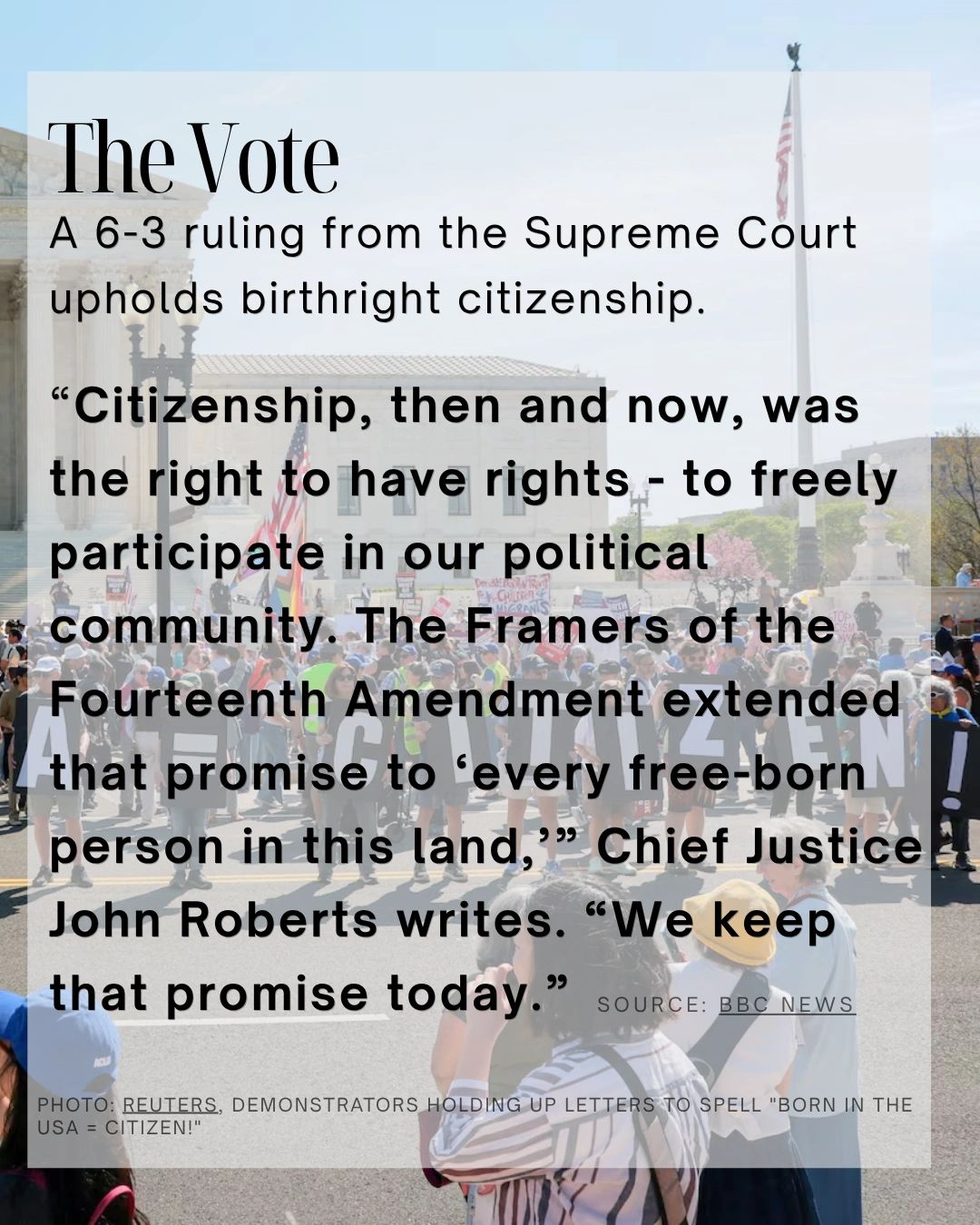
Altogether, these decisions have many implications that make it harder for people to enter the U.S. legally or to seek asylum, and make it difficult for those already inside the country to apply for asylum, given the lengthy, difficult process, made even worse by recent procedures implemented by the second Trump administration. Now, regarding people holding TPS, deportations will begin—starting with Haitians and Syrians—but the issue likely will not stop there. People with TPS have been in the U.S. for decades, working, paying taxes, contributing to the economy and the arts. They have children born in the U.S. who are U.S. citizens under the current practice of granting birthright citizenship; soon, the Court will rule on the future of birthright citizenship, which is so common in many countries in the Americas, which started as European colonies with an important proportion of the population born from parents and ancestors born elsewhere.  

Ernesto Castañeda is a political, social, and cultural analyst. Edited by Esmeralda Alverde Duarte, Research Intern at the Immigration Lab

Changing Birthright Citizenship Would Weaken American Democracy

By Ernesto Castañeda

American University

The U.S. Supreme Court will soon announce its ruling on Birthright Citizenship. If it sides with the Trump administration, it will revoke the practice of automatically obtaining citizenship by birth in U.S. territories. The outcome of this case has the potential not only to change how immigration law functions but also how citizenship is defined for everyone in the United States. Doing away with it would permanently damage the Supreme Court’s reputation.

Birthright Citizenship is part of the 14th Amendment and has been a right guaranteed to anyone born within the country since 1868. The amendment was originally implemented to guarantee citizenship to formerly enslaved people and means that anyone born on American soil is an American citizen, regardless of their parents’ citizenship at birth. Slaves were not considered citizens nor had the same political rights, and their status was inherited through maternal lines and thus also affected the children slave-owners had with enslaved mothers.

Revoking Birthright Citizenship would immediately bring into question the citizenship of hundreds of thousands of children born each year, both to citizens and to undocumented or temporary residents with permission to work and study in the United States, and not officially representing a foreign country.  It would reinstate the inheritance of status that existed during slavery, where a mother’s status, in this case, documentation, would be passed down to her children, possibly for generations. It would create a group of people in the U.S. with no rights, greatly deepening inequality and democratic erosion.

Previous court decisions have upheld Birthright Citizenship regardless of the parents’ immigration status. There is a strong precedent for birthright citizenship. Even during previous periods of immigration restriction in the US, like during the years following the Chinese Exclusion Act, the U.S.-born children of undocumented Chinese parents were American citizens. Changes to birthright citizenship would directly impact newborns from undocumented parents as well as the children of foreign workers with permission to reside in the country. Systems like this have existed before in countries like Germany, but were abandoned due to their impracticality and the enduring inequalities they created.

A small group is fighting to end birthright citizenship. Most Americans do not have a problem with birthright citizenship; 64% of Americans support it. The widespread impact of ending birthright citizenship would be felt not just by everyday people but also by foreign-born CEOs, scientists, healthcare professionals, and, yes, agricultural and service workers. It would impact U.S. innovation for decades to come. It would deter people from immigrating and bringing new ideas and approaches to common problems. The U.S. would no longer be the main global hub of intellectual exchange and creativity that it has been for decades.

Ernesto Castañeda is a political, social, and cultural analyst.

Latino Sense of Belonging Decreases amid Racial Profiling, Detention, and a Fading American Dream

By Anjini K. Patel

Source: Encuesta de Ipsos para Axios/Noticias Telemundo

A recent Telemundo survey reveals increasing pessimism from Latinos in the United States regarding their sense of belonging. Telemundo, in collaboration with Axios and Ipsos, surveyed a nationally representative sample of over 1,100 U.S. Latino adults from October 21 to 27, 2025. Conducted in both English and Spanish, the survey asked a variety of questions about their views on the American Dream, their sense of belonging in the US, and their optimism about the future of the country. Only 44% of respondents described the American Dream as achievable in 2025, a decrease from 61% in 2023. Similarly, 40% of 2025 respondents affirmed that the US makes them feel like they belong, and only 36% felt optimistic about the future of the US. This ​compares​ to 57% and 52%, respectively, in 2022. This survey provides an insight into the feelings of Latinos as they navigate the uncertainty of the current American political landscape.  

The survey also asked respondents about their anxieties related to being Latino/Hispanic in the United States. Compared with 39% in June 2022, 53% of respondents in 2025 reported feeling worried about themselves or a loved one being attacked because of their ethnicity. Two out of three (2/3) Latinos who identify as Republicans say it is a good time to be a Latino in the United States, while only one in ten (1/10) Latino Democrats agree. Seventy-one percent (71%) of those aged between 18 and 29 and 57% of those who are 50 and older, said it is a bad time to be Latino. 

Most respondents indicate that the Democratic Party, as compared to the Republican Party, better represents Latinos, cares more about them, and is better on economic and immigration policy. Additionally, most respondents agreed that the Republican Party takes Latino Americans for granted (39%) as compared to the Democratic Party (22%). Interestingly, more respondents describe the Republican Party as a good option for public safety compared to the Democratic Party, even in the face of increased fear and anxiety over being attacked for being Latino.  

What do experts say? 

Dr. Ernesto Castañeda, Director of the Center for Latin American and Latino Studies at American University, discussed this survey on Telemundo. As he states, the data from this poll are unsurprising given the very strong anti-immigrant rhetoric that Donald Trump and the Republican Party campaigned with and continue to use. Rather than focusing on people with violent criminal records, ICE raids and subsequent deportation, often without due process, have detained and deported people with all types of immigration statuses, and thus increased fear among Latinos. Castañeda points to comments by Justice Cavanagh and decisions by the conservative majority in the Supreme Court that made detaining someone based on their appearance and manner of speaking permissible, further blurring the lines between individuals with papers and those who are undocumented. In light of these violent mass deportations and detentions happening in public places, following stereotypes and racial profiling, it is no wonder that many Latinos report a decreased feeling of belonging in the United States. 

Regarding the impacts of these recent events, Dr. Castañeda explains that the feasibility of immigrants achieving the American Dream is decreasing. While people still arrive in the United States with high hopes that “they can come and work hard, send remittances, enjoy a better life, and that their children can go to university, in the United States right now, we see high underemployment rates, and many people are afraid to go to work because of mass raids. We are seeing inflation. It is harder to pay for health insurance, housing, and to save.” In this way, the American Dream is stalled. Since the end of the pandemic, the U.S. had seen a rapid and strong economic recovery, which Dr. Castañeda attributes largely “to the people arriving, especially from Latin America, seeking asylum—Venezuelans, Cubans, Haitians, Nicaraguans, and others—which increased the US population by 1%, which was very significant.” With the border closing under the current administration and deportations by the dozens of thousands, businesses are unable to grow at the same rate. Dr. Castañeda underlines: “If there’s less migration, it doesn’t mean there will be more jobs for locals. It means there will be less work for everyone, and more people will lose their jobs because the demand for goods and services decreases, businesses cannot hire and grow, and therefore they stop hiring and start firing workers.” 

Additionally, research shows that immigrants are much more likely to start businesses and hire more workers than businesses started by native-born citizens. Therefore, the lack of immigration has a negative impact on the overall economic growth of the United States. As Dr. Castañeda describes, “the fact that Latinos aren’t going to work here means there are fewer nannies. There are fewer construction workers, fewer lawyers, fewer nurses… it also makes many Latinos afraid. They don’t go to the markets, they don’t go to the malls, they are spending less, which has an impact, and many immigrants, seeing that there’s no American Dream anymore, aren’t going to bring their families or many of them are thinking about returning to their country.” 

The decreased sense of belonging by the Latino/Hispanic community has affected numerous outlets that embrace these cultures. Some events honoring Hispanic Heritage Month were canceled. This hurt artists, folk dancers, and musicians, as well as the larger public, who did not have the opportunity to engage with these rich cultural traditions. “Latin restaurants are struggling,” Dr. Castañeda says. “Hundreds are closing because they can’t hire enough people; workers are afraid to go to work because food is so expensive. So, it’s no longer a profitable business for them. The decline of the Latino food business also means fewer dining options, fewer cultural spaces, and fewer opportunities for communities to enjoy Latino cuisine. This is a loss for the United States as a whole.” 

Hope and Resilience in the Face of Uncertainty 

How should the Latino community respond to the ever-changing political landscape in the United States? Dr. Castañeda urges people to “stay calm and continue with their daily lives. We often do this for our children and grandchildren​,​ who, I truly believe, will have a good future. This storm is temporary. This will pass.” Importantly, he points out that nearly 80% of Americans view immigration positively. Mass raids are not popular​, ​and vulnerable​​ communities are​ witnessing​ peaceful protests carried out by citizens who are physically placing their bodies between immigration agents and migrants ​​who are in the process of being​​ detained. The November 2025 elections indicate that a majority of Americans reject the current administration’s extreme policies on immigration and the mismanagement of the economy. The anti-immigrant sentiment is ​driven ​primarily by​​ the federal government under Donald Trump, not the American people. With a hopeful outlook, Dr. Castañeda says, “I think that once this nightmare is over, there will be a greater sense of belonging, so we have to have patience, have faith in your fellow citizens, and I do truly believe that this will pass and the future will be better for U.S.-born Latinos and those immigrants who are able to stay. There will be concrete actions that will tell Latinos that they belong because this is their home.” 

Anjini K. Patel is a Sociology Research & Practice MA candidate at American University (AU) and works as a graduate research assistant at the AU Inequality, Social Justice, & Health Lab. Her research interests include immigration, criminal legal system & housing justice, and artivism & community building.

“We Knew We Were Going with God”

Religion, Hope, and Perseverance

By Tabby Ford

Photo by Katheryn Olmos; Silver Spring, MD

Migration is often a difficult process for those who leave their home country, both physically and emotionally. Whether their migration was motivated by finances, safety, or better career and educational opportunities elsewhere, leaving is not easy. The dangerous conditions of the journey and the uncertainty of what lies ahead deter many and can be overwhelming for those who proceed. For some migrants, religious belief gives them courage and strength to push forward, despite the stressful and hazardous obstacles they may encounter.

Many migrants and asylum seekers attribute their safety and the safety of others in their group to prayer and “God’s blessing” despite the dangerous conditions they faced on their journey to the United States. Especially for those who emigrate from Central and South America, the journey may require travel through multiple countries, often on foot or by car, and obstacles such as rough terrain, gangs, and hostile immigration agents. In some cases, migrants’ faith protects them from the emotional toll of potential danger. As one migrant from Venezuela states, when asked if he felt like he was in danger during his journey north, “No, we weren’t afraid. I mean, we knew we were going with God.” His faith kept him going during the long journey.

Migrants who encountered dangerous obstacles also attribute their successful journey to God. For Arturo, from Venezuela, the journey was incredibly dangerous. He crossed a 60-mile stretch of dense rainforest, known as the Darién Gap, with strangers, enduring hunger and exhaustion. Armed groups are known to extort migrants at gunpoint in this remote area, and those unable to pay sometimes never return. “We saw other people being kidnapped… thank God they didn’t catch us,” he recounted, describing the terror of running through the forest with a child in his arms and the relief of making it through. Eduardo, from El Salvador, recounts being shot at by immigration authorities at one point in his journey and how many members of his group survived due to their prayers; “Thank God, praying to God and the Virgin Mary, we hid [from] them … God already performed the miracle.” For one Honduran immigrant, Alma, her migration journey was shaped largely by religion. While she was born in Honduras, she was brought to El Salvador as a teen to attend a high school run by Catholic missionaries. Her religion, education, and physical location have long been intertwined. Although she has needed to move a lot and now must adjust to living in yet another new country, she says, “things happen for a reason. I always say, sometimes you feel lost, but God is showing you something… You gotta, you know, go forward.” She attributes her prayers and God’s plan to where she is in life, especially her education and career. For many immigrants, even though their faith and belief in God did not shield them from life-threatening conditions and the challenges of immigrating, their faith fueled their courage, guiding them along the way.

Houses of worship often play an integral part in assisting migrants, especially in the first few months after arrival, by providing a space for community building and cultural events. They also become sources of mutual aid. For instance, this can be seen in local Mosques and Ukrainian churches, where Afghan and Ukrainian refugees, respectively, utilize resources. For example, Oleg, from Ukraine, reports a lack of restaurants that serve Ukrainian food in the region he settled in. Despite this lack of places to go out and eat Ukrainian food, he says that “usually, [he] can get something from the church.” Although he is able to make Ukrainian food at home, the local Ukrainian church is Oleg’s only option for connecting with the wider Ukrainian community over a meal. Another example is Latif, a refugee from Afghanistan, who also utilized resources from local churches and mosques. In his efforts to further his education in the United States, he learned that a local mosque “had some funds to help some refugees get an education.” He used these funds to enroll in an IT certificate program, which helped him find a job that aligned with his career goals.

In addition to getting material resources from local religious groups and congregations, many migrants also rely on faith in God’s plan to get through the difficult transition and settling process. Once in the United States, religious migrants use their belief system as motivation to create a new life in their new community. They are able to leverage their belief systems for community engagement and to establish a sense of belonging. Many migrants also report celebrating religious holidays in local congregations and communities with similar cultural backgrounds or with other immigrants from their home country. Faith helps to form the lens in which people see the world through. As one Mexican woman states, “I practice my faith, […] I’m Catholic, so I ground myself a lot in just the human dignity coming from something beyond me.” Arturo, an immigrant from Venezuela embodies this mindset well, as his faith has helped him in adjusting to his new life and feeling a sense of belonging. As he states, “We are all equal as the children of God, we are all equal.” His belief system has given him an optimistic attitude about his new home and how he has been received.

Although it is taking him time to learn English, Arturo also thanks God for his ability to pick up enough English to get by in his work as a delivery driver and for his work permit allowing him to make money to send home: “Right now at this moment thank God at least I have the work permit, I have my partner and I am about to find a way to get my papers together.” He implies that process of finalizing his immigration papers will involve lots of time, money, and effort, but is hopeful and thankful to God for where he is and that he at least has a work permit. Similarly, Silvia, who immigrated from El Salvador in her 20s, implies that God’s work helped her in finding a job when she first arrived in the United States, saying “It was almost not difficult for me, thank God, because a lady gave me a job who had a business selling pupusas.” Arturo and Silvia both thank God for where they are in life now and have trust in their religious beliefs to carry them where they need to be.

For many people who undertake the process of immigration to the United States, their faith and religious beliefs are as essential to their journey and adaptation as it is to every other aspect of their life. Religion plays an important role in maintaining hope and resilience throughout the danger and uncertainty of both the journey and the destination. Once arrived, religious communities, positive outlooks, and faith in a bright future help immigrants settle and feel like they belong in their new home country.

Tabby Ford is a Research Assistant at The Immigration Lab and a Sociology Research & Practice MA Candidate at American University

Edited by Quinn Pierson, Sociology Research and Practice MA Candidate at American University, Ernesto Castañeda, Director, and Chris Belden, Research Assistant at the Center for Latin American and Latino Studies and the Immigration Lab.