Immigration Realities

Book Review

by Blogger Ben from ACEMAXX Analytics

It seems that the modern world is drowning in crises.

Imperialism, decolonization, violence, natural disasters, instability, and poverty have been uprooting people around the world for thousands of years.

Migration is part of human history. But “Migration” is a highly politicized theme.

Refugees are people who are facing problems and do not fundamentally pose a problem themselves.

A serious, systemic problem related to expulsion is the legacy of imperialism and current neo-colonial relations.

Ernesto Castañeda and Carina Cione: Immigration Realities – Challenging Common Misperceptions, Columbia University Press, Nov 2024.

According to the UNHCR, the real crisis is that a few countries have “a disproportionate responsibility for taking newcomers,” and not there is a relatively disproportionate number of arrivals:

Politicians and journalists speak of “immigrant and refugee crises,” but the authors explain why “we see it as a political crisis, not a crisis of migration.”

The constant production of refugee crises influences the public’s political and social views about migration.

“Migration cannot be “solved” because it is a timeless and constantly fluctuating phenomenon.”

It is an open secret that the strong opinions that people often have are based on idiosyncratic personal experiences, prejudiced views, and false assumptions spread by politicians and mainstream media.

However, the average citizen often does not have all the facts at hand to look at the topic of migration from an objective yet sensitive perspective – and cannot do so.

The authors attach great importance to summarizing academic literature to help promote public understanding of today’s international migration.

The recent book summarizes relevant research results on common myths for readers who are not familiar with contemporary migration or border studies.

In other words, the authors present the relevant scientific research, which is often closed behind paywalls, research specialization, and subject-specific jargon so that most readers find it awkward and difficult to understand. This book is clearly aimed at the general public.

Each chapter revolves around a certain misunderstanding and can be read as an independent work or together with the others. The individual chapters contain relevant and up-to-date knowledge about the realities of migration, which is presented in such a way that it is also appealing and accessible to non-professionals.

Ernesto Castañeda and Carina Cione distinguish how some rhetoric accuses, patronizes, and criminalizes refugees, which, in connection with xenophobia, stereotypes, and fear-mongering, support the myth of a crisis.

A refugee is defined as someone who has left his home country and cannot return because he has a reasonable fear of violence and/or persecution due to his identity or political conviction.

The word has two meanings: a “legal meaning” that describes a person entitled to asylum under international law, and a “colloquial meaning” that describes a person who has fled their homeland. The criteria for international recognition as a refugee are strict, and other displaced people can be wrongly referred to as refugees.Neo-colonialism under the auspices of neoliberal capitalism, for example, contributed to the fact that entire regions in Africa, Asia, and Latin America, which were first described as “the third world” and then now the “Global South,” because they were oppressed in the past and the present, and not simply because of their low national income or the degree of integration into international trade.

Every “refugee crisis” is a socially constructed term that distracts from the real problem: the high-income and imperialist countries do not take responsibility for their violent actions because they benefit from the equally violent postcolonial world order.

The current neo-colonial conditions are undoubtedly part of the neoliberal driven dismantling of the welfare state, which leads to a lack of state programs for the public and the acceptance of tax cuts for the rich.

Globalization and migration are presented as two sides of the same coin, but in reality, they are very different phenomena – economic globalization and migration are not causal since migration tendencies do not necessarily agree with trade trends: periods of expanding international trade do not always correlate with migration waves or vice versa.

The authors also clarify usual terms such as “integration, assimilation, and acculturation.” Yours truly, for example, has so far preferred the term “acclimatization” to “assimilation” and “integration.”

According to Ernesto Castañeda and Carina Cione, comprehensive integration is a social integration; it does not mean cultural assimilation to the morals of the dominant group, but rather presupposes certain negotiations, reciprocal communication, and mutual influence.

Integration is often mistakenly equated with assimilation and acculturation. However, these are different concepts.

Acculturation refers to the process of getting to know the culture of the new place of residence and the achievement of a fluid cultural language. Immigrants can acculturate while maintaining many of their native traditions and culture.

In the spirit of Ernesto Castañeda’s previous work, social integration means equality and equal opportunities while maintaining cultural differences.

Assimilation is based on intolerance towards identities that deviate from the dominant and often Eurocentric culture.

Migration is an inherent human phenomenon that is subject to changes that are influenced by local and national political, economic, and social conditions. Data relating to the overall world population does not allow the conclusion that globalization is driving migration forward.

Research refutes widespread misconceptions about immigration. In fact, only 3.5% of the world’s population live in a country other than the one in which they were born.

Worldwide, the percentage of people who change residences due to war, political or religious persecution, poverty, or lack of opportunity is not as high as ever before and is not unmanageable for host countries.

Migration is a geographical and social relocation process. Subjective affiliation also depends on the objective conditions, including the absorption capacity of the new environment and the attitude of the locals towards immigrant groups.

In the US, for example, there is still no national integration program specifically designed to support immigrant integration. Migrants are expected to go through this process alone.

In sum, “Immigration Realities” is an indispensable masterpiece of intellectual honesty.

Immigration Realities – Challenging Common Misperceptions, by Ernesto Castañeda and Carina Cione – Columbia University Press, Nov 2024.

Originally published in German in ACEMAXX-ANALYTICS’s Newsletter!
Los Inmigrantes Impulsan la Economía de Estados Unidos. Aquí está la prueba.

Por Ernesto Castañeda

November 22, 2024

Donald Trump ha prometido deportar a millones de inmigrantes si es elegido para un segundo mandato, afirmando que, entre otras cosas, los trabajadores nacidos en el extranjero les quitan el trabajo a los locales. Su compañero de fórmula, JD Vance ha hecho eco de esas opiniones antiinmigrantes.

Sin embargo,  la mayoría de los expertos coinciden en que las deportaciones masivas dañan la economía de EE.UU. y que incluso pueden provocar una recesión.

Los científicos sociales y los analistas tienden a estar de acuerdo en que la inmigración —tanto de personas documentadas como indocumentadas— estimula el crecimiento económico. Pero es casi imposible calcular directamente cuánto contribuyen los inmigrantes a la economía. Eso se debe a que no conocemos los ingresos de cada trabajador inmigrante en los Estados Unidos.

Sin embargo, tenemos una buena idea de cuánto envían a sus países de origen; más de 81 mil millones de dólares en 2022, según el Banco Mundial. Podemos utilizar esta cifra para calcular indirectamente el valor económico total que genera la mano de obra inmigrante en EE. UU.

Es probable que se subestimen las contribuciones económicas

Llevé a cabo un estudio con investigadores del Centro de Estudios Latinoamericanos y Latinos y El Laboratorio de Inmigración en la American University para cuantificar cuánto contribuyen los inmigrantes a la economía de los EE. UU. en función de sus remesas o dinero enviado a casa.

Varios estudios indican que las remesas constituyen el 17,5% de los ingresos de los inmigrantes.

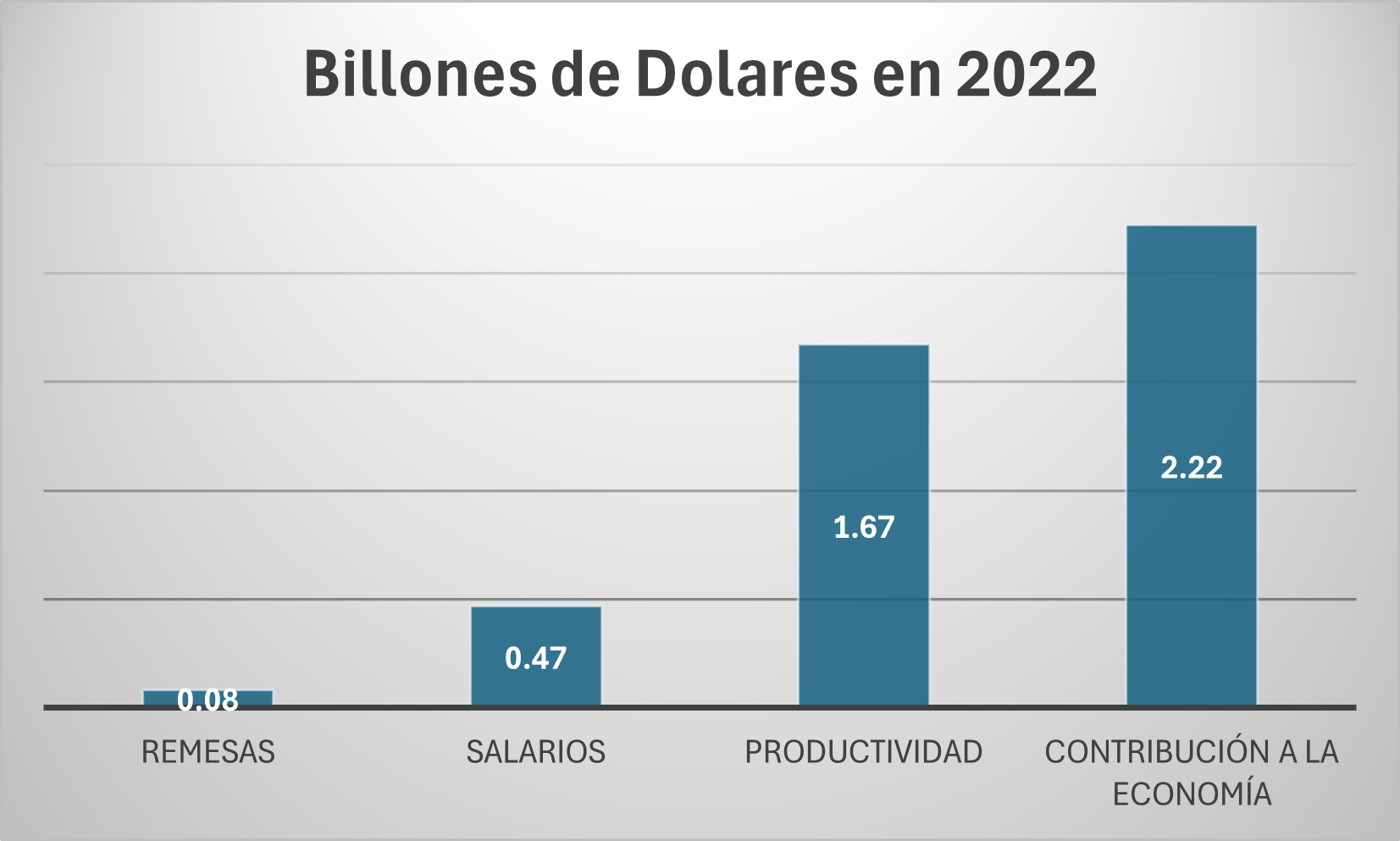
Teniendo en cuenta eso, estimamos que los inmigrantes que enviaron remesas en 2022 tuvieron salarios netos de más de $466 mil millones. Luego, suponiendo que sus salarios netos representan alrededor del 21% del valor económico de lo que producen para las empresas donde trabajan, por ejemplo, en restaurantes y construcción, los inmigrantes agregaron un total de $2,2 billones a la economía estadounidense sólo en 2022.

Esto es aproximadamente el 8% del producto interno bruto de los Estados Unidos y cerca de todo el PIB de Canadá para 2022,la novena economía más grande del mundo.

Los Inmigrantes en Estados Unidos que mandan dinero al extranjero crean al menos $2 billones en actividad económica

Basado en cuanto dinero los inmigrantes en Estados Unidos envían al exterior en 2022, los académicos estimaron los ingresos y de allí, cuanta productividad generaron en la economía estadunidense.  El estudio estimó que las contribuciones totales de los migrantes a la economía estadunidense exceden $2 billones (trillones en inglés) en 2022.

La inmigración fortalece a Estados Unidos

Más allá de su gran valor, esta cifra nos dice algo importante: los principales beneficiarios de la mano de obra inmigrante son la economía y la sociedad de Estados Unidos.

Los 81 mil millones de dólares que los inmigrantes enviaron a casa en 2022 son una pequeña fracción del valor total con el que contribuyen a la economía: 2.2 billones de dólares. La gran mayoría de los salarios y la productividad de los inmigrantes (el 96 %) se queda en Estados Unidos.

Las remesas desde los EE. UU. representan una fuente sustancial de ingresos para las personas que las reciben. Pero no representan un drenaje de dólares estadounidenses, como ha insinuado Trump cuando llamó a las remesas “asistencia social” para personas de otros países y sugirió imponerles impuestos para pagar la construcción de un muro fronterizo.

Es probable que las contribuciones económicas de los inmigrantes estadounidenses sean incluso más sustanciales de lo que calculamos.

Por un lado, la estimación del Banco Mundial sobre las remesas de inmigrantes es probablemente un recuento insuficiente, ya que muchos inmigrantes envían dinero al exterior con personas que viajan a sus países de origen.

En investigaciones previas, mis colegas y yo también hemos descubierto que algunos grupos de inmigrantes tienen menos probabilidades de enviar remesas que otros.

Uno de ellos son los profesionales de cuello blanco: inmigrantes con carreras en la banca, ciencia, tecnología y educación, por ejemplo. A diferencia de muchos inmigrantes indocumentados, los profesionales de cuello blanco generalmente tienen visas que les permiten traer a sus familias con ellos, por lo que no necesitan enviar dinero al extranjero para cubrir sus gastos domésticos. De igual forma, los inmigrantes que han estado trabajando en el país durante décadas y tienen más familiares en el país también tienden a enviar remesas con menos frecuencia. Ambos grupos tienen mayores ingresos y sus contribuciones no están incluidas en nuestra estimación de 2,2 billones de dólares.

Además, nuestras estimaciones no tienen en cuenta el crecimiento económico estimulado por los inmigrantes cuando gastan dinero en los EE. UU., creando demanda, generando empleos y empezando negocios que contratan inmigrantes y locales.

Por ejemplo, calculamos los aportes de los inmigrantes salvadoreños y solo sus hijos agregaron aproximadamente 223 mil millones de dólares a la economía de Estados Unidos en 2023. Eso es aproximadamente el 1% del PIB total del país.

Teniendo en cuenta que la economía de Estados Unidos creció alrededor de un 2% en 2022 y 2023, esa es una suma sustancial.

Las cifras qué presentamos son un recordatorio de que parte del éxito financiero de Estados Unidos depende de los inmigrantes y su trabajo.

Ernesto Castañeda es director del Centro de Estudios Latinoamericanos y Latinos y del Laboratorio sobre la Inmigración de American University.

Edgar Aguilar ayudo con la preparación, análisis y traducción.

You can republish and reprint this piece in full or in part as long as you credit the author and link to the original when possible.

Dual Perspective on Food Program Administration 

By Lia Sullivan

November 21, 2024

A table full of vegetables including celery and carrots.

Addressing and combatting food insecurity requires a coordinated approach across all sectors, including nonprofit organizations, government agencies, and private corporations. Although these varying groups may approach the cause differently, there is a shared goal of increasing food security. This analysis was influenced by my experience working in a nonprofit addressing food insecurity as well as the United States Department of Agriculture (USDA) in the Food and Nutrition Service. My experiences gave me valuable insights into the stark differences between government and nonprofit organizations. in understanding, approaching, and solving food insecurity between government and nonprofit organizations.  

The mission of the USDA Food and Nutrition Service is stated as, “To increase food security and reduce hunger in partnership with cooperating organizations by providing children and low-income people access to food, a healthy diet and nutrition education in a manner that supports American agriculture and inspires public confidence.”  They administer 15 federal assistance programs including SNAP (Supplemental Nutrition Assistance Program), school meals, CACFP (Child and Adult Food Care Program), WIC (Supplemental Nutrition Assistance Program for Women, Infants, and Children), TANF (Temporary Assistance for Needy Families). My responsibilities included reviewing and editing resources that program administrators used to properly procure and serve food that aligns with the nutritional standards set by the agency. This opportunity allowed me to gain experience in the federal processes that go into the nutrition programs that serve and assist millions of Americans.  

The nonprofit organization I worked with aimed their mission as, “Striving to eliminate hunger in the nation’s capital while enhancing the nutrition, health, financial stability, and overall well-being of low-income residents in the District.” Their main focuses are on D.C. resident participation in federal nutrition programs, improving public policies, and educating the public on the reality of hunger’s existence within the District. My responsibilities were increasing SNAP and WIC participation by creating relationships with residents and producing educational content. This role gave me first-hand experience with the communities directly affected by food insecurity and allowed me to see how the policy created by our government affects Americans every day.  

The differences I noted between the two experiences varied, from how the meetings were conducted to how they defined activism. Within the USDA, meetings were highly structured, with a specific focus on compliance with federal regulations and guidelines. I found the weekly staff meetings to be lively, with a lot of small talk and team activities. On the contrary, the nonprofit team meetings were centered around community intervention with little to no small talk and few team connection activities. These differences were notable for me, as they showed the discrepant level of urgency in the line of work between the two sectors.  This could be attributed to numerous factors, including different standards and regulations each organization is held to. Nevertheless, it shined light on the importance of nonprofit organizations supporting USDA policy.  

Additionally, the difference in staffing retention and burnout between the two organizations was striking. Throughout my year at the nonprofit, I saw many team members resign from positions due to the stress and emotional toll that comes with aiding underserved communities. Furthermore, there were few to no employees who had been with the organization for over four years.  In my year with the organization, I witnessed the reinstating of three different presidents and the resignation of two. Whereas in the USDA, most employees had high tenure, with some even reaching 20-25 years in the agency. This difference in retention is a common problem, in the nonprofit sector. With limited funding and resources, staff often are forced to take on responsibilities beyond their original job description, working long hours to meet deadlines, and to keep up with the needs of District residents. In the government, however, there are strict guidelines in place limiting hours worked by each employee and the duties they are permitted to perform, helping keep their retention rate high.  

 Beyond job loss from burnout, I also witnessed the nonprofit organization’s largest layoff period in its history. Essential positions such as communications and public relations coordinators, government affairs specialists, and others were released from the organization due to large budget cuts. Additionally, other employees were forced to take furlough days to keep their jobs afloat. In contrast, job stability within the government sector was a promising factor for prospective employees. The federal government, the largest employer in the United States, provides comprehensive benefits and job security. 

Overall, both organizations play vital roles in supporting and combatting food insecurity nationwide. The government creates vital policies and budgets to support the “boots on the ground” and educational information that nonprofit organizations work tirelessly to implement. Through these experiences, I was able to see the varying factors that go into supporting our neighbors who experience food insecurity every day.  Having worked at a nonprofit before the USDA allowed my work through the government to remain grounded in the experiences of those we are seeking to help. Therefore, policymakers and direct service providers should better collaborate in hopes of making these efforts more effective.  

Lia Sullivan is an MA student in the Sociology and Research Program at American University.

You can republish and reprint this piece in full or in part as long as you credit the author and link to the original when possible.

The Taxing Debate

The Taxing Debate on Migration in the U.S.

By Mary Capone

November 19, 2024

Nearly half of American adults feel that immigration threatens national identity. This proportion has increased in recent years as anti-immigration sentiments have surged in politics and partisan divergence has deepened in rhetoric. The former Trump administration was highly influential in the anti-immigration movement, with much of Trump’s campaigns hinging on xenophobic policies like building a wall on the southern border and ending DACA. Such policies jeopardize the human rights of immigrants in the United States, who make up nearly 14% of the U.S. population. The Biden administration’s handling of immigration has also been criticized by 60% of Americans, indicating that the ongoing conflict over immigration is worsening.

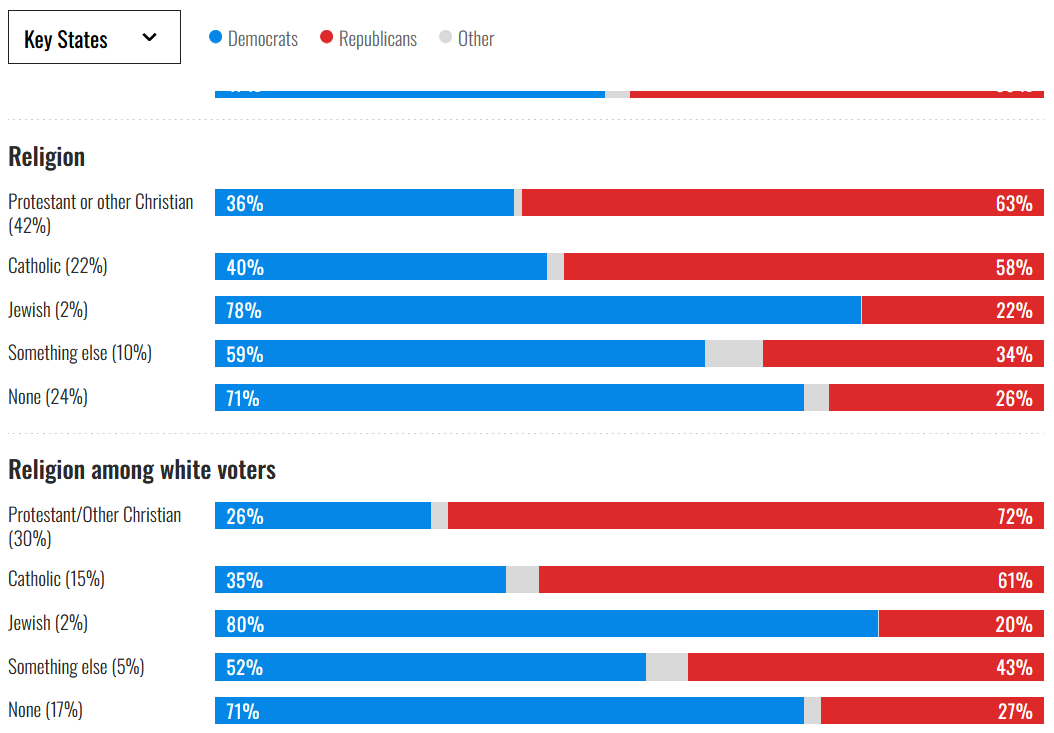
Polls from PBS NewsHour, 2024.

 Why is migration so controversial? Shouldn’t people be allowed to migrate safely?

The answer lies in white supremacy and ‘tax dollars.’

At a 1983 Conservative Party conference, former UK Prime Minister Margaret Thatcher famously said, “If the State wishes to spend more, it can do so only by borrowing your savings or by taxing you more. It is no good thinking that someone else will pay—that ‘someone else’ is you. There is no such thing as public money; there is only taxpayers’ money.” Like many politicians, Thatcher propagated the notion that government spending relies on taxpayers’ money, placing the burden of spending on individuals.

Similar sentiments are not uncommon in the United States. Former Republican governor of Wisconsin, Scott Walker, featured this tagline in his 2018 campaign targeting his opponent: “Tony Evers: Special treatment for illegals, higher taxes for you.” Donald Trump continues to campaign on anti-immigration policies to appeal to Americans who feel skeptical about their tax dollars going to immigrant welcoming programs. Trump’s campaign website highlights “20 Core Campaign Promises to Make America Great Again,” two of which focus on blocking immigration, including the first promise: “Seal the border and stop the migrant invasion.” These arguments are used to justify relatively small government investment in important services that benefit communities of color and immigrants by suggesting they would be an imposition on the ‘taxpayer.’

To understand the historical use of the term ‘tax dollars,’ Camille Walsh analyzed hundreds of letters defending racial segregation addressed to the Supreme Court in the years following the ruling in Brown v. Board of Education (1954). One-third of the letters consisted of some language about taxes, taxpayers, or having “paid” for public schools, implying the right to decide whether to keep them segregated. The American ‘taxpayer’ historically represents white individuals, and such language “obscured class divisions among whites and elevated those racialized groups presumed to have higher taxable income to a higher position in claiming citizenship rights.” White individuals like Aura Lee (1956), argued that “poor white taxpayers are entitled to enjoy some all-white places, if they so desire.”

As the term ‘taxpayer’ is historically associated with whiteness, it is used to justify the entitlement of resources concentrated in white communities. Meanwhile, the ‘nontaxpayer’ is meant to symbolize Black and Brown individuals who are perceived not to have “earned” their rights. While this argument is used to exclude people of color from resources, historian James Anderson finds that taxes from predominantly Black communities were at least as much during the time of the Brown ruling, and often higher than those of white neighborhoods. These taxes were often distributed by white school boards into all-white schools prior to Brown. This does not account for today’s common tax evasion of the nation’s wealthiest individuals and corporations. The Treasury Department estimates that there is a $160 billion gap between what the wealthiest 1% of the population should pay and what they actually pay.

Seventy years after the ruling in Brown v. Board of Education, politicians, citizens, and the media hold ‘taxpayer dollars’ to be sacred. Similar to the discussions surrounding racial integration in the mid-20th century, immigration represents a battle between the ‘taxpayer,’ or white American, and the ‘nontaxpayer,’ or immigrant. Just as white parents feared sending their children to integrated schools with “much lower standards and run-down facilities than the ones that [they] helped pay for,” many white Americans do not want immigrants to have access to vital resources and fear the use of their dollars on government spending.

Nevertheless, between sales taxes and property taxes, undocumented immigrants pay billions of dollars in taxes each year. Not only are immigrants taxpayers, but they pay taxes at higher rates than the richest Americans and get less in return. Taxpayer rhetoric is another weapon of othering by separating white U.S.-born individuals from Black and Brown immigrants, regardless of who pays their taxes.

Graph from the American Immigration Council (2016).

A quote from former Chair of the U.S. Federal Reserve Alan Greenspan counters concerns about government spending causing a deficit, stating: “There is nothing to prevent the government from creating as much money as it wants.” Similar to banks not lending out depositors’ money, government spending does not use tax dollars for spending. To illustrate this, the U.S. government spent trillions on wars post-9/11 and hundreds of billions to bail out banks in 2008, neither of which were framed as a tax dollar problem. Despite the framing of funding essential services as an attack on individual taxpayers, in reality, it falls within the bounds of federal government spending.

International law considers migration to be a universal right. Immigration control “is a relatively recent invention of states,” according to Vincent Chetail, a professor of international law. The U.S. has a duty to protect the rights of all people and not discriminate based on race, national origin, religion, or any other group category according to the 14th Amendment, and many international treaties it is a party to.

Research indicates that government investments in immigrants have a higher return over time. For example, more educated immigrants earn more and, therefore, pay more in taxes. Fiscal concerns are not based on reality, as immigrants are net contributors to the federal budget. ‘Tax dollars’ are simply a code for white dollars to instill fear and discrimination against vulnerable populations, despite taxation realities.

Mary Capone is a researcher at the Immigration Lab at American University.  

You can republish and reprint this piece in full or in part as long as you credit the author and link to the original when possible.

2024 Elections

Myths about the Causes Behind the 2024 U.S. Presidential Election Results

By Ernesto Castañeda

November 16, 2024

I was wrong about Harris winning. Concerns about the future of democracy were mainly an issue for around 32% of those who voted for Democrats (according to NBC exit polls). The uncommitted, abstainers, and disengaged affected turnout. Both candidates were voted by a diverse electorate. As I wrote before the election, “An unintended effect of Trump’s hate speech has created a certain increase in support among some Black, Latino, and Asian voters.” This was not enough in itself for Trump to win, but it added to the lead among White voters. What I wrote about the rightward shift of the Latino vote [here, here, and here] holds true.

Cable news coverage across the board has obsessed with “immigration” and “the economy” being the main concerns of the electorate and that public opinion favors Trump to handle them. But in polls and exit polls, these were the main issues for less than half of the electorate, and they were the main issues for Republican respondents, who naturally favor Trump’s solutions in these areas.

In terms of the “economy,” members of union households voted slightly more for Democrats (53%) than non-union households (47%). The voting split was not that different across income brackets. Even if unemployment is low, and wage and economic growth rates are positive and steady, with a big improvement from 2020, still many minimum-wage earners and the lower middle class are no longer happy with the economic status quo, as I wrote here.

 The biggest errors in the 2024 election coverage have been the out-of-proportion focus on the economy and immigration as the biggest concerns of all voters when, indeed, these complaints are not fully based on reality and are mainly coming from Republican-leaning voters. But the exaggeration around immigrants did not cost Trump the election and probably reinforced his dog whistles and helped in an election against a Black female opponent. Her identity was my major question here about whether Nikki Haley supporters, independents, and enough White men without a college education could vote and actively campaign for Harris.

The Harris campaign was strong, but its short duration meant that many voters did not feel like they knew her well enough. The campaign was careful to stick to the center and even to appeal to Republicans. As in 2016, in 2024, more White women supported Trump than the female candidate. In some states, they voted for Trump and still voted for some protections for abortion in certain cases.

Trump did not win because of the politicization of immigration. One reason for this is that only in a few polls did “immigration” rank as the main concern for over 50% of likely voters. Only a minority said they would vote for a presidential candidate solely on that issue. Those who did were over 70% Republican across polls. There was a similar dynamic regarding “economics.” It was misleading, both during the campaign and after the election, to assert that the primary concerns of the electorate are the economy and immigration. For example, an exit poll from ten key states conducted by NBC shows that only 11% of the electorate saw immigration as the issue that “mattered most” for their vote (when given only five possible issues), and of those voters, 90% of them were Republican.

A different response to that poll sheds further light on the polarization along party lines regarding immigration policy: 75% of Democrats (and 56% of respondents overall) support offering a chance for undocumented immigrants to apply for legal status. In contrast, 87% of Republicans (40% of respondents overall) favor deportation.

Immigration is not the weakness for Democrats that many make it to be. Still, the Harris campaign was hesitant to discuss immigration or border issues in detail. This is largely due to the narrative among mainstream media pundits and consultants, who believe that Trump’s “strengths” lie in the economy and immigration, as these same polls indicated that voters trusted Trump slightly more on these issues. However, this average was significantly impacted by Republican respondents, and the headlines failed to mention that respondents across party identification trusted Harris more on most other issues. Regardless of rhetoric or immigration policies presented by the Democrats (whether it was the bipartisan Senate deal or restriction on asylum seeking at the border), Trump supporters were always going to vote for Trump. As a result, the Harris campaign could have taken a stronger stance against the misinformation about immigrants that the Trump campaign consistently spread and that many others amplified.

The MAGA base cannot be swayed by facts about the issue because they use the term “immigration” as code to promote a White Christian Ethnostate. This goal was said or implied by Trump and his surrogates and is part of Project 2025. Trump’s largest base of support was White men (60%), white people who never attended college 66%), and especially White Protestants/Christians (72%). Many understood Trump to be the White Christian Nationalist Candidate on the presidential ballot.

What Does This All Mean for Immigration Scholars?

My point above indicates that we need to research immigration, racialization, and the politicization of religion in tandem. These processes are linked to each other by right-wing ideologues. Many of us look at immigration; some of us are starting to look again at the relationship between immigration policies and race, and key sociologists have coined and looked at the rise of White Christian Nationalism.

There is much misinformation about immigration trends and processes, and as a community, we have much to offer. Moderates and independents are open to learning more about immigration, and Democratic-leaning voters and spokespeople need more fact-based talking points. For this reason, Carina Cione and I recently published the book “Immigration Realities: Challenging Common Misperceptions” (Columbia University Press 2024). This work condenses years of research on immigration, making it accessible for journalists, policymakers, students, and the public who want to access social science without facing paywalls or complicated jargon.

However, to be realistic, few people read books, much less academic books. Professors are less likely to assign books than before. Thus, to reach a wider audience, we have to write accessible pieces like op-eds, blogs, and newsletters and talk to the media. I encourage all of you to do so more often. If approached, agree to share your insights. It’s important that people learn about our research findings to help shift the negative and inaccurate stereotypes about immigrants.

As we write and read books about recent immigrants, the immigrant rights movement, Dreamers, and similar topics, we tend to focus on immigrants who are left-leaning, progressive, and activists themselves. Some of us often assume that an increase in immigrants and children of immigrants would lead to a shift towards more liberal views among the electorate. This last election puts that assumption partly into question, but what does this mean for immigration studies? As we have collectively written about, immigrants adapt, acculturate, and become distinct from those in their countries of origin. Over time and across generations, many immigrants become culturally like Americans. This means that, eventually, the public opinion of immigrants tends to align with the national average and those of their neighbors and social circles. In a country where around half of the electorate leans Republican, it is likely that around half of Latinos, Asians, and other immigrant groups, particularly those in the third generation, would do the same —whether we like it or not. This is indeed evidence of integration and assimilation. Their voting patterns will increasingly be influenced by education levels, gender, geographic location, and religion, as they do for White Americans.  

Prices have gone up around the world, the working class is under large pressure, and housing is scarce. There is much conflict-driven immigration around the world. There is not a federally financed emergency shelter and welcome system in the U.S. similar to that used for refugees. The American immigration legal system is antiquated and inadequate. These are issues that must be addressed by Congress. It is hard for non-specialists to understand how all the pieces are connected, and it is easy for politicians to point to real images of lines at the border, asylum-seekers sleeping in the streets, or outside of shelters and hotels in U.S. cities to say that these human beings in need will lead to local fiscal crises. In a forthcoming report, we show how that is not the case.

To conclude, the results of this election were not determined by immigration policies or the misinformation around it. However, to animate its base with racist dog whistles, Trump vilified, scapegoated, and spread lies about immigrants and minorities. We need to combat these misconceptions. While naturalized citizens and U.S.-born Latino votes did not determine the election outcome, they were used to polarize the electorate, painting Haitians and Latino men as dangerous criminals. In response, some Latinos themselves spread hate speech as a way to pass and protect themselves.

As we have documented well in sociology, many individuals draw symbolic boundaries, try to create distinctions, and avoid racialization and exclusion by trying to pass as White or White-adjacent in response to the stigmatization of whole categorical groups. Individuals in tenuous situations understand that adopting majority opinions and beliefs may be a survival strategy. This is caused by racism. We have collectively documented cases like this for a long time. However, among the public, there is a lack of understanding (even among immigrants, their children, and grandchildren) about immigration history and the common exclusion of newcomers. New immigrant groups are often framed as unassimilable, and once they do, many descendants of those groups repeat the pattern and exclude those who come after them.

Our research is more relevant than ever as we teach our students, readers, and the public about the many positive outcomes brought about by immigration in the long term and about how immigration status does not equal morality. It is not that individuals want to be undocumented, but many find themselves in that situation amidst strong labor demand in the U.S., a lack of legal pathways for many, as well as armed conflicts, and economic and political crises abroad.

Ernesto Castañeda is a Full Professor of Sociology at American University and Director of the Immigration Lab and the Center for Latin American and Latino Studies. Among his latest books, he published with Daniel Jenks, “Reunited: Family Separation and Central American Youth Migration” (Russell Sage Foundation 2024).

A shorter version of this text was written for the newsletter of the International Migration Section of the American Sociological Association.

Kamala Will Win

This Is Why Kamala Harris Will Win

By Ernesto Castañeda

November 5, 2024

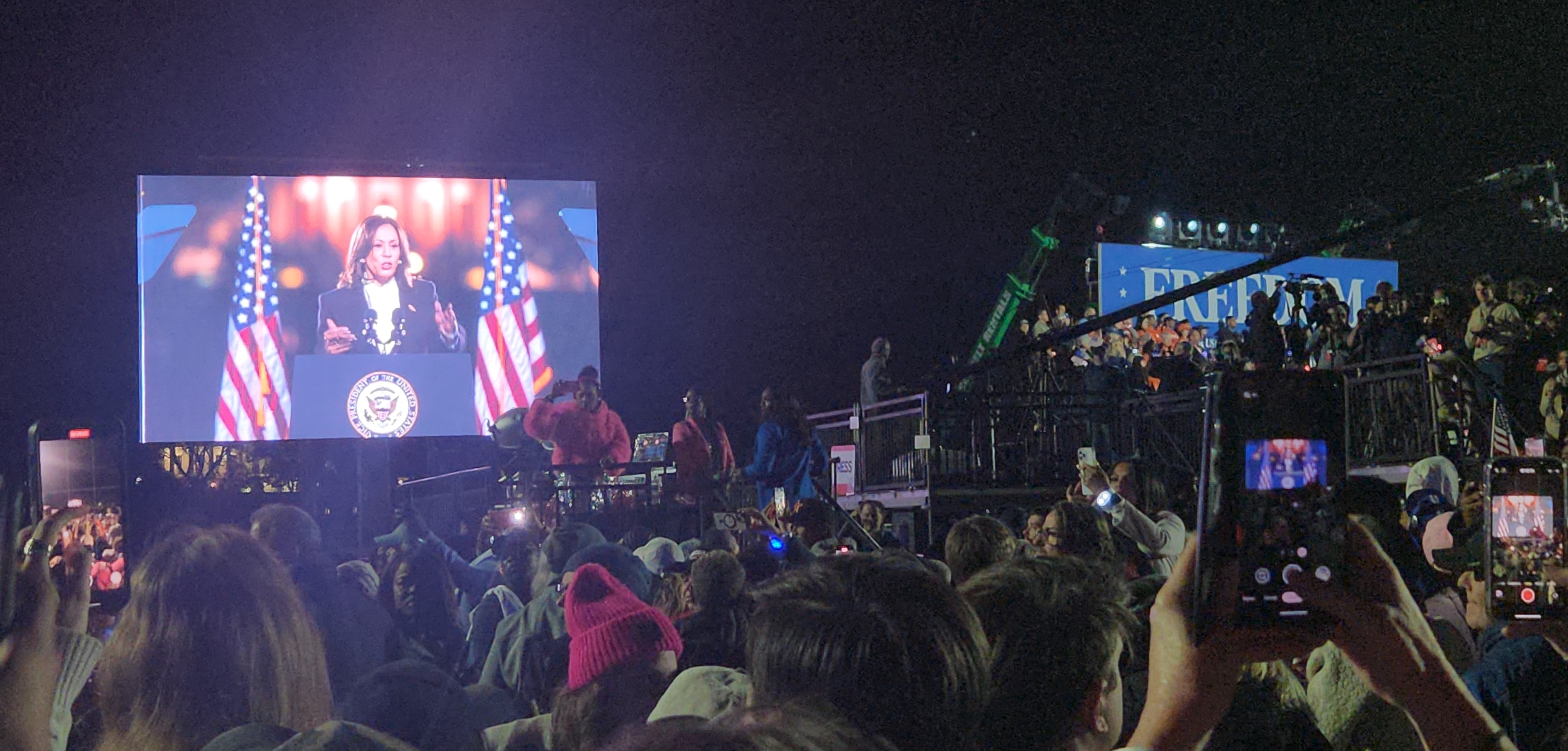
Harris at the packed DC rally in the Ellipse on October 29.

Harris at the packed DC rally in the Ellipse on October 29.

My assessment is that Kamala Harris will win the election. It is not based on the polls or the betting markers, which are not helpful given their very tight margins. Instead, Harris’ big tent, misrepresentation of the primacy of the economy and immigration in surveys, and social trends lead me to believe that Harris will win.

First of all, following the voting trends from the 2016 and 2020 presidential elections, Trump will not win the popular vote. This matters, as it determines popularity and broad appeal nationwide. Trump has never been appealing to over half of the population as a politician. While Trump was a fresh figure in politics in 2016, and there were some shy voters (given his novel strident and racist anti-immigrant comments), in 2024, he is a well-known entity, and most of his ardent followers are loud about their support, and not shy to say so to pollsters, door knockers, or people calling to get out the vote. Even so, attendance at his rallies and Trump flags outside of houses have decreased from previous cycles. Trump obsesses over crowd sizes, which was one of the indicators of his appeal in 2016. However, the infamous Madison Square Garden Trump rally on October 27 had around 19,500 people in attendance compared to around 30,000 people for Kamala Harris in Houston, Texas, on October 25, and over 75,000 at her rally in Washington, DC, on October 29.

Trump counts on a core base of around 33% of the electorate that holds strong views against immigration, complains about the economy, and will support Trump no matter what. Some more traditional Republicans will also vote for him. Nonetheless, his main campaign strategic imperative was to appeal to moderates, independents, and White suburban women to expand his margin over 50%. His 2024 campaign has not done so; he has focused on animating and mobilizing his core base. Many of his comments and those of his surrogates and supporters have alienated moderates as well as some registered Republicans. He has been more focused on discrediting the electoral process, the media, and his opponents and critics than on appealing to all voters.

In contrast, Kamala Harris has been explicitly open to conservative-leaning independents and even former Republican officeholders, including, but not limited to, Liz Cheney. Many registered Republicans, college-educated men, and many women will vote for her. That should be enough to guarantee her victory. She has done so not by compromising her beliefs and Democratic priorities but by promising to uphold the Constitution and protect democracy.

It is true that an unintended effect of Trump’s hate speech has created a certain increase in support among some Black, Latino, and Asian voters, but that will not be enough to counter the fact that a majority of women across racial and ethnic groups will vote for Kamala Harris as will many men and registered Republicans and independents.

A weakness for Harris lies in the uncommitted voters because of the situation in the Middle East who may vote for Jil Stein or abstain in places like Philadelphia, Pittsburgh, Milwaukee, Detroit, Dearborn, and college campuses. Trump’s election would make things worse in the Middle East, so some will reluctantly vote for Harris and then get ready to continue with their protests and demands for a ceasefire.

The media across the board has obsessed with “immigration” and “the economy” being the main concerns of the electorate and that public opinion favors Trump to handle them. But first of all, objectively, the economy is strong, and asylum-seeking at the border today is at very low levels. Second, and most importantly for elections, when one looks at the polls that are used to make these claims, these are the main issues for less than half of the electorate, and they are the main issues for Republican respondents, who naturally favor Trump’s solutions on these areas. In other words, putting the bulk of the Republican agenda around closing the border is not enough to gain a majority of voters nationwide or even in most swing states. The urban legend about immigrants eating cats shows voters how exaggerated these warnings are. The common claims against immigrants are false, as my book —coming out today— Immigration Realities documents.

Many pundits, consultants, and advisors have been saying that “Harris is weak on the border.” Not only is that false, but my response has been that the immigration obsession will cost Trump the election. Mass deportations are not popular outside of MAGA circles, while a path to citizenship has large levels of support. The Madison Square Garden rally made it clear to many voters and agnostic observers that this was not about undocumented immigration but about creating a White Christian Ethnostate.

There are even some indications (like the exit polls in the Republican primaries in Ohio) that some Evangelicals and religious voters are tired of Trump supposedly representing their views and values. The majority will still vote for him, but less than in previous elections when he has been on the ballot. The same is true for rural and union members. Biden has been a strong pro-labor president. Tim Walz is more familiar with rural White voters than Vance is these days. The majority will vote Republican, but many will vote Democrat. Harris is endorsed by both Liz Cheney and Bernie Sanders. Her appeal and favorability are wide, and she could create an even wider base of support than Obama.

Democratic institutions, freedom of the press, and many other values and institutions are on the line. This is the first election where Trump is on the ballot after January 6, 2021, and the many trials against him. He will not lose all his supporters, but he will lose some.

Recent local and midterm elections have shown that the across-the-board restrictions on abortion and emergency care while pregnant are large motivators to drive women and men to the polls to repeal these propositions and to vote for Democrats. In 2016, most White women supported Trump and not Hilary Clinton. This may be different this time because of the end of Roe vs. Wade. This would be crucial because women are the majority of likely voters, and they were more active in early voting.

Established Latinos of Puerto Rican, Mexican, and South American origin in Pennsylvania, Nevada, Arizona, Georgia, and New York will make important contributions to the Democratic vote. I predict that many women and new citizens of immigrant origin and some who did not vote in previous elections because of age or lack of interest (thus often not in pollster models of likely voters) will turn out to vote for Harris.

All along, the expectations have been set very highly for Harris, and she has excelled at each challenge, including securing the nomination uncontested, choosing a strong VP candidate,  leading the RNC, speaking at rallies, showing she can be Commander in Chief, bettering Trump at their debate, engaging with the media effectively, she can take questions from the media and answer them thoughtfully, to round it all out she can engage in retail politics with much enthusiasm and empathy.

Trump carries all the media attention and campaign resources from the RNC, and most Republicans down the ballot depend, to a large degree, on his appeal. This does not bode well for them. Furthermore, the Republican-led Congress has been one of the most ineffective in recent memory. Government shutdowns have been adverted, and there have been impactful and popular bipartisan accomplishments such as the Infrastructure Bill, the Inflation Reduction Act, the CHIPS Act, and support for Ukraine, but many Republican Congresspeople have voted against these achievements.

All these factors combined seem to indicate that Trump supporters will have a weaker showing than when he lost in 2020, even if we are not in the middle of a pandemic. Kamala Harris has benefited from a fresh, exciting, flawless campaign, drawing all the enthusiasm that had been lacking since Obama’s first presidential campaign.

To recap, the biggest errors in the 2024 election coverage have been the out-of-proportion focus on the economy and immigration as the biggest concerns of all voters when, indeed, these complaints are not fully based on reality and are mainly coming from Republican-leaning voters. Nobody likes inflation, but unemployment is low, and wage and economic growth rates are positive and steady, with a big improvement from 2020. Reproductive health and women’s rights will be more important in motivating people across party affiliations to vote for Harris and Democrats. While the polls are currently very tight, and there is noise that favors Trump (allowing him to repeat the big lie), ultimately, cold analyses of the electorate’s behavior and preferences tell us that Harris is on track to win the electoral college and with wider margins than the polls show.

Ernesto Castañeda, PhD is Director of the Center for Latin American and Latino Studies and the Immigration Lab and Professor at American University.

You can republish and reprint this piece in full or in part as long as you credit the author and link to the original when possible.

Political Piñatas

Political Piñatas: How Conservatives Use Latinos to Polarize U.S. Society

By Ernesto Castañeda

November 5, 2024

Many are surprised to learn that some Latinos vote Republican. A larger percentage of Latinos voted for Trump in 2020 than in 2016. A similar percentage or even more may vote for Trump in 2024. There are many reasons for this, which are often misunderstood by the wider public. I discuss some of them here.

Latinos represent the largest minority in the U.S. at over 65 million and have gained attention as political parties vie for the so-called “Latino vote” as elections are won by tighter margins. This is particularly the case in swing states with large Latino populations. How best to describe the landscape of Latino voters’ preferences remains a question of regular debate. On the one hand, Latinos are still frequently superficially treated as a relatively uniform voting bloc —even if more “up for grabs” today with polling data suggesting gradual shifts in party affiliation. As such, Latinos are often treated as a demographic that can tip the balance in favor of a party. Nonetheless, polls and pundits necessarily flatten the real views of Latinos. This has always been a diverse group. The birth of the term Hispanic aimed to bring together Mexicans, Puerto Ricans, and Cubans around common causes. Regional differences are key; for example, in the D.C.-metro region, Latinos are diverse and majority Salvadoran; in California and Texas, they are mainly of Mexican and Central American descent; in South Florida, they are a mixture of Cuban, Venezuelan, Colombian, Nicaraguan, among others.

Many recent immigrants from Latin America and the Caribbean come escaping failed states and so-called leftist regimes. Many migrants have been directly affected by inequality in their countries of origin. Democratic erosion throughout Latin America and the Caribbean makes it hard for opposition activists and critics of these regimes. Like Eastern Europeans behind the Iron Curtain and Cubans after Castro’s takeover, many recent immigrants see themselves as forced political exiles escaping from authoritarian states that robbed them of their wealth and freedoms. Therefore, in the U.S. they are more likely to identify with ideals of individual freedom and free enterprise.

Trump has also had a polarizing effect on Latinos. Republicans have sought to exploit a process well-documented by scholars: the creation of social boundaries. Trump’s discourse encourages distinctions between “good immigrants” and “good Latinos” in contrast to undocumented “criminals.” Those immigrants with visas and legal permits, higher education levels and family incomes, lighter skin, or who align better with the U.S. geopolitical preferences tend to be more successful than those who do not have immigration papers. This creates hierarchical differences within Latinos. Many U.S.-born and legal Latino immigrants try hard to distinguish themselves from individuals and groups framed as “illegal” and “criminal” to avoid the stigma assigned to those groups.

These social processes create durable inequalities not only between Latinos and non-Latinos but also among Latinos. In public discourse, Latinos are used as proxies and piñatas to polarize Americans further. In turn, some Latinos internalize feelings of inferiority or superiority and may loudly act upon them, adding to the process of polarization. Some Latinos organize against dehumanizing language and build networks of solidarity among Latinos and with other groups. However, a numerical minority such as the White Nationalists and antisemites Nick Fuentes or Enrique Tario, leader of the Proud Boys, are not passive receivers of stigmatizing attacks but become amplifiers of hate speech in exchange for group membership as part of a sometimes-xenophobic White majority. Some who have seen fellow Latinos excluded, targeted, and stigmatized may try to pass as White by attacking other Latinos, further polarizing the country in the process and weakening democratic institutions and minority rights. For these reasons, studying the effects of polarization on Latinos and the role that Latinos have in social polarization is of national importance. 

Latinos can hardly be said to form a cohesive or predictable voting bloc. Latinos do not fit neatly into the racial categories that often orient public political debate, which can lead to simplifications of Latinos’ views. Latinos are relatively less partisan as a group. A Pew Research Center report indicates that less than half of Latinos acknowledge significant differences between political parties, with a large share agreeing that neither party effectively represents their interests. Immigration is motivated by economic success, so access to jobs and better pay are their priority. Most Latinos have papers, so immigration is not an immediate concern for most Latino individuals, but it is a theme full of an emotional load; the immigration struggles of family members are close to their hearts.

An influential narrative regarding political polarization is that the electorate has become increasingly stoked by racial tensions and grievances. In this account, race is an important source of polarization. Latinos’ views are diverse and sometimes distinct from those of other Americans and more often map with those of similar occupations and socio-economic status. The diversity within Latino communities impacts the overall political polarization dynamics in the U.S. Typical analyses of race/ethnicity as a variable in culture war-type political contests do not adequately account for the heterogeneity of Latinos as a group and for the range of variation of their political commitments. National origin, gender, religious affiliation, geographic location, educational attainment, class, media consumption, and generational experience, among others, are impactful factors in identity formation.

Latinos display greater cultural unity than political unity. Latinos are part of their local and larger national political ecosystems. Latinos, despite immigration status, have demonstrated notable unity mobilizing in response to racist anti-immigrant rhetoric from local, state, or national politicians. Research also shows that over time, anti-immigrant policies can contribute to the withdrawal of Latinos from the public sphere. But sometimes there is increased group cohesion among Latinos as a reaction to external group threats such as public hostility toward immigrants and the portrayal in the media of  Latinos as likely to be Mexican, undocumented, and lesser than. A stronger identification as Latino resulting from previous political organizing does lead to higher levels of political participation. In other cases, as Latinos become business owners, upper middle class, and part of mainstream U.S. society, they may become more politically conservative and may try to distinguish themselves from newcomers. Other successful Latinos, who are less insecure about their status, mentor and open doors for others, volunteer, and become philanthropists.

Furthermore, some Latino subgroups are more susceptible to misinformation. The choice of media varies by immigration status and age. Older first-generation Latinos often opt for more traditional media sources such as radio and T.V., and more often in Spanish. Younger Latinos, often second- or third-generation, exhibit a wider range of media consumption, mainly in English and social media. These choices create different media echo chambers, differing attitudes about the meaning of “Latino,” and varying political values even within the same family.

Ernesto Castañeda, PhD is Director of the Center for Latin American and Latino Studies and the Immigration Lab and Professor at American University.

This piece is a revised and shortened version of an unfunded research proposal written for the Carnegie Fellows Program on Polarization in November of 2023.

You can republish and reprint this piece in full or in part as long as you credit the author and link to the original when possible.

Anti-Immigrant Campaigns

Anti-Immigration Rhetoric: Winning Campaign Strategy or Coin Toss?

By Joseph Fournier and Ernesto Castaneda

October 10, 2024

With the U.S. presidential election drawing nearer, many Kamala Harris supporters fear a perceived weakness on the border “crisis” may cost her the election to Donald J. Trump. Trump has championed himself as the figurehead for tough border policy. Restricting immigration has been associated with Trump. An NBC poll showed that 89% of people who identify as conservative point to the situation at the U.S.-Mexico border as a major factor in their vote for president, while only 25% of those who identify as liberal do so, and 52% among moderates. Therefore, we are not witnessing an anti-immigrant turn in public opinion but a further polarization by political ideology.

Crosstab from CBS, YouGov poll page 23.

Trump has been capitalizing on this perceived base of support by making even more extreme comments regarding the issue, most recently employing race pseudo-science in claiming that recent migrants possess “bad genes.”

In the past, Harris and the Democrats have painted themselves in clear opposition to his cruel immigration policies, such as family separation. When on the campaign trail in 2019, Harris’s rhetoric focused on pathways to citizenship and the plight of migrants. This strategy worked as Biden and Harris defeated Trump in 2020.

There was a slight rightward shift from Harris and the DNC on immigration. This was probably in reaction to an increase in the visibility of border crossings after the pandemic.  Trump has framed these increases as a “border crisis.”

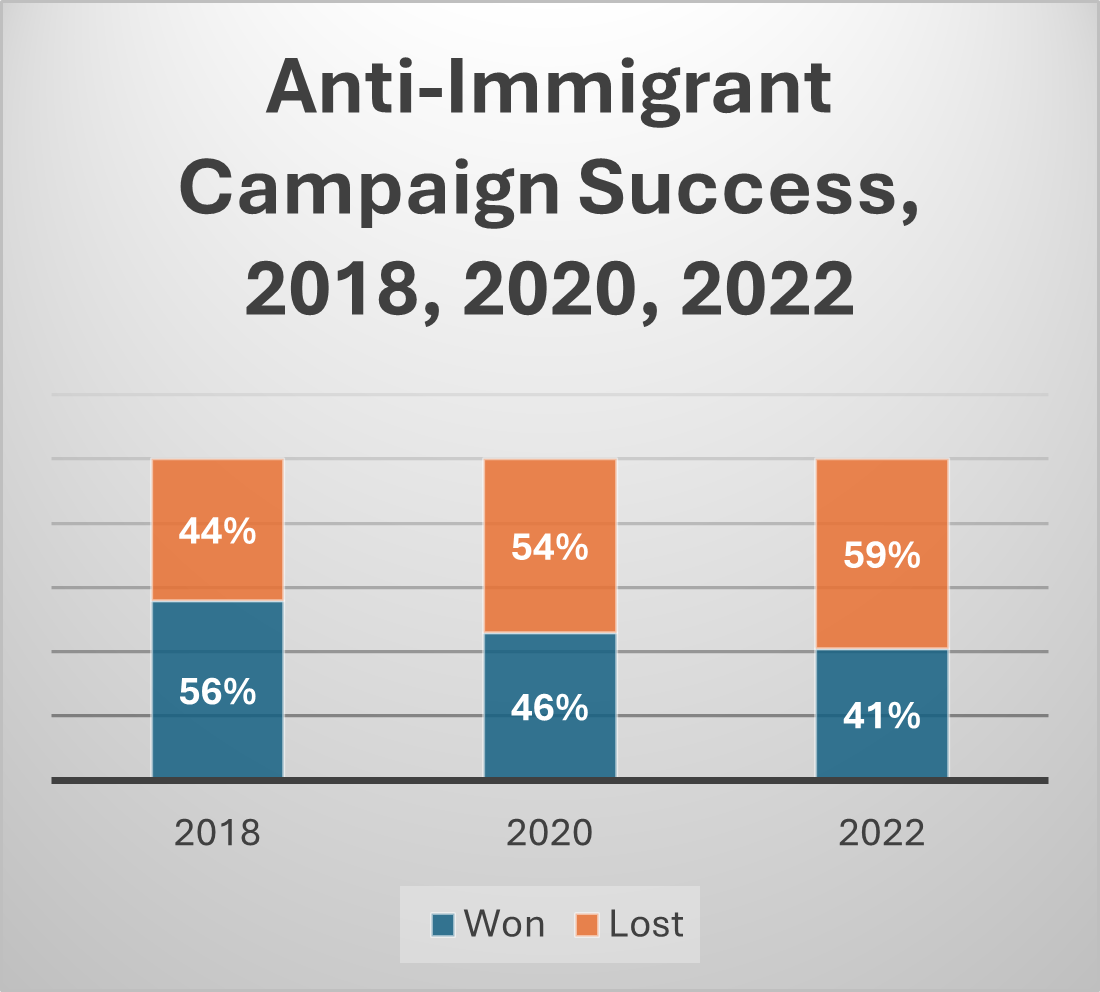
But do Democrats need to get harsher on immigration if they want to win? Data shown in Figure 1 demonstrates a phenomenon that may surprise political strategists on both sides of the aisle. Research from The Immigration Lab analyzing congressional and gubernatorial elections in 2018, 2020, and 2022 has shown that these anti-immigrant campaign victories have decreased by about 15%. This data was pulled from online campaign material from every election result with a 10% margin between the two major candidates.

Successes of anti-immigrant campaigns in competitive elections, 2018-2022 by the authors.

In 2018, businessman and former state senator Brian Kemp ran for governor in Georgia. His campaign epitomized the culture wars that the GOP included as part of their messaging strategy. Kemp styled himself as a “politically incorrect conservative” and filmed himself touting chainsaws and shotguns in service of this persona. He ended one of his ads by showcasing him in his truck, threatening to “round up criminal illegals myself.” On November 8, 2018, Kemp defeated his opponent in the closest Georgia gubernatorial race since 1966.

In 2022, Kemp ran for re-election against the same opponent. With essentially the same election conditions, Kemp’s strategy radically changed. His new primary TV ad, titled “Stronger Georgia,” listed a myriad of his accomplishments as governor. Many of his themes continued from his 2018 ads, including his support of decreased government regulation. Nonetheless, a notable point missing from his 2022 ad, however, was immigration. Kemp made no mention of the issue, making only a brief note of him “fighting human trafficking.” In softening his tone on migration, Kemp nearly tripled his margin of victory in 2022 in comparison to 2018.

Even while encounters at the border today are as low as during the pandemic when Title 42 was in effect closing the border to asylum-seekers, many think that long lines of people asking for asylum at the U.S.-Mexico border is a political liability for the Biden-Harris administration. However, when Americans in these competitive elections have shown up to the polls in the last six years, running an anti-immigrant campaign has demonstrated itself to be well short of the secure victory strategy that many seem to think it is.

Joseph Fournier is a Research Assistant at the Immigration Lab and a senior at American University.

Ernesto Castañeda is the Director of the Immigration Lab and the Center for Latin American Studies.

Uncertainty: Migrant Self-classification of Immigration Statuses

By Mackenzie Hoekstra

October 3, 2024

Starting in 2022, the Immigration Lab at American University began interviewing recent migrant and refugee arrivals to the DMV. So far, we have interviewed 181 from a variety of origins. The interviews aim to understand the experiences of refugees and migrants before, during, and after their entrance into the United States. Interviewers asked participants to reflect on their immigration journey and classify their immigration status. Self-perception, specifically individual understanding of immigration status, varied depending on the respondents’ country of origin, with particular uncertainty for migrants coming from South and Central America. Out of the fifty-nine respondents who were asked to classify their immigration status, eight were uncertain, seven of these were from El Salvador and one from Venezuela.

This broad range of understanding can be partly attributed to the higher clarity in legal definitions for refugee status and recipients of asylum or humanitarian parole versus migrants who have come without papers or who are in the middle of requesting asylum or other humanitarian relief. Refugees and asylum seekers qualify for legal residence based on proving a “well-founded fear of persecution for reasons of race, religion, nationality, political opinion or membership in a particular social group” (UNHCR). Refugees are vetted, approved, and brought to the U.S. through international refugee organizations and the U.S. government. They receive specific resettlement services and benefits through sponsoring resettlement agencies in the U.S. under the program known as Reception and Placement. These services are usually limited to the first 90 days after arrival and include necessities such as securing and setting up housing and rent assistance. Other services are provided by case managers, such as cash assistance, cultural orientations, school enrollment, benefit application assistance, employment support, and aid in navigating medical and legal services in their new communities. The goal of these services is for refugees to be economically self-sufficient as soon as possible. The number of refugees allowed in the U.S. is capped each year by the president and Congress. The current admissions cap for FY 2024 is 125,000 and 100,000 were resettled.

Asylum seekers must also prove they meet the conditions set by UNHCR but apply for asylum upon their arrival to the United States. They can apply affirmatively either at the point of entry or within a year of arriving in the U.S., or defensively once they receive notice of removal proceedings. Once granted asylum, they are known as asylees and gain access to government benefits and services similar to refugees like cash assistance and medical assistance, but do not have the same level of support as refugees do through case management. The are no numerical caps on how many asylum seekers can be granted that status but rather are decided on an individual case through immigration courts. This process can be lengthy and has a very significant backlog. According to TRAC, 1,101,819 asylum applicants currently have a pending case with U.S. immigration courts. This number translates into an average wait time of 1,424 days, a wait of almost four years for their case to be heard and decided.

For individuals who do not qualify for legal permanent residency as refugees or asylees, the definitions and processes become more complicated. Unlike for refugees and asylum seekers, there is no legal definition of a ‘migrant.’ A variety of programs/statuses exist for migrants including, but not limited to Humanitarian Parole (HP), Temporary Protected Status (TPS), work permits/visas, student visas, and green card applications, all of which have strict eligibility requirements and timelines.

Social services and benefits available to asylum seekers and migrants are limited. According to the National Immigration Forum, federal benefits such as the Supplemental Nutrition Assistance Program (SNAP), Temporary Assistance for Needy Families (TANF), Supplemental Security Income (SSI), and Medicare are not available for these immigrants. These benefits are only available to immigrants who have been granted asylum or become lawful permanent residents (LPR) and lived in the U.S. for a minimum of 5 years. Some states offer limited cash, food, and healthcare assistance, however, most of the services available are provided by local nonprofits which face similar barriers to resources and visibility. Accordingly, research shows that immigrants use less government services than the U.S.-born.

In addition to limited social benefits, legal status designations are complex to navigate, often requiring legal guidance and representation to get one’s status adjusted and obtain permanent residency. The interviews conducted by the Immigration Lab highlight this confusion and uncertainty and the need for better and more accessible resources and legal guidance for migrants.

Among respondents who did not classify themselves with a concrete immigration status in the interviews, two main groups emerged, those with some form of legal guidance and those without. Respondents without any form of legal guidance were quick to classify themselves originally as undocumented or express complete uncertainty as to their status. When prompted further during the interviews, many respondents clarified that they were uncertain about their status, not undocumented.

In other cases, individuals thought they may be out of status but in reality, they were pending a decision by migrant courts. In one instance, a respondent from a woman from Colombia stated, “Let’s say right now I don’t have status. I don’t have documentation. I am undocumented.” However, further discussion revealed that she had been processed and released by U.S. immigration and had been allowed to stay in the U.S. on legal grounds, which she did not fully understand. This response highlights how a self-classification as “undocumented” is used as a way to express initial uncertainty. While this response pattern emerged in a few cases, one example of complete uncertainty came from a Honduran male respondent. When we asked about his immigration status, he responded “What can you call it?” The interviewer then went on to explain different avenues of immigration: asylum, visa, and entry without inspection. In response, the man once again affirmed that “I don’t know…” The man explained that he was interested in getting a work permit but had no avenues through whichto obtain one. This shows that they do not know how the U.S. immigration system works, much less how to navigate it.

For those who expressed having legal guidance or representation, a theme of classifying as “in-process” was common. These respondents understood that there was a process that they were going through to get documentation but could not specifically articulate what that process was. For example, when asked to identify her immigration status, one El Salvadorian female explained that she and her family had found a lawyer to represent them. But never articulated what legal avenue was lawyer pursuing. Similarly, an El Salvadorian male expressed confusion over his next court date, not knowing when or what the court appearance was for.

In a working paper written by the American University’s Center for Latin American and Latino Studies on Newcomer Central American Immigrants’ Access to Legal Services, researchers found that less than half of Central American immigrants have access to legal services because low-income and pro bono services are hard to find. Additionally, this affordable representation often only takes on limited cases, specifically focusing on the cases that are more likely to be won in court. This has resulted in more legal referrals to private firms, and despite these firms providing high-quality services, they are very expensive. Immigrants may be tempted to work with notary generals confusing them with notarios, who in Latin America are highly influential lawyers. This creates a higher degree of fraud risk. Therefore, these Central American immigrants either avoid, don’t have access to, or cannot afford legal services. This means that they must rely on their knowledge or the knowledge of family and friends. In the context of the complex and process-oriented immigration legal system, this information is often not enough and may lead to them losing their immigration case to remain in the U.S.

The analysis of these interviews uncovered the important reality that migrants are often uncertain about their immigration status in the U.S., even when they have access to legal representation or guidance. Volunteers, legal offices that do pro-bono immigration work, and non-profits that have this as their mission are overburdened by caseloads and don’t receive enough funding and donations to expand. People come to the United States for a variety of reasons and often must take timely action to secure their legal statuses. It is crucial that theyhave access to resources that can help guide and support them through the various processes available to them, both legal and non-legal. It is not enough to ensure basic access to these resources; efforts must be made to make information about immigration statuses accessible and understandable for migrants.

Mackenzie Hoekstra is a senior majoring in Sociology at American University and a member of the Immigration Lab.

Edited by Dr. Ernesto Castañeda, CLALS, and Immigration Lab Director.

Are Digital Nomads Bringing Security to Tepito?

By Sofia Guerra

Creative Commons Licenses

Abstract:

Mexico City has seen a rise in digital nomads, individuals who work remotely while exploring low-cost international destinations. Sofia Guerra, along with a colleague, conducted fieldwork during the summer of 2024 to study this phenomenon. One finding showcased a significant increase in tourism in Tepito, one of Mexico City’s most dangerous neighborhoods. There has been an attempt to rebrand it as ‘Reforma Norte’ to mitigate its notorious reputation. Despite these efforts, Tepito residents report little to no improvement in the safety of the area, which remains heavily associated with crime and gang activity. Digital nomads generally avoid living in Tepito, visiting only its markets with local guides during the day.

Mexico City has experienced a notable increase in the number of digital nomads from around the globe. Digital nomads are individuals who can work remotely, using their flexibility to explore and reside in different countries. This lifestyle allows them to earn a living while working away from their home base. Typically, they choose destinations with a lower cost of living compared to their hometowns, which results in them earning in one currency and spending in another. This constructs economic growth by attracting investment in the area but raises local prices.

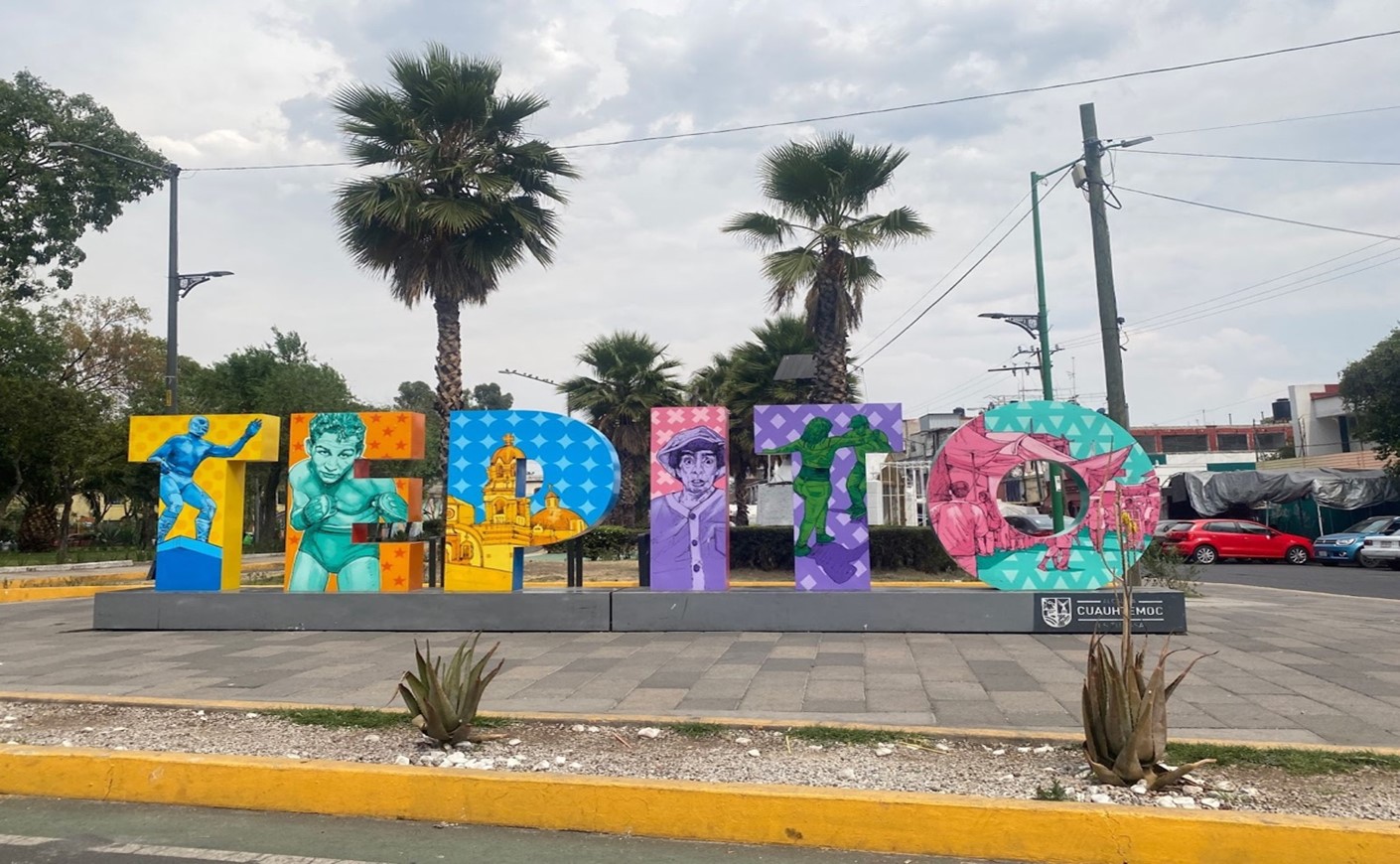
I have been studying this social phenomenon through research conducted with my colleague Montse Hernandez by interviewing locals and digital nomads to gather data. One theme that impressed us the most was that, due to gentrification, Tepito—a neighborhood known as one of the six most dangerous barrios in Mexico—is now becoming an intriguing destination for digital nomads. One of our participants even claimed that tourism led to increased security in the area. 

Being born and raised in Mexico City and always hearing about the crime surrounding Tepito, made this theme catch my attention and I decided to explore it further. Kristýna Omastová, conducted research to understand Tepito’s transformation from the 1960s to the present day. She describes how Tepito, initially known for its informal commerce, evolved into a major drug distribution hub in the heart of Mexico City. With the rise of the informal economy and growing demand for illegal goods, Tepito solidified its reputation as a place where illicit products were easily accessible. Tepito became a key center for drug distribution, and violence peaked and fell under gang control. To this day, remains a hub for drug trafficking operations, dominated by gangs like “La Unión Tepito,” which control not only the drug trade, but also other illegal activities such as extortion, kidnapping, and theft. 

So, why has Tepito become a target for digital nomads? The real estate company Grupo UBK launched a new remarketing campaign for the area, driven by the rising demand for apartments in Mexico City. Tepito is being promoted as an affordable investment opportunity, making the rent prices in the area rise. A rebranding effort has emerged, and it involves renaming it ‘Reforma Norte’ to mitigate its reputation for insecurity. It’s important to note that the buildings are not located in the heart of Tepito, but rather on the outside of the neighborhood. Some locals don’t even know that the area is now being called Reforma Norte and believe that the promotion of Reform Norte will not change or affect the prices of the heart of Tepito, although they have seen an increase in foreign-born visitors in some of the busiest market areas. This showcases that the marketing strategy has digital nomads as their target, therefore causing an increase in tourists in that area.

Although there has been an increase in foreign-born visitors in Tepito, the area is still known for delinquency, drug trafficking, and informal commerce. Digital nomads are mostly living in safer neighborhoods such as Condesa, Roma, Polanco, and Juárez. In Tepito, tourists often visit for the day and go to the markets in the heart of the barrio, usually accompanied by a tour guide or locals who know the area. This suggests that the rebranding strategy by the real estate company has led them to believe that Tepito is becoming safer, although locals from Tepito themselves do not perceive any significant changes in the Barrio Bravo safety.

Sofia Guerra is a sociology graduate student at American University. She is a research assistant at the Immigration Lab and Center of Latin American and Latino Studies at American University. She has conducted research on migration, gender studies, and the bilateral relationship between Mexico and the United States. She has an interest in policy-making, migration studies, criminology, and academia. She currently working on her research regarding migration and interpersonal violence.