The U.S. Supreme Court Immigration Rulings: Citizenship, Asylum, Metering, and TPS

By Ernesto Castañeda

American University
By Ernesto Castañeda

In recent weeks, the conservative majority in the U.S. Supreme Court has issued several rulings affecting the U.S. immigration system. One of these rulings states that people cannot seek asylum in the United States until they are physically inside U.S. territory. This has significant implications for people arriving—especially at the U.S.-Mexico border—who were requesting entry at the border wall or at ports of entry, turning themselves over to immigration agents to ask for admission with the stated goal of seeking asylum. Now, according to the Supreme Court, the U.S. government will view them as being in Mexico, and since they will largely be denied entry, they cannot apply for asylum while still outside U.S. territory. That is, the Court treated people waiting on the Mexican side of the border as not yet having entered the United States for asylum purposes. This is curious because in some cases the side of the border wall facing Mexico is already U.S. territory because clearly the U.S. cannot build on Mexican territory. Meaning that in many places, by reaching the wall, one is technically already on U.S. soil. Future suits may test this. However, given these new legal precedents, it appears the U.S. government would deny entry for the purpose of seeking asylum inside the country. This will affect many people, particularly those from Latin America and regions experiencing armed conflict or political turmoil. 

Another ruling related to what is known as “metering”—essentially a slow, controlled trickle of people allowed into U.S. territory when there is congestion of asylum seekers at the border, or when large numbers of people wish to enter the United States. It is not the first time this border-processing policy, which limits how many asylum seekers are admitted or processed at a time, has been brought up. During the pandemic—and even earlier, under programs like “Remain in Mexico”—the U.S. government stated it would only accept, say, five hundred, two hundred, or two thousand people per day across the entire border. Consequently, even though many people sought asylum, they were not immediately admitted. The U.S. government claimed this was necessary to maintain order and manage logistics—handling the entry process in a way they could manage without people sleeping on the streets or needing more hostels for migrants or overcrowded immigration detention centers. Metering was an “emergency” policy that began under Obama, continued under Trump, was paused during most of Biden’s term, though it was brought back towards the end, and continued under the Trump administration. The Supreme Court has allowed the policy to proceed into the future by lifting the lower-court block.

The third topic is Temporary Protected Status (TPS), which allows legal residence in the United States to whole groups of people from particular countries due to events like earthquakes, hurricanes, civil conflict, or other crises—as seen in Honduras, Haiti, El Salvador, and other countries—where nationals could stay in the U.S. without fear of deportation. However, the Supreme Court has now ruled that, in the case of Haitians and Syrians, this status of temporary protection can be completely revoked despite motives and the decision-making process. But the Supreme Court conservative majority went further, arguing that TPS designation is a matter that falls under executive authority, specifically the president’s power to decide whom, how, when, and for how long TPS is granted. Therefore, the decision strengthens the executive’s ability to terminate TPS designations and may affect other TPS holders. So, although the ruling did not directly address cases involving, for example, Salvadorans, it grants the president greater power to revoke TPS at will without explanation, preventing even lower courts from blocking such decisions—something they had done in recent years. 

Altogether, these decisions have many implications that make it harder for people to enter the U.S. legally or to seek asylum, and make it difficult for those already inside the country to apply for asylum, given the lengthy, difficult process, made even worse by recent procedures implemented by the second Trump administration. Now, regarding people holding TPS, deportations will begin—starting with Haitians and Syrians—but the issue likely will not stop there. People with TPS have been in the U.S. for decades, working, paying taxes, contributing to the economy and the arts. They have children born in the U.S. who are U.S. citizens under the current practice of granting birthright citizenship; soon, the Court will rule on the future of birthright citizenship, which is so common in many countries in the Americas, which started as European colonies with an important proportion of the population born from parents and ancestors born elsewhere.  

Ernesto Castañeda is a political, social, and cultural analyst. Edited by Esmeralda Alverde Duarte, Research Intern at the Immigration Lab

Changing Birthright Citizenship Would Weaken American Democracy

By Ernesto Castañeda

American University

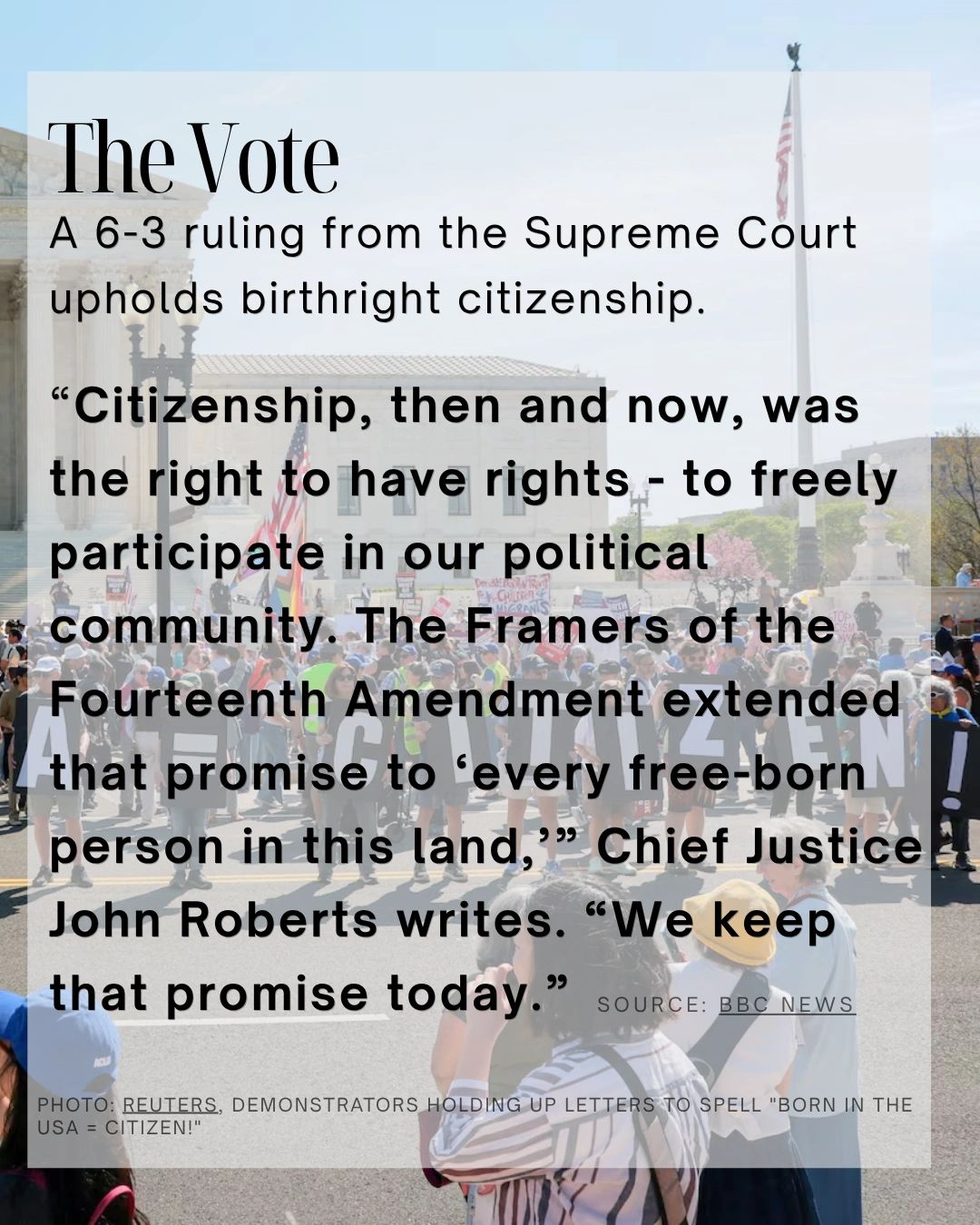
The U.S. Supreme Court will soon announce its ruling on Birthright Citizenship. If it sides with the Trump administration, it will revoke the practice of automatically obtaining citizenship by birth in U.S. territories. The outcome of this case has the potential not only to change how immigration law functions but also how citizenship is defined for everyone in the United States. Doing away with it would permanently damage the Supreme Court’s reputation.

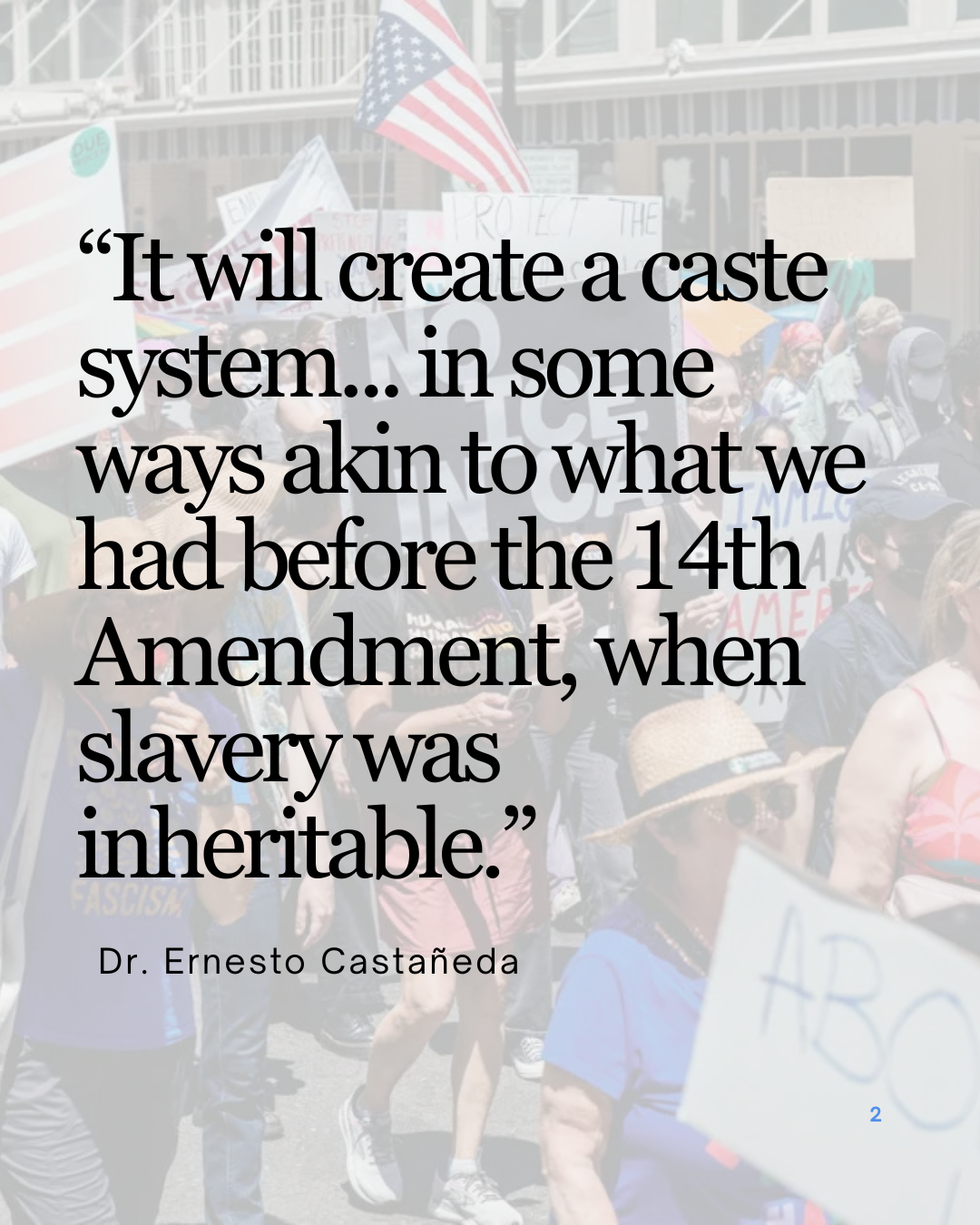
Birthright Citizenship is part of the 14th Amendment and has been a right guaranteed to anyone born within the country since 1868. The amendment was originally implemented to guarantee citizenship to formerly enslaved people and means that anyone born on American soil is an American citizen, regardless of their parents’ citizenship at birth. Slaves were not considered citizens nor had the same political rights, and their status was inherited through maternal lines and thus also affected the children slave-owners had with enslaved mothers.

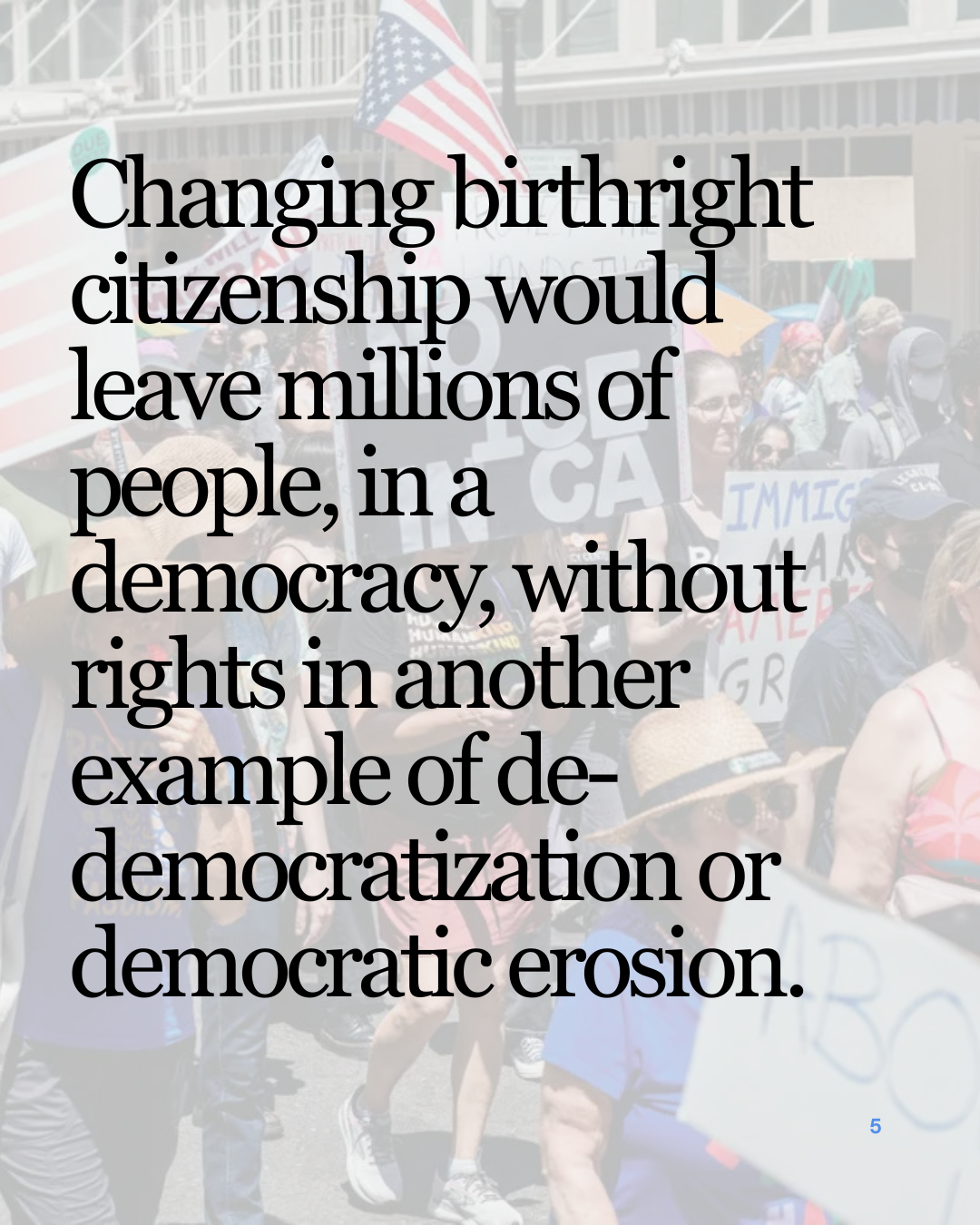
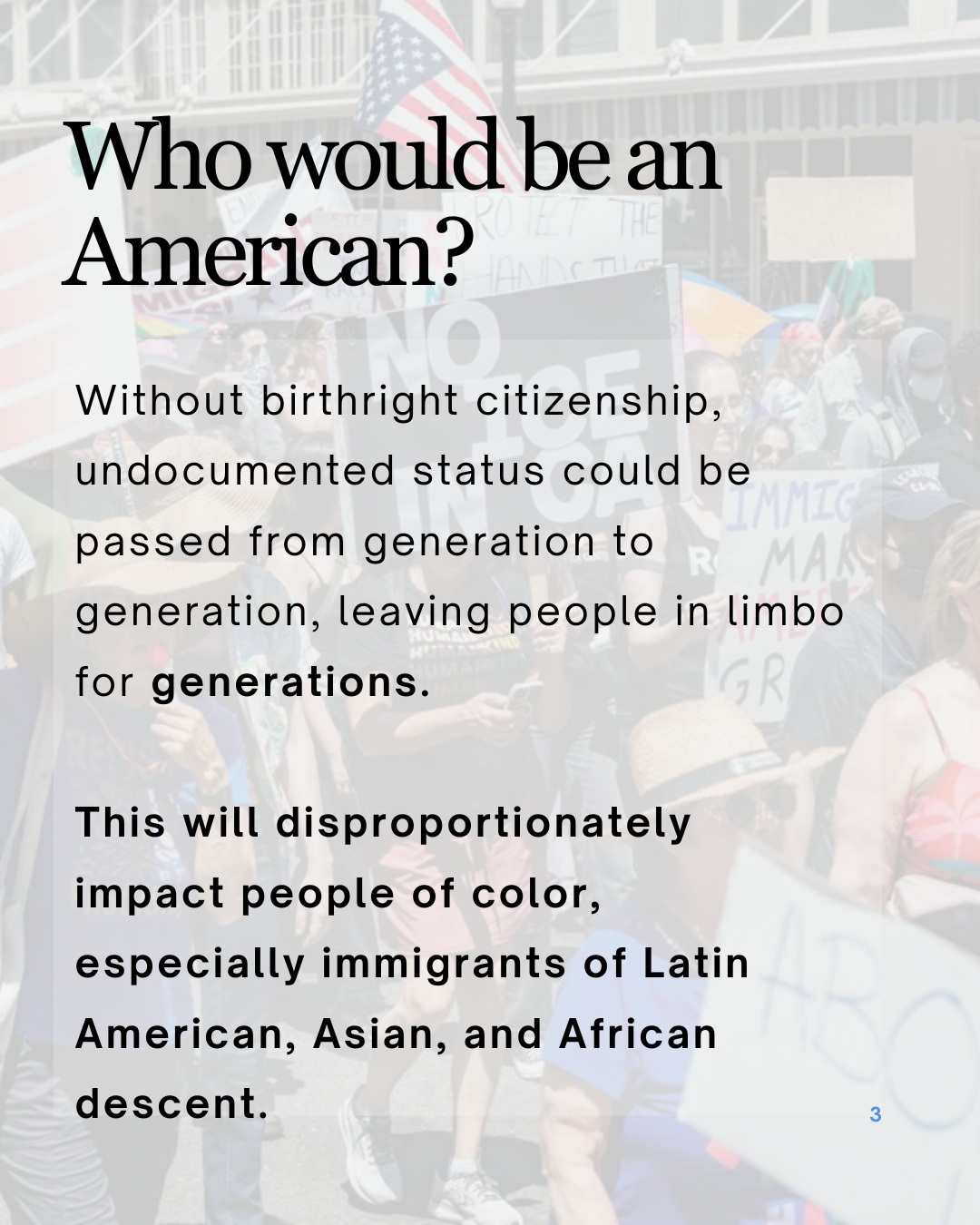
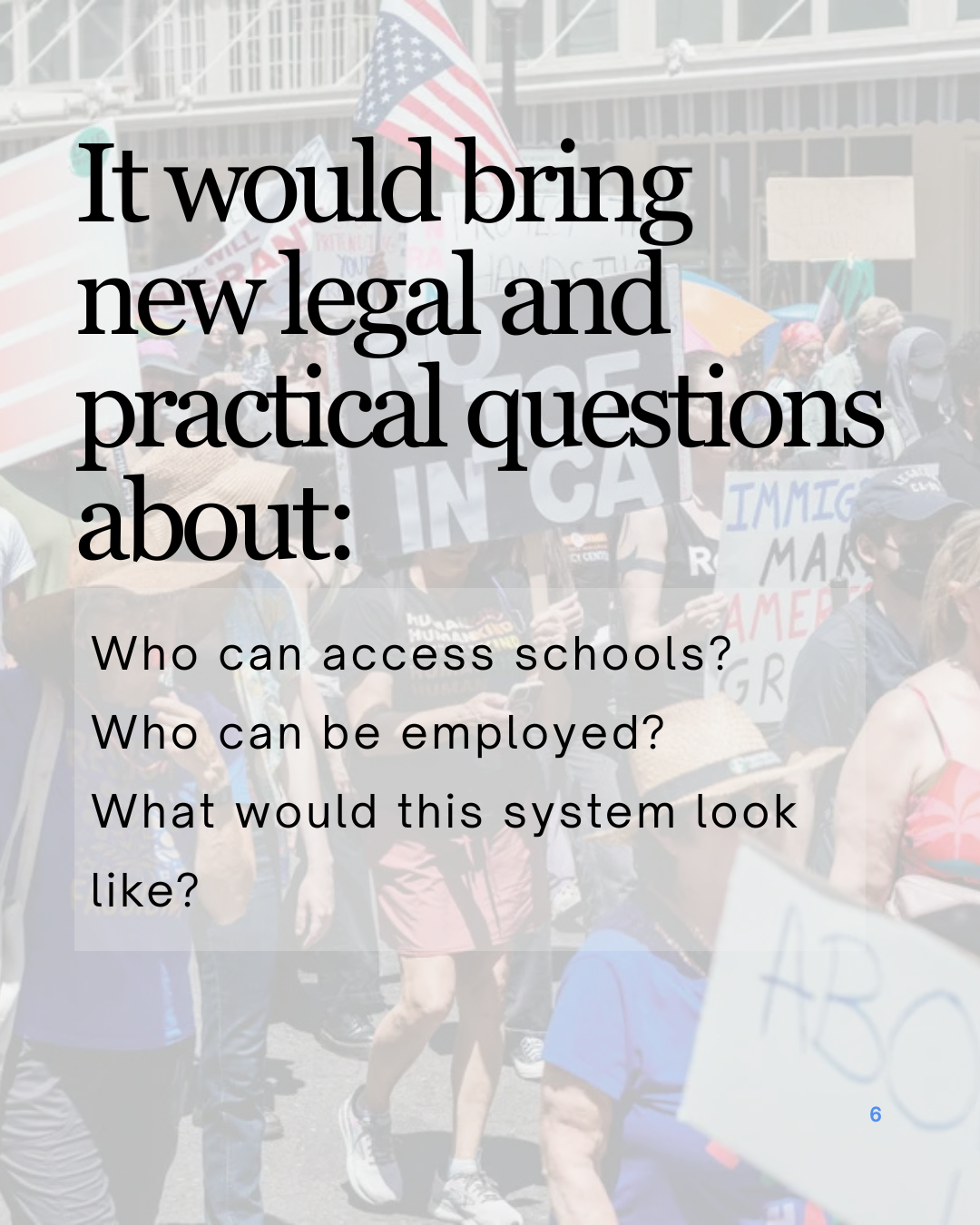
Revoking Birthright Citizenship would immediately bring into question the citizenship of hundreds of thousands of children born each year, both to citizens and to undocumented or temporary residents with permission to work and study in the United States, and not officially representing a foreign country.  It would reinstate the inheritance of status that existed during slavery, where a mother’s status, in this case, documentation, would be passed down to her children, possibly for generations. It would create a group of people in the U.S. with no rights, greatly deepening inequality and democratic erosion.

Previous court decisions have upheld Birthright Citizenship regardless of the parents’ immigration status. There is a strong precedent for birthright citizenship. Even during previous periods of immigration restriction in the US, like during the years following the Chinese Exclusion Act, the U.S.-born children of undocumented Chinese parents were American citizens. Changes to birthright citizenship would directly impact newborns from undocumented parents as well as the children of foreign workers with permission to reside in the country. Systems like this have existed before in countries like Germany, but were abandoned due to their impracticality and the enduring inequalities they created.

A small group is fighting to end birthright citizenship. Most Americans do not have a problem with birthright citizenship; 64% of Americans support it. The widespread impact of ending birthright citizenship would be felt not just by everyday people but also by foreign-born CEOs, scientists, healthcare professionals, and, yes, agricultural and service workers. It would impact U.S. innovation for decades to come. It would deter people from immigrating and bringing new ideas and approaches to common problems. The U.S. would no longer be the main global hub of intellectual exchange and creativity that it has been for decades.

Ernesto Castañeda is a political, social, and cultural analyst.

Immigration Realities

Book Review

by Blogger Ben from ACEMAXX Analytics

It seems that the modern world is drowning in crises.

Imperialism, decolonization, violence, natural disasters, instability, and poverty have been uprooting people around the world for thousands of years.

Migration is part of human history. But “Migration” is a highly politicized theme.

Refugees are people who are facing problems and do not fundamentally pose a problem themselves.

A serious, systemic problem related to expulsion is the legacy of imperialism and current neo-colonial relations.

Ernesto Castañeda and Carina Cione: Immigration Realities – Challenging Common Misperceptions, Columbia University Press, Nov 2024.

According to the UNHCR, the real crisis is that a few countries have “a disproportionate responsibility for taking newcomers,” and not there is a relatively disproportionate number of arrivals:

Politicians and journalists speak of “immigrant and refugee crises,” but the authors explain why “we see it as a political crisis, not a crisis of migration.”

The constant production of refugee crises influences the public’s political and social views about migration.

“Migration cannot be “solved” because it is a timeless and constantly fluctuating phenomenon.”

It is an open secret that the strong opinions that people often have are based on idiosyncratic personal experiences, prejudiced views, and false assumptions spread by politicians and mainstream media.

However, the average citizen often does not have all the facts at hand to look at the topic of migration from an objective yet sensitive perspective – and cannot do so.

The authors attach great importance to summarizing academic literature to help promote public understanding of today’s international migration.

The recent book summarizes relevant research results on common myths for readers who are not familiar with contemporary migration or border studies.

In other words, the authors present the relevant scientific research, which is often closed behind paywalls, research specialization, and subject-specific jargon so that most readers find it awkward and difficult to understand. This book is clearly aimed at the general public.

Each chapter revolves around a certain misunderstanding and can be read as an independent work or together with the others. The individual chapters contain relevant and up-to-date knowledge about the realities of migration, which is presented in such a way that it is also appealing and accessible to non-professionals.

Ernesto Castañeda and Carina Cione distinguish how some rhetoric accuses, patronizes, and criminalizes refugees, which, in connection with xenophobia, stereotypes, and fear-mongering, support the myth of a crisis.

A refugee is defined as someone who has left his home country and cannot return because he has a reasonable fear of violence and/or persecution due to his identity or political conviction.

The word has two meanings: a “legal meaning” that describes a person entitled to asylum under international law, and a “colloquial meaning” that describes a person who has fled their homeland. The criteria for international recognition as a refugee are strict, and other displaced people can be wrongly referred to as refugees.Neo-colonialism under the auspices of neoliberal capitalism, for example, contributed to the fact that entire regions in Africa, Asia, and Latin America, which were first described as “the third world” and then now the “Global South,” because they were oppressed in the past and the present, and not simply because of their low national income or the degree of integration into international trade.

Every “refugee crisis” is a socially constructed term that distracts from the real problem: the high-income and imperialist countries do not take responsibility for their violent actions because they benefit from the equally violent postcolonial world order.

The current neo-colonial conditions are undoubtedly part of the neoliberal driven dismantling of the welfare state, which leads to a lack of state programs for the public and the acceptance of tax cuts for the rich.

Globalization and migration are presented as two sides of the same coin, but in reality, they are very different phenomena – economic globalization and migration are not causal since migration tendencies do not necessarily agree with trade trends: periods of expanding international trade do not always correlate with migration waves or vice versa.

The authors also clarify usual terms such as “integration, assimilation, and acculturation.” Yours truly, for example, has so far preferred the term “acclimatization” to “assimilation” and “integration.”

According to Ernesto Castañeda and Carina Cione, comprehensive integration is a social integration; it does not mean cultural assimilation to the morals of the dominant group, but rather presupposes certain negotiations, reciprocal communication, and mutual influence.

Integration is often mistakenly equated with assimilation and acculturation. However, these are different concepts.

Acculturation refers to the process of getting to know the culture of the new place of residence and the achievement of a fluid cultural language. Immigrants can acculturate while maintaining many of their native traditions and culture.

In the spirit of Ernesto Castañeda’s previous work, social integration means equality and equal opportunities while maintaining cultural differences.

Assimilation is based on intolerance towards identities that deviate from the dominant and often Eurocentric culture.

Migration is an inherent human phenomenon that is subject to changes that are influenced by local and national political, economic, and social conditions. Data relating to the overall world population does not allow the conclusion that globalization is driving migration forward.

Research refutes widespread misconceptions about immigration. In fact, only 3.5% of the world’s population live in a country other than the one in which they were born.

Worldwide, the percentage of people who change residences due to war, political or religious persecution, poverty, or lack of opportunity is not as high as ever before and is not unmanageable for host countries.

Migration is a geographical and social relocation process. Subjective affiliation also depends on the objective conditions, including the absorption capacity of the new environment and the attitude of the locals towards immigrant groups.

In the US, for example, there is still no national integration program specifically designed to support immigrant integration. Migrants are expected to go through this process alone.

In sum, “Immigration Realities” is an indispensable masterpiece of intellectual honesty.

Immigration Realities – Challenging Common Misperceptions, by Ernesto Castañeda and Carina Cione – Columbia University Press, Nov 2024.

Originally published in German in ACEMAXX-ANALYTICS’s Newsletter!