
Anti-Immigration Rhetoric: Winning Campaign Strategy or Coin Toss?
By Joseph Fournier and Ernesto Castaneda
October 10, 2024
With the U.S. presidential election drawing nearer, many Kamala Harris supporters fear a perceived weakness on the border “crisis” may cost her the election to Donald J. Trump. Trump has championed himself as the figurehead for tough border policy. Restricting immigration has been associated with Trump. An NBC poll showed that 89% of people who identify as conservative point to the situation at the U.S.-Mexico border as a major factor in their vote for president, while only 25% of those who identify as liberal do so, and 52% among moderates. Therefore, we are not witnessing an anti-immigrant turn in public opinion but a further polarization by political ideology.

Crosstab from CBS, YouGov poll page 23.
Trump has been capitalizing on this perceived base of support by making even more extreme comments regarding the issue, most recently employing race pseudo-science in claiming that recent migrants possess “bad genes.”
In the past, Harris and the Democrats have painted themselves in clear opposition to his cruel immigration policies, such as family separation. When on the campaign trail in 2019, Harris’s rhetoric focused on pathways to citizenship and the plight of migrants. This strategy worked as Biden and Harris defeated Trump in 2020.
There was a slight rightward shift from Harris and the DNC on immigration. This was probably in reaction to an increase in the visibility of border crossings after the pandemic. Trump has framed these increases as a “border crisis.”
But do Democrats need to get harsher on immigration if they want to win? Data shown in Figure 1 demonstrates a phenomenon that may surprise political strategists on both sides of the aisle. Research from The Immigration Lab analyzing congressional and gubernatorial elections in 2018, 2020, and 2022 has shown that these anti-immigrant campaign victories have decreased by about 15%. This data was pulled from online campaign material from every election result with a 10% margin between the two major candidates.
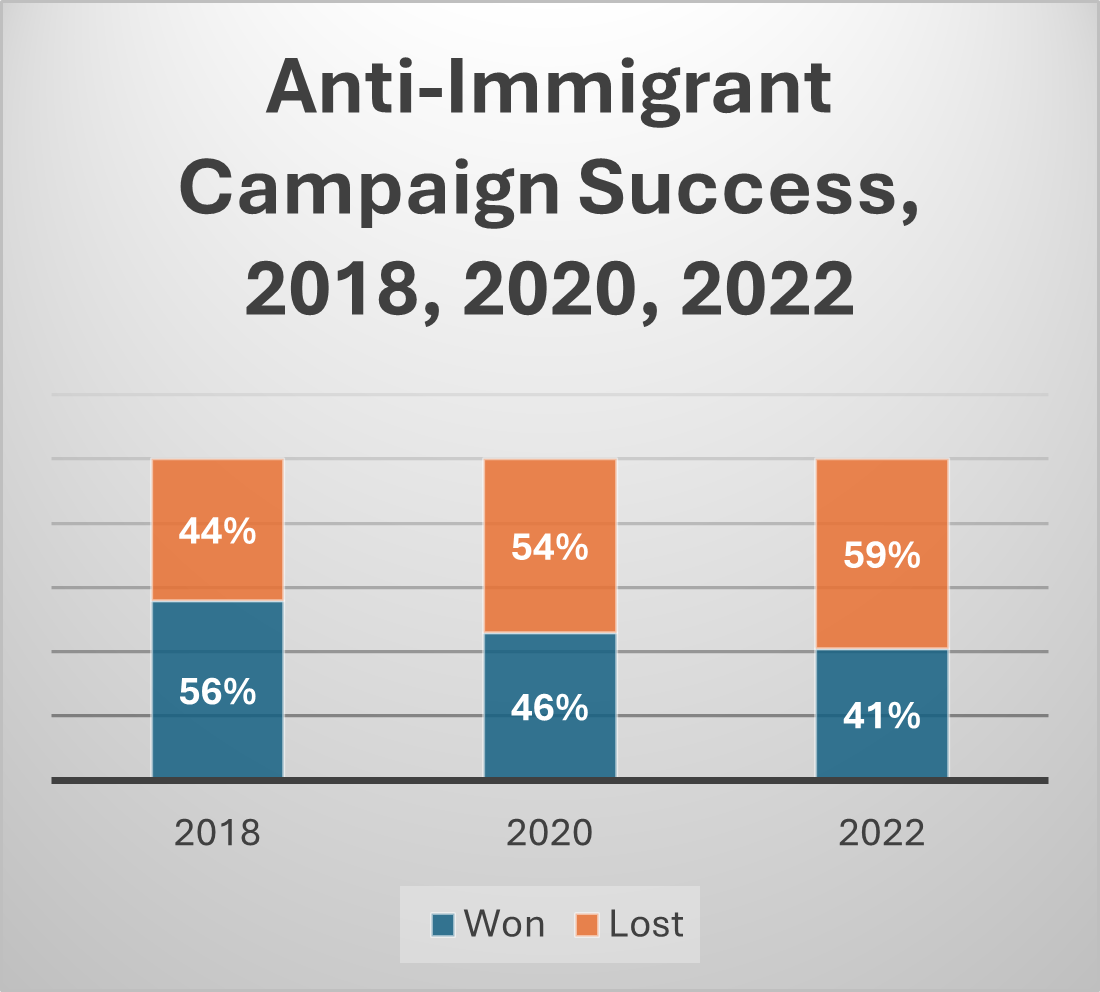
Successes of anti-immigrant campaigns in competitive elections, 2018-2022 by the authors.
In 2018, businessman and former state senator Brian Kemp ran for governor in Georgia. His campaign epitomized the culture wars that the GOP included as part of their messaging strategy. Kemp styled himself as a “politically incorrect conservative” and filmed himself touting chainsaws and shotguns in service of this persona. He ended one of his ads by showcasing him in his truck, threatening to “round up criminal illegals myself.” On November 8, 2018, Kemp defeated his opponent in the closest Georgia gubernatorial race since 1966.
In 2022, Kemp ran for re-election against the same opponent. With essentially the same election conditions, Kemp’s strategy radically changed. His new primary TV ad, titled “Stronger Georgia,” listed a myriad of his accomplishments as governor. Many of his themes continued from his 2018 ads, including his support of decreased government regulation. Nonetheless, a notable point missing from his 2022 ad, however, was immigration. Kemp made no mention of the issue, making only a brief note of him “fighting human trafficking.” In softening his tone on migration, Kemp nearly tripled his margin of victory in 2022 in comparison to 2018.
Even while encounters at the border today are as low as during the pandemic when Title 42 was in effect closing the border to asylum-seekers, many think that long lines of people asking for asylum at the U.S.-Mexico border is a political liability for the Biden-Harris administration. However, when Americans in these competitive elections have shown up to the polls in the last six years, running an anti-immigrant campaign has demonstrated itself to be well short of the secure victory strategy that many seem to think it is.
Joseph Fournier is a Research Assistant at the Immigration Lab and a senior at American University.
Ernesto Castañeda is the Director of the Immigration Lab and the Center for Latin American Studies.


