One surprising trend that emerged from the 2024 elections was New York City’s subtle shift to the right. Although the overall results of how each of the five boroughs that make up the city did not change, Trump gained 30% of the overall votes in the 2024 election as opposed to 19% in 2016. There were significant shifts in working-class neighborhoods in the Bronx and Queens. One reason for this may have been the high cost of living in New York and believing that Trump would bring prices down. Nonetheless, we must consider xenophobic messaging on both sides of the political aisle to get the full picture.
Since the initial arrival to of busses with immigrants and asylum seekers from Texas and Arizona to New York City, harmful rhetoric about them has had real-life implications. For instance, in late January 2024 reporting began surrounding an altercation which took place in Times Square between NYPD and a group of migrants. Former Police Commissioner Edward Caban responded to the incident with, “a wave of migrant crime has washed over our city.” Mayor Eric Adams described the incident as “an attack on the foundation of our symbol of safety.” Despite body cam footage released just a few days after the initial reporting, both the media and residents alike repeated the messaging purported by Eric Adams and the NYPD Residents sharing the Eric Adams administration’s belief that migrants’ presence is correlated to an increase in crime in the city is reflected in the results of May 2024 poll. Of the 974 eligible New York City voters surveyed, “over 70 percent blamed migrants in the city for the current crime rate, with 41 percent saying immigration is having a ‘significant’ impact and 31 percent saying a ‘fair amount’ of impact.”
New Yorker’s shift to the right is not limited to the presidential election. Another election result that may appear surprising to some is Republican Stephan Chan’s New York State Senate District 17 win, beating incumbent Iwen Chu. In 2020, New York State underwent a redistricting cycle, and Iwen Chu was the first representative of the newly formed district and served as representation for the growing Asian population in the area. Reporter Michael Lange described Chu’s loss as the solidification of “the Chinese Republican realignment in Southern Brooklyn.” On his campaign website, Stephan Chan emphasized being an immigrant from Hong Kong, a long time Bensonhurst resident, his law enforcement background, and his strong family ties. He also emphasizes his opposition of “wasteful spending of our tax dollars” juxtaposed to photo of himself at a protest opposing the building of a homeless shelter in Gravesend. Unsurprisingly, Chan’s opposition is not limited to homeless shelters. In a campaign ad, a supporter states, “he won’t hand out freebies to migrants while we pay the price.” This reflects not only Chan’s stance on spending on resources for migrants, but of some New Yorkers who often feel like New York City provides recently arrived migrants with services that long-time New Yorkers do not have access to.
On the national level, the growing anti-immigrant sentiment can be seen in how New York’s Congresspeople voted on the Lanken-Riley Act. This bill will allow the Department of Homeland security to detain undocumented immigrants who have been accused of burglary, theft, larceny or shoplifting. It also allows for states to sue the federal government for “decisions or alleged failures related to immigration enforcement.” Opponents of the bill are concerned about the erosion of due process for those accused of crimes and the lack of funding that is required to implement it. On January 23, 2025, the bill passed 263 to 156, with 6 out of 17 New York House members representing Downstate New York voting “Yea.” The bill was signed by President Trump on January 29, 2025.
These election results amongst other things have already caused great concern around the upcoming mayoral and gubernatorial races. Ironically, despite Adam’s law and order campaign, he is in legal trouble. Likewise, since fall 2024, New Yorkers have been left many questions. During a November 6, 2024, news conference, Eric Adams was asked about his administration’s plans to cooperate with Donald Trump’s mass deportation efforts. In reply, Adams stated “We cannot add to the anxiety and fear that people are experiencing.” The following week, Adams affirmed New York City’s sanctuary city status but stated that he believed that laws surrounding local law enforcement’s cooperation with Immigration and Customs Enforcement should be changed. Adams was also present as Trump’s inauguration and cancelled his attendance at various Martin Luther King Day celebrations to many New Yorker’s dismay. His reluctance to outright denounce Trump’s stance on immigration and recent ICE raids has caused uneasiness for immigrant advocacy groups within the city and causes further speculation that Adam’s refusal to publicly critique Trump is for his own personal gain. Democrats have long relied on New York City to keep New York State blue but shifts to the right in New York City may lead to the party losing its stronghold in the country.
Caryalyn Jean, Sociology Research and Practice MA (SORP) Student at American University
ORLANDO, Florida.- La política migratoria en Estados Unidos se encuentra en el foco de la atención tras las recientes órdenes ejecutivas firmadas por el presidente Donald Trump en los primeros días de su mandato. Entre las medidas, se encuentran restricciones temporales para refugiados, la limitación de solicitudes de asilo en la frontera y la polémica orden para negar certificados de nacimiento a hijos de padres sin estatus migratorio regular.
Estos movimientos han generado demandas en 18 estados, argumentando que violan el derecho de ciudadanía por nacimiento, protegido por la 14.ª Enmienda de la Constitución.
1. Migrante
Un migrante es cualquier persona que se traslada lejos de su lugar de origen, ya sea dentro de su país o al extranjero. Algunos se ven forzados a moverse por violencia o desastres naturales, mientras que otros migran por razones económicas o familiares. Este término incluye tanto a quienes cruzan fronteras de manera documentada como no documentada.
2. Inmigrante
El inmigrante es un migrante que se establece en un país diferente al de su nacimiento. En Estados Unidos, los inmigrantes pueden tener diferentes estatus legales, desde la residencia permanente (Green Card) hasta visas temporales, como las de trabajo (H-1B) o estudio (F-1). También hay visas humanitarias, como la T para víctimas de tráfico humano y la U para víctimas de crímenes graves.
3. Inmigrante indocumentado o irregular
Este término engloba a personas que ingresan o permanecen en un país sin autorización legal. Algunos llegaron con visas que vencieron, mientras que otros cruzaron sin documentos. En Estados Unidos muchos indocumentados trabajan y pagan impuestos, aunque no reciben beneficios de seguridad social.
4. Solicitante de asilo
Es alguien que pide protección al llegar a un puerto de entrada o dentro del país, alegando peligro en su nación de origen por persecución política, religiosa, étnica o de otro tipo. El proceso puede tomar años y requiere pruebas contundentes.
5. Refugiado
Un refugiado solicita protección desde el extranjero antes de ingresar a Estados Unidos, generalmente escapando de conflictos armados o persecución. Una vez en el país, pueden trabajar legalmente y, al cabo de un año, solicitar la residencia permanente.
6. Niños no acompañados
Se refiere a menores que cruzan la frontera sin un tutor legal. Según las leyes estadounidenses, pueden permanecer en el país y buscar estatus legal, generalmente bajo el cuidado de familiares ya residentes.
7. Separación familiar
Esta práctica polémica, intensificada durante el primer mandato de Trump, consiste en separar a padres migrantes de sus hijos al cruzar la frontera. Aunque la administración Biden intentó reunificar familias, cientos de niños aún están separados de sus padres.
8. Detención migratoria
Es la detención de inmigrantes en centros similares a cárceles, gestionados por el gobierno o empresas privadas, mientras esperan audiencias o deportaciones. Estas condiciones han sido criticadas por su dureza, incluyendo el uso de “hieleras” con temperaturas extremadamente bajas.
9. Coyote
Es el término utilizado para describir a los guías que, a cambio de dinero, ayudan a migrantes a cruzar fronteras de manera clandestina. Esta actividad se ha vuelto más costosa y peligrosa debido al endurecimiento de las políticas fronterizas.
10. Jugadores clave del gobierno
La política migratoria en EE. UU. involucra varias agencias: el Departamento de Seguridad Nacional (DHS), la Patrulla Fronteriza (CBP), Inmigración y Control de Aduanas (ICE) y el Departamento de Salud y Servicios Humanos (HHS), que asiste a menores no acompañados. Entender estos términos humaniza a las personas detrás de las estadísticas. En tiempos de políticas migratorias restrictivas, la empatía y el conocimiento son herramientas esenciales para abordar este tema con sensibilidad.
President Donald Trump aims to upend the immigration system in the United States in his first few days in office. On Jan. 20, 2025, Trump signedvarious executive ordersthat temporarily prevent refugees from coming to the U.S. and block immigrants from applying for asylum at a U.S. border, among other measures.
We arescholarsofimmigrationwho closely followpublic discussionsabout immigrationpolicy, trends and terminology. Understanding the many different immigration terms – some technical, some not – can help people better understand immigration news. While not an exhaustive list, here are 10 important terms to know:
1. Migrant
A migrant is a person who moves from their place of birth to another location relatively far away. There are different words used to describe migrants and their particular circumstances. Internally displaced people, for example, means people who are forced to move within their own country because of violence, natural disasters and other reasons.
International migrants move from one country to another, sometimes without the legal authorization to enter or stay in another country. There are also seasonal or circular migrants, who often move back and forth between different places.
Between 30% and 60% of all migrants eventually return to their birth countries.
There is not much difference in why people decide to migrate within their own country or internationally, with or without the legal permission to do so. But it is easier for people from certain countries to move than from others.
2. Immigrants
The terms immigrants and migrants are often used interchangeably. Migration indicates movement in general. Immigration is the word used to describe the process of a non-citizen settling in another country. Immigrants have a wide range of legal statuses.
An immigrant in the U.S. might have a green card or a permanent resident card – a legal authorization that gives the person the legal right to stay and work in the U.S. and to apply for citizenship after a few years.
An immigrant with a T visa is a foreigner who is allowed to stay in the U.S. for up to four years because they are victims of human or sex trafficking. Similarly, an immigrant with a U visa is the victim of serious crimes and can stay in the U.S. for up to four years, and then apply for a Green Card.
Many international students in higher education have an F-1 visa. They must return to their country of birth soon after they graduate, unless they are sponsored by a U.S. employer, enroll in another educational program, or marry a U.S. citizen. The stay can be extended for one or two years, depending on the field of study.
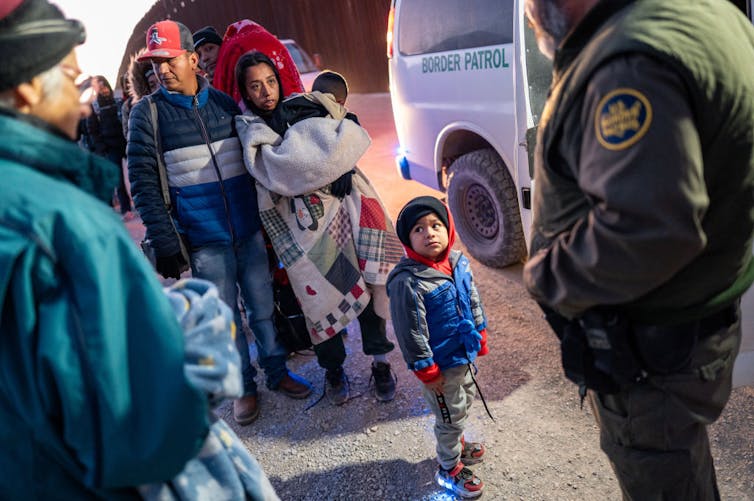
Photo cerdits to Brandon Bell/Getty Images
3. Undocumented Immigrants, Unauthorized Immigrants and Illegal Immigrants
These three charged political terms refer to the same situation: migrants who enter or remain in the country without the proper legal paperwork. People in this category also include those who come to the U.S. with a visa and overstay its permitted duration.
Some of these immigrants work for cash that is not taxed. Most work with fake Social Security numbers, pay taxes and contribute to Social Security funds without receiving money after retirement.
Immigrants without legal authorization to be in the U.S. spent more than US$254 billion in 2022.
4. Asylum Seekers
An asylum seeker is a person who arrives at a U.S. port of entry – via an airport or a border crossing – and asks for protection because they fear returning to their home country. An immigrant living in the U.S. for up to one year can also apply for asylum.
Asylum seekers can legally stay temporarily in the U.S. while they wait to bring their case to an immigration judge. The process typically takes years.
Someone is eligible for asylum if they can show proof of persecution because of their political affiliation, religion, ethnic group, minority status, or belonging to a targeted group. Many others feel they need to leave their countries because of threats of violence or abusive relationships, among other dangerous circumstances.
A judge will eventually decide whether a person’s fear is with merit and can stay in the country.
Photo cerdits to Angela Weiss/AFP via Getty Images
5. Refugees
Refugees are similar to asylum seekers, but they apply to resettle in the U.S. while they remain abroad. Refugees are often escaping conflict.
The Biden administration had a cap of admitting up to 125,000 refugees a year.
Refugees can legally work in the U.S. as soon as they arrive and can apply for a green card one year later. Research shows that refugees become self-sufficient soon after they settle in the country and are net-positive for the country’s economy through the federal taxes they pay.
6. Unaccompanied Children
This is a U.S. government classification for migrant children who enter the U.S. without a parent or guardian, and without proper documentation or the legal status to be in the country. Because they are minors, they are allowed to enter the country and apply for the right to stay. Most often, they have relatives already in the country, who assume the role of financial and legal sponsors.
7. Family Separation
This refers to a government policy of separating detained migrant parents or guardians from the children they are responsible for an traveling with as a family unit. The first Trump administration separated families arriving at the border as part of an attempt to reduce immigration.
Legal migration systems that lack avenues for immigrants who work in manual labor to move with their families, and deportations, both also create family separations.
8. Immigration Detention
Immigration detention refers to the U.S. government apprehending immigrants who are in the U.S. without authorization and holding them in centers that are run similar to prisons. Some of these centers are run by the government, and others are outsourced to private companies.
When a U.S. Customs and Border Protection official apprehends an immigrant, they are often first brought to a building where they are placed in what many call a hielera, which means icebox or freezer in Spanish. This refers to cells, cages or rooms where the government keeps immigrants at very low temperatures with foil blankets and without warm clothing.
Immigrants might then be quickly deported or otherwise released in the country while they await a court date for an asylum case. Other immigrants who are awaiting deportation or a court date will be placed in an immigration detention center. Some must post bond to be released while awaiting trial.
9. Coyote
A coyote is the Spanish word for a guide who is paid by migrants and asylum seekers to take them to their destination, undetected by law enforcement. Coyotes used to be trusted by the migrantsthey were helping cross into the country. As the U.S. has tried to make it harder to enter illegally, the business of taking people to and across the U.S.-Mexico border unseen has become more expensive and dangerous.
10. The Alphabet Soup of Government Players
The Department of Homeland Security, or DHS, is a law enforcement agency created after 9/11. It includes a number of agencies that focus on immigration.
These include U.S. Customs and Border Protection, or CBP, an agency that is in charge of collecting import duties, passport and document controls at airports, ports, and official points of entry along the border.
The Border Patrol is a federal law enforcing agency under CBP in charge of patrolling and securing U.S. borders and ports.
Immigration and Customs Enforcement, or ICE, is a branch of DHS that works within the U.S., within its borders, focusing on detaining and deporting immigrants.
by Fernando Medici, Mackenzie Presbyterian University
Photo Credit to Amauri Nehn/NurPhoto via AP
Few people outside of Brazil are likely aware that this South American country endured its own version of a Capitol attack. On January 8th, 2023 — two years after the infamous U.S. incident — a mob of supporters of former president Bolsonaro stormed government buildings, including Congress and the Supreme Court. This brazen assault on democratic institutions highlights the dangerous influence of right-wing radicalization and rampant social mediatized fake news, which continue to undermine the nation’s fragile democracy by amplifying a hate campaign against Brazil’s Supreme Court, and pleas for military intervention, while celebrating the insurrection that ended with Bolsonaro’s followers storming the Supreme Court Building.
Like its American counterpart, the unrest was fueled by unsubstantiated claims of election fraud following Bolsonaro’s defeat at the polls. However, what set Brazil’s crisis apart was the additional troubling involvement and support of several high-profile military figures.
Subsequently many of the insurgents were indicted, but until recently little had been done regarding the still unknown leadership of the movement.
That changed this past November as former President Jair Bolsonaro and 36 others were indicted by Brazil’s Federal Police for crimes including an attempted coup d’état, violent abolition of the democratic rule of law, and involvement in an alleged attempt on the lives of President Lula, Vice-President Geraldo Alckmin, and Supreme Court Minister Alexandre de Moraes.
Of course, despite the political weight of these charges, an indictment is not equivalent to a conviction and does not automatically lead to a trial. It only provides evidence for the Prosecutor General’s Office to decide whether to proceed with the case or not. This is not the first time Bolsonaro has been indicted. He was previously implicated in investigations for fraudulent vaccine records and for trying to conceal Saudi Jewelry he was gifted as president, which, according to Brazilian Law, belongs to the government. Both criminal proceedings are currently underway, and Bolsonaro is prohibited from leaving the country.
Regarding the coup d’état-related indictments, after an extensive investigation, the Brazilian Federal Police concluded that the alleged coup attempt was supposed take place in late 2022, after Bolsonaro’s election defeat and led by prominent military figures, including General and formal State-Secretary Mario Fernandes and General Braga Netto, Bolsonaro’s vice president candidate in the most recent election. According to the investigators, Bolsonaro was aware of and supported the coup efforts.
This case underscores the frail state of Brazilian Democracy after years of political radicalization and the unchecked spread of rampant fake news. In large part the proliferation of fake news has been fueled by Bolsonaro’s “Hate Cabinet”, a group led Bolsonaro’s sons Flávio and Eduardo and responsible for managing far-right social networks, the spread of misinformation, and promotion of hate campaigns against Bolsonaro’s political adversaries.
Now, Brazilians await conclusion of the legal process. Expectations are that at the soonest a possible legal action could be filed next year, since the General Prosecutor’s Office will need months to go through the evidence.
Uncertainty surrounding the legal process and the timeline for potential action reflect the broader challenges facing Brazilian institutions and democracy. While the indictments represent a significant step toward accountability, the slow pace of the justice system underscores deeper institutional challenges, exacerbating political polarization and social mistrust. It also feeds narratives of persecution and bias, particularly among Bolsonaro’s far-right supporters, who often portray the judiciary as politically motivated. The credibility of the Brazilian Supreme Court, already eroded by its controversial role in the Lava Jato operation and its perceived partisanship during past political crises, now faces renewed scrutiny. In a country already deeply divided along ideological lines, its lack of perceived impartiality risks intensifying public skepticism, further destabilizing Brazil’s fragile democratic institutions.
It is not a surprise that Bolsonaro supporters have dismissed the allegations against him as political persecution and remain entrenched in their views, further deepening political rifts in Brazilian society. When large segments of the population operate under different understandings of reality, it becomes nearly impossible to foster the trust needed for a healthy democracy.
This scenario places Brazil’s democratic institutions under considerable strain. The 2023 storming of Congress and the Supreme Court demonstrated the vulnerability of these institutions when confronted with coordinated antidemocratic efforts. Now, with claims of military involvement, the alleged coup raises serious questions about how long Brazilian democracy can continue to withstand such blows.
The problem is made worse by Bolsonaro’s hate campaign against the Supreme Court, which has eroded trust in the institution, guaranteeing that any legal decision against him will be seen by a large subset of Brazilians as corrupt and politically motivated.
If Brazilian democracy is to survive, it will require more than just the prosecution of a few individuals, even if they are high-profile. A broader effort to rebuild trust in democratic institutions and to reduce the spread of misinformation will also be necessary. Without addressing the root causes of radicalization and polarization, Brazilian Democracy will continue to be vulnerable, whether to attacks by Bolsonaro’s followers or other political groups.
This piece can be reproduced completely or partially with proper attribution to its author.
Neither Walls nor Deportations Can Stop Mobility and the Search for Asylum and Shelter
by Ernesto Castañeda
Question by Patricia Caro: Your book with Carina Cione, “Immigration Realities,”contradicts many of the ideas circulating about immigrants. Did you feel like it was time to write a book like this?
Answer by Ernesto Castañeda: Yes, the lies about migration have been going on for many years, but Trump placed immigration as the number one issue of his campaign, and he has spread many falsehoods. The public has many misunderstandings about who immigrants are, why they come, and what are the real economic, social, and cultural effects of immigration.
Q. What do you think is the stereotype about immigrants that has caused the most damage?
A. That immigrants are a threat. In many countries, people think that immigrants are taking jobs and houses from the locals. When moving to a new place, it is true that they need a job, but they also pay rent and thus generate more economic wealth. Also, as they are new, they are more likely to create innovations, start businesses, and generate more jobs for locals hiring them directly or through the goods and services they need. But that is something that is not visible to everyone, it is not immediate, and people find it very hard to imagine something they don’t see. However, research and the data clearly show that immigrants and refugees are net contributions in terms of fiscal taxes, economic output, as well as social, intellectual, culinary, and cultural contributions.
The other dangerous myth is that immigrants are a cultural threat. That, if they hear you speaking Spanish, it is because you may not speak English. But many people are bilingual. American culture can be respected and understood very well without immigrants having to forget their own culture. Teachers and administrators in public schools worry when newcomers who do not speak Spanish arrive, but young immigrants pick up English relatively quickly. So do their parents, if they have the time to learn or access to programs to help them do so. History and social science research show clearly that the children and grandchildren of immigrants are culturally indistinguishable from the locals’ descendants. We see this itself with Donald Trump. His paternal grandfather was an immigrant born in Germany, his mom was an immigrant born in Scotland and a native Gaelic speaker, and now DJT thinks he’s the most American of all.
Q. In your book, “Immigration Realities,” you argue that the border area is one of the safest places. It is surprising because the authorities denounce the insecurity of the area.
A. Yes, I was surprised, too. Northern Mexico has become dangerous in the last two decades. Many people think that the border region —on the U.S. side— is dangerous because of the immigrants who arrive, but as we did research for years for this chapter, we found that for an American citizen, especially middle-class white men, it is one of the safest places in the country. However, if you are a newly arrived immigrant, woman, LGBTQ, undocumented, of Indigenous origin, or someone who does not speak Spanish, you may indeed lose your life in the area. For an average citizen, being in El Paso, San Diego, Arizona, or any city, town, or border state, is very safe, and official data shows that crime rates are among the lowest in the United States. The immigrant who arrives at the border wall, asks for asylum, surrenders to the authorities. Those who have escaped the violence of their countries or come looking for work and try to pass through the desert without being arrested or found may indeed die trying. Nonetheless, there are no cases of someone who has committed a terrorist act within the United States who has crossed undocumented across the border with Mexico. The main concern is political violence among citizens and domestic terrorism.
Q. Is there a migration crisis or not?
A. No, no, no. The focus must be on crises abroad. There are crises in Haiti and Venezuela. An invasion of Ukraine, and a civil war ending in Syria. There are wars and tragedies in those and other countries. The displacement of Ukrainian women and children to save their own lives is a humanitarian problem but the main issue is the continued bombing of cities. Conflict-related displacement is not a permanent state. E.g., now with the fall of Assad, we are seeing that many Syrians immediately are returning home. More will do so if things get stabilized there. If Russia ended the war tomorrow, Ukrainians would look forward to returning if their houses were still standing or if they could afford to rebuild. So, it is not a migration crisis first and foremost; it is an armed conflict, it is a genocide, a civil war, a famine, or climate change, that makes people move. Some say people go to other countries because they are rich, but another way of seeing it is that rich countries are rich because they have relatively a lot of migration.
Japan and China are in relative economic decline because of population decline and too little immigration. Japan does not find a way to attract international people, because it has no tradition nor a good record of receiving immigrants. America has been very successful in turning into American people coming from around the world, something that Trump wants to change. Nevertheless, these trends and traditions are difficult to do away with. But if successful, it would be a real decline for the American economy. It is a wish of MAGA people, but if it comes true, it is not going to make America Great Again, it is going to create some of the weakest America in history.
This interview is an edited and extended translation of the interview with Patricia Caro for El País U.S. Spanish edition published here on January 1, 2025.
According to the UNHCR, the real crisis is that a few countries have “a disproportionate responsibility for taking newcomers,” and not there is a relatively disproportionate number of arrivals:
Politicians and journalists speak of “immigrant and refugeecrises,” but the authors explain why “we see it as a political crisis, not a crisis of migration.”
The constant production of refugee crises influences the public’s political and social views about migration.
“Migration cannot be “solved” because it is a timeless and constantly fluctuating phenomenon.”
It is an open secret that the strong opinions that people often have are based on idiosyncratic personal experiences, prejudiced views, and false assumptions spread by politicians and mainstream media.
However, the average citizen often does not have all the facts at hand to look at the topic of migration from an objective yet sensitive perspective – and cannot do so.
The authors attach great importance to summarizing academic literature to help promote public understanding of today’s international migration.
The recent book summarizes relevant research results on common myths for readers who are not familiar with contemporary migration or border studies.
In other words, the authors present the relevant scientific research, which is often closed behind paywalls, research specialization, and subject-specific jargon so that most readers find it awkward and difficult to understand. This book is clearly aimed at the general public.
Each chapter revolves around a certain misunderstanding and can be read as an independent work or together with the others. The individual chapters contain relevant and up-to-date knowledge about the realities of migration, which is presented in such a way that it is also appealing and accessible to non-professionals.
Ernesto Castañeda and Carina Cione distinguish how some rhetoric accuses, patronizes, and criminalizes refugees, which, in connection with xenophobia, stereotypes, and fear-mongering, support the myth of a crisis.
A refugee is defined as someone who has left his home country and cannot return because he has a reasonable fear of violence and/or persecution due to his identity or political conviction.
The word has two meanings: a “legal meaning” that describes a person entitled to asylum under international law, and a “colloquial meaning” that describes a person who has fled their homeland. The criteria for international recognition as a refugee are strict, and other displaced people can be wrongly referred to as refugees.Neo-colonialism under the auspices of neoliberal capitalism, for example, contributed to the fact that entire regions in Africa, Asia, and Latin America, which were first described as “the third world” and then now the “Global South,” because they were oppressed in the past and the present, and not simply because of their low national income or the degree of integration into international trade.
Every “refugee crisis” is a socially constructed term that distracts from the real problem: the high-income and imperialist countries do not take responsibility for their violent actions because they benefit from the equally violent postcolonial world order.
The current neo-colonial conditions are undoubtedly part of the neoliberal driven dismantling of the welfare state, which leads to a lack of state programs for the public and the acceptance of tax cuts for the rich.
Globalization and migration are presented as two sides of the same coin, but in reality, they are very different phenomena – economic globalization and migration are not causal since migration tendencies do not necessarily agree with trade trends: periods of expanding international trade do not always correlate with migration waves or vice versa.
The authors also clarify usual terms such as “integration, assimilation, and acculturation.” Yours truly, for example, has so far preferred the term “acclimatization” to “assimilation” and “integration.”
According to Ernesto Castañeda and Carina Cione, comprehensive integration is a social integration; it does not mean cultural assimilation to the morals of the dominant group, but rather presupposes certain negotiations, reciprocal communication, and mutual influence.
Integration is often mistakenly equated with assimilation and acculturation. However, these are different concepts.
Acculturation refers to the process of getting to know the culture of the new place of residence and the achievement of a fluid cultural language. Immigrants can acculturate while maintaining many of their native traditions and culture.
In the spirit of Ernesto Castañeda’s previous work, social integration means equality and equal opportunities while maintaining cultural differences.
Assimilation is based on intolerance towards identities that deviate from the dominant and often Eurocentric culture.
Migration is an inherent human phenomenon that is subject to changes that are influenced by local and national political, economic, and social conditions. Data relating to the overall world population does not allow the conclusion that globalization is driving migration forward.
Research refutes widespread misconceptions about immigration. In fact, only 3.5% of the world’s population live in a country other than the one in which they were born.
Worldwide, the percentage of people who change residences due to war, political or religious persecution, poverty, or lack of opportunity is not as high as ever before and is not unmanageable for host countries.
Migration is a geographical and social relocation process. Subjective affiliation also depends on the objective conditions, including the absorption capacity of the new environment and the attitude of the locals towards immigrant groups.
In the US, for example, there is still no national integration program specifically designed to support immigrant integration. Migrants are expected to go through this process alone.
In sum, “Immigration Realities” is an indispensable masterpiece of intellectual honesty.
Immigration Realities – Challenging Common Misperceptions, by Ernesto Castañeda and Carina Cione – Columbia University Press, Nov 2024.
Originally published in German in ACEMAXX-ANALYTICS’s Newsletter!
Donald Trump ha prometido deportar a millones de inmigrantes si es elegido para un segundo mandato, afirmando que, entre otras cosas, los trabajadores nacidos en el extranjero les quitan el trabajo a los locales. Su compañero de fórmula, JD Vance ha hecho eco de esas opiniones antiinmigrantes.
Los científicos sociales y los analistas tienden a estar de acuerdo en que la inmigración —tanto de personas documentadas como indocumentadas— estimula el crecimiento económico. Pero es casi imposible calcular directamente cuánto contribuyen los inmigrantes a la economía. Eso se debe a que no conocemos los ingresos de cada trabajador inmigrante en los Estados Unidos.
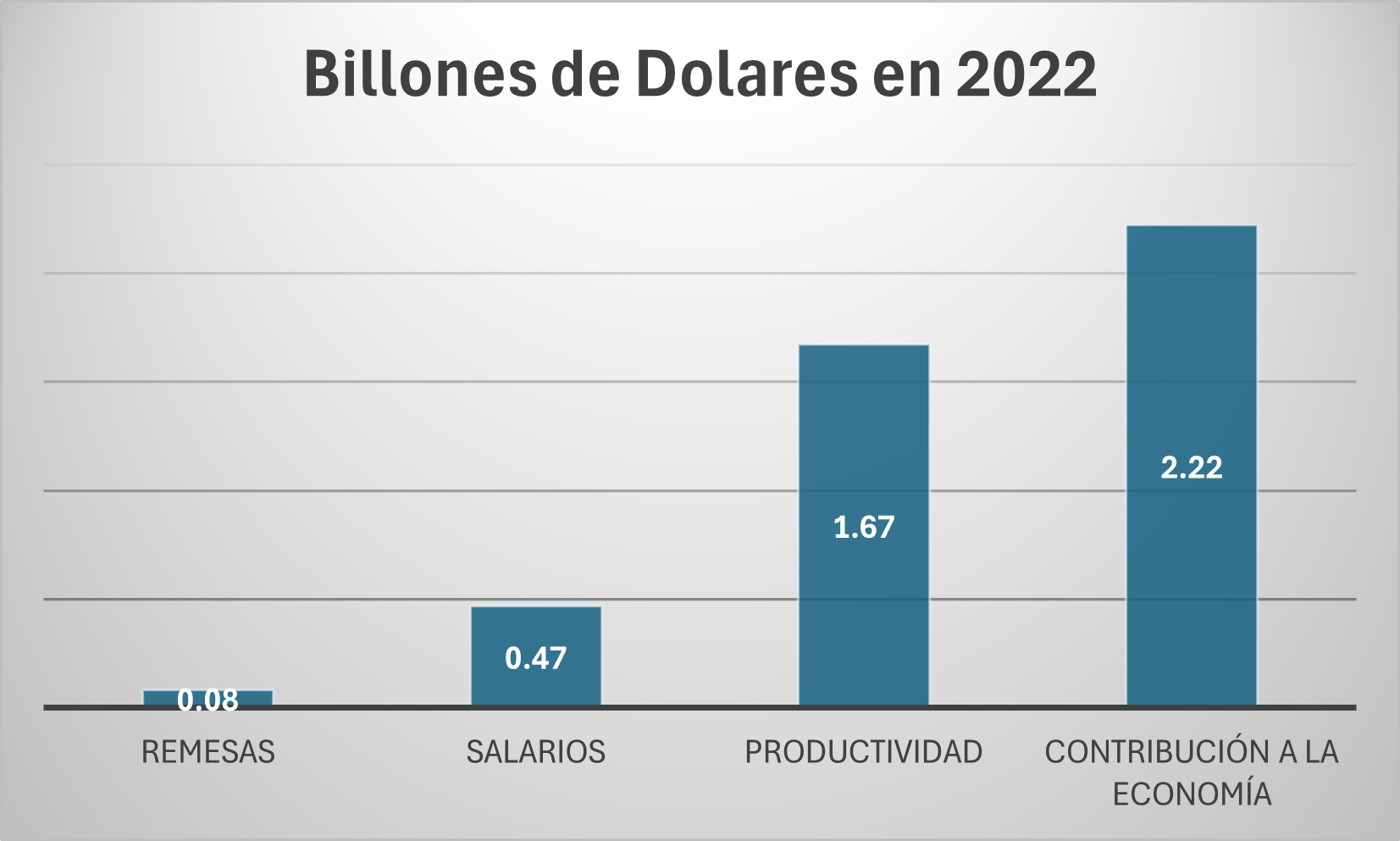
Sin embargo, tenemos una buena idea de cuánto envían a sus países de origen; más de 81 mil millones de dólares en 2022, según el Banco Mundial. Podemos utilizar esta cifra para calcular indirectamente el valor económico total que genera la mano de obra inmigrante en EE. UU.
Es probable que se subestimen las contribuciones económicas
Teniendo en cuenta eso, estimamos que los inmigrantes que enviaron remesas en 2022 tuvieron salarios netos de más de $466 mil millones. Luego, suponiendo que sus salarios netos representan alrededor del 21% del valor económico de lo que producen para las empresas donde trabajan, por ejemplo, en restaurantes y construcción, los inmigrantes agregaron un total de $2,2 billones a la economía estadounidense sólo en 2022.
Esto es aproximadamente el 8% del producto interno bruto de los Estados Unidos y cerca de todo el PIB de Canadá para 2022,la novena economía más grande del mundo.
Los Inmigrantes en Estados Unidos que mandan dinero al extranjero crean al menos $2 billones en actividad económica
Basado en cuanto dinero los inmigrantes en Estados Unidos envían al exterior en 2022, los académicos estimaron los ingresos y de allí, cuanta productividad generaron en la economía estadunidense. El estudio estimó que las contribuciones totales de los migrantes a la economía estadunidense exceden $2 billones (trillones en inglés) en 2022.
La inmigración fortalece a Estados Unidos
Más allá de su gran valor, esta cifra nos dice algo importante: los principales beneficiarios de la mano de obra inmigrante son la economía y la sociedad de Estados Unidos.
Los 81 mil millones de dólares que los inmigrantes enviaron a casa en 2022 son una pequeña fracción del valor total con el que contribuyen a la economía: 2.2 billones de dólares. La gran mayoría de los salarios y la productividad de los inmigrantes (el 96 %) se queda en Estados Unidos.
Es probable que las contribuciones económicas de los inmigrantes estadounidenses sean incluso más sustanciales de lo que calculamos.
Por un lado, la estimación del Banco Mundial sobre las remesas de inmigrantes es probablemente un recuento insuficiente, ya que muchos inmigrantes envían dinero al exterior con personas que viajan a sus países de origen.
En investigaciones previas, mis colegas y yo también hemos descubierto que algunos grupos de inmigrantes tienen menos probabilidades de enviar remesas que otros.
Uno de ellos son los profesionales de cuello blanco: inmigrantes con carreras en la banca, ciencia, tecnología y educación, por ejemplo. A diferencia de muchos inmigrantes indocumentados, los profesionales de cuello blanco generalmente tienen visas que les permiten traer a sus familias con ellos, por lo que no necesitan enviar dinero al extranjero para cubrir sus gastos domésticos. De igual forma, los inmigrantes que han estado trabajando en el país durante décadas y tienen más familiares en el país también tienden a enviar remesas con menos frecuencia. Ambos grupos tienen mayores ingresos y sus contribuciones no están incluidas en nuestra estimación de 2,2 billones de dólares.
Además, nuestras estimaciones no tienen en cuenta el crecimiento económico estimulado por los inmigrantes cuando gastan dinero en los EE. UU., creando demanda, generando empleos y empezando negocios que contratan inmigrantes y locales.
Por ejemplo, calculamos los aportes de los inmigrantes salvadoreños y solo sus hijos agregaron aproximadamente 223 mil millones de dólares a la economía de Estados Unidos en 2023. Eso es aproximadamente el 1% del PIB total del país.
Teniendo en cuenta que la economía de Estados Unidos creció alrededor de un 2% en 2022 y 2023, esa es una suma sustancial.
Las cifras qué presentamos son un recordatorio de que parte del éxito financiero de Estados Unidos depende de los inmigrantes y su trabajo.
Ernesto Castañeda es director del Centro de Estudios Latinoamericanos y Latinos y del Laboratorio sobre la Inmigración de American University.
Edgar Aguilar ayudo con la preparación, análisis y traducción.
You can republish and reprint this piece in full or in part as long as you credit the author and link to the original when possible.
A table full of vegetables including celery and carrots.
Addressing and combatting food insecurity requires a coordinated approach across all sectors, including nonprofit organizations, government agencies, and private corporations. Although these varying groups may approach the cause differently, there is a shared goal of increasing food security. This analysis was influenced by my experience working in a nonprofit addressing food insecurity as well as the United States Department of Agriculture (USDA) in the Food and Nutrition Service. My experiences gave me valuable insights into the stark differences between government and nonprofit organizations. in understanding, approaching, and solving food insecurity between government and nonprofit organizations.
The mission of the USDA Food and Nutrition Service is stated as, “To increase food security and reduce hunger in partnership with cooperating organizations by providing children and low-income people access to food, a healthy diet and nutrition education in a manner that supports American agriculture and inspires public confidence.” They administer 15 federal assistance programs including SNAP (Supplemental Nutrition Assistance Program), school meals, CACFP (Child and Adult Food Care Program), WIC (Supplemental Nutrition Assistance Program for Women, Infants, and Children), TANF (Temporary Assistance for Needy Families). My responsibilities included reviewing and editing resources that program administrators used to properly procure and serve food that aligns with the nutritional standards set by the agency. This opportunity allowed me to gain experience in the federal processes that go into the nutrition programs that serve and assist millions of Americans.
The nonprofit organization I worked with aimed their mission as, “Striving to eliminate hunger in the nation’s capital while enhancing the nutrition, health, financial stability, and overall well-being of low-income residents in the District.” Their main focuses are on D.C. resident participation in federal nutrition programs, improving public policies, and educating the public on the reality of hunger’s existence within the District. My responsibilities were increasing SNAP and WIC participation by creating relationships with residents and producing educational content. This role gave me first-hand experience with the communities directly affected by food insecurity and allowed me to see how the policy created by our government affects Americans every day.
The differences I noted between the two experiences varied, from how the meetings were conducted to how they defined activism. Within the USDA, meetings were highly structured, with a specific focus on compliance with federal regulations and guidelines. I found the weekly staff meetings to be lively, with a lot of small talk and team activities. On the contrary, the nonprofit team meetings were centered around community intervention with little to no small talk and few team connection activities. These differences were notable for me, as they showed the discrepant level of urgency in the line of work between the two sectors. This could be attributed to numerous factors, including different standards and regulations each organization is held to. Nevertheless, it shined light on the importance of nonprofit organizations supporting USDA policy.
Additionally, the difference in staffing retention and burnout between the two organizations was striking. Throughout my year at the nonprofit, I saw many team members resign from positions due to the stress and emotional toll that comes with aiding underserved communities. Furthermore, there were few to no employees who had been with the organization for over four years. In my year with the organization, I witnessed the reinstating of three different presidents and the resignation of two. Whereas in the USDA, most employees had high tenure, with some even reaching 20-25 years in the agency. This difference in retention is a common problem, in the nonprofit sector. With limited funding and resources, staff often are forced to take on responsibilities beyond their original job description, working long hours to meet deadlines, and to keep up with the needs of District residents. In the government, however, there are strict guidelines in place limiting hours worked by each employee and the duties they are permitted to perform, helping keep their retention rate high.
Beyond job loss from burnout, I also witnessed the nonprofit organization’s largest layoff period in its history. Essential positions such as communications and public relations coordinators, government affairs specialists, and others were released from the organization due to large budget cuts. Additionally, other employees were forced to take furlough days to keep their jobs afloat. In contrast, job stability within the government sector was a promising factor for prospective employees. The federal government, the largest employer in the United States, provides comprehensive benefits and job security.
Overall, both organizations play vital roles in supporting and combatting food insecurity nationwide. The government creates vital policies and budgets to support the “boots on the ground” and educational information that nonprofit organizations work tirelessly to implement. Through these experiences, I was able to see the varying factors that go into supporting our neighbors who experience food insecurity every day. Having worked at a nonprofit before the USDA allowed my work through the government to remain grounded in the experiences of those we are seeking to help. Therefore, policymakers and direct service providers should better collaborate in hopes of making these efforts more effective.
Lia Sullivan is an MA student in the Sociology and Research Program at American University.
You can republish and reprint this piece in full or in part as long as you credit the author and link to the original when possible.
Nearly half of American adults feel that immigration threatens national identity. This proportion has increased in recent years as anti-immigration sentiments have surged in politics and partisan divergence has deepened in rhetoric. The former Trump administration was highly influential in the anti-immigration movement, with much of Trump’s campaigns hinging on xenophobic policies like building a wall on the southern border and ending DACA. Such policies jeopardize the human rights of immigrants in the United States, who make up nearly 14% of the U.S. population. The Biden administration’s handling of immigration has also been criticized by 60% of Americans, indicating that the ongoing conflict over immigration is worsening.
Polls from PBS NewsHour, 2024.
Why is migration so controversial? Shouldn’t people be allowed to migrate safely?
The answer lies in white supremacy and ‘tax dollars.’
At a 1983 Conservative Party conference, former UK Prime Minister Margaret Thatcher famously said, “If the State wishes to spend more, it can do so only by borrowing your savings or by taxing you more. It is no good thinking that someone else will pay—that ‘someone else’ is you. There is no such thing as public money; there is only taxpayers’ money.” Like many politicians, Thatcher propagated the notion that government spending relies on taxpayers’ money, placing the burden of spending on individuals.
Similar sentiments are not uncommon in the United States. Former Republican governor of Wisconsin, Scott Walker, featured this tagline in his 2018 campaign targeting his opponent: “Tony Evers: Special treatment for illegals, higher taxes for you.” Donald Trump continues to campaign on anti-immigration policies to appeal to Americans who feel skeptical about their tax dollars going to immigrant welcoming programs. Trump’s campaign website highlights “20 Core Campaign Promises to Make America Great Again,” two of which focus on blocking immigration, including the first promise: “Seal the border and stop the migrant invasion.” These arguments are used to justify relatively small government investment in important services that benefit communities of color and immigrants by suggesting they would be an imposition on the ‘taxpayer.’
To understand the historical use of the term ‘tax dollars,’ Camille Walsh analyzed hundreds of letters defending racial segregation addressed to the Supreme Court in the years following the ruling in Brown v. Board of Education (1954). One-third of the letters consisted of some language about taxes, taxpayers, or having “paid” for public schools, implying the right to decide whether to keep them segregated. The American ‘taxpayer’ historically represents white individuals, and such language “obscured class divisions among whites and elevated those racialized groups presumed to have higher taxable income to a higher position in claiming citizenship rights.” White individuals like Aura Lee (1956), argued that “poor white taxpayers are entitled to enjoy some all-white places, if they so desire.”
As the term ‘taxpayer’ is historically associated with whiteness, it is used to justify the entitlement of resources concentrated in white communities. Meanwhile, the ‘nontaxpayer’ is meant to symbolize Black and Brown individuals who are perceived not to have “earned” their rights. While this argument is used to exclude people of color from resources, historian James Anderson finds that taxes from predominantly Black communities were at least as much during the time of the Brown ruling, and often higher than those of white neighborhoods. These taxes were often distributed by white school boards into all-white schools prior to Brown. This does not account for today’s common tax evasion of the nation’s wealthiest individuals and corporations. The Treasury Department estimates that there is a $160 billion gap between what the wealthiest 1% of the population should pay and what they actually pay.
Seventy years after the ruling in Brown v. Board of Education, politicians, citizens, and the media hold ‘taxpayer dollars’ to be sacred. Similar to the discussions surrounding racial integration in the mid-20th century, immigration represents a battle between the ‘taxpayer,’ or white American, and the ‘nontaxpayer,’ or immigrant. Just as white parents feared sending their children to integrated schools with “much lower standards and run-down facilities than the ones that [they] helped pay for,” many white Americans do not want immigrants to have access to vital resources and fear the use of their dollars on government spending.
Nevertheless, between sales taxes and property taxes, undocumented immigrants pay billions of dollars in taxes each year. Not only are immigrants taxpayers, but they pay taxes at higher rates than the richest Americans and get less in return. Taxpayer rhetoric is another weapon of othering by separating white U.S.-born individuals from Black and Brown immigrants, regardless of who pays their taxes.
Graph from the American Immigration Council (2016).
A quote from former Chair of the U.S. Federal Reserve Alan Greenspan counters concerns about government spending causing a deficit, stating: “There is nothing to prevent the government from creating as much money as it wants.” Similar to banks not lending out depositors’ money, government spending does not use tax dollars for spending. To illustrate this, the U.S. government spent trillions on wars post-9/11 and hundreds of billions to bail out banks in 2008, neither of which were framed as a tax dollar problem. Despite the framing of funding essential services as an attack on individual taxpayers, in reality, it falls within the bounds of federal government spending.
International law considers migration to be a universal right. Immigration control “is a relatively recent invention of states,” according to Vincent Chetail, a professor of international law. The U.S. has a duty to protect the rights of all people and not discriminate based on race, national origin, religion, or any other group category according to the 14th Amendment, and many international treaties it is a party to.
Research indicates that government investments in immigrants have a higher return over time. For example, more educated immigrants earn more and, therefore, pay more in taxes. Fiscal concerns are not based on reality, as immigrants are net contributors to the federal budget. ‘Tax dollars’ are simply a code for white dollars to instill fear and discrimination against vulnerable populations, despite taxation realities.
Mary Capone is a researcher at the Immigration Lab at American University.
You can republish and reprint this piece in full or in part as long as you credit the author and link to the original when possible.
Myths about the Causes Behind the 2024 U.S. Presidential Election Results
By Ernesto Castañeda
November 16, 2024
I was wrong about Harris winning. Concerns about the future of democracy were mainly an issue for around 32% of those who voted for Democrats (according to NBC exit polls). The uncommitted, abstainers, and disengaged affected turnout. Both candidates were voted by a diverse electorate. As I wrote before the election, “An unintended effect of Trump’s hate speech has created a certain increase in support among some Black, Latino, and Asian voters.” This was not enough in itself for Trump to win, but it added to the lead among White voters. What I wrote about the rightward shift of the Latino vote [here, here, and here] holds true.
Cable news coverage across the board has obsessed with “immigration” and “the economy” being the main concerns of the electorate and that public opinion favors Trump to handle them. But in polls and exit polls, these were the main issues for less than half of the electorate, and they were the main issues for Republican respondents, who naturally favor Trump’s solutions in these areas.
In terms of the “economy,” members of union households voted slightly more for Democrats (53%) than non-union households (47%). The voting split was not that different across income brackets. Even if unemployment is low, and wage and economic growth rates are positive and steady, with a big improvement from 2020, still many minimum-wage earners and the lower middle class are no longer happy with the economic status quo, as I wrote here.
The biggest errors in the 2024 election coverage have been the out-of-proportion focus on the economy and immigration as the biggest concerns of all voters when, indeed, these complaints are not fully based on reality and are mainly coming from Republican-leaning voters. But the exaggeration around immigrants did not cost Trump the election and probably reinforced his dog whistles and helped in an election against a Black female opponent. Her identity was my major question here about whether Nikki Haley supporters, independents, and enough White men without a college education could vote and actively campaign for Harris.
The Harris campaign was strong, but its short duration meant that many voters did not feel like they knew her well enough. The campaign was careful to stick to the center and even to appeal to Republicans. As in 2016, in 2024, more White women supported Trump than the female candidate. In some states, they voted for Trump and still voted for some protections for abortion in certain cases.
Trump did not win because of the politicization of immigration. One reason for this is that only in a few polls did “immigration” rank as the main concern for over 50% of likely voters. Only a minority said they would vote for a presidential candidate solely on that issue. Those who did were over 70% Republican across polls. There was a similar dynamic regarding “economics.” It was misleading, both during the campaign and after the election, to assert that the primary concerns of the electorate are the economy and immigration. For example, an exit poll from ten key states conducted by NBC shows that only 11% of the electorate saw immigration as the issue that “mattered most” for their vote (when given only five possible issues), and of those voters, 90% of them were Republican.
A different response to that poll sheds further light on the polarization along party lines regarding immigration policy: 75% of Democrats (and 56% of respondents overall) support offering a chance for undocumented immigrants to apply for legal status. In contrast, 87% of Republicans (40% of respondents overall) favor deportation.
Immigration is not the weakness for Democrats that many make it to be. Still, the Harris campaign was hesitant to discuss immigration or border issues in detail. This is largely due to the narrative among mainstream media pundits and consultants, who believe that Trump’s “strengths” lie in the economy and immigration, as these same polls indicated that voters trusted Trump slightly more on these issues. However, this average was significantly impacted by Republican respondents, and the headlines failed to mention that respondents across party identification trusted Harris more on most other issues. Regardless of rhetoric or immigration policies presented by the Democrats (whether it was the bipartisan Senate deal or restriction on asylum seeking at the border), Trump supporters were always going to vote for Trump. As a result, the Harris campaign could have taken a stronger stance against the misinformation about immigrants that the Trump campaign consistently spread and that many others amplified.
The MAGA base cannot be swayed by facts about the issue because they use the term “immigration” as code to promote a White Christian Ethnostate. This goal was said or implied by Trump and his surrogates and is part of Project 2025. Trump’s largest base of support was White men (60%), white people who never attended college 66%), and especially White Protestants/Christians (72%). Many understood Trump to be the White Christian Nationalist Candidate on the presidential ballot.
What Does This All Mean for Immigration Scholars?
My point above indicates that we need to research immigration, racialization, and the politicization of religion in tandem. These processes are linked to each other by right-wing ideologues. Many of us look at immigration; some of us are starting to look again at the relationship between immigration policies and race, and key sociologists have coined and looked at the rise of White Christian Nationalism.
There is much misinformation about immigration trends and processes, and as a community, we have much to offer. Moderates and independents are open to learning more about immigration, and Democratic-leaning voters and spokespeople need more fact-based talking points. For this reason, Carina Cione and I recently published the book “Immigration Realities: Challenging Common Misperceptions” (Columbia University Press 2024). This work condenses years of research on immigration, making it accessible for journalists, policymakers, students, and the public who want to access social science without facing paywalls or complicated jargon.
However, to be realistic, few people read books, much less academic books. Professors are less likely to assign books than before. Thus, to reach a wider audience, we have to write accessible pieces like op-eds, blogs, and newsletters and talk to the media. I encourage all of you to do so more often. If approached, agree to share your insights. It’s important that people learn about our research findings to help shift the negative and inaccurate stereotypes about immigrants.
As we write and read books about recent immigrants, the immigrant rights movement, Dreamers, and similar topics, we tend to focus on immigrants who are left-leaning, progressive, and activists themselves. Some of us often assume that an increase in immigrants and children of immigrants would lead to a shift towards more liberal views among the electorate. This last election puts that assumption partly into question, but what does this mean for immigration studies? As we have collectively written about, immigrants adapt, acculturate, and become distinct from those in their countries of origin. Over time and across generations, many immigrants become culturally like Americans. This means that, eventually, the public opinion of immigrants tends to align with the national average and those of their neighbors and social circles. In a country where around half of the electorate leans Republican, it is likely that around half of Latinos, Asians, and other immigrant groups, particularly those in the third generation, would do the same —whether we like it or not. This is indeed evidence of integration and assimilation. Their voting patterns will increasingly be influenced by education levels, gender, geographic location, and religion, as they do for White Americans.
Prices have gone up around the world, the working class is under large pressure, and housing is scarce. There is much conflict-driven immigration around the world. There is not a federally financed emergency shelter and welcome system in the U.S. similar to that used for refugees. The American immigration legal system is antiquated and inadequate. These are issues that must be addressed by Congress. It is hard for non-specialists to understand how all the pieces are connected, and it is easy for politicians to point to real images of lines at the border, asylum-seekers sleeping in the streets, or outside of shelters and hotels in U.S. cities to say that these human beings in need will lead to local fiscal crises. In a forthcoming report, we show how that is not the case.
To conclude, the results of this election were not determined by immigration policies or the misinformation around it. However, to animate its base with racist dog whistles, Trump vilified, scapegoated, and spread lies about immigrants and minorities. We need to combat these misconceptions. While naturalized citizens and U.S.-born Latino votes did not determine the election outcome, they were used to polarize the electorate, painting Haitians and Latino men as dangerous criminals. In response, some Latinos themselves spread hate speech as a way to pass and protect themselves.
As we have documented well in sociology, many individuals draw symbolic boundaries, try to create distinctions, and avoid racialization and exclusion by trying to pass as White or White-adjacent in response to the stigmatization of whole categorical groups. Individuals in tenuous situations understand that adopting majority opinions and beliefs may be a survival strategy. This is caused by racism. We have collectively documented cases like this for a long time. However, among the public, there is a lack of understanding (even among immigrants, their children, and grandchildren) about immigration history and the common exclusion of newcomers. New immigrant groups are often framed as unassimilable, and once they do, many descendants of those groups repeat the pattern and exclude those who come after them.
Our research is more relevant than ever as we teach our students, readers, and the public about the many positive outcomes brought about by immigration in the long term and about how immigration status does not equal morality. It is not that individuals want to be undocumented, but many find themselves in that situation amidst strong labor demand in the U.S., a lack of legal pathways for many, as well as armed conflicts, and economic and political crises abroad.
Ernesto Castañeda is a Full Professor of Sociology at American University and Director of the Immigration Lab and the Center for Latin American and Latino Studies. Among his latest books, he published with Daniel Jenks, “Reunited: Family Separation and Central American Youth Migration” (Russell Sage Foundation 2024).
A shorter version of this text was written for the newsletter of the International Migration Section of the American Sociological Association.