
Part 3: Songs of Sovereignty:

Geopolitics & International Declarations

Julia Lisco, Researcher at American University’s Center for Latin American & Latino Studies and the Immigration Lab, International Affairs Policy Analysis in Global Migration MA candidate
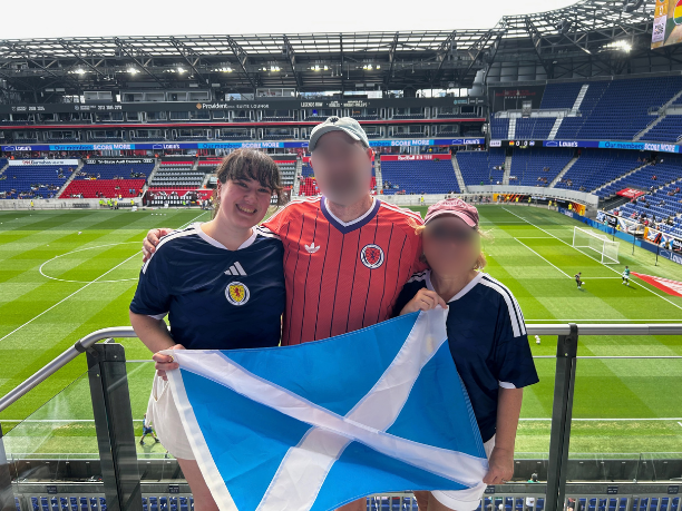
Image by Julia Lisco of her and her family in Scotland kits with a Scotland flag at the June 6th, 2026, Scotland v Bolivia FIFA World Cup 2026 warm-up game.

Singing and soccer are so deeply intertwined; they exist at the core of sports fandom. Throughout a game, crowds will sing songs, often with altered lyrics, in support of a player or to express their discontent with the actions on the field.

Occasionally, chants are politically informed, particularly at the national-team level, even at the World Cup despite FIFA’s attempts to prohibit political statements. These policies did not stop politically charged chants from ringing out among the fans after kick-off across several matches.

Australian Fans and Current Politics

Australian fans drew international ire with their chant, crafted specifically for this World Cup. Cries of “Aussie boys are on a bender, Donald Trump is a sex offender” echoed in stadiums, pubs, and across America and Canada. The chant is believed to be in reference to the President’s alleged relationship with convicted sex offender Jeffrey Epstein, and his inclusion in the Epstein Files.

Argentina and Historical Memory

Argentina is infamous for its political and anti-English chants, even when they are not playing England. In The Five-Minute Ritual, I discuss their 2026 semi-final clash, the hostility that permeated the match, and the Falklands context, but the hostility was not contained to these events.

The 1982 Falklands War is frequently referenced in Argentinian songs. One of the most famous Argentinian football chants, regardless of tournament or opponent, is “Y ya lo ve, y ya lo ve, El que no salta, Es un ingles!” (“And now you see, and now you see, whoever doesn’t jump is English!”), which is sung while fans across the stadium jump in unison.

After Argentina beat Switzerland on July 11, 2026, in the quarter-finals, videos were posted online of players singing: “Por Malvinas, por el Diego, por la ultima de Leo” (“For the Malvinas [The Falklands], for Diego [Maradona], for Leo [Messi]’s last one”) from the locker room; and in 2022, while on the hunt for the World Cup trophy, several long chants included call-outs to the war and berating the English.

This animosity is healthily returned by English fans. Enzo Fernandez, a high-profile Argentinian player, has played in England since 2023. Just after the World Cup concluded, the player completed a high-profile, €100 million transfer from FIFA Club World Cup Champions Chelsea to Manchester City, who have won the Premier League six times since the 2017-2018 season. During his debut for the club on September 5, 2026, at home against Coventry City, the crowd rang out with a new custom chant for the player. This is not unusual for new players, but generally songs are focused on the player, and not political commentary. “The Falklands are ours, the Falklands are ours. Enzo Fernandez, the Falklands are ours” was sung so loudly that it was clearly heard over the television broadcast, despite match commentators speaking over the feed.

Scotland and National Identity

Smaller and lower-ranked nations throughout the tournament repeatedly dominated the hearts and minds of fans, regardless of the proportion of fans in the stands. One of these nations, despite not progressing out of the group stage, was Scotland.

Interestingly, Scotland’s participation as an independent nation in international sports is not fully representative of its nuanced legal status. Scotland’s status is legally complex; it is an independent nation with “devolved and reserved powers,” and significant essential infrastructure is controlled by Westminster, including defense, military, border enforcement, and currency (they use British Pounds, but they do have their own Scotland-specific notes which can be used across the UK interchangeably).

Only in the Olympic Games does the United Kingdom compete as the joint entity “Team Great Britain.” Otherwise, the UK member states, including Scotland, compete as independent entities. This is due to specific regulations that grandfather them, and a few other territories, like Puerto Rico, into international competition qualification. When Scotland qualified for the World Cup for the first time since 1998, they did so as an equal to England, to whose political authority they’ve been subject for centuries.

Scotland fans were extremely excited to return to the World Cup and support their entire team against Brazil, Haiti, and Morocco. Nowhere was this passion as evident as during the playing of the national anthem. As part of the UK, Scotland does not have its own legal national anthem separate from “God Save the King”; instead, “Flower of Scotland” is the unofficial national anthem, which is sung before every Scotland game, regardless of sport. When Flower of Scotland rings out before a match, a nation with a complex international designation gets two minutes where Scottish national pride is central without the shadow of England.

Scotland never expected to win the tournament, but for those three matches, every Scotland fan around the world reveled in those few minutes. In unison, millions would profess their love for their country and their team, manifesting the love these teams carry for their fans and countrymen around the world in a display that is more than just meaningless ceremony. I did not get to experience Scotland’s World Cup campaign in person, but I did attend their final pre-tournament match against Bolivia on June 6, 2026, and I dare say few nations sing their national anthem as passionately as the “Tartan Army,” particularly one of the song’s final concluding phrases, “But we can still rise now, And be a nation again…”

With the referendum of understanding between Scotland, Northern Ireland, and Wales signed on September 14, 2026, in which each government’s First Minister confirms they will call votes for independence from Westminster’s authority, this statement may ring true sooner than most Scotland fans may have believed during the tournament.
Part 2: The Five-Minute Ritual

Anthems as Political Battlegrounds

Julia Lisco, Researcher at American University’s Center for Latin American & Latino Studies and the Immigration Lab, International Affairs Policy Analysis in Global Migration MA candidate

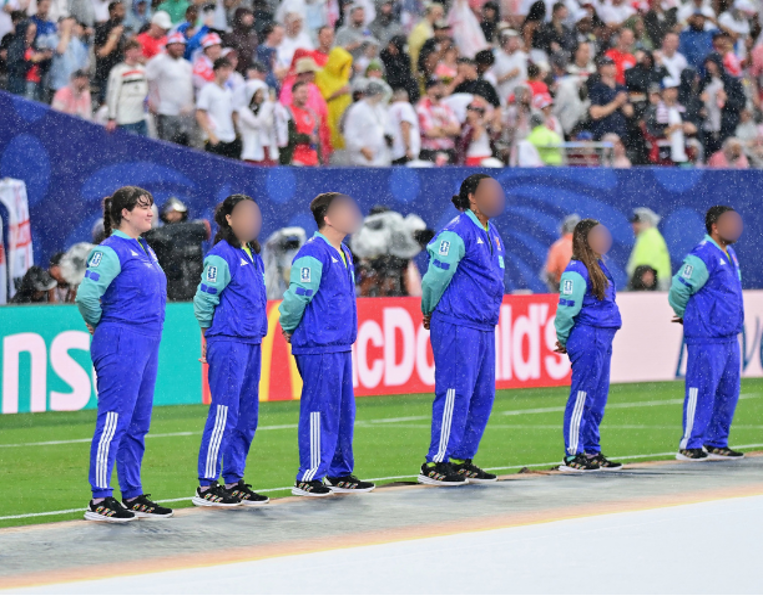
Image by Julia Lisco of her and her fellow FIFA World Cup 2026 Pre-Match Ceremonies on the pitch during the playing of the national anthem proceeding the Panama v England game on June 27th, 2026.

In his book, Imagined Communities (1983), Benedict Anderson discusses the power and practice of “unisonance” (p. 145) that emerges when communities sing their national anthems. He elaborates that nations are built on words, and that regardless of the “banality” of national anthems’ lyrics and melodies (p. 145), it is the history and community that these songs create among groups of individuals.

In sports, national pride is not just a consequence of international play but an integral part of the 2026 FIFA World Cup. Before every match, there is a moment where this national identity is explicitly highlighted: the Pre-Match Ceremony in which the national flags of both teams are presented. Players walk onto the pitch behind their flag, and tens of thousands of people sing their national anthem in unison. This ceremony happened 104 times over the course of the tournament, and despite any outside or historical tensions between teams, and the vitriol that politics has embraced in recent decades, only two matches saw any form of disrespect during this process. For a few minutes, all outside noise was put aside 102 times, and instead stadiums full of people from all over the world gathered and basked in their love and pride for their team. Meanwhile, their opponents respectfully stood by and shared in their excitement for the match to begin.

The two games where this ceremony played out abnormally were Iran’s opening match against New Zealand on June 15, 2026, and England vs Argentina’s semifinal clash on July 15, 2026. These were two very different instances of “unsportsmanlike behavior”

Islamic Republic of Iran v New Zealand

Tensions around the Iranian national team were already high prior to a single ball being kicked due to the conflict between the USA, one of the three host nations, and Iran, preceding the opening ceremonies. Donald Trump threatened to prevent the team’s entry to the U.S. altogether, and ultimately forced the team to move their headquarters from the U.S. to Tijuana, Mexico, and made them leave the country directly after the conclusion of their games; a requirement no other team faced, and which significantly interrupted player recovery processes.

By match day, sentiments surrounding the Iranian team resembled a powder keg. Diaspora groups who, due to immigration bans, made up most of the in-person supporters were divided in their support for the team. This was largely informed by their families’ experience with the Iranian Revolution and the regime that followed. CNN interviewed an Iranian community soccer team in California, where the Iranian team’s World Cup campaign would begin, and they said they did not feel “represented” by the team.

Inside the stadium, strict rules were in place to prevent the presentation of political materials, including the use of pre-revolutionary flags and imagery. It’s extremely common for fans to bring national flags to national team football games, blanketing themselves and the stadium in their country’s colors. Despite guidance suggesting otherwise, several pre-revolutionary flags made their way into the stadium, with some fans reporting it was easy to get them in.

When the national anthem was played and the current regime’s flag was unfurled, it was largely Iranian fans brandishing pre-revolutionary flags who expressed discontent, not the opposing New Zealand fans. Rather than an action of intercultural conflict and disrespect, this was instead a political protest by a disenfranchised section of the diaspora taking the opportunity to make their voice heard globally, and by their homeland’s government.

England v Argentina

Fittingly, two of the most hated teams in international football met in the semi-final. Tensions were high, and not only do they share a soccer rivalry, but they also share a tense geopolitical history. When the national anthems were projected into the stadium prior to kick-off, boos and other acts of disrespect were littered amongst the prideful singing of both national anthems, and echoes of the Falklands War (a brief conflict in 1982 between the two nations over the long-contested sovereignty of the archipelago 300 miles off the eastern coast of Argentina, that took the lives of about 650 Argentinians and 255 British military personnel) and a decades-long sporting rivalry hung over the match.

Despite FIFA’s prohibition of political flags or signs from entering the stadiums, some Argentinian fans managed to sneak in a sheet with the words “Las Malvinas son Argentinas” (The Falklands are Argentine) painted on it. After Argentina beat England 2-1, several players paraded around the pitch with the flag, celebrating while pridefully dancing with it on international TV. These actions, combined with the physical altercations following the final a few days later, resulted in a $321,000 fine.

I had the honor of participating in the tournament as an on-field Pre-Match Ceremony volunteer for six matches, playing a critical role in the execution of the flag presentation for the national anthems. The events of these matches are not representative of the whole tournament and the love that filled the pre-match ceremonies of every other game. Soccer is already an emotional sport, so it is only natural that emotions like these seep into these moments of passion. I got to feel this firsthand from the field of play, and there is nothing like it. Sport does not happen in a vacuum, but for 98% of the tournament, national anthems remained a sacred space of love and national pride.

Re-imagining the Americas Through Culture Amid an Increasingly Fragmented Hemisphere

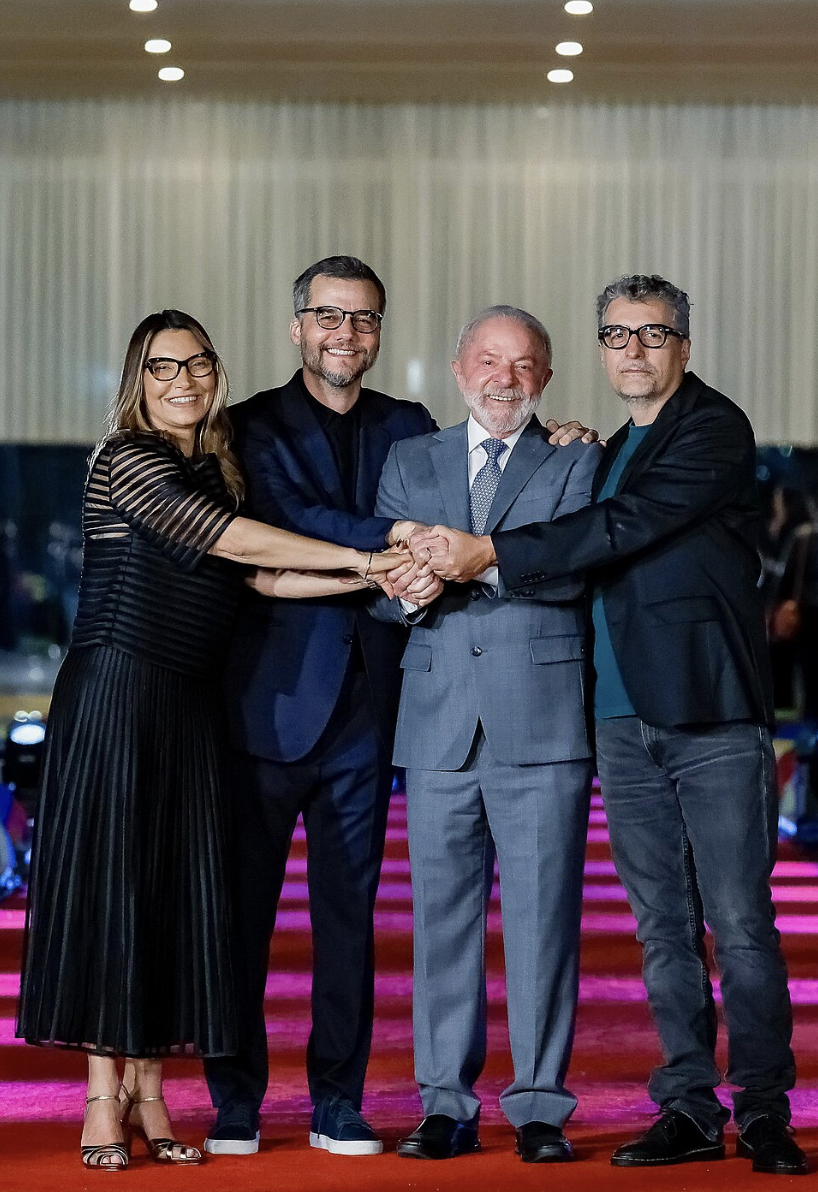
Source: Wikimedia Commons

By Felipe Rezende, Research Fellow and Visiting Scholar in Residence at American University’s Center for Latin American and Latino Studies (AU-CLALS), from the University of Brasília (UnB), Brazil. 

In the current context of jingoistic nationalisms and divisive political projects, particularly in the United States, where the current Trump administration has intensified a political agenda anchored in anti-immigration discourse and practices, reflecting upon the challenges and opportunities for re-imagining what people across the America’s might have in common, in terms of identity, culture and shared belong, is at present particularly important. Contemporary cultural developments such as Bad Bunny’s performance at the Super Bowl LX and Brazil’s global awarded film industry illustrate how notions of “American” belonging can also be culturally and politically contentious.

Hemispheric Myths of National Assimilation

At first glance, imagining a unitary cultural identity across the Americas appears challenging. Although Latin American nation-states might share similar colonial and post-colonial histories, their different national and subnational cultural commitments have also been forged in dynamic relation with cultural assets from elsewhere influencing what is now recognized as latino culture. Similarly, the idea of a North American identity does not emerge as an empirically verifiable cultural synthesis, but rather as the contingent result of ongoing symbolic disputes marked by racial hierarchies, power asymmetries, and competing projects of belonging.

Mid-twentieth century notions such as the melting pot in the United and the myth of the so-called cosmic race or mestizaje in Latin America, offer different but comparable assimilationist narratives for the nation, narratives which obscure persistent structural conflicts within post-colonial American societies. Such accounts function largely as ideological constructs aimed at producing one or another sort of unified national identity. In this sense, contemporary debates about pluri- or multiculturalism in the Americas carry an inherent ambiguity: cultural diversity is recognized rhetorically but also regulated through mechanisms that posit and reproduce racial and other social asymmetries.

This multicultural dilemma in the Americas, therefore, derives from the tension between the political recognition of plural identities, on the one hand, and the impulse to preserve national identity as previously imagined, on the other. In this context, artistic and cultural production and its diffusion emerge as privileged arenas of symbolic mediation, contestation of meaning, and negotiation of belonging, which often seek to transcend closed assumptions of national identity. We might understand the hemispheric and global diffusion of national artistic production from Latin American countries as more than just cultural industry content, and as helping to circulate diverse cultural perspectives.

Latin American Pop Culture is Having a Moment

Recently, numerous products of Latin American popular culture have achieved global recognition, potentially serving as pillars for re-imagining a broader and more cohesive sense of identity across the Americas, and in ways increasingly independent from taken-for-granted nationalist mythologies across the continent. Especially in times of growing international fragmentation, authoritarian threats to democratic systems, and dysfunctional global regimes that fail to produce international cooperation the cases below illustrate new opportunities for re-imagining identity, culture, and belonging in the Americas.

In recent years musical artists like the Colombian Karol G and Puerto Rican Bad Bunny have come to exemplify the consolidation of Latin urban pop as a transnational cultural phenomenon, with a strong presence in the global music industry and recurring visibility through numerous nominations and awards in the GRAMMY and Latin GRAMMY circuits. Bad Bunny won the 68th GRAMMY Awards in the following categories: Best Música Urbana Album and Best Album Cover, for DeBÍ TiRAR MáS FotoS, and Best Global Music Performance for EoO. Also, his 2026 Super Bowl LX halftime performance made history as the first solo Latino artist to headline the show, bringing renewed attention to discussions about what it means to be “American.”

Also in music, Liniker, a Black Brazilian trans woman songwriter, won three categories at the 26th Latin GRAMMY Awards: Best Portuguese-Language Contemporary Pop Album, and Portuguese-Language Urban Performance for Caju, as well as Best Portuguese-Language Song for Veludo Marrom. In addition, the album Milton + esperanza (2024), a collaboration between the acclaimed North American jazz artist Esperanza Spalding and the Brazilian master Milton Nascimento, was nominated for the 67th GRAMMY Award in the category Best Jazz Vocal Album.

In cinema, Brazilian audiovisual productions have undeniably entered the global mainstream, particularly through films addressing the memory of political tragedies such as that country’s military dictatorship. “I’m Still Here” (2024) won the 2025 Academy Award for Best International Feature Film, the 2025 Golden Globe for Best Actress in a Motion Picture – Drama (Fernanda Torres), and more than 70 additional international awards. “The Secret Agent”(2025) won Best Director (Kleber Mendonça Filho) and Best Actor (Wagner Moura) at the 2025 Cannes Film Festival, and later won the 2026 Golden Globe for Best Non-English Language Film and Best Actor in a Motion Picture – Drama (Wagner Moura). The film is also nominated for the 2026 Academy Awards in the categories Best Picture, Best Actor, Best International Feature Film, and Achievement in Casting.

In literature, the growing presence of Latin American authors within global circuits of recognition can also be observed through the wider international circulation of their books, increasing number of translations, and their selection for prestigious literary prizes. For example, the Brazilian novelist Itamar Vieira Junior, author of Torto Arado (2019), saw the 2023 English translation shortlisted for the 2024 International Booker Prize.

Each Latin American cultural producer mentioned here successfully transformed historically localized experiences – often addressing political violence, state terrorism, racism, and patriarchy, among other challenging topics – into aesthetically communicable narratives accessible at a transnational scale. But it is important to note that these recent successes in music, film and literature cannot be explained solely by the artistic genius of their creators. Beyond their evident creative excellence, also important has been the existence of public policies supporting the production and diffusion of national cultural assets, which have also contributed to the international success of Latin American popular culture.

Take the case of Brazil, which put in place a set of public policies that directly incentivize and support contributions to the country’s cultural economy. These include the so-called Rouanet Law, providing tax incentives to support the completion and circulation cultural projects. In the audiovisual field specifically, the Audiovisual Sector Fund (FSA) ensures public resources for film production and distribution. They also include the National Aldir Blanc Policy (PNAB), which established a continuous and decentralized state-funding model strengthening cultural infrastructure and expanding access to cultural rights at the local level. The international reach of works such as “I’m Still Here” (2024) and “The Secret Agent” (2025) should also be understood as the result of a public infrastructure that sustains the competitiveness and global insertion of Brazilian audiovisual products.

What Hemispheric Cultural Diplomacy Has to Offer

Whether through voluntary cultural cooperation, institutional support from domestic cultural public policies, or efforts of public and cultural diplomacy, the growing presence of Latin American artistic production in the hemisphere is neither accidental nor merely the result of its exoticization by Global North audiences. Despite long-standing legacies of stereotyping and archetypal representations of Latin American peoples and cultures, contemporary Latin American cultural products, which circulate throughout the hemisphere and beyond, help us to reconfigure the hemisphere’s identity in new and pluricultural ways.

Even amid the challenges posed by a context of fragmentation, competition, and new threats of geopolitical violence, the aesthetic innovations and moral premises foregrounded by contemporary Latin American artists, and informed by expressions of human rights, peaceful coexistence, and American belonging, present rich opportunities for new imaginaries of hemispheric identity and culture. In this sense, imagining what people across the Americas might have in common can cease to be just an idealistic abstraction and become one critical horizon for revitalizing mutual respect and democratic coexistence in the hemisphere.