Honduras Elections: Serious Challenges Ahead

Honduras coat of arms / public domain

Honduras coat of arms / public domain

Honduras faces an enormous challenge in the next two months:  ensuring that elections in November – when Hondurans go to the polls to elect their next president, 128 National Assembly deputies, and municipal authorities – are clean and transparent.  The elections are especially important because they are the first conducted outside the framework of the coup of 2009.  The elections that year, held five months after the coup, were conducted under the black cloud of the break in constitutional order and gave rise to the transition government headed by President Porfirio Lobo.  This year, nine parties are participating – a clear signal that the country’s traditional two-party system is ending.  The Freedom and Refoundation Party (LIBRE), with a base among supporters of ousted President Mel Zelaya, has nominated his wife, Xiomara Castro, as its Presidential candidate, and the Anticorruption Party, led by sports journalist Salvador Nasrala, represent a true challenge to the traditional political elite.

All of the polls give the edge to Xiomara Castro, with a lead ranging anywhere from two to eight percentage points, over the candidate of the National Party, Juan Orlando Hernández, who is President of the Congress.  The polls also show that a majority of the population, having witnessed multiple accusations of fraud during the primaries held by the two traditional parties (including Hernández’s), expect the elections to be marred by fraud.  Casting further doubt on the credibility of the outcome is the narrow representation of the parties and lack of professionalism of the Supreme Electoral Tribunal (TSE), which is charged with organizing and supervising the elections.  Only the three traditional parties have representatives serving on the TSE and, unlike in other countries, they are distinguished as militants of their parties rather than independents or experts in electoral processes.

Should the results of the election not be seen as legitimate, the potential for conflict is worrisome, and there are ample grounds for concern that the security forces that have proliferated under the Lobo government could be deployed to suppress protest.  Only strong international pressure and strong citizen pressure can guarantee that the elections will be clean and open the possibility for Honduras to overcome the political crisis that has now been damaging the country for several years. 

A number of events – including the firing of Supreme Court justices last December and the National Congress’s intervention in matters far outside its jurisdiction – underscore the continuing tendency toward authoritarian and illegal actions to suit ambitious politicians’ pursuit of power, with potentially dire consequences for the elections. An ongoing economic crisis, including a nearly 50 percent unemployment rate, and a serious deterioration of government finances, also contributes to political fragility. Against this backdrop, the United States and the rest of the international community can play a positive role in promoting elections that are fair and impartial and taking proactive measures to ensure that security forces ill-suited to managing social unrest not be deployed to suppress political dissent.  Failing to do so would waste an opportunity to help effect a truly democratic outcome in Honduras, and invite a further deterioration of a political, economic and social climate that is the most worrisome in Central America.

September 11 Coup in Chile: Global Ramifications

By Eric Hershberg

Chilean Grape export photo by Dick Howe Jr CC-BY-NC Flickr / Indictment of Pinochet, Photo by a-birdie CC-BY-NC Flickr

Chilean Grape export photo by Dick Howe Jr CC-BY-NC Flickr / Indictment of Pinochet, Photo by a-birdie CC-BY-NC Flickr

In Washington last week many events recalled the bloody coup of September 11, 1973, which overthrew the Popular Unity government of Chilean Socialist President Salvador Allende and ushered in a dictatorship that, even by South American standards of the time, stood out for its brutality.  Discussion about “the other September 11” highlighted the human cost of the coup, the role of U.S. government agencies in undermining Chilean democracy and encouraging the military’s actions, and the memories of the coup and dictatorship that remain deeply embedded in Chile today.  These and similar gatherings around the world and in Chile featured demands for the full truth about the dictatorship’s crimes – the fate of some thousand of the disappeared remains unknown today, according to the Human Rights Observatory of the Diego Portales University – and to hold those who committed them fully accountable.

The coup led by General Augusto Pinochet destroyed Latin America’s longest standing democratic regime and ended a unique experiment testing the proposition that electoral democracy could catalyze a transition to socialism.  In Chile, the coup initiated 17 years of military rule grounded in state-sponsored violence, but it also resonated far beyond that country’s borders, marking a watershed in global affairs.  To this day how people around the world conceive fundamental issues of political change, economic development and human rights is affected by September 11, 1973.  These broader legacies were the focus of a panel discussion at American University, co-sponsored by the Center for Latin American Studies and the Washington College of Law, this week.  (Click here for details.)

We can now see three large sets of consequences that the Chilean coup had far beyond its borders. 

Political:  Across Southern Europe, it reverberated powerfully, undermining the confidence of sectors of the Left that believed fervently a socialist transition could be effected through victory at the ballot box.  After the coup, Eurocommunists in Italy and Spain came to believe that victory would require an alliance with Christian Democrats or other centrists, lest a coup coalition akin to that in Chile bring down democracy altogether. For much of the Latin American left, the Chilean experience would over time prove a wake-up call, alerting those aspiring to turn the world upside down that democracy was not a mere bourgeois luxury and suggesting that “second-best” options – more gradual change –were preferable to maximalist goals that would likely jeopardize democracy.

Economic: The coup paved the way for “neoliberal” policies that would shake the foundations of conventional thinking about development for nearly three decades.  They were prescribed across Latin America.  It would not be until the emergence of ALBA in the mid-2000’s that the region would again witness a faith (however misguided), in the capacity of import-substitution and inward-oriented redistribution to achieve lasting economic advance in the region. 

U.S. policy:  Finally, the coup set in train levels of violence and human rights abuses so abhorrent that they drove major changes in U.S. human rights policy and international jurisprudence.  In the United States, advocacy organizations, progressive majorities in Congress, and the Carter Administration introduced unprecedented legislation aimed at preserving democracy and curbing human rights abuses.  Well beyond Washington, numerous international regimes put in place to combat impunity were motivated and influenced by what had taken place in Chile and the imperative of ensuring that it not happen again.  

Just as the cataclysmic event that took place in the U.S. on 9/11/01 opened the door to extreme and ongoing changes felt around the world, so too did the Chilean tragedy that began on 9/11/73.

Egypt Policy – Latin America Style

By Fulton Armstrong

U.S. Department of State Headquarters | Wikimedia Commons

U.S. Department of State Headquarters | Wikimedia Commons

We who follow U.S. policy in Latin America shouldn’t be surprised to see Washington’s policy toward Egypt drift from support for democracy to support for the status quo ante.  President Obama’s 2009 speech in Cairo reaching out to Muslims – calling for an end to the “cycle of suspicion and discord” – came just six weeks after he told the Summit of the Americas that he wanted “an equal partnership” with the hemisphere and sought “a new beginning with Cuba.”  When 30-year President Hosni Mubarak stepped down in 2011, the Administration eagerly linked Egypt to the “Arab Spring” and, despite concerns about the Muslim Brotherhood roots of Egypt’s first democratically elected president, tried to make the relationship with Mohamad Morsi work.  Over time, however, Morsi – successor to an undemocratic regime in an undemocratic country with no democratic traditions and no democratic institutions – was accused of being undemocratic.  The estrangement grew so deep that the Obama Administration still cannot bring itself to call the July 3 coup against Morsi a coup, and Secretary of State Kerry saw fit to refer to the military takeover as “restoring democracy” even as the Army was firing on unarmed crowds.

To Latin America watchers, this chronology is reminiscent of U.S. policy in our own hemisphere.  The case of Honduran President Mel Zelaya is clearest.  The Honduran military removed Zelaya– in his pajamas – from his home and country in June 2009 for proposing a referendum that, the putschists claimed, violated the Honduran constitution.  The Obama Administration’s nominee to be Assistant Secretary of State at the time, Arturo Valenzuela, testified that the action was, in his opinion, a coup, but the State Department never categorized it as such and, despite rhetoric committing to restore Zelaya, the Administration let the interim regime consolidate power.  Amidst a state of emergency, media closures, and other irregularities, the State Department also gave its blessing to elections held several months later.  Zelaya’s rhetoric before the coup was caustic, and he squandered political capital in needless confrontations, but he never threatened Honduran “democracy” or violated human rights as the interim regime did.  Nor did he preside over a steady deterioration of security, civil rights, and the economy as the current government has.  Yet, ironically, the Obama Administration has never set the history of the coup straight – just as the Bush Administration never rectified its disastrous support for the 2002 coup against Chávez in Venezuela.

The excesses of some leaders, like Zelaya and Chávez, make supporting or turning a blind eye to a coup very tempting.  But Washington has also shelved its moral outrage when much less provocative presidents – democratically elected but progressive-leaning – have been removed from power, if not with a gun at their head.  The “constitutional coup” against President Lugo in Paraguay last year is the most recent example.  The gap between U.S. rhetoric about democracy, rule of law, and due process on the one hand and its tangible actions on the other has a number of causes. 

  • American “exceptionalism” – the sense that U.S. success gives it a right to judge others and intervene even when national interests are not at stake – sometimes leads Washington to over-extend and make rash decisions.
  • Eagerness to act quickly – to appear decisive – often makes policymakers confuse the symptoms of problems, which seem amenable to quick solutions, and the essence of the problems themselves.  Policies address the short-term while neglecting the strategic.
  • Washington lobbies – the pro-Israel lobby in the case of any matter in the Middle East and the Cuban-American lobby in Latin America – are able to dominate U.S. perceptions of events, pushing administrations into a corner. 
  • Administrations embarrass themselves when they throw around words like “Arab Spring” and “democracy.”  When the inevitable bumps in the road occur, they act betrayed rather than admit they got carried away by wishful thinking. 
  • Double-standards –the expectation that progressives succeeding authoritarians will be perfectly democratic and flawlessly inclusive – make it difficult for Washington to avoid prematurely throwing a potential ally overboard. 
  • Another factor, and potentially the most important, is that the U.S. government builds deeper relationships with elites and the security services that do their bidding than with any other forces.  During the Bush Administration’s “War on Terror,” the U.S. Government entrusted Egypt with extremely sensitive operations, including the interrogation (and alleged torture) of suspected terrorists, and Washington relies on Latin American security services to prosecute the “war on drugs.” 

When U.S. interagency committees discuss how to respond to crises, the departments and agencies with the deepest ties in the country under discussion claim more influence over events there than anyone else – and win most policy debates.  The problem is that their ties are mostly to political and economic elites – or the military and intelligence services that back them – which are rarely agents of change.  Washington winds up allied with forces that suppress the new voices essential for the “springs” and “democracies” that it says it wants.


Brazil Protests: Amorphous Causes, Unpredictable Consequences

By Matthew M. Taylor

Protestors in Brazil / Photo credit: Izaias Buson / Foter.com / CC BY-NC

Protestors in Brazil / Photo credit: Izaias Buson / Foter.com / CC BY-NC

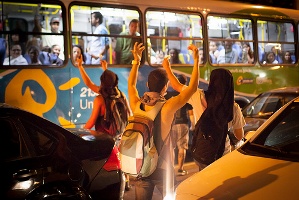
Hundreds of thousands of Brazilians hit the streets of a dozen state capitals this past week.  The initial trigger was a proposed hike in São Paulo bus fares, already among the world’s most expensive, but news media soon reported that the protests reflected anger with the rising cost of living, crime, corruption, impunity, and the high costs of hosting the World Cup. Lackluster public services haven’t helped, and widely televised police violence last week provided another rallying cry.  Polling by Datafolha shows that the protest is a middle class phenomenon, with 77 percent of the marchers in São Paulo claiming a university degree.  This growing demographic group is turning against President Dilma Roussef’s Worker’s Party (PT) but it is also weary of the opposition PSDB, especially in São Paulo state.

So far, the protests have been difficult for political parties to harness for their own ends.  Partisans who showed up at the marches on Monday waving party flags were reportedly forced to pull them down by indignant protestors.  Dilma’s popularity has been falling – she was recently booed at the opening match of the Confederations Cup – but the marchers don’t seem collectively exercised about her policies or those of any single party or politician.  Aecio Neves, Marina Silva and Eduardo Paes, her potential opponents in elections scheduled for late 2014, have yet to capitalize on her vulnerabilities, as the protestors seem to be casting “a pox on all their houses.”  An outside candidacy is a rising possibility, but Brazilians have been wary of supposed political saviors after the rapid rise and fall of Fernando Collor in 1990‑92.  Anger is directed at the political class as a whole because it is incapable of responding to public disgust with Brazil’s unsatisfactory public services.

It is quite possible that the protests may peter out on their own, especially if the renewed violence seen in São Paulo on Tuesday night alienates supporters.  If the protests continue and remain peaceful, they may result in increased social solidarity and a shared sense of patriotism in the face of an unsatisfactory political system.  Something similar happened during other mass protests in the past, especially the Diretas Já marches of 1985.  A renewed consensus in favor of a more robust and effective democracy would be salutary, but the concrete results arising from the protestors’ demands are difficult to predict.  One thing to be sure of: withdrawing the proposed bus fare increase proposal is too little, too late.

Constitutions: End-State or National Dialogue?

By Todd Eisenstadt

Protestor holding the Constitution of Honduras. Photo credit: giggey / Foter.com / CC BY-NC

Protestor holding the Constitution of Honduras. Photo credit: giggey / Foter.com / CC BY-NC

The role of constitutions is evolving as deeply as the countries in which they are being written.  At least since 1787, constitutions have been pacts around which societal expectations converge – the written record of elite agreements on how things should be.  During the “Third Wave” of democratic transitions (since the 1970s), they were viewed as precursor “contracts” to founding elections.  But increasingly, constitutions are way stations rather than destinations.  The content and implementation of constitutions is of course important, but the politics surrounding them can, in some cases, be more important than the clauses and amendments contained therein.

In Bolivia, Ecuador, Venezuela, and perhaps, in the near future in Paraguay, constitutional moments seem to be taking on different meanings.  Optimism about constitutions as core elements of Third Wave democratization pacts is giving way to the 21st century reality of democratic backsliding, semi-authoritarianism, and hybrid regimes – making it all the more important to reconsider how to read constitutions and evaluate governments’ adherence to them.  These are not stale parchments, but living narratives which represent iterations in decades-long intra-elite bargaining efforts to stall Arab Spring-like social movements (regardless of whether they actually seek to create spaces for new political actors).  They represent societal gains – both real and symbolic, even with ephemeral institutional advances.  This may be especially true in new and developing democracies, which need government services, constitutions that improve fairness and equity, and implementation of those commitments.  Developed democracies fall short too, but in developing countries new to the art of promulgating democratic constitutions, these shortcomings are more transparent as they are less proficiently hidden from view.

We need an intellectual space where Madison’s Dilemma – how to empower citizens without overpowering political institutions with the tyranny that unruly majorities can bring – meets Hugo Chávez’ shadow.  Chávez, who was obsessed with linking the Boliviarian Union of nations via new trade agreements and political arrangements, sought to empower himself and his political allies in the guise of solomonic constitutional reform to consolidate democracy.  Observers have long criticized “window dressing institutions” in the electoral arena, as evident in studies of “electoral engineering” and “sham elections.” While “sham constitutions” – a phrase that may ring too loudly – require more subtlety and political craftsmanship, we do need to question the longstanding stylization of constitutions as the “last word” (literally) on a nation’s quality of democracy.  There is much to learn, and a conference held last week at American University by CLALS Affiliate Rob Albro, SIS Researcher Carl LeVan, and I, and sponsored by the Latin American Studies Association and the Mellon Foundation, made some headway in finding new ways to conceive of constitutions not as the “final word,” but only as the most recent one.

Finding New Approaches to Media-Government Tensions in Latin America

By John Dinges

Press Conference in Lima, Peru Photo credit: World Economic Forum / Foter.com / CC BY-NC-SA

Press Conference in Lima, Peru Photo credit: World Economic Forum / Foter.com / CC BY-NC-SA

Establishment news media and government are on a collision course in a number of Latin American countries.  At the heart of the conflict is government rejection of the classic role of an ideologically diverse press as a check on government power and as a forum of citizen deliberation.  The media, in response, charge that government actions constitute violations of international free press guarantees.  But that defense has been ineffective and has not resonated at the popular level.  All of the governments involved are democratically elected, and most espouse left-of-center programs of progressive reform aimed to benefit the poorest sectors and address other forms of inequality.

The most severe conflicts are in Venezuela and Ecuador, where aggressive government use of laws and lawsuits has dramatically diminished the influence of independent television and newspaper organizations.  The once strident news media, not unfairly characterized as the de-facto opposition, have been cowed, and are cowering.  At the same time, governments are embarking on the redistribution of the broadcast spectrum to favor community and state-owned (“public”) channels.  The Morales government in Bolivia has achieved the upper hand over the media as it builds its own media network.  The Kirchner government of Argentina is fighting a legal battle –with mixed success – to cripple the media empire of Grupo Clarín, the owner of the largest newspaper in Latin America and the largest cable network.  The conservative governments of Honduras and Panama are also on the freedom of expression watch list, indicating that the phenomenon is not purely a matter of ideology.

The polarization and growing government dominance represents a serious problem for democracy in these countries.  For all the harsh rhetoric on both sides, however, the overall threat to freedom of expression (measured in censorship, direct control of media and imprisonment of journalists) is far less than was the case during the rightist military governments of previous decades.  Still, it would be a mistake to limit our promotion of healthy democracy to the defense of the traditional “legacy” media institutions in these countries.  Government leaders, especially Presidents Correa of Ecuador and Kirchner of Argentina, have used (some would say misused) democratic arguments in criticizing the traditional media.  They charge that the concentration of media in the hands of the private sector (with ownership participation of banks in the case of Ecuador) is itself a violation of democracy, and that they are trying to “democratize” the media by delivering increased access to citizens in the form of public and community media.  Not surprisingly, these new media creations are beholden to the government and lack political independence.  But they are not going away.  In an effort to defuse the tension, institutions such as the Carter Center and others have developed an alternative conflict resolution approach that is quietly garnering support.  The idea is to promote an honest dialogue between governments and wide sectors of the media.  It would create a process to explore the substance of government positions as well as investigate alleged abuses. To this end, the Carter Center organized meetings earlier this year in Ecuador and Bolivia, and a conference was held at Columbia University’s School of Journalism this month bringing together leaders of government, media institutions and international organizations to debate media regulation and press standards as a platform to reconstitute consensus about media in democratic societies.

Brazil: The STF, Congress, and Checks and Balances

By Matthew M. Taylor

Supreme Federal Tribunal (STF), Brasilia / Photo credit: R. Motti / Foter.com / CC BY-NC-SA

Supreme Federal Tribunal, Brasilia / Photo credit: R. Motti / Foter.com / CC BY-NC-SA

Brazil’s last resort for political minorities and opposition parties – the Supreme Federal Tribunal (STF) – is facing growing pressures on its independence.  In Brazil’s famously hyper-presidential system, the executive branch dominates Congress through an elaborate system of presidential decrees, budgetary pork, and cabinet appointments.  Since 1990, no president’s party has ever held more than one-fifth of the seats in Congress, yet presidents – using a diverse array of carrots and sticks – have routinely been able to rely on support from coalitions that surpass three-quarters of the Chamber and Senate.  As Brazil’s high court, the STF has been the only channel through which majoritarian decision-making has been contested.

In recent weeks, Congress has bluffed its way onto the scene: the constitutional committee in the lower house voted to curb the courts via a proposed – but ultimately shelved – constitutional amendment that would restrict the STF’s powers of constitutional review, subjecting decisions that Congress finds objectionable to public consultation.  The reaction has been deafening.  The press has drawn parallels to similar moves in neighboring Argentina and Venezuela.  Eminent political analyst Sérgio Abranches claimed that this was further evidence that an “oligarchic civil coup” was under way.

Some judicial actions have indeed been provocative, such as decisions on contentious issues such as political party formation and the distribution of oil royalties. But the Congress’ effort to curb the court has left a bitter taste – because it points both to the increasing politicization of judicial decision-making and its potentially destabilizing effects on the political system.  The fact that the amendment proposal had support even from some members of the opposition underscores the depth of congressional resentment of the STF’s proactive role.  The Court appears likely to face continued pushback from Congress, with overwhelmingly political objectives.  But some elements of the proposed reform may be worth thinking about, such as restrictions on the issuance of injunctions by single members of the Court.  Too often these injunctions have been seen as high-handed and lacking in the legitimacy that decisions by the full Court carry.

Honduras: Simmering Crisis

Porfirio Lobo and Hillary Clinton
US Embassy Guatemala
/ Foter.com / CC BY-NC-ND

Little good and lots of bad has transpired in Honduras since the night in June 2009 that an Army-backed coup d’état, orchestrated by the economic elites, ousted President Mel Zelaya and installed Roberto Micheletti as the de facto ruler.  Almost four years later, Honduras remains one of the places in the Americas where democracy is at permanent risk – where drug trafficking, corruption, impunity, private armies and feudal caudillos thrive in a climate of spiraling violence.  Honduras today is the most violent country in the Americas and last year was among the top three in the numbers of assassinated journalists.  Honduras also remains one of the poorest countries in the hemisphere.

President Porfirio “Pepe” Lobo lacked credibility from the moment he donned the presidential sash in January 2010 – the candidate who, by almost all accounts, would have lost the election had not the coup reversed that fate, clamped down on opposition media, and suspended many civil rights.  While Washington worked hard to gain OAS recognition of his government, Lobo offered no guarantees – to either Hondurans or foreigners – that he would reverse the ongoing activities of the Army and rapacious economic elites to undermine democratic institutions.

  • Timid attempts to show independence, such as a projected police reform, languished due to lack of political will and financial support.
  • Honduras’s doors opened ever wider to organized crime and corruption.  According to U.S. agencies, roughly 60 percent of the cocaine passing through Central America on its way to U.S. markets in 2011 went through Honduras.  (The Obama Administration funded a militarized drug interdiction program that sputtered after Honduran civilians were killed.)
  • Politically motivated murders by sicarios – reminiscent of 1980s death squads – skyrocketed.  Investigations were few, and prosecutions were nonexistent.
  • By the end of last year, Lobo was pointing fingers at his old allies in the Army, the elites, and even his own party, accusing them of trying to destabilize his government. He failed to pass constitutional reforms that he claimed would protect democracy.  General Romeo Vásquez Velásquez, the military commander during the coup, announced that he was running for president.
  • Honduras is facing one of the worst fiscal crises of its history – a significant landmark for the perennially mismanaged country.

In Washington none of this seems to raise red flags.  On the contrary, the ideological bent of statements from both the executive and legislative branches suggests satisfaction with the state of affairs in Honduras – and willingness to keep the crisis there unsolved.  Hillary Clinton´s State Department was, to say the least, shy when addressing the deteriorating situation of the Central American country.  In January, at Senator John Kerry’s confirmation hearing, Republican Senator Marco Rubio’s assertion that what happened in Honduras in 2009 wasn’t a coup went unchallenged – despite the overwhelming consensus otherwise throughout our hemisphere.  The first sign offered by Kerry as Secretary of State, however, gives room to expect at least a modest change in the narrative: on March 4th, the State Department gave one of eight International Women of Courage Awards to Julieta Castellanos, a respected human rights advocate and critic of corruption and impunity in Honduras.  This hint of a less ideological and a more strategic and humanistic approach to the unsolved Honduran question is welcome.

Haiti: Not Back, Not Better

Photo by: Gonmi | Flickr | Creative Commons License

Photo by: Gonmi | Flickr | Creative Commons License

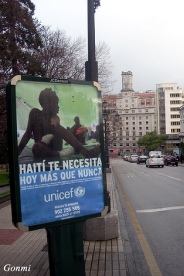
The third anniversary of the devastating earthquake in Haiti has passed with no sign of either serious reconstruction or progress toward improving democratic institutions.About three-quarters of the earthquake rubble has been removed, and several hundred thousand individuals have been moved to temporary shelters and some back into permanent housing. A light-industrial park in northern Haiti is providing jobs to some 1,300 workers. The U.S. Government alone has committed over $3.6 billion toward relief, recovery, and reconstruction, of which $2.5 billion has been disbursed as of September 30, 2012. Despite these billions, the infrastructure remains a shambles; the economy is weak; unemployment is around 40 percent; and the World Food Program estimates that 6.7 million people (out of a population of 10 million) are “food insecure.”

Progress in political affairs has also been slow, and incumbent leaders remain reluctant to commit to elections. The head of MINUSTAH, Chilean diplomat Mariano Fernández, last week reiterated calls for the Haitian government to hold legislative and local elections that were supposed to have been held a year ago. He said an agreement reached last month by President Michel Martelly and members of parliament to form a semi-permanent electoral council to stage elections for one-third of the 30-seat senate and local mayors was “an important first step.” The U.S. Assistant Secretary of State for Democracy, Human Rights and Labor, Michael Posner, also tried to emphasize the positive during a recent visit to Port-au-Prince, but noted “there is a lack of faith in the system, the sense that the rule of law is not respected, that institutions like the judiciary and the police and the prisons and the prosecutors are not doing the job adequately, and that the government isn’t living up to expectations.”

The Obama Administration’s pledge to “build back better” may have been slightly bold from the start, but one of the objectives – to use the crisis to drive some reforms in both the Haitian government and how international programs are implemented – was indeed within reach. The business-as-usual approach since the earthquake has led to the loss of a historic opportunity to move the country forward. While the Haitian political class continues to focus on its internecine struggles, the international community has funneled its vast funds to its own NGOs, most of which operate outside a master strategy and far from the political and bureaucratic authorities nominally in charge of overseeing and coordinating their programs. Real progress is unlikely until both local and outside players develop a shared vision for the future – hopefully before another natural disaster pushes the reset button again.

Central American Elites Are Evolving But Cling to Power

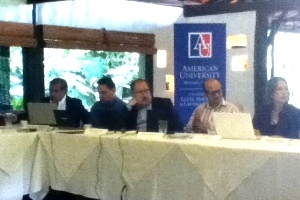
From left to right: Manuel Torres, Ricardo Barrientos, Hugo Noé Pino, Aaron Schneider and Elizabeth Oglesby participating in the project seminar in Costa Rica

From left to right: Manuel Torres, Ricardo Barrientos, Hugo Noé Pino, Aaron Schneider and Elizabeth Oglesby participating in the project seminar in Costa Rica

The sources of Central American elites’ wealth are evolving, as are their fundamental interests and the ways they wield political power.  Land‑intensive production – the focus of decades of insightful scholarship – continues to prevail in Guatemala and Honduras, but the economically powerful now maintain their position through a growing array of service-sector activities and by capturing rents from public coffers.  Changes in their economic foundations are but one of several transformative processes that swept the region beginning during the 1980s, making the past three decades a period of fundamental rupture with the past.

  • Civil wars in El Salvador, Guatemala and Nicaragua during the 1980s transformed the economies in all three countries and had spillover effects in Costa Rica and Honduras.  Most striking is the case of El Salvador, where elites abandoned the countryside upon which they had depended from time immemorial, never to return.
  • Structural adjustment programs, implemented throughout the region during the 1990s, changed the role of the state in Central American economies and thus the ways in which the public sector intersected with the elites’ wealth-accumulation strategies.  Hasty and corruption-ridden privatizations, in particular of energy and telecommunications and of an array of public services, created a reformist façade but gave private-sector groups a piñata that helped to ensure uninterrupted enrichment.
  • During that same decade, transitions to electoral democracy contributed to elite reliance – albeit with some important exceptions – on political parties, campaign strategies and legislative lobbying to protect their interests.  Ties to military and death squad enforcers are no longer the principal vehicles for the enforcement of elite imperatives, though Honduras today is increasingly reminiscent of the worst times in Guatemala and El Salvador.

Central America’s elites have yet to offer the region a vision of reform that will enable the isthmus to overcome misery, exploitation and predatory rule.  While dominant groups have embarked on aggressive state-building strategies, experts question whether these are producing the virtuous dynamics that advance the general welfare of the population and ensure effective governance. 

Scholars from across Central America have reached these conclusions through research and seminars under a multi-year AU program on Central American elites and power.  To foster better understanding of the shifting landscape in the region, and thus to illuminate plausible paths toward more equitable distribution of power and resources, the Ford Foundation is supporting this effort, undertaken in partnership with more than two dozen researchers from institutions throughout the isthmus and the United States.  The project was the focus of a recent workshop at FLACSO Costa Rica, and several publications will result over the course of 2013 and 2014.  Click here for more information.