Political Participation in Latin America Expanding

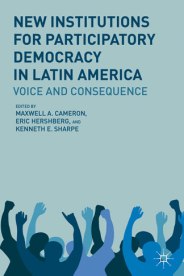
participatory democracy coverFrom local citizen initiatives to national referenda, mechanisms of direct political participation have been spreading with astonishing vigor throughout Latin America in recent years. Some of these mechanisms are new and unprecedented in the way they involve citizens in politics, such as frequently touted participatory budgeting systems at the municipal level in numerous countries.  Other initiatives, such as the National Policy Conferences that consult the citizenry regarding an array of issues in Brazil, are less widely known. In most Andean countries and to some extent elsewhere, these forms of participation often emerge where established representative institutions, such as party systems, have collapsed, or where legislatures have fallen into disrepute.  Yet they also proliferate alongside strong parties, legislatures, and interest associations, as we see in Brazil and Uruguay.

A recent CLALS-sponsored book* examines these new forms of participation and analyzes when they promote, and when not, the consolidation and deepening of representative institutions. The participatory innovations vary along a number of key dimensions, including how they interact with political parties and established institutions, their focus on collective versus individual rights and, perhaps most importantly, their autonomy from political and economic elites.  These differences and their implications are analyzed in detail in case studies on seven Latin American countries: Bolivia, Brazil, El Salvador, Mexico, Nicaragua, Uruguay and Venezuela.

When new forms of political participation emerge spontaneously and independently – as a natural reaction to an unfulfilled need at a local or national level – their voices are authentic and tend to enhance democratic rule.  Brazil’s National Policy Conferences and Uruguay’s referenda to enhance accountability are examples of the incorporation of new voices in policy formulation – to the benefit of the constituencies driving them and the nation as a whole.  We also find instances where participation has exacerbated and reinforced longstanding patterns of clientelism (including in Mexico and Brazil), and autocratic leaders have sought to create or capture such voices to bypass representative institutions (including in Nicaragua and Venezuela).  A valuable lesson of this research, however, is that, once in place, these spaces may become increasingly autonomous. Venezuela’s community councils are an important case to watch: created to reinforce the Chavista project as defined by the Casa Rosada, they may take on a life of their own when the politicians who sponsored them relinquish their positions of power or pass away.

New Institutions of Participatory Democracy: Voice and Consequence, published by Palgrave Macmillan 2012, resulted from a multi-year project co-organized by CLALS and the University of British Columbia’s Andean Democracy Research Network.  More information on the project can be found here .  (The volume has also been published in Spanish by FLACSO-Mexico, Nuevas instituciones de democracia participativa en América Latina: la voz y sus consecuencias)

Top Five Events of 2012

A poll of contributors to AULABLOG identified the following five events (listed below in no particular order) as the most important in Latin America in 2012.  We welcome you to post your own list using the Leave a Comment link below.

By: Matt Westgate "Mettamatt" | Flickr | Creative Commons

By: Matt Westgate “Mettamatt” | Flickr | Creative Commons

Venezuelan President Hugo Chavez’s third major cancer surgery signaled that change – probably profound – will come to Venezuela much faster than his presidential campaign let on.  We expect growing tensions among his aides, none of whom has his charisma or base, as they jockey in a succession scenario.  We’ll be watching whether the PSUV can become an institutionalized mechanism for channeling Chavismo’s support into a governing project in the post-Chavez era.

The election and inauguration of Mexican President Enrique Peña Nieto signals a natural swing back to PRI leadership after 12 years of PAN governments.  Differences over the approach to counternarcotics might flare up in an overall smooth relationship with the United States, but the new president’s biggest challenge is going to be overcoming the persistent economic backwardness that has kept Mexico from achieving the economic growth of others since the turn of the century.

The ouster of Paraguayan President Fernando Lugo last June – as well as the United States and Latin America’s ambivalent reaction to it – was a dramatic illustration that democracy in the region rests on a tenuous foundation of sometimes contradictory constitutions and weak institutions.  The continuing struggle of Honduran President Pepe Lobo, three-plus years after the coup that removed President Mel Zelaya, shows that failure to bring those whose power grabs violate laws and the spirit of law to account sows the seeds of long-term instability and even greater threats to democracy.

The Colombian peace talks, the first serious attempt in 10 years at resolving the decades-old conflict, could lead to a watershed in that country’s development.  President Juan Manuel Santos has shown strong leadership, despite incessant carping from his predecessor, Alvaro Uribe, and has smartly acknowledged that success in the talks is far from certain.  If the talks are successful, 2013 could be a defining moment for a country already experiencing strong economic growth and an important degree of social progress.

Washington continued to sit on the sidelines on most regional issues.  President Obama got a spanking at the Summit of Americas from even perennially friendly governments for Washington’s approach to counternarcotics (overly militarized) and Cuba (stuck in the Cold War).  He was silent on Latin America during the campaign, and his rhetoric of “partnership” and “neighborhood” remained unfulfilled.  Although the President won kudos for implementing elements of the Dream Act by Presidential Directive, the Administration boasted of deporting more than 400,000 illegal immigrants in 2012, the most of any year in the nation’s history.  The region is likely to remain eager for U.S. leadership on issues of mutual interest in 2013, but most countries’ blossoming dealings with Europe, Asia and even Africa suggest they’re not going to sit around waiting for the U.S. to take up the challenge.

Honduras: What is U.S. policy?

The sustained surge in crime and violence in Honduras – including more than 60 politically motivated murders in the past year – is raising doubts about the viability of the government and its institutions.  The term “failed state” is often abused, but there’s no doubt that Honduras falls short of the rhetoric about its stability and democracy that the Obama Administration recited when arguing for the country’s readmission to the OAS after the 2009 coup that removed President Mel Zelaya.  Indeed, the coup set the country on a downward spiral from being a weak democracy to one struggling for basic credibility.  The U.N. Office on Drugs and Crime says Honduras has the world’s highest murder rate – 91.6 murders per 100,000 inhabitants in 2011.

Undersecretary of State María Otero has spent time and energy trying to establish a policy toward Honduras.  During a visit to Tegucigalpa last month, she signed an agreement with Foreign Minister Corrales that “sets the stage for results-oriented action towards our shared objective of a safe Honduras that respects the rule of law and human rights,” and she announced that the United States would provide an additional $1.8 million in aid to help counter gang activity in Honduras.  Despite her efforts, the State Department and the U.S. Embassy in Tegucigalpa have failed to go beyond ready-made programs and put in place a framework for a comprehensive policy.  Programs are not policy.  The Administration appears reluctant to admit that its Honduras policy, which has failed, needs an overhaul.

Multimillion-dollar programs will not succeed until they take into account that the Honduran “partners” upon which they depend are themselves at the core of the problem.  Three years after the coup, the Obama Administration still fails to see that its allies in the struggle against transnational and local gangs, as well as its efforts to build judicial institutions, are the same people who mocked the rule of law, overthrew the previous president, and re-politicized the military and police to serve their own purposes.  (The reasons for Washington’s unwillingness to help fund a “Commission for Security Reform” approved by the Honduran Congress are unclear, but this may be a factor.)  There are strong suspicions in many sectors of Honduran society that members of the country’s political-economic elite are the sponsors of the sicarios (hired gunmen) who have killed dozens of citizens whose offense was to demand an end to government impunity.  Given the challenge that the growing popularity of the country’s new political party, LIBRE, poses to traditional powerbrokers, informed observers expect violence to increase in the run-up to elections next year.  Absent public explanation of U.S. policy, it is fair to ask why Washington hasn’t seen these patterns – obvious to Hondurans – and why it hasn’t offered sustained support from the FBI and other U.S. law enforcement to investigate the assassinations and trace them back to the power bosses.  It is also fair to ask Assistant Secretary of State Brownfield and others who espouse the militarized approach to dealing with organized crime how this strategy, which has failed elsewhere, will succeed in Honduras.  Why hasn’t the Obama Administration supported the sort of U.N.-sanctioned investigative capacity that has proven effective with the International Commission Against Impunity in Guatemala?  Why has Washington not even pushed for meaningful implementation of the recommendations of the Truth and Reconciliation Commission released last year?  If Washington wants to make its rhetoric about Honduras into reality, it needs to do more than just to funnel funds into programs run by questionable partners.

Mercosur, Unasur Holding Firm on Democracy in Paraguay

Photo by Christian Van Der Henst S. via Flickr , http://www.flickr.com/photos/cvander/5215442086/

As Paraguay marked the one-month anniversary of the summary removal of President Lugo from office, the distance between South America and the rest of the hemisphere on how to deal with the “constitutional coup” remains great and is perhaps growing.  OAS Secretary General Insulza announced last week that the regional organization’s Permanent Council decided to take no further action, except to send a “support mission” to Asunción.  The Obama Administration’s inaction further indicates that the United States is prepared to allow things to stand unchallenged and even unexamined.

Mercosur, Unasur, Spain and, more predictably, ALBA have all been tougher.  Mercosur last week announced that the new Paraguayan government, led by President Federico Franco, is still barred from participating in the organization’s activities, although the government to be elected in April 2013 will be welcome.  Unasur made clear that Paraguay’s participation will be suspended “until democratic order is reestablished.”  ALBA countries have minced no words in condemning Lugo’s ouster.  Spanish Foreign Minister García-Margallo suggested publicly last week that Paraguay’s participation in the Ibero-American Summit in November may not be appropriate.

This division among hemispheric players is reminiscent of the tensions following the coup that removed democratically elected President Mel Zelaya in Honduras three years ago.  Whereas the United States quickly softened its stance on the value of isolating the golpista government of Roberto Micheletti in 2009 and later became Tegucigalpa’s most ardent advocate for speedy readmission to the OAS – while Brazil and most South Americans remained committed to seeking a more democratic outcome – Washington is now showing patience with the right-wing factions that ousted Lugo.  Mercosur’s formula for welcoming the government to be elected next year helps avoid the sort of crisis for the incoming leadership that hindered Honduran President Lobo’s efforts to push back against his country’s golpistas, who to this day are undermining his administration.


El Salvador’s “Constitutional Crisis”

Photo by: rosaamarilla via Flickr http://www.flickr.com/photos/amccy/3395160591/

A months-long political feud over the Supreme Court in El Salvador has blossomed into what observers are calling a constitutional crisis.  The first shot was fired in April when legislators from the FMLN engineered a “legislative decree” to replace five court Magistrates, the outgoing Assembly’s second shot at choosing justices during its three-year term.  The court’s Constitutional Chamber in June declared the decree unconstitutional – because each Legislature gets to vote only once for Magistrates.  At the same time, the Chamber invalidated a similar move by the opposition ARENA party affecting Magistrates chosen in 2006.

The theater came to a head this month when two feuding Supreme Courts met in different wings of the same building and claimed legitimacy – one with five members elected in 2009 and the other with the 10 invalidated members.  The rightwing ARENA party and its allies in Washington are claiming the crisis represents a shift against democracy by the FMLN.  Two Cuban-American members of the U.S. Senate have called on the Obama Administration to impose sanctions – principally suspending negotiations on a second Millennium Challenge Corporation compact potentially worth hundreds of millions of dollars – if the crisis is not ended quickly and in the manner they wish.  The Inter-American Commission on Human Rights (IACHR) has called for prompt resolution, and the U.S. Ambassador in San Salvador and the State Department have expressed “concern.”  A Washington Post editorial this week lambasted the FMLN for shifting toward Chávez-style authoritarianism and President Funes for failing to stop it.

This episode reflects maneuvering within the FMLN – fueled by frustration that President Funes’s soft line toward ARENA has only weakened the party’s influence – and poor judgment among activists on where and how to pick the fight.  The legislators rushed the decree because they anticipated correctly that they were about to lose control of the Assembly in elections several weeks later.  The crisis falls into a much more ominous pattern, however, in that – like the coups in Honduras (2009) and Paraguay (2012) – the right wing and its coreligionists in Washington exploit events to challenge the democratic credentials of a democratically elected reformist government to rationalize weakening it, while the Obama Administration responds timidly.  ARENA is again demonstrating its superior lobbying skills in Washington, which have already severely disadvantaged President Funes on issues such as relations between his security cabinet and its U.S. counterparts – resulting in a serious erosion of his own influence over security issues.  If the current political impasse is not resolved to the satisfaction of U.S. conservatives, Washington’s threats – ironically directed against the Administration’s “best friend” in Central America – will likely continue and relations will be strained, further persuading hardliners around Funes that moderation pays no dividends.

Panamanian President Martinelli Examined

Photo by: Congreso de la Republic del Perú via http://www.flickr.com/photos/congresoperu/4923731107/


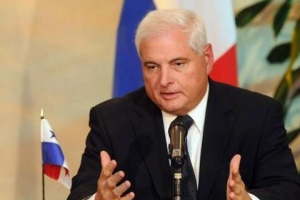
Wall Street Journal columnist Mary Anastasia O’Grady on June 20 published a commentary about right-leaning Panamanian President Ricardo Martinelli that had a tone and edge that she usually reserves for leaders she suspects of being communists, populists or nationalists.  Entitled Panama’s Democracy Goes South, Ms. O’Grady documented “the warnings from a growing chorus of Panamanians that [he] is moving the country toward authoritarianism.”

Martinelli – blessed by the Obama Administration last year with a Free Trade Agreement in part based on an evaluation of Panama’s democratic institutions – is “tearing down institutions,” stacking the Supreme Court, and apparently steering government lucre to build a parliamentary coalition that made the national assembly into a rubberstamp of his agenda.  O’Grady points out that this amounts to “the erosion of Panamanian pluralism” and compares him with Venezuelan President Chávez.

This portrayal of Martinelli’s leadership is not unique – it is well documented – but official Washington’s embrace of it would be.  The authoritarian tendencies of some ALBA presidents have been well publicized and, at times, exaggerated, but rightwingers with similar tendencies often get a pass.  In this context, such comments in the Wall Street Journal are significant.  For now, no regional institution and no major democracy, including the United States, has threatened sanctions against Martinelli.  Last week, the State Department announced that some assistance to Nicaragua will be suspended because of poor progress toward achieving transparency in government budgets – precisely one of the areas where Panama has experienced egregious backsliding.  Sanctions against Martinelli, however, seem remote.  Latin American leaders at times have bridled at the double-standards of external criticism more than at the sanctions themselves.  O’Grady’s commentary challenges the State Department to send a message to the region that its “democracy promotion” agenda applies to conservatives as well as those it often categorizes as on the Left.

Paraguay Coup: Setback to Democracy Even if Technically Constitutional


Photo by: Juan Alberto Pérez Doldán, via http://www.flickr.com/photos/38384810@N02/3531158719/

President Fernando Lugo, struggling to consolidate power since taking office in 2008 in Paraguay’s first meaningful transfer of power in 60 years, was removed from office on Friday by the same elites who had resisted him all along.  In a series of lightning actions, the Senate convened an impeachment process – giving him only two hours to prepare a defense – and voted him out of office.  Opposition leaders cited the government’s mishandling of a squatter protest earlier this month, resulting in 17 dead, but they had been undermining him from day one of his administration.  By Friday afternoon, Lugo accepted his removal and left the Presidential residence.  His vice president, Federico Franco, was sworn in and subsequently declared, “The country is calm. … Activity is normal and there is no protest.”

International reaction was slow at first, as the region focused on an environmental summit in Brazil.  But Brazil, Argentina and the ALBA nations condemned Lugo’s ouster and threatened sanctions.  President Dilma Rousseff urged immediate suspension of Paraguay in Mercosur and UNASUR, and Brasilia and others have withdrawn their ambassadors.  The U.S. State Department expressed “concern” at first and then urged “all Paraguayans to act peacefully, with calm and responsibility, in the spirit of Paraguay’s democratic principles.”  The OAS held an extraordinary session of the Permanent Council and sent a fact-finding mission to Asunción.

As President Lugo said, the action was as much against “Paraguay’s history, its democracy” as it was against him.  Like the coup that removed President Mel Zelaya in Honduras three years ago, the action was intended to stop a popular president and influence elections scheduled in coming months, but Zelaya was removed and exiled by the military, and the Congressional documents sanctioning it were fabricated after the fact.  The events in Paraguay pose an important challenge to the democracy clauses of the various regional charters (Mercosur, UNASUR, OAS) as well as the leadership of the region’s biggest democracies, including Brazil and United States.  At this early point, the Paraguayan elites probably judge that they can weather the storm because the U.S. and Brazil – with the diplomatic tensions about the Honduran coup, elections and reaccession to the OAS still fresh – have few options for restoring Lugo to presidency.  Insofar as entrenched elites sense that Washington will react mildly to the removal of democratically elected presidents they can cast as “leftist,” coups like those that have taken place in Honduras and Paraguay will continue.

Nicaragua: Government-Private Sector Tactical Cooperation

Leaders of Nicaragua’s private sector and political opposition have teamed up with the government to press Washington not to go overboard with sanctions in response to flawed elections last November.  Their traditional allies in Congress, including the Cuban-Americans who dominate the Obama Administration policy toward Latin America, are pressing for suspension of two waivers to U.S. laws that suspend bilateral and multilateral aid to Nicaragua.  One waiver depends on progress on fiscal “transparency,” and the other on the resolution of property disputes from the 1980s.  The former, which would affect several million US dollars in bilateral aid (apparently for an AIDS program), is doomed, according to insiders.  But a decision on the property waiver – suspension of which would require the United States to oppose Nicaraguan loans from the Inter-American Development Bank, World Bank and IMF worth more than $200 million in 2011 – has not yet been made.

In public and private appearances, leaders of the Nicaraguan business community and political opposition, including Nicaraguan Liberal Alliance standard-bearer and Presidential Candidate Eduardo Montealegre, have forcefully stated their differences with the government of President Daniel Ortega, particularly regarding the conduct of elections and the lack of “institutionality” – i.e., the politicization of government institutions.  But the business community has pleaded for U.S. flexibility.  They estimate that suspension of the property waiver would threaten $1.4 billion in development assistance, deal a serious blow to their own prospects, and thrust Nicaragua into deep crisis.  Montealagre said he would lobby “neither for nor against” the waiver, but his participation in the delegation signaled a clear preference for Washington to be cautious.  Ortega’s personal emissary for foreign investment, Alvaro Baltodano, has emphasized the growing commercial links between the two countries and the benefit it provides directly to the Nicaraguan people.

The private sector and opposition are in the odd position of trying to persuade their own friends in Washington to be practical – not to be more anti-Sandinista than they.  Suspension of the property waiver would not only hurt them in the pocketbook; it would give a propaganda boost to President Daniel Ortega and make the population even more dependent on his social programs, heavily subsidized by Venezuela.  All of the U.S. aid and most of the multilateral aid provides direct benefit to the Nicaraguan people.  Ortega’s opponents do not want U.S. sanctions to close the business and political operating space they have enjoyed in recent years, despite Ortega’s excesses.