
Latin America’s Treaty for Environmental Defenders at a Crossroads
Belén Fernández Milmanda, Associate Professor, Trinity College
Giancarlo Madera, undergraduate student and research assistant, American University
Mariana Muñoz Restrepo, undergraduate student and research assistant, Trinity College
Andrea Vilán, Assistant Professor, American University

While environmental and land defenders are under attack around the world, nowhere is this danger more palpable than in Latin America, which accounted for 85 percent of deadly attacks in 2025.[1] Four Latin American countries – Colombia, Brazil, Mexico, and Honduras – account for 58 percent of all murders of environmental activists around the world since record keeping began.[2]
In response to this dire situation, in 2018 the Latin American and Caribbean (LAC) countries established the Escazú Agreement, the first legally binding treaty to include provisions on the rights of environmental defenders. In this post, we explore its impact so far and what can be expected going forward.
What is the Escazú Agreement?
The Escazú Agreement is a landmark treaty that includes specific measures to protect environmental defenders. It also enshrines the rights of communities and individuals to access environmental information, participate in environmental decision-making, and access the judicial system when their rights have been violated, thus facilitating legal mobilization against environmental degradation. Specifically, Escazú instructs members to protect the physical integrity and freedom of expression of environmental and land activists (Article 9) and to guarantee public access to environmental information (Article 5). Moreover, it enshrines the rights of communities and individuals to participate in environmental decision-making (Article 7) and access justice in environmental matters (Article 8).
The Agreement was negotiated over six years, including three years of preparatory meetings and three of formal treaty drafting. The text was written over the course of nine committee meetings held virtually and in person and ultimately adopted in Escazú, Costa Rica, in 2018. After receiving the eleventh ratification, it entered into force in 2021.
Commitment to Escazú So far
While most countries participated in the negotiations of Escazú, to date commitment to its standards has been uneven. So far, only 19 countries out of 33 countries in Latin America and the Caribbean (LAC) have ratified or acceded to the treaty. In particular, it is worrisome that some of the countries with the highest deforestation rates in the world, such as Brazil or Paraguay, as well as some of the most biodiverse ones, like Peru, Costa Rica and Guatemala, have signed the treaty but failed to ratify it.[3]
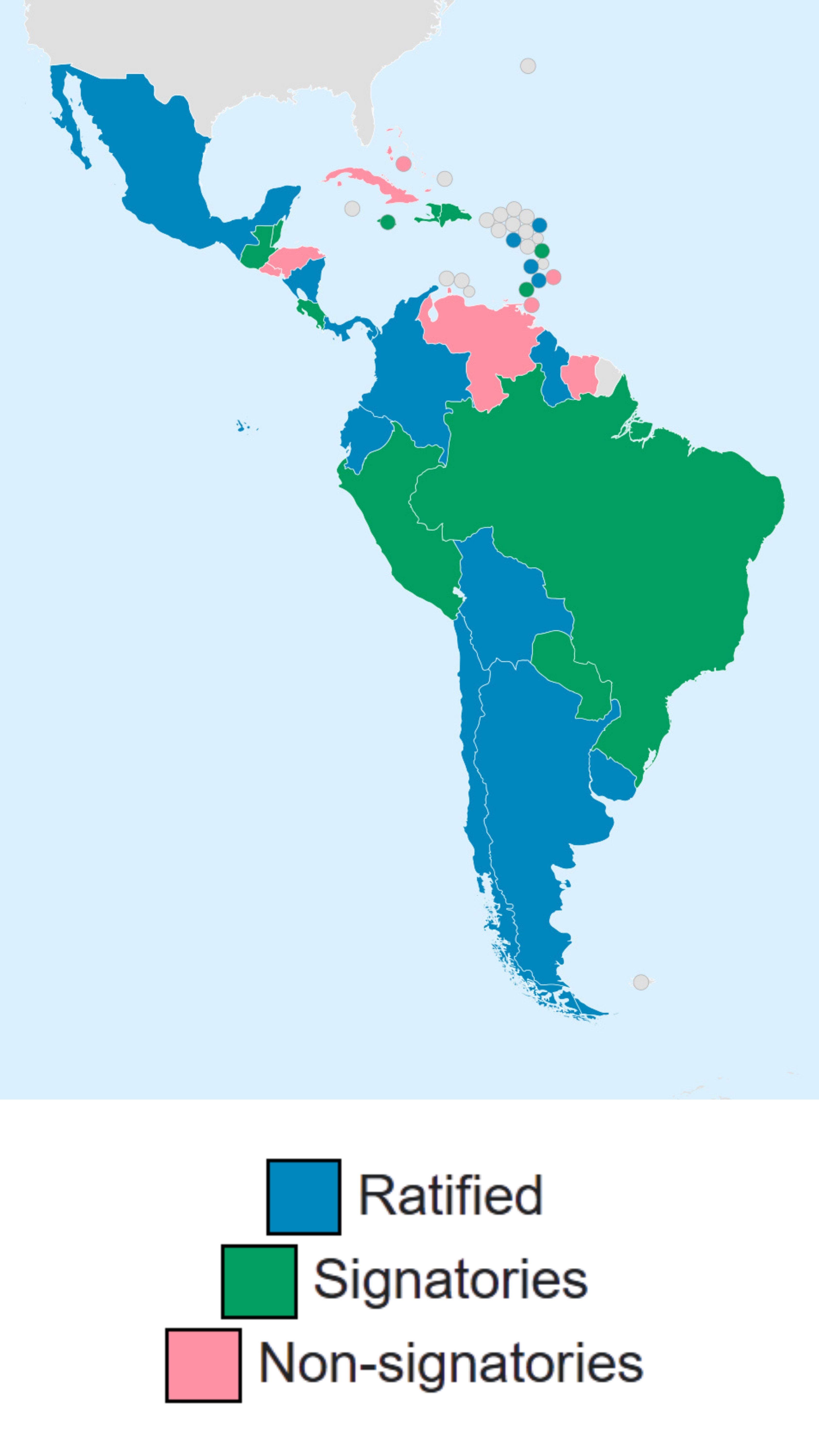
Source: Wikimedia Commons.
Some countries like Argentina or Mexico, ratified the agreement quickly. Strong opposition to the agreement, coming in particular from extractivist industries, has delayed or obstructed commitment in countries such as Brazil, Chile, Colombia, and Peru. In some cases, social mobilization in support of the agreement has been key to overcoming the reticence of business interests. Colombia – a country that we have studied in-depth with support from American University’s Public Affairs and Policy Lab – only committed to the agreement after a mass mobilization known as the Paro Nacional pressured then President Duque to sign and subsequently set in motion a political process that President Petro finished while in office in 2022.[4]
In the last few years, several Caribbean countries joined the agreement, including Dominica, the Bahamas, and Trinidad and Tobago. In fact, the fourth conference of state parties (COP4) – a multi-day event including state and elected representatives from the public – was held in Nassau in April of 2026. The region is one of the most vulnerable to climate change in the world, so their inclusion is important. However, their inclusion also introduces several complexities, since many state parties are not Spanish-speaking and do not follow civil law.
Ratification is only one of the first steps, and a growing group of countries are now working on implementation. Many countries have developed a national roadmap (hoja de ruta) for putting the treaty into practice, with support from the UN Economic Commission for Latin America and the Caribbean (ECLAC). In 2023, Argentina and Ecuador produced the earliest roadmaps; Uruguay and Chile followed in 2024, Panama in 2025 and Belize and Colombia in 2026.[5]
What Lies Ahead
At the COP4 held in 2026, state parties made several key decisions,[6] including creating an official working group on “pollutant release and transfer registers,” intended to provide publicly available information systems and verifiable data on pollutants released into natural ecosystems. State delegates also approved the composition of new leadership, choosing Saint Kitts and Nevis to take the Chair, and electing the Bahamas, Belize, Colombia and Panama, as Vice-chairs. The election of the representatives of the public — a novel feature of the agreement designed to encourage participation on environmental matters — will be held in November of 2026.
The next conference of the parties will take place in 2028. In the meantime, states will have to navigate the political shifts in the region, including potential realignments due to presidential elections. The current shift to the right in the region could mean trouble for the agreement, as detractors took office. In Brazil, a Flávio Bolsonaro administration would almost certainly lower the chances of the country ratifying the agreement – which awaits consideration in the Senate after having cleared the Chamber of Deputies in November of 2025 – to zero. In Argentina, Chile, and Colombia, even if withdrawing the agreement may prove difficult, governments may undermine the agreement by cutting public resources supporting implementation.
However, ratifying the agreement is no panacea for environmental defenders on the ground, as many implementation challenges remain. Ecuador is a case in point. While the country was the first in the world to enshrine the Rights of Nature in its national constitution in 2008 and among the first to ratify Escazú in 2020,[7] violence against environmental defenders remains high. The 2023 assassination of Eduardo Mendúa Vargas, a leader of the Indigenous Nations Confederation (CONAIE) and a key member in the implementation of Escazú who was fighting the state oil company Petroecuador, sent the country into uproar. Environmentalists demanded justice from President Guillermo Lasso, but the case remains open.[8] Presidents Lasso and Noboa have faced criticisms for not implementing Escazú and, more broadly, neglecting the constitutionally enshrined Rights of Nature. In 2025, for example, over 250 domestic and international organizations criticized the government for not implementing Escazú.[9] Still, in 2026 two environmental activists were killed in Santa Elena province, presumably due to their environmental and anti-corruption activism.[10]
Before states meet at the next Conference of the Parties in April 2028, several tests will show how strong the treaty really is. Will Brazil finally join? Will governments hollow it out from within? Will the implementation roadmaps help turn states’ commitments into concrete action? Will the newly elected representatives of the public decisively shape the path forward? The next years will show whether the agreement moves from promise to practice, and whether it can deliver for the people it was meant to protect.
[1] Global Witness. https://globalwitness.org/en/campaigns/land-and-environmental-defenders/collective-power/
[2] Authors’ calculations based on Global Witness, https://globalwitness.org/en/campaigns/land-and-environmental-defenders/collective-power/
[3] UN Treaty Collection. https://treaties.un.org/pages/viewdetails.aspx?src=treaty&mtdsg_no=xxvii-18&chapter=27&clang=_en
[4] We explore these political dynamics in Fernández Milmanda & Vilan, “Who Protects Environmental Defenders? How Domestic Interest Groups Shape Latin American States’ Commitment to the Escazú Agreement,” presented at the 2026 APSA Annual Meeting.
[5] See https://observatoriop10.cepal.org/es
[6] CEPAL. https://acuerdodeescazu.cepal.org/cop4/en/news/cop-4-escazu-agreement-approves-key-decisions-accelerating-treatys-implementation-latin-america
[7] Observatory on Principle 10, CEPAL https://observatoriop10.cepal.org/en/treaty/regional-agreement-access-information-public-participation-and-justice-environmental-matters
[8] Vargas assassination https://es.mongabay.com/2023/03/asesinato-de-eduardo-mendua-en-ecuador/
[9] Front line defenders (250 organizations protest) https://www.frontlinedefenders.org/en/statement-report/over-280-ecuadorian-and-international-organizations-speak-out-against
[10] Silva and Pezo assassination https://gk.city/2026/06/12/tres-activistas-hallados-sin-vida-ecuador-siete-meses/


