
Sonja Wolf, Research Professor, School of Government and Economics, Panamerican University, Mexico City
In February 2027 El Salvador will hold general elections. Constitutional reforms passed in July 2025 moved the presidential contest from 2029 to 2027 to synchronize it with the legislative and municipal elections, eliminated limits on reelection, and scrapped the second-round runoff requirement. The scheduling change will allow the ruling party’s embattled lawmakers and mayors to ride the coattails of the country’s popular president, Nayib Bukele.
Bukele, unconstitutionally reelected in 2024 due to a controversial 2021 ruling by the Supreme Court, will stand for a third term and is widely expected to win. The political campaigns will formally kick off in October 2026, but some of the dynamics that will characterize the electoral process are already taking shape. Chief among them are the opposition’s dilemmas: participate in the elections or boycott them, and condemn the ongoing state of emergency or run on platforms that avoid alienating voters who support the measure.
Since 2019, Bukele has swiftly and systematically dismantled the democracy that propelled him to the highest office. Behind a democratic façade exists an electoral autocracy—a hybrid regime that holds regular but unfair elections, lacks institutional checks and balances, undermines the rule of law, and imposes media and civic restrictions. The state of emergency, in force since March 2022 ostensibly to dismantle the country’s gangs, has become a tool to silence dissent. Together with a burgeoning surveillance state, it has once again reduced Salvadoran society to one of fear.
The electoral playing field has been rigged so extensively—through gerrymandered districts, an altered voting formula, and the elimination of public financing—that the opposition faces an uphill battle to make strategic gains. For Bukele, on the other hand, the elections serve no purpose other than to legitimize his power.
For now, the president’s continued high citizen support rests on three sources. First, both the conservative ARENA and the leftist FMLN came to be seen as incompetent and corrupt; widespread dissatisfaction with these traditional parties opened the door to a leader who tapped into people’s frustrations, fears, and hopes. Second, an extensive propaganda apparatus relentlessly pitches Bukele as a savior transforming El Salvador from an impoverished, violence-torn country into a safe, technologically advanced, and investor-friendly nation. Third, the state of emergency—declared in response to a gang massacre that followed the breakdown of Bukele’s secret pact with gang leaders—has reduced violence and restored freedom of movement in formerly gang-controlled neighborhoods.
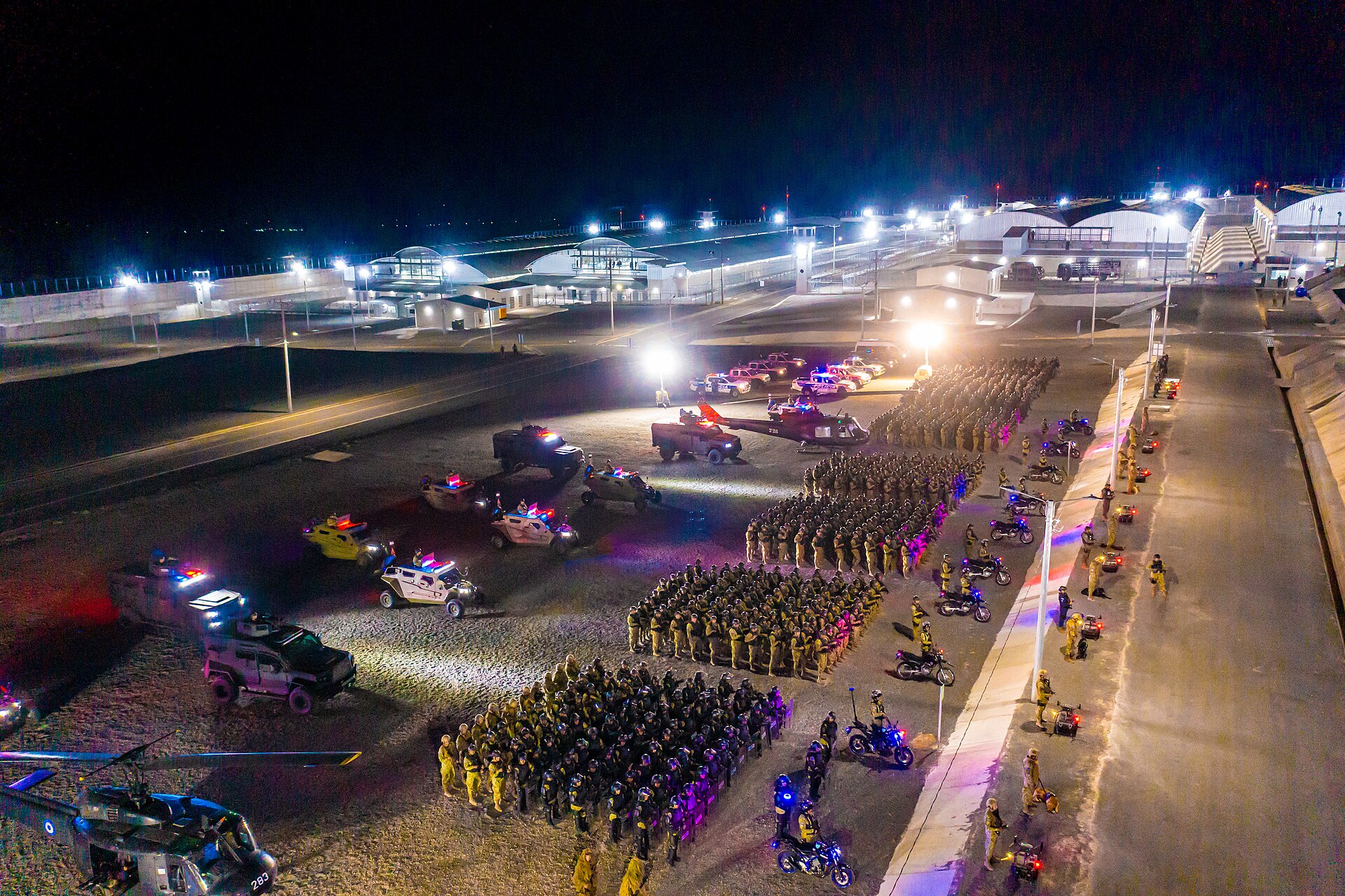
The measure continues to enjoy widespread backing; according to a recent survey by the local Jesuit university, seven out of ten Salvadorans believe it should even be extended. Images of gang members detained in the CECOT maximum-security prison have made headlines around the world. Coupled with domestic support for the president’s security policy, these visuals have fueled the myth of the “Bukele security model” that politicians across the region now tout to court voters.
In El Salvador, the manipulation of official crime statistics raises doubts about the extent to which violence has actually declined. Furthermore, the respite that the arrests of suspected gang members has brought to many communities contrasts with widespread human rights abuses, including arbitrary detention and due process violations, alongside ill-treatment and deaths in custody. By September 2026, the NGO Socorro Jurídico Humanitario had documented 570 such deaths. An international group of experts has concluded that the human rights violations committed under the state of emergency are sufficiently widespread and systematic to amount to crimes against humanity.
Compounding this issue are mass trials in which prosecutors group defendants with no gang affiliation alongside actual gang members, submitting them to bulk judicial processes and securing lengthy convictions using unsubstantiated evidence. Legal reforms have not only suspended core constitutional guarantees but have fundamentally reshaped the Salvadoran justice system. This autocratic legalism creates a veneer of legality for abuses of power, setting the current mass incarceration apart from earlier periods of mano dura policing. Today, the state of emergency can be wielded against anyone the regime perceives as a threat, as indicated by the scores of journalists and human rights defenders who have fled the country for fear of arbitrary arrest.
Salvadorans have largely accepted the premise that the state of emergency is required to keep gang members in prison. The Bukele administration stokes this belief by arguing that an opposition victory would hand thousands of gang members a “get-out-of-jail-free-card.” Even families whose loved ones have been arbitrarily detained often view the measure positively; they frequently assume that in their own case the state simply made a mistake, leading them to plead with the president to intercede and order their relative’s release.
Human rights defenders tread a fine line to avoid being labeled as defenders of criminals or terrorists. The Movimiento de Víctimas del Régimen (MOVIR), for example, explicitly demands justice and freedom solely for innocent victims. Its leader, Samuel Ramírez, has insisted: “I don’t care about the human rights of gang members.” By adopting a narrative that distinguishes between worthy and unworthy victims, advocacy groups run the risk of inadvertently reinforcing the logic that the state of emergency would be acceptable if applied only to gang members, and thereby weakening the universal fight for human rights and the rule of law.
The state of emergency also complicates the political campaigns of the remnants of the opposition. In an electoral autocracy, opposition parties might decide to boycott elections to deny the incumbent the legitimacy they crave. However, hybrid regimes typically end through the electoral arena—either when the opposition successfully mobilizes voters to defeat the autocrat or when citizens take to the streets to protest rigged ballots. For El Salvador’s opposition to achieve the former, it would require strategic coordination, a compelling alternative platform, and, above all, an insider defector capable of splitting the regime’s base. Instead, challengers continue to run under “polluted brands”—the parties that Bukele has spent much of his political capital discrediting. At present, none of these conditions are being met.
ARENA, the FMLN, and VAMOS—a centrist, Christian humanist party—all plan to participate in the 2027 elections. The first two will field presidential candidates, as will two of the Bukele-aligned satellite parties. Claudia Ortiz, a VAMOS lawmaker first elected in 2021, has emerged as the opposition’s most distinctive voice. She has argued that to become a competitive alternative to Bukele’s Nuevas Ideas, VAMOS must open its doors to independent citizen candidates and build broad civic alliances. However, she is currently facing a disciplinary process aimed at expelling her from the party, a move that threatens to further debilitate El Salvador’s fragmented opposition.
Amid the asymmetric conditions they face, opposition parties would be unlikely to act as a meaningful counterweight in the Legislative Assembly or to govern effectively in the municipalities they won. Instead, by participating, they could secure their survival within the party system, use the legislative floor to advance alternative narratives, and exercise oversight in municipal councils. The presidential candidates, for their part, may struggle to articulate a platform that resonates with voters. Rafael Aguirre, the FMLN’s presidential hopeful, has voiced support for the state of emergency — a position calculated to avoid alienating voters who back the measure, but one that risks turning away those who oppose it.
Regime critics continue to document and resist autocratization and emergency rule in El Salvador. Exiled journalists report on corruption and impunity, activists denounce human rights violations at press conferences and demonstrations, and citizen journalists cover these events or offer analysis on their social media channels. All of this is necessary, but the risk is that echo chambers will prevail over attempts to engage Bukele’s supporters and systematically deconstruct their arguments.
In other contexts, political activists and influencers go into public squares and strategically confront authoritarian or far-right supporters, interviewing them to expose contradictions or falsehoods in their claims. These encounters are then filmed and repackaged into fact-checked, contextualized social media content. Ultimately, this form of grassroots activism works by forcing people to interrogate their own beliefs and political choices. In El Salvador, such an approach might do more to blunt Bukele’s appeal than facts addressed to an audience he won over through emotion. The 2027 elections may not bring significant opposition gains, but the painstaking work of reducing polarization and building democracy from the ground up can begin now.


