South America: Is UNASUR Dead?

By Stefano Palestini Céspedes*

Three men sit at a table with microphones and two flags behind them.

President pro tempore of UNASUR, Bolivian Foreign Minister Fernando Huanacuni (middle), held a press conference last week to discuss the suspended participation of six member countries. / UNASUR SG / Flickr / Creative Commons

The decision of UNASUR’s six center-right members to suspend their participation in the group underscores the immense challenges the regional organization faces but may also lead to its effective reform.  In a letter last Friday to the Foreign Minister of Bolivia, current President pro tempore of UNASUR, his colleagues from Argentina, Brazil, Chile, Colombia, Paraguay, and Peru communicated their decision to suspend participation and budget support for UNASUR immediately.  In the past, single governments have unilaterally withdrawn from a regional organization when they considered it was not serving their interests, but a collective – albeit temporary – exit is unprecedented for an international organization in Latin America.  UNASUR now has only six fully participating members.

  • Although considered by some a left wing organization, UNASUR grew out of an idea that can be traced back to Brazilian President Fernando Henrique Cardoso’s first South American Summit in 2000. Institutionalized under the leadership of Presidents Lula da Silva and Hugo Chávez in 2008, UNASUR successfully grouped together Bolivarian, center-left, and center-right governments during its first 10 years of existence.  Under the leadership of Chilean President Michelle Bachelet, it helped avert a presidential crisis in Bolivia in 2008 and mediated in a conflict between Colombia and Ecuador.  Two years later, it adopted a democracy clause that has been applied once, in Paraguay in 2012.  UNASUR agencies such as the South American Defense Council, the South American Health Council, and the Council for Planning and Infrastructure have enjoyed broad participation and delivered regional public goods.

The six dissenting foreign ministers explained in their letter that their decision was motivated by the “need to solve the anarchy (acefalia) of the organization.”  They referred explicitly to the vacancy of the post of Secretary General since January 2017.  In fact, the organization’s requirement that decisions be by consensus perennially complicates decision-making.  The candidate with majority support – Argentine José Octavio Bordón – was vetoed by Venezuela, which the six believe is in violation of the organization’s democratic commitment.  Venezuela is currently suspended from Mercosur; was not invited to the Summit of the Americas in Lima; and has been singled out by a Resolution of the OAS.  As the application of UNASUR’s democracy clause against President Maduro is also blocked by the consensus rule, the six seemingly had few courses of action to exercise their voice.

  • Some observers say the six– all center-right governments – seek to destroy UNASUR because it is supposedly leftist or Bolivarian. However, the dissenters have not initiated formal procedures to withdraw from UNASUR, which would have de facto started its dissolution.  Indeed, there are different stances among the six signatories of the letter, with some in favor of the dissolution and others in favor of overhauling UNASUR.  The prevailing position seems to be to press the remaining countries, mainly Bolivia, Ecuador, and Uruguay, to convince Venezuela to lift its veto of Bordón.

The impasse may provide opportunities to transform UNASUR into a more effective organization.  A first positive indicator has been the political leadership of the Bolivian foreign minister; instead of overreacting to the letter, he has convened all foreign ministers (including the six signatories) to a meeting to solve the impasse.  The Chilean foreign minister and others have urged reform, which in theory could be achieved by introducing a majority-voting mechanism to overcome the sort of deadlocks that hamper the organization.  The risk is obvious:  Bolivia could fail to persuade Maduro to drop his veto, in which case at least a couple of the dissenters would probably withdraw from UNASUR.  Some of these governments have never been enamored with South American multilateralism and believe their interests are best served by cultivating relations with the United States and China bilaterally.  But bilateralism cannot provide regional public goods – such as peace, infrastructure, and economic stability – and hardly ever results in a balanced global economic insertion because it benefits the party in the stronger position.  As several South American countries – including some of the six dissenters – are facing domestic turmoil, breaches of the rule of law, and threats to good governance, a strong regional organization in which all South American states sit as members is more necessary than ever.

April 27, 2018

* Stefano Palestini Céspedes is a former CLALS Research Fellow and Postdoctoral Fellow at the Department of Political and Social Sciences at the Freie Universität Berlin, where he specializes in international organizations and regional governance.

A Summit in Search of the Americas

By Carlos Malamud*

A large round table encompasses a room with various heads of state from the Americas

Last week’s Summit of the Americas in Lima, Peru. / U.S. State Department / Public Domain

The Summit of the Americas in Lima last weekend has left its organizers and principal participants with a bittersweet feeling, leaning to the bitter.  The absence of Donald Trump, Raúl Castro, and Nicolás Maduro reflects only the existing difficulties.  The bigger problems relate to the impossibility of achieving general consensus about the big hemispheric issues, such as corruption or Venezuela, and – of even greater concern – the lack of clarity and substance of the Latin America policy of the United States.

  • The Summits initially were linked to Washington’s efforts to create the Free Trade Area of the Americas (FTAA), but since that project’s failure they have represented the United States’ ongoing interest in Latin America and the Caribbean. That explains why, since the Summit process was created in 1994, no resident of the White House has missed a Summit – regardless of how complicated national and international situations have been.  That was until Donald Trump gave priority to the conflict in Syria over his relationship with Latin American counterparts.

The disturbing thing is not just Trump’s conflict with Mexico, or his hostility toward Cuba and Venezuela.  Neither is the deterioration of the image of the United States in Latin America since President Obama’s term ended.  The fundamental problem is the lack of clear indications from the Trump Administration about its intentions and objectives in the region.  This is the case even with the closest countries.  For example, several South American countries’ exports to the United States could be affected by the trade war between Beijing and Washington.  But no one has clear answers about the policies driving these events, and no one is taking steps to reduce the impact of them or of Washington’s lack of policy.

  • Even though the official theme of the Summit was “Democratic Governance against Corruption,” it was impossible for the participants to go beyond good words and advance any global solutions. Without a doubt, this is good evidence of the weakness of regional integration.  In their Final Declaration, the leaders were unable to include either a condemnation of Venezuela or a call to disregard its Presidential elections on May 20.  Instead, what we got was a statement by the Grupo de Lima plus the United States expressing extreme concern for the situation in Venezuela.  Despite the decline of the Bolivarian project and Maduro’s isolation, Bolivia, Cuba and some Caribbean states dependent for oil on Petrocaribe remain capable of blocking hemispheric consensus.

This probably will not be the last Summit of the Americas, but the future of these hemispheric meetings depends in great part on the capacity of the governments in the hemisphere, beginning with the United Sates, to redefine continental relations and find anew the essence of the Americas.  This means more than just responding to the growing Chinese role; it means putting on the table the real problems that affect the continent and going beyond mere rhetoric about them.  For now, with hemispheric relations buffeted by the unpredictable slams issuing in the form of Trump’s tweets, it will be difficult to get there.

April 17, 2018

*Carlos Malamud is Senior Analyst for Latin America at the Elcano Royal Institute, and Professor of Latin American History at the Universidad Nacional de Educación a Distancia (UNED), Madrid.  A version of this article was originally published in El Heraldo de México.

Peru: Challenges to the Summit of the Americas

By Fulton Armstrong

Men and women standing in Peruvian congressional chamber

Martín Vizarra’s inauguration as President of Peru on March 23, 2018. / Twitter: @prensapalacio / Creative Commons

The resignation of Peruvian President Pedro Pablo Kuczynski (PPK) last weekend marks not only a deepening of the crisis of governance in that country; it also signals the greatest threat yet to the credibility of the Summit of the Americas process begun in 1994.

  • The 2016 election of PPK, a technocrat with international experience, business acumen, and a stated commitment to attacking corruption, appeared at the time to reaffirm Peru’s preference for competent, if unglamorous, government. Allegations of inappropriate dealings with the Brazilian construction giant, Odebrecht, when he was a government minister in the 2000s and as a consultant prior to the last election – which he blamed on business partners – were his undoing.  He dodged charges, fought back, made deals (including releasing former President Fujimori from prison), and reportedly deployed his allies to buy votes to oppose his impeachment – all to no avail.  Vice President Martín Vizcarra, sworn in last Friday to succeed him, had been spirited off to Canada to be Peru’s ambassador last September when allegations of malfeasance as Transportation Minister led to calls for his impeachment.  But last week he pledged to make anticorruption and transparency top priorities.
  • PPK is not the only tainted politician, or even the worst, in this drama. Two of his predecessors – Alejandro Toledo (2001-06) and Ollanta Humala (2011-16) – have been indicted for offenses involving Odebrecht.  The Congress that hounded PPK out of office is itself reportedly riddled with corruption.  Odebrecht officials have testified that PPK’s congressional nemesis, Keiko Fujimori, took $1.2 million from them in the 2011 presidential race.  The respected GFK poll indicates that, at 82 percent, Congress has a worse disapproval rating (by 1 percent) than PPK did last week – with the body’s corruption being a major factor.

The crisis comes just weeks before the eighth Summit of the Americas scheduled to be held in Lima on April 13‑14, with the overarching theme of “Democratic Governance against Corruption.”  Vizcarra has directed the Peruvian foreign ministry to proceed with preparations.  The event’s anticorruption focus could produce deeply embarrassing moments for a number of hemispheric heads of state in addition to the Peruvian hosts.  Odebrecht and the Lava Jato investigations loom large over Brazilian President Michel Temer (who, despite support in the single digits, last week announced his intention to run for reelection in October).  U.S. President Trump is engaged in warfare against the Department of Justice, FBI, and special prosecutor looking into allegations that he or his campaign colluded with Russians suspected of intervening in U.S. elections.  Mexican President Enrique Peña Nieto has stumbled from scandal to scandal.  Honduran President Juan Orlando Hernández remains under a cloud because of persistent questions about the vote count in his reelection in November.  Venezuelan President Maduro would be an obvious outcast – for both his corruption and poor governance – but his peers’ own baggage would force some restraint on their condemnations.

Other than newly inaugurated President Vizcarra’s anticorruption pledge, the conditions for a successful summit around the theme of corruption and democratic governance are obviously absent, and going ahead with it risks rendering the event a laughing stock.  Changing the theme would undermine its credibility and raise the troubling questions of what meaningful topics – trade, democracy, inequality, infrastructure investment, or counternarcotics – could replace it.  There are also tempting reasons to postpone the event, including the fact that several countries – Mexico, Brazil, and Colombia among them – will be electing new presidents this year and could bring fresh, validated ideas to a meeting next year or beyond.  Postponing the event, however, would risk braking what little momentum the Summit process has and would leave open when, if ever, the perfect summit could be held.  Crises driven by corruption (and, in the case of Venezuela, the collapse of decency) have a tendency to go on for years.  Either way, Summit organizers are going to have to scale back their expectations – with a protocolary event that sacrifices substance in April, or create a pretext for postponement and hope for a more propitious moment in the future.  The Ibero-American Summit, which includes Spain but excludes the United States and Canada, is scheduled to meet in Guatemala in November under the theme of “A Prosperous, Inclusive, and Sustainable Ibero-America.”  Perhaps that event’s timing and theme will help get regional discussions back on track.

March 26, 2018

U.S.-Latin America: Lack of Vision from Washington Didn’t Start with Trump

By Thomas Andrew O’Keefe*

A group of representatives from Latin America and China stand in a group

The Community of Latin American and Caribbean States (CELAC) hosted representatives from China in late January 2018. / Cancillería del Ecuador / Flickr / Creative Commons

U.S. leadership in the hemisphere has declined significantly over the past two decades – manifested in Washington’s inability to implement a comprehensive environmental and energy strategy for the Americas; conclude a hemispheric trade accord; revitalize the inter-American system; and stem the rising tide of Chinese influence.  In a recently published book, I argue that Washington under Presidents George W. Bush (2001-2009), Barack Obama (2009-2017), and now Donald Trump has lacked vision in Latin America and the Caribbean, and has allowed a narrow security agenda to dominate.  The most noteworthy accomplishment – the assertion of central government control in Colombia – was largely bankrolled by the Colombians themselves who also devised most of the strategy to achieve that goal.

  • President Obama’s rhetoric was the loftiest, and his opening to Cuba in 2014 changed regional perceptions of Washington. But he got off to a slow start, entering office when the United States was engulfed in the worst economic crisis since the Great Depression.  His ability to devise a bold new policy for the Western Hemisphere was further stymied by an intransigent Republican majority in both the Senate and House of Representatives after the 2010 mid-term legislative elections.

Washington’s inability or unwillingness to act is most obvious in four key areas.

  • The Energy and Climate Partnership of the Americas (ECPA) represented an opportunity for leadership on environmental issues. The United States proposed many ECPA initiatives but did not fund them, expecting the private sector or other governments to step up to the plate – which failed to happen in any significant manner.  Failure to ratify the Kyoto Protocol or enact meaningful national climate change legislation also undermined its moral authority on the issue.  Carbon offset programs would have provided an important boost to ECPA.
  • Although the United States played a predominant role in devising the parameters for a Free Trade Area of the Americas, its own positions caused it to fail. It refused to give up the options to re-impose tariffs in response to alleged dumping even if there were alternative means (such as competition policy) to redress the impact of unfair trade practices.  Washington kept discussion of the highly distortive impact of its agricultural subsidies out of the talks.  As a result, the United States was unable to offer meaningful concessions.
  • The Organization of American States (OAS) has also been a victim of U.S. neglect. Washington has pulled back from exerting leadership and, on occasion, has delayed payments of its dues.  The most effective component of the inter-American system relates to the promotion and protection of human rights, but the U.S. Senate has never ratified the American Convention on Human Rights.  The United States also rejects the binding character of decisions from the Inter-American Commission on Human Rights, opening the way for governments with deplorable human rights records to question its work.  Latin American and Caribbean governments have also shown enthusiasm for forming alternative institutions to the OAS, such as the Community of Latin American and Caribbean States (CELAC), which purposefully exclude the United States.
  • China is now the largest trading partner for many South American nations, and it could conceivably replace Washington’s influence and leadership in at least some areas, including models for economic and political reform. The boom in South American commodity exports to China allowed governments to build up their reserves, pay off debts, and liberate themselves from dependence on multilateral lending agencies centered on Washington.  Chinese banks now contribute more money, on an annual basis, to economic development projects in Latin America and the Caribbean than do traditional lenders such as the World Bank and the Inter-American Development Bank.  Moreover, this lending comes free of the conditionalities often attached to capital provided by Washington based multilateral institutions.  China’s role in building ports and telecommunication systems gives it an intelligence advantage, and arms sales have given China military influence as well.

While broad policies and political commitment behind them have been lacking, Washington has run a number of security programs in the region.  This focus, however, has often turned out to be problematic.  The Mérida Initiative, the Central American Regional Security Initiative (CARSI), and the Caribbean Basin Security Initiative (CBSI) did not resolve the myriad root causes of the drug trade and escalating violence in the beneficiary countries.  They were myopically fixated on a narrow, short-term security agenda with precarious and uncertain funding streams.  While Pathways to Prosperity and 100,000 Strong in the Americas exemplify American liberal idealism at its best, the lack of an overarching sense of purpose and political consensus behind them have led to both being woefully underfunded.  A vision for the Americas doesn’t guarantee Washington will have positive influence, but the lack of one will indeed prolong its decline.

March 16, 2018

*Thomas Andrew O’Keefe is the President of Mercosur Consulting Group, Ltd.  This article is based on his new book, Bush II, Obama, and the Decline of U.S. Hegemony in the Western Hemisphere (Routledge, 2018).

U.S.-Latin America: Resuscitating the Monroe Doctrine

By Max Paul Friedman*

Two men stand at podiums

U.S. Secretary of State Rex Tillerson (right) participates in a joint press conference with Colombian President Juan Manuel Santos (left) in Bogotá, Colombia on February 6, 2018. / State Department / Public Domain

U.S. Secretary of State Rex Tillerson’s recent re-embrace of the Monroe Doctrine ignored the accumulated knowledge of the career diplomats in his Department and has reanimated this ghost of empire past.  In 2013, then-Secretary John F. Kerry launched an Obama Administration policy that helped bring the most improvement in U.S.-Latin American relations since Franklin Roosevelt, by announcing that “the era of the Monroe Doctrine is over.”  Speaking at the University of Texas before embarking on his six-day Latin America tour earlier this month, Tillerson proclaimed that the Monroe Doctrine is “as relevant today as it was the day it was written.”

  • Only Americans who are new to diplomacy and Latin America think the Monroe Doctrine was a selfless gesture by the United States to curl a protective arm around a defenseless Latin America. When President James Monroe announced in 1823 that the Western Hemisphere was closed to future European intervention, he had not consulted any Latin Americans.  If he had, they would have pointed out that he was quite deliberately not promising that there would be no U.S. intervention.  Indeed, the United States would go on to claim the right under the Monroe Doctrine to invade and occupy half a dozen countries in the Caribbean Basin in the century that followed.
  • In his remarks, Tillerson invoked President Theodore Roosevelt’s visit to Panama, which to many Latin Americans symbolizes the first covert operation for regime change of the 20th century, when TR conspired to tear the province of Panama away from Colombia. Tillerson echoed President John F. Kennedy’s promise to “eliminate tyranny” from the hemisphere, a pledge that has unfortunate resonance also.  Kennedy made use of economic warfare, assassination attempts, and invasion to try to “eliminate tyranny” from Cuba.  Tillerson also denounced China and Russia for their growing presence in the hemisphere, arguing explicitly that the United States is the only natural partner for Latin American countries.  Of the Monroe Doctrine, the Secretary said: “It clearly has been a success.”

The Monroe Doctrine has rankled in Latin America for two centuries.  Mexico refused to join the League of Nations because its charter incorporated the Monroe Doctrine.  Diplomats and jurists in Argentina, Brazil, Chile, and Uruguay tried unsuccessfully for decades to persuade the United States to convert it from a unilateral claim of hemispheric dominance into a multilateral, mutual security agreement among sovereign equals.  The dispute came to a head at an inter-American conference in Montevideo in 1933.  “This doctrine bothers, disunites and hurts us,” said Mexico’s Foreign Secretary José Manuel Puig Casauranc.  “As long as something is not the result of a reciprocal arrangement or obligation, even if it is a favor, it bothers and humiliates.”  In an effort to hem in U.S. unilateralism, the Montevideo conference passed a resolution declaring that “no state has the right to intervene in the internal or external affairs of another.”  That declaration became the core of Franklin Roosevelt’s Good Neighbor Policy, a rare period of inter-American respect made possible by Washington’s restraint.

Latin American reactions to Tillerson’s speech and visit were tepid, but his rhetoric could not have helped him win friends and influence people.  President Obama and Secretary Kerry’s efforts to follow FDR’s tradition brought accolades and cheering crowds from Havana to Buenos Aires.  Now, in the context of Trump’s boasting in his State of the Union speech of having increased pressure on Cuba and Venezuela for regime change, and his earlier remark that he was preparing a “military option” for Venezuela, Tillerson’s speech suggests that the President’s interventionist instincts will not be restrained by his chief diplomat.  Referring to China and Russia, Tillerson concluded that “Latin America does not need new imperial powers.”  But his resurrection of the specter of Monroe, wittingly or not, signals that he would prefer a return to the old one.

February 22, 2018

*Max Paul Friedman is Professor of History and Affiliate Professor of International Relations at American University.

Summit of the Americas: Awkward Agenda, Dim Prospects

By Eric Hershberg

Large group of men and women stand awkwardly while waving to a crowd

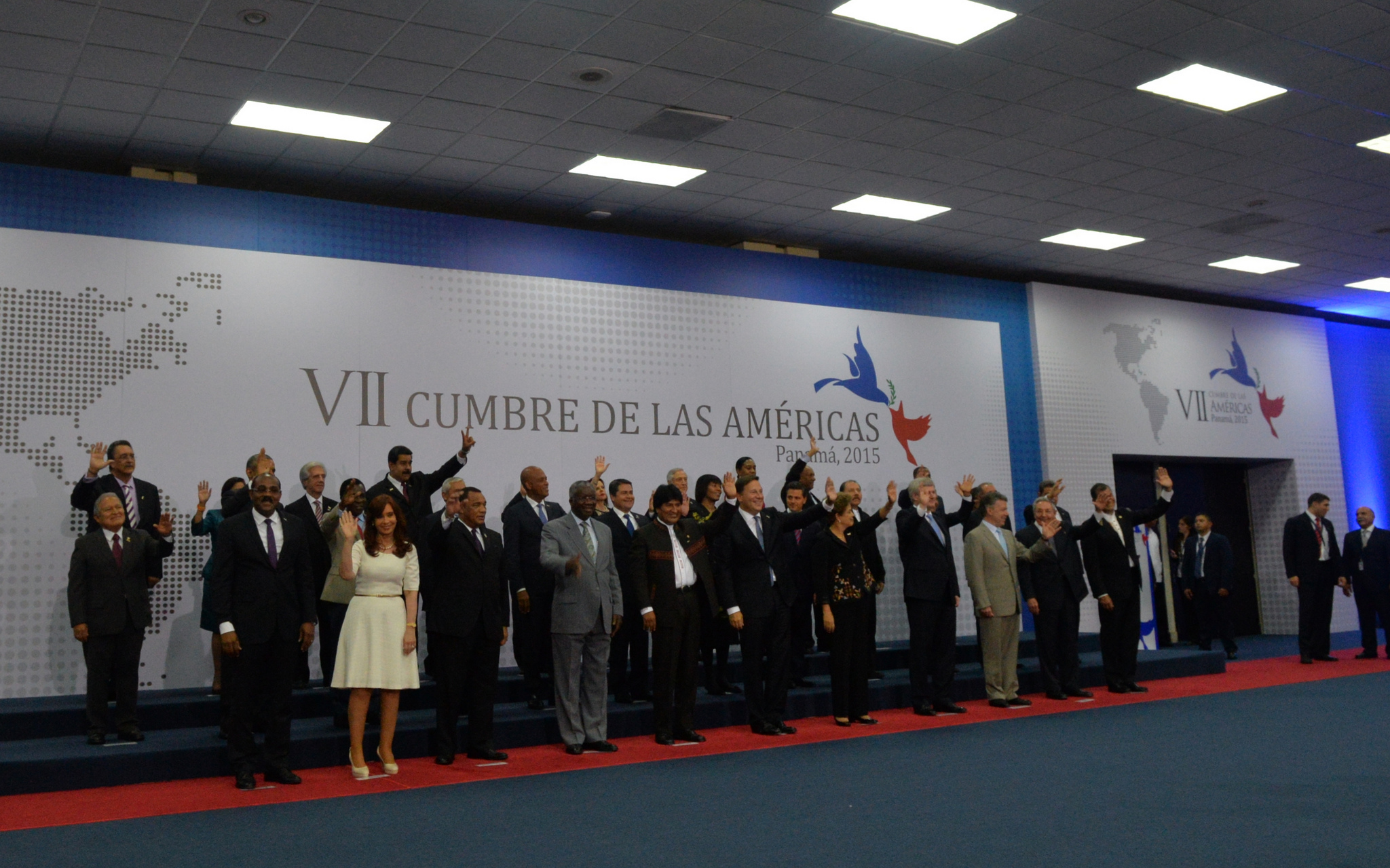
Leaders from the hemisphere during the last Summit of the Americas in 2015. / Maria Patricia Leiva / OAS / Flickr / Creative Commons

Preparations for the 8th Summit of the Americas, scheduled for April 13-14 in Lima, face a number of challenges.  Trump Administration measures have upended longstanding assumptions throughout the hemisphere about Washington’s agenda in the region and beyond.  No less distracting is the wave of ongoing corruption scandals in Latin America and impending elections in numerous countries.

  • The three presidential summits attended by President Barack Obama (2009, 2012, and 2015) arguably were shaped by the standing of the United States in the region. Emphasizing “change we can believe in” at his first presidential summit, in Trinidad, Obama pledged that the United States would be a partner rather than an embodiment of hubris.  Leaders across the ideological spectrum applauded.  Yet the second, three years later in Cartagena, was a disaster for Washington, with even friendly heads of state lambasting the President for continuing an unacceptable Cold War line on Cuba and rigid drug control policies.  It was in the wake of this embarrassment that Obama finally moved to change policy toward Cuba.  This watershed, supplemented by advances in other areas overseen by Vice President Biden, made Obama’s third summit, in Panama in 2015 – attended by Cuban President Raúl Castro – a much more positive experience.

This year’s Summit seems unlikely to produce advances – substantive or symbolic – and indeed has the potential both to highlight conflicting agendas and even to provoke widespread ridicule.

  • Under normal circumstances, the partial but damaging reversal of Obama’s Cuba opening would elicit hostility from Latin American leaders, but tensions over Trump’s dramatic departure from traditional U.S. positions on trade and climate, and his caustic posturing on immigration policies that especially impact Mexico and Central America, may overshadow regional bewilderment at Washington’s renewed hostility towards Havana. Latin American countries that Trump jilted at the altar when he summarily withdrew the United States from the Trans-Pacific Partnership (TPP) have begun moving on – negotiating trade deals with China while uniting with Canada and seven Asian countries to form “TPP 2.0.”  That chauvinism and race, not security, are at the heart of Trump’s “Great Wall” proposal is widely understood and resented in Latin America.
  • Trump’s postures and policies are by no means the only strain on the summit agenda. Venezuela’s meltdown and impending elections are of grave concern to virtually all leaders who will attend, whether President Maduro does or not, yet there is no consensus on what to do about the problem and the humanitarian emergency it has spawned.  Questions about the legitimacy of Brazilian President Michel Temer diminish the standing of the hemisphere’s second largest democracy.  Tensions swirling around the Summit’s host – Peruvian President Pedro Pablo Kuczynski (PPK) – are also intense.  PPK is but one of numerous incumbent and recent Latin American presidents under siege by corruption allegations.  Strong evidence of corruption among presidents of Latin American countries big and small will hardly be news to anyone, but the scope of the problem – and the strength of public rejection of it – means many governments will come to the Summit wounded and distracted.

The irony that the theme of this year’s Summit is “Democratic Governance against Corruption” will be lost on no one, as the Lava Jato investigations and lesser inquiries reveal the venality of government after government.  OAS Secretary General Luis Almagro, a co-host of the Summit, has done his fair share to rescue the region from authoritarian and corrupt leaders – challenging both Maduro and the tainted reelection of Honduran President Juan Orlando Hernández – but few others in the hemisphere have lived up to the lofty rhetoric about democracy and anti-corruption at previous summits.  The Peruvian national host is hardly in a position to steer the Summit to take on Trump on matters such as TPP.  If he were not so badly tainted by recent events, he could have represented the globalists in the Americas who are convinced that a misguided America First posture issuing from Washington amounts to a U.S. abdication of leadership on trade, climate, and other pressing matters.  Yet it is now doubtful whether he will be able to say anything more than “Welcome to Peru.”  The smiling faces in the protocol photos will conceal the striking disjuncture between the Summit agenda and its protagonists.

 February 6, 2018

Lima Group: Committed to Democratic Principles?

By Nicolás Comini*

Group of men and women stand at a podium

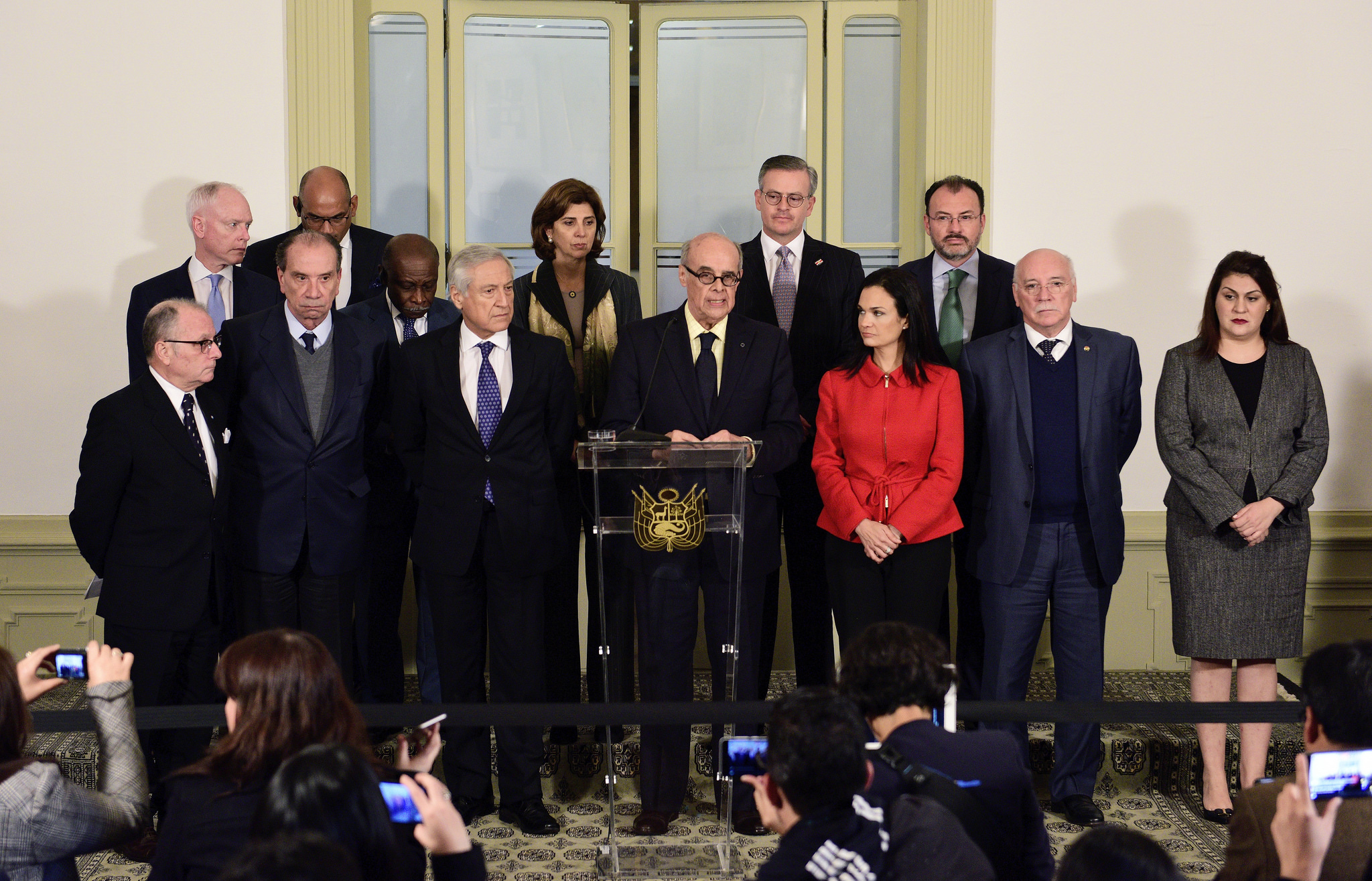
Government officials from different Latin American countries met in August 2017 to sign the “Lima Declaration,” establishing the Lima Group. / Ministerio de Relaciones Exteriores, Perú / Flickr / Creative Commons

The “Lima Group” – an informal alliance of 12 Latin American countries created to observe the sensitive situation in Venezuela – has shown that its defense of democracy in the hemisphere is inconsistent.  Argentina, Brazil, Canada, Chile, Colombia, Costa Rica, Guatemala, Honduras, Mexico, Panama, Paraguay, and Peru have on at least a handful of occasions condemned Venezuelan President Nicolás Maduro for stoking political violence, holding political prisoners, committing electoral fraud, and engaging in other abuses, justifying their positions as based on ethics, morals, and good practices.

The reactions of the Lima Group and its leading members to the situation in Honduras since that country’s presidential election in November, however, suggests that the values they espouse do not have universal application.  After OAS Secretary General Luis Almagro declared that the election lacked credibility and called for new elections, some countries’ pro-democracy fervor faded.

  • Argentine President Mauricio Macri’s administration quickly recognized Honduran President Juan Orlando Hernández’s victory and officially declared its “disposition to continue working for the development of closer ties of friendship and more cooperation between the two nations.” The Brazilian foreign ministry expressed its “commitment to maintain and strengthen the ties of friendship and cooperation that traditionally have united both countries.”  In Mexico, President Enrique Peña Nieto’s government quickly recognized Hernández as well, calling on “Honduran society to support dialogue in order to preserve peace and democratic stability in that sister nation.”

The discrepancies between the group’s rhetoric and actions appear to be rooted in various reasons.

  • Political alignments take precedence over values. Honduran President Hernández has been active in the group’s (and indirectly the OAS’) efforts on Venezuela.  Honduras is a member of the Lima Group, and Hernández is perceived by conservative governments as an ally to contain the spread of the left.  The risk of massive Venezuelan population displacement, with profound potential consequences for neighboring countries, contrasts with the situation in Honduras.  With the region entering a new election cycle, moreover, incumbents’ lack of support for Almagro’s position signals that they do not want the OAS messing around in their own electoral processes.
  • These governments also see Hernández as a strategic United States ally in Central America in combating drug trafficking, transnational criminal networks, money laundering, and irregular migration. Many of the governments may also refrain from criticizing the belief that Tegucigalpa benefits from the presence of 1 million Hondurans in the United States (more than half of whom the State Department says “are believed to be undocumented”).  In addition, Honduras was one of the eight countries that supported President Donald Trump’s rejection of the UN General Assembly Resolution asking nations not to locate diplomatic missions in Jerusalem.

The crises in Venezuela and Honduras are indeed different, and the international community’s interests in them are naturally different.  Maduro’s and Hernández’s failings affect other countries’ political and economic equities in different ways.  Maduro’s undemocratic actions increase unpredictability in the management of oil and other sectors of foreign interest, whereas Hernández’s represent predictability, if not stability, in areas that Washington cares about and Buenos Aires, Brasilia, and the rest of Latin America do not.  But the high-sounding values at stake – democracy, institutionality, and rule of law – are the same in both countries.  While Venezuela’s population is three times the size of Honduras’ and its political crisis arguably three times more advanced, the moral responsibility – and moral authority – of the Lima Group or its member nations is many times greater in a small, vulnerable, poor country like Honduras.  Security forces have gunned down some three dozen oppositionists and protestors since the November election, and allegations of human rights violations have soared, but Latin America’s major democracies have been silent.

  • The failure to support the OAS’ call for new elections was not just a stab in the back of Secretary General Almagro; it revealed that their rhetoric about the OAS Democracy Charter – embodiment of democratic values they demand be respected in Venezuela – are not as universal as they say. When the Lima Group last Tuesday (with considerable justification) rejected the Venezuelan National Assembly’s call for an early presidential election, the Hernández government’s signature was there alongside the others.  If universal democratic values and principles are not for universal application – if even an informal grouping will not criticize a small actor with whom they do not have major equities at stake – their value is much diminished.

January 30, 2018

* Nicolás Comini is Director of the Bachelor and Master Programs in International Relations at the Universidad del Salvador (Buenos Aires) and Professor at the New York University-Buenos Aires.  He was Research Fellow at CLALS.

Canada and Mexico Face Uncertainty of NAFTA Renegotiation

By Daniela Stevens*

Two men stand at podiums with Mexican and Canadian flags behind them

Canadian Prime Minister Justin Trudeau gives a presentation with Mexican President Enrique Peña Nieto during an official visit to Mexico in October 2017. / Presidencia de la República Mexicana / Flickr / Creative Commons

Facing the growing possibility that the Trump Administration is walking away from the North America Free Trade Agreement (NAFTA), Mexico and Canada are beginning to look for trading partners beyond the United States.  The interdependencies binding the three are strong.  Both Mexico and Canada have deep commercial ties with the United States, which imports about 80 percent of Mexico’s exports and about 70 percent of Canada’s.  Both have significant leverage vis-à-vis the United States as well.  U.S. auto and agriculture industries have a major stake in free trade with Mexico, which also provides important cooperation on security issues and controlling Central American migration.  Liberalization measures within the energy sector by the current Mexican administration make Mexico a strategic partner in terms of energy security.  Canada buys about 19 percent of U.S. exports.

But these ties are fraying as conversations drag on.  Trump Administration proposals are hurting the talks; especially contentious are changes in the “rules of origin” (since the United States proposed increasing the U.S. content of autos to 85 percent from the current 62.5 percent) as well as the inclusion of a “sunset clause” that would make NAFTA expire unless it is renegotiated every five years.  NAFTA’s Article 2205 lets either of the three member countries announce its withdrawal from the accord with six months’ notice.  Canadian and Mexican trade officials have not given such notice yet, but they show signs of heading in that direction.  Both have held high-level meetings with counterparts from South America and Europe, according to official and non-government sources.

  • Mexican President Peña Nieto’s administration has expressed a preference for leaving the negotiations over accepting “a free trade agreement that ceases to promote free trade.” President Trump has said that his administration would be willing to negotiate a free trade agreement with Canada alone if the NAFTA talks fail.  However, Canadian Prime Minister Trudeau’s government has stated a preference for keeping the trilateral alive rather than resorting to bilateral agreement, since the terms of the U.S.-Canada deal were more outdated than the NAFTA’s.  The two presidents have been reluctant to take these actions because they apparently believe, as do many experts, that dismantling NAFTA would inevitably create uncertainty and inefficiencies for the three economies.  For example, the auto sector relies on three-way product flows that move several times across borders to be assembled into finished products.  Canadian and Mexican auto parts makers have a direct stake in each other’s dealings with the United States.  Even small duties would add up.
  • Nonetheless, some increased trade and a bilateral free trade agreement between just Mexico and Canada is possible. The two countries originally joined NAFTA to protect their access to the U.S. market, not to obtain access to each other’s.  Canadian public opinion and media reflect continued disinterest in Mexico, which is viewed as unstable due to drug-related criminality and corruption.  However, as the completion of a satisfactory NAFTA renegotiation is unlikely, Canadians are exploring deepening the bilateral link.  Mexican interest in Canada is also growing, according to some specialists.  Beyond North America, moreover, Canadians and Mexicans are exploring trade and investment diversification.  Canada is looking for increased cooperation with Latin America, in particular within the Pacific Alliance, a free trade partnership that includes Mexico, Chile, Peru and Colombia, and of which Canada is already Associate Member.  Mexico started a renegotiation last January of its free trade agreement with the European Union, which parties hope to finalize in the next few days.  It has begun warming up neglected ties with the Southern Cone and has already pledged to deepen ties with China.

Trade experts convened recently within the framework of American University’s Robert A. Pastor North America Research Initiative (NARI) were unanimous that that a trilateral agreement that protects the interests of all three partners would be the optimal outcome, but few observers of the NAFTA talks are confident that the Trump Administration will soften its position.  Canada’s commitment to a trilateral renegotiation should exert more pressure on the U.S. to compromise while strengthening both Canada and Mexico’s negotiating positions.  In the event of U.S. withdrawal from NAFTA, however, the two can expand their trade and investment relationship by lowering barriers further through modernization and e-commerce.  In addition, trade can potentially expand between the two since they have similar approaches to achieving various commitments of the Paris Accord involving energy projects and greenhouse gas emissions reductions.  Pastor Scholars concluded that both countries will have to carry out public campaigns to explain to their constituencies the benefits of continued cooperation, either trilateral or bilateral, if the United States significantly alters or abandons NAFTA.  Mexico and Canada have options outside North America in the quest for trade and investment diversification – even though their preferred scenario is a stronger NAFTA.  China, South America, and the European Union arise as the most readily available partners.

December 21, 2017

*Daniela Stevens is a Ph.D. Candidate in the American University School of Public Affairs and a Pastor Scholar.  Her research focuses on national and subnational policies that put a price on carbon emissions.

And the Winner is… Trump in Latin America

By Nicolás Comini*

Donald_Trump_and_Mauricio_Macri_in_the_Oval_Office,_April_27,_2017

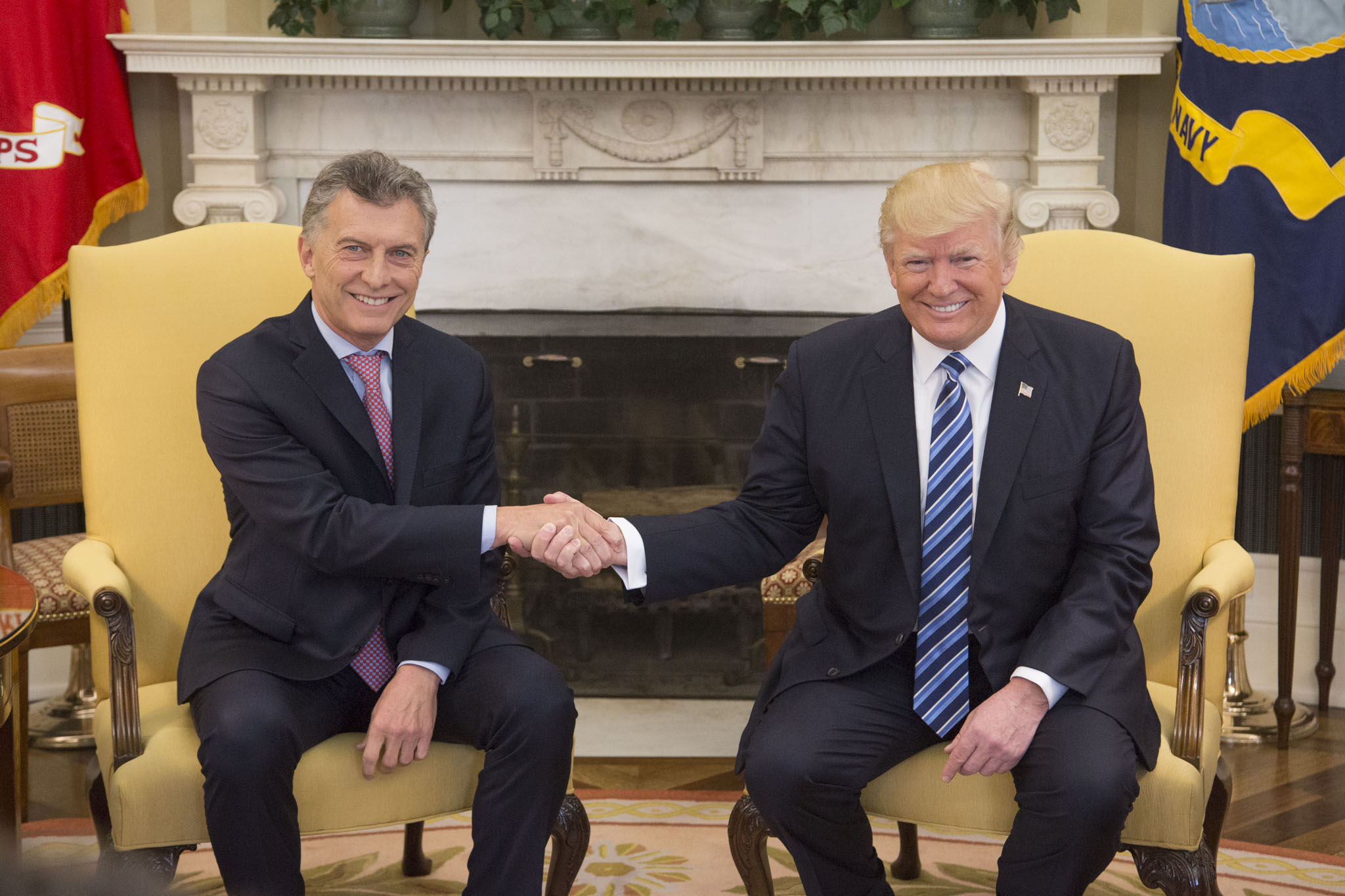
U.S. President Trump and Argentine President Macri meet in the Oval Office. / Official White House Photo by Shealah Craighead / Wikimedia / Creative Commons

Criticism of U.S. President Donald Trump’s policies toward Latin America ranges from mild to furious in the region and among many U.S. Latin America watchers, but that anger is not likely to drive greater regional unity and demands for a more balanced relationship.  Trump’s rhetoric – emphasizing sovereignty, nationalism, and protectionism – have long been popular concepts in many countries of the region.  During Latin America’s recent “turn to the left,” for example, political leaders embraced a developmentalist emphasis on using tariffs and non-tariff trade barriers to give domestic industries an advantage in national economic expansion strategies.  But the U.S. President’s statements have generally infuriated not only the left as reflecting bias on an array of issues, such as immigration, but also the right.

  • Trump’s policies contradict the prescriptions that Washington has been advocating – and most conservative politicians have embraced – for Latin America for many years. Those prescriptions have emphasized free trade but touched on other issues as well, such as the shift (symbolic and material) of resources from traditional national defense to the “war on drugs.”  Trump’s “America First” approach undercuts his natural allies in Argentina, Brazil, Mexico, and elsewhere.  It has also given their leftist opponents a sense of legitimization of their anti-Americanism speeches, something that is surging also because of Washington’s new policies toward Cuba.
  • The U.S. summary abandonment of the Trans-Pacific Partnership (TPP), conservatives’ last great hope for deeper trade integration with the United States, left them angry. According to the ECLAC, 73 percent of all FDI in Latin America in 2016 came from the United States (20 percent) and the European Union (53 percent).  Individuals with strong anti-Communist credentials in Colombia, Chile, and Peru are all flirting with joining China’s Regional Comprehensive Economic Partnership (RCEP).

Regional organizations show no sign of providing leadership in how to respond to U.S. policy.  UNASUR is fading rapidly, in part, because it was labeled by the new conservative governments as too Bolivarian and anti-American.  Something similar is happening with the CELAC.  MERCOSUR is struggling, in part, because of the political tumult in Brazil.  Indeed, most governments are trying to remain friends with Washington, prioritizing bilateral agendas in detriment of regional (multilateral) institutions and mechanisms.

The surge in resentment toward Washington – within and among Latin American countries – is unlikely to lead to increased regional unity.  Internally, the left and right may agree that Trump is harming their interests, but their reasons are different and prescriptions for dealing with it are far apart.  On a regional basis as well, the current context accelerates the atomization of the region – and threatens to expand the bargaining power of the great powers of the United States, China, Germany, or Israel.  Although China is making inroads, in the end the United States has, and will retain, the greatest influence in Latin America – and the lack of efficient regional decision-making will prolong that situation.  Latin American fragmentation will create an image of acquiescence – and President Trump will think he is not doing so badly in the region.

October 18, 2017

* Nicolás Comini is Director of the Bachelor and Master Programs in International Relations at the Universidad del Salvador (Buenos Aires) and Professor at the New York University-Buenos Aires.  He was Research Fellow at CLALS.

Brazil’s Foreign Policy:  A Regressive Path?

By Gilberto M.A. Rodrigues*

36028591940_8475019dc8_b

Brazilian Foreign Minister Aloysio Nunes speaks at a MERCOSUR meeting regarding the situation in Venezuela. / Divulgação / Flickr / Creative Commons

President Dilma Rousseff’s foreign policy was less active than President Lula’s, but Brazil has lost prominence in international politics even faster since her impeachment almost exactly one year ago.  According to the Soft Power 30 survey, Brazil now ranks 29th in international influence, having ranked 24th in 2016.  One reason is both domestic and political:  President Temer’s government has had to struggle to be recognized as legitimate.  The other is strategic: a wrong bet made by the new heads of Brazil’s foreign affairs.

  • Temer left the Ministry of Foreign Relations in the hands of the Social-Democratic Party (PSDB), appointing São Paulo Senator Jose Serra – at that stage a potential presidential candidate – as foreign minister. Temer and his PSDB partners’ most important project was to align Brazil more closely with the United States.  In parallel, they sought to progressively dismantle the South-South international policy that President Lula championed and President Rousseff continued, with its focus on the BRICS countries.
  • Their approach was based, however, on the expectation that Hillary Clinton would win the U.S. election, and they had no “Plan B” for collaboration with the Trump Administration and its significantly different view toward Latin America and Brazil. Unable to rescue the heart of his policy, Serra resigned after nine months, claiming health issues, and another PSDB senator and political ally, Aloysio Nunes, took the job with a clear plan to align Brazil with the international market.  Brazil’s application to the OECD was done fast and without controversy.

At the same time, several important issues have been disempowering Brazil’s foreign policy.

  • MERCOSUR and UNASUR. The most important diplomatic capital Brazil built in the past 20 years – launched by President Cardoso, deepened and revamped by Lula, and maintained by Dilma – was the broad South American cooperation built in MERCOSUR and, later, UNASUR.  Temer has refocused the former on trade and essentially abandoned the latter.  The country’s vision for broad integration has fallen prey to ideological suspicions.
  • Venezuela. By shaming President Maduro as a dictator, Brazil essentially disqualified itself as a possible neutral player in efforts to resolve the Venezuela crisis, the most important challenge in South America today.  Many Brazilian observers believe Brasilia’s absence could mean a blank check to a still unknown and unpredictable White House policy on Latin America.  President Trump’s recent suggestion of a possible military intervention in Venezuela has deepened those concerns.
  • Corruption. The Temer Administration is poorly positioned to push for the sort of initiatives that many governments and societies need to combat corruption.  The problem has deep roots, but Temer’s rise to power in the wake of a campaign attacking alleged corruption by Lula and Dilma gives greater salience to his own shortcomings.  The Attorney General’s Office and the Lava Jato investigators have accused him and most of his ministers of corruption.  This makes Brazilian foreign policy fragile and contradictory in this field despite the government’s efforts to cast itself as a champion of integrity.  It is much more like “a saint with feet of clay,” according to a Brazilian saying.

President Temer and his Foreign Ministers’ two-pronged approach to foreign policy entails risks for Brazil’s international clout.  By deconstructing the so-called “ideological diplomacy” of Lula, Dilma, and their Workers Party, the new team is eliminating an agenda that has achieved unity, albeit in fits and starts, of the continent around a series of issues relevant to them all.  Their efforts to refocus policy on trade and financial issues – essentially a neoliberal agenda that most of the region has rejected – may ultimately yield them economic and political benefits at home, but at the cost of moving Brazil off center stage and reducing its ability to provide regional leadership in the future.  The country’s inability to drive a regionally-supported resolution in Venezuela is already being felt.  Even if this reorientation of foreign policy is ultimately successful, the political capital that gave Brazil a higher international profile as a major world democracy will be difficult to rebuild. 

September 6, 2017

*Gilberto M.A. Rodrigues is Professor of International Relations at the Federal University of ABC (UFABC) in Brazil, and was a CLALS Research Fellow in 2017.