Argentina: Excessive Optimism?

By Nicolás Comini*

Man delivers a speech on an airfield.

Argentine President Mauricio Macri. / Cancillería del Ecuador / Flickr / Creative Commons

Argentine President Macri’s Cambiemos coalition won an overwhelming victory in last month’s legislative elections – a step toward fulfilling his 2015 promise of a “revolution of joy” – but it’s not clear yet whether the administration’s optimism translates into national hope.  The coalition won in 15 of the 24 provinces of the country, including the five largest jurisdictions – the City of Buenos Aires, Buenos Aires, Córdoba, Mendoza, and Santa Fe.  Government officials and Macri’s supporters have expressed optimism that the economy will turn around and political confrontation will be overcome.  Macri won the presidency in 2015 with an alliance that made optimism – and the appearance of optimism – a central theme for overcoming what he called the polarization generated by his predecessor, former President Cristina Fernández.  His discourse was rooted in the ideas of change, happiness, efficiency, and meritocracy.

  • Even critics acknowledge that the government has generated innovation in terms of political discourse and representation, rooted in a greater horizontality of leadership and greater citizen access to public officials. News of some officials’ questionable business practices as revealed in the “Panama Papers” and “Paradise Papers” has caused little or no backlash.  Second, the idea of “normalization” of the country, supported by the media, has had a positive impact on part of society.  GDP growth at almost 3 percent this year and the lifting of exchange controls and imports have also buttressed this theme.  The unfavorable trade balance, with a deficit of US$765 million in 2017, has not been a factor.  Third, the government is still able to blame the country’s problems – including high levels of inflation and indebtedness – on the “received inheritance” from his predecessors, whose rule implied corruption, social polarization, and isolation from the world.
  • Rejection of the legacy of Cristina Fernández and her husband/predecessor, Néstor Kirchner, also seems to be one of the Macri government’s greatest assets. Even though Cristina is the most popular candidate in the opposition, her rejection among the broader population is greater; many of the votes that the government’s allies garnered were “anti-Kirchner” votes.  Cristina won a seat in the Senate, but in national politics, there’s a growing sentiment of “anyone but Cristina,” while a civil war simmers within the ranks of her Peronista base.  The political rise of Macri ally María Eugenia Vidal as governor of the Province of Buenos Aires – historic bastion of Peronismo and the country’s main electoral district – attests to these troubles.

Macri’s gains indicate a significant strengthening of the government, which is key to the reform package that the administration launched almost immediately after the election.  Proposals include aggressive changes in tax and labor matters.  While the tax reform has triggered battles with some large corporations, such as Coca-Cola, that will pay higher taxes, the labor reform has broad support from employers.  The latter faces strong resistance from a large part of society and, above all, of the union and opposition sectors, who fear that it, similar to one already carried out in Brazil, will contribute to job insecurity.  Macri’s increasingly forceful discourse on reducing public employment has also raised concerns despite his assurances that reducing state structures will help create private-sector jobs.

British theorist Terry Eagleton has said that an optimist is someone who thinks that things will improve even if there are no reasons for it.  The optimism of the government and its supporters is as easy to understand – there are some clear reasons for it – as it is palpable.  Macri has a strong government in a Latin America plagued by weak governments.  He not only has power in parliament; the country’s large corporations, mass media, security forces and, of course, an important part of the people are also behind him.  But Argentina is accustomed to living in cycles.  Expecting that in Argentina one or two or even three electoral victories will produce a durable revolution and fundamentally change those cycles, as the current government’s rhetoric suggests, may not be warranted by the facts.  Each administration usually assumes that the previous one did things absolutely wrong, and they will do better this time.  But this kind of impulse has an expiration date.  Joy and good vibes can have a positive impact on a society’s feelings about itself, but a real lasting solution will require addressing the underlying causes of the country’s polarization, poverty, and exclusion.  This implies, above all, state policies and continuity through different administrations.

November 15, 2017

* Nicolás Comini is Director of the Bachelor and Master Programs in International Relations at the Universidad del Salvador (Buenos Aires) and Professor at the New York University-Buenos Aires. He was Research Fellow at CLALS.

Brazil: Surge in Divisive Politics

By Marcus Vinicius Rossi da Rocha*

Two politicians debate

Brazilian right-wing politician Jair Bolsonaro disparages fellow politician Maria do Rosário during a debate on violence against women. / Marcelo Camargo / Agência Brasil / Wikimedia / Creative Commons

Political tumult, constant corruption scandals, and widespread popular loss of confidence in political institutions have given rise to divisive right-wing movements that, although not poised to win office in the 2018 elections, are laying the groundwork to have an impact on Brazilian politics in coming years.  Brazil will elect a president and both houses of Congress in October 2018, after five years of economic crisis (3.6 percent contraction in 2016); corruption scandals (President Michel Temer is still under investigation in the Lava Jato probe); low confidence in government (Temer has 3 percent approval); and political instability.  Many observers believe Brazilian democracy could be in peril.

Two factors in particular – the economic decline and the odor of taint surrounding Temer and the political class – are fueling a surge in right-wing and populist politics.  Conservative and market-oriented agendas are, unsurprisingly, gaining momentum, but also are challenges to the country’s three decades of democracy, including the defense of torture and military dictatorship.  The surge is seen in three main areas:

  • The Free Brazil Movement (Movimento Brasil Livre, MBL) is a youth libertarian movement born in early 2014 following the mass street protests of 2013, which its leaders helped organize. While promoting free speech, less government, individual liberty, and market-oriented reforms, its agenda emphasizes moral issues as an electoral strategy.  It mobilizes protesters against left-leaning politicians and gay art exhibits and succeeded in shutting one event down on spurious grounds.
  • Jair Bolsonaro, a former army captain turned lawmaker, is famous for his defense of torture and the death penalty, his opposition to human rights protections, and his praise for the military dictatorship that ruled Brazil in 1964-85. Proud of his lack of political correctness, he compares himself to U.S. President Donald Trump, and he casts himself as engaged in a moral struggle to save the nation.  He promises to withdraw Brazil from international human rights agreements; opposes gay marriage; and wants to adopt the death penalty and loosen gun laws.  In a speech on the House floor one time, he told a female legislator and human rights defender, “I do not rape you because you are not worth it.” He was reprimanded by the courts for this and other statements, but a leading public opinion institute Datafolha shows him with almost 20 percent of popular support.
  • A handful of senior active-duty and reservist military officers also seem to be crossing the line with greater frequency, openly speaking about “constitutional military intervention.” These officers espouse a highly disputed interpretation of Article 142 of the Constitution – which states that the “Armed Forces aims … to defend the homeland, to assure the constitutional powers, and, by initiative of any of these powers, to assure law and order” – to argue that the Constitution gives the Armed Forces authorization to intervene in politics.  At an event a few weeks ago, General Antonio Hamilton Mourão said that if the judiciary does not fix the government’s corruption problem, the Armed Forces could.  The high command remained silent.

Few analysts believe that the 2018 elections will be obstructed in any way, but the years of crisis, compounded by the polarizing rhetoric and activities of frustrated conservatives, will put checks and balances to test.  A military coup is highly unlikely – the Army is not eager to run the state again – but the apparent politicization of institutions sworn to defend the rule of law could cause others to flout the Constitution.  Congressman Bolsonaro does not appear likely to score big in 2018.  His party is small, but his popularity could very well give a boost to similarly minded groups poised to gain ground in Congress. This could lead to more than a continued shift toward the interests of construction firms, financial system, and agriculture sector that support them; it could portend a dismantling of decades of work to build democratic institutions; end torture and police brutality; and protect citizens’ rights to choice, freedom from discrimination based on sex or sexual orientation; pro-choice laws, gay rights, and indigenous rights.  Three decades of democracy won’t be reversed easily, but the next several years call for healing, not a new politics of division.

 October 5, 2017

* Marcus Rocha is a Ph.D. Candidate in Public Policy at the Federal University of Rio Grande do Sul (Brazil) and a CLALS Research Fellow specializing in the Brazilian executive branch and corruption in municipalities.

Venezuela: Can Trump’s Coercive Diplomacy Help?

By Michael McCarthy*

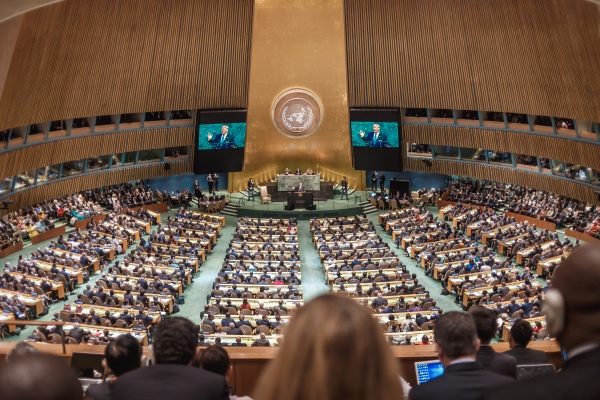
A large auditorium-style room filled with people watching a speaker at the front

U.S. President Trump addresses the United Nations General Assembly on September 19, 2017. / John Gillespie / Flickr / Creative Commons

U.S. President Trump’s new rhetorical attacks and financial sanctions against the Venezuelan government suggest a shift toward coercive diplomacy aimed at achieving regime change, but U.S. power faces significant limits in the conflict-ridden country.  At the UN General Assembly on Tuesday, Trump called President Maduro an authoritarian and said “this situation is completely unacceptable and we cannot stand by and watch.”  Washington’s approach emphasizes sticks – sanctions against President Maduro, senior advisors, and threatened action against the oil sector – over carrots, while also voicing support for the opening of new mediated face-to-face talks between Maduro and the opposition.  A contact group of six Latin American and four European countries is promoting the talks, with the backing of UN Secretary General and the Vatican, to help avoid the worst-case scenario of open conflict.  Previous efforts to coordinate a multilateral coalition that simultaneously keeps the pressure on the government while opening negotiation avenues have failed – and agreeing on a roadmap is even more complex in view of the installation of the Constituent Assembly that stripped the elected, opposition-controlled National Assembly of its powers.

  • Trump’s new Executive Order directs financial sanctions that come close to directly threatening Maduro’s vital supports. It bans Caracas from issuing new debt in the United States and prohibits U.S.-based CITGO – a wholly owned subsidiary of the Venezuelan state oil company – from repatriating dividends to Caracas.  These measures will impose austerity on Maduro (who claims he will still make upcoming debt payments) and future actions are likely to try and undermine the government’s economic foundations.
  • In addition to installing the Constituent Assembly, Maduro seems to be pursuing a new regime-survival strategy in which he plays the role of a non-vengeful victim. Maduro criticized Trump’s sanctions and called him “the new Hitler” after the UN speech on Tuesday, but he’s also offered donations to aid post-Harvey recovery efforts in Houston and invoked John Lennon in a call for “giving peace a chance” in a New York Times ad earlier this month.  To regain a degree of credibility, Maduro will probably consider making elections for Governors slated for October 15 look competitive, but whether he has the political capital with his base to make bigger political or economic moves is unclear.  He may look to establish a new institutional equilibrium of dual legislatures, though it would hinge on removing the threat of retaliation against the opposition via the Constituent Assembly’s so-called “Truth Commission.”  He may also try to address massive fiscal imbalances by reforming the multi-tiered exchange rate, though this would be difficult as the system’s subsidized dollars help underwrite regime loyalty.

While the United States, Europeans, and Latin Americans are operating in loose formation – with Washington ratcheting up pressure while everyone else scrambles for negotiations – China and Russia are sticking to their strategic game.  As Maduro’s main financial backers, they are betting talks can stabilize the situation bit by bit.  They may kick in some more financial assistance if and when Maduro restores some stability by holding peaceful regional elections, delivering on the dialogue, and making large upcoming debt payments.  But while there is some basis for the geopolitical schadenfreude of Beijing and Moscow making it harder for Washington in Caracas, there are also signs that both have buyer’s remorse.  While they prefer Maduro stay afloat, they seem unlikely to extend loans that help stabilize the economy unconditionally.

None of the piecemeal actions that Maduro is apparently contemplating can defuse the political and social crisis, but a combination of steps may be enough to convince China and Russia to stay in the game.  Despite Trump’s statement that he was “not going to rule out a military option” in Venezuela, the Administration apparently is open to a policy of coercive diplomacy that includes genuine support for talks.  Trump attacked his predecessor for “leading from behind,” but figuring out how to sequence sticks and carrots in coordination with Latin American and European countries may require just that.  The bottom line is that the chance of a breakthrough on the biggest issues – the Constitutional road map and conditions for electoral participation – remain low, although some movement by both parties toward the middle seems realistic.  Despite the actions of outside actors, the situation is likely to remain poised over a knife-edge – without the catharsis of either peace or regime change.

September 21, 2017

* Michael McCarthy is a Research Fellow with the Center for Latin American & Latino Studies.  He publishes Caracas Wire, a newsletter on Venezuela and South America.

Guatemala: Anti-Corruption Still Losing Momentum

By Ricardo Barrientos*

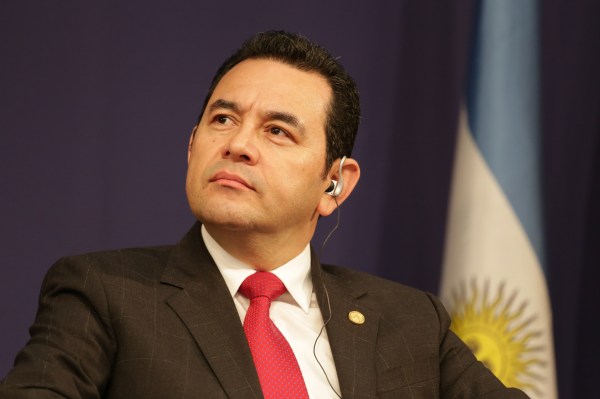
President Jimmy Morales of Guatemala looks upward

President Jimmy Morales of Guatemala. / OECD / Andrew Wheeler / Flickr / Creative Commons

Although the International Commission Against Impunity (CICIG), Attorney General, and civil society remain bulwarks in efforts to combat corruption and impunity in Guatemala – and occasionally score big hits – the Administration of President Jimmy Morales is slowly grinding them down and generating opposition to much-needed reforms.  In a speech at the signing of the National Development Agenda last month, the President attacked provisions in the law requiring transparency in public procurement and budgeting as counterproductive, while also lashing out at the judges, congressmen, general comptroller, and civil society leaders who support such measures.  He claimed on that occasion and others that anti-corruption measures have hindered his ability to govern.

  • The Morales Administration has not just complained; it has tried to remove anti-corruption controls. On July 14, CICIG and the Ministerio Público (MP) made the first of dozens arrests of persons involved in a corruption network run by former Communications, Infrastructure and Housing Minister (CIV) and potential presidential candidate in the 2015 elections, Alejandro Sinibaldi.  Three days later, the government responded to the case, known as “Corruption and Construction,” with a Presidential Decree declaring a “State of Emergency” on conditions of the nation’s roadways.  The order would allow the government for 30 days to sign new contracts and modify existing ones with companies involved in the scandal, including Brazilian contractor Odebrecht, free of all anti-corruption controls.  Congress not only rejected the Decree, but also impeached current CIV Minister, Aldo García, and forced him to take the blame for decrepit road conditions.

Despite such high-profile cases, Guatemalan anti-corruption advocates are concerned the MP and CICIG could still lose the war against corruption.  In addition, CICIG Commissioner Iván Velásquez has publicly lamented that structural reform – the Commission’s other mandate – has been too slow.  Last month, he said that “with current [circumstances] it is very difficult to defeat corruption and impunity.”  Some local observers believe that Velásquez’s focus on constitutional reforms to enhance the Attorney General’s powers is overly ambitions, and that other important initiatives are more attainable, but they acknowledge the generally hostile political environment he faces.  Advocates also believe that the Morales Administration is waiting out the term of fiscal general (attorney general) and head of the MP Thelma Aldana, who steps down next year.  The President even excluded her from his delegation attending a summit in June with U.S. Vice President Pence and Central American counterparts.

The strident complaints of some Guatemalans about U.S. support to CICIG and other anti-corruption initiatives has fueled perceptions that external support for clean government is more important than local demands for good governance – and coincided with a decline in the civic engagement that helped bring down the corrupt government of President Pérez Molina in 2015.  Much attention in Guatemala City has focused on outgoing U.S. Ambassador Todd Robinson and is now naturally shifting to the man confirmed by the U.S. Senate on August 3 to replace him:  Luis Arreaga – most recently a deputy assistant secretary of state for narcotics and law enforcement – is a Guatemala-born naturalized U.S. citizen who, nominated to the post by President Trump in June, is expected to distance himself from the Obama Administration’s strong commitment to anti-corruption programs.  Even though Attorney General Aldana was bumped from President Morales’s delegation at the June summit, Pence publicly praised Morales’s “personal dedication” to fighting corruption.

August 21, 2017

*Ricardo Barrientos is a senior economist at the Central American Institute for Fiscal Studies (ICEFI).

The Brazilian Roller Coaster … Still Heading Down

By Fábio Kerche*

34976737542_8c2ede46de_k

Rodrigo Maia (center), Speaker of the House of Representatives, gives an interview to the Brazilian press. If President Temer loses the House, Maia may replace him as President.

The political situation in Brazil is dramatic and shows no prospect of improving in the short term.  The Supreme Court has received an indictment against President Michel Temer on corruption charges.  A close adviser of his was caught on video receiving money in a suitcase.  The Chief Prosecutor, who had been playing a minor role in the anti-corruption Car Wash Operation, saw an opportunity to grab the limelight.  Rede Globo, Brazil’s most powerful media group, made Temer’s fall from power seem likely in a matter of days.

  • But Temer did not surrender. As Supreme Court action against a president must be authorized by the House of Representatives, the battle turned to Parliament.  Using means denounced as unethical, such as giving administration positions to people appointed by congressmen, the President won the first round in the committee with jurisdiction over the case.  The next step, in August, will be a full House vote, which could reverse the committee decision.

Regardless of the outcome of House proceedings, political turmoil appears certain to continue – and Temer’s conservative policies will continue to aggravate social divisions.  If Temer loses and the House gives a green light to a Supreme Court investigation, the Constitution foresees that he must be removed from the presidency during the trial (for up to 180 days) – with little chance of regaining the post, according to analysts.  In this scenario, his most likely successor would be Rodrigo Maia, Speaker of the House of Representatives, and a member of a small right-wing party that supported the military dictatorship.  He has little experience in electoral terms; many attribute his victories in legislative elections to the reputation of his father, a former mayor of Rio de Janeiro.  His attempt to run for the executive branch in Rio de Janeiro, a more difficult kind of election than for the Congress, proved to be a huge failure.  He is signaling that he would keep Temer’s conservative economic team and continue an agenda that cuts workers’ rights – proposals that are music to the market’s ears but likely to further rile opponents.

  • An alternative pushed by social movements – a constitutional amendment calling for direct elections right now – would seem to offer a chance for Brazil to break its downward spiral. Protesters show little sign, however, of breaking the roadblocks that the mainstream press has created against the proposal.  The popular mobilizations involve thousands of people but are having little resonance on television, in newspapers, and on websites.  The government, press, and market do not wish to delegate to citizens the right to choose their president, at least not now.

By default, general elections scheduled for October 2018 still appear to be the country’s best hope for putting democracy on track again.  The chance that the elections will end the crisis will be undermined, however, if former President Lula da Silva is barred from running.  Convicted of corruption in a process that many observers claim lacked evidence, the matter is now in the court’s hands.  If the conviction is confirmed, the legitimacy of the elections will be in jeopardy.  Brazil’s political institutions will be further weakened as confidence in election results will plummet –more than in a healthy democracy – and the democratic game itself, as expression of popular rights and will, will be threatened.  There is no hope of improvement in the short term.  The impeachment without a crime of former President Dilma Rousseff continues to take its toll.

July 31, 2017

* Fábio Kerche is a Researcher at Casa de Rui Barbosa Foundation, Rio de Janeiro, and was a CLALS Research Fellow in 2016-2017.

Lula Convicted: End of an Era?

By Anthony W. Pereira*

35075875073_62df9e06f4_k

Former Brazilian President Luiz Inácio “Lula” da Silva / Jeso Carneiro / Flickr / Creative Commons

Former Brazilian President Luiz Inácio “Lula” da Silva’s conviction last week on corruption charges was more than a legal decision and could mark a political watershed – the beginning of the end of “Lula-ism,” a political and redistributive pact that lasted from 2003 until 2010 which Lula has been offering to revive as a candidate in the 2018 presidential elections.  On July 12, Federal Judge Sergio Moro found Lula guilty of taking a bribe and laundering money, sentenced him to nine years and six months in prison, and banned him from taking public office for seven years.  This judgment, the first to convict an ex-president in Brazil, was the result of the Carwash anti-corruption investigations begun in March 2014.

  • The decision will be appealed to the Federal court for the Fourth Region in Porto Alegre. This court will probably rule on the case before the 2018 filing deadline for presidential candidates (yet to be decided, but usually in mid-August), and is expected to uphold the conviction.  Lula would be legally barred from being a candidate at that point, although he might mount some sort of challenge to such a ruling.  Lula’s strategy for now is to press on with his campaign, to criticize his conviction as political persecution that was not based on evidence, and to portray himself as a man of the people capable of taking on the “elite.”

Lula still has great strengths.  The basis of Lula-ism has been his personal appeal – he captured twice as many voters as did his political party, the Partido dos Trabalhadores (PT), in 2002 and 2006 – boosted by economic forces and public policies that raised the living standards of the poor.  With his finely-tuned ability to communicate to ordinary people, he showed that it was possible to both grow the economy and redistribute its fruits.  His government reduced poverty significantly, offered the poor inclusion in the consumer society and the chance of social mobility, and even achieved a modest reduction in income inequality – while promoting the interests of big companies.

  • But he may not have achieved the long-term realignment his supporters claim. Lula-ism proper only lasted for eight years, the length of his two presidential terms.  His hand-picked successor, Dilma Rousseff, ruled for almost six more years, but by the last year of her first term, poverty had stopped declining.  The current government of President Michel Temer has passed a constitutional amendment freezing federal spending in real terms for 20 years; the measure does not automatically reduce spending on social programs, but in the absence of tax increases that is what it has produced.  Temer’s own bribery scandal may take him down, perhaps within the next couple of weeks, but his policies raise a more fundamental question:  whether Brazil can return to economic redistribution, diminishing the severe inequality that still marks its society, without Lula-ism.

The organs of anti-corruption investigation and control that have challenged Lula, Dilma, and Temer – the media, the Federal Police, the Public Prosecutor’s Office, and the judiciary – are neither consistently politically neutral nor free of corruption themselves.  They are not a Deus ex machina that can free the Brazilian polity of corruption all by themselves.  For that, Brazil needs political reform, further changes in at least some of the rules that regulate elections and governance, a realignment of incentives faced by elected officials, state bureaucrats, business people, trade unions, and the electorate.

  • The PT and the other two most important parties, however, seem incapable of renovation despite leaders’ awareness of the low level of legitimacy with which they are viewed by voters. The PT has few viable new leaders and is clinging to Lula’s candidacy as its only hope of a return to power.  The Brazilian Social Democratic Party (PSDB) still nominally supports Temer.  And Temer’s own party, the Brazilian Democratic Movement Party (PMDB), is torn between defending the president in an act of self-preservation, and fearing the wrath of the voters in 2018.

Brazilians face a “trilemma”: they yearn for the three long hoped-for goals of sustained and successful anti-corruption investigations, political reform, and a return to economic redistribution.  Achieving two of those goals at the same time, let alone three, seems impossible.  The 2018 elections therefore will reveal a country in which anti-corruption investigations continue to knock major figures out of the political game, while political reform and economic redistribution are postponed.  The old cliché that Brazil is the country of the future takes on a new meaning in light of this somber possibility.

July 17, 2017

*Anthony W. Pereira is a Professor and Director of the Brazil Institute at King’s College London.

Migrants Make Family Back Home Critical of Government

By Clarisa Pérez-Armendáriz and David Crow*

9017797074_eccf684eb1_b

A mural depicting the transnational migrant experience. / Max Herman / Flickr / Creative Commons

Latin American citizens who discuss politics and belong to a transnational household – a household in which at least one member lives abroad – are more critical of their democracy than those who discuss politics but have no household members abroad.  In our recently published report, we use data from 2006-08 Americas Barometer surveys in 20 Latin American countries to demonstrate that among transnational household members (THMs) with an emigrant living in the United States, assessments of how democratic their country is, satisfaction with their country’s currently existing democracy, and pride in their democratic system all decline as discussions about politics become more frequent.

THMs talk about politics with their emigrant household members across international borders.  When they hear about the political and social system in the U.S., they become more aware that they have reason to be critical of their system’s performance, and judge their own democracy more harshly.  Skeptics counter that migrants and their children – particularly ethnoracial minorities – are marginalized, second-class members of receiving societies, which would logically alter the impact of their communications with THMs.  Public opinion polls show, however, that immigrants embrace and adopt their host country’s political beliefs and behaviors within as little as two years and that their social, political, and religious organizations give them a feeling of civic engagement they did not have back home.  Furthermore, even when conditions abroad are difficult, civil liberty protections in the U.S. enable immigrants to mobilize politically and to demonstrate a greater sense of personal efficacy – two traits that THMs respect.

  • Even absent cross-border political discussions, having a household member abroad shifts THMs’ sense of political community to include co-nationals living both at home and abroad. In turn, THMs expect their government to deliver the goods of democracy to its citizens wherever they live.  Data from the Mexico, the Americas, and the World survey in 2014 provide initial support for this claim.  Among Mexican THMs, 65 percent described “protecting nationals abroad” as a very important foreign policy objective, compared to 52.8 percent of non-THMs.  Furthermore, this policy emphasis indirectly influenced negatively their feelings toward President Enrique Peña Nieto, giving him a slightly lower “thermometer score.”
  • To the extent that THMs’ everyday talk (with other THMs or non-THMs living in Latin America) about politics revolves around this transnational sense of community (in contrast to the narrower national identity of non-THMs) THMs become aware that they have even more reasons to be critical of their government’s performance than do fellow citizens without migrant connections. Our analysis of this rests entirely on the case of Mexico, but we believe it holds elsewhere in Latin America since, of all the countries in the region, Mexico provides the most extensive range of services to its citizens abroad.

The 2006-08 Americas Barometer data that we used predates major shifts in U.S. immigration policy during President Obama’s term and, in particular, the hard shift in rhetoric, roundups of undocumented migrants, and deportations during these first months of the Trump Administration.  The sense of political efficacy that democratic rights to mobilize and protest produces among immigrants may decline in impact if, as reported, migrants are keeping a low profile out of fear of capture or harassment.

July 5, 2017

 *Clarisa Pérez-Armendáriz is an Assistant Professor at Santa Clara University. Her research, which focuses on how immigrants influence politics in their origin countries, has appeared in Comparative Political Studies and Studies in Comparative International Development.  She is also a participant in the Robert A. Pastor North America Research Initiative.

*David Crow is an Associate Professor of International Studies at CIDE (Mexico City). He is co-PI (and past director) of the Americas and the World survey on international relations and the Human Rights Perceptions Polls, and formerly Associate Director of the Survey Research Center at UC Riverside.  His research has appeared in Comparative Politics, Comparative Political Studies, Political Psychology, Human Rights Quarterly, and elsewhere.

Perspectives on U.S.-Cuba Relations Under Trump

Trump and Cuban Americans

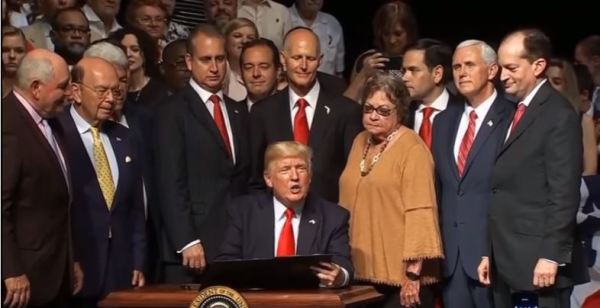
President Trump announces his administration’s policy toward Cuba. / YouTube / Livestream TV News / Creative Commons

Reversing Obama’s Cuba Policy?

By William M. LeoGrande*

In the two years after President Barack Obama and Cuban President Raúl Castro agreed to normalize relations, Obama tried to make his policy of engagement “irreversible” by opening up travel and trade that would create constituencies with a self-interest in defending engagement. He half-way succeeded. Despite the incendiary rhetoric in which Donald Trump cloaked his new policy when he rolled it out at a rally of Cuban-American hardliners in Miami, the sanctions he announced were limited.

Obama granted general licenses for all 12 categories of legal travel and relaxed other restrictions on who could visit Cuba. Trump rolled back only individualized people-to-people educational travel, so people-to-people visitors must once again travel on organized tours. But they can still go, and bring back rum and cigars.

Obama opened the Cuban market to U.S. businesses by licensing contracts with state enterprises in the travel, telecommunications, pharmaceuticals, construction, agriculture, and consumer goods sectors. Trump prohibited only contracts with Cuban enterprises managed by the military, and even then he exempted all existing contracts, and future contracts involving ports, airports, and telecomm – the sectors in which all but a handful of current U.S. businesses operate.

Trump did not impose any restrictions on Cuban–American family travel and remittances. He did not break diplomatic relations or put Cuba back on the State Department’s terrorism list. He did not restore the wet foot/dry foot policy that gave Cuban immigrants preferential treatment after reaching the United States. He did not abrogate the bilateral agreements on issues of mutual interest negotiated by the Obama administration.

Why such a flaccid set of sanctions from a president who stood on the stage in Little Havana and demonized the Cuban regime as brutal, criminal, depraved, oppressive, murderous, and guilty of “supporting human trafficking, forced labor, and exploitation all around the globe”?

Because Obama’s strategy of creating constituencies in favor of engagement worked. In the weeks leading up to Trump’s announcement, he was deluged with appeals not to retreat from engagement. The U.S. Chamber of Commerce argued in favor of expanding business opportunities, not constricting them. Farmers argued for expanding agricultural sales. Travel providers argued for expanding travel. Fifty-five U.S. Senators cosponsored a bill to lift all travel restrictions. Seven Republican members of Congress and 16 retired senior military officers argued that disengagement would damage national security by boosting Russian and Chinese influence on the island. Polling data showed that large majorities of the public, of Republicans, and even of Cuban Americans support engagement.

Even the executive bureaucracy was won over by the successes scored by the policy of engagement. During the last two years of Obama’s presidency, Cuba and the United States signed 23 bilateral agreements. When Trump ordered an inter-agency review of Cuba policy, the consensus of the agencies involved was that engagement was working and ought to be continued. Trump rejected that conclusion because it did not fit with his political strategy of currying favor with the Cuban-American right, but the agencies fought back successfully against more extreme proposals to roll back Obama’s policies entirely.

Trump’s vicious rhetoric and his open embrace of the goal of regime change – through sanctions, support for dissidents, and “democracy promotion” – risks destroying the atmosphere of mutual respect and good faith that made the gains of Obama’s policy possible. Already, hardliners in Havana who saw engagement as a Trojan Horse for subversion are saying, “We told you so!” Cuba’s private entrepreneurs, who Trump’s policy purportedly aims to help, will be hurt the most by the prohibition on individual people-to-people travel. However, the overall economic impact of his sanctions will be limited, both on U.S. businesses and in Cuba.

Cuba’s official response has been pragmatic but firm. A statement released shortly after Trump’s Miami speech declared, “The Government of Cuba reiterates its willingness to continue respectful dialogue and cooperation on issues of mutual interest, as well as the negotiation of pending bilateral issues with the United States Government…. But it should not be expected that Cuba will make concessions inherent to its sovereignty and independence, nor will it accept any kind of conditionality.”

In all likelihood, political pressures from the constituencies Obama’s policy created will continue to constrain Trump’s impulse to beat up on Cuba, but his loyalty to the exile right and his penchant for bullying will make it impossible to realize further progress toward normalizing relations. That will have to wait until the White House has a new occupant motivated by the national interest rather than by a political IOU given to Miami’s most recalcitrant Cuban-American minority.

*William M. LeoGrande is Professor of Government at American University in Washington, DC, and co-author with Peter Kornbluh of Back Channel to Cuba: The Hidden History of Negotiations between Washington and Havana (University of North Carolina Press, 2015).

Cuba: Trump’s “New Policy”


By Ricardo Torres*

The “new policy” toward Cuba that President Trump announced to great fanfare in Miami last Friday features little that is new while seeking to restore oxygen to a failed approach advocated by extreme sectors of the Cuban-American community. While adopting language reflecting the worst traditions of American foreign policy, Trump’s declaration implicitly blessed much of the rapprochement between the two countries introduced by President Obama – diplomatic relations will remain intact, for example. But the new measures he announced have symbolic and practical implications. His Cuban-American backers expended great political capital to change the policy in hope of accelerating regime change on the island, but the Trump approach will instead retard change – while increasing the pain of the Cuban people. Moreover, it will undermine the activities of legitimate U.S. citizens, companies, and groups interested in contact with the island and compromise U.S. citizens’ freedom to travel. They have acted against Trump’s campaign promise to create jobs (threatening thousands of workers who depend on U.S.-Cuba interaction) and increase national security (putting U.S.-Cuba cooperation in counternarcotics, counterterrorism, and illegal migration at risk). The new approach also runs counter to Secretary of State Tillerson’s repeated assertion that U.S. policy is not to impose its values and standards on others.

U.S. national interests seem to have taken a back seat to internal U.S. political factors, particularly the opposition to Obama’s policies among certain groups of the Cuban Americans that had seen their political influence decline over the past decade.

In addition to its symbolic weight, the Trump approach is likely to be felt most strongly in several principal areas. Despite continuing differences between the two countries, both governments had decided to move ahead together. It is difficult to overstate the sense of hope created during the Obama era, with immediate and tangible benefits for both.

Cuba’s internal situation has been changing recently, due to a gradual opening internally and to other nations. A steady increase in visits by foreign businessmen and Cuban travel overseas are evidence of this change. Trump’s rhetoric and actions will only strengthen those sectors inside Cuba that exaggerate the external threat and want to reduce the space for debate in the country.

The economic impact that Trump and his backers want – to hurt the Cuban government – cannot be separated from the harm it will cause the Cuban people. The new measures will probably reduce tourism, which provides a significant flow of revenue to vast sectors of the Cuban population that, in formal or informal jobs, benefit from that industry. Indeed, the much bandied-about private sector has been one of the principal beneficiaries of tourism development.

The Cuban government will assess its options in relations with the United States as well as in domestic policies. It will naturally have to let the U.S. government know that cooperation has yielded mutual benefits to both countries and that this step backward will not be limited to areas that Washington prefers. Havana might look for more ambitious ties with alternative partners, including both allies and competitors of the United States. Internally, rather than slow down, Cuba’s transformation should accelerate. The legitimate needs of the Cuban people should not be postponed in the face of this new adversity. The pace of Cuban reform should never be tied to external threats. As for the Cuban people, they will once again tell all who will listen that they themselves – not those on the other side of the Florida Strait – represent their interests. President Trump has empowered a small group of Cuban Americans to speak for people in Cuba whom they do not know, at the cost of sacrificing U.S. prestige and an array of its national interests. The absurd has become the accepted norm in American politics.

*Ricardo Torres is a Professor at the Centro de Estudios de la Economía Cubana at the University of Havana and a former CLALS Research Fellow.

Macri in the Next 100 Days

By Nicolás Comini*

32919903642_2bd30877a1_k

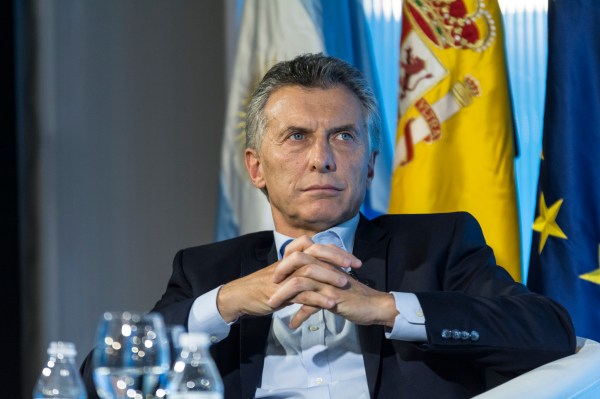
Argentine President Mauricio Macri. / Casa de América / Flickr / Creative Commons

Everybody seems to love President Mauricio Macri outside Argentina – it’s not hard to understand why – but he faces tough challenges at home.  Foreign supporters have plenty of reasons to believe in him.  First, he is not Cristina Fernández de Kirchner, the former president whom they branded a populist too close to Venezuela, Bolivia, or Ecuador.  Like many conservatives inside Argentina itself, they see Macri as the person who avoided the “Venezuelization” of the country, and his market-friendly credentials were sealed through his campaign promise of a “rain of investment” and his government’s implementation of a package of measures aimed at financial liberalization, regulatory flexibility, liberalization of foreign trade, and stronger fiscal discipline.  He has been less confrontational in diplomacy.  “Return to the world,” “de-ideologization,” “pragmatism,” and “transparency” are the continuous slogans that draw the foreign accolades.

Things look different at home, however.  The federal government confronts a convoluted scenario in the next 100 days, during which it will face at least three sets of sensitive issues in the run-up to Legislative primaries in August and elections in October.

  • Domestic issues. The government will have to deal with a hostile internal front.  One challenge will be resolving a long-running pay dispute with teacher unions – especially in the province of Buenos Aires.  Another is quelling complaints about steep increases in the costs of government services and deep slashes in funding for Science and Technology, Culture, Human Rights, Health, Production, and Energy.  Macri’s failure to meet inflation reduction targets (prices rose by 40 percent in 2016); the need to stimulate the economy; and debates on tax reform are a daunting agenda.
  • Controversy over human rights and immigration. One of the Achilles’ heels of the current administration is the imprisonment of social activist Milagro Sala in the northwestern province of Jujuy.  An ally of former President Fernández de Kirchner, Sala was arrested in January 2016 – one month after Macri took office – on highly contested charges: initially of “instigate criminal activity disorder” and later of “illicit association, fraud, and extortion.”  Pope Francis, Canadian Prime Minister Trudeau, and UN officials have expressed concern, fueling tensions inside Argentina.  An immigration reform decree facilitating deportations and restricting access at border crossings has been rejected by social movements, international organizations, and much of the Argentine political opposition.  The repudiation is not only felt in the formal political arena but also on the streets.
  • External dynamics with internal consequences. Brazil’s Lava Jato scandal is splashing as much onto Macri’s government as his predecessor’s.  Officials from both administrations are being accused of receiving bribes from Odebrecht, the largest Brazilian construction company, and no one knows how this process will develop hereafter.  Congresswoman and Macri ally Elisa Carrió claims the whole political elite is complicit in the Odebrecht mess.  The “Panama Papers” – leaked from the law firm Mossack Fonseca, which allegedly was involved in helping companies hide bribes paid to a number of South American leaders – has so far not touched Macri, whose family has links to firms cited in the documents.

The August primaries, followed by full legislative elections in October, are a potential inflection point for both Macri and his opponents.  Neither side has yet announced its slate of candidates, but one essential factor is already clear: the candidacy (or not) of Cristina Fernández de Kirchner.  The primary election will define how the pieces of the political chessboard are placed, and Macri’s handling of his economic, political, and social challenges will be decisive.  Achievement of his reform agenda – including the overhauling the National Institute of Statistics and Census (INDEC, accused of cooking data during previous governments), an ambitious “Plan Belgrano” infrastructure program, and the end of currency controls – may not be enough.  The potential reunification of his key Peronist opponents, increased social unrest, splits in his own coalition, and the spillover from the Brazilian crisis suggest a sobering future.  True love cannot be achieved from one day to the next, but in the domestic political arena it is simple to lose it suddenly.

June 8, 2017

* Nicolás Comini is Research Fellow at CLALS; Director of the Bachelor and Master Programs in International Relations (Universidad del Salvador, Argentina); and Professor at the New York University-Buenos Aires.

Brazil: The Day after Temer

By Marcio Cunha Filho*

34622412041_b5ddcca3d7_k

Demonstrators in São Paulo demanded the resignation of Brazilian President Temer on May 17, 2017. / Mídia NINJA / Flickr / Creative Commons

Brazil’s political turmoil has reached new heights with the leaking of audio recordings of President Temer allegedly authorizing bribes to prevent the former Speaker of the House, Eduardo Cunha, from concluding a plea bargain arrangement with investigators.  Although the recordings were inconclusive and Temer alleges that they were fabricated, their emergence was enough to push an already fragile government to the verge of collapse in less than 24 hours.  The day after the leak, according to press reports, four of Temer’s ministers were already discussing his replacement at a closed meeting with current Speaker of the House Rodrigo Maia, who is the next in line for succession. Some parties, such as the PPS, have already left Temer’s coalition. The PSDB, Brazil’s largest center-right party and Temer’s main coalition partner, is also discussing a possible withdrawal from government.  (The party’s former President and one of Temer’s closest allies, Senator Aécio Neves, was removed from office by a Supreme Court decision as part of Operation Car Wash.  (See here and here for previous articles about the Lava Jato investigations.)

  • Temer has denied the possibility of resigning, but there are a few ways he could be forcefully removed from office. Most observers argue that, however he departs, the Constitution would require his successor to be indirectly elected by Congress within 30 days.  Others posit, however, that if the Superior Electoral Court condemns Dilma and Temer together for illicit funding in the 2014 Presidential campaign – the trial is in early June and is likely to be the fastest possible way to remove Temer – then the electoral code dictates that new direct popular elections be held (as long as annulment is not declared within the last six months of their term, which ends in December 2018).
  • Key political actors seem to be favoring the scenario in which Congress indirectly elects the successor. Although very fragmented, the Brazilian Congress is mostly conservative or right-leaning, and many of its members fear that former President Luis Inácio Lula da Silva, who polls currently indicate would easily defeat any other candidate, might be elected in a popular election.

In this context, indirect election would put Brazil’s political system on the very edge of legality.  During a similar crisis in 1964, Congress’s ousted left-wing acting Vice President João Goulart and elected another itself, without popular approval, in an act almost universally seen today as illegal.  That act ended up throwing Brazil into a violent military dictatorship that lasted for more than two decades.  In the current political crisis, if Congress were to act against the current rules of the electoral code and without popular approval, this could again be another step towards the establishment of an illegal regime, which could further curtail accountability and democratic mechanisms in the country.  Placing the destiny of the country in the hands of a Congress, with many of its members under investigation themselves, might be a mistake with profound consequences.  Popular elections would also entail great uncertainty as well, but the uncertainty of elections is an inherent element of democratic systems.  When political actors try to limit or manipulate electoral outcomes in the name of predictability or security, this is when democracy dies.

May 19, 2017

* Marcio Cunha Filho is a Ph.D. candidate at the University of Brasília; federal auditor in Brazil’s Office of the Comptroller General; and CLALS Research Fellow.