Ecuador: Lenín Moreno’s Balancing Act

By John Polga-Hecimovich*

Lenín Moreno

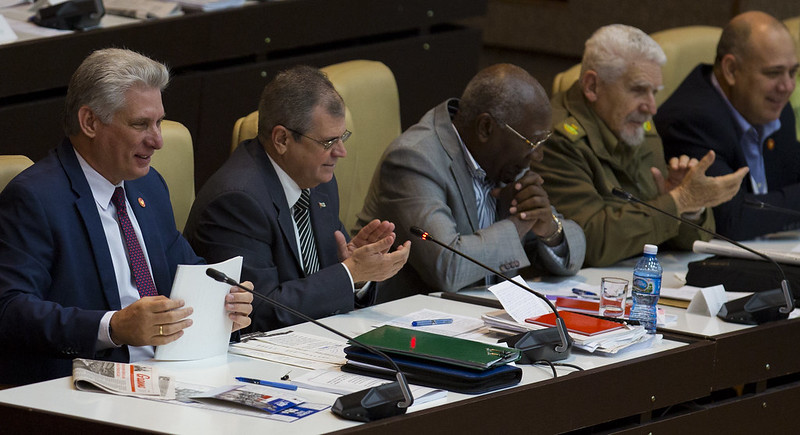
Ecuadorian President Lenín Moreno (far right) meets with members of the National Assembly in October 2018. / Diego Cevallos / Asamblea Nacional / Flickr / Creative Commons

As Ecuadorian President Lenín Moreno begins the post-honeymoon phase of his presidency, he appears firmly committed to positioning himself as a judicious voice and centrist in a region where ideological moderation and restrained oratory are the exception rather than the norm.  This might be unexpected given his political background and four years as vice president under leftist firebrand Rafael Correa (2007-17), but it makes sense given the country’s challenging economic situation and political constraints.  As previously noted, Moreno had two choices when taking office: remain loyal to his socialist roots, govern through his Alianza PAIS legislative bloc, and double down on Correa’s (fiscally unsustainable) “Citizens’ Revolution;” or move towards the political center, splinter his legislative majority, and abandon Correa and many of his policies.  He has decisively opted for the latter, attempting to navigate a middle ground between the left and the right.

  • No issue depicts the thin line Moreno walks more than Ecuador’s foreign policy, and no foreign policy issue reflects that tug-of-war better than his handling of Wikileaks founder Julian Assange. Assangeto whom Correa granted asylum in 2012 at the Ecuadorian Embassy in Londonis now a costly and increasingly undesirable houseguest.  He is a liability in Moreno’s quest for technical assistance, international loans, and greater security and commercial cooperation with the United States, which is still seeking justice for Wikileaks’s publication of U.S. classified material.  Although Moreno has called Assange “more than a nuisance” and “an inherited problem,” the president has been reluctant to push him out over concern for his human rights.  In July, Moreno suggested Ecuador was seeking guarantees that Assange would not face the death penalty.  Maintaining its delicate dance, however, in October, the government broke from its longstanding dialogue with British authorities over Assange’s situation and announced that it will no longer pay for his food and medical care.
  • Ecuador is also seeking closer relations with its right-of-center neighbors, beginning to distance itself from the region’s leftist governments, and attempting to rebuild ties with the United States. Since June, Moreno has attended the inauguration of Colombian President Iván Duque, met with Peruvian President Martín Vizcarra, welcomed U.S. Vice President Mike Pence to Quito, and launched a security agreement with Washington.  Moreno has also changed his tone with regards to Venezuela.  Speaking to the United Nations General Assembly on September 25, he spoke of the burden caused by arrival of more than 6,000 Venezuelan migrants a day and called for a national dialogue in that country, provoking an acrimonious back-and-forth between the two capitals that culminated in the Ecuadorian government tweeting that “corrupt, murderous, and lying socialism of the 21st century is still alive in Venezuela and producing the most massive migration in the country’s history.”

Moreno’s strategy to confront the country’s fiscal deficit, which was 5.5 percent of GDP in 2017, is an even greater departure from his predecessor’s approach.  Whereas Correa pursued financing primarily through oil-for-loan deals from China after Ecuador’s selective default in 2008, Moreno has turned to other global lenders such as the World Bank and Japan.  He has also pursued new commercial relationships and market-friendly policies, including a free trade agreement with the European Free Trade Association, beginning accession talks with the pro-market Pacific Alliance, and continuing to encourage foreign investment in Ecuador’s hydrocarbon industry.  However, Moreno has not fully committed to Washington consensus-style reforms: the government announced measures in August to reduce its $60 billion debt, but it also authorized over $1.2 billion in loans to the housing sector, agriculture, and small and medium-sized business to reactivate the domestic economy.

Although not an ideological rightist like Chilean President Sebastián Piñera or Colombian President Iván Duque, Lenín Moreno has reoriented many of Rafael Correa’s domestic and foreign policies out of necessity as he confronts Ecuador’s difficult economic situation.  Given that the country’s fiscal deficit and outstanding debt are strategic challenges, it seems likely that he will continue to judiciously tread this middle path.  Although fiscal austerity measures have lowered Moreno’s approval rating and provoked protests from the Correista left, it would be a mistake to bet against him.  Moreno has not only upended expectations but also proven far more resourceful and politically sophisticated than his critics—and probably even his admirers—expected.  He may also send Julian Assange at some point an eviction notice.

November 6, 2018

*John Polga-Hecimovich is an Assistant Professor of Political Science at the U.S. Naval Academy.  The views expressed here are solely those of the author and do not represent the views of or endorsement by the Naval Academy, the Department of the Navy, the Department of Defense, or the U.S. government.

Paraguay: Stormy First Month for New President

By Barbara dos Santos*

Mario Abdo Benítez

Paraguayan President Mario Abdo Benítez. / Marcos Corrêa / Flickr / Creative Commons

A little over a month into his five-year term, Paraguayan President Mario Abdo Benítez is already being challenged by corruption scandals – including allegations against himself – and internal party squabbling, but he is continuing efforts to build his image as an ambitious reformer.  While emphasizing continuity with the previous administration’s economic policies – focusing on export-fueled growth, low taxes, and domestic investment – Abdo Benítez’s push for certain reforms is ruffling feathers.

  • In the wake of protests against highly publicized corruption and influence-trafficking cases involving national legislators and top judges, Abdo Benítez based his campaign on a pledge to fight government and judicial corruption though deep reforms. In his inauguration speech, he called for immediate priority to be given to comprehensive reform of the national judicial system.  Three days after taking office, he called on all political parties – including those without representation in the National Congress – to join a national debate on constitutional reform.

The president, however, faces a number of challenges to his image and leadership.

  • During the campaign, he distanced himself from the legacy of his father, who was a top aide to Paraguayan dictator Alfredo Stroessner (1954-89), but a visit he made to his father’s grave after voting on election day and his use of Stroessner’s white Chevrolet on inauguration day fueled apprehensions about his commitment to democracy.
  • He is being buffeted by allegations that he has ties with drug traffickers. Social media have publicized a picture of the president in his home with his arm around drug kingpin Reinaldo Javier “Cucho” Cabaña, who was arrested earlier this month.  He has denied receiving money from Cabaña and said that he did not recognize the man – that he had taken “millions of photos” with sympathizers who came to his house to express support during the campaign.
  • One of his closest allies in the congress, Ulises Quintana, was also indicted this month for alleged involvement in “Cucho’s” international drug trafficking network. Another close ally facing corruption charges is Miguel Cuevas, the president of the Chamber of Deputies, who stands accused of illicit enrichment while in office and who has become the new main target of the anti-corruption protest groups.
  • A faction within his party, the Cartistas —allies of former President Horacio Cartes – has been holding back on support Abdo Benítez’s reforms. They claim his call for inclusive debate, rather than negotiating directly with them before opening to other parties, was a sign of bad faith, and they have not agreed to join the talks.
  • The president also faces challenges from the opposition Partido Liberal Radical Auténtico (PLRA), whose leader says he supports reforming the constitution, even drafting a new one, but that it should be based on a “national agenda” – not only Abdo Benítez’s priorities. PLRA and other parties are concerned that a key purpose of the reforms is open the way to presidential reelection, which has long been a goal of the Cartistas.  They also claim the president is appointing cronies to positions that require technical expertise, such as management posts at the Itaipú power plant on the Brazil-Argentina border.

Abdo Benítez’s commitment to reforms may be mostly rhetorical – his bottom line seems mostly about continuity – but the political threats that they entail could get out of control and spark protests.  Six weeks into his presidency, he seems unlikely to rally the domestic support necessary to enact deep reforms to make the electoral, political, and judicial processes more open and transparent.  He may find some comfort in the fact that neighboring presidents – Michel Temer in Brazil, Mauricio Macri in Argentina, and Evo Morales in Bolivia – all have their hands full too, and that, if anything, the region’s turn to the right during elections since 2015 means that he is not likely to be isolated politically.  As a new president, however, Abdo Benítez has to be wondering what the next five years hold.

September 27, 2018

*Barbara dos Santos is a Ph.D. Candidate in Political Science at the School of Public Affairs at American University.

U.S. Politics: Ted Cruz’s Spanish Problem

By Chip Gerfen*

Beto O'Rourke and Ted Cruz

Beto O’Rourke, D-El Paso (left), is challenging Republican incumbent U.S. Senator Ted Cruz. / Marjorie Kamys Cotera: O’Rourke/ Bob Daemmrich: Cruz

In the race for the U.S. Senate seat in Texas, a non-Latino challenger is gaining on an incumbent widely hailed as the Senate’s first Hispanic member by mischievously challenging his bond with Latino voters.  Last Friday evening in Dallas, Democrat Beto O’Rourke and Republican Ted Cruz held the first of three planned face-to-face debates in what now appears to be a toss-up race for the Senate seat Cruz has held since 2013.  The Texas Republican Party misjudged O’Rourke’s appeal, ineptly miscalculating that his punk rock past, ability to skateboard, and occasional use of obscenities would swing sentiment away from rather than towards him.  O’Rourke is a three-term member of the U.S. House of Representatives from his hometown of El Paso.

  • Extraordinarily, the race pits a fourth-generation Irish-American, Robert Francis O’Rourke, with the Spanish nickname “Beto,” against a first-generation Cuban-American, Rafael Edward Cruz, who goes by “Ted” – and it is impossible to miss the irony in the fact that the Irish-American has challenged the Cuban-American to hold two debates in Spanish.

Cruz’s Spanish language bona-fides have come up in an electoral context before.  As I wrote during the 2016 presidential primaries, Cruz and Florida Senator Marco Rubio, also a Cuban-American, sparred openly on national television, with Cruz accusing Rubio of using Spanish to send different messages to different constituencies.  Rubio ridiculed Cruz’s lack of fluency in the language, suggesting a major positive shift in attitudes towards the value of Spanish in the public, political sphere.

  • Cruz’s traditional homogenizing view of immigrant language and identity was already clearly visible in his prior description of English as the language of the people of Texas, while Spanish was foreign and appropriate for use in the public and political discourse of places such as Cuba or Mexico. Rubio, by contrast, viewed his fluency in Spanish as a useful tool for connecting with Hispanic voters without incurring costs with non-Hispanic voters.  By openly disparaging Cruz’s Spanish in a nationally broadcast debate, Rubio sought to undermine the man’s cultural and ethnic authenticity, especially when contrasted with his own demonstrable bilingualism and cultural pluralism.

The current race in Texas is more than an incumbent defending his seat in a statewide election.  It is one with national consequences being played out on a big stage – at a time when the tsunami of Trump’s political victory and subsequent discourse and policies may seem to have changed the political calculus regarding linguistic and ethnic identity away from Rubio’s embrace of linguistic pluralism in the public square.  Nevertheless, not only are Cruz’s Spanish bona-fides being called into question again; the challenge arises from a political competitor named O’Rourke who has no ethnic connection to the Latino communities of Texas.  O’Rourke and Cruz are, in fact, polar opposites.  Cruz, son of a Cuban immigrant father, is a paradigm of traditional assimilation.  Like the children of many immigrants, he lost the language of his father, embraced English as a marker of his American identity, and chose an English nickname, Ted, over his given name, Rafael.  O’Rourke, by contrast, was raised in the bilingual border city of El Paso, grew up with a Spanish nickname, and learned to speak fluently the Spanish language of the generally economically less privileged citizens of his home.

By challenging Cruz to debate in Spanish, O’Rourke is advancing a vision of political and societal inclusion that does not demand linguistic assimilation.  Like Rubio in 2016, he is leveraging his own knowledge of Spanish to connect with a specific constituency and espouse an inclusive vision.  At the same time, by forcing Cruz to admit his inability to speak Spanish, O’Rourke, like Rubio before him, implicitly identifies Cruz as an outsider to the linguistic community to which he should, by birthright, feel some affinity.  While language itself does not define the ethnicity of either candidate, O’Rourke is adeptly challenging Cruz’s authenticity as a Latino, while at the same time signaling his own solidarity with constituents who speak Spanish or are descended from Hispanic families in ways that Cruz cannot.  Simply put, by taking the Spanish out of Cruz, O’Rourke leaves Cruz with little choice but to continue betting on the political value of the traditional, and increasingly challenged, narrative of assimilation in a demographically changing political landscape.

September 25, 2018

* Chip Gerfen is Professor of Linguistics and Spanish at American University.

Mexico: Is Centralization the Way to Battle Corruption?

By Daniela Stevens*

A large group of people stand on a stage.

Mexican President-elect Andrés Manuel López Obrador (center left) meets with current President Enrique Peña Nieto and members of his cabinet during the transitional government period. / Presidencia de la República Mexicana / Flickr / Creative Commons

Half way through Mexico’s five-month transition period, an effort by President-elect Andrés Manuel López Obrador (AMLO) to increase central government oversight over states’ affairs suggests an agenda that may go beyond the “republican austerity” he frequently calls for.  His plans to lower the numbers and salaries of high-ranking bureaucrats have been well received, but he raised hackles when he announced plans to appoint a single federal representative – a delegado – to liaise with each of the 32 states, eliminating the 20 to 30 central government representatives that until now have been dispersed throughout each jurisdiction.  He claims the measure is to save on the bureaucracy payroll, but many observers are concerned it will concentrate more power in his own hands.

  • Criticism has already forced AMLO to repackage his plan somewhat. He uses mixed language to refer to the responsibilities of the delegados.  While he has strongly defended his legal ability to appoint a single delegado, he more recently reassured aggravated governors that his representatives would maintain “institutional relations” and respect local elected officials’ autonomy and authority.  Olga Sánchez Cordero, AMLO’s appointee as Secretary of the Interior, further clarified that the delegates would only be in charge of social development programs, constituting a “layer of proximity to citizens” currently or potentially enrolled in social programs.  Under AMLO’s proposal, delegados would take over all kinds of programs, including youth scholarships, conservation efforts, health care, and social security programs for special populations – a herculean portfolio for a single representative.
  • Critics argue that the appointment of single delegados reporting directly to AMLO will undermine federalism. Electoral and administrative decentralization were integral to Mexico’s long democratization process.  For decades, the president was not only the predominant force over the legislative and judicial powers; he also appointed governors from the hegemonic party to the states.  The delegados would potentially create a power structure that parallels and rivals that of the state governors.  Some governors argue that the constitution does not recognize intermediate authorities, and wonder whether persons with partisan agendas will get too deeply involved in local budgets and policies.  In addition, the position would be coveted for its discretionary power and direct link to the president – giving politicians from AMLO’s party, Morena, a leg up as potential candidates for governor.

If done right, however, the measure could alleviate the plague of corruption that permeates the states, and the governorships in particular, and which AMLO has repeatedly condemned.  Governors routinely abuse their powers and engage in serious acts of corruption and financial crime.  As Agustina Giraudy has documented, undemocratic governors have used their offices to perpetuate “subnational undemocratic regimes” in the wake of Mexico’s 2000 transition to electoral democracy at the national level.  Former Governor Javier Duarte, of Veracruz, stole hundreds of millions of dollars from the public budget, and others, like Humberto Moreira in Coahuila, left their state with large debts.  Oversight from an anti-corruption executive in Mexico City might not necessarily be a bad thing.

Ideally, state legislatures – rather than the president or his delegado – would constitute the brake on governors’ decisions, providing a real counterweight anchored in local political dynamics.  AMLO’s efforts to turn Mexico into an “authentic democracy” will miss the mark – and amount to a crass political move – if the transformation does not include an institutionalization of leadership.  His party, Morena, is extraordinarily dependent on his personal leadership; it is an amalgam of politicians who abandoned other parties or joined it because of personal ties to him.  AMLO, who plans to preach integrity by example, cannot alone be the foundation of the “fourth transformation” he purports to lead (the first being independence, the second the “Reforma,” wars, and the third the 1910 Revolution).  With institutionalization, AMLO and Morena could put appointees and delegados through a transparent, legal vetting process – based on merit – and give them clear, legal operational responsibilities.  Failing that, their reforms may prove to be a primarily partisan project.

September 14, 2018

* Daniela Stevens is a Ph.D. candidate in Political Science in the School of Public Affairs at American University.

Colombia: Duque Preparing to Turn the Clock Back

By Christian Wlaschütz *

Uribe and Duque

Former Colombian President Álvaro Uribe (left) and President-elect Iván Duque (right). / Centro Democrático (left), Casa de América (right) / Flickr, modified / Creative Commons

Colombian President-elect Iván Duque is not losing any time fulfilling campaign promises to take steps that will derail the peace process or at least put serious obstacles in its way, which will likely drive dissident FARC guerrillas back into the country’s already troubled rural areas.  Four weeks after his election and three weeks before his inauguration, Duque’s strong coalition in Congress has already passed legislation weakening the special peace courts (JEP) established for peace accord implantation.

  • Anyone who may have speculated that Duque would distance himself from his political godfather, former President Álvaro Uribe Vélez, as did outgoing President Juan Manuel Santos at his time, does not understand the president-elect’s dependence on Uribe. Santos had always belonged to Colombia’s elite and had his own standing, while Duque has no backing on his own.
  • As Duque assembles his first government, observers expect that he will tap into his campaign alliances – including individuals keenly opposed to the peace accords. Among them are Vivian Morales, a leading representative of the Christian churches, and Alejandro Ordóñez, a Catholic conservative and former Inspector General of the Republic (2009-17) who allied with Duque after losing to him in the primaries.  Morales and Ordóñez were among the main figures behind the negative campaign that led to popular rejection of the peace accord in late 2016, arguing that it promoted homosexuality and would weaken the traditional family.

The changing international context makes it easier for Duque to pursue his agenda.  When Santos assumed the presidency in 2010, he had strong support to pursue peace, led by U.S. President Obama and visibly demonstrated by the frequent presence of UN Secretary General Ban Ki-Moon.  He immediately issued the “victims’ law,” admitted that Colombia had an armed conflict, and moderated the violent discourse of his predecessor, Álvaro Uribe.

  • Now the United States has shifted away from international cooperation and reduced its support for “soft” issues. President Trump has signaled priority to rigid counternarcotics and security policies, and not negotiated settlements.  Since Duque’s agenda includes a strong stance against the “Venezuelization of Colombia,” – referring to the emergence of a left-wing authoritarian government allied with Cuba and Venezuela – he is widely believed to be confident of Trump’s support for initiatives against FARC and other members of the Colombian opposition whom he claims are aided by alleged allies in the neighboring country.  The European Union, for its part, is currently completely immersed in internal affairs regarding migration and its own future.  In general, international enthusiasm seems to be suffering from fatigue –undermined by perceptions of Colombia popular rejection of the accords coupled with frustration over the high number of assassinations of social leaders.
  • The number of threats and assassinations of those who either support the political opposition or defend human rights and victims’ rights is simply breathtaking. Colombia’s weekly Semana reports that, in addition to killings related to land restitution, those related to political vendettas are increasing, concluding that the “ghost of political extermination” – similar to that of the Patriotic Union, a leftist party exterminated in the 1980s and 1990s – is back.

Duque’s efforts to weaken the peace process appear likely to advance – to the detriment of Colombian security.  Former FARC combatants will have little incentive to remain demobilized in cities and towns where they have little hope of inclusion in political and economic life, and are likely targets for harassment and assassination.  More likely, they will return to rural areas, which have already been experiencing a resurgence in criminality in the last year, and align themselves with active criminal groups there.  The insecurity and selective killings may lead Colombia towards times that it already seemed to have overcome.  The new president’s coalition of people with a strong resentment against the policies of the last eight years is not likely to take the steps necessary to lead Colombia into a different future, laying the groundwork for more crises, as the United States, EU, and the international community in general stands by.

July 12, 2018

* Christian Wlaschütz is a political scientist, independent mediator, and international consultant who has lived and worked in Colombia, in particular in conflict zones in the fields of transitional justice, reconciliation, and communitarian peace-building.

Venezuela: Maduro’s Ploy Backfires

By Michael McCarthy*

Maduro and the Venezuelan flag

Venezuelan President Nicolás Maduro. / President of Russia / Flickr / Creative Commons

Almost a month after Nicolás Maduro held a snap presidential vote to strengthen his political power, the ploy appears to have largely backfired and left him weaker.  The dynamics underlying the years-long crisis have not fundamentally shifted, but the deepening impact of the economic implosion on the oil industry poses a threat to vital state interests and regime stability.  Maduro’s crisis management will face another major stress test.

  • Even the government’s own dubious figures on voter turnout – 46 percent – were too low to give the election credibility, limiting Maduro’s ability to claim a strong mandate. Criticism of the government’s efforts to sway voters by distributing food, medications, and other necessities at polling places was intense.  All but a few loyal friends in the international community have been reluctant to congratulate Maduro.  China and Russia accepted the vote count, but Beijing appeared particularly cooler than in the past, while Ecuador and Uruguay issued statements aimed at depolarizing the situation.  The OAS General Assembly lacked the 24-vote threshold necessary to invoke the Inter-American Democratic Charter to suspend Venezuela’s participation in the regional body, but the Dominican Republic’s shift away from its previous support for Maduro must have been a blow.
  • Maduro’s victory is further overshadowed by the fact that as much as 85 percent of the pro-government vote went to the party of Diosdado Cabello, who leads a competing faction under the flag of the Partido Socialista Unido (PSUV), while Maduro’s Movimiento Somos Venezuela got only 5 percent. Longtime observers argue that a battle between Maduro and Cabello, an original member of the Chávez 4F movement that staged a failed coup in 1992, is heating up.  The PSUV will hold a party congress on July 28 – Chávez’s birthday – that promises to serve as venue for Cabello to pursue his leadership ambitions.

Maduro’s weakness appears to have motivated several actions he’s taken since the election.  Most observers believe that he directed a raft of prisoner releases to improve his sagging image, pacify the situation, and set the stage for dialogue.  He reportedly wanted to reshuffle his cabinet to shore up unity, but internal political difficulties apparently have delayed it temporarily.

  • He also released a U.S. national, Joshua Holt, who had been under arrest since 2016 on trumped up charges of espionage and conspiracy to undermine the constitution. Maduro’s goal may have been to disarm U.S. criticism and open a line of communication, but the day after the election he also expelled the U.S. Chargé d’Affaires and his deputy.  The U.S. State Department wasted no time in reciprocating by expelling two Venezuelan diplomats, and later, in the wake of the Holt release, it underlined that policy toward Venezuela “remains unchanged.”

More U.S. sanctions may be imposed, but Maduro’s self-destructive rule is doing his government even more harm.  A combination of increasing hyperinflation and a potential record drop in month-to-month oil production from May-June suggest a rapidly worsening economy.  Press reports suggest state oil company PDVSA will soon announce that it cannot honor its monthly production obligations with a number of key partners – a major blow for a government dependent on oil for 95 percent of its income.  After calling for a boycott of the May 20 vote, the traditional opposition breathed a collective sigh of relief that a majority of voters stayed home, but this does not give them the win they need to regain public trust.  Continually bleak prognoses once again stir speculation that the military will step in.  Yet it is not so simple.  The military seems to operate more according to informal networks and personality-driven hierarchies, creating divisions that make it hard for groups to credibly act in the name of the armed forces.  So far, senior officials seem to have determined that loyalties to a dysfunctional regime do not yet sufficiently threaten business and institutional interests for them to take action.

 June 14, 2018

* Michael McCarthy is a Research Fellow with the Center for Latin American & Latino Studies.  He publishes Caracas Wire, a newsletter on Venezuela and South America.

Mexico: Tough Congressional-Executive Relations Ahead

By Daniela Stevens*

Piñata with the Mexican flag in the background

Bandera mexicana en el Zócalo de la Ciudad de México / Wikimedia/ Creative Commons

Whoever wins Mexico’s presidential election on July 1 probably will face a divided and cantankerous Congress – especially if, as appears likely, Andrés Manuel López Obrador of the Morena Party is the victor.  López Obrador has been ridiculed by the Mexican political class, some of whose leaders have called him the next Hugo Chávez, but most polls give the polemical candidate at least a 10-point lead over Ricardo Anaya of the coalition Por México al Frente.  In Congressional races, polls also give the advantage to López Obrador’s party and its coalition partners, including Partido del Trabajo (PT) and Partido Encuentro Social (PES), under the joint banner of Juntos Haremos Historia.  According to the Parametría poll, 32 percent of respondents intend to vote for Morena, five percent for PT, and two percent for PES.  Other polls give them higher numbers.

  • The formerly hegemonic Partido Revolucionario Institucional (PRI) appears likely to fall to third place due to President Peña Nieto’s poor performance and the party’s association with corruption, while the Partido de la Revolución Democrática (PRD), traditionally the largest leftist party, would be the fourth.
  • Under the most likely post-election scenarios, López Obrador’s coalition would constitute the largest minority in the Chamber but still fall short of the 51 percent absolute majority, except perhaps by the thinnest of margins. Under Mexico’s mixed electoral system – with both majority and “proportional representation” determining the allocation of Congressional seats – the larger parties lure the smaller ones into coalitions, but unity is often seriously challenged during legislative and other battles.

The traditional categories of left and right are growing obsolete in Mexico, as parties and candidates increasingly resort to opportunism rather than act based on loyalty to any particular ideology or party.  Personal and political grudges also often trump political agendas.

  • As a result, an alternative scenario may emerge in which alliances shift after election day in a way that enhances López Obrador’s power. Tensions between the left-leaning PRD and López Obrador, who was its leader for many years, were so deep that the candidate split with it and created Morena as a party in 2014, but opportunists in the party could well jump ship and join him if he wins by a comfortable margin.  In the PRI also, frustration with party leadership could also prompt defections, and López Obrador – a prominent Priista in the 1970s and 1980s – could also harness their backing.
  • Party switching from one election to another has long been a common practice of politicians in Mexico, but only recently have representatives switched parties in the midst of legislative periods. In particular the PRD’s ranks significantly dwindled as legislators elected under its rubric defected to join Morena. Were this to be replicated later this year or next, López Obrador’s congressional majority could be larger than polls suggest.
  • Party discipline in Mexico has been comparatively higher than in other multi-partisan presidential systems such as Brazil, because of the constitutional prohibition of consecutive reelection. In the past, incumbents did not have incentives to serve their constituencies because their careers depended strictly on party leaders, who centralized nominations to elective positions.  From 2018 on, representatives in both Chambers may run for reelection.  The promise of a Morena candidacy can fuel even more defections into its ranks if the party keeps growing its electoral base.
  • If Morena achieves such dominance, the Congress’s commissions, the equivalent of U.S. Congressional committees, could be important partners of López Obrador because the executive delivers proposals directly to them, and they, in turn, issue the final dictamen that the plenary votes on. Juntos’ influence in the commissions would translate into a fairly unexamined prioritization of the presidential agenda.

Even a comfortable victory on July 1 will not assure López Obrador a readily compliant Congress.  Most legislators in the Por México al Frente coalition, which includes PAN, PRD, and Movimiento Ciudadano stalwarts, will certainly constitute an obstructionist opposition.  How successfully they can sabotage the president’s agenda will obviously depend on their numbers, but unity in opposition to Constitutional amendments required by some of his campaign promises appears certain.  Constitutional amendments require a two-thirds majority in both chambers of Congress and in a majority of state legislatures – unachievable in any likely political configuration during a López Obrador administration.  His proposals for revocation of presidential tenure, lowering high-ranking officials’ salaries, and reversing education reforms– which would require Constitutional amendments – thus appear dead on arrival.  Absent reliable Congressional support, López Obrador would also have difficulty passing essential budget and revenue bills and gaining confirmation of important appointees such as the attorney general and key prosecutors.  No candidate would have an easy Congress, but the Mexican parties’ willingness to set aside petty divisions and coalesce behind pressing issues, at least early in the presidential term, appears lower than ever before.  Thus, López Obrador would have a lot riding on the willingness of some sectors of the opposition to defect.

May 24, 2018

* Daniela Stevens is a Ph.D. candidate in Political Science in the School of Public Affairs at American University.

Latin America: Evangelical Churches Gaining Influence

By Carlos Malamud*

Five people stand up in front of a screen with their arms raised

The evangelical political party Partido Encuentro Social (PES) held a rally earlier this month in Mexico City. / Twitter: @PESoficialPPN / Creative Commons

The line between religion and politics is getting increasingly blurred in Latin America as evangelical churches grow in strength and candidates try to curry the support of – or at least avoid confrontation with – the faithful.  Tensions over mixing religion and politics have historic roots in Europe and Latin America and persisted throughout the 20th century, but we are witnessing a new phenomenon in Latin America now.  In much of the region, evangelical churches are showing an increased political presence and institutional representation in partisan politics.

  • In Mexico, the secular Movimiento de Regeneración Nacional (MORENA) and the Partido del Trabajo (PT) have struck an alliance with the evangelical Partido Encuentro Social (PES) to back presidential candidate Andrés Manuel López Obrador. Guatemalan President Jimmy Morales is an evangelical, and Costa Rica – if current polls prove correct – could soon have Fabricio Alvarado, an evangelical pastor, as President.  In Brazil, presidential aspirant Jair Bolsonaro has been building popular support by, among other things, appealing to the an evangelical base, even though most Brazilian evangelical churches aren’t reaching for executive power but rather support parties concentrated on building local, provincial, and congressional influence.
  • The evangelical churches’ membership has grown steadily but unevenly in recent decades. About 20 percent of all Latin Americans are evangelicals.  In Mexico, they account for more than 10 percent of the population.  In Peru, Ecuador, Colombia, Venezuela, Argentina, and Panama, observers estimate more than 15 percent.  In Brazil and Costa Rica, the number reaches 20 percent, while in Guatemala, Honduras, and Nicaragua it surpasses 40 percent.

The evangelical churches’ political agenda is centered on defense of family values – basically opposition to abortion, same-sex marriage, divorce, euthanasia, and what they erroneously call “gender ideology.”  On these topics on certain occasions, there’s a striking convergence with the Catholic hierarchy, Social-Christians, and conservative parties.  The evangelicals do not usually take positions, however, on other issues in which the government has a strong role, such as the economy or international relations.

The evangelical phenomenon reflects a double dynamic:  the unstoppable surge in non-Catholic faithful poses an enormous challenge for the region’s deeply rooted bishops conferences, and the growing distrust for political leaders and parties has facilitated the emergence of new options, including evangelicals, with barely articulated platforms.  The faithful who profess the tenets of evangelicalism are disciplined, and pastors’ positions have a lot of influence over them.  Even if not linked directly to candidates through the parties, voters’ evangelical affiliation and their churches’ recommendations have a strong influence over them.  The evangelical vote, moreover, is highly desired by all candidates and at least indirectly influences campaigns.  Candidates in Colombia, Brazil, or Mexico, as in other Latin American countries, are making that increasingly obvious as elections approach.

March 20, 2018

*Carlos Malamud is Senior Analyst for Latin America at the Elcano Royal Institute, and Professor of Latin American History at the Universidad Nacional de Educación a Distancia (UNED), Madrid.  A version of this article was originally published in El Heraldo de México.

Ecuador: Referendum Marks Critical Juncture for Moreno and Correa

By John Polga-Hecimovich*

Two men sit at a table with a yellow background

Current President of Ecuador Lenín Moreno (left) and ex-President Rafael Correa (right) during the presidential transition last spring. / Micaela Ayala V / ANDES / Flickr / Creative Commons

A national referendum in Ecuador this Sunday appears likely to give a boost to President Lenín Moreno in his political struggle against his predecessor, Rafael Correa (2007-2017).  The central item on the seven-question ballot will be whether or not presidential term limits should be reinstated into the Constitution – an initiative that Correa, who would like to run for a fourth term in 2021, is campaigning against.  The country appears poised to move on from the thrice-elected yet polarizing Correa to the more conciliatory Moreno; at the time of writing, citizens resoundingly endorse all seven referendum questions, with no question polling lower than 66 percent approval.  A “yes” vote on term limits would end Correa’s future presidential aspirations and position Moreno – Correa’s hand-picked successor – as the standard bearer of the political left in Ecuador.

  • The feud between Moreno and Correa – and within their ruling Alianza PAIS (AP) party – has been building for nearly a year and a half. Last November, one of Moreno’s closest advisors, Eduardo Mangas, alleged in a leaked recording that Correa hoped Moreno would lose the election.  Correa purportedly provided no logistical or financial support for his chosen successor while saddling him with the deeply unpopular Jorge Glas as running mate.  According to Mangas, Correa preferred that AP lose the presidential election and instead govern through its control of the vast state bureaucracy and National Assembly – with Correa returning to the presidency in 2021.  Eking out a narrow victory (51.6 percent against Guillermo Lasso’s 48.8 percent), Moreno upended this plan.
  • The morenista and correista factions have divided the AP since Moreno took office in May 2017. Vice President Glas, a Correa ally accused of taking $13.5 million in bribes from the Brazilian construction firm Odebrecht, was sentenced to six years in prison and impeached as part of Moreno’s campaign against corruption.  The AP Secretary, a correista assemblywoman, tried to remove Moreno as party head after he alleged the party put a hidden camera in his office.  Correa and 28 legislative deputies have left the party and formed what they are calling the “Citizen’s Revolution Party.”

Moreno took office facing a polarized political environment and daunting fiscal deficit and weak GDP, but his sound policies and astute political strategy have given him the highest approval ratings in Latin America.  His focus on the popular valence issues of corruption and re-election – about which citizens will usually share a common preference regardless of ideology – has also helped distract voters from the tepid economy.  The referendum is a particularly smart gambit.  It proposes seven different changes that would reverse actions taken during Correa’s rule – and that happen to enjoy broad popular support.  Instead of trying to push them through established institutional channels staffed with correistas, like the National Assembly or the courts, the President is turning directly to the public to give the measures legality.

Absent any bombshell announcements or drastic changes in public opinion, Moreno looks set to coast to victory in the referendum, quite remarkably establishing him as the country’s most powerful politician.  However, he faces a number of challenges to governance over the remainder of his four-year term.  The defection of Correa and his faction from Alianza PAIS left him with only 46 seats in the 137-member National Assembly.  This means Moreno’s bloc will continue to depend on ephemeral voting alliances with the center-right to govern – exactly like much of the 1979-2006 period when no popularly elected president finished his term.  Moreover, after 2.7 percent GDP growth in 2017, the IMF predicts that Ecuador’s economy – vulnerable because of its dependence on oil exports – will grow by only 2.2 percent in 2018 and 1.7 percent in 2019.  Moreno should enjoy his victory on Sunday, but he will soon face challenges greater than Rafael Correa: long-term governance in a country that has long proven averse it.  Whether he is up to the challenge remains to be seen, although he has so far proven resourceful.

February 2, 2018

*John Polga-Hecimovich is an Assistant Professor of Political Science at the US Naval Academy.  The views expressed in this article are solely those of the author and do not represent the views of or endorsement by the Naval Academy, the Department of the Navy, the Department of Defense, or the US government.

Lima Group: Committed to Democratic Principles?

By Nicolás Comini*

Group of men and women stand at a podium

Government officials from different Latin American countries met in August 2017 to sign the “Lima Declaration,” establishing the Lima Group. / Ministerio de Relaciones Exteriores, Perú / Flickr / Creative Commons

The “Lima Group” – an informal alliance of 12 Latin American countries created to observe the sensitive situation in Venezuela – has shown that its defense of democracy in the hemisphere is inconsistent.  Argentina, Brazil, Canada, Chile, Colombia, Costa Rica, Guatemala, Honduras, Mexico, Panama, Paraguay, and Peru have on at least a handful of occasions condemned Venezuelan President Nicolás Maduro for stoking political violence, holding political prisoners, committing electoral fraud, and engaging in other abuses, justifying their positions as based on ethics, morals, and good practices.

The reactions of the Lima Group and its leading members to the situation in Honduras since that country’s presidential election in November, however, suggests that the values they espouse do not have universal application.  After OAS Secretary General Luis Almagro declared that the election lacked credibility and called for new elections, some countries’ pro-democracy fervor faded.

  • Argentine President Mauricio Macri’s administration quickly recognized Honduran President Juan Orlando Hernández’s victory and officially declared its “disposition to continue working for the development of closer ties of friendship and more cooperation between the two nations.” The Brazilian foreign ministry expressed its “commitment to maintain and strengthen the ties of friendship and cooperation that traditionally have united both countries.”  In Mexico, President Enrique Peña Nieto’s government quickly recognized Hernández as well, calling on “Honduran society to support dialogue in order to preserve peace and democratic stability in that sister nation.”

The discrepancies between the group’s rhetoric and actions appear to be rooted in various reasons.

  • Political alignments take precedence over values. Honduran President Hernández has been active in the group’s (and indirectly the OAS’) efforts on Venezuela.  Honduras is a member of the Lima Group, and Hernández is perceived by conservative governments as an ally to contain the spread of the left.  The risk of massive Venezuelan population displacement, with profound potential consequences for neighboring countries, contrasts with the situation in Honduras.  With the region entering a new election cycle, moreover, incumbents’ lack of support for Almagro’s position signals that they do not want the OAS messing around in their own electoral processes.
  • These governments also see Hernández as a strategic United States ally in Central America in combating drug trafficking, transnational criminal networks, money laundering, and irregular migration. Many of the governments may also refrain from criticizing the belief that Tegucigalpa benefits from the presence of 1 million Hondurans in the United States (more than half of whom the State Department says “are believed to be undocumented”).  In addition, Honduras was one of the eight countries that supported President Donald Trump’s rejection of the UN General Assembly Resolution asking nations not to locate diplomatic missions in Jerusalem.

The crises in Venezuela and Honduras are indeed different, and the international community’s interests in them are naturally different.  Maduro’s and Hernández’s failings affect other countries’ political and economic equities in different ways.  Maduro’s undemocratic actions increase unpredictability in the management of oil and other sectors of foreign interest, whereas Hernández’s represent predictability, if not stability, in areas that Washington cares about and Buenos Aires, Brasilia, and the rest of Latin America do not.  But the high-sounding values at stake – democracy, institutionality, and rule of law – are the same in both countries.  While Venezuela’s population is three times the size of Honduras’ and its political crisis arguably three times more advanced, the moral responsibility – and moral authority – of the Lima Group or its member nations is many times greater in a small, vulnerable, poor country like Honduras.  Security forces have gunned down some three dozen oppositionists and protestors since the November election, and allegations of human rights violations have soared, but Latin America’s major democracies have been silent.

  • The failure to support the OAS’ call for new elections was not just a stab in the back of Secretary General Almagro; it revealed that their rhetoric about the OAS Democracy Charter – embodiment of democratic values they demand be respected in Venezuela – are not as universal as they say. When the Lima Group last Tuesday (with considerable justification) rejected the Venezuelan National Assembly’s call for an early presidential election, the Hernández government’s signature was there alongside the others.  If universal democratic values and principles are not for universal application – if even an informal grouping will not criticize a small actor with whom they do not have major equities at stake – their value is much diminished.

January 30, 2018

* Nicolás Comini is Director of the Bachelor and Master Programs in International Relations at the Universidad del Salvador (Buenos Aires) and Professor at the New York University-Buenos Aires.  He was Research Fellow at CLALS.