The First Freedom

The First Freedom: How We Lost Sight of Our Oldest Right—The Freedom of Movement

By Bashir Mobasher  

Image: David Peinado Romero / shutterstock.com

Today, when we speak of migration, we no longer picture the awe-inspiring journeys of Herodotus, Xuanzang, Marco Polo, Ibn Battuta, or James Cook, men who ventured across oceans and deserts, through empires and unknown lands without needing a permit to enter and sometimes even received an audience with curious royalties.[1] We forget that their stories represent countless others, unnamed, unrecorded. We overlook the migration of the earliest human, homo erectus and homo sapiens, those bold crossings over mountains and plains, rivers and seas, islands and continents, by people who knew no boundaries, only the pull of necessity, survival, and discovery. They exercised the most ancient human freedom: the freedom to migrate.

Now, when we hear the word migration, our minds leap not to the journey, but to borders, passports, patrols, visas. We ask whether someone’s movement is legal or illegal, allowed or forbidden. We debate thresholds and quotas, risks and threats. Rarely do we ask the more human question: Does a person have the right to move freely? Doesn’t a person have the right to seek safety, pursue happiness, or simply adventure elsewhere?

What once seemed instinctive is now seen as impermissible, unnatural, even immoral. But this distorted view of movement is astonishingly new. It is newer than carriages and clocks, than spectacles and telescopes. For most of human history, the idea that one needed permission to move would have been absurd. Questioning human migration was questioning human nature—it still is. For over 90% of our existence as hunter-gatherers, humans were entirely dependent on movement.

Even with the rise of agriculture and the building of cities, migration between spaces remained natural to individual and social life. Entire communities shifted with the seasons. Trade and travel routes like the Silk Road, the trans-Saharan highways were arteries of constant movement. Nomadic peoples endured. Even the settled recognized migration as a response to drought, war, or opportunity. One needed no reason, or any reason would suffice.

This right to move is older than nearly all others. It predates the right to property, that most revered right in American political mythology. Property only became relevant when humans began to fence off land. Even the American settlers who enshrined property rights had to first migrate across oceans and continents to claim the land often by force. The right to the ‘pursuit of happiness’, enshrined in the US Declaration of Independence (1776), presupposes freedom of movement. Before there was freedom of speech, freedom of religion, the right to vote, or the right to due process, there was the right to migrate. Kings and empires might silence your tongue, outlaw your prayers, chain your thoughts, but they rarely questioned your decision to migrate. To migrate was beyond question. Often, it was the only freedom you could use to protect other personal rights by going to a new place. As the most respected freedom, it was the guardian of all other rights and freedoms.

Ancient thinkers, and traditions revered it as a sacred endeavour. Herodotus wrote, “Human prosperity never abides long in one place.” Aristotle saw migration as part of the natural order, while Socrates found it preceded new polities and civilizations. Religious traditions elevated migration into a moral duty: Abraham’s journey across deserts, the Exodus of the Israelites, the disciples’ missions across lands and cultures, and the Prophet Muhammad’s Hijra from Mecca to Medina were not mere detours or escapes. They were profound tales of faith, survival, and liberation in these traditions. Similarly, the Buddha’s Great Renunciation, the exiles in the Ramayana and Mahabharata, and the Anishinaabe migration were considered sacred journeys in these traditions shaping both the self and the world.

And yet today, that great engine of human history has been stalled. The rise of modern nation-states, colonial cartographies, and rigid immigration regimes has replaced this freedom with control. The invention of passports, visa systems, and surveillance bureaucracies has shackled what was once humanity’s most basic instinct. A species that roamed the earth for millennia now finds itself trapped inside boxes, walled by citizenship papers, embassies, fences, and checkpoints.

Ironically, it was the very colonial powers who once championed expeditions, economic and political adventurism, and settlement expansion that later rebranded rather more peaceful and kinder versions as a threat. The same empires that moved freely across oceans and continents in search of resources and dominion turned around to criminalize movement when it came from the margins. They eagerly promoted a pantheon of liberal rights, including free speech, religion, property, and even humanitarian intervention, but withheld the most ancient and universal of them all: the freedom of movement.

When the Universal Declaration of Human Rights was adopted, freedom of movement was included but subtly severed from the act of migration. A quiet sleight of hand. The right to leave was affirmed; the right to enter was not. It was a masterstroke of legal illusion, a political magic trick from the Western sleeve that has since cast a spell over global consciousness. A disillusion so complete, we forgot that the right to move was indeed the right to migrate; and it was never theirs to define, give or take. It was ours all along.

They even manufactured some baseless rights like preemptive self-defence, preemptive strikes, trade liberalization, and economic embargo, but somehow framed the right to migrate as too unrealistic, too disruptive, too dangerous to recognize. Denying the right to free movement has never been merely a matter of security or order; it reflects much deeper structural concerns. Facilitating and even coercing the flow of capital and resources from the Global South while restricting the movement of people ensures that global inequality remains entrenched, locking entire populations into structural disadvantage. These deeply embedded, often racialized, immigration systems have historically privileged certain regions and populations over others.

This redefinition has traveled far beyond its Western origins. For example, it is not only the United States or Germany that now deport Afghans, the very people they once claimed to protect. So too does Pakistan, Iran, and Tajikistan, who call Afghans their ‘Muslim brethren’, their ‘cultural kin’, their ‘linguistic neighbours’. Yet all these words evaporate at the border. Solidarity collapses at the gate.
Today, we no longer speak of migration as a right. We speak of it as a problem. A crime, a disruption to be managed. The image of the migrant has shifted from that of a seeker or survivor to that of an invader. We no longer greet them with wonder. We do not ask about their journeys, their struggles, their dreams. We fear them. Our attention has shifted from people to policies, from humanity to geography. We have created a world where those most in need of movement are the most forbidden to move. People are trapped in war zones, failing economies, and ecological disasters, not because they cannot escape, but because they are not allowed to. The powerful still glide across borders with ease; the vulnerable are held hostage by the coordinates of their birth. Worse still, this system has seeded hatred and xenophobia, nationalism, and exploitation. It has enabled trafficking where safe passage is denied. It has weaponized difference and built moral hierarchies out of geography. Borders are no longer lines; they are Great Walls of China, dividing people, excluding them.

To forget this freedom is not only to forget our past; it is to endanger our future. In boxing humanity into artificial lines, we have betrayed the very idea of freedom. We have turned a natural preservation instinct, a birthright, into a crime. We have silenced the journey. And in doing so, we have not only lost sight of our first freedom; we have lost a piece of what it means to be human.
 

[1] The empires were, however, hesitant to let Ibn Battuta and Marco Polo leave because they needed their services, not because they had some random law about migrations.

Dr. Bashir Mobasher teaches at the American University (DC) Department of Sociology, New York University DC, and the American University of Afghanistan Departments of Political Science. Dr. Bashir is the current President of Afghanistan Law and Political Science Association (in Exile). He is an expert in comparative constitutional law, identity politics, and human rights. He has authored, reviewed, and supervised numerous research projects on constitutional law, electoral systems, and identity politics. His recent research projects are centered around decentralization, social justice, and orientalism. Bashir obtained his B.A. (2007) from the School of Law and Political Science at Kabul University and his LLM (2010) and PhD (2017) from the University of Washington School of Law.
What is a migrant? What is ICE? 10 terms to help you understand

By Ernesto Castañeda, Daniel Jenks

President Donald Trump aims to upend the immigration system in the United States in his first few days in office. On Jan. 20, 2025, Trump signed various executive orders that temporarily prevent refugees from coming to the U.S. and block immigrants from applying for asylum at a U.S. border, among other measures.

Another executive order calls on federal agencies to not issue passports, birth certificates or Social Security numbers to babies born in the U.S. to parents not in the country legally, or with temporary permission. Eighteen states sued on Jan. 21 to block this executive order that challenges birthright citizenship, which is guaranteed by the 14th Amendment to the U.S. Constitution.

We are scholars of immigration who closely follow public discussions about immigration policy, trends and terminology. Understanding the many different immigration terms – some technical, some not – can help people better understand immigration news. While not an exhaustive list, here are 10 important terms to know:

1. Migrant

A migrant is a person who moves from their place of birth to another location relatively far away. There are different words used to describe migrants and their particular circumstances. Internally displaced people, for example, means people who are forced to move within their own country because of violence, natural disasters and other reasons.

International migrants move from one country to another, sometimes without the legal authorization to enter or stay in another country. There are also seasonal or circular migrants, who often move back and forth between different places.

Between 30% and 60% of all migrants eventually return to their birth countries.

There is not much difference in why people decide to migrate within their own country or internationally, with or without the legal permission to do so. But it is easier for people from certain countries to move than from others.

2. Immigrants

The terms immigrants and migrants are often used interchangeably. Migration indicates movement in general. Immigration is the word used to describe the process of a non-citizen settling in another country. Immigrants have a wide range of legal statuses.

An immigrant in the U.S. might have a green card or a permanent resident card – a legal authorization that gives the person the legal right to stay and work in the U.S. and to apply for citizenship after a few years.

An immigrant with a T visa is a foreigner who is allowed to stay in the U.S. for up to four years because they are victims of human or sex trafficking. Similarly, an immigrant with a U visa is the victim of serious crimes and can stay in the U.S. for up to four years, and then apply for a Green Card.

An immigrant with a H-1B visa is someone working for a U.S. company within the U.S.

Many international students in higher education have an F-1 visa. They must return to their country of birth soon after they graduate, unless they are sponsored by a U.S. employer, enroll in another educational program, or marry a U.S. citizen. The stay can be extended for one or two years, depending on the field of study.

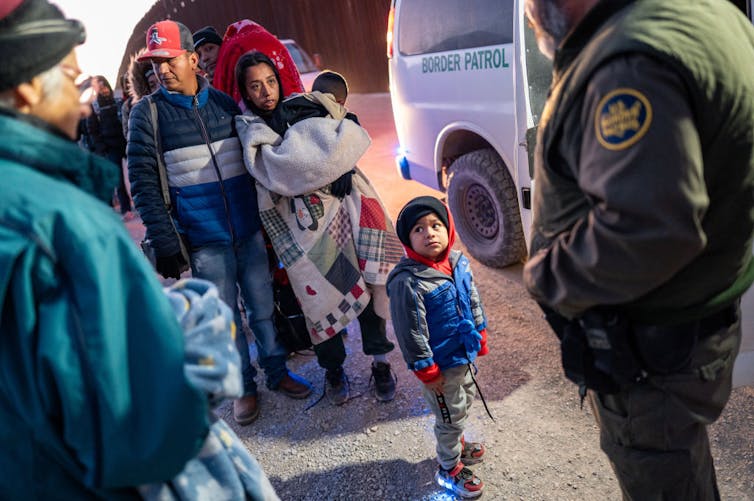
Mexican migrants prepare to turn themselves in to U.S. Customs and Border Patrol officers after crossing the border into Ruby, Ariz., on Jan. 5, 2025. Brandon Bell/Getty Images
Photo cerdits to Brandon Bell/Getty Images

3. Undocumented Immigrants, Unauthorized Immigrants and Illegal Immigrants

These three charged political terms refer to the same situation: migrants who enter or remain in the country without the proper legal paperwork. People in this category also include those who come to the U.S. with a visa and overstay its permitted duration.

Some of these immigrants work for cash that is not taxed. Most work with fake Social Security numbers, pay taxes and contribute to Social Security funds without receiving money after retirement.

Immigrants without legal authorization to be in the U.S. spent more than US$254 billion in 2022.

4. Asylum Seekers

An asylum seeker is a person who arrives at a U.S. port of entry – via an airport or a border crossing – and asks for protection because they fear returning to their home country. An immigrant living in the U.S. for up to one year can also apply for asylum.

Asylum seekers can legally stay temporarily in the U.S. while they wait to bring their case to an immigration judge. The process typically takes years.

Someone is eligible for asylum if they can show proof of persecution because of their political affiliation, religion, ethnic group, minority status, or belonging to a targeted group. Many others feel they need to leave their countries because of threats of violence or abusive relationships, among other dangerous circumstances.

A judge will eventually decide whether a person’s fear is with merit and can stay in the country.

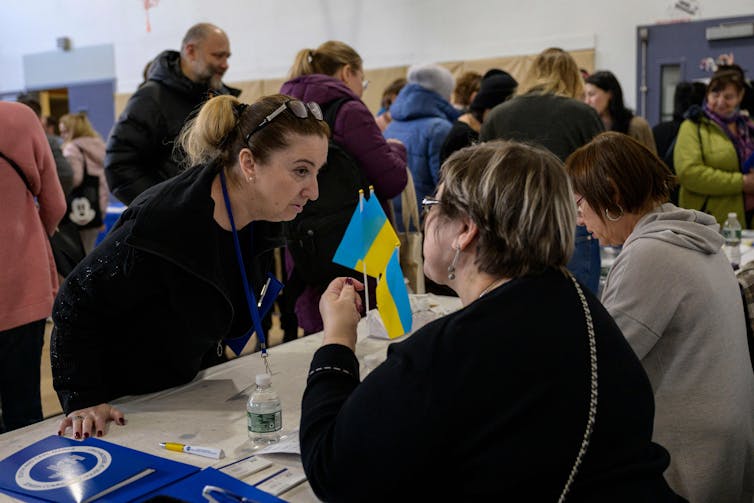
Ukrainian immigrants attend a job fair in New York City in February 2023. Angela Weiss/AFP via Getty Images
Photo cerdits to Angela Weiss/AFP via Getty Images

5. Refugees

Refugees are similar to asylum seekers, but they apply to resettle in the U.S. while they remain abroad. Refugees are often escaping conflict.

The Biden administration had a cap of admitting up to 125,000 refugees a year.

Refugees can legally work in the U.S. as soon as they arrive and can apply for a green card one year later. Research shows that refugees become self-sufficient soon after they settle in the country and are net-positive for the country’s economy through the federal taxes they pay.

6. Unaccompanied Children

This is a U.S. government classification for migrant children who enter the U.S. without a parent or guardian, and without proper documentation or the legal status to be in the country. Because they are minors, they are allowed to enter the country and apply for the right to stay. Most often, they have relatives already in the country, who assume the role of financial and legal sponsors.

7. Family Separation

This refers to a government policy of separating detained migrant parents or guardians from the children they are responsible for an traveling with as a family unit. The first Trump administration separated families arriving at the border as part of an attempt to reduce immigration.

At least 4,000 children were separated from their parents during the first Trump administration. The Biden administration tried to reunite these families, but as of May 2024, over 1,400 children separated during Trump’s first term still were not reunited with their families.

Legal migration systems that lack avenues for immigrants who work in manual labor to move with their families, and deportations, both also create family separations.

8. Immigration Detention

Immigration detention refers to the U.S. government apprehending immigrants who are in the U.S. without authorization and holding them in centers that are run similar to prisons. Some of these centers are run by the government, and others are outsourced to private companies.

When a U.S. Customs and Border Protection official apprehends an immigrant, they are often first brought to a building where they are placed in what many call a hielera, which means icebox or freezer in Spanish. This refers to cells, cages or rooms where the government keeps immigrants at very low temperatures with foil blankets and without warm clothing.

Immigrants might then be quickly deported or otherwise released in the country while they await a court date for an asylum case. Other immigrants who are awaiting deportation or a court date will be placed in an immigration detention center. Some must post bond to be released while awaiting trial.

9. Coyote

A coyote is the Spanish word for a guide who is paid by migrants and asylum seekers to take them to their destination, undetected by law enforcement. Coyotes used to be trusted by the migrants they were helping cross into the country. As the U.S. has tried to make it harder to enter illegally, the business of taking people to and across the U.S.-Mexico border unseen has become more expensive and dangerous.

10. The Alphabet Soup of Government Players

The Department of Homeland Security, or DHS, is a law enforcement agency created after 9/11. It includes a number of agencies that focus on immigration.

These include U.S. Customs and Border Protection, or CBP, an agency that is in charge of collecting import duties, passport and document controls at airports, ports, and official points of entry along the border.

The Border Patrol is a federal law enforcing agency under CBP in charge of patrolling and securing U.S. borders and ports.

Immigration and Customs Enforcement, or ICE, is a branch of DHS that works within the U.S., within its borders, focusing on detaining and deporting immigrants.

The Department of Health and Human Services, or HHS, takes care of unaccompanied minors after they enter the country.

Ernesto Castañeda is the Director of the Immigration Lab and the Center for Latin American and Latino Studies and Professor at American University. 

Daniel Jenks is a Doctoral Student at the University of Pennsylvania,

This piece can be reproduced completely or partially with proper attribution to its author.

Immigration Realities

Book Review

by Blogger Ben from ACEMAXX Analytics

It seems that the modern world is drowning in crises.

Imperialism, decolonization, violence, natural disasters, instability, and poverty have been uprooting people around the world for thousands of years.

Migration is part of human history. But “Migration” is a highly politicized theme.

Refugees are people who are facing problems and do not fundamentally pose a problem themselves.

A serious, systemic problem related to expulsion is the legacy of imperialism and current neo-colonial relations.

Ernesto Castañeda and Carina Cione: Immigration Realities – Challenging Common Misperceptions, Columbia University Press, Nov 2024.

According to the UNHCR, the real crisis is that a few countries have “a disproportionate responsibility for taking newcomers,” and not there is a relatively disproportionate number of arrivals:

Politicians and journalists speak of “immigrant and refugee crises,” but the authors explain why “we see it as a political crisis, not a crisis of migration.”

The constant production of refugee crises influences the public’s political and social views about migration.

“Migration cannot be “solved” because it is a timeless and constantly fluctuating phenomenon.”

It is an open secret that the strong opinions that people often have are based on idiosyncratic personal experiences, prejudiced views, and false assumptions spread by politicians and mainstream media.

However, the average citizen often does not have all the facts at hand to look at the topic of migration from an objective yet sensitive perspective – and cannot do so.

The authors attach great importance to summarizing academic literature to help promote public understanding of today’s international migration.

The recent book summarizes relevant research results on common myths for readers who are not familiar with contemporary migration or border studies.

In other words, the authors present the relevant scientific research, which is often closed behind paywalls, research specialization, and subject-specific jargon so that most readers find it awkward and difficult to understand. This book is clearly aimed at the general public.

Each chapter revolves around a certain misunderstanding and can be read as an independent work or together with the others. The individual chapters contain relevant and up-to-date knowledge about the realities of migration, which is presented in such a way that it is also appealing and accessible to non-professionals.

Ernesto Castañeda and Carina Cione distinguish how some rhetoric accuses, patronizes, and criminalizes refugees, which, in connection with xenophobia, stereotypes, and fear-mongering, support the myth of a crisis.

A refugee is defined as someone who has left his home country and cannot return because he has a reasonable fear of violence and/or persecution due to his identity or political conviction.

The word has two meanings: a “legal meaning” that describes a person entitled to asylum under international law, and a “colloquial meaning” that describes a person who has fled their homeland. The criteria for international recognition as a refugee are strict, and other displaced people can be wrongly referred to as refugees.Neo-colonialism under the auspices of neoliberal capitalism, for example, contributed to the fact that entire regions in Africa, Asia, and Latin America, which were first described as “the third world” and then now the “Global South,” because they were oppressed in the past and the present, and not simply because of their low national income or the degree of integration into international trade.

Every “refugee crisis” is a socially constructed term that distracts from the real problem: the high-income and imperialist countries do not take responsibility for their violent actions because they benefit from the equally violent postcolonial world order.

The current neo-colonial conditions are undoubtedly part of the neoliberal driven dismantling of the welfare state, which leads to a lack of state programs for the public and the acceptance of tax cuts for the rich.

Globalization and migration are presented as two sides of the same coin, but in reality, they are very different phenomena – economic globalization and migration are not causal since migration tendencies do not necessarily agree with trade trends: periods of expanding international trade do not always correlate with migration waves or vice versa.

The authors also clarify usual terms such as “integration, assimilation, and acculturation.” Yours truly, for example, has so far preferred the term “acclimatization” to “assimilation” and “integration.”

According to Ernesto Castañeda and Carina Cione, comprehensive integration is a social integration; it does not mean cultural assimilation to the morals of the dominant group, but rather presupposes certain negotiations, reciprocal communication, and mutual influence.

Integration is often mistakenly equated with assimilation and acculturation. However, these are different concepts.

Acculturation refers to the process of getting to know the culture of the new place of residence and the achievement of a fluid cultural language. Immigrants can acculturate while maintaining many of their native traditions and culture.

In the spirit of Ernesto Castañeda’s previous work, social integration means equality and equal opportunities while maintaining cultural differences.

Assimilation is based on intolerance towards identities that deviate from the dominant and often Eurocentric culture.

Migration is an inherent human phenomenon that is subject to changes that are influenced by local and national political, economic, and social conditions. Data relating to the overall world population does not allow the conclusion that globalization is driving migration forward.

Research refutes widespread misconceptions about immigration. In fact, only 3.5% of the world’s population live in a country other than the one in which they were born.

Worldwide, the percentage of people who change residences due to war, political or religious persecution, poverty, or lack of opportunity is not as high as ever before and is not unmanageable for host countries.

Migration is a geographical and social relocation process. Subjective affiliation also depends on the objective conditions, including the absorption capacity of the new environment and the attitude of the locals towards immigrant groups.

In the US, for example, there is still no national integration program specifically designed to support immigrant integration. Migrants are expected to go through this process alone.

In sum, “Immigration Realities” is an indispensable masterpiece of intellectual honesty.

Immigration Realities – Challenging Common Misperceptions, by Ernesto Castañeda and Carina Cione – Columbia University Press, Nov 2024.

Originally published in German in ACEMAXX-ANALYTICS’s Newsletter!

Biden’s executive order to protect immigrant spouses of citizens from deportation will benefit their families and communities

by Jane Lilly López, Kristina Fullerton Rico*

President Joe Biden prepares to board Air Force One in California on June 16, 2024. Mandel Ngan/AFP via Getty Images/ Creative Commons License

Rodrigo Salazar is a man who entered the U.S. without a visa and has been living in the country without legal status ever since. Because of this, Rodrigo, who asked that we not use his or his wife’s real names in order to protect their identity, cannot advance from low-paying jobs at restaurants and car washes. 

His wife, Carmela, is a U.S. citizen, but she is also facing career limitations. Carmela doesn’t feel safe moving to a place where she could get a higher-paying job. She worries that Rodrigo’s lack of legal status would be more obvious in a city with a smaller Latino population, which would put him at risk for arrest and deportation.

The entire Salazar family, including their two children, live with the constant fear of family separation if Rodrigo is deported.

Immigrants like Rodrigo, who are living in the U.S. without legal status but are married to U.S. citizens, will now have protectionfrom deportation, President Joe Biden announced on June 18, 2024. In order to qualify, they must have arrived 10 or more years ago and be married to a U.S. citizen. Those who meet these criteria will be able to get work permits and can get on the pathway to citizenship while working and living in the U.S. legally. 

The Biden administration estimates that about 500,000 immigrant spouses of citizens will be protected from deportation with this policy change. The policy will also apply to approximately 50,000 U.S. citizens’ stepchildren who are living in the U.S. without legal immigration status.

We are migration scholars who study mixed-citizenship marriages – meaning some family members are citizens or have the legal right to stay in the U.S., while others do not – and the consequences of being undocumented. Our research shows that when one family member lacks legal immigration status in the U.S., the family as a whole assumes an undocumented status. 

When one family member cannot safely travel, work or access health careall family members suffer. The opposite is also true. When a family member is able to shift from living without legal status in the U.S. to getting legal status, the lives of the entire family improve.

A shift in immigration policy in the 1990s

Generally, having an immediate family member who is a U.S. citizen gives a foreign citizen the chance to live legally in the U.S. with permanent residency and a pathway to citizenship. 

For most of the 20th century, all spouses of U.S. citizens who met the legal standards for qualified marital relationships were able to become citizens through a relatively straightforward process, but that changed in 1996

A 1996 law called the Illegal Immigration Reform and Immigrant Responsibility Act imposed harsh penalties for people living in the U.S. without legal immigration status. One of the penalties is a 10-year “bar to re-entry” for anyone who has lived without a visa in the U.S. for one year or more. This ban goes into effect as soon as that individual leaves U.S. territory.

Technicalities create a divide

A consequence of this 1996 law was that getting a green card, which is an identity document that gives someone legal permanent residency in the country, became dependent on whether an immigrant entered – and remained in – the U.S. with or without a visa. 

This change in the law produced a stark inequality in U.S. citizens’ ability to legally sponsor their immigrant spouses for permanent residency.

If an immigrant spouse of a U.S. citizen has overstayed a visa, this person can apply for legal immigration status – through their spouse – from within the U.S. In these cases, the spouse does not have to leave U.S. territory and is not subject to the 10-year ban. 

In contrast, if a U.S. citizen’s spouse entered the U.S. without a visa or other legal permission, they must leave the country for the final step in their legal immigration application process. But when they leave the country, their 10-year ban automatically goes into effect. 

This means that although every U.S. citizen’s spouse, including those lacking legal immigration status, technically qualifies for legal permanent residency, some of them will have to spend a decade or more outside the country before they can actually get a green card.

As a result, over the past few decades, millions of immigrants who were living in the U.S. without legal permission but were married to U.S. citizens have not gotten legal immigration status

While the 10-year bar applies only to immigrants without legal status, in practice it also profoundly affects their citizen spouses, too

In these cases, citizens married to immigrants without legal permission to be in the U.S. have two difficult options. They can resign themselves to a life of fear and limitations in the U.S., including the ever-present threat of their spouse’s deportation, or they can give up living in the U.S. altogether for a decade or more.

A new U.S. citizen, originally from Mexico, poses with his family after a naturalization ceremony in November 2023 in Long Beach, Calif. Biden’s new policy will make it easier for undocumented immigrants with citizen spouses to become citizens. Mario Tama/Getty Images

The impacts of Biden’s immigration policy changes

The Biden administration has connected this new executive action on families to its recent announcement that it will heighten restrictions for seeking asylum, which scholars have called a ban on asylum.

The administration said in a press release that it both wants to “secure the border” and expand “lawful pathways to keep families together.” 

Under this new policy, immigrant spouses who entered the country without a visa before June 17, 2014, will be allowed to “parole in place,” which is similar to a policy that benefitsmilitary veterans’ immigrant spouses who lack legal immigration status in the U.S. Parole in place means that these immigrants will have authorization to work and increased protection from deportation. 

Parole in place will also allow immigrant spouses of U.S. citizens to have their immigration applications processed within the U.S., whether they arrived with or without a visa. This means they will no longer need to leave the country for 10 years or more if they entered the U.S. without a visa.

Having the legal right to work in the U.S. will allow these immigrant spouses to find jobs that better match their education and skills. Some estimates suggest that this could increase an immigrant’s wages anywhere from 14% to 40% more than what they currently earn

The executive action will also yield economic benefits for the communities where mixed-citizenship families live.

Economic analyses measuring the impact of expanding work authorization and access to citizenship predict that this will create new jobs, boost incomes across communities, increase local and federal tax revenues and encourage ongoing economic growth.

As scholars of migration, we believe that this executive action is an important step toward guaranteeing that U.S. citizens who marry immigrants do not end up experiencing negative consequences because their spouses cannot legally live, work or vote in the U.S. It will also prevent the de facto deportation of U.S. citizens alongside their noncitizen spouses.

In essence, this policy change benefits American families and protects the rights of U.S. citizens to marry the person they love, keep their families together and even live in their own country. Beyond helping families, this change will have far-reaching economic benefits for the communities – and country – where they live.

Copyleft Creative Commons. Reproduction with full attribution is possible by news media and for not-for profit and educational purposes. Minor modifications, such as not including the “About the Study” section, are permitted. 

*Jane Lilly López is an Assistant Professor of Sociology, Brigham Young University. Jane Lilly López’s research on mixed-citizenship couples has received funding from the National Science Foundation, UC MEXUS, and the Center for US-Mexican Studies.

*Kristina Fullerton Rico is a Research Fellow, Center for Racial Justice, Ford School of Public Policy, University of Michigan. Kristina Fullerton Rico’s research on the impact of long-term undocumented immigration status has received funding from the Russell Sage Foundation and Sociologists for Women in Society. 

This is reproduced from The Conversation with the authors’ permission.

https://theconversation.com/how-bidens-executive-order-to-protect-immigrant-spouses-of-citizens-from-deportation-will-benefit-their-families-and-communities-231651

We Must Ensure Access to Health Care for Immigrants

by Rodrigo Stein, MSc.*

This graph summarizes the Census Bureau’s American Community Survey data, capturing the percentage of uninsured adult Latinos in the Washington, D.C. Metropolitan Area. By Rodrigo Stein / Creative Commons License

Gaps in access to public health insurance like Medicaid and other subsidized programs, coupled with restrictions in private job-based health coverage, create significant barriers for immigrants in obtaining essential healthcare services. The disparate treatment of immigration statuses leads to a fragmented health coverage system, resulting in many immigrants, including those lawfully present, foregoing necessary medical care. This contributes to poorer health outcomes, reduced life expectancy, and increased morbidity rates among immigrant populations in the Washington, D.C. metropolitan area.1

Immigration Status Impacts Health

The Washington, D.C. metropolitan area is home to over 900,000 Latinos, 53% of whom are foreign-born.A significant portion of this immigrant population hails from Central American countries such as El Salvador, Honduras, and Guatemala. Numerous studies highlight how immigration and immigration status impact health outcomes through various material and psychological mechanisms.3,4  These include heightened fear and stress, unequal access to resources, experiences of prejudice and violence, and disparities in accessing safe employment and quality housing.2,3 Despite the implementation of the Affordable Care Act (ACA), individuals with Central American heritage are still less likely to have health insurance compared to non-Latino Whites.4

Over 32,000 Temporary Protected Status (TPS) holders who have sought protection in the United States due to conflict or natural disasters in their home countries reside primarily in the Washington, D.C. metropolitan area.5 TPS holders (the majority, Salvadoran nationals) qualify for ACA subsidies and plans but not Medicaid.6 Medicaid, the primary public health program for low-income working-age adults, is limited to citizens and “qualified non-citizens,” a category that requires both legal status and (in most cases) completion of a five-year waiting period to be eligible for public assistance programs.7

These provisions combine to make thousands of immigrants ineligible for public health services and financial assistance for purchasing insurance, forcing them to choose between purchasing expensive private market insurance at cost, going without health insurance, or relying on the emergency room as their main source of care. (See Table 1).

 Table 1 Eligibility for Federally Funded Health Care Coverage Based on Immigration Status

Eligibility for Federally Funded Coverage Based on Immigration Status
Immigration StatusMarketplace EligibleMedicaid/CHIP Eligible
Lawfully Present and Eligible for Federally Funded Coverage
Valid non-immigrant visa holders (e.g. students, worker visas)X
Humanitarian statuses or circumstances (including Temporary Protected Status, Special Juvenile Status, asylum applicants, Convention Against Torture, victims of trafficking)X
Legal status conferred by other laws (temporary resident status, Legal Immigration Family Equity Act, Family Unity individuals)X
Qualified non-citizens • Lawful Permanent Residents [(LPR)/Green Card Holder)]*
• Paroled into the U.S. for at least one year* 
• Battered non-citizens, spouses, children, or parents* • People fleeing persecution (e.g., asylees, refugees) 
• Granted withholding of deportation 
• Cuban/Haitian entrants • Certain Amerasian immigrants 
• Members of a federally recognized Indian tribe or American Indian born in Canada 
• Veterans or active duty military and their family members 
• Victims of trafficking and their family members 
• Citizens of the Marshall Islands, Micronesia, and Palau who are living in one of the U.S. states or territories [“Compact of Free Association (COFA) migrants”]
• Granted Iraqi or Afghan special immigrant status 
• Children receiving foster care or adoption assistance 
• Conditional entry granted before 1980
Ineligible for Federally Funded Coverage
Undocumented immigrants:Individuals who entered the country without authorizationIndividuals who entered the country lawfully and stayed after their visa or status expiredXX
DACA: Temporary status allowing individuals who came to the country as children to remain in the U.S.XX
Deferred Action for Parents of Americans and Lawful PermanentResidents (DAPA): Temporary status allowing parents of citizens or LPRs to remain in the countryXX
*Subject to the five-year bar (i.e. requirement to reside in the U.S. for five years or more before becoming eligible for Medicaid/CHIP). Note that there is no five-year bar for accessing subsidized Marketplace coverage.

Health Risks & Social Determinants of Health 

In addition to access barriers, immigrants experience a lack of social support and the absence of culturally and linguistically competent services. This means that many Latino immigrants, even those with access to quality care, forego seeking medical care until they face an emergency. Language barriers contribute to increased rates of misdiagnoses, weaker health literacy skills, and reduced access to acute and preventive care.8

This issue is compounded by the fact that many Latino immigrants are employed in occupations that offer limited access to employer-sponsored health coverage and often have comparatively lower incomes.9 As a result, these individuals face barriers to accessing care when trying to afford employer-sponsored coverage, when available, or when navigating the individual health insurance market. Given these barriers, what policy alternatives exist to ensure thousands of Latino immigrant residents in our region are not excluded from health care? 

Current Options: Federally Qualified Health Centers

Because of their limited access to health care, Latino immigrants often seek services at community health centers (CHCs) where they can access care without insurance (over 35% of CHC patients in the U.S. are Latino).10 Federally Qualified Health Centers (FQHCs) are CHCs that meet stringent federal requirements and receive funding via the Health Resources and Services Administration (HRSA) to provide primary health care services to all people regardless of their ability to pay or documentation status through a sliding fee scale.11

FQHC’s like La Clínica Del Pueblo (La Clínica), play a significant role in reducing racial and ethnic health disparities. The success of these centers in narrowing these gaps is attributed to the wide range of services they offer, culturally competent care, and strong relationships built with underserved communities.12  Since all direct service staff are bilingual, and most are first-generation Latino immigrants, La Clínica provides much-needed culturally and linguistically appropriate health care to a large yet excluded population in the Washington, D.C. metro area.

However, despite their effectiveness in producing high-quality healthcare outcomes, FQHCs are limited in size, scope, and resources. Because these centers vary in size, depth, and jurisdiction, addressing the cost of care for those who are ineligible for federally funded health programs is paramount—without them, FQHCs bear the burden of uncompensated care for a population with significant health needs.

Potential Policy Solutions

As of March 2024, the District of Columbia and six states—California, Colorado, Illinois, New York, Oregon, and Washington—have expanded fully state-funded coverage to some income-eligible adults regardless of immigration status.13 These legislative or administrative actions rely on establishing state Medicaid/CHIP equivalent or comparable programs, and creating state premium or cost-sharing subsidies to enable individuals to purchase marketplace coverage.9 In addition to these six states, Maryland will allow income-eligible individuals to purchase marketplace coverage regardless of immigration status through a Section 1332 waiver.

Maryland’s Access to Care Act

On May 16, Maryland Governor Wes Moore signed the Access to Care Act into law. Sponsored by Delegate Bonnie Cullison and Senator Antonio Hayes, the law removes immigration status as an eligibility requirement for purchasing a health plan through the Maryland Health Benefit Exchange (MHBE). In doing so, Maryland allows the remaining 6% of uninsured Maryland residents to purchase insurance. Immigrants make up a substantial number of that uninsured population; they are 15% of Maryland’s population overall, and the state’s Montgomery and Prince George’s counties have the highest concentrations of the Latino population in Maryland, with 21% in each jurisdiction. Soon, they will not only have the choice to buy a healthcare plan in the state but also receive care in a culturally and linguistically competent manner.  

Stepping Toward Equity

By expanding eligibility for public health programs and supporting community health centers, we can ensure that all residents, regardless of immigration status, have access to essential healthcare services. Legislative actions like the Maryland Access to Care Act represent significant steps towards achieving health equity for immigrant populations.

[1] Martinez O, Wu E, Sandfort T, Dodge B, Carballo-Dieguez A, Pinto R, Rhodes SD, Moya E, Chavez-Baray S. Evaluating the impact of immigration policies on health status among undocumented immigrants: a systematic review. J Immigr Minor Health. 2015 Jun;17(3):947-70. doi: 10.1007/s10903-013-9968-4. Erratum in: J Immigr Minor Health. 2016 Feb;18(1):288. Rhodes SD [corrected to Rhodes SD]. PMID: 24375382; PMCID: PMC4074451.

[2] Migration Policy Institute. Central American Immigrants in the United States. Migrationpolicy.org. Published May 2023. Accessed February 18, 2024. https://www.migrationpolicy.org/article/central-american-immigrants-united-states

[3] Yamanis T, Morrissey T, Bochey L, Cañas N, Sol C. “Hay que seguir en la lucha”: An FQHC’s Community Health Action Approach to Promoting Latinx Immigrants’ Individual and Community Resilience. Behavioral Medicine. 2020;46(3-4):303-316. doi:10.1080/08964289.2020.1738320

[4] Bucay-Harari L, Page KR, Krawczyk N, Robles YP, Castillo-Salgado C. Mental Health Needs of an Emerging Latino Community. The journal of behavioral health services & research. 2020;47(3):388-398. doi:10.1007/s11414-020-09688-3 

[5] National Immigration Forum. Temporary Protected Status (TPS): Overview and Current Issues. Accessed February, 2, 2024. Available from: https://immigrationforum.org/article/fact-sheet-temporary-protected-status/#:~:text=The%20largest%20populations%20of%20TPS,York%20(23%2C168)%20metropolitan%20areas

[6] HealthCare.gov. Immigration status & the Marketplace. Accessed May 16, 2024. Available at: https://www.healthcare.gov/immigrants/immigration-status/

[7] Supporting Health Equity and Affordable Health Coverage for Immigrant Populations: State-Funded Affordable Coverage Programs for Immigrants. Shvs.org. https://www.shvs.org/wp-content/uploads/2021/10/State-Funded-Affordable-Coverage-Programs-for-Immigrants.pdf. Published 2021. Accessed April 3, 2024.

[8] Nelson B, Tu L and Sanford F. To Advance Health Equity For Patients With Limited English Proficiency, Go Beyond Interpreter Services. Health Affairs (Millwood). October 23, 2023. https://www.healthaffairs.org/content/forefront/advance-health-equity-patients-limited-english-proficiency-go-beyond-interpreter

[9] American Immigration Council. District of Columbia Immigration Data. American Immigration Council. https://map.americanimmigrationcouncil.org/locations/district-of-columbia/. Published 2023. Accessed February 8, 2024.

[10] Ortega AN, Rodriguez HP, Vargas Bustamante A. Policy dilemmas in Latino health care and implementation of the Affordable Care Act. Annu Rev Public Health. 2015;36:525-544. doi:10.1146/annurev-publhealth-031914-122421

[11] Federally Qualified Health Centers. Official web site of the U.S. Health Resources & Services Administration. https://www.hrsa.gov/opa/eligibility-and-registration/health-centers/fqhc/index.html. Published 2022. Accessed April 10, 2022.

[12] Yamanis T, Morrissey T, Bochey L, Cañas N, Sol C. “Hay que seguir en la lucha”: An FQHC’s Community Health Action Approach to Promoting Latinx Immigrants’ Individual and Community Resilience. Behavioral Medicine. 2020;46(3-4):303-316. doi:10.1080/08964289.2020.1738320

[13] Kaiser Family Foundation. State Health Coverage for Immigrants and Implications for Health Coverage and Care. Kaiser Family Foundation website. Published October 1, 2021. Accessed May 16, 2024. Available at: https://www.kff.org/racial-equity-and-health-policy/issue-brief/state-health-coverage-for-immigrants-and-implications-for-health-coverage-and-care/

Copyleft Creative Commons. Reproduction with full attribution is possible by news media and for not-for profit and educational purposes. Minor modifications, such as not including the “About the Study” section, are permitted. 

*Rodrigo Stein is a resourceful public health professional with experience in program management, design and evaluation, advocacy, and strategic planning.

The Legacy of U.S. Immigration Policy Towards Cuba

by William M. LeoGrande*

Cuban Privilege by Susan Eckstein / Creative Commons License

Susan Eckstein’s recent book, Cuban Privilege: The Making of Immigrant Inequality in America, is a deep dive into how the U.S. government structured its immigration policy to the advantage of Cuban migrants as part of its Cold War policy to destabilize Fidel Castro’s revolutionary government. The book caused quite a stir among some Cuban Americans, who were insulted that someone pointed out policies that helped make the Cuban American community a success story.  

Cuban Privilege was not Eckstein’s first book on Cuban diaspora. She has written extensively on the threads that connect Cubans abroad with their family still on the island. Her book The Immigrant Divide: How Cuban Americans Changed the U.S. and Their Homeland was one of the first in-depth studies of how the Cuban American community began reconnecting to the island in the 1980s and 1990s, building bridges based mainly on family ties.

In the 1960s and 1970s, both the Cuban and U.S. governments erected a “sugar cane curtain” that made it almost impossible for families to stay connected across the Florida Strait. Travel was prohibited, direct mail service was unavailable, and connecting by phone was nearly impossible and prohibitively expensive. 

But in the 1980s, travel opened up, and remittances began to flow. Ever since the Special Period, Cuba’s economic crisis in the 1990s, Cuban American remittances have made an essential contribution to the livelihood of millions of Cuban families—a stark reality demonstrated by the humanitarian crisis on the island that resulted when Donald Trump and the COVID-19 pandemic cut remittance flows by some two-thirds. 

Cuban Privilege reverses the lens to look not at Cuban immigrants but at the U.S. immigration policies that brought them here. It is the definitive account of how Washington, motivated by the Cold War, gave Cuban immigrants privileged access to the United States and unprecedented support once they got here. Key elements of that privilege remain in place today, exacerbating the current migration crisis—foremost among them the Cuban Adjustment Act, which allows Cubans living in the United States for a year to apply for permanent residence, regardless of their form of entry.  

Most of the time, academics toil in relative obscurity, writing for one another in hopes of contributing new knowledge to their chosen field. On occasion, they write for a broader audience, hoping that their expertise might have some positive impact on public policy. And most of the time, when they speak truth to power, power isn’t listening. Rarely do academic contributions to the public debate attract much attention or make much difference.

Susan Eckstein’s Cuban Privilege is a cautionary tale of what can happen when the public does take notice. Presenting her book in Miami, Eckstein endured 30 minutes of hate, denounced as an agent of Castroism, because she had the nerve to state the obvious — Cuban immigrants to the United States have enjoyed enormous privileges that no other immigrant group has enjoyed. To say that is not an attack on Cuban Americans; it’s a simple truth. 

Ironically, the policy of privileged immigration for Cubans, which was intended to weaken and embarrass the Cuban government, has instead weakened and embarrassed the U.S. government producing a series of migration “crises” or more correctly punctuated increases (Camarioca in 1965, Mariel in 1980, the rafters crisis in 1994, and the post-Covid increase in emigration that is ongoing today), and distorting U.S. domestic politics by creating one of the most powerful domestic foreign policy lobbies in history—Cuban Americans in south Florida.

For 30 years, successive presidents —with the sole exception of Barack Obama— have been afraid to stand up to the Miami lobby on U.S. policy toward Cuba. As President George H. W. Bush’s National Security Adviser Brent Scowcroft put it, “Cuba is not a foreign policy question. Cuba is a domestic issue.” The result is a policy of regime change that, in 65 years, has done nothing to advance the cause of democracy or human rights in Cuba, but has lowered the living standard of the Cuban people and alienated Washington from allies in Latin America.

Before the Trump administration, Cuban American attitudes were gradually evolving toward moderation and support of engagement. President Obama won more Cuban American votes in Florida than any Democrat before him. And a majority—albeit a narrow one—supported his normalization policy.

But Trump’s return to a policy aimed at overthrowing the Cuban government re-energized the most recalcitrant Cuban American right. Recently both attitudes and voting behavior in the community seem to have swung sharply to the right, the result of a new wave of immigrants, a toxic social media environment, and disinformation spread by some of Miami’s Spanish language media.

As a result, Democrats have gone back to being afraid of Cuba—not the island, but the issue. Despite his campaign promise to return, for the most part, to Obama’s policy of engagement, President Biden has kept in place most of Donald Trump’s draconian economic sanctions aimed at strangling the Cuban economy.

            The final irony is that Florida does not actually matter very often in presidential elections. Conventional political wisdom casts it as a critical swing state. But in the sixteen presidential elections since 1960, Florida has determined the outcome in Electoral College only twice: in 2000, when Cuban Americans gave George W. Bush a 537-vote margin over Al Gore because the Clinton administration returned six-year-old Elián González to his father in Cuba; and in 2004 when Bush narrowly beat John Kerry.

            Kerry lost Florida by such a wide margin that he would have lost the state even if he had won the Cuban vote. So Cuban Americans in Florida have only cost the Democrats the White House once: in the unforgettable election of 2000. Ever since, Democrats have suffered from electoral post-traumatic stress disorder over the issue of Cuba, and it appears that 2024 will be no different. That is the legacy of the immigration policies that Susan Eckstein so expertly chronicles in Cuban Privilege.

Copyleft Creative Commons. Reproduction with full attribution is possible by news media and for not-for profit and educational purposes. Minor modifications, such as not including the “About the Study” section, are permitted. 

*William M LeoGrande is a CLALS faculty affiliate and Professor of Government at American University in Washington, DC, and co-author with Peter Kornbluh of Back Channel to Cuba: The Hidden History of Negotiations between Washington and Havana(University of North Carolina Press, 2015).

Surviving the Criminalization of Migration

by Ernesto Castañeda, Makenna Lindsay, and Natalie Turkington*

Survivor of Ciudad Juarez Migrant Detention Center Fire / Creative Commons License

On March 27, 2023, a fire at a migrant detention center in Ciudad Juarez, Mexico killed 40 migrants and injured 29 more. One of those injured was Justen (pseudonym), a man in his late 20s from El Salvador who lost six of his friends in the fire. Dr. Ernesto Castañeda, Director of the Immigration Lab and the Center for Latin American and Latino Studies (CLALS) sat down with Justen last year to discuss the horrors experienced inside of the center and what happened after. The following testimony reveals the cruelty inside the Ciudad Juarez detention center fire as well as the treatment victims encountered by both U.S. and Mexican officials after the fact. 

Justen mentioned how difficult it was to transit through Mexico. He crossed into Chiapas in a pickup truck under a tarp. Later in Northern Mexico, he was stopped and questioned. He claimed he was from Chihuahua, Mexico but the authorities decided that given his answers, he was not Mexican, and he was taken to an immigration detention center. At the center, people had different rights and access to necessities such as mattresses and water bottles—only if they had money to pay for them. After some of the immigrants complained that they had no water to drink, the officials would reply that it was not up to them to support them and that it was their fault “por andar migrando” for migrating. Some of the people detained got angry, put the mattresses together, and said “if you do not open the doors or give us water, we will burn them.” An agent said, “Que les vaya bien”— “farewell,” as he saw them light the place on fire and left without opening the door.  

When the fire broke out, Justen felt his skin getting too hot, the smoke made it hard to breathe. He ran to the bathrooms to try to get away from the flames and found dozens of people, all crammed together–there was no running water. He and others screamed “Please let us out! “We do not want to die!” However, migration officials did not open the door. Justen recalls that, “the immigration officials did not at any moment try to open the door or call other authorities or ambulances.” Trapped in the bathroom, Justen lost consciousness, thinking he would die being burnt alive.

He later heard people crediting a passing firefighter who saw the smoke, called the fire department, and ran towards the building. Firefighters stopped the fire before everyone died inside. Justen’s burnt but breathing body was brought to Mexico City where he underwent treatment and a hospital stay of over two weeks and was incubated for much of that time. Immediately following his discharge, he had multiple interactions with agents of the Mexican government to arrange lodging for the remainder of his recovery. “When I saw migración [migrant agents] there, I said, ‘Why, why are our aggressors looking out for us?’’ Even in his injured state, Justen recognized the paradox that although migration officials played a major role in his near-fatal condition, they also “helped” him to recover. Ironically, they also helped bring his mother from El Salvador for humanitarian reasons.  

This is not the only striking paradox illuminated by the fire. The fire, namely smoke inhalation and dehydration caused immense damage to Justen’s lungs and kidneys. The doctor told him that 90% organ function would be considered great given the extent of the organ damage; he would likely never recover full function and health. “…I have to keep living and be more cautious of my lungs, airways, and kidneys… if I ever get too dehydrated because this could jeopardize my life.” Indeed, he would often cough while we spoke. 

The sequelae are not only related to his physical health but also to his mental health. In the interview Justen shared that to this day he still hears the cries of people trapped screaming, ‘We don’t want to die! We don’t want to die!’, and his own screams: ‘I don’t want to die! I don’t want to die!’ Six of his travel companions died in the fire. He also expressed the mistreatment and further neglect he endured from the Executive Commission of Attention for Victims (CEAV), and the chronic health problems he must deal with because of the tragedy. 

Following the fire, Justen was allowed to apply for asylum in the United States. Given his condition, Justen was asked about his health care and public services access in the United States. He specifically notes the conditional nature of his asylee status he understood that “…it was a condition of the government that we were in good health and all that and not to be a public charge.” He will not apply to receive disability income and will depend on remittances from his wife in DC and a job the mom can find in Texas.

The acute irony of the situation is that the United States government played a pivotal role in the development of his condition by asking Mexico to more forcefully enforce its immigration policies and to dissuade Central American and other immigrants from reaching the U.S./Mexico border, and yet it granted him asylum as a survivor of a tragedy abroad. Nonetheless, in establishing such a condition, the U.S. evades its responsibility to not only protect migrants but to protect and honor the rights of asylees.  

As discussed in the book “Reunited: Family Separation and Central American Youth Migration,” Justen was on his way to the U.S. in part to reunite with his wife and family who are living in the Washington, DC area. Justen’s wife escaped violence from El Salvador and moved to Nicaragua, but then the situation got unstable in Nicaragua and she came to DC. Justen and his mother were relocated by non-profits to a city in Texas under humanitarian parole and applied asylum, but his wife is undocumented and cannot apply for asylum simultaneously because she was not traveling with him and she was not at the fire. Justen is not in condition to work yet, though his wife has a job in DC and therefore, they still live apart despite both being in the United States. Such family separations show how immigration laws tend to work at the individual level, putting family unity and well-being in a secondary place.  

Violence against immigrants, like that in the Ciudad Juarez fire is a direct result of immigrant restrictionism and the externalization of borders that we see in North America and Europe. There is a need for the public to pay closer attention to the realities experienced by migrants, asylees, and refugees. Unjust treatment which goes unnoticed points to the lack of care taken to uphold the human rights of those on the move.   

For more see: 

Délano Alonso, Alexandra. “Before and After the Juárez Fire.” CLALS Working Paper, no. 45 (2023). https://www.american.edu/centers/latin-american-latino-studies/upload/ssrn-id4655183.pdf 

Brashear, Madeline and Diaz, Sarah and American University, CLALS, No Right to Life: Lives Lost and the Legalized Violence That Shaped a Humanitarian Crisis in the Arizona Borderlands (November 15, 2023). Available at SSRN: https://ssrn.com/abstract=4634297 

Book Review: Migration and Mortality: Social Death, Dispossession, and Survival in the Americas https://www.academia.edu/108876335/Book_Review_Migration_and_Mortality_Social_Death_Dispossession_and_Survival_in_the_Americas 

Guerra, Sofia. Invisible Deaths. https://aulablog.net/2024/03/07/invisible-deaths/  

Copyleft Creative Commons. Reproduction with full attribution is possible by news media and for not-for profit and educational purposes. Minor modifications, such as not including the “About the Study” section, are permitted. 

*Ernesto Castaneda is the Director of the Center for Latin American and Latino Studies, and the Immigration Lab. He conducted the interviews and helped write the blog. Makenna Lindsay, Coordinator of the Immigration Lab, and Natalie Turkington, a Research Assistant with the Center for Latin American and Latino Studies at American University, transcribed and translated the interview, and drafted and edited this blog. 

Changing Aid Conference: Rethinking Aid and Migration

By Nancy Kim, American University

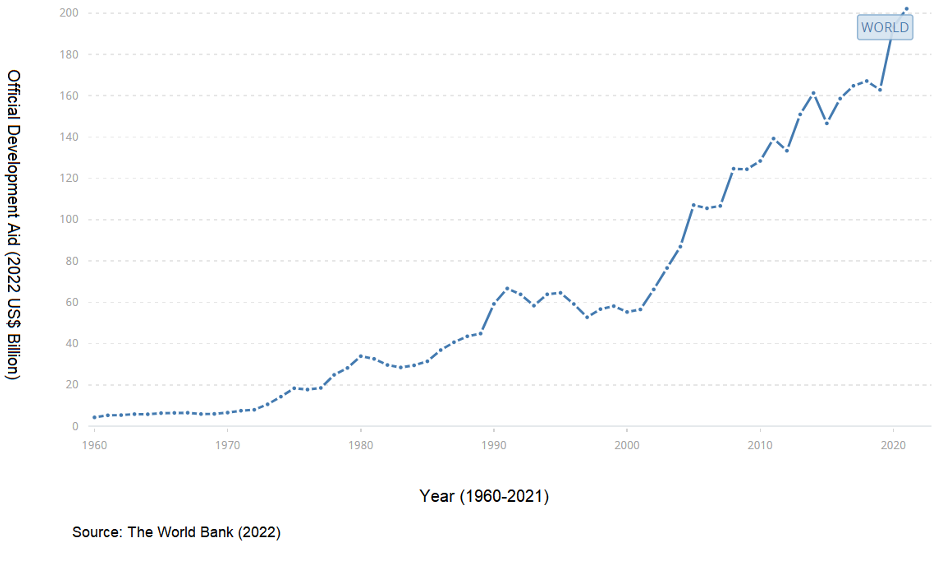
The inaugural Changing Aid Conference, hosted by the Changing Aid Signature Research Initiative (SRI) at the School of International Service at American University, brought together scholars and practitioners in the field. The three panels were 1) Aid and Conflict, 2) Aid and Migration, and 3) Careers in Aid. There have been large shifts in who gives, how much, where, and in which manner. As demonstrated in Figure 1, official development assistance (ODA) has been on an upward trend since the 1960s. Although this might seem “positive” for the aid industry and those in need of aid, there is a need to critique this trend as the definition of ODA changes constantly. For example, ODA has expanded to include the money spent within donor countries to host and house refugees where the same amount might not stretch as far due to higher cost of living.

Figure 1. Net official development assistance and official aid received (current US$)

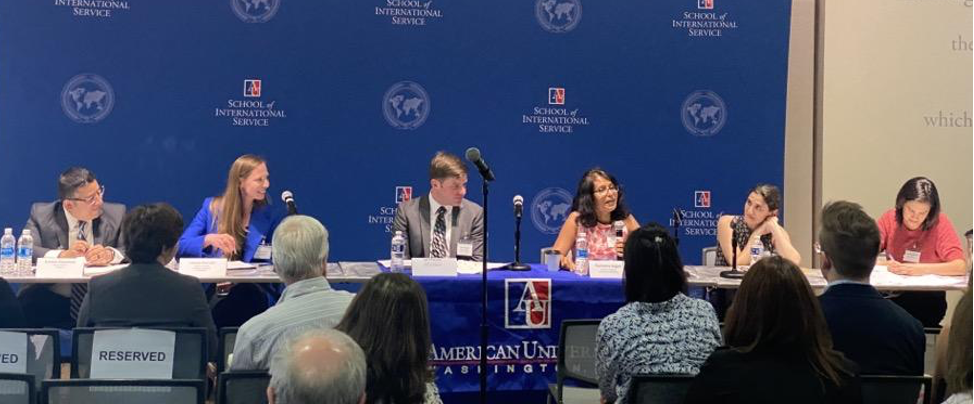
Within this context, highlighted by Panel 1, Panel 2 delved into the nexus between aid, especially ODA, humanitarian aid, and migration. The second panel on Aid and Migration was moderated by Dr. Ernesto Castañeda, Director of the Immigration Lab and the Center for Latin American and Latino Studies and a faculty of SRI. Panelists were from diverse backgrounds including academia, funding entities, policy research organizations, and direct service providers (Lauren Carruth, American University; Ian Proctor, Catholic Relief Services; Tazreena Sajjad, American University; Yael Schacher, Refugees International; Daniela Villacres, USAID)[1].

From left to right: Ernesto Castañeda, Lauren Carruth, Ian Proctor, Tazreena Sajjad, Yael Schacher, Daniela Villacres

            The panelists focused on the perception and work around aid, development, and migration. To start, Dr. Schacher explained the shift that led to an explicit link between aid and migration: “During the Cold War era, aid was used to win the hearts of people. Now, aid is used to deter migration.” In the earlier days of international aid, it was seen as a way to elevate the view of the global north and to fight against communist ideologies. More and more, however, aid, especially development aid, is considered by donor countries as a way to deter migration from the global south despite evidence showing that development can lead to increased mobility.

Such aid practices based on the belief that aid will deter migration can harm the wellbeing and best-interest of the migrants themselves. Dr. Carruth shared her experience working in the Horn of Africa and brought up the question of the work of many migration and humanitarian aid organizations. In particular, she critiqued the notion of “voluntary return” where migrants fleeing devastating situations through the desert find themselves at help centers or refugee camps coerced to consent to return to where they came from to receive much-needed treatment or food and water. In such a case, aid actors were directly inhibiting the ability of migrants to move even when their lives depended on leaving their place of origin.

Dr. Sajjad also critiqued the basis of aid with regards to deterring migration. Most often aid is seen as something done “over there”, and increasingly, refugee and asylum assistance in the global north is undermined and even externalized as seen in the case of Australia offshoring refugees to the island of Nauru. Mr. Proctor built upon this theme of mobility and said, “What we need is a program, a way for someone to survive and flourish where they want to. If that means the end of the asylum system as we know it, that’s ok.” The panelists reacted to this, emphasizing that the legal figures of the asylum and the refugee cannot provide legal relief to everybody; broader categories and programs of sanctioned migration are needed to include migration due to mixed motives including climate change. But indeed, the goal is to increase protection of people on the move and to save lives.

In closing, Dr. Sajjad asked the audience to consider who is given the right to move. The movement of humanitarian and development aid professionals is seen as acceptable and even necessary while the same right to move is denied to the very people whose lives are supposed to be improved by aid.

* Nancy Kim is a doctoral student in the School of international Service at American University, researcher with Changing Aid and Project Coordinator at the Immigration Lab.


[1] The views expressed during the panel belong to each panelist as individuals and may not reflect the views and/or opinion of the entity where they work.

United States: DACA Challenges Continue to Threaten Vulnerable Migrants

By Andréia Fressatti Cardoso*

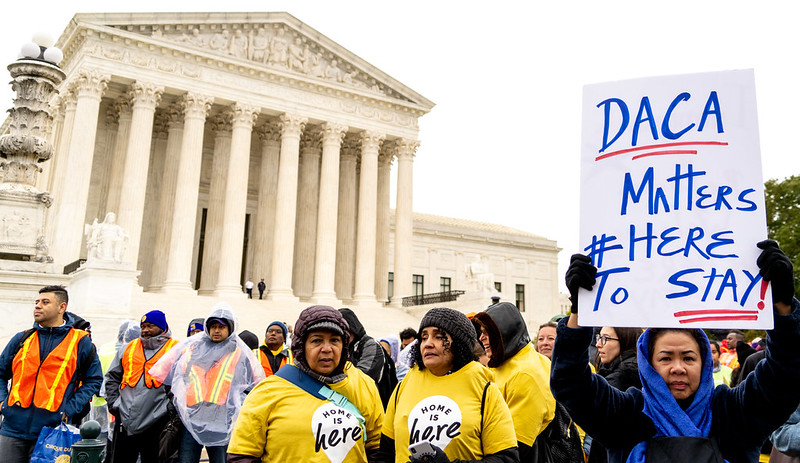
Rally by the Supreme Court as the DACA cases are heard inside on November 12, 2019 / https://www.flickr.com/photos/vpickering/49057840887
Rally by the Supreme Court as the DACA cases are heard inside on November 12, 2019 / Victoria Pickering / Flickr / Creative Commons License

A looming U.S. Supreme Court decision on the Deferred Action for Childhood Arrivals (DACA) program threatens to strip over 830,000 undocumented migrants of protection from arrest and deportation as well as any sense of belonging in the country where they have lived for most of their lives. The court is poised to throw these individuals, who have long lived in legal limbo, into the excruciating dilemma of whether to be forcibly or voluntarily “returned” to countries where they were born but have no roots, few job prospects, and often limited ability to speak the language.

  • The Obama Administration’s executive order establishing DACA in 2012 made undocumented non-citizens who entered the United States as children and met certain criteria eligible for a liminal (or temporary) legalization of their status. The benefits included being able to have a social security number, a work permit, and, depending on the state, even a driver’s license and pay in-state tuition.
  • DACA enabled these youths to come out of the shadows and pursue some of the activities of adult life. It also defined the terms of their social belonging, as access to public education cannot be denied based on immigration status since Plyler v. Doe (1982). As a place of socialization, school is usually where children start understanding the terms of their participation in society, at an age that they do not need documents for many of their pursuits.

The Obama Administration did not intend DACA to be a permanent solution for undocumented youths, but several challenges – including one led by Texas with the support of eight other states – have sought to declare Obama’s action a violation of U.S. law. In response to State of Texas v. United States (2015), the Biden Administration last August issued a final rule that used rulemaking procedures that, in its view, protected DACA from further legal challenges. But Texas objected, and the U.S. Court of Appeals agreed – leaving the Administration no recourse but to ask the Supreme Court to reverse the decision. The legal maneuvering highlights the temporary aspect of DACA for its beneficiaries.

DACA was an administration’s effort to compensate for the lack of congressional action. A decade later, this fix – a resource of paramount importance to many of the undocumented population – remains fragile and limited. DACA opponents’ legal challenges have been relentless, underscoring how easily DACA can be taken away.

  • The unraveling of DACA in the absence of legislation would be devastating for its over 830,000 beneficiaries. The status of liminal legality under DACA provides access to benefits rather than rights; legal presence rather than membership. While they were children, very few know that they do not have documents; they hardly need them for everyday activities, and some parents try to hide their status from them. As they get older and need documents for daily living, such as having a driver’s license, they face a potential shock of having no ties to the only country they have known. They discover that they can’t have the same life as their peers. The feeling of belonging shrinks and disappears.
  • Many DACA recipients would face even greater stress than the other 10 million undocumented migrants in the United States. The federal government has complete data on their identities, whereabouts, schools, and employers, making targeting them for potential detention and deportation easy. Many of their friends and family are likely to be targeted too.

The Supreme Court in 2020 blocked an effort by the Trump Administration to cancel DACA in September 2017, but the legal decision was based on procedural rather than substantive arguments – i.e., that the Trump action was “arbitrary and capricious,” not on determination that the policy behind it was unconstitutional.

  • The current U.S. Congress appears loath to institutionalize DACA. Moreover, the Administration appears reluctant to try again to use executive authority to ensure both the potential and limitations of the policy – much less a solution for membership of a population that has been present and socially and culturally belongs in the United States. If nothing is done, we could see mass detentions, family separation, and deportations – as well as resistance and protests from people who no longer want to live in the shadows and have claims to belonging.

March 9, 2023

* Andréia Fressatti Cardoso is a research fellow at the Center for Latin American and Latino Studies and Ph.D. student in Political Science at the University of São Paulo.

Nicaragua: Triple-Crisis Threatens More Instability, Poverty, and Migration

By William Vigil*

EU solidarity: helping Central America recover after hurricanes ETA and IOTA / European Union (D. Membreño) / Flickr / Creative Commons License

Three years of political unrest, COVID-19, and back-to-back Category 4 hurricanes last November have created a precarious situation in Nicaragua – raising the probability of increased instability, poverty, and migration into Costa Rica and northward toward the United States. Long ranked the second poorest country in the hemisphere (after Haiti), the country has experienced worsening socio-economic conditions since 2018, and shrinking democratic and civic spaces have deepened political polarization.

  • In 2018, the government cracked down on protests triggered by cuts in social security benefits, followed by months of violent suppression of unrest and demands for a democratic opening. The result was more than 325 dead, thousands wounded, mass detentions, and the exodus of more than 100,000 persons.
  • The turmoil drove a steep downturn in the economy. According to the Nicaraguan Central Bank (BCN), Nicaragua’s economy contracted 4.0 percent in 2018 and 3.9 percent in 2019, while inflation increased to 3.9 percent and 6.1 percent respectively. Other sources estimate a 4.0 percent decline in 2020. According to the World Bank, investment and consumption fell sharply, prompting significant unemployment, particularly in construction, commerce, and tourism. A 2019 household survey by Fundación Internacional para el Desafío Económico Global (FIDEG), a Nicaraguan think tank, indicated that poverty rates had increased at the national level, both in terms of general poverty and extreme poverty.
  • Efforts by national and international groups to advance dialogue to reduce political tensions have not been successful. Framework accords in March 2019 on the release of political prisoners and the restoration of civil rights were only partially fruitful. Targeted international sanctions against government individuals and entities have been intermittent and have not changed government behavior. Some measures have led to retribution, moreover, such as the abrupt closure of the UN and OAS human rights missions in the country.

Nicaragua’s policies regarding COVID‑19 have been erratic and haphazard, and recovery from last November’s hurricanes has been slow. Leaders initially argued that the country’s economic challenges made quarantine largely untenable, and Nicaragua attempted Sweden’s policy of “herd immunity” despite the dramatically different national and institutional capacities of the two countries. In addition, Hurricanes Eta and Iota left tens of thousands of people homeless and without drinking water. According to the Nicaraguan Finance Minister, 3 million people in 56 municipalities were affected, with estimated economic damages of $738 million.

  • Nicaragua has experienced a surge in unemployment, but – in contrast to other countries – has not adopted policies favoring a return to pre-crises levels. Some economists estimate that basic necessities and services now cost more than double the average household income. According to a Gallup poll taken in January, six out of every 10 Nicaraguans would migrate to other countries if they had the opportunity.

These crises do not show credible signs of abating. They significantly increase the likelihood of a challenging outlook, particularly for the country’s most vulnerable population groups. Systematic and comprehensive action has been lacking in and outside the country, however. The international community, including donors, multilateral banks, development agencies, and NGOs, has not been in a position to respond to the crises in a coordinated fashion. Their natural desire to seek a prominent role for civil society in any comprehensive strategy – with accountability and transparency – is frustrated by government resistance.

  • Nicaragua’s volatile political situation could eventually evolve into a humanitarian crisis with repercussions for the rest of the region. Tensions will increase as national elections scheduled for November approach, as all indications are that the government will further restrict civil and political rights. The country’s problems, moreover, could easily spill over its borders. Migration has traditionally been an escape valve. A new wave of refugees could be expected in Costa Rica, but that country’s own economic challenges may well instead drive many to head north.
  • International assistance alone won’t be enough. Conditions of strict accountability, transparency, civil society engagement, and close consultation with affected populations are necessary for it to have significant impact. Together, donors, multilateral banks, the UN, and NGOs have a degree of leverage to ensure the correct use of resources, such as by conditioning it on full respect for human rights. UN human rights chief Michelle Bachelet last month called on the government to “urgently adopt effective electoral reforms and establish a genuine and inclusive dialogue with all sectors of society,” but slowing or stopping the country’s downward spiral will require much more from all sides.

March 23, 2021

* William Vigil is co-director of the South-North Nexus. He is a former Nicaraguan diplomat who served in New York (at the United Nations) and in Washington, D.C. This article is based on a South-North Nexus report entitled Nicaragua’s Converging Crises.