
Anti-Immigration Rhetoric is an Electoral Vulnerability: Evidence from the 2022 Midterm Elections

By Ernesto Castañeda, Joseph Fournier, and Mary Capone

October 1, 2024

Graph elaborated by the authors with data collected from CNN Politics’ Midterm Election Results.

The above graph represents the proportional success of candidates who used anti-immigration sentiment in their campaigns for the 2022 midterm elections. Results data was taken from CNN Politics. Anti-immigration rhetoric was found in campaign material through Meta Ad Library, X (formerly Twitter), debate responses, campaign website archives, YouTube ad searches, and general Google searches. We focused on competitive elections defined as having electoral results within a 10% margin between candidates. Candidates in these competitive elections who used ani-immigrant sentiment were no more likely to win the election than those who did not; in fact, more candidates who campaigned on anti-immigration lost than won in 2022. This data provides evidence that not being anti-immigration is not a hindering campaign decision. It may be quite the opposite.

Immigration often emerges as a prominent talking point among candidates in presidential, congressional, and gubernatorial elections. Former President Donald Trump frequently employs anti-immigration rhetoric and continues to campaign under similar sentiments about the allegedly dangerous porosity of the southern U.S. border. In the presidential debate in June of 2024 against President Joe Biden, Trump mentioned immigration in 42% of the 38 times he spoke while Biden mentioned immigration 13% of the time.  In the subsequent debate against Vice President Kamala Harris, out of 38 times when Trump spoke for more than two sentences, he incorporated immigration 10 times (26% of the time). In comparison, Harris did so 4 out of 27 times (15% of the time).

Anti-immigration rhetoric has become practically synonymous with the Republican Party as these candidates often use immigrants as scapegoats for shortcomings in national security, economics, and crime control. While several Democratic candidates support anti-immigration policies as well, it is less commonly a key aspect of their campaigns. The graphic below indicates the overall tone of immigration speeches in Congress and the president by party from the late nineteenth century until 2020. While the data excludes 2022, it encapsulates the general trends of immigration sentiments over time.
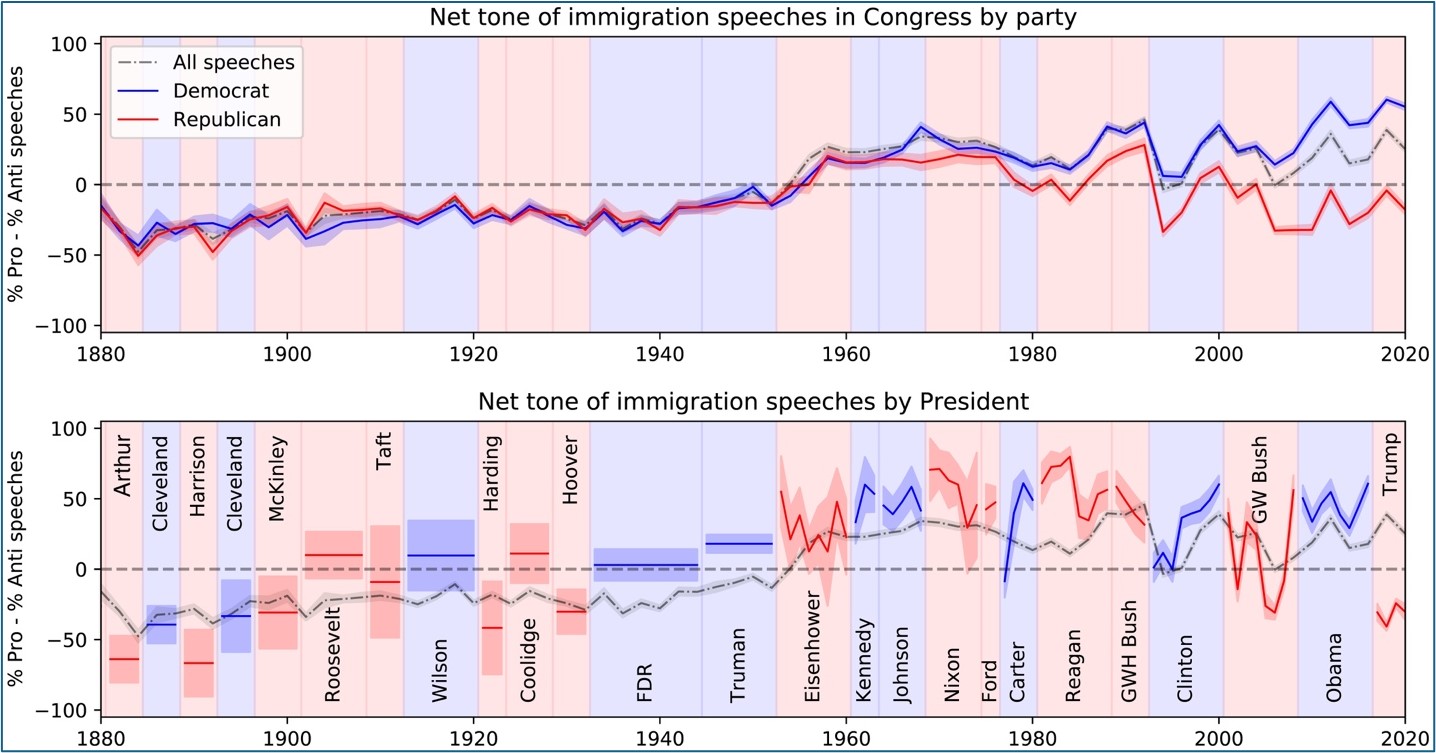
Source: Card et al., 2022 published by the Proceedings of the National Academy of Sciences.

The top of the graph shows that trends in the rhetoric of Republican and Democratic congressional representatives were negative before the 1950s and became positive in both parties in the late 1950s and through the 1960s and 1970s. The divergence in sentiments is clearest in the early 1980s and beyond, with the greatest points of divergence occurring between 2000 and 2020. Card et al. acknowledge that the divergence also represents other trends in the polarization of other issues. However, they find that immigration polarization predated the rise in generic political polarization observed in Gentzkow et al. by more than a decade.

The lower part of the graph shows the variation in presidential sentiments through positive and negative language employed to discuss immigration. The anti-immigrant rhetoric of President Trump has been unseen since the presidency of Herbert Hoover. Overall, the graph represents the rise in anti-immigration rhetoric in congressional and presidential speeches by Republicans in recent years as it has become more of a political talking point.

Discourse gathered from the campaign sites and social media accounts of Republican candidates who ran in competitive elections in 2022 with anti-immigration campaigns includes several instances of strongly prejudiced statements. Republican Mark Robertson (Nevada District 1) sought to “turn off the illegal flow of people coming into our country… end chain-migration, visa lotteries and vacation-birth citizenship.” Ending “vacation-birth citizenship” implies a possible erasure of birthright citizenship. Anti-immigrant candidates describe policies like these in misleading ways to garner political support, despite understanding the implausibility of such a policy.

Many of these anti-immigrant candidates take further aim at immigrant children. Republican candidate for the Senate in Pennsylvania Mehmet Oz stated in an ad that, “The Biden administration’s failure on the border is so massive that they are flying illegal immigrants up to airports like this where illegal immigrants are being taken on buses. Now every state has become a border state.” The ad is filmed outside of Scranton-Wilkes-Barre Airport in Pennsylvania, an airport that has been instrumental in the facilitation of protecting unaccompanied migrant children. This airport and the role it plays in the migrant children protection apparatus made it a popular target for Pennsylvania Republicans in 2022. Jim Bognet (R), who ran for Congress in the district that includes the airport itself, ran an ad claiming “Joe Biden & Matt Cartwright still won’t STOP ghost flights of illegal immigrants into (Northeast Pennsylvania).” The reason for this secrecy is that these are minors whose identities are obscured to ensure their security. Many of these children come from vulnerable backgrounds, including a sixteen-year-old victim of sex trafficking seeking protection while awaiting possible testimony and an asylum claim. These children have become the target of a political stunt by the GOP in their attempt to create fear surrounding migration.

Numerous other candidates posit a link between undocumented immigration and drug cartels. Republican Congressman Bryan Steil, who won in Wisconsin District 1, claimed on his campaign website that “drug dealers (and) human traffickers” are crossing the border, framing it in such a way that implies the two are intertwined in their business dealings. Republican Congressman John James, who won reelection in 2022 for Michigan District 10, conducts a similar framing in a tweet highlighting “millions of illegal border crossings, millions of lethal doses of Chinese fentanyl.”

A more brazen example of such framing can be found in campaign material from Blake Masters’ failed bid for Arizona Senate, which shamelessly claims that “More than 225,000 illegal aliens pour into our country every month. And they bring enough fentanyl over each month to kill every American twice over.” In a recent conference on immigration at American University, Dr. Andrew Selee, head of the Migration Policy Institute, notes that these organizations are separate entities. Though they sometimes do collaborate, they are by no means the same and have independent organizational structures. This is a subtle yet important distinction that has been masked to criminalize migrants and conflate them with criminal enterprises such as drug cartels.

The criminalization of migrants was certainly not limited to linking them to cartels. Many candidates rely upon preconceived racist notions of immigrant populations (mostly Latinos) in making generalizations. Such candidates keep their statements on immigration vague, like Nevada Republican Senate hopeful Adam Laxalt: “[the] crisis at the border that has put communities across Nevada in danger…. [Laxalt] fought against dangerous sanctuary city policies and worked to help stop their spread.” The advantages yielded by anti-immigrant candidates in utilizing this sort of vagueness are twofold. The first is that it appeals to a voter base that has already constructed a negative bias toward immigrant populations, and it is this sort of rhetoric that energizes these voters. The second advantage of such vagueness is the removal of the burden of proof from Laxalt or other candidates. Because of this vagueness, the claim becomes difficult to disprove because the meaning can be fluid and easily manipulated at the whim of the candidate.

Similarly, a campaign ad from Republican gubernatorial candidate Kari Lake of Arizona claims to finish the southern border wall and reinstate the “Remain in Mexico” policy: “the best policy I’ve seen in my 27 years, it worked.” The “Remain in Mexico” policy, a Trump-era directive modified by President Biden, has been largely condemned by human rights groups. Multiple immigration advocates highlighted that the policy forced all migrants to wait on the Mexican side of the border, including those who are escaping persecution in Mexico, in unsafe and uncertified conditions while their asylum case were pending.

Overall, anti-immigration statements like those highlighted in the 2022 midterm election campaigns are prevalent across Republican candidates. Trends indicate a rise in such rhetoric in congressional and presidential speeches with a partisan divergence as Republican candidates are more likely to employ this as a strategy in campaigning. Nonetheless, there was limited success for anti-immigrant campaigns in the 2022 midterm elections. The data shows that anti-immigration rhetoric is not a guarantee for winning elections; in fact, it may be an electoral vulnerability as it does not lead to more success in competitive elections.

Ernesto Castañeda PhD, Director of the Immigration Lab and the Center for Latin American and Latino Studies, American University in Washington DC.

Joseph Fournier and Mary Capone are research assistants at the Immigration Lab and the Center for Latin American and Latino Studies at American University.

Sources

“2022 Midterms.” CNN Politics, Accessed September 17, 2024. https://www.cnn.com/election/2022.

Adam Laxalt for NV. “Issues | Adam Laxalt for Senate.” Accessed February 6, 2024. https://www.adamlaxalt.com/issues.

Card, D., Chang, S., Becker, C., Mendelsohn, J., Voigt, R., Boustan, L., Abramitzky, R., & Jurafsky, D. (2022). Computational analysis of 140 years of us political speeches reveals more positive but increasingly polarized framing of immigration. Proceedings of the National Academy of Sciences, 119(31). https://doi.org/10.1073/pnas.2120510119 

Castaneda, Ernesto. “First Presidential Debate Was Mainly about Immigration, Few Noticed”. AULA Blog Accessed September 25, 2024 https://aulablog.net/2024/07/19/first-presidential-debate-was-mainly-about-immigration-few-noted/.

“Frequently Asked Questions: ‘Remain in Mexico’ Policy.” Justice for Immigrants. Accessed October 2, 2024. https://justiceforimmigrants.org/wp-content/uploads/2019/02/Remain-in-Mexico_en.pdf.

Gentzkow, M., Shapiro, J. M., & Taddy, M. (2019). Measuring group differences in high dimensional choices: Method and application to congressional speech. Econometrica, 87(4), 1307–1340. https://doi.org/10.3982/ECTA16566

James, John. (JohnJamesMI). “Our border is plagued with chaos – millions of illegal border crossings, millions of lethal doses of Chinese fentanyl & incompetence from the White House. I’m glad to support the House GOP’s Commitment to America to fund border security & put an end to human & drug trafficking.” September 26, 2022. 3:10 PM. Tweet. https://x.com/JohnJamesMI/status/1574476402392457217.

Jordan, Miriam. “’Ghost Flights’? The Facts Behind Transporting Migrant Children”. New York Times. June 24, 2022. Accessed February 4, 2024. https://www.nytimes.com/2022/06/24/us/ghost-flights-migrant-children.html?login=google&auth=login-google#.

“Kari Lake January 2022 Ad.” Accessed February 6, 2024. https://www.facebook.com/ads/library/?active_status=all&ad_type=political_and_issue_ads&country=US&id=313372640712991&media_type=all.

“Remain in Mexico” Human Rights Watch. Accessed October 2, 2024. https://www.hrw.org/tag/remain-mexico

Robertson, Mark. “Mark’s Stances – Robertson for Congress.”Accessed February 11, 2024. https://web.archive.org/web/20221104220014/https://robertsonforcongress.com/stances/

Selee, Andrew. “Wilson Center Discussion on Immigration Policy”. September 23, 2024. C-SPAN, 58:43. https://www.c-span.org/video/?538598-1/wilson-center-discussion-immigration-policy.

Steil, Bryan. “The Issues: Bryan’s Vision for America – Securing Our Border”. Accessed September 26, 2024, https://web.archive.org/web/20221104220838/https://www.bryansteil.com/issues/.

“STOP ILLEGAL IMMIGRATION – Dr. Oz for Senate.” Accessed February 11, 2024. https://web.archive.org/web/20221028022107/https://doctoroz.com/issue/stop-illegal-immigration/.

New Wave of Salvadoran Immigrants in the DMV

By Hanseul Cho, Washington College of Law ’23

Based on data from the Immigration Lab’s Immigration to the DMV (DC, Maryland, and Virginia) project, there is a new wave of immigration from El Salvador, even though people from this country have sought refuge in the U.S. for decades. Despite being better educated, many Salvadoran immigrants work in lower-income, service-oriented jobs due to credential recognition issues and language barriers. Addressing integration challenges through inclusive policies for immigrants is crucial for harnessing their full potential and strengthening society.

El Salvador is similar in size to New Jersey and has a population like Tennessee. Although a relatively small country, Salvadorans are the biggest immigrant group in Washington, DC. Seventeen percent of the population in DC is immigrants, 11% of which are from El Salvador. 

Individuals from El Salvador ranked fourth in the number of refugeeslocated in the United States, and a significant number concentrated in the DMV. Although Los Angeles has the biggest Salvadoran migrant population, DC has the second largest group. Although when combined with Maryland and Virginia, the DMV has the largest Salvadoran population in the U.S.

Salvadorans rank fifth among the largest immigrant populations in the United States, behind China, India, Mexico, and the Philippines. 

Why did they choose to migrate? El Salvador experienced right-wing military regimes seizing power through rigged elections in the 1950s. The failure of land reform and political turmoil led to a civil war from 1979 to 1992, causing a 21.5% drop in GDP.

The United States justified its intervention in the Salvadorean civil war as preventing a left-wing party from taking power within the context of the Cold War. The conflict led to many refugees moving to the United States. A few of them formed gangs in Los Angeles, who were incarcerated and later deported, leading to the emergence of gangs in El Salvador, including MS-13. These gangs focused on territorial control and their violence caused some targeted people to look for safety in the United States.

Among the immigrants interviewed in the Immigration to the DMV project, 95% answered that El Salvador’s violence, climate, and economic difficulties influenced their decision to immigrate to the U.S. Our interviewees cite a bad economic situation, a serious lack of security, and corruption as the reasons they left.

Female immigrants make up a significant portion of the sample in this interview. The data indicates an increasing trend of more female migrants, which aligns with previous research. Some of the factors contributing to this include the demand for care and domestic work in the U.S. and an increased probability for women to pursue higher in the United States. A young woman who came to Washington, D.C. in 2022 mentioned that she migrated for a better chance at self-development, to study college, and to become a nurse. 

Even though the female participants in this study faced danger, including receiving contraceptive injections to avoid pregnancies during the arduous journey and threats of sexual violence, they desperately wanted to find long-term security and a chance to study.

New Generation of Salvadoran Immigrants

We interviewed Salvadoran immigrants who arrived in the U.S. fleeing the aftermath of the civil war, which they saw as a truly traumatic event. Political violence contributed to political corruption, economic failure, and widespread violence. Interviewers coming later also came looking for safety and economic opportunity.

People who arrived after 2019 are relatively proficient in English and more educated. Interviewees are from a country where only 33% of the population graduated from middle school, but 80% of the interviewees from this generation graduated middle school, and 60% graduated high school or with their GED. All of them had a better education than their parents. They had much better education and skills than their parents, but still, even though they are minors and part-timers, most still tend to work in lower-income jobs in the service sector. What causes this tendency? 

Two main challenges face this group: language barriers and lack of recognition of relevant training and job experience. These factors hinder their integration into the U.S. job market and society.

One of the main challenges that Salvadoran immigrants face is credential recognition. The skills and experiences they obtain in their home country may need to be properly evaluated or acknowledged in the United States. This includes the requirement for a GED, a U.S. high school diploma, or a U.S.-specific certificate. This can prevent immigrants from utilizing their previous experience and instead require them to start from scratch.

A 24-year-old Salvadoran man who lives in DC has been certified in forklift management in El Salvador. Another former electric technician also mentioned a similar experience. Still, those certifications needed to be recognized in the U.S., and ultimately, their professional experience was dismissed. So, in this case, the electrician became a cook even though electricians and forklift drivers are in high demand and are well-paying jobs.

This experience can lead to immigrants’ struggle with “imposter syndrome,” which negatively affects their self-image and makes it harder to derive self-esteem from their work. Furthermore, it can be argued that language barriers are a significant obstacle for immigrants to fully participate in the labor market.

The pandemic’s profound economic repercussions severely impacted El Salvador, exacerbating the country’s preexisting high crime rates. Interestingly, statistical data indicates that language barriers among Salvadoran immigrants do not immediately result in income disparities. Their incomes are quite similar when comparing Spanish-speaking immigrants who arrived recently with English-speaking immigrants who arrived in 2010 (Median is $30,000 for English speakers versus $35,000 for Spanish speakers, and the average is $36,430 versus $37,000). Most interviewees noted that their ability to speak only Spanish did not pose a significant challenge in assimilating into society. Spanish speakers might even have an advantage when seeking certain jobs.

However, English-speaking individuals tend to have a wider range of job opportunities, which can influence their assimilation and long-term settlement. While Spanish-speaking immigrants typically work in service-oriented roles, English speakers often have access to a broader spectrum of employment options, including management positions and roles in non-governmental organizations. Language proficiency plays a crucial role in the employment opportunities available to immigrants, affecting their ability to assimilate and succeed long-term.

Although immigrants from El Salvador could get jobs with the help of friends and relatives, there is a risk that the occupation will be limited to the service industry only. A Salvadoran woman in her 20s who wants to be a Spanish teacher faced challenges getting information about how to become one due to language barriers. 

In the DMV area, organizations like Northern Virginia Family Service, Maryland Multicultural Youth Centers, and DC Central Kitchen’s Culinary Job Training Program are available in multiple languages for immigrants. However, these services are decentralized and challenging for immigrants to access due to lack of time and transportation, creating barriers to utilization. In the data analyzed, almost none of the participants reported being part of a community organization, but most of them stated they were interested in learning opportunities and cultural activities.

It would be helpful to create a centralized portal that provides professional skills enhancement and digital-based social networking, integrating Salvadoran cultural influences.

It is important to acknowledge that immigrants, specifically Salvadorans, contribute to diverse cultural environments and enrich communities economically and socially. Addressing their integration challenges through inclusive policies and accessible support systems is crucial for developing a united and strong society.

Immigration as the Current Main Driver of Economic Growth in the U.S.

By Ernesto Castañeda, Edgar Aguilar, and Natalie Turkington

A new report from CLALS and the Immigration Lab finds that recent immigrants are a key driver of economic growth in the United States.

The report presents an original calculation that finds that only in 2022:

  • Immigrants who sent money home contributed over $2.2 trillion dollars to the U.S. economy.
  • This contribution by migrant labor constitutes about 8% of the U.S. GDP.
  • Remittances represent just 4% of the total output generated by immigrants, even if they add up to $81.6 billion annually, disputing the narrative that immigrants drain the U.S. economy.


Immigrants who remit contribute around $2.2 trillion annually to the U.S. economy. Despite concerns that remittances drain U.S. dollars, they only represent 4% of immigrants’ total contributions. This estimate is based on credible sources indicating that 17.5% of immigrants’ income is sent as remittances and considering a combined yearly salary of approximately $466.5 billion.  Using data from the World Bank, the Association for Central Banks of Latin America, the U.S. Census Bureau, and the Bureau of Labor Statistics, however, this is just a good approximation to quantify some of the benefits of migration. Immigrants’ contributions to the economy are greater as not all send remittances through formal channels. Additionally, it overlooks the economic growth immigrants stimulate by spending their wages in the U.S., creating demand, and generating jobs. Not to say anything about the human, cultural, culinary, and creative contributions. Below are more details about this novel estimation and projections of future contributions by immigrants to the U.S. economy.

The Congressional Budget Office’s Demographic Outlook 2024-2054, which has gotten some deserved media attention, estimates that in 2034 the U.S. economic output will be $7 trillion larger due to new immigration. Tax revenues would also be higher and the deficit lower because of immigration all else equal.

The quote from the CBO Director’s press release is, “in our projections, the deficit is also smaller than it was last year because economic output is greater, partly as a result of more people working. The labor force in 2033 is larger by 5.2 million people, mostly because of higher net immigration. As a result of those changes in the labor force, we estimate that, from 2023 to 2034, GDP will be greater by about $7 trillion and revenues will be greater by about $1 trillion than they would have been otherwise.”

We estimate immigrants’ contribution to the U.S. economy between 2023 and 2034 will be greater. Using the same immigration estimates as the Congressional Budget Office’s (see graph below), we calculate new immigrants have the potential to elevate the U.S. economic output by a staggering $17 trillion just in 2034.

Net population growth is through immigration.

Source: Congressional Budget Office interactive graph here.

However, if the number of new immigrants and asylum seekers continues at the same pace as in estimated for 2024, 3.3 million per year (10,000 per day as happened in December of 2023), we calculate that the U.S. would enjoy an increased economic output of over $37 trillion just in 2034.

As the Economic Policy Institute writes, “The unemployment rate for U.S.-born workers averaged 3.6% in 2023, the lowest rate on record. Obviously, immigration is not causing high unemployment among U.S.-born workers.” They further write, “immigrants that make up 18.6% of the U.S. labor force are playing key roles in numerous industries and are employed in a mix of lower, middle, and higher-wage jobs. And as the Congressional Budget Office recently reported, immigration is contributing to strong economic growth—with future immigration forecasted to boost real gross domestic product by 2% over the next 10 years—as well as increasing government revenue. Immigrants are also complementing U.S.-born workers by contributing to overall population and workforce growth. The U.S. Census Bureau projects that if the U.S. were to have lower-than-expected immigration levels, the population would begin to decline in 20 years, and if there were suddenly zero immigration, the population would begin to decline next year, deeply harming economic growth.”

A Washington Post article states that around 50% of the growth in the labor market in 2023 was due to foreign-born workers. The same was the case in the 1990s.

In 2021, 45 million immigrants lived in the United States, accounting for 14% of the country’s population. Immigrants are integrated into American social, economic, cultural, and political life. The Immigrant Research Initiative calculates that “Immigrants account for 17 percent of the U.S. economic output (GDP), even higher than their share of the population. The United States has a $19.6 trillion economy according to the Bureau of Economic Analysis 2021 statistics, which means immigrants are conservatively responsible for $3.3 trillion of economic output.” This supports our calculation of around 2.2 trillion only from immigrants who send money abroad because many do not send remittances.

Estimates and projections vary, but what is clear is that there would be no economic growth without recent immigrant arrivals. If immigration (of all types) decreases in the following years, economic growth will most likely plummet, and inflation will rise. Furthermore, this does not only apply to the United States but to other countries as well.

You can find coverage of the report in Spanish here:

“Immigracion y Economia en EE.UU.” RTVE 24h.

“Los hispanos y el mercado laboral en EE. UU.” Y Esto No es Todo podcast on YouTube.

“Ernesto Castañeda y el mercado laboral en EE.UU.” RTVE audio.

Ernesto Castañeda is the Director of the Center for Latin American and Latino Studies and the Immigration Lab.

Edgar Aguilar and Natalie Turkington are research assistants at the Center for Latin American and Latino Studies.

Full report here.

1.5- and Second-Generation Female Immigrant Experiences

by Marcela Ventura*

February 23, 2024

A young girl holds an American flag during a stand for immigrants’ rights in Chicago, May 1, 2006. Photo credit: Joseph Voves. CC GPA Photo Archive/ Creative Commons License

From its presence at Thanksgiving dinners and presidential debates, immigration is a recurrent topic of debate in the U.S. and around the world. Unfortunately, people often fail to see the full impact immigration can have. One aspect of immigration that is rarely discussed is the effect immigration has on immigrants and their families. Growing up in a diverse environment, I saw the lack of support immigrants and their children encounter in the United States. Just imagine arriving in a new country with little idea of how anything works, often being unable to ask for help due to a language barrier. 

While researching this topic, I realized that many first-generation immigrants (those born abroad) end up relying on their young children for support. Published works that shed light on the experiences of 1.5- or 2nd-generation immigrants tend to focus on the male experiences or the experiences of specific ethnic groups. Similarly, many papers researched the correlation between acculturation stress and criminal or negative behavior within immigrant groups.

To bridge this gap in research, I conducted interviews with 1.5- and 2nd-generation female immigrants to learn more about their experiences. I wanted to see if they faced acculturation stress, usually associated with first-generation immigrants. Many of the participants shared similar experiences surrounding immigration regardless of their ethnic background. Feelings of not belonging and high family responsibilities were constant among participants. 

A participant who immigrated as a child—1.5 generation—from Central America stated:

“I am held responsible for my parents because I am the English speaker, I am the translator, I am the one […] that saves them whenever they face certain scenarios that they can’t get themselves out of.”

Similarly, a participant who was born in the U.S.—2nd-generation—of South American descent, stated:

“I feel like it’s always a pressure when they tell you that you have to speak for them […] or do things for them like make appointments or go with them to help translate […] it’s going to keep happening […] sometimes it is a lot.”

The sense of responsibility that participants felt towards their parents affected the choices they made later in life. 1.5- and 2nd-generation female immigrants considered financial stability of high importance, seeing it as a means to honor the sacrifices their parents made during their immigration journey. A participant who immigrated as a child from the Caribbean stated:

“I also had to be able to provide […] get to a place where I have financial stability […] sometimes that means sacrificing what you really want to do.” 

Throughout the interview, this participant consistently mentioned how her parents never supported or approved of her creative endeavors, forcing her to let go of such passions. 

When comparing the experiences of 1.5- and 2nd-generation female immigrants to those of first-generation female immigrants, similarities were found. First-generation immigrants’ stress on the importance of financial stability coincided with that of 1.5- and 2nd-generation immigrants.  However, there were key differences among those similarities. Unlike 1.5 or 2nd generation immigrants, first-generation immigrants aimed for financial stability to achieve personal goals. First-generation female immigrants were not attempting to make their family members happy or proud; instead, they were attempting to achieve self-satisfaction. For example, a first-generation female Afghan immigrant stated:

“If I wanted to have a good career I should get out and go to the Western countries because in Afghanistan […] it was tough on women.”

These similarities and differences did not come as a surprise but as a reassurance that while immigration affects first-generation, 1.5- and 2nd-generation immigrants in unique ways, there is consistency in their experiences. Knowing this, I wonder what we can do to support our immigrant community better. There is an unfair reality in the United States, where there are generations unable to achieve their dreams knowing they will always have to look out for their parents. As a result, many participants mentioned the importance of mental health and the positive effects therapy had or could have had on them. Participants stated that they would have benefitted from mental health services as they dealt with the responsibilities placed upon them by their parents. Among the interviewees, we found some cases of first-generation immigrants who were able to receive mental health support. Nonetheless, young children of migrants often did not have the vocabulary to ask for access to mental health professionals. Parents may also be reluctant to bring their children to therapy because this could wrongly imply their failure as parents. 

A plethora of questions appear as we look deeper into the experiences of 1.5- and 2nd-generation female immigrants. Would providing counseling at school help these children navigate the burden of responsibility? Is there a way to assist first-generation parents so that the responsibility does not so fall heavily on their children? Can we aid the advancement of the United States by helping both first-, 1.5-, and 2nd-generation immigrants, are we also? Given these questions, it is important to continue research on the impact of immigration-related stress on the children of immigrants.

Copyright Creative Commons. Reproduction with full attribution is possible by news media and for not-for-profit and educational purposes. Minor modifications, such as not including the “About the Study” section, are permitted. 

* Marcela Ventura came to the United States at age 11 from Peru. She is an active of the Immigration Lab at American University, where she is also taking graduate classes. 

Blinken and Mayorkas visited Mexico to Discuss Migration

By Ernesto Castañeda

January 11, 2024

Republicans in Congress are denying funding to Ukraine and Israel over migration and border security, but the premises and assumptions used to discuss the issue fail to take the following elements into account.

It is hard to determine if numbers are really without precedent. There has been a change in that immigrants come and turn themselves in to try to come in with a legal immigration status, such as through asylum or the regularization programs available to Ukrainians, Afghans, Cubans, Haitians, Venezuelans, Nicaraguans, and other groups. In previous decades, many low-skilled workers knew there were no avenues to enter legally and would try to pass undetected and live undocumented in the United States. That is less common today for so-called low-skilled, recently arrived immigrants. So, an imaginary example would be to count people who once would mainly drive to New York City for the holidays and then compare them to a time when most people would arrive via plane. It would be easier to count the people arriving on planes, but that would not necessarily mean that there are more people arriving now by plane than the ones who arrived driving in the past. 

Historically, numbers are not comparable because, before Title 42, apprehensions were counted versus encounters afterward. Previously, most apprehensions would happen inside the U.S., while today, most people present themselves in groups and in a visible manner at ports of entry, along the physical border, or in front of the border wall. Another important difference is that in the past, undocumented workers relied on established family members and networks to get provisional housing and food and find a job. Many recent arrivals may not have close people in the United States and are actively asking for temporary housing and food from city governments. The U.S. does this for refugees and has done it in the past for Cubans and others escaping repressive regimes. Research and history show that these short-term expenses have been good investments, given that refugees and immigrants are more likely than U.S.-born individuals to work, start businesses, and be innovative leaders. Republicans in Congress have denied requests from the White House to provide funding to cities to cover some of these costs.

Some propose detention as deterrence, but prolonged detention in the United States is very expensive and mainly benefits the companies or workers providing and managing detention centers.

A misconception repeated in the media is that most people are immigrating illegally. That is technically incorrect because people are presenting themselves to immigration authorities. Many migrants are applying to legal programs, asking for asylum, or being placed in deportation proceedings.

The situation that we are seeing at the border and some of the solutions proposed indicate some important points that have been rarely discussed,

1) Border walls do not work. Smugglers can cut them, and people can walk around them or come in front of them on U.S. territory. 

2) People are turning themselves in, so contrary to what Trump said recently, authorities know where people are from and where they are going. They have notices to appear in immigration court, and they register an address in order to receive notices and updates if they want to continue with their asylum process and regularize their status. In the past, a great majority of people go to their migration court hearings.

3) CBP One appointments are too cumbersome to make, and there are not enough slots available, so people are showing themselves at ports of entry and between them.

4) The parole program for Haitians, Cubans, Venezuelans, and Nicaraguans is working to create a more rational and orderly process. Taking the program away —as Republicans in the Senate want—would make things worse. 

5) Putting more pressure on Mexico to deport more people and stop them from getting to the border is unsustainable. Mexico cannot manage the issue by itself unless it gets pressure and funding from the U.S. and international organizations, like Colombia does, to establish immigrant integration programs for immigrants who want to stay in Mexico, and it provides paths to citizenship for them. 

Thus, Blinken, Mayorkas, and their companions and team’s visit to Mexico is important. Mexico has been a willing partner, agreeing to take people from third countries under the Remain in Mexico and Title 42 programs, but those programs could only work temporarily. Mexico has also increased the number of deportations. However, deportation only works if people are unwilling to try multiple times. Increasing immigration surveillance, deterrence, and deportation does make arriving in the U.S. harder. It also makes it more expensive and thus attractive for organized crime to get involved in it as a business, thus getting more people to the border once they figure out the business model and logistics even with new policies in place. 

Mexican President Andrés Manuel López Obrador has asked for a regularization of U.S. relations with Cuba and Venezuela. There have been positive steps with Venezuela already. This could be a good opportunity to remove Cuba from the list of states sponsoring terrorism, which would reduce some of the emigration pressure in Cuba. 

Mexican authorities have disbanded many caravans and slowed the trek of thousands of migrants. Nevertheless, people who are escaping violence and persecution or have sold everything will try to get to the United States. 

Long-term ways to address the root causes of migration are to continue providing international aid and supporting democratic institutions. One has to keep in mind human rights. The Mexican Supreme Court of Justice has found that profiling people suspected to be migrants in buses to be unconstitutional. To engage the Mexican Army is not the solution either.

The silver lining is that despite the images we see in the news and seasonal peaks, it is not as if all the world is on the way to the U.S.-Mexico border. Most people want to stay home.

Congresswoman Delia C. Ramirez (IL-03)

Congresswoman Delia C. Ramirez (IL-03) presenting immigration policies the Congress could be working on instead.

In the January 10 hearing towards impeaching DHS Secretary Alejandro Mayorkas, Republicans repeated many myths, cliches, and anti-immigrant talking points but did not propose any sensible solutions. It was remarkable that Democrats in the committee saw the political nature of the exercise, and many offered actual solutions to improve the situation at the border and inside the United States in a way that makes the immigration and asylum processes more humane and above ground.

Ernesto Castañeda is the Director of the Center for Latino American and Latino Studies and the Immigration Lab at American University.

Creative Commons license. Free to republish without changing content for news and not-for-profit purposes.