The OAS and the Honduran Election Crisis

By Stefano Palestini Céspedes*

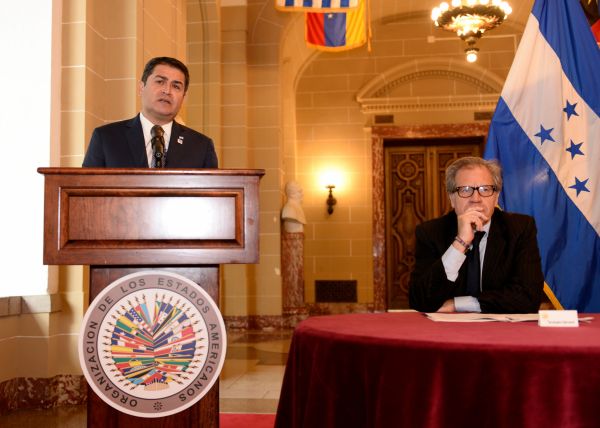
One man stands at a podium while another sits at a table

Honduran President Juan Orlando Hernández (left) and OAS Secretary General Luis Almagro (right) at an OAS meeting last year. / Juan Manuel Herrera / OAS / Flickr / Creative Commons

OAS Secretary General Luis Almagro – consistent with his mandate and commitment to protect democracy throughout the hemisphere – has challenged the legitimacy of the Honduran presidential election, but member countries’ failure to embrace his call for new elections could undermine his leadership and the credibility of OAS democracy protection instruments.  Almagro so far stands out as the only international actor exerting pressure on the Honduran government to guarantee free and fair elections after the serious irregularities observed on November 26.

  • On December 4, the OAS Electoral Observation Mission’s preliminary report established that the electoral process was characterized by irregularities and deficiencies, with low technical quality, and lacking integrity. Two days later, Almagro issued a statement concluding no winner could be determined and calling for the lifting of Honduran government measures that suspended the civil and political rights of Hondurans.
  • On December 17 – the same day the Honduran Electoral Tribunal proclaimed President Juan Orlando Hernández the winner in the election – the Observation Mission issued a second report documenting concerns about the electoral process The Secretary General then called for new elections, and appointed special representatives to set out the new electoral process and the process of national reconciliation in Honduras.

The Honduran government’s rejection of the OAS actions has hardened, apparently emboldened by the fact that no other international actor has backed Almagro’s call for new elections.  In an official communique, Tegucigalpa rejected Almagro’s initiative to send a special representative; claimed the Secretary General had exceeded his authority; and accused him of jeopardizing the autonomy of the Electoral Mission and inciting the polarization of the Honduran population.  In this way, Hernández, initially a strong supporter of OAS democracy protection efforts in Venezuela, now fends off the organization with arguments that recall those employed by Maduro’s government.

  • President Hernández seems to expect that he will overcome all challenges. He apparently believes the internal discontent, which has included peaceful demonstrations involving thousands of protesters, will cool down, and the opposition and angry citizens will come to terms with his reelection.  He must be pleased, moreover, that Washington has endorsed his supposed victory, and that no other international actor has backed Almagro’s call for new elections.  The European Union electoral mission dropped its initial complaints about the election.  Colombia, Mexico, Guatemala, and others have congratulated Hernández on his reelection.

The burden now falls on the OAS Permanent Council and the OAS member states whether to support their Secretary General’s efforts to reestablish democratic order in Honduras.  After the failed attempts to come up with a collective response in Venezuela, the electoral crisis in Honduras represents a new test for the credibility of American states’ commitment to multilateral democracy protection.  If a majority of OAS member states do not support the call for new elections and accept the results of November 26, the signal would be that they trust neither the OAS electoral mission nor the Secretary General.  This would be a new erosion in OAS legitimacy as an international organization and could even prompt the Secretary General to resign.  As Latin America enters a “super electoral cycle” this year – with elections in Costa Rica, Paraguay, Colombia, Mexico, Brazil, and possibly Venezuela – the management of the crisis in Honduras will have crucial, demonstrative effects on how tolerant the hemispheric community will be with breaches to the quintessential democratic institution: fair and free elections.

January 16, 2018

* Stefano Palestini Céspedes is a former CLALS Research Fellow and Postdoctoral Fellow at the Department of Political and Social Sciences at the Freie Universität Berlin, where he specializes in international organizations and regional governance.

Honduras: Hernández Stealing the Election Too?

By Eric Hershberg and Fulton Armstrong

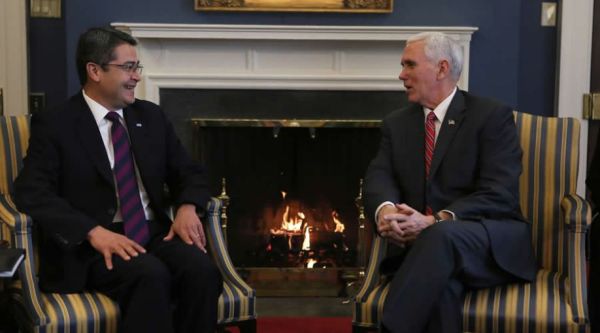
Two men sitting in chairs looking at each other.

Honduran President Juan Orlando Hernández and U.S. Vice President Mike Pence. / Embassy of Honduras / Creative Commons

Honduran President Juan Orlando Hernández and the military have declared a “state of emergency” – tantamount to martial law – to ensure that the President wins a second term, but irregularities in the vote-counting and the harsh suppression of the opposition probably will poison political discourse and hinder democratic progress for years to come.  The government declared the emergency, which will run for 10 days, on Friday night after days of growing tensions over mysterious actions by the Supreme Electoral Tribunal (TSE) – heavily stacked in favor of Hernández – that erased opposition candidate Salvador Nasralla’s five-point lead earlier in the week and moved toward formalizing the incumbent’s victory by 1.5 percentage points.  Senior government officials themselves have characterized the action as a “suspension of constitutional guarantees.”  Hondurans are now living under a dusk-to-dawn curfew; radio and TV stations have been warned against publicizing opposition claims of fraud; and street confrontations are growing.  Media confirm several deaths, but opposition leaders say that more than a dozen demonstrators have been killed.  Opposition videos showing military and police violence, including chasing individual protestors and shooting them, have been removed from Facebook and other venues, although still photos of the victims can be found.

  •  The TSE has agreed to hand-count about a thousand ballot boxes with “irregularities” in three of 18 departments, representing about 6 percent of the votes, but the opposition claims that several thousand more boxes have been compromised and need to be reviewed.

International reaction has been mixed and generally muted.  The EU’s observers have held firm on demanding a full vote count and expressing, diplomatically, skepticism about TSE’s handling of it.  Observers for the “Grupo de Lima,” which has been active on the Venezuela issue, issued a “position” paper on election day (November 26) urging calm and patience with the vote count, but it has released no apparent updates since then.  OAS observers have taken a similar low-key position.

  • Although the Trump Administration may conceivably be working behind the scenes, neither the White House nor State Department has done publicly more than urge calm. Vice President Pence, who previously praised Hernández “for his leadership in addressing security and governance challenges,” has remained silent.  The U.S. chargé d’affaires has said Honduras is in “a new, unprecedented phase in the electoral process” but limited herself to calling for calm and a full vote count.

The audacity of this apparent election fraud and crackdown on Hernández’s opponents dwarfs the many other charges of corruption brought against the Hernández government, including some validated by the OAS Mission to Support the Fight against Corruption and Impunity in Honduras (MACCIH).  Although different in form from the coup in 2009, these events also threaten to undermine the nation’s political stability, economic wellbeing, and institutions necessary to building democracy.  The U.S. reaction suggests that Washington will acquiesce in the ongoing abuses and Hernández’s second term despite the obvious irregularities and rights violations.  The United States – convinced as in the past that political leaders who are “our SOBs” can make good partners – has often countenanced dubious elections.  Moreover, both the Obama and Trump Administrations were persuaded that Hernández has been their faithful, effective ally in combating the drug trade, despite evidence of official involvement in it, and the temptation to turn a blind eye to less-than-democratic political outcomes must be strong.

  •  The OAS, the “Lima Group,” and other intraregional groupings do not appear poised to weigh in despite their good intentions. Neither do Mexico, Guatemala, and El Salvador appear likely to condemn a neighbor for engaging in practices that are ongoing or fresh in their own near pasts.  The Inter-American Democratic Charter, a historic document laying out hemispheric values, is of little value in the absence of the political will and ability to enforce it.  Now is a crunch time both for the OAS and for those governments that advocate some teeth to the charter.  At this point, they appear likely to cave – to the detriment of democracy in Latin America.

 December 4, 2017

Argentina: Excessive Optimism?

By Nicolás Comini*

Man delivers a speech on an airfield.

Argentine President Mauricio Macri. / Cancillería del Ecuador / Flickr / Creative Commons

Argentine President Macri’s Cambiemos coalition won an overwhelming victory in last month’s legislative elections – a step toward fulfilling his 2015 promise of a “revolution of joy” – but it’s not clear yet whether the administration’s optimism translates into national hope.  The coalition won in 15 of the 24 provinces of the country, including the five largest jurisdictions – the City of Buenos Aires, Buenos Aires, Córdoba, Mendoza, and Santa Fe.  Government officials and Macri’s supporters have expressed optimism that the economy will turn around and political confrontation will be overcome.  Macri won the presidency in 2015 with an alliance that made optimism – and the appearance of optimism – a central theme for overcoming what he called the polarization generated by his predecessor, former President Cristina Fernández.  His discourse was rooted in the ideas of change, happiness, efficiency, and meritocracy.

  • Even critics acknowledge that the government has generated innovation in terms of political discourse and representation, rooted in a greater horizontality of leadership and greater citizen access to public officials. News of some officials’ questionable business practices as revealed in the “Panama Papers” and “Paradise Papers” has caused little or no backlash.  Second, the idea of “normalization” of the country, supported by the media, has had a positive impact on part of society.  GDP growth at almost 3 percent this year and the lifting of exchange controls and imports have also buttressed this theme.  The unfavorable trade balance, with a deficit of US$765 million in 2017, has not been a factor.  Third, the government is still able to blame the country’s problems – including high levels of inflation and indebtedness – on the “received inheritance” from his predecessors, whose rule implied corruption, social polarization, and isolation from the world.
  • Rejection of the legacy of Cristina Fernández and her husband/predecessor, Néstor Kirchner, also seems to be one of the Macri government’s greatest assets. Even though Cristina is the most popular candidate in the opposition, her rejection among the broader population is greater; many of the votes that the government’s allies garnered were “anti-Kirchner” votes.  Cristina won a seat in the Senate, but in national politics, there’s a growing sentiment of “anyone but Cristina,” while a civil war simmers within the ranks of her Peronista base.  The political rise of Macri ally María Eugenia Vidal as governor of the Province of Buenos Aires – historic bastion of Peronismo and the country’s main electoral district – attests to these troubles.

Macri’s gains indicate a significant strengthening of the government, which is key to the reform package that the administration launched almost immediately after the election.  Proposals include aggressive changes in tax and labor matters.  While the tax reform has triggered battles with some large corporations, such as Coca-Cola, that will pay higher taxes, the labor reform has broad support from employers.  The latter faces strong resistance from a large part of society and, above all, of the union and opposition sectors, who fear that it, similar to one already carried out in Brazil, will contribute to job insecurity.  Macri’s increasingly forceful discourse on reducing public employment has also raised concerns despite his assurances that reducing state structures will help create private-sector jobs.

British theorist Terry Eagleton has said that an optimist is someone who thinks that things will improve even if there are no reasons for it.  The optimism of the government and its supporters is as easy to understand – there are some clear reasons for it – as it is palpable.  Macri has a strong government in a Latin America plagued by weak governments.  He not only has power in parliament; the country’s large corporations, mass media, security forces and, of course, an important part of the people are also behind him.  But Argentina is accustomed to living in cycles.  Expecting that in Argentina one or two or even three electoral victories will produce a durable revolution and fundamentally change those cycles, as the current government’s rhetoric suggests, may not be warranted by the facts.  Each administration usually assumes that the previous one did things absolutely wrong, and they will do better this time.  But this kind of impulse has an expiration date.  Joy and good vibes can have a positive impact on a society’s feelings about itself, but a real lasting solution will require addressing the underlying causes of the country’s polarization, poverty, and exclusion.  This implies, above all, state policies and continuity through different administrations.

November 15, 2017

* Nicolás Comini is Director of the Bachelor and Master Programs in International Relations at the Universidad del Salvador (Buenos Aires) and Professor at the New York University-Buenos Aires. He was Research Fellow at CLALS.

Chile: Election Likely to Show Big Political Shifts

By Kenneth Roberts and Eduardo Silva*

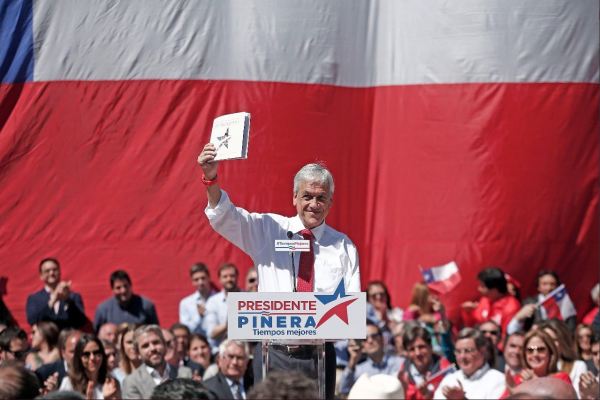
A presidential candidate stands in front of a crowd and a large Chilean flag

Ex-president Sebastián Piñera addresses his supporters at a campaign rally last month. / Twitter: @sebastianpinera

Chilean politics in the run-up to national presidential and legislative elections on November 19 have revealed that – within major lines of continuity – significant changes in the political alignments that have structured the country’s democracy since the end of the Pinochet dictatorship in 1990 are taking place.

  • Continuity is most pronounced on the conservative side of the political spectrum, where the two main conservative parties, Renovación Nacional (RN) and Unión Demócrata Independiente (UDI), have joined forces with smaller parties to sponsor the presidential candidacy of billionaire business mogul and former President Sebastián Piñera. In public opinion surveys of voter intentions, Piñera has maintained a healthy lead over a collection of centrist and leftist candidates.  He appears likely to come out on top in the first round of voting – and significant abstention (if fewer than 5.5 million registered voters vote) could push him over the top.  If he is forced into a run-off, the final outcome will rest heavily on the ability of his opponents in the divided center-left bloc to coalesce forces.
  • The center-left space is where most change is concentrated. The core parties in the Nueva Mayoría coalition that backed incumbent Socialist President Michelle Bachelet have won five of Chile’s six presidential elections since the transition to democracy in 1990.  For the first time, however, the main centrist party, the Partido Demócrata Cristiano (PDC), has opted out of the alliance to run its own candidate, Senator Carolina Goic.  With Goic languishing in the polls, however, the primary challengers to Piñera are located further to the left, including the Nueva Mayoría’s favorite, Senator Alejandro Guillier.  Although early speculation pegged him as an outsider, he is now firmly identified with the moderate reformist left and represents continuity with the current government.

A new left-leaning group, the Frente Amplio, has nominated Beatriz Sánchez, an independent journalist.  She arguably represents a larger challenge to the status quo, as her candidacy gives political expression to social actors who are sharply critical of Chile’s political establishment and the neoliberal economic model.  Even though the Broad Front’s electoral strength is untested, it brings together a number of small parties alienated from Nueva Mayoría and inspired by Chile’s massive student protest movement and other activist networks that have mobilized around labor, environmental, and pension reform issues in recent years.  Sánchez favors more redistributive taxation and greater state intervention in strategic enterprises and utilities, as well as in water property rights and forestry where social conflict has been high.  She is also for replacing the private pensions system with a mixed public-private one and getting private banking out of the student loan business.

This election will likely show that the broad center-left coalition that dominated Chilean politics since the 1990 transition has effectively splintered, with the Christian Democrats seeking to carve out an independent space in the political center and a movement-based alternative emerging on the mainstream parties’ left flank.  Uniting such disparate forces to compete against Piñera in a run-off election, should one be required, will clearly be a formidable task.  Nueva Mayoría candidate Alejandro Guillier, considered the strongest run-off candidate to take on Piñera, is already in conversation with Christian Democrats and Sánchez’s Frente Amplio.  In a run-off, he is thought likely to get around 60 percent of the Christian Democratic vote, with more conservative Christian Democrats voting for Piñera.  His appeal to Frente Amplio voters could suffer because of their unhappiness with Nueva Mayoría.

  •  The specter of high abstention looms large for second-round voting, too. President Bachelet’s low approval ratings for most of her second term in office, although recently reversed, signaled low enthusiasm despite her successful pushing through a series of major reforms, including a reform of the electoral law to enhance proportional representation, a tax reform to increase revenues for social programs, the initiation of free university education for low-income students, and a much-debated law to legalize abortions in limited circumstances.  Last, but not least, mainstream parties across the board have been weakened by a series of corruption and campaign finance scandals, leaving many citizens alienated from parties.

November 2, 2017

*Eduardo Silva is Professor of Political Science at Tulane University, and Kenneth Roberts is Professor of Government at Cornell University.

Brazil: Surge in Divisive Politics

By Marcus Vinicius Rossi da Rocha*

Two politicians debate

Brazilian right-wing politician Jair Bolsonaro disparages fellow politician Maria do Rosário during a debate on violence against women. / Marcelo Camargo / Agência Brasil / Wikimedia / Creative Commons

Political tumult, constant corruption scandals, and widespread popular loss of confidence in political institutions have given rise to divisive right-wing movements that, although not poised to win office in the 2018 elections, are laying the groundwork to have an impact on Brazilian politics in coming years.  Brazil will elect a president and both houses of Congress in October 2018, after five years of economic crisis (3.6 percent contraction in 2016); corruption scandals (President Michel Temer is still under investigation in the Lava Jato probe); low confidence in government (Temer has 3 percent approval); and political instability.  Many observers believe Brazilian democracy could be in peril.

Two factors in particular – the economic decline and the odor of taint surrounding Temer and the political class – are fueling a surge in right-wing and populist politics.  Conservative and market-oriented agendas are, unsurprisingly, gaining momentum, but also are challenges to the country’s three decades of democracy, including the defense of torture and military dictatorship.  The surge is seen in three main areas:

  • The Free Brazil Movement (Movimento Brasil Livre, MBL) is a youth libertarian movement born in early 2014 following the mass street protests of 2013, which its leaders helped organize. While promoting free speech, less government, individual liberty, and market-oriented reforms, its agenda emphasizes moral issues as an electoral strategy.  It mobilizes protesters against left-leaning politicians and gay art exhibits and succeeded in shutting one event down on spurious grounds.
  • Jair Bolsonaro, a former army captain turned lawmaker, is famous for his defense of torture and the death penalty, his opposition to human rights protections, and his praise for the military dictatorship that ruled Brazil in 1964-85. Proud of his lack of political correctness, he compares himself to U.S. President Donald Trump, and he casts himself as engaged in a moral struggle to save the nation.  He promises to withdraw Brazil from international human rights agreements; opposes gay marriage; and wants to adopt the death penalty and loosen gun laws.  In a speech on the House floor one time, he told a female legislator and human rights defender, “I do not rape you because you are not worth it.” He was reprimanded by the courts for this and other statements, but a leading public opinion institute Datafolha shows him with almost 20 percent of popular support.
  • A handful of senior active-duty and reservist military officers also seem to be crossing the line with greater frequency, openly speaking about “constitutional military intervention.” These officers espouse a highly disputed interpretation of Article 142 of the Constitution – which states that the “Armed Forces aims … to defend the homeland, to assure the constitutional powers, and, by initiative of any of these powers, to assure law and order” – to argue that the Constitution gives the Armed Forces authorization to intervene in politics.  At an event a few weeks ago, General Antonio Hamilton Mourão said that if the judiciary does not fix the government’s corruption problem, the Armed Forces could.  The high command remained silent.

Few analysts believe that the 2018 elections will be obstructed in any way, but the years of crisis, compounded by the polarizing rhetoric and activities of frustrated conservatives, will put checks and balances to test.  A military coup is highly unlikely – the Army is not eager to run the state again – but the apparent politicization of institutions sworn to defend the rule of law could cause others to flout the Constitution.  Congressman Bolsonaro does not appear likely to score big in 2018.  His party is small, but his popularity could very well give a boost to similarly minded groups poised to gain ground in Congress. This could lead to more than a continued shift toward the interests of construction firms, financial system, and agriculture sector that support them; it could portend a dismantling of decades of work to build democratic institutions; end torture and police brutality; and protect citizens’ rights to choice, freedom from discrimination based on sex or sexual orientation; pro-choice laws, gay rights, and indigenous rights.  Three decades of democracy won’t be reversed easily, but the next several years call for healing, not a new politics of division.

 October 5, 2017

* Marcus Rocha is a Ph.D. Candidate in Public Policy at the Federal University of Rio Grande do Sul (Brazil) and a CLALS Research Fellow specializing in the Brazilian executive branch and corruption in municipalities.

Nicaragua: Protest Abstention, Dedazos and Electoral Farce

By Kenneth M. Coleman*

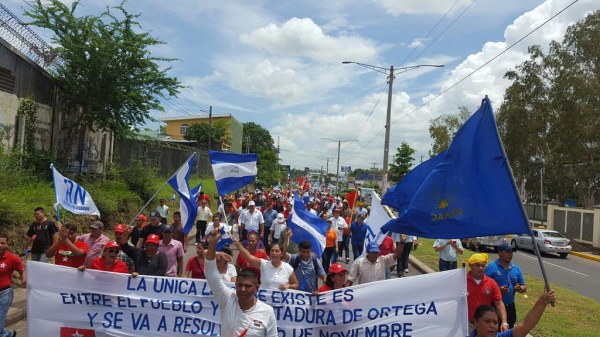
A group of people holding Nicaraguan flags and banners protest outside

Organized by the Sandinista dissident group Movimiento Renovador Sandinista (MRS), protesters took to the streets last year ahead of the general elections to demand recognition of their party, and free and open elections. Many members of MRS will abstain from voting in the upcoming elections. / MRS / Flickr / Creative Commons

The surge in protest abstentionism in Nicaragua’s presidential election last November appears likely to worsen in elections this November 5 – undermining the legitimacy of the Daniel Ortega government but not threatening its control.  The  Supreme Electoral Council, dominated by the ruling Sandinista Party (FSLN), proclaimed that 68 percent of the registered electorate had voted last November 6, but two more credible estimates – that of independent observers (closer to 30 percent) and post-election public opinion polls (50 percent) indicated a much lower turnout.  Non-voters come in at least two variants: the disinterested, disengaged, and poorly informed; and protest abstainers.  The evidence points to the latter reason.

  • Critics of the now-autocratic FSLN had nowhere meaningful to go electorally. In June 2016, the FSLN-controlled Supreme Court of Justice (CSJ) withdrew recognition of the Partido Liberal Independiente (PLI) from Eduardo Montealegre, a prior presidential nominee who had finished second to Daniel Ortega in 2006, and recognized Pedro Reyes, a political non-entity soon booted from party leadership.  Years before, in 2008, the government withdrew recognition from the Movimiento Renovador Sandinista, which included most of the well-known Sandinista dissidents (including author Sergio Ramírez, once Daniel Ortega’s Vice President, and several surviving members of the Sandinistas’ original nine-person National Directorate).
  • Focus groups organized by scholars at Florida International University (FIU) and follow up studies confirmed high abstention rates driven by unhappiness with the election. Interviewees said, for example, “There was no candidate who fulfilled my expectations for making the country better … none … capable of taking the country forward.”

Protest abstentionism appears likely to be equally high or even higher in the municipal elections on November 5, reflecting frustration from an unexpected source:  loyal Sandinistas opposing the imposition of candidates by President Daniel Ortega, and his wife and vice president, Rosario Murillo.  Adapting Mexican political discourse, many FSLN nominees for mayors, vice-mayors, and municipal councilors are now criticized as representing dedazos, candidates “fingered” from above.  Two unhappy Sandinistas told the opposition paper Confidencial on August 29 of their discontent.  “It hurts me … but that is what [the party] has left me… not to vote in the municipal elections,” said one in Masaya.  “They didn’t take the party loyalists into account [in picking candidates], so the party loyalists will not take the party into account in the elections in November,” said a former FSLN supporter in Corinto.

  • Associates of the old PLI, reconstituted as Ciudadanos por Libertad (CxL), have been granted legal registration – and intend to compete as long as the Organization of American States observes the elections. The OAS role remains unclear, however, prompting the initial CxL candidate for Mayor of Managua to resign his candidacy earlier this month.

What the opposition proclaimed an “electoral farce” last November seems likely to be repeated on November 5.  Ortega has taken steps to allow “same-day registration” of voters on election day – apparently to counter abstentionism – and recent reports of distributing cédulas (national identity cards necessary for voting) to minors have surfaced in La Prensa, presumably also with an intent to increase electoral turnout.  However, anger over dedazos may be deep enough to keep many members of the FSLN away from the polls.  In spite of high abstention levels, the Ortega family enjoys control over all branches of government – National Assembly, Judiciary, and Electoral Council – and continues to enjoy an implicit corporatist accord with COSEP, the leading business organization, while having long proven adept at undermining potentially competitive leaders.  Overreaching via the dedazos may have caused visible cracks in the partisan foundation of the dynasty – strengthening party dissidents’ portrayal of Daniel and Rosario as usurpers – but no leader capable of undermining their grip over governmental structures is yet visible or appears likely to emerge in the near term.

September 18, 2017

* Kenneth M. Coleman is a political scientist at the Association of American Universities who directed the 2014 AmericasBarometer national survey in Nicaragua.

The Brazilian Roller Coaster … Still Heading Down

By Fábio Kerche*

34976737542_8c2ede46de_k

Rodrigo Maia (center), Speaker of the House of Representatives, gives an interview to the Brazilian press. If President Temer loses the House, Maia may replace him as President.

The political situation in Brazil is dramatic and shows no prospect of improving in the short term.  The Supreme Court has received an indictment against President Michel Temer on corruption charges.  A close adviser of his was caught on video receiving money in a suitcase.  The Chief Prosecutor, who had been playing a minor role in the anti-corruption Car Wash Operation, saw an opportunity to grab the limelight.  Rede Globo, Brazil’s most powerful media group, made Temer’s fall from power seem likely in a matter of days.

  • But Temer did not surrender. As Supreme Court action against a president must be authorized by the House of Representatives, the battle turned to Parliament.  Using means denounced as unethical, such as giving administration positions to people appointed by congressmen, the President won the first round in the committee with jurisdiction over the case.  The next step, in August, will be a full House vote, which could reverse the committee decision.

Regardless of the outcome of House proceedings, political turmoil appears certain to continue – and Temer’s conservative policies will continue to aggravate social divisions.  If Temer loses and the House gives a green light to a Supreme Court investigation, the Constitution foresees that he must be removed from the presidency during the trial (for up to 180 days) – with little chance of regaining the post, according to analysts.  In this scenario, his most likely successor would be Rodrigo Maia, Speaker of the House of Representatives, and a member of a small right-wing party that supported the military dictatorship.  He has little experience in electoral terms; many attribute his victories in legislative elections to the reputation of his father, a former mayor of Rio de Janeiro.  His attempt to run for the executive branch in Rio de Janeiro, a more difficult kind of election than for the Congress, proved to be a huge failure.  He is signaling that he would keep Temer’s conservative economic team and continue an agenda that cuts workers’ rights – proposals that are music to the market’s ears but likely to further rile opponents.

  • An alternative pushed by social movements – a constitutional amendment calling for direct elections right now – would seem to offer a chance for Brazil to break its downward spiral. Protesters show little sign, however, of breaking the roadblocks that the mainstream press has created against the proposal.  The popular mobilizations involve thousands of people but are having little resonance on television, in newspapers, and on websites.  The government, press, and market do not wish to delegate to citizens the right to choose their president, at least not now.

By default, general elections scheduled for October 2018 still appear to be the country’s best hope for putting democracy on track again.  The chance that the elections will end the crisis will be undermined, however, if former President Lula da Silva is barred from running.  Convicted of corruption in a process that many observers claim lacked evidence, the matter is now in the court’s hands.  If the conviction is confirmed, the legitimacy of the elections will be in jeopardy.  Brazil’s political institutions will be further weakened as confidence in election results will plummet –more than in a healthy democracy – and the democratic game itself, as expression of popular rights and will, will be threatened.  There is no hope of improvement in the short term.  The impeachment without a crime of former President Dilma Rousseff continues to take its toll.

July 31, 2017

* Fábio Kerche is a Researcher at Casa de Rui Barbosa Foundation, Rio de Janeiro, and was a CLALS Research Fellow in 2016-2017.

Lula Convicted: End of an Era?

By Anthony W. Pereira*

35075875073_62df9e06f4_k

Former Brazilian President Luiz Inácio “Lula” da Silva / Jeso Carneiro / Flickr / Creative Commons

Former Brazilian President Luiz Inácio “Lula” da Silva’s conviction last week on corruption charges was more than a legal decision and could mark a political watershed – the beginning of the end of “Lula-ism,” a political and redistributive pact that lasted from 2003 until 2010 which Lula has been offering to revive as a candidate in the 2018 presidential elections.  On July 12, Federal Judge Sergio Moro found Lula guilty of taking a bribe and laundering money, sentenced him to nine years and six months in prison, and banned him from taking public office for seven years.  This judgment, the first to convict an ex-president in Brazil, was the result of the Carwash anti-corruption investigations begun in March 2014.

  • The decision will be appealed to the Federal court for the Fourth Region in Porto Alegre. This court will probably rule on the case before the 2018 filing deadline for presidential candidates (yet to be decided, but usually in mid-August), and is expected to uphold the conviction.  Lula would be legally barred from being a candidate at that point, although he might mount some sort of challenge to such a ruling.  Lula’s strategy for now is to press on with his campaign, to criticize his conviction as political persecution that was not based on evidence, and to portray himself as a man of the people capable of taking on the “elite.”

Lula still has great strengths.  The basis of Lula-ism has been his personal appeal – he captured twice as many voters as did his political party, the Partido dos Trabalhadores (PT), in 2002 and 2006 – boosted by economic forces and public policies that raised the living standards of the poor.  With his finely-tuned ability to communicate to ordinary people, he showed that it was possible to both grow the economy and redistribute its fruits.  His government reduced poverty significantly, offered the poor inclusion in the consumer society and the chance of social mobility, and even achieved a modest reduction in income inequality – while promoting the interests of big companies.

  • But he may not have achieved the long-term realignment his supporters claim. Lula-ism proper only lasted for eight years, the length of his two presidential terms.  His hand-picked successor, Dilma Rousseff, ruled for almost six more years, but by the last year of her first term, poverty had stopped declining.  The current government of President Michel Temer has passed a constitutional amendment freezing federal spending in real terms for 20 years; the measure does not automatically reduce spending on social programs, but in the absence of tax increases that is what it has produced.  Temer’s own bribery scandal may take him down, perhaps within the next couple of weeks, but his policies raise a more fundamental question:  whether Brazil can return to economic redistribution, diminishing the severe inequality that still marks its society, without Lula-ism.

The organs of anti-corruption investigation and control that have challenged Lula, Dilma, and Temer – the media, the Federal Police, the Public Prosecutor’s Office, and the judiciary – are neither consistently politically neutral nor free of corruption themselves.  They are not a Deus ex machina that can free the Brazilian polity of corruption all by themselves.  For that, Brazil needs political reform, further changes in at least some of the rules that regulate elections and governance, a realignment of incentives faced by elected officials, state bureaucrats, business people, trade unions, and the electorate.

  • The PT and the other two most important parties, however, seem incapable of renovation despite leaders’ awareness of the low level of legitimacy with which they are viewed by voters. The PT has few viable new leaders and is clinging to Lula’s candidacy as its only hope of a return to power.  The Brazilian Social Democratic Party (PSDB) still nominally supports Temer.  And Temer’s own party, the Brazilian Democratic Movement Party (PMDB), is torn between defending the president in an act of self-preservation, and fearing the wrath of the voters in 2018.

Brazilians face a “trilemma”: they yearn for the three long hoped-for goals of sustained and successful anti-corruption investigations, political reform, and a return to economic redistribution.  Achieving two of those goals at the same time, let alone three, seems impossible.  The 2018 elections therefore will reveal a country in which anti-corruption investigations continue to knock major figures out of the political game, while political reform and economic redistribution are postponed.  The old cliché that Brazil is the country of the future takes on a new meaning in light of this somber possibility.

July 17, 2017

*Anthony W. Pereira is a Professor and Director of the Brazil Institute at King’s College London.

Macri in the Next 100 Days

By Nicolás Comini*

32919903642_2bd30877a1_k

Argentine President Mauricio Macri. / Casa de América / Flickr / Creative Commons

Everybody seems to love President Mauricio Macri outside Argentina – it’s not hard to understand why – but he faces tough challenges at home.  Foreign supporters have plenty of reasons to believe in him.  First, he is not Cristina Fernández de Kirchner, the former president whom they branded a populist too close to Venezuela, Bolivia, or Ecuador.  Like many conservatives inside Argentina itself, they see Macri as the person who avoided the “Venezuelization” of the country, and his market-friendly credentials were sealed through his campaign promise of a “rain of investment” and his government’s implementation of a package of measures aimed at financial liberalization, regulatory flexibility, liberalization of foreign trade, and stronger fiscal discipline.  He has been less confrontational in diplomacy.  “Return to the world,” “de-ideologization,” “pragmatism,” and “transparency” are the continuous slogans that draw the foreign accolades.

Things look different at home, however.  The federal government confronts a convoluted scenario in the next 100 days, during which it will face at least three sets of sensitive issues in the run-up to Legislative primaries in August and elections in October.

  • Domestic issues. The government will have to deal with a hostile internal front.  One challenge will be resolving a long-running pay dispute with teacher unions – especially in the province of Buenos Aires.  Another is quelling complaints about steep increases in the costs of government services and deep slashes in funding for Science and Technology, Culture, Human Rights, Health, Production, and Energy.  Macri’s failure to meet inflation reduction targets (prices rose by 40 percent in 2016); the need to stimulate the economy; and debates on tax reform are a daunting agenda.
  • Controversy over human rights and immigration. One of the Achilles’ heels of the current administration is the imprisonment of social activist Milagro Sala in the northwestern province of Jujuy.  An ally of former President Fernández de Kirchner, Sala was arrested in January 2016 – one month after Macri took office – on highly contested charges: initially of “instigate criminal activity disorder” and later of “illicit association, fraud, and extortion.”  Pope Francis, Canadian Prime Minister Trudeau, and UN officials have expressed concern, fueling tensions inside Argentina.  An immigration reform decree facilitating deportations and restricting access at border crossings has been rejected by social movements, international organizations, and much of the Argentine political opposition.  The repudiation is not only felt in the formal political arena but also on the streets.
  • External dynamics with internal consequences. Brazil’s Lava Jato scandal is splashing as much onto Macri’s government as his predecessor’s.  Officials from both administrations are being accused of receiving bribes from Odebrecht, the largest Brazilian construction company, and no one knows how this process will develop hereafter.  Congresswoman and Macri ally Elisa Carrió claims the whole political elite is complicit in the Odebrecht mess.  The “Panama Papers” – leaked from the law firm Mossack Fonseca, which allegedly was involved in helping companies hide bribes paid to a number of South American leaders – has so far not touched Macri, whose family has links to firms cited in the documents.

The August primaries, followed by full legislative elections in October, are a potential inflection point for both Macri and his opponents.  Neither side has yet announced its slate of candidates, but one essential factor is already clear: the candidacy (or not) of Cristina Fernández de Kirchner.  The primary election will define how the pieces of the political chessboard are placed, and Macri’s handling of his economic, political, and social challenges will be decisive.  Achievement of his reform agenda – including the overhauling the National Institute of Statistics and Census (INDEC, accused of cooking data during previous governments), an ambitious “Plan Belgrano” infrastructure program, and the end of currency controls – may not be enough.  The potential reunification of his key Peronist opponents, increased social unrest, splits in his own coalition, and the spillover from the Brazilian crisis suggest a sobering future.  True love cannot be achieved from one day to the next, but in the domestic political arena it is simple to lose it suddenly.

June 8, 2017

* Nicolás Comini is Research Fellow at CLALS; Director of the Bachelor and Master Programs in International Relations (Universidad del Salvador, Argentina); and Professor at the New York University-Buenos Aires.

Ecuador: Moreno’s Victory Probably Not Enough

By John Polga-Hecimovich*

33482925094_376ea03379_k

President-elect Lenín Moreno at a meeting to discuss the presidential transition in April 2017. / Agencia Noticias ANDES / Flickr / Creative Commons

President-elect Lenín Moreno’s narrow victory and modest legislative majority fall short of what he needs to push his costly leftist agenda while simultaneously bridging deep socio-political divisions and struggling with vexing economic challenges.  Moreno, of the ruling Alianza PAIS, narrowly defeated Guillermo Lasso of the CREO movement, 51.16 to 48.84 percent, in Ecuador’s presidential runoff election on April 2.  As a referendum on outgoing president Rafael Correa and his “Citizen’s Revolution,” the election marks a victory for Latin America’s ideological left after setbacks in Argentina, Brazil, and Peru.  The splintered opposition vote largely coalesced behind Lasso’s candidacy – he earned only 28.09 percent in the first round – but an uneven electoral playing field (including support from state-run media and Correa’s deployment of thugs to intimidate Lasso supporters) and his affiliation with the banking crisis of 1999 appear to have hurt him.

  • The incoming government appears committed to continuing Correa’s economic and social policies. Moreno is reassembling many of the further left members of Correa’s team for his own government, including powerful ex-ministers Fander Falconí and María Belén Moncayo.  Although he is more rhetorically moderate than his predecessor, Moreno is an avowed socialist.  As a young man, he was a member of the fringe Marxist-Leninist Revolutionary Left Movement, and as president-elect he has already promised an additional US$2 billion on top of the government’s already unsustainable social spending.  At the same time, Moreno has adopted a more conciliatory tone with the United States than Correa and has already made overtures to social movement leaders that had fallen afoul of the outgoing president.

Although Moreno will enjoy a legislative majority, he is taking office under difficult political and economic circumstances that will test his leadership.  The outgoing government’s politicization of public agencies like the National Electoral Council (CNE) has hurt the president-elect’s legitimacy.  The slim difference in the vote spawned protests outside the CNE in Quito by mostly middle-class members of the opposition.  What is more, despite assurances from the Organization of American States (OAS) and the local NGO Participación Ciudadana that the final vote closely aligned to their internal quick counts, a number of opposition voices maintain that there was electoral fraud. There are more challenges:

  • In the National Assembly, Moreno and his party won 54 percent of the seats (74 of 137) with just 39 percent of popular support due to clever districting and a seat allocation formula that favors large parties. Although this provides for unified government in a constitutional environment that can harshly penalize legislative gridlock, it is also disproportional to the popular support for the party.
  • Moreover, Moreno’s majority may also be more illusory than it appears. As many as 24 of Alianza PAIS’s 74 legislators, 32 percent of the movement’s total seats, were elected via electoral alliance between PAIS and a different party: seven from the Ecuadorian Socialist Party and the remainder from a panoply of inchoate provincial-level movements.  These legislators’ support for PAIS is not guaranteed.

Maintaining his heterogeneous alliance in a country with notoriously high levels of party switching will require a great deal of negotiating skill and flexibility of the inexperienced Moreno.  He possesses limited policymaking options to confront an unviable fiscal situation – the deficit doubled in 2016 – and economic slowdown – according to the IMF, the economy contracted by 2.2 percent in 2016 and is expected to decrease by an additional 1.6 percent in 2017 – and an overvalued currency in real terms.  The Moreno administration confronts the unenviable task of continuing and even expanding an economically costly political project in the midst of fiscal constraints, a fragile political majority, and a limited popular mandate among deep social divisions.  Less daunting situations have felled more experienced leaders in Ecuador’s history.

May 8, 2017

*John Polga-Hecimovich is an Assistant Professor of Political Science at the US Naval Academy.  The views expressed in this article are solely those of the author and do not represent the views of or endorsement by the Naval Academy, the Department of the Navy, the Department of Defense, or the US government.