Mexico: Tough Congressional-Executive Relations Ahead

By Daniela Stevens*

Piñata with the Mexican flag in the background

Bandera mexicana en el Zócalo de la Ciudad de México / Wikimedia/ Creative Commons

Whoever wins Mexico’s presidential election on July 1 probably will face a divided and cantankerous Congress – especially if, as appears likely, Andrés Manuel López Obrador of the Morena Party is the victor.  López Obrador has been ridiculed by the Mexican political class, some of whose leaders have called him the next Hugo Chávez, but most polls give the polemical candidate at least a 10-point lead over Ricardo Anaya of the coalition Por México al Frente.  In Congressional races, polls also give the advantage to López Obrador’s party and its coalition partners, including Partido del Trabajo (PT) and Partido Encuentro Social (PES), under the joint banner of Juntos Haremos Historia.  According to the Parametría poll, 32 percent of respondents intend to vote for Morena, five percent for PT, and two percent for PES.  Other polls give them higher numbers.

  • The formerly hegemonic Partido Revolucionario Institucional (PRI) appears likely to fall to third place due to President Peña Nieto’s poor performance and the party’s association with corruption, while the Partido de la Revolución Democrática (PRD), traditionally the largest leftist party, would be the fourth.
  • Under the most likely post-election scenarios, López Obrador’s coalition would constitute the largest minority in the Chamber but still fall short of the 51 percent absolute majority, except perhaps by the thinnest of margins. Under Mexico’s mixed electoral system – with both majority and “proportional representation” determining the allocation of Congressional seats – the larger parties lure the smaller ones into coalitions, but unity is often seriously challenged during legislative and other battles.

The traditional categories of left and right are growing obsolete in Mexico, as parties and candidates increasingly resort to opportunism rather than act based on loyalty to any particular ideology or party.  Personal and political grudges also often trump political agendas.

  • As a result, an alternative scenario may emerge in which alliances shift after election day in a way that enhances López Obrador’s power. Tensions between the left-leaning PRD and López Obrador, who was its leader for many years, were so deep that the candidate split with it and created Morena as a party in 2014, but opportunists in the party could well jump ship and join him if he wins by a comfortable margin.  In the PRI also, frustration with party leadership could also prompt defections, and López Obrador – a prominent Priista in the 1970s and 1980s – could also harness their backing.
  • Party switching from one election to another has long been a common practice of politicians in Mexico, but only recently have representatives switched parties in the midst of legislative periods. In particular the PRD’s ranks significantly dwindled as legislators elected under its rubric defected to join Morena. Were this to be replicated later this year or next, López Obrador’s congressional majority could be larger than polls suggest.
  • Party discipline in Mexico has been comparatively higher than in other multi-partisan presidential systems such as Brazil, because of the constitutional prohibition of consecutive reelection. In the past, incumbents did not have incentives to serve their constituencies because their careers depended strictly on party leaders, who centralized nominations to elective positions.  From 2018 on, representatives in both Chambers may run for reelection.  The promise of a Morena candidacy can fuel even more defections into its ranks if the party keeps growing its electoral base.
  • If Morena achieves such dominance, the Congress’s commissions, the equivalent of U.S. Congressional committees, could be important partners of López Obrador because the executive delivers proposals directly to them, and they, in turn, issue the final dictamen that the plenary votes on. Juntos’ influence in the commissions would translate into a fairly unexamined prioritization of the presidential agenda.

Even a comfortable victory on July 1 will not assure López Obrador a readily compliant Congress.  Most legislators in the Por México al Frente coalition, which includes PAN, PRD, and Movimiento Ciudadano stalwarts, will certainly constitute an obstructionist opposition.  How successfully they can sabotage the president’s agenda will obviously depend on their numbers, but unity in opposition to Constitutional amendments required by some of his campaign promises appears certain.  Constitutional amendments require a two-thirds majority in both chambers of Congress and in a majority of state legislatures – unachievable in any likely political configuration during a López Obrador administration.  His proposals for revocation of presidential tenure, lowering high-ranking officials’ salaries, and reversing education reforms– which would require Constitutional amendments – thus appear dead on arrival.  Absent reliable Congressional support, López Obrador would also have difficulty passing essential budget and revenue bills and gaining confirmation of important appointees such as the attorney general and key prosecutors.  No candidate would have an easy Congress, but the Mexican parties’ willingness to set aside petty divisions and coalesce behind pressing issues, at least early in the presidential term, appears lower than ever before.  Thus, López Obrador would have a lot riding on the willingness of some sectors of the opposition to defect.

May 24, 2018

* Daniela Stevens is a Ph.D. candidate in Political Science in the School of Public Affairs at American University.

Colombia: Is the Peace Process Failing?

By Christian Wlaschütz*

A man stands on the right side of the frame with a large rifle

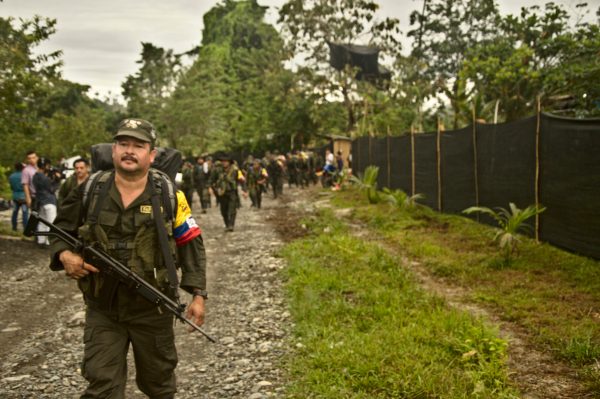
Members of the FARC in Tumaco, Colombia waiting to be disarmed last January. / Andrés Gómez Tarazona / Flickr / Creative Commons

As Colombia prepares for its presidential elections, the peace process with the FARC is already seriously jeopardized by shortcomings in its implementation —and it stands to worsen considerably.

  • The strong showing in polls of Iván Duque – nominee of Alvaro Uribe’s Centro Democrático (CD), which has consistently opposed the peace agreement – bodes poorly for implementation in the future. Former Vice President Germán Vargas Lleras is polling poorly, but his Cambio Radical’s antagonism toward the peace agreement enjoys support.  Leftist candidate and former Bogotá mayor Gustavo Petro, second in the polls, supports the accord, but he faces a steep uphill battle.  Centrist candidates Sergio Fajardo, former mayor of Medellín and governor of Antioquia, and Humberto de la Calle, chief negotiator with the FARC, have not been able to gain ground.  The polls do not enjoy much credibility but are influencing public perceptions on the peace process and other key policies.
  • The peace talks between the government and the country’s other main guerrilla group, the Ejército de Liberación Nacional (ELN), have been in a limbo since Ecuador withdrew as host and guarantor of the negotiations two weeks ago. Ecuadoran President Lenín Moreno made the announcement apparently in anger over the assassination of two Ecuadoran journalists by FARC “dissidents” (those rejecting the accords) and over the increasing criticism among locals of the worsening security situation in the border region with Colombia.  It was a big blow to Colombian President Santos’s hopes to conclude an agreement with the ELN during his mandate.  The peace talks have been suspended several times in the past due to bombings and kidnappings, but most observers believe it will be very difficult for talks to resume without Ecuador’s facilitation.

A serious challenge to political consensus to push ahead with the peace process is the dramatic decline in security in several Colombian regions, most notably Catatumbo (near the Venezuelan border) and Tumaco (on the Pacific Coast).  As experts had foreseen, the vacuum left by the FARC’s demobilization was quickly filled by the ELN and criminal organizations linked to the drug trade.  In Catatumbo, a hitherto irrelevant force, the “dissidents” of the Ejército Popular de Liberación (that is, those who did not demobilize with EPL in 1991), have taken advantage of the opportunity to conduct a deadly war against the ELN.  According to the weekly Semana, the dissidents may be supported by the Mexican Clan del Golfo cartel that wants control of strategic corridors for the drug trade.  Armed actors are sowing fear by declaring and suspending curfews at random; the state seems completely absent.  In Tumaco, bloody battles between FARC dissidents, other criminal groups, and state security forces are terrorizing the civilian population.  In these and other regions, threats against community leaders and assassinations are increasing.

  • Deficient implementation of reintegration programs for former FARC combatants is a major concern. Most former combatants are in a limbo regarding their judicial, economic, and social situation.  Lessons learned from the demobilization of paramilitary fighters some 14 years ago have not been applied, and lagging reintegration is tempting fighters to join other illegal actors.  The possible extradition of FARC leader Jesús Santrich to the United States on drug-related charges is also undermining demobilized combatants’ confidence that they’ll get a fair deal.  Santrich has started a hunger strike and claims to prefer dying than being extradited.

Most worrying in the long run is the polarization demonstrated by the inappropriate behavior of most of the presidential candidates.  Instead of offering programs to lead the country into a different future, personal attacks and the settling of accounts are at the core of the campaigns so far.  Colombian society’s contract to integrate into national life an unarmed FARC, free to pursue change through peaceful, democratic means, has never been strong.  But a surge in opposition to the peace process and the former guerrillas – led by politicians without a viable alternative policy – could easily translate into irreversible blows for peace and democratic inclusion.  Colombia is at a risky and decisive crossroad.  The possibility to relapse into former times is real.

May 4, 2018

* Christian Wlaschütz is a political scientist, independent mediator, and international consultant who has lived and worked in Colombia, in particular in conflict zones in the fields of transitional justice, reconciliation, and communitarian peace-building.

Colombia’s Elections: With New Comes Old

By Julián Silva*

Two men sit in white chairs during an interview

Iván Duque (left), appears to be the frontrunner in Colombia’s May 27 presidential election. / Casa de América / Flickr / Creative Commons

The first round of Colombia’s presidential election on May 27 has raised the profile of independent voices but does not appear likely to bring significant changes.  Most of the nine candidates represent new political forces, but the strongest are allied with the traditional elites that ruled under Liberal and Conservative banners during most of the 20th century.

  • Since the 1991 Constitution opened space for new competition to the Liberal and Conservative Parties, “independent” groups have shown increasing willingness to take the presidency for themselves. The old clientelistic machines, associated with the land-owning elites and those parties, have lost popularity in the urban-dominated country, and the rejection of the more traditional families seems to have prompted a certain “rebranding” by their heirs.  This year, only the Liberal Party presented a candidate – former minister, vice president, and peace negotiator Humberto De la Calle – but current polls indicate that he is unlikely to reach one of the two spots heading into the second round.  The youngest of the candidates seem to hold the lead: Iván Duque (42 years old) is pulling 38 percent; Gustavo Petro (58) has 29 percent support; Sergio Fajardo (61) has 12.8 percent; German Vargas Lleras (56) has 8.2 percent; and De la Calle (71) has 3.2 percent.

Several ostensibly independent candidates actually have close ties to well-established local and national elites.  Iván Duque, a fairly new figure in the Colombian political landscape, is aggressively supported by former President and current Senator Álvaro Uribe Vélez, who had deep roots in the Liberal Party and Antioquia Department elite before founding Centro Democrático in 2013.  The party is closely tied to land-owning oligarchs, big corporations, and the military, which gives Duque prospects for victory no truly independent candidate could have.  German Vargas Lleras, grandson of former President Alberto Lleras, is running on a new ticket called “Coalición Mejor Vargas Lleras,” which receives support from his old party, Cambio Radical, as well as stalwarts of the Conservative party and his family’s Liberal allies.

  • Several independents deserve the label. Gustavo Petro, a former guerrilla and mayor of Bogotá, occupies a more leftist space on the political spectrum that was usually excluded by the traditional parties during most of the 20th century.  Former Mayor of Medellín and Governor of Antioquia Sergio Fajardo promises to bring an “academic” perspective to the presidency if elected.
  • In addition to airing complaints about the candidates, social media users have been extremely critical of links that most candidates have to the traditional Colombian political class. Provocateurs mix truthful information with fake news to mislead the electorate and, protected by anonymity and authorities’ loose control over the virtual space, even issue threats of violence.  An unidentified projectile shattered a window of the car in which Gustavo Petro was heading to a rally in the city of Cúcuta.  The Matador, a political cartoonist working for El Tiempo, received death threats after he depicted Ivan Duque as a pig in one of his drawings.

With a little more than three weeks until the first round, the table seems to be set for Colombians to choose between leaders with significantly different political bases.  Current polls suggest they will stick with the neoconservative elite that has improved security and driven economic growth during the last few decades but has been tolerant of corruption, inequity, and even violence in some parts of the country.  But support for a different formula that promises to address some of these chronic problems is not inconsequential, even if the new leaders’ effectiveness is still unproven on a national level.  Colombians will also have a chance to decide if social media will be a vehicle for amplifying the old politics of threats and violence – or perhaps channel legitimate popular voices to demand accountability that exposes “fake news” and hate-mongering for what they are.  On that, too, the old practices and characters seem to have the advantage as they pursue a strategy that creates an image of change to ensure that everything remains the same.  The appearance of change in Colombia probably portends more of the same.

May 2, 2018

* Julián Silva is a CLALS Research Fellow, a Ph.D. Candidate in History at Universidad de los Andes, and Professor of International Relations at several Colombian universities.

Brazil: Is Democracy Under Threat?

By Marcio Cunha Filho*

A large group of Brazilians wave the Brazilian flag

A rally supporting former president Luiz Inácio Lula da Silva in October 2017. / Eduardo Figueiredo / Midia NINJA / Flickr / Creative Commons

Brazil’s ongoing political turmoil hit a new peak last weekend – resulting in former President Luiz Inácio Lula da Silva’s decision to turn himself in to be imprisoned – and strongly suggests that the country’s democracy is in deeper trouble than previously thought.  Lula said he was a victim of political persecution by both prosecutors and the courts, including the six Supreme Court justices who ruled that he not be allowed the courtesy of remaining free during his appeals to Brazil’s higher courts on his conviction on corruption charges.

  • Lula’s Worker’s Party (PT) claims that the decision is part of a campaign against leftwing forces that has intensified since Dilma Rousseff’s impeachment in August 2016. Supporters say that Lula’s imprisonment at a time that he is leading in presidential polls is the culmination of a strategy aimed at making sure that the PT – the only party to have won the presidency in elections since 2002 – remains out of power.  Most mainstream media and some rightwing lawyers have argued that Lula’s arrest obeyed all legal procedures, but PT supporters are not alone in their allegation of impropriety.  José Afonso da Silva, one of the most prominent non-partisan constitutional law professors in Brazil, has written a legal opinion against Lula’s imprisonment.  Other experts claim that Lula’s imprisonment order was strangely rushed (jurist Celso Antônio Bandeira de Mello), while others have expressly criticized the Supreme Court for denying Lula Habeas Corpus (Prof. José Geraldo da Silva Júnior).
  • While proof remains elusive, strong circumstantial evidence of conspiracy persists. The lawsuit against Lula was tried much more rapidly by Judge Sérgio Moro than most cases, and the guilty verdict was reaffirmed by the regional court just in time to keep Lula out of the presidential election scheduled for October 7.  Moreover, the accusations against Lula are fragile:  Moro argues that the former president received a $1 million remodeled beach apartment as a bribe from a construction company in exchange for political favors, but there is no evidence that the apartment was Lula’s or that he used it in any way.  Neither is there evidence that the construction firm received any favors.

Other indications that Brazil is experiencing an “open season” against the left are emerging.  Civil society leaders have reported repressive practices against them, including violent protests at their public events.

  • The assassination of a Rio de Janeiro municipal legislator is widely thought to have been carried out by rightwing elements. At a recent political rally, unidentified gunmen shot at Lula’s vehicle.  A wealthy São Paulo night club owner is offering a reward for anyone willing to murder Lula in prison.  Radical and angry political movements such as Movimento Brasil Livre are gaining strength by angrily advocating and celebrating through social media the imprisonment of political opponents.  Congressman Jair Bolsonaro, a former military officer who praises the military dictatorship, has become the new frontrunner in the presidential race.
  • Another troubling sign was a tweet from the Armed Forces – issued the day before the Supreme Court’s judgment against Lula – that it will not tolerate impunity. It has been widely interpreted as the most direct threat to the Court since the end of military dictatorship.
  • Freedom of expression and academic freedom are under pressure as well, according to many observers. Local, state, and federal legislators are trying to ban the teaching of gender issues in public schools, claiming gender issues are a leftwing ideology should not be taught to young children.  At the university level, in Rio Grande do Sul a local congressman filed a complaint to the Public Prosecutor’s Office asking that a course entitled “The 2016 Coup d’état” – referring to the removal of Dilma Rousseff and inauguration of President Michel Temer – be disallowed.

Democracies rarely die as a result of the acts by one or even a small group of political leaders, but rather as the outcome of repressive actors’ manipulation of popular confusion and anxiety about the country’s direction.  Lula may not have been perfect – he was not – but he deserved fair treatment by the government and fair enforcement of the law.  Democracies cannot endure when one group or another uses government institutions, even with significant popular support, to impose its views on others, often violently.  We should not forget that, in its early stages, the military coup in Brazil was supported by the media (at least by the biggest TV network in the country, Rede Globo), by civil society institutions (such as the Ordem dos Advogados do Brasil), as well as by much of the political leadership.  Radicalization, inability to dialogue, and unwillingness to make political compromises are the factors that made Brazil descend in 1964 into two decades of repression.  We might now be slipping down this same path, and witnessing the rebirth of institutionalized and popularly-supported repression and intolerance.

April 10, 2018

* Marcio Cunha Filho is a Ph.D. candidate at the University of Brasília; federal auditor in Brazil’s Office of the Comptroller General; and former CLALS Research Fellow.

Presidential Elections in Mexico: Tough Campaign, Tougher Challenges Ahead

By Daniela Stevens*

Andrés Manuel López Obrador stands at a microphone

Frontrunner candidate in Mexico’s 2018 presidential elections, Andrés Manuel López Obrador, speaks to the press. / ANDES / Micaela Ayala V / Flickr / Creative Commons

Campaigning for Mexico’s July 1 presidential election officially begins next week, and no candidate appears to have an insurmountable advantage over the others.  Polls vary, but Andrés Manuel López Obrador (MORENA) appears to be the frontrunner, with 35 to 44 percent of support.  He is followed by PAN-PRD coalition candidate Ricardo Anaya, who has between 24 and 31 percent of the vote.  The PRI candidate, José Antonio Meade, seems a third option, at about 20 to 26 percent, and Margarita Zavala, the only independent candidate who officially obtained registry, lags far behind.  It is too early to see if voters will base their decisions on party loyalty or on perceptions of the candidates.

  • López Obrador (widely known by his initials, “AMLO”) has broad name recognition – 84 percent of Mexicans are familiar with him for better or for worse – but Anaya, Meade, and Zavala have an important opportunity to build new images and attract voters. Indeed, AMLO sometimes seems to be in a race against himself; his rhetoric is often harsh, and his disregard for international free trade alienates a large sector of the business world and the media.  His mixed signals regarding a “review” of the contracts made in conjunction with energy reforms have fostered distrust and uncertainty.
  • Ricardo Anaya’s strategy appears likely to be open confrontation with PRI candidate Meade, aiming to attract PRI voters who see him as the candidate best positioned to prevent an AMLO victory. Anaya’s focus has been on winning the endorsement of key figures in states that constitute large electoral strongholds, such as Jalisco.  However, Anaya’s alleged involvement in a money laundering scandal stands to undermine his support.   PRI Secretary General Claudia Ruiz Massieu tried to tar him in an international context last week by giving the OAS a file with evidence she claimed substantiates the charges against him.  Anaya has cried foul.
  • José Antonio Meade, a highly skilled and seasoned technocrat associated with both PRI and PAN presidencies, is being held back by his association with the very unpopular incumbent President Enrique Peña Nieto. He is trying to cast himself as a PRI “sympathizer,” rather than as a party “militant” responsible for recent years’ weak performance.  To distance himself from his party’s image of electoral fraud, corruption, and crony capitalism, he has emphasized his commitment to transform the PRI.  The party is cooperating, framing him as a “citizen candidate.”

While candidates are immersed in the customary personal attacks against each other, violence appears to be playing into electoral politics with renewed intensity.  The Second Report of Political Violence in Mexico, prepared by the risk assessment firm Etellekt, documents 141 attacks against politicians and public servants since the start of the pre-campaign period last September.  Over 50 of these attacks have been assassinations of officials, incumbents, and candidates at all levels of government.  Violence is worst in Guerrero, Veracruz, the State of México, and Puebla, all states with significant organized crime.

Public insecurity is certain to join organized crime, corruption, inequality, and redistribution of income as central in the Mexican landscape as elections approach, and each candidate will pledge to make those issues his or her top priority.  As in other Latin American countries, the election also appears likely to signal the deepening discredit and low representation of the traditional party system.  Voters could very well select a candidate who, while not an outsider, presents him- or herself as committed to attacking the corruption of the major parties.  While running on a law-and-order slate, the candidates will also likely promise new approaches on the “war on drugs” that, led by both PAN and PRI, has devastated the country – with little or no prospect of avoiding the same pitfalls as predecessors.  Winning the election on July 1 will not be easy for any of the declared candidates; governing once in office will be even harder.

March 23, 2018

* Daniela Stevens is a Ph.D. candidate in Political Science in the School of Public Affairs at American University.

Latin America: Evangelical Churches Gaining Influence

By Carlos Malamud*

Five people stand up in front of a screen with their arms raised

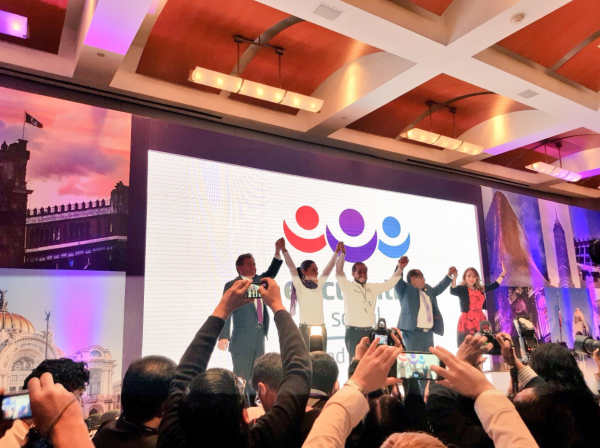
The evangelical political party Partido Encuentro Social (PES) held a rally earlier this month in Mexico City. / Twitter: @PESoficialPPN / Creative Commons

The line between religion and politics is getting increasingly blurred in Latin America as evangelical churches grow in strength and candidates try to curry the support of – or at least avoid confrontation with – the faithful.  Tensions over mixing religion and politics have historic roots in Europe and Latin America and persisted throughout the 20th century, but we are witnessing a new phenomenon in Latin America now.  In much of the region, evangelical churches are showing an increased political presence and institutional representation in partisan politics.

  • In Mexico, the secular Movimiento de Regeneración Nacional (MORENA) and the Partido del Trabajo (PT) have struck an alliance with the evangelical Partido Encuentro Social (PES) to back presidential candidate Andrés Manuel López Obrador. Guatemalan President Jimmy Morales is an evangelical, and Costa Rica – if current polls prove correct – could soon have Fabricio Alvarado, an evangelical pastor, as President.  In Brazil, presidential aspirant Jair Bolsonaro has been building popular support by, among other things, appealing to the an evangelical base, even though most Brazilian evangelical churches aren’t reaching for executive power but rather support parties concentrated on building local, provincial, and congressional influence.
  • The evangelical churches’ membership has grown steadily but unevenly in recent decades. About 20 percent of all Latin Americans are evangelicals.  In Mexico, they account for more than 10 percent of the population.  In Peru, Ecuador, Colombia, Venezuela, Argentina, and Panama, observers estimate more than 15 percent.  In Brazil and Costa Rica, the number reaches 20 percent, while in Guatemala, Honduras, and Nicaragua it surpasses 40 percent.

The evangelical churches’ political agenda is centered on defense of family values – basically opposition to abortion, same-sex marriage, divorce, euthanasia, and what they erroneously call “gender ideology.”  On these topics on certain occasions, there’s a striking convergence with the Catholic hierarchy, Social-Christians, and conservative parties.  The evangelicals do not usually take positions, however, on other issues in which the government has a strong role, such as the economy or international relations.

The evangelical phenomenon reflects a double dynamic:  the unstoppable surge in non-Catholic faithful poses an enormous challenge for the region’s deeply rooted bishops conferences, and the growing distrust for political leaders and parties has facilitated the emergence of new options, including evangelicals, with barely articulated platforms.  The faithful who profess the tenets of evangelicalism are disciplined, and pastors’ positions have a lot of influence over them.  Even if not linked directly to candidates through the parties, voters’ evangelical affiliation and their churches’ recommendations have a strong influence over them.  The evangelical vote, moreover, is highly desired by all candidates and at least indirectly influences campaigns.  Candidates in Colombia, Brazil, or Mexico, as in other Latin American countries, are making that increasingly obvious as elections approach.

March 20, 2018

*Carlos Malamud is Senior Analyst for Latin America at the Elcano Royal Institute, and Professor of Latin American History at the Universidad Nacional de Educación a Distancia (UNED), Madrid.  A version of this article was originally published in El Heraldo de México.

Brazil: Growing Federal Role in Security

By Marcus Rocha*

A man in a military uniform and a man in civilian dress shake hands

Brazilian President Temer (right) and General Villas Bôas (left) shake hands. / Romério Cunha / Flickr / Creative Commons

Brazilian President Temer is increasing the armed forces’ role in security matters, especially in Rio de Janeiro, in what appears to be a populist measure to increase his odds in the October election should he decide to run.  Although General Villas Bôas, commanding general of Brazilian Army, has cautioned about the limitations on the military’s ability to carry out civilian security operations, the Army has generally accepted the mission and used it as pretext for more funding and more legal protection from prosecution.  Governments have increased the use of the Armed Forces for security in Rio on a number of occasions in the last 26 years, including during international conferences, a Papal visit, and surges in drug violence in the favelas.  Preparing for the 2014 World Cup and 2016 Olympics, then-President Dilma Rousseff also favored using the military over state police for many security functions.  Military units have usually operated under Decretos de Garantia de Lei e Ordem to circumvent Constitutional prohibitions on their role in civilian policing.

  • This approach has been criticized for both its fiscal and human costs. During a 15-month period beginning in 2014, when the Armed Forces occupied Favela da Maré (a group of 16 communities in Rio), the operation used 85 percent of both the military personnel and of the $200 million budget used during Brazil’s 11 years of involvement in Haiti peacekeeping under MINUSTAH.  Violations against slum residents were reported, and polls showed that most of the inhabitants of Maré did not feel safer with the Army in the streets.
  • Congress last year approved a law initially proposed in 2003 allowing cases of civilians killed by the military in such operations to be tried in special military courts – fueling popular concern that the extra protections for troops would give them a “license to kill.” Army commander Villas Bôas had lobbied for the law.  The internal security mission gives the military leverage for resources, but generals acknowledge that soldiers aren’t trained to deal with security in urban areas.  Villas Bôas has said publicly that his forces “don’t like this kind of deployment”; are concerned it hurts their image; and lament that affected areas return to status quo after they depart.  Villas Bôas has spoken also of “fears of the contamination” of troops by organized crime.

Temer’s moves go beyond his predecessors’ in that federal authority, rather than supplementing local officials, is subordinating them for the first time under the 1988 Constitution.  The interventor assumes the governor’s authority for the entire state’s security, with power to command both civilian and military units.

  • Temer has also announced the creation of a new Ministry of Public Security focused only on security – an issue normally under the states’ exclusive purview. While the ministry would provide more federal funds and coordination to anticrime initiatives, specialists note that the move also would give the President increased influence over the anti-corruption investigations that have rattled his Administration (among many others).  The Brazilian Federal Police, now under the Ministry of Justice and widely speculated to move to the newly created Ministry, is a key player in the years-long Lava Jato  Temer’s announcement has prompted fear – including among Lava Jato investigators, according to press – that changes in the chain of command could undermine efforts against corruption under the guise of focusing the resources in public security.

Temer’s actions suggest greater concern about polls than improved security.  With national elections just seven months away, he has single-digit approval ratings and has been unable to push through signature initiatives, such as pension reform.  Of the three top concerns in the polls – health care, corruption, and security – he has chosen the latter as the centerpiece of his agenda for the election, even though he has said he will not run.  Temer may find confirmation of his strategy in a drop in the crime rate during Carnival this month, but the use of the Armed Forces against drug-trafficking, organized crime, gangs, and other security challenges has proved dubious at best in Colombia, Mexico, and elsewhere.  In Rio de Janeiro, mafias made up of former Army, civilian police, and firemen dominate the drug trade and even services like gas, light and cable TV.  The increased use of the military also has potentially profound consequences for human rights, military professionalization, the development of civilian institutions, and the broader embrace of rule of law.  Increased federal intervention in Rio and elsewhere responds to short-term political interests with long-term outcomes that will only make things worse.

February 26, 2018

*Marcus Rocha is a CLALS Research Fellow.

Brazil: Lula’s Conviction and Electoral Reforms Stirring Up Presidential Race

By Paulo Castro*

Large room in with many people at desks

Brazil’s Chamber of Deputies. Presidential candidates’ TV and radio time in the upcoming 2018 election will be proportionally determined by the number of seats they hold in the Chamber. / Edilson Rodrigues / Agência Senado / Flickr / Creative Commons

Already overshadowed by the Lava Jato corruption investigations, Brazil’s preparations for general elections in October are likely to take place amid rising tensions – and perhaps even some violent protests.  Early campaign maneuvering intensified last month when a regional federal court raised obstacles to former President Luiz Inácio “Lula” da Silva’s candidacy, and electoral reforms passed in 2015 promise to fuel further disruption as election day approaches.

  • Lula’s appeal to overturn his conviction on corruption and money laundering charges was rejected by the Regional Federal Court in Porto Alegre (TRF-4). The ruling does not automatically knock him out of the race, but it drastically decreases his chances of running in October.  His best hope at this point lies with the Federal Supreme Court (STF), which has the power to overturn the regional court’s ruling.  This is very unlikely, however, because (i) a recent change in the Supreme Court’s interpretation of the law allows a defendant to be arrested if the original conviction is confirmed ; (ii) STF Chief-Justice Carmen Lúcia, who unilaterally has the power to set the Court’s agenda, has stated clearly that “overturning the Federal Court’s ruling against Lula would undermine the Supreme Court”; and (iii) the Clean Record Act (Lei da Ficha Limpa) prevents candidates from running for public office for eight years if they have been convicted by a second instance court such as the TRF-4.
  • The campaign climate is also affected by changes brought about by the electoral reforms of 2015, which reduced the campaign period from 90 to 45 days (with TV/radio time reduced from 45 to 35 days) and barred corporate donations to campaigns. These changes are likely to shift the balance in favor of traditional political leaders who already have national name recognition and have more influence inside their parties to get the few resources available.

Lula’s likely disqualification and the reforms have thrown the parties, especially his Workers Party (PT), into uncharted territory.  After 30 years of internal deal-making with his “mystical” name at the center, the PT will have to produce new political leaders and policy platforms.  For all parties, reduced financial resources and less TV time will increase the role of “politics as usual.”

  • TV and radio time is allocated in proportion to the parties’ representation in the Lower House of Congress, so candidates will need a strong party’s support to build a competitive candidacy. This suggests that the rise in the polls of Jair Bolsonaro – an Army reservist and congressman with a penchant for populist, authoritarian rhetoric – doesn’t necessarily make him a strong candidate; the small party under whose banner he’s running controls only 3 of 513 seats in the Chamber of Deputies. The center and center-right parties, such as PMDB and PSDB, will also have an advantage because in 2016 they elected the highest number of mayors, who can bring additional resources to bear.

 The final outcome of the Lula case and implementation of the reforms could ignite further political instability.  Lula’s arrest could very well spark a new wave of demonstrations, with possible violence.  Lacking resources, Bolsonaro – who has already advocated military intervention in civilian political affairs – will try to rally right-wing groups behind his candidacy.  Combined, these opposing movements create a dangerous political landscape that brings both sides of the spectrum to doubt the capacity of democratic institutions.  A recent survey by Latinobarometro already shows that only 13 percent of Brazilians are pleased with the current state of their democracy.  Perceptions that the Judiciary has been excessive in the Lula case and that election laws have only empowered traditional (and corrupt) forces are likely to feed into the sort of authoritarian rhetoric Bolsonaro espouses and cause turmoil that harms the overall confidence on Brazil’s democracy.

February 9, 2018

* Paulo Castro is Ph.D. Candidate in Political Science at the University of Brasilia, where he is focusing on the political actions of the Brazilian Supremo Tribunal Federal.  He has worked as an advisor and analyst in the Ministry of Justice and private sector organizations.  He is also a CLALS Research Fellow.

Ecuador: Referendum Marks Critical Juncture for Moreno and Correa

By John Polga-Hecimovich*

Two men sit at a table with a yellow background

Current President of Ecuador Lenín Moreno (left) and ex-President Rafael Correa (right) during the presidential transition last spring. / Micaela Ayala V / ANDES / Flickr / Creative Commons

A national referendum in Ecuador this Sunday appears likely to give a boost to President Lenín Moreno in his political struggle against his predecessor, Rafael Correa (2007-2017).  The central item on the seven-question ballot will be whether or not presidential term limits should be reinstated into the Constitution – an initiative that Correa, who would like to run for a fourth term in 2021, is campaigning against.  The country appears poised to move on from the thrice-elected yet polarizing Correa to the more conciliatory Moreno; at the time of writing, citizens resoundingly endorse all seven referendum questions, with no question polling lower than 66 percent approval.  A “yes” vote on term limits would end Correa’s future presidential aspirations and position Moreno – Correa’s hand-picked successor – as the standard bearer of the political left in Ecuador.

  • The feud between Moreno and Correa – and within their ruling Alianza PAIS (AP) party – has been building for nearly a year and a half. Last November, one of Moreno’s closest advisors, Eduardo Mangas, alleged in a leaked recording that Correa hoped Moreno would lose the election.  Correa purportedly provided no logistical or financial support for his chosen successor while saddling him with the deeply unpopular Jorge Glas as running mate.  According to Mangas, Correa preferred that AP lose the presidential election and instead govern through its control of the vast state bureaucracy and National Assembly – with Correa returning to the presidency in 2021.  Eking out a narrow victory (51.6 percent against Guillermo Lasso’s 48.8 percent), Moreno upended this plan.
  • The morenista and correista factions have divided the AP since Moreno took office in May 2017. Vice President Glas, a Correa ally accused of taking $13.5 million in bribes from the Brazilian construction firm Odebrecht, was sentenced to six years in prison and impeached as part of Moreno’s campaign against corruption.  The AP Secretary, a correista assemblywoman, tried to remove Moreno as party head after he alleged the party put a hidden camera in his office.  Correa and 28 legislative deputies have left the party and formed what they are calling the “Citizen’s Revolution Party.”

Moreno took office facing a polarized political environment and daunting fiscal deficit and weak GDP, but his sound policies and astute political strategy have given him the highest approval ratings in Latin America.  His focus on the popular valence issues of corruption and re-election – about which citizens will usually share a common preference regardless of ideology – has also helped distract voters from the tepid economy.  The referendum is a particularly smart gambit.  It proposes seven different changes that would reverse actions taken during Correa’s rule – and that happen to enjoy broad popular support.  Instead of trying to push them through established institutional channels staffed with correistas, like the National Assembly or the courts, the President is turning directly to the public to give the measures legality.

Absent any bombshell announcements or drastic changes in public opinion, Moreno looks set to coast to victory in the referendum, quite remarkably establishing him as the country’s most powerful politician.  However, he faces a number of challenges to governance over the remainder of his four-year term.  The defection of Correa and his faction from Alianza PAIS left him with only 46 seats in the 137-member National Assembly.  This means Moreno’s bloc will continue to depend on ephemeral voting alliances with the center-right to govern – exactly like much of the 1979-2006 period when no popularly elected president finished his term.  Moreover, after 2.7 percent GDP growth in 2017, the IMF predicts that Ecuador’s economy – vulnerable because of its dependence on oil exports – will grow by only 2.2 percent in 2018 and 1.7 percent in 2019.  Moreno should enjoy his victory on Sunday, but he will soon face challenges greater than Rafael Correa: long-term governance in a country that has long proven averse it.  Whether he is up to the challenge remains to be seen, although he has so far proven resourceful.

February 2, 2018

*John Polga-Hecimovich is an Assistant Professor of Political Science at the US Naval Academy.  The views expressed in this article are solely those of the author and do not represent the views of or endorsement by the Naval Academy, the Department of the Navy, the Department of Defense, or the US government.

Costa Rica: Anything is Possible in Upcoming Elections

By Carlos Malamud*

Two boring men look out into space

The apparent front-runners in the Costa Rican presidential election, Juan Diego Castro (left) and Antonio Álvarez (right). / Wikimedia, edited / Luis Madrigal Mena (left) / MadriCR (right) / Creative Commons

In the run-up to Costa Rica’s presidential and legislative elections on February 4, the words “uncertain” and “uncertainty,” “volatility,” and “surprise” are crowding out all others.  Since current President Luis Guillermo Solís’s unexpected victory in 2014 marked the end of two-party domination – in which power was shared by Liberación Nacional (PLN) and the Partido Unidad Social Cristiana (PUSC) – fragmentation has deepened.  Today there are 13 candidates for President and a heightened number of undecided voters.  Alongside the many who don’t know who they want to vote for, there are others, including many liberacionistas, who do not want to reveal their support for other candidates.  The country is in a scenario in which anything can happen.

  • According to most polls, former Minister of Justice and Security Juan Diego Castro (of the minority Partido Integración Nacional, PIN) and Antonio Álvarez (of the PLN) are practically at a technical tie. Castro’s campaign has focused on combating corruption, an issue of steadily growing concern to Costa Ricans, and the threat posed by gangs.  Close behind are Rodolfo Piza (PUSC) and evangelical candidate Fabricio Alvarado (Restauración Nacional).  The latter’s support surged last week when he denounced a decision by the Inter-American Human Rights Court accepting same-sex marriage.  It’s unclear whether any of the candidates’ issues have lasting support or only an ephemeral presence on the electoral agenda.

Since these four top candidates each have about 15 percent of the vote so far, it will be difficult for any to reach the 40 percent necessary to avoid a runoff.  The two strongest – Álvarez and Castro –also have strong negatives.  If, as seems most likely, the undecided and the “hidden vote” do not give one candidate or other a clear victory, there will be a second round between the top two vote-getters on April 1 (Easter Sunday).  Polls also show that many voters see Piza as the best “second option.”  For that reason, the results of a second round of voting are also difficult to predict.

Insofar as Costa Rica was the exception in Central American or even Latin American politics in the past, things have changed very rapidly.  Its distinction in the 1960s and 1970s as one of only four countries without military dictatorships (along with Colombia, Mexico, and Venezuela) has faded into different clichés.  The lauded former President Óscar Arias once made the specious argument that the constitutional prohibition on presidents running for consecutive terms was a violation of politicians’ human rights.  In addition, the conviction of two ex-presidents on corruption charges has laid bare the links between part of the political class and misgovernment.

  • Solís’s election in 2014 ended Costa Rican bipartisanship. It’s possible that the new President will be from the PLN or PUSC, but the two traditional parties’ hegemony is over.  That Costa Rica could become like its neighbors is no consolation.  To avoid that fate, it should strengthen its principal institutions, beginning with the Judiciary and the National Assembly, without forgetting the important role of the political parties, which are key to democratic regeneration.

January 25, 2018

*Carlos Malamud is Senior Analyst for Latin America at the Elcano Royal Institute, and Professor of Latin American History at the Universidad Nacional de Educación a Distancia (UNED), Madrid.  A version of this article was originally published in El Heraldo de México.