Haiti: Hurricane Matthew’s Devastating Impact

By Emma Fawcett*

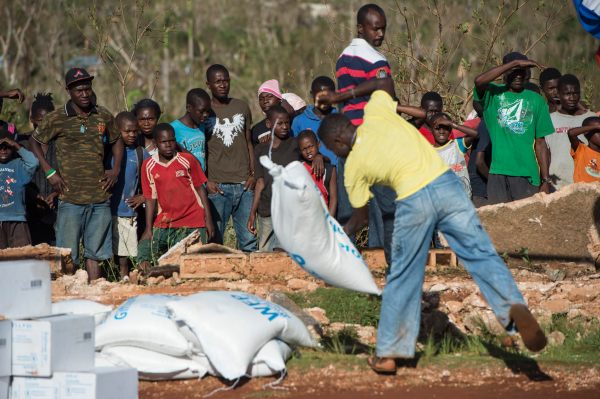
Group of Haitians unpacking supplies

A citizen of Beaumont, Haiti unloads hurricane relief supplies from USAID on October 13, 2016. / U.S. Air Force / Photo by Tech. Sgt. Russ Scalf / Flickr / Creative Commons

Hurricane Matthew, which made landfall on Haiti’s southwestern claw on October 4, devastated citizens’ lives, homes, and businesses – and set back much more across the country.  Some 546 are reported dead, and 128 are still listed as missing.  According to World Bank estimates, the Category 4 hurricane caused nearly $2 billion in damages, including $600 million in the agricultural sector.  The hard-hit southern peninsula provides about one-third of Port-au-Prince’s food supply, and the losses of crops and fishing equipment have long-term implications for food security.  Ninety percent of the homes in the South and Grand’Anse regions were damaged or destroyed, and according to the Environment Ministry, the storm sped up deforestation and has destroyed more recently planted trees.  The relief efforts have been poorly coordinated by Haiti’s interim government, resulting in press reports of looted aid convoys and sporadic protests.

The storm has also set back almost every key initiative underway in Haiti.

  • Just two months after the United Nations finally acknowledged its role in bringing cholera to the country in 2010 (for which it subsequently proposed an aid package that includes restitution to victims), flooding and contaminated water have led to a dramatic increase in the number of cholera cases. An estimated 3,400 new cases have been reported in just the last four weeks.  With help from the World Health Organization, the Haitian Ministry of Health will begin administering 1 million doses of the oral cholera vaccine, but addressing cholera also necessitates serious improvements in access to safe water and sanitation.
  • Haiti’s elections, scheduled for October 9 and already a year overdue, were rescheduled once more due to the hurricane. They are now set for November 20, but foreign observers and candidates alike indicate that major obstacles remain.  More than 770 schools, which are typically used as polling stations, were destroyed by the storm, and roads throughout the south remain impassable.

Once again, it falls to the international community to lend Haiti a hand, but donors have been sluggish.  During a visit in mid-October, UN Secretary General Ban Ki-moon said that he was “disappointed by the response of the international community.”  Less than a third of the UN’s $120 million appeal for immediate hurricane relief has been raised – and the UN was already struggling to raise funds for its separate cholera fund.  Donor fatigue in the United States, where the government contributed several billion in tax dollars and more than half of citizens made private donations following the 2010 earthquake, has been deepened by widespread perceptions that money was wasted.  Poor coordination, wasteful spending by aid agencies, and political stagnation have meant that Haiti has little to show for the $9 billion in earthquake relief.  (The Red Cross, for example, spent $500 million on various projects, but, despite its stated focus on housing, famously built just six permanent homes.)  Canada’s anticipated assumption of leadership of MINUSTAH, the UN peacekeeping mission, from Brazil by the end of the year may help energize aid efforts.  Canada has a large Haitian diaspora population and Prime Minister Trudeau has signaled interest in taking a larger role in Haiti’s recovery, but Canada’s contributions to hurricane relief are still dwarfed by those of the United States.  Once again, Haiti lurches from one crisis to another – and it will continue to until aid and development efforts are better coordinated and the country achieves some measure of political stability.

October 31, 2016

Emma Fawcett recently completed a Ph.D. in International Relations at American University.  Her doctoral thesis focused on the political economy of tourism and development in four Caribbean countries: Haiti, Dominican Republic, Cuba, and the Mexican Caribbean.

U.S. Elections: Latino Voters Lost in the Noise?

By Fulton Armstrong and Eric Hershberg

pew-latinos-for-blog

The U.S. general election on November 8 could give Latino voters their biggest chance yet to flex their political muscles.  The Pew Research Center has released new projections showing that a record 27.3 million Latino voters – 4 million more than in 2012 and 12 percent of the U.S. total – are eligible to vote this year.  Millennials (born since 1981) now make up 44 percent of Latino eligible voters, and Pew Research says that first-time voters represent one-fifth of those who say they are “absolutely certain” to vote.  (Only 9 percent of those over 36 are “absolutely certain.”)  Pew is agnostic, however, on whether their turnout in November will set a record.  Latino non-participation rates are generally high:  their turnout rate was only 48 percent in 2012.  Indeed, analysts at the New York Times cautioned last month that comparisons between Clinton’s support among Latinos now and Obama’s in 2012 – which are similar – indicate that she can’t take them for granted.

Latinos’ political preferences – traditionally Democratic except in the Cuban-American community, which itself is trending towards the Democrats – appear poised for an unprecedented surge in favor of Democratic candidate Hillary Clinton next month.  The “Vote Predict” model of Latino Decisions shows Clinton stands to win 82 percent of the Latino vote, and her Republican counterpart, Donald Trump, 15 percent, with a 5.5 percent margin of error.  This 67-point gap breaks the previous record of a 51 percent split between President Bill Clinton and Senator Bob Dole in 1991, and the 71-to-27 difference between President Obama and Mitt Romney in 2012.  Press reports indicate that, despite unhappiness with aspects of the Obama Administration’s immigration policies which Clinton supported as Secretary of State, Latinos judge that Donald Trump’s policies of walls and expulsions call for active opposition.  Pew’s polls confirm that two-thirds of Millennial Latinos say their support for Clinton is more a vote against Donald Trump than for her.  The Republican Party’s own “autopsy” of its resounding 2012 electoral defeat underscored the importance of attracting Latino voters, who were dismayed by anti-immigrant and xenophobic stances they associated with the GOP.  In nominating Trump, the party fulfilled its strategists’ worst fears.

An overwhelming Latino majority for Clinton seems almost certain.  Political scientists increasingly predict that their rejection of the Republican brand may endure for generations to come, with profound implications for the viability of the Republican Party beyond the Congressional district and state levels.  Latinos may not get credit as the crucial swing vote in the presidential race, but they could be crucial in other contests.  The Latino vote could prove critical to the outcome of key Senate races in states such as Florida, North Carolina, and Arizona.  While the absolute number of Latino voters appears likely to rise, turnout in this unusual – even unsightly – presidential contest is one of the most unpredictable variables confounding polling experts, who see signs that many Americans’ faith in democracy and its processes is dropping, at least temporarily.  A survey reported in the Washington Post, for example, showed that fully 40 percent of 3,000 registered voters say they “have lost faith in American democracy,” while just 52 percent say they have not.  An astounding 28 percent said they probably would not accept the legitimacy of the outcome if their candidate loses.  These trends, along with Trump’s allegations that the election may be rigged, make the timing of the coming-of-age of Latino Millennials truly ironic in this extraordinary election year.  Many Latinos, or their parents or grandparents, left polarized, imperfect democracies and, after earning U.S. citizenship and the right to vote, find themselves in a polarized, imperfect democracy with deep historical roots but an uncertain near-term future.

October 20, 2016

Venezuela: Running Out the Clock in 2016

By Michael McCarthy*

venezuela-military

A military exercise in Caracas, Venezuela. The Venezuelan military remains tolerant, if not actively supportive, of President Nicolás Maduro’s government. / Cancilleria del Ecuador / Flickr / Creative Commons

Despite continuing high tensions in Venezuela, neither President Nicolás Maduro nor the opposition appears likely to gain an upper hand in their years-long confrontation over the next couple months.  Venebarómetro polls buttress press reports and observers’ impressions that the opposition is slowly making gains, but support for the government – while extremely low – has stabilized.  A plan to reschedule 2017 debt owed by the national oil company will probably give the administration some breathing room, especially if oil prices continue to recover – a more likely scenario thanks to OPEC’s announced production cut agreement.
  • The very high turnout for the opposition’s Toma de Caracas demonstration on September 1, which mobilized hundreds of thousands of people, showed the depth of support for the anti-Maduro platform. The Electoral Tribunal’s announcement last week of onerous requirements on the opposition to schedule a referendum to recall Maduro (requiring, for example, the signatures of 20 percent of residents of all states, rather than nationally) rekindled opposition anger and unity.  A Venebarómetro poll earlier this month showed that 90 percent of Venezuelans view their overall situation negatively, and 71 percent support Maduro’s immediate resignation, but that only roughly 50 percent identify with the opposition.  The Mesa de Unidad opposition coalition is under great pressure to satisfy different constituencies – promoting street mobilization and pursuing dialogue at the same time – even when these initiatives seem at counter purposes.  Hamstrung by coalitional politics, anti-Maduro forces have not shown the cunning needed to force a course reversal from the Electoral Tribunal.
  • While Maduro’s popular support remains extremely low (22 percent), an internal party revolt against him appears unlikely. The government’s big push for a deal under which PDVSA creditors would swap debt coming due in 2017 for generous new 2020 bonds is making headway, according to the press.  Enhanced short-term liquidity may result in increased imports, a development which cannot come soon enough for a government that faces a restive population that has seen quality of life deteriorate dramatically during the crisis.

The common wisdom that the military is at least tolerant, if not actively supportive, of Maduro still stands.  Armed Forces chief Vladimir Padrino López showed an independent streak during last December’s Parliamentary election but this has not translated into a public rivalry with Maduro.  He moved into the spotlight when Maduro tasked the military with taking charge of food distribution, but he has since kept a lower profile.  Other senior commanders’ political leanings are even more difficult to discern.  Appealing to the military is a key element of the opposition’s current strategy, but there are still no signs of an increase in the institution’s willingness to press Maduro to step down or even change policies.

Maduro’s time-buying strategy looks likely to prevail for now.  His repressive tactics toward the opposition – keeping pressure on while occasionally offering negotiations, prisoner releases, and other gestures – are gaining the government time but failing to address any of the underlying causes of the ongoing crisis.  The debt swap is also a palliative that only delays the implementation of major reforms.  Popular unrest, political instability, and even violence are the factors that might conceivably persuade the military that its support and patience are misplaced.  However, with the world watching, most of the opposition leadership wants to play by constitutional rules.  Those who consider the chances of success justify the human price of further ramping up protests may see their hand strengthened if government obstructionism kills the referendum this year.  Few Venezuelans, moreover, view possible talks with the Vatican and the United States as likely to produce a breakthrough.  Even if the government alleviates the pain a bit to generate some Christmas cheer, the country will wake up with a terrible national hangover in 2017.

September 30, 2016

* Michael McCarthy is a Research Fellow with the Center for Latin American and Latino Studies.  He is international associate for Venebarómetro polling and publishes Caracas Wire, a newsletter on Venezuela and South America.

Nicaragua: A New Family Dynasty Taking Root

By Aaron T. Bell*

nicaragua-0919l

Left: Photo of Daniel Ortega celebrating his latest presidential triumph (July 20, 2012) / Fundación ONG de Nicaragua / Wikimedia / Creative Commons; Right: Anastasio Somoza DeBayle / DemonSabre / Wikimedia / Creative Commons

Events in Nicaragua this summer have demonstrated that President Ortega and his family have a vision for the future that erodes a key element of political democracy – the replacement of the executive through free and fair elections – and risks establishing a dynasty of corruption and authoritarian rule.  In May 2016, President Daniel Ortega of the Frente Sandinista de Liberación Nacional (FSLN) announced his candidacy for a fourth presidential term – his third consecutive.  Since then the government has taken several steps to ensure that Ortega and his family remain in power in November’s elections for President and National Assembly, and beyond:

  • Voting irregularities, a lack of transparency, and accusations of fraud have marred several successive elections since Ortega’s return to power in 2007. In June of this year, Ortega announced that he would not permit international election observers to monitor this fall’s elections.
  • Weeks later, the Supreme Court stripped opposition leader Eduardo Montealgre of his position as head of the Partido Liberal Independiente (PLI) and replaced him with Pedro Reyes, considered by observers to be an Ortega ally. In July, Nicaragua’s electoral council removed 16 sitting members of the National Assembly and 12 alternates after they refused to recognize Reyes.
  • In August, Ortega announced that Rosario Murillo, his long-time partner and wife since 2005, would serve as his vice presidential candidate in the November election. Murillo has been a prominent figure in the Ortega government while serving as both first lady and chief spokeswoman.  Her political ascension is complemented by the rise to prominence in recent years of her and Ortega’s children as operators of business and media interests, including the couple’s eldest son and presidential adviser on investments, Laureano Facundo, who helped sell the stalled interoceanic canal project to Chinese businessman Wang Jing.

Nicaragua’s opposition parties have thus far been unable to mount an effective response and have shown the lack of cohesion and focus that have plagued them for decades. Montealgre announced that the coalition led by the PLI would boycott the election and called on others to do the same.  But rather than present a united front, opposition leaders are fighting amongst themselves to seize the mantle of leadership and challenge Ortega through several competing parties and coalitions.  This will be no easy task: polling conducted by M&R Consultores this summer shows that over 60 percent of voters are likely to vote for Ortega, with the leading opposition parties drawing low single digits.  Over a quarter of potential voters said they were unsure whom they would vote for.  With the opposition beset by division and lacking much legitimacy – tainted as they are by a history of corruption, self-interest, and financial support from the United States – it is unsurprising that protests and civil unrest have been largely absent.  The ouster of the PLI delegates has also stirred the FSLN’s old opponents outside the government, who have been largely quiescent in recent years but condemned the decision: the Bishops of the Episcopal Council, the Nicaraguan-American Chamber of Commerce, and the Consejo Superior de la Empresa Privada (COSEP), the largest business chamber that has enjoyed a working relationship with the Ortega government.

The FSLN’s authoritarian turn, Ortega’s long reign, and the rise to prominence of both Murillo and the couple’s children invite comparisons between Ortega and Somoza family dynasties.  It may be from COSEP and the business sector, rather than among the weak and divided political opposition, that a serious challenge to Ortega could eventually emerge. It was after all the defection of non-Somoza family interests in the private sector, combined with a popular insurrection led by a guerrilla insurgency, that did away with Nicaragua’s previous family dynasty.  But that combination only emerged following the shock of the 1972 earthquake and resulting massive corruption, the assassination of a national figure like Pedro Chamorro in 1978, and the particularly bloodthirsty turn that the Somoza regime had taken. With similarly game-changing circumstances absent at this juncture, the sort of cross-sector revolutionary movement that ultimately toppled the Somozas appears unlikely.  For the moment at least, an Ortega family will be well on its way to firmly preserving its dynastic power come November.

 September 19, 2016

* Aaron Bell is an Adjunct Professorial Lecturer in History and American Studies at American University.

Peru’s Frente Amplio: The Emergence of a Post-Extractivist Left

By Carlos Monge*

OperacionesYanacocha

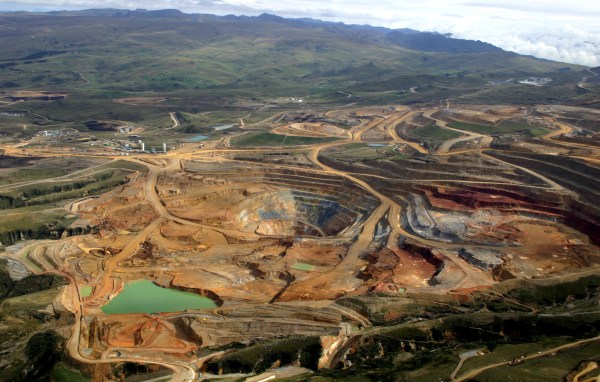
An abandoned gold mining project in the Cajamarca region, Peru / Wikimedia / Creative Commons

The surprising emergence of the Frente Amplio (FA), a coalition of political parties, social organizations and independent activists, in Peru’s recent presidential and congressional elections signals the first significant support for the Peruvian Left since the collapse of the Izquierda Unida in the 1980s.  The Left was not able to present its own alternatives in the ‘90s, the early 2000s, and again in 2011.  In October 2015 barely 13 percent of Peruvians knew about FA’s internal election to select presidential candidates.  Veronika Mendoza had the support of only 1 percent of intending voters, and over 60 percent of Peruvians did not even know who she was.  Nevertheless, FA ended up receiving 18.74 percent of the vote in the first electoral round, coming in third and only a couple of points behind Pedro Pablo Kuczynski (PPK), who secured 21.05 percent and ended up defeating the Fuerza Popular’s candidate, Keiko Fujimori, to become President for the 2016-2021 period.

FA’s “post-extractivist” program has been key.  Breaking away from the nationalist redistributive programs of leftists in Venezuela, Ecuador, Bolivia, Brazil, and Argentina, FA espouses economic diversification and tax reform rather than more mineral or hydrocarbon exports to sustain economic growth and public incomes.  FA also emphasizes the need to protect the environment and renewable natural resources for future generations and to recognize indigenous rights to territories, autonomy, direct political representation and effective consultations.

  • These are not only electoral campaign ideas. Indeed, FA local activists and national leaders have maintained staunch opposition to emblematic mining projects such as the Conga project in the northern Cajamarca region and the Tía María project in southern Arequipa.  In the same way, FA is denouncing that the new government is trying to lower air quality environmental standards to ease foreign investments in mineral smelters and has harshly criticized the new Minister of Production for abandoning the National Plan for Productive Diversification launched by the outgoing Ollanta Humala administration.
  • Frente Amplio is grounded in social movements that have long confronted extractivist projects. Veronika Mendoza left President Humala’s Nationalist Party in 2012 in a dispute over his repressive response to socio-environmental protests around mining projects in the highlands of her native Cusco.  Tierra y Libertad, FA’s largest party, has its roots in the Cajamarca rondas campesinas resistance against the Conga project.  Another factor is that the end of the commodities “super cycle” has moved extractive rents off center stage.  Even in Venezuela the official discourse is now moving in the direction of economic diversification.

Frente Amplio is not alone in Latin America in attempting to build a post–extractivist platform, but it seems to be the region’s most successful.  Similar policies were at the heart of the presidential campaign of Alberto Acosta and a coalition of social and indigenous organizations in Ecuador.  And in El Salvador, the Farabundo Martí government is also keeping extractivist temptations at bay.  But Acosta did not manage to get significant support or to build a stable political alternative, and El Salvador is not a major commodity exporter.  The importance of the FA experience is that it happens in a significant mineral and gas producer, that it has had immediate electoral success, and that it can become a permanent political player in Peruvian democracy.  FA and PPK will probably agree on issues such as the fight against corruption, crime, and violence against women, but they will certainly disagree over macroeconomic and sector policies, such as taxes.  Also, FA has denounced PPK for his call to lower air pollution standards and for his authorization to large fishing factories to operate up to 5 km off the coast, leaving very little for artisanal, small scale, internal market-oriented fishing activities.  Where this ends up is anybody’s guess, but this is certainly a process worth keeping an eye on.

August 29, 2016

*Carlos Monge is Latin America regional director at the Natural Resource Governance Institute in Lima.

Latin America Sees Little That’s “Great” about U.S. Caudillo

By Aaron T. Bell*

Trump Latin America

Photo Credit: Maialisa/Pixabay/Public Domain (modified) and NASA/Wikimedia Commons/Public Domain

Donald Trump’s presumptive nomination as the Republican Party’s candidate for president is raising fears among Latin Americans that the United States could close the door on them, while also provoking self-reflection about the region’s own potential to produce a Donald of its own.  Mexico has borne the brunt of Mr. Trump’s hostility for “beating us economically” and “sending people that have a lot of problems.”  He has proposed imposing steep tariffs on Mexico, restricting its access to visas, and forcing it to pay for a border wall.  Gustavo Madero, former president of the Partido Acción Nacional, denounced him as a “venom-spitting psychopath,” while members of Mexico’s Partido de la Revolución Democrática organized a social media campaign – #MXcontraTrump – to rebut Mr. Trump’s attacks.  Mexican President Peña Nieto has pledged to stay out of U.S. electoral politics and work with whomever is elected, but he rejected any notion that Mexico would pay for a wall and compared Mr. Trump’s rhetoric to Adolf Hitler and Benito Mussolini’s.  In addition to initiating a public relations campaign to promote the positive effects of U.S.-Mexican relations, Peña Nieto replaced his ambassador to the United States, who was criticized for soft-pedaling Mr. Trump’s comments, with Carlos Sada, an experienced diplomat with a reputation for toughness.

Other nations have joined in the criticism while looking inward as well:

  • Latin American critics have compared Trump’s populism to that of Venezuelan Presidents Hugo Chávez and Nicolás Maduro, and former Argentine President Cristina Fernández de Kirchner. In Colombia, a member of the Partido Verde described former President Álvaro Uribe’s call for civil resistance to peace negotiations with the FARC as a “Donald Trump-like proposal.”  In Lucia, Prime Minister Kenny Anthony accused opposition leader Allen Chastenet of “fast becoming the Donald Trump of St. Lucian politics” for resorting to the “politics of hate and divisiveness.”
  • While worrying what might happen if immigrants to the United States are forced to return home, the editorial page of Guatemala’s La Hora has raised the issue of the long-term wisdom of relying on remittances. Meanwhile Argentina’s Nueva Sociedad used attention to Trump’s immigrant comments to analyze restrictive immigration policies within Latin America.
  • Some political observers see Mr. Trump’s rise as a warning of the danger of divisive politics. In Colombia’s El Tiempo, Carlos Caballero Argáez wrote that polarization and anti-government discourse in Washington paved the way for a “strong man” like Trump, and cautioned that something similar could happen in Colombia.  In El Salvador, Carlos G. Romero in La Prensa Gráfica attributed Trump’s success to his ability to connect with the working class, and warned that his country’s own parties risk facing a Trump lest they make similar connections.

Much of Latin America’s take on Trump mirrors that of opponents in the United States: they recognize that his support reflects the frustration of those who feel cut out from the benefits of globalization and ignored by political elites of all stripes; they reject his anti-immigrant and misogynistic comments; and they fear that someone with seemingly little depth on global politics may soon be the face of a global superpower.  While the region hasn’t exactly surged in its appreciation for President Obama’s leadership over the past seven years, Trump’s popularity reminds them that many Americans have less appealing values and principles, which could result in policies harmful to the region.  Latin Americans know of what they speak.  One need not look too far into the past to see the catastrophic effects of simplistic, nationalistic, strong-man policies on the people of Latin America.

 June 21, 2016

* Aaron Bell is an adjunct professor in History and American Studies at American University.

Correction 2016.06.22: Gustavo Madero is the former president of Mexico’s PAN, currently headed by Ricardo Anaya.

Peru: Serious Challenges Ahead

By Michael Baney*

CLALS Keiko protest Peru

Photo Credit: harimarachinv / Flickr / Creative Commons

Peru’s presidential election, won by Pedro Pablo Kuczynski, bore the hallmarks of Peru’s distinct brand of democracy – political parties that are mere temporary electoral vehicles with little ideology; strong anti-incumbent sentiment; and the absence of a serious challenge by the left.  Neither Kuczynski’s Peruanos Por el Kambio (PPK) nor Keiko Fujimori’s Fuerza Popular is a party with any true structure.  The fact that the acronym of Kuczynski’s party forms his initials and that Keiko Fujimori’s party uses a large K as its symbol underscores the personal nature of these parties and of politics in Peru.  For the fourth time in a row, not only did the governing party not remain in power; it did not field a candidate – symptom of the deep distrust of institutions and unhappiness with the status quo in the country.  The lack of a serious challenge by the left was also repeated.  Although Socialist Verónika Mendoza’s effective handling of a press challenge to her heritage gave her a surge in nationalist and indigenista support, her campaign faltered when her economic policies came under scrutiny.

The election also marked the emergence of a new generation of young antifujimorista activists who combined efforts on social media with traditional protests to undermine Fujimori’s electability.  These efforts included the production and online dissemination of Su Nombre es Fujimori, a documentary that links Keiko to some of the worst abuses of her father’s government, as well as pillorying her distribution of Keiko-branded tupperware (called tápers in Peru) among the rural poor in an apparent vote-buying effort.  Online voices ridiculed her by rewriting reports on the number of votes by which she trailed Kuczynski as indicating the number of additional tápers that she should have distributed, and the hashtag #KeikoTAPERdiendo – a colloquial pronunciation of “Keiko is losing” – was widely used to track reporting on the election.  Whereas protests traditionally were organized by older demonstrators linked to Marxist parties, this year a Facebook-based group organized two days of nationwide marches of tens of thousands of mostly younger antifujimoristas.

The weakness of Peru’s parties will complicate President Kuczynski’s efforts to govern, as it has with past presidents.  Kuczynski’s narrow victory was largely due to the effort of this new form of activism – which he did not lead, which is not necessarily loyal to him, and to which he does not have any strong allegiance.  His ability to continue to benefit from such efforts designed to shut fujimorista politicians out of office will be extremely constrained, particularly because his lack of support in the fujimorista-majority congress will likely compel him to adopt a friendlier attitude toward his former rivals.  Kuczynski has previously stated that he would sign a law allowing imprisoned former President Alberto Fujimori, Keiko’s father, to serve out his prison sentence at home, a move that he may consider to secure the cooperation of the fujimorista congressional bloc to move proposed legislation forward.  Such a move would be a major blow to Peru’s human rights movement, which spent many years campaigning to imprison the former leader, and it would also infuriate the antifujimoristas, bringing them out onto the streets once again.  Fujimorismo and antifujimorismo may remain the most salient political positions in a country where economic progress has not improved people’s trust of the system, a recipe for further polarization that could overwhelm the Kuczynski government should it attempt to straddle the two positions in an attempt to overcome the weaknesses inherent in a system with no parties.

June 13, 2016

*  Michael Baney is Political Risk Analyst at Allan & Associates in Washington, DC.

Seismic Shift in the Politics of Language in the U.S.?

By Chip Gerfen*

Cruz Rubio Spanish

Photo Credit: Gage Skidmore / Flickr / Creative Commons

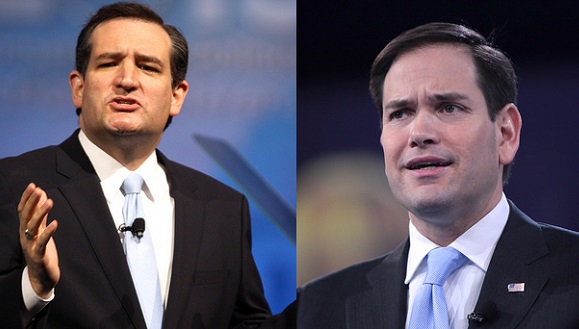
Heated words between the two Latino U.S. senators seeking the Republican nomination earlier this year may have been the first time national-level candidates cudgeled each other over their use of Spanish on the campaign trail.  Current party frontrunner Donald Trump set the stage for it in June 2015, when he declared that Mexicans are “bringing drugs, they’re bringing crime, they’re rapists, and some, I assume, are good people.”  In July, Trump promised a crowd in Phoenix that he would build a wall between the United States and Mexico – a trope and applause line that still stands front and center in his campaign.  Seven months later, during one of Ted Cruz’s attacks on Marco Rubio – over the issue of undocumented immigrants – the Texas senator attacked Rubio’s use of Spanish, saying:

“Marco has a long record when it comes to amnesty.  In the state of Florida, as speaker of the house, he supported in-state tuition for illegal immigrants.  In addition to that, Marco went on Univision in Spanish [emphasis added] and said he would not rescind President Obama’s illegal executive amnesty on his first day in office.”

Several years earlier, in a Fox News interview during his 2012 Senate campaign, Cruz refused to debate in Spanish, explaining:

“Most Texans speak English.  If we were in Mexico, if we were in Cuba, we’d do the debate in Spanish.   Here in Texas, we should do it in English.  [My opponent] wants to do a debate in a language where the vast majority of primary voters don’t understand it, because he doesn’t want them to hear about his record.”

Cruz’s attack on Rubio’s use of Spanish was a suggestion that he used the language to deceive non-Spanish speaking voters by saying one thing in Spanish and another in English.  This use of what linguists refer to as implicature – suggesting something in speech (or in writing) without explicitly stating or even openly implying it – is something that we all produce and have to interpret every day.  But Cruz makes a number of implicatures: that Spanish hides the truth from most voters; that the public political language for Texas is English and that Spanish should be used in other countries; and that he himself does not to fully embrace a Hispanic identity.  He also said that his Spanish was “lousy.”  In the February confrontation, Rubio turned the tables on Cruz by mocking his Spanish, asking “how [Cruz] knows what I said on Univision because he doesn’t speak [Spanish].”  (Cruz responded in idiomatic Spanish – “ahora mismo díselo en español, si tú quieres” – that was much better than “lousy.”)

Such attacks are not entirely new.  As the Dallas Morning News reported in February 2012, Cruz stated that the traditional “American dream” was being destroyed by “letting people use their native languages and grow dependent on government aid,” suggesting that non-English speakers are non-contributing members of the society.  He also perpetuated the nonsensical but persistent myth that immigrants actively “refuse” to learn English.  Rubio apparently believes, however, that speaking Spanish is an asset.  Former Florida Governor Jeb Bush – from a white, patrician family – had no difficulty spinning his Spanish skills positively.  But things are different for people surnamed Rubio or Cruz, for whom language use is a political decision.  Whereas Cruz attacked Rubio according to an old playbook – one that conjures up suspicious behavior and a refusal to integrate – Rubio calculated that bilingualism and biculturalism can now be positives in national politics.  With both Latinos out of the race, the baton has been passed back to Trump, who recently asserted that a U.S.-born “Mexican” judge named Gonzalo Curiel cannot fairly oversee a class action suit against him.  Rubio’s portrayal of language as a political asset, however, may be the more accurate bellwether in the long run, even if his party’s candidate continues to embrace the old playbook.

June 10, 2016

* Chip Gerfen is Professor of Linguistics and Spanish and Department Chair, World Languages and Cultures, American University.

Peru’s Election: Close Vote Count, Divided Nation

By Cynthia McClintock*

Keiko Kuczyinski

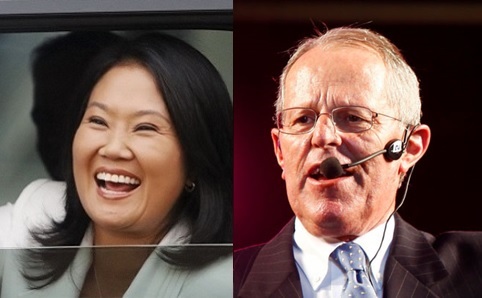
Photo Credits: Venezualan Government / Public Domain and Diario La Primera / Wikimedia Commons

Peru’s National Office of Electoral Processes (ONPE) will not announce the final results of Sunday’s run-off presidential election until later this week, but the current statistical tie is already setting the stage for serious tensions.  The ONPE’s official count, with about 93 percent of votes counted, puts Pedro Pablo Kuczynski (Peruanos por el Kambio) at 50.32 percent and Keiko Fujimori (Fuerza Popular) at 49.68 percent.  Some local observers say that late-arriving vote tallies from rural areas could give Fujimori the edge, but others point out that recent quick counts have reliably predicted final results.  The campaigns may have aggravated tensions on Sunday night, when Fujimori’s spokesperson proclaimed her victory, and Kuczynski called on loyalists to “defend the vote” and “to be vigilant that they not steal votes from us.”

The campaign underscored the country’s enduring polarization over Fujimori’s imprisoned father, Alberto.  Although Alberto Fujimori was convicted on charges of human rights violations and corruption, and although his 1990s government became increasingly authoritarian, he is still perceived by many Peruvians as the savior who restored order and broke the back of the Sendero Luminoso guerrillas.   Primarily for this reason, Keiko Fujimori won almost 40 percent of the votes in the first round on April 10; Kuczynski was the runner-up with 21 percent, narrowly defeating leftist candidate Verónika Mendoza (Frente Amplio), with 19 percent.

  • The last two weeks were a roller coaster. At the time of the first round, Kuczynski had held a slight lead over Fujimori, but only a week ago was trailing her by about five points.  An international economist and banker who had lived for long periods in the United States, Kuczynski lost support in part because, after the first round, he spent eight days in the U.S., exacerbating perceptions that he was more gringo than Peruvian, while Fujimori traveled to remote areas of Peru.  She claimed that, whereas her opponent favored big business, she favored small and medium business.  Also, in the first debate, Kuczynski, who is 77, appeared at a loss to counter Fujimori’s attacks.
  • In the last week, however, it was Kuczynski with the momentum. He effectively communicated integrity and a commitment to democracy just as memories of the corruption and authoritarianism during the government of Fujimori’s father were revived.  A scandal implicating the head of her party, Joaquín Ramírez, in money laundering gradually took a toll, especially when her vice-presidential candidate was believed to have orchestrated the broadcast of a doctored audiotape in an effort to clear Ramírez’s name.  Fujimori appeared to believe that “the best defense is a good offense,” but her increasingly confrontational style and dismissive tone may have been a factor in the decision by third-place Mendoza to strongly endorse Kuczynski.  In the second debate a week ago Sunday, Kuczynski emphasized that Fujimori could not be trusted to keep her key pledge to fight crime when Ramírez and other leaders of her party were under criminal investigation.

The presidential campaign has reflected deep polarization and tensions since at least March, when electoral authorities disqualified two important candidates – Julio Guzmán and César Acuña – for violations of party and electoral regulations. Guzmán’s party had not kept to the letter of its internal party statutes and Acuña handed out cash at a campaign rally.  The disqualifications prompted OAS Secretary General Luis Almagro to label Peru only “semi-democratic.”  A key problem was that the laws were not consistently enforced; most saliently, Fujimori, captured on video passing out prizes at a campaign event, was not disqualified.  Strains are likely to remain high this week, and could grow worse after ONPE’s final announced tally at the end of the week.  Fujimori’s followers, embracing the polls showing her lead prior to election day, may cry foul if a Kuczyinski victory is declared.  Many of Kuczyinski’s and Mendoza’s followers, for their part, intensely fear a return to Fujimorismo.  In this context, it is not impossible that disqualified candidates Guzmán and Acuña and their supporters could call for a total do-over.  Although serious, sustained instability remains unlikely, Peru’s 2016 election is by far its most problematic since the country’s return to democracy in 2001.

(Previous analyses on the Peruvian election are available here and here.)

June 6, 2016

* Cynthia McClintock is Professor of Political Science and International Affairs at George Washington University.

Trumping GOP Resistance to Strengthened Ties with Cuba

By Eric Hershberg

Malecon Twilight

Nighttime on the Malécon in Havana, Cuba. Photo credit: William Beem / Google Images / Creative Commons

One wild card on the horizon in the normalization of U.S.-Cuba ties looks unlikely to materialize.  As pointed out in several CLALS publications (such as here and here), ever since Presidents Obama and Castro announced on December 17, 2014, that they intended to improve relations, there has been a sense of uncertainty regarding whether their successors might roll back the advances they make.  This was particularly so when several Republican politicians seeking their party’s presidential nomination campaigned against President Obama’s “coddling” of the Cuban Communists and his “unilateral concessions” to Havana.  Marco Rubio (Florida) and Ted Cruz (Texas) – two of the Cuban-Americans in the U.S. Senate –made particularly aggressive statements indicating an intention to reverse all or parts of the Obama administration’s executive actions affecting Cuba policy, which, unlike legislation, can be reversed by a subsequent administration.  But they have dropped out of the race as presumptive nominee Donald Trump defeated them and former Governor Jeb Bush, whose Florida political base, family background, and public statements also indicated opposition to normalization.

Trump and the leading Democratic candidate, Hillary Clinton, have very significant policy differences on many issues, but apparently not on Cuba.  Clinton in her memoirs about her tenure as Secretary of State, like Trump in his public statements, appears inclined to sustain the current direction of Washington’s engagement with Havana (although Trump claimed last year that “we should have made a better deal”).  The two likely nominees share noteworthy characteristics, including, remarkably, that they are the least popular candidates that either major party has nominated since polling data have been collected. Advocates of full normalization cannot take either candidate’s leadership on the issue for granted. Clinton’s challenger, Senator Bernie Sanders, has pushed her to the left on some domestic issues, but recent press profiles on her indicate that she remains wedded to a hawkish approach to foreign policy.  The endorsement of several key Washington Neo-Conservatives further suggests she could swing to the right on foreign policy matters.  On the other hand, Trump’s zigzagging on Cuba – 15 years ago he was a staunch proponent of the embargo – and his impulsive decision-making style leave open the possibility that he also could reverse Obama’s executive actions and call on the Congress to keep embargo legislation unchanged.

Although mistakes can occur and various wildcards can slow, or even break, the current momentum, the twists and turns of the U.S. primary election season seem to have diminished substantially prospects that a new President sworn in next January would significantly change Obama’s winning formula on Cuba.  Clinton will have no incentives to abandon a policy that she takes some credit for promoting.  Trump has, if anything, proven that he revels in taking on GOP orthodoxy – and will presumably continue to do so on Cuba policy.  His sympathies align much more clearly with the pro-business Chamber of Commerce, an aggressive opponent of the embargo against Cuba, than with the ideologues on the right of his party, and he will give a green light to the many members of Congress who want full trade with and free travel to the island to change the law.  Concerns that a new U.S. president could reverse Obama’s executive actions on January 20, 2017, can now be assuaged, and Congressional proponents of lifting the embargo likely will have time to build momentum to pass legislation rendering the executive measures moot.  One can imagine that the Donald’s criteria of success for Cuba policy begin with the glare of a gaudy neon Trump sign on a casino along the Havana Malecón, but it’s reasonable to wager that the Cuban government will negotiate a better deal.

May 31, 2016