Spain: Too Distracted to Play in Latin America?

By An Observer*

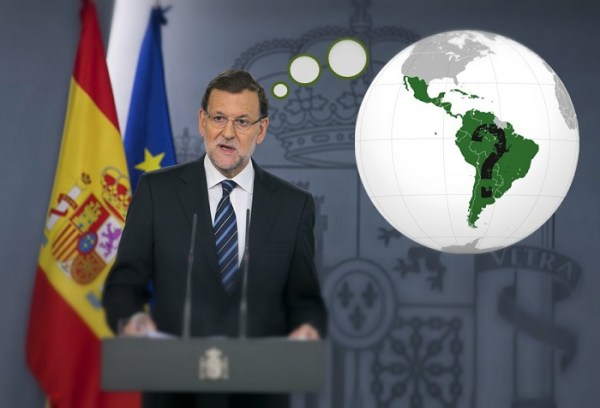
Rajoy Latin America

Photo Credit: La Moncloa Gobierno de España and Heraldry (Modified) / Flickr & Wikimedia / Creative Commons

Spain’s political crisis and problems facing the European Union have undermined Madrid’s ability to pursue interests in Latin America at a time of new opportunities.  Amidst countless months of lameduck government and the failure of either the Partido Popular (PP) or the Partido Socialista (PSOE) to form a government, the country is also tied in knots over corruption scandals, including some touching a Cabinet member and the royal family, and Cataluña’s persistent challenges to central authority.  Even before the current mess, Prime Minister Rajoy had shown only modest interest in Latin America, and King Felipe hadn’t yet demonstrated the mettle of his father, who once famously told Venezuelan President Chávez to shut up at an Ibero-American Summit.  Adding to Spain’s distractions are a series of EU challenges, ranging from refugee crises to terrorism and the Mediterranean countries’ debt overhang.  Spanish elites, who remain committed to the EU vision, are seized with concerns about Brexit, the UK’s flirtation with withdrawal, and perplexed by the absence of a renewed integration project.

Madrid’s declining role coincides with changes in Latin America that would normally grab its attention.  President Obama and Raúl Castro’s historic normalization of diplomatic relations has opened the door to at least one major U.S. hotel firm signing contracts to refurbish and manage several Cuban hotels – an industry in which Spain previously had extraordinary advantages.  Having played “good cop” with Cuba for many years, compared to Washington’s “bad cop,” Madrid’s future role on the island is at most uncertain.  The election of market-friendly President Macri in Argentina, where the previous government nationalized a Spanish energy company and adopted other policies causing bilateral estrangement, also represents an opportunity for Spain.  The near-completion of peace talks between the Colombian government and guerrillas should be the crowning jewel of a foreign policy in which Spain made a strong political investment early on, but Madrid has receded to the role of bit player.  At a time that Latin Americans continue to espouse support for CELAC and other regional organizations that exclude Spain (and the United States), Spain-sponsored Cumbres Iberoamericanas since 1991 have – even more than the U.S.-sponsored Summit of the Americas – lacked dynamism and produced little as the beacon of the Spanish transition was dying down

By turning inward, Spain risks losing what remains of its special cachet as Latin America’s link to Europe and as a country that made a successful transition to democracy with inclusion, human rights, vibrant media, and increasing transparency.  Its political capital in the region is running low, and budgetary constraints have diminished its aid budgets (from 0.5 percent of GDP to 0.13 percent).  But opportunities remain.  Big Spanish companies – Telefónica, Banco Santander, BBVA, Repsol, and others – and numerous mid-sized firms have shown interest in Latin America.  Cuba’s reluctance to embrace U.S. ties too tightly and too fast gives Spain important space to play a role if it wants.  Moreover, Spain’s diplomatic skills, critical for Central America’s peace processes and elsewhere, could still be a positive force in that subregion.   If it weren’t for former Spanish Prime Ministers’ contradictory roles in Venezuela, where U.S. baggage undermines Washington’s approach to political, economic, and security problems, Spain could be active there too.  But the Prime Minister and his cabinet have not given the Foreign Ministry the green light to get more deeply involved.  It’s not too late for Spain to turn things around and get back into the game in Latin America.  For that to happen Spain needs more consistent governance.

April 18, 2016

* The writer is long-time non-academic observer of Spanish foreign policy in Latin America.

Lobbying Washington: Does it Work?

By Aaron T. Bell*

LatAm Lobbying

Photo credits: Jack Says Relax & AlexR. L., respectively / Flickr and Wikimedia Commons / Creative Commons

Latin American governments, political parties, and business associations have a long history of turning to U.S.-based lobbying, legal, and public relations firms to advance their interests in the United States – with mixed results.  Both national and multinational groups have been utilizing lobbyists since at least the 1940s, when the U.S. government began registering foreign agents.  Their most consistent goal over the decades has been to influence U.S. policy on foreign trade and investment, but they have also aimed to improve governments’ sagging reputation and protect them from adverse policies.  In the 1970s, a number of military regimes and right-wing political groups in Central and South America hired lobbyists to devise and implement strategies to counter criticism of their human rights record – to preserve trade and military assistance.

  • Some 30 Latin American countries and interests groups in 2010-14 registered foreign agents to influence U.S. policies. The Bahamas Ministry of Tourism spent the most, paying $128.9 million to promote tourism – as well as to monitor and speak with Congressional representatives about U.S. legislation related to transnational financial activities in which they are involved, such as the regulation of offshore tax havens and online casinos.
  • In 2013, Mexico ranked fifth worldwide, at $6.1 million. Both federal and local governments pay firms to burnish the image of their respective constituencies.  From 2010-12, for example, Mexico City worked with a firm to “enhance the image of Mexico City in light of recent negative media reports.”  In 2014, the Consejo de Promoción Turístico de México hired another company to “make Mexico an attractive destination.”
  • Ecuador, which at $1.1 million ranked twenty-second in 2013, spent nearly half a million dollars lobbying in support of the ultimately failed Yasuni rain forest oil drilling initiative.
  • More recently, the government of Honduras – burdened with the image as one of the most violent, corrupt, and crime-ridden countries in the world – hired lobbyists to “provide ongoing strategic counsel, media relations (proactive and reactive outreach), and third-party relations.” The firm, winning an initial one-year contract for $420,000, had just completed a nine-year relationship representing Russia.

A review of the U.S. Foreign Agents Registration Act (FARA) records indicates that foreign lobbyists represent almost exclusively governments, state agencies, and the private business sector, and that more popular civil-society actors – such as labor unions and indigenous organizations – are notably absent.  Even though foreign governments obviously judge the investment worthwhile, the impact of foreign-funded lobbyists is difficult to measure.  The Honduran government’s new push to burnish its image has paid off on Capitol Hill, according to observers, but a new initiative to reduce Honduran corruption doesn’t appear to have gone exactly as Tegucigalpa hoped.  Forced to respond to a protest wave calling for the creation of an independent investigative body similar to the Comisión Internacional contra la Impunidad en Guatemala (CICIG), the Honduran government agreed with the OAS to create the Misión de Apoyo Contra la Corrupción y la Impunidad en Honduras (MACCIH) as a collaborative effort.  MACCIH indeed lacks the independence – and the potential bite – that CICIG had, but it is significantly tougher than the Honduran President Juan Orlando Hernández initially proposed.  In this case at least, lobbyists have helped the government gain access and public relations points in Washington but didn’t get it off the hook entirely.

January 22, 2016

* Aaron Bell is an adjunct professor in History and American Studies at American University.

Argentine-U.S. Relations: Things Can Only Get Better

By Federico Merke*

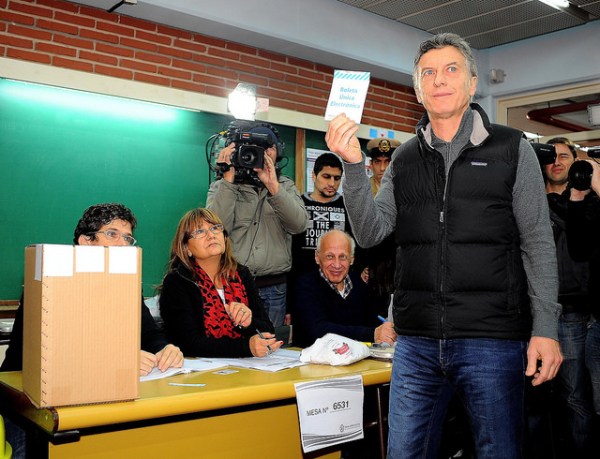
Argentina elections

Argentine presidential candidate Mauricio Macri. Photo Credit: Nico Bovio and Guillermo Viana GCBA / Flickr / Creative Commons

Foreign policy remains largely uncharted territory as Mauricio Macri (Cambiemos) and Daniel Scioli (incumbent Peronist Frente para la Victoria) head into the presidential runoff on November 22, but they both are likely eager to get over Argentina’s rough patch with the United States.  Foreign policy has rarely been a big campaign issue, and this time there are probably reasons behind the silence.  The mainstream Argentine media portray the candidates as representing two different political and economic stances on domestic policies, with only nuanced differences on foreign policy.  Macri is seen as more friendly to the outside world in general and to the U.S. in particular, but he has been reluctant to play up his “anti-Bolivarian” views.  Scioli has the same incentives as Macri to restart a dialogue with Washington, but he has not wanted to highlight this difference between himself and his party’s standard bearer, outgoing President Cristina Fernández de Kirchner (CFK).

Argentina’s relations with the U.S. are at a low point in which nothing really good or really bad takes place.

  • The impasse started early in CFK’s administration. Just two days after her inauguration on December 10, 2007, U.S. federal prosecutors claimed that five foreign nationals in the so-called “suitcase scandal” were attempting to deliver funds to CFK’s presidential campaign.  The President maintained that the United States manufactured the scandal to punish her for maintaining close relations with then-President Hugo Chávez of Venezuela.
  • Washington was clearly irritated again in 2011 when Argentine authorities seized the cargo of a U.S. Air Force plane that was delivering supplies for an authorized police training program. Argentina’s foreign minister accused the United States of smuggling weapons and “drugs” into the country.  In 2013, CFK reached an agreement with Iran to set up a truth commission (which was never established) to investigate the bombings of the AMIA Jewish community center in Buenos Aires in 1994 – alienating Jews in the U.S. and Argentina, but giving her a boost among her domestic constituency.
  • Terrorism, human rights, and nuclear proliferation have brought the two countries together, albeit with little publicity. But Venezuela, Cuba (the U.S. embargo), trade (tough license and import restrictions on both sides), and Iran have been divisive issues.

Because the twists and turns in the bilateral relationship have revolved around scandals, rhetoric, and domestic political maneuvering – not driven by either deep ideological differences or substantive material interests – CFK’s successor will be free to shift gears.  Thus, in a sense, it does not matter who wins on November 22; a new chapter will begin in Argentina-U.S. relations.  Macri no doubt will be more enthusiastic than Scioli in declaring a new beginning, but the latter exhibits a pragmatic tone and intention to attract investment and promote trade, including by resolving the confrontation over “holdout debt” plaguing ties with the U.S. financial community.  Both candidates are aware that the ongoing litigation in New York complicates access to international credit.  Both also understand that the memorandum with Iran represented a major step backwards and thus will probably change course on this matter.  Scioli and Macri exhibit contrasting styles and might look at the world through different lenses, but they both will have the opportunity – and probably the desire – to develop a more constructive relationship with the U.S. 

November 19, 2015

*Federico Merke directs the Political Science and International Relations Programs at the Universidad de San Andrés in Buenos Aires.

A Major Gig for Buena Vista

By Ana Serra* 

Photo Credit: OtherDrK / Flickr / Creative Commons

Photo Credit: OtherDrK / Flickr / Creative Commons

The Buena Vista Social Club Orchestra’s performance at the White House last week was a celebration of the ongoing normalization process between the United States and Cuba and of the musical collaboration – considered illegal at the time – that made this group possible.  Playing in commemoration of Hispanic Heritage month and the Educational Excellence of Hispanics, it was the first visit to the executive mansion by a Cuban band in more than 50 years, and part of its Adiós World Farewell Tour including a number of U.S. states before traveling to Puerto Rico and Latin America.  Buena Vista Social Club (BVSC) is a brand, starting as a 1940s club in Havana and revived by a 1997 album produced by Ry Cooder with Cuban and US musicians, a 1999 documentary film directed by Wim Wenders (chronicling concerts in Amsterdam and New York), and decades of fame-garnering recognition of Grammies and film awards.  At a time that the U.S. administration is taking steps to relax the terms of the embargo, the invitation auspiciously recognized Ry Cooder’s inaugural ice-breaker, which was investigated as a violation of the Trading with the Enemy Act.  While tied to the commercial success of the band, the concert inadvertently has progressive implications in a racial context.

The invitation to play at the White House amounts to a diplomatic gesture, and as such it was both cautious and optimistic.  The event resonated with many other people-to-people exchanges that have made thaw a reality, and highlighted the prominence of Americans of Cuban descent among Hispanics in the U.S.  The band is tried and true – if fully predictable – in its powerful evocations of a memorable past.  Its traditional musicians evoke the Havana music scene of the 1940s, a time of intense exchange and collaboration between Cuban and U.S. musicians.  In addition, it may cause for some a nostalgia for a supposedly harmonic relationship between the two countries, despite decades of strong U.S. intervention in political and economic affairs during the two administrations of Fulgencio Batista.  The album’s son, bolero, guajira, and danzón rhythms do not challenge expectations and the lyrics talk about love, beautiful women, and tropical landscapes.  Ry Cooder’s role in forming the original band – he apparently brought piano virtuoso Rubén González away from a shoe-shining job – represents the current dream of many art representatives hoping to go down to Cuba and “discover” or “bring to light” hidden talent.

Fans of Cuban music may be disappointed that far more interesting Cuban musicians – in terms of novel song styles or political messages – were not invited.  BVSC’s tunes have become so familiar as to make the minds of listeners numb: they have been played to exhaustion in tourist sites in Havana, and added to the ambiance of many a foreign venue aiming to evoke the irresistible rhythms of Latin American music.  A silver lining, however, are the progressive implications of what the band represents in a racial context.  The original Buena Vista Social Club was a so-called “club de negros” in the 1940s, in which the 1997 BVSC performer Compay Segundo had played.  These clubs were closed down after the 1959 revolution, since their emphasis on black identity was deemed divisive.  At the time of #blacklivesmatter in the United States, it is fitting that the first African-American president hosted this historic band in the White House.  Beyond the problematic background of a beautiful diplomatic gesture the event establishes a bridge between some of the common struggles in the U.S. and Cuba.

October 22, 2015

* Ana Serra is an Associate Professor of Spanish and Latin American Studies in the Department of World Languages and Cultures at American University.

U.S.-Cuba Diplomatic Ties: Beyond Symbolism

By William M. LeoGrande*

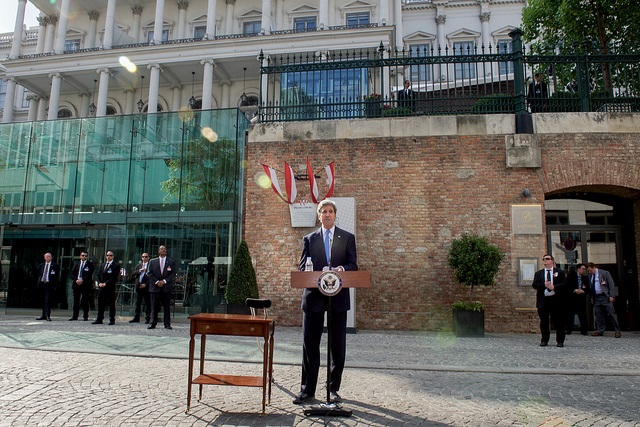
U.S. Secretary of State John Kerry delivers a statement to the international media after President Obama announced plans to re-open a U.S. Embassy in Cuba. Photo Credit: U.S. Government / Public Domain

U.S. Secretary of State John Kerry delivers a statement to the international media after President Obama announced plans to re-open a U.S. Embassy in Cuba. Photo Credit: U.S. Government / Public Domain

The reopening of embassies in Washington and Havana is symbolic of the change in U.S. policy that President Obama announced last December 17—replacing the hostility and subversion dating back to the break in diplomatic relations 54 years ago with engagement and cooperation.  As he declared on July 1, “This is what change looks like.”  Beyond symbolism, reopening the embassies has important practical benefits.

  • Cuba and the United States have had diplomatic representation in each other’s capitals since 1977, but those “Interests Sections” were restricted in their operations. Having full embassies will create better channels of communication between the two governments, facilitating negotiations on other issues that must be resolved before bilateral relations are fully normal.
  • Diplomats will have greater freedom to travel and speak with citizens of the host country.  Diplomats’ travel has been restricted to the capital regions of both countries since 2003, when the George W. Bush administration imposed controls on Cuban diplomats, and Cuba reciprocated.  Negotiations on opening the embassies were delayed by Cuban concerns that U.S. diplomats would travel around the island promoting opposition to the government—a common practice during the Bush administration.  The restoration of diplomatic relations returns to the pre-2003 status quo, when diplomats could travel freely upon simply notifying the host government.
  • For Washington, the move will have benefits beyond Cuba ties.  The policy of hostility persisted through ten U.S. presidential administrations, gradually isolating the United States from allies in Latin America and seriously endangering U.S. relations with the entire region.  It was no coincidence that President Obama noted that the new approach to Cuba would also “begin a new chapter with our neighbors in the Americas.”

Congressional opponents of the opening to Cuba can do nothing to stop the re-establishment of diplomatic relations, but they can slow down broader normalization processes.  The Constitution vests the power to recognize foreign countries with the president alone.  But whoever the president nominates as the new U.S. ambassador to Cuba will face tough sledding in the Senate Foreign Relations Committee, where Senators Marco Rubio (R-Fla.) and Robert Menendez (D-NJ) have declared unwavering opposition to normalizing relations.  In the House of Representatives, Republicans have introduced legislation to deny funds to upgrade the Interests Section to a full embassy—a move that only punishes U.S. diplomats in Havana, prospective Cuban immigrants, and visiting and U.S. citizens who need consular services.  Moreover, opponents will not allow any legislation in the next 18 months that would make Obama’s Cuba policy look like a success.  That means U.S. economic sanctions—the embargo and ban on tourist travel—will remain in place at least through the next presidential election since lifting them entirely requires changing the law.

Although full normalization—with robust trade, social, cultural, and political ties—will take a long time, there is more that can be done to expand government ties.  Washington and Havana have a half-dozen working groups on a wide range of topics, and we could soon see bilateral agreements on issues of mutual interest like law enforcement cooperation, counter-narcotics cooperation, environmental protection in the Caribbean, the restoration of postal service, and more.  President Obama also could use his licensing authority to further expand commerce with Cuba, in particular, licensing U.S. banks to clear dollar-denominated international banking transactions involving Cuba, a prohibition that is today one of the major impediments to Cuba’s international commerce with the West.  The president could restructure democracy promotion programs so that they support authentic exchanges in education, the arts, and culture, rather than promoting opposition to the Cuban government.  The issues between the United States and Cuba are complex and multi-faceted.  Resolving them will require overcoming half century of mutual distrust.  But the re-establishment of normal diplomatic relations constitutes the first necessary—symbolic and practical—step toward the future.

July 14, 2015

*William M. LeoGrande is professor of government in the School of Public Affairs at American University.  This blog is adapted from his op-ed on Fox News Latino.

Brazil on the Global Stage: Power, Ideas, and the International Order

By Matthew Taylor and Oliver Stuenkel*

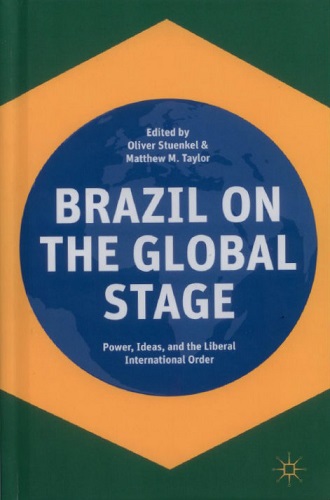
Now available via Palgrave Macmillan.

Now available via Palgrave Macmillan.

Brazil has risen to become the seventh largest economy and fourth largest democracy in the world – yet its rise challenges the conventional wisdom that capitalist democracies will necessarily converge to become faithful adherents of a U.S.-led global liberal order.  Indeed, Brazil demonstrates that middle powers, even those of a deeply democratic bent, may offer important challenges to prevailing conceptions of the world order, differing in their views of what democracy means on the global stage and how international relations should be conducted among sovereign nations.  For Brazil, successful diplomacy involves an increased voice for the developing world, greater accountability in multilateral institutions, and a desire to reduce emphasis on coercive instruments.

  • Because the role of middle powers such as Brazil is often less easily understood in the realist terms that dominate U.S. foreign policy circles, its foreign policy stances are often portrayed by frustrated Washington officials as quixotic and naïve, or ridiculed as puerile and petulant third-worldist jabs at a stereotypical Tío Sam, intended only to win popular approval from a nationalistic and anti-American electorate. In fact, Brazilian foreign policy positions usually have deeper and more enduring origins, embedded within a deeply held set of beliefs that together shape Brazil’s rational strategic perspective on the structure of power in the world today.
  • Brazil’s new role on the world stage has much to do with the country’s success in addressing its own domestic challenges under a succession of democratically elected presidents. Over the past three decades, Brazil has left behind its history of economic disarray, established a robust democracy, and begun to address its record-setting inequality.  It has found paths past the hyperinflation and financial crises of the 1980s and 1990s, undertaken substantial institutional reforms to overhaul the gargantuan and inefficient public sector, and implemented highly regarded social policies.  Even its recent stumbles can be seen in the positive light of democratic progress: the demonstrations that took hold in many Brazilian cities in 2013 and 2014 can largely be attributed to a growing middle class impatient with the pace of change and increasingly conscious of its political rights, a direct consequence of the important successes of the past generation.  Although the country continues to face a number of domestic challenges, the gains of the past generation appear to have fostered an enduring intent to play a role on the world stage.

These conclusions and others are presented in a book entitled Brazil on the Global Stage: Power, Ideas, and the Liberal International Order (Palgrave Macmillan, 2015), co-edited by Professors Matthew Taylor and Oliver Stuenkel.  The book is based on a conference sponsored jointly by American University’s Center for Latin American & Latino Studies and School of International Service, and includes contributions by eight faculty members from AU and Fundação Getulio Vargas (FGV), as well as experts from the Washington community.  It offers a general evaluation of Brazil’s stance toward global order, while also addressing its postures on specific aspects of governance, including trade, foreign and environmental policy, humanitarian intervention, nuclear proliferation, and South-South relations, among other topics.

May 21, 2015

*Professors Matthew Taylor and Oliver Stuenkel teach at American University’s School of International Service and the Fundação Getulio Vargas in Brazil, respectively.

The Summit of the Americas: Important Progress

By Aaron Bell and Eric Hershberg

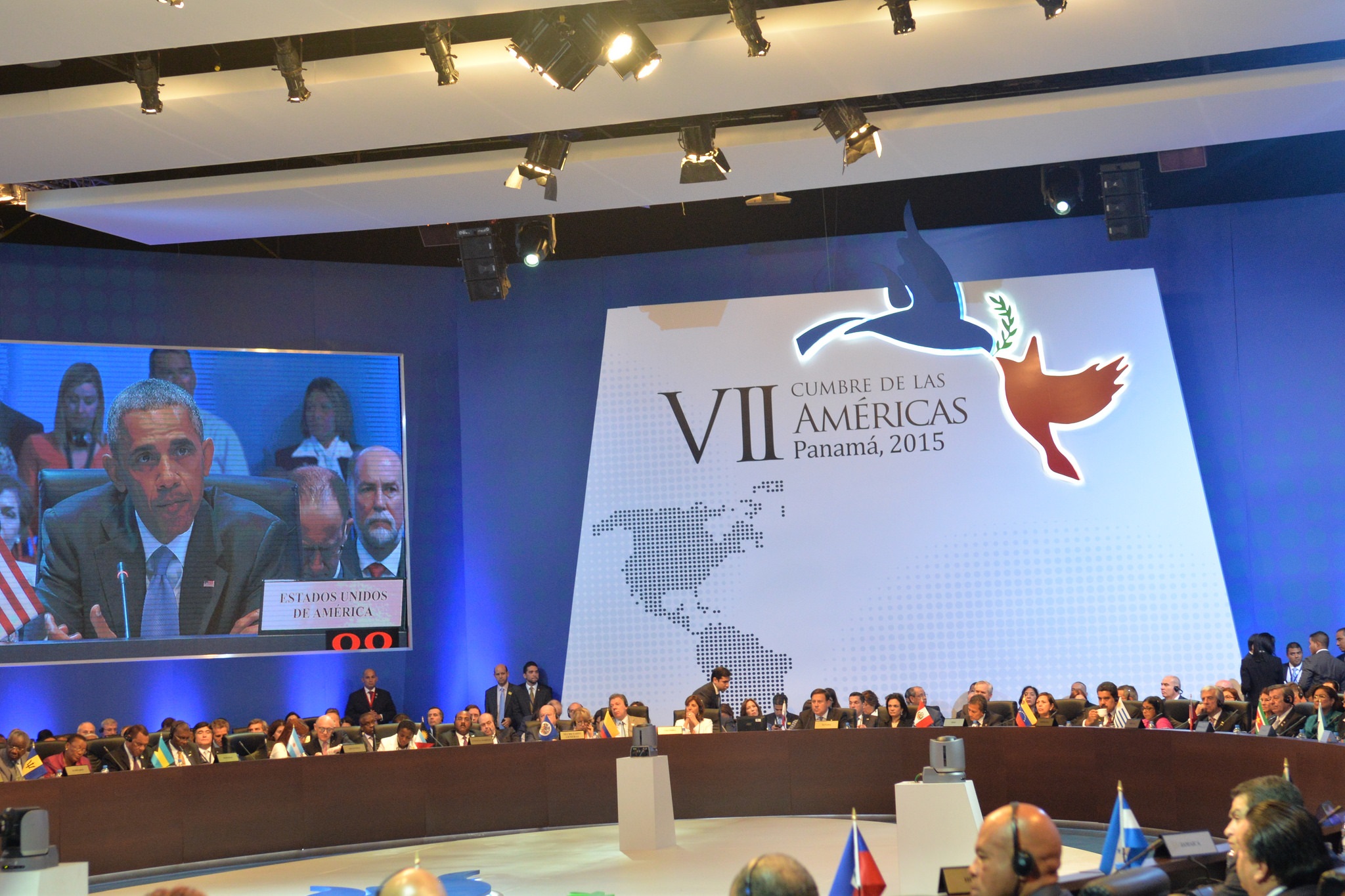
VII Summit of the Americas Photo Credit: OEA-OAS / Flickr / Creative Commons

VII Summit of the Americas Photo Credit: OEA-OAS / Flickr / Creative Commons

The U.S.-Cuba rapprochement has returned the Summit of the Americas (SOA) to the way it was before George W. Bush turned it into a forum in which the U.S. was increasingly isolated – a community of vibrant but respectful debate reflecting the varied perspectives of the hemisphere.  The event in Panama this past weekend was dominated by Cuba’s attendance at its first SOA and Presidents Raúl Castro and Barack Obama’s cordial public encounter and hour-long meeting, the first of its kind between the two nations’ leaders in over half a century.  The next step in improving relations will be for Obama to formally announce Cuba’s removal from Washington’s list of “state sponsors of terrorism,” which the State Department reportedly recommended last week.  Regrettably, the leaders did not take advantage of the Summit as an occasion to announce a target date for the formal restoration of diplomatic relations and the appointment of Ambassadors.  But that, presumably, will come soon, and regardless, in the plenary session Obama set a new tone for U.S. policy when he acknowledged that “the days in which our agenda in this hemisphere so often presumed that the United States could meddle with impunity — those days are past.”  Obama clearly articulated a desire to move beyond not only the legacy of U.S. intervention in the region but also the stale ideological debates that, he observed pointedly, pre-dated his birth.

Statements and activities surrounding the SOA also reaffirmed the broad range of perspectives in the hemisphere,  including in attitudes toward the United States.  The “People’s Summit,” held parallel with the SOA, provided a forum for left-wing critiques aimed primarily at U.S. meddling in the region, in particular its foreign military bases and its recent allegation – which it subsequently backed away from – that Venezuela poses an “extraordinary threat to U.S. national security.”  The sanctions it imposed on senior officials drew critiques from around the region, including from Argentina, Colombia, and from Brazil’s Dilma Rousseff, who summarized regional sentiment in characterizing them as “counterproductive and inefficient.”  The criticism was overshadowed, however, by widespread applause for changes in U.S.-Cuba relations.  Obama also won points from observers for meeting with Venezuelan President Nicolás Maduro, who used the Summit to denounce the 1989 U.S. invasion of Panama and present to Obama a list of 11,000 signatures opposing Washington’s sanctions.  Maduro praised the meeting as the “Summit of Truth” and even “cordial,” noting that it opened the door to further discussions on the bilateral relationship.  Obama also seemed to subscribe to a different role for civil society representatives – as opponents of sitting governments – at the summit, choosing to meet privately, for example, with Cuban dissidents opposed to the Raúl Castro and his government.

Obama’s steps to remove the festering U.S.-Cuba issue from the hemispheric agenda have been game-changing, even if some presidents criticized Washington’s continued enforcement of the economic embargo and the Administration’s bewildering inability to move faster to remove Cuba from its highly politicized terrorist list.  This summit may signal a return to the values and respectful debate that Obama, and before him Bill Clinton, espoused at past Summits, and may pave the way for cooperation over contemporary issues rather than Cold War-era ideological hang-ups.  In the final days before the Summit, senior White House advisors had intervened to ease tensions over the State Department’s national security rhetoric vis-à-vis Venezuela, emphasizing with regret that assertions regarding Venezuela’s posing a security threat were an unfortunate procedural necessity rather than a genuine assessment of the situation.  This recognition that “words matter” turned on their head the words used earlier in the week by Assistant Secretary of State Roberta Jacobson in lamenting that Latin American governments were not using language similar to Washington’s to characterize the deteriorating political situation in Venezuela.  While the correctives from the White House and the focus on the transformation of U.S.-Cuba relations were both conducive to a successful SOA, these developments did overshadow both the official theme of this year’s summit – Prosperity with Equity – and related discussions on energy, the environment, and education.  These crucial issues, all ripe for regional cooperation, are the core of what should become the focus of U.S.-Latin American relations for the remainder of this administration and beyond.

April 13, 2015

Why Is Madrid Not in the Game in Latin America?

By Fulton Armstrong

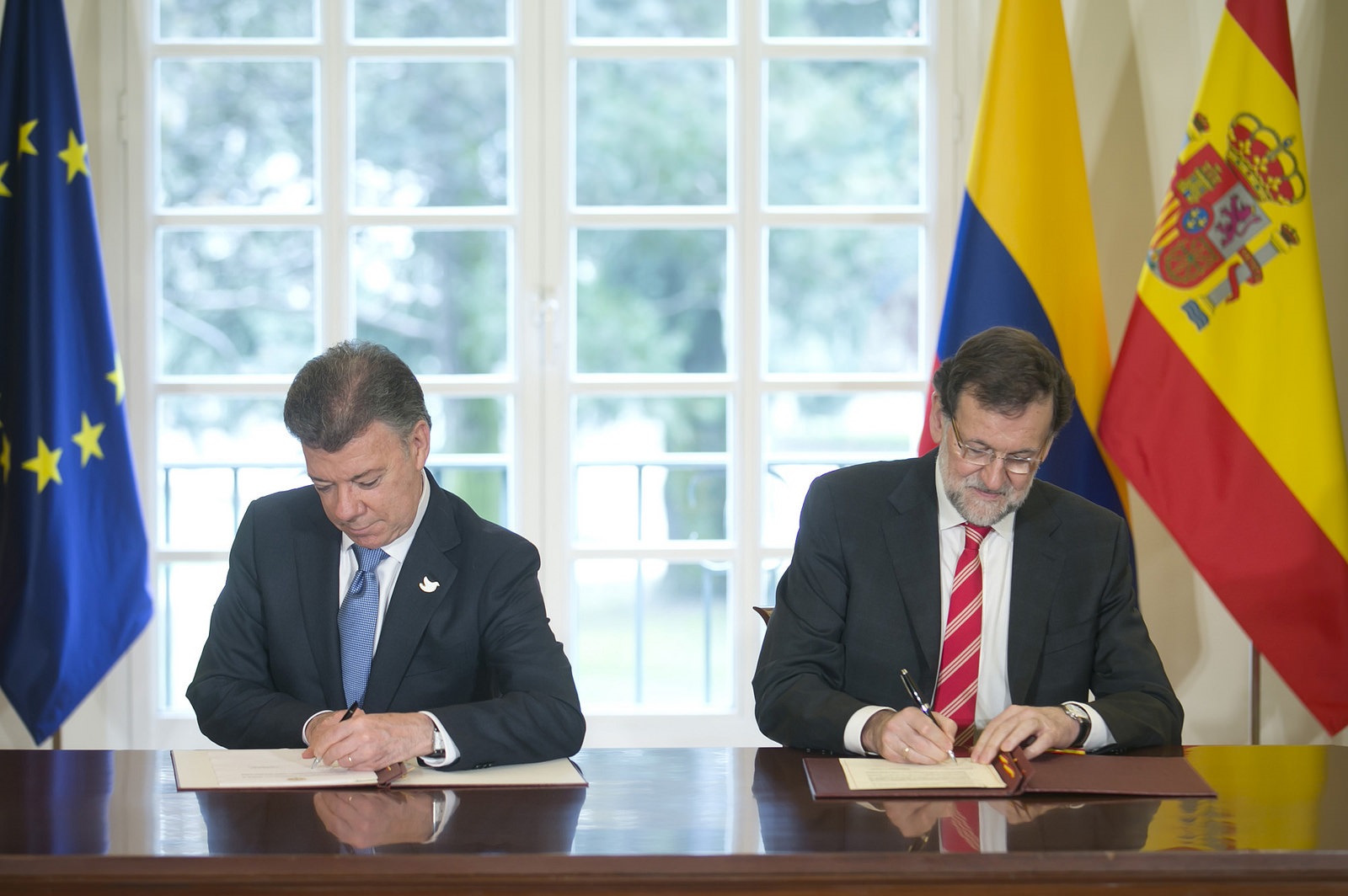
Pres. Mariano Rajoy (Spain) y  Juan Manuel Santos (Colombia), signing an agreement at the Palacio de La Moncloa. Photo Credit: La Moncloa Gobierno de España / Flickr / Creative Commons

Pres. Mariano Rajoy (Spain) y Juan Manuel Santos (Colombia), signing an agreement at the Palacio de La Moncloa. Photo Credit: La Moncloa Gobierno de España / Flickr / Creative Commons

Spain’s media, government ministries and academic specialists watch what they call Iberoamérica closely, but President Rajoy and other political leaders have adopted a lower policy profile in the region than in the past – and they appear unlikely to raise it soon.  Local observers stress that Spain’s interests in the region – preserving historic leadership and influence and building commercial relations – remain the same.  The Foreign Ministry’s website emphasizes the goal of achieving “relations based on equality and balance with all of the countries” in Latin America and to be the European Union’s “key agent” in relations with the region.  Spain also puts great stock in the annual Iberoamerican Summits, even though attendance can fall short of what it hopes for, such as in Veracruz, Mexico, last December.  Madrid rolled out the red carpet for Colombian President Juan Manuel Santos in February, during which both countries’ leaders spoke of their unstinting friendship and backing.  Spanish investment in Latin America has rebounded from the setbacks of the 2008 crisis and the bad odor left by Argentina’s nationalization of Repsol’s shares in the YPF oil corporation in 2012.  Trade has never been the mainstay of the bilateral relationship, but it too has been steady, according to local experts.

Neither of Spain’s two leading parties, however, has shown much interest in making relations as “special” as they like to say.  The frisson of excitement from President Obama’s decision to restore diplomatic relations with Cuba – arguably a validation of longstanding Spanish policy that engagement is better – did not last long.  Observers in Madrid say the government is neither concerned about new U.S. competition on the island, such as in the hotel industry, nor excited that Spanish companies will win big when U.S. tourists flood in.  After former President Zapatero met with Cuban President Raúl Castro late last month, current Foreign Minister García-Margallo accused him of “extraordinary disloyalty and … inappropriateness,” apparently for violating several Spanish protocols for former heads of government.  But Margallo’s pique was consistent with the Partido Popular’s longstanding chilliness toward Cuba (particularly under former President Aznar) and almost certain was aggravated by the fact that Raúl had stood him up for a meeting in Havana in November.  The two parties use similar rhetoric to condemn Venezuelan President Maduro’s increasingly abusive policies, but neither has provided creative leadership in finding solutions to the country’s impasse.  Former President Felipe González, of the Socialist Party (PSOE), has agreed to join the legal defense team of jailed oppositionists but apparently not counseled them on broader strategies.

Transient issues, such as frustration that investments might be nationalized, and widespread perceptions that Venezuela and other problem cases in Latin America are intractable probably lie at the heart of Spain’s preference to stay on the sidelines.  The shift probably also reflects Spanish leaders’ focus on internal priorities – an economy still reeling from the 2008 crisis and youth unemployment so high (over 40 percent in some regions) that there’s fear of a “lost generation.”  In important ways, Spain’s posture toward the region parallels Washington’s – showing fatigue or doubt at a crucial juncture in Latin America’s search for political and economic models as well as effective trading alliances.  Even though Latin American rhetoric tends to reject outside models for democratic transition and institution-building – including Spain’s – Madrid’s historical experience gives it potential advantages in dealing with the region’s political challenges.  Spain and the United States approach in Latin America are quite different – Washington tends to rely on programs to strengthen regime opponents as agents of change – but their strategic objectives in Latin America are complementary.  It would make sense for the two to team up in the region, cooperate in diplomatic strategies, and provide the sort of respectful partnership that many Latin Americans seem to yearn for.

March 31, 2015

Will Washington’s Attention to Latin America Last?

By Fulton Armstrong

Photo Credit: Prensa Presidencial Venezuela

Vice President Biden meets with Venezuelan President Maduro / Photo Credit: Prensa Presidencial Venezuela

U.S. President Obama, Vice President Biden, and Secretary of State Kerry gave Latin America increased priority in 2014, including at least two efforts to open channels to countries previously off their calling lists.  Issues combining domestic politics and foreign policy– such as immigration, Cuba, and drug policy – saw noteworthy breakthroughs.

  • President Obama’s highest profile action was his announcement in December that the United States and Cuba would normalize relations. He said he would travel to Panama in April for the Summit of the Americas – the venue of his pledge to seek a “new beginning” with Cuba in 2009 and his isolation over the Cuba issue in 2012.  Last May, his trip to Mexico and Costa Rica, where he met with Central American presidents, signaled a shift on counternarcotics strategy – downplaying militarized efforts – in response to the region’s concerns about surging violence.  His November announcement of executive measures on immigration, offering temporary legal status to millions of undocumented migrants, also steeped him in Latin America policy.
  • Vice President Biden greatly expanded his Latin America portfolio, at times as stand-in for Obama but also putting a deep imprint on policy. On an extended trip in June, he met with heads of state during the World Cup and attended a summit in Central America.  In November he participated in a followup meeting with the Honduran, Salvadoran, and Guatemalan Presidents hosted by the Inter-American Development Bank, where he announced U.S. measures to prevent another crisis involving migrant children as was seen last summer.  He met with and telephoned Latin American Presidents more than a dozen times over the year and, on the margins of Brazilian President Rousseff’s reinauguration last week, even met with Venezuelan President Maduro, with whom he agreed that it was time to restore ties.
  • Secretary Kerry traveled to the region several times – to Mexico, Panama, Peru, and Colombia – and met with Latin American Presidents and foreign ministers in Washington. Some critics judged his broad policy speeches as unexciting, but he clearly has confidence in his Latin America team, and sources say his support for the President’s initiative on Cuba was strong.

We Latin America watchers in Washington tend to complain that our region doesn’t get enough attention, but it’s clear that the Administration’s level of engagement in 2014 was deeper and more sustained than in years past.  Senior advisors at the National Security Council, Vice President’s office, and State Department – Ricardo Zúñiga, Juan González, and Assistant Secretary Roberta Jacobson, respectively – got their bosses’ to act despite the many competing demands in other regions occupying the front pages of U.S. newspapers.  Several ongoing processes promise continued senior-level attention in at least the first half of the new year.  The normalization process with Cuba could entail a visit there by Secretary Kerry, and preparations for the Summit of the Americas in Panama in April afford opportunities to give momentum to U.S. engagement – in addition to rebuilding U.S. credibility in the Summit process lost at the Summit in Cartagena in 2012.  Continued political crisis in Venezuela, nose-diving oil prices, progress in the Colombian peace talks, and the ever-evolving drug threat suggest 2015 will also be a challenging year.  For now at least, Washington’s senior team is engaged.

January 7, 2015

U.S.-Cuba: Rhetoric and Reality

By Fulton Armstrong

Obama speaks to Raul Castro / Official White House Photo by Pete Souza / Public Domain

Obama speaks to Raul Castro / Official White House Photo by Pete Souza / Public Domain

The decision by Presidents Obama and Castro to normalize relations is truly historic – for which they and their advisors deserve enthusiastic applause – even though both leaders’ rhetoric seems intended to suggest that they don’t know how deep the uncharted waters ahead run.  Their statements since last Wednesday sound solicitousness toward their right flanks.  President Obama launched his statement by proclaiming that the United States of America is changing its relationship with “the people of Cuba” and, while conceding that past strategies to “push Cuba toward collapse” have failed, cast his new policy as a better way of helping the Cuban people “enjoy lasting transformation.”  President Castro told the National Assembly this last weekend that he wasn’t jettisoning Cuba’s revolutionary project either.  Cuba is not going to give up, he said, “the ideas for which it has fought for more than a century and for which its people have spilled much blood and gone through the greatest risks.”

It’s true that the nature of the relationship is unlikely to change fast, and that neither President can ignore the legal strictures built up during 54 years of tensions.  Obama can’t lift the embargo and permit, for example, tourist travel without Congressional approval.  Cuba’s “Law 88 for the Protection of National Independence and the Economy of Cuba” remains on the books, and Castro’s not about to welcome the U.S. Government’s “democracy promotion” activities soon.  But normalization will significantly reduce both governments’ ability to restrain nongovernmental contacts and will unleash forces that will make the Presidents’ rhetoric look old-fashioned and unnecessary.  Both countries have to learn how to talk to each other, and time-tested people-to-people contacts show that citizens with shared interests are better than governments at learning the language of cooperation and problem-resolution – without ideological agendas.  It stands to reason that pressure will grow on Obama and Castro to pursue concrete interests, especially trade, and to manage their dreams, respectively, of “lasting transformation” and “updated communism.”

No model for this new bilateral dance is perfect.  China and Vietnam show that trade-driven economic change – even with U.S. most-favored-nation status – doesn’t necessarily drive a country to democracy.  An educated and healthy people with strategic needs, the Cubans are prepared to work hard to build their country, but they’re not going to work in factories with anti-suicide nets under the dormitory windows.  That sort of political awareness argues for change, but the Cuban revolution implanted in the Cuban psyche a certain set of values and expectations – ranging from social programs to an almost obsessive sense of dignity – that won’t always coincide with U.S. values.  The Cubans will want to go a la carte with us on political matters, and they, like every country of Asia and Latin America emerging from difficult times, will almost certainly expect us to give them the space to do change their own way.  The United States worked with Mexico under one-party rule for 70 years last century.  If Washington and Havana approach the challenge of building a healthy relationship with respect and open minds, they should able to find a middle ground and grow together a lot faster than that.

December 22, 2014