Perspectives on U.S.-Cuba Relations Under Trump

Trump and Cuban Americans

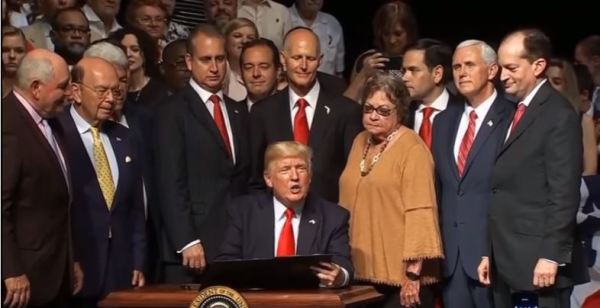
President Trump announces his administration’s policy toward Cuba. / YouTube / Livestream TV News / Creative Commons

Reversing Obama’s Cuba Policy?

By William M. LeoGrande*

In the two years after President Barack Obama and Cuban President Raúl Castro agreed to normalize relations, Obama tried to make his policy of engagement “irreversible” by opening up travel and trade that would create constituencies with a self-interest in defending engagement. He half-way succeeded. Despite the incendiary rhetoric in which Donald Trump cloaked his new policy when he rolled it out at a rally of Cuban-American hardliners in Miami, the sanctions he announced were limited.

Obama granted general licenses for all 12 categories of legal travel and relaxed other restrictions on who could visit Cuba. Trump rolled back only individualized people-to-people educational travel, so people-to-people visitors must once again travel on organized tours. But they can still go, and bring back rum and cigars.

Obama opened the Cuban market to U.S. businesses by licensing contracts with state enterprises in the travel, telecommunications, pharmaceuticals, construction, agriculture, and consumer goods sectors. Trump prohibited only contracts with Cuban enterprises managed by the military, and even then he exempted all existing contracts, and future contracts involving ports, airports, and telecomm – the sectors in which all but a handful of current U.S. businesses operate.

Trump did not impose any restrictions on Cuban–American family travel and remittances. He did not break diplomatic relations or put Cuba back on the State Department’s terrorism list. He did not restore the wet foot/dry foot policy that gave Cuban immigrants preferential treatment after reaching the United States. He did not abrogate the bilateral agreements on issues of mutual interest negotiated by the Obama administration.

Why such a flaccid set of sanctions from a president who stood on the stage in Little Havana and demonized the Cuban regime as brutal, criminal, depraved, oppressive, murderous, and guilty of “supporting human trafficking, forced labor, and exploitation all around the globe”?

Because Obama’s strategy of creating constituencies in favor of engagement worked. In the weeks leading up to Trump’s announcement, he was deluged with appeals not to retreat from engagement. The U.S. Chamber of Commerce argued in favor of expanding business opportunities, not constricting them. Farmers argued for expanding agricultural sales. Travel providers argued for expanding travel. Fifty-five U.S. Senators cosponsored a bill to lift all travel restrictions. Seven Republican members of Congress and 16 retired senior military officers argued that disengagement would damage national security by boosting Russian and Chinese influence on the island. Polling data showed that large majorities of the public, of Republicans, and even of Cuban Americans support engagement.

Even the executive bureaucracy was won over by the successes scored by the policy of engagement. During the last two years of Obama’s presidency, Cuba and the United States signed 23 bilateral agreements. When Trump ordered an inter-agency review of Cuba policy, the consensus of the agencies involved was that engagement was working and ought to be continued. Trump rejected that conclusion because it did not fit with his political strategy of currying favor with the Cuban-American right, but the agencies fought back successfully against more extreme proposals to roll back Obama’s policies entirely.

Trump’s vicious rhetoric and his open embrace of the goal of regime change – through sanctions, support for dissidents, and “democracy promotion” – risks destroying the atmosphere of mutual respect and good faith that made the gains of Obama’s policy possible. Already, hardliners in Havana who saw engagement as a Trojan Horse for subversion are saying, “We told you so!” Cuba’s private entrepreneurs, who Trump’s policy purportedly aims to help, will be hurt the most by the prohibition on individual people-to-people travel. However, the overall economic impact of his sanctions will be limited, both on U.S. businesses and in Cuba.

Cuba’s official response has been pragmatic but firm. A statement released shortly after Trump’s Miami speech declared, “The Government of Cuba reiterates its willingness to continue respectful dialogue and cooperation on issues of mutual interest, as well as the negotiation of pending bilateral issues with the United States Government…. But it should not be expected that Cuba will make concessions inherent to its sovereignty and independence, nor will it accept any kind of conditionality.”

In all likelihood, political pressures from the constituencies Obama’s policy created will continue to constrain Trump’s impulse to beat up on Cuba, but his loyalty to the exile right and his penchant for bullying will make it impossible to realize further progress toward normalizing relations. That will have to wait until the White House has a new occupant motivated by the national interest rather than by a political IOU given to Miami’s most recalcitrant Cuban-American minority.

*William M. LeoGrande is Professor of Government at American University in Washington, DC, and co-author with Peter Kornbluh of Back Channel to Cuba: The Hidden History of Negotiations between Washington and Havana (University of North Carolina Press, 2015).

Cuba: Trump’s “New Policy”


By Ricardo Torres*

The “new policy” toward Cuba that President Trump announced to great fanfare in Miami last Friday features little that is new while seeking to restore oxygen to a failed approach advocated by extreme sectors of the Cuban-American community. While adopting language reflecting the worst traditions of American foreign policy, Trump’s declaration implicitly blessed much of the rapprochement between the two countries introduced by President Obama – diplomatic relations will remain intact, for example. But the new measures he announced have symbolic and practical implications. His Cuban-American backers expended great political capital to change the policy in hope of accelerating regime change on the island, but the Trump approach will instead retard change – while increasing the pain of the Cuban people. Moreover, it will undermine the activities of legitimate U.S. citizens, companies, and groups interested in contact with the island and compromise U.S. citizens’ freedom to travel. They have acted against Trump’s campaign promise to create jobs (threatening thousands of workers who depend on U.S.-Cuba interaction) and increase national security (putting U.S.-Cuba cooperation in counternarcotics, counterterrorism, and illegal migration at risk). The new approach also runs counter to Secretary of State Tillerson’s repeated assertion that U.S. policy is not to impose its values and standards on others.

U.S. national interests seem to have taken a back seat to internal U.S. political factors, particularly the opposition to Obama’s policies among certain groups of the Cuban Americans that had seen their political influence decline over the past decade.

In addition to its symbolic weight, the Trump approach is likely to be felt most strongly in several principal areas. Despite continuing differences between the two countries, both governments had decided to move ahead together. It is difficult to overstate the sense of hope created during the Obama era, with immediate and tangible benefits for both.

Cuba’s internal situation has been changing recently, due to a gradual opening internally and to other nations. A steady increase in visits by foreign businessmen and Cuban travel overseas are evidence of this change. Trump’s rhetoric and actions will only strengthen those sectors inside Cuba that exaggerate the external threat and want to reduce the space for debate in the country.

The economic impact that Trump and his backers want – to hurt the Cuban government – cannot be separated from the harm it will cause the Cuban people. The new measures will probably reduce tourism, which provides a significant flow of revenue to vast sectors of the Cuban population that, in formal or informal jobs, benefit from that industry. Indeed, the much bandied-about private sector has been one of the principal beneficiaries of tourism development.

The Cuban government will assess its options in relations with the United States as well as in domestic policies. It will naturally have to let the U.S. government know that cooperation has yielded mutual benefits to both countries and that this step backward will not be limited to areas that Washington prefers. Havana might look for more ambitious ties with alternative partners, including both allies and competitors of the United States. Internally, rather than slow down, Cuba’s transformation should accelerate. The legitimate needs of the Cuban people should not be postponed in the face of this new adversity. The pace of Cuban reform should never be tied to external threats. As for the Cuban people, they will once again tell all who will listen that they themselves – not those on the other side of the Florida Strait – represent their interests. President Trump has empowered a small group of Cuban Americans to speak for people in Cuba whom they do not know, at the cost of sacrificing U.S. prestige and an array of its national interests. The absurd has become the accepted norm in American politics.

*Ricardo Torres is a Professor at the Centro de Estudios de la Economía Cubana at the University of Havana and a former CLALS Research Fellow.

Return of the Monroe Doctrine: Making Latin America Irate Again

By Max Paul Friedman*

monroe_doctrine

Uncle Sam stakes his claim in the Western Hemisphere in a political cartoon outlining the basic tenants of the Monroe Doctrine (1912). / Wikimedia / Creative Commons

A vigorous resuscitation of the Monroe Doctrine may well be at hand under U.S. President Donald Trump, even though history shows us that it will contradict another favored policy – “America First” – which signals a desire to return to the most notorious isolationist organization in U.S. history.  The Monroe Doctrine, first articulated in 1823 as a means of blocking external interference in the Western Hemisphere, was the central pillar of U.S. policy toward Latin America until Barack Obama’s Secretary of State, John Kerry, told a roomful of Latin American diplomats in 2013 that “the era of the Monroe Doctrine is over.”  The statement was part of an effort to rehabilitate the U.S. image in a region long accustomed to seeing the United States as seeking to control it through persuasion when possible, and force when necessary.  In a policy paper published last December, Craig Deare, a dean at the U.S. National Defense University and now Trump’s top Latin America advisor on the National Security Council staff, denounced Kerry’s statement “as a clear invitation to those extra-regional actors looking for opportunities to increase their influence.”  He specifically mentioned China.

A revitalized Monroe Doctrine, however, contradicts the Administration’s other strong impulse, present in its statements far beyond Latin America, toward isolationism.  Trump is promising to build a literal wall between Latin America and the United States, but the Monroe Doctrine was decisively unilateral and interventionist.  It stated that the United States would not intervene in European affairs if European powers did not intervene in the Americas, but Monroe carefully did not state that the United States would not intervene in the region.  Indeed, Presidents James Monroe (1817-1825) and John Quincy Adams (1825-1829) and other U.S. leaders desired and expected the future annexation of parts of what was then Spanish or Latin American territory in Cuba, northern Mexico (later Texas), and beyond.  Later, even in the “isolationist” early decades of the 20th century, the United States was vigorously engaged in military intervention and outright occupation of several countries in Latin America.  The Marines were in Nicaragua (1912-33), Haiti (1915-34), and the Dominican Republic (1916-24).

  • Latin American resistance prompted Franklin Roosevelt’s “Good Neighbor Policy,” which supplanted the Monroe Doctrine’s unilateralism with respect for national sovereignty, but during World War II, FDR threatened Latin American governments with economic embargoes and other measures if they didn’t round up and intern thousands of Germans, Italians, and Japanese. After the tide in the war turned in 1943, the Latin American deportation and internment program was continued by U.S. officials seeking to turn the program to economic advantage by crushing commercial rivals.

Even Obama had difficulty reversing the United States’ longstanding desire to guide political and economic developments in Latin America – continuing, for example, Washington’s “democracy promotion” efforts in Cuba and elsewhere – but steps toward normalization of relations with Cuba and other initiatives made important strides toward assuaging Latin American irritation with U.S. imperiousness.  Obama went further than any president since FDR in restoring good relations, and ended the Cold War in Latin America.  Donald Trump’s competing impulses – the interventionism of Monroe and the isolationism of “America First” – will keep U.S.-Latin America relations on edge.  His unilateralist style has already hit its first victim, Mexico’s President Enrique Peña Nieto, and is likely to claim more soon.  If Trump revives the Monroe Doctrine’s unilateralism more broadly in response to a perceived threat from China throughout the region, he is likely to succeed only in making Latin America irate again.

February 2, 2017

* Max Paul Friedman is a Professor in the History Department at American University and author of Rethinking Anti-Americanism: The History of an Exceptional Concept in American Foreign Relations.

U.S.-Mexico Tensions: Harbinger for Latin America?

By Eric Hershberg and Fulton Armstrong

1024px-us-mexico_border_at_tijuana

The U.S.-Mexico border near Tijuana and San Diego. / Tomas Castelazo / Wikimedia Commons / Creative Commons

U.S. President Donald Trump’s unilateral actions on Mexico last week have precipitated the most serious crisis in bilateral relations in decades and threaten to further undermine U.S. image and interests throughout Latin America.  During last year’s campaign, in the face of Trump’s characterization of Mexicans as rapists and drug-traffickers and repeated pledges that he’d make Mexico “pay for the Great Wall,” President Enrique Peña Nieto adopted a strategy of patience and positive engagement.  He paid dearly in political terms for meeting with Trump in August – a misjudgment that worsened his already declining popular approval – but he continued to try to stay on the high road after the election.

  • Peña Nieto resurrected former Finance Minister Luis Videgaray, the architect of the Trump meeting last August, as Foreign Minister, and he replaced his ambassador in Washington with one having deep experience with NAFTA and a reputation for calm negotiation, in response to Trump’s repeated demand for a renegotiation of the 1994 accord. As opponents across the political spectrum egged him on to reciprocate Trump’s belligerent tone and strident U.S. nationalism, Peña Nieto – like all Mexican presidents for the past 25 years – tried hard to suppress the anti-Americanism that has lingered beneath the surface of Mexican politics even while the two neighbors have become increasingly integrated economically, demographically, and in governance.  Even after Trump’s first barbs following inauguration on January 20, Peña Nieto emphasized his preference for calm dialogue – “neither confrontation, nor submission.”  He declared that Mexico doesn’t want walls but bridges, and accepted the American’s demand to renegotiate NAFTA, although with a “constructive vision” that enables both sides to “win,” with “creativity and new, pragmatic solutions.”

Preparations for the summit meeting, scheduled for this week, crashed when Trump – without coordinating with his Mexican counterpart or the appropriate U.S. government agencies – issued executive orders putatively aimed at tightening control of the border.  One directed an immediate increase in efforts to deport undocumented Mexicans, and the other launched the “immediate construction of a physical wall on the southern border.”  Trump initially abided by an informal agreement with the Mexicans not to repeat his harangue that he was going to make Mexico pay for the wall, but on January 26 he tweeted that “If Mexico is unwilling to pay for the badly needed wall, then it would be better to cancel the upcoming meeting.”  His press spokesman followed up with a suggestion that Washington could impose a 20 percent tariff on imports from Mexico to cover the costs of construction, after which Peña Nieto, facing a firestorm at home, postponed the meeting.  The two presidents talked on the phone for an hour the following day and reportedly agreed to let things calm down, although the two sides presented different versions of the chat.

The speed of the trainwreck – in Trump’s first week in office – and the depth of the damage his unilateralism has done to bilateral relations have alarmed many in Mexico and the United States, including Republicans who worked hard to build the relationship.  (Only the Administration’s stunning decrees regarding immigration from other parts of the world have overshadowed the mess.)  Mexico is, of course, not without leverage and, as Trump stirs up long-repressed Mexican nationalism, Peña Nieto – whose popular support was recently in the garbage bin – is going to have to talk tough (at least) and could have to retaliate.  He could impose tariffs on the billions of dollars of Mexican exports that Americans have grown accustomed to having at low prices.  Mexico could also opt to diminish cooperation in counternarcotics and other law enforcement efforts, or to cease blocking Central American migrants seeking to reach the U.S. border – interests that the impulsive Trump policy team doesn’t seem to have considered.

Coming on the heels of Trump’s executive order totally withdrawing from the Trans-Pacific Partnership, the new president is presenting the image of a U.S. leader whose harsh policies and arrogant style serve neither the United States nor Latin America’s interests.  Having appointed as White House National Security Council Senior Director for Latin America a political scientist whose writings draw bizarrely on analytic approaches that have been rejected in the discipline for more than 30 years, and whose recent articles lament the Obama administration’s abandonment of the Monroe Doctrine, the region’s leaders will rightly conclude that Washington is voluntarily abdicating any plausible case for leading multilateral cooperation around common interests.  The United States and Latin America are inextricably linked, however, and a policy based on stale assumptions of big power unilateralism ultimately will run into insurmountable obstacles: however ignorant Trump and his team are proving themselves to be, we live in the real world of the 21st century, in which imperialist, mercantilist fantasy will be treated with the disdain that it deserves.

January 31, 2017

Prospects Dim for Better U.S.-Venezuela Relations under Trump

By Timothy M. Gill*

maduro-tillerson-face-off

Venezuelan President Nicolás Maduro and U.S. President Trump’s nominee for Secretary of State, Rex Tillerson. Tillerson’s past dealings with Venezuela may lead to increased tensions between the two countries. / President of Russia website / Creative Commons / William Muñoz / Flickr / Creative Commons / Modified

U.S. President Donald Trump and his foreign policy team have expressed similar criticisms of the Venezuelan government and, while giving off contradictory policy signals, appear headed toward a policy focused on sanctions rather than continuing the dialogue that the Obama administration recently opened with its counterpart in Caracas.  As the U.S. Senate continues its confirmation hearings of Trump nominees, Latin America has featured very little in the discussion thus far, but passing mentions of the region suggest greater consensus among the Trump team than on other issues such as the threat of Russia and the Iran nuclear agreement.

  • In September, Trump expressed support for the Venezuelan opposition. He asserted that he will “stand in solidarity with all people oppressed in our hemisphere … [and] with the oppressed people of Venezuela yearning to be free.”  He blamed “the socialists” for running Venezuela “into the ground.”  He has also recently shown interest in the cases of Antonio Ledezma and Leopoldo López, two opposition leaders that respectively remain under house arrest and in a Venezuelan prison.
  • Several of Trump’s cabinet selections also seemingly harbor animosity toward the Venezuelan government. ExxonMobil CEO Rex Tillerson, nominated to be Secretary of State, concluded a case against the Venezuelan government in an international court in 2014 involving the expropriation of his company’s facilities.  Venezuelan President Maduro accused ExxonMobil of inciting conflict between Venezuela and Guyana when it announced that it would work with the Guyanese government to drill oil in an area that both countries claim.  General Michael Flynn, Trump’s pick for national security adviser, has included Venezuela (and Cuba) in the “enemy alliance” that the United States faces “in a global war.”  General John Kelly, Secretary of Homeland Security, has condemned the Venezuelan government for its alleged involvement in drug trafficking.

While the Trump team is obviously unhappy with Caracas, their statements so far shed little light on what they’ll concretely do differently from the Obama Administration.  Obama designated the Venezuelan government “an unusual and extraordinary threat” to the national security of the U.S. in 2015 and sanctioned a handful of state security leaders.  But there has also been renewed interest in recent months on the part of both governments to dialogue.  In late 2016, Maduro met with former U.S. Secretary of State John Kerry and Under Secretary Tom Shannon.  Despite disparaging Trump during the campaign season, Maduro extended his congratulations to him on November 9, and publicly reiterated his hope for better relations.  On January 16, Maduro stated that he was “surprised at the brutal hate campaign against Donald Trump,” and he welcomed the Trump administration, saying that Trump “won’t be worse than Obama.”

Aggressive rhetoric from Trump is a given, but his true position on Venezuela – as well as many other countries – is not entirely clear.  Businessman Trump undoubtedly grasps that strategic relations are founded on Venezuela’s role among the United States top five international suppliers of crude.  He has at times been dismissive of the concept of “democracy promotion,” which drives much of Washington’s advocacy in places like Venezuela.  He shows a penchant, however, for the sort of double-standard that most irks Latin America – criticizing Cuba and Venezuela’s political systems but praising Kazakhstan and Russia.  Moreover, he may be tempted to throw a sop to U.S. politicians who have led the effort to impose sanctions on the Venezuelan government.  During Tillerson’s confirmation hearing in the U.S. Senate, Senator Marco Rubio – with whom Trump had bitter exchanges during their party’s primaries last year – made criticisms suggesting continuing tensions, but Venezuela would be an easy issue for Trump to throw Rubio’s way as a peace offering to the lawmaker from Miami.  Indeed, while it’s far too early to make concrete predictions, it seems safe to say that Obama’s late-game efforts to reset the relationship with Venezuela will not continue under the new Administration – and we might expect Trump to more intensively target the Venezuelan government in the coming years.

January 23, 2017

*Timothy M. Gill is a post-doctoral fellow at the Center for Inter-American Policy Research at Tulane University.

Cuba: Preparing for President Trump

By Fulton Armstrong

15859186069_103bf8055c_b

Photo credit: Day Donaldson / Flickr / Creative Commons

Cubans are already calibrating their expectations for relations with the United States under President Trump – hoping the normalization process does not unravel but preparing for a return to a sanctions-based policy from Washington.  Conversations in Havana reveal deep concern that the President-elect’s tweets and statements about Cuba, Mexico, and Latinos in the United States will translate into efforts to slow, stop, or reverse normalization.  The past two years of dialogue have focused on mutual interests, without ignoring remaining differences between capitals but not allowing them to blot out hopes of mutually beneficial cooperation.  Cuba will interpret a return to bombastic rhetoric, exaggerated conditions to reach a “deal,” and the pressure tactics of the pre-Obama era as a sign of U.S. willingness to put bullying a small neighbor eager for improved ties ahead of its own national interests.

Cubans present the stiff upper lip in conversations and, not surprisingly, defiantly note that they’ve already survived decades of U.S. pressure, but their disappointment is palpable.

  • Most concerned are entrepreneurs in Cuba’s small but growing private sector, who depend on investment from U.S.-based relatives and friends. More than 100 Cuban private businessmen wrote a letter to Trump last week urging restraint.
  • Nationalism has precluded Cubans from saying that normalization would be a major driver of their long-promised economic reforms, but few deny that improving ties with the United States would eventually present Havana important opportunities. U.S. retrenchment will remove important incentives for the government to move ahead with its reform strategy.
  • Rumors about tensions between Cuban proponents of normalization and conservative opponents may have some merit, but Cubans across the spectrum will close ranks if Trump gets aggressive.

Cuba’s reactions to Trump’s election, including President Raúl Castro’s congratulatory message to him, so far suggest that it will hold its tongue and resist being provoked.  A U.S. return to full-bore Cold War tactics would not pose an existential threat to Cuba, even considering the country’s difficulties dealing with unrelated problems such as the crisis in Venezuela.  Popular reactions to the passing of Fidel Castro last month are being construed as evidence of residual political legitimacy for the government and support for it to deliver on promised improvements.  Moreover, Cuba’s progress in normalization; its effective contribution to the Colombia peace accord; its new political dialogue and cooperation agreement with the European Union; and the recent Havana visit of Japanese Prime Minister Abe have boosted the country’s international image – and blame for collapse of normalization will surely fall solely upon the United States.  However difficult it will be for the proud people of Cuba to resist rising to whatever bait the Trump Administration throws its way, showing forbearance in the bilateral relationship and moving “without hurry but without pause,” as Raúl Castro said, with its national reform plan would protect the investment that Cuba has already made in normalization.

December 19, 2016

What does “Canada is back” mean in the Americas?

By Stephen Baranyi*

27950219435_acf41153d5_h

Mexican President Enrique Peña Nieto and Canadian Prime Minister Justin Trudeau during the “Tres Amigos Summit” in Ottawa, June 2016. / Presidencia de la República Mexicana / Flickr / Creative Commons

Canadian Prime Minster Justin Trudeau and his cabinet ministers’ statements following their election in October 2015 that “Canada is back” reflect a global strategy that is likely to give a boost to Canada-Latin America relations.  Canada never “left” the Americas during the decade of Conservative governments led by Prime Minister Harper, but the new administration is patching up its predecessors’ mixed record.  Building on the Americas Strategy launched in 2007, Ottawa signed new bilateral free trade agreements with Colombia, Peru and others; broadened its engagement in regional security affairs; and greatly increased its whole-of-government engagement in Haiti.  Canada played a major role at the Summit of the Americas in Panama (April 2015) and hosted the Pan American Games (July 2015).  Yet the revelation of Canada’s espionage in Brazil, visa restrictions on Mexicans, the poor reputation of some Canadian mining firms in the region, and its inability to reach a trade agreement with the Caribbean Community fed a growing desencanto in Canada’s relations with the region.

Through mandate letters issued to ministers in late 2015, the Trudeau government made clear that the Americas would remain an important priority, despite renewed emphasis on Asia and Africa, and that inclusive growth, the responsible governance of Canadian extractive activities abroad, and women’s and indigenous peoples’ rights would get emphasis in the region.  In June, Canada hosted the “Tres Amigos Summit” with NAFTA partners United States and Mexico.  Ottawa also announced that by December, Mexican citizens would no longer need visas to enter Canada, removing a big irritant in Canada-Mexico relations.  The government reaffirmed its partnership with Colombia by indicating its desire to make bilateral free trade more inclusive and announcing projects to support the implementation of peace accords.

  • Ottawa has opportunities for deeper involvement in these countries. In Mexico, Canadian interests will be served through a better balance between pursuing economic opportunities in sectors like petroleum and supporting Mexicans struggling to strengthen rule of law in a system compromised by corruption.  Colombia also requires a sophisticated whole-of-Canada engagement strategy, particularly since the failure of its referendum on the peace accords on Sunday.  Ottawa has signaled interest in continuing to support the rule of law and broader development in Haiti, but Trudeau’s ability to justify large expenditures there will depend on the completion of legitimate elections by February 2017.

Ottawa’s appointment of a new Ambassador to the Organization of American States (OAS) and commitment to revitalizing it as “the premier multilateral organization of the Americas” points to broader engagement on a regional level.  The Trudeau administration could join the Latin American and Caribbean trend on drug policy by decriminalizing the sale of marijuana at home and supporting reforms to OAS and UN counterdrug programs.  Assisting the implementation of the UN Small Arms Treaty, which Ottawa is poised to ratify, could also contribute to rule of law and security in the Americas.  Canada will also find many partners (from Chile to Costa Rica) to promote gender equality.  With regard to First Nations, Ottawa may be tempted to focus on funding new aid projects; yet Canada’s credibility will remain suspect until it ratifies the American Convention on Human Rights and ensures that all Canadian mining firms respect the rights of indigenous communities to free and prior informed consent in large-scale extractive activities.  The Trudeau government will probably monitor the multi-dimensional crisis in Venezuela, the situation in Brazil, and other challenges in the region – over which it probably lacks the leverage to make a significant difference but can lend moral authority to solutions.  Given its clear commitment to a global, rather than regional, strategy, the current administration is wise to carefully select entry points on which its thematic priorities align with opportunities in particular countries.

October 5, 2016

* Stephen Baranyi is an Associate Professor at the University of Ottawa’s School of International Development and Global Studies.  He also chairs the Latin America and Caribbean Group (LACG) of the Canadian International Council.  The author acknowledges his LACG colleagues’ input into this blog, while taking responsibility for its limitations.

Canada-Cuba Relations Poised for Progress under Prime Minister Justin Trudeau

By John M. Kirk*

Cuba Canada

Photo Credits: Wisegie/ Flickr / Creative Commons, Pixabay / Creative Commons

After a decade of ignoring Cuba under the government led by Stephen Harper, Canada is on the cusp of an era of a significant improvement in bilateral relations with the island.  Many constants supporting this longstanding relationship remain: Canada, along with Mexico, was the only country in the Western Hemisphere not to break relations with revolutionary Cuba in 1962; Pierre Trudeau was the first leader of a NATO country to visit Cuba (1976) and developed a strong friendship with Fidel Castro (who was an honorary pall-bearer at his funeral); Canadians make up the largest tourist group (1.3 million a year) there; and the largest single foreign investor in Cuba is the Canadian firm Sherritt International.

Justin Trudeau, elected prime minister in October 2015, has undertaken several significant foreign policy initiatives, mainly in Asia and Europe.  Steps to improve relations with Cuba have been taken slowly, but are noticeable.  In May Cuban Foreign Minister Bruno Rodríguez visited Ottawa and Quebec City, while Canada’s Minister of Tourism Bardish Chagger attended the International Tourist Fair in Havana, at which Canada was the “invited country of honor,” reciprocating an earlier visit by her counterpart.  In December the Canadian Senate held a special session to celebrate the 70th anniversary of diplomatic relations.  Canada has been invited as the country of honor to the International Book Fair in Havana, in March 2017, and it is rumored that Trudeau will shortly visit Cuba.  Significantly, the gradual improvement of bilateral relations is due mainly to Canadian initiatives, and not to developments in the U.S.-Cuba relationship.

  • Investment and trade, however, have not kept up with diplomatic initiatives. Annual bilateral trade remains about $1 billion, mainly because of uncertainty over Cuba’s economy.  Canadian business has yet to take advantage of its privileged relationship, concerned with existing U.S. legislation and the looming wave of U.S. investment once the embargo is lifted.

After a decade of neglect, Canada and Cuba have the potential to rediscover their deep-rooted ties.  Trudeau’s willingness to work with Cuba and his diplomatic initiatives were unthinkable under the Harper government.  A complicating factor for business has been the arrest and imprisonment of two Armenian-Canadian entrepreneurs, found guilty of corruption.  Canadian civil society ties remain strong, with Canada making up 43 percent of tourists to Cuba.  Again, however, concern exists at how Canadian tourists face skyrocketing prices when Americans are allowed to visit the island.  In sum, Canada-Cuba relations are at this point characterized by political commitment to improve ties, largely untapped commercial potential, and anxiety about the ramifications of closer U.S. ties with Cuba.  The big question is whether Canadian trade and investment will provide the energy to propel relations beyond their special past status into a new era of collaboration.

August 8, 2016

*John M. Kirk is Professor of Latin American Studies at Dalhousie University in Canada.  He is the author/co-editor of 16 books on Cuba, and also works as a consultant on investment and trade in Cuba.

Trumping GOP Resistance to Strengthened Ties with Cuba

By Eric Hershberg

Malecon Twilight

Nighttime on the Malécon in Havana, Cuba. Photo credit: William Beem / Google Images / Creative Commons

One wild card on the horizon in the normalization of U.S.-Cuba ties looks unlikely to materialize.  As pointed out in several CLALS publications (such as here and here), ever since Presidents Obama and Castro announced on December 17, 2014, that they intended to improve relations, there has been a sense of uncertainty regarding whether their successors might roll back the advances they make.  This was particularly so when several Republican politicians seeking their party’s presidential nomination campaigned against President Obama’s “coddling” of the Cuban Communists and his “unilateral concessions” to Havana.  Marco Rubio (Florida) and Ted Cruz (Texas) – two of the Cuban-Americans in the U.S. Senate –made particularly aggressive statements indicating an intention to reverse all or parts of the Obama administration’s executive actions affecting Cuba policy, which, unlike legislation, can be reversed by a subsequent administration.  But they have dropped out of the race as presumptive nominee Donald Trump defeated them and former Governor Jeb Bush, whose Florida political base, family background, and public statements also indicated opposition to normalization.

Trump and the leading Democratic candidate, Hillary Clinton, have very significant policy differences on many issues, but apparently not on Cuba.  Clinton in her memoirs about her tenure as Secretary of State, like Trump in his public statements, appears inclined to sustain the current direction of Washington’s engagement with Havana (although Trump claimed last year that “we should have made a better deal”).  The two likely nominees share noteworthy characteristics, including, remarkably, that they are the least popular candidates that either major party has nominated since polling data have been collected. Advocates of full normalization cannot take either candidate’s leadership on the issue for granted. Clinton’s challenger, Senator Bernie Sanders, has pushed her to the left on some domestic issues, but recent press profiles on her indicate that she remains wedded to a hawkish approach to foreign policy.  The endorsement of several key Washington Neo-Conservatives further suggests she could swing to the right on foreign policy matters.  On the other hand, Trump’s zigzagging on Cuba – 15 years ago he was a staunch proponent of the embargo – and his impulsive decision-making style leave open the possibility that he also could reverse Obama’s executive actions and call on the Congress to keep embargo legislation unchanged.

Although mistakes can occur and various wildcards can slow, or even break, the current momentum, the twists and turns of the U.S. primary election season seem to have diminished substantially prospects that a new President sworn in next January would significantly change Obama’s winning formula on Cuba.  Clinton will have no incentives to abandon a policy that she takes some credit for promoting.  Trump has, if anything, proven that he revels in taking on GOP orthodoxy – and will presumably continue to do so on Cuba policy.  His sympathies align much more clearly with the pro-business Chamber of Commerce, an aggressive opponent of the embargo against Cuba, than with the ideologues on the right of his party, and he will give a green light to the many members of Congress who want full trade with and free travel to the island to change the law.  Concerns that a new U.S. president could reverse Obama’s executive actions on January 20, 2017, can now be assuaged, and Congressional proponents of lifting the embargo likely will have time to build momentum to pass legislation rendering the executive measures moot.  One can imagine that the Donald’s criteria of success for Cuba policy begin with the glare of a gaudy neon Trump sign on a casino along the Havana Malecón, but it’s reasonable to wager that the Cuban government will negotiate a better deal.

May 31, 2016


Spain: Too Distracted to Play in Latin America?

By An Observer*

Rajoy Latin America

Photo Credit: La Moncloa Gobierno de España and Heraldry (Modified) / Flickr & Wikimedia / Creative Commons

Spain’s political crisis and problems facing the European Union have undermined Madrid’s ability to pursue interests in Latin America at a time of new opportunities.  Amidst countless months of lameduck government and the failure of either the Partido Popular (PP) or the Partido Socialista (PSOE) to form a government, the country is also tied in knots over corruption scandals, including some touching a Cabinet member and the royal family, and Cataluña’s persistent challenges to central authority.  Even before the current mess, Prime Minister Rajoy had shown only modest interest in Latin America, and King Felipe hadn’t yet demonstrated the mettle of his father, who once famously told Venezuelan President Chávez to shut up at an Ibero-American Summit.  Adding to Spain’s distractions are a series of EU challenges, ranging from refugee crises to terrorism and the Mediterranean countries’ debt overhang.  Spanish elites, who remain committed to the EU vision, are seized with concerns about Brexit, the UK’s flirtation with withdrawal, and perplexed by the absence of a renewed integration project.

Madrid’s declining role coincides with changes in Latin America that would normally grab its attention.  President Obama and Raúl Castro’s historic normalization of diplomatic relations has opened the door to at least one major U.S. hotel firm signing contracts to refurbish and manage several Cuban hotels – an industry in which Spain previously had extraordinary advantages.  Having played “good cop” with Cuba for many years, compared to Washington’s “bad cop,” Madrid’s future role on the island is at most uncertain.  The election of market-friendly President Macri in Argentina, where the previous government nationalized a Spanish energy company and adopted other policies causing bilateral estrangement, also represents an opportunity for Spain.  The near-completion of peace talks between the Colombian government and guerrillas should be the crowning jewel of a foreign policy in which Spain made a strong political investment early on, but Madrid has receded to the role of bit player.  At a time that Latin Americans continue to espouse support for CELAC and other regional organizations that exclude Spain (and the United States), Spain-sponsored Cumbres Iberoamericanas since 1991 have – even more than the U.S.-sponsored Summit of the Americas – lacked dynamism and produced little as the beacon of the Spanish transition was dying down

By turning inward, Spain risks losing what remains of its special cachet as Latin America’s link to Europe and as a country that made a successful transition to democracy with inclusion, human rights, vibrant media, and increasing transparency.  Its political capital in the region is running low, and budgetary constraints have diminished its aid budgets (from 0.5 percent of GDP to 0.13 percent).  But opportunities remain.  Big Spanish companies – Telefónica, Banco Santander, BBVA, Repsol, and others – and numerous mid-sized firms have shown interest in Latin America.  Cuba’s reluctance to embrace U.S. ties too tightly and too fast gives Spain important space to play a role if it wants.  Moreover, Spain’s diplomatic skills, critical for Central America’s peace processes and elsewhere, could still be a positive force in that subregion.   If it weren’t for former Spanish Prime Ministers’ contradictory roles in Venezuela, where U.S. baggage undermines Washington’s approach to political, economic, and security problems, Spain could be active there too.  But the Prime Minister and his cabinet have not given the Foreign Ministry the green light to get more deeply involved.  It’s not too late for Spain to turn things around and get back into the game in Latin America.  For that to happen Spain needs more consistent governance.

April 18, 2016

* The writer is long-time non-academic observer of Spanish foreign policy in Latin America.

Lobbying Washington: Does it Work?

By Aaron T. Bell*

LatAm Lobbying

Photo credits: Jack Says Relax & AlexR. L., respectively / Flickr and Wikimedia Commons / Creative Commons

Latin American governments, political parties, and business associations have a long history of turning to U.S.-based lobbying, legal, and public relations firms to advance their interests in the United States – with mixed results.  Both national and multinational groups have been utilizing lobbyists since at least the 1940s, when the U.S. government began registering foreign agents.  Their most consistent goal over the decades has been to influence U.S. policy on foreign trade and investment, but they have also aimed to improve governments’ sagging reputation and protect them from adverse policies.  In the 1970s, a number of military regimes and right-wing political groups in Central and South America hired lobbyists to devise and implement strategies to counter criticism of their human rights record – to preserve trade and military assistance.

  • Some 30 Latin American countries and interests groups in 2010-14 registered foreign agents to influence U.S. policies. The Bahamas Ministry of Tourism spent the most, paying $128.9 million to promote tourism – as well as to monitor and speak with Congressional representatives about U.S. legislation related to transnational financial activities in which they are involved, such as the regulation of offshore tax havens and online casinos.
  • In 2013, Mexico ranked fifth worldwide, at $6.1 million. Both federal and local governments pay firms to burnish the image of their respective constituencies.  From 2010-12, for example, Mexico City worked with a firm to “enhance the image of Mexico City in light of recent negative media reports.”  In 2014, the Consejo de Promoción Turístico de México hired another company to “make Mexico an attractive destination.”
  • Ecuador, which at $1.1 million ranked twenty-second in 2013, spent nearly half a million dollars lobbying in support of the ultimately failed Yasuni rain forest oil drilling initiative.
  • More recently, the government of Honduras – burdened with the image as one of the most violent, corrupt, and crime-ridden countries in the world – hired lobbyists to “provide ongoing strategic counsel, media relations (proactive and reactive outreach), and third-party relations.” The firm, winning an initial one-year contract for $420,000, had just completed a nine-year relationship representing Russia.

A review of the U.S. Foreign Agents Registration Act (FARA) records indicates that foreign lobbyists represent almost exclusively governments, state agencies, and the private business sector, and that more popular civil-society actors – such as labor unions and indigenous organizations – are notably absent.  Even though foreign governments obviously judge the investment worthwhile, the impact of foreign-funded lobbyists is difficult to measure.  The Honduran government’s new push to burnish its image has paid off on Capitol Hill, according to observers, but a new initiative to reduce Honduran corruption doesn’t appear to have gone exactly as Tegucigalpa hoped.  Forced to respond to a protest wave calling for the creation of an independent investigative body similar to the Comisión Internacional contra la Impunidad en Guatemala (CICIG), the Honduran government agreed with the OAS to create the Misión de Apoyo Contra la Corrupción y la Impunidad en Honduras (MACCIH) as a collaborative effort.  MACCIH indeed lacks the independence – and the potential bite – that CICIG had, but it is significantly tougher than the Honduran President Juan Orlando Hernández initially proposed.  In this case at least, lobbyists have helped the government gain access and public relations points in Washington but didn’t get it off the hook entirely.

January 22, 2016

* Aaron Bell is an adjunct professor in History and American Studies at American University.