Colombia: University Professors Appeal for Post-Referendum Solution

By Eric Hershberg and Fulton Armstrong
27352274634_50095d1bc9_o

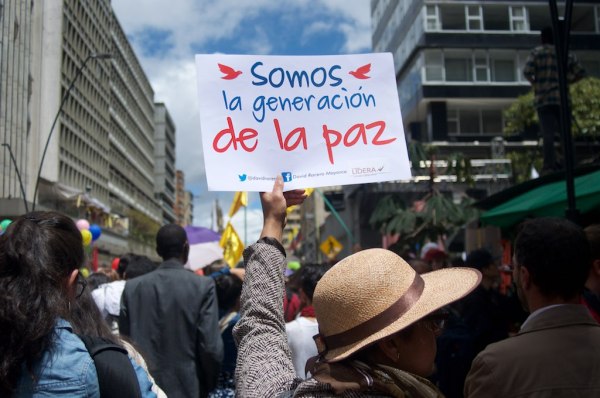
At a march for peace in Bogotá, Colombia, a woman holds a sign that states, “We are the generation of peace.” / Agencia Prensa Rural / Flickr / Creative Commons

A group of Colombian university professors have organized an appeal to their colleagues in and outside the country to sign a petition “requesting an effective solution without delay” to overcome the impasse created by rejection of the peace accord on October 2.  The text of the petition, which currently has more than 1,700 cosigners, is as follows:

[We] university professors, from different disciplines, universities, and regions, join our voices with those underscoring the urgent need to reach, as soon as possible, a final Accord to end the conflict with the FARC.  Delay poses enormous risks.  It is essential to set, with all urgency, an agenda for talks limited to points requiring discussion, with concrete and viable proposals for modifying the existing text.  Reflecting the extremely close results in the October 2 plebiscite, the agenda should address the concerns of the No voters, who won the vote, while respecting the voice of the equally numerous Yes voters, who supported a text that cannot be wholly reevaluated, as well as those who did not speak at the polls.

The result of the plebiscite on Sunday [2 October] provides the unique opportunity to adjust the existing Accord in a way that draws a majority of society.  Capitalizing on that opportunity is the responsibility of all sides:  the FARC, the representatives of No, and those of Yes.  The plebiscite leaves no doubt – and the mobilizations in the streets and social media confirm – that society demands that all be flexible in their positions.  That’s what the youth demand as they convoke marches and other actions to push a quick Agreement, and which we support without hesitation.

The professors are an important voice of society and, as the statement explicitly states, of young people throughout the country who aspire to have a peaceful future.  The statement dodges specifics on what needs to be changed in the accord, but its assumption that sufficient pressure can be brought on all parties, including those who opposed the accord, to find common ground is credible.  Appeals such as this – unprecedented in the sheer number as well as in the wide range of institutions, disciplines, and regions that are represented – will be a good test of the capacity of Colombian civil society, such as the Academy, to push compromise, and for others, such as the economic elites, to achieve compromise.  Agreement may emerge, for example, to move discussion of certain social issues, such as those that riled some religious groups, into another venue so they aren’t an obstacle to agreement on war-and-peace issues.  The professors have their finger on the pulse of the nation and grasp the underlying political, economic, and social drivers of peace – and their optimism that neither side will come to a new negotiating table with dealbreakers is probably more warranted than anyone else’s.

Click here to see the original Spanish version of the petition.

October 14, 2016

Nicaragua: A New Family Dynasty Taking Root

By Aaron T. Bell*

nicaragua-0919l

Left: Photo of Daniel Ortega celebrating his latest presidential triumph (July 20, 2012) / Fundación ONG de Nicaragua / Wikimedia / Creative Commons; Right: Anastasio Somoza DeBayle / DemonSabre / Wikimedia / Creative Commons

Events in Nicaragua this summer have demonstrated that President Ortega and his family have a vision for the future that erodes a key element of political democracy – the replacement of the executive through free and fair elections – and risks establishing a dynasty of corruption and authoritarian rule.  In May 2016, President Daniel Ortega of the Frente Sandinista de Liberación Nacional (FSLN) announced his candidacy for a fourth presidential term – his third consecutive.  Since then the government has taken several steps to ensure that Ortega and his family remain in power in November’s elections for President and National Assembly, and beyond:

  • Voting irregularities, a lack of transparency, and accusations of fraud have marred several successive elections since Ortega’s return to power in 2007. In June of this year, Ortega announced that he would not permit international election observers to monitor this fall’s elections.
  • Weeks later, the Supreme Court stripped opposition leader Eduardo Montealgre of his position as head of the Partido Liberal Independiente (PLI) and replaced him with Pedro Reyes, considered by observers to be an Ortega ally. In July, Nicaragua’s electoral council removed 16 sitting members of the National Assembly and 12 alternates after they refused to recognize Reyes.
  • In August, Ortega announced that Rosario Murillo, his long-time partner and wife since 2005, would serve as his vice presidential candidate in the November election. Murillo has been a prominent figure in the Ortega government while serving as both first lady and chief spokeswoman.  Her political ascension is complemented by the rise to prominence in recent years of her and Ortega’s children as operators of business and media interests, including the couple’s eldest son and presidential adviser on investments, Laureano Facundo, who helped sell the stalled interoceanic canal project to Chinese businessman Wang Jing.

Nicaragua’s opposition parties have thus far been unable to mount an effective response and have shown the lack of cohesion and focus that have plagued them for decades. Montealgre announced that the coalition led by the PLI would boycott the election and called on others to do the same.  But rather than present a united front, opposition leaders are fighting amongst themselves to seize the mantle of leadership and challenge Ortega through several competing parties and coalitions.  This will be no easy task: polling conducted by M&R Consultores this summer shows that over 60 percent of voters are likely to vote for Ortega, with the leading opposition parties drawing low single digits.  Over a quarter of potential voters said they were unsure whom they would vote for.  With the opposition beset by division and lacking much legitimacy – tainted as they are by a history of corruption, self-interest, and financial support from the United States – it is unsurprising that protests and civil unrest have been largely absent.  The ouster of the PLI delegates has also stirred the FSLN’s old opponents outside the government, who have been largely quiescent in recent years but condemned the decision: the Bishops of the Episcopal Council, the Nicaraguan-American Chamber of Commerce, and the Consejo Superior de la Empresa Privada (COSEP), the largest business chamber that has enjoyed a working relationship with the Ortega government.

The FSLN’s authoritarian turn, Ortega’s long reign, and the rise to prominence of both Murillo and the couple’s children invite comparisons between Ortega and Somoza family dynasties.  It may be from COSEP and the business sector, rather than among the weak and divided political opposition, that a serious challenge to Ortega could eventually emerge. It was after all the defection of non-Somoza family interests in the private sector, combined with a popular insurrection led by a guerrilla insurgency, that did away with Nicaragua’s previous family dynasty.  But that combination only emerged following the shock of the 1972 earthquake and resulting massive corruption, the assassination of a national figure like Pedro Chamorro in 1978, and the particularly bloodthirsty turn that the Somoza regime had taken. With similarly game-changing circumstances absent at this juncture, the sort of cross-sector revolutionary movement that ultimately toppled the Somozas appears unlikely.  For the moment at least, an Ortega family will be well on its way to firmly preserving its dynastic power come November.

 September 19, 2016

* Aaron Bell is an Adjunct Professorial Lecturer in History and American Studies at American University.

Political Upheaval in South America

By Eric Hershberg

MarchaVenezuela

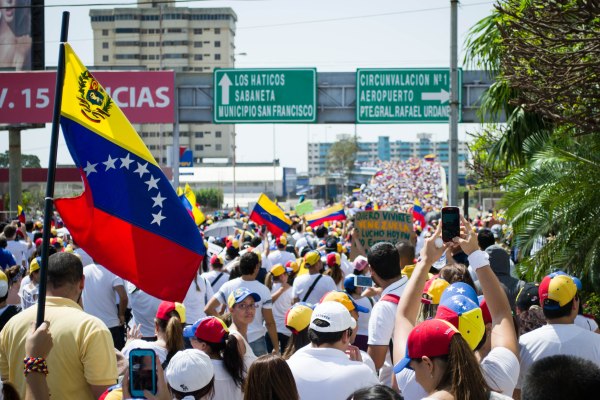
Thousands of protesters in Maracaibo, Venezuela. Photo Credit: Google Images / Creative Commons

2016 is proving to be this century’s most complicated year to date for South American political systems, and the coming months will be critical to assessing how well the region’s democracies can govern amid declining economic conditions and spiraling corruption scandals.  Brazil and Venezuela – two very different systems with very different problems – are suffering the most visible crises.

  • In Venezuela, where the Bolivarian project has descended into an incompetent Putinism in the tropics, is collapsing under the weight of monumental mismanagement of the economy. Many of the ills of the Venezuelan petrostate predate Chavismo, but during a collapse in oil prices President Maduro has doubled-down on profligate economic policies introduced by Hugo Chávez, bringing the country to catastrophe made worse by increasingly draconian repression of loyal and disloyal opposition alike.
  • President Dilma Rousseff’s mismanagement of coalitions in a presidential system predicated on coalition-building has opened the way to political and economic implosion in Brazil.  Contrary to the fervent assertions of important segments of the Workers Party (PT), her impeachment does not precisely constitute a coup, but it may indeed amount to an ill-advised bending of institutional mechanisms by cynical legislators and aggressive judges, egged on by rightist sectors whose commitment to democracy is in fact dubious.  Dilma didn’t invent the corruption and footloose budgetary practices that have been her undoing, but her fall does respond to overwhelming popular rejection of her performance.  Interim President Temer’s appointment of an entirely white male cabinet that includes representatives of some of the country’s most retrograde interests suggests abandonment of many of the most laudable achievements of more than a decade under PT rule – and more backlash as well.

Other institutional crises may be on the horizon.  Ecuadoran President Rafael Correa pursued a high-risk strategy of debt-driven expansion of the state, which is not sustainable amid economic contraction.  Argentine President Mauricio Macri’s honeymoon may prove short-lived.  Much-needed economic reforms are likely to provoke even greater inflation and have already stoked resistance from the Peronist opposition.  Macri enjoys some unprecedented assets – for the first time non-Peronists also control the city and province of Buenos Aires– but Argentine public opinion overwhelmingly favors statist economic policies that he aims to dismantle, and no non-Peronist elected president has completed his term in office since the rise of Peronism as a political force.  Chilean President Michelle Bachelet, wounded by a drop in mineral export revenues and comparatively minor corruption allegations involving her daughter-in-law, reshuffled her cabinet earlier this month but continues to tank in the polls.  Latinobarómetro reports that 70 percent of Chileans believe their political system doesn’t work.

It’s not hard to envision other relatively stable South American democracies facing hard times ahead.  The June 5 presidential runoff in Peru could leave the country deeply polarized, especially if Keiko Fujimori, heiress to the country’s darkest episode in recent history, wins.  It is not a foregone conclusion that Colombian President Juan Manuel Santos, who has staked his second term on a long-awaited and much-needed peace accord, will secure its ratification, risking lameduck status for the remainder of his administration.  If the presidents elsewhere appear to be weathering the storm, democratic governance nonetheless faces important challenges.  It would be rash to predict that democracy will fail the test – and that such failure will give rise to a new era of authoritarian rule – but it’s clear that the region will witness widespread instability during the coming years.

May 26, 2016

Haiti: Crisis Upon Crisis

By Fulton Armstrong

Haiti OAS

OAS Secretary General Almagro visits Haiti. Photo Credit: OAS / Flickr / Creative Commons

Haiti is stumbling, again, from one crisis into another, but the timing of this ongoing mess puts the United States and other international partners in a particularly bad position.  The country’s political institutions are dysfunctional, without an elected executive nor fully legitimate legislature, and efforts to rebuild them continue to be haphazard.  Under Interim President Jocelerme Privert (formerly leader of the Senate), the government has missed another deadline for resolving disputes over the first round of presidential elections held last October and re-running them or scheduling the second round.  Instead, Privert, who assumed the Presidency in February, on 28 April formed a five-member “verification panel” to take yet another look at allegations of first-round fraud and determine which candidates should participate in the runoff, with a 30-day deadline.  The deadline for Privert to step down passed on 14 May.

  • The move coincides with growing perceptions that Privert is enjoying the perquisites of the job and may be dragging things out on purpose. Both sides to the contested elections – supporters of Jovenel Moïse, former President Martelly’s hand-picked successor, and the opposition party’s Jude Célestin – are mobilizing crowds, some numbering thousands, for almost-daily protests.  Calls for Privert to resign are growing intense as suspicions of his own ambitions and imputed bias for or against one of the candidates surge.  Several dozen gunmen, allegedly directed by an enemy of Privert, shot up a police station in the southern city of Les Cayes earlier this week, resulting in six dead.
  • International reactions to Privert’s delays have been mixed but predictably of frustration.  The former leader of an official OAS mission to Haiti in early April supported the verification process, and OAS Secretary General Almagro said recently that elections “shouldn’t be rushed.”  But U.S. Secretary of State John Kerry last month condemned “this process of delay” and urged Haiti’s “so-called leaders” to act.  His Special Coordinator for Haiti Affairs, veteran diplomat Kenneth Merten, called the new verification process a “black box” and said it was “opaque and non-democratic.”

The political mess coincides with other serious challenges.

  • The World Food Program (WFP) is increasingly concerned about hunger caused by a three-year drought, aggravated by El Niño, and the country’s economic situation. Some 3.6 million Haitians (one third of the population) face “food insecurity,” including 1.5 million who are “severely food insecure.”  A U.S. program to send Haiti surplus peanuts, which is one of Haitian farmers’ most successful crops, has deflated prices and further hurt local food production.
  • Shortages of medical supplies, worsened by corruption, have prompted doctors to conduct strikes. High-profile cases, including the death of a bleeding pregnant woman at the entrance of the Port-au-Prince General Hospital, have led to dramatic demonstrations, on at least one occasion parading around a victim’s corpse.
  • Fear of spread of the Zika virus is rampant. The University of Florida recently confirmed that Zika was present in Haiti before the outbreak in Brazil last year.  (Carried by the same mosquito, Aedes aegypti, it was mistakenly identified as chikungunya, which has almost identical symptoms except microencephaly.)  Haiti’s cholera epidemic, which has killed 9,200 people since 2010, continues to claim about 50 lives a month, according to some estimates.

The usual threats by the United States and Haiti’s other international partners to suspend aid if the government doesn’t resolve the political impasse have been muted presumably because they’re unlikely to be credible while such major threats to Haitian citizens’ wellbeing loom large.  Haiti’s political and economic elites assume that the outsiders will care for the Haitian people and continue bailing the country out while they pursue their internecine struggles.  Former President Martelly, who is not free from blame for the elections impasse, has been in Miami these days to promote his autobiography ($50 a copy) and reestablish himself as a naughty boy Kompa musician.  The international community is, once again, in a lose-lose situation.  A previous caretaker government, headed by Gérard Latortue, lasted two years (2004-2006).  The United States and others can ill afford a deeper humanitarian disaster, so while Haitian elites fiddle, outsiders will try to put out the fires.

May 19, 2016

Peru Elections 2016: Back to the Future?

By Jo-Marie Burt*

Peru Elections 2016

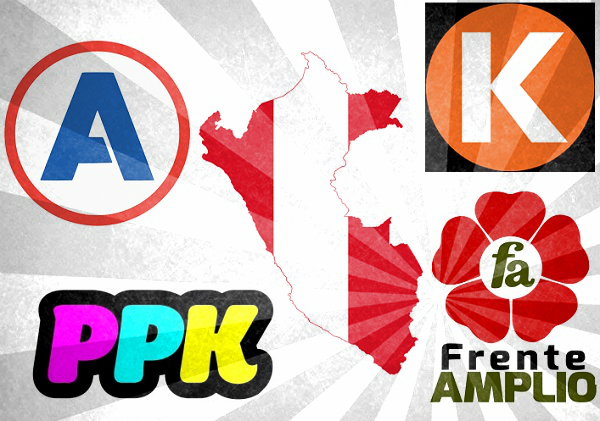
Photo Credits: Huhsunqu, Alex Albornoz, Alianza para el Progreso, Fuerza 2011, and Peruanos por el Kambio (modified) / Wikimedia / Creative Commons

Peruvian electoral authorities’ decision last month to disqualify two candidates in this weekend’s first-round presidential election has conjured up the ghosts of one of the most disputed elections in recent Latin American history: the “re-re-election” of Alberto Fujimori in 2000.  Large demonstrations this week against the candidacy of the strongman’s daughter, Keiko Fujimori, were a rejection of the corruption and authoritarianism of the past – as well as the electoral fraud that kept him in power.  The two candidates were disqualified for technical violations of campaign laws.  Newcomer Julio Guzmán, who polls indicated commanded around 20 percent of the vote, was punished because his party failed to follow certain registration norms, and the other, César Acuña, was accused of giving away gifts above newly set limits.  Local observers point out, however, that other leading parties are guilty of similar missteps but have faced no penalties.  Video and testimonials show, for example, Keiko Fujimori attended events where cash “prizes” were handed out.

The disqualifications have put the spotlight on the Inter-American Commission of Human Rights (IACHR), which disqualified candidate Julio Guzmán asked to investigate the decisions.  Postponing the election would be extremely disruptive, particularly because other political groups in Peru, which have benefited from Guzmán’s exclusion, have seized on the immediate political advantage.  The possibility that uneven application of the electoral rules might taint the credibility of the eventual winner is not their immediate concern.

  • The two immediate beneficiaries are Pedro Pablo Kuczynski (known by his initials PPK, which also identify his party, Peruanos por el Kambio), and Verónica Mendoza of the left-wing Frente Amplio. At 15-20 percent each, they are jockeying for second and third place behind Fujimori (30-35 percent), but the real race is in the runoff on June 5 that will take place in the likely event that no candidate wins 50 percent of the vote.  In the 2011 elections, Fujimori won the first round, but lost in the runoff vote to Ollanta Humala.  Fujimorismo has a hard-core following of 25-30 percent of the voting public, but a majority of the population also has a negative opinion of her.

Peruvian elections had come a long way since Alberto Fujimori fled office in 2000.  (In 2009, he was sentenced to prison for 25 years for human rights violations, corruption, and abuse of authority.)  Free and fair elections were held in 2001, 2006, and 2011 – marking the first time in Peruvian history that two democratically elected presidents consecutively handed the presidential sash over to successors.  Whether politically motivated or merely the result of incompetence, electoral authorities’ apparently one-sided handling of this year’s campaign has created an appearance of favoritism discrediting the electoral process itself.  The Secretary General of the Organization of American States, Luis Almagro, has already referred to these elections as “semi-democratic.”  Others speak openly of fraud.  The potential damage is compounded by popular concerns that Keiko Fujimori represents a return to the authoritarian and corrupt tactics that characterized her father’s decade in power.  Her detractors say that she is not simply her father’s daughter; she served as his First Lady and benefited from the corruption of his regime (for example, she testified before Congress that she accepted cash from intelligence chief Vladimiro Montesinos to pay for her college education).  Keiko has acknowledged “errors” (but not “crimes) were committed during her father’s government, and she continues to say her father’s regime was the “best” Peru has ever had.  These were bound to be contentious elections due to the divisive legacy Keiko Fujimori represents, as the massive nationwide demonstrations marking the April 5 “self-coup” on Tuesday made clear.  But the uneven application of the law by electoral authorities raises even more serious questions about Peru’s democratic institutions.

 April 7, 2016

*Jo-Marie Burt is Director of Latin American Studies and Associate Professor of Political Science at George Mason University and a Senior Fellow at the Washington Office on Latin America (WOLA).

Bolivia’s Constitutional Referendum Marks New Political Era

By Miguel Centellas*

Referendo Morales

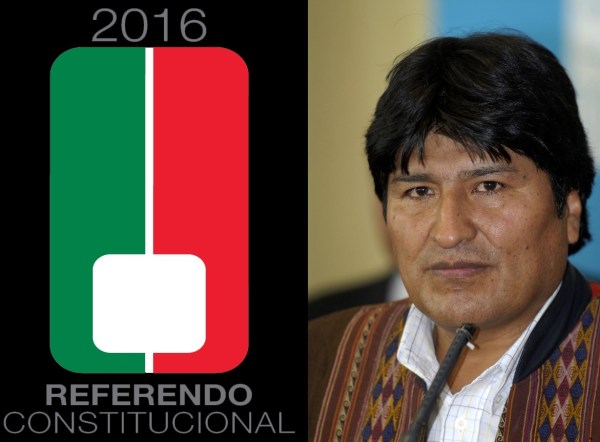
Photo Credit: Organo Electoral Plurinacional de Bolivia and Alain Bachellier, respectively / Wikimedia and Flickr / Creative Commons

Bolivian voters’ rejection last week of a constitutional amendment to allow an incumbent president to run for a third consecutive term is a setback for President Evo Morales but a step forward for the country.  Both the government and opposition understood the national referendum as a plebiscite on Morales, who is now the longest serving head of state in Bolivian history.  Had the referendum passed, Morales would have been able to run for a fourth five-year term in 2019.  (Because Morales was first elected in 2005, before the new constitution was approved in 2009, the high court decided that he was eligible to run for reelection in 2014.)  During the months leading up to the referendum vote, polls showed a narrow gap between the votes in favor of the amendment and the No votes, with a large number of undecided.

As the final count began to crystalize (the official count is not yet available), it became clear that No won by a slim margin (51.3% to 48.7%).  At first, Morales and members of his government disputed the results, arguing that late-arriving rural ballots would vindicate him.  Later, they claimed opposition fraud and manipulation, including a “dirty” war waged by the opponents and the media.  Several scandals, however, appear to have been the real cause of Morales’s loss.

  • New developments in lingering accusations of fraud committed at the Fondo Indígena, an organization established to support economic, social, and political development of marginalized peoples. Government auditors last year uncovered more than a hundred incomplete or non-existent projects valued at tens of millions of dollars.  The case involved several ex-ministers in Morales’s government and leaders of his MAS party.
  • New allegations of corruption involving Gabriela Zapata Montaño, a romantic liaison of the President in 2006 who is now an executive for a Chinese-owned company (CAMC) that was awarded a large number of no-bid contracts for government development projects. Some sources claim millions of dollars have been misappropriated.  Zapata was arrested shortly after the vote.
  • Accusations that the MAS (and, implicitly, Morales) instigated angry protesters to attack the municipal building in El Alto, Bolivia’s second largest city, killing seven people and injuring many others. The mayor, Soledad Chapetón, and La Paz provincial governor Felix Patzi, a former education minister under Morales, were the first two opposition candidates to win those positions since MAS came to power.  The government dismissed the allegations and suggested that Chapetón orchestrated the violence to make herself a martyr.

The results of the referendum – and, more importantly, the frenzied reactions from Morales and other high-ranking members of his government – make the immediate future appear uncertain.  Morales accepted the results of the referendum but also ominously pointed out that there are other ways to amend the constitution.  He also dared opponents to initiate a recall referendum to remove him.  Nevertheless, some members of MAS – showing eagerness to carry the party’s wide support among Bolivians into the future – have begun publicly discussing possible successors.  Another positive sign is that Bolivia’s electoral court showed itself to be truly autonomous, bolstering opposition confidence in a key institution.  The question is whether Morales believes his party (and by extension his legacy) is worth preserving, or whether he wants to risk them for another dubious bid for reelection.  Claims that Morales’s setback is part of a “conservative tide” sweeping through Latin America may be premature, but this referendum may have repercussions elsewhere.  Ecuador’s Rafael Correa’s public comments that he would not seek reelection in 2017 may now become firmer.  The day of the three- or four-term president seems over.

March 3, 2016

* Miguel Centellas teaches political sociology at the Croft Institute for International Studies at the University of Mississippi.

Hope Fading for Guatemalan Spring

By Ricardo Barrientos*

Jimmy Morales

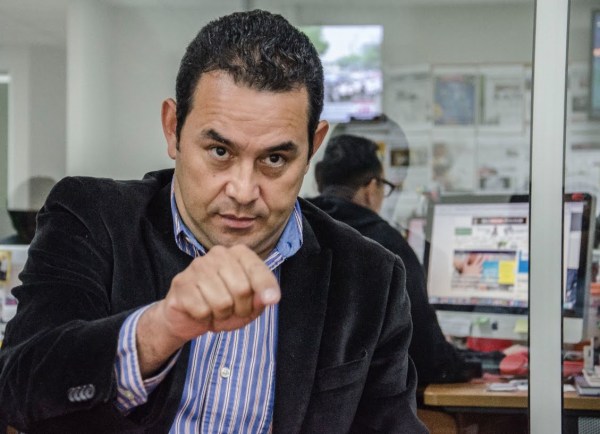
Photo Credit: Publinews Guatemala / YouTube / Creative Commons

The high hopes created by Guatemala’s peaceful, democratic change of government last year are hitting the shoals of reality.  Guatemalans managed a major political crisis in 2015 in an exemplary way: massive citizen demonstrations against authorities accused of corruption lasted four months without a single incident of violence.  Acceptably free and fair elections took place just three days after disgraced President Pérez Molina resigned, and a transition government was formed as mandated by the Constitution to govern until Jimmy Morales, the new Guatemalan President, was sworn in on January 14.  Although lacking experience, a cabinet, and a plan, Morales inspired confidence with a very good slogan (that he was “neither corrupt, nor a thief”) and good communication skills honed as a former TV comedian.  Voters had rejected and punished the “old politics” and felt hope that honesty would prevail.

Since Morales took office, however, serious mistakes have caused confidence to dim.

  • His reluctance or inability to answer questions from journalists and to refrain from underestimating audiences by telling silly jokes and childhood stories are raising concerns among observers of an emerging authoritarian personality.
  • Secrecy surrounding his cabinet selection process has led to missteps. His Minister of Communications, Infrastructure, and Housing was forced to resign after just 11 days in office – in the face of evidence of tax fraud and a serious conflict of interest.
  • His first approach to Congress was only to reverse the position on 2016 public debt cuts that his representatives advocated last November. Asking Congress to reduce debt proved popular back then, but now transfers to the Public Prosecutor Office or to the public university can be made only if the original debt amount is restored by Congress.  That condition is not only unpopular; it risks hampering the effort to prosecute corruption.
  • Instead of asking Congress for an urgently needed budget increase to solve ongoing shortages of medicines and equipment in public hospitals and clinics – almost a humanitarian tragedy, he accepted pharmaceutical company donations of expired medications – in a deal redolent of past corruption.
  • Morales’s political party, Frente de Convergencia Nacional (FCN), has grown substantially in Congress by receiving “turncoat” congressmen, directly contradicting an important campaign promise. “Turncoating,” jumping from party to party in Congress (always for a “price”), is one of the practices condemned in 2015 as part of the “old politics” and was strongly rejected by voters who trusted Morales.  The Public Prosecutor Office has received complaints denouncing bribes, government jobs, and contracts offered to “turncoats” now affiliating with the FCN.

Events in Guatemala over the past year present a huge contrast with what the country was a couple of decades ago – triumph for a society deeply marked by civil war, poverty, and brutal inequality, with the fresh hope of a new democratic spring.  Jimmy Morales appears to be squandering a historic opportunity to harness this democratic momentum.  Voters who set aside concerns about his links to right-wing Army veterans accused of crimes against humanity during the civil war could soon feel deceived because the “old politics” is still in place.  Guatemala’s democratic spring may fade before it blooms, sowing the seeds of crisis and instability in the future.

February 22, 2016

*Ricardo Barrientos is a senior economist at the Central American Institute for Fiscal Studies (Icefi).

Haiti: Postponed Elections, Ever-Deepening Crisis

By Emma Fawcett*

Haiti Elections 2016

Photo Credit: mackendy mentor, Kurious, and KeshtoKar (modified) / YouTube, Pixabay, and Wikimedia Commons / Licensed for noncommercial reuse

Postponement of Haiti’s protracted electoral process has triggered a seemingly existential crisis.  The January 24 vote, a runoff to select a president, was postponed indefinitely in the face of violent protests challenging the legitimacy of the first round in October.  Those elections trimmed the field of 54 presidential candidates down to two: President Martelly’s hand-picked successor, banana exporter Jovenel Moïse, and opposition candidate Jude Célestin.  While that round was mostly peaceful and the vote tallies were upheld by most outside observers (including the OAS), Haitian human rights groups and dissidents cited widespread cases of fraud and other irregularities.  Célestin disputed the count and boycotted the runoff, which he says Martelly rigged to install Moïse.  Martelly has dismissed the accusations, and the embattled Provisional Electoral Council has been unable to assuage the opposition alliance’s concerns.  Last week’s postponement of the runoff was the second, but the clock is ticking louder now because Martelly is scheduled to, and reaffirmed his intent to, step down on February 7.

  • The postponement triggered international pleas for a speedy resolution. The U.S. State Department condemned “electoral intimidation, destruction of property, and violence”; while the OAS, the UN, and the EU all issued calls for Haitians to come together to end the crisis.

International efforts to foster elections as a means of laying groundwork for political and economic stability in Haiti have repeatedly stumbled, even when stretching the rules to accommodate Haitian reality.  The OAS and the State Department intervened on Martelly’s behalf in the 2011 election by pushing him into the runoff and asking opponents to stand down.  In addition to providing up to $4 billion dollars in economic and reconstruction aid, the United States has since spent more than $30 million on the elections, and continued to push for them to go ahead as recently as January 21.  But these efforts have backfired, as members of opposition parties, the Haitian private sector, and the Catholic Church regard the electoral process as illegitimate and increasingly resent what they feel is U.S. interference.  The political crisis also jeopardizes economic development that Washington has encouraged.  Royal Caribbean, a cruise line that leases a recreational area on Haiti’s northern coast, skipped its port call in Labadie several times over the past week because small boats of protesters approached its ships. Protesters also threw rocks at the windows of the new Marriott hotel in Port-au-Prince.

Haitian democracy is – yet again – at a perilous juncture.  Martelly’s departure from office on February 7 will be disruptive, but his strong-arm tactics and entourage of shady characters threatened a peaceful transition of power anyway.  (His critics point out that an extension of his term in office is what he has sought all along.)  U.S. officials have spoken publicly of a transitional government emerging, but selecting one and imbuing it with credibility will be a massive task.  Business leaders have proposed that a “consensus” prime minister head an interim government for six months, during which a new Electoral Council would coordinate new elections, but the negotiations lack transparency.  If the government, the protesters, and the business community are unable to reach an agreement – as seems likely at this point – Haiti will face a power vacuum with increased violence that will be even more difficult to resolve. 

January 28, 2016

*Emma Fawcett is a PhD candidate in International Relations at American University.  Her doctoral thesis focuses on the political economy of tourism and development in Haiti, Dominican Republic, Cuba, and the Mexican Caribbean.

Bolivia: Implications of Referendum for Democracy and the MAS

By Santiago Anria*

Evo Referendum

Photo Credit: zak / Flickr / Creative Commons

A Bolivian referendum on February 21 – one month after the 10th anniversary of President Morales’s rise to power – threatens a break with the country’s tradition and the democratic principle of power alternation.  A “Yes” vote on the constitutional amendment up for approval would allow Morales and Vice President García Linera to run in 2019 for a fourth consecutive term – a scenario that the fragmented opposition claims would mean not only greater concentration of power in a personalistic leader but also a shift toward authoritarianism, similar to that in Venezuela.  The government claims that a “No” vote would mean the end of an era of unprecedented economic and democratic stability, the end of measures that have empowered subordinate groups in society, and the return of the right and neoliberalism.  Opinion polls so far show the vote will be close.

Morales’s efforts to extend his time in office are consistent with his tendencies to dominate politics and the policy process.  Yet my research shows that increased political incorporation during his government has also given previously marginalized groups enhanced influence over agenda-setting and policy-making and led to important shifts in domestic power relations.  In today’s Bolivia, well-organized interest groups typically belonging to the “informal” labor sector (such as coca growers, cooperative miners, and transportation unions) have greater influence over policy from within the state (in representative institutions and state bureaucracies at all levels) and from without (direct pressure in the streets).  This has resulted in greater regime responsiveness to the groups’ interests and in policies that expand economic and social benefits, as well as improvements in poverty and inequality reduction – even without meeting some of their fundamental needs such as employment and health care reform.  While in some instances newly empowered groups have mobilized and served as a check on state power, their role is founded on a highly particularistic relationship of the MAS and allied groups and, as such, can actually be an obstacle for governing in the interest of broader segments of society.

An intense government campaign in favor of the constitutional amendment is already under way and will likely deepen in the coming weeks.  The Morales government lacks the kind of epic framing it had when it first won the presidential election in 2005.  Citizens today express concerns similar to those voiced during previous governments – concentration of power, widespread corruption, inefficient institutions, weak protection of liberal rights, politicization of courts, and hostility to opponents and the press.  A “Yes” victory on February 21 would not automatically mean a shift to an authoritarian regime as core features of authoritarianism (i.e., power exercised by a small group overriding the will of the citizens) are not currently evident.  In addition, Morales’s tendencies to dominate often meet strong checks from a relatively autonomous civil society.  Comparative evidence suggests, however, that a fourth Morales term might lead to further power concentration and decreased political input from below — which could mean a weakening of the MAS as an organizational actor for the empowerment of subordinate groups independent of its undisputed leader.  A “No” victory, on the other hand, would not necessarily mean the end of the social and political transformations carried out by the MAS.  If nothing else, Bolivia’s “process of change” over the past decade has given rise to a “new normal” of more inclusive institutions and basic social programs that benefit large sectors of the population and will be difficult for any future government to reverse.

January 19, 2016

* Santiago Anria is a postdoctoral fellow at Tulane University’s Center for Inter-American Policy and Research.

U.S.-Cuba: Must “Democracy Promotion” Obstruct Normalization?*

By Fulton Armstrong

Photo Credit: Martin Burns / Flickr / Creative Commons

Photo Credit: Martin Burns / Flickr / Creative Commons

“Democracy promotion” has been one of the most contentious aspects of U.S. policy toward Cuba – and one of the most counterproductive – but it doesn’t have to be either.  The concept of democracy promotion is ingrained in U.S. policy culture, and the bureaucracies and programs they’ve been charged with conducting over the years are as bullet-proof as any in Washington.  Democracy promotion in different forms has been a main element of U.S. policy toward Cuba for decades. In the 1980s and early 1990s, the U.S. Interests Section conducted an array of outreach programs, engaging with Cuban academics, journalists, and officials – people tolerant if not deeply supportive of the Cuban government – as well as human rights activists and others “outside the system.”  These activities informed and nurtured the aspirations of Cubans in and outside the system who were eager to find Cuban solutions to their country’s mounting problems.  The Helms-Burton Act of 1996 moved democracy promotion into a more aggressive mode, explicitly linking it to regime change.  President Clinton spent token amounts on initiatives related to Cuba’s future transition, but the Bush Administration launched an expansion that has since cost U.S. taxpayers more than $250 million.  The arrest, conviction, and five-year imprisonment of USAID sub-contractor Alan Gross shed light on one such operation.  He smuggled sophisticated communication equipment onto the island to set up secret networks.  Associated Press investigative reporter Desmond Butler uncovered other programs involving communications and political operations against the Cuban government.

The investment has yielded some operational successes, but the impact toward promoting democracy has been negligible and, in important ways, counterproductive.  The program has delivered food, medicines, and other support to the families of imprisoned dissidents (many of whom have been released since Presidents Obama and Castro announced reestablishment of relations last December), but more provocative operations have arguably led only to arrests.  The amateurish clandestine tradecraft of the contractors and program activists, moreover, made it easy for Cuban counterintelligence to penetrate and manipulate their ranks.  The “private libraries” that U.S. taxpayers have paid for do not exist, and communications systems involving expensive satellite gear and satellite access fees have been compromised.  The secretive modus operandi of the operations has given credibility to draconian Cuban government measures, like Law 88 for “Protection of Cuba’s National Independence and Economy,” imposing prison terms for certain contact with foreigners “aimed at subverting the internal order of the nation and destroying its political, economic, and social system.”  Authentic people-to-people exchanges have been tainted as Cubans in the government and on the street are wary that any contact could be part of Washington’s regime-change efforts.

The democracy promotion ideology and bureaucracy seem unstoppable, but Presidents Obama and Castro can take the edge off this irritant with a little effort and flexibility, and even make it mutually beneficial.  The State Department and USAID have pledged to continue the Cuba democracy promotion programs and are asking Congress for $20 million to fund them again this year, but the President’s statement that “it is time for us to try something new” suggests acknowledgment that they need not be so ineffective and counterproductive.  For starters, the Administration could stop citing Helms-Burton authorities, which are explicitly for regime change, and establish criteria for operations in Cuba similar to those in other countries with whom the U.S. has diplomatic relations and is trying to improve bilateral ties.  It could restore and expand what worked in the past, such as the distribution of books and clippings; support for exchange visits; promotion of academic and cultural events; and other non-political activities that include people with government affiliation.  Perhaps most importantly, to decontaminate the programs, the organizations that have already spent millions trying to drive regime change should step aside and let a new generation – based on real people-to-people interests – try something different with the funds.  Both Presidents can trust their citizens to develop the historic roadmap that will define the relationship into the future.  Both the United States and Cuba stand to benefit.

September 25, 2015

*This article is excerpted from the second in a series of policy briefs from the CLALS Cuba Initiative, supported by the Christopher Reynolds Foundation. To read the full brief, please click here.