Brazil: Is Democracy Under Threat?

By Marcio Cunha Filho*

A large group of Brazilians wave the Brazilian flag

A rally supporting former president Luiz Inácio Lula da Silva in October 2017. / Eduardo Figueiredo / Midia NINJA / Flickr / Creative Commons

Brazil’s ongoing political turmoil hit a new peak last weekend – resulting in former President Luiz Inácio Lula da Silva’s decision to turn himself in to be imprisoned – and strongly suggests that the country’s democracy is in deeper trouble than previously thought.  Lula said he was a victim of political persecution by both prosecutors and the courts, including the six Supreme Court justices who ruled that he not be allowed the courtesy of remaining free during his appeals to Brazil’s higher courts on his conviction on corruption charges.

  • Lula’s Worker’s Party (PT) claims that the decision is part of a campaign against leftwing forces that has intensified since Dilma Rousseff’s impeachment in August 2016. Supporters say that Lula’s imprisonment at a time that he is leading in presidential polls is the culmination of a strategy aimed at making sure that the PT – the only party to have won the presidency in elections since 2002 – remains out of power.  Most mainstream media and some rightwing lawyers have argued that Lula’s arrest obeyed all legal procedures, but PT supporters are not alone in their allegation of impropriety.  José Afonso da Silva, one of the most prominent non-partisan constitutional law professors in Brazil, has written a legal opinion against Lula’s imprisonment.  Other experts claim that Lula’s imprisonment order was strangely rushed (jurist Celso Antônio Bandeira de Mello), while others have expressly criticized the Supreme Court for denying Lula Habeas Corpus (Prof. José Geraldo da Silva Júnior).
  • While proof remains elusive, strong circumstantial evidence of conspiracy persists. The lawsuit against Lula was tried much more rapidly by Judge Sérgio Moro than most cases, and the guilty verdict was reaffirmed by the regional court just in time to keep Lula out of the presidential election scheduled for October 7.  Moreover, the accusations against Lula are fragile:  Moro argues that the former president received a $1 million remodeled beach apartment as a bribe from a construction company in exchange for political favors, but there is no evidence that the apartment was Lula’s or that he used it in any way.  Neither is there evidence that the construction firm received any favors.

Other indications that Brazil is experiencing an “open season” against the left are emerging.  Civil society leaders have reported repressive practices against them, including violent protests at their public events.

  • The assassination of a Rio de Janeiro municipal legislator is widely thought to have been carried out by rightwing elements. At a recent political rally, unidentified gunmen shot at Lula’s vehicle.  A wealthy São Paulo night club owner is offering a reward for anyone willing to murder Lula in prison.  Radical and angry political movements such as Movimento Brasil Livre are gaining strength by angrily advocating and celebrating through social media the imprisonment of political opponents.  Congressman Jair Bolsonaro, a former military officer who praises the military dictatorship, has become the new frontrunner in the presidential race.
  • Another troubling sign was a tweet from the Armed Forces – issued the day before the Supreme Court’s judgment against Lula – that it will not tolerate impunity. It has been widely interpreted as the most direct threat to the Court since the end of military dictatorship.
  • Freedom of expression and academic freedom are under pressure as well, according to many observers. Local, state, and federal legislators are trying to ban the teaching of gender issues in public schools, claiming gender issues are a leftwing ideology should not be taught to young children.  At the university level, in Rio Grande do Sul a local congressman filed a complaint to the Public Prosecutor’s Office asking that a course entitled “The 2016 Coup d’état” – referring to the removal of Dilma Rousseff and inauguration of President Michel Temer – be disallowed.

Democracies rarely die as a result of the acts by one or even a small group of political leaders, but rather as the outcome of repressive actors’ manipulation of popular confusion and anxiety about the country’s direction.  Lula may not have been perfect – he was not – but he deserved fair treatment by the government and fair enforcement of the law.  Democracies cannot endure when one group or another uses government institutions, even with significant popular support, to impose its views on others, often violently.  We should not forget that, in its early stages, the military coup in Brazil was supported by the media (at least by the biggest TV network in the country, Rede Globo), by civil society institutions (such as the Ordem dos Advogados do Brasil), as well as by much of the political leadership.  Radicalization, inability to dialogue, and unwillingness to make political compromises are the factors that made Brazil descend in 1964 into two decades of repression.  We might now be slipping down this same path, and witnessing the rebirth of institutionalized and popularly-supported repression and intolerance.

April 10, 2018

* Marcio Cunha Filho is a Ph.D. candidate at the University of Brasília; federal auditor in Brazil’s Office of the Comptroller General; and former CLALS Research Fellow.

Ecuador: Referendum Marks Critical Juncture for Moreno and Correa

By John Polga-Hecimovich*

Two men sit at a table with a yellow background

Current President of Ecuador Lenín Moreno (left) and ex-President Rafael Correa (right) during the presidential transition last spring. / Micaela Ayala V / ANDES / Flickr / Creative Commons

A national referendum in Ecuador this Sunday appears likely to give a boost to President Lenín Moreno in his political struggle against his predecessor, Rafael Correa (2007-2017).  The central item on the seven-question ballot will be whether or not presidential term limits should be reinstated into the Constitution – an initiative that Correa, who would like to run for a fourth term in 2021, is campaigning against.  The country appears poised to move on from the thrice-elected yet polarizing Correa to the more conciliatory Moreno; at the time of writing, citizens resoundingly endorse all seven referendum questions, with no question polling lower than 66 percent approval.  A “yes” vote on term limits would end Correa’s future presidential aspirations and position Moreno – Correa’s hand-picked successor – as the standard bearer of the political left in Ecuador.

  • The feud between Moreno and Correa – and within their ruling Alianza PAIS (AP) party – has been building for nearly a year and a half. Last November, one of Moreno’s closest advisors, Eduardo Mangas, alleged in a leaked recording that Correa hoped Moreno would lose the election.  Correa purportedly provided no logistical or financial support for his chosen successor while saddling him with the deeply unpopular Jorge Glas as running mate.  According to Mangas, Correa preferred that AP lose the presidential election and instead govern through its control of the vast state bureaucracy and National Assembly – with Correa returning to the presidency in 2021.  Eking out a narrow victory (51.6 percent against Guillermo Lasso’s 48.8 percent), Moreno upended this plan.
  • The morenista and correista factions have divided the AP since Moreno took office in May 2017. Vice President Glas, a Correa ally accused of taking $13.5 million in bribes from the Brazilian construction firm Odebrecht, was sentenced to six years in prison and impeached as part of Moreno’s campaign against corruption.  The AP Secretary, a correista assemblywoman, tried to remove Moreno as party head after he alleged the party put a hidden camera in his office.  Correa and 28 legislative deputies have left the party and formed what they are calling the “Citizen’s Revolution Party.”

Moreno took office facing a polarized political environment and daunting fiscal deficit and weak GDP, but his sound policies and astute political strategy have given him the highest approval ratings in Latin America.  His focus on the popular valence issues of corruption and re-election – about which citizens will usually share a common preference regardless of ideology – has also helped distract voters from the tepid economy.  The referendum is a particularly smart gambit.  It proposes seven different changes that would reverse actions taken during Correa’s rule – and that happen to enjoy broad popular support.  Instead of trying to push them through established institutional channels staffed with correistas, like the National Assembly or the courts, the President is turning directly to the public to give the measures legality.

Absent any bombshell announcements or drastic changes in public opinion, Moreno looks set to coast to victory in the referendum, quite remarkably establishing him as the country’s most powerful politician.  However, he faces a number of challenges to governance over the remainder of his four-year term.  The defection of Correa and his faction from Alianza PAIS left him with only 46 seats in the 137-member National Assembly.  This means Moreno’s bloc will continue to depend on ephemeral voting alliances with the center-right to govern – exactly like much of the 1979-2006 period when no popularly elected president finished his term.  Moreover, after 2.7 percent GDP growth in 2017, the IMF predicts that Ecuador’s economy – vulnerable because of its dependence on oil exports – will grow by only 2.2 percent in 2018 and 1.7 percent in 2019.  Moreno should enjoy his victory on Sunday, but he will soon face challenges greater than Rafael Correa: long-term governance in a country that has long proven averse it.  Whether he is up to the challenge remains to be seen, although he has so far proven resourceful.

February 2, 2018

*John Polga-Hecimovich is an Assistant Professor of Political Science at the US Naval Academy.  The views expressed in this article are solely those of the author and do not represent the views of or endorsement by the Naval Academy, the Department of the Navy, the Department of Defense, or the US government.

Mexico: Migrants Getting Political but Not Driving Reform

By Michael S. Danielson*

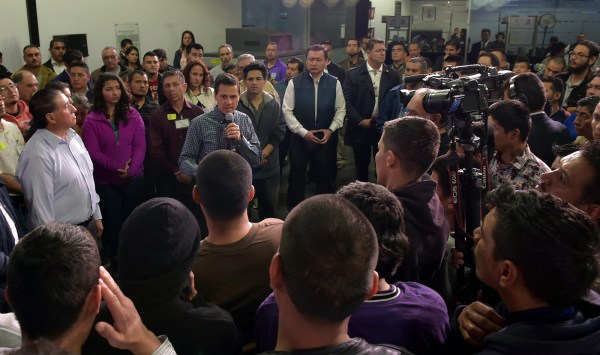
A large group of people gathers in an airport.

Returning Mexican migrants are greeted upon their arrival in Mexico by Mexican President Enrique Peña Nieto. / Presidencia de la República Mexicana / Flickr / Creative Commons

Mexican migrants who currently live in the United States or have returned home after spending many years abroad have become an important social and political constituency in the Mexican polity, but they do not uniformly enhance local democracy.  A growing body of research indicates that migrants affect the politics of their home towns and home countries through both direct and indirect channels.  Their departure releases pressure on prevailing authorities to reform, and the prospect of future migration causes citizens to disengage from the political process.  Friendships, alliances, and other contacts allow migrants to become intimately involved in their home communities from abroad as they communicate their attitudes and ideologies among themselves and friends and relatives back home.  Returning home with accumulated social, political, and economic capital also enables them to become influential leaders there.

  • Analysis of the municipalities to which U.S.-based migrants provide financial support, for example, shows that migrants are more likely to contribute where migrant civil society has become more deeply institutionalized at the state level and in municipalities and states with longer histories of migration.
  • A survey of more than 400 mayors in Oaxaca shows that migrants returning to their home communities who become mayors are more likely to be members of the popular classes than their non-migrant counterparts, suggesting that migration might be a pathway to power for non-elite individuals. But the same data also show that migrant mayors are just as likely to align with dominant political groups as with opponents of the status quo, suggesting the limits of their transformative and democratizing potential.

Field research shows different outcomes in different states.  In Oaxaca – where the exclusion of migrants from influence has alienated them from the governing party (an attitude further fueled by their experiences of exploitation and resistance as migrants in Mexico and California) – returnees tend to enter the political fray in opposition to dominant powers.  In contrast, the returning migrants who have been most influential in the states of Guanajuato and Zacatecas have tended to be mobilized by and act in support of the dominant parties in their states.  The institutionalization of the state-migrant relationship in these states facilitates migrant social and political engagement with governing parties.

  • Ethnographic data in 12 high-migration municipalities in Oaxaca, Guanajuato, and Zacatecas indicate, moreover, that the political engagement of returning migrants resulted in increased political competition that, in all but one case, caused factionalism and a divided opposition at best and deep, violent social conflict at worst. In the remaining six municipalities, dominant political actors either incorporated migrants into the prevailing system by establishing neocorporatist equilibria or successfully blocked the influence of migrant actors all together, despite high levels of migration.

Returning migrants’ political influence will only increase.  The historic flow – some 16 million Mexicans entered the United States in the 50 years since 1965 – has been reversed, as more migrants are returning to Mexico than entering the United States.  The economic, social, cultural, and political ties forged between communities on both sides of the border are growing, and the futures of the two countries are more intertwined than ever.  The economic and social importance of migration in some municipalities helps migrant political actors gain influence back home, and it can open up a pathway to local power for historically excluded social groups, even if – as in the cases that I have examinedthis influence has only rarely translated into fundamental changes in the way that politics are done.  The engagement of millions of Mexican migrants in their home towns has not resulted in thousands of political earthquakes, but rather the Mexican political system is incorporating these new actors without instituting fundamental changes to the way that politics are done.

 January 4, 2018

*Michael S. Danielson is CLALS Research Fellow and Visiting Professor at the University of California Washington DC Program.  His new book, Emigrants Get Political: Mexican Migrants Engage Their Home Towns, was published by Oxford University Press.  He has also participated in CLALS’ North America Research Initiative as a Pastor Scholar.

Migrants Make Family Back Home Critical of Government

By Clarisa Pérez-Armendáriz and David Crow*

9017797074_eccf684eb1_b

A mural depicting the transnational migrant experience. / Max Herman / Flickr / Creative Commons

Latin American citizens who discuss politics and belong to a transnational household – a household in which at least one member lives abroad – are more critical of their democracy than those who discuss politics but have no household members abroad.  In our recently published report, we use data from 2006-08 Americas Barometer surveys in 20 Latin American countries to demonstrate that among transnational household members (THMs) with an emigrant living in the United States, assessments of how democratic their country is, satisfaction with their country’s currently existing democracy, and pride in their democratic system all decline as discussions about politics become more frequent.

THMs talk about politics with their emigrant household members across international borders.  When they hear about the political and social system in the U.S., they become more aware that they have reason to be critical of their system’s performance, and judge their own democracy more harshly.  Skeptics counter that migrants and their children – particularly ethnoracial minorities – are marginalized, second-class members of receiving societies, which would logically alter the impact of their communications with THMs.  Public opinion polls show, however, that immigrants embrace and adopt their host country’s political beliefs and behaviors within as little as two years and that their social, political, and religious organizations give them a feeling of civic engagement they did not have back home.  Furthermore, even when conditions abroad are difficult, civil liberty protections in the U.S. enable immigrants to mobilize politically and to demonstrate a greater sense of personal efficacy – two traits that THMs respect.

  • Even absent cross-border political discussions, having a household member abroad shifts THMs’ sense of political community to include co-nationals living both at home and abroad. In turn, THMs expect their government to deliver the goods of democracy to its citizens wherever they live.  Data from the Mexico, the Americas, and the World survey in 2014 provide initial support for this claim.  Among Mexican THMs, 65 percent described “protecting nationals abroad” as a very important foreign policy objective, compared to 52.8 percent of non-THMs.  Furthermore, this policy emphasis indirectly influenced negatively their feelings toward President Enrique Peña Nieto, giving him a slightly lower “thermometer score.”
  • To the extent that THMs’ everyday talk (with other THMs or non-THMs living in Latin America) about politics revolves around this transnational sense of community (in contrast to the narrower national identity of non-THMs) THMs become aware that they have even more reasons to be critical of their government’s performance than do fellow citizens without migrant connections. Our analysis of this rests entirely on the case of Mexico, but we believe it holds elsewhere in Latin America since, of all the countries in the region, Mexico provides the most extensive range of services to its citizens abroad.

The 2006-08 Americas Barometer data that we used predates major shifts in U.S. immigration policy during President Obama’s term and, in particular, the hard shift in rhetoric, roundups of undocumented migrants, and deportations during these first months of the Trump Administration.  The sense of political efficacy that democratic rights to mobilize and protest produces among immigrants may decline in impact if, as reported, migrants are keeping a low profile out of fear of capture or harassment.

July 5, 2017

 *Clarisa Pérez-Armendáriz is an Assistant Professor at Santa Clara University. Her research, which focuses on how immigrants influence politics in their origin countries, has appeared in Comparative Political Studies and Studies in Comparative International Development.  She is also a participant in the Robert A. Pastor North America Research Initiative.

*David Crow is an Associate Professor of International Studies at CIDE (Mexico City). He is co-PI (and past director) of the Americas and the World survey on international relations and the Human Rights Perceptions Polls, and formerly Associate Director of the Survey Research Center at UC Riverside.  His research has appeared in Comparative Politics, Comparative Political Studies, Political Psychology, Human Rights Quarterly, and elsewhere.

Venezuela- OAS: New Chapter in a Long Story

By Stefano Palestini Céspedes*

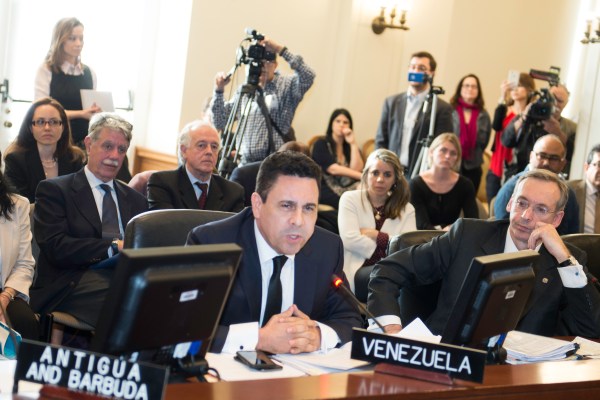
Special Meeting of the Permanent Council, April 3, 2017

On April 3, a special meeting of the OAS Permanent Council voted to condemn Venezuela’s action that allows the Tribunal Supremo de Justicia (TSJ) to take over the functions of the National Assembly. / Juan Manuel Herrera/ OAS / Flickr / Creative Commons

Venezuelan President Nicolás Maduro seems determined to validate critics’ claims that the separation of powers in Venezuela has been breached, thereby strengthening diplomatic efforts to force him to reverse course.  After the OAS Permanent Council met for two days to discuss Secretary General Almagro’s call for Caracas’ suspension, Venezuelan courts on March 29 authorized the Tribunal Supremo de Justicia (TSJ) to take over the functions of the National Assembly, and to limit the immunity of the members of the parliament.  The action reinvigorated an exhausted domestic opposition and further infuriated international observers.  Two days later, the TSJ overturned the two rulings after Maduro, casting himself as a mediator between competing constitutional powers, requested it.  These erratic actions signaled the worsening erosion of the rule of law as well as the divisions in the government and the Bolivarian movement.

  • The reversal did not take the edge off OAS General Secretary Almagro’s and others’ condemnation of the power grab as an autogolpe or “self-coup.” The Inter-American Democratic Charter was designed in 2001 precisely to provide the OAS with instruments to deter self-coups in the aftermath of those carried out by Alberto Fujimori (Peru) and Jorge Serrano (Guatemala) in the 1990s.

The TSJ decisions and Venezuela’s defiance didn’t put Almagro’s suspension efforts over the top, but the Permanent Council is now much more actively involved in the crisis.  Venezuela has isolated itself within the Permanent Council.  Speaking at the Council, its delegation severely criticized individual member states the day before the TSJ decisions.  Chile and Peru recalled their ambassadors for consultation after it.  Ecuador, an ally since the time of Hugo Chávez, distanced itself from Maduro.  On April 1, MERCOSUR invoked the Protocol of Ushuaia – the group’s democracy clause – against Venezuela, and it joined Colombia and Chile in a forceful public statement on behalf of UNASUR.  Mexico, historically a jealous guardian of the principle of non-intervention, has assumed the leadership in holding Venezuela accountable for its undemocratic practices.  As a result, the Permanent Council on April 3 approved a resolution condemning the TSJ decisions and committing to “undertake as necessary further diplomatic initiatives to foster the restoration of the democratic institutional system,” including convening a ministerial meeting.

Building a consensus for tougher action in the Permanent Council will be difficult, however.  Last week’s resolution was approved by 19 member states, but four abstained and 10 were absent.  Any proposal to suspend Venezuela will require two-thirds of the members’ affirmative votes.  Although there is still a long way to go to make the OAS part of the solution of the Venezuelan crisis, the General Secretary’s activism has set an important precedent in rallying a majority of states in the Americas to come together to discuss a member’s erosion of democratic principles and institutions – and to condemn the non-democratic actions of a democratically-elected government.  This is a first for the organization, and it is a big step toward fulfilling the original purpose of the drafters of the Inter-American Democratic Charter.

April 10, 2017

* Stefano Palestini Céspedes is a CLALS Fellow and Postdoctoral Fellow at the Department of Political and Social Sciences at the Freie Universität Berlin, where he specializes in international organizations and regional governance.

Latin America: The Spirit of Constitutionalism under Attack

By Maxwell Cameron*

Venezuela constitition

A participant in a march in Venezuela holds up the country’s constitution. / TeleSURtv / Flickr / Creative Commons

Recent events in Paraguay and Venezuela raise yet again the issue of whether political leaders are capable of deliberating and acting in ways that show an appreciation for constitutional essentials, or whether they choose instead to perform their roles and offices in ways that continuously test constitutional principles and, over time, contribute to their erosion.  The principles of re-election and term limits are important in every presidential democracy, the product of historical circumstance.  In the case of Paraguay, a dictatorship under strongman Alfredo Stroessner from 1954 to 1989, sensitivity to the idea of a president serving for too long is strong.  Venezuela’s elimination of term limits a few years ago set a dangerous precedent.  Other constitutions limit incumbents to one term (Mexico, Paraguay) or two terms (United States, Colombia); in some constitutions, presidents cannot be re-elected immediately but can run later after a term has elapsed (Peru, Uruguay).

  • More important than the constitutionality of term limits is that the re-election issue be settled in a way that commands the assent of all parties – within a certain spirit of constitutionalism. Paraguayan President Horacio Cartes’s error was to think that he could change the constitution by means that violated this spirit, even if the public would arguably support a modification of the re-election rule if pursued in the right way.  (Since the fall of Stroessner, the Partido Colorado, the pillar of his rule, has won every election except in 2008, when Catholic priest Fernando Lugo was elected.  Lugo was deposed in 2012.)  The President of the Senate, Roberto Acevedo, opposed the change and was outraged by the way it was adopted: the Senate voted in a special session held behind closed doors.  In that session, 25 Senators approved the measure, bypassing the opposition Partido Liberal Radical Auténtico.

The showdown in Venezuela over President Maduro’s effort to shut down the congress was another undemocratic blunder.  A decision by the Tribunal Supremo de Justicia (TSJ), Venezuela’s supreme court, to arrogate legislative functions to itself or delegate them to other branches or agencies was unconstitutional.  (The TSJ has the power only to declare a law invalid or that another branch of government is operating outside the law.)  When the Fiscal General de la República, Venezuela’s equivalent of attorney general, Luisa Ortega Díaz argued that the TSJ’s decision was unconstitutional, she gave herself political cover by expressing loyalty to the Constitution of 1999 – the legitimacy of which has long been undermined by the fact that it is a document made to measure for chavismo.  As a result of this and significant domestic and international pressure, the government backed down – a rare event.  The attorney general’s insistence that the constitution not be violated indicates that a spirit of constitutionalism among chavistas is not completely dead, but it also shows that it remains a mechanism for coordinating the actions of agents within the government.  Her position also raises the possibility of a split between constitutionalists and hardline militarists within the regime.

Democracy is not just a system of rules.  It requires politicians to acknowledge and respect the essential constitutional agreements that have to underpin the struggle for power in a self-governing community.  The crises in Paraguay and Venezuela both forewarn of the dangers of excessive partisanship and the risks of playing fast and loose with constitutional rules.  Something similar seems to be playing out in Ecuador, where allegations of fraud have been made by the opposition.  If spurious, they are condemnable; if supported by evidence, they are deeply disturbing.  Either way, they reflect mistrust in institutions after a decade of rule by Rafael Correa (Likewise, U.S. Senate Republicans’ threats to use of the “nuclear option” to confirm Judge Gorsuch threatens to deepen the politicization of the U.S. Supreme Court.)  The cost of the failure of politicians and citizens to cultivate a spirit of constitutionalism is very heavy.  In Paraguay, it has resulted in deadly protests and resignations by top officials; in Venezuela it has taken the country to the brink of civil war; in Ecuador, there is a real prospect of debilitating governance problems as Lenín Moreno of Alianza PAIS takes office; and in the United States we are starting to see the kinds of governance problems that have long been associated with the “politicized states” (to use Douglas Chalmers’s phrase) of Latin America.

April 5, 2017

* Maxwell A. Cameron is Director of the Centre for the Study of Democratic Institutions at the University of British Columbia.

OAS-Venezuela: Almagro Ups the Ante

By Stefano Palestini Céspedes*

32009916073_0a79dea9a2_k

Luis Almagro, OAS Secretary General, met with Freddy Guevara, First Vice President of the National Assembly of Venezuela, in Washington, DC in early February 2017. / Juan Manuel Herrera, OAS / Flickr / Creative Commons

OAS Secretary General Luis Almagro’s second report on Venezuela, issued on March 14, reflects his personal commitment to enforce the principles enshrined in the Inter-American Democratic Charter, but risks getting ahead of the organization’s member states and could ultimately hurt the credibility of the charter and OAS.  The 73-page document states that the government of Venezuelan President Nicolás Maduro has become a “dictatorial regime” that violates “every article” of the Charter; concludes that all attempts at dialogue have failed; and essentially calls for the OAS to suspend Venezuela’s membership in accordance with the charter’s democracy clause.  Almagro said the UNASUR negotiation (supported by the Vatican) has failed to achieve any of its proposed objectives and has become “a tool for reinforcing the regime’s worst authoritarian features domestically and, externally, for not engaging in international condemnation and pressure.”

  • The report concludes with an ultimatum: If the government does not call for general elections, release all political prisoners, restore all laws it has annulled, and select a new electoral authority and a supreme tribunal in the next 30 days, Venezuela should be suspended from the OAS. Few observers believe Maduro could meet these conditions even if he wanted.

Almagro’s actions, including his forceful call for application of Article 21 of the Charter – the “democracy clause” – moves his office and the OAS into uncharted territory as it would be the first time it is applied against an elected government.  Article 21 was applied against the government in Honduras that came to power in a coup in June 2009, but the sanctions were initiated at the request of ousted President Zelaya and strongly supported by Latin American governments – including Hugo Chávez – and Washington.  To enforce Article 21 against an incumbent government, a strong consensus needs to be built.

The Secretary General’s showdown with President Maduro presents a test for the Charter and, ultimately, for the OAS, as it pushes the organization beyond its traditional institutional limits.  Any decision on suspension must be approved by a two-thirds majority of member states, whose delegates represent executive branches that traditionally have shied from intervening in each other’s affairs.  Some insiders also grumble that the Secretary General has fallen short in his consultation with the member states; instead he seems to take a partisan position such as by inviting Maduro’s opposition to OAS headquarters this week for a press conference.  If the members back Almagro’s call for suspension, he will have demonstrated that principled arguments can break even strong institutional barriers – moving OAS into a new phase.  In that case, the Secretary General together with the member states will need to come up with a post-suspension plan; only then will OAS become part of the solution to Venezuela’s crisis.  If member states do not support the Secretary General’s call, Almagro will be respected as a leader moved by convictions, but the OAS will probably move one step down towards irrelevance.

March 21, 2017

Stefano Palestini Céspedes is CLALS Fellow and Postdoctoral Fellow at the Department of Political and Social Sciences at the Freie Universität Berlin, where he specializes in international organizations and regional governance.

2017: Happy New Year in Latin America?

By Eric Hershberg and Fulton Armstrong

posse_de_michel_temer_3

Brazilian President Michel Temer surrounded by members of his party in mid-2016. His government will continue to face questions of legitimacy in 2017. / Valter Campanato / Agência Brasil / Wikimedia / Creative Commons

The year 2016 laid down a series of challenges for Latin America in the new year – not the least of which will be adapting to a radically different administration in Washington.  Last year saw some important achievements, including an elusive peace agreement in Colombia ending the region’s oldest insurgency.  Several countries shifted politically, eroding the “pink tide” that affected much of the region over the past decade or so, but the durability and legitimacy of the ensuing administrations will hinge on their capacity to achieve policy successes that improve the well-being of the citizenry.  The legitimacy of Brazil’s change of government remains highly contested.  Except in Venezuela, where President Maduro clung to power by an ever-fraying thread, the left-leaning ALBA countries remained largely stable, but the hollowing out of democratic institutions in those settings is a cause for legitimate concern.  Across Latin America and the Caribbean, internal challenges, uncertainties in the world economy, and potentially large shifts in U.S. policy make straight-line predictions for 2017 risky.

  • Latin America’s two largest countries are in a tailspin. The full impact of Brazil’s political and economic crises has yet to be fully felt in and outside the country.  President Dilma’s impeachment and continuing revelations of corruption among the new ruling party and its allies have left the continent’s biggest country badly damaged, with profound implications that extend well beyond its borders.  Mexican President Peña Nieto saw his authority steadily diminish throughout the course of the past year, unable to deal with (and by some accounts complicit in) the most fundamental issues of violence, such as the disappearance of 43 students in 2014.  The reform agenda he promised has fizzled, and looking ahead he faces a long period as a lame duck – elections are not scheduled until mid-2018.
  • The “Northern Triangle” of Central America lurches from crisis to crisis. As violence and crime tears his country apart, Honduran President Hernández has devoted his energies to legalizing his efforts to gain a second term as president.  Guatemala’s successful experiment channeling international expertise into strengthening its judicial system’s ability to investigate and prosecute corrupt officials is threatened by a weakening of political resolve to make it work, as elites push back while civil society has lost the momentum that enabled it to bring down the government of President Pérez Molina in 2015.  El Salvador, which has witnessed modest strides forward in dealing with its profound corruption problems, remains wracked with violence, plagued by economic stagnation, and bereft of decisive leadership.
  • Venezuela stands alone in the depth of its regime-threatening crisis, from which the path back to stability and prosperity is neither apparent nor likely. The election of right-leaning governments in Argentina (in late 2015) and Peru (in mid-2016) – with Presidents Macri and Kuczynski – has given rise to expectations of reforms and prosperity, but it’s unclear whether their policies will deliver the sort of change people sought.  Bolivian President Morales, Ecuadoran President Correa, and Nicaraguan President Ortega have satisfied some important popular needs, but they have arrayed the levers of power to thwart opposition challenges and weakened democratic institutional mechanisms.
  • As Cuban President Raúl Castro begins his final year in office next month, the credibility of his government and his successors – who still remain largely in the shadows – will depend in part on whether the party’s hesitant, partial economic reforms manage to overcome persistent stagnation and dissuade the country’s most promising professionals from leaving the island. Haiti’s President-elect Jovenel Moise will take office on February 7 after winning a convincing 55 percent of the vote, but there’s no indication he will be any different from his ineffective predecessors.

However voluble the region’s internal challenges – and how uncertain external demand for Latin American commodities and the interest rates applied to Latin American debt – the policies of incoming U.S. President Donald Trump introduce the greatest unknown variables into any scenarios for 2017.  In the last couple years, President Obama began fulfilling his promise at the 2009 Summit of the Americas in Trinidad and Tobago to “be there as a friend and partner” and seek “engagement … that is based on mutual respect and equality.”  His opening to Cuba was an eloquent expression of the U.S. disposition to update its policies toward the whole region, even while it was not always reflected in its approach to political dynamics in specific Latin American countries.

 Trump’s rhetoric, in contrast, has already undermined efforts to rebuild the image of the United States and convince Latin Americans of the sincerity of Washington’s desire for partnership.  His rejection of the Trans-Pacific Partnership – more categorical than losing candidate Hillary Clinton’s cautious words of skepticism about the accord – has already closed one possible path toward deepened ties with some of the region’s leading, market-oriented economies.  His threat to deport millions of undocumented migrants back to Mexico and Central America, where there is undoubtedly no capacity to handle a large number of returnees, has struck fear in the hearts of vulnerable communities and governments.  The region has survived previous periods of U.S. neglect and aggression in the past, and its strengthened ties with Asia and Europe will help cushion any impacts of shifts in U.S. engagement.  But the now-threatened vision of cooperation has arguably helped drive change of benefit to all.  Insofar as Washington changes gears and Latin Americans throw up their hands in dismay, the region will be thrust into the dilemma of trying to adjust yet again or to set off on its own course as ALBA and others have long espoused.

 January 4, 2017

Local Ownership in Peacebuilding, Colombian style

By Angelika Rettberg*

30182229095_5b894a1d05_k

“Colombian peace is our American peace.” / urban_lenny / Flickr / Creative Commons

Amid the increased political juggling in Colombia as the government’s peace deal with the Fuerzas Armadas Revolucionarias de Colombia (FARC) has advanced, one key lesson is that the nature of “local ownership” will have an impact on its success or failure. After the razor-thin victory of the agreement’s opponents in the referendum on October 2 propelled the country into uncertainty, its proponents – buttressed by the informal deadline created by the Nobel Peace Prize being awarded to President Juan Manuel Santos on December 10 – tried a different track. Instead of calling for a new referendum, as many expected, the government appears to have learned its lesson about the perils of direct democracy and sent the new agreement to Congress, where it was approved by an undisputed majority in both houses. A Constitutional Court ruling on December 13 gave Congress fast-track authority to approve required changes in the law, paving the way for implementation. Meanwhile, FARC fighters have begun moving toward the more than 20 camps in which complete disarmament is expected to conclude by June 2017.

The country’s shifting approach to the accord has been caused by uneven local ownership. As scholars and practitioners alike underscore, broad participation in transitional countries must be involved in order to achieve sustainable peace. To avoid difficulties such as those experienced by Guatemala, where many felt the agreement was imposed by international actors, societies need to feel that agreements and the resulting commitments have been developed bottom-up, or at least with domestic actors. The Colombian process was touted as one “by Colombians for Colombians.” International participation was intentionally kept to a low profile and key players in the negotiations were all Colombians. But when the results of the October referendum temporarily pushed the country back to square one – “Nada está acordado” – it became clear that local ownership in this case had a broader meaning: Paradoxically, submitting the agreement to the popular will did not cause collective responsibility behind it to surge but rather gave a boost to people’s sense that they had the democratic right to reject the deal altogether. Similarly, despite the actions of Congress and the Constitutional Court, debate on how the agreement will be translated into action is taking place within and among the domestic institutions, including the Presidency, Congress, the courts, and several control organisms.

Colombia’s peace deal has powerfully posed the question not of whether to include popular opinion in peace deals, but how to do so in the most constructive way. The result will be very much a reflection of the Colombian people’s and their institutions’ capabilities to negotiate and establish priorities and to design policy accordingly. After all, peace is a public policy. The Colombian case thus holds many lessons for peacebuilding in general, and for the potential tensions and dilemmas needed to balance peace, majoritarian democracy, public opinion, and justice. The agreement itself may turn into a moving target as different sectors on all sides of the debate seek to steer implementation toward their interests. Regardless of what happens, the quality of “local ownership” will be central to determining the shapes and contents – and the durability – of Colombian peace.

December 22, 2016

* Angelika Rettberg is a Professor of Political Science at La Universidad de los Andes in Bogotá.

Success of the Implementation of the Peace Accord Depends on Real Participation

By Christian Wlaschütz*

30457706561_c969365b8c_k

A march for peace in Colombia after the failure of the October 2016 plebiscite. / Leon Hernandez / Flickr / Creative Commons

The same thing that caused the Colombian government to fail to win the plebiscite on its peace agreement with the FARC in October – a deficient understanding of participation – could complicate implementation of the version of the agreement approved by the Congress last week.  Congressional approval on November 30 is occasion for joy and expectation, but it is also a moment for reflection.  That failure was caused not only by disagreements about political participation and justice issues, but also by the government’s consistently deficient understanding of the meaning of participation in its broader sense, beyond politics, and an over-reliance on the desirability of “peace” in the absence of tangible benefits.  Since negotiations began in 2012, several partial accords on issues such as land reform, political participation, and victims were achieved and publicized.  Unlike the negotiations between the government of former President Uribe and the paramilitary groups a decade ago, there was clarity about the process, the results of the specific negotiations, and the way forward.  President Santos’s decision to submit the final accord to a plebiscite, however, changed the public dynamic significantly and revealed several shortcomings in the government’s strategy regarding communication and participation.

  • Participation has been inadequately understood as a space for the public to be informed and to listen – rather than for the government to listen. Massive public events gave the political elite the opportunity to speak about the process, with only a few moments for the listeners to ask questions.  While many written proposals were submitted to the negotiation process, no comment or feedback was ever given.  This one-way communication did not help the public balance the benefits and costs of the peace process, and there was an enormous gap between the informed, mostly urban circles of academics, organized civil society, and other political and economic actors and the people in the urban and rural peripheries of the country.
  • The distance between elites who negotiated “peace” and the very poor living conditions of many people on the ground transformed peace into an abstract term void of tangible significance. Talk of peace dividends lacked a real connection to people’s everyday experience of corruption, deficient state services, and increasing insecurity.  The high abstention rate in the plebiscite – 63 percent –is clear evidence of the disconnect.
  • Indeed, “peace” has remained a distant objective claimed by many generations of Colombians. Since almost nobody has real experience with what peace is like, how it feels and changes life, the motivation to make deals on things such as justice in exchange was limited.  In contrast, terms such as impunity or privileges for criminals have an authentic meaning based on experience, helping the NO campaign discredit the peace accord.

Despite the Congressional approval, enthusiasm for the peace process has waned in comparison to two months ago, when the first version was solemnly signed in Cartagena.  Even though no plebiscite was legally required on either version, the lack of a second plebiscite has left a bitter taste behind – as if the accord were pushed through despite popular rejection.  Also troubling is a wave of assassinations and threats against civil society leaders.  According to the Jesuit Research Center CINEP, 31 leaders have been killed in the last three months; the UN High Commissioner for Human Rights counts 57 assassinations in the course of this year.

The legitimacy and success of implementation of the accord will depend on more authentic participatory methods to plan and implement the politically controversial issues of reintegration, land reform, justice, and the creation of a political party by the FARC.  Real participation – with space for exchange, debate, and the certainty of having a stake in the process – would foster shared responsibility for the successful implementation of the accords.  It would also help the people to grasp the benefits of peace and, therefore, the need to make compromises.  The contents of the accord are sufficiently comprehensive to end the armed conflict; whether or not it also helps to transform a structurally unequal society will depend to a great extent on the way participation is defined.  Only with broad participation will the communities protect and support the peace process.

December 6, 2016

Christian Wlaschütz is an independent mediator and international consultant who has lived and worked in Colombia, in particular in conflict zones in the fields of disarmament; demobilization and reintegration; and reconciliation and communitarian peace-building.