Chile: Can the Constitutional Plebiscite Lead to a New Social Contract?

By Peter M. Siavelis*

An agreement between the Chilean government and opposition to hold a referendum in April on whether to scrap the current Constitution — legacy of the Augusto Pinochet dictatorship — has helped reduce tensions throughout the country and signaled that stakeholders are willing to compromise in order to reestablish Chile as a model of stability in a tumultuous region.

  • The most significant, violent, and deadly protests since the end of the Pinochet era exploded in Chile on October 20, after several years of simmering protests and social discontent. The protests, accompanied by looting, attacks on property and infrastructure, and 23 deaths, represented a turning point. Widely billed in the press as sparked by opposition to increased transport fees, this social mobilization represents a much wider demand for a fundamental rewriting of Chile’s prevailing social contract. It shocked the international community and Chileans alike, challenging the idea that Chile was a model of peace and economic development in a regional sea of economic crisis and social conflict.
  • The initial response of center-right President Sebastián Piñera’s government only created more conflict. Calling protestors delinquents and terrorists, and contending the country was at war with itself, he conjured uncomfortable parallels with the dictatorship. Widespread evidence of human rights abuses by police and security forces reinforced these parallels.

Piñera eventually bowed to public and elite pressure and announced a set of immediate reforms, including boosting the minimum wage and pension payments, cutting the price of medicines, lowering public transportation costs, slashing electricity prices, implementing higher taxes for the rich, and reducing the salary of members of congress, who are the highest paid in the region. For the longer term, Piñera acquiesced — one month after the initial explosion of protests — to a process to potentially scrap Chile’s 1980 Constitution, which was also the target of protesters’ ire. The agreement, dubbed acuerdo por la paz y una nueva constitución, grew from intense negotiations between the government and political parties. It was approved in Congress by a wide margin (127 in favor, 18 against, and 5 abstentions).

  • The legislation establishes that on April 26 a nationwide plebiscite will ask Chileans whether they want a new constitution and how it is to be drafted, with two simple questions: if the voter wants a new constitution, and, if so, if the voter prefers a “Constitutional Convention” or a “Mixed Constitutional Convention.” The former will entail a constituent assembly of citizens elected by the population, and the latter a body of one-half members of Parliament and one-half private citizens.
  • Most polling shows over 80 percent of Chileans in favor of a new constitution, and a large majority of those preferring a constitutional convention — an indication of the low regard in which Chilean politicians are held by the public. Whatever mechanism is eventually used, a second plebiscite will be held at a date to be determined for ratification of the new constitution.

The agreement left elements of both sides dissatisfied. The right grudgingly accepted the arrangement, but its more extreme elements remained concerned that a Constitutional Convention will establish social guarantees similar to those of Venezuelan Chavismo and undermine social peace and Chile’s development. More progressive signatories of the agreement added their support, thrilled at the prospects of doing away with the authoritarian constitution, but were concerned it did not go far enough to offer guarantees of gender parity or reserve representation for Indigenous groups and independents.  The Communist Party and a smattering of small parties refused to sign because they wanted deeper reforms.

For now, the immediate reforms and the acuerdo have calmed the pace and tenor of protests, and most accounts point to a peaceful plebiscite in April. This constitutional moment is a big one for Chile. Given the government’s recognition of the severity of the crisis, there is no reason to doubt its sincerity to make the plebiscite go smoothly and provide a framework for moving peaceably forward. If the plebiscite is successful, Chileans will achieve what was nowhere on the horizon only months ago: a definitive end to the Pinochet constitution, one of the dictatorship’s most objectionable legacies. This change will be followed by a reconfiguration of Chile’s fundamental social pact and reforms to its extreme form of neoliberalism, which has created staggering economic and social inequality at the root of these protests. However, for Chile to reestablish its status as model of economic development and social peace, it will have to walk a careful line between reform between competing interests and reestablish some sense of order and predictability after what undoubtedly has been Chile’s most significant social convulsion since the end of the dictatorship. The strength of Chile’s democratic institutions and its political class — which is fundamentally different than others in the region in terms of political skill, respect for the rule of law, and relative probity enhances the possibilities that the country will be able to walk this line.  

January 9, 2020

* Peter M. Siavelis is Chair and Professor in the Department of Politics and International Affairs, and Associate Director of the Latin American and Latino Studies Program at Wake Forest University. His most recent edited book on Chile, with Kirsten Sehnbruch, is Democratic Chile: The Politics and Policies of a Historic Coalition.

Latin America: Total Chaos?

By Carlos Malamud*

47389747662_9be46749b5_z

South American Presidents waving to the cameras in Santiago, Chile / Flickr / Creative Commons

Democracy and democratic values are in crisis throughout South and Central America, but the causes – and solutions – vary across the region, with rays of hope that at least some countries will find their way forward. The Bolivian elections, plagued by suspicions of fraud, reflect some of the problems that affect all of Latin America. The previously unbeaten President Evo Morales, in government since 2006, has now shown his limits and, even if his election is confirmed, will govern without the parliamentary majorities he enjoyed in the past.

  • Latin America witnessed violent protests almost simultaneously in Ecuador and Chile; Mexico blinked during a confrontation with the son of narcotics kingpin Chapo Guzmán; the Congress was dissolved in Peru; an ex-President in the Dominican Republic denounced as fraudulent the primary election he lost and joined another party to be its candidate; and a massive exodus continued pouring out of Venezuela, whose crisis is terminal but without an expiration date.
  • The Argentine and Uruguayan elections on October 27 marked the end of a three-year cycle of elections during which 14 countries voted to elect or re-elect their presidents. Speculation was originally that a swing to the right would counteract the Bolivarianism of the previous swing to the left. That shift never happened. In its place, a more heterogeneous and divided Latin America emerged, reflected in the outcome of the Argentine and Uruguayan elections, and in the not-insignificant fact that Mexico is governed by Andrés Manuel López Obrador while Brazil, the other regional power, has Jair Bolsonaro.

The causes of this wave of divisiveness are the subject of different theories. Many observers speak of a Castro-Chavista conspiracy, orchestrated by Venezuelan President Nicolás Maduro and the leftist São Paulo Forum. Others think it’s a popular reaction to the drastic adjustment programs of the IMF. Yet others argue about a contagion factor and the impact of social networks, which enable real-time communication and the transfer of vivid images of events. Nonetheless, any theory that tries to harness all of these theories will be flawed because each national reality is responding to different logic and dynamics.

  • All of the countries of the region are experiencing inequality, poverty, corruption, violence and narco-trafficking, unhappiness with democracy and its institutions, rejection of politicians, and the impact of the “new politics” of social media and fake news. But they are not present to the same proportions.
  • Neoliberal, Bolivarian, and populist governments are all suffering from rebellions. The Chilean protests over transportation fees under neoliberal President Piñera were preceded by protests in Brazil in 2013 under progressive President Dilma Rousseff. If Piñera resorts to military force to stop the protests, Nicaraguan President Daniel Ortega did something similar in 2018, killing more than 300. The IMF might have been behind the reduction of fuel subsidies in Ecuador, but it had no role in Chile. While elections went as normal in Argentina and Uruguay, in Bolivia, like in Venezuela, the allegations of fraud have been constant.

The solutions to each country’s challenges will have to be as different as their causes. While one country needs deeper economic adjustment, another needs to fix its political institutions. Each is going to have to find its way through the crises. Latin America will find little solace, moreover, in the fact that this high level of conflict is not exclusive to its region. From Hong Kong to Cataluña, or in Libya and Lebanon, similar challenges are disrupting national life.

  • Amid the many indications that representative or liberal democracy is under direct attack – that we may be facing the end of an era with potentially dire implications – some positive notes are visible in Latin America. In addition to the orderly contests in Argentina and Uruguay, the local and regional elections in Colombia in late October were an effective exercise in democracy – won by the center and lost by the extremes. Uribismo on the right and Gustavo Petro on the left were the big losers. The emerging symbol was Claudia López, the first woman elected mayor of Bogotá, who is also a lesbian, environmentalist, and leader against corruption. The path ahead is certainly not going to be easy for Latin America, but there is evidence that, with a big dose of tolerance and respect for each other’s reality, Latin Americans can do a lot better.

November 5, 2019

* Carlos Malamud is Senior Analyst for Latin America at the Elcano Royal Institute and Professor of Latin American History at the Universidad Nacional de Educación a Distancia (UNED), Madrid. A version of this article originally was published as Turbulencias latinoamericanas in El Clarín of Buenos Aires.

Brazil: How Long the Nightmare?

By Luiz Carlos Bresser-Pereira 

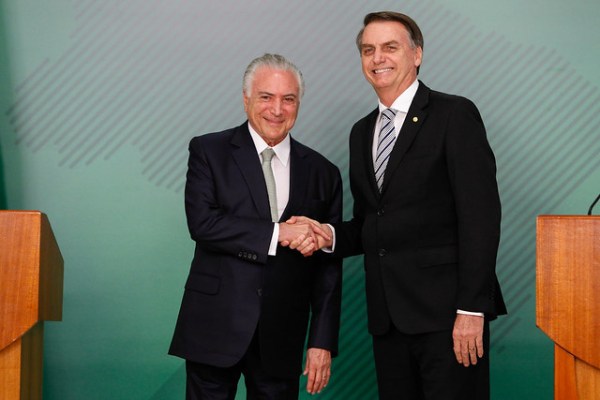
Current Brazilian President Jair Bolsonaro shaking hands with former President Michel Temer

Jair Bolsonaro (right) meeting with former Brazilian President Michel Temer (left)/ Flickr/ Creative Commons/ https://www.flickr.com/photos/micheltemer/45044560194

The decline of Brazil’s democratic culture since 2013 has thrust the country into nightmarish times from which only its ample civil society, if mobilized, can rescue it. The media daily reveal evidence that many Brazilians now celebrate violence, irrationality, torture, racism, and the demeaning of education, science and culture. We are witnesses to a blend of authoritarianism and radical economic liberalism, explicit subordination to the United States, and abnormality and evil.

  • Many Brazilians long nostalgically for the 20 years behind us, when two parties – one left- and another right-of-center – alternated as incumbents. They were subject to hits and misses, achieved good and bad outcomes. Each side swore that its policies and results were the best, but they were democratic, and they knew the meaning and rules of politics. Until 2013, politics was not a bitter fight between enemies that hated each other, but a compassionate fight between mutually respectful adversaries.

The two adversaries were the Social Democracy Party (PSDB) and the Workers’ Party (PT) – one standing for liberal orthodoxy, the other for distributive orthodoxy. The former put its chips on the markets, the latter on industrial policy. The PT achieved greater growth because it increased public investment and benefitted from the commodities boom of the 2000s, but the two administrations fell into the macroeconomic trap of high interest rates and an appreciated exchange rate that prevented private-sector investment.

  • On the fiscal level, after the financial crisis of 1998, the two administrations posted satisfactory primary surpluses up until 2013. Crisis in 2014 changed all that. Commodities prices plunged; a fiscal crisis ended surpluses and caused a large primary deficit; manufacturing firms were unable to turn a profit because of an overvalued real that flooded the domestic market with imports and caused excessive corporate indebtedness.

The political crisis might have been resolved or partly addressed if the opposition had won in 2014. The reelection of President Dilma Rousseff deepened it instead as her new term began with no support whatsoever from the economic elites.

  • During his brief period as Minister of Finance, Nelson Barbosa attempted to counter the fiscal crisis with a sharp current-spending cut, while increasing investment. Instead, the country returned to an absurd procyclical policy that persists to this day and keeps unemployment at unacceptable levels.
  • These mistakes were the fruit of the deep political crisis that since 2013 put hatred at the heart of political life. Although classic liberalism is defined by tolerance and some level of relativism concerning truth in politics, a form of intolerant liberalism emerged among the liberals, and Luiz Inácio “Lula” da Silva (president in 2003-2010) and the PT were turned into enemies, even if they were simply adversaries. The leaders of the Lava Jato (Car Wash) investigations took advantage of this hatred for self-promotion. Michel Temer, vice president under Lula’s successor, Dilma Rousseff, took advantage of it to take over, using his “A Bridge to the Future” plan as an instrument. President Jair Bolsonaro, who took office on January 1 this year, harnessed the hatred to win last year’s elections, while relying on economist and investment banker Paulo Guedes as an assurance of a neoliberal economic policy.

For nine months, governmentlessness has resulted, with little or no prospect of a return to right-of-center liberalism or left-of-center developmentalism. Brazil does not appear headed back to the path of normalcy and a healthy alternation of moderate and democratic parties. Brazilians do not know where they are headed, but one thing for sure is that the rule of law and democracy are facing very severe risks. Only a far-right minority truly identifies with the incumbent administration’s policies. But Brazil’s civil society is already well organized, with a working class, a middle class, and a varied and qualitative business class. These are the assets that could help the country overcome the nightmare into which it has plunged. 

September 24, 2019

* Luiz Carlos Bresser-Pereira is emeritus professor of the Getulio Vargas Foundation, has served as government minister in several Brazilian administrations, and is author of numerous books and articles catalogued at www.bresserpereira.org.br.


Latin America: The Perils of Judicial Reform

by Aníbal Pérez-Liñán and Andrea Castagnola*

Former President of Chile and current head of the United Nations OHCHR Michelle Bachelet addresses the Chilean Supreme Court in 2015

Former President of Chile and current UN High Commissioner for Human Rights Michelle Bachelet addresses the Chilean Supreme Court in 2015/ Gobierno de Chile/ Flickr/ Creative Commons/ https://www.flickr.com/photos/gobiernodechile/22180910394

Conventional wisdom that institutional reforms always strengthen the judiciary is not supported by the facts. A constitutionally fixed number of justices is widely thought to make “court packing” more difficult, and longer terms in office supposedly protect judges from partisan trends. Nomination processes that involve multiple actors should produce moderate justices; high requirements for impeachment should protect judges from legislative threats; and explicit powers of judicial review should assure politicians’ compliance with judicial decisions. Our research, however, shows that institutional reforms often undermine judicial independence, even when they appear to improve constitutional design along these crucial dimensions.

  • Countries with longer democratic traditions such as the United States, Chile, Costa Rica, and Uruguay display low turnover: few justices leave office in any given year, and their exits appear to follow a random pattern. But countries like Bolivia, Honduras, Guatemala, El Salvador, and Paraguay – all of which nominally protect judges from political pressures – display abrupt patterns of judicial turnover. On repeated occasions, a majority of the court has left in the same year, allowing for a complete reshuffle. About half of all exits in our sample took place in years when more than 50 percent of a court left at once, mostly due to political pressures.
  • Some constitutions create turnover by design. Until 2001, for example, Honduran justices served for four years, concurrent with the presidential term. However, less than 30 percent of court reshuffles can be explained by constitutional rules. In Argentina, even though the Constitution grants Supreme Court justices life tenure, presidents forced a majority of justices out of office in 1947, 1955, 1958, 1966, 1973, 1976, and 1983.

Our project analyzed the tenure of almost 3,500 justices serving in Supreme Courts and Constitutional Tribunals in the Western Hemisphere since 1900. We found – against our expectations – that several constitutional reforms increased the likelihood of turnover in the high courts. Because major reforms produce turnover in Supreme Courts and Constitutional Tribunals, they create new opportunities for parties to appoint loyal judges and politicize the courts.

  • Constitutional reforms that involve more actors in the nomination of justices (i.e., “multilateralize” the process) also increase turnover in the high courts. Reforms that constrain the removal of justices (for example, requiring supermajorities for their impeachment) paradoxically have prompted the exit of justices in democracies. Constitutional reforms that granted courts explicit powers of judicial review of government actions increased judicial instability, and reforms that grant life tenure to justices on average created turnover in the high courts, particularly when adopted under dictatorships.
  • Two basic reasons seem to explain these paradoxes. In the short run, reformers exercise (and abuse) “constituent” power, restructuring the courts in ways that force the resignation of incumbent justices or create new vacancies. In the long run, formal constitutional protections for the judiciary create a strategic trap. If parties can use informal instruments, such as threats and bribes, to induce the resignation of judges, their incentives to deploy those blunt instruments are greater when justices are completely isolated from other forms of political influence.

Some features of constitutional design – including life terms and supermajority requirements to impeach judges – do explicitly protect justices against purges. Other constitutional features, however, create incentives for the political capture of high courts. Greater powers of judicial review, for example, make courts politically relevant and, therefore, more important targets. A constitutionally fixed number of seats prevents court “packing” but encourages purging as an alternative. Appointment procedures controlled by the President and Congress make purges profitable for them. Irrespective of their stated goals, constitutional amendments and replacements offer a window of opportunity to reorganize the composition of the judiciary.

  • Judicial purges occasionally pursue desirable goals, like the removal of judges who have been corrupt or obstructed transitions to democracy, but a recurrent pattern of politicized replacements inevitably produces a weak judiciary, creating an unstable interpretation of the laws and the Constitution.

July 9, 2019

* Aníbal Pérez-Liñán teaches political science and global affairs at the University of Notre Dame, and Andrea Castagnola teaches judicial politics at the Universidad Torcuato Di Tella, in Buenos Aires. Their project was supported by the National Science Foundation. Conclusions expressed here do not necessarily reflect the views of the NSF.

Brazil: Will Officers’ Role in Government Taint the Military Institution?

By Christoph Harig*

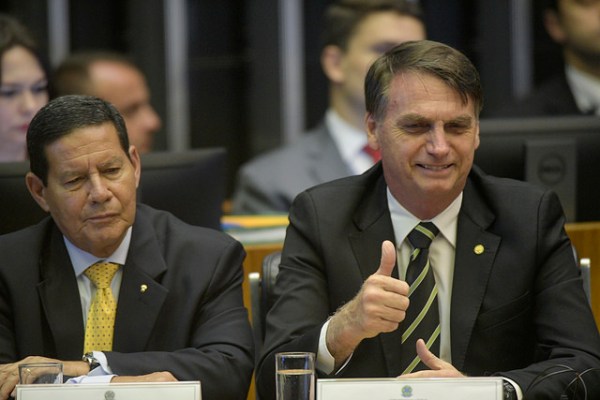
President and Vice President of Brazil

Vice-President General Hamilton Mourão and President Jair Bolsonaro / Pedro França / Agência Senado / Flickr / Creative Commons

More military officers have joined Brazilian President Jair Bolsonaro’s government than during most periods of the country’s last military regime (1964-1985), which raises the question how much the military – as an institution – will avoid compromising its supposed non-partisan nature.  The President, Vice-President, as well as eight government ministers, are retired or reserve military officers.  Bolsonaro furthermore nominated an active-duty army general as the government spokesperson.  In total, more than 100 reserve and active-duty military personnel serve in various ministries and subordinate government agencies.  Some officers have joined out of true allegiance, others, out of a sense of duty or because they want to prevent worse things from happening.  The government is drawing heavily on individual (mostly reserve) military officers, but the military as an institution is not running the government.  This is not a return to the military’s previous political interventionism: instead, a democratically elected government is (re)militarizing politics.

  • The military’s official discourse is keen on maintaining its image as a non-partisan state institution. However, officers are aware that this will be a challenge.  The presence of dozens of reserve officers in government agencies irrevocably connects the armed forces to the administration.  Although many officers do have reservations about Bolsonaro, others have proudly displayed their satisfaction with the victory of the former paratrooper.  Many citizens and international observers will thus perceive the government’s actions as being at least implicitly backed by the military.
  • For the armed forces, this involvement comes with opportunities as well as risks. On the one hand, there is a considerable increase in the military’s veto power.  They can expect privileged treatment and an effective representation of their interests.  The military might for instance be able to draw some red lines when it comes to being included in the government’s planned pension reform.  On the other hand, the prominent role in Bolsonaro’s administration attracts unwanted public scrutiny.  Discontent with an eventual preferential treatment of the armed forces in the pensions reform might grow louder than if the military had stayed below the radar.

So far, military officers’ involvement in government appears to have boosted the military’s standing.  The generals are widely being seen as a moderating force.  They have blocked some controversial foreign policy proposals of Bolsonaro and the radical wing of the government, such as the move of the Brazilian embassy in Israel to Jerusalem or the establishment of a U.S. military base on Brazilian soil.  Some observers even suggest that the generals have established a tutelary role in foreign policy after the Minister of Foreign Affairs ended military cooperation with Venezuela without consulting the armed forces.

  • Particularly Vice-President General Mourão – once known for threatening military intervention in politics and even considered a liability during the election campaign due to several ill-considered statements – excels in his newly found role as “adult in the room.” As President Bolsonaro is stuck in polarizing campaign mode (for instance, he keeps on attacking Brazil’s press and recently lauded late Paraguayan dictator Alfredo Stroessner as great statesman), it is fairly easy for Mourão to present himself as pragmatic and reliable statesman.  In this role, he led Brazil’s delegation to the Lima Group meeting in Bogotá, where he clarified that Brazil would not support a military intervention in Venezuela.

In the long run, the impact of officers’ enhanced policymaking role on the military’s prestige will depend on whether they stay clear of blunders, failures, and scandals.  While the military officers in government might succeed in playing a moderating role for the time being, this development entails considerable risks.  Within and outside of the barracks, there already is a widespread perception of the military as savior that is supposed to rescue Brazil in times of extreme crisis.  This historically grown paternalistic role of high levels of political interventionism – in which allegedly competent armed forces save the nation from incompetent civilian politicians – will only become further entrenched.

March 6, 2019

*Christoph Harig is a Postdoctoral Research Fellow in Political Science at the Helmut Schmidt University/University of the Federal Armed Forces in Hamburg, Germany.

Venezuela: When Will the Military Flip?

By Fulton Armstrong

venezuelan military marching

A military exercise in Caracas, Venezuela. / Cancilleria del Ecuador / Flickr / Creative Commons

Venezuelan leader Juan Guaidó and his backers, including the Trump administration, are increasingly focused on swaying the country’s security forces to switch allegiance from Nicolás Maduro to the National Assembly President.  Guaidó has appealed to the military to support his efforts to “restore constitutional order” and is pushing through the legislature a law giving amnesty to cooperating officers for certain crimes committed since President Chávez took office in early 1999.  U.S. officials, apparently to shake up the armed forces, continue to say that “all options are on the table”; National Security Advisor John Bolton held a notepad at a press briefing referring to “5,000 troops to Colombia.”  Maduro, for his part, continues to orchestrate loyalty pledges from senior officers and preside over military exercises.

  • Several small units of the military have flipped, and Maduro’s military attaché in Washington – serving there for a number of years to get medical treatment – has declared loyalty to Guaidó. The vast majority of the officer corps, however, still maintain an appearance of commitment to Maduro.

The most common explanation for the military’s apparent loyalty cited by Maduro’s opponents is that the high command has been bought off by opportunities to engage in corruption.  Other factors, however, may better explain why the institution has stuck with him this long.

  • Ideological reasons? Most available information suggests that Madurismo – with its gross, incompetent mismanagement of the economy, corruption, and thuggery – is not attractive to the officer corps.  But they appear to know that Chavismo has deep roots; that the elites, including the more hardline opposition, don’t understand the significance of change since 1999; and that efforts to return to the pre-Chávez era would be destabilizing and bloody.
  • Financial reasons? Although historically and perennially corrupt, senior officers arguably have been able to do more corruption under Maduro than under another regime.  That said, in their heart of hearts, they probably know a lot of their activities will continue under any government.
  • Distrust of the opposition? The military traditionally has communicated better with opposition moderates, such as Henrique Capriles, and in recent years has shown no trust in the faction that Guaidó comes from and its leader, Leopoldo López.  Information is very limited, of course, but many officers may believe that this group’s obsession with overthrowing Maduro and its no-negotiation stance has contributed to the crisis.  Senior officers’ confidence in Maduro’s ability to hold the country together seems to have evaporated, but the opposition have not presented a viable, comprehensive alternative.
  • Concern about the López-Guaidó faction’s ties with Colombia and the U.S.? Good information is elusive, but senior officers’ posture suggests that they see Bogotá’s strategic objective to keep Venezuela weak and Washington’s objective to purge the country of Chavismo and themselves.
  • Concern that the “international community” will not give them a fair deal? Distrust of Washington seems obvious, but – within their logic – senior officers almost certainly are suspicious of OAS Secretary General Luis Almagro, the Lima Group, Brazilian President Jair Bolsonaro, and others as intolerant and biased.
  • Belief that, in the face of total chaos and widespread bloodshed, they can force a last-minute peaceful solution onto Maduro? Senior officers presumably have good enough intelligence to know when and how to intervene – and persuade Maduro to accept a peaceful solution and fly into exile.  The bigger problem at this point is that they do not see a viable alternative to sticking it out.
  • Fear that Maduro’s people have deeply penetrated officer ranks, and their lives will be at stake if they move against him? As the scope of the crisis grows and the credibility of Maduro’s power begins to slip, this would appear now to be less important.  Officers talk among themselves more than outsiders think.

The Venezuelan military’s threshold for intervening against civilian governments of any stripe has always been high, amplified by the embarrassment of the reversed coup against Chávez in 2002.  None of the factors that, on balance, still appear to favor sticking with Maduro is unmovable.  Distrust of the United States, OAS, and the Lima Group – the outside forces that legitimized Guaidó’s claim to power – leave the military with no reliable allies; Cuban, Russian, and Chinese friends can provide no solace.  A credible negotiation proposal from someone like Mexican and Uruguayan Presidents López Obrador and Vázquez, especially if backed by Pope Francis, could conceivably give them a credible direction in which to push Maduro.  But at this moment – subject to rapid change – the balance still argues in favor of the military fearing a new course.

Honduras: Will Political Reforms Go Anywhere?

Honduras Highway Sign

Honduras by Nick Youngson CC BY-SA 3.0 Alpha Stock Images / Picserver.org / Creative Commons

By Eugenio Sosa*

Honduras’s long-running political crisis and the realignment of its political parties have given rise to broad discussion of political and electoral reforms, but resistance from the political parties – including the relatively new Libertad y Refundación (LIBRE) Party – appears likely to stymie significant change.  Honduran civil society groups increasingly believe that only through political and electoral reforms will the country move toward democracy.  Holding elections is an important starting point, reform advocates say, but deepening democracy requires reducing the monopoly of the political parties.  The configuration of the parties has changed significantly since the coup d’état in June 2009; the century-old “bipartisanship” of the National and Liberal Parties has been shaken up and become more volatile.  LIBRE has moved to the front line, and smaller players, like the Partido Anticorrupción (PAC), have faded.  Reformers argue that this realignment affords the country an opportunity to undertake reforms that cut across the country’s institutions and processes.

  • Depoliticizing the Supreme Electoral Tribunal (TSE) and making it a truly independent and autonomous body to supervise elections. The current TSE has fallen far short of its legal requirements to ensure, without prejudice, to enfranchise all citizens. 
  • Professionalizing and depoliticizing the National Registry of Persons – removing the partisan activists who dominate it today and directing it to issue identification cards without political influence. Observers agree that 30 percent of voters on the current lists have deceased or left the country.  Other citizens’ names have been mysteriously dropped from voter rolls or been lost while changing domicile.  Similarly, the country needs a complete, honest census.
  • Allowing regular citizens to staff election tables in polling places. They should be chosen based on clear criteria, such as their contributions to society.  In 2013 and 2017, credentials were being bought and sold with party funds, totally undermining observers’ credibility.
  • Establishing second round balloting when no candidate wins an absolute majority. The country’s shift away from a two-party system has significantly increased the chance that a president would be elected with a percentage of votes below the abstention rate.  A runoff between the top two candidates will give the victor greater legitimacy.

Other important reforms are receiving less attention.  Laws on transparency and accountability in campaign finances, such as the Law on Clean Politics implemented in 2017, have not had significant results so far, but discussion of ways to give them teeth has been limited.  Neither is there much talk about how the incumbent candidate benefits from access to public resources, including access to the national networks, or about the biases of privately owned media, which slant coverage and charge different rates for advertising depending on their preferences.  Guarantees of political participation by sectors traditionally excluded from representation and government, such as women, the indigenous, and youth, are also largely off the table.

The urgency for reform, obvious since the coup in June 2009, has surged since the contested elections in November 2017, during which the Constitutional Court decided in favor of the reelection of President Juan Orlando Hernández in the face of evidence of electoral fraud.  Honduras is now living the paradox of a President serving a second term that is still prohibited by the Constitution.  Some issues, such as re-election, demand serious national debate and may have to be resolved by plebiscite or through a National Constituent Assembly.

  • Despite the broad base of the organizations proposing reforms, the success of any initiatives will depend on the views, limitations, and vetoes imposed by the three main parties. Even LIBRE, the newcomer that previously challenged the status quo, sometimes appears to be buying into existing systems and could go soft on reform.  As a result, one possible outcome could be that certain reforms are implemented in form – such as modernization of the National Registry of Persons – but the parties retain their influence over the office’s magistrates and personnel.  In addition, neither of the three main political forces appears interested in allowing authentic citizen control over voting tables on election day. 
  • While the need for reform is arguably deeper than at any time since the current Constitution was approved in 1982, and while the proposals for moving forward are constructive and mature, the prospects for change appear limited. The configuration of the country’s political parties has changed, but their priorities and behavior have not. 

January 22, 2019

*Eugenio Sosa is a sociologist and senior analyst at the Centro de Estudio para la Democracia (CESPAD), in Tegucigalpa.  This article is adapted from his essay on the CESPAD website.

Mexico: Will AMLO Bring a “Fourth Transformation” or Return to Authoritarian Past?

By Daniela Stevens*

President-Elect Andrés Manuel López Obrador / Eneas / 500px / Creative Commons

A week before his inauguration, Mexican President-elect Andrés Manuel López Obrador (AMLO) continues to stress his commitment to be a “good president” and leader of the country’s “Fourth Transformation,” but some of his early actions suggest that he will challenge political pluralism and destabilize the investment environment.  His sexenio could have a rocky start both politically and economically.

  • AMLO’s handling of a “national consultation” over the ongoing construction of Mexico City’s new international airport – a project that he criticized as corruption-laden – raised red flags about his intended governing style. Most observers say the consultation was unconstitutional and, with only one percent of registered voters participating, inconsistent with the President-elect’s pledge to respect the “people’s will.”  AMLO’s reaction to the criticism – asking “¿quién manda?” (who governs?) – was widely interpreted as a sign that the airport maneuver was not about careful financial planning but rather political power.  He held another referendum last weekend, a “consultation” with citizens on 10 projects on which he seemed to have made up his mind beforehand.  These referendums seem intended to legitimize his intentions and enhance his power.
  • He and his party, Movimiento de Regeneración Nacional (Morena), appear to be moving ahead with plans to increase control over public spending, eroding institutional checks on presidential power. The Morena majority in the Tabasco state congress, for example, last month approved a provision empowering the next governor, also from Morena, to assign public works and acquisitions directly, without public bidding.  If the Supreme Court does not deem the reform unconstitutional, the administration will build a refinery in Tabasco without any review of the integrity of the process.
  • To reduce imports of gasoline and natural gas, AMLO plans to halt oil exports and reserve production for national consumption only, as well as to build a new refinery and modernize six existing ones. Critics say such policies reflect an outdated vision of national sovereignty closely tied to oil, and that they would directly diminish Mexico’s creditworthiness, endanger the finances of state-owned Petróleos Mexicanos (Pemex), and, according to Moody’s, result in a two percent decrease in GDP.  Additionally, oil experts say, the emphasis on refining would detract from important efforts to expand exploration and production.  The country cannot immediately meet domestic demand for crude.  Similarly, the transition team seems to disregard the potential of renewable energies and the need to electrify transportation.

Morena proposals to reduce the autonomy of regulatory agencies are scaring investors as well.  A Morena Congressman, for example, is pushing to incorporate the energy sector’s regulatory agencies into the Secretariat of Energy, subordinating them to greater political control.  Although AMLO did not publicly support the initiative, his appointee as Secretary of Energy, Rocío Nahle, has already asked the director of the National Commission of Hydrocarbons, one of the regulatory agencies, to step down three years ahead of schedule.  Given its debt and deficits, Pemex can ill afford to strain its partnerships with private capital.

It’s too early to assess how many of these actions reflect AMLO’s and Morena’s inexperience or a considered approach to governing, but the incoming leadership so far seems unaware or unconcerned that such measures undercut their stated vision of ushering in a “Fourth Transformation” on a par with the country’s three previous ones – independence (1810–1821), the Reforma wars (1857–1861), and revolution (1910).  The hints of authoritarianism, alongside decisions to appoint single-representatives in the states and to maintain a pervasive military presence in the streets, suggest AMLO’s tenure may indeed transcend history – as a government not different from the priista centralized governments of the 20th century, and the militarized calderonista administration (2006 2012) he vehemently criticizes.  After 1997, when the hegemonic Partido Revolucionario Institucional (PRI) – from which AMLO had already defected to lead the leftwing Partido de la Revolución Democrática (PRD) – lost the majority of the Chamber of Deputies for the first time, political analysts and academics pointed out the disadvantages of divided governments in presidential systems, such as political gridlock.  A unified government under AMLO, however, may not be the answer for Mexico either, unless progressives in Morena committed to democracy and its institutions find a way to restrain his impulses and keep his government on a democratic path. 

November 27, 2018

* Daniela Stevens is a Ph.D. candidate in Political Science in the School of Public Affairs at American University.

Mexico: Is Centralization the Way to Battle Corruption?

By Daniela Stevens*

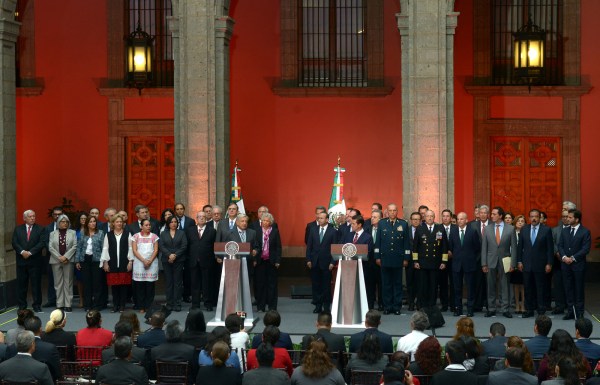
A large group of people stand on a stage.

Mexican President-elect Andrés Manuel López Obrador (center left) meets with current President Enrique Peña Nieto and members of his cabinet during the transitional government period. / Presidencia de la República Mexicana / Flickr / Creative Commons

Half way through Mexico’s five-month transition period, an effort by President-elect Andrés Manuel López Obrador (AMLO) to increase central government oversight over states’ affairs suggests an agenda that may go beyond the “republican austerity” he frequently calls for.  His plans to lower the numbers and salaries of high-ranking bureaucrats have been well received, but he raised hackles when he announced plans to appoint a single federal representative – a delegado – to liaise with each of the 32 states, eliminating the 20 to 30 central government representatives that until now have been dispersed throughout each jurisdiction.  He claims the measure is to save on the bureaucracy payroll, but many observers are concerned it will concentrate more power in his own hands.

  • Criticism has already forced AMLO to repackage his plan somewhat. He uses mixed language to refer to the responsibilities of the delegados.  While he has strongly defended his legal ability to appoint a single delegado, he more recently reassured aggravated governors that his representatives would maintain “institutional relations” and respect local elected officials’ autonomy and authority.  Olga Sánchez Cordero, AMLO’s appointee as Secretary of the Interior, further clarified that the delegates would only be in charge of social development programs, constituting a “layer of proximity to citizens” currently or potentially enrolled in social programs.  Under AMLO’s proposal, delegados would take over all kinds of programs, including youth scholarships, conservation efforts, health care, and social security programs for special populations – a herculean portfolio for a single representative.
  • Critics argue that the appointment of single delegados reporting directly to AMLO will undermine federalism. Electoral and administrative decentralization were integral to Mexico’s long democratization process.  For decades, the president was not only the predominant force over the legislative and judicial powers; he also appointed governors from the hegemonic party to the states.  The delegados would potentially create a power structure that parallels and rivals that of the state governors.  Some governors argue that the constitution does not recognize intermediate authorities, and wonder whether persons with partisan agendas will get too deeply involved in local budgets and policies.  In addition, the position would be coveted for its discretionary power and direct link to the president – giving politicians from AMLO’s party, Morena, a leg up as potential candidates for governor.

If done right, however, the measure could alleviate the plague of corruption that permeates the states, and the governorships in particular, and which AMLO has repeatedly condemned.  Governors routinely abuse their powers and engage in serious acts of corruption and financial crime.  As Agustina Giraudy has documented, undemocratic governors have used their offices to perpetuate “subnational undemocratic regimes” in the wake of Mexico’s 2000 transition to electoral democracy at the national level.  Former Governor Javier Duarte, of Veracruz, stole hundreds of millions of dollars from the public budget, and others, like Humberto Moreira in Coahuila, left their state with large debts.  Oversight from an anti-corruption executive in Mexico City might not necessarily be a bad thing.

Ideally, state legislatures – rather than the president or his delegado – would constitute the brake on governors’ decisions, providing a real counterweight anchored in local political dynamics.  AMLO’s efforts to turn Mexico into an “authentic democracy” will miss the mark – and amount to a crass political move – if the transformation does not include an institutionalization of leadership.  His party, Morena, is extraordinarily dependent on his personal leadership; it is an amalgam of politicians who abandoned other parties or joined it because of personal ties to him.  AMLO, who plans to preach integrity by example, cannot alone be the foundation of the “fourth transformation” he purports to lead (the first being independence, the second the “Reforma,” wars, and the third the 1910 Revolution).  With institutionalization, AMLO and Morena could put appointees and delegados through a transparent, legal vetting process – based on merit – and give them clear, legal operational responsibilities.  Failing that, their reforms may prove to be a primarily partisan project.

September 14, 2018

* Daniela Stevens is a Ph.D. candidate in Political Science in the School of Public Affairs at American University.

Honduras: Would a Constituent Assembly Help?

By Hugo Noé Pino*

Several people raise their hands in the Honduran National Congress

A recent session in Honduras’ National Congress. / Congreso Nacional de Honduras / Creative Commons

The need for Honduras to convene a National Constituent Assembly appears increasingly compelling even though the country’s political elites continue to oppose one.  Proponents of an “ANC” argue that it would not only help the country overcome the fraud perpetrated in last November’s elections; it would give oxygen to the country’s failing democracy.  They note that the current constitution, promulgated in 1982, has been violated and modified so many times – such as when President Juan Orlando Hernández was allowed to run for reelection – that the document’s original meaning has been obscured if not lost.  ANC proponents cite other facts pointing to the need for an assembly:

  • The constitution calls for a “planned economic policy,” in which the state and law “shall regulate the system and process of planning with the participation of the Powers of State, and political, economic and social organizations shall be duly represented.” But that planning model, which has never been implemented in Honduras, has been overtaken by the neoliberal model, based on market freedoms, adopted in the 1990s.  Amendments passed in 2012 were intended to create special employment and development zones, but not a single one has emerged.
  • Since the 2009 coup, Honduran society has been polarized by violations of the law, the concentration of power, abuses, corruption, and other problems – all aggravated by the widely contested election of last November. Business, workers, farmers, trade unions, academia, non-governmental organizations, and other sectors have been unable to find agreement on how to deal with the nation’s pressing problems.  ANC supporters say that true national reconciliation is going to require a new social pact that a new constitution can create.
  • Backers also argue that the ANC would breathe new life into the political parties – deeply discredited by the corruption and chaos engulfing them – and allow them to become a mechanism for intermediation between society and the state. An assembly, they say, would bring political leaders and the people together in pursuit of better alternatives to the current system.  A system of checks and balances, including a new judicial system, would help guarantee the separation of powers and enhance citizen participation in public policy.

Prospects for an ANC do not look good at this moment despite important endorsements, such as that of the Honduran Catholic Bishops Conference in a public letter last December.  Most of the political elite, responsible for setting the country on its destructive course, stridently oppose the idea, but proponents feel the elites will eventually have to accept one.  The “national dialogue” launched after the November elections has made no progress or, worse, has aggravated tensions.  The black cloud over those elections and the surge in corruption cases under investigation – an important achievement of the Misión de Apoyo contra la Corrupción y la Impunidad en Honduras (MACCIH) and its partners working under the Attorney General – have driven politicians to dig in their heels.  Their efforts to hold onto power, prevent transparency, and block accountability puts them directly against the sort of reforms an ANC would represent. 

  • Even when the political class eventually allows the ANC proposal to take off, many obstacles lay ahead. One of the first – and extremely difficult – steps would be selection of a truly independent Supreme Electoral Tribunal to oversee a referendum on the ANC and the election of assembly delegates.  The questions on the ballot would be simple, focused on support for the ANC and support for presidential reelection, but the task of making Honduras an inclusive society, with transparency, accountability, and respect for the rule of law would take the sort of vision and discipline that only a new constitution would provide.  While critics claim an ANC would be playing with fire, it’s certainly better than the current situation in which we are all threatened with being burned.

August 14, 2018

* Hugo Noé Pino is currently a professor and coordinator of a Ph.D. program at the Universidad Tecnológica Centroamericana (Unitec) in Tegucigalpa, Honduras.