Mayor Adams, Don’t Sell Out New York City’s Economy

By Marshall Plane, Ernesto Castañeda

Photo credits to Flickr

Days after federal corruption charges against him were dropped, Mayor Eric Adams appears poised to open New York City to President Trump’s mass deportation agenda in what Manhattan’s federal attorney described as a “quid pro quo”. Mr. Adams’ posturing has hinted at this for some time: the mayor has framed the recent influx of asylum-seeking migrants as an economic burden that “will destroy New York City.” “The long-term consequences have yet to materialize of what this crisis will do to our cities,” he told Tucker Carlson on January 22nd.

After crunching the numbers, we agree with Mr. Adams: New York City is just beginning to reap the benefits of this influx of hardworking people. We conservatively estimate that, if their earnings and employment rates are similar to the current undocumented population, the 316,000 asylum seekers who have come here since 2022 will contribute $8.62 billion annually to the city’s economy, a figure greater than the GDP of forty countries. Much of this economic activity will flow to public coffers: the asylum seeker population is projected to pay $942 million more in taxes than they receive in benefits each year. If ICE is allowed to wreak havoc on New York City, all these benefits will be lost.

This is not particularly surprising. Previous waves of immigrants have similarly fled desperate situations, arrived with limited resources, faced nativist backlash, and still become vital contributors to the city’s economy and culture. There’s no reason to believe today’s newcomers should be any different. With New York’s US-born population declining and demand for workers growing fastest in the industries most reliant on immigrant labor, they are arriving at an opportune time.

It’s true that New York City has spent substantial amounts on services for asylum seekers: a combined $5.2 billion in fiscal years 2023 and 2024, with another $4.5 billion budgeted for FY2025. These costs doubtless been have been inflated by Adams’ “emergency” decision to suspend background checks and competitive bidding requirements for contractors providing such services. The Comptroller’s investigation found several egregious examples of overpayment. One contractor received $117/hour for security guards and $201/hour for off-site managers. Despite this waste, spending on asylum seekers made up just 4.2% of the FY2025 budget.

Most importantly, these costs are not the product of an “open border.” Immigrants have been coming to New York City via the border for decades. In fact, the city’s undocumented population was 611,000 in 2012 and fell to 412,000 by 2022. Nor is the scale of the current influx unusual in recent times–during the 1990s, the city’s foreign-born population grew at a higher annual rate than it has during the 2020s.

Instead, the recent difficulty housing asylum seekers is a unique case created by a perfect storm of policies: a political stunt that brought people to cities where they lacked connections; an artificial housing shortage; an already-struggling, poorly run shelter system unequipped to house new arrivals; a lack of legal immigration pathways; and outdated laws that prevent asylum seekers from working.

Each wave of immigration to New York City has been beneficial to both the immigrants themselves and their adopted city. The only difference today is that arcane policies have forced both sides to make major upfront investments before they begin to enjoy those mutual benefits.

Before claiming asylum, people must physically come to the US. For nearly all the asylum seekers we spoke with as part of our ongoing study, this involved taking on substantial debt to finance a deadly, months-long overland journey. This debt can be a major obstacle as people try to establish themselves in New York.

In 2023, John borrowed nearly $30,000 to bring his family of five from Ecuador to the US border. A mechanic by trade, he quickly found work repairing e-bikes at a workshop in Queens, earning $1,200 a week. Yet over half of each paycheck goes to repaying his creditors back home (who have threatened to kill his parents should he miss a payment), leaving him unable to afford rent and trapping his family in the shelter system. He says he’ll have paid off enough debt to move to an apartment in New Jersey in three months.

Lacking a sponsor in the US, crossing the border was John’s only way to come here. Leave aside, for a moment, your beliefs about whether doing so was morally correct. The fact is, he’s here and contributing to our economy. Had he been able to come directly from Quito to New York, his spending power would be going to New York businesses instead of human smugglers.

Another problem: after applying for asylum, people must wait 180 days before receiving a work permit. Unless they have connections to support them, this effectively forces people to live off the state for six months. In practice, our conversations have made clear, it’s often much longer. In 2023, New York City began limiting stays in any one shelter to 60 days, forcing people to shuffle between different facilities. Many migrants are not informed that failing to report this change of address to USCIS within 10 days is a misdemeanor and can delay or derail their ability to get documents.

The experience of Carlos, who we spoke to outside a Manhattan shelter, exemplifies the bureaucratic absurdities that hold migrants back. Bused to NYC in late 2023 as part of Operation Lone Star, he immediately applied for asylum, citing political persecution in Venezuela. While waiting for his work permit, he has bounced between different shelters and worked temporary construction and moving gigs. He says his lack of documentation allowed these employers to exploit him, frequently not paying him in full.

Carlos told us a relative in Oklahoma has found him a job in trucking, his original profession. “The moment my papers arrive, I’m going to Oklahoma,” he says. “They’re waiting on me.” He was supposed to get his work permit months ago but had to restart the process when his address changed. He was most recently told his papers should arrive in 90 days.

The absurdity is infuriating. Due to decades-old laws, people itching to work linger in shelters against their wishes and at great financial cost, while crucial jobs across the country remain unfilled. The Independent Budget Office estimates the cost of missed work authorizations for asylum seekers at up to $1 billion in 2024 alone.

Even so, with US-born workers rapidly aging, rising immigration has done much to ease post-pandemic labor shortages, helping reduce inflation while maintaining economic growth. And asylum seekers are quietly integrating into the city’s economy. Of the 225,000 migrants who have passed through the shelter system, over 170,000 (77%) have moved out, and the number remaining in city care continues to dwindle.

Many interviewees, having recently gotten their work permits and found jobs after a long ordeal, expressed excitement to begin living independently and working towards the various dreams that kept them going through sweltering jungles and deserts. As asylum seekers increasingly fill the jobs that keep New York’s service-based economy moving, the investments made by both sides finally appear to be paying off. For deportations to derail asylum seekers’ budding lives as New Yorkers would be a human tragedy and an economic catastrophe

Marshall Plane is a Research Assistant at The Immigration Lab.

Ernesto Castañeda is the Director of the Immigration Lab and the Center for Latin American and Latino Studies and a Professor at American University.

Innocence Suspended: From Seeking Security to the Guantanamo Concentration Camp

Luis Alberto Castillo Rivera graduating from high school in Venezuela (Photo courtesy of his family; Source: Migrant Insider)

Luis Alberto Castillo Rivera graduating from high school in Venezuela (Photo courtesy of his family; Source: Migrant Insider)

The story of Luis Alberto Castillo Rivera, a Venezuelan asylum seeker, has gone viral on TikTok and gained media coverage. Castillo is a man without any criminal history or gang affiliation who entered the United States through a legal pathway. In 2024, this Venezuelan asylum seeker flew to Mexico and awaited his court date. Once he received his appointment date on the CBPOne app on January 19th, 2025, he presented himself at the U.S.-Mexico border in El Paso, where he was processed by immigration authorities and held in detention for no given reason. At the ICE detention center in El Paso, authorities started to question his tattoos, specifically one he had of Michael Jordan. Authorities claimed his Jordan tattoo was affiliated with the Venezuelan gang Tren De Aragua. Many of the tattoos identified by a law enforcement list as used by Tren de Aragua, including stars, roses, tigers, and jaguars, are common among Americans. These so-called identifiers may just be a flimsy pretense for criminalizing the average, non-criminal migrant.

Castillo in a photo released by the Department of Homeland Security of the first flight of migrants preparing to takeoff for Guantanamo Bay, Feb. 4, 2025. DHS

Castillo in a photo released by the Department of Homeland Security of the first flight of migrants preparing to takeoff for Guantanamo Bay, Feb. 4, 2025. DHS

On February 3rd, Castillo told his family that he would be deported to Venezuela, even without a hearing. The next day, he lost contact with his family and was sent to Guantanamo Bay, Cuba on February 4th. President Trump stated he is sending those who have committed crimes in the U.S. to Guantanamo Bay, but Castillo had no criminal history nor gang affiliation and never even had the chance to freely step foot in the U.S.

Castillo’s family was not notified that he would be held at the “longest-running war prison.” His family members only found out about this after seeing pictures online of migrants arriving in Guantanamo Bay. When his family searched for him on the US Immigration and Customs Enforcement website, it appeared he was still in the processing center in El Paso, Texas. Attorneys are calling Guantanamo Bay a “legal black hole,” a place where typical legal protections do not exist for some of the detainees. Some are being held without due process indefinitely without trial or conviction, including thousands of Haitian refugees in the 1990s and almost 800 Muslim men, including minors, over the past two decades. Some of these prisoners have endured incredible physical and psychological abuse and torture in this extralegal space.

Now, the first group sent to Guantanamo Bay, including low-risk migrants and migrants with no criminal record, such as Castillo, were detained in the “counterterrorism suspect” part of the prison – rather than the Migrant Operations Center used in the past to process migrants. The conditions these individuals are facing at this maximum-security prison are inhumane, including mold, undrinkable water, and a lack of adequate medical care. Guantanamo Bay does not even meet the minimum safety standards for detention facilities as set by the U.S. government. Furthermore, the detainees at Guantanamo Bay are subject to permanent physical and psychological trauma.

A less-known but recent story close to home is one where five migrants in North Florida went into a gas station to grab breakfast on the way to their construction job on January 27th and were detained by ICE. Four of them remain detained in Florida. One of them, a Mexican man name Jose Angel Juarez, was sent to Guantanamo Bay; the rumors go that he would be held there for two years. He has no criminal record beyond being caught multiple times crossing the border. He is simply a worker who has been entering and leaving the U.S. every year to work and go home. The idea that Guantanamo Bay was ever for the “worst of the worst” is an illusion. These are just two among many cases of immigrants being detained, held, deported, or sent indefinitely to Guantanamo Bay without due process after being profiled racially or for having tattoos. 


Katheryn Olmos is a Research Assistant at the Center for Latin American and Latino Studies and a graduate student at the Sociology Research and Practice program at American University.

Edited by Ernesto Castañeda, Director, and Emma Wyler, intern at the Center for Latin American and Latino Studies and the Immigration Lab.

New York City’s Shift To The Right

By Caryalyn Jean

One surprising trend that emerged from the 2024 elections was New York City’s subtle shift to the right. Although the overall results of how each of the five boroughs that make up the city did not change, Trump gained 30% of the overall votes in the 2024 election as opposed to 19% in 2016. There were significant shifts in working-class neighborhoods in the Bronx and Queens. One reason for this may have been the high cost of living in New York and believing that Trump would bring prices down. Nonetheless, we must consider xenophobic messaging on both sides of the political aisle to get the full picture.

Since the initial arrival to of busses with immigrants and asylum seekers from Texas and Arizona to New York City, harmful rhetoric about them has had real-life implications. For instance, in late January 2024 reporting began surrounding an altercation which took place in Times Square between NYPD and a group of migrants. Former Police Commissioner Edward Caban responded to the incident with, “a wave of migrant crime has washed over our city.”  Mayor Eric Adams described the incident as “an attack on the foundation of our symbol of safety.” Despite body cam footage released just a few days after the initial reporting, both the media and residents alike repeated the messaging purported by Eric Adams and the NYPD Residents sharing the Eric Adams administration’s belief that migrants’ presence is correlated to an increase in crime in the city is reflected in the results of May 2024 poll. Of the 974 eligible New York City voters surveyed, “over 70 percent blamed migrants in the city for the current crime rate, with 41 percent saying immigration is having a ‘significant’ impact and 31 percent saying a ‘fair amount’ of impact.” 

New Yorker’s shift to the right is not limited to the presidential election. Another election result that may appear surprising to some is Republican Stephan Chan’s New York State Senate District 17 win, beating incumbent Iwen Chu. In 2020, New York State underwent a redistricting cycle, and Iwen Chu was the first representative of the newly formed district and served as representation for the growing Asian population in the area. Reporter Michael Lange described Chu’s loss as the solidification of “the Chinese Republican realignment in Southern Brooklyn.” On his campaign website, Stephan Chan emphasized being an immigrant from Hong Kong, a long time Bensonhurst resident, his law enforcement background, and his strong family ties. He also emphasizes his opposition of “wasteful spending of our tax dollars” juxtaposed to photo of himself at a protest opposing the building of a homeless shelter in Gravesend. Unsurprisingly, Chan’s opposition is not limited to homeless shelters. In a campaign ad, a supporter states, “he won’t hand out freebies to migrants while we pay the price.” This reflects not only Chan’s stance on spending on resources for migrants, but of some New Yorkers who often feel like New York City provides recently arrived migrants with services that long-time New Yorkers do not have access to.

On the national level, the growing anti-immigrant sentiment can be seen in how New York’s Congresspeople voted on the Lanken-Riley Act. This bill will allow the Department of Homeland security to detain undocumented immigrants who have been accused of burglary, theft, larceny or shoplifting. It also allows for states to sue the federal government for “decisions or alleged failures related to immigration enforcement.” Opponents of the bill are concerned about the erosion of due process for those accused of crimes and the lack of funding that is required to implement it. On January 23, 2025, the bill passed 263 to 156, with 6 out of 17 New York House members representing Downstate New York voting “Yea.” The bill was signed by President Trump on January 29, 2025. 

These election results amongst other things have already caused great concern around the upcoming mayoral and gubernatorial races. Ironically, despite Adam’s law and order campaign, he is in legal trouble. Likewise, since fall 2024, New Yorkers have been left many questions. During a November 6, 2024, news conference, Eric Adams was asked about his administration’s plans to cooperate with Donald Trump’s mass deportation efforts. In reply, Adams stated “We cannot add to the anxiety and fear that people are experiencing.”  The following week, Adams affirmed New York City’s sanctuary city status but stated that he believed that laws surrounding local law enforcement’s cooperation with Immigration and Customs Enforcement should be changed. Adams was also present as Trump’s inauguration and cancelled his attendance at various Martin Luther King Day celebrations to many New Yorker’s dismay. His reluctance to outright denounce Trump’s stance on immigration and recent ICE raids has caused uneasiness for immigrant advocacy groups within the city and causes further speculation that Adam’s refusal to publicly critique Trump is for his own personal gain. Democrats have long relied on New York City to keep New York State blue but shifts to the right in New York City may lead to the party losing its stronghold in the country.

Caryalyn Jean, Sociology Research and Practice MA (SORP) Student at American University

The Taxing Debate

The Taxing Debate on Migration in the U.S.

By Mary Capone

November 19, 2024

Nearly half of American adults feel that immigration threatens national identity. This proportion has increased in recent years as anti-immigration sentiments have surged in politics and partisan divergence has deepened in rhetoric. The former Trump administration was highly influential in the anti-immigration movement, with much of Trump’s campaigns hinging on xenophobic policies like building a wall on the southern border and ending DACA. Such policies jeopardize the human rights of immigrants in the United States, who make up nearly 14% of the U.S. population. The Biden administration’s handling of immigration has also been criticized by 60% of Americans, indicating that the ongoing conflict over immigration is worsening.

Polls from PBS NewsHour, 2024.

 Why is migration so controversial? Shouldn’t people be allowed to migrate safely?

The answer lies in white supremacy and ‘tax dollars.’

At a 1983 Conservative Party conference, former UK Prime Minister Margaret Thatcher famously said, “If the State wishes to spend more, it can do so only by borrowing your savings or by taxing you more. It is no good thinking that someone else will pay—that ‘someone else’ is you. There is no such thing as public money; there is only taxpayers’ money.” Like many politicians, Thatcher propagated the notion that government spending relies on taxpayers’ money, placing the burden of spending on individuals.

Similar sentiments are not uncommon in the United States. Former Republican governor of Wisconsin, Scott Walker, featured this tagline in his 2018 campaign targeting his opponent: “Tony Evers: Special treatment for illegals, higher taxes for you.” Donald Trump continues to campaign on anti-immigration policies to appeal to Americans who feel skeptical about their tax dollars going to immigrant welcoming programs. Trump’s campaign website highlights “20 Core Campaign Promises to Make America Great Again,” two of which focus on blocking immigration, including the first promise: “Seal the border and stop the migrant invasion.” These arguments are used to justify relatively small government investment in important services that benefit communities of color and immigrants by suggesting they would be an imposition on the ‘taxpayer.’

To understand the historical use of the term ‘tax dollars,’ Camille Walsh analyzed hundreds of letters defending racial segregation addressed to the Supreme Court in the years following the ruling in Brown v. Board of Education (1954). One-third of the letters consisted of some language about taxes, taxpayers, or having “paid” for public schools, implying the right to decide whether to keep them segregated. The American ‘taxpayer’ historically represents white individuals, and such language “obscured class divisions among whites and elevated those racialized groups presumed to have higher taxable income to a higher position in claiming citizenship rights.” White individuals like Aura Lee (1956), argued that “poor white taxpayers are entitled to enjoy some all-white places, if they so desire.”

As the term ‘taxpayer’ is historically associated with whiteness, it is used to justify the entitlement of resources concentrated in white communities. Meanwhile, the ‘nontaxpayer’ is meant to symbolize Black and Brown individuals who are perceived not to have “earned” their rights. While this argument is used to exclude people of color from resources, historian James Anderson finds that taxes from predominantly Black communities were at least as much during the time of the Brown ruling, and often higher than those of white neighborhoods. These taxes were often distributed by white school boards into all-white schools prior to Brown. This does not account for today’s common tax evasion of the nation’s wealthiest individuals and corporations. The Treasury Department estimates that there is a $160 billion gap between what the wealthiest 1% of the population should pay and what they actually pay.

Seventy years after the ruling in Brown v. Board of Education, politicians, citizens, and the media hold ‘taxpayer dollars’ to be sacred. Similar to the discussions surrounding racial integration in the mid-20th century, immigration represents a battle between the ‘taxpayer,’ or white American, and the ‘nontaxpayer,’ or immigrant. Just as white parents feared sending their children to integrated schools with “much lower standards and run-down facilities than the ones that [they] helped pay for,” many white Americans do not want immigrants to have access to vital resources and fear the use of their dollars on government spending.

Nevertheless, between sales taxes and property taxes, undocumented immigrants pay billions of dollars in taxes each year. Not only are immigrants taxpayers, but they pay taxes at higher rates than the richest Americans and get less in return. Taxpayer rhetoric is another weapon of othering by separating white U.S.-born individuals from Black and Brown immigrants, regardless of who pays their taxes.

Graph from the American Immigration Council (2016).

A quote from former Chair of the U.S. Federal Reserve Alan Greenspan counters concerns about government spending causing a deficit, stating: “There is nothing to prevent the government from creating as much money as it wants.” Similar to banks not lending out depositors’ money, government spending does not use tax dollars for spending. To illustrate this, the U.S. government spent trillions on wars post-9/11 and hundreds of billions to bail out banks in 2008, neither of which were framed as a tax dollar problem. Despite the framing of funding essential services as an attack on individual taxpayers, in reality, it falls within the bounds of federal government spending.

International law considers migration to be a universal right. Immigration control “is a relatively recent invention of states,” according to Vincent Chetail, a professor of international law. The U.S. has a duty to protect the rights of all people and not discriminate based on race, national origin, religion, or any other group category according to the 14th Amendment, and many international treaties it is a party to.

Research indicates that government investments in immigrants have a higher return over time. For example, more educated immigrants earn more and, therefore, pay more in taxes. Fiscal concerns are not based on reality, as immigrants are net contributors to the federal budget. ‘Tax dollars’ are simply a code for white dollars to instill fear and discrimination against vulnerable populations, despite taxation realities.

Mary Capone is a researcher at the Immigration Lab at American University.  

You can republish and reprint this piece in full or in part as long as you credit the author and link to the original when possible.

2024 Elections

Myths about the Causes Behind the 2024 U.S. Presidential Election Results

By Ernesto Castañeda

November 16, 2024

I was wrong about Harris winning. Concerns about the future of democracy were mainly an issue for around 32% of those who voted for Democrats (according to NBC exit polls). The uncommitted, abstainers, and disengaged affected turnout. Both candidates were voted by a diverse electorate. As I wrote before the election, “An unintended effect of Trump’s hate speech has created a certain increase in support among some Black, Latino, and Asian voters.” This was not enough in itself for Trump to win, but it added to the lead among White voters. What I wrote about the rightward shift of the Latino vote [here, here, and here] holds true.

Cable news coverage across the board has obsessed with “immigration” and “the economy” being the main concerns of the electorate and that public opinion favors Trump to handle them. But in polls and exit polls, these were the main issues for less than half of the electorate, and they were the main issues for Republican respondents, who naturally favor Trump’s solutions in these areas.

In terms of the “economy,” members of union households voted slightly more for Democrats (53%) than non-union households (47%). The voting split was not that different across income brackets. Even if unemployment is low, and wage and economic growth rates are positive and steady, with a big improvement from 2020, still many minimum-wage earners and the lower middle class are no longer happy with the economic status quo, as I wrote here.

 The biggest errors in the 2024 election coverage have been the out-of-proportion focus on the economy and immigration as the biggest concerns of all voters when, indeed, these complaints are not fully based on reality and are mainly coming from Republican-leaning voters. But the exaggeration around immigrants did not cost Trump the election and probably reinforced his dog whistles and helped in an election against a Black female opponent. Her identity was my major question here about whether Nikki Haley supporters, independents, and enough White men without a college education could vote and actively campaign for Harris.

The Harris campaign was strong, but its short duration meant that many voters did not feel like they knew her well enough. The campaign was careful to stick to the center and even to appeal to Republicans. As in 2016, in 2024, more White women supported Trump than the female candidate. In some states, they voted for Trump and still voted for some protections for abortion in certain cases.

Trump did not win because of the politicization of immigration. One reason for this is that only in a few polls did “immigration” rank as the main concern for over 50% of likely voters. Only a minority said they would vote for a presidential candidate solely on that issue. Those who did were over 70% Republican across polls. There was a similar dynamic regarding “economics.” It was misleading, both during the campaign and after the election, to assert that the primary concerns of the electorate are the economy and immigration. For example, an exit poll from ten key states conducted by NBC shows that only 11% of the electorate saw immigration as the issue that “mattered most” for their vote (when given only five possible issues), and of those voters, 90% of them were Republican.

A different response to that poll sheds further light on the polarization along party lines regarding immigration policy: 75% of Democrats (and 56% of respondents overall) support offering a chance for undocumented immigrants to apply for legal status. In contrast, 87% of Republicans (40% of respondents overall) favor deportation.

Immigration is not the weakness for Democrats that many make it to be. Still, the Harris campaign was hesitant to discuss immigration or border issues in detail. This is largely due to the narrative among mainstream media pundits and consultants, who believe that Trump’s “strengths” lie in the economy and immigration, as these same polls indicated that voters trusted Trump slightly more on these issues. However, this average was significantly impacted by Republican respondents, and the headlines failed to mention that respondents across party identification trusted Harris more on most other issues. Regardless of rhetoric or immigration policies presented by the Democrats (whether it was the bipartisan Senate deal or restriction on asylum seeking at the border), Trump supporters were always going to vote for Trump. As a result, the Harris campaign could have taken a stronger stance against the misinformation about immigrants that the Trump campaign consistently spread and that many others amplified.

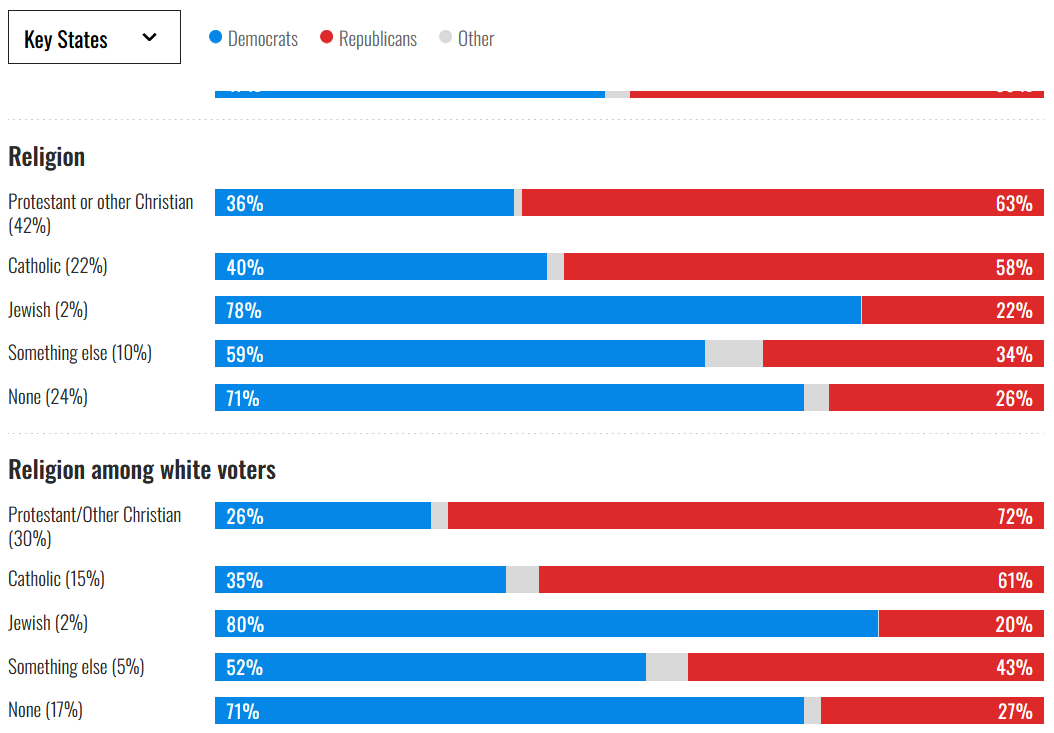
The MAGA base cannot be swayed by facts about the issue because they use the term “immigration” as code to promote a White Christian Ethnostate. This goal was said or implied by Trump and his surrogates and is part of Project 2025. Trump’s largest base of support was White men (60%), white people who never attended college 66%), and especially White Protestants/Christians (72%). Many understood Trump to be the White Christian Nationalist Candidate on the presidential ballot.

What Does This All Mean for Immigration Scholars?

My point above indicates that we need to research immigration, racialization, and the politicization of religion in tandem. These processes are linked to each other by right-wing ideologues. Many of us look at immigration; some of us are starting to look again at the relationship between immigration policies and race, and key sociologists have coined and looked at the rise of White Christian Nationalism.

There is much misinformation about immigration trends and processes, and as a community, we have much to offer. Moderates and independents are open to learning more about immigration, and Democratic-leaning voters and spokespeople need more fact-based talking points. For this reason, Carina Cione and I recently published the book “Immigration Realities: Challenging Common Misperceptions” (Columbia University Press 2024). This work condenses years of research on immigration, making it accessible for journalists, policymakers, students, and the public who want to access social science without facing paywalls or complicated jargon.

However, to be realistic, few people read books, much less academic books. Professors are less likely to assign books than before. Thus, to reach a wider audience, we have to write accessible pieces like op-eds, blogs, and newsletters and talk to the media. I encourage all of you to do so more often. If approached, agree to share your insights. It’s important that people learn about our research findings to help shift the negative and inaccurate stereotypes about immigrants.

As we write and read books about recent immigrants, the immigrant rights movement, Dreamers, and similar topics, we tend to focus on immigrants who are left-leaning, progressive, and activists themselves. Some of us often assume that an increase in immigrants and children of immigrants would lead to a shift towards more liberal views among the electorate. This last election puts that assumption partly into question, but what does this mean for immigration studies? As we have collectively written about, immigrants adapt, acculturate, and become distinct from those in their countries of origin. Over time and across generations, many immigrants become culturally like Americans. This means that, eventually, the public opinion of immigrants tends to align with the national average and those of their neighbors and social circles. In a country where around half of the electorate leans Republican, it is likely that around half of Latinos, Asians, and other immigrant groups, particularly those in the third generation, would do the same —whether we like it or not. This is indeed evidence of integration and assimilation. Their voting patterns will increasingly be influenced by education levels, gender, geographic location, and religion, as they do for White Americans.  

Prices have gone up around the world, the working class is under large pressure, and housing is scarce. There is much conflict-driven immigration around the world. There is not a federally financed emergency shelter and welcome system in the U.S. similar to that used for refugees. The American immigration legal system is antiquated and inadequate. These are issues that must be addressed by Congress. It is hard for non-specialists to understand how all the pieces are connected, and it is easy for politicians to point to real images of lines at the border, asylum-seekers sleeping in the streets, or outside of shelters and hotels in U.S. cities to say that these human beings in need will lead to local fiscal crises. In a forthcoming report, we show how that is not the case.

To conclude, the results of this election were not determined by immigration policies or the misinformation around it. However, to animate its base with racist dog whistles, Trump vilified, scapegoated, and spread lies about immigrants and minorities. We need to combat these misconceptions. While naturalized citizens and U.S.-born Latino votes did not determine the election outcome, they were used to polarize the electorate, painting Haitians and Latino men as dangerous criminals. In response, some Latinos themselves spread hate speech as a way to pass and protect themselves.

As we have documented well in sociology, many individuals draw symbolic boundaries, try to create distinctions, and avoid racialization and exclusion by trying to pass as White or White-adjacent in response to the stigmatization of whole categorical groups. Individuals in tenuous situations understand that adopting majority opinions and beliefs may be a survival strategy. This is caused by racism. We have collectively documented cases like this for a long time. However, among the public, there is a lack of understanding (even among immigrants, their children, and grandchildren) about immigration history and the common exclusion of newcomers. New immigrant groups are often framed as unassimilable, and once they do, many descendants of those groups repeat the pattern and exclude those who come after them.

Our research is more relevant than ever as we teach our students, readers, and the public about the many positive outcomes brought about by immigration in the long term and about how immigration status does not equal morality. It is not that individuals want to be undocumented, but many find themselves in that situation amidst strong labor demand in the U.S., a lack of legal pathways for many, as well as armed conflicts, and economic and political crises abroad.

Ernesto Castañeda is a Full Professor of Sociology at American University and Director of the Immigration Lab and the Center for Latin American and Latino Studies. Among his latest books, he published with Daniel Jenks, “Reunited: Family Separation and Central American Youth Migration” (Russell Sage Foundation 2024).

A shorter version of this text was written for the newsletter of the International Migration Section of the American Sociological Association.

Transit Barriers

Transportation Barriers Hinder New Asylum Seekers in NYC 

By Caryalyn Jean*

October 16, 2024

Photo by the Rockaway Times/ Rockawaytimes.com

In September 2023, the City of New York finalized a leasewith the United States Department of the Interior National Park Service to house asylum seekers in tents within the Floyd Bennett Field, located in Marine Park, Brooklyn as part of New York’s Humanitarian Emergency Response and Relief Centers. Floyd Bennett Field is a part of Gateway National Recreation Area and is known for being New York’s first municipal airport and for its use by the Navy during World War II. Despite growing up about 15 minutes from the airfield, I never gave the space much thought and neither did my neighbors as it was left abandoned serving as a desolate area. With the renewal of the lease, I reflect on the transportation issue migrants have faced for the last year.  

Despite the lack of direct subway access, growing up on the cusp of Marine Park, Mill Basin, and Flatlands in southeast Brooklyn always felt accessible due to the multitude of bus routes that ran through these neighborhoods.

MTA Brooklyn Bus Map of the Marine Park, Mill Basin, and Flatlands Area.

Bus routes such as the B100, B41, and B46 gave me access to not only other neighborhoods in Brooklyn but also an easy way to transfer to the B, Q, 2, and 5 trains to enter Manhattan. Another bus I frequently rode was the Q35. Despite only 9 of its 29 stops being in Brooklyn, the Q35 serves as a convenient alternative for Brooklyn residents looking to access connections to Kings Highway, Brooklyn College, and the 2 and 5 trains going to Manhattan.  Although the Floyd Bennett Field is also located in the seemingly accessible Marine Park area, the Q35 is the only bus route that directly connects migrants living at the site to the rest of the transportation system.

Transit App, MTA Queens Bus Stop (Q35) at the Floyd Bennett Field

Since the arrival of asylum seekers in November of 2023, I have noticed many changes to the experience of riding the Q35. One observation was the change in the bus model used for the route. Since the 2010s, the Q35 used the Orion VII bus model. According to the NREL Fleet Test & Evaluation Team, this model has seats for between 38 and 44 passengers and has a width of 8.5 feet. During the spring of 2024, I slowly noticed these models were being phased out and replaced with the Nova LFSd bus model. This model also seats around 40 passengers and has the same width. Despite the similarity in the number of seats and bus width, the arrangement of seating created less space for standing passengers, making accessibility for passengers with strollers and shopping carts more difficult. This is an extreme disadvantage to migrant passengers riding the bus since many of them are parents with young children.  

One attempt to address the lack of transportation options to and from Floyd Bennett is riding shuttle buses provided by Accord through the Department of Education. These shuttle buses provide those living in the Floyd Bennett shelters access to the rest of Brooklyn so that teenagers and parents with younger children can get to and from school. As of November 2023, it cost the Department of Education $625,000 to run this transportation program. The December 2023 City Limits article by Daniel Parra, highlights the transportation issues faced by migrants residing at the Floyd Bennett Field shelters. The article states, “Families who spoke with City Limits reported delays at the end of November with the buses that were supposed to take children to school first thing in the morning.” Parra also noted that shuttle buses should run every 90 minutes, but “…during City Limits’ visit…buses took an average of two hours to complete the route.”  As of December 2023, there is no published available information about whether the city has made any attempts to improve the shuttle system or additional firsthand accounts from migrants. However, from my observation, this seems to be an ongoing issue.  

The unreliability of shuttle buses and changes in bus models have made transportation difficult for migrants living in this isolated area. These issues are affecting parents’ ability to find work and children’s ability to attend school consistently, causing them to miss crucial learning time. The city must take real steps to improve public transportation for Floyd Bennett residents to ensure they have the opportunity to thrive. With the recent renewal of the Floyd Bennett lease, it is my hope that the city works towards better transportation accessibility that creates an environment where the new bus riders are not othered by the surrounding community by impacting their ability to access job and educational opportunities that would provide stability. Comprehensive public transportation accessibility is at the core of navigating New York City, and everyone deserves to experience it.

Caryalyn Jean is a Research Assistant at the Center for Latin American and Latino Studies and the Immigration Lab. She is in the Master’s program in Sociology, Research, and Practice at American University.

Edited by Erica Criollo, Research and Data Coordinator at the Immigration Lab.

Anti-Immigrant Campaigns

Anti-Immigration Rhetoric: Winning Campaign Strategy or Coin Toss?

By Joseph Fournier and Ernesto Castaneda

October 10, 2024

With the U.S. presidential election drawing nearer, many Kamala Harris supporters fear a perceived weakness on the border “crisis” may cost her the election to Donald J. Trump. Trump has championed himself as the figurehead for tough border policy. Restricting immigration has been associated with Trump. An NBC poll showed that 89% of people who identify as conservative point to the situation at the U.S.-Mexico border as a major factor in their vote for president, while only 25% of those who identify as liberal do so, and 52% among moderates. Therefore, we are not witnessing an anti-immigrant turn in public opinion but a further polarization by political ideology.

Crosstab from CBS, YouGov poll page 23.

Trump has been capitalizing on this perceived base of support by making even more extreme comments regarding the issue, most recently employing race pseudo-science in claiming that recent migrants possess “bad genes.”

In the past, Harris and the Democrats have painted themselves in clear opposition to his cruel immigration policies, such as family separation. When on the campaign trail in 2019, Harris’s rhetoric focused on pathways to citizenship and the plight of migrants. This strategy worked as Biden and Harris defeated Trump in 2020.

There was a slight rightward shift from Harris and the DNC on immigration. This was probably in reaction to an increase in the visibility of border crossings after the pandemic.  Trump has framed these increases as a “border crisis.”

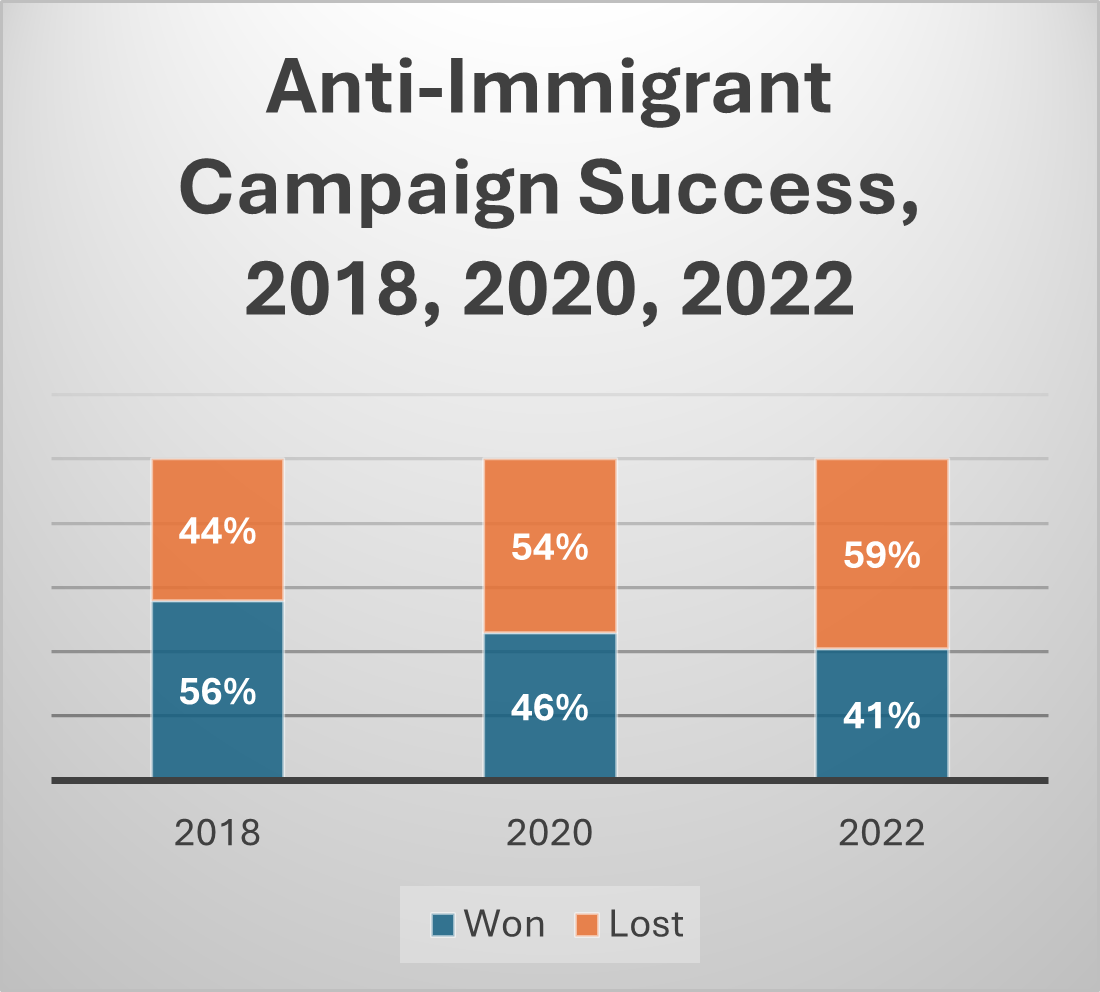
But do Democrats need to get harsher on immigration if they want to win? Data shown in Figure 1 demonstrates a phenomenon that may surprise political strategists on both sides of the aisle. Research from The Immigration Lab analyzing congressional and gubernatorial elections in 2018, 2020, and 2022 has shown that these anti-immigrant campaign victories have decreased by about 15%. This data was pulled from online campaign material from every election result with a 10% margin between the two major candidates.

Successes of anti-immigrant campaigns in competitive elections, 2018-2022 by the authors.

In 2018, businessman and former state senator Brian Kemp ran for governor in Georgia. His campaign epitomized the culture wars that the GOP included as part of their messaging strategy. Kemp styled himself as a “politically incorrect conservative” and filmed himself touting chainsaws and shotguns in service of this persona. He ended one of his ads by showcasing him in his truck, threatening to “round up criminal illegals myself.” On November 8, 2018, Kemp defeated his opponent in the closest Georgia gubernatorial race since 1966.

In 2022, Kemp ran for re-election against the same opponent. With essentially the same election conditions, Kemp’s strategy radically changed. His new primary TV ad, titled “Stronger Georgia,” listed a myriad of his accomplishments as governor. Many of his themes continued from his 2018 ads, including his support of decreased government regulation. Nonetheless, a notable point missing from his 2022 ad, however, was immigration. Kemp made no mention of the issue, making only a brief note of him “fighting human trafficking.” In softening his tone on migration, Kemp nearly tripled his margin of victory in 2022 in comparison to 2018.

Even while encounters at the border today are as low as during the pandemic when Title 42 was in effect closing the border to asylum-seekers, many think that long lines of people asking for asylum at the U.S.-Mexico border is a political liability for the Biden-Harris administration. However, when Americans in these competitive elections have shown up to the polls in the last six years, running an anti-immigrant campaign has demonstrated itself to be well short of the secure victory strategy that many seem to think it is.

Joseph Fournier is a Research Assistant at the Immigration Lab and a senior at American University.
Ernesto Castañeda is the Director of the Immigration Lab and the Center for Latin American Studies.

Uncertainty: Migrant Self-classification of Immigration Statuses

By Mackenzie Hoekstra

October 3, 2024

Starting in 2022, the Immigration Lab at American University began interviewing recent migrant and refugee arrivals to the DMV. So far, we have interviewed 181 from a variety of origins. The interviews aim to understand the experiences of refugees and migrants before, during, and after their entrance into the United States. Interviewers asked participants to reflect on their immigration journey and classify their immigration status. Self-perception, specifically individual understanding of immigration status, varied depending on the respondents’ country of origin, with particular uncertainty for migrants coming from South and Central America. Out of the fifty-nine respondents who were asked to classify their immigration status, eight were uncertain, seven of these were from El Salvador and one from Venezuela.

This broad range of understanding can be partly attributed to the higher clarity in legal definitions for refugee status and recipients of asylum or humanitarian parole versus migrants who have come without papers or who are in the middle of requesting asylum or other humanitarian relief. Refugees and asylum seekers qualify for legal residence based on proving a “well-founded fear of persecution for reasons of race, religion, nationality, political opinion or membership in a particular social group” (UNHCR). Refugees are vetted, approved, and brought to the U.S. through international refugee organizations and the U.S. government. They receive specific resettlement services and benefits through sponsoring resettlement agencies in the U.S. under the program known as Reception and Placement. These services are usually limited to the first 90 days after arrival and include necessities such as securing and setting up housing and rent assistance. Other services are provided by case managers, such as cash assistance, cultural orientations, school enrollment, benefit application assistance, employment support, and aid in navigating medical and legal services in their new communities. The goal of these services is for refugees to be economically self-sufficient as soon as possible. The number of refugees allowed in the U.S. is capped each year by the president and Congress. The current admissions cap for FY 2024 is 125,000 and 100,000 were resettled.

Asylum seekers must also prove they meet the conditions set by UNHCR but apply for asylum upon their arrival to the United States. They can apply affirmatively either at the point of entry or within a year of arriving in the U.S., or defensively once they receive notice of removal proceedings. Once granted asylum, they are known as asylees and gain access to government benefits and services similar to refugees like cash assistance and medical assistance, but do not have the same level of support as refugees do through case management. The are no numerical caps on how many asylum seekers can be granted that status but rather are decided on an individual case through immigration courts. This process can be lengthy and has a very significant backlog. According to TRAC, 1,101,819 asylum applicants currently have a pending case with U.S. immigration courts. This number translates into an average wait time of 1,424 days, a wait of almost four years for their case to be heard and decided.

For individuals who do not qualify for legal permanent residency as refugees or asylees, the definitions and processes become more complicated. Unlike for refugees and asylum seekers, there is no legal definition of a ‘migrant.’ A variety of programs/statuses exist for migrants including, but not limited to Humanitarian Parole (HP), Temporary Protected Status (TPS), work permits/visas, student visas, and green card applications, all of which have strict eligibility requirements and timelines.

Social services and benefits available to asylum seekers and migrants are limited. According to the National Immigration Forum, federal benefits such as the Supplemental Nutrition Assistance Program (SNAP), Temporary Assistance for Needy Families (TANF), Supplemental Security Income (SSI), and Medicare are not available for these immigrants. These benefits are only available to immigrants who have been granted asylum or become lawful permanent residents (LPR) and lived in the U.S. for a minimum of 5 years. Some states offer limited cash, food, and healthcare assistance, however, most of the services available are provided by local nonprofits which face similar barriers to resources and visibility. Accordingly, research shows that immigrants use less government services than the U.S.-born.

In addition to limited social benefits, legal status designations are complex to navigate, often requiring legal guidance and representation to get one’s status adjusted and obtain permanent residency. The interviews conducted by the Immigration Lab highlight this confusion and uncertainty and the need for better and more accessible resources and legal guidance for migrants.

Among respondents who did not classify themselves with a concrete immigration status in the interviews, two main groups emerged, those with some form of legal guidance and those without. Respondents without any form of legal guidance were quick to classify themselves originally as undocumented or express complete uncertainty as to their status. When prompted further during the interviews, many respondents clarified that they were uncertain about their status, not undocumented.

In other cases, individuals thought they may be out of status but in reality, they were pending a decision by migrant courts. In one instance, a respondent from a woman from Colombia stated, “Let’s say right now I don’t have status. I don’t have documentation. I am undocumented.” However, further discussion revealed that she had been processed and released by U.S. immigration and had been allowed to stay in the U.S. on legal grounds, which she did not fully understand. This response highlights how a self-classification as “undocumented” is used as a way to express initial uncertainty. While this response pattern emerged in a few cases, one example of complete uncertainty came from a Honduran male respondent. When we asked about his immigration status, he responded “What can you call it?” The interviewer then went on to explain different avenues of immigration: asylum, visa, and entry without inspection. In response, the man once again affirmed that “I don’t know…” The man explained that he was interested in getting a work permit but had no avenues through whichto obtain one. This shows that they do not know how the U.S. immigration system works, much less how to navigate it.

For those who expressed having legal guidance or representation, a theme of classifying as “in-process” was common. These respondents understood that there was a process that they were going through to get documentation but could not specifically articulate what that process was. For example, when asked to identify her immigration status, one El Salvadorian female explained that she and her family had found a lawyer to represent them. But never articulated what legal avenue was lawyer pursuing. Similarly, an El Salvadorian male expressed confusion over his next court date, not knowing when or what the court appearance was for.

In a working paper written by the American University’s Center for Latin American and Latino Studies on Newcomer Central American Immigrants’ Access to Legal Services, researchers found that less than half of Central American immigrants have access to legal services because low-income and pro bono services are hard to find. Additionally, this affordable representation often only takes on limited cases, specifically focusing on the cases that are more likely to be won in court. This has resulted in more legal referrals to private firms, and despite these firms providing high-quality services, they are very expensive. Immigrants may be tempted to work with notary generals confusing them with notarios, who in Latin America are highly influential lawyers. This creates a higher degree of fraud risk. Therefore, these Central American immigrants either avoid, don’t have access to, or cannot afford legal services. This means that they must rely on their knowledge or the knowledge of family and friends. In the context of the complex and process-oriented immigration legal system, this information is often not enough and may lead to them losing their immigration case to remain in the U.S.

The analysis of these interviews uncovered the important reality that migrants are often uncertain about their immigration status in the U.S., even when they have access to legal representation or guidance. Volunteers, legal offices that do pro-bono immigration work, and non-profits that have this as their mission are overburdened by caseloads and don’t receive enough funding and donations to expand. People come to the United States for a variety of reasons and often must take timely action to secure their legal statuses. It is crucial that theyhave access to resources that can help guide and support them through the various processes available to them, both legal and non-legal. It is not enough to ensure basic access to these resources; efforts must be made to make information about immigration statuses accessible and understandable for migrants.

Mackenzie Hoekstra is a senior majoring in Sociology at American University and a member of the Immigration Lab.

Edited by Dr. Ernesto Castañeda, CLALS, and Immigration Lab Director.

Are Digital Nomads Bringing Security to Tepito?

By Sofia Guerra

Creative Commons Licenses

Abstract:

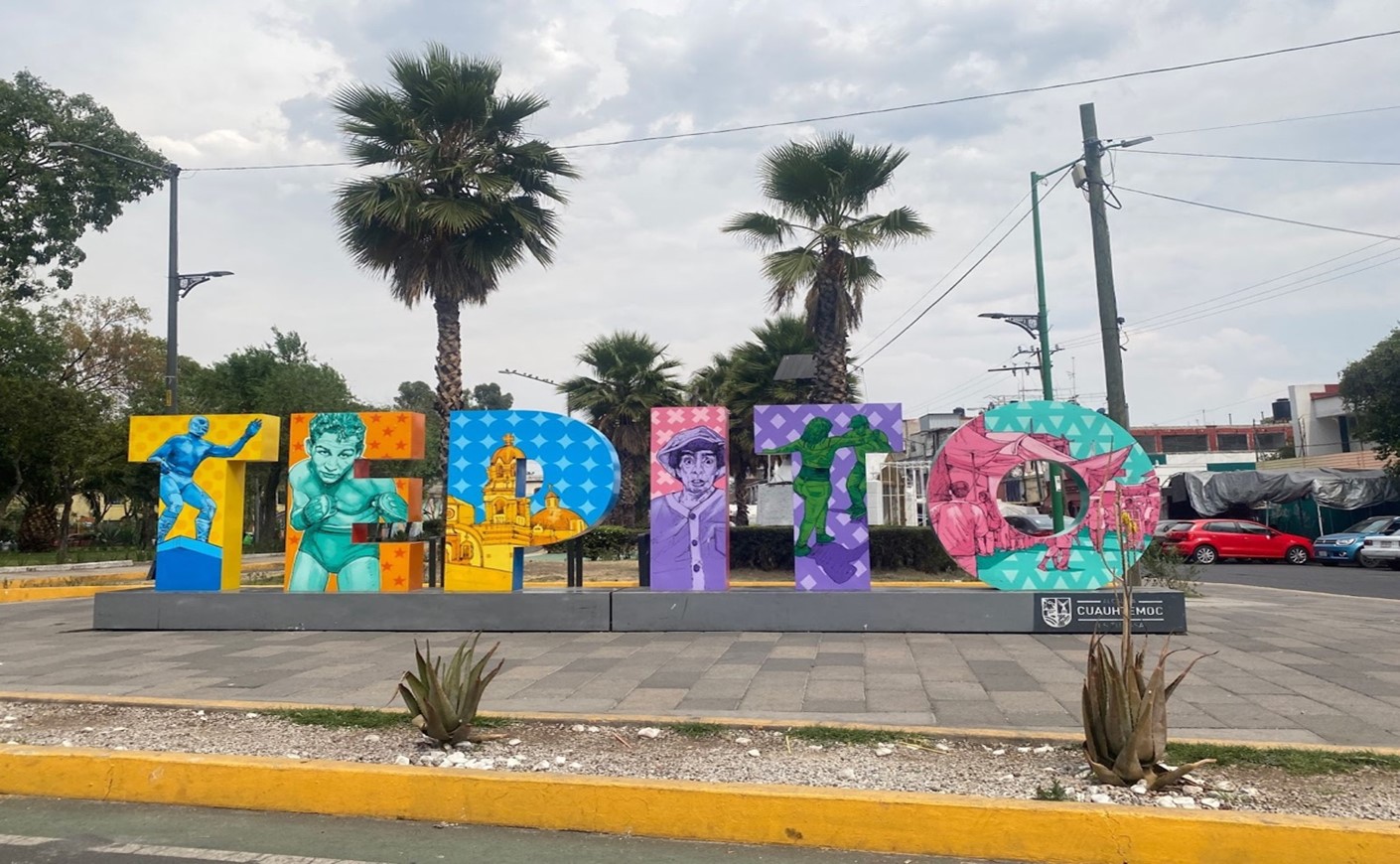
Mexico City has seen a rise in digital nomads, individuals who work remotely while exploring low-cost international destinations. Sofia Guerra, along with a colleague, conducted fieldwork during the summer of 2024 to study this phenomenon. One finding showcased a significant increase in tourism in Tepito, one of Mexico City’s most dangerous neighborhoods. There has been an attempt to rebrand it as ‘Reforma Norte’ to mitigate its notorious reputation. Despite these efforts, Tepito residents report little to no improvement in the safety of the area, which remains heavily associated with crime and gang activity. Digital nomads generally avoid living in Tepito, visiting only its markets with local guides during the day.

Mexico City has experienced a notable increase in the number of digital nomads from around the globe. Digital nomads are individuals who can work remotely, using their flexibility to explore and reside in different countries. This lifestyle allows them to earn a living while working away from their home base. Typically, they choose destinations with a lower cost of living compared to their hometowns, which results in them earning in one currency and spending in another. This constructs economic growth by attracting investment in the area but raises local prices.

I have been studying this social phenomenon through research conducted with my colleague Montse Hernandez by interviewing locals and digital nomads to gather data. One theme that impressed us the most was that, due to gentrification, Tepito—a neighborhood known as one of the six most dangerous barrios in Mexico—is now becoming an intriguing destination for digital nomads. One of our participants even claimed that tourism led to increased security in the area. 

Being born and raised in Mexico City and always hearing about the crime surrounding Tepito, made this theme catch my attention and I decided to explore it further. Kristýna Omastová, conducted research to understand Tepito’s transformation from the 1960s to the present day. She describes how Tepito, initially known for its informal commerce, evolved into a major drug distribution hub in the heart of Mexico City. With the rise of the informal economy and growing demand for illegal goods, Tepito solidified its reputation as a place where illicit products were easily accessible. Tepito became a key center for drug distribution, and violence peaked and fell under gang control. To this day, remains a hub for drug trafficking operations, dominated by gangs like “La Unión Tepito,” which control not only the drug trade, but also other illegal activities such as extortion, kidnapping, and theft. 

So, why has Tepito become a target for digital nomads? The real estate company Grupo UBK launched a new remarketing campaign for the area, driven by the rising demand for apartments in Mexico City. Tepito is being promoted as an affordable investment opportunity, making the rent prices in the area rise. A rebranding effort has emerged, and it involves renaming it ‘Reforma Norte’ to mitigate its reputation for insecurity. It’s important to note that the buildings are not located in the heart of Tepito, but rather on the outside of the neighborhood. Some locals don’t even know that the area is now being called Reforma Norte and believe that the promotion of Reform Norte will not change or affect the prices of the heart of Tepito, although they have seen an increase in foreign-born visitors in some of the busiest market areas. This showcases that the marketing strategy has digital nomads as their target, therefore causing an increase in tourists in that area.

Although there has been an increase in foreign-born visitors in Tepito, the area is still known for delinquency, drug trafficking, and informal commerce. Digital nomads are mostly living in safer neighborhoods such as Condesa, Roma, Polanco, and Juárez. In Tepito, tourists often visit for the day and go to the markets in the heart of the barrio, usually accompanied by a tour guide or locals who know the area. This suggests that the rebranding strategy by the real estate company has led them to believe that Tepito is becoming safer, although locals from Tepito themselves do not perceive any significant changes in the Barrio Bravo safety.

Sofia Guerra is a sociology graduate student at American University. She is a research assistant at the Immigration Lab and Center of Latin American and Latino Studies at American University. She has conducted research on migration, gender studies, and the bilateral relationship between Mexico and the United States. She has an interest in policy-making, migration studies, criminology, and academia. She currently working on her research regarding migration and interpersonal violence.
Anti-Immigration Rhetoric is an Electoral Vulnerability: Evidence from the 2022 Midterm Elections

By Ernesto Castañeda, Joseph Fournier, and Mary Capone

October 1, 2024

Graph elaborated by the authors with data collected from CNN Politics’ Midterm Election Results.

The above graph represents the proportional success of candidates who used anti-immigration sentiment in their campaigns for the 2022 midterm elections. Results data was taken from CNN Politics. Anti-immigration rhetoric was found in campaign material through Meta Ad Library, X (formerly Twitter), debate responses, campaign website archives, YouTube ad searches, and general Google searches. We focused on competitive elections defined as having electoral results within a 10% margin between candidates. Candidates in these competitive elections who used ani-immigrant sentiment were no more likely to win the election than those who did not; in fact, more candidates who campaigned on anti-immigration lost than won in 2022. This data provides evidence that not being anti-immigration is not a hindering campaign decision. It may be quite the opposite.

Immigration often emerges as a prominent talking point among candidates in presidential, congressional, and gubernatorial elections. Former President Donald Trump frequently employs anti-immigration rhetoric and continues to campaign under similar sentiments about the allegedly dangerous porosity of the southern U.S. border. In the presidential debate in June of 2024 against President Joe Biden, Trump mentioned immigration in 42% of the 38 times he spoke while Biden mentioned immigration 13% of the time.  In the subsequent debate against Vice President Kamala Harris, out of 38 times when Trump spoke for more than two sentences, he incorporated immigration 10 times (26% of the time). In comparison, Harris did so 4 out of 27 times (15% of the time).

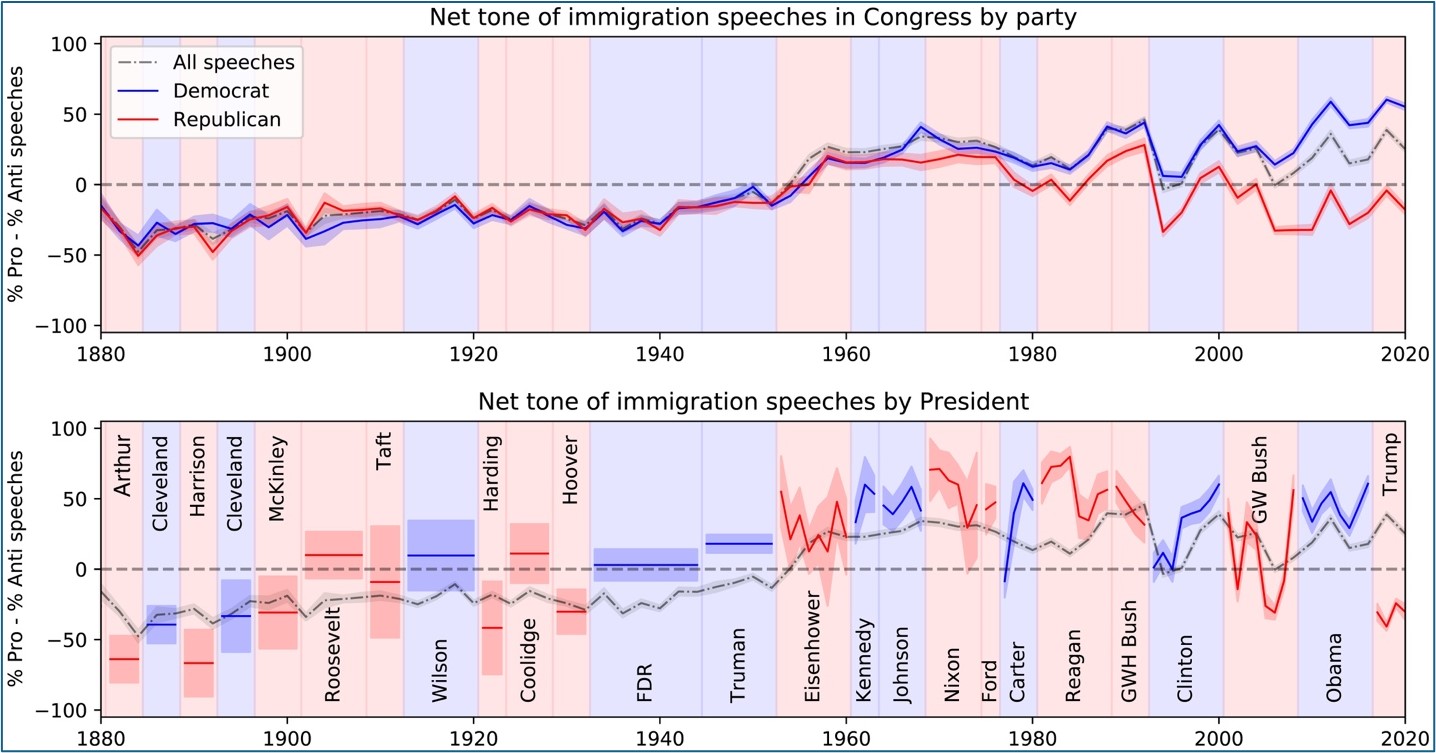
Anti-immigration rhetoric has become practically synonymous with the Republican Party as these candidates often use immigrants as scapegoats for shortcomings in national security, economics, and crime control. While several Democratic candidates support anti-immigration policies as well, it is less commonly a key aspect of their campaigns. The graphic below indicates the overall tone of immigration speeches in Congress and the president by party from the late nineteenth century until 2020. While the data excludes 2022, it encapsulates the general trends of immigration sentiments over time.

Source: Card et al., 2022 published by the Proceedings of the National Academy of Sciences.

The top of the graph shows that trends in the rhetoric of Republican and Democratic congressional representatives were negative before the 1950s and became positive in both parties in the late 1950s and through the 1960s and 1970s. The divergence in sentiments is clearest in the early 1980s and beyond, with the greatest points of divergence occurring between 2000 and 2020. Card et al. acknowledge that the divergence also represents other trends in the polarization of other issues. However, they find that immigration polarization predated the rise in generic political polarization observed in Gentzkow et al. by more than a decade.

The lower part of the graph shows the variation in presidential sentiments through positive and negative language employed to discuss immigration. The anti-immigrant rhetoric of President Trump has been unseen since the presidency of Herbert Hoover. Overall, the graph represents the rise in anti-immigration rhetoric in congressional and presidential speeches by Republicans in recent years as it has become more of a political talking point.

Discourse gathered from the campaign sites and social media accounts of Republican candidates who ran in competitive elections in 2022 with anti-immigration campaigns includes several instances of strongly prejudiced statements. Republican Mark Robertson (Nevada District 1) sought to “turn off the illegal flow of people coming into our country… end chain-migration, visa lotteries and vacation-birth citizenship.” Ending “vacation-birth citizenship” implies a possible erasure of birthright citizenship. Anti-immigrant candidates describe policies like these in misleading ways to garner political support, despite understanding the implausibility of such a policy.

Many of these anti-immigrant candidates take further aim at immigrant children. Republican candidate for the Senate in Pennsylvania Mehmet Oz stated in an ad that, “The Biden administration’s failure on the border is so massive that they are flying illegal immigrants up to airports like this where illegal immigrants are being taken on buses. Now every state has become a border state.” The ad is filmed outside of Scranton-Wilkes-Barre Airport in Pennsylvania, an airport that has been instrumental in the facilitation of protecting unaccompanied migrant children. This airport and the role it plays in the migrant children protection apparatus made it a popular target for Pennsylvania Republicans in 2022. Jim Bognet (R), who ran for Congress in the district that includes the airport itself, ran an ad claiming “Joe Biden & Matt Cartwright still won’t STOP ghost flights of illegal immigrants into (Northeast Pennsylvania).” The reason for this secrecy is that these are minors whose identities are obscured to ensure their security. Many of these children come from vulnerable backgrounds, including a sixteen-year-old victim of sex trafficking seeking protection while awaiting possible testimony and an asylum claim. These children have become the target of a political stunt by the GOP in their attempt to create fear surrounding migration.

Numerous other candidates posit a link between undocumented immigration and drug cartels. Republican Congressman Bryan Steil, who won in Wisconsin District 1, claimed on his campaign website that “drug dealers (and) human traffickers” are crossing the border, framing it in such a way that implies the two are intertwined in their business dealings. Republican Congressman John James, who won reelection in 2022 for Michigan District 10, conducts a similar framing in a tweet highlighting “millions of illegal border crossings, millions of lethal doses of Chinese fentanyl.”

A more brazen example of such framing can be found in campaign material from Blake Masters’ failed bid for Arizona Senate, which shamelessly claims that “More than 225,000 illegal aliens pour into our country every month. And they bring enough fentanyl over each month to kill every American twice over.” In a recent conference on immigration at American University, Dr. Andrew Selee, head of the Migration Policy Institute, notes that these organizations are separate entities. Though they sometimes do collaborate, they are by no means the same and have independent organizational structures. This is a subtle yet important distinction that has been masked to criminalize migrants and conflate them with criminal enterprises such as drug cartels.

The criminalization of migrants was certainly not limited to linking them to cartels. Many candidates rely upon preconceived racist notions of immigrant populations (mostly Latinos) in making generalizations. Such candidates keep their statements on immigration vague, like Nevada Republican Senate hopeful Adam Laxalt: “[the] crisis at the border that has put communities across Nevada in danger…. [Laxalt] fought against dangerous sanctuary city policies and worked to help stop their spread.” The advantages yielded by anti-immigrant candidates in utilizing this sort of vagueness are twofold. The first is that it appeals to a voter base that has already constructed a negative bias toward immigrant populations, and it is this sort of rhetoric that energizes these voters. The second advantage of such vagueness is the removal of the burden of proof from Laxalt or other candidates. Because of this vagueness, the claim becomes difficult to disprove because the meaning can be fluid and easily manipulated at the whim of the candidate.

Similarly, a campaign ad from Republican gubernatorial candidate Kari Lake of Arizona claims to finish the southern border wall and reinstate the “Remain in Mexico” policy: “the best policy I’ve seen in my 27 years, it worked.” The “Remain in Mexico” policy, a Trump-era directive modified by President Biden, has been largely condemned by human rights groups. Multiple immigration advocates highlighted that the policy forced all migrants to wait on the Mexican side of the border, including those who are escaping persecution in Mexico, in unsafe and uncertified conditions while their asylum case were pending.

Overall, anti-immigration statements like those highlighted in the 2022 midterm election campaigns are prevalent across Republican candidates. Trends indicate a rise in such rhetoric in congressional and presidential speeches with a partisan divergence as Republican candidates are more likely to employ this as a strategy in campaigning. Nonetheless, there was limited success for anti-immigrant campaigns in the 2022 midterm elections. The data shows that anti-immigration rhetoric is not a guarantee for winning elections; in fact, it may be an electoral vulnerability as it does not lead to more success in competitive elections.

Ernesto Castañeda PhD, Director of the Immigration Lab and the Center for Latin American and Latino Studies, American University in Washington DC.

Joseph Fournier and Mary Capone are research assistants at the Immigration Lab and the Center for Latin American and Latino Studies at American University.

Sources

“2022 Midterms.” CNN Politics, Accessed September 17, 2024. https://www.cnn.com/election/2022.

Adam Laxalt for NV. “Issues | Adam Laxalt for Senate.” Accessed February 6, 2024. https://www.adamlaxalt.com/issues.

Card, D., Chang, S., Becker, C., Mendelsohn, J., Voigt, R., Boustan, L., Abramitzky, R., & Jurafsky, D. (2022). Computational analysis of 140 years of us political speeches reveals more positive but increasingly polarized framing of immigration. Proceedings of the National Academy of Sciences119(31). https://doi.org/10.1073/pnas.2120510119 

Castaneda, Ernesto. “First Presidential Debate Was Mainly about Immigration, Few Noticed”. AULA Blog Accessed September 25, 2024 https://aulablog.net/2024/07/19/first-presidential-debate-was-mainly-about-immigration-few-noted/.

“Frequently Asked Questions: ‘Remain in Mexico’ Policy.” Justice for Immigrants. Accessed October 2, 2024. https://justiceforimmigrants.org/wp-content/uploads/2019/02/Remain-in-Mexico_en.pdf.

Gentzkow, M., Shapiro, J. M., & Taddy, M. (2019). Measuring group differences in high dimensional choices: Method and application to congressional speech. Econometrica, 87(4), 1307–1340. https://doi.org/10.3982/ECTA16566

James, John. (JohnJamesMI). “Our border is plagued with chaos – millions of illegal border crossings, millions of lethal doses of Chinese fentanyl & incompetence from the White House. I’m glad to support the House GOP’s Commitment to America to fund border security & put an end to human & drug trafficking.” September 26, 2022. 3:10 PM. Tweet. https://x.com/JohnJamesMI/status/1574476402392457217.

Jordan, Miriam. “’Ghost Flights’? The Facts Behind Transporting Migrant Children”. New York Times. June 24, 2022. Accessed February 4, 2024. https://www.nytimes.com/2022/06/24/us/ghost-flights-migrant-children.html?login=google&auth=login-google#.

“Kari Lake January 2022 Ad.” Accessed February 6, 2024. https://www.facebook.com/ads/library/?active_status=all&ad_type=political_and_issue_ads&country=US&id=313372640712991&media_type=all.

“Remain in Mexico” Human Rights Watch. Accessed October 2, 2024. https://www.hrw.org/tag/remain-mexico

Robertson, Mark. “Mark’s Stances – Robertson for Congress.”Accessed February 11, 2024. https://web.archive.org/web/20221104220014/https://robertsonforcongress.com/stances/

Selee, Andrew. “Wilson Center Discussion on Immigration Policy”. September 23, 2024. C-SPAN, 58:43. https://www.c-span.org/video/?538598-1/wilson-center-discussion-immigration-policy.

Steil, Bryan. “The Issues: Bryan’s Vision for America – Securing Our Border”. Accessed September 26, 2024, https://web.archive.org/web/20221104220838/https://www.bryansteil.com/issues/.

“STOP ILLEGAL IMMIGRATION – Dr. Oz for Senate.” Accessed February 11, 2024. https://web.archive.org/web/20221028022107/https://doctoroz.com/issue/stop-illegal-immigration/.