

Press Release | October 28, 2026
Americans show great concern about forced deportation, but those concerns do not translate into support for ending removals altogether. An online survey conducted by the Center for Latin American and Latino Studies and YouGov asks 5,000 registered voters in late September 2026 about a range of immigration-related topics. The sample is structured to represent the American public across key demographics, including age, gender, race, education, and political affiliation.
This report highlights American voters’ attitudes toward forced and mass deportation, focusing on concerns about current enforcement, preferred alternatives, and how factual information influences public opinion. Together, the findings show how humanitarian and political concerns can drive opposition to forced deportation without implying support for ending immigration removals entirely.
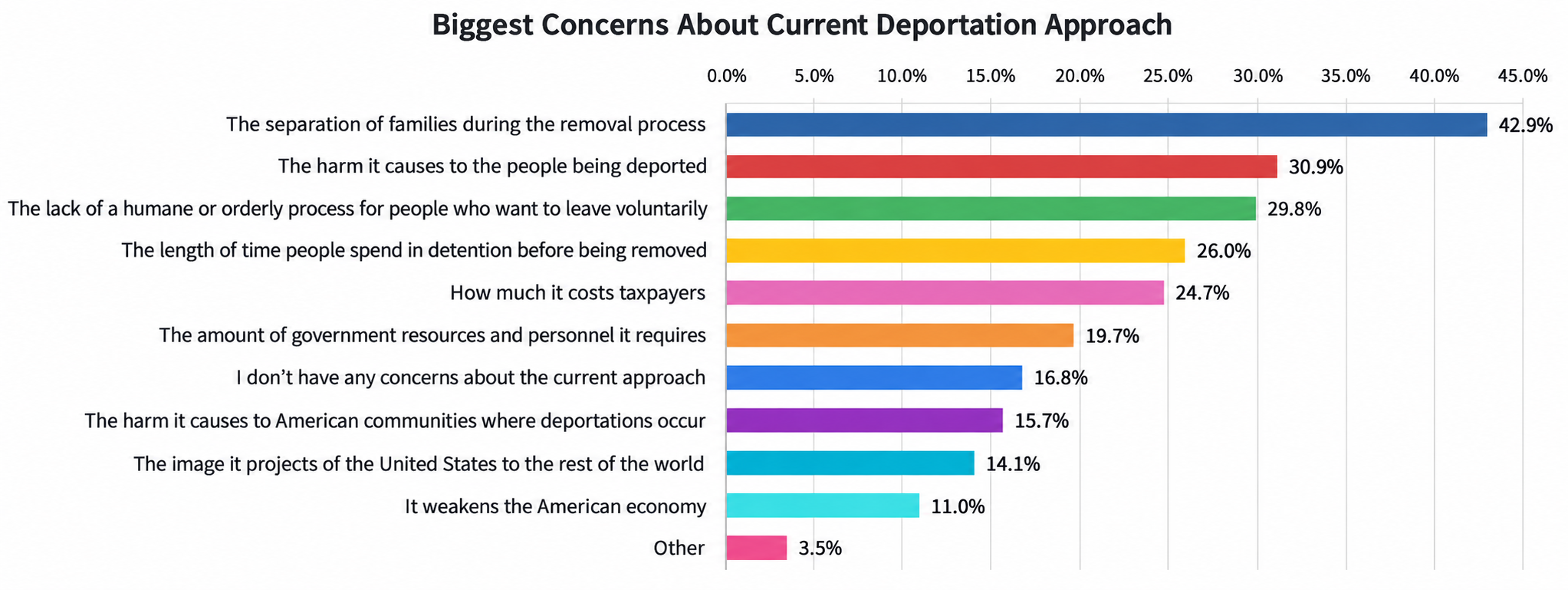
The top concern regarding the current deportation approach is family separation (42.9%). Harm to people being deported (30.9%) and concerns about whether the process is humane or orderly (29.8%) are among the most frequent responses. Overall, concerns range from the personal treatment of deportees to broader operational issues within the deportation system.
Public trust in how enforcement agencies carry out deportations further reflects these concerns. Around 50.2% of respondents do not trust ICE to handle deportations fairly, adding further context to doubts about current enforcement practices.
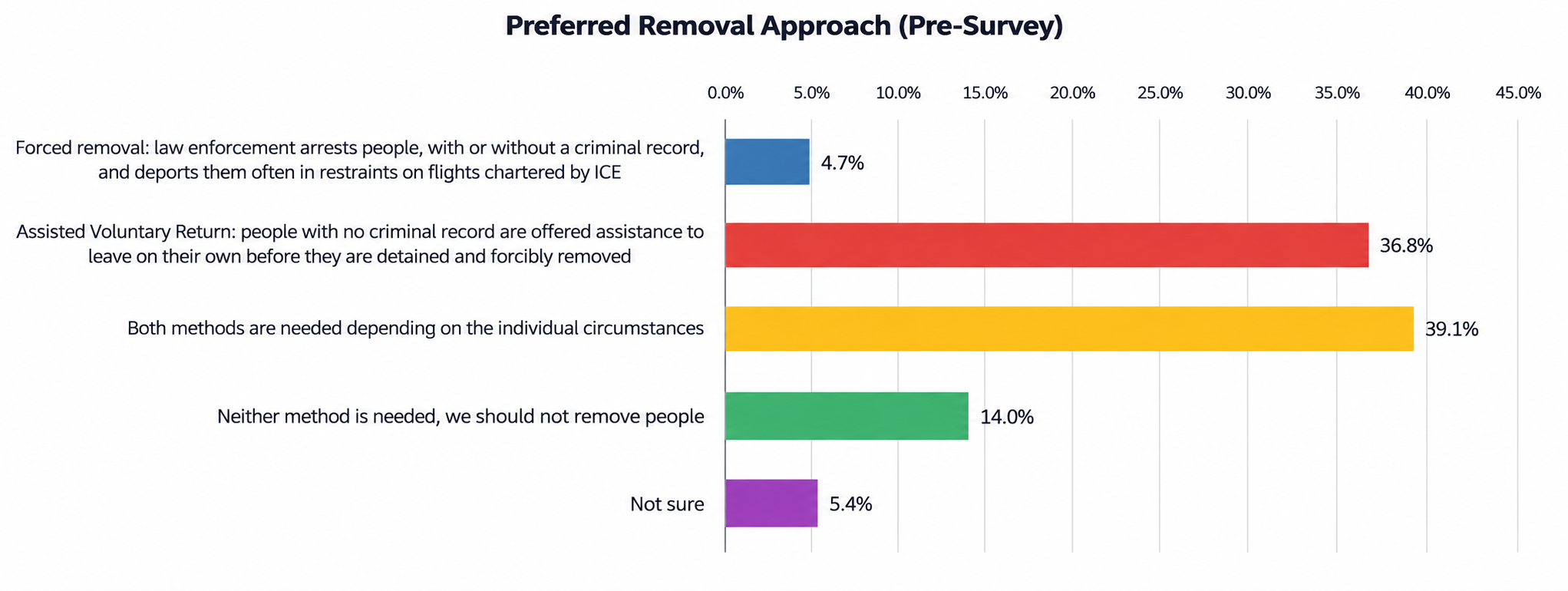
Preferences for deportation approaches demonstrate a similar trend. The largest share of respondents (39.1%) say the appropriate response depends on individual circumstances, while 36.8% favor assisted voluntary return. Only 4.7% see forced removal as the preferred method, 5.4% are unsure, and 14% disapprove of both removal methods.
Learning about costs changes how voters view forced deportation. After learning that deportation flights cost $6,045 per person, more than seven times the cost of a commercial flight, 62.3% become less supportive of forced deportation, compared with 23.9% who become more supportive, while 13.9% are unsure.
Political reactions to mass deportation are similarly divided. When asked how they view a member of Congress who opposes mass deportation, 41% of respondents say they are more likely to support them, while 33.5% say they are less likely. Another 17.3% say it makes no difference, and 8.3% are unsure.
Ultimately, the survey results point to a nuanced middle ground. Respondents expressed concerns about family separation and treatment during deportation while also favoring case-by-case or voluntary alternatives. Cost information also moved many respondents away from forced deportation. Overall, the results suggest that humanitarian concerns and practical objections can both shape opposition to forced removal.
Report created by Fernando Atencio Herrera, Ismail Akbulut, Ernesto Castañeda, and Katheryn Olmos
Read more about the survey:
https://www.american.edu/centers/latin-american-latino-studies/yougov-survey.cfm
More information about CLALS:
https://www.american.edu/centers/latin-american-latino-studies/index.cfm
For media inquiries, contact clals@american.edu or olmos@american.edu


