Deportaciones Masivas Podrían Crear una Recesión en EE.UU

Ernesto Castañeda

Entrevista de Diana Castrillón a Ernesto Castañeda publicada por Stornia 13 de agosto de 2024 editada y expandida por Castañeda.

Diana Castrillón: “La inmigración irregular es uno de los temas más importantes de las campañas presidenciales de los candidatos, el republicano Donald Trump y la demócrata Kamala Harris. Por un lado, la administración de Biden-Harris restringió el número de solicitantes de asilo que pueden ingresar al país. Por otro lado, los republicanos están prometiendo el “mayor programa de deportación masiva en la historia de Estados Unidos” si es que ganan la Casa Blanca este otoño.

El sentimiento antiinmigrante en Estados Unidos está en aumento. Este año, el 55% de los estadounidenses dijeron que les gustaría ver una disminución de la inmigración, una novedad desde el 2001. Esto se debe en parte a la creencia que los inmigrantes, en particular los indocumentados, son una carga para los recursos del gobierno y no contribuyen en nada.

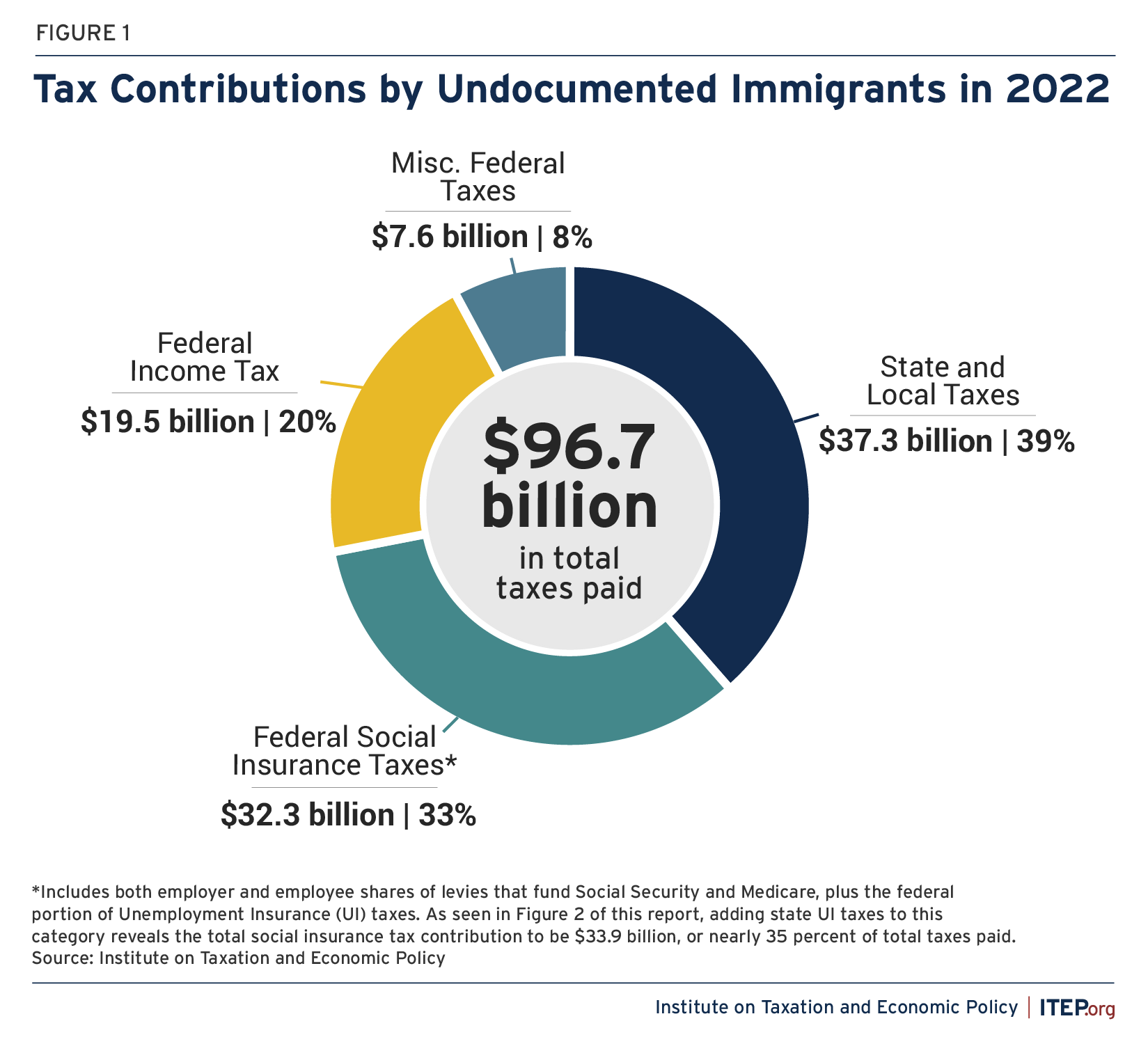
Sin embargo, un nuevo estudio del Instituto de Política Fiscal y Económica muestra que es todo lo contrario. Según el informe, los inmigrantes indocumentados contribuyeron con casi $100 mil millones de dólares en impuestos durante 2022 y a su vez, no pudieron acceder a muchos de los programas que financiaron sus dólares de impuestos.

De esos casi $100 mil millones, $60 mil millones se destinaron al gobierno federal. Por cada millón de inmigrantes indocumentados, los servicios federales reciben $8.900 millones de dólares adicionales en ingresos fiscales. Más de un tercio de los impuestos que pagan estos inmigrantes se destinan a programas a los que no pueden acceder, como la Seguridad Social ($25,700 millones de dólares), salud Medicare ($6,400 millones de dólares) y el seguro de desempleo ($1,800 millones de dólares).

Los indocumentados suelen pagar tasas impositivas más altas que los ciudadanos estadounidenses. En 40 de los 50 estados del país, los inmigrantes irregulares pagan tasas de impuestos estatales y locales más altos que el 1% de los hogares con mayores ingresos. Además, no pueden recibir muchos créditos fiscales. No se dan cuenta que pueden reclamar reembolsos y tampoco tienen acceso a ayuda fiscal.

“En total, la contribución fiscal federal de los inmigrantes indocumentados ascendió a $59,400 millones de dólares en 2022, mientras que la contribución fiscal estatal y local se situó en 37,300 millones de dólares”, escribieron los autores del estudio. “Estas cifras dejan claro que las decisiones sobre política migratoria tienen implicaciones sustanciales para los ingresos públicos en todos los niveles de gobierno”, menciona el informe.”

En entrevista con Stornia, Ernesto Castañeda PhD, Director del Laboratorio de la Inmigración y el Centro de Estudios Latino Americanos y Latinos de American University en Washington DC, aseguró que los inmigrantes son necesarios y esenciales para el crecimiento económico de Estados Unidos.

Diana Castrillón: ¿Cómo paga un inmigrante indocumentado impuestos, si como su nombre lo dice, son migrantes irregulares?

Ernesto Castañeda: Los indocumentados pagan impuestos cada vez que compran algo, está el impuesto a la compra, el porcentaje depende de cada localidad. Si compran casas, que lo pueden hacer, también pagan impuestos, si rentan o pagan renta, también hay un porcentaje que se debe pagar en impuestos al gobierno local y federal. La gente indocumentada que trabaja en compañías formales, que son muchos, pueden tener una identificación temporal para pagar impuestos (ITIN), que funciona de manera similar al número de Seguridad Social, entonces pagan impuestos a la nómina como cualquier otra persona trabajando en Estados Unidos. Hay gente que usa documentos de identidad falsos o que no les corresponden, pero alguien se los presta, y así pagan a las arcas de Seguro Social y programas de retiro y de salud, pero como el número es falso o no es de ellos, no tienen acceso a esos beneficios.

Entonces, no solo pagan a estos servicios, sino que muchos inmigrantes no piden ese apoyo. Por lo tanto, tienen una contribución mayor a los ciudadanos que pagan, pero quien luego si retiran esas ayudas. Es una ganancia que el Gobierno Federal y el Tesoro aceptan abiertamente que sucede.

¿Entonces los inmigrantes indocumentados están pagando más impuestos que los mismos ciudadanos americanos?

Si, la tasa de muchos indocumentados que pagan impuestos es más alta que las tasas que paga la gente más rica del país. Claro, los ingresos son diferentes pero la tasa es a veces mayor o muy similar, a la de los ciudadanos. Los ciudadanos llenan sus declaraciones de impuestos y muchas veces piden reembolsos, por ejemplo, por gastos de negocios o les dan un crédito por tener hijos, pero muchos de los indocumentados no hacen esos reclamos porque no quieren que más adelante se les niegue la ciudadanía por haber pedido ayudas o servicios. Por ese temor, tampoco piden programas de apoyo para sus hijos, que ya son ciudadanos y tienen derecho a esos servicios. Hemos comprobado en nuestras investigaciones en el Laboratorio de Inmigración que los inmigrantes usan menos servicios sociales que los nacionales (Castañeda y Cione, 2024).

Pareciera que los indocumentados están entre la espada y la pared ahora con la campaña electoral tanto por el lado de los republicanos como por el lado de los demócratas, ¿hay preocupación en la comunidad?

Algunos políticos usan a los inmigrantes indocumentados como chivos expiatorios en tiempos electorales. Por un lado, Trump hace esta amenaza de deportaciones masivas, pero es poco probable que lo haga, eso mismo lo había prometido anteriormente y cuando fue presidente no deportó a tanta gente. Eso no significa que la gente no tenga miedo ahora y si gana creará un terror real entre la población que ya de por sí vive con mucho miedo a que los encuentren como indocumentados a ellos o a alguien cercano.

En cuanto situaciones de asilo, en efecto, mucha gente está escapando de situaciones difíciles en Afganistán, Ucrania, Cuba, Venezuela, Haití o Nicaragua.  Muchos con pruebas de persecución, y ahora el gobierno ha cambiado cómo tramita buscar asilo.  La frontera está cerrada a muchas de esas peticiones de asilo como se hizo durante la pandemia. Por ende, estamos viendo menos cruces irregulares en la frontera. La administración Biden-Harris piensa que eso les puedes ayudar electoralmente para que los republicanos no les hagan la crítica de que la frontera está supuestamente abierta y los que indocumentados o quienes piden asilo están recibiendo comida y vivienda en algunas ciudades. Es un momento difícil, y no es sostenible. En algún momento van a tener que reabrir la frontera al asilo humanitario, porque a lo que llaman el derecho nacional e internacional es a recibir a la gente que está pidiendo asilo. Tras procesar sus aplicaciones, a unos los aceptarán a otros no.

Trump necesitaría mucho dinero y mucha policía, casi tendría que crear un estado totalitario para poder deportar a toda la gente que está aquí sin papeles migratorios en regla. Muchas de estas personas tienen más de 10 años aquí, tienen hijos ciudadanos, trabajan, contribuyen, por lo cual, deportar masivamente o dejar de recibir inmigrantes es un gran ataque a Estados Unidos. La economía se podría contraer. Se podría crear una recesión porque como mencionamos anteriormente, los migrantes pagan miles de millones en impuestos, pero los impuestos son un porcentaje pequeño de lo que la gente gana. La mayoría de los inmigrantes ganan, lo gastan en las ciudades donde viven, y con el trabajo que hacen generan crecimiento económico, servicios, entretenimiento y hacen que la economía crezca.

Hace algunos días JD Vance, la fórmula vicepresidencial de Donald Trump justificaba el plan de deportación masiva y decía que los indocumentados le están robando plazas de trabajo a los ciudadanos americanos. ¿Existe esa fila de estadounidenses esperando a que deporten inmigrantes para tomar sus puestos de trabajo?

Esto no funciona así. Trump y Vance están equivocados sobre que los inmigrantes les quitan trabajos a los afroamericanos o a otros ciudadanos. Es un estereotipo fácil de vender, algún votante pudo haber tenido una experiencia donde pareciera que pudo ser el caso, sin embargo, si vemos a la economía en general, la inmigración genera nuevos empleos.

En Florida, está en efecto la ley anti-inmigrante más estricta del país. De hecho, han salido muchos indocumentados del estado, y hoy no hay suficiente mano de obra para la construcción, para servicios como hoteles, para la agricultura en los cultivos de naranjas. Entonces los negocios que necesitaban esa mano de obra para generar riqueza ahora no pueden tener su negocio al 100%. Propietarios de granjas han tenido que cerrar porque les falta mano de obra para trabajar, algunos negocios pequeños han tenido que limitar sus horas de servicios. Si no hay construcción no hay viviendas, seguirá habiendo inflación por las viviendas existentes. Los inmigrantes llegan y necesitan un lugar donde vivir, quien les corte el pelo, quien les venda comida, entonces generan trabajo e ingreso para los comerciantes.

Los migrantes emprenden con más negocios (desde pequeños negocios hasta las grandes empresas) que los nacidos en Estados Unidos. También sabemos que los inmigrantes emplean más gente que los dueños de negocios del país. No es que haya un pastel que esté limitado y se lo reparta el número de gente que llega, entre más personas lleguen, incrementa el tamaño del pastel entonces hay más pastel para todos. No es una competencia desleal y eso se ve en las tasas de desempleo.

Ahora bajo la administración Biden-Harris tenemos una tasa de desempleo para afroamericanos históricamente baja, una tasa de desempleo de latinos muy baja y no hay muchos ciudadanos de origen europeo que están desempleados porque algún migrante esté tomando su trabajo, si noq que usualmente no encuentran trabajo porque no los estudios o capacitación suficiente para tomar un empleo bien pagado, o por el contrario, porque tienen demasiada educación y no hay un empleo con alto ingreso que les convenga tomar. O porque se rehúsan a mudarse dentro del país para buscar trabajo. Las tasas de desempleo son bajas en general y de lo que se quejan los empresarios es que no tienen suficiente personal para expandir sus negocios. Esto también afecta a los ciudadanos buscando servicios, teniendo que esperar más en restaurantes porque no hay suficientes meseros o cocineros.

¿Cuál es la respuesta para el manejo de inmigración, más visas temporales de empleos, legalizar a los indocumentados o hacer más muro en la frontera?

La solución a los casos de inmigración irregular a largo plazo es aumentar las visas temporales de empleo para que la gente venga de manera legal. Existen programas como la Visa H2A, H2B son ejemplos de visas que funciona muy bien, la gente viene, trabaja y se regresa a su país, porque ya ganaron ingresos en dólares pudieron ahorrar suficiente y ahora quieren estar con su familia.

El problema es que hay límites, hay cuotas para esas visas, son para cierto tipo de empleos, y hay más demanda de esa gente trabajadora temporal de lo que la que la ley permite. Para que aumenten los topes, los números de esas visas, el Congreso tiene que actuar. Tiene que actuar la Cámara de Representantes y el Senado, y tienen que estar de acuerdo los demócratas, de que es lo que harían, y un número suficiente de republicanos. Pero ellos se niegan a hacerlo, porque parece que no quieren solucionar el tema, solo lo quieren usar de manera electoral.

Para las personas que ya están aquí, la solución es legalizarlos. Al darle papeles o permisos laborales a quienes están aquí, de esa manera muchos ganarían más dinero, tendrían más confianza de invertir, pagarían más impuestos. Esto sería una inyección a la economía americana, y podrían traer a sus familiares de manera legal y expandir la base trabajadora un poco más.

Y eso es algo que ni Trump ni Vance entienden, nunca lo harán. A diferencia del presidente Ronald Reagan, quien sí firmó una ley como esa, aunque a regañadientes. Tampoco es algo sobre lo que han querido hablar mucho Kamala Harris ni Tim Walz en la campaña porque la gente lo usa como un ataque muy simple con ellos, pero los dos tienen un historial político de apoyar este tipo de medidas.

¿Y con esta legalización de indocumentados en Estados Unidos ganan países de América Latina o pierden?

Las remesas representan solo el 4% de lo que los inmigrantes generan en Estados Unidos. Un migrante que está más establecido o es profesional, manda remesas menos seguido, entonces son ayudas a familias en pobreza. Las remesas representan separaciones familiares por años hasta que el migrante termina regresando o trata de traer a la familia entera. Es una ayuda a corto plazo, pero pone a las familias que se dividen en dificultad emocional y cualquier país que pierde migrantes, desde agricultores hasta científicos, médicos, como en Cuba que ha perdido un par de millones de migrantes profesionales durante el último par de años debilita cada vez más su economía. También pasa en la economía venezolana, que ha sido debilitada entre otras muchas cosas por la emigración. Las remesas son ayudas de corto plazo, pero la verdadera ayuda económica se da en donde llegan los migrantes, en este caso Estados Unidos.

De acuerdo con el estudio de Instituto de Política Fiscal y Económica, la autorización de trabajo sería beneficiosa para todos, pues otorgar a los inmigrantes indocumentados una autorización de trabajo resultaría en un aumento de sus contribuciones fiscales de $40,000 millones de dólares a $137,000 millones de dólares por año, ya que la autorización de trabajo aumentaría los salarios.

Ernesto Castañeda PhD, Director del Laboratorio de Inmigración y el Centro de Estudios Latino Americanos y Latinos, American University en Washington DC.

This piece can be reproduced completely or partially with proper attribution to its author.

The English version of this text is available at the following link: https://aulablog.net/2024/08/26/mass-deportations-could-create-a-us-recession/

Mass Deportations Could Create a US Recession

By Ernesto Castañeda

Interview by Diana Castrillon with Ernesto Castañeda published in Stornia August 13, 2024. Edited and expanded by Castañeda. Original in Spanish. Translated by Castañeda.

Diana Castrillon: “Irregular immigration is one of the most important issues in the presidential campaigns of the candidates, Republican Donald Trump and Democrat Kamala Harris. On the one hand, the Biden administration, of which Vice President Harris is part, restricted the number of asylum seekers entering the country, and on the other hand, Republicans are promising the “largest mass deportation program in US history” if they win the White House this fall.

Anti-immigrant sentiment in the United States is on the rise, with more than half (55%) of Americans this year saying they would like to see a decrease in immigration, a first since 2001. This is partly due to the belief that immigrants, particularly undocumented immigrants, are a burden on government resources and contribute nothing to the economy.

However, a new study from the Institute on Taxation and Economic Policy shows that the opposite is true. According to the report, undocumented immigrants contributed nearly $100 billion in taxes during 2022, while being unable to access many of the programs their tax dollars funded. Of that nearly $100 billion, $60 billion went to the federal government. For every million undocumented immigrants, federal services receive an additional $8.9 billion in tax revenue. More than a third of the taxes paid by these immigrants go to programs they cannot access, such as Social Security ($25.7 billion), Medicare ($6.4 billion), and unemployment insurance ($1.8 billion).

In addition, undocumented immigrants often pay higher tax rates than American citizens: in 40 of the 50 U.S. states, illegal immigrants pay higher state and local tax rates than the 1% of households with the highest incomes. In addition, they cannot receive many tax credits and often do not realize that they can claim refunds or prefer not to. “In total, the federal tax contribution of undocumented immigrants amounted to $59.4 billion in 2022, while the state and local tax contribution stood at $37.3 billion,” the authors of the study wrote. “These figures make it clear that decisions on immigration policy have substantial implications for public revenues at all levels of government,” the report says.

In an interview with Stornia, Ernesto Castañeda PhD, Director of the Immigration Lab and the Center for Latin American and Latino Studies at American University in Washington DC, said that immigrants are necessary and essential for the economic growth of the United States.

Diana Castrillon: How does an undocumented immigrant pay taxes, if as their name suggests, they are irregular migrants?

Ernesto Castañeda: Undocumented immigrants pay taxes every time they buy something; there is a sales tax, and the percentage depends on each locality. If they buy houses, they also pay taxes, or if they rent, there is a percentage that must be paid in taxes to the local and federal governments. Undocumented people who work in formal companies, which are many, can have a temporary identification to pay taxes (ITIN), which works in a similar way to a Social Security number, so they pay payroll taxes like any other person working in the United States. There are some undocumented people who use false or incorrect identification documents, but someone lends them one, and so they pay into the Social Security and retirement and health programs. However, since the number is false or does not belong to them, they do not have access to those benefits when they retire. So, not only do they pay for these services, but many immigrants do not ask for these benefits. Therefore, they have a net or even greater contribution than the citizens who pay, but then they withdraw those benefits such as social security after retirement. It is a gain that the federal government and the Treasury openly accept that happens.

So, are undocumented immigrants paying more taxes than American citizens themselves?

Yes—the rate of many undocumented people who pay taxes is higher than the rates paid by the richest people in the country. Of course, their incomes are different, but the rate is sometimes higher or very similar to that of citizens. Citizens fill out their tax returns and often ask for tax returns and reimbursements, for example, they get a credit for having children, but many undocumented taxpayers do not make these claims because they do not want to be denied citizenship in the future for having asked for aid. Nor do they ask for support programs for their children, who are already citizens and have the right to those services, out of fear. We have documented that, indeed, immigrants use fewer social services than U.S.-born citizens (Castañeda and Cione, 2024).

It seems that undocumented immigrants are between a rock and a hard place now with the electoral campaign on both the Republican and Democratic sides. Is there concern in the community?

Some politicians use undocumented immigrants as scapegoats. On the one hand, Trump makes this threat of mass deportations, but it is unlikely that he will do it. He had promised that before, and when he was president, he did not deport as many people. That doesn’t mean that people aren’t scared now, and if he wins, he’s going to create real terror among the people who already live in fear of themselves or their family members being found. That’s a reality that undocumented immigrants have been living with for many years.

As for asylum, in fact, many people are fleeing Cuba, Venezuela, Nicaragua, and Haiti, many with proof of persecution, and now the government has changed how it processes these asylum cases. The border is closed to many of these asylum requests as it was during the pandemic, so we’re seeing fewer people let in through the wall in between ports of entry. The Biden-Harris administration thinks that this can help them electorally so that Republicans don’t criticize them about the border supposedly being open or about undocumented individuals or those seeking asylum temporarily receiving food and housing in some cities. At some point, they will have to reopen the border to asylum seekers because national and international law calls to receive people who are asking for asylum. Some will be accepted, others will not after processing their applications.

Trump would need a lot of money and policing. He would have to create a totalitarian state to be able to deport all the people who are here. Many of these people have been here for more than 10 years. Their children are citizens. They work, and they contribute. So, deporting in massive numbers or stopping receiving immigrants and asylum seekers is a great attack on the United States and the economy could contract. Massive deportations from the interior could create a recession because, as we indicated, migrants pay billions in taxes. However, taxes are a small percentage of what people earn, and most of what immigrants earn is spent in the cities where they live. With the work they do, they generate economic growth, services, and entertainment.

A few days ago, JD Vance, Donald Trump’s vice-presidential candidate, justified the mass deportation plan and said that undocumented immigrants are stealing jobs from American citizens. Is there a line of Americans waiting for immigrants to be deported to take their jobs?

It doesn’t work like that. Trump and Vance are wrong about immigrants taking jobs from citizens or African Americans. It’s an easy stereotype to sell. Some voters may have had an experience where it seemed that could be the case. However, if we look at the economy in general, immigration generates new jobs. In Florida, the strictest anti-immigrant law in the country is in effect. In fact, many undocumented immigrants have left the state, and today, there is not enough labor for construction, services such as hotels, or even to pick oranges. So, the businesses that needed that labor to generate wealth now do not have their business functioning 100%. Middle-sized farm owners have had to close because they lack the labor, and some small businesses have had to limit their service hours. If there is no construction, there is no housing, and there is more inflation for existing housing. Immigrants arrive and need a place to live, someone to cut their hair, and someone to sell them food, so they generate work and income for merchants. Immigrants start more service businesses, as well as large companies, than those born in the United States. We also know that in general, immigrants employ more people than business owners who are from the country.

It is not like there is an economic pie that is shared by the number of people who are here plus those who arrive. Indeed, the more people arrive, the bigger the pie becomes, so there will be more pie for everyone to share. It is not unfair competition, and that is seen in the unemployment rates. Under the Biden-Harris administration, we have a historically low unemployment rate for African Americans and for Latinos. There are very few citizens of European origin who are unemployed because some immigrants are taking their jobs. They usually do not find work because they do not have enough education to take a job or, on the contrary, because they have too much education and there is no high-income job that they can take. Or because they refuse to move to look for work. Unemployment rates are low and what business owners complain about is that they do not have enough staff in organizations to expand their businesses. This also affects citizens looking for services and having to wait longer in restaurants because there are not enough waiters or cooks.

What is the answer to immigration management, more temporary employment visas, legalizing undocumented immigrants, or building more walls on the border?

The solution to long-term cases of irregular immigration is to increase temporary employment visas so that people can migrate legally. There are programs such as the H2A and H2B visas, which are examples of visas that work very well. People come, work, and return to their country because they have already earned income in dollars and want to be with their families. The problem is that there are limits, there are quotas for these visas, they are for certain types of jobs, and there is more demand for these temporary workers than the law allows. Congress has to pass legislation to increase the number of these visas. Thus, the House of Representatives and the Senate, along with enough members from both parties, have to agree. Many Republicans refuse to reform immigration because they want to use it for electoral purposes rather than solve the issue.

For the people who are already here, the solution is to legalize them. By giving papers or work permits to those who are here, many would earn more money, have more confidence to invest, and pay more taxes. This would be an injection into the American economy, and they could bring their relatives legally and expand the worker base a little more. That is something that neither Trump nor Vance understands, and they would never do it. Unlike President Ronald Reagan, who did sign a law like that, although reluctantly. It is not something that Kamala Harris or Tim Walz have wanted to talk about much in the campaign either because people use it as a very simple attack, but they have a political history of supporting these types of measures.

And with this legalization of undocumented immigrants in the United States, do Latin American countries win or lose?

Remittances represent only 4% of the wealth that immigrants generate in the United States, and a migrant who is more established sends remittances less often. Remittances help support families in economic need, but they represent long family separations until the migrant ends up returning or tries to bring the entire family. So, it is short-term help, but it puts families that are divided in emotional difficulty. In any country that loses migrants, from farmers to scientists, from teachers to doctors —like Cuba which loses a couple of million professional migrants every year for the last couple of years— and increasingly weakens its economy. The same is true of the Venezuelan economy, which, among other things, has been weakened by emigration.

Remittances are short-term aid, but the real economic growth happens where the migrants live, in this case, the United States.

According to the study by the Institute for Fiscal and Economic Policy, work authorization would be beneficial for everyone since granting undocumented immigrants a work authorization would result in an increase in their tax contributions from $40 billion to $137 billion per year since the work authorization would increase salaries.

Ernesto Castañeda PhD, Director of the Immigration Lab and the Center for Latin American and Latino Studies, American University in Washington DC.

This piece can be reproduced completely or partially with proper attribution to its author.

The Spanish version of this text is available at the following link: https://aulablog.net/2024/08/26/deportaciones-masivas-podrian-crear-una-recesion-en-ee-uu/

Venezuela: Authoritarian Election Aftermath

By Michael McCarthy

Photo credit to Matias Delacroix /AP

In the wake of a sham Presidential election event, Venezuela’s complex crisis appears to be deepening. Marked by electoral authorities’ apocryphal claims of a government victory, Maduro’s iron-fisted post-election crackdown against the opposition, and thus far unsuccessful efforts at international mediation from Brazil, Colombia, and Mexico, the ongoing electoral episode has placed the government and opposition in an increasingly bitter conflict.

Stuck in between stands the population, a large portion of which may migrate unless hope for political change can be revitalized. The region should brace itself for a new movement of Venezuelans abroad.   

The opposition coalition continues to press its case. The opposition is led by María Corina Machado, the winner of open primaries who was forced to endorse Edmundo González Urrutia after the government-controlled courts banned her candidacy. Their election witnesses documented a landslide victory — 67% to 31% for González Urrutia. Due to both the total lack of transparency by the electoral authorities (disaggregated precinct-level data has still not been published though that was the norm in previous Maduro-era elections) and the validity of election witness tally sheets consolidated by the González Urrutia campaign, opposition claims have resonated widely. The Biden administration and multiple Latin American governments recognized González Urrutia as the winner of the election, while even historical Left-wing allies of the chavista political movement, such as former President of Argentina Cristina Fernández de Kirchner, cast serious doubts on Maduro´s claim to victory.

Privately, numerous pro-government voices have admitted they cannot attest to the credibility of the official results, which state that Maduro won with 51% of the vote, a telling admission that no independent checks on executive power grabs exist. However, despite Maduro´s most acute crisis of legitimacy yet, no highly influential ruling party official or strategic international ally (Bolivia, China, Cuba, Russia) has publicly aired such concerns. Maduro seems more influenced by the hard line elements in his government and, amid his intransigence toward calls for releasing credible electoral data, his government seems headed for greater international isolation. Meanwhile, the opposition — though strengthened by its impressive organizational effort to retrieve over 80% of the tally sheets from voting centers — is struggling to capitalize on its status as the electoral majority.

The Biden administration is losing patience with the situation. Following a period of pre-election diplomatic engagement with Maduro, Washington is strongly considering the imposition of new individual sanctions against government authorities involved in engineering the fraudulent election results and responsible for recent human rights violations. According to Venezuelan human rights groups, Maduro’s security forces have arbitrarily detained over 1,500 persons since the July 28 vote, including activists and leaders from the different opposition coalition partners, as well as one hundred and thirty adolescents. Over 20 demonstrators died amid state repression against post-election protests held to contest the official results.

As this dark post-election period continues to unfold, Maduro not only has a corrupt and ideologically conditioned army but also time on his side. The regime´s cohesion, while lower than in previous moments of chavismo´s 25 years of rule, appears to be sufficiently strong for Maduro to hold power until the new presidential period begins in January 2025. Maduro holding power does not guarantee Venezuela’s stability. Rather, the electoral crisis is likely to translate into weaker than previously forecast economic growth (4% according to Spring 2024 projections by the IMF), a scenario that could, in turn prompt Maduro to panic and forsake the more pragmatic economic policies he’s been pursuing to contain inflation. Indeed, Maduro has never articulated an overarching vision to unify the movement the way Chávez did. While his ongoing use of coercion and repression has helped him secure loyalties among ruling party power brokers, those tools cannot fix the underlying problem of internal political fragmentations, some of which grew more salient during the multi-billion corruption scandal that resulted in Maduro jailing his oil czar Tareck El-Aissami, among others.

Thus, while the return to democracy in Venezuela still seems far off, it is also true that Maduro´s leadership has never been under as much pressure as it is today. His ability to deliver economic gains from the oil sector is likely to decline, with historical investors such as China likely to take a wait-and-see approach and Maduro´s ambition to join the BRICs+ and obtain New Development Bank financing likely to go unfulfilled. If the economy spirals downward, then Maduro will face tougher questions from his own coalition’s strategic players in the military. In this respect, Maduro’s blatant rigging of the vote count opens a new, highly uncertain chapter in chavismo’s already stressful history of losing popular legitimacy.

Over sixty years ago, a previous Venezuelan dictator, Marco Pérez Jíménez, lost power months after holding a fraudulent plebiscite on his rule. A general uprising catalyzed a coup against Pérez Jiménez, which in turn yielded a caretaker transition government that later paved the way for restoring democratic rule. History may not repeat itself, but if one is searching for reasons to believe Maduro has not consolidated power for good, Venezuela’s past has plenty to offer.

Michael McCarthy is President of Caracas Wire, and Adjunct Professor of International Affairs at George Washington University

Edited by Ernesto Castaneda, Director of the Center for Latin America and Latino Studies

This piece can be reproduced completely or partially with proper attribution to its author.

Takeaways from the North American Leaders Summit and Biden’s Visit to Canada

Editorial

By Ernesto Castañeda*

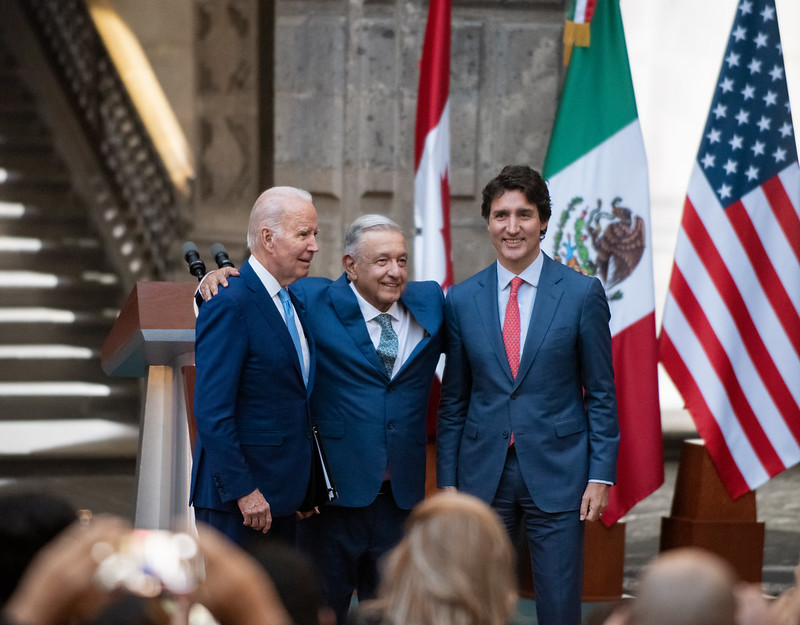
North American leaders, Andrés Manuel López Obrador, Justin Trudeau and Joe Biden, met in Mexico for the 10th North American Leaders’ Summit /Eneas De Troya /Flickr/ Creative Commons License

President Joe Biden conducted his first trip to Mexico in the context of the North American Leaders’ Summit on January 10, 2023. These summits started with George W. Bush in 2005 and did not take place at all while Trump was President. The 2021 and 2023 meetings signal a return to thinking of and valuing the North American region as such. The discussions were best when they decoupled local political considerations, common challenges, and regional opportunities. Three points toward integration are described here.

  1. President Joe Biden, Canadian Prime Minister Justin Trudeau, and Mexican President Andrés Manuel López Obrador (AMLO) discussed the advantages of further integrating supply chains within the region. Labor costs in China have gone up, and the pandemic showed that relying on long-distance shipping can delay things during crises, epidemics, and international disputes. There was a push for nearshoring, meaning having an increasing proportion of essential and high-value products manufactured in Canada, Mexico, and Central America rather than Asia. Concrete efforts were mentioned to increase manufacturing in the region within the context of the regional trade agreement USMCA, which includes regulations, respects local preferences, and supports specific sectors and products. Thus, during the summit, Biden and Trudeau were able to look past Mexican President Andrés Manuel López Obrador’s protection of PEMEX, Mexico’s oil company, and specific controversies about car manufacturing. Furthermore, Biden, Trudeau, and López Obrador discussed the desire for further integration beyond trade. The Mexican President mentioned in his closing speech that Mexico will be represented in planned regional integration meetings by Foreign Minister Marcelo Ebrard, Finance Minister of Mexico Rogelio Ramírez de la O, Secretary of Economy Raquel Buenrostro Sánchez, and independent businessman who represents the business community, Alfonso Romo Garza. During the meetings, Prime Minister Trudeau was accompanied by his wife, Sophie Gregoire Trudeau, Minister of Foreign Affairs Melanie Joly, Minister of International Trade Mary Ng, and the Minister of Public Safety Marco Mendicino. President Biden was accompanied by the First Lady Dr. Jill Biden, Secretary of State Anthony Blinken, National Security Advisor Jake Sullivan, U.S. Ambassador to Mexico Ken Salazar, U.S. Ambassador to Canada David Cohen, Secretary of Homeland Security Alejandro Mayorkas, Special Presidential Advisor for the Americas Chris Dodd, Secretary of Commerce Gina Raimondo, and National Security Council Senior Director for the Western Hemisphere Juan Gonzalez. The size and high profile of the entourage show the seriousness of these talks and the intentions to communicate further and coordinate around shared challenges and regional integration.
  2. The three leaders emphasized that migration is a regional process requiring a regional approach. Biden and Trudeau recognized their history and reality as countries of immigration. Canada emphasized its desire to welcome new people to keep growing its population and economy. Biden recognized the history of the United States as a country built largely by immigrants. The Mexican President missed an opportunity to acknowledge that in the last hundred years, a substantial number of people moved to Mexico from places like Spain, Chile, Argentina, Cuba, Lebanon, Guatemala, and the United States. There were mentions about the need for Mexico to become the place where some of the people from the hemisphere should receive asylum and be allowed to settle legally long-term. The three heads of government also stressed a safe, humane, and legal entry for migrants through more legal pathways and shared responsibility as advocated for in the Los Angeles Declaration. Additionally, Biden announced the monthly legal entry of 30,000 migrants from Cuba, Nicaragua, Haiti, and Venezuela with appropriate sponsors, background checks, and airplane flights. Generally, they recognized that the people who emigrate do it as an option of last resort. They expressed the humanitarian need to help create ways to migrate more safely than is currently possible for many.
  3. Prime Minister Trudeau and Presidents López Obrador and Biden committed to collaborating on climate change and promoting racial equity, diversity, and inclusion, including collaborating with marginalized populations to fight violence against Native women and girls and expand the protection of LGBTQI+ people. Regarding climate change, the three nations promised to reduce methane emissions by 15% by the end of 2030, develop a plan to cut food loss and waste in half by 2030, and create trilateral infrastructure for EV chargers. The three leaders also spoke about their support for democratic practice and condemned the events on January 8 in Brazil. Biden and Trudeau spoke about how a feature and strength of their democracies is their diversity. Overall, most of the meetings were about strengthening ties and facing shared challenges pragmatically and collectively. The demeanor was friendly, forward-looking, and about partnership. As Justin Trudeau said, “We are stronger together.”

Where are we two and a half months later, when Biden visited Canada?

Biden spoke about the interconnectedness of the U.S. and Canadian economies, sports leagues, and people. Saying that “the U.S. and Canada share one heart.” Both spoke about green jobs and more regional manufacturing with unionized jobs.

Nevertheless, the attention was focused on asylum seekers. President Biden referred to the Los Angeles Declaration and the importance of helping migrants as a region. Canada announced the orderly welcoming of 15,000 immigrants from the Western Hemisphere. However, the discussion about the official announcement underlines “irregular migration” while mainly talking about people seeking prompt and secure asylum. Cable media commentary often referred to an agreement to address “illegal arrivals” to Canada by people asking for asylum. Nonetheless, asking for asylum is a right that people have under U.S., Canadian, and international law. The issue is that some have arrived away from official ports of entry and then approached authorities to announce themselves and exercise their right to ask for asylum proactively. Under the new agreement, Canada can send migrants back to the United States if they have not applied for asylum in-country first and vice versa. This agreement further weakens the right to asylum in North America and criminalizes those seeking it. The often-mentioned record numbers are probably inaccurate regarding legal and undocumented migrants as a proportion of the population. Still, an increasing number of asylum seekers from Ukraine, Afghanistan, Haiti, Cuba, and the Americas are arriving at land borders. The announcement of this agreement with so much fanfare constitutes a narrowing of asylum avenues and conceding to the Canadian opposition’s framing of immigrants and asylum seekers as “burdens.” It contradicts the speeches of Biden and Trudeau at the North American Leaders Summit in Mexico City on January 10 and Biden’s speech at the Canadian parliament, which recognized the many contributions immigrants make and have made to both countries.

President Biden noted the continued interest of the U.S. and Canada in supporting democracy in the Western Hemisphere.

In the meantime, the Mexican President did not appreciate messages of alarm from the north about the proposed changes to the independent Mexican electoral agency (INE) and other signs of de-democratization. In turn, AMLO spoke about the possible criminal charges against Trump being politically motivated. He also wrongly stated that Mexico is safer than the U.S. after the killing and disappearances of U.S. citizens and legal permanent residents in Mexico.

Therefore, a few months after the North American Leaders Summit, we see how some leaders are more concerned with national politics, popularity polls, and elections than working with other countries to face common problems. At the same time, working meetings about regional cooperation also serve as a reminder that despite nationalistic and isolationist presidents (like Trump was), civil servants continue working with their counterparts to make sure that regional trade, tourism, migration, consular relations, and educational and cultural exchanges continue.

March 28, 2023

*Ernesto Castañeda is the Director of the Center for Latin American and Latino Studies, Immigration Lab, and the MA in Sociology Research & Practice.

Fact-checking and editing by Karen Perez-Torres. Copy-editing by Mackenzie Cox.

CC BY-ND: This license allows reusers to copy and distribute the material in any medium or format in unadapted form only, and only so long as attribution is given to the creator. The license allows for commercial use by news sites. 

Ecuador: Is Coca Codo Sinclair a Bellwether for China in Latin America?

by Julie Radomski*

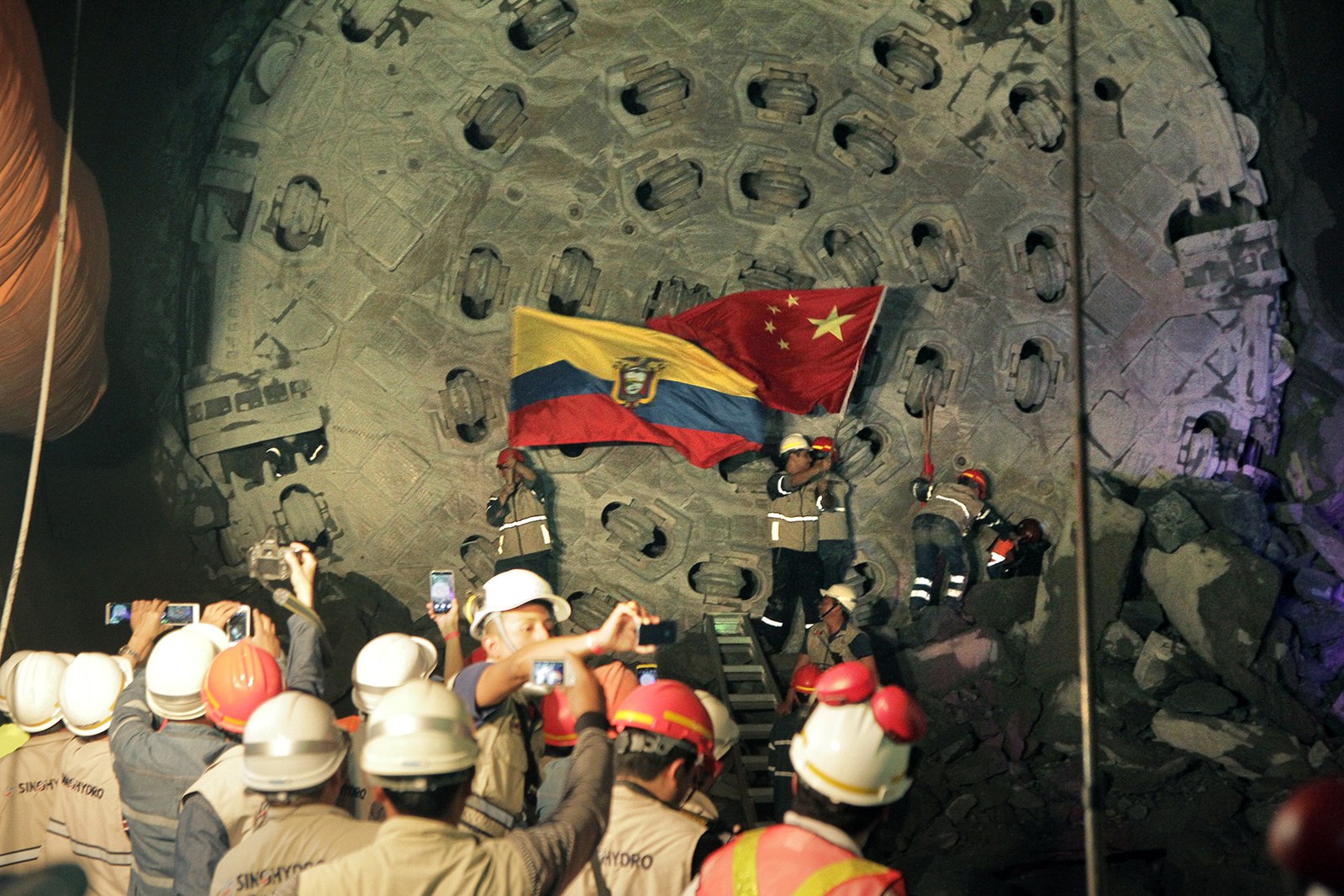
Mega project Coca Codo Sinclair inaugurates its new tunnel / Carlos Rodriguez / Agenda de Noticias ANDES / Wikimedia Commons / Creative Commons license

Ecuador’s Coca Codo Sinclair hydroelectric project – celebrated as a triumph of then-President Rafael Correa’s Revolución Ciudadana and a harbinger of the promise of South-South Cooperation when inaugurated in November 2016 – today appears to be a lightning rod for debate around China’s preferred form of international cooperation. The project was emblematic of the new relationship between Latin American countries and development finance’s new regional leaders, Chinese policy banks. Five years into its operations, Coca Codo is riddled with uncertainties and dramas at local, national, and global scales. 

  • The 1500 Mw project consists of a diversion dam; 24.8 km of tunnel to channel water under the Andean foothills; a compensation reservoir; pipes dropping the water 620 meters; and an eight-turbine powerhouse. It supplies Ecuadorians with 30 percent of their electricity, helping to edge out expensive and fossil fuel-driven thermoelectricity.

The project was a crowning jewel of efforts since the mid-2000s by Chinese policy banks – the China Development Bank and China Export-Import Bank – to provide Latin American countries with billions of dollars in loans, the majority for large infrastructure projects of the variety once financed by multilateral development lenders like the World Bank. Indeed, between 2005 and 2018, the total lending to the region by these two Chinese banks was greater than that of the World Bank and Inter-American Development Bank combined. Coca Codo was financed by a 2010 loan from the China Export-Import Bank and constructed by Chinese state company Sinohydro.

  • However, since 2015 lending has trended steeply downwards, and since 2019 Chinese policy banks have provided no new loans to Latin American countries or state-owned enterprises. While this by no means indicates a downgrading of China-Latin America relations, the nature of this political and economic relationship is no longer oriented around multibillion-dollar state-to-state infrastructure lending like that which made Coca Codo Sinclair possible. This is likely due, at least in part, to the increased hesitancy on the part of Chinese lenders following political controversies surrounding such projects.

The impacts of the projects of this period are still very much an ongoing and controversial issue for countries like Ecuador.

  • Although vital in providing Ecuadorians inexpensive and emissions-friendly electricity, to this day the project has not been fully turned over to the Ecuadorian government, primarily because its distributors (snail-shaped pipes that channel water to each of the powerhouse’s eight turbines) exhibit thousands of fissures that Sinohydro has been unable to repair despite years and millions spent trying. New fissures continue to emerge that experts say indicate “imminent danger” of equipment failure, or even collapse.
  • The diversion dam is also in danger of collapse due to a rare and catastrophic process of “headward” erosion (erosión regresiva o remontante) along the Coca River. The erosion, resulting from the collapse of the famed 150-meter San Rafael waterfall in February 2020, has so far caused two major oil spills, the loss of houses and land, and the repeated destruction of a major roadway connecting the Amazonian region to Ecuador’s capital. The Ecuadorian state power company, CELEC-EP, is investing millions in new infrastructure to attempt to contain the erosion before it reaches the dam. They are also studying the possibility of building an entirely new dam that could be reconnected to the existing powerplant.

The scientific community is debating the extent to which the dam itself may have contributed to the disastrous erosion. Lack of rigorous environmental assessments and monitoring mean that there may never be definitive evidence either exonerating the dam or proving its guilt in the current social, economic, and environmental crisis. There is, however, broad agreement that, given the instability of the Coca River basin, the dam should not have been constructed at the current location and scale due to environmental risks.

Critics of Chinese global economic expansion have seized on Coca Codo Sinclair as a symbol of the danger of China’s influence in Latin America. Other observers argue that the project’s downsides are a result of national institutional failures, irrespective of the “Chineseness” of its finance, engineering, and construction. Either way, recent patterns in Chinese lending indicate that the country’s decisionmakers no longer see this type of project as the basis of win-win development or mutual cooperation. It appears that environmentally sensitive, politically polarizing mega-infrastructure will not be the face of China-Latin America cooperation going forward. Regardless, Ecuadorians are faced with the return of expensive and unreliable electricity, an irrevocably altered Amazonian River basin, and about $3 billion at risk of being carried away by the river.

May 6, 2022

*Julie Radomski is a PhD Candidate and Fulbright-Hays Fellow at American University specializing in development studies.

North America: More Support Than Meets the Eye

By Malcolm Fairbrother, Tom Long, and Clarisa Pérez-Armendáriz*

Mexican President Andrés Manuel López Obrador (L) and Canadian Prime Minister Justin Trudeau (R) join President Joe Biden for the North American Leaders Summit (NALS) at The White House/ The White House/ Flickr/ United States government work

U.S., Canadian, and Mexican leaders’ support for North American integration has ebbed and flowed in the years since the North American Free Trade Agreement (NAFTA) was signed in 1994. But our analysis of some previously little-known polls taken a few years ago shows that, even when support for trade integration and other big-picture institutional initiatives has been weak, interest in some forms of cooperation has been relatively strong in all three countries.

  • Discussions of North American integration have been fraught from the beginning. Fiery debates over NAFTA in the early 1990s meant politicians had to work hard to sell regional cooperation. Canadian politicians’ approach to North America has been pragmatic, low-key, and mostly bilateral with the United States. U.S. politicians gave North American cooperation a tepid embrace at best, until Donald Trump turned to repeatedly badmouthing NAFTA and both neighbors. Although Mexican political and business leaders’ enthusiasm for NAFTA has cooled in recent years, and President Andrés Manuel López Obrador is a longtime NAFTA critic, they have made a reluctant peace with its regional economic structures.

Perceptions of NAFTA as a political loser paint too dark a scenario for North American cooperation. Though U.S. views briefly soured and polarized in 2016-17, strong public support for the agreement’s successor – the U.S.-Mexico-Canada Agreement (USMCA) – suggest those negative views were short-lived. North American cooperation beyond trade enjoys robust support. Our analysis of surveys conducted before the “Trump shock” shows that respondents in Canada, Mexico, and the United States have long favored more cooperation in a variety of areas, albeit with a few important qualifications. In our recently published study, Areas, Sovereignty Costs, and North Americans’ Attitudes Toward Regional Cooperation, we show: 

  • The three countries share strikingly similar aggregate levels of support for free trade. But levels of support for regional coordination in six different issue areas – currency, energy, defense, economic affairs, environment, and border security – vary by issue and country, and are often higher. For respondents, it matters “on what” North America cooperates in ways that questions about trade and NAFTA do not capture. For example, there was significant support in all three countries for regional policy coordination with respect to environmental protection and border security.
  • Mexicans show the highest level of aggregate support for regional cooperation, but also the greatest variation by issue area, suggesting that they are attuned to the potential costs and benefits of cooperating in an asymmetrical region. Only Mexicans express much support for North American currency coordination, but they showed comparatively little desire for cooperation in energy. They are strong backers of border and environmental cooperation.
  • Although Canadians are skeptical of the benefits of some aspects of the relationship, they also identify cooperation on the border and environment as worth pursuing. Canadians expressed the lowest average support for policy coordination. In contrast to their government’s approach, Canadians slightly prefer trilateralism to bilateralism. Indeed, Canadians, Mexicans, and Americans don’t always want to cooperate trilaterally. Americans report stronger support for regionalism with Canada alone, rather than trilateral cooperation with both Canada and Mexico. 

North America is a highly asymmetric, U.S.-centric region. That shapes patterns of public attitudes as Canadians and Mexicans are concerned about national vulnerabilities vis-a-vis the United States. Mexican citizens’ support appears to be shaped by perceptions that Mexico stands to gain from regional cooperation on many shared problems that Mexico struggles to address alone, such as the environment and border security. Still, support for coordination in the United States also was comparatively high for border security, perhaps a result of politicians’ dramatizing a supposed U.S. inability to “control” the border. 

  • Paying attention to the issues where public support exists and overlaps may allow supporters of regional projects to build on firmer – albeit narrow – ground.

March 22, 2022

* Malcolm Fairbrother is Professor in the Department of Sociology, Umeå University and the Institute for Futures Studies, Sweden, and the Department of Sociology, University of Graz, in Austria. Tom Long is Associate Professor in the Department of Politics and International Studies, University of Warwick, UK and Affiliated Professor in the División de Estudios Internacionales, Centro de Investigación y Docencia Económicas, Mexico. Clarisa Pérez-Armendáriz is Associate Professor the Politics Department and Program in Latin American and Latinx Studies at Bates College, USA. This article, part of the Robert A. Pastor North American Research Initiative, draws on “Issue-Areas, Sovereignty Costs, and North Americans’ Attitudes Toward Regional Cooperation,” published recently in Global Studies Quarterly. The underlying surveys, Rethinking North America, were conducted in 2013 by Miguel Basáñez, Frank Graves, and Robert Pastor. 

How Is the Crisis in Ukraine Like the Cuban Missile Crisis?

By William M. LeoGrande*

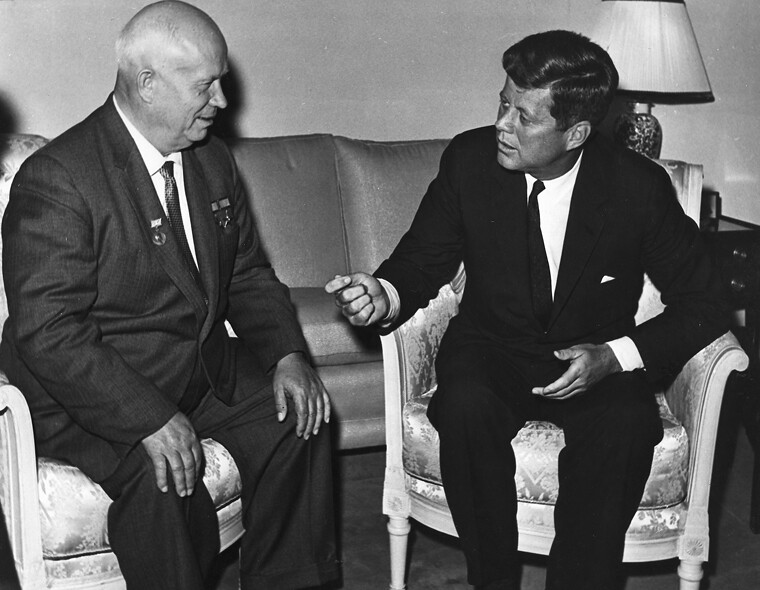
President John F. Kennedy and Soviet General Secretary Nikita Khrushchev/ U.S. Department of State & Kennedy Presidential Library/ Flickr/ Creative Commons License

When Russian Deputy Foreign Minister Sergei Ryabkov warned that the standoff between Moscow and Washington over Ukraine could trigger a crisis akin to the Cuban Missile Crisis, he wasn’t just referring to the danger of nuclear war, narrowly averted. He was also reminding Washington that Russia is not the only great power jealous of its sphere of influence. Russia has its “near abroad,” and the United States has its “own backyard” as defined in the 1823 Monroe Doctrine warning European powers to stay on their own side of the Atlantic. 

Sixty years ago this October, the Soviet Union projected its military power into the Western Hemisphere by placing missiles with nuclear warheads in Cuba. Soviet Premier Nikita Khrushchev’s principal purpose, we know now, was to protect Cuba from another U.S. invasion. (The Bay of Pigs invasion had failed the year before, and Washington had plans for an encore using U.S. troops.) 

To President John F. Kennedy, this intrusion into the U.S. sphere of influence was intolerable, not just because it posed a military threat, but because a U.S. failure to defend its own neighborhood would throw Washington’s credibility into doubt. To Kennedy, it was worth risking thermonuclear war to repel the Soviet incursion. Had Khrushchev not backed down, agreeing to withdraw the missiles, the United States was ready to launch a full-scale invasion of Cuba.

To this day, the United States has not accepted the idea that a hostile government allied with a rival superpower should be allowed to exist just 90 miles off the coast of Florida. This year marks not only the 60th anniversary of the Missile Crisis, but also the 60th anniversary of the U.S. economic embargo against Cuba designed to overthrow the Cuban government and replace it with one more to Washington’s liking. As Donald Trump’s national security adviser, John Bolton, candidly proclaimed, “The Monroe Doctrine is alive and well.” 

The Biden administration, however, appears not to recognize its own great power conceits. “We can’t go back to a world of spheres of influence,” Secretary of State Antony Blinken told CNN, chastising Russia for its attempts to exert influence over former Soviet states. “We’re not going back to that.” He apparently had not read the U.S. Southern Command’s annual Posture Statements for the past decade, each of which defines the growing influence of Russia, China, and Iran as one of the principal threats the United States faces in the Western Hemisphere. The 2021 version elevates these interlopers to a collective proper noun: External State Actors (ESAs) – external to the U.S. sphere of influence.

When Russian diplomat Sergei Ryabkov suggested that Russia might enhance its military posture in Cuba and Venezuela in response to the U.S. build-up in Eastern Europe, the U.S. warning was unequivocal. Any Russian attempt to deploy missiles in Latin America would be an “aggressive action,” declared United Nations Ambassador Linda Thomas-Greenfield, and would be met with a “strong response.”  “If Russia were to move in that direction,” said National Security Adviser Jake Sullivan, “we would deal with it decisively.” 

Biden’s officials seem not to grasp the irony of defending a U.S. sphere of influence while condemning Russia’s claims to its own. Not much has changed in the 60 years since the Missile Crisis, when Soviet missiles in Cuba were, by definition, “offensive” weapons, whereas U.S. missiles in Turkey were merely “defensive.”

If President Joe Biden is serious about replacing spheres of influence with what Secretary Blinken called a “rules based international order” in which small states can decide their own future free of great power coercion, Biden can start in his own backyard. Washington’s policy of regime change toward Cuba, based on economic coercion and subversion – a policy Biden inherited from Donald Trump and continues unchanged – has not worked for more than 60 years. Replacing it with a policy of engagement and coexistence would set a good example for President Putin in his near abroad.

February 1, 2022

* William M. LeoGrande is Professor of Government at American University and co-author with Peter Kornbluh of Back Channel to Cuba: The Hidden History of Negotiations between Washington and Havana (University of North Carolina Press, 2015).

China-Latin America: Literature Shows Varying Perspectives on Beijing’s Intentions

By Andrés Serbin*

Communicating Influence: China’s Messaging in Latin America and the Caribbean project page logo

By frequently casting China-Latin America relations as a “triangular relationship” between China, the United States, and Latin America, much of the academic literature generates a series of misunderstandings. Studies in both the English-speaking community and in China generally portray Latin America and the Caribbean (LAC) as a relatively homogeneous and unified area – ignoring regional fragmentation and diversity – in a triangular relationship with the two superpowers. But Latin American analysts are increasingly focused on the widely varying nature of countries’ bilateral and subregional ties with each.

  • Latin American analysts generally produce theoretically more complex, politically diverse, and ultimately contradictory approaches to the relationships. Whereas the theoretical disciplines of international relations (IR) and international political economy (IPE) are ubiquitous in the English-speaking community, recent debates and critiques in Latin America reveal accelerated development of their own theoretical and conceptual approaches.

The two sets of analyses overlap in several important areas, such as China’s primary interest in securing resources and in investing its booming wealth in the region, but they yield different interpretations of its strategic objectives. Most views center around China promoting a version of globalization based on its geostrategic objectives, generating an increasingly tense dispute between the United States, as the traditional hegemonic power, and the rising PRC. This competition occurs mainly in the commercial and technological arenas, but it has military and cultural elements as well.

  • The Western epistemic community, to some extent reflecting the demands and expectations of the political milieu in which they work, frequently regards the Chinese presence in Latin America as a threat to U.S. interests and the autonomy of LAC countries. In this dynamic, China’s objectives go beyond economics and into spaces from which the United States has withdrawn. Latin America, despite its peripheral situation, is immersed in and eventually subordinated to a broader and more global geostrategic dispute, even if (as most analysts believe) China is not trying to impose its political system and development model on the region. 
  • Others tend to view China’s modernization and transformation, its remarkable need for commodities, and its ability to finance large acquisitions and projects as having important bilateral effects for the region. China has incorporated countries into its “Belt and Road Initiative” (BRI) infrastructure megaproject. Recently, it has undertaken an aggressive “health diplomacy” project during the COVID‑19 pandemic. 

The Latin American perspective is independent of efforts by LAC-based and Chinese analysts to foster joint research and interaction in the past 25 years; Chinese input into LAC analysis is growing but still limited. 

  • The most prolific LAC authors maintain fluid links with U.S. and European academic counterparts, but their work draws on theoretical frameworks that are rooted in approaches developed in the region. This includes a wealth of economic analysis and statistical data developed by individual scholars, research centers, and networks (such as Red‑ALC China), and institutions such as the UN-sponsored Economic Commission for Latin America and the Caribbean (ECLAC). Many aspects of China’s policies, such as their impact on labor, environment, regional industrialization, and increasing LAC indebtedness to China (the “debt trap”) have been criticized, but its “soft power” has expanded significantly and benefited many in LAC.

This significant body of research and publications about China’s activities in LAC reflects three predominant disciplinary and theoretical approaches in addition to analysts’ own perceptions of their national interests.

  • The focus of international relations neorealism on China’s potentially destabilizing effects in the region and its relations with the United States gives short shrift to other important actors in the region and world. It also stimulates an inaccurate vision of Latin America as a monolithic, unitary actor and deep down expresses a subtle neocolonialism and “neocolonialist paradigm.” 
  • The emphasis of the international political economy approach is on China’s intentions as predominantly linked to its development – and not as a threat to the United States. Most argue that Latin America must develop its relationship with China and maintain its links with the United States simultaneously, without getting involved in a confrontation between them. 
  • But LAC is showing a third, hybrid approach mixing IPE and geopolitical analysis to contextualize China’s influence. It has shown that some “benign” impacts have also generated new dependency and center-periphery relations that can be characterized as a “dependency with Chinese characteristics.”

The debate between these differing interpretations –viewing dynamics as either bilateral or triangular – will continue to mold U.S., Chinese, and LAC countries’ policies as China pursues its global projection strategy.

January 21, 2022

* Andrés Serbin is an international analyst and president of the Regional Coordinator of Economic and Social Research (CRIES), a network of more than 70 research centers, think tanks, NGOs, and other organizations focused on Latin America and the Caribbean. This article is adapted from his recent CLALS Working Paper, Latin America-China Relations: A Review of Recent Literature (2010-2020)

The Interamerican Democratic Charter Turns 20: Is it Becoming Irrelevant?

By Stefano Palestini Céspedes*

Commemoration of the 10th Anniversary of the Inter-American Democratic Charter, September 2011./ OEA – OAS/ Flickr/ Creative Commons License

Despite the clear merits of its text, the Interamerican Democratic Charter (IADC) has been enforced inconsistently over the 20 years since its singing; its effectiveness in curbing democratic backsliding remains unclear; and, with little chance of being reformed, it risks becoming increasingly irrelevant.

  • The Charter was speedily adopted in Lima on September 11, 2001, while the world was reacting to the terrorist attacks in New York and Washington. It emerged from a proposal by the government of Peru after the resignation of authoritarian President Alberto Fujimori to reinforce existing multilateral instruments for democracy. It became the main multilateral framework to deal with breakdowns of democracy and backsliding in the hemisphere.
  • The IADC developed a shared and precise definition of representative democracy; expanded the scope of action of the OAS to address coups and violations perpetrated by the elected governments; and defined procedures for various enforcement actions ranging from the dispatch of missions to the imposition of sanctions and the suspension states from the OAS.

Limits on the IADC mandate have compromised its enforcement and effectiveness, however. The enforcement of measures is under the control of governments, which take decisions through consensus or qualified majority-voting (in the case of suspensions from the OAS). Even though the IADC is grounded on the principle that democracy is a “right of the people” (Art.1), non-state actors and state institutions other than the executive branches have limited capacity to activate the IADC, and the Inter-American Commission of Human Rights does not play any role in its enforcement.

  • The IADC has not been invoked in cases in which member states have conflicting interests. For instance, it was not applied against Haiti in the wake of the forced removal of President Jean Bertrand Aristide in 2004 or against Honduras after the electoral fraud of President Juan Orlando Hernández in 2017. In both cases, Washington obstructed enforcement of the Charter for reasons other than “the defense of the right to democracy” of Haitians and Hondurans. More recently, Mexico has obstructed enforcement against Nicaragua despite the serious violations of the opposition’s political rights by President Daniel Ortega. Similarly, the IADC has been altogether ignored when the attacks against democracy have taken place in powerful states, such as after the assault against the U.S. Capitol in January.
  • Against this backdrop, the activism of current Secretary General Luis Almagro – who has pressured member states to take a stance through social networks and moral shaming on various occasions – has sought to work around governments’ monopoly of enforcement and break gridlocks. But his actions often compromised the impartiality of his post as he has been perceived as taking sides in the conflicts at hand and overreaching his powers under the IADC.
  • Disappointment with the IADC and Almagro’s performance has led Mexico and other governments to advocate for reinforcing alternative regional forums such as the Community of Latin American and Caribbean States (CELAC). However, these announcements have little credibility if they are not accompanied with sustained political leadership – in the face of certain U.S. opposition – and commitment of resources to build strong regional institutions.

Ironically, the IADC came into existence precisely when the conditions that made it possible – a liberal consensus and an international agenda on democracy promotion – were fading away. These two decades have demonstrated that the democracies of the hemisphere, including Washington, are not always willing to put the defense of democracy in the neighborhood before other foreign-policy interests. Governments are also prone to bypass the OAS and the IADC and go unilateral if they feel that a crisis affects their interests, as the Lima Group and the U.S. unilateral sanctions against Venezuela have recently shown.

  • These two decades have also demonstrated that member states are not up to even discuss reforming the IADC. They are reluctant, for example, to create an enforcement authority, which would render the application of the Charter more impartial and possibly more effective. This is certainly disappointing news for those who believe in Inter-American relations based not only on Realpolitik but also on principles and norms. The IADC will continue being a roadmap for the states in the region and a reminder of the commitment to democracy, but it will be – paraphrasing the first OAS Secretary General Alberto Lleras Camargo – what the states want to make of it.

September 28, 2021

* Stefano Palestini Céspedes is Assistant Professor of International Relations at the Pontificia Universidad Católica de Chile.

China in Latin America: Influential But Not Liked

By Andrei Serbin and Luiza Duarte*

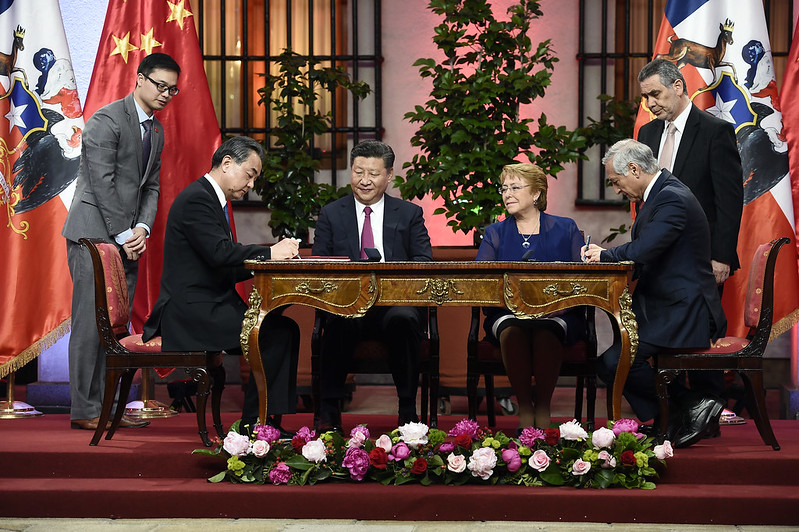
President Michelle Bachelet participates in a document-signing ceremony with the President of the People’s Republic of China, Xi Jinping./ Government of Chile/ Flickr/ Creative Commons License

An on-line survey of Latin American international relations experts reveals that China is viewed as having great influence in regional commerce, surpassing the United States and Europe, but that its engagement with the region is perceived as relatively negative. Although Chinese media have been increasing efforts to enter the information landscape in Latin America, they are not perceived to be a significant source of news for Latin American opinion leaders and do not appear to have significant influence on public opinion.

The questionnaire was administered by CLALS and CRIES last May and June as part of a broader project to assess the role of China and its communication strategies in Latin America and the Caribbean. It targeted academics and other thought leaders throughout Latin America. Some 379 experts responded.

Key findings:

  • China was perceived by 80 percent of the experts to have a “high” level of influence in Latin America, and only 5 percent said it was low. According to respondents, China’s influence was surpassed only by that of the United States. Madrid and Moscow scored slightly lower than Beijing.
  • The specific areas of Chinese influence were not homogeneous across the region. Asked about Beijing’s role in culture, the economy, health care, and technology, about 90 percent of respondents cited the economy as top area, followed by technology and medicine. (In each of these three categories, it was surpassed only by the United States.) Fewer than 5 percent named culture – higher than Russia and India but lower than six other countries on the list.
  • On the positive or negative impact of that influence, fewer than 10 percent said they had a “very good” opinion of the Asian power, while a little more than a quarter said they had a “good” opinion. About one-third said they had an “intermediate” opinion of Beijing, and the final third had a “bad” or “very bad” estimation. When asked to compare China with other world or regional powers, respondents ranked it among the lowest. A little more than one third view it negatively, 32 percent as neutral, and a little more than 25 percent positively. Germany, Japan, and Spain scored highest as “very good” and “good,” even if they’re ranked as having a lower level of influence. The United States scored somewhat lower, but China and Russia had stronger negatives and weaker positives. Only Russia’s influence is perceived more negatively than China’s.
  • Most of the experts felt the principal priority for having relations with China should be commercial, followed by foreign direct investment and other financial ties. International security ranked as their lowest priority – even lower than multilateral cooperation and human rights. Importantly, this order of priorities is the same as with U.S. relations – with the only statistically significant difference being a preference for cooperation on international security with Washington.

Important among the findings of the survey is that China is failing in its efforts to use media tools to create a positive image for the country and its government. Beijing has made significant investments in establishing a media presence, principally through its China Global Television Network (CGTN).

China’s state broadcaster launched CGTN Español in 2007, and it has significatively expanded operations worldwide in the past decade, multiplying platforms, newsrooms and crew. CGTN doesn’t have a Portuguese-language TV channel, but content in that language is produced by other Chinese media outlets, such as Xinhua, Radio China International, and People’s Daily.

  • Despite these efforts, fewer than 4 percent of those interviewed say Beijing’s influence was “high” or “very high,” while 38.8 percent say it was “low,” and 30 percent say it was “very low.” U.S. media influence, on the other hand, is high. More than 70 percent of the experts said CNN, for example, has “high” or “very high” impact. China’s CGTN international television network also ranked lower than the United Kingdom’s BBC, Venezuela’s Telesur, Russia’s RT, and France24.
  • According to most of the experts consulted, CGTN’s influence is principally “neutral,” but 33 percent of them said they didn’t know how to characterize it. That said, a greater percentage of them say its effect on China’s image is “positive” (about 20 percent) than “negative” (about 12 percent). In this regard, CGTN’s impact is similar to that of CNN (which is not a government entity tasked with burnishing the United States’ image) and RT, and much better than Telesur. But BBC and France24 reflect more positively on the British and French governments.
  • Even if findings indicate that Chinese media have “low” influence among Latin American leaders, a growing number of media-sharing agreements are facilitating the distribution of Chinese content through local media in Latin America. The influence of this indirect consumption has yet to be measured.

September 17, 2021

* Luiza Duarte is a journalist, has a PhD in Political Science, and is a Research Fellow at CLALS, the Brazil Institute, and the Wilson Center. Andrei Serbin Pont is the Director of CRIES and an International Relations PhD candidate at the Universidad Complutense de Madrid. The survey is part of a CLALS project on China’s Messaging in Latin America and the Caribbean, supported by the Institute for War & Peace Reporting with funding from the U.S. Department of State.