
Mayor Adams, Don’t Sell Out New York City’s Economy

By Marshall Plane, Ernesto Castañeda

Photo credits to Flickr

Days after federal corruption charges against him were dropped, Mayor Eric Adams appears poised to open New York City to President Trump’s mass deportation agenda in what Manhattan’s federal attorney described as a “quid pro quo”. Mr. Adams’ posturing has hinted at this for some time: the mayor has framed the recent influx of asylum-seeking migrants as an economic burden that “will destroy New York City.” “The long-term consequences have yet to materialize of what this crisis will do to our cities,” he told Tucker Carlson on January 22nd.

After crunching the numbers, we agree with Mr. Adams: New York City is just beginning to reap the benefits of this influx of hardworking people. We conservatively estimate that, if their earnings and employment rates are similar to the current undocumented population, the 316,000 asylum seekers who have come here since 2022 will contribute $8.62 billion annually to the city’s economy, a figure greater than the GDP of forty countries. Much of this economic activity will flow to public coffers: the asylum seeker population is projected to pay $942 million more in taxes than they receive in benefits each year. If ICE is allowed to wreak havoc on New York City, all these benefits will be lost.

This is not particularly surprising. Previous waves of immigrants have similarly fled desperate situations, arrived with limited resources, faced nativist backlash, and still become vital contributors to the city’s economy and culture. There’s no reason to believe today’s newcomers should be any different. With New York’s US-born population declining and demand for workers growing fastest in the industries most reliant on immigrant labor, they are arriving at an opportune time.

It’s true that New York City has spent substantial amounts on services for asylum seekers: a combined $5.2 billion in fiscal years 2023 and 2024, with another $4.5 billion budgeted for FY2025. These costs doubtless been have been inflated by Adams’ “emergency” decision to suspend background checks and competitive bidding requirements for contractors providing such services. The Comptroller’s investigation found several egregious examples of overpayment. One contractor received $117/hour for security guards and $201/hour for off-site managers. Despite this waste, spending on asylum seekers made up just 4.2% of the FY2025 budget.

Most importantly, these costs are not the product of an “open border.” Immigrants have been coming to New York City via the border for decades. In fact, the city’s undocumented population was 611,000 in 2012 and fell to 412,000 by 2022. Nor is the scale of the current influx unusual in recent times–during the 1990s, the city’s foreign-born population grew at a higher annual rate than it has during the 2020s.

Instead, the recent difficulty housing asylum seekers is a unique case created by a perfect storm of policies: a political stunt that brought people to cities where they lacked connections; an artificial housing shortage; an already-struggling, poorly run shelter system unequipped to house new arrivals; a lack of legal immigration pathways; and outdated laws that prevent asylum seekers from working.

Each wave of immigration to New York City has been beneficial to both the immigrants themselves and their adopted city. The only difference today is that arcane policies have forced both sides to make major upfront investments before they begin to enjoy those mutual benefits.

Before claiming asylum, people must physically come to the US. For nearly all the asylum seekers we spoke with as part of our ongoing study, this involved taking on substantial debt to finance a deadly, months-long overland journey. This debt can be a major obstacle as people try to establish themselves in New York.

In 2023, John borrowed nearly $30,000 to bring his family of five from Ecuador to the US border. A mechanic by trade, he quickly found work repairing e-bikes at a workshop in Queens, earning $1,200 a week. Yet over half of each paycheck goes to repaying his creditors back home (who have threatened to kill his parents should he miss a payment), leaving him unable to afford rent and trapping his family in the shelter system. He says he’ll have paid off enough debt to move to an apartment in New Jersey in three months.

Lacking a sponsor in the US, crossing the border was John’s only way to come here. Leave aside, for a moment, your beliefs about whether doing so was morally correct. The fact is, he’s here and contributing to our economy. Had he been able to come directly from Quito to New York, his spending power would be going to New York businesses instead of human smugglers.

Another problem: after applying for asylum, people must wait 180 days before receiving a work permit. Unless they have connections to support them, this effectively forces people to live off the state for six months. In practice, our conversations have made clear, it’s often much longer. In 2023, New York City began limiting stays in any one shelter to 60 days, forcing people to shuffle between different facilities. Many migrants are not informed that failing to report this change of address to USCIS within 10 days is a misdemeanor and can delay or derail their ability to get documents.

The experience of Carlos, who we spoke to outside a Manhattan shelter, exemplifies the bureaucratic absurdities that hold migrants back. Bused to NYC in late 2023 as part of Operation Lone Star, he immediately applied for asylum, citing political persecution in Venezuela. While waiting for his work permit, he has bounced between different shelters and worked temporary construction and moving gigs. He says his lack of documentation allowed these employers to exploit him, frequently not paying him in full.

Carlos told us a relative in Oklahoma has found him a job in trucking, his original profession. “The moment my papers arrive, I’m going to Oklahoma,” he says. “They’re waiting on me.” He was supposed to get his work permit months ago but had to restart the process when his address changed. He was most recently told his papers should arrive in 90 days.

The absurdity is infuriating. Due to decades-old laws, people itching to work linger in shelters against their wishes and at great financial cost, while crucial jobs across the country remain unfilled. The Independent Budget Office estimates the cost of missed work authorizations for asylum seekers at up to $1 billion in 2024 alone.

Even so, with US-born workers rapidly aging, rising immigration has done much to ease post-pandemic labor shortages, helping reduce inflation while maintaining economic growth. And asylum seekers are quietly integrating into the city’s economy. Of the 225,000 migrants who have passed through the shelter system, over 170,000 (77%) have moved out, and the number remaining in city care continues to dwindle.

Many interviewees, having recently gotten their work permits and found jobs after a long ordeal, expressed excitement to begin living independently and working towards the various dreams that kept them going through sweltering jungles and deserts. As asylum seekers increasingly fill the jobs that keep New York’s service-based economy moving, the investments made by both sides finally appear to be paying off. For deportations to derail asylum seekers’ budding lives as New Yorkers would be a human tragedy and an economic catastrophe

Marshall Plane is a Research Assistant at The Immigration Lab.

Ernesto Castañeda is the Director of the Immigration Lab and the Center for Latin American and Latino Studies and a Professor at American University.
What is a migrant? What is ICE? 10 terms to help you understand

By Ernesto Castañeda, Daniel Jenks

President Donald Trump aims to upend the immigration system in the United States in his first few days in office. On Jan. 20, 2025, Trump signed various executive orders that temporarily prevent refugees from coming to the U.S. and block immigrants from applying for asylum at a U.S. border, among other measures.

Another executive order calls on federal agencies to not issue passports, birth certificates or Social Security numbers to babies born in the U.S. to parents not in the country legally, or with temporary permission. Eighteen states sued on Jan. 21 to block this executive order that challenges birthright citizenship, which is guaranteed by the 14th Amendment to the U.S. Constitution.

We are scholars of immigration who closely follow public discussions about immigration policy, trends and terminology. Understanding the many different immigration terms – some technical, some not – can help people better understand immigration news. While not an exhaustive list, here are 10 important terms to know:

1. Migrant

A migrant is a person who moves from their place of birth to another location relatively far away. There are different words used to describe migrants and their particular circumstances. Internally displaced people, for example, means people who are forced to move within their own country because of violence, natural disasters and other reasons.

International migrants move from one country to another, sometimes without the legal authorization to enter or stay in another country. There are also seasonal or circular migrants, who often move back and forth between different places.

Between 30% and 60% of all migrants eventually return to their birth countries.

There is not much difference in why people decide to migrate within their own country or internationally, with or without the legal permission to do so. But it is easier for people from certain countries to move than from others.

2. Immigrants

The terms immigrants and migrants are often used interchangeably. Migration indicates movement in general. Immigration is the word used to describe the process of a non-citizen settling in another country. Immigrants have a wide range of legal statuses.

An immigrant in the U.S. might have a green card or a permanent resident card – a legal authorization that gives the person the legal right to stay and work in the U.S. and to apply for citizenship after a few years.

An immigrant with a T visa is a foreigner who is allowed to stay in the U.S. for up to four years because they are victims of human or sex trafficking. Similarly, an immigrant with a U visa is the victim of serious crimes and can stay in the U.S. for up to four years, and then apply for a Green Card.

An immigrant with a H-1B visa is someone working for a U.S. company within the U.S.

Many international students in higher education have an F-1 visa. They must return to their country of birth soon after they graduate, unless they are sponsored by a U.S. employer, enroll in another educational program, or marry a U.S. citizen. The stay can be extended for one or two years, depending on the field of study.

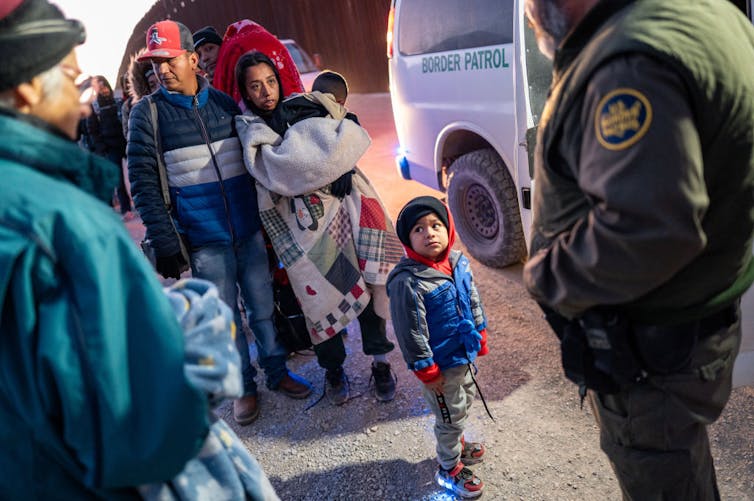
Mexican migrants prepare to turn themselves in to U.S. Customs and Border Patrol officers after crossing the border into Ruby, Ariz., on Jan. 5, 2025. Brandon Bell/Getty Images
Photo cerdits to Brandon Bell/Getty Images

3. Undocumented Immigrants, Unauthorized Immigrants and Illegal Immigrants

These three charged political terms refer to the same situation: migrants who enter or remain in the country without the proper legal paperwork. People in this category also include those who come to the U.S. with a visa and overstay its permitted duration.

Some of these immigrants work for cash that is not taxed. Most work with fake Social Security numbers, pay taxes and contribute to Social Security funds without receiving money after retirement.

Immigrants without legal authorization to be in the U.S. spent more than US$254 billion in 2022.

4. Asylum Seekers

An asylum seeker is a person who arrives at a U.S. port of entry – via an airport or a border crossing – and asks for protection because they fear returning to their home country. An immigrant living in the U.S. for up to one year can also apply for asylum.

Asylum seekers can legally stay temporarily in the U.S. while they wait to bring their case to an immigration judge. The process typically takes years.

Someone is eligible for asylum if they can show proof of persecution because of their political affiliation, religion, ethnic group, minority status, or belonging to a targeted group. Many others feel they need to leave their countries because of threats of violence or abusive relationships, among other dangerous circumstances.

A judge will eventually decide whether a person’s fear is with merit and can stay in the country.

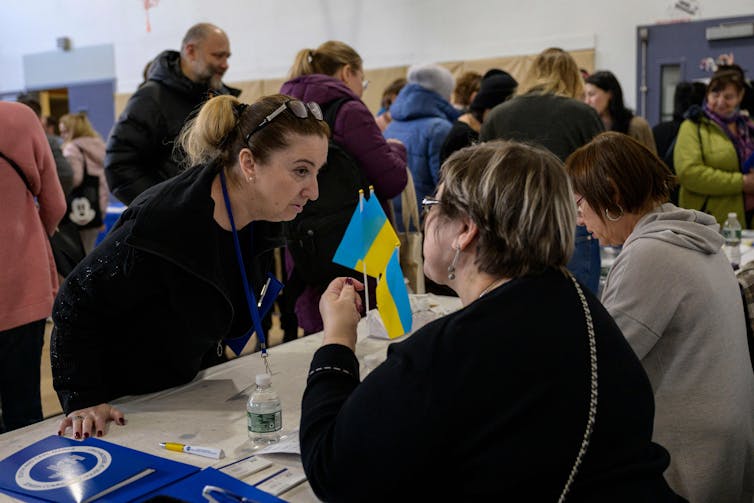
Ukrainian immigrants attend a job fair in New York City in February 2023. Angela Weiss/AFP via Getty Images
Photo cerdits to Angela Weiss/AFP via Getty Images

5. Refugees

Refugees are similar to asylum seekers, but they apply to resettle in the U.S. while they remain abroad. Refugees are often escaping conflict.

The Biden administration had a cap of admitting up to 125,000 refugees a year.

Refugees can legally work in the U.S. as soon as they arrive and can apply for a green card one year later. Research shows that refugees become self-sufficient soon after they settle in the country and are net-positive for the country’s economy through the federal taxes they pay.

6. Unaccompanied Children

This is a U.S. government classification for migrant children who enter the U.S. without a parent or guardian, and without proper documentation or the legal status to be in the country. Because they are minors, they are allowed to enter the country and apply for the right to stay. Most often, they have relatives already in the country, who assume the role of financial and legal sponsors.

7. Family Separation

This refers to a government policy of separating detained migrant parents or guardians from the children they are responsible for an traveling with as a family unit. The first Trump administration separated families arriving at the border as part of an attempt to reduce immigration.

At least 4,000 children were separated from their parents during the first Trump administration. The Biden administration tried to reunite these families, but as of May 2024, over 1,400 children separated during Trump’s first term still were not reunited with their families.

Legal migration systems that lack avenues for immigrants who work in manual labor to move with their families, and deportations, both also create family separations.

8. Immigration Detention

Immigration detention refers to the U.S. government apprehending immigrants who are in the U.S. without authorization and holding them in centers that are run similar to prisons. Some of these centers are run by the government, and others are outsourced to private companies.

When a U.S. Customs and Border Protection official apprehends an immigrant, they are often first brought to a building where they are placed in what many call a hielera, which means icebox or freezer in Spanish. This refers to cells, cages or rooms where the government keeps immigrants at very low temperatures with foil blankets and without warm clothing.

Immigrants might then be quickly deported or otherwise released in the country while they await a court date for an asylum case. Other immigrants who are awaiting deportation or a court date will be placed in an immigration detention center. Some must post bond to be released while awaiting trial.

9. Coyote

A coyote is the Spanish word for a guide who is paid by migrants and asylum seekers to take them to their destination, undetected by law enforcement. Coyotes used to be trusted by the migrants they were helping cross into the country. As the U.S. has tried to make it harder to enter illegally, the business of taking people to and across the U.S.-Mexico border unseen has become more expensive and dangerous.

10. The Alphabet Soup of Government Players

The Department of Homeland Security, or DHS, is a law enforcement agency created after 9/11. It includes a number of agencies that focus on immigration.

These include U.S. Customs and Border Protection, or CBP, an agency that is in charge of collecting import duties, passport and document controls at airports, ports, and official points of entry along the border.

The Border Patrol is a federal law enforcing agency under CBP in charge of patrolling and securing U.S. borders and ports.

Immigration and Customs Enforcement, or ICE, is a branch of DHS that works within the U.S., within its borders, focusing on detaining and deporting immigrants.

The Department of Health and Human Services, or HHS, takes care of unaccompanied minors after they enter the country.

Ernesto Castañeda is the Director of the Immigration Lab and the Center for Latin American and Latino Studies and Professor at American University. 

Daniel Jenks is a Doctoral Student at the University of Pennsylvania,

This piece can be reproduced completely or partially with proper attribution to its author.

Understanding Refugee Resettlement

By Mackenzie Hoekstra

January 19, 2025

In 2023, around 43.4 million people globally were recognized as refugees; of that 43.4 million, only about 60,000 were admitted to be resettled in the United States (UNHCR; OHSS). The number of refugees admitted for resettlement is determined by the cap established by the current president and Congress. This cap has fluctuated largely over the past eight years, with the lowest annual ceiling and number of admitted refugees set by former President Trump in 2017 at 50,000. During his final year in office, 2020, he lowered the cap to 18,000 and the number of refugees admitted fell to 11,000. These admittances were much lower than after, including tighter vetting and restrictions following 9/11.

Migration Policy Institute

What exactly defines someone as a refugee? Does it mean they are coming to the United States entirely of their own choice? Will they impose a significant financial burden on U.S. taxpayers? Are they a danger to the safety of U.S. citizens? These are all fair considerations, and while no system is perfect, the refugee vetting and resettlement process in the United States is very secure, safe, and economically beneficial. However, it is becoming increasingly limited, leading to many individuals being denied the opportunity to obtain refuge in the U.S.

Do refugees decide to come to the U.S. of their own autonomous choice?

No, refugees are considered to be forcibly displaced peoples, meaning that their choice to leave is a matter of personal safety, of life and death. To apply for refugee status, a person must have fled and remain outside their home country. To be eligible for refugee status, they must be able to prove a well-founded fear of persecution based on “race, religion, nationality, political opinion or membership in a particular social group” and be unable or unwilling to return to their home country (UNHCR). This initial qualification is decided by the United Nations High Commissioner for Refugees (UNHCR), which then refers the case to a resettlement country (such as the U.S.).

Before traveling to the U.S., refugees must undergo a lengthy vetting process that can take up to 36 months and will continue upon arrival in the U.S. This vetting process includes background checks, security clearances, in-person interviews, and medical clearances run by the Department of Homeland Security (DHS) and United States Citizenship and Immigration Services (USCIS). If the refugee application is rejected during the interview process, it cannot be appealed. If it is accepted, it is only on a conditional basis and is dependent on further medical and security checks. Refugees will also receive a cultural orientation about what to expect upon their arrival in the United States. Finally, the refugee’s case will be designated to a particular refugee resettlement agency and location in the U.S. (there are only 10 approved agencies as of December 2024). Once the refugees arrive, they will receive care from their refugee resettlement agency for 90 days. The resettlement process for refugees in the U.S. is complex and rigorous, but it also serves as a vital lifeline for those fleeing life-threatening circumstances in search of safety and protection.

Do refugees cost U.S. taxpayers lots of money?

No, while refugees who have been in the U.S. less than five years have a median income of about $30,000, that median increases to $70,000 after twenty years. Additionally, studies have shown that refugees end up contributing more than they receive in benefits, paying up to twice as much in the long run. In 2019 alone, the 2.4 million refugees in the United States earned $93.6 billion in income through their contributions to American enterprises and organizations, paid $25 billion in taxes, and were left with $68.6 billion of disposable income, some of which will be spent or invested in U.S. businesses.

Graph created by Mackenzie Hoekstra, Immigration Lab, with data from the American Immigration Council

You may be wondering, if refugees are making so much money, does that mean they are taking jobs from U.S.-born citizens? The answer is no. Research shows that refugees fill three important gaps within the U.S. labor market: entrepreneurship, the service industry, and slightly rejuvenating an overall aging U.S.-born population. In 2019, 19% of refugees in the U.S. were entrepreneurs compared to only 9% of U.S.-born citizens and generated business income of $5.1 billion. Refugees also participate in the workforce at a rate of over 80%, a rate of almost 20% more than the overall national average (at around 60%), and are two times more likely than U.S.-born citizens to work in the service industry. The population of the United States is aging, and it is predicted that over 20% of people in the United States will be 65 or older in 15 years, compared to only 16% in 2016. Furthermore, almost 80% of the current refugee population is of working age compared to only 60% of the U.S.-born population. In conclusion, refugees contribute significantly to the U.S. economy and help address critical labor market needs, making them valuable assets.

Are refugees a danger to the safety of U.S. citizens?

Research demonstrates that the growing presence of refugees and immigrants in U.S. cities does not lead to increased crime rates; in fact, it often correlates with stability or reductions in crime. Studies spanning from 1980 to 2022 reveal a clear pattern: areas that welcome diverse populations experience steady or declining rates of both property and violent crimes.

Lowered crime rates for refugees come in conjunction with successful integration into a local community and job market. Refugees undergo thorough vetting processes, which makes it unlikely for individuals with a predisposition to criminal behavior to receive approval. Furthermore, as refugees are assigned to resettlement agencies, they receive support to help them integrate into their communities and the local job market. These agencies work closely with refugees and can address any inappropriate behaviors at the start of the resettlement process. The evidence clearly indicates that embracing refugees enriches communities and makes them safer.

Possible Impacts of a Second Trump Term on Refugee Resettlement

As you can see, refugee resettlement is a system with many benefits; however, its future is uncertain. Refugee resettlement organizations rely on government funding to resettle and support refugees during their 90-day resettlement period. During the first Trump administration, the cap for refugees allowed was significantly reduced, and subsequently, funding decreased. Despite the proven success of refugee resettlement, Donald Trump has promised to target the system once again under a second term. He may once again push to allow states the right to refuse refugee resettlement, putting an undue burden on certain areas of the country and creating further barriers to integration. Finally, Trump may also target private sponsorship for refugees which allows communities to privately sponsor, fundraise for, and resettle refugees, leading to better integration, economic participation, and a lesser cost for the government and U.S. taxpayers.

A Series of Travel Bans (AKA Muslim Bans)

Like during his first term, he may implement travel bans, further spreading the harmful and misinformed narrative that refugees from Muslim-majority countries have ties with terrorism. At the beginning of 2017, Trump signed an executive order, Protecting the Nation from Foreign Terrorist Entry into the United States, which banned entry to the United States for 90 days for citizens of seven Muslim-majority countries–Iraq, Syria, Iran, Libya, Somalia, Sudan, and Yemen–and prohibited entry for refugees from Sudan indefinitely. Six weeks later, he signed another executive order that removed Iraq from the list and halted all refugee admissions for 120 days. Later in 2017, Trump signed a third executive order, which included travel restrictions for two additional countries, Chad and North Korea, as well as stricter vetting procedures. Although many of Trump’s critics dubbed these travel bans as Muslim bans, many of his supporters as well as the Department of Homeland Security, were insistent that these bans were solely focused on addressing and preventing terrorism threats. But the fact is that these bans greatly and unduly affected immigrants and refugees from Muslim-majority countries.

Source: The Washington Post

The implementation of such bans unjustly put numerous refugees from these countries at risk and tore families apart. It also contributed to a rise in hate crimes targeting Muslim communities in the United States. Additionally, this ban was implemented under the guise of addressing ethnic and religious terrorism threats in the United States. However, the number of arrests for suspected terrorist plots and acts of terrorism in the U.S. has been very small. In fact, threats of domestic terrorism from far-right extremists occur at a higher rate (40% more) than Islamic terrorist events. This policy was ineffective, and it caused great psychological and physical harm to Muslim communities in the U.S. due to increased Islamophobia and hate crimes.

Opting Out of Resettlement

During Trump’s first term, he signed an executive order requiring local refugee resettlement agencies in the U.S. to obtain written permission from their local and state governments to continue resettling refugees. This order would also have allowed state governors to opt their entire state out of refugee resettlement. Although a federal judge blocked this order, Trump has continued to advocate for lower immigration levels and increased local control over resettlement.

Implementing a policy like this in his second term could alienate refugees and place an undue short-term burden on areas willing to accept them. Additionally, opting out of refugee resettlement could have significant negative economic impacts on the longer-term for areas missing out. Before the executive order was blocked, Texas Governor Greg Abbott had opted out of refugee resettlement, a choice that could have cost the state around $17 million. Implementing such restrictive policies could undermine the humanitarian goals of refugee resettlement and hinder economic growth in states with communities that are willing to embrace diversity and support vulnerable populations.

New American Economy Research Fund

The United States has long provided refuge to those fleeing persecution, violence, and life-threatening circumstances. Refugee resettlement has great humanitarian importance and provides a safe, secure, and economically beneficial system that strengthens communities and the workforce. However, this important system faces significant threats. During his first term, Trump’s policies drastically reduced the number of refugees allowed in the United States, perpetuated negative stereotypes, and attacked resettlement infrastructure. The second Trump term could once again target this system through travel bans and restrictions on local resettlement–actions that would harm refugees, the U.S. economy, local communities, and international reputation.

Rather than working to tear down a system that saves lives and benefits our country, there must be a shift in focus on protecting, expanding, and strengthening it. Refugees enrich a society through economic contributions, filling labor shortage gaps, and expanding cultural diversity, all while undergoing one of the most secure and rigorous vetting processes in the world. The United States should move away from narratives driven by fear and misinformation and instead endorse policies that promote the overall well-being of refugees, benefiting the nation’s prosperity as a whole.

Mackenzie Hoekstra is a senior in Sociology student at American University.

Edited by Ernesto Castañeda and Mary Capone

Immigration Realities

Book Review

by Blogger Ben from ACEMAXX Analytics

It seems that the modern world is drowning in crises.

Imperialism, decolonization, violence, natural disasters, instability, and poverty have been uprooting people around the world for thousands of years.

Migration is part of human history. But “Migration” is a highly politicized theme.

Refugees are people who are facing problems and do not fundamentally pose a problem themselves.

A serious, systemic problem related to expulsion is the legacy of imperialism and current neo-colonial relations.

Ernesto Castañeda and Carina Cione: Immigration Realities – Challenging Common Misperceptions, Columbia University Press, Nov 2024.

According to the UNHCR, the real crisis is that a few countries have “a disproportionate responsibility for taking newcomers,” and not there is a relatively disproportionate number of arrivals:

Politicians and journalists speak of “immigrant and refugee crises,” but the authors explain why “we see it as a political crisis, not a crisis of migration.”

The constant production of refugee crises influences the public’s political and social views about migration.

“Migration cannot be “solved” because it is a timeless and constantly fluctuating phenomenon.”

It is an open secret that the strong opinions that people often have are based on idiosyncratic personal experiences, prejudiced views, and false assumptions spread by politicians and mainstream media.

However, the average citizen often does not have all the facts at hand to look at the topic of migration from an objective yet sensitive perspective – and cannot do so.

The authors attach great importance to summarizing academic literature to help promote public understanding of today’s international migration.

The recent book summarizes relevant research results on common myths for readers who are not familiar with contemporary migration or border studies.

In other words, the authors present the relevant scientific research, which is often closed behind paywalls, research specialization, and subject-specific jargon so that most readers find it awkward and difficult to understand. This book is clearly aimed at the general public.

Each chapter revolves around a certain misunderstanding and can be read as an independent work or together with the others. The individual chapters contain relevant and up-to-date knowledge about the realities of migration, which is presented in such a way that it is also appealing and accessible to non-professionals.

Ernesto Castañeda and Carina Cione distinguish how some rhetoric accuses, patronizes, and criminalizes refugees, which, in connection with xenophobia, stereotypes, and fear-mongering, support the myth of a crisis.

A refugee is defined as someone who has left his home country and cannot return because he has a reasonable fear of violence and/or persecution due to his identity or political conviction.

The word has two meanings: a “legal meaning” that describes a person entitled to asylum under international law, and a “colloquial meaning” that describes a person who has fled their homeland. The criteria for international recognition as a refugee are strict, and other displaced people can be wrongly referred to as refugees.Neo-colonialism under the auspices of neoliberal capitalism, for example, contributed to the fact that entire regions in Africa, Asia, and Latin America, which were first described as “the third world” and then now the “Global South,” because they were oppressed in the past and the present, and not simply because of their low national income or the degree of integration into international trade.

Every “refugee crisis” is a socially constructed term that distracts from the real problem: the high-income and imperialist countries do not take responsibility for their violent actions because they benefit from the equally violent postcolonial world order.

The current neo-colonial conditions are undoubtedly part of the neoliberal driven dismantling of the welfare state, which leads to a lack of state programs for the public and the acceptance of tax cuts for the rich.

Globalization and migration are presented as two sides of the same coin, but in reality, they are very different phenomena – economic globalization and migration are not causal since migration tendencies do not necessarily agree with trade trends: periods of expanding international trade do not always correlate with migration waves or vice versa.

The authors also clarify usual terms such as “integration, assimilation, and acculturation.” Yours truly, for example, has so far preferred the term “acclimatization” to “assimilation” and “integration.”

According to Ernesto Castañeda and Carina Cione, comprehensive integration is a social integration; it does not mean cultural assimilation to the morals of the dominant group, but rather presupposes certain negotiations, reciprocal communication, and mutual influence.

Integration is often mistakenly equated with assimilation and acculturation. However, these are different concepts.

Acculturation refers to the process of getting to know the culture of the new place of residence and the achievement of a fluid cultural language. Immigrants can acculturate while maintaining many of their native traditions and culture.

In the spirit of Ernesto Castañeda’s previous work, social integration means equality and equal opportunities while maintaining cultural differences.

Assimilation is based on intolerance towards identities that deviate from the dominant and often Eurocentric culture.

Migration is an inherent human phenomenon that is subject to changes that are influenced by local and national political, economic, and social conditions. Data relating to the overall world population does not allow the conclusion that globalization is driving migration forward.

Research refutes widespread misconceptions about immigration. In fact, only 3.5% of the world’s population live in a country other than the one in which they were born.

Worldwide, the percentage of people who change residences due to war, political or religious persecution, poverty, or lack of opportunity is not as high as ever before and is not unmanageable for host countries.

Migration is a geographical and social relocation process. Subjective affiliation also depends on the objective conditions, including the absorption capacity of the new environment and the attitude of the locals towards immigrant groups.

In the US, for example, there is still no national integration program specifically designed to support immigrant integration. Migrants are expected to go through this process alone.

In sum, “Immigration Realities” is an indispensable masterpiece of intellectual honesty.

Immigration Realities – Challenging Common Misperceptions, by Ernesto Castañeda and Carina Cione – Columbia University Press, Nov 2024.

Originally published in German in ACEMAXX-ANALYTICS’s Newsletter!

Uncertainty: Migrant Self-classification of Immigration Statuses

By Mackenzie Hoekstra

October 3, 2024

Starting in 2022, the Immigration Lab at American University began interviewing recent migrant and refugee arrivals to the DMV. So far, we have interviewed 181 from a variety of origins. The interviews aim to understand the experiences of refugees and migrants before, during, and after their entrance into the United States. Interviewers asked participants to reflect on their immigration journey and classify their immigration status. Self-perception, specifically individual understanding of immigration status, varied depending on the respondents’ country of origin, with particular uncertainty for migrants coming from South and Central America. Out of the fifty-nine respondents who were asked to classify their immigration status, eight were uncertain, seven of these were from El Salvador and one from Venezuela.

This broad range of understanding can be partly attributed to the higher clarity in legal definitions for refugee status and recipients of asylum or humanitarian parole versus migrants who have come without papers or who are in the middle of requesting asylum or other humanitarian relief. Refugees and asylum seekers qualify for legal residence based on proving a “well-founded fear of persecution for reasons of race, religion, nationality, political opinion or membership in a particular social group” (UNHCR). Refugees are vetted, approved, and brought to the U.S. through international refugee organizations and the U.S. government. They receive specific resettlement services and benefits through sponsoring resettlement agencies in the U.S. under the program known as Reception and Placement. These services are usually limited to the first 90 days after arrival and include necessities such as securing and setting up housing and rent assistance. Other services are provided by case managers, such as cash assistance, cultural orientations, school enrollment, benefit application assistance, employment support, and aid in navigating medical and legal services in their new communities. The goal of these services is for refugees to be economically self-sufficient as soon as possible. The number of refugees allowed in the U.S. is capped each year by the president and Congress. The current admissions cap for FY 2024 is 125,000 and 100,000 were resettled.

Asylum seekers must also prove they meet the conditions set by UNHCR but apply for asylum upon their arrival to the United States. They can apply affirmatively either at the point of entry or within a year of arriving in the U.S., or defensively once they receive notice of removal proceedings. Once granted asylum, they are known as asylees and gain access to government benefits and services similar to refugees like cash assistance and medical assistance, but do not have the same level of support as refugees do through case management. The are no numerical caps on how many asylum seekers can be granted that status but rather are decided on an individual case through immigration courts. This process can be lengthy and has a very significant backlog. According to TRAC, 1,101,819 asylum applicants currently have a pending case with U.S. immigration courts. This number translates into an average wait time of 1,424 days, a wait of almost four years for their case to be heard and decided.

For individuals who do not qualify for legal permanent residency as refugees or asylees, the definitions and processes become more complicated. Unlike for refugees and asylum seekers, there is no legal definition of a ‘migrant.’ A variety of programs/statuses exist for migrants including, but not limited to Humanitarian Parole (HP), Temporary Protected Status (TPS), work permits/visas, student visas, and green card applications, all of which have strict eligibility requirements and timelines.

Social services and benefits available to asylum seekers and migrants are limited. According to the National Immigration Forum, federal benefits such as the Supplemental Nutrition Assistance Program (SNAP), Temporary Assistance for Needy Families (TANF), Supplemental Security Income (SSI), and Medicare are not available for these immigrants. These benefits are only available to immigrants who have been granted asylum or become lawful permanent residents (LPR) and lived in the U.S. for a minimum of 5 years. Some states offer limited cash, food, and healthcare assistance, however, most of the services available are provided by local nonprofits which face similar barriers to resources and visibility. Accordingly, research shows that immigrants use less government services than the U.S.-born.

In addition to limited social benefits, legal status designations are complex to navigate, often requiring legal guidance and representation to get one’s status adjusted and obtain permanent residency. The interviews conducted by the Immigration Lab highlight this confusion and uncertainty and the need for better and more accessible resources and legal guidance for migrants.

Among respondents who did not classify themselves with a concrete immigration status in the interviews, two main groups emerged, those with some form of legal guidance and those without. Respondents without any form of legal guidance were quick to classify themselves originally as undocumented or express complete uncertainty as to their status. When prompted further during the interviews, many respondents clarified that they were uncertain about their status, not undocumented.

In other cases, individuals thought they may be out of status but in reality, they were pending a decision by migrant courts. In one instance, a respondent from a woman from Colombia stated, “Let’s say right now I don’t have status. I don’t have documentation. I am undocumented.” However, further discussion revealed that she had been processed and released by U.S. immigration and had been allowed to stay in the U.S. on legal grounds, which she did not fully understand. This response highlights how a self-classification as “undocumented” is used as a way to express initial uncertainty. While this response pattern emerged in a few cases, one example of complete uncertainty came from a Honduran male respondent. When we asked about his immigration status, he responded “What can you call it?” The interviewer then went on to explain different avenues of immigration: asylum, visa, and entry without inspection. In response, the man once again affirmed that “I don’t know…” The man explained that he was interested in getting a work permit but had no avenues through whichto obtain one. This shows that they do not know how the U.S. immigration system works, much less how to navigate it.

For those who expressed having legal guidance or representation, a theme of classifying as “in-process” was common. These respondents understood that there was a process that they were going through to get documentation but could not specifically articulate what that process was. For example, when asked to identify her immigration status, one El Salvadorian female explained that she and her family had found a lawyer to represent them. But never articulated what legal avenue was lawyer pursuing. Similarly, an El Salvadorian male expressed confusion over his next court date, not knowing when or what the court appearance was for.

In a working paper written by the American University’s Center for Latin American and Latino Studies on Newcomer Central American Immigrants’ Access to Legal Services, researchers found that less than half of Central American immigrants have access to legal services because low-income and pro bono services are hard to find. Additionally, this affordable representation often only takes on limited cases, specifically focusing on the cases that are more likely to be won in court. This has resulted in more legal referrals to private firms, and despite these firms providing high-quality services, they are very expensive. Immigrants may be tempted to work with notary generals confusing them with notarios, who in Latin America are highly influential lawyers. This creates a higher degree of fraud risk. Therefore, these Central American immigrants either avoid, don’t have access to, or cannot afford legal services. This means that they must rely on their knowledge or the knowledge of family and friends. In the context of the complex and process-oriented immigration legal system, this information is often not enough and may lead to them losing their immigration case to remain in the U.S.

The analysis of these interviews uncovered the important reality that migrants are often uncertain about their immigration status in the U.S., even when they have access to legal representation or guidance. Volunteers, legal offices that do pro-bono immigration work, and non-profits that have this as their mission are overburdened by caseloads and don’t receive enough funding and donations to expand. People come to the United States for a variety of reasons and often must take timely action to secure their legal statuses. It is crucial that theyhave access to resources that can help guide and support them through the various processes available to them, both legal and non-legal. It is not enough to ensure basic access to these resources; efforts must be made to make information about immigration statuses accessible and understandable for migrants.

Mackenzie Hoekstra is a senior majoring in Sociology at American University and a member of the Immigration Lab.

Edited by Dr. Ernesto Castañeda, CLALS, and Immigration Lab Director.

Invisible Deaths

The U.S. and Mexico’s Federal Strategic Plans against Migration and their Relation to Invisible Deaths

by Sofia Guerra*

March 8, 2024

A monument at the Tijuana-San Diego border for those who have died attempting to cross. Each coffin represents a year and the number of dead.
A monument at the Tijuana-San Diego border for those who have died attempting to cross. Each coffin represents a year and the number of dead. (Photo credit: © Tomas Castelazo, www.tomascastelazo.com / Wikimedia Commons / CC BY-SA 3.0)

The U.S. and Mexico have strategies to control migration that dehumanize migrants and sometimes lead to their deaths becoming invisible. The U.S. border infrastructure forces migrants to be exposed to extreme natural environments causing deaths while crossing. Some paths to the U.S. are controlled by criminal organizations making them experience violence. The lack of transparency, visibility, and care create invisible deaths.

The U.S./Mexico border has become a dangerous path for immigrants when crossing, creating thousands of deaths. An invisible death is when people die while migrating, later to be found without any form of identification and no information about who the person is and why they passed away.  Jason De Leon conducted a deep dive into invisible deaths within the U.S./Mexico border. He argues that the existing border infrastructure is the result of a federal strategic plan to deter migration that facilitates death but hides its strategy by redirecting blame to migrants.

The U.S. federal strategy pushes migrants into physically demanding natural environments like deserts, rivers, and extreme temperatures. This endangers the migrant’s lives and risks the possibility of death while crossing. USA’s federal strategy also involves developing infrastructure such as walls, militarization, ground sensors, checkpoints, and other measures to impede migrants’ passing.  These strategies cause migrants to face isolation and physiological strain,  making the migration process more challenging and leading to higher mortality rates.

Like the U.S., Mexico has an infrastructure of checkpoints and militarized immigration stations, but with increased anti-immigrant policies criminal organizations further interfere in the movement of people across “their” territories. Corruption has allowed the growth of criminal activities, affecting the safety of migrants passing through. Thus, Mexico has also developed a quiet strategic federal plan against migrants that consists of extreme violence. Mexican trials to get to the US have become a site of intense violence, exploitation, and profit-making among gang members. They encounter abuse, rape, kidnapping, dismemberment, and death. Their migrant journey is used to make a profit and form part of the strategic corruption in the criminal world. This makes the Mexican drug war members control some of the routes that immigrants take within Mexico, making migrant smuggling blend into criminal activity. Migrants’ lives are at risk when encountering the criminal world while crossing; those who die due to criminal activities are likely to have an invisible death. This is due to the lack of transparency that organized crime has with its victims. 

Although the USA and Mexico have different federal strategic plans to dissuade land migration, it becomes evident that their strategies do not favor life but instead create a systematic weapon against migrants. In the USA, migration is seen as a dangerous crisis, while in Mexico, migration is seen as an opportunity for profit. Migrants are dehumanized, and therefore, their lives are not protected, increasing the invisibility of their death.

Copyright Creative Commons. Reproduction with full attribution is possible by news media and for not-for-profit and educational purposes. Minor modifications, such as not including the “About the Study” section, are permitted. 

* Sofia Guerra is a sociology graduate student at American University. She is a research assistant at the Immigration Lab and Center of Latin American Studies at AU. She has conducted research on migration, gender studies, and the bilateral relationship between Mexico and the United States. She also has an interest in policy-making and expanding her research expertise.