The Taxing Debate

The Taxing Debate on Migration in the U.S.

By Mary Capone

November 19, 2024

Nearly half of American adults feel that immigration threatens national identity. This proportion has increased in recent years as anti-immigration sentiments have surged in politics and partisan divergence has deepened in rhetoric. The former Trump administration was highly influential in the anti-immigration movement, with much of Trump’s campaigns hinging on xenophobic policies like building a wall on the southern border and ending DACA. Such policies jeopardize the human rights of immigrants in the United States, who make up nearly 14% of the U.S. population. The Biden administration’s handling of immigration has also been criticized by 60% of Americans, indicating that the ongoing conflict over immigration is worsening.

Polls from PBS NewsHour, 2024.

 Why is migration so controversial? Shouldn’t people be allowed to migrate safely?

The answer lies in white supremacy and ‘tax dollars.’

At a 1983 Conservative Party conference, former UK Prime Minister Margaret Thatcher famously said, “If the State wishes to spend more, it can do so only by borrowing your savings or by taxing you more. It is no good thinking that someone else will pay—that ‘someone else’ is you. There is no such thing as public money; there is only taxpayers’ money.” Like many politicians, Thatcher propagated the notion that government spending relies on taxpayers’ money, placing the burden of spending on individuals.

Similar sentiments are not uncommon in the United States. Former Republican governor of Wisconsin, Scott Walker, featured this tagline in his 2018 campaign targeting his opponent: “Tony Evers: Special treatment for illegals, higher taxes for you.” Donald Trump continues to campaign on anti-immigration policies to appeal to Americans who feel skeptical about their tax dollars going to immigrant welcoming programs. Trump’s campaign website highlights “20 Core Campaign Promises to Make America Great Again,” two of which focus on blocking immigration, including the first promise: “Seal the border and stop the migrant invasion.” These arguments are used to justify relatively small government investment in important services that benefit communities of color and immigrants by suggesting they would be an imposition on the ‘taxpayer.’

To understand the historical use of the term ‘tax dollars,’ Camille Walsh analyzed hundreds of letters defending racial segregation addressed to the Supreme Court in the years following the ruling in Brown v. Board of Education (1954). One-third of the letters consisted of some language about taxes, taxpayers, or having “paid” for public schools, implying the right to decide whether to keep them segregated. The American ‘taxpayer’ historically represents white individuals, and such language “obscured class divisions among whites and elevated those racialized groups presumed to have higher taxable income to a higher position in claiming citizenship rights.” White individuals like Aura Lee (1956), argued that “poor white taxpayers are entitled to enjoy some all-white places, if they so desire.”

As the term ‘taxpayer’ is historically associated with whiteness, it is used to justify the entitlement of resources concentrated in white communities. Meanwhile, the ‘nontaxpayer’ is meant to symbolize Black and Brown individuals who are perceived not to have “earned” their rights. While this argument is used to exclude people of color from resources, historian James Anderson finds that taxes from predominantly Black communities were at least as much during the time of the Brown ruling, and often higher than those of white neighborhoods. These taxes were often distributed by white school boards into all-white schools prior to Brown. This does not account for today’s common tax evasion of the nation’s wealthiest individuals and corporations. The Treasury Department estimates that there is a $160 billion gap between what the wealthiest 1% of the population should pay and what they actually pay.

Seventy years after the ruling in Brown v. Board of Education, politicians, citizens, and the media hold ‘taxpayer dollars’ to be sacred. Similar to the discussions surrounding racial integration in the mid-20th century, immigration represents a battle between the ‘taxpayer,’ or white American, and the ‘nontaxpayer,’ or immigrant. Just as white parents feared sending their children to integrated schools with “much lower standards and run-down facilities than the ones that [they] helped pay for,” many white Americans do not want immigrants to have access to vital resources and fear the use of their dollars on government spending.

Nevertheless, between sales taxes and property taxes, undocumented immigrants pay billions of dollars in taxes each year. Not only are immigrants taxpayers, but they pay taxes at higher rates than the richest Americans and get less in return. Taxpayer rhetoric is another weapon of othering by separating white U.S.-born individuals from Black and Brown immigrants, regardless of who pays their taxes.

Graph from the American Immigration Council (2016).

A quote from former Chair of the U.S. Federal Reserve Alan Greenspan counters concerns about government spending causing a deficit, stating: “There is nothing to prevent the government from creating as much money as it wants.” Similar to banks not lending out depositors’ money, government spending does not use tax dollars for spending. To illustrate this, the U.S. government spent trillions on wars post-9/11 and hundreds of billions to bail out banks in 2008, neither of which were framed as a tax dollar problem. Despite the framing of funding essential services as an attack on individual taxpayers, in reality, it falls within the bounds of federal government spending.

International law considers migration to be a universal right. Immigration control “is a relatively recent invention of states,” according to Vincent Chetail, a professor of international law. The U.S. has a duty to protect the rights of all people and not discriminate based on race, national origin, religion, or any other group category according to the 14th Amendment, and many international treaties it is a party to.

Research indicates that government investments in immigrants have a higher return over time. For example, more educated immigrants earn more and, therefore, pay more in taxes. Fiscal concerns are not based on reality, as immigrants are net contributors to the federal budget. ‘Tax dollars’ are simply a code for white dollars to instill fear and discrimination against vulnerable populations, despite taxation realities.

Mary Capone is a researcher at the Immigration Lab at American University.  

You can republish and reprint this piece in full or in part as long as you credit the author and link to the original when possible.

2024 Elections

Myths about the Causes Behind the 2024 U.S. Presidential Election Results

By Ernesto Castañeda

November 16, 2024

I was wrong about Harris winning. Concerns about the future of democracy were mainly an issue for around 32% of those who voted for Democrats (according to NBC exit polls). The uncommitted, abstainers, and disengaged affected turnout. Both candidates were voted by a diverse electorate. As I wrote before the election, “An unintended effect of Trump’s hate speech has created a certain increase in support among some Black, Latino, and Asian voters.” This was not enough in itself for Trump to win, but it added to the lead among White voters. What I wrote about the rightward shift of the Latino vote [here, here, and here] holds true.

Cable news coverage across the board has obsessed with “immigration” and “the economy” being the main concerns of the electorate and that public opinion favors Trump to handle them. But in polls and exit polls, these were the main issues for less than half of the electorate, and they were the main issues for Republican respondents, who naturally favor Trump’s solutions in these areas.

In terms of the “economy,” members of union households voted slightly more for Democrats (53%) than non-union households (47%). The voting split was not that different across income brackets. Even if unemployment is low, and wage and economic growth rates are positive and steady, with a big improvement from 2020, still many minimum-wage earners and the lower middle class are no longer happy with the economic status quo, as I wrote here.

 The biggest errors in the 2024 election coverage have been the out-of-proportion focus on the economy and immigration as the biggest concerns of all voters when, indeed, these complaints are not fully based on reality and are mainly coming from Republican-leaning voters. But the exaggeration around immigrants did not cost Trump the election and probably reinforced his dog whistles and helped in an election against a Black female opponent. Her identity was my major question here about whether Nikki Haley supporters, independents, and enough White men without a college education could vote and actively campaign for Harris.

The Harris campaign was strong, but its short duration meant that many voters did not feel like they knew her well enough. The campaign was careful to stick to the center and even to appeal to Republicans. As in 2016, in 2024, more White women supported Trump than the female candidate. In some states, they voted for Trump and still voted for some protections for abortion in certain cases.

Trump did not win because of the politicization of immigration. One reason for this is that only in a few polls did “immigration” rank as the main concern for over 50% of likely voters. Only a minority said they would vote for a presidential candidate solely on that issue. Those who did were over 70% Republican across polls. There was a similar dynamic regarding “economics.” It was misleading, both during the campaign and after the election, to assert that the primary concerns of the electorate are the economy and immigration. For example, an exit poll from ten key states conducted by NBC shows that only 11% of the electorate saw immigration as the issue that “mattered most” for their vote (when given only five possible issues), and of those voters, 90% of them were Republican.

A different response to that poll sheds further light on the polarization along party lines regarding immigration policy: 75% of Democrats (and 56% of respondents overall) support offering a chance for undocumented immigrants to apply for legal status. In contrast, 87% of Republicans (40% of respondents overall) favor deportation.

Immigration is not the weakness for Democrats that many make it to be. Still, the Harris campaign was hesitant to discuss immigration or border issues in detail. This is largely due to the narrative among mainstream media pundits and consultants, who believe that Trump’s “strengths” lie in the economy and immigration, as these same polls indicated that voters trusted Trump slightly more on these issues. However, this average was significantly impacted by Republican respondents, and the headlines failed to mention that respondents across party identification trusted Harris more on most other issues. Regardless of rhetoric or immigration policies presented by the Democrats (whether it was the bipartisan Senate deal or restriction on asylum seeking at the border), Trump supporters were always going to vote for Trump. As a result, the Harris campaign could have taken a stronger stance against the misinformation about immigrants that the Trump campaign consistently spread and that many others amplified.

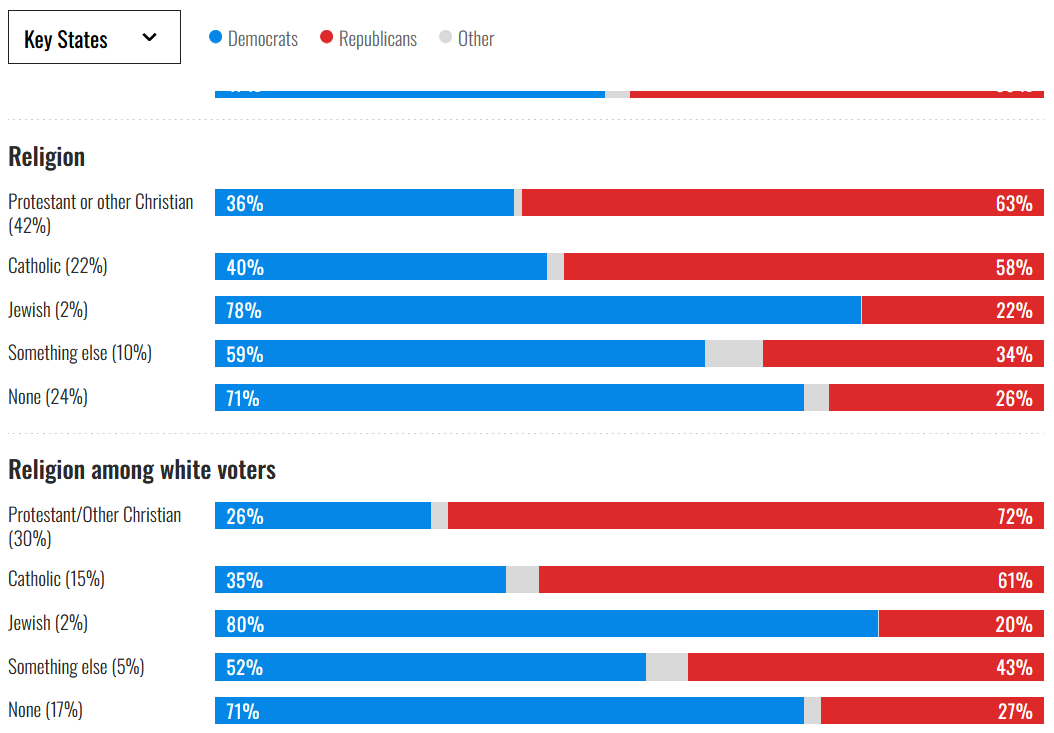
The MAGA base cannot be swayed by facts about the issue because they use the term “immigration” as code to promote a White Christian Ethnostate. This goal was said or implied by Trump and his surrogates and is part of Project 2025. Trump’s largest base of support was White men (60%), white people who never attended college 66%), and especially White Protestants/Christians (72%). Many understood Trump to be the White Christian Nationalist Candidate on the presidential ballot.

What Does This All Mean for Immigration Scholars?

My point above indicates that we need to research immigration, racialization, and the politicization of religion in tandem. These processes are linked to each other by right-wing ideologues. Many of us look at immigration; some of us are starting to look again at the relationship between immigration policies and race, and key sociologists have coined and looked at the rise of White Christian Nationalism.

There is much misinformation about immigration trends and processes, and as a community, we have much to offer. Moderates and independents are open to learning more about immigration, and Democratic-leaning voters and spokespeople need more fact-based talking points. For this reason, Carina Cione and I recently published the book “Immigration Realities: Challenging Common Misperceptions” (Columbia University Press 2024). This work condenses years of research on immigration, making it accessible for journalists, policymakers, students, and the public who want to access social science without facing paywalls or complicated jargon.

However, to be realistic, few people read books, much less academic books. Professors are less likely to assign books than before. Thus, to reach a wider audience, we have to write accessible pieces like op-eds, blogs, and newsletters and talk to the media. I encourage all of you to do so more often. If approached, agree to share your insights. It’s important that people learn about our research findings to help shift the negative and inaccurate stereotypes about immigrants.

As we write and read books about recent immigrants, the immigrant rights movement, Dreamers, and similar topics, we tend to focus on immigrants who are left-leaning, progressive, and activists themselves. Some of us often assume that an increase in immigrants and children of immigrants would lead to a shift towards more liberal views among the electorate. This last election puts that assumption partly into question, but what does this mean for immigration studies? As we have collectively written about, immigrants adapt, acculturate, and become distinct from those in their countries of origin. Over time and across generations, many immigrants become culturally like Americans. This means that, eventually, the public opinion of immigrants tends to align with the national average and those of their neighbors and social circles. In a country where around half of the electorate leans Republican, it is likely that around half of Latinos, Asians, and other immigrant groups, particularly those in the third generation, would do the same —whether we like it or not. This is indeed evidence of integration and assimilation. Their voting patterns will increasingly be influenced by education levels, gender, geographic location, and religion, as they do for White Americans.  

Prices have gone up around the world, the working class is under large pressure, and housing is scarce. There is much conflict-driven immigration around the world. There is not a federally financed emergency shelter and welcome system in the U.S. similar to that used for refugees. The American immigration legal system is antiquated and inadequate. These are issues that must be addressed by Congress. It is hard for non-specialists to understand how all the pieces are connected, and it is easy for politicians to point to real images of lines at the border, asylum-seekers sleeping in the streets, or outside of shelters and hotels in U.S. cities to say that these human beings in need will lead to local fiscal crises. In a forthcoming report, we show how that is not the case.

To conclude, the results of this election were not determined by immigration policies or the misinformation around it. However, to animate its base with racist dog whistles, Trump vilified, scapegoated, and spread lies about immigrants and minorities. We need to combat these misconceptions. While naturalized citizens and U.S.-born Latino votes did not determine the election outcome, they were used to polarize the electorate, painting Haitians and Latino men as dangerous criminals. In response, some Latinos themselves spread hate speech as a way to pass and protect themselves.

As we have documented well in sociology, many individuals draw symbolic boundaries, try to create distinctions, and avoid racialization and exclusion by trying to pass as White or White-adjacent in response to the stigmatization of whole categorical groups. Individuals in tenuous situations understand that adopting majority opinions and beliefs may be a survival strategy. This is caused by racism. We have collectively documented cases like this for a long time. However, among the public, there is a lack of understanding (even among immigrants, their children, and grandchildren) about immigration history and the common exclusion of newcomers. New immigrant groups are often framed as unassimilable, and once they do, many descendants of those groups repeat the pattern and exclude those who come after them.

Our research is more relevant than ever as we teach our students, readers, and the public about the many positive outcomes brought about by immigration in the long term and about how immigration status does not equal morality. It is not that individuals want to be undocumented, but many find themselves in that situation amidst strong labor demand in the U.S., a lack of legal pathways for many, as well as armed conflicts, and economic and political crises abroad.

Ernesto Castañeda is a Full Professor of Sociology at American University and Director of the Immigration Lab and the Center for Latin American and Latino Studies. Among his latest books, he published with Daniel Jenks, “Reunited: Family Separation and Central American Youth Migration” (Russell Sage Foundation 2024).

A shorter version of this text was written for the newsletter of the International Migration Section of the American Sociological Association.

Kamala Will Win

This Is Why Kamala Harris Will Win

By Ernesto Castañeda

November 5, 2024

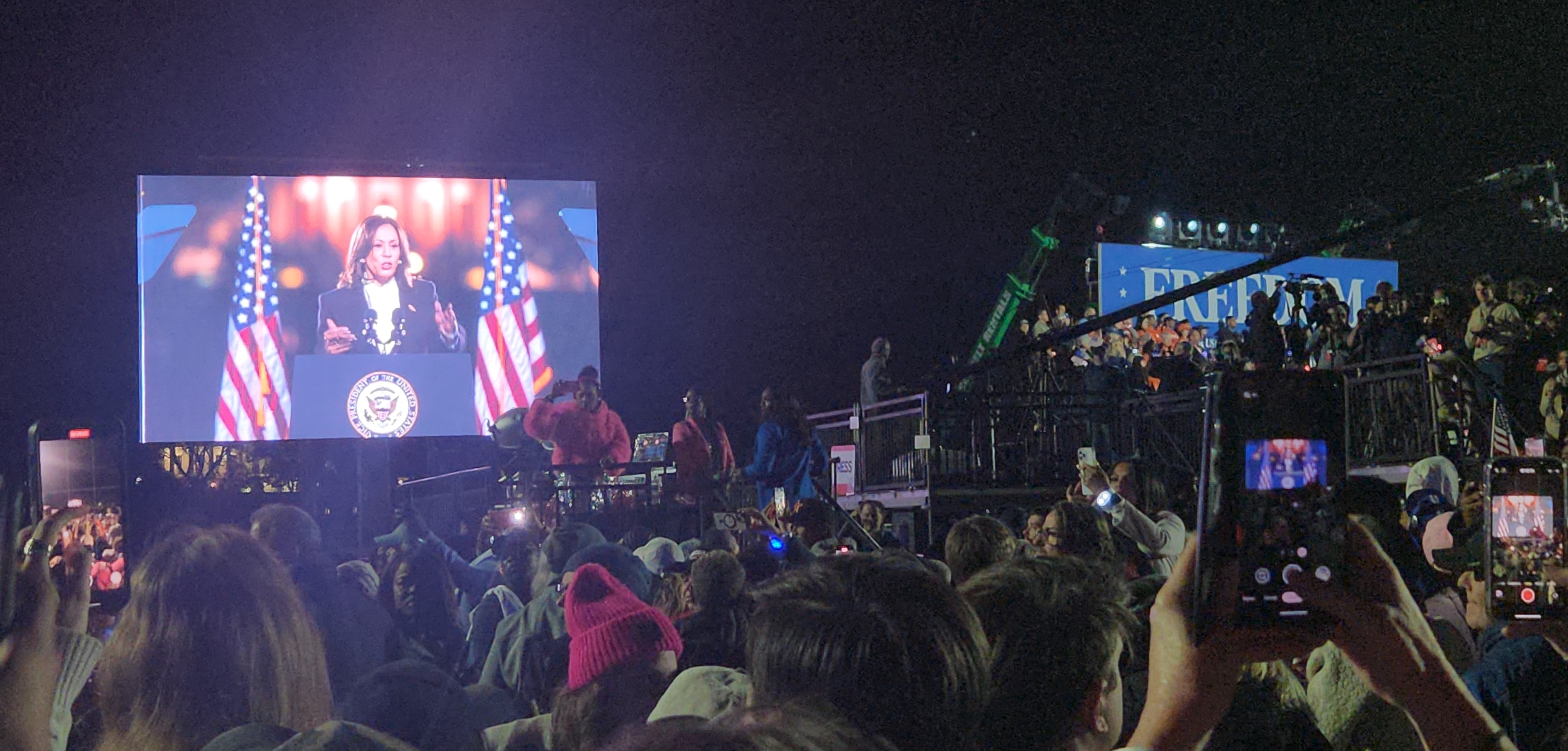
Harris at the packed DC rally in the Ellipse on October 29.

Harris at the packed DC rally in the Ellipse on October 29.

My assessment is that Kamala Harris will win the election. It is not based on the polls or the betting markers, which are not helpful given their very tight margins. Instead, Harris’ big tent, misrepresentation of the primacy of the economy and immigration in surveys, and social trends lead me to believe that Harris will win.

First of all, following the voting trends from the 2016 and 2020 presidential elections, Trump will not win the popular vote. This matters, as it determines popularity and broad appeal nationwide. Trump has never been appealing to over half of the population as a politician. While Trump was a fresh figure in politics in 2016, and there were some shy voters (given his novel strident and racist anti-immigrant comments), in 2024, he is a well-known entity, and most of his ardent followers are loud about their support, and not shy to say so to pollsters, door knockers, or people calling to get out the vote. Even so, attendance at his rallies and Trump flags outside of houses have decreased from previous cycles. Trump obsesses over crowd sizes, which was one of the indicators of his appeal in 2016. However, the infamous Madison Square Garden Trump rally on October 27 had around 19,500 people in attendance compared to around 30,000 people for Kamala Harris in Houston, Texas, on October 25, and over 75,000 at her rally in Washington, DC, on October 29.

Trump counts on a core base of around 33% of the electorate that holds strong views against immigration, complains about the economy, and will support Trump no matter what. Some more traditional Republicans will also vote for him. Nonetheless, his main campaign strategic imperative was to appeal to moderates, independents, and White suburban women to expand his margin over 50%. His 2024 campaign has not done so; he has focused on animating and mobilizing his core base. Many of his comments and those of his surrogates and supporters have alienated moderates as well as some registered Republicans. He has been more focused on discrediting the electoral process, the media, and his opponents and critics than on appealing to all voters.

In contrast, Kamala Harris has been explicitly open to conservative-leaning independents and even former Republican officeholders, including, but not limited to, Liz Cheney. Many registered Republicans, college-educated men, and many women will vote for her. That should be enough to guarantee her victory. She has done so not by compromising her beliefs and Democratic priorities but by promising to uphold the Constitution and protect democracy.

It is true that an unintended effect of Trump’s hate speech has created a certain increase in support among some Black, Latino, and Asian voters, but that will not be enough to counter the fact that a majority of women across racial and ethnic groups will vote for Kamala Harris as will many men and registered Republicans and independents.

A weakness for Harris lies in the uncommitted voters because of the situation in the Middle East who may vote for Jil Stein or abstain in places like Philadelphia, Pittsburgh, Milwaukee, Detroit, Dearborn, and college campuses. Trump’s election would make things worse in the Middle East, so some will reluctantly vote for Harris and then get ready to continue with their protests and demands for a ceasefire.

The media across the board has obsessed with “immigration” and “the economy” being the main concerns of the electorate and that public opinion favors Trump to handle them. But first of all, objectively, the economy is strong, and asylum-seeking at the border today is at very low levels. Second, and most importantly for elections, when one looks at the polls that are used to make these claims, these are the main issues for less than half of the electorate, and they are the main issues for Republican respondents, who naturally favor Trump’s solutions on these areas. In other words, putting the bulk of the Republican agenda around closing the border is not enough to gain a majority of voters nationwide or even in most swing states. The urban legend about immigrants eating cats shows voters how exaggerated these warnings are. The common claims against immigrants are false, as my book —coming out today— Immigration Realities documents.

Many pundits, consultants, and advisors have been saying that “Harris is weak on the border.” Not only is that false, but my response has been that the immigration obsession will cost Trump the election. Mass deportations are not popular outside of MAGA circles, while a path to citizenship has large levels of support. The Madison Square Garden rally made it clear to many voters and agnostic observers that this was not about undocumented immigration but about creating a White Christian Ethnostate.

There are even some indications (like the exit polls in the Republican primaries in Ohio) that some Evangelicals and religious voters are tired of Trump supposedly representing their views and values. The majority will still vote for him, but less than in previous elections when he has been on the ballot. The same is true for rural and union members. Biden has been a strong pro-labor president. Tim Walz is more familiar with rural White voters than Vance is these days. The majority will vote Republican, but many will vote Democrat. Harris is endorsed by both Liz Cheney and Bernie Sanders. Her appeal and favorability are wide, and she could create an even wider base of support than Obama.

Democratic institutions, freedom of the press, and many other values and institutions are on the line. This is the first election where Trump is on the ballot after January 6, 2021, and the many trials against him. He will not lose all his supporters, but he will lose some.

Recent local and midterm elections have shown that the across-the-board restrictions on abortion and emergency care while pregnant are large motivators to drive women and men to the polls to repeal these propositions and to vote for Democrats. In 2016, most White women supported Trump and not Hilary Clinton. This may be different this time because of the end of Roe vs. Wade. This would be crucial because women are the majority of likely voters, and they were more active in early voting.

Established Latinos of Puerto Rican, Mexican, and South American origin in Pennsylvania, Nevada, Arizona, Georgia, and New York will make important contributions to the Democratic vote. I predict that many women and new citizens of immigrant origin and some who did not vote in previous elections because of age or lack of interest (thus often not in pollster models of likely voters) will turn out to vote for Harris.

All along, the expectations have been set very highly for Harris, and she has excelled at each challenge, including securing the nomination uncontested, choosing a strong VP candidate,  leading the RNC, speaking at rallies, showing she can be Commander in Chief, bettering Trump at their debate, engaging with the media effectively, she can take questions from the media and answer them thoughtfully, to round it all out she can engage in retail politics with much enthusiasm and empathy.

Trump carries all the media attention and campaign resources from the RNC, and most Republicans down the ballot depend, to a large degree, on his appeal. This does not bode well for them. Furthermore, the Republican-led Congress has been one of the most ineffective in recent memory. Government shutdowns have been adverted, and there have been impactful and popular bipartisan accomplishments such as the Infrastructure Bill, the Inflation Reduction Act, the CHIPS Act, and support for Ukraine, but many Republican Congresspeople have voted against these achievements.

All these factors combined seem to indicate that Trump supporters will have a weaker showing than when he lost in 2020, even if we are not in the middle of a pandemic. Kamala Harris has benefited from a fresh, exciting, flawless campaign, drawing all the enthusiasm that had been lacking since Obama’s first presidential campaign.

To recap, the biggest errors in the 2024 election coverage have been the out-of-proportion focus on the economy and immigration as the biggest concerns of all voters when, indeed, these complaints are not fully based on reality and are mainly coming from Republican-leaning voters. Nobody likes inflation, but unemployment is low, and wage and economic growth rates are positive and steady, with a big improvement from 2020. Reproductive health and women’s rights will be more important in motivating people across party affiliations to vote for Harris and Democrats. While the polls are currently very tight, and there is noise that favors Trump (allowing him to repeat the big lie), ultimately, cold analyses of the electorate’s behavior and preferences tell us that Harris is on track to win the electoral college and with wider margins than the polls show.

Ernesto Castañeda, PhD is Director of the Center for Latin American and Latino Studies and the Immigration Lab and Professor at American University.

You can republish and reprint this piece in full or in part as long as you credit the author and link to the original when possible.
Anti-Immigrant Campaigns

Anti-Immigration Rhetoric: Winning Campaign Strategy or Coin Toss?

By Joseph Fournier and Ernesto Castaneda

October 10, 2024

With the U.S. presidential election drawing nearer, many Kamala Harris supporters fear a perceived weakness on the border “crisis” may cost her the election to Donald J. Trump. Trump has championed himself as the figurehead for tough border policy. Restricting immigration has been associated with Trump. An NBC poll showed that 89% of people who identify as conservative point to the situation at the U.S.-Mexico border as a major factor in their vote for president, while only 25% of those who identify as liberal do so, and 52% among moderates. Therefore, we are not witnessing an anti-immigrant turn in public opinion but a further polarization by political ideology.

Crosstab from CBS, YouGov poll page 23.

Trump has been capitalizing on this perceived base of support by making even more extreme comments regarding the issue, most recently employing race pseudo-science in claiming that recent migrants possess “bad genes.”

In the past, Harris and the Democrats have painted themselves in clear opposition to his cruel immigration policies, such as family separation. When on the campaign trail in 2019, Harris’s rhetoric focused on pathways to citizenship and the plight of migrants. This strategy worked as Biden and Harris defeated Trump in 2020.

There was a slight rightward shift from Harris and the DNC on immigration. This was probably in reaction to an increase in the visibility of border crossings after the pandemic.  Trump has framed these increases as a “border crisis.”

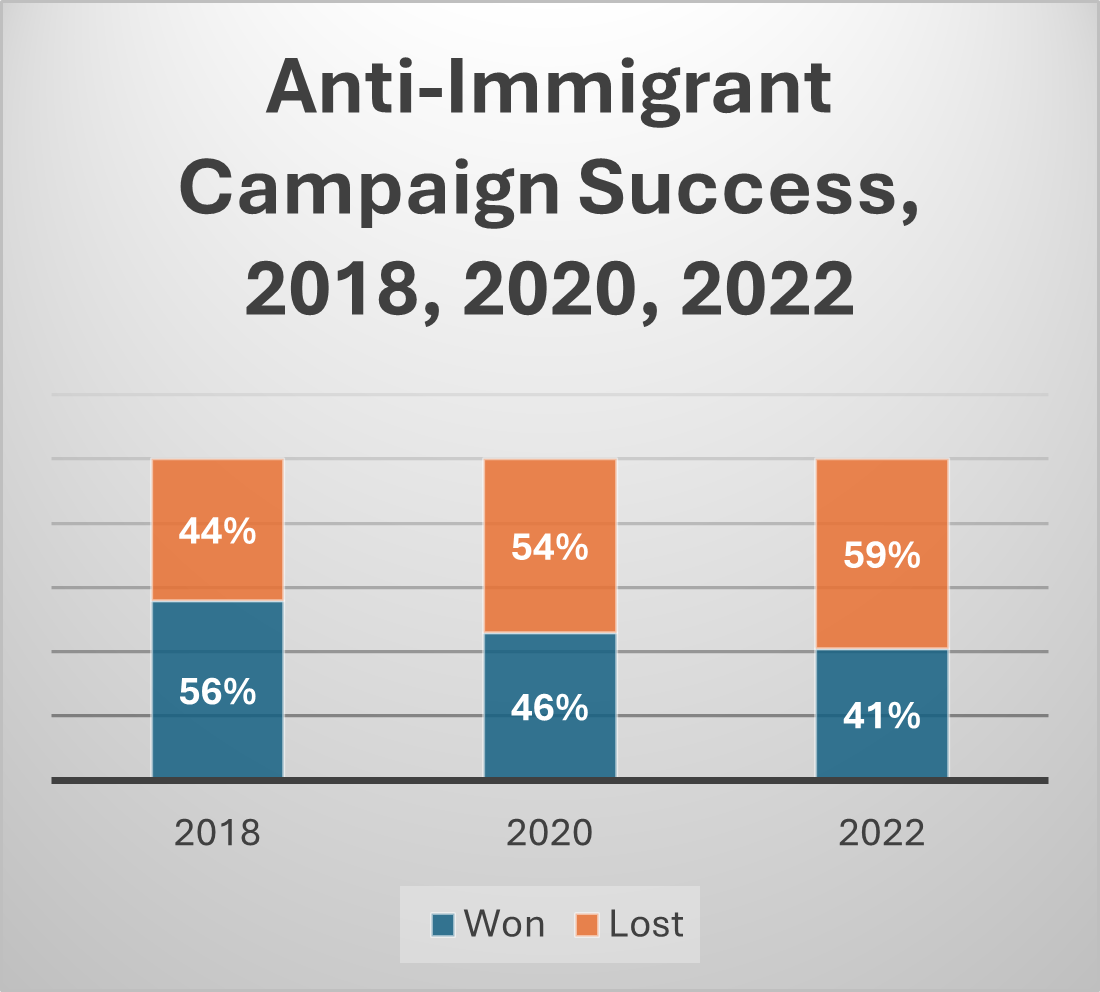
But do Democrats need to get harsher on immigration if they want to win? Data shown in Figure 1 demonstrates a phenomenon that may surprise political strategists on both sides of the aisle. Research from The Immigration Lab analyzing congressional and gubernatorial elections in 2018, 2020, and 2022 has shown that these anti-immigrant campaign victories have decreased by about 15%. This data was pulled from online campaign material from every election result with a 10% margin between the two major candidates.

Successes of anti-immigrant campaigns in competitive elections, 2018-2022 by the authors.

In 2018, businessman and former state senator Brian Kemp ran for governor in Georgia. His campaign epitomized the culture wars that the GOP included as part of their messaging strategy. Kemp styled himself as a “politically incorrect conservative” and filmed himself touting chainsaws and shotguns in service of this persona. He ended one of his ads by showcasing him in his truck, threatening to “round up criminal illegals myself.” On November 8, 2018, Kemp defeated his opponent in the closest Georgia gubernatorial race since 1966.

In 2022, Kemp ran for re-election against the same opponent. With essentially the same election conditions, Kemp’s strategy radically changed. His new primary TV ad, titled “Stronger Georgia,” listed a myriad of his accomplishments as governor. Many of his themes continued from his 2018 ads, including his support of decreased government regulation. Nonetheless, a notable point missing from his 2022 ad, however, was immigration. Kemp made no mention of the issue, making only a brief note of him “fighting human trafficking.” In softening his tone on migration, Kemp nearly tripled his margin of victory in 2022 in comparison to 2018.

Even while encounters at the border today are as low as during the pandemic when Title 42 was in effect closing the border to asylum-seekers, many think that long lines of people asking for asylum at the U.S.-Mexico border is a political liability for the Biden-Harris administration. However, when Americans in these competitive elections have shown up to the polls in the last six years, running an anti-immigrant campaign has demonstrated itself to be well short of the secure victory strategy that many seem to think it is.

Joseph Fournier is a Research Assistant at the Immigration Lab and a senior at American University.

Ernesto Castañeda is the Director of the Immigration Lab and the Center for Latin American Studies.

Anti-Immigration Rhetoric is an Electoral Vulnerability: Evidence from the 2022 Midterm Elections

By Ernesto Castañeda, Joseph Fournier, and Mary Capone

October 1, 2024

Graph elaborated by the authors with data collected from CNN Politics’ Midterm Election Results.

The above graph represents the proportional success of candidates who used anti-immigration sentiment in their campaigns for the 2022 midterm elections. Results data was taken from CNN Politics. Anti-immigration rhetoric was found in campaign material through Meta Ad Library, X (formerly Twitter), debate responses, campaign website archives, YouTube ad searches, and general Google searches. We focused on competitive elections defined as having electoral results within a 10% margin between candidates. Candidates in these competitive elections who used ani-immigrant sentiment were no more likely to win the election than those who did not; in fact, more candidates who campaigned on anti-immigration lost than won in 2022. This data provides evidence that not being anti-immigration is not a hindering campaign decision. It may be quite the opposite.

Immigration often emerges as a prominent talking point among candidates in presidential, congressional, and gubernatorial elections. Former President Donald Trump frequently employs anti-immigration rhetoric and continues to campaign under similar sentiments about the allegedly dangerous porosity of the southern U.S. border. In the presidential debate in June of 2024 against President Joe Biden, Trump mentioned immigration in 42% of the 38 times he spoke while Biden mentioned immigration 13% of the time.  In the subsequent debate against Vice President Kamala Harris, out of 38 times when Trump spoke for more than two sentences, he incorporated immigration 10 times (26% of the time). In comparison, Harris did so 4 out of 27 times (15% of the time).

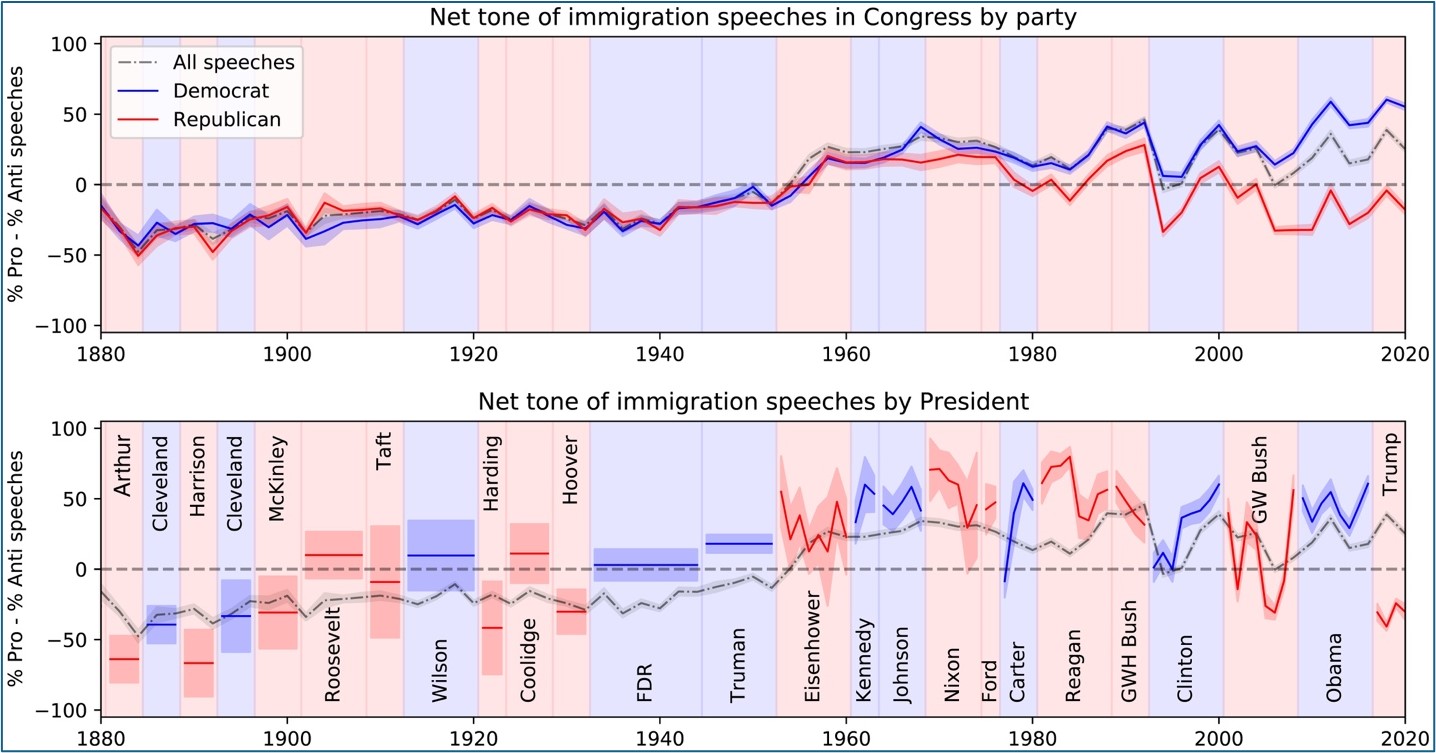
Anti-immigration rhetoric has become practically synonymous with the Republican Party as these candidates often use immigrants as scapegoats for shortcomings in national security, economics, and crime control. While several Democratic candidates support anti-immigration policies as well, it is less commonly a key aspect of their campaigns. The graphic below indicates the overall tone of immigration speeches in Congress and the president by party from the late nineteenth century until 2020. While the data excludes 2022, it encapsulates the general trends of immigration sentiments over time.

Source: Card et al., 2022 published by the Proceedings of the National Academy of Sciences.

The top of the graph shows that trends in the rhetoric of Republican and Democratic congressional representatives were negative before the 1950s and became positive in both parties in the late 1950s and through the 1960s and 1970s. The divergence in sentiments is clearest in the early 1980s and beyond, with the greatest points of divergence occurring between 2000 and 2020. Card et al. acknowledge that the divergence also represents other trends in the polarization of other issues. However, they find that immigration polarization predated the rise in generic political polarization observed in Gentzkow et al. by more than a decade.

The lower part of the graph shows the variation in presidential sentiments through positive and negative language employed to discuss immigration. The anti-immigrant rhetoric of President Trump has been unseen since the presidency of Herbert Hoover. Overall, the graph represents the rise in anti-immigration rhetoric in congressional and presidential speeches by Republicans in recent years as it has become more of a political talking point.

Discourse gathered from the campaign sites and social media accounts of Republican candidates who ran in competitive elections in 2022 with anti-immigration campaigns includes several instances of strongly prejudiced statements. Republican Mark Robertson (Nevada District 1) sought to “turn off the illegal flow of people coming into our country… end chain-migration, visa lotteries and vacation-birth citizenship.” Ending “vacation-birth citizenship” implies a possible erasure of birthright citizenship. Anti-immigrant candidates describe policies like these in misleading ways to garner political support, despite understanding the implausibility of such a policy.

Many of these anti-immigrant candidates take further aim at immigrant children. Republican candidate for the Senate in Pennsylvania Mehmet Oz stated in an ad that, “The Biden administration’s failure on the border is so massive that they are flying illegal immigrants up to airports like this where illegal immigrants are being taken on buses. Now every state has become a border state.” The ad is filmed outside of Scranton-Wilkes-Barre Airport in Pennsylvania, an airport that has been instrumental in the facilitation of protecting unaccompanied migrant children. This airport and the role it plays in the migrant children protection apparatus made it a popular target for Pennsylvania Republicans in 2022. Jim Bognet (R), who ran for Congress in the district that includes the airport itself, ran an ad claiming “Joe Biden & Matt Cartwright still won’t STOP ghost flights of illegal immigrants into (Northeast Pennsylvania).” The reason for this secrecy is that these are minors whose identities are obscured to ensure their security. Many of these children come from vulnerable backgrounds, including a sixteen-year-old victim of sex trafficking seeking protection while awaiting possible testimony and an asylum claim. These children have become the target of a political stunt by the GOP in their attempt to create fear surrounding migration.

Numerous other candidates posit a link between undocumented immigration and drug cartels. Republican Congressman Bryan Steil, who won in Wisconsin District 1, claimed on his campaign website that “drug dealers (and) human traffickers” are crossing the border, framing it in such a way that implies the two are intertwined in their business dealings. Republican Congressman John James, who won reelection in 2022 for Michigan District 10, conducts a similar framing in a tweet highlighting “millions of illegal border crossings, millions of lethal doses of Chinese fentanyl.”

A more brazen example of such framing can be found in campaign material from Blake Masters’ failed bid for Arizona Senate, which shamelessly claims that “More than 225,000 illegal aliens pour into our country every month. And they bring enough fentanyl over each month to kill every American twice over.” In a recent conference on immigration at American University, Dr. Andrew Selee, head of the Migration Policy Institute, notes that these organizations are separate entities. Though they sometimes do collaborate, they are by no means the same and have independent organizational structures. This is a subtle yet important distinction that has been masked to criminalize migrants and conflate them with criminal enterprises such as drug cartels.

The criminalization of migrants was certainly not limited to linking them to cartels. Many candidates rely upon preconceived racist notions of immigrant populations (mostly Latinos) in making generalizations. Such candidates keep their statements on immigration vague, like Nevada Republican Senate hopeful Adam Laxalt: “[the] crisis at the border that has put communities across Nevada in danger…. [Laxalt] fought against dangerous sanctuary city policies and worked to help stop their spread.” The advantages yielded by anti-immigrant candidates in utilizing this sort of vagueness are twofold. The first is that it appeals to a voter base that has already constructed a negative bias toward immigrant populations, and it is this sort of rhetoric that energizes these voters. The second advantage of such vagueness is the removal of the burden of proof from Laxalt or other candidates. Because of this vagueness, the claim becomes difficult to disprove because the meaning can be fluid and easily manipulated at the whim of the candidate.

Similarly, a campaign ad from Republican gubernatorial candidate Kari Lake of Arizona claims to finish the southern border wall and reinstate the “Remain in Mexico” policy: “the best policy I’ve seen in my 27 years, it worked.” The “Remain in Mexico” policy, a Trump-era directive modified by President Biden, has been largely condemned by human rights groups. Multiple immigration advocates highlighted that the policy forced all migrants to wait on the Mexican side of the border, including those who are escaping persecution in Mexico, in unsafe and uncertified conditions while their asylum case were pending.

Overall, anti-immigration statements like those highlighted in the 2022 midterm election campaigns are prevalent across Republican candidates. Trends indicate a rise in such rhetoric in congressional and presidential speeches with a partisan divergence as Republican candidates are more likely to employ this as a strategy in campaigning. Nonetheless, there was limited success for anti-immigrant campaigns in the 2022 midterm elections. The data shows that anti-immigration rhetoric is not a guarantee for winning elections; in fact, it may be an electoral vulnerability as it does not lead to more success in competitive elections.

Ernesto Castañeda PhD, Director of the Immigration Lab and the Center for Latin American and Latino Studies, American University in Washington DC.

Joseph Fournier and Mary Capone are research assistants at the Immigration Lab and the Center for Latin American and Latino Studies at American University.

Sources

“2022 Midterms.” CNN Politics, Accessed September 17, 2024. https://www.cnn.com/election/2022.

Adam Laxalt for NV. “Issues | Adam Laxalt for Senate.” Accessed February 6, 2024. https://www.adamlaxalt.com/issues.

Card, D., Chang, S., Becker, C., Mendelsohn, J., Voigt, R., Boustan, L., Abramitzky, R., & Jurafsky, D. (2022). Computational analysis of 140 years of us political speeches reveals more positive but increasingly polarized framing of immigration. Proceedings of the National Academy of Sciences119(31). https://doi.org/10.1073/pnas.2120510119 

Castaneda, Ernesto. “First Presidential Debate Was Mainly about Immigration, Few Noticed”. AULA Blog Accessed September 25, 2024 https://aulablog.net/2024/07/19/first-presidential-debate-was-mainly-about-immigration-few-noted/.

“Frequently Asked Questions: ‘Remain in Mexico’ Policy.” Justice for Immigrants. Accessed October 2, 2024. https://justiceforimmigrants.org/wp-content/uploads/2019/02/Remain-in-Mexico_en.pdf.

Gentzkow, M., Shapiro, J. M., & Taddy, M. (2019). Measuring group differences in high dimensional choices: Method and application to congressional speech. Econometrica, 87(4), 1307–1340. https://doi.org/10.3982/ECTA16566

James, John. (JohnJamesMI). “Our border is plagued with chaos – millions of illegal border crossings, millions of lethal doses of Chinese fentanyl & incompetence from the White House. I’m glad to support the House GOP’s Commitment to America to fund border security & put an end to human & drug trafficking.” September 26, 2022. 3:10 PM. Tweet. https://x.com/JohnJamesMI/status/1574476402392457217.

Jordan, Miriam. “’Ghost Flights’? The Facts Behind Transporting Migrant Children”. New York Times. June 24, 2022. Accessed February 4, 2024. https://www.nytimes.com/2022/06/24/us/ghost-flights-migrant-children.html?login=google&auth=login-google#.

“Kari Lake January 2022 Ad.” Accessed February 6, 2024. https://www.facebook.com/ads/library/?active_status=all&ad_type=political_and_issue_ads&country=US&id=313372640712991&media_type=all.

“Remain in Mexico” Human Rights Watch. Accessed October 2, 2024. https://www.hrw.org/tag/remain-mexico

Robertson, Mark. “Mark’s Stances – Robertson for Congress.”Accessed February 11, 2024. https://web.archive.org/web/20221104220014/https://robertsonforcongress.com/stances/

Selee, Andrew. “Wilson Center Discussion on Immigration Policy”. September 23, 2024. C-SPAN, 58:43. https://www.c-span.org/video/?538598-1/wilson-center-discussion-immigration-policy.

Steil, Bryan. “The Issues: Bryan’s Vision for America – Securing Our Border”. Accessed September 26, 2024, https://web.archive.org/web/20221104220838/https://www.bryansteil.com/issues/.

“STOP ILLEGAL IMMIGRATION – Dr. Oz for Senate.” Accessed February 11, 2024. https://web.archive.org/web/20221028022107/https://doctoroz.com/issue/stop-illegal-immigration/.

Voter Concerns: The Economy or The Government’s Role in Shaping It?

By Ernesto Castañeda

September 27, 2024

On the morning of September 9, 2024, a Republican voter called into C-SPAN’s Washington Journal and said, “Democrats used to be all about the workers, but now it’s just socialism.” This short piece is respectfully directed to those who may share that sentiment. First, it’s important to note that, in principle, socialism is centered around workers, but it asks that workers own the companies they work at. Democrats are not socialists. Even the party’s most progressive figures, like Bernie Sanders and Alexandria Ocasio-Cortez (AOC), identify as Democratic Socialists and advocate for the U.S. to adopt some of the social safety nets seen in Northern European countries and fight monopolies and for workers’ rights to create a tempered capitalism. Now, let’s turn to the real concerns about the economy as we approach the upcoming elections.

The economy is doing well

The U.S. economy is objectively performing very well, largely due to the Biden-Harris administration’s adoption and successful implementation of policies championed by figures like Sanders, Warren, and AOC. Compared to other countries, the U.S. has recovered more quickly from the pandemic’s effects, which were driven by lockdowns, labor shortages, and disruptions to global supply chains—all of which contributed to inflation. These policies, alongside immigration, have supported healthy economic growth. Notably, inflation and interest rates are decreasing without the economy slipping into a recession—an almost ideal outcome often referred to as a “soft landing.”

Nonetheless, some citizens and commentators still insist that the economy is weak, and voters often mention “the economy” as their main concern.

A shift in expectations on the economy

Before the COVID-19 pandemic, it was already common for millions of Americans to live paycheck to paycheck and carry significant debt. The pandemic, however, reshaped Americans economic expectations in at least three important ways: 1) The imminent threat to life placed greater value on human life and people’s time; 2) It exposed our heavy dependence on foreign producers, global supply chains, and essential local workers; and 3) It led to a bipartisan recognition that the government can and should take action to address hunger, unemployment, public wellbeing, inequality and support the working and middle class, as well as small and large business and postpone evictions in times of collective suffering.

Let me elaborate on point three. The economic policies and incentives—such as support for businesses both large and small, direct checks to families, and the child tax credit—implemented in a bipartisan effort during the pandemic by both the Trump-Pence and Biden-Harris administrations significantly raised economic standards and cut child poverty in half. These policies also reflected what C. Wright Mills advocated in the 1960s: when unemployment is widespread, it should be viewed as a social issue rather than a matter of personal responsibility, worth, or morality. In contrast to the neoliberal focus on market fundamentalism, these pandemic-era measures revived Keynesian principles, emphasizing a return to full employment and expanding support for policies reminiscent of FDR’s New Deal—where the government plays a role in reducing inequality and supporting the working and middle class.

The real cause of frustration

One of Joe Biden’s boldest and most significant accomplishments may have been his repeated assertion that “trickle-down economics has never worked. It’s time to grow the economy from the bottom up and the middle out.” This is a change in the long-held belief in individualistic ideologies, such as the notion of “pulling yourself up by your bootstraps.” Stemming from this ideological shift, I believe much of the unease felt by the working and lower-middle class about “the economy” stems from frustration over the end of many pandemic-era cash transfers and stimulus checks, which were initiated by both the Trump and Biden administrations. These transfers and the forced savings due to the lockdowns allowed some families to pay credit card debt and even increase their savings, which for many are now depleted again.

Ironically, it was the Republican Party that blocked the extension of the child tax credit, a key measure backed by Democrats to support working families. Yet, many voters remain unaware of this. Meanwhile, tax-evading billionaires, including figures like Trump, exacerbate the economic challenges rather than providing solutions. A modest increase in taxes on billionaires would help fund essential programs like the child tax credit, and contrary to popular rhetoric, this is not socialism—it’s a practical approach to ensuring fair contributions from the wealthiest.

Outdated and Misguided Economic Narratives

Trump has attempted to link his scapegoating of immigrants to the current economic challenges, falsely claiming that immigrants are taking jobs from those most in need, particularly African Americans, Hispanics, and union workers. However, this argument does not hold up—unemployment rates are low, and wages are rising. As a result, most people are unlikely to be swayed by this rhetoric. Those who do buy into it likely already held anti-immigration views prior to the pandemic and/or are victims of structural changes stemming from Reaganomics.

By invoking fears that the U.S. could become “like Venezuela,” Trump taps into concerns among immigrants who lived Venezuela’s prosperity before Chavismo or those fleeing other authoritarian regimes. However, Republicans risk losing these voters by frequently portraying Venezuelan immigrants as criminals—members of the Tren de Aragua gang—or as individuals released from prisons and mental institutions by Maduro and sent to the U.S. This narrative echoes real historical events such as Cuba’s Marielitos or British prisoners sent to Australia as settlers, as well as xenophobic stereotypes and prejudices once directed at Irish, Italian, and Mexican immigrants. History, however, shows that the children of immigrants often experience rapid social mobility and thus contribute as much, if not more, to society than the children of native-born citizens.

Some attempt to alarm undecided voters by claiming that Harris is advocating for price controls. In reality, she is focused on preventing monopolies and negotiating better prices when the government buys in bulk, as demonstrated successfully with insulin. This pragmatic approach has broad support across Republicans, Democrats, and Independents. Harris and Walz are not pushing radical leftist ideas; rather, they are promoting a moderate populism that is not linked to exclusionary Christian nationalism.

“Opportunity economy”

In her speech at the Economic Club of Pittsburgh on September 25, 2024, Harris stated:

“The American economy is the most powerful force for innovation and wealth creation in human history. We just need to move past the failed policies that have proven not to work. And like generations before us, let us be inspired by what is possible. As president, I will be guided by my core values of fairness, dignity, and opportunity. I promise you I will take a pragmatic approach. I will engage in what Franklin Roosevelt called bold, persistent experimentation, because I believe we shouldn’t be constrained by ideology but instead pursue practical solutions to problems.”

With this statement, she invoked FDR’s legacy while offering a centrist, pragmatic vision for addressing the economic challenges facing Americans.

While some commentators argue that Harris and Walz haven’t provided enough details on their economic policy, they are actually offering a balanced approach that appeals to both corporations and small businesses. Their plan promotes U.S. manufacturing and nearshoring, aims to reduce the climate impact of production and consumption, and provides much-needed support to the low and middle class in regions hit hardest by deindustrialization. Trump talks much about caring about the working class but did little to benefit them structurally and long-term while in the White House. Policies like exempting tips and overtime from taxation fit within Harris’ framework, but Harris also advocates for more ambitious measures to really level the economic playing field a bit more. Harris calls this vision the ‘opportunity economy,’ a pragmatic approach to economic and industrial policy that many former Bernie and Trump supporters could, in principle, support.

Ernesto Castañeda PhD, Director of the Immigration Lab and the Center for Latin American and Latino Studies, American University in Washington DC.

Edited by Robert Albro, CLALS Associate Director of Research, and Edgar Aguilar, International Economics master’s student at American University.

This piece can be reproduced completely or partially with proper attribution to its author.