Colombia: Four More Years for Santos

By Eric Hershberg

Photo Credit: eltiempo.com / Foter / Creative Commons Attribution-NonCommercial-ShareAlike 2.0 Generic (CC BY-NC-SA 2.0)

Photo Credit: eltiempo.com / Foter / Creative Commons Attribution-NonCommercial-ShareAlike 2.0 Generic (CC BY-NC-SA 2.0)

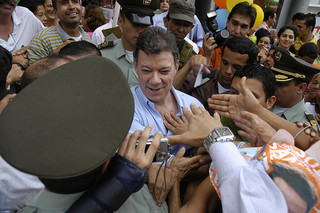
Incumbent center-right president Juan Manuel Santos emerged triumphant from yesterday’s second round of presidential balloting in Colombia – giving momentum to his peace talks with the FARC and his efforts to continue improving the country’s democracy.  He defeated challenger Oscar Iván Zuluaga, of the rightwing Union of the Democratic Center, which is led by former President Álvaro Uribe, a polarizing figure remembered in Washington as George W. Bush’s favorite Latin American leader.  Santos prevailed by a clear margin of five percentage points, and Colombia’s technically impeccable vote-counting process virtually ensures that the outcome will not be disputed.  The turnout of 2.4 million additional voters yesterday reduced voter abstention from 60 percent in the first round to a still-worrisome 52 percent.  Regional divisions among the electorate were striking: in some areas long plagued by Colombia’s civil conflict, the President won overwhelmingly, and he achieved substantial gains in Bogota, winning a strong majority, thanks in large measure to the endorsement of leading leftist politicians.  By contrast, in the central and southern parts of the country, particularly in Antioquia, the bastion of Uribismo, the opposition candidate garnered nearly two thirds of the vote.

The candidates’ campaigns focused on the polarizing issue of peace talks with the Revolutionary Armed Forces of Colombia (FARC), which Santos launched early in his administration and have proceeded slowly but steadily in Havana.  The President sought a second term in order to complete the negotiations and end a conflict that some estimate has taken more than 200,000 lives and caused devastating human and material damage over the past half century.  By contrast, Zuluaga, taking his cue from his mentor and chief advocate Uribe – who had spent Santos’ first term and virtually all of the campaign vilifying the President as a traitor for having launched the talks – changed approach in the second round and suggested that he, too, sought peace but would impose far more stringent preconditions before talks.  Most commentators viewed his shift as suggesting a return to the Uribe-era policy of crushing the insurgency before speaking with it.  Ironically, polls showed an electorate that was barely interested in the talks and far more concerned with other issues as elsewhere in Latin America: citizen security, unemployment and public services (such as health, education and transportation) were at the forefront of voters’ concerns.  On these fronts the two candidates offered little to distinguish themselves from one another.  Further assessments of the voting data will indicate whether this may account for low voter participation in an election that outsiders perceived as momentous.

While commentary in Washington and abroad has focused on the implications of the election for the peace process, the longer term consequences may lie elsewhere, particularly in the robustness of Colombia’s democratic institutions.  We will never know the extent to which Zuluaga would have been a pawn of Uribe, but suspicions were widespread that he was to the former President as Dmitry Medvedev was to Vladimir Putin.  Thus, beyond potential reversal of the negotiations for peace, a Zuluaga presidency might have entailed a return to authoritarian practices that had undermined Colombia’s democracy under Uribe and that Santos did much to rectify.  Although he is a staunchly establishment figure, Santos has advanced the spirit and letter of the 1991 Constitution, a progressive charter that emphasized separation of powers, rule of law, a strong and accountable judiciary, as well as minority representation and unwavering respect for human rights and accountability for abuses.  Santos also embodied a spirit of reasoned deliberation both at home and in matters abroad.  His pragmatic dealings with the often troublesome regime in neighboring Venezuela have been a far cry from the saber rattling that the rightwing authoritarian populist Uribe directed toward his similarly bombastic leftwing authoritarian counterpart Hugo Chávez.  Four more years of Santos may or may not produce tangible advances on the issues that seem to preoccupy the Colombian electorate – jobs, public safety and services – but they probably will ensure continued strengthening of democratic institutions and continued opportunities for Colombia to join with sensible governments elsewhere in the region to cooperate productively regarding Venezuela and other regional concerns. It may also pave the way towards a lasting peace and some degree of reconciliation for a country long plagued by civil war. 

Brazil: Evangelicals Gaining Influence

By Daniel Azevedo

Photo Credit: Igreja Adventista Central de Porto Alegre / Flickr / Creative Commons Attribution-NonCommercial 2.0 Generic (CC BY-NC 2.0)

Photo Credit: Igreja Adventista Central de Porto Alegre / Flickr / Creative Commons Attribution-NonCommercial 2.0 Generic (CC BY-NC 2.0)

Brazil still has the largest Catholic population in the world, but evangelical churches are gaining in size and political clout.  In the 1980s, persons identifying themselves as evangelicals made up 6.6 percent of the population; today they are 22.2 percent, according to the Brazilian Institute of Geography and Statistics.  Whereas Catholics have generally not organized politically, evangelicals from various parties have gradually been gathering under their religious banner.  They have been growing in numbers and influence since the 2010 elections that chose President Dilma Rousseff.  That year, fearing she would lose the second round of the election to opposition candidate José Serra, Rousseff signed a letter to deputies and senators of the “evangelical bench” promising that she would not sign any laws that went counter to their values, such as legalizing abortion or gay marriage.  The letter gave her the support of evangelical churches, and ensured Dilma’s victory.  Also in 2010, the evangelical bench in the legislature grew 50 percent compared to the 2006 election, reaching 60 deputies and 3 senators.

The evangelical bench anticipates even greater gains in the general elections this October, although polls substantiating its optimism are lacking.  The Folha de São Paulo reports that the Evangelical Parliamentary Front of the House of Representatives estimates it will grow 30 percent, reaching up to 95 representatives – 18 percent of the total House.  This could have legislative consequences.  As a congressman, for example, Pastor Marco Feliciano tried to win approval for a “gay cure” law, which would make it legal for psychologists to treat and “heal” homosexuals in search of heterosexuality.  (Feliciano may at times be an outlier.  Last year he said that “black people are cursed by God in the Bible and, for that reason, Africa is the worst continent in world.”)  Despite the evangelicals’ strong unifying platform, gaining support beyond their bases may be difficult.

The evangelicals seem to have electoral strategies in Rio de Janeiro in place.  Among the four pre-candidates for state governor, two of them are members of the evangelical bench.  Early polls suggest one or the other may become the executive of Brazil’s second most important state, although both face legal problems.  The first one, Anthony Garotinho, has been accused of money-laundering and illegal distribution of political propaganda; his Caravana da Palavra da Paz allegedly misused public money and broke election laws by distributing Bibles and other materials just to people over the minimum voting age.  The other, Marcelo Crivella, is suspected of misusing of public money with his NGO, Farm New Canaan.  (The Portal de Transparência Brasil, an NGO tracking Brazilian politicians, has found that all of the evangelical bench members face unspecified lawsuits, and 95 percent of them are on the list of House members missing the most sessions.)  They are leading the polls, albeit with only 19 percent and 18 percent of intended votes, because the two non-evangelical candidates have apparently more serious political problems.  One is connected to the current and discredited governor, and the other faces serious legal challenges.  Despite the low probability of a breakthrough at the presidential level in the near future, the evangelicals’ efforts in the legislature and states strongly suggest their conservative voice will be an increasingly powerful force to be reckoned with.

El Salvador’s Former Guerrilla – and New Commander in Chief

By Héctor Silva Ávalos

14169581511_3b3b43cb13_z

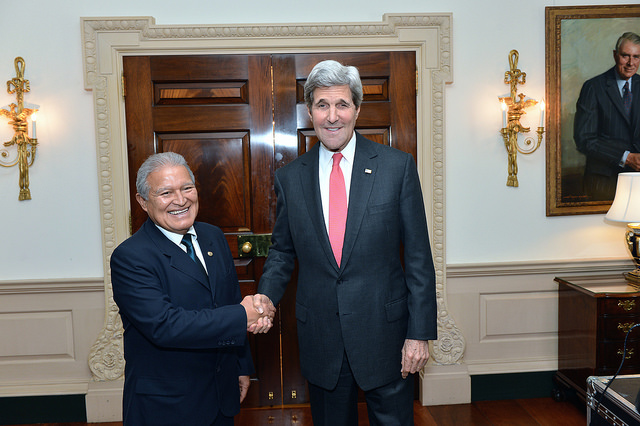
Salvadoran President Salvador Sanchez Ceren with Secretary of State John Kerry during his visit to Washington, D.C. [State Department photo/ Public Domain]

Twenty-two years after participating in the signing ceremony of the UN-brokered peace accord that ended El Salvador’s civil war, Salvador Sánchez Cerén, one of the FMLN’s top guerrilla commanders, was sworn-in as president last Sunday.  The political reforms mandated by the Chapultapec agreement launched the country onto a sometimes tumultuous path toward a new democratic landscape that, at least on paper, included the alternation of power: for 20 years the ARENA party, representing the hard-right, ruled the country; in 2009, moderate Mauricio Funes, a popular TV journalist, and the FMLN established an alliance that took them to the Presidential Palace.  Through the prism of Sánchez Cerén’s recent victory, Funes’s was a transitional government.  El Salvador now begins its first period under the rule of the former guerrilla party that fought an insurrectional war against the allies of Ronald Reagan´s Washington during the last years of the Cold War.

Sánchez Cerén and the FMLN’s challenges are many – a stagnant economy; a private sector not used to a political system that doesn’t respond resolutely to its economic interests; a dysfunctional fiscal system; and one of the worst security situations in the world – with 14 homicides a day, growing gangs, and a reign of impunity inherited from the war years and perpetuated by organized crime’s success infiltrating state and political institutions.

The new leadership will also have to deal with the interests of El Salvador’s most powerful neighbor and ally, the United States.  The Obama administration sent a third-level delegation to Sánchez Cerén’s inauguration, and Secretary of State John Kerry did receive him in Washington before that.  Among the first items on the bilateral agenda is El Salvador’s access to funds in a second compact with the Millennium Challenge Corporation (MCC), a $400 million program aimed at bringing fresh money to the underdeveloped and poor coastal areas.  The program is on hold because MCC is not satisfied with the country’s Anti-Money Laundering and Asset Law and because San Salvador has not yet caved to pressure from the U.S. Trade Representative to buy agricultural products – mainly seeds – within the CAFTA region, which would favor U.S. producers.  Washington’s reluctance to work with FMLN officers in law enforcement and security issues is another obstacle.

So far, Sánchez Cerén and his cabinet have tried to play the U.S. relationship smart.  But managing ties is not going to be a walk in the park.  Despite public winks and carefully worded statements, neither side really trusts the other.  But the bilateral connection is important to both.  Roughly one third of all Salvadorans live in the United States, and, in the last several decades, Washington has appreciated El Salvador’s importance in a region where it is losing influence.  The new government has sent a number of signals to Washington by visiting the State Department, engaging in most of the Treasury’s and USTR’s conditions on the MCC compact and launching an early dialogue with the international financial institutions.  But Sánchez Cerén has made it clear that he will also heed El Salvador’s natural allies, albeit for practical rather than ideological reasons.  Just this week, El Salvador requested formal acceptance to Petrocaribe, the Venezuelan economic and financial aid program.  Dealing with violence, insecurity and financial problems will require fresh resources that the government will welcome wherever their origin.  But it also seems possible that the new commander in chief´s patience with Washington’s style of diplomacy – such as pressure tactics to buy American agricultural goods – could be much shorter than that of his predecessors.  

Colombian President Santos’s Challenges Now … and Later

By Fulton Armstrong
Embed from Getty Images
Colombian polls continue to give President Santos a comfortable margin in a second-round re-election victory, but the gap is closing – and an array of issues plaguing his campaign suggest serious challenges ahead for a second term.  The economy grew 4.3 percent last year, and optimism about future growth is so strong that the central bank is implementing measures to keep inflation under control.  The peace process with the FARC has been tedious – yielding agreements on only two of five main agenda items over 17 months of talks – but the fundamental drivers of the talks, including fatigue on both sides, remain strong.  But a number of political messes are swirling around the President:

  • The Army was caught red-handed spying on Santos’s top advisors in the FARC negotiations, suggesting disloyalty to him as Commander in Chief.  (The intercept center that police last week [6 May] raided was not the Army’s.  It was staffed by contractors reporting to the Centro Democrático, the party of former President Uribe and Santo’s leading rival in the election, Óscar Iván Zuluaga.)
  • Uribe, who in March won a seat in the Colombian Senate, has been a relentless critic and drawn Santos into public spats.  Santos recently called on the former President to “stop causing the country harm” and to stop politicizing the Armed Forces.
  • An agricultural strike launched in late April has revived memories of a nasty confrontation last year and threatens food supplies in the run-up to the election.  Santos has mobilized police and military assets to keep highways open, but a political solution has eluded him.
  • In late April, the courts forced Santos to reinstate Bogotá mayor Gustavo Petro, whom he had removed a month earlier because the nation’s inspector general, an Uribe partisan, found that the mayor’s decision to cancel private garbage-collection contracts did not follow proper procedure.  Santos had gone ahead with the firing over the objections of a unanimous Inter-American Human Rights Commission.
  • Santos’s political message has been off target.  He has made the peace talks his top priority and proclaimed that “the second term will be about peace,” but polls indicate that only 5 percent of voters say the peace process is their top concern.

If the polls are correct, Colombians voting in the first round on May 25 and second round on June 15 feel little enthusiasm for Santos, but even less for Zuluaga and Uribe’s party.  A recent surge in support for former Bogota mayor Enrique Peñalosa suggests, on the other hand, that voters could turn on both candidates.  Behind the numbers is a country eager to consolidate its democracy, maintain stability and – probably – end the 50-year insurgency.  But the red flags – such as the security service’s continued penchant for spying on government officials – are not inconsequential.  Santos, who was Defense Minister during Uribe’s presidency, should have earned the military’s confidence, will have to decide how far to push the military to respect democratically elected civilian leadership.  The farmers’ demands, including relief from low-priced, low-quality imports facilitated by Colombia’s free trade agreements, will also be difficult to satisfy.  A peace deal with the FARC will be an historic achievement, but the political reality is probably that any assistance to demobilized combatants will be minuscule compared to that given to the former paramilitaries – increasing the likelihood that ex-insurgents, like the paramilitaries, will join the bandas criminales (BACRIM) who continue to maraud throughout large swaths of the country.  Santos’s second term, should he win one, will not be easy.

Will Costa Rica Seize the Opportunity?

By Fulton Armstrong

Embed from Getty Images

Costa Rican voters have given President-elect Luis Guillermo Solís a mandate for change, but they have also given him a Legislature and culture of political inertia that will make revitalizing the country’s democracy very difficult.  The withdrawal of opponent Johnny Araya from the presidential runoff on Sunday threatened to trigger such low voter turnout that Solís feared his legitimacy would be questioned from the start, but he received 78 percent (1.3 million) of the total votes – more than any other recent presidential victor.  Although he was deeply involved in the National Liberation Party (PLN) until nine years ago, he established himself and the Citizen Action Party (PAC) as viable alternatives to the PLN and Costa Rica’s other discredited traditional party, the PUSC.  His public persona – as a university history professor, former diplomat, a non-corrupt political neophyte, and an unglamorous campaigner – has engendered sympathy even if, as the head of a party with no record, people don’t really know what they’re getting in terms of policy.  Various business groups have signaled they can work with him and presented their wish lists – all touching on energy availability and prices – but that agenda also remains vague.

The composition of the Legislature, elected in February, poses a formidable obstacle to any agenda that Solís develops.  (Click here to see AULABLOG’s first read on this.)  His PAC won two more seats in Parliament – up to 13 out of a total of 57 – but the PLN won 18, the Broad Front (FA) won nine, and the PUSC won eight.  Outgoing President Chinchilla, of the PLN, had a broader base – 24 seats – but obstructionism from across the political spectrum made Executive-Legislative relations rough throughout her term.  The country’s premier economic newspaper, El Financiero, last week gave a generally positive review of President Chinchilla’s performance in ten crucial economic policies – poverty, unemployment, exports, fiscal deficit, and more – and even if that assessment is too generous, the Costa Rican political machines have treated her like an unmitigated failure.  With both traditional parties out of the Executive, maneuvering in the parliament is likely to intensify and be more damaging.

Statements by Costa Rican academics and opinion makers since the lackluster, non-substantive campaigning in the recent elections, suggest a concern that the country is in a funk over the quality of its democracy and democratic institutions.  The political elites are held in low regard for putting their own (often pecuniary) interests before all others.  When Solís takes office on May 8, Costa Ricans will have an opportunity to shake themselves out of that mentality, taking advantage of the new president’s outsider image and his lack of a political machine eager to attach itself as a parasite on the government and economy.  Johnny Araya’s cowardice and his failure to even pretend to have a political program worth fighting for in the second-round campaign, however, bodes poorly for whether the traditional parties are interested in revitalizing Costa Rican politics.  Being the best democracy in Central America has been important to Costa Ricans for decades; being the best it can be is the new challenge.

The Politics of the Brazilian World Cup

By Luciano Melo

Embed from Getty Images

The 2014 World Cup, scheduled to begin in just 66 days, at this point poses greater risks for President Dilma and her administration than it does benefits.  When the Brazilian government presented its preliminary budget for the event in 2007 – around US$14 billion, or an estimated billion dollars for each 70,000-seat stadium – President Lula was perhaps the most popular president Brazil had ever had.  Despite the mensalão vote-buying scandal several years earlier, Lula was a “man of the people” with a strong personal magnetism.  Brazilians were seeing themselves as an emerging power with a dynamic economy.  Dilma, Lula’s chief of staff, was anointed his successor; she easily won the 2010 election; the Workers Party’s continuity in office seemed assured for the foreseeable future; and the World Cup would be a crowning jewel.

The scenario today looks far grimmer for Dilma.  Her support in the polls dropped from 43 to 36 percent just last month, underscoring her lack of charisma, and the largest Brazilian companies – Petrobras and Eletrobras – have lost half of their market value under her administration.  Cost overruns on World Cup projects have tripled and now exceed the annual budgets for both health and education ($35.6 and $28.8 billion, respectively).  Massive protests last year raised doubts about Dilma’s governance.  The armed forces are being deployed to maintain order in urban slums.  Brazil is now ranked 72nd in the Corruption Perception Index 2013 (a decline from 2012), and press reports indicate that nobody believes that World Cup construction companies have been chosen through a transparent process.  Economic analysts deem budget cuts and taxes increases inevitable – and austerity is in the cards no matter who wins the October 2014 elections.

World Cups and Olympic games are important for governments seeking to boost their image before international and domestic audiences.  If the Olympics in London 2012 aimed to sell England as a beacon of innovation, and the winter games in Sochi marketed Putin’s Russia as a powerful and modern state, the World Cup was Brazil’s opportunity to project itself internationally as a global player with a vibrant economy.  It was to show that high levels of violence and corruption are part of the old days.  Mismanagement and other problems so far suggest those objectives are beyond reach.  Domestically, if Brazil fails to win the cup, we will again see thousands (if not millions) of people protesting in the streets, and Dilma’s prospects of securing a second term will be complicated.  Should Brazil win, however, a soccer-induced surge of national pride may assist her re-election despite public concerns about the cost of the tournament and other economic woes.  But the reprieve probably would be short-lived.  The military move into the favelas is an ad-hoc measure, since organized crime has spread to surrounding urban areas and is likely to reemerge as strong as ever once the events are over.  The middle class and the private sector will continue to pressure the government to fix woefully inadequate public services and improve the business climate – even more challenging with austerity budgets.  The national soccer team could help Dilma win a second term, but the celebration is destined to have a short life. 

Will Bolivia’s Half Moon Rise Again?

By Robert Albro

Embed from Getty Images

In early 2014 Bolivian President Evo Morales’s main nemesis, the Media Luna (or Half Moon), composing the eastern departments of Tarija, Pando, and Beni, and led by the economically powerful department of Santa Cruz, has all but vanished politically. Morales is a prohibitive favorite to win a third term, while the opposition Social Democratic Movement built on the vestiges of the Media Luna is not a serious electoral contender. In 2008 this seemed highly improbable. Evo Morales was in a battle for control of Bolivia’s future. The Media Luna was in open revolt. The conflict had begun with Morales’s election in 2005 and was exacerbated by the acrimonious constituent assembly of 2006-2007. It came to a head over the MAS government’s intention to nationalize the country’s natural gas industry and use royalties from Tarija’s vast reserves to fund a new national pension plan. The Media Luna wanted greater regional autonomy and control over revenues. Its August 2008 revolt, which raged for several months, included a region-wide strike, widespread road blocks, takeover of natural gas facilities, government offices, and airports, and violent skirmishes between youth brigades and the police and army, culminating in the killing or wounding of dozens of pro-MAS indigenous marchers in Pando.

Then what happened? The Media Luna, led by elites who had dominated Bolivia’s economic and political fortunes at least up through the second Banzer regime (1997-2001), discovered the limits of its diminishing influence. Throughout the conflict in 2008, Morales maintained control of the machinery of state, including the police and the military, while opposition leaders lacked a political party, critical presence in government, or the international leverage to oust the MAS government. Nor did they have a clear agenda beyond opposition to Morales. Their at times racist attacks fueled national outrage, mobilized defenders of the government, and elicited international condemnation. Accused of conspiring with the Media Luna, the U.S. ambassador was expelled. Media Luna overtures to the OAS were rejected. Most tellingly, UNASUR issued an unequivocal statement supporting Morales’s “constitutional government” and comparing Media Luna tactics to the ousting of Chilean President Salvador Allende in 1973.

Morales’s 67% victory total in the 2008 recall vote, convened as a concession to the opposition, hastened its fragmentation. Moreover, the MAS has made steady electoral inroads in the East, in part capitalizing upon a demographic shift. Santa Cruz is now far from “wealthy and white,” and the MAS enjoys sizable support among indigenous groups, highland in-migrants, urban and rural poor, and small business owners. Support for the MAS led to popular rejection of autonomy initiatives in these departments. The MAS has also successfully recruited candidates among former elite enemies, a strategy of cooptation that has enabled it to gain six of nine governorships (including in Pando). Even in the once reactionary bastion of Santa Cruz, the MAS won nine of fifteen provinces in the most recent elections. At the same time, the MAS has promoted its model of state capitalism with the private sector, promising to respect private property, and pledging economic development, even as it has begun to expropriate the agricultural holdings of many lowland opposition leaders.

What seemed an existential threat to Morales and the MAS in 2008 has been reduced to a disjointed cadre of right-wing ideologues in 2014. The fate of the Media Luna is a lesson about the sometimes rapidly changing political and economic circumstances around elites in Bolivia and Latin America. The MAS firmly controls the Bolivian state and enjoys broadly distributed electoral support. Despite occasional tensions, neighboring states have also backed the Morales administration. With major agribusiness and hydrocarbons investments in Bolivia, Brazil energetically pressured Media Luna leaders to negotiate with the MAS government. Internationally isolated, lacking a credible electoral instrument, with less economic clout than in the past, Media Luna elites also have lost their historical monopoly brokering access to the global economy. Perhaps hardest to recapture: they no longer appear able to offer a compelling national project or vision for the future.

El Salvador: Storm or Calm Ahead?

By CLALS Staff

Embed from Getty Images

The post-election crisis in El Salvador has been tense but generally peaceful – and, despite some tough talk and street scuffles, both sides appear prepared to accept the final vote tally when certified.  FMLN candidate Salvador Sánchez Cerén still holds a tiny lead of about 6,000 votes of 3 million cast.  The last polls released before the runoff contest last Sunday gave him a 10- to 15-point lead, obviously failing to reflect the success of a well-structured campaign of fear by ARENA to rebuild support for its candidate, Norman Quijano.  The campaign, facilitated by mainstream media long sympathetic to ARENA, claimed that four more years of “leftist” FMLN rule would result in the sort of political instability and economy shortages that Venezuela is experiencing.  ARENA proclaimed, “El Salvador, otra Venezuela.”  Voting analyses suggest that the campaign and an energetic ground strategy rebuilt ARENA’s traditional base among the middle- and upper-middle class, enabling it to close much of the gap.  Specifically, the first-round votes that went to former President Tony Saca – who had moved away from the ARENA hard right and even flirted with alliance with FMLN moderates – tacked back to the right.  The FMLN won an additional 150,000 votes.

The FMLN has been behaving as the reasonable incumbent and ARENA as the noisy opposition.  Sánchez Cerén has pledged to accept “any results announced by the TSE.”  Quijano and other ARENA officials have accused the Supreme Electoral Tribunal (TSE) of “Chávez-style fraud.”  He said he was “not going to allow the citizens to be robbed of an election” and told party faithful to “fight, if necessary, with our lives.”  He called on the Army, which he claimed “is tracking this fraud that his occurring,” to “defend the results.”

ARENA’s heated rhetoric – Quijano’s invitation to military intervention was unprecedented in recent years – has been alarming, but most reports indicate that the TSE has retained credibility throughout the vote count and crisis.  The TSE may soon be able to determine a winner, but the hard fact remains that his legitimacy will not automatically be accepted across party lines.  If certified the winner, Sánchez Cerén will enjoy fairly solid party support but will have to moderate his approach from the start.  A victorious Quijano, on the other hand, will sit atop a divided party – of which he represents the more conservative wing – and probably will also feel pressure to move toward the center.  The campaign to portray the FMLN as the equivalent of Chávez’s party succeeded without a shred of evidence because, despite the FMLN’s relatively democratic and transparent governance over the past four years, many Salvadorans still lean right when afraid.  Quijano’s suggestion that he has an inside track with the Army – harkening back to the days that ARENA indeed enjoyed near lockstep cooperation from the armed forces – may haunt him if he doesn’t restate his confidence in civilian democratic institutions.  The U.S. Embassy has called on all parties to respect the TSE’s count and accept the final results.

Argentina: Yet another political cycle ends in crisis?

By Inés M. Pousadela

President Cristina Fernández de Kirchner / Photo credit: Expectativa Online / Foter / CC BY

President Cristina Fernández de Kirchner / Photo credit: Expectativa Online / Foter / CC BY

Another ismo born of peronismokirchnerismo, more recently reshaped as cristinismo – is coming to an end in Argentina.  President Cristina Kirchner and her government – reelected in 2011 with 54 percent of the vote – have lost support and burned political capital at an alarming pace. For most of the decade that she and her predecessor and late husband, Néstor Kirchner, have occupied the Casa Rosada, economic growth and favorable external conditions fueled both public expenditures and private consumption. The Kirchners’ administrations (Nestor’s in 2003-2007 and Cristina’s since 2007) renewed state intervention in the economy after the failure of the “neoliberal” experiment led by Carlos Menem (menemismo, another variant of peronismo), and implemented social policies that elicited widespread support from a population that was sympathetic to redistributive initiatives after the economic crisis in the early 2000s. Yet little progress was made in reducing inequality or increasing social cohesion, as was evident when inhabitants of poor suburban areas looted their own neighbors’ small businesses last Christmas. As the economy has weakened, corruption and the absence of efficient and transparent institutions have once again riled the middle class, as shown by both opinion polls and street protests.

The quick social fixes and improvised economics that have long characterized Argentine politics invariably have an expiration date – which in this case seems to be arriving soon.  High inflation – 5 percent in January alone despite repeated attempts at price controls – is eroding wages as the government keeps trying to fund expenditures by printing currency. Amidst inadequate investment and widespread corruption, commuter train crashes have killed dozens of people; massive electricity cuts have taken place over the summer, and gas supplies are expected to fall short as soon as the weather chills. Government denials of any intention to devalue the currency rang increasingly hollow as the official value of the peso dropped 19 percent in January – the biggest devaluation in 12 years. Leaders’ portrayal of the tendency of the population to hoard dollars as an ideological deviation, rather than a rational economic decision, rankled.

As the quality of life of Argentines declines, popular discontent mounts. The prevailing sentiment is one of uncertainty not just about the value of the currency, or even about the durability of policies that are typically announced one day and contradicted, modified or ignored the next. The deeper trepidation in popular feeling is that the future itself has yet again become uncertain.  No one doubts that a cycle is ending; the question – candidly posed even by some of the government’s allies – is how this will all end.  Will conditions become as bad as those that cut short the governments of Raúl Alfonsín in 1989 and Fernando De la Rúa in 2001?  And what comes next?  Unlike those two relatively recent debacles, this time it is the Peronistas who risk association with economic collapse.  With the president increasingly relying on her loyal inner circle, anxious peronista governors, mayors and labor leaders are trying to distance themselves from the Kirchnerista experiment.  Peronista candidates jockeying for position in the 2015 presidential race are as apprehensive as the broader population, while opposition forces lack incentives to cooperate towards developing a credible alternative. Across the spectrum, political leaders appear as clueless as the government regarding how to get out of this most recent mess. Judging from Argentina’s experience, mounting popular frustration is likely to find some expression in the streets as well as at the polls. It is still to be seen which combination of electoral politics and street protest eventually prevails.

Central America: Elections Send Different Messages

By CLALS Staff

Salvadoran Presidential candidat Salvador Sánchez Ceréne  Photo credit: Cancillería Ecuador / Foter / CC BY-SA

Salvadoran Presidential candidate Photo credit: Cancillería Ecuador / Foter / CC BY-SA

The two elections held last weekend reflected different states of mind in El Salvador and Costa Rica. In the former, FMLN candidate Sánchez Cerén didn’t win the majority necessary to avoid a runoff, but the rejection of the ARENA party was strong and almost nationwide. ARENA candidate Norman Quijano not only trailed by 10 percentage points; his party’s victory in only one of the country’s 14 departments – remote Cabañas – was a serious blow to its image.  According to press reports, party infighting is intensifying.

Costa Rican Presidential candidate Johnny Araya and Antonio Álvarez Desanti, Chief of the Araya Presidential Campaign  By Lcascante2000 (Own work) [CC-BY-SA-3.0 (http:/via Wikimedia Commons

Costa Rican Presidential candidate Johnny Araya (left) / By Lcascante2000 / CC-BY-SA-3.0 / Wikimedia Commons

In Costa Rica, the eleventh-hour surge of a left-leaning progressive – Legislator José María Villalta – gave rise to a unified effort by the traditional parties to cast themselves as essential to warding off “Chavismo” and even Communism. Commentators judged that Citizen Action Party candidate Luis Guillermo Solís ran a mediocre campaign, but he denied ruling National Liberation Party candidate Johnny Araya – whose large campaign coffers gave him a significant edge – a first-round victory, beating him by about 1.5 percent (but still far short of the 40 percent to avoid a runoff). Both candidates’ red-baiting tactics apparently got people out to vote – abstentionism was not higher than in the past as feared – and popular cries for change shifted to a mandate for the status quo.

Jockeying for the second- round elections – on March 9 in El Salvador and April 6 in Costa Rica – has begun in both countries.  The FMLN’s Sánchez Cerén appears likely to win even without a pact with former President Saca, formerly an ARENA standardbearer. In Costa Rica, Solís is widely believed likely to win, as Araya is burdened by a lackluster record as San José mayor for 21 years and by his party ties to President Laura Chinchilla, whose disapproval ratings have broken records in the history of polling in the country.

Neither new president will have an easy time governing. Their legislatures are deeply fractured, and corruption and weak Executive Branch institutions will plague them as they’ve plagued their predecessors. ARENA appeared as weak as ever and, already showing signs of crisis, will need to retool. As it loses its access to the lucre of government treasury, it’s going to lose the glue that holds it together and infighting will persist and intensify. Costa Rica’s legislators, including those of the majority National Liberation Party (PLN), have in recent years shown little willingness or ability to put aside venal interests and engage in the serious business of policymaking. Insofar as they construe voters’ last-minute rejection of Villalta as a rejection of change, Costa Rican politicians probably judge that the coast is clear for business as usual.