Argentina: Yet another political cycle ends in crisis?

By Inés M. Pousadela

President Cristina Fernández de Kirchner / Photo credit: Expectativa Online / Foter / CC BY

President Cristina Fernández de Kirchner / Photo credit: Expectativa Online / Foter / CC BY

Another ismo born of peronismokirchnerismo, more recently reshaped as cristinismo – is coming to an end in Argentina.  President Cristina Kirchner and her government – reelected in 2011 with 54 percent of the vote – have lost support and burned political capital at an alarming pace. For most of the decade that she and her predecessor and late husband, Néstor Kirchner, have occupied the Casa Rosada, economic growth and favorable external conditions fueled both public expenditures and private consumption. The Kirchners’ administrations (Nestor’s in 2003-2007 and Cristina’s since 2007) renewed state intervention in the economy after the failure of the “neoliberal” experiment led by Carlos Menem (menemismo, another variant of peronismo), and implemented social policies that elicited widespread support from a population that was sympathetic to redistributive initiatives after the economic crisis in the early 2000s. Yet little progress was made in reducing inequality or increasing social cohesion, as was evident when inhabitants of poor suburban areas looted their own neighbors’ small businesses last Christmas. As the economy has weakened, corruption and the absence of efficient and transparent institutions have once again riled the middle class, as shown by both opinion polls and street protests.

The quick social fixes and improvised economics that have long characterized Argentine politics invariably have an expiration date – which in this case seems to be arriving soon.  High inflation – 5 percent in January alone despite repeated attempts at price controls – is eroding wages as the government keeps trying to fund expenditures by printing currency. Amidst inadequate investment and widespread corruption, commuter train crashes have killed dozens of people; massive electricity cuts have taken place over the summer, and gas supplies are expected to fall short as soon as the weather chills. Government denials of any intention to devalue the currency rang increasingly hollow as the official value of the peso dropped 19 percent in January – the biggest devaluation in 12 years. Leaders’ portrayal of the tendency of the population to hoard dollars as an ideological deviation, rather than a rational economic decision, rankled.

As the quality of life of Argentines declines, popular discontent mounts. The prevailing sentiment is one of uncertainty not just about the value of the currency, or even about the durability of policies that are typically announced one day and contradicted, modified or ignored the next. The deeper trepidation in popular feeling is that the future itself has yet again become uncertain.  No one doubts that a cycle is ending; the question – candidly posed even by some of the government’s allies – is how this will all end.  Will conditions become as bad as those that cut short the governments of Raúl Alfonsín in 1989 and Fernando De la Rúa in 2001?  And what comes next?  Unlike those two relatively recent debacles, this time it is the Peronistas who risk association with economic collapse.  With the president increasingly relying on her loyal inner circle, anxious peronista governors, mayors and labor leaders are trying to distance themselves from the Kirchnerista experiment.  Peronista candidates jockeying for position in the 2015 presidential race are as apprehensive as the broader population, while opposition forces lack incentives to cooperate towards developing a credible alternative. Across the spectrum, political leaders appear as clueless as the government regarding how to get out of this most recent mess. Judging from Argentina’s experience, mounting popular frustration is likely to find some expression in the streets as well as at the polls. It is still to be seen which combination of electoral politics and street protest eventually prevails.

Central America: Elections Send Different Messages

By CLALS Staff

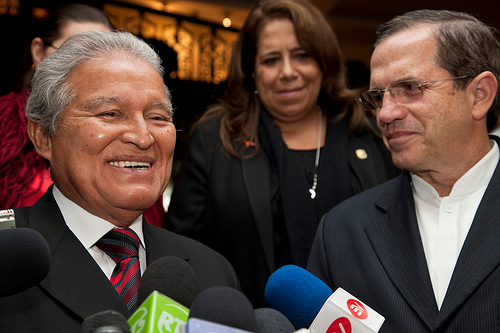
Salvadoran Presidential candidat Salvador Sánchez Ceréne  Photo credit: Cancillería Ecuador / Foter / CC BY-SA

Salvadoran Presidential candidate Photo credit: Cancillería Ecuador / Foter / CC BY-SA

The two elections held last weekend reflected different states of mind in El Salvador and Costa Rica. In the former, FMLN candidate Sánchez Cerén didn’t win the majority necessary to avoid a runoff, but the rejection of the ARENA party was strong and almost nationwide. ARENA candidate Norman Quijano not only trailed by 10 percentage points; his party’s victory in only one of the country’s 14 departments – remote Cabañas – was a serious blow to its image.  According to press reports, party infighting is intensifying.

Costa Rican Presidential candidate Johnny Araya and Antonio Álvarez Desanti, Chief of the Araya Presidential Campaign  By Lcascante2000 (Own work) [CC-BY-SA-3.0 (http:/via Wikimedia Commons

Costa Rican Presidential candidate Johnny Araya (left) / By Lcascante2000 / CC-BY-SA-3.0 / Wikimedia Commons

In Costa Rica, the eleventh-hour surge of a left-leaning progressive – Legislator José María Villalta – gave rise to a unified effort by the traditional parties to cast themselves as essential to warding off “Chavismo” and even Communism. Commentators judged that Citizen Action Party candidate Luis Guillermo Solís ran a mediocre campaign, but he denied ruling National Liberation Party candidate Johnny Araya – whose large campaign coffers gave him a significant edge – a first-round victory, beating him by about 1.5 percent (but still far short of the 40 percent to avoid a runoff). Both candidates’ red-baiting tactics apparently got people out to vote – abstentionism was not higher than in the past as feared – and popular cries for change shifted to a mandate for the status quo.

Jockeying for the second- round elections – on March 9 in El Salvador and April 6 in Costa Rica – has begun in both countries.  The FMLN’s Sánchez Cerén appears likely to win even without a pact with former President Saca, formerly an ARENA standardbearer. In Costa Rica, Solís is widely believed likely to win, as Araya is burdened by a lackluster record as San José mayor for 21 years and by his party ties to President Laura Chinchilla, whose disapproval ratings have broken records in the history of polling in the country.

Neither new president will have an easy time governing. Their legislatures are deeply fractured, and corruption and weak Executive Branch institutions will plague them as they’ve plagued their predecessors. ARENA appeared as weak as ever and, already showing signs of crisis, will need to retool. As it loses its access to the lucre of government treasury, it’s going to lose the glue that holds it together and infighting will persist and intensify. Costa Rica’s legislators, including those of the majority National Liberation Party (PLN), have in recent years shown little willingness or ability to put aside venal interests and engage in the serious business of policymaking. Insofar as they construe voters’ last-minute rejection of Villalta as a rejection of change, Costa Rican politicians probably judge that the coast is clear for business as usual.


Brazilian Presidential Election: Challenging a Divided Society

By Luciano Melo

Dilma Rousseff | Photo credit: Office of Governor Patrick / Foter.com / CC BY-NC-SA Aécio Neves | Photo credit: Agência Senado / Foter.com / CC BY-NC Marina Silva | Photo credit: BrasilemRede / Foter.com / CC BY-SA

Dilma Rousseff | Photo credit: Office of Governor Patrick / Foter.com / CC BY-NC-SA
Aécio Neves | Photo credit: Agência Senado / Foter.com / CC BY-NC
Marina Silva | Photo credit: BrasilemRede / Foter.com / CC BY-SA

The Brazilian presidential elections are nine months off, but President Dilma’s adversaries are starting to present more clear and consistent visions of their values and positions.

  • Aécio Neves, from the main opposition PSDB, was a successful governor of the state of Minas Gerais and is currently a well-respected senator in Brasilia.  But his party has long suffered from “oppositional apathy” – the inability to position themselves as a real alternative.  This weakness appeared when former Ministry of Health José Serra was the party’s candidate in 2010.  Now, in opposition to the highly criticized welfare state represented by Dilmas’s Workers Party (PT), Neves has been defending a liberal (or more libertarian) state that will not stand in the way of people’s initiatives.
  • On the other side of the spectrum is the unlikely coalition represented by a former senator and minister in the Lula administration, Marina Silva.  She is a leader of the PSB party, and she earned a strong reputation for fighting for environmental protection alongside assassinated Brazilian hero Chico Mendes and for resigning as Minister of Environment over disagreements with the PT policies.  Marina Silva brings a certain gravitas and edge to the alliance, which, as a former ally of PT, has never differentiated itself well as a real competitor.

Neves and Silva are seen as possible game changers, but no one is under the illusion that it will be easy to surpass Dilma.  Her popularity has been steadily increasing since she stood up against the NSA’s spying activities, and she still benefits from the PT’s popular welfare policies.  The latest polls show that 67 percent of Brazilian Facebook users disapprove of the current government, but Dilma’s primary support remains from the poorer states located in the Northern and Northeastern regions, where the main beneficiaries of PT social programs live.  Neves is the clear representative of the frustrated middle class that was behind large protests in July, and it is behind the current social media campaigns attacking Dilma and the corruption perpetrated by PT’s leaders.  Marina Silva and coalition leaders, also representing those regions, would have to strategically target swing voters in order to obtain a larger margin in the next elections.  At this early moment, Dilma seems to have a good chance of obtaining a second term – but leading a highly divided society, with a middle class unwilling to accept excuses for poor results in the economy, education and security.

Venezuela: Maduro versus Capriles, again

By Michael McCarthy*

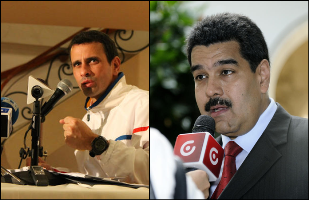
Henrique Caprile / Photo Credit: ICP Colombia / Foter.com / CC BY-SA and  Nicolas Maduro / Photo credit: OEA - OAS / Foter.com / CC BY-NC-ND

Henrique Capriles / Photo Credit: ICP Colombia / Foter.com / CC BY-SA and
Nicolás Maduro / Photo credit: OEA – OAS / Foter.com / CC BY-NC-ND

Venezuela’s municipal elections on December 8 didn’t conclusively answer the single question on people’s minds:  Would the parties aligned under the leadership of President Nicolás Maduro or those under opposition leader Henrique Capriles win a commanding victory?  Attention centered on this question because Capriles had rejected the results of the April 14 balloting as fraudulent and this time called on voters to give a clear majority to his opposition “electoral bloc.”  Maduro came out ahead in last Sunday’s contest, with its complex ballot asking voters to choose mayors and councilpersons in 335 districts.  His alliance, the United Socialist Party of Venezuela (PSUV) plus left-wing parties, totaled 49 percent of the vote, and parties aligned with the opposition received 42 percent.

But Maduro’s crowing about a “great victory” that propels the Bolivarian Revolution forward with “greater force” and legitimates a “deepening of the economic offensive” rings hollow.  Some of the 9 percent of the vote that went to candidates identified as independents may lean toward him, but the PSUV aspires to be a hegemonic party, claiming a much stronger base, and some hardcore chavistas are complaining about the opposition’s resilience in major urban centers and victories in the capitals of three interior states, all chavista strongholds, including former President Chávez’s home state of Barinas.  In broad strokes, Maduro’s economic populism – attacks last month on so-called economic criminals and measures forcing stores to lower prices – gave him a late boost.  Polls indicate that, with annual inflation running at 54 percent, the move paid off.  Maduro’s blitzkrieg gave urban working-class voters a means to afford items ahead of Christmas and showed the radical base of chavismo his commitment to challenge crony capitalism.  The opposition failed to mount an effective counterattack.  Preparations next year for 2015 National Assembly elections will tell the staying power of this victory for Maduro and the effectiveness of his “economic offensive.”   Capriles, who offered a calm post-election speech, sounded confident of his strategic game, but some in the opposition are probably disappointed that they did not take more Chavista strongholds.

Even though the opposition didn’t win the global numbers game, its significant presence in city halls around the country gives it a position from which to build the outline of a governance model.  One important winner appears to be the electoral process itself, in which the technical machinery ran smoothly and no sustained allegations of fraud were made.  A second winner was governability.  Notwithstanding some bullying of Capriles campaign workers, no violence transpired during the campaign or on voting day, and both sides can claim victories.  Maduro’s triumphalist rhetoric confirms that Venezuelan politics is going to remain far from harmonious, but even a modicum of governability could go a long way as the country faces many tough, if not intractable, questions in the coming year and beyond.

*Michael McCarthy is Lecturer, Latin American Politics, at Johns Hopkins University, School for Advanced International Studies.

Haiti: Crisis as Usual

By CLALS Staff

World Bank Group President Jim Yong Kim and Haitian President Michel Martelly / Photo credit: World Bank Photo Collection / Foter / CC-BY-NC-ND

World Bank Group President Jim Yong Kim and Haitian President Michel Martelly / Photo credit: World Bank Photo Collection / Foter / CC-BY-NC-ND

Half way through his term, President Martelly and his opponents have shown the same weak leadership and shallow commitment to democracy and transparency that has long plagued Haitian politics.  The IMF recently reported preliminary data indicating that Haiti’s GDP grew around 4 percent in FY2013; that inflation dropped from almost 8 percent to 4.5 percent; and that, although the fiscal deficit was larger than planned, domestic revenues were in line with projections.  On the streets, however, popular suffering shows no sign of abating.  Some 170,000 remain homeless since the earthquake almost four years ago; hundreds of thousands still have no prospect of employment, and poverty rates remain sky-high.  Suspicions about the whereabouts of more than a billion dollars in foreign aid are growing.  The World Bank last week criticized the lack of government transparency regarding funds from Venezuela’s “Petrocaribe” program, worth about $300 million a year to Haiti, and repeated its call for an end to the government’s use of “non-compete” contracts.  Corruption, a perennial concern, was a main theme of several large protests last month, involving thousands of citizens demanding Martelly’s resignation.

United Nations officials have repeatedly called on Haiti to hold parliamentary elections originally scheduled for two years ago.  The lower house of parliament in November passed a bill protecting the tenure of certain members of the senate – which the UN Secretary General’s senior representative in Haiti praised as “an important step for the organization of inclusive, transparent, and democratic elections” – but myriad other preparations remain undone.  The UN last August found that failure to hold elections by next month “runs the risk of [the Parliament] becoming inoperative,” but the Security Council went ahead and renewed the MINUSTAH mission for yet another year, albeit with fewer troops and police.

Donor fatigue – when the international community tires of lending a hand – seems to have been overtaken by donor disinterest, and the Haitian political elite appears much obliged.  Martelly, whose stage name was Sweet Micky during his singing career, has failed to use his fame and charm to promote serious reform among Haitians, as he promised, nor has he weaned his government and its supporters off the lucre of corruption.  His detractors, like those organized against Presidents Préval and Aristide before him, are better at mobilizing opposition than they are at mustering support for any political alternatives.  The Obama Administration’s commitment after the earthquake to help Haiti “build back better” has faded.  A central element of its vision was construction of an industrial park in northern Haiti, which more than a year after its inauguration has created fewer than 2,000 of the 65,000 jobs it promised.  As long as Haitians and their international supporters are satisfied with bandaid solutions to systemic problems, the country will wallow in its misery until the next crisis makes things yet worse again.

Subnational Regimes Reveal Uneven Nature of Democracy

By Agustina Giraudy

Peruvian mayoral campaign poster / Photo credit: Pedro Rivas Ugaz / Flickr / CC-BY

Peruvian mayoral campaign poster / Photo credit: Pedro Rivas Ugaz / Flickr / CC-BY

Most Latin American countries have transitioned away from autocracy and authoritarianism over the past three decades, but much of their democratic advancement has been territorially uneven and mostly limited to the national level.  In Argentina, Peru, Brazil, Bolivia, Mexico and other countries, democracy has not trickled down to subnational levels of government.  Many provinces, states, and municipalities in these (and other) countries continue to be governed in ways that resemble the period of undemocratic rule.  In these subnational undemocratic regimes (SURs), the political and civic rights of regular citizens and the political opposition are severely curtailed.

In SURs such as Formosa, San Luis or La Rioja in Argentina; Oaxaca (pre 2010), Puebla (pre 2010), or Tabasco in Mexico; and Goiás in Brazil, provincial autocrats use a variety of undemocratic, illegal, and informal actions – such as electoral fraud, electoral violence, and changes in electoral rules and political institutions – to prevent the opposition from gaining access to state positions.  My research and others’ indicates that, to further protect their own power, these subnational rulers frequently and arbitrarily reshuffle provincial- and state-level supreme courts, capriciously remove opposition mayors from office, deny funding to municipalities controlled by the opposition, and arbitrarily commission provincial- and state-level audits to investigate contrived financial misdeeds of opposition mayors.  They also co-opt or divide local organized groups, such as small unions, social movements, and street vendors, to undermine potential opposition.

The existence of SURs within national democracies underscores the difficulty of assessing the quality of a democracy from a purely national perspective.  As recent research has shown, the continuation of SURs in national democracies requires that we take a different approach and, importantly, grasp how seemingly democratic national-level leaders benefit from and, in some circumstances, encourage the SURs as a reliable base outside the capital.  Subnational undemocratic rulers, who typically control voters and legislators in the national congress, are seen by national officials as key partners for crafting winning electoral and legislative coalitions.  To the extent that national democratic incumbents succeed at inducing and securing autocrats’ cooperation, the former have strong incentives to help the latter stay in power.  Ironically, the accepted practice of democratic coalition-building contributes to the obstruction of democratization at the subnational level.  In the second decade of the 21st century, the quality of Latin American democracies depends at least as much on subnational democracy – and reducing the influence of SURs – as on the quality of national-level institutions.

Honduran Election Crisis Marks New Phase in Country’s Agony

By CLALS Staff

Juan Orlando Hernández Photo credit: Tercera Informacion / wikimedia commons / and Xiomara Castro / Photo credit: hablaguate / Flickr / Creative Commons

Juan Orlando Hernández Photo credit: Tercera Informacion / wikimedia commons / and Xiomara Castro / Photo credit: hablaguate / Flickr / Creative Commons

Yesterday’s election in Honduras was peaceful and orderly – the 61 percent voter turnout forced polls to remain open an extra hour – but anomalies in the vote count have cast a dark shadow over the legitimacy of the results. Although most polls for months indicated that Libre candidate Xiomara Castro had a several-point lead over National Party candidate Juan Orlando Hernández (and a few polls showed they were in a dead heat), the Superior Electoral Tribunal (TSE) said the Nationalist beat Castro by more than a five percentage point  margin – 34.2 percent to 28.6 percent. Castro and other candidates had repeatedly claimed the National Party activist who heads the TSE (which has no representative from the nontraditional parties or Libre) would skew the results and, citing exit polls, she has alleged that fraud tainted up to 20 percent of yesterday’s votes. The TSE’s claim that, of more than 1.6 million ballots cast, there were no null or blank votes – when party poll watchers reported many – has also drawn attacks on its credibility. Nonetheless, the U.S. Ambassador and the European Union observer team hastily declared the process transparent and clean.

Hernández and Castro have both declared victory – promising high tensions in at least the short term. Castro is the wife of former President Mel Zelaya, who was ousted in a coup in 2009, and has assembled a broad and deep popular base in Libre outside of Honduras’s two traditional parties. The government, military, economy and, importantly, news media are all dominated by elites that have long resisted the sort of popular movement she has built.  Few observers believe that, particularly with U.S. endorsement of the election results, Castro’s demands for a recount or other review of the results will be heeded.

If the results had been seen as accurate and fair, the election could have helped Honduras close the dark chapter of tensions and violence that started when the military forced President Zelaya into exile three and a half years ago. If Hernández is allowed to take office, his low vote – barely a third of all votes cast – alone promises a prolonged crisis like that which has plagued current President Lobo since his inauguration, a period during which both criminal and political violence has skyrocketed, public finances have deteriorated alarmingly, and political polarization has reached unprecedented heights. Under a Hernández presidency, the crisis may become even worse. Castro ran a campaign explicitly committed to peace and reconciliation and consistently urged her supporters to give democratic process a chance. She has never shown even the slightest inclination to call her supporters to violence, but popular anger has festered since the 2009 coup and there’s no guarantee that some frustration will not spill into the streets.  The surge in right-wing violence in Honduras since the coup – reminiscent of death squad activities in other Central American countries in the 1980s – has persuaded many protesters to keep their heads down, but this election may lead to desperate acts which the death squads will be eager to respond to, threatening a spiral of violence the hemisphere’s second-poorest country can ill-afford.

Chile Elections: Bachelet’s Partial Victory

By Maribel Vasquez and Eric Hershberg

President Michelle Bachelet / Photo credit: Chile Ayuda a Chile / Flickr / CC-BY-NC-ND

President Michelle Bachelet / Photo credit: Chile Ayuda a Chile / Flickr / CC-BY-NC-ND

Elections last Sunday didn’t give former President Michelle Bachelet the strong mandate that she wanted but she appears well positioned to win the second round and the honor of serving a tough second four-year term. An underwhelming number of Chileans headed to the polls to cast their votes for the president of the republic, parliamentarians, and for the regional councilors. Polls had indicated that Bachelet would win convincingly in the first round but, with 46.7 percent of the ballots cast, she fell just short of the 50 percent needed to avoid a run-off election on December 15. Conservative Evelyn Matthei, from the governing right wing Alliance Party, received 25 percent of the vote in the first round and has little chance of winning the run-off: another 17 percent of Chileans voting in the first round opted for candidates running to the left of Bachelet, and observers predict they will either stay home in December or select the former president as a second best option.

A 2012 change in voting law appears to have hurt Bachelet’s percentages. Under the new norm, Chileans for the first time were automatically registered to vote in presidential and congressional elections upon reaching 18 years of age, instantly expanding the electorate from eight to 13 million potential voters. But also for the first time, voting was not compulsory, and that proved consequential. In a country where public opinion polls have long shown high levels of alienation from the political system, particularly among younger segments of the population, abstention reached unprecedented heights. Fewer than seven million Chileans turned out to vote on Sunday, representing only around half of those eligible to do so. Turnout was undoubtedly suppressed by the stubborn persistence of Chile’s binomial electoral system, a holdover from the Pinochet dictatorship’s 1980 Constitution that gives the losing party a bloated presence in Congress (in order to receive both seats in any given district, the winning party or coalition must win double the percentage of the vote received by the runner-up, so frequently even a wide margin between the two top vote getters generates an equal allocation of seats). Bachelet’s center-left coalition, the New Majority, has proposed amending the constitution to make the electoral system more reflective of public preferences. But the newly-elected Congress, selected according to the rules of the authoritarian regime, is unlikely to generate the super-majorities needed to achieve constitutional changes that would alter the system so as to democratize congressional representation.

Getting elected to a second four-year term as Chile’s president might prove to be the easy part for Bachelet.  Harder still will be pushing forward the ambitious policy reforms she has promised. An especially prominent issue in the campaign was the demand of a growing student movement to reform Chile’s privatized education system, and Bachelet responded with a pledge to guarantee free, quality higher education to all Chileans, to be funded by a proposed increase in corporate tax rates and elimination of tax deferrals used widely by Chilean companies. Yet while Bachelet’s bloc secured the simple majority needed to secure modest tax reform, it fell short of the super majorities needed to secure education reform or change the electoral system or constitution, and the rightist opposition is loath to cede ground on either of these issues, which are also legacies of the Pinochet constitution. To enact the key pillars of her agenda, Bachelet’s second presidency will need to calibrate difficult negotiations with Congress with popular pressures to fulfill democratic aspirations for political representation and a more social democratic approach to public services than has been possible to achieve during the first 23 years of post-authoritarian rule.

Costa Rica: Losing Faith in Democratic Institutions?

By Fulton Armstrong

Supreme Elections Tribunal President Luis Antonio Sobrado / Photo credit: izahorsky / Foter.com / CC BY-NC-ND

Supreme Elections Tribunal President Luis Antonio Sobrado / Photo credit: izahorsky / Foter.com / CC BY-NC-ND

Costa Rica is approaching February’s presidential and legislative elections with a distinct lack of enthusiasm, if not with dread.  Most international surveys present Costa Rica as the “world’s happiest country” (the Happy Planet Index), or in the elite club of the world’s “full democracies” (ahead of Japan and Belgium in The Economist’s list), or as the 48th least-corrupt country (out of 174 reviewed by Transparency International).  The economy is expected to grow about 3 percent this year, and the country’s access to foreign direct investment is blunting the impact of the government’s fiscal deficit of about 5 percent of GDP.  Crime is on the rise, but Ticos know that their pain is small compared to that wreaked by the narcos and maras in Guatemala, El Salvador and Honduras.

Reputable polls show, however, that Costa Ricans are gloomy about the state of their political institutions and specifically about their upcoming elections.  According to polls, about 32 percent of the country’s 3 million eligible voters say they plan to abstain, citing corruption, a lack of leadership, insensitivity to the average citizen, and unemployment as reasons to reject not just the candidates but also the political elite in general.  The President of the Supreme Electoral Tribunal (TSE), Luis Antonio Sobrado, acknowledged last month that the election was taking place in the context of “citizen uneasiness … and a lot of anger with politics and politicians.”  Abstentionism was high in 2006 (35 percent) and 2010 (32 percent), but commentators sense a much deeper and darker alienation this time around.  A columnist lamented that the “multiparty” system has been replaced by “atomization,” and another said the political parties have “disconnected themselves from the national reality.”

Further reflecting the malaise, President Chinchilla’s support has nosedived – a July poll showed only 9 percent of voters said she was “good” and none said “very good” – and pundits cite her ineffectiveness as the cause of collapsed highways, dengue outbreaks, and other calamities.  The nominee of her Partido de Liberación Nacional (PLN), Johnny Araya, is widely thought to have an edge in February, but his 12 years as mayor of San José have coincided with a deterioration in the city’s infrastructure and security, and his personal lifestyle (including five marriages) may be a factor in popular skepticism.  The government’s recent announcement that it will contract the services of 4,125 new employees in 2014, mostly in the education sector, drew immediate criticism as yet another example of political patronage to influence the race.

The self-doubt seems at this point indicative of concerns about Chinchilla and the crop of candidates, rather than a rejection of democracy.  Costa Ricans comparing themselves with the rest of Central America still feel good about themselves, and the green image that eco-tourists reinforce is comforting.  But crumbling infrastructure – including collapsing bridges and the exorbitant cost of repeated repairs – and shocking crimes, such as the recent assassination of an environmentalist protecting turtles on a Caribbean beach, fuel the sort of doubts that only effective political and economic leadership can quell. 

Colombia: President Santos’s Challenges

By Maribel Vasquez

President Santos Calderón / Photo credit: Agência Brasil, Creative Commons

President Santos Calderón / Photo credit: Agência Brasil, Creative Commons License

Colombian President Juan Manuel Santos has yet to announce whether he will seek a second four-year term in May, but with the November deadline fast approaching for him to declare his candidacy, many Colombians are expressing dissatisfaction with his performance. Three years after taking office, and after a protracted honeymoon period, Santos’s approval ratings dropped to a dismal 21 percent several weeks ago. (A more recent poll surged to 41 percent but the rollercoaster ride appears likely to continue.) Colombia has experienced a wave of strikes and protests – perhaps reflecting a phenomenon evident from Brazil to Chile to Peru by which popular sentiment nosedives despite steady economic growth because much of the population is left out and institutions fail to respond to needs. The Santos administration has governed more democratically than his predecessor and shown greater commitment to the rule of law and accountability. Unlike the Clintonian dictum that “It’s the economy, stupid,” Colombia’s long-standing adage has been that “La economía va bien, el país va mal.”

The stalled peace talks between the Colombian government and the Revolutionary Armed Forces of Colombia (FARC) are also to blame for Santos’s dwindling public support. On October 13th, the 15th round of negotiations concluded in Havana without visible progress towards an agreement. (Talks are set to resume next week.) The agenda has six major points agreed to by both sides: land reform, political participation, disarmament, illicit drugs, rights of the victims, and implementation of an eventual peace accord. To date, agreement has been reached on only land reform and rural development. A number of thorny issues persist, including the FARC’s demand that a constituent assembly be convened to incorporate the peace deals into the country’s constitution – which the government has rejected.  In the latest development, the government also turned down the FARC’s call to have civil rights activist Reverend Jesse Jackson act as mediator in the release of Kevin Scott Sutay, a former U.S. marine abducted by the FARC earlier this year. Criticism of Santos’s handling of the talks is due in part to perennial public concern that the FARC is stalling the peace talks to regroup and rebuild its capabilities.

President Santos has staked his political legacy on ending Latin America’s longest-running armed conflict. Success or failure of the peace talks will define his presidency for many Colombians, and failure to reach an accord would cast a cloud over his political future. While he has talked tough – saying FARC stalling is wearing out the government and the Colombian people’s patience – President Santos appears in every bit of a hurry to see these negotiations come to a conclusion before the end of the year. Former President Alvaro Uribe and his loyalists in the Centro Democrático (CD) have already blasted what they claim is excessive leniency on the President’s part.  Santos is in a bind: if he rushes the peace talks, he risks making too many concessions and playing into the Uribistas’ hand, while canceling the talks would strip him of the desired distinction of being Colombia’s peace president. The easy road to reelection – effective conclusion of the peace process and greater responsiveness to the country’s widespread malaise – seems remote.  A strong opposition candidate has yet to emerge, however, giving Santos time to rebuild public support. CD frontrunner Francisco Santos’s recent threat to leave the party hints at a split within Uribismo.  The failure of an organized opposition may be the only advantage Santos has at the moment.