Mexico: Will AMLO Bring a “Fourth Transformation” or Return to Authoritarian Past?

By Daniela Stevens*

President-Elect Andrés Manuel López Obrador / Eneas / 500px / Creative Commons

A week before his inauguration, Mexican President-elect Andrés Manuel López Obrador (AMLO) continues to stress his commitment to be a “good president” and leader of the country’s “Fourth Transformation,” but some of his early actions suggest that he will challenge political pluralism and destabilize the investment environment.  His sexenio could have a rocky start both politically and economically.

  • AMLO’s handling of a “national consultation” over the ongoing construction of Mexico City’s new international airport – a project that he criticized as corruption-laden – raised red flags about his intended governing style. Most observers say the consultation was unconstitutional and, with only one percent of registered voters participating, inconsistent with the President-elect’s pledge to respect the “people’s will.”  AMLO’s reaction to the criticism – asking “¿quién manda?” (who governs?) – was widely interpreted as a sign that the airport maneuver was not about careful financial planning but rather political power.  He held another referendum last weekend, a “consultation” with citizens on 10 projects on which he seemed to have made up his mind beforehand.  These referendums seem intended to legitimize his intentions and enhance his power.
  • He and his party, Movimiento de Regeneración Nacional (Morena), appear to be moving ahead with plans to increase control over public spending, eroding institutional checks on presidential power. The Morena majority in the Tabasco state congress, for example, last month approved a provision empowering the next governor, also from Morena, to assign public works and acquisitions directly, without public bidding.  If the Supreme Court does not deem the reform unconstitutional, the administration will build a refinery in Tabasco without any review of the integrity of the process.
  • To reduce imports of gasoline and natural gas, AMLO plans to halt oil exports and reserve production for national consumption only, as well as to build a new refinery and modernize six existing ones. Critics say such policies reflect an outdated vision of national sovereignty closely tied to oil, and that they would directly diminish Mexico’s creditworthiness, endanger the finances of state-owned Petróleos Mexicanos (Pemex), and, according to Moody’s, result in a two percent decrease in GDP.  Additionally, oil experts say, the emphasis on refining would detract from important efforts to expand exploration and production.  The country cannot immediately meet domestic demand for crude.  Similarly, the transition team seems to disregard the potential of renewable energies and the need to electrify transportation.

Morena proposals to reduce the autonomy of regulatory agencies are scaring investors as well.  A Morena Congressman, for example, is pushing to incorporate the energy sector’s regulatory agencies into the Secretariat of Energy, subordinating them to greater political control.  Although AMLO did not publicly support the initiative, his appointee as Secretary of Energy, Rocío Nahle, has already asked the director of the National Commission of Hydrocarbons, one of the regulatory agencies, to step down three years ahead of schedule.  Given its debt and deficits, Pemex can ill afford to strain its partnerships with private capital.

It’s too early to assess how many of these actions reflect AMLO’s and Morena’s inexperience or a considered approach to governing, but the incoming leadership so far seems unaware or unconcerned that such measures undercut their stated vision of ushering in a “Fourth Transformation” on a par with the country’s three previous ones – independence (1810–1821), the Reforma wars (1857–1861), and revolution (1910).  The hints of authoritarianism, alongside decisions to appoint single-representatives in the states and to maintain a pervasive military presence in the streets, suggest AMLO’s tenure may indeed transcend history – as a government not different from the priista centralized governments of the 20th century, and the militarized calderonista administration (2006 2012) he vehemently criticizes.  After 1997, when the hegemonic Partido Revolucionario Institucional (PRI) – from which AMLO had already defected to lead the leftwing Partido de la Revolución Democrática (PRD) – lost the majority of the Chamber of Deputies for the first time, political analysts and academics pointed out the disadvantages of divided governments in presidential systems, such as political gridlock.  A unified government under AMLO, however, may not be the answer for Mexico either, unless progressives in Morena committed to democracy and its institutions find a way to restrain his impulses and keep his government on a democratic path. 

November 27, 2018

* Daniela Stevens is a Ph.D. candidate in Political Science in the School of Public Affairs at American University.

Ecuador: Lenín Moreno’s Balancing Act

By John Polga-Hecimovich*

Lenín Moreno

Ecuadorian President Lenín Moreno (far right) meets with members of the National Assembly in October 2018. / Diego Cevallos / Asamblea Nacional / Flickr / Creative Commons

As Ecuadorian President Lenín Moreno begins the post-honeymoon phase of his presidency, he appears firmly committed to positioning himself as a judicious voice and centrist in a region where ideological moderation and restrained oratory are the exception rather than the norm.  This might be unexpected given his political background and four years as vice president under leftist firebrand Rafael Correa (2007-17), but it makes sense given the country’s challenging economic situation and political constraints.  As previously noted, Moreno had two choices when taking office: remain loyal to his socialist roots, govern through his Alianza PAIS legislative bloc, and double down on Correa’s (fiscally unsustainable) “Citizens’ Revolution;” or move towards the political center, splinter his legislative majority, and abandon Correa and many of his policies.  He has decisively opted for the latter, attempting to navigate a middle ground between the left and the right.

  • No issue depicts the thin line Moreno walks more than Ecuador’s foreign policy, and no foreign policy issue reflects that tug-of-war better than his handling of Wikileaks founder Julian Assange. Assangeto whom Correa granted asylum in 2012 at the Ecuadorian Embassy in Londonis now a costly and increasingly undesirable houseguest.  He is a liability in Moreno’s quest for technical assistance, international loans, and greater security and commercial cooperation with the United States, which is still seeking justice for Wikileaks’s publication of U.S. classified material.  Although Moreno has called Assange “more than a nuisance” and “an inherited problem,” the president has been reluctant to push him out over concern for his human rights.  In July, Moreno suggested Ecuador was seeking guarantees that Assange would not face the death penalty.  Maintaining its delicate dance, however, in October, the government broke from its longstanding dialogue with British authorities over Assange’s situation and announced that it will no longer pay for his food and medical care.
  • Ecuador is also seeking closer relations with its right-of-center neighbors, beginning to distance itself from the region’s leftist governments, and attempting to rebuild ties with the United States. Since June, Moreno has attended the inauguration of Colombian President Iván Duque, met with Peruvian President Martín Vizcarra, welcomed U.S. Vice President Mike Pence to Quito, and launched a security agreement with Washington.  Moreno has also changed his tone with regards to Venezuela.  Speaking to the United Nations General Assembly on September 25, he spoke of the burden caused by arrival of more than 6,000 Venezuelan migrants a day and called for a national dialogue in that country, provoking an acrimonious back-and-forth between the two capitals that culminated in the Ecuadorian government tweeting that “corrupt, murderous, and lying socialism of the 21st century is still alive in Venezuela and producing the most massive migration in the country’s history.”

Moreno’s strategy to confront the country’s fiscal deficit, which was 5.5 percent of GDP in 2017, is an even greater departure from his predecessor’s approach.  Whereas Correa pursued financing primarily through oil-for-loan deals from China after Ecuador’s selective default in 2008, Moreno has turned to other global lenders such as the World Bank and Japan.  He has also pursued new commercial relationships and market-friendly policies, including a free trade agreement with the European Free Trade Association, beginning accession talks with the pro-market Pacific Alliance, and continuing to encourage foreign investment in Ecuador’s hydrocarbon industry.  However, Moreno has not fully committed to Washington consensus-style reforms: the government announced measures in August to reduce its $60 billion debt, but it also authorized over $1.2 billion in loans to the housing sector, agriculture, and small and medium-sized business to reactivate the domestic economy.

Although not an ideological rightist like Chilean President Sebastián Piñera or Colombian President Iván Duque, Lenín Moreno has reoriented many of Rafael Correa’s domestic and foreign policies out of necessity as he confronts Ecuador’s difficult economic situation.  Given that the country’s fiscal deficit and outstanding debt are strategic challenges, it seems likely that he will continue to judiciously tread this middle path.  Although fiscal austerity measures have lowered Moreno’s approval rating and provoked protests from the Correista left, it would be a mistake to bet against him.  Moreno has not only upended expectations but also proven far more resourceful and politically sophisticated than his critics—and probably even his admirers—expected.  He may also send Julian Assange at some point an eviction notice.

November 6, 2018

*John Polga-Hecimovich is an Assistant Professor of Political Science at the U.S. Naval Academy.  The views expressed here are solely those of the author and do not represent the views of or endorsement by the Naval Academy, the Department of the Navy, the Department of Defense, or the U.S. government.

Argentina: The Downside of Gradualism

By Arturo C.  Porzecanski*

Tortoise heads down a dirt path surrounded by greenery

Towards Turtle Path / Maxpixel / Creative Commons

President Mauricio Macri made a surprise announcement on May 8 that his government would seek financial support from the IMF to enable the country to “avoid a crisis like the ones we have faced before in our history” – essentially, an admission that time may be up for his policy of gradualism in dealing with the legacy of populism.  Sources in his administration expressed confidence that Argentina could obtain some $30 billion in “precautionary” loans at low interest rates and with few strings attached as an alternative to more borrowing in the international capital markets at higher and rising rates.  His finance minister, Nicolás Dujovne, and other members of the economic team departed Buenos Aires for Washington, DC, that same evening to formalize the request at IMF headquarters and to meet with a top Trump administration official at the U.S. Treasury.  After an initial round of friendly conversations, the parties agreed to meet again starting on May 14 to initiate a negotiation process that they acknowledged would take several weeks.

  • Macri blamed downward pressure on the Argentine peso (despite drastic hikes in short-term interest rates and the sale of one-tenth of hard-currency official reserves), on tighter monetary conditions and on volatility abroad at a time when the government must still raise money internationally to finance its large fiscal deficit.  “The problem that we have today is that we are one of the countries in the world that most depends on external finance, as a result of the enormous public spending that we inherited and are restoring order to,” the President stated.
  • The decision to turn to the IMF surprised observers because it came at an unusually early point in the country’s financial cycle.  Argentina’s central bank still has about $55 billion in international reserves, the equivalent of some 10 months of imports, or three times the amount of foreign-currency government debt maturing in 2018.  Also, foreign investors by no means have slammed the door on Argentina’s face, though admittedly the government probably could not sell another 100-year dollar bond like it did last June, raising $2.75 billion from die-hard optimists.  Argentina in the past, like most other countries, has generally turned to the IMF only in desperation once they were unwelcomed by Wall Street and their vaults were almost bare.
  • The onus placed by Macri on deteriorating financial conditions abroad was also surprising.  After all, the U.S. Federal Reserve has barely begun its monetary tightening process: the overnight fed funds rate, currently around 1.7 percent per annum, is still below U.S. inflation of 2.1 percent, so it has yet to enter positive territory.  Moreover, U.S. bond yields now in the vicinity of 3 percent for 10-year Treasuries, are up from 2.3 percent a year ago but have merely bounced back to a level they were at as of end-2013.  And the financial markets’ “fear” index VIX, a measure of expectations implied by options on the S&P 500 index, has fluctuated in the teens, which while higher than last year’s mostly single digits, remains very far from the range of 30 to 80 seen during prior episodes of extreme risk aversion in the financial markets.

 President Macri’s announcement did not have the favorable intended effect on confidence and market behavior, as evidenced by the peso remaining under downward pressure in the three business days that followed.  Despite renewed central bank intervention to boost the currency, it now takes almost 24 pesos to buy a U.S. dollar when it took fewer than 16 pesos to do so a year ago – a loss of about one-third in the currency’s purchasing power.  One reason is that Macri’s blaming adverse developments abroad for his currency’s woes rings hollow with investors, given how very slowly his administration has moved to reduce a fiscal deficit running above 6 percent of GDP since 2015; how much debt (around $100 billion) he has taken on in just a couple of years; and how timid his central bank has been in its attempt to bring down inflation running at about 2 percent per month.  And the other reason is that it quickly became apparent that any loan from the IMF will come with strict conditionality attached, because Argentina’s request was routed to the Fund’s regular, “stand-by” window – and not to its easier-access, precautionary lending window for highly creditworthy borrowers.  The Fund spelled out its economic policy advice for Argentina in its December 2017 “Staff Report for the 2017 Article IV Consultation,” and it calls for a more assertive reduction in the fiscal deficit, especially by cutting government spending, and for supply-side reforms it called “indispensable” to support economic growth, raise labor productivity, attract private investment, and enhance the country’s competitiveness.  These are all recommendations that fly in the face of President Macri’s gradualist approach to defusing the economic minefield left behind by his populist predecessor, Cristina Fernández Kirchner, and will therefore paint his government into a politically fragile corner.  We are witnessing the demise of Macri’s cherished – and popular – gradualism.

 May 14, 2018

*Dr.  Arturo C.  Porzecanski is Distinguished Economist in Residence at American University and Director of the International Economic Relations Program at its School of International Service.


Brazil in 1999: The Impact of Rigid Labor Regulations

By Jennifer P. Poole and Rita Almeida*

The outside of a building in Brasilia, Brazil

Brazil’s Ministry of Labor and Employment in Brasília. / Grupo Vestcon / Creative Commons

During Brazil’s currency crisis and devaluation in 1999, stringent implementation of labor regulations hindered, rather than enhanced, manufacturing plants’ recovery and workers’ wellbeing – an important lesson to keep in mind in current debates in many countries.  In an article published in the May 2017 Journal of Development Economics (JDE), we examine the implications of global economic integration through international trade on local labor markets during that critical period in 1999.

  • Many economic policymakers agree that reforms in the latter half of the 20th century, such as liberalizing trade relations and encouraging foreign investment, have been powerful drivers of efficiency gains, income growth, and consumer choice around the globe. At the same time, however, there is agreement that – as firms adapt to a more competitive global environment – the gains are often accompanied by short-term costs for workers in terms of unemployment and income risk.  Policymakers have to weigh the broad economic benefits from globalization and technological change, on the one hand, against workers’ opportunities and security on the other.

A micro-econometric estimation analysis of detailed, confidential, and proprietary micro-data sets – collected in part while visiting the Brazilian Labor Ministry – reveals a causal impact of trade reform on employment.  Brazil’s policy environment of strict labor market regulations (e.g., hiring and firing costs), coupled with its dramatic trade liberalization and currency devaluation, make it a particularly appropriate setting to study the implications of globalization on employment opportunities in a middle-income country.  As in many countries, much of the de jure labor market framework was established on a national basis in Brazil (in the Brazilian Federal Constitution of 1988), but de facto labor regulations – the varying levels of implementation through labor inspections, fines, and other processes in different locales – are heterogeneous.

  • Administrative data on the enforcement of labor regulations during the 1999 currency crisis, a shock to trade openness, show that the way trade affects employment largely depends on the stringency of de facto labor regulations that companies face. The impact of the currency devaluation – widely predicted to expand employment by facilitating access to foreign markets and weakening import competition – was less significant in plants facing strong labor enforcement than in those facing more lax enforcement.  The findings suggest that stringent labor regulations limit job creation and lower productivity gains.
  • Not only was the efficient reallocation of labor in response to shocks inhibited by strict de facto labor market regulations; rigid enforcement also restricted the within-plant potential for productivity gains. The data reveal that regulations, for example, may limit plants’ ability to introduce new goods or investment in more complex production technologies that might have higher value-added.  The burden of having to retain unproductive workers, making plants less able to compete, is another possible explanation for weak productivity gains.

Previous research – arguing that weak enforcement leaves regulations ineffective – ruled out the possibility of labor regulations as an explanation for slow labor adjustment to trade reform.  But our research shows that flexible regulations maximize the gains of reforms such as trade liberalization.  As middle-income countries continue to face a globalizing and technologically advancing world economy, their strict labor market policies, limiting adjustment and reallocation, may have potentially distortive, unintended consequences.  The trade-off between job security, on the one hand, and productivity and growth is already one of the most prominent public policy debates worldwide.  Regulations designed to protect workers may actually further reduce employment as costs increase.  Countries must show flexibility, while enhancing education and training programs, to benefit fully from changes driven by the global economy.  As populist, protectionist policies gain influence in the world, policymakers should know that increasing the flexibility of de jure regulations will allow for increased job creation and thus offer broader access to productivity gains.

March 7, 2018

*Jennifer Poole is Assistant Professor of Economics, School of International Service, and Research Fellow at the IZA Institute of Labor Economics and the CESifo Research Network.  Rita Almeida is a Research Fellow at the World Bank and the IZA Institute of Labor Economics.  Their article is titled “Trade and Labor Reallocation with Heterogeneous Enforcement of Labor Regulations.”

Cuba: Trump Actions Strengthening Hardliners

By Fulton Armstrong and William M. LeoGrande

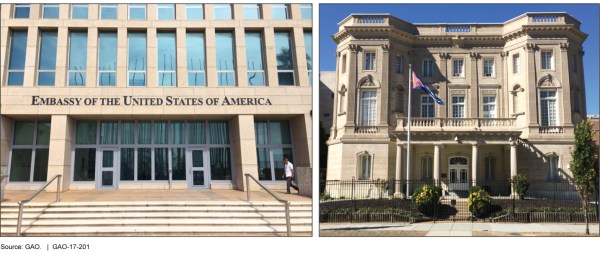
Two buildings in a composite photo

On the left, the U.S. Embassy in Havana; on the right, the Cuban Embassy in D.C. / U.S. Government Accountability Office / Flickr / Creative Commons

As the end of Raúl Castro’s presidency approaches, Trump Administration actions halting, if not reversing, the process of normalizing relations with Cuba have tilted debate in Havana in favor of hardliners trying to keep the brakes on economic reform and on constructive relations with Washington.

  • In retaliation for alleged “sonic attacks” against U.S. diplomats in Havana, Secretary of State Rex Tillerson’s ordered departure of staff from the U.S. Embassy in Havana, the closure of the U.S. consulate, and the expulsion of Cuban consular and commercial staff in Washington –has put a chill on bilateral relations that ratifies Havana hardliners’ contention that Washington cannot be trusted. By halting the issuance of visas to Cubans in Havana, the Trump Administration will almost certainly violate the 1994 migration accord committing the United States to issue at least 20,000 immigrant visas to Cubans annually.  That would rupture the longstanding bipartisan consensus in Washington that bilateral cooperation on migration serves an important U.S. interest in safe and orderly migration.
  • The State Department’s unwillingness to share meaningful information on the U.S. diplomats’ mysterious symptoms – underscored by the Embassy’s refusal to use a hotline established for Cuba to investigate alleged attacks real-time – has frustrated pro-normalization Cubans, who face conservatives’ claims that Washington is cynically exploiting the incident to embarrass Cuba and return to a policy of hostility and regime change.
  • Other Trump measures reinforce Cuban conservatives’ efforts to limit the growth of the country’s nascent private sector, particularly entrepreneurs who profit from U.S. visitors and need easy travel to import inputs from the United States. A travel warning issued in conjunction with the withdrawal of U.S. diplomats is causing a sharp drop in U.S. travelers, and new regulations abolishing individual people-to-people educational travel are channeling people into large hotels, away from private bed and breakfast rentals.  A prohibition on doing business with companies and hotels allegedly linked to the Cuban military is not pushing new clients to cuentapropistas’ businesses but instead is discouraging travel and commerce in general.  Cuban reformers are further dispirited by the perception that Washington is shifting back to the erroneous view that it can promote regime collapse by tightening the economic screws on the government, thereby reinforcing a siege mentality among senior leaders and discouraging needed economic reforms as too risky in the current environment.
  • Trump’s actions have so closely dovetailed with the agenda of Cuban hardliners that some people speculate it was opponents of reform inside the Cuban government who perpetrated the mysterious “sonic attacks” to provoke a confrontation with Washington. But there is no evidence whatsoever in support of that theory, and for anyone to sabotage Raúl Castro’s opening to Washington – one of the signal achievements of his presidency – would be to commit political (if not literal) suicide.

Implementation of Raúl Castro’s road map for economic change, embodied in the 311 lineamientos approved in 2011 and the Conceptualización of Cuba’s socialist model approved by the Communist Party congress last year, had already slowed before Trump’s sanctions due to Cuban concerns about growing income inequality during a period of poor economic performance, uncertainty about energy imports, and perhaps the 86-year-old president’s own level of energy and state of mind after the passing of his two brothers (Ramón and Fidel both died in 2016).  Widely discussed political reforms, such as the Electoral Law and the Law on Associations, that were expected months ago have yet to be unveiled.  The Trump Administration’s efforts to expedite regime change by curtailing financial flows to the government and by promoting private sector growth at the expense of state enterprises make it easy for Cuban hardliners to rally support for slowing reforms.  Ever since he launched the reform process in 2011, Castro has insisted it would move ahead, “Without haste, but without pause.”  Lately, in part because of the Trump Administration’s actions, there’s a lot more “pause” than “haste.”

The election of First Vice President Miguel Díaz-Canel to succeed Raúl as president seems to be a foregone conclusion of the ongoing multi-tiered election process that culminates in February, but no one outside the two men’s inner circle seems to know how or when next steps on reforms will be sequenced.  Raúl’s focus has been on creating processes and institutions for governing after he steps down, rather than achieving particular results between now and the formalities confirming Díaz-Canel.  One thing that is near-certain, however, is that the successor’s legitimacy will be determined by performance, not his surname or soaring oratory.  Tackling the really big reforms that loom ahead, such as currency and exchange rate unification, will require political will from a relatively unified leadership.  Cuba has long been adept at dealing with U.S. sanctions and pressure, so Trump’s policies are more an irritant than a threat, but the effect they have in Havana is to slow the implementation of changes that would improve the standard of living of ordinary citizens and to reduce the willingness of Cuba’s leaders to engage with Washington in ways that would serve the interests of both countries.

 December 18, 2017

The Caribbean After the Hurricanes: What Path for Recovery?

By Daniel P. Erikson*

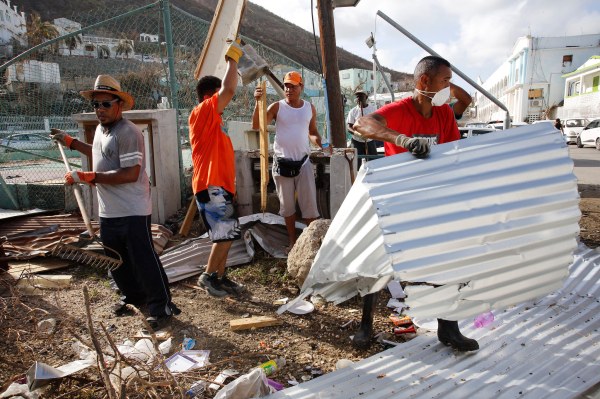
A group of man clear debris

Residents and volunteers begin clearing debris from Hurricane Irma on St. Maarten. / NLRC / Flickr / Creative Commons

This fall’s historically fierce hurricane season reminds us once again that the Caribbean remains extraordinarily vulnerable to natural disasters – especially in the lucrative tourist sectors – and needs to move beyond tourism.  The services sector in the Caribbean may serve as an important source of economic growth, but only if the region begins to take advantage of opportunities in banking and financial services; call centers and information and communication technology; off-shore education and health services; and transportation.

  • While the impact of Harvey, Irma, Jose, Katia, and Maria in U.S. states like Texas and Florida has received wide attention, the small island nations of the Caribbean have also been left to contend with extensive damage to infrastructure and loss of life that has resulted in thousands of newly homeless and dozens of deaths. Irma struck the tiny nation of Antigua and Barbuda as a peak-strength Category 5 storm, and Prime Minister Gaston Browne estimated that 95 percent of the properties on the smaller island of Barbuda were destroyed.  Irma then raked across the U.K. territories of Anguilla, the British Virgin Islands, and the Turks and Caicos, the French territories of St. Bart’s, Guadeloupe and St. Martin (including the Dutch half of St. Maarten).  Cuba also suffered as the storm swept across its northern coast and ravaged the third-largest city, Camaguey.  Then, just as Hurricanes Jose and Katia rattled the islands only to retreat as minor threats, Hurricane Maria strengthened into a Category 4 storm that ravaged Dominica and the U.S. territory of Puerto Rico with winds exceeding 150 mph, devastating local infrastructure and knocking out the power grid, possibly for months to come.

Clearly, the focus of the near-term will be relief and recovery efforts, as these small islands seek to cope with the enormous damage.  But rebuilding a stronger and more diversified service sector may offer the best path towards a sustainable and much-deserved recovery for the people of the region.  Several years ago, the Centre for International Governance and Innovation in Waterloo, Canada, asked me to assess what steps the Caribbean islands could take to diversify their economies away from an over-reliance on tourism to create a more sustainable future.  The lessons of that study, Beyond Tourism: The Future of the Service Industry in the Caribbean, remain relevant today.  The bottom line:  Expanding the competitiveness of the Caribbean services sector beyond tourism is a way to draw on regional strengths and broaden the basis for economic growth.

The hurricanes have dealt a tragic and costly blow to the Caribbean, but the reconstruction efforts may also provide an opportunity to build back stronger and more resilient economies.  While the damage is still being assessed, it is already clear that the lives of tens of thousands of people who live on these islands will never be the same and that property damage will extend into the billions.  The recent damage to Puerto Rico from Hurricane Maria will likely jolt those figures substantially higher, while some of the smaller, remote islands hurt by earlier storms may be uninhabitable for weeks to come.  French President Emmanuel Macron and the King of the Netherlands traveled to the region to show solidarity with their afflicted citizens, while the United States deployed teams to assist in disaster relief and deployed over $1 million in aid to the smaller affected islands – and is beginning to launch a major relief effort in Puerto Rico as well.  Once the challenges of treating the injured and assisting with basic human needs are met, much of the early reconstruction effort is likely to focus on rebuilding tourist infrastructure.  This will be necessary, but not sufficient, to create a full recovery.  Caribbean leaders have increasingly recognized that developing globally competitive services industries offers one way to retain high-skilled workers and mitigate the risk of external shocks to the tourist sector. During the Obama administration, Vice President Biden made a major effort to deepen U.S. investments in the Caribbean’s energy sector, and new sources of financing through the Inter-American Development Bank, the Overseas Private Investment Corporation, and private U.S. companies could similarly lead to a major push to modernize services-related infrastructure throughout the islands.  Future storms cannot be prevented, but a more diversified services sector will help the islands to navigate the challenge of reconstruction more effectively.

September 28, 2017

* Daniel P. Erikson is managing director at Blue Star Strategies in Washington, DC, and previously served as a White House and State Department advisor on Latin America during the Obama Administration.

Perspectives on U.S.-Cuba Relations Under Trump

Trump and Cuban Americans

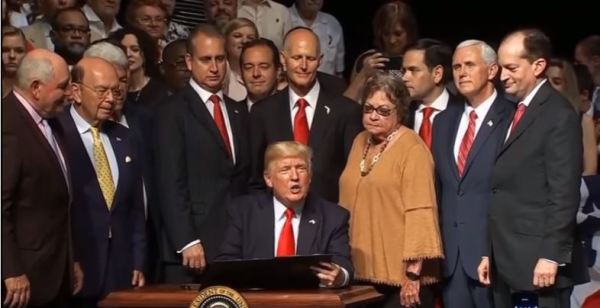
President Trump announces his administration’s policy toward Cuba. / YouTube / Livestream TV News / Creative Commons

Reversing Obama’s Cuba Policy?

By William M. LeoGrande*

In the two years after President Barack Obama and Cuban President Raúl Castro agreed to normalize relations, Obama tried to make his policy of engagement “irreversible” by opening up travel and trade that would create constituencies with a self-interest in defending engagement. He half-way succeeded. Despite the incendiary rhetoric in which Donald Trump cloaked his new policy when he rolled it out at a rally of Cuban-American hardliners in Miami, the sanctions he announced were limited.

Obama granted general licenses for all 12 categories of legal travel and relaxed other restrictions on who could visit Cuba. Trump rolled back only individualized people-to-people educational travel, so people-to-people visitors must once again travel on organized tours. But they can still go, and bring back rum and cigars.

Obama opened the Cuban market to U.S. businesses by licensing contracts with state enterprises in the travel, telecommunications, pharmaceuticals, construction, agriculture, and consumer goods sectors. Trump prohibited only contracts with Cuban enterprises managed by the military, and even then he exempted all existing contracts, and future contracts involving ports, airports, and telecomm – the sectors in which all but a handful of current U.S. businesses operate.

Trump did not impose any restrictions on Cuban–American family travel and remittances. He did not break diplomatic relations or put Cuba back on the State Department’s terrorism list. He did not restore the wet foot/dry foot policy that gave Cuban immigrants preferential treatment after reaching the United States. He did not abrogate the bilateral agreements on issues of mutual interest negotiated by the Obama administration.

Why such a flaccid set of sanctions from a president who stood on the stage in Little Havana and demonized the Cuban regime as brutal, criminal, depraved, oppressive, murderous, and guilty of “supporting human trafficking, forced labor, and exploitation all around the globe”?

Because Obama’s strategy of creating constituencies in favor of engagement worked. In the weeks leading up to Trump’s announcement, he was deluged with appeals not to retreat from engagement. The U.S. Chamber of Commerce argued in favor of expanding business opportunities, not constricting them. Farmers argued for expanding agricultural sales. Travel providers argued for expanding travel. Fifty-five U.S. Senators cosponsored a bill to lift all travel restrictions. Seven Republican members of Congress and 16 retired senior military officers argued that disengagement would damage national security by boosting Russian and Chinese influence on the island. Polling data showed that large majorities of the public, of Republicans, and even of Cuban Americans support engagement.

Even the executive bureaucracy was won over by the successes scored by the policy of engagement. During the last two years of Obama’s presidency, Cuba and the United States signed 23 bilateral agreements. When Trump ordered an inter-agency review of Cuba policy, the consensus of the agencies involved was that engagement was working and ought to be continued. Trump rejected that conclusion because it did not fit with his political strategy of currying favor with the Cuban-American right, but the agencies fought back successfully against more extreme proposals to roll back Obama’s policies entirely.

Trump’s vicious rhetoric and his open embrace of the goal of regime change – through sanctions, support for dissidents, and “democracy promotion” – risks destroying the atmosphere of mutual respect and good faith that made the gains of Obama’s policy possible. Already, hardliners in Havana who saw engagement as a Trojan Horse for subversion are saying, “We told you so!” Cuba’s private entrepreneurs, who Trump’s policy purportedly aims to help, will be hurt the most by the prohibition on individual people-to-people travel. However, the overall economic impact of his sanctions will be limited, both on U.S. businesses and in Cuba.

Cuba’s official response has been pragmatic but firm. A statement released shortly after Trump’s Miami speech declared, “The Government of Cuba reiterates its willingness to continue respectful dialogue and cooperation on issues of mutual interest, as well as the negotiation of pending bilateral issues with the United States Government…. But it should not be expected that Cuba will make concessions inherent to its sovereignty and independence, nor will it accept any kind of conditionality.”

In all likelihood, political pressures from the constituencies Obama’s policy created will continue to constrain Trump’s impulse to beat up on Cuba, but his loyalty to the exile right and his penchant for bullying will make it impossible to realize further progress toward normalizing relations. That will have to wait until the White House has a new occupant motivated by the national interest rather than by a political IOU given to Miami’s most recalcitrant Cuban-American minority.

*William M. LeoGrande is Professor of Government at American University in Washington, DC, and co-author with Peter Kornbluh of Back Channel to Cuba: The Hidden History of Negotiations between Washington and Havana (University of North Carolina Press, 2015).

Cuba: Trump’s “New Policy”


By Ricardo Torres*

The “new policy” toward Cuba that President Trump announced to great fanfare in Miami last Friday features little that is new while seeking to restore oxygen to a failed approach advocated by extreme sectors of the Cuban-American community. While adopting language reflecting the worst traditions of American foreign policy, Trump’s declaration implicitly blessed much of the rapprochement between the two countries introduced by President Obama – diplomatic relations will remain intact, for example. But the new measures he announced have symbolic and practical implications. His Cuban-American backers expended great political capital to change the policy in hope of accelerating regime change on the island, but the Trump approach will instead retard change – while increasing the pain of the Cuban people. Moreover, it will undermine the activities of legitimate U.S. citizens, companies, and groups interested in contact with the island and compromise U.S. citizens’ freedom to travel. They have acted against Trump’s campaign promise to create jobs (threatening thousands of workers who depend on U.S.-Cuba interaction) and increase national security (putting U.S.-Cuba cooperation in counternarcotics, counterterrorism, and illegal migration at risk). The new approach also runs counter to Secretary of State Tillerson’s repeated assertion that U.S. policy is not to impose its values and standards on others.

U.S. national interests seem to have taken a back seat to internal U.S. political factors, particularly the opposition to Obama’s policies among certain groups of the Cuban Americans that had seen their political influence decline over the past decade.

In addition to its symbolic weight, the Trump approach is likely to be felt most strongly in several principal areas. Despite continuing differences between the two countries, both governments had decided to move ahead together. It is difficult to overstate the sense of hope created during the Obama era, with immediate and tangible benefits for both.

Cuba’s internal situation has been changing recently, due to a gradual opening internally and to other nations. A steady increase in visits by foreign businessmen and Cuban travel overseas are evidence of this change. Trump’s rhetoric and actions will only strengthen those sectors inside Cuba that exaggerate the external threat and want to reduce the space for debate in the country.

The economic impact that Trump and his backers want – to hurt the Cuban government – cannot be separated from the harm it will cause the Cuban people. The new measures will probably reduce tourism, which provides a significant flow of revenue to vast sectors of the Cuban population that, in formal or informal jobs, benefit from that industry. Indeed, the much bandied-about private sector has been one of the principal beneficiaries of tourism development.

The Cuban government will assess its options in relations with the United States as well as in domestic policies. It will naturally have to let the U.S. government know that cooperation has yielded mutual benefits to both countries and that this step backward will not be limited to areas that Washington prefers. Havana might look for more ambitious ties with alternative partners, including both allies and competitors of the United States. Internally, rather than slow down, Cuba’s transformation should accelerate. The legitimate needs of the Cuban people should not be postponed in the face of this new adversity. The pace of Cuban reform should never be tied to external threats. As for the Cuban people, they will once again tell all who will listen that they themselves – not those on the other side of the Florida Strait – represent their interests. President Trump has empowered a small group of Cuban Americans to speak for people in Cuba whom they do not know, at the cost of sacrificing U.S. prestige and an array of its national interests. The absurd has become the accepted norm in American politics.

*Ricardo Torres is a Professor at the Centro de Estudios de la Economía Cubana at the University of Havana and a former CLALS Research Fellow.
Who Really Benefited from the Commodities Supercycle – and Who Loses with Its End?

By Carlos Monge*

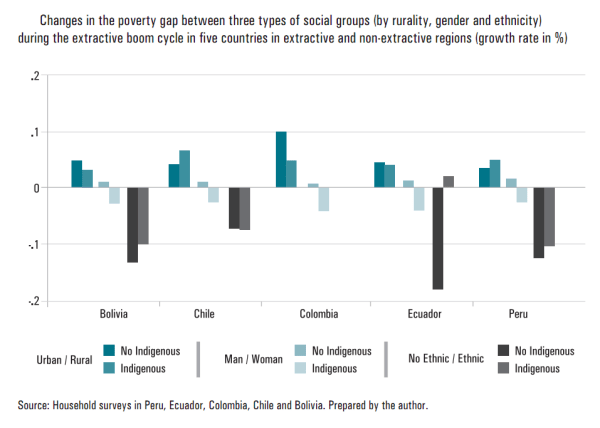
2017-05-13 AULABLOG_Carlos_Monge_graphic

Latin American governments and business associations have tended to overstate the benefits of extractive industries during the commodities supercycle that ended in 2014-15.  Resource-rich Latin American countries did experience high rates of economic growth and diminished poverty and inequality during the boom years.  On the surface, this would appear to strengthen arguments that – despite their negative environmental impact – extractive industries are the key to progress, especially in resource-rich areas.  Nevertheless, a closer look at data from household surveys in Bolivia, Chile, Colombia, Ecuador, and Peru shows that things are a bit more complicated.

  • The inequality gap between individuals, as measured on the GINI Index, has narrowed, but the gaps between groups of the population have not evolved evenly. For example, the National Resource Governance Institute (of which I’m regional director) recently completed a study of the performance of social indicators during the supercycle that concluded that the poverty gap between urban and rural populations has increased in all countries.  (The report is available in English and Spanish.)  In Peru and Chile, the gap increased more in territories where extractive territories are located, while in Colombia, Bolivia, and Ecuador less so.  The gap between indigenous and non-indigenous populations increased only in extractive territories in Ecuador, decreasing in both extractive and non-extractive settings in the rest of the countries considered.  Regarding gender, in all five countries the gap between men and women increased slightly in non-extractive territories and decreased a bit more in extractive ones.

This report establishes correlations between the increase in extractive activities, the availability of extractive rents, and patterns of inequality reflected in social indicators, but it does not establish a causal relation between such variables.  For example, the data show that urban populations in Peru’s extractive regions have benefited more than rural ones – which some very preliminary research shows is probably because urban centers provide extractive projects with the goods and services they need, while less sophisticated rural areas do not.  At the same time, rural populations have to compete with the extractive projects for those same urban goods and services, and with local governments for the labor force that the public sector contracts to develop infrastructure projects that are paid for through increased revenues delivered by the extractive sector.  This is what we have called the “Cholo Disease.”  A variation of the “Dutch Disease,” it reflects a loss of competitiveness resulting not from large exports of raw materials causing the currency to appreciate, but rather from increases in the cost of labor and of urban goods and services consumed by campesinos.  However, a more definitive explanation regarding exactly how this happens in Peru and in other countries certainly needs further research.

While our data clearly show the impact of mining and hydrocarbons extraction and the resulting expenditure of extractive rents on the poverty gaps between urban and rural populations, men and women, and indigenous and non-indigenous populations, further investigation into the causes and consequences is needed.  The end of the supercycle has already meant a fall in growth rates and extractive revenues, leading to a worrisome rebound in poverty rates.  We are still unable to answer, however, the question of how broadly it will impact the substantial segments of Latin America’s population that emerged from poverty but remains in a vulnerable position – and how it will aggravate poverty gaps among individuals and between groups in extractive and non-extractive territories.

May 16, 2017

* Carlos Monge is Latin America Director at the Natural Resource Governance Institute in Lima.

Mexico: Nationalism Alone is Not the Answer to Trump

By Gema Santamaría*

32281848542_397a45bc77_k

In Mexico City, citizens mobilized against President Trump on his Inauguration Day with signs against U.S. imperialism (“Fuera Yankees”) and effigies of the U.S. President. / Adrián Martínez / Flickr / Creative Commons

The Mexican government hasn’t yet figured out how to react to U.S. President Donald Trump’s proposed policies toward Mexico, which have already eroded trust and potential cooperation, but one thing is clear: Mexican nationalism alone will not help.  In terms of security cooperation, Trump has proposed a “great wall” and increased police and military presence to keep “bad hombres” outside U.S. territory without the consent or cooperation of his southern neighbor.  The notion of shared responsibility, which shaped the Mérida Initiative and informed most cooperation under past administrations, has been virtually abandoned.  Instead, Mexico has been presented to the U.S. public only as the source of security challenges – illegal migration, drugs, and common crime – and not part of the solution.

The Mexican government’s response has been, so far, equivocal at best.  President Peña Nieto and his administration have proven incapable of articulating a coherent message towards Trump’s provocations.  Responding to an erratic, Twitter-driven foreign policy poses challenges for any country accustomed to traditional diplomatic interaction, but Peña Nieto has an additional force to manage:  surging nationalism from the left, center, and right.  This revival includes disjointed appeals on social media for citizens to boycott “gringo” companies – notably Starbucks – and to consume “only national” products.  Many campaigns express solidarity with the Mexican government as well as repudiation of Trump.  The cover of Letras Libres, for example, carries an image that emulates Mexico’s national coat of arms – an eagle attacking a snake – but the snake being devoured by the Mexican eagle wears a blond Trump-style hairdo.

Nationalism, however, is not the answer.  Beyond its potentially chauvinistic nature, it can too easily translate into a call for political loyalty and suppress necessary criticism of the current government.  In moments of crisis, Mexican elites have long used anti-American sentiment to create consensus, overcome divisions, and even conceal a government’s lack of legitimacy – unhelpful in a moment that, like now, citizens need to hold their government accountable for its impunity, corruption, and human rights abuses.

  • Instead of making themselves feel good with nationalist slogans, Mexicans should assert their commitment to multilateralism and international cooperation, not only in trade (which at times seems to be the only issue on the agenda) but also on matters of security, human rights, and the rule of law. A critique of Trump’s militaristic understanding of immigration should include a critique of Mexico’s own failure to adopt a more integral migration policy south of its border – one protecting Central American migrants from the rampage of organized crime and capable of addressing the institutional and structural challenges behind the surge of Central American migration.  Mexican citizens should call into question their government’s resort to militarized border control on the southern border, a strategy that in many ways mirrors the U.S.’ short-sighted and unilateral response to migration.  By the same token, criticism of Trump’s reactive and militarized vision of security should also involve a close look at Mexico’s own militarized, short-term, and repressive response to insecurity and violence.
  • Some Mexican intellectuals have insinuated that an effective critique of Trump and his policies calls for a revival of national pride and honor. Letras Libres director Enrique Krauze, for example, tweeted that not attending protests to denounce Trump’s actions is a sign of “passivity, indifference, and even cowardice.”  Yet if Mexico proves incapable of articulating a sound critique and resistance vis-à-vis Trump the real cause will not be a lack of nationalist ardor, but rather citizens’ incapacity to move beyond nationalism and uncritical support for their government.  Mexico does not need nationalistic and “brave” citizens as much as it needs a citizenry committed to international cooperation, transparency, and critical engagement and that can call into question another government’s erroneous policies – like Trump’s – while demanding better of its own.

April 13, 2017

* Gema Santamaría Balmaceda is the Director of Undergraduate Studies in the Department of International Studies at the Instituto Tecnológico Autónomo de México (ITAM), and a participant in the Robert A. Pastor North America Research Initiative.

Latin America: End of “Supercycle” Threatens Reversal of Institutional Reforms

By Carlos Monge*

Monge graphic

By Eduardo Ballón and Raúl Molina (consultores) and Claudia Viale and Carlos Monge (National Resource Governance Institute, América Latina), from Minería y marcos institucionales en la región andina. El superciclo y su legado, o las difíciles relaciones entre políticas de promoción de la inversión minero-hidrocarburífera y las reformas institucionales, Reporte de Investigación preparado por NRGI con colaboración de la GIZ, Lima, Marzo del 2017. See blog text for high-resolution graphic

Policies adopted in response to the end of the “supercycle” have slowed and, in some cases, reversed the reforms that moved the region toward greater decentralization, citizen participation, and environmental protection over the past decade.  Latin American governments of the left and right used the commodities supercycle to drive growth and poverty reduction at an unprecedented pace.  They also undertook institutional reforms aimed at improving governance at large.

  • Even before demand and prices for Latin American energy and minerals began to rise in the early 2000s, some Latin American countries launched processes of decentralization (Colombia and Bolivia); started to institutionalize mechanisms for citizens’ participation in decision making (Colombia and Bolivia); and built progressively stronger environmental management frameworks (Colombia and Ecuador). Peru pressed ahead with decentralization and participation at the start of the supercycle, and when it was in full swing, created a Ministry of the Environment.
  • Implementation of the reforms was subordinated by governments’ overarching goal of fostering investments in the extractive sector. Indigenous consultation rights in Peru, for example, were approved in the second half of 2011, but implementation was delayed a year and limited only to indigenous peoples in the Amazon Basin.  President Ollanta Humala, giving in to the mining lobby, claimed there were no indigenous peoples in the Andes and that no consultations were needed around mining projects.  Local pressure forced a reversal, and by early 2015 four consultation projects on mid-size mining projects were launched.

These reformist policies have suffered setbacks since the decrease in Asia’s and particularly China’s appetite for Latin American energy and minerals has caused prices to fall – and the value of exports, taxes, and royalties, and public incomes along with them.  The latest ECLAC data show a decline in economic growth and a rebound of poverty both in absolute and relative figures.  The gradual fall in the price of minerals starting in 2013 and the abrupt collapse in oil prices by the end of 2015 reversed this generally favorable trend.

The response of the governments of resource-dependent countries has been “race to the bottom” policies, which included steps backward in fiscal, social, and environmental policies.  Governments’ bigger concern has been to foster investments in the new and more adverse circumstances.  In this new scenario, the processes of decentralization, participation, and environmental management have been negatively impacted as local authorities and citizens’ participation – as well as environmental standards and protocols – are perceived by companies and rent-seeking public officials as obstacles to investments.

  • Peru’s Law 30230 in 2014, for example, reduced income tax rates, weakened the oversight capacity of the Ministry of the Environment, and weakened indigenous peoples’ claim public lands.

The correlation between the supercycle years and the progress and regressions in reforms is clear. (click here for high-resolution graphic).  During the supercycle – when huge amounts of money were to be made – companies and government were willing to incorporate the cost of citizen participation, decentralization and environmental standards and protocols.  But now, governments are desperate for new investments to overcome the fall in economic growth and extractive rents, and extractive companies are not willing any more to assume these additional costs.  Those who oppose the “race to the bottom strategy” are fighting hard to restore the reforms and to move ahead with decentralization, increased participation, and enhanced environmental management, to achieve a new democratic governance of the territories and the natural resources they contain.

April 7, 2017

* Carlos Monge is Latin America Director at the Natural Resource Governance Institute in Lima.