Cuba: Trump Actions Strengthening Hardliners

By Fulton Armstrong and William M. LeoGrande
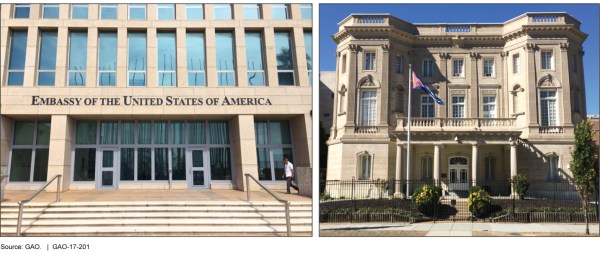
Two buildings in a composite photo

On the left, the U.S. Embassy in Havana; on the right, the Cuban Embassy in D.C. / U.S. Government Accountability Office / Flickr / Creative Commons

As the end of Raúl Castro’s presidency approaches, Trump Administration actions halting, if not reversing, the process of normalizing relations with Cuba have tilted debate in Havana in favor of hardliners trying to keep the brakes on economic reform and on constructive relations with Washington.

  • In retaliation for alleged “sonic attacks” against U.S. diplomats in Havana, Secretary of State Rex Tillerson’s ordered departure of staff from the U.S. Embassy in Havana, the closure of the U.S. consulate, and the expulsion of Cuban consular and commercial staff in Washington –has put a chill on bilateral relations that ratifies Havana hardliners’ contention that Washington cannot be trusted. By halting the issuance of visas to Cubans in Havana, the Trump Administration will almost certainly violate the 1994 migration accord committing the United States to issue at least 20,000 immigrant visas to Cubans annually.  That would rupture the longstanding bipartisan consensus in Washington that bilateral cooperation on migration serves an important U.S. interest in safe and orderly migration.
  • The State Department’s unwillingness to share meaningful information on the U.S. diplomats’ mysterious symptoms – underscored by the Embassy’s refusal to use a hotline established for Cuba to investigate alleged attacks real-time – has frustrated pro-normalization Cubans, who face conservatives’ claims that Washington is cynically exploiting the incident to embarrass Cuba and return to a policy of hostility and regime change.
  • Other Trump measures reinforce Cuban conservatives’ efforts to limit the growth of the country’s nascent private sector, particularly entrepreneurs who profit from U.S. visitors and need easy travel to import inputs from the United States. A travel warning issued in conjunction with the withdrawal of U.S. diplomats is causing a sharp drop in U.S. travelers, and new regulations abolishing individual people-to-people educational travel are channeling people into large hotels, away from private bed and breakfast rentals.  A prohibition on doing business with companies and hotels allegedly linked to the Cuban military is not pushing new clients to cuentapropistas’ businesses but instead is discouraging travel and commerce in general.  Cuban reformers are further dispirited by the perception that Washington is shifting back to the erroneous view that it can promote regime collapse by tightening the economic screws on the government, thereby reinforcing a siege mentality among senior leaders and discouraging needed economic reforms as too risky in the current environment.
  • Trump’s actions have so closely dovetailed with the agenda of Cuban hardliners that some people speculate it was opponents of reform inside the Cuban government who perpetrated the mysterious “sonic attacks” to provoke a confrontation with Washington. But there is no evidence whatsoever in support of that theory, and for anyone to sabotage Raúl Castro’s opening to Washington – one of the signal achievements of his presidency – would be to commit political (if not literal) suicide.

Implementation of Raúl Castro’s road map for economic change, embodied in the 311 lineamientos approved in 2011 and the Conceptualización of Cuba’s socialist model approved by the Communist Party congress last year, had already slowed before Trump’s sanctions due to Cuban concerns about growing income inequality during a period of poor economic performance, uncertainty about energy imports, and perhaps the 86-year-old president’s own level of energy and state of mind after the passing of his two brothers (Ramón and Fidel both died in 2016).  Widely discussed political reforms, such as the Electoral Law and the Law on Associations, that were expected months ago have yet to be unveiled.  The Trump Administration’s efforts to expedite regime change by curtailing financial flows to the government and by promoting private sector growth at the expense of state enterprises make it easy for Cuban hardliners to rally support for slowing reforms.  Ever since he launched the reform process in 2011, Castro has insisted it would move ahead, “Without haste, but without pause.”  Lately, in part because of the Trump Administration’s actions, there’s a lot more “pause” than “haste.”

The election of First Vice President Miguel Díaz-Canel to succeed Raúl as president seems to be a foregone conclusion of the ongoing multi-tiered election process that culminates in February, but no one outside the two men’s inner circle seems to know how or when next steps on reforms will be sequenced.  Raúl’s focus has been on creating processes and institutions for governing after he steps down, rather than achieving particular results between now and the formalities confirming Díaz-Canel.  One thing that is near-certain, however, is that the successor’s legitimacy will be determined by performance, not his surname or soaring oratory.  Tackling the really big reforms that loom ahead, such as currency and exchange rate unification, will require political will from a relatively unified leadership.  Cuba has long been adept at dealing with U.S. sanctions and pressure, so Trump’s policies are more an irritant than a threat, but the effect they have in Havana is to slow the implementation of changes that would improve the standard of living of ordinary citizens and to reduce the willingness of Cuba’s leaders to engage with Washington in ways that would serve the interests of both countries.

 December 18, 2017
The Caribbean After the Hurricanes: What Path for Recovery?

By Daniel P. Erikson*

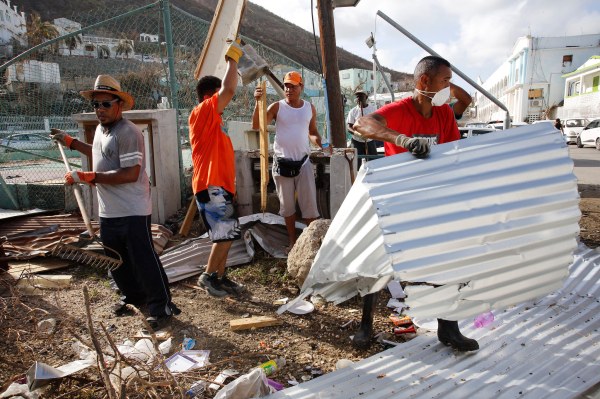
A group of man clear debris

Residents and volunteers begin clearing debris from Hurricane Irma on St. Maarten. / NLRC / Flickr / Creative Commons

This fall’s historically fierce hurricane season reminds us once again that the Caribbean remains extraordinarily vulnerable to natural disasters – especially in the lucrative tourist sectors – and needs to move beyond tourism.  The services sector in the Caribbean may serve as an important source of economic growth, but only if the region begins to take advantage of opportunities in banking and financial services; call centers and information and communication technology; off-shore education and health services; and transportation.

  • While the impact of Harvey, Irma, Jose, Katia, and Maria in U.S. states like Texas and Florida has received wide attention, the small island nations of the Caribbean have also been left to contend with extensive damage to infrastructure and loss of life that has resulted in thousands of newly homeless and dozens of deaths. Irma struck the tiny nation of Antigua and Barbuda as a peak-strength Category 5 storm, and Prime Minister Gaston Browne estimated that 95 percent of the properties on the smaller island of Barbuda were destroyed.  Irma then raked across the U.K. territories of Anguilla, the British Virgin Islands, and the Turks and Caicos, the French territories of St. Bart’s, Guadeloupe and St. Martin (including the Dutch half of St. Maarten).  Cuba also suffered as the storm swept across its northern coast and ravaged the third-largest city, Camaguey.  Then, just as Hurricanes Jose and Katia rattled the islands only to retreat as minor threats, Hurricane Maria strengthened into a Category 4 storm that ravaged Dominica and the U.S. territory of Puerto Rico with winds exceeding 150 mph, devastating local infrastructure and knocking out the power grid, possibly for months to come.

Clearly, the focus of the near-term will be relief and recovery efforts, as these small islands seek to cope with the enormous damage.  But rebuilding a stronger and more diversified service sector may offer the best path towards a sustainable and much-deserved recovery for the people of the region.  Several years ago, the Centre for International Governance and Innovation in Waterloo, Canada, asked me to assess what steps the Caribbean islands could take to diversify their economies away from an over-reliance on tourism to create a more sustainable future.  The lessons of that study, Beyond Tourism: The Future of the Service Industry in the Caribbean, remain relevant today.  The bottom line:  Expanding the competitiveness of the Caribbean services sector beyond tourism is a way to draw on regional strengths and broaden the basis for economic growth.

The hurricanes have dealt a tragic and costly blow to the Caribbean, but the reconstruction efforts may also provide an opportunity to build back stronger and more resilient economies.  While the damage is still being assessed, it is already clear that the lives of tens of thousands of people who live on these islands will never be the same and that property damage will extend into the billions.  The recent damage to Puerto Rico from Hurricane Maria will likely jolt those figures substantially higher, while some of the smaller, remote islands hurt by earlier storms may be uninhabitable for weeks to come.  French President Emmanuel Macron and the King of the Netherlands traveled to the region to show solidarity with their afflicted citizens, while the United States deployed teams to assist in disaster relief and deployed over $1 million in aid to the smaller affected islands – and is beginning to launch a major relief effort in Puerto Rico as well.  Once the challenges of treating the injured and assisting with basic human needs are met, much of the early reconstruction effort is likely to focus on rebuilding tourist infrastructure.  This will be necessary, but not sufficient, to create a full recovery.  Caribbean leaders have increasingly recognized that developing globally competitive services industries offers one way to retain high-skilled workers and mitigate the risk of external shocks to the tourist sector. During the Obama administration, Vice President Biden made a major effort to deepen U.S. investments in the Caribbean’s energy sector, and new sources of financing through the Inter-American Development Bank, the Overseas Private Investment Corporation, and private U.S. companies could similarly lead to a major push to modernize services-related infrastructure throughout the islands.  Future storms cannot be prevented, but a more diversified services sector will help the islands to navigate the challenge of reconstruction more effectively.

September 28, 2017

* Daniel P. Erikson is managing director at Blue Star Strategies in Washington, DC, and previously served as a White House and State Department advisor on Latin America during the Obama Administration.

Perspectives on U.S.-Cuba Relations Under Trump

Trump and Cuban Americans

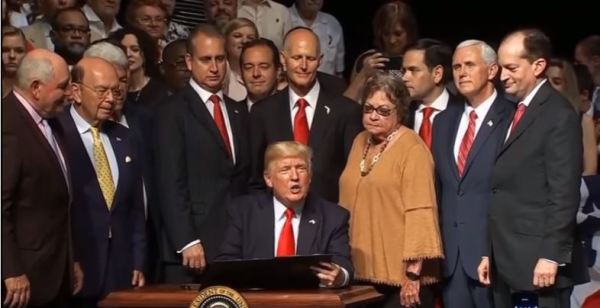
President Trump announces his administration’s policy toward Cuba. / YouTube / Livestream TV News / Creative Commons

Reversing Obama’s Cuba Policy?

By William M. LeoGrande*

In the two years after President Barack Obama and Cuban President Raúl Castro agreed to normalize relations, Obama tried to make his policy of engagement “irreversible” by opening up travel and trade that would create constituencies with a self-interest in defending engagement. He half-way succeeded. Despite the incendiary rhetoric in which Donald Trump cloaked his new policy when he rolled it out at a rally of Cuban-American hardliners in Miami, the sanctions he announced were limited.

Obama granted general licenses for all 12 categories of legal travel and relaxed other restrictions on who could visit Cuba. Trump rolled back only individualized people-to-people educational travel, so people-to-people visitors must once again travel on organized tours. But they can still go, and bring back rum and cigars.

Obama opened the Cuban market to U.S. businesses by licensing contracts with state enterprises in the travel, telecommunications, pharmaceuticals, construction, agriculture, and consumer goods sectors. Trump prohibited only contracts with Cuban enterprises managed by the military, and even then he exempted all existing contracts, and future contracts involving ports, airports, and telecomm – the sectors in which all but a handful of current U.S. businesses operate.

Trump did not impose any restrictions on Cuban–American family travel and remittances. He did not break diplomatic relations or put Cuba back on the State Department’s terrorism list. He did not restore the wet foot/dry foot policy that gave Cuban immigrants preferential treatment after reaching the United States. He did not abrogate the bilateral agreements on issues of mutual interest negotiated by the Obama administration.

Why such a flaccid set of sanctions from a president who stood on the stage in Little Havana and demonized the Cuban regime as brutal, criminal, depraved, oppressive, murderous, and guilty of “supporting human trafficking, forced labor, and exploitation all around the globe”?

Because Obama’s strategy of creating constituencies in favor of engagement worked. In the weeks leading up to Trump’s announcement, he was deluged with appeals not to retreat from engagement. The U.S. Chamber of Commerce argued in favor of expanding business opportunities, not constricting them. Farmers argued for expanding agricultural sales. Travel providers argued for expanding travel. Fifty-five U.S. Senators cosponsored a bill to lift all travel restrictions. Seven Republican members of Congress and 16 retired senior military officers argued that disengagement would damage national security by boosting Russian and Chinese influence on the island. Polling data showed that large majorities of the public, of Republicans, and even of Cuban Americans support engagement.

Even the executive bureaucracy was won over by the successes scored by the policy of engagement. During the last two years of Obama’s presidency, Cuba and the United States signed 23 bilateral agreements. When Trump ordered an inter-agency review of Cuba policy, the consensus of the agencies involved was that engagement was working and ought to be continued. Trump rejected that conclusion because it did not fit with his political strategy of currying favor with the Cuban-American right, but the agencies fought back successfully against more extreme proposals to roll back Obama’s policies entirely.

Trump’s vicious rhetoric and his open embrace of the goal of regime change – through sanctions, support for dissidents, and “democracy promotion” – risks destroying the atmosphere of mutual respect and good faith that made the gains of Obama’s policy possible. Already, hardliners in Havana who saw engagement as a Trojan Horse for subversion are saying, “We told you so!” Cuba’s private entrepreneurs, who Trump’s policy purportedly aims to help, will be hurt the most by the prohibition on individual people-to-people travel. However, the overall economic impact of his sanctions will be limited, both on U.S. businesses and in Cuba.

Cuba’s official response has been pragmatic but firm. A statement released shortly after Trump’s Miami speech declared, “The Government of Cuba reiterates its willingness to continue respectful dialogue and cooperation on issues of mutual interest, as well as the negotiation of pending bilateral issues with the United States Government…. But it should not be expected that Cuba will make concessions inherent to its sovereignty and independence, nor will it accept any kind of conditionality.”

In all likelihood, political pressures from the constituencies Obama’s policy created will continue to constrain Trump’s impulse to beat up on Cuba, but his loyalty to the exile right and his penchant for bullying will make it impossible to realize further progress toward normalizing relations. That will have to wait until the White House has a new occupant motivated by the national interest rather than by a political IOU given to Miami’s most recalcitrant Cuban-American minority.

*William M. LeoGrande is Professor of Government at American University in Washington, DC, and co-author with Peter Kornbluh of Back Channel to Cuba: The Hidden History of Negotiations between Washington and Havana (University of North Carolina Press, 2015).

Cuba: Trump’s “New Policy”


By Ricardo Torres*

The “new policy” toward Cuba that President Trump announced to great fanfare in Miami last Friday features little that is new while seeking to restore oxygen to a failed approach advocated by extreme sectors of the Cuban-American community. While adopting language reflecting the worst traditions of American foreign policy, Trump’s declaration implicitly blessed much of the rapprochement between the two countries introduced by President Obama – diplomatic relations will remain intact, for example. But the new measures he announced have symbolic and practical implications. His Cuban-American backers expended great political capital to change the policy in hope of accelerating regime change on the island, but the Trump approach will instead retard change – while increasing the pain of the Cuban people. Moreover, it will undermine the activities of legitimate U.S. citizens, companies, and groups interested in contact with the island and compromise U.S. citizens’ freedom to travel. They have acted against Trump’s campaign promise to create jobs (threatening thousands of workers who depend on U.S.-Cuba interaction) and increase national security (putting U.S.-Cuba cooperation in counternarcotics, counterterrorism, and illegal migration at risk). The new approach also runs counter to Secretary of State Tillerson’s repeated assertion that U.S. policy is not to impose its values and standards on others.

U.S. national interests seem to have taken a back seat to internal U.S. political factors, particularly the opposition to Obama’s policies among certain groups of the Cuban Americans that had seen their political influence decline over the past decade.

In addition to its symbolic weight, the Trump approach is likely to be felt most strongly in several principal areas. Despite continuing differences between the two countries, both governments had decided to move ahead together. It is difficult to overstate the sense of hope created during the Obama era, with immediate and tangible benefits for both.

Cuba’s internal situation has been changing recently, due to a gradual opening internally and to other nations. A steady increase in visits by foreign businessmen and Cuban travel overseas are evidence of this change. Trump’s rhetoric and actions will only strengthen those sectors inside Cuba that exaggerate the external threat and want to reduce the space for debate in the country.

The economic impact that Trump and his backers want – to hurt the Cuban government – cannot be separated from the harm it will cause the Cuban people. The new measures will probably reduce tourism, which provides a significant flow of revenue to vast sectors of the Cuban population that, in formal or informal jobs, benefit from that industry. Indeed, the much bandied-about private sector has been one of the principal beneficiaries of tourism development.

The Cuban government will assess its options in relations with the United States as well as in domestic policies. It will naturally have to let the U.S. government know that cooperation has yielded mutual benefits to both countries and that this step backward will not be limited to areas that Washington prefers. Havana might look for more ambitious ties with alternative partners, including both allies and competitors of the United States. Internally, rather than slow down, Cuba’s transformation should accelerate. The legitimate needs of the Cuban people should not be postponed in the face of this new adversity. The pace of Cuban reform should never be tied to external threats. As for the Cuban people, they will once again tell all who will listen that they themselves – not those on the other side of the Florida Strait – represent their interests. President Trump has empowered a small group of Cuban Americans to speak for people in Cuba whom they do not know, at the cost of sacrificing U.S. prestige and an array of its national interests. The absurd has become the accepted norm in American politics.

*Ricardo Torres is a Professor at the Centro de Estudios de la Economía Cubana at the University of Havana and a former CLALS Research Fellow.

Who Really Benefited from the Commodities Supercycle – and Who Loses with Its End?

By Carlos Monge*

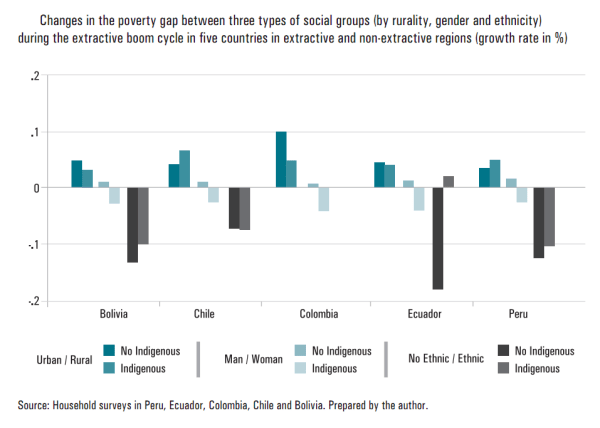
2017-05-13 AULABLOG_Carlos_Monge_graphic

Latin American governments and business associations have tended to overstate the benefits of extractive industries during the commodities supercycle that ended in 2014-15.  Resource-rich Latin American countries did experience high rates of economic growth and diminished poverty and inequality during the boom years.  On the surface, this would appear to strengthen arguments that – despite their negative environmental impact – extractive industries are the key to progress, especially in resource-rich areas.  Nevertheless, a closer look at data from household surveys in Bolivia, Chile, Colombia, Ecuador, and Peru shows that things are a bit more complicated.

  • The inequality gap between individuals, as measured on the GINI Index, has narrowed, but the gaps between groups of the population have not evolved evenly. For example, the National Resource Governance Institute (of which I’m regional director) recently completed a study of the performance of social indicators during the supercycle that concluded that the poverty gap between urban and rural populations has increased in all countries.  (The report is available in English and Spanish.)  In Peru and Chile, the gap increased more in territories where extractive territories are located, while in Colombia, Bolivia, and Ecuador less so.  The gap between indigenous and non-indigenous populations increased only in extractive territories in Ecuador, decreasing in both extractive and non-extractive settings in the rest of the countries considered.  Regarding gender, in all five countries the gap between men and women increased slightly in non-extractive territories and decreased a bit more in extractive ones.

This report establishes correlations between the increase in extractive activities, the availability of extractive rents, and patterns of inequality reflected in social indicators, but it does not establish a causal relation between such variables.  For example, the data show that urban populations in Peru’s extractive regions have benefited more than rural ones – which some very preliminary research shows is probably because urban centers provide extractive projects with the goods and services they need, while less sophisticated rural areas do not.  At the same time, rural populations have to compete with the extractive projects for those same urban goods and services, and with local governments for the labor force that the public sector contracts to develop infrastructure projects that are paid for through increased revenues delivered by the extractive sector.  This is what we have called the “Cholo Disease.”  A variation of the “Dutch Disease,” it reflects a loss of competitiveness resulting not from large exports of raw materials causing the currency to appreciate, but rather from increases in the cost of labor and of urban goods and services consumed by campesinos.  However, a more definitive explanation regarding exactly how this happens in Peru and in other countries certainly needs further research.

While our data clearly show the impact of mining and hydrocarbons extraction and the resulting expenditure of extractive rents on the poverty gaps between urban and rural populations, men and women, and indigenous and non-indigenous populations, further investigation into the causes and consequences is needed.  The end of the supercycle has already meant a fall in growth rates and extractive revenues, leading to a worrisome rebound in poverty rates.  We are still unable to answer, however, the question of how broadly it will impact the substantial segments of Latin America’s population that emerged from poverty but remains in a vulnerable position – and how it will aggravate poverty gaps among individuals and between groups in extractive and non-extractive territories.

May 16, 2017

* Carlos Monge is Latin America Director at the Natural Resource Governance Institute in Lima.

Mexico: Nationalism Alone is Not the Answer to Trump

By Gema Santamaría*

32281848542_397a45bc77_k

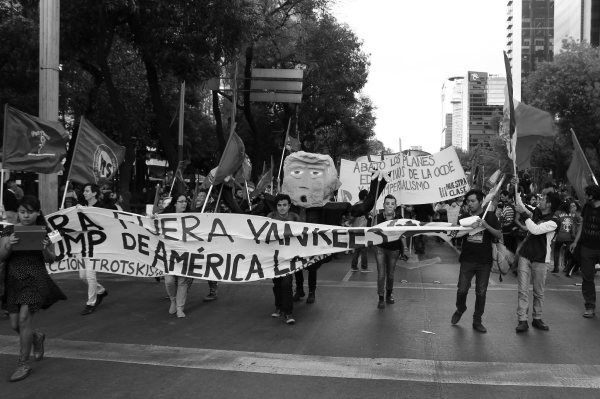
In Mexico City, citizens mobilized against President Trump on his Inauguration Day with signs against U.S. imperialism (“Fuera Yankees”) and effigies of the U.S. President. / Adrián Martínez / Flickr / Creative Commons

The Mexican government hasn’t yet figured out how to react to U.S. President Donald Trump’s proposed policies toward Mexico, which have already eroded trust and potential cooperation, but one thing is clear: Mexican nationalism alone will not help.  In terms of security cooperation, Trump has proposed a “great wall” and increased police and military presence to keep “bad hombres” outside U.S. territory without the consent or cooperation of his southern neighbor.  The notion of shared responsibility, which shaped the Mérida Initiative and informed most cooperation under past administrations, has been virtually abandoned.  Instead, Mexico has been presented to the U.S. public only as the source of security challenges – illegal migration, drugs, and common crime – and not part of the solution.

The Mexican government’s response has been, so far, equivocal at best.  President Peña Nieto and his administration have proven incapable of articulating a coherent message towards Trump’s provocations.  Responding to an erratic, Twitter-driven foreign policy poses challenges for any country accustomed to traditional diplomatic interaction, but Peña Nieto has an additional force to manage:  surging nationalism from the left, center, and right.  This revival includes disjointed appeals on social media for citizens to boycott “gringo” companies – notably Starbucks – and to consume “only national” products.  Many campaigns express solidarity with the Mexican government as well as repudiation of Trump.  The cover of Letras Libres, for example, carries an image that emulates Mexico’s national coat of arms – an eagle attacking a snake – but the snake being devoured by the Mexican eagle wears a blond Trump-style hairdo.

Nationalism, however, is not the answer.  Beyond its potentially chauvinistic nature, it can too easily translate into a call for political loyalty and suppress necessary criticism of the current government.  In moments of crisis, Mexican elites have long used anti-American sentiment to create consensus, overcome divisions, and even conceal a government’s lack of legitimacy – unhelpful in a moment that, like now, citizens need to hold their government accountable for its impunity, corruption, and human rights abuses.

  • Instead of making themselves feel good with nationalist slogans, Mexicans should assert their commitment to multilateralism and international cooperation, not only in trade (which at times seems to be the only issue on the agenda) but also on matters of security, human rights, and the rule of law. A critique of Trump’s militaristic understanding of immigration should include a critique of Mexico’s own failure to adopt a more integral migration policy south of its border – one protecting Central American migrants from the rampage of organized crime and capable of addressing the institutional and structural challenges behind the surge of Central American migration.  Mexican citizens should call into question their government’s resort to militarized border control on the southern border, a strategy that in many ways mirrors the U.S.’ short-sighted and unilateral response to migration.  By the same token, criticism of Trump’s reactive and militarized vision of security should also involve a close look at Mexico’s own militarized, short-term, and repressive response to insecurity and violence.
  • Some Mexican intellectuals have insinuated that an effective critique of Trump and his policies calls for a revival of national pride and honor. Letras Libres director Enrique Krauze, for example, tweeted that not attending protests to denounce Trump’s actions is a sign of “passivity, indifference, and even cowardice.”  Yet if Mexico proves incapable of articulating a sound critique and resistance vis-à-vis Trump the real cause will not be a lack of nationalist ardor, but rather citizens’ incapacity to move beyond nationalism and uncritical support for their government.  Mexico does not need nationalistic and “brave” citizens as much as it needs a citizenry committed to international cooperation, transparency, and critical engagement and that can call into question another government’s erroneous policies – like Trump’s – while demanding better of its own.

April 13, 2017

* Gema Santamaría Balmaceda is the Director of Undergraduate Studies in the Department of International Studies at the Instituto Tecnológico Autónomo de México (ITAM), and a participant in the Robert A. Pastor North America Research Initiative.

Latin America: End of “Supercycle” Threatens Reversal of Institutional Reforms

By Carlos Monge*

Monge graphic

By Eduardo Ballón and Raúl Molina (consultores) and Claudia Viale and Carlos Monge (National Resource Governance Institute, América Latina), from Minería y marcos institucionales en la región andina. El superciclo y su legado, o las difíciles relaciones entre políticas de promoción de la inversión minero-hidrocarburífera y las reformas institucionales, Reporte de Investigación preparado por NRGI con colaboración de la GIZ, Lima, Marzo del 2017. See blog text for high-resolution graphic

Policies adopted in response to the end of the “supercycle” have slowed and, in some cases, reversed the reforms that moved the region toward greater decentralization, citizen participation, and environmental protection over the past decade.  Latin American governments of the left and right used the commodities supercycle to drive growth and poverty reduction at an unprecedented pace.  They also undertook institutional reforms aimed at improving governance at large.

  • Even before demand and prices for Latin American energy and minerals began to rise in the early 2000s, some Latin American countries launched processes of decentralization (Colombia and Bolivia); started to institutionalize mechanisms for citizens’ participation in decision making (Colombia and Bolivia); and built progressively stronger environmental management frameworks (Colombia and Ecuador). Peru pressed ahead with decentralization and participation at the start of the supercycle, and when it was in full swing, created a Ministry of the Environment.
  • Implementation of the reforms was subordinated by governments’ overarching goal of fostering investments in the extractive sector. Indigenous consultation rights in Peru, for example, were approved in the second half of 2011, but implementation was delayed a year and limited only to indigenous peoples in the Amazon Basin.  President Ollanta Humala, giving in to the mining lobby, claimed there were no indigenous peoples in the Andes and that no consultations were needed around mining projects.  Local pressure forced a reversal, and by early 2015 four consultation projects on mid-size mining projects were launched.

These reformist policies have suffered setbacks since the decrease in Asia’s and particularly China’s appetite for Latin American energy and minerals has caused prices to fall – and the value of exports, taxes, and royalties, and public incomes along with them.  The latest ECLAC data show a decline in economic growth and a rebound of poverty both in absolute and relative figures.  The gradual fall in the price of minerals starting in 2013 and the abrupt collapse in oil prices by the end of 2015 reversed this generally favorable trend.

The response of the governments of resource-dependent countries has been “race to the bottom” policies, which included steps backward in fiscal, social, and environmental policies.  Governments’ bigger concern has been to foster investments in the new and more adverse circumstances.  In this new scenario, the processes of decentralization, participation, and environmental management have been negatively impacted as local authorities and citizens’ participation – as well as environmental standards and protocols – are perceived by companies and rent-seeking public officials as obstacles to investments.

  • Peru’s Law 30230 in 2014, for example, reduced income tax rates, weakened the oversight capacity of the Ministry of the Environment, and weakened indigenous peoples’ claim public lands.

The correlation between the supercycle years and the progress and regressions in reforms is clear. (click here for high-resolution graphic).  During the supercycle – when huge amounts of money were to be made – companies and government were willing to incorporate the cost of citizen participation, decentralization and environmental standards and protocols.  But now, governments are desperate for new investments to overcome the fall in economic growth and extractive rents, and extractive companies are not willing any more to assume these additional costs.  Those who oppose the “race to the bottom strategy” are fighting hard to restore the reforms and to move ahead with decentralization, increased participation, and enhanced environmental management, to achieve a new democratic governance of the territories and the natural resources they contain.

April 7, 2017

* Carlos Monge is Latin America Director at the Natural Resource Governance Institute in Lima.

Bolivia’s Remarkable Political Stability

By Miguel Centellas*

31077401152_b9af7fb247_b

Political slogans in support of Bolivian President Evo Morales and his MAS party (Movement for Socialism), calling for “500 more years” of their rule. / Francoise Gaujour / Flickr / Creative Commons

In the 11 years since he was first elected president of Bolivia, Evo Morales has delivered remarkable stability and progress even though his drive for power still concerns many opponents.  Along with Venezuela’s Hugo Chávez and Ecuador’s Rafael Correa, he was labelled by some observers as part of the “irresponsible” or “populist” left – in contrast to more “social democratic” leftists like Brazil’s Lula da Silva or Chile’s Michelle Bachelet.  The “populists” were also widely criticized for weakening and playing loose with democratic institutions and for authoritarian practices associated with the region’s caudillo legacy.  But Morales’ course has neither followed Venezuela’s, whose populist regime lies in ruins with no clear exit strategy; nor Ecuador’s, which looks set to accept a peaceful transition of power to the opposition later this year.  Bolivia appears to have reached a sort of political equilibrium.

  • Despite charged economic rhetoric and his championing of leftist socioeconomic policies, Morales has pursued prudent, conservative macroeconomic policies. Bolivia has carefully increased its reserves from a little over $3 billion in 2006 to more than $15 billion by 2014.  As of 2015 reserves amounted to 40 percent of GDP.  At the same time, the GDP has grown from just over $8 billion in 2000 to nearly $33 billion by 2015, with GDP per capita (PPP) nearly doubling from $3,497 to $6,954 in the same time span.
  • Morales’s signature socioeconomic reforms borrow from the “responsible” leftist models, rather than the vertical chavista model. He has created cash transfer programs similar to those used successfully in Mexico and Brazil.  These bonos, including some created by Gonzalo Sánchez de Lozada, provide unconditional cash for pensions, pre- and post-natal care, and education.  While this spending pales in comparison to “megaprojects” such as highways and soccer stadiums, it goes directly to Bolivian households – with obvious political benefit for the Morales government and clear, direct benefits to average Bolivians.
  • The new constitution adopted in 2009 – a product of compromise between Morales and the regionalist opposition – radically decentralized state structure, satisfying opponents’ desire for significant space at the local level. The eastern lowland regionalist opposition can regularly count on winning governorships in Santa Cruz, Beni, and Tarija, while middle-class, liberal opponents win in the major cities of La Paz, Cochabamba, Potosí, and now even El Alto.  This diffuses political conflicts and prevents the consolidation of unified opposition.  Conflict between the central state and regionalists continues, but it has become routinized and therefore has stabilized.
  • The electoral court, elevated to be a “branch” of government in the 2009 constitution, has remained largely impartial, maintained its political independence, and significantly improved its capabilities – increasing Bolivians’ trust in the legitimacy of elections. A referendum last year, rejecting a constitutional reform that would allow Morales to run for another term in 2019, was managed competently and (for the most part) fairly.

Not all is well, however.  Despite losing the referendum, Morales and his MAS party made clear that he intends to find a way to run for reelection yet again in 2019.  The opposition’s concerns about his authoritarian tendencies are not wholly exaggerated.  Indeed, the government frequently lashes out at its perceived enemies in ways that go well beyond the niceties of democratic adversarial politics.  Likewise, there are clear signs that corruption remains deeply rooted within the government.  But none of this contradicts what seems obvious: The MAS government has brought relative prosperity and stability – even fueling optimism that if (or when) it steps down, its transition may be more like the one that Ecuador appears likely to experience later this year than the meltdown that is tearing apart Venezuela.

March 23, 2017

* Miguel Centellas teaches political sociology at the University of Mississippi’s Croft Institute for International Studies and has written extensively on Bolivian electoral and subnational politics.  He also co-directs an interdisciplinary summer field school based in La Paz.

Argentina: The (Un)Fulfilled Promises of an Election Year

By Ernesto Calvo*

ArgentineCongressCC

Palace of the Argentine National Congress / Andresumida / Wikimedia / Creative Commons

As the 2017 mid-term election approaches, both Argentine voters and party elites see a gloomy present and a bright future. With only seven months until the October 22 election, the economy still shows few signs of recovery. Patience is running thin in Congress, among governors, and with organized labor – but it seems to be never-ending among voters.

  • For over a year, surveys have shown that a majority of voters perceive their personal economic situation as dire. In survey parlance, each month voters perceive that they are worse off than in the previous month. Yet, to the surprise of specialists, a majority of voters also expect the economy to improve in the next month. Indeed, voters seem as willing to credit the current administration of President Mauricio Macri for its policy choices as they are unhappy with the economy.
  • The opposition is betting its future success on the dismal economic outlook: high inflation, stagnating wages, and lack of growth. The government expects voters’ optimism, the raw expectation of future growth, to carry the day. The increasing gap between current perceptions and future expectations has baffled specialists. The only possible result, many confide, is either a rude awakening for the administration or a real change in the pace of economic growth.

Both parties suffer from divisions. Former President Cristina Fernández’s Front for Victory still carries most support among Peronists, although many fear that a Senate victory by their leader in the Province of Buenos Aires will ensure a divided party in the election of 2019. Peronist dissident Sergio Massa is still running outside the party, and few anticipate any grand-coalition before 2019. The other traditional party, the UCR, remains on life support after a decade of mishaps, and is only a minor partner of President Macri’s party, Republican Proposal (PRO), in the government coalition. Meanwhile, the incumbent PRO has yet to decide their strategy to form Provincial alliances and nominate its candidates.

As the election nears, it is unclear whether voters will hold the government responsible for their current economic malaise or will still believe in PRO’s capacity to deliver a better economy. Voters have one leg in a bad economy and another leg in the promise of a better tomorrow. They are, in the words of the Herald Editor J.G. Bennet, “Like a stork by a frog pond, they are as yet undecided which to rest upon.” Eventually, one of the two legs will have to go up, for either the government or the opposition – but not both – to celebrate on Election Day. Regardless, the mid-term election may provide little information as to who the real winner is. With no presidential candidates on the ballot, no important gubernatorial races to publicize, and only one important Senator on the line (that of the Province of Buenos Aires), the signal will be unclear. If the government does extremely well, it may gather a third of the House vote, all provinces considered together. If the government performs badly, it may get a quarter of the House seats. As the election approaches, it would seem that the only measure of success or failure would be whether the government coalition, Cambiemos, wins first, second, or third place in races for the National Senators of the Province of Buenos Aires. More troubling yet, it is unlikely that the result of the election, whichever it may be, will clarify the choices faced by voters, the future of the Peronists, or the likelihood of a steady government coalition after 2017.

March 9, 2017

*Ernesto Calvo is a Professor and Associate Chair of the Department of Government and Politics at the University of Maryland.

U.S.-Mexico Trade: The Numbers and the Real Issues

By Robert A. Blecker*

30986371735_f660fc42e9_k

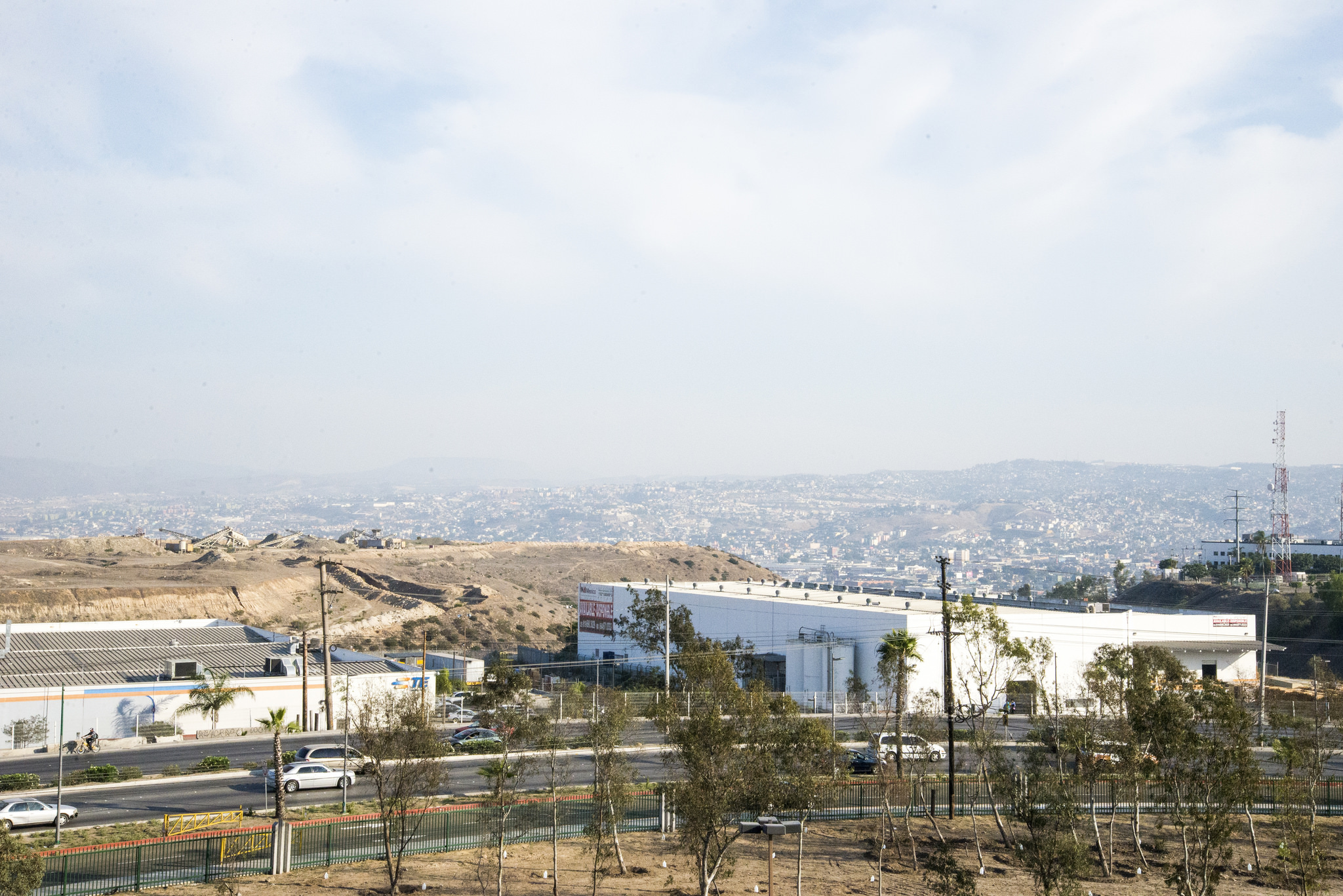
Two maquiladoras in Tijuana, Mexico. The low percentage of Mexican value-added in Mexico’s exports is a key reason why the country has not gotten nearly as much employment growth as it hoped for when it joined NAFTA. / Anthony Albright / Flickr / Creative Commons

Officials in the Trump administration are proposing a new way of measuring the U.S.-Mexican trade deficit that, by making the deficit look larger than it currently appears, will likely be spun to support efforts to impose high tariffs or dismantle NAFTA.  According to press reports, the President’s senior advisors, including the head of his new trade council, Peter Navarro, are proposing to include only “domestic exports” (exports of U.S.-produced goods) in calculating bilateral trade balances with Mexico and other countries.  This would exclude “re-exports” – goods that are imported into the United States from other countries (such as Canada or China) and transshipped into Mexico – which are currently counted in total U.S. exports.

  • In spite of its political motivation, the proposed new accounting would render a more accurate measure of U.S. exports. In fact, it would make the U.S. deficit with Mexico look closer to what Mexico reports as its surplus with the U.S.  For 2016, the U.S. reports a deficit of $63.2 billion with Mexico, while Mexico reports almost twice as big a surplus of $123.1 billion with the U.S.  If the U.S. excluded re-exports, its trade deficit with Mexico for 2016 would be $115.4 billion, which is much closer to the Mexican number.

Nonetheless, this recalculation fails to correct for another bias, which makes the U.S. deficit with Mexico look artificially large.  Imports are measured by the total value of the goods when they enter the country, from the immediate country of origin.  But in today’s global supply chains only part of the value-added in imported goods comes from any one country.  A television, for example, can be assembled in Mexico with components imported from Korea and other East Asian nations.  As a result, the reported U.S. imports from Mexico (especially of manufactured goods) greatly exaggerate the Mexican content of those goods.  Although data limitations do not permit an exact calculation of the Mexican content of U.S. imports from Mexico, it is likely relatively low.  (My own estimates suggest it is on the order of about 30-40 percent for manufactured goods).  Indeed, the low percentage of Mexican value-added in Mexico’s exports is a key reason why the country has not gotten nearly as much employment growth as it hoped for when it joined NAFTA.

The Trump Administration’s aggressive rhetoric and action on other issues related to Mexico, including immigration and the wall, suggest a political motivation for the proposal to adopt a new measure of exports, regardless of its merits.  But the real problem is not the “correct” number for the U.S.-Mexican trade deficit; it is why NAFTA has not lived up to its promise of supporting high-value added exports and high-wage job creation in both countries.  This promise was based on the idea that the United States would export capital and intermediate goods to Mexico for assembly into consumer goods, which would then be exported back to the United States.  But especially since China joined the WTO in 2001, Mexico has increasingly become a platform for assembling mostly Asian inputs into goods for export to the United States (and secondarily Canada).  Even if “re-exports” are excluded, Mexico remains the second largest export market for the United States (after Canada) – and U.S. exports to Mexico are 65 percent greater than U.S. exports to China.  Focusing too much on measuring the U.S.-Mexico trade imbalance only distracts attention from the need to reform NAFTA so as to encourage more of the “links” in global supply chains to be produced in North America generally.  If the Trump administration is serious about making the U.S. more competitive vis-à-vis China, it should think about viewing Mexico as a partner instead of as an enemy.  In the larger context of Trump’s many objectionable policies on migration and in other areas, a long-overdue correction of U.S. export statistics is not worth getting upset over.  The real issue is whether Trump’s trade policies – with Mexico and beyond – will bring the promised gains to U.S. workers, or will further enrich corporate billionaires and Wall Street tycoons.

February 23, 2017

* Robert A. Blecker is a Professor of Economics at American University.

What Will Trump Do About NAFTA?

By Malcolm Fairbrother*

trump-nafta

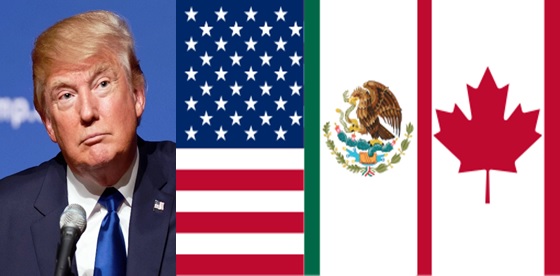
U.S. President-elect Donald Trump and the flag of the North American Free Trade Agreement (NAFTA). / Flickr and Wikimedia / Creative Commons / Modified

Despite his campaign rhetoric repeatedly attacking the North American Free Trade Agreement, U.S. President-elect Donald Trump probably won’t touch it, except in superficial ways.  He has called NAFTA the “worst trade deal ever,” and promised to pull the U.S. out unless Mexico and Canada agree to renegotiate it.  Last week, he suggested renegotiation of NAFTA will include provisions for Mexico to repay the U.S. government for the wall he wants to build along the border.

Dismantling or even significantly rewriting the accord is unlikely for a couple reasons:

  • First, the billionaires, chief executives, and friends he is choosing for his cabinet are hardly people inclined to dismantle an agreement whose contents largely reflect what American business wanted from the U.S.-Mexico relationship when NAFTA was being negotiated in the early 1990s. Corporate preferences weighed heavily against any big deviation from the status quo after the last political transition in Washington, in 2008.  Barack Obama too said that “NAFTA was a mistake,” though his criticisms were a little different.  He railed against lobbyists’ disproportionate influence over trade policy, and promised big changes to international trade agreements, including better protections for workers and the environment.  Even so, he didn’t touch NAFTA, and the Transatlantic Trade and Investment Partnership (TTIP) and the Trans-Pacific Partnership (TPP) he negotiated included – like NAFTA – shady provisions for investor-state dispute settlement.
  • It would be near-impossible, or least massively expensive, to get what Trump seems to want most: a big drop in imports from Mexico. In his eyes this would make NAFTA a better deal for America, though of course serious economists disagree.  Realistically, reopening the agreement would be very messy, and if he tried to throw up massive new trade barriers business leaders would strongly object.  NAFTA could include some additional measures to make it easier for goods and/or people to get around among the NAFTA countries, but that’s not what Trump has promised.

His economic nationalism makes the Republican Party establishment squirm, but it’s clear it also helped Trump win several Midwestern states, tipping the electoral college in his favor.  Insofar as agreements like NAFTA entrench rules friendly to business, and generate market efficiencies and economies whose benefits accumulate in the hands of the few, voter hostility is no mystery.  But economics is only part of the reason.  The bigger issue is what the backlash against globalization – embodied also by Brexit and the rise of neo-nationalist parties in Europe – means more broadly.  The average Democratic voter has a lower income than the average Republican voter, but Democrats are more supportive of trade agreements because they are more internationalist, more open to other cultures, younger, more educated, and more urban.  Throughout his presidency, Trump will therefore be squeezed between his working class rhetoric – appealing to the distrustful – and his business class milieu.  He is an extreme case of the politicians’ mercantilist thinking on trade, wherein exports are good and imports are bad, and “trade deals” like NAFTA are somehow like deals in the business world, where it’s possible to out-negotiate someone.  The reality is that this thinking – which flies in the face of basic economics – doesn’t point to any clear course of action.  This is why Trump won’t actually do much about NAFTA.

January 10, 2017

* Malcolm Fairbrother is social science researcher and teacher/mentor in the School of Geographical Sciences at the University of Bristol (UK).  This article is adapted from a recent blog post for the American Sociological Association.