Behind Argentina’s Making up with its Creditors

By Arturo C. Porzecanski*

Pensive Macri

Photo Credit: Mauricio Macri / Flickr / Creative Commons

A recently concluded agreement in principle between Argentina and most of its holdout creditors is part of a 180-degree turn in economic policy that the new administration of Mauricio Macri is attempting to make in order to end five years of economic stagnation, 10 years of double-digit inflation, and 15 years of isolation from the international capital markets.  President Macri has to navigate very carefully, however.  First, he does not have a majority in either congressional chamber, so he has to work hard to persuade legislators to support his policy initiatives.  Second, the judiciary and the Executive branch are packed with political appointees from the Néstor and Cristina Kirchner administrations, and while some of them have been fired, Macri and his economic team must still tread cautiously.  Third, all the key economic institutions, such as the government’s commercial and development bank (BNA), the central bank (BCRA), and the social security administration (ANSES) have been stuffed to the gills with either risky or unprofitable assets (from bad loans to government IOUs), thereby compromising their effectiveness.  Last but not least, Macri must be mindful of his very fickle electorate: over the past seven decades, Argentines have periodically voted non-Peronists into office to clean up the mess left behind by the Peronists, but then they have soured and yanked their support.  It is a sobering fact that not a single non-Peronist government has ever made it to the end of its constitutional term in office.

This is why the Macri administration is going for some “quick wins” rather than for major structural reforms or the necessary dose of fiscal austerity and monetary restraint.  And this is the context within which his willingness to “bury the hatchet” with private and official creditors must be understood.  As a former businessman, Macri realizes that if one takes over a money-losing enterprise – in this case the public sector, which is running a deficit equivalent to more than five percent of GDP – one needs to cultivate sources of interim financing until the enterprise can be turned around.  After all, the prior government had been living hand-to-mouth on loans from the BNA, the BCRA, and ANSES, with increasingly inflationary consequences.  Having lost official international reserves and seen the currency depreciate rapidly after abolishing capital controls, the authorities are now under great pressure to obtain interim financing from abroad to help stabilize international reserves and support the weak currency.

President Macri faces a very difficult governance challenge in the months and years ahead.  His ability to mend fences with private creditors – Argentina has been in arrears to all its bondholders since mid-2014 – as well as with the IMF, multilateral development banks, and official creditors such as the Ex-Im banks – is crucial to the restoration of financing to the private and public sectors and the fostering of an investment-friendly climate.  Macri’s agreement in principle with most holdout creditors is a big step in the right direction, but he must now secure the requisite congressional approvals to dismantle Kirchner-era legislation inimical to a settlement and obtain interim financing at reasonable interest rates to clear all overdue debts.  These are early and relatively easy tests for a government that is yet to adopt most of the divisive and unpopular austerity measures that circumstances warrant.

March 10, 2016

*Dr. Porzecanski is Distinguished Economist in Residence at American University and Director of the International Economic Relations Program at the School of International Service.

Brazil: Crises Hindering Foreign Policy

Dilma 2016

Photo Credit: Marcelo Camargo / Agência Brasil / Flickr / Creative Commons

by Tullo Vigevani*

The pace of Brazil’s rise in international affairs since 2000 is likely to be slowed by the multiple crises facing President Dilma Rousseff’s government and the private sector, but Brasilia will strive as best it can to maintain its global and regional priorities.  Political tensions are soaring amid corruption indictments and severe economic contraction – the nearly 4 percent decline in GDP in 2015 is expected to be repeated this year, with increasingly negative social consequences.  The government faces growing criticism that extends beyond the principal opposition parties: its own party base and supportive labor unions and social movements criticizing Rousseff’s administration.  The corruption investigations have spread far beyond the national oil company, Petrobras, and into corporate networks across economic sectors, exacerbating a climate of growing anxiety.  Major media are railing against the President and her predecessor, Luiz Inacio Lula da Silva, whose detention for questioning by a judge last week deepens the crisis and further dims the already faint prospects for a restoration of stability in 2016.

These developments have created an element of paralysis in foreign policy.  Foreign minister Mauro Vieira, like his two immediate predecessors – Luis Alberto Figueiredo (2013-2015) and Antonio Patriota (2011-2013) – has been unable to sustain the “active and proud” policy of Lula-era Foreign Minister Celso Amorim (2003-2010).  After basking not long ago in the fruits of its assertive foreign policies – including selection as host of the 2016 Olympics – Brazil’s government now is dealing with matters such as the Zika virus and microcephaly taking front stage.  Rousseff on one hand is barraged by criticism of a lack of macroeconomic rigor and the failure to better integrate Brazil’s economy into global production chains, and on the other she is criticized for slow investments and development policies.  Her ambition to promote South American trade and economic integration is being undermined by the recessionary pressures confronting Brazil and neighboring economies buffeted by the end of the commodities boom.

  • MERCOSUR remains a priority for the administration. Criticism by liberal economists will mount, however, that Mercosur, as a customs union, discourages potential agreements with developed economies, particularly the United States, thus exacerbating Brazil’s de-industrialization.  There is evidence that Mercosur helps companies that produce high value-added goods: whereas in 2014 manufacturing accounted for 77 percent of Brazilian exports within Mercosur, it accounted for only 4 percent of exports to China.  (The figures for the European Union and the U.S. were 37 and 55 percent, respectively).  Progress on trade agreements with the United States and other developed countries appears unlikely, but agreements on trade promotion seem likely.
  • Cooperation with UNASUR will remain a priority as well, but plans that rely on Brazil’s ability to provide resources face new political and economic restraints. The Ministries of Finance and Planning and the Central Bank reportedly are going to rein in contributions of the Brazilian Development Bank (BNDES), and funding for the South American Council of Infrastructure and Planning (COSIPLAN).  Initiatives such as the South American Defense Council will continue.  Clearly, state enterprises such as Petrobras and private-sector conglomerates will face limits on their foreign activities, reducing Brazil’s influence in the region.

The relationship between domestic and international affairs is inescapable, and Brazil is no exception.  But even as the domestic political and economic conditions deteriorate for a period, the country will not turn inward or abandon its interest in the international arena, particularly with China and the BRICS.  However rough the road ahead, President Rousseff’s government appears likely to remain steadfast in its approach to regional diplomatic and political organizations – including the Community of Latin American and Caribbean States (CELAC) and the OAS – even though resources will be tight.  It will remain active, within its diminished capacity, in an array of multilateral settings ranging from UN peacekeeping operations and the FAO, to the G-20, WTO and IMF.  Moreover, senior officials in Brasilia, including in the Foreign Ministry, appear committed to stronger bilateral ties with core partners, particularly the United States, and continued Brazilian support for democratic stability throughout Latin America, including in resolution of the Venezuelan crisis.  Even though resources and performance may suffer, a robust role in the hemisphere appears likely to remain a pillar of Brazil’s foreign policy.  The idea of Brazil’s autonomy in the international arena has deep roots, and whatever the domestic criticism leveled against the Rousseff administration, these will be matters of interpretation rather than a fundamental questioning of Brazil’s greater insertion into global processes and of political and economic interdependence.

March 7, 2016

*Tullo Vigevani is Professor of Political Science and International Relations at the State University of São Paulo (UNESP) and a researcher at the Center for Studies on Contemporary Culture (Cedec) and the Brazilian National Institute of Science and Technology for Studies on the United States (INCT-INEU), in São Paulo.

Venezuela: Trying to Stay Afloat

By Michael McCarthy* and Fulton Armstrong

Venezuela Oil Maduro

Photo Credit: Democracy Chronicles and Charles Henry (modified) / Flickr / Creative Commons

Venezuelan President Nicolás Maduro continues to receive increasingly bleak economic news, and his modestly positive policy responses seem unlikely to help.  Oil revenues dropped 293 percent from 2014 (US$37 billion) to 2015 (US$12.5 billion).  The value of oil exports, which account for 95 percent of the country’s export earnings, has dropped to a 30-year low ($30 a barrel), accelerating a recession, paralyzing shortages, and soaring inflation.  The Central Bank reported that inflation reached 180.9 percent in 2015, and that the GDP contracted for the second consecutive year (5.7 percent).  Maduro blamed an “imperialist strategy in a petroleum war” aimed at destroying OPEC.  He also asserted that Venezuela suffered from an “international financial blockade” that – by obstructing the country’s efforts to refinance its debt – was intended to force it “to its knees” and to “take over” its wealth.

Several days after celebrating a Supreme Court decision reaffirming his authority to declare an “economic emergency,” which the opposition challenged last month, Maduro this week announced several modest economic measures aimed at stemming the slide.

  • He ordered a 60-fold increase in gasoline prices – dramatic-sounding but preserving Venezuelan gas (about US$0.23 per gallon at the black-market exchange rate) as one of the cheapest in the world – but the decision is significant as the first increase in about 20 years. An increase in 1989 triggered riots – the famous Caracazo that most analysts cite as the beginning of the end of the old order that Hugo Chavez toppled definitively when elected President in 1998.  In allusion to this past, Maduro said he “hoped people on the streets would understand.”  (Caracas-based consultancy Ecoanalítica estimates that the existing fuel subsidy costs the Venezuelan government US$12 billion a year.)
  • Maduro also announced a 37 percent devaluation of the bolívar – from 6.3 to 10 to the U.S. dollar – for official exchange rates used for the essential goods like food and medicine. The bolívar trades at about 1,000 to one on the black market, but the decreased subsidy implicit of the official rate for necessities is nonetheless significant.
  • Venezuela’s proposal for an OPEC freeze in oil production, in hopes of driving oil prices back up, drew supportive remarks from Qatar, the United Arab Emirates, Russia, Saudi Arabia, and even Iran, but the scheme has lacked traction. Industry observers said one reason is that Tehran is eager to increase exports to regain market share as sanctions against it are lifted.
  • Maduro replaced economic czar Luis Salas – known as a hardline leftist – just five weeks after appointing him, and appointed in his place a more business-friendly economist, Miguel Pérez Abad, who had been serving as Minister of Commerce. Pérez Abad, whose appointment the President of the Venezuelan Chamber of Commerce described as a “friendly sign,” has publicly (and accurately) said that Venezuela must simplify its byzantine exchange rate system.
  • These changes come amid Maduro’s increasingly frank self-criticism about state corruption. He recently described a government food distribution company as “rotten” while calling for a restructuring of state-run food import and distribution outlets.

In a four-hour speech replete with foul language and insults against opposition leaders, the President argued that the measures are “a necessary action to balance things,” and he said, “I take responsibility for it.”  But his measures are piecemeal at best.  As opposition leaders have pointed out, he has not explained how he is going to pay Venezuela’s debt, obtain the foreign exchange to import sufficient amounts of basic goods, and guarantee food for the people.  With US$10 billion in bond payments coming due this year, the country has no clear path for avoiding default.  However painful for the population and politically costly for the government, measures such as gasoline price increases will have little impact.  The government wanted the opposition to share some of the costs for economic policy changes, but opposition politicians say that the gas price increase and devaluation are too little, too late. Most believe economic revival depends on dismantling the entire chavista system.  They are once again talking about removing Maduro through a referendum or other means – with one leader, Henrique Capriles, openly calling for a presidential recall, and another, Henry Ramos, the President of the National Assembly, calling for a constitutional amendment to cut the presidential term from six to four years.  The government’s measures suggest a welcome change from Maduro’s previous strategy of buying time through diversionary tactics.  However, the economic measures are likely to fail and, moreover, they increase the chances political temperatures will surge once again.

February 19, 2016

* Michael McCarthy is a Research Fellow with the Center for Latin American & Latino Studies.

Ignoring MERCOSUR and UNASUR at Your Peril

By Thomas Andrew O’Keefe*

Mercosur map

Participating countries in MERCOSUR. Image Credit: Immanuel Giel (modified) / Wikimedia / Creative Commons

Pundits who dismiss MERCOSUR and the Union of South American Nations (UNASUR) as failed attempts at Latin American economic integration should look again.  MERCOSUR has presided over an explosion in intra-regional trade among its four original member states (Argentina, Brazil, Paraguay, and Uruguay) from just over US$ 5 billion at its launch in 1991 to US$ 43 billion by 2014.  UNASUR, for its part, is credited with thwarting a coup attempt against Evo Morales in 2008 and putting a damper on continental arms races.

  • MERCOSUR and UNASUR member countries have taken additional important steps toward convergence since 2014, when MERCOSUR’s highest governing body adopted “CMC Decision 32,” which allows initiatives pursued by either collective to be binding on both if they arise from a set of goals and objectives common to both. The document reaffirms the UNASUR founding treaty stipulation that “South American integration shall be achieved through an innovative process that includes all of the achievements and advances by the processes of MERCOSUR and CAN [Andean Community].”  Chile has spearheaded this effort as a means of reducing duplication of efforts, and is also attempting to bridge ideological differences between the Pacific Alliance (Chile, Colombia, Mexico, and Peru) and MERCOSUR to further build Latin American unity.

Given the relentless negative assessment of both integration projects, multinational pharmaceutical companies were caught off guard when MERCOSUR and UNASUR forced them late last year to make substantial price cuts for public-sector purchases of Darunavir, an antiretroviral to combat HIV-AIDS, as well as Sofosbuvir, used with other medications to treat Hepatitis C.  Both drugs are on the World Health Organization’s List of Essential Medicines.  As a result of CMC Decision 32/14, the Ministers of Health of all the South American nations met in Montevideo on September 11, 2015, and launched a joint MERCOSUR/UNASUR committee to negotiate with multinational pharmaceutical companies on the prices for bulk purchases of certain high-priced drugs.  The committee, made up of representatives from each government’s agency responsible for purchasing medicines, won major price cuts last November – a steep reduction for Darunavir from Hetero Labs as well as lower prices with Gilead for Sofosbuvir.  The new costs were premised on the lowest amount charged to any one of the member governments, and enabled Chile’s Ministry of Health to pay 90 percent less than what it previously paid for Darunavir.  The South American governments as a whole are expected to save US$ 20 million in 2016 on purchases of this anti-retroviral.  A proposed 14 percent reduction in the cost of the combination Sofosbuvir-Ledispaver drug for Hepatitis C – if accepted by the MERCOSUR/UNASUR committee – would enable further savings.

The South American governments have their eyes set on several additional high-priced medications, with a particular focus on drugs used to treat cancer.  In order to aid the committee’s work, UNASUR is creating a data bank of the prices charged by the multinationals for specified medicines purchased by the public health sector in each member state.  The fact that the purchases are made jointly through the Pan American Health Organization’s already existing Strategic Fund opens the possibility that countries in Central America and the Caribbean can benefit as well.  It also means that all these countries can access the Fund’s capital account and do not need to have the cash in hand to acquire medications required to address public health emergencies.  MERCOSUR and UNASUR – often dismissed as ineffective – are demonstrating that integration produces tangible results.

February 11, 2016

* Thomas Andrew O’Keefe is President of San Francisco-based Mercosur Consulting Group, Ltd. and is former chair of Western Hemisphere Area Studies at the U.S. State Department’s Foreign Service Institute (2011-15).

Correction: Due to an editing error, an earlier version of this post mistakenly stated that “a 14 percent reduction in the cost of its combination Sofosbuvir-Ledispaver drug for Hepatitis C will enable Chile’s Ministry of Health to pay 90 percent less than what it previously paid for Darunavir.”  The outcomes of the cost negotiations for the two medications are unconnected.

U.S.-Colombia: Launching “Peace Colombia”

By Eric Hershberg and Fulton Armstrong

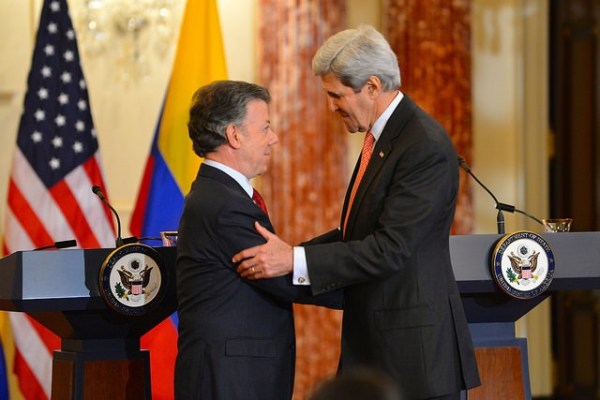
Kerry Santos

Photo Credit: U.S. Department of State / Flickr / Public Domain

The United States, buoyed by good feelings about what President Obama called Colombia’s “remarkable transformation,” last week pledged $450 million a year in continued aid for the next five years, but it’s not clear yet whether “Peace Colombia” will be very different from Plan Colombia, to which the United States contributed some $10 billion.  The new spending includes unspecified amounts to support the reintegration of FARC combatants who lay down their arms as part of a peace accord expected next month, but much of the emphasis appears to be on old priorities, such as “consolidating and expanding progress in security and counternarcotics.”

  • Obama and Colombian President Santos announced the new program in Washington events marking the 15th anniversary of the launch of Plan Colombia. Amid the many remarks about Colombia’s progress, indicators such as homicide rates (down 50 percent since 2002), kidnapping rates (down 90 percent), economic growth (averaging 4.3 percent), and poverty and unemployment (down slightly) stand out.  By most accounts, moving around core regions of Colombia is easier and safer than it’s been in decades.

Some of these gains of the past 15 years remain tenuous, and “Peace Colombia” will face new challenges as well.  In speeches and backgrounders, government officials have acknowledged that coca eradication and crop substitution programs have failed to reverse Colombia’s role as the world’s biggest producer of coca.  Moreover, programs supporting the demobilization of the FARC will be more difficult to implement than those given to the rightwing paramilitaries in 2002-2006.  Tens of thousands of former paramilitaries are now active in bandas criminales (BACRIMs), which President Santos recently referred to as “2,500 miniscule criminal organizations scattered throughout the country.”  Changing economic circumstances could also complicate efforts to advance peace.  During the years of Plan Colombia, the country got a healthy bump from both domestic and foreign investment – because of the improved security environment as well as the external economic environment, including the U.S.-Colombia Free Trade Agreement and Chinese demand for commodities.  Investment remains strong, but the export boom is over, which is lowering growth and squeezing government budgets.

The creation of economic opportunity is at least as important to the success of Peace Colombia as continued support for the Colombian military and security system, although last week’s speeches and press releases did not shed much light on that.  Achieving peace and building democracy will also require addressing infrastructure deficits, educational inequality, inadequate job training, and poverty.  Several Florida congressmen, arguing that “Peace Colombia” supports an accord that’s overly generous to the FARC, say they’ll oppose Obama’s pledged aid.  The assistance will almost certainly advance, however, because of the strong Washington consensus that Colombia is its biggest (if not only) success worldwide in beating back irregular armed groups.  Moreover, as President Santos and U.S. Secretary of State Kerry emphasized in a press conference, there are no conditions on the new assistance – which should assuage Congressional opponents’ concerns that the relationship will get held up by investigations into alleged human rights violations in the past.  The Presidents spoke of pulling Colombia back from the “verge of collapse” in the 2000s to the “verge of peace” now.  A broadening of strategies in both capitals, including a reassessment of the emphasis on military options, could push the country toward becoming a more inclusive democracy, which ultimately may be what is required in order to achieve lasting peace.

February 8, 2016

Brazil: Not-so-Happy New Year

By Matthew Taylor*

Brazil Basta

Photo Credit: Antonio Thomás Koenigkam Oliveira / Flickr / Creative Commons

A vicious combination of corruption scandal and economic malaise suggests a troubled new year awaits Brazil.  Economists estimate gross domestic product has contracted 3 percent this year and will decline a similar amount in 2016, while inflation and weak government finances hamper efforts to stimulate growth.  Two of three big rating agencies have cut Brazilian debt from investment grade to junk. Unemployment has risen from under 7 percent a year ago to nearly 10 percent, with forecasts of 12 percent on the horizon.  Efforts to reform fiscal policy are getting nowhere, and the champion of fiscal reform, Finance Minister Joaquim Levy, has just resigned.  The bonanza launched by the 2003-2010 presidency of Lula da Silva – seemingly setting Brazil on a unique path of state capitalist development – is long over.

The country’s interconnected scandals cast shadows on many of the leading players on the national stage, including President Dilma Rousseff.

  • Petrobras, the crown jewel of Brazil’s state capitalist model, is at the center of allegedly massive corruption schemes. Rousseff, who was chair of the Petrobras board at the time of the alleged wrongdoing, has claimed absolute ignorance.  But the charges implicate Brazil’s leading political and business elites, many of whom have been jailed in recent months.
  • A feud between Dilma and the president of the Chamber of Deputies, Eduardo Cunha, reached a new low this month after Cunha’s approval of impeachment proceedings against her. (His own ethics problems continue to fester.)  The charge against Dilma is not of personal corruption but rather that Rousseff flouted budget laws by using public banks to cover up unauthorized debt issuance and off-books spending.  Rousseff supporters have argued that the impeachment charges represent the worst of golpismo, or coup-mongering, and a constitutional overreach that threatens to undermine democracy.

For Brazil, 2016 will be dramatic and unpredictable – as the country weathers the most dangerous political crisis since the impeachment and resignation of President Fernando Collor in 1992.  Dilma’s opponents will have difficulty convincing two-thirds of the Chamber and Senate to oust her, but the crisis is already creating significant fissures in the democratic system.  The parties have been turned upside down.  Even if Dilma survives in office, she faces nearly impossible odds in restoring the credibility of her administration and party, the Partido dos Trabalhadores, or PT.  There are early indications that the PT will face a bloodletting in the 2016 municipal elections, and former President Lula, the party’s once-ironclad standard-bearer, has the highest rejection rate (55 percent) of any potential candidate in the 2018 presidential contest.  The PMDB, Dilma’s coalition partner, is threatening to break with the government, but is internally divided. The opposition PSDB is facing scandals, protests, and troubles of its own in the states it governs.  The newfound proactivity of prosecutors and judges is making democratic checks and balances work as never before – and is largely welcomed by Brazilians – but Brazil’s old party system may not be able to keep pace.  Rumblings for a rethinking of the political system will grow louder in the new year, as the crisis deepens.

December 21, 2015

*Matthew M. Taylor is associate professor at the School of International Service at American University.

Cuba: Limited Opportunity Drives Migration

By Ricardo Torres*

Embed from Getty Images


A generation of young Cubans is eager to leave the island because they feel that recent reforms have opened scant opportunities for them, and they see a much brighter economic future for themselves in the United States or Latin America. Cuba has made vast investments over the years in education, generating a population with high levels of human capital and technological potential, but job opportunities – in the declining state sector, in the 200 or so occupations now authorized for cuentapropismo, and in the slowly opening cooperative sector – hold little promise for Cubans under 30. Although statistics on the socioeconomic background of migrants are lacking, a strong body of anecdotal information indicates that this generation, with aspirations of a career that matches their intellectual and technical capabilities, is concluding that there is little for them in Cuba. For a number of reasons, the conditions necessary to start a new business – such as financing and markets – are simply not there.

Mainstream technologies that are now common in modern societies are lacking in Cuba, hindering it from unleashing the potential of its human capital. Inconsistent and excessively controlled access to computer technology and the internet is also discouraging youths to have hope. Free education, healthcare, and a low crime rate set Cuba apart from most other countries in the region producing large numbers of migrants, but those same factors have created expectations among youths that they should have fulfilling, better-paying jobs – which simply are not abundant. Moreover, people under 35 have fewer emotional or historical attachments to the Revolution. They did not experience the purported “Golden Age” of the 1980s, and the “revolutionary and socialist” Cuba they know is one of only economic hardship.

For migrants elsewhere in the region – driven by endemic poverty, violence, and weak, corrupt institutions – young Cubans’ reasons for leaving the island may appear exaggerated. Cubans’ education, health, and relative security, however, do not discount their profound desire, engendered in part by the Communist Party’s own unfulfilled rhetoric about a better life, to seek better fortunes outside their country. They have been trained for knowledge-based economy, but Cuba’s current development model relegates them to low value-added occupations that cannot generate the rewards to which they aspire (or the prosperity that the society needs and in principle could achieve). U.S.-Cuba normalization, particularly if the two governments allow capital and goods to flow freely, and accelerated reforms in Cuba hold some promise of reducing migration pressures from the island in the future, but persuading Cubans that building a better life on the island rather than emigrating elsewhere will take time and vision.

December 17, 2015

*Ricardo Torres, a CLALS Research Fellow, is Professor of Economics and Cuban economy at the University of Havana, and is affiliated with the UH’s Center for the Study of the Cuban Economy.

Venezuelan Elections: Economic Crisis Turns Up the Heat on Chavismo

By Michael M. McCarthy*

A faded legacy. Photo Credit: Julio César Mesa / Flickr / Creative Commons

A faded legacy for Chavismo? Photo Credit: Julio César Mesa / Flickr / Creative Commons

Twenty-four long months since their country’s last national election, Venezuelans head back to the polls to elect a new National Assembly on December 6 in a tense political climate – with no promise that the government will respect the opposition’s near-certain victory.  All 167 seats in the unicameral body will be up for grabs in a race polarized between Chavismo’s pro government coalition and the Mesa de Unidad Democrática opposition coalition.  Thanks largely to a rapidly deteriorating economy, the government’s approval rating decreased from 50 percent in 2013 to 20 percent in September, according to the national Venebarómetro poll.  A range of polls in September indicated the MUD is poised to win either a simple or “qualified” (60 percent) majority.  Observers generally agree that the main measure of success for Chavismo is preventing the MUD from obtaining a two-thirds majority, and that blocking a qualified majority would be a major triumph.

For ordinary Venezuelans the campaign is overshadowed by the massive economic crisis.  Skyrocketing inflation, severe shortages of basic goods and services, and reduced social assistance programs are contributing to tensions on the street, where the campaign is not as present as in years past.  Nevertheless, heavy turnout is still expected – 66 percent of eligible voters participated in the last National Assembly elections in 2010, and pollsters report a strong intention to vote.

  • The MUD has shaped its campaign around leveraging the vote as a mechanism for punishing economic mismanagement and restoring some institutional balance to a political system that barely reflects opposition voices at the national level. Skepticism of the National Electoral Board, which rejected the MUD’s request for international electoral observation by the OAS, EU or UN, has increased.  Slashes to budgetary support for opposition governors and mayors, while the government channels funds to unelected parallel state and municipal authorities, make supporters wonder whether a victory will be fully respected.
  • The government refreshed its slate of candidates by promoting generational and gender diversity, but stalwarts, including current National Assembly leader Diosdado Cabello, remain prominent. The party is distributing last-minute pork to mobilize voters, and it’s working the system’s rural bias – each department is automatically allocated three deputies – where strong government presence gives it a strategic advantage.  Strikingly, the Chávez legacy has become a liability for President Maduro because the former President was much more charismatic and economic conditions were considerably better during his tenure.

The Maduro administration seems to have run out of diversionary moves after exaggerated external threats from Colombia and Guyana faded.  It is also on the defensive after the Rousseff administration, Maduro’s most powerful diplomatic partner, expressed unhappiness about Caracas’s opposition to its choice of a Brazilian political heavyweight to lead UNASUR’s “electoral accompaniment mission.”  The President has also been set on back on his heels by intensified international criticism of the trial and conviction of opposition leader Leopoldo López, who, according to a state attorney who worked the case, was sent to jail for 14 years on fraudulent charges.  Regardless of the outcome on December 6, the direction of the country is highly uncertain.  Maduro has said he’ll accept the results “whatever they are,” but he has also said “we have to win, by whatever means possible” (como sea and cualquier manera), and that if the opposition wins “I will not hand over the revolution” but rather “proceed to govern with the people in a civic-military union.”  In the next couple weeks, the government may still try to throw the opposition off course, but the MUD does not seem interested in renewing street protests – more violence is unlikely to advance its objectives. Neither do its leaders seem confident that a renewal of talks on rebuilding democratic institutions will help.

November 9, 2015

* Michael McCarthy is a Research Fellow with the Center for Latin American and Latino Studies.

Cuba’s Limited Absorptive Capacity Will Slow Normalization*

By Fulton Armstrong

Photo Credit: PBS NewsHour / Flickr / Creative Commons

Photo Credit: PBS NewsHour / Flickr / Creative Commons

As the U.S. embargo – the main obstacle to expanding U.S.-Cuban economic ties – is relaxed by presidential regulatory action and eventually lifted by Congress, limits on Cuba’s own willingness and ability to conduct trade, absorb investment, utilize information technology, and even accommodate tourists risk putting a brake on the normalization of economic relations.  Five decades of embargo and failed socialist models have rendered key sectors in Cuba ill-equipped to take advantage of the surge in U.S. business interest in the island.  In some areas, the political will to open up and reform is crucial.  These problems do not translate into a rejection of normalization but rather into a slower timeline than many on and off the island would hope for.

The advantages of economic engagement are well known.  Foreign investment will help provide the $8.7 billion Cuba wants for its “Portfolio of Foreign Investment Opportunities” – some 246 projects in energy, tourism, agriculture, and industry.  Havana also wants growth rates to rise to 4-5 percent per year (from an estimated 1.5 percent in 2014), fueled by at least $2 billion in annual foreign investment.  Trade, investment, and tourism are all potentially powerful engines for growth and employment in Cuba.  Private farmers have long out-produced their state competitors and many cooperatives, making them ideal for engagement under current U.S. regulations if the Cuban government facilitates it.  The small private sector, currently employing over a million people, could – with a more supportive infrastructure – provide many more vital goods, services, and employment that the Cuban government years ago admitted it could not provide.  Sectors utilizing Cuba’s specialized and skilled human capital, such as biotechnology, could also benefit quickly and generously from the new U.S. relationship.

Cuba has a lot going for it – such as its deep reserve of potential human capital – but it is also is held back by a variety of problems, many of which are prolonged by political caution.

  • Cuba is updating laws governing investments, property, and labor – a new foreign investment law in March 2014 and related regulations are steps in the new direction – but the multi-year, incremental process has been too slow to keep ahead of burgeoning opportunities. Regulations on how foreign firms select, pay and release Cuban employees are also antiquated.  Paperwork for approving foreign direct investment remains formidable and must pass through multiple levels.  The country lacks the basic institutions necessary to license import and export transactions for beneficiaries outside government ministries.  Much of the bureaucracy – chronically underpaid and, during periods of party dominance, neglected – has yet to grow into a new, more professional role.
  • Unifying Cuba’s two national currencies is absolutely essential but, despite the government’s repeated declarations of intent, it has still not been done. The existence of a different, lower exchange rate for state enterprises creates distortions that will worsen as demand for imports rises.  The financial system, moreover, is too over-burdened, secretive, and lacking in agility, and continued blocks to Cuba’s access to IMF, World Bank, and Inter-American Development Bank (IDB) funds deny it important breathing room to reform.
  • Cuba lacks an information and communications technology (ICT) framework capable of harnessing and nurturing its human capital and driving growth and efficiency – which will retard progress in a number of priority areas.
  • De-industrialization over the past 25 years has further reduced Cuba’s absorptive capacity. Many key sectors – including textiles, clothing, metals, machinery, transportation equipment, and more – have contracted between 50 and 100 percent.  Much of the infrastructure is dilapidated.  The transportation sector is in dire need of repair and modernization; and the construction industry is inefficient and poorly resourced.

Cuba’s challenges in taking advantage of new opportunities are not insurmountable – with political will and time.  The pace of reform and corresponding expansion of Cuba’s absorptive capacity may be maddeningly slow for many Cubans and Americans alike.  But insofar as the U.S.-Cuba normalization process is irreversible, so too is the conviction in Cuba on the need to “update” the system through reform in order to take advantage of the opportunities it brings.  Cuban national pride and the Communist Party’s fear of losing control could very well be assuaged as the island experiences the benefits of engagement.  Foreigners, especially the United States, who push too hard, too fast, and too haughtily could fail and even delay this aspect of normalization, just as Cubans who move too passively, too slowly, and too skeptically could stymie the process as well.

October 27, 2015

*This blog post is excerpted from the third in a series of policy briefs from the CLALS Cuba Initiative, supported by the Christopher Reynolds Foundation.  Read the full brief here.

Mexico’s Petroleum Sector: Not Yet Out of the Woods

By Thomas Andrew O’Keefe*

Photo Credits: Ian Burt and Alex / Flickr / Creative Commons

Photo Credits: Ian Burt and Alex / Flickr / Creative Commons

The September 30 awarding of three contracts on five oil production blocks that the Mexican government opened for bidding has raised hopes that the Peña Nieto administration’s efforts to reform the country’s energy sector are back on track, but many challenges remain.  In contrast, an auction of leases on 14 blocks in July was a huge disappointment as contracts could only be issued for two of them.  The auctions are part of Mexico’s effort to reverse years of declining petroleum output by permitting private sector and foreign participation in an industry monopolized for decades by the state oil company, PEMEX.  Foreign and private sector firms are now allowed to enter into both profit- as well as production-sharing agreements with PEMEX and thereby retain a percentage of the gains on the oil they extract.  In some cases, outright concessions – termed “licenses” so as not to run afoul of the Mexican Constitution – are permitted.

A careful examination of the successful bids last month, however, leaves doubts as to whether the auction marks a change of fortune.  To entice a better response, the Mexican entity responsible for the auctions, the National Hydrocarbons Commission (CNH), relaxed many rules in a way that may be difficult to repeat and can be challenged politically.  Noticeably absent from the list of winning bidders are the major multinational oil giants.

  • The Italian state oil company, ENI International, won the block that attracted the most bids, while an Argentine-led consortium headed by Pan American Energy won a second block. They are well-known players in several South American countries – Argentina, Bolivia, Ecuador, and Venezuela – where the rules of the game are constantly changing and lack of transparency is a major issue.  The third block had only one bidder, a consortium made up of the U.S.-based Fieldwood Energy and Mexican Petrobal (whose director is PEMEX’s former director of exploration and production, Carlos Morales Gil).
  • The blocks awarded on September 30 are for already discovered shallow water fields, meaning lower geological risks for private operators. In order to make the auction attractive, the CNH lowered the fees required to bid and added the right to explore for new oil as well as pumping oil from existing reserves.

Mexican President Enrique Peña Nieto came to office in 2012 with an ambitious reform plan to revitalize the Mexican economy by focusing on structural reforms, including education, finance, telecommunication, transportation infrastructure, and energy.  While there have been noticeable changes in all five areas, the results have not yet led to significant improvements in Mexico’s economic performance.  The optimistic reform scenarios of three years ago are further clouded by corruption scandals – including one touching the President, his wife, and a finance minister who had houses built by prominent contractors who had won lucrative government contracts – the lack of progress investigating the Iguala Massacre (involving 43 students who disappeared), and high levels of citizen insecurity.  The real test for the Mexican energy reform – and the credibility of President Peña Nieto’s reform policies – will come next year when offshore deep water blocks in the Gulf of Mexico and extra-heavy oil fields are put up for auction.

October 19, 2015

* Thomas Andrew O’Keefe is President of San Francisco-based Mercosur Consulting Group, Ltd.