Peru Elections 2016: Back to the Future?

By Jo-Marie Burt*

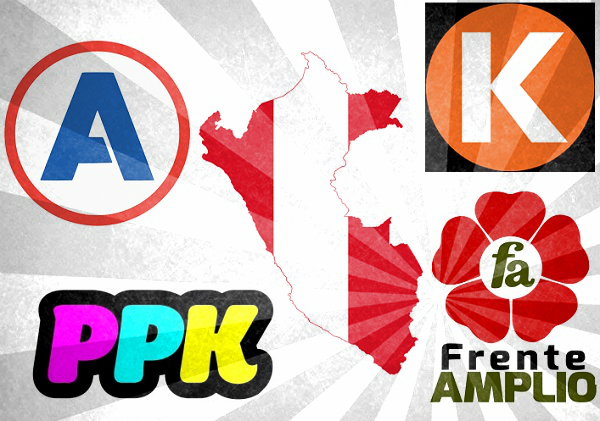
Peru Elections 2016

Photo Credits: Huhsunqu, Alex Albornoz, Alianza para el Progreso, Fuerza 2011, and Peruanos por el Kambio (modified) / Wikimedia / Creative Commons

Peruvian electoral authorities’ decision last month to disqualify two candidates in this weekend’s first-round presidential election has conjured up the ghosts of one of the most disputed elections in recent Latin American history: the “re-re-election” of Alberto Fujimori in 2000.  Large demonstrations this week against the candidacy of the strongman’s daughter, Keiko Fujimori, were a rejection of the corruption and authoritarianism of the past – as well as the electoral fraud that kept him in power.  The two candidates were disqualified for technical violations of campaign laws.  Newcomer Julio Guzmán, who polls indicated commanded around 20 percent of the vote, was punished because his party failed to follow certain registration norms, and the other, César Acuña, was accused of giving away gifts above newly set limits.  Local observers point out, however, that other leading parties are guilty of similar missteps but have faced no penalties.  Video and testimonials show, for example, Keiko Fujimori attended events where cash “prizes” were handed out.

The disqualifications have put the spotlight on the Inter-American Commission of Human Rights (IACHR), which disqualified candidate Julio Guzmán asked to investigate the decisions.  Postponing the election would be extremely disruptive, particularly because other political groups in Peru, which have benefited from Guzmán’s exclusion, have seized on the immediate political advantage.  The possibility that uneven application of the electoral rules might taint the credibility of the eventual winner is not their immediate concern.

  • The two immediate beneficiaries are Pedro Pablo Kuczynski (known by his initials PPK, which also identify his party, Peruanos por el Kambio), and Verónica Mendoza of the left-wing Frente Amplio. At 15-20 percent each, they are jockeying for second and third place behind Fujimori (30-35 percent), but the real race is in the runoff on June 5 that will take place in the likely event that no candidate wins 50 percent of the vote.  In the 2011 elections, Fujimori won the first round, but lost in the runoff vote to Ollanta Humala.  Fujimorismo has a hard-core following of 25-30 percent of the voting public, but a majority of the population also has a negative opinion of her.

Peruvian elections had come a long way since Alberto Fujimori fled office in 2000.  (In 2009, he was sentenced to prison for 25 years for human rights violations, corruption, and abuse of authority.)  Free and fair elections were held in 2001, 2006, and 2011 – marking the first time in Peruvian history that two democratically elected presidents consecutively handed the presidential sash over to successors.  Whether politically motivated or merely the result of incompetence, electoral authorities’ apparently one-sided handling of this year’s campaign has created an appearance of favoritism discrediting the electoral process itself.  The Secretary General of the Organization of American States, Luis Almagro, has already referred to these elections as “semi-democratic.”  Others speak openly of fraud.  The potential damage is compounded by popular concerns that Keiko Fujimori represents a return to the authoritarian and corrupt tactics that characterized her father’s decade in power.  Her detractors say that she is not simply her father’s daughter; she served as his First Lady and benefited from the corruption of his regime (for example, she testified before Congress that she accepted cash from intelligence chief Vladimiro Montesinos to pay for her college education).  Keiko has acknowledged “errors” (but not “crimes) were committed during her father’s government, and she continues to say her father’s regime was the “best” Peru has ever had.  These were bound to be contentious elections due to the divisive legacy Keiko Fujimori represents, as the massive nationwide demonstrations marking the April 5 “self-coup” on Tuesday made clear.  But the uneven application of the law by electoral authorities raises even more serious questions about Peru’s democratic institutions.

 April 7, 2016

*Jo-Marie Burt is Director of Latin American Studies and Associate Professor of Political Science at George Mason University and a Senior Fellow at the Washington Office on Latin America (WOLA).

Bolivia’s Constitutional Referendum Marks New Political Era

By Miguel Centellas*

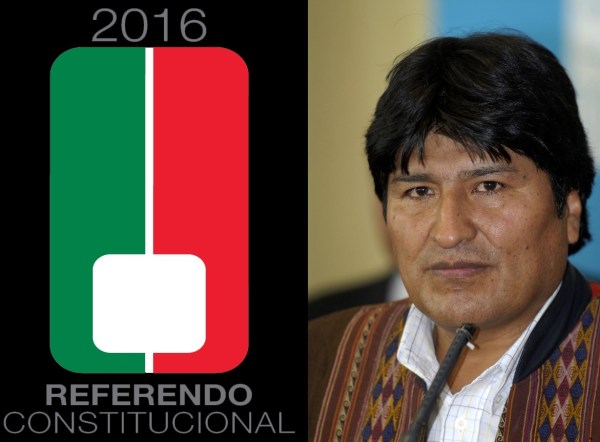
Referendo Morales

Photo Credit: Organo Electoral Plurinacional de Bolivia and Alain Bachellier, respectively / Wikimedia and Flickr / Creative Commons

Bolivian voters’ rejection last week of a constitutional amendment to allow an incumbent president to run for a third consecutive term is a setback for President Evo Morales but a step forward for the country.  Both the government and opposition understood the national referendum as a plebiscite on Morales, who is now the longest serving head of state in Bolivian history.  Had the referendum passed, Morales would have been able to run for a fourth five-year term in 2019.  (Because Morales was first elected in 2005, before the new constitution was approved in 2009, the high court decided that he was eligible to run for reelection in 2014.)  During the months leading up to the referendum vote, polls showed a narrow gap between the votes in favor of the amendment and the No votes, with a large number of undecided.

As the final count began to crystalize (the official count is not yet available), it became clear that No won by a slim margin (51.3% to 48.7%).  At first, Morales and members of his government disputed the results, arguing that late-arriving rural ballots would vindicate him.  Later, they claimed opposition fraud and manipulation, including a “dirty” war waged by the opponents and the media.  Several scandals, however, appear to have been the real cause of Morales’s loss.

  • New developments in lingering accusations of fraud committed at the Fondo Indígena, an organization established to support economic, social, and political development of marginalized peoples. Government auditors last year uncovered more than a hundred incomplete or non-existent projects valued at tens of millions of dollars.  The case involved several ex-ministers in Morales’s government and leaders of his MAS party.
  • New allegations of corruption involving Gabriela Zapata Montaño, a romantic liaison of the President in 2006 who is now an executive for a Chinese-owned company (CAMC) that was awarded a large number of no-bid contracts for government development projects. Some sources claim millions of dollars have been misappropriated.  Zapata was arrested shortly after the vote.
  • Accusations that the MAS (and, implicitly, Morales) instigated angry protesters to attack the municipal building in El Alto, Bolivia’s second largest city, killing seven people and injuring many others. The mayor, Soledad Chapetón, and La Paz provincial governor Felix Patzi, a former education minister under Morales, were the first two opposition candidates to win those positions since MAS came to power.  The government dismissed the allegations and suggested that Chapetón orchestrated the violence to make herself a martyr.

The results of the referendum – and, more importantly, the frenzied reactions from Morales and other high-ranking members of his government – make the immediate future appear uncertain.  Morales accepted the results of the referendum but also ominously pointed out that there are other ways to amend the constitution.  He also dared opponents to initiate a recall referendum to remove him.  Nevertheless, some members of MAS – showing eagerness to carry the party’s wide support among Bolivians into the future – have begun publicly discussing possible successors.  Another positive sign is that Bolivia’s electoral court showed itself to be truly autonomous, bolstering opposition confidence in a key institution.  The question is whether Morales believes his party (and by extension his legacy) is worth preserving, or whether he wants to risk them for another dubious bid for reelection.  Claims that Morales’s setback is part of a “conservative tide” sweeping through Latin America may be premature, but this referendum may have repercussions elsewhere.  Ecuador’s Rafael Correa’s public comments that he would not seek reelection in 2017 may now become firmer.  The day of the three- or four-term president seems over.

March 3, 2016

* Miguel Centellas teaches political sociology at the Croft Institute for International Studies at the University of Mississippi.

Hope Fading for Guatemalan Spring

By Ricardo Barrientos*

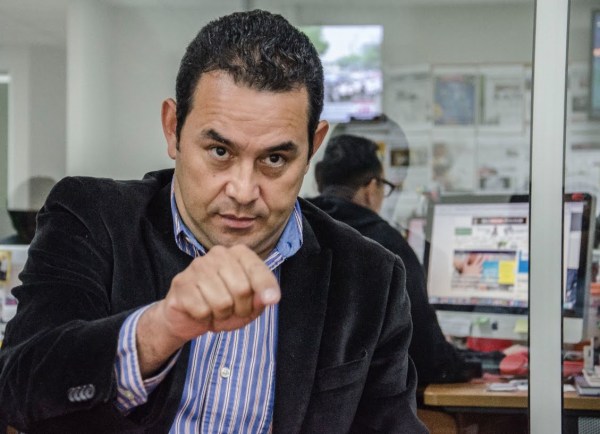
Jimmy Morales

Photo Credit: Publinews Guatemala / YouTube / Creative Commons

The high hopes created by Guatemala’s peaceful, democratic change of government last year are hitting the shoals of reality.  Guatemalans managed a major political crisis in 2015 in an exemplary way: massive citizen demonstrations against authorities accused of corruption lasted four months without a single incident of violence.  Acceptably free and fair elections took place just three days after disgraced President Pérez Molina resigned, and a transition government was formed as mandated by the Constitution to govern until Jimmy Morales, the new Guatemalan President, was sworn in on January 14.  Although lacking experience, a cabinet, and a plan, Morales inspired confidence with a very good slogan (that he was “neither corrupt, nor a thief”) and good communication skills honed as a former TV comedian.  Voters had rejected and punished the “old politics” and felt hope that honesty would prevail.

Since Morales took office, however, serious mistakes have caused confidence to dim.

  • His reluctance or inability to answer questions from journalists and to refrain from underestimating audiences by telling silly jokes and childhood stories are raising concerns among observers of an emerging authoritarian personality.
  • Secrecy surrounding his cabinet selection process has led to missteps. His Minister of Communications, Infrastructure, and Housing was forced to resign after just 11 days in office – in the face of evidence of tax fraud and a serious conflict of interest.
  • His first approach to Congress was only to reverse the position on 2016 public debt cuts that his representatives advocated last November. Asking Congress to reduce debt proved popular back then, but now transfers to the Public Prosecutor Office or to the public university can be made only if the original debt amount is restored by Congress.  That condition is not only unpopular; it risks hampering the effort to prosecute corruption.
  • Instead of asking Congress for an urgently needed budget increase to solve ongoing shortages of medicines and equipment in public hospitals and clinics – almost a humanitarian tragedy, he accepted pharmaceutical company donations of expired medications – in a deal redolent of past corruption.
  • Morales’s political party, Frente de Convergencia Nacional (FCN), has grown substantially in Congress by receiving “turncoat” congressmen, directly contradicting an important campaign promise. “Turncoating,” jumping from party to party in Congress (always for a “price”), is one of the practices condemned in 2015 as part of the “old politics” and was strongly rejected by voters who trusted Morales.  The Public Prosecutor Office has received complaints denouncing bribes, government jobs, and contracts offered to “turncoats” now affiliating with the FCN.

Events in Guatemala over the past year present a huge contrast with what the country was a couple of decades ago – triumph for a society deeply marked by civil war, poverty, and brutal inequality, with the fresh hope of a new democratic spring.  Jimmy Morales appears to be squandering a historic opportunity to harness this democratic momentum.  Voters who set aside concerns about his links to right-wing Army veterans accused of crimes against humanity during the civil war could soon feel deceived because the “old politics” is still in place.  Guatemala’s democratic spring may fade before it blooms, sowing the seeds of crisis and instability in the future.

February 22, 2016

*Ricardo Barrientos is a senior economist at the Central American Institute for Fiscal Studies (Icefi).

Haiti: Postponed Elections, Ever-Deepening Crisis

By Emma Fawcett*

Haiti Elections 2016

Photo Credit: mackendy mentor, Kurious, and KeshtoKar (modified) / YouTube, Pixabay, and Wikimedia Commons / Licensed for noncommercial reuse

Postponement of Haiti’s protracted electoral process has triggered a seemingly existential crisis.  The January 24 vote, a runoff to select a president, was postponed indefinitely in the face of violent protests challenging the legitimacy of the first round in October.  Those elections trimmed the field of 54 presidential candidates down to two: President Martelly’s hand-picked successor, banana exporter Jovenel Moïse, and opposition candidate Jude Célestin.  While that round was mostly peaceful and the vote tallies were upheld by most outside observers (including the OAS), Haitian human rights groups and dissidents cited widespread cases of fraud and other irregularities.  Célestin disputed the count and boycotted the runoff, which he says Martelly rigged to install Moïse.  Martelly has dismissed the accusations, and the embattled Provisional Electoral Council has been unable to assuage the opposition alliance’s concerns.  Last week’s postponement of the runoff was the second, but the clock is ticking louder now because Martelly is scheduled to, and reaffirmed his intent to, step down on February 7.

  • The postponement triggered international pleas for a speedy resolution. The U.S. State Department condemned “electoral intimidation, destruction of property, and violence”; while the OAS, the UN, and the EU all issued calls for Haitians to come together to end the crisis.

International efforts to foster elections as a means of laying groundwork for political and economic stability in Haiti have repeatedly stumbled, even when stretching the rules to accommodate Haitian reality.  The OAS and the State Department intervened on Martelly’s behalf in the 2011 election by pushing him into the runoff and asking opponents to stand down.  In addition to providing up to $4 billion dollars in economic and reconstruction aid, the United States has since spent more than $30 million on the elections, and continued to push for them to go ahead as recently as January 21.  But these efforts have backfired, as members of opposition parties, the Haitian private sector, and the Catholic Church regard the electoral process as illegitimate and increasingly resent what they feel is U.S. interference.  The political crisis also jeopardizes economic development that Washington has encouraged.  Royal Caribbean, a cruise line that leases a recreational area on Haiti’s northern coast, skipped its port call in Labadie several times over the past week because small boats of protesters approached its ships. Protesters also threw rocks at the windows of the new Marriott hotel in Port-au-Prince.

Haitian democracy is – yet again – at a perilous juncture.  Martelly’s departure from office on February 7 will be disruptive, but his strong-arm tactics and entourage of shady characters threatened a peaceful transition of power anyway.  (His critics point out that an extension of his term in office is what he has sought all along.)  U.S. officials have spoken publicly of a transitional government emerging, but selecting one and imbuing it with credibility will be a massive task.  Business leaders have proposed that a “consensus” prime minister head an interim government for six months, during which a new Electoral Council would coordinate new elections, but the negotiations lack transparency.  If the government, the protesters, and the business community are unable to reach an agreement – as seems likely at this point – Haiti will face a power vacuum with increased violence that will be even more difficult to resolve. 

January 28, 2016

*Emma Fawcett is a PhD candidate in International Relations at American University.  Her doctoral thesis focuses on the political economy of tourism and development in Haiti, Dominican Republic, Cuba, and the Mexican Caribbean.

Bolivia: Implications of Referendum for Democracy and the MAS

By Santiago Anria*

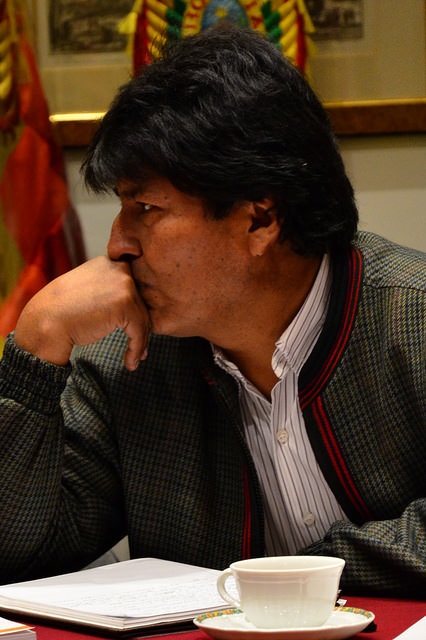
Evo Referendum

Photo Credit: zak / Flickr / Creative Commons

A Bolivian referendum on February 21 – one month after the 10th anniversary of President Morales’s rise to power – threatens a break with the country’s tradition and the democratic principle of power alternation.  A “Yes” vote on the constitutional amendment up for approval would allow Morales and Vice President García Linera to run in 2019 for a fourth consecutive term – a scenario that the fragmented opposition claims would mean not only greater concentration of power in a personalistic leader but also a shift toward authoritarianism, similar to that in Venezuela.  The government claims that a “No” vote would mean the end of an era of unprecedented economic and democratic stability, the end of measures that have empowered subordinate groups in society, and the return of the right and neoliberalism.  Opinion polls so far show the vote will be close.

Morales’s efforts to extend his time in office are consistent with his tendencies to dominate politics and the policy process.  Yet my research shows that increased political incorporation during his government has also given previously marginalized groups enhanced influence over agenda-setting and policy-making and led to important shifts in domestic power relations.  In today’s Bolivia, well-organized interest groups typically belonging to the “informal” labor sector (such as coca growers, cooperative miners, and transportation unions) have greater influence over policy from within the state (in representative institutions and state bureaucracies at all levels) and from without (direct pressure in the streets).  This has resulted in greater regime responsiveness to the groups’ interests and in policies that expand economic and social benefits, as well as improvements in poverty and inequality reduction – even without meeting some of their fundamental needs such as employment and health care reform.  While in some instances newly empowered groups have mobilized and served as a check on state power, their role is founded on a highly particularistic relationship of the MAS and allied groups and, as such, can actually be an obstacle for governing in the interest of broader segments of society.

An intense government campaign in favor of the constitutional amendment is already under way and will likely deepen in the coming weeks.  The Morales government lacks the kind of epic framing it had when it first won the presidential election in 2005.  Citizens today express concerns similar to those voiced during previous governments – concentration of power, widespread corruption, inefficient institutions, weak protection of liberal rights, politicization of courts, and hostility to opponents and the press.  A “Yes” victory on February 21 would not automatically mean a shift to an authoritarian regime as core features of authoritarianism (i.e., power exercised by a small group overriding the will of the citizens) are not currently evident.  In addition, Morales’s tendencies to dominate often meet strong checks from a relatively autonomous civil society.  Comparative evidence suggests, however, that a fourth Morales term might lead to further power concentration and decreased political input from below — which could mean a weakening of the MAS as an organizational actor for the empowerment of subordinate groups independent of its undisputed leader.  A “No” victory, on the other hand, would not necessarily mean the end of the social and political transformations carried out by the MAS.  If nothing else, Bolivia’s “process of change” over the past decade has given rise to a “new normal” of more inclusive institutions and basic social programs that benefit large sectors of the population and will be difficult for any future government to reverse.

January 19, 2016

* Santiago Anria is a postdoctoral fellow at Tulane University’s Center for Inter-American Policy and Research.

U.S.-Cuba: Must “Democracy Promotion” Obstruct Normalization?*

By Fulton Armstrong

Photo Credit: Martin Burns / Flickr / Creative Commons

Photo Credit: Martin Burns / Flickr / Creative Commons

“Democracy promotion” has been one of the most contentious aspects of U.S. policy toward Cuba – and one of the most counterproductive – but it doesn’t have to be either.  The concept of democracy promotion is ingrained in U.S. policy culture, and the bureaucracies and programs they’ve been charged with conducting over the years are as bullet-proof as any in Washington.  Democracy promotion in different forms has been a main element of U.S. policy toward Cuba for decades. In the 1980s and early 1990s, the U.S. Interests Section conducted an array of outreach programs, engaging with Cuban academics, journalists, and officials – people tolerant if not deeply supportive of the Cuban government – as well as human rights activists and others “outside the system.”  These activities informed and nurtured the aspirations of Cubans in and outside the system who were eager to find Cuban solutions to their country’s mounting problems.  The Helms-Burton Act of 1996 moved democracy promotion into a more aggressive mode, explicitly linking it to regime change.  President Clinton spent token amounts on initiatives related to Cuba’s future transition, but the Bush Administration launched an expansion that has since cost U.S. taxpayers more than $250 million.  The arrest, conviction, and five-year imprisonment of USAID sub-contractor Alan Gross shed light on one such operation.  He smuggled sophisticated communication equipment onto the island to set up secret networks.  Associated Press investigative reporter Desmond Butler uncovered other programs involving communications and political operations against the Cuban government.

The investment has yielded some operational successes, but the impact toward promoting democracy has been negligible and, in important ways, counterproductive.  The program has delivered food, medicines, and other support to the families of imprisoned dissidents (many of whom have been released since Presidents Obama and Castro announced reestablishment of relations last December), but more provocative operations have arguably led only to arrests.  The amateurish clandestine tradecraft of the contractors and program activists, moreover, made it easy for Cuban counterintelligence to penetrate and manipulate their ranks.  The “private libraries” that U.S. taxpayers have paid for do not exist, and communications systems involving expensive satellite gear and satellite access fees have been compromised.  The secretive modus operandi of the operations has given credibility to draconian Cuban government measures, like Law 88 for “Protection of Cuba’s National Independence and Economy,” imposing prison terms for certain contact with foreigners “aimed at subverting the internal order of the nation and destroying its political, economic, and social system.”  Authentic people-to-people exchanges have been tainted as Cubans in the government and on the street are wary that any contact could be part of Washington’s regime-change efforts.

The democracy promotion ideology and bureaucracy seem unstoppable, but Presidents Obama and Castro can take the edge off this irritant with a little effort and flexibility, and even make it mutually beneficial.  The State Department and USAID have pledged to continue the Cuba democracy promotion programs and are asking Congress for $20 million to fund them again this year, but the President’s statement that “it is time for us to try something new” suggests acknowledgment that they need not be so ineffective and counterproductive.  For starters, the Administration could stop citing Helms-Burton authorities, which are explicitly for regime change, and establish criteria for operations in Cuba similar to those in other countries with whom the U.S. has diplomatic relations and is trying to improve bilateral ties.  It could restore and expand what worked in the past, such as the distribution of books and clippings; support for exchange visits; promotion of academic and cultural events; and other non-political activities that include people with government affiliation.  Perhaps most importantly, to decontaminate the programs, the organizations that have already spent millions trying to drive regime change should step aside and let a new generation – based on real people-to-people interests – try something different with the funds.  Both Presidents can trust their citizens to develop the historic roadmap that will define the relationship into the future.  Both the United States and Cuba stand to benefit.

September 25, 2015

*This article is excerpted from the second in a series of policy briefs from the CLALS Cuba Initiative, supported by the Christopher Reynolds Foundation. To read the full brief, please click here.

Haiti: Yet More Lost Opportunity

By Emma Fawcett*

Photo Credit: Nacho Fradejas Garcia / Flickr / Creative Commons

Photo Credit: Nacho Fradejas Garcia / Flickr / Creative Commons

Six months into Haiti’s most recent political crisis, popular uncertainty and frustration are palpable – amid indications that even the Obama Administration may be tiring of corruption and mismanagement under President Martelly.  Officials in Washington in April expressed concerns over the abrupt release of gang leaders alleged to have ties to Martelly who had been held on kidnapping charges.  Recent U.S. Embassy tweets have focused on the importance of press freedom and free and fair elections.  Protests are a regular occurrence, and anti-government graffiti covers buildings throughout Port-au-Prince.  Martelly’s network of old friends – whom some long-time Haiti-watchers have called “nefarious characters” – has been politically useful to him, and various press reports indicate that criminal prosecutions against them for drug trafficking, kidnapping, and worse have mysteriously dropped off the books.  Criticism of his record on other issues is also strong.  A visit from Beyoncé on May 16 led the US Embassy to ask its Facebook followers: “Where should she go to see the progress in Haiti? Let us know!”  Social media users mocked, “What progress?” and derided the embassy for asking.  Washington politics, such as criticism of Bill and Hillary Clinton’s role in Haiti, is further casting a shadow on Martelly and his government.

The country has made partial progress towards holding its long overdue elections, but – if history and Martelly’s record are any guide – obstacles could easily arise.  A list of candidates has been approved, and dates have been set – August 9 for Parliamentary elections (all 118 seats in the Chamber of Deputies and 20 of the 30 seats in the Senate).   Presidential elections will take place on October 25, with a December 27 runoff if necessary.  But the process has not been without controversy: a quarter of the 2,039 who had registered to be candidates have been disqualified for various reasons.  (First Lady Sophia Martelly wanted to run for Senate but was not accepted because she is a U.S. citizen.)  As the government has not provided explanations in most instances, accusations that the exclusions were politically-motivated abound.

Martelly’s carefully calculated consolidation of power over the last four years has led many observers in Haiti to wonder whether he will actually make elections happen and leave office on schedule.  Many of them are perplexed by what they perceive as steadfast U.S. support for him.  Even in January, when an agreement on elections fell through once again and Martelly commenced to rule by decree, the State Department’s admonishment was widely seen as weak.  Rather than building bridges at home, Martelly has often appeared more externally focused – capitalizing on his ties to the Clintons, who along with the OAS helped him secure the contested presidency in the first place; declaring that Haiti is “open for business”; and holding his historic meeting earlier this month with French President Francois Hollande.  Indeed, the Hollande visit resulted in yet more protests in Port-au-Prince’s streets from those frustrated by France’s refusal to pay reparations for past abuses – such as the “independence debt” that France demanded, which consumed 80 percent of Haiti’s budget for 125 years (the equivalent of $17 billion dollars today).  Predictions about the elections and transition of power at the end of the year would be premature, but Martelly already seems to have squandered his chance to leave a legacy of progress, institution-building, and stability for the nascent Haitian democracy. 

June 1, 2015

*Emma Fawcett is a PhD candidate in International Relations at American University.  Her doctoral thesis focuses on the political economy of tourism and development in four Caribbean case studies: Haiti, Dominican Republic, Cuba, and the Mexican Caribbean.

Ecuador: Stacking the Deck Against Democracy

Enlace Cuidadano

Ecuadorian President Rafael Correa during one of his weekly broadcasts Enlace Ciudadano / Mauricio Muñoz / Flickr / Creative Commons

By Catherine M. Conaghan*

Taking a page from Hugo Chávez’s playbook, Ecuadorian President Rafael Correa is intimidating and steadily increasing controls on his opponents.  He regularly uses his Saturday morning broadcasts to name and shame them.  Actors from all walks of Ecuador’s civil society – journalists, lawyers, activists, academics, bloggers, union and social movement leaders – have been the target of his insults and thinly veiled threats on the weekly program, Enlace Ciudadano.  In February, Correa’s show was skewered by HBO comedian John Oliver – and, to Oliver’s delight, Correa fired back by tweeting insults (click here and here).  Journalists and civil society leaders applauded Oliver for drawing attention to the continuing deterioration of civil liberties in Ecuador.  Correa’s virulent rhetoric and intimidating use of media is part of a larger matrix of policies endangering freedom of expression and association in Ecuador.  Over the last two years, the Correa administration has worked methodically to mount a legal framework allowing for greater government control over the media and civil society organizations.

  • The 2013 Law of Communication and a new oversight agency, the Superintendence of Information and Communication, are intended to ensure that all print and broadcast media provide “truthful information” that is “verified, contrasted, precise, and contextualized.”  Superintendent Carlos Ochoa was selected from a short-list of nominees provided by Correa.  Among alleged violations recently singled out for sanctions are items in the leading newspaper El Universo and its accomplished political cartoonist, Xavier ‘Bonil’ Bonilla.
  • Issued in 2013, Executive Decree 16 also has civil society – from neighborhood associations to think tanks, business chambers, unions, and advocacy groups – under pressure. In addition to elaborate regulations for the legal registration of organizations, the decree stipulates conditions allowing the government to “dissolve” them.  These include group involvement in “partisan activity” and “interfering in public policies.”  To date, only one organization – the Fundación Pachamama involved in environmental activism – has been dissolved, but civic leaders fear that the decree will induce ”self-censorship” and stifle participation.

The new laws amount to a project – unprecedented for Ecuador – of surveillance and regulation.  They provide the government with a tempting arsenal of weapons to use, if necessary, in upcoming battles on other important legal matters, especially on the issue of presidential re-election.  After years of pledging that he would not seek a third term in office, Correa reversed course and has tasked his legislative super-majority with finding a swift route to amending the constitution.  Most public opinion polls show, however, that a majority of Ecuadorians would prefer a referendum to decide whether or not yet another consecutive re-election should be allowed.  The road to re-election may be more difficult than Correa and his advisors imagine, but they enter the fray with the weight of the law on their side.  With powers to control the media and limit the activity of civil society, the Correa administration enjoys the upper hand as 2017 approaches.

March 12, 2015

*Catherine Conaghan is the Sir Edward Peacock Professor of Latin American Politics at Queen’s University in Kingston, Ontario.  She specializes in Andean politics.  She is the author of an article, “Surveil and Sanction: The Return of the State and Societal Regulation in Ecuador,” in the April issue of the European Review of Latin American and Caribbean Studies.

Panama: A Central American Singapore?

By Tom Long*

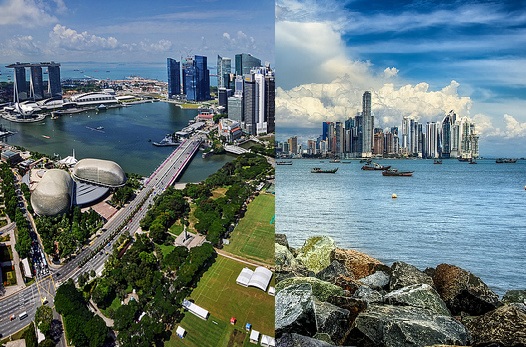
Singapore (left) and Panama City (right) / William Cho and Jim Nix / Flickr / Creative Commons

Singapore (left) and Panama City (right) / William Cho and Jim Nix / Flickr / Creative Commons

As a transportation hub, logistics center, and regional financial player, Panama has long been painted by investment bankers and Panamanian politicians as a potential “Singapore of Latin America,” but that vision still seems a way off.  In some respects, Panama’s story has been quite impressive.  For a decade, it has boasted GDP growth far beyond the regional average, even surpassing 10 percent in some recent years.  Unlike many of its neighbors, its dollar-based economy relies on services, not exports of commodities or low-value-added light manufacturing.  Since the 1989-1990 U.S. invasion to unseat General Manuel Noriega, the total size of the Panamanian economy has quadrupled in constant dollars.  It is also different from Singapore in important ways.  Singapore’s approach to planning and public housing might be helpful in Panama City, which has suffered traffic, environmental degradation, and inadequate housing for the poor as a consequence of poorly planned growth.

In other important ways, however, the Panama-Singapore comparison is less apt.

  • Singapore is a city, with nearly two million more people than Panama has spread across 100 times the landmass. Urban-rural divides are wide in Panama, with poor delivery of health and education services outside the cities, exacerbating inequality.  A Singapore-style strategy in Panama would leave the countryside behind – and indigenous and Afro-Caribbean populations would benefit much less.
  • Differences between the two countries in governance – for better and worse – are profound. The Panamanian people are much freer under the country’s democracy than they would be under a single-party-dominated system like Singapore’s.  In other ways, though, Panama’s governance leaves much to be desired.  Corruption is a massive problem, and watchdog groups highlight weakness in the rule of law, judicial independence, and press freedom.  Projects to expand the Panama Canal and build a capital city subway are over budget and behind schedule, and have suffered from strikes, contract disputes, and questionable bidding practices.  While it may seem easy to blame the corruption on former President Martinelli, who faces criminal charges, the problem has much deeper roots.
  • The two countries have very different policies toward education. Singapore invested, and continues to invest, heavily in world-class universities.  Panama lacks these, weakening its ability to compete globally in industries where innovation is key.  While Panama’s primary education has improved, its research and development lags.
  • A final difference is where the countries find themselves in their political and economic evolution. Singapore became independent 50 years ago, but it has been only a quarter century since Panama ended its kleptocratic, military rule.  It has been just 15 since the United States officially turned control of the canal over to Panamanian authorities.  The roots of its problems cannot be easily or quickly extirpated.

Panama’s boosters often use the comparison to highlight the areas in which Panama excels – economic growth, unique geography, and infrastructure crucial to global shipping and air transit.  The comparison might be more helpful in highlighting areas where Panama needs to improve.  These include dedicating resources to higher education and R&D, addressing inequality, rooting out corruption, and enhancing political and bureaucratic accountability.  Singaporean scholar Alan Chong argues that Singapore’s attempt to present itself as a model, global city is in part a foreign policy strategy of “virtual enlargement.”  The city-state’s wealth, reputation, and active role in international organizations allow it to “punch above its weight” in Southeast Asia and beyond.  Some chapters of Panama’s recent economic story might be the envy of neighbors with their own canal dreams, but the country will need to focus on governance and accountability if even its logistics-hub strategy is in fact going to deliver shared welfare at home and enhanced influence abroad – let alone become a Latin American equivalent of an Asian Tiger.

March 2, 2015

* Dr. Long is a visiting professor in International Relations at the Centro de Investigación y Docencia Económicas in Mexico City.  He is the author of Latin America Confronts the United States: Asymmetry and Influence, which is forthcoming with Cambridge University Press.

Who Will Attend the OAS Presidential Summit in Panama?

By Fulton Armstrong and Eric Hershberg

OAE-OAS & tgraham / Flickr / Creative Commons Attribution-NonCommercial-ShareAlike 2.0 Generic (CC BY-NC-SA 2.0)

OAE-OAS & tgraham / Flickr / Creative Commons Attribution-NonCommercial-ShareAlike 2.0 Generic (CC BY-NC-SA 2.0)

The Summit of the Americas isn’t until next April, but interest in how Panama as host handles near-unanimous pressure from Latin America to invite Cuban President Raúl Castro, and how the United States and Cuba will respond, is growing fast.  Speaking to reporters at the United Nations last week, U.S. Assistant Secretary of State Roberta Jacobson answered several questions on the U.S. position.  Key excerpts follow:

  • Asked “if the United States is still opposed to Cuba attending.”  On the Summit of the Americas, I think we’ve been pretty clear in our position on the summit, which is that obviously Panama is the host country for the summit, and as the host country they will make the decisions on invitations to that summit.  …  And the fact of the matter is we have said from the start that we look forward to a summit that can include a democratic Cuba at the table.  We also have said that the summit process, ever since Quebec in 2001, has made a commitment to democracy, and we think that’s an important part of the summit process.  But the decision about invitations is not ours to make, and obviously there’s been no invitations formally issued to the United States and other countries. And so there is no acceptance or rejection yet called for or made. …
  • Asked “is there a chance that the U.S. might refuse going.”  Again, I think you won’t be surprised to hear me say that we’re really not going to answer hypotheticals in the future yet.  Obviously, the Summit of the Americas is in April and that’s not a situation that we can answer, although I think we have made clear that we believe the summit process is committed to democratic governance and we think that the governments that are sitting at that table ought to be committed to the summit principles, which include democratic governance. And therefore that’s our position at this point.  Obviously, we have a position on Cuba which does not at this point see them as upholding those principles.

Panama’s likely invitation to Cuba – reflecting the consensus of 32 hemispheric nations at the last Summit – will draw protests from official quarters in Washington.  But it’s far from certain that the Obama Administration would risk blame for torpedoing the 20-year Summit process.  Obama survived a handshake with Raúl Castro at Nelson Mandela’s funeral last December, and being in the same room with him again as a President in the second half of his second term will have little political consequence.  A workshop in Mexico City in June, in which CLALS researchers participated, and another in Ottawa in September, sponsored by the Center and the University of Ottawa, explored likely outcomes.  Mexican international relations specialists speculated that a reasonable outcome was for the United States to show up like a polite guest, and thus avoid having the anachronism of U.S. antagonism toward Cuba overshadow its broader relations with Latin America.  Canadian experts were deeply concerned that Cuba’s inclusion might undermine the centrality to the OAS of the Inter-American Democratic Charter, but they agreed that failure to convene a Summit would constitute a serious blow to the OAS and to the regular summits that provide Canada a seat at the inter-governmental table.

The reality is that Cuba does not conform to the Democratic Charter or to the broader OAS criteria of democratic rule, but equally real is that Latin America sees Cuba as a full member of the hemisphere and has lost all patience with those in Washington who would deny that.  Either Washington — and Ottawa — set aside their objections to Cuba’s inclusion or they bid farewell to such fora and their constructive impact on regional relationships that ought to matter to them.  Moreover, if they acquiesce to Cuban participation but then try to commandeer the agenda and make the Summit a seminar on democracy and human rights, it will only reinforce the widespread sense in the region that Washington cannot move beyond its obsession with the trivial matter of Cuba and get on with a serious conversation among equal partners.  They would thus sacrifice an opportunity to discuss issues on which significant, substantive advances are possible through dialogue among leaders of countries throughout the hemisphere.  The value of the Summit rests with the capacity of all involved to act like grownups.  President Obama did so at Mandela’s funeral, and it will be telling whether he can do it again in Panama this coming April.

October 2, 2014