Brazil Protests: Amorphous Causes, Unpredictable Consequences

By Matthew M. Taylor
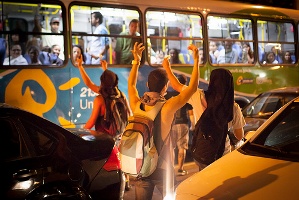
Protestors in Brazil / Photo credit: Izaias Buson / Foter.com / CC BY-NC

Protestors in Brazil / Photo credit: Izaias Buson / Foter.com / CC BY-NC

Hundreds of thousands of Brazilians hit the streets of a dozen state capitals this past week.  The initial trigger was a proposed hike in São Paulo bus fares, already among the world’s most expensive, but news media soon reported that the protests reflected anger with the rising cost of living, crime, corruption, impunity, and the high costs of hosting the World Cup. Lackluster public services haven’t helped, and widely televised police violence last week provided another rallying cry.  Polling by Datafolha shows that the protest is a middle class phenomenon, with 77 percent of the marchers in São Paulo claiming a university degree.  This growing demographic group is turning against President Dilma Roussef’s Worker’s Party (PT) but it is also weary of the opposition PSDB, especially in São Paulo state.

So far, the protests have been difficult for political parties to harness for their own ends.  Partisans who showed up at the marches on Monday waving party flags were reportedly forced to pull them down by indignant protestors.  Dilma’s popularity has been falling – she was recently booed at the opening match of the Confederations Cup – but the marchers don’t seem collectively exercised about her policies or those of any single party or politician.  Aecio Neves, Marina Silva and Eduardo Paes, her potential opponents in elections scheduled for late 2014, have yet to capitalize on her vulnerabilities, as the protestors seem to be casting “a pox on all their houses.”  An outside candidacy is a rising possibility, but Brazilians have been wary of supposed political saviors after the rapid rise and fall of Fernando Collor in 1990‑92.  Anger is directed at the political class as a whole because it is incapable of responding to public disgust with Brazil’s unsatisfactory public services.

It is quite possible that the protests may peter out on their own, especially if the renewed violence seen in São Paulo on Tuesday night alienates supporters.  If the protests continue and remain peaceful, they may result in increased social solidarity and a shared sense of patriotism in the face of an unsatisfactory political system.  Something similar happened during other mass protests in the past, especially the Diretas Já marches of 1985.  A renewed consensus in favor of a more robust and effective democracy would be salutary, but the concrete results arising from the protestors’ demands are difficult to predict.  One thing to be sure of: withdrawing the proposed bus fare increase proposal is too little, too late.

Constitutions: End-State or National Dialogue?

By Todd Eisenstadt

Protestor holding the Constitution of Honduras. Photo credit: giggey / Foter.com / CC BY-NC

Protestor holding the Constitution of Honduras. Photo credit: giggey / Foter.com / CC BY-NC

The role of constitutions is evolving as deeply as the countries in which they are being written.  At least since 1787, constitutions have been pacts around which societal expectations converge – the written record of elite agreements on how things should be.  During the “Third Wave” of democratic transitions (since the 1970s), they were viewed as precursor “contracts” to founding elections.  But increasingly, constitutions are way stations rather than destinations.  The content and implementation of constitutions is of course important, but the politics surrounding them can, in some cases, be more important than the clauses and amendments contained therein.

In Bolivia, Ecuador, Venezuela, and perhaps, in the near future in Paraguay, constitutional moments seem to be taking on different meanings.  Optimism about constitutions as core elements of Third Wave democratization pacts is giving way to the 21st century reality of democratic backsliding, semi-authoritarianism, and hybrid regimes – making it all the more important to reconsider how to read constitutions and evaluate governments’ adherence to them.  These are not stale parchments, but living narratives which represent iterations in decades-long intra-elite bargaining efforts to stall Arab Spring-like social movements (regardless of whether they actually seek to create spaces for new political actors).  They represent societal gains – both real and symbolic, even with ephemeral institutional advances.  This may be especially true in new and developing democracies, which need government services, constitutions that improve fairness and equity, and implementation of those commitments.  Developed democracies fall short too, but in developing countries new to the art of promulgating democratic constitutions, these shortcomings are more transparent as they are less proficiently hidden from view.

We need an intellectual space where Madison’s Dilemma – how to empower citizens without overpowering political institutions with the tyranny that unruly majorities can bring – meets Hugo Chávez’ shadow.  Chávez, who was obsessed with linking the Boliviarian Union of nations via new trade agreements and political arrangements, sought to empower himself and his political allies in the guise of solomonic constitutional reform to consolidate democracy.  Observers have long criticized “window dressing institutions” in the electoral arena, as evident in studies of “electoral engineering” and “sham elections.” While “sham constitutions” – a phrase that may ring too loudly – require more subtlety and political craftsmanship, we do need to question the longstanding stylization of constitutions as the “last word” (literally) on a nation’s quality of democracy.  There is much to learn, and a conference held last week at American University by CLALS Affiliate Rob Albro, SIS Researcher Carl LeVan, and I, and sponsored by the Latin American Studies Association and the Mellon Foundation, made some headway in finding new ways to conceive of constitutions not as the “final word,” but only as the most recent one.

Finding New Approaches to Media-Government Tensions in Latin America

By John Dinges

Press Conference in Lima, Peru Photo credit: World Economic Forum / Foter.com / CC BY-NC-SA

Press Conference in Lima, Peru Photo credit: World Economic Forum / Foter.com / CC BY-NC-SA

Establishment news media and government are on a collision course in a number of Latin American countries.  At the heart of the conflict is government rejection of the classic role of an ideologically diverse press as a check on government power and as a forum of citizen deliberation.  The media, in response, charge that government actions constitute violations of international free press guarantees.  But that defense has been ineffective and has not resonated at the popular level.  All of the governments involved are democratically elected, and most espouse left-of-center programs of progressive reform aimed to benefit the poorest sectors and address other forms of inequality.

The most severe conflicts are in Venezuela and Ecuador, where aggressive government use of laws and lawsuits has dramatically diminished the influence of independent television and newspaper organizations.  The once strident news media, not unfairly characterized as the de-facto opposition, have been cowed, and are cowering.  At the same time, governments are embarking on the redistribution of the broadcast spectrum to favor community and state-owned (“public”) channels.  The Morales government in Bolivia has achieved the upper hand over the media as it builds its own media network.  The Kirchner government of Argentina is fighting a legal battle –with mixed success – to cripple the media empire of Grupo Clarín, the owner of the largest newspaper in Latin America and the largest cable network.  The conservative governments of Honduras and Panama are also on the freedom of expression watch list, indicating that the phenomenon is not purely a matter of ideology.

The polarization and growing government dominance represents a serious problem for democracy in these countries.  For all the harsh rhetoric on both sides, however, the overall threat to freedom of expression (measured in censorship, direct control of media and imprisonment of journalists) is far less than was the case during the rightist military governments of previous decades.  Still, it would be a mistake to limit our promotion of healthy democracy to the defense of the traditional “legacy” media institutions in these countries.  Government leaders, especially Presidents Correa of Ecuador and Kirchner of Argentina, have used (some would say misused) democratic arguments in criticizing the traditional media.  They charge that the concentration of media in the hands of the private sector (with ownership participation of banks in the case of Ecuador) is itself a violation of democracy, and that they are trying to “democratize” the media by delivering increased access to citizens in the form of public and community media.  Not surprisingly, these new media creations are beholden to the government and lack political independence.  But they are not going away.  In an effort to defuse the tension, institutions such as the Carter Center and others have developed an alternative conflict resolution approach that is quietly garnering support.  The idea is to promote an honest dialogue between governments and wide sectors of the media.  It would create a process to explore the substance of government positions as well as investigate alleged abuses. To this end, the Carter Center organized meetings earlier this year in Ecuador and Bolivia, and a conference was held at Columbia University’s School of Journalism this month bringing together leaders of government, media institutions and international organizations to debate media regulation and press standards as a platform to reconstitute consensus about media in democratic societies.

Brazil: The STF, Congress, and Checks and Balances

By Matthew M. Taylor

Supreme Federal Tribunal (STF), Brasilia / Photo credit: R. Motti / Foter.com / CC BY-NC-SA

Supreme Federal Tribunal, Brasilia / Photo credit: R. Motti / Foter.com / CC BY-NC-SA

Brazil’s last resort for political minorities and opposition parties – the Supreme Federal Tribunal (STF) – is facing growing pressures on its independence.  In Brazil’s famously hyper-presidential system, the executive branch dominates Congress through an elaborate system of presidential decrees, budgetary pork, and cabinet appointments.  Since 1990, no president’s party has ever held more than one-fifth of the seats in Congress, yet presidents – using a diverse array of carrots and sticks – have routinely been able to rely on support from coalitions that surpass three-quarters of the Chamber and Senate.  As Brazil’s high court, the STF has been the only channel through which majoritarian decision-making has been contested.

In recent weeks, Congress has bluffed its way onto the scene: the constitutional committee in the lower house voted to curb the courts via a proposed – but ultimately shelved – constitutional amendment that would restrict the STF’s powers of constitutional review, subjecting decisions that Congress finds objectionable to public consultation.  The reaction has been deafening.  The press has drawn parallels to similar moves in neighboring Argentina and Venezuela.  Eminent political analyst Sérgio Abranches claimed that this was further evidence that an “oligarchic civil coup” was under way.

Some judicial actions have indeed been provocative, such as decisions on contentious issues such as political party formation and the distribution of oil royalties. But the Congress’ effort to curb the court has left a bitter taste – because it points both to the increasing politicization of judicial decision-making and its potentially destabilizing effects on the political system.  The fact that the amendment proposal had support even from some members of the opposition underscores the depth of congressional resentment of the STF’s proactive role.  The Court appears likely to face continued pushback from Congress, with overwhelmingly political objectives.  But some elements of the proposed reform may be worth thinking about, such as restrictions on the issuance of injunctions by single members of the Court.  Too often these injunctions have been seen as high-handed and lacking in the legitimacy that decisions by the full Court carry.

Honduras: Simmering Crisis

Porfirio Lobo and Hillary Clinton
US Embassy Guatemala
/ Foter.com / CC BY-NC-ND

Little good and lots of bad has transpired in Honduras since the night in June 2009 that an Army-backed coup d’état, orchestrated by the economic elites, ousted President Mel Zelaya and installed Roberto Micheletti as the de facto ruler.  Almost four years later, Honduras remains one of the places in the Americas where democracy is at permanent risk – where drug trafficking, corruption, impunity, private armies and feudal caudillos thrive in a climate of spiraling violence.  Honduras today is the most violent country in the Americas and last year was among the top three in the numbers of assassinated journalists.  Honduras also remains one of the poorest countries in the hemisphere.

President Porfirio “Pepe” Lobo lacked credibility from the moment he donned the presidential sash in January 2010 – the candidate who, by almost all accounts, would have lost the election had not the coup reversed that fate, clamped down on opposition media, and suspended many civil rights.  While Washington worked hard to gain OAS recognition of his government, Lobo offered no guarantees – to either Hondurans or foreigners – that he would reverse the ongoing activities of the Army and rapacious economic elites to undermine democratic institutions.

  • Timid attempts to show independence, such as a projected police reform, languished due to lack of political will and financial support.
  • Honduras’s doors opened ever wider to organized crime and corruption.  According to U.S. agencies, roughly 60 percent of the cocaine passing through Central America on its way to U.S. markets in 2011 went through Honduras.  (The Obama Administration funded a militarized drug interdiction program that sputtered after Honduran civilians were killed.)
  • Politically motivated murders by sicarios – reminiscent of 1980s death squads – skyrocketed.  Investigations were few, and prosecutions were nonexistent.
  • By the end of last year, Lobo was pointing fingers at his old allies in the Army, the elites, and even his own party, accusing them of trying to destabilize his government. He failed to pass constitutional reforms that he claimed would protect democracy.  General Romeo Vásquez Velásquez, the military commander during the coup, announced that he was running for president.
  • Honduras is facing one of the worst fiscal crises of its history – a significant landmark for the perennially mismanaged country.

In Washington none of this seems to raise red flags.  On the contrary, the ideological bent of statements from both the executive and legislative branches suggests satisfaction with the state of affairs in Honduras – and willingness to keep the crisis there unsolved.  Hillary Clinton´s State Department was, to say the least, shy when addressing the deteriorating situation of the Central American country.  In January, at Senator John Kerry’s confirmation hearing, Republican Senator Marco Rubio’s assertion that what happened in Honduras in 2009 wasn’t a coup went unchallenged – despite the overwhelming consensus otherwise throughout our hemisphere.  The first sign offered by Kerry as Secretary of State, however, gives room to expect at least a modest change in the narrative: on March 4th, the State Department gave one of eight International Women of Courage Awards to Julieta Castellanos, a respected human rights advocate and critic of corruption and impunity in Honduras.  This hint of a less ideological and a more strategic and humanistic approach to the unsolved Honduran question is welcome.

Haiti: Not Back, Not Better

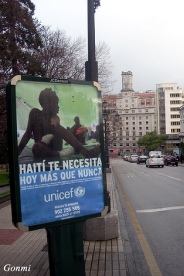
Photo by: Gonmi | Flickr | Creative Commons License

Photo by: Gonmi | Flickr | Creative Commons License

The third anniversary of the devastating earthquake in Haiti has passed with no sign of either serious reconstruction or progress toward improving democratic institutions.About three-quarters of the earthquake rubble has been removed, and several hundred thousand individuals have been moved to temporary shelters and some back into permanent housing. A light-industrial park in northern Haiti is providing jobs to some 1,300 workers. The U.S. Government alone has committed over $3.6 billion toward relief, recovery, and reconstruction, of which $2.5 billion has been disbursed as of September 30, 2012. Despite these billions, the infrastructure remains a shambles; the economy is weak; unemployment is around 40 percent; and the World Food Program estimates that 6.7 million people (out of a population of 10 million) are “food insecure.”

Progress in political affairs has also been slow, and incumbent leaders remain reluctant to commit to elections. The head of MINUSTAH, Chilean diplomat Mariano Fernández, last week reiterated calls for the Haitian government to hold legislative and local elections that were supposed to have been held a year ago. He said an agreement reached last month by President Michel Martelly and members of parliament to form a semi-permanent electoral council to stage elections for one-third of the 30-seat senate and local mayors was “an important first step.” The U.S. Assistant Secretary of State for Democracy, Human Rights and Labor, Michael Posner, also tried to emphasize the positive during a recent visit to Port-au-Prince, but noted “there is a lack of faith in the system, the sense that the rule of law is not respected, that institutions like the judiciary and the police and the prisons and the prosecutors are not doing the job adequately, and that the government isn’t living up to expectations.”

The Obama Administration’s pledge to “build back better” may have been slightly bold from the start, but one of the objectives – to use the crisis to drive some reforms in both the Haitian government and how international programs are implemented – was indeed within reach. The business-as-usual approach since the earthquake has led to the loss of a historic opportunity to move the country forward. While the Haitian political class continues to focus on its internecine struggles, the international community has funneled its vast funds to its own NGOs, most of which operate outside a master strategy and far from the political and bureaucratic authorities nominally in charge of overseeing and coordinating their programs. Real progress is unlikely until both local and outside players develop a shared vision for the future – hopefully before another natural disaster pushes the reset button again.

Central American Elites Are Evolving But Cling to Power

From left to right: Manuel Torres, Ricardo Barrientos, Hugo Noé Pino, Aaron Schneider and Elizabeth Oglesby participating in the project seminar in Costa Rica

From left to right: Manuel Torres, Ricardo Barrientos, Hugo Noé Pino, Aaron Schneider and Elizabeth Oglesby participating in the project seminar in Costa Rica

The sources of Central American elites’ wealth are evolving, as are their fundamental interests and the ways they wield political power.  Land‑intensive production – the focus of decades of insightful scholarship – continues to prevail in Guatemala and Honduras, but the economically powerful now maintain their position through a growing array of service-sector activities and by capturing rents from public coffers.  Changes in their economic foundations are but one of several transformative processes that swept the region beginning during the 1980s, making the past three decades a period of fundamental rupture with the past.

  • Civil wars in El Salvador, Guatemala and Nicaragua during the 1980s transformed the economies in all three countries and had spillover effects in Costa Rica and Honduras.  Most striking is the case of El Salvador, where elites abandoned the countryside upon which they had depended from time immemorial, never to return.
  • Structural adjustment programs, implemented throughout the region during the 1990s, changed the role of the state in Central American economies and thus the ways in which the public sector intersected with the elites’ wealth-accumulation strategies.  Hasty and corruption-ridden privatizations, in particular of energy and telecommunications and of an array of public services, created a reformist façade but gave private-sector groups a piñata that helped to ensure uninterrupted enrichment.
  • During that same decade, transitions to electoral democracy contributed to elite reliance – albeit with some important exceptions – on political parties, campaign strategies and legislative lobbying to protect their interests.  Ties to military and death squad enforcers are no longer the principal vehicles for the enforcement of elite imperatives, though Honduras today is increasingly reminiscent of the worst times in Guatemala and El Salvador.

Central America’s elites have yet to offer the region a vision of reform that will enable the isthmus to overcome misery, exploitation and predatory rule.  While dominant groups have embarked on aggressive state-building strategies, experts question whether these are producing the virtuous dynamics that advance the general welfare of the population and ensure effective governance. 

Scholars from across Central America have reached these conclusions through research and seminars under a multi-year AU program on Central American elites and power.  To foster better understanding of the shifting landscape in the region, and thus to illuminate plausible paths toward more equitable distribution of power and resources, the Ford Foundation is supporting this effort, undertaken in partnership with more than two dozen researchers from institutions throughout the isthmus and the United States.  The project was the focus of a recent workshop at FLACSO Costa Rica, and several publications will result over the course of 2013 and 2014.  Click here for more information.

Political Participation in Latin America Expanding

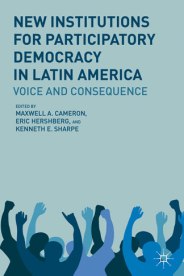
participatory democracy coverFrom local citizen initiatives to national referenda, mechanisms of direct political participation have been spreading with astonishing vigor throughout Latin America in recent years. Some of these mechanisms are new and unprecedented in the way they involve citizens in politics, such as frequently touted participatory budgeting systems at the municipal level in numerous countries.  Other initiatives, such as the National Policy Conferences that consult the citizenry regarding an array of issues in Brazil, are less widely known. In most Andean countries and to some extent elsewhere, these forms of participation often emerge where established representative institutions, such as party systems, have collapsed, or where legislatures have fallen into disrepute.  Yet they also proliferate alongside strong parties, legislatures, and interest associations, as we see in Brazil and Uruguay.

A recent CLALS-sponsored book* examines these new forms of participation and analyzes when they promote, and when not, the consolidation and deepening of representative institutions. The participatory innovations vary along a number of key dimensions, including how they interact with political parties and established institutions, their focus on collective versus individual rights and, perhaps most importantly, their autonomy from political and economic elites.  These differences and their implications are analyzed in detail in case studies on seven Latin American countries: Bolivia, Brazil, El Salvador, Mexico, Nicaragua, Uruguay and Venezuela.

When new forms of political participation emerge spontaneously and independently – as a natural reaction to an unfulfilled need at a local or national level – their voices are authentic and tend to enhance democratic rule.  Brazil’s National Policy Conferences and Uruguay’s referenda to enhance accountability are examples of the incorporation of new voices in policy formulation – to the benefit of the constituencies driving them and the nation as a whole.  We also find instances where participation has exacerbated and reinforced longstanding patterns of clientelism (including in Mexico and Brazil), and autocratic leaders have sought to create or capture such voices to bypass representative institutions (including in Nicaragua and Venezuela).  A valuable lesson of this research, however, is that, once in place, these spaces may become increasingly autonomous. Venezuela’s community councils are an important case to watch: created to reinforce the Chavista project as defined by the Casa Rosada, they may take on a life of their own when the politicians who sponsored them relinquish their positions of power or pass away.

New Institutions of Participatory Democracy: Voice and Consequence, published by Palgrave Macmillan 2012, resulted from a multi-year project co-organized by CLALS and the University of British Columbia’s Andean Democracy Research Network.  More information on the project can be found here .  (The volume has also been published in Spanish by FLACSO-Mexico, Nuevas instituciones de democracia participativa en América Latina: la voz y sus consecuencias)

Top Five Events of 2012

A poll of contributors to AULABLOG identified the following five events (listed below in no particular order) as the most important in Latin America in 2012.  We welcome you to post your own list using the Leave a Comment link below.

By: Matt Westgate "Mettamatt" | Flickr | Creative Commons

By: Matt Westgate “Mettamatt” | Flickr | Creative Commons

Venezuelan President Hugo Chavez’s third major cancer surgery signaled that change – probably profound – will come to Venezuela much faster than his presidential campaign let on.  We expect growing tensions among his aides, none of whom has his charisma or base, as they jockey in a succession scenario.  We’ll be watching whether the PSUV can become an institutionalized mechanism for channeling Chavismo’s support into a governing project in the post-Chavez era.

The election and inauguration of Mexican President Enrique Peña Nieto signals a natural swing back to PRI leadership after 12 years of PAN governments.  Differences over the approach to counternarcotics might flare up in an overall smooth relationship with the United States, but the new president’s biggest challenge is going to be overcoming the persistent economic backwardness that has kept Mexico from achieving the economic growth of others since the turn of the century.

The ouster of Paraguayan President Fernando Lugo last June – as well as the United States and Latin America’s ambivalent reaction to it – was a dramatic illustration that democracy in the region rests on a tenuous foundation of sometimes contradictory constitutions and weak institutions.  The continuing struggle of Honduran President Pepe Lobo, three-plus years after the coup that removed President Mel Zelaya, shows that failure to bring those whose power grabs violate laws and the spirit of law to account sows the seeds of long-term instability and even greater threats to democracy.

The Colombian peace talks, the first serious attempt in 10 years at resolving the decades-old conflict, could lead to a watershed in that country’s development.  President Juan Manuel Santos has shown strong leadership, despite incessant carping from his predecessor, Alvaro Uribe, and has smartly acknowledged that success in the talks is far from certain.  If the talks are successful, 2013 could be a defining moment for a country already experiencing strong economic growth and an important degree of social progress.

Washington continued to sit on the sidelines on most regional issues.  President Obama got a spanking at the Summit of Americas from even perennially friendly governments for Washington’s approach to counternarcotics (overly militarized) and Cuba (stuck in the Cold War).  He was silent on Latin America during the campaign, and his rhetoric of “partnership” and “neighborhood” remained unfulfilled.  Although the President won kudos for implementing elements of the Dream Act by Presidential Directive, the Administration boasted of deporting more than 400,000 illegal immigrants in 2012, the most of any year in the nation’s history.  The region is likely to remain eager for U.S. leadership on issues of mutual interest in 2013, but most countries’ blossoming dealings with Europe, Asia and even Africa suggest they’re not going to sit around waiting for the U.S. to take up the challenge.

Honduras: What is U.S. policy?

The sustained surge in crime and violence in Honduras – including more than 60 politically motivated murders in the past year – is raising doubts about the viability of the government and its institutions.  The term “failed state” is often abused, but there’s no doubt that Honduras falls short of the rhetoric about its stability and democracy that the Obama Administration recited when arguing for the country’s readmission to the OAS after the 2009 coup that removed President Mel Zelaya.  Indeed, the coup set the country on a downward spiral from being a weak democracy to one struggling for basic credibility.  The U.N. Office on Drugs and Crime says Honduras has the world’s highest murder rate – 91.6 murders per 100,000 inhabitants in 2011.

Undersecretary of State María Otero has spent time and energy trying to establish a policy toward Honduras.  During a visit to Tegucigalpa last month, she signed an agreement with Foreign Minister Corrales that “sets the stage for results-oriented action towards our shared objective of a safe Honduras that respects the rule of law and human rights,” and she announced that the United States would provide an additional $1.8 million in aid to help counter gang activity in Honduras.  Despite her efforts, the State Department and the U.S. Embassy in Tegucigalpa have failed to go beyond ready-made programs and put in place a framework for a comprehensive policy.  Programs are not policy.  The Administration appears reluctant to admit that its Honduras policy, which has failed, needs an overhaul.

Multimillion-dollar programs will not succeed until they take into account that the Honduran “partners” upon which they depend are themselves at the core of the problem.  Three years after the coup, the Obama Administration still fails to see that its allies in the struggle against transnational and local gangs, as well as its efforts to build judicial institutions, are the same people who mocked the rule of law, overthrew the previous president, and re-politicized the military and police to serve their own purposes.  (The reasons for Washington’s unwillingness to help fund a “Commission for Security Reform” approved by the Honduran Congress are unclear, but this may be a factor.)  There are strong suspicions in many sectors of Honduran society that members of the country’s political-economic elite are the sponsors of the sicarios (hired gunmen) who have killed dozens of citizens whose offense was to demand an end to government impunity.  Given the challenge that the growing popularity of the country’s new political party, LIBRE, poses to traditional powerbrokers, informed observers expect violence to increase in the run-up to elections next year.  Absent public explanation of U.S. policy, it is fair to ask why Washington hasn’t seen these patterns – obvious to Hondurans – and why it hasn’t offered sustained support from the FBI and other U.S. law enforcement to investigate the assassinations and trace them back to the power bosses.  It is also fair to ask Assistant Secretary of State Brownfield and others who espouse the militarized approach to dealing with organized crime how this strategy, which has failed elsewhere, will succeed in Honduras.  Why hasn’t the Obama Administration supported the sort of U.N.-sanctioned investigative capacity that has proven effective with the International Commission Against Impunity in Guatemala?  Why has Washington not even pushed for meaningful implementation of the recommendations of the Truth and Reconciliation Commission released last year?  If Washington wants to make its rhetoric about Honduras into reality, it needs to do more than just to funnel funds into programs run by questionable partners.