Is a “CICIH” the answer to Honduras’ Crisis?

By Fulton Armstrong and Eric Hershberg

Photo Credit: US Embassy Guatemala / Flickr / Creative Commons

Photo Credit: US Embassy Guatemala / Flickr / Creative Commons

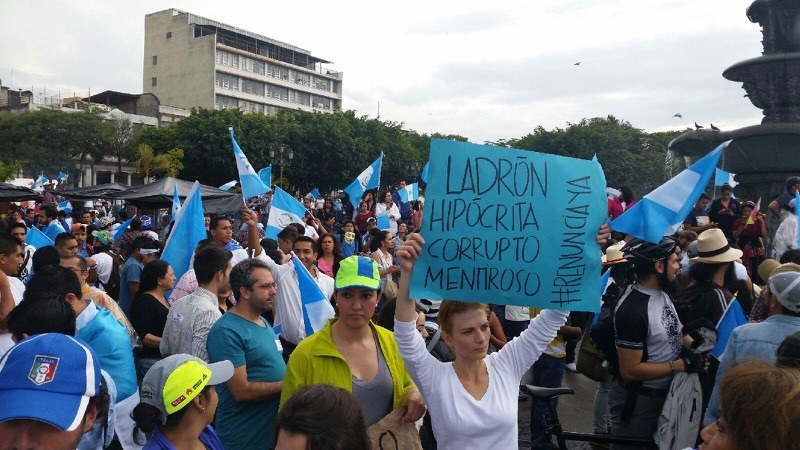
The success of the Comisión Internacional Contra la Impunidad en Guatemala (CICIG) in driving anti-corruption efforts there – culminating in the resignation of President Pérez Molina – has stoked debate in neighboring Honduras on the wisdom of creating a “CICIH” with the same mission to root out the rot that permeates state institutions and perpetuates the misery of the citizenry.  President Juan Orlando Hernandez has stated categorically that no such entity is needed in Honduras given advances in the country’s own institutions and his own putative commitment to good governance.  Some civil society organizations are at least implicitly concurring by taking part in accountability initiatives involving collaboration with the government.  Other voices from civil society are objecting vociferously, however.  Most notable among them are the indignados, a largely youth-based movement that insists that the President himself and virtually the entire institutional system in Honduras is so rotten that only an international body can be trusted to root out endemic corruption.  The argument rages on, with the indignados staging regular demonstrations and the government – occupied simultaneously with promoting its credibility at home and abroad and maneuvering to secure authorization for presidential re-election – holding fast to its opposition to any such international role.  The debate will continue for the foreseeable future.  We sketch below our understanding of the competing arguments.

Arguments in favor of a CICIH:

By nearly all accounts, corruption has rendered the public and private sectors chronically ineffective – from the President (who admitted that millions from Social Security made it into his campaign coffers and who engaged in nepotism), through the government ministries and even the judicial bureaucracies (where political pressure, intimidation, and bribery are rampant), and companies large and small (for whom payoffs are merely an added budget item).  The country has topped the charts in non-war homicides, including targeted killings, and other violence for several years, further discouraging investigations and prosecutions.  The flood of narcotics and cash through Honduras has thrown fuel onto the flames.  Only an independent, UN-endorsed entity like a CICIH – with its unique ability to train, protect, and motivate judicial personnel, issue indictments, and put powerful people in jail, and shame local government into taking action – can help the country climb out of this deep hole, this argument goes.

Arguments against:

Steven Dudley of InSight Crime notes that the call for a CICIH comes at a time that the Attorney General’s office is showing some signs of life.  Its anti-corruption efforts have led to the indictment and arrest of the former head of the Social Security Institute on charges of embezzlement and illegally financing political parties (although some charges were dropped).  Combating crime, cheaper homemade solutions are showing results in Honduras in terms of training and cases resolved.  Organizations like the Asociación para una Sociedad más Justa (ASJ) are doing groundbreaking work to keep homicide levels down in some of the worst neighborhoods at a fraction of the cost of a CICIH.  Expense is another important factor.  In Guatemala the CICIG costs between $12 million and $15 million annually, which even that country, far wealthier than Honduras, cannot afford.  CICIG has provided valuable assistance and training to Guatemala’s Attorney General’s Office, but its foreign investigators, who move around in armored vehicles with armed bodyguards, leech massive resources that might otherwise go to fortify local prosecutors’ offices.  Moreover, according to this argument, the investigators don’t need foreign prosecutors to tell them what they’re doing wrong.

Skeptics further contend that international donors and pro-reform Hondurans arguably will not get the quick fix and public relations victory they want from a CICIH.  It took over a decade for CICIG to set up in Guatemala and nearly eight years to get the right mix of cases.  Its greatest strategic goal – fortifying Guatemala’s justice system – remains a work in progress.  The Guatemalan Attorney General’s Office has not yet executed a complicated, forensic investigation leading to a high-level prosecution.  Honduras’s greater reliance on foreign assistance, according to this argument, suggests a CICIH would actually enable its dependency, rather than break it.

The weakness and rot within Honduran institutions and the venality of national leadership strongly suggest that neither approach – a foreign-backed entity like CICIH or a home-grown solution – could quickly reverse the tsunami of corruption and violence that the isthmus’s poorest country has been experiencing since the 2009 coup.  Ideally, the best of Honduras’s own efforts could be buttressed by a Honduran version of the CICIG model, but the knack of the country’s leaders for overwhelming even the best of intentions, as they did the “Truth Commission” charged with determining accountability for the coup and rights abuses carried out in its aftermath, argues for extreme caution in forming expectations.  The debate therefore may boil down to the moral argument of whether the international community, witnessing Honduras’s descent into utter lawlessness and destitution, can stand idly by or should at least offer its help in what form it can, such as a CICIH.  Even if a CICIH is not a panacea, it at least would send a powerful message to Honduran elites that the world is watching.

September 15, 2015
Guatemala’s Crisis is Not Over

By Eric Hershberg*

Guatemala City, August 2015. Photo Courtesy of Eric Hershberg.

Guatemala City, August 2015. Photo Courtesy of Eric Hershberg.

With President Otto Pérez Molina’s resignation early this morning, Guatemala lurches into a new phase in its long-running political crisis, with little prospect that this weekend’s elections will resolve much.  The investigations into the Pérez Molina administration’s corruption, the national assembly’s unanimous vote to suspend his immunity, and the peaceful surge in popular protests demanding that he step down all suggest progress in the country’s efforts to build a functioning democracy.  The UN-sponsored Comisión Internacional Contra la Impunidad en Guatemala (CICIG) fulfilled its mandate, and its example and training were arguably important factors in the ability of judicial officials in Pérez Molina’s own government to support the processes that led to his downfall.  (Click here for an AULABLOG assessment of CICIG in May.)  The Congressional vote to strip him of immunity was unanimous, including even his most loyal supporters, who until then had rejected popular clamoring for the president’s ouster.  By the end of last week societal disgust with the political elite had reached the point that even the most recalcitrant of incumbents realized that their own survival required ditching the president.  The comptroller’s office called on him to resign “to avoid greater social unrest that could have unpredictable consequences” – a sentiment echoed by powerful business groups and the Catholic Bishops Council.

The Guatemalan Constitution and laws lay out the next steps.  The Congress has accepted the resignation, clearing the way for Vice President Alejandro Maldonado – who replaced Vice President Roxana Baldetti after she was jailed in connection with the same corruption scandal – to take office.  The first round of Presidential elections, with 15 candidates in the running, will proceed as scheduled this Sunday, despite calls from some civil society organizations to delay the balloting on grounds that the campaign regulations reflect the influence and interests of criminal elements.  In all likelihood, a runoff round will be necessary six weeks later (October 25).  The convulsions of recent months and deep distrust in government suggest that tensions will be high between now and then, but there’s no indication yet that civil unrest could threaten the electoral process, and military intervention appears to be a thing of the past.  There is every reason to expect that a new President will be inaugurated on January 14.

The elections are unlikely, however, to lead Guatemala into an era of less corruption and greater accountability, or to install leadership willing or able to spearhead economic and social policies to enable the majority of the population to live with dignity.  The slogans on the banners of the tens of thousands of protestors in Guatemala City’s central square lacked any message beyond a rejection of the status quo.  “Throw them all out” and “I have no president”are potent rallying cries but do not address the core challenges of a country where the elite pay no taxes, half of all children are malnourished and tens of thousands of young people desperately seek better lives anywhere other than Guatemala.  

The reputations of the leading candidates and their failure to articulate coherent governing platforms give little room for optimism.  Leading in the polls is a wealthy businessman, Manuel Baldizón, whose running mate is already being investigated for corruption and whose own closet is widely understood to contain plenty of skeletons.  Protestors have already singled out Baldizón as unacceptable, taunting him with chants of “it’s your turn next.”  In second place is a comedian named Jimmy Morales, who enjoys the support of the economic elites and media but has advanced no policy platform whatsoever.  Former first lady Sandra Torres appears to be running third.  She divorced President Álvaro Colom in 2011 to circumvent a court ruling that, as First Lady, she couldn’t run for office.  (The Constitutional Court put a final stop to her campaign a month before elections that year.) 

Electoral victory by any of these candidates would leave Guatemala with weak leadership at a time that most government institutions desperately need revitalization.  Corruption is too deep-rooted for CICIG and its few allies in government to face down alone, and these candidates won’t use the presidency to carry out the needed purge.  The organized criminal groups that traffic drugs and persons through the country and permeate governing institutions stand to grow only stronger, and the misery that plagues a population deprived of education, health care and jobs will continue unabated.  U.S. Vice President Joe Biden’s billion-dollar aid package for Guatemala, Honduras and El Salvador, already in trouble in Washington, may have nowhere good to go.

September 3, 2015

*Eric Hershberg, director of the Center for Latin American & Latino Studies at American University, witnessed the protests in Guatemala City last week.

Dilma – and Brazil – in Crisis

By Eric Hershberg

Photo Credit: Ministério da Ciência, Tecnologia e Inovação / Flickr / Creative Commons

Photo Credit: Ministério da Ciência, Tecnologia e Inovação / Flickr / Creative Commons

Brazil’s corruption scandals and deepening recession have raised doubts about not only the viability of President Dilma Rouseff’s government, but also about the national renaissance and global role that Brazilians have long strived for and seemed only recently to have achieved.  The commodity boom of the past decade propelled Brazil to become the world’s sixth largest economy and make major inroads against its historically obscene levels of poverty and inequality.  Often working in tandem, Brazil’s leading public and private enterprises, assisted by the generous state development bank, prospered immensely and fueled growth in Brazil itself and elsewhere in Latin America, building infrastructure from Ecuador to Cuba.  Four Partido dos Trabalhadores (PT) presidential victories in a row (two each for President Lula da Silva and for Dilma) appeared to validate a development strategy built upon government alliances with ambitious large firms and generous cash-transfer programs for needy segments of the population, which became reliable sources of electoral support.  Brazil, the country that skeptics considered unlikely to ever fulfill its aspiration of becoming more than “the country of the future,” seemed to have turned a historic corner – until it all came crashing down.

With the commodity boom now over, the economy is contracting at an annual rate of more than 2 percent, and a Central Bank survey released last week forecast that the recession will continue into 2016.  The past decade’s extraordinary gains in formal sector employment and wage rates are being rapidly eroded.  The dire macro-economic situation forced Dilma to shift course earlier this year, when to the dismay of her PT base, she appointed pro-austerity economist Joaquim Levy as Finance Minister.  His mandate – to tackle fiscal deficits – required dealing with the end of the commodity-driven cycle of growth and problems with the state capitalist model pursued by the PT since 2004.  Levy’s strategy will take time to bear fruit, probably through most of Dilma’s term, and will be painful.

But the President’s biggest challenges stem from the vast corruption scandals that have devastated her credibility and the reputation of the enormous companies that were the protagonists of Brazil’s latest miracle.  Although Dilma has not been charged with any wrongdoing, the scandalous actions at state oil firm Petrobras, which at its height accounted for as much as 10 percent of Brazil’s GDP, were in full flourish when she was Lula’s Energy Minister and nominally in charge.  Prosecutors have filed evidence of bribery and kickback schemes that bilked billions of dollars from the company’s coffers, and officials in both the PT and allied parties have been charged with serious crimes.  Dilma’s popularity ratings are now in single digits, with little prospect of improvement.  Street protests calling for her impeachment are more focused than those that tormented her in 2013 and 2014, when popular discontent focused less on corruption than on the poor quality of transportation, education, health care, and other public services at a time when the government was making huge investments to prepare for the 2014 World Cup and the 2016 Olympic games.

Further damaging revelations are likely as investigations continue, and they will affect an ever-wider array of political actors and major economic enterprises.  Many of the president’s political foes support either impeachment or resignation, while others are inclined to let her government wither in place.  The key alternative parties – the PSDB of former President Cardoso and the PMDB (the latter rumored to be closer than ever to breaking its tenuous alliance with the President) – are not aligned in a way that establishes a clear path to push Dilma out.  The most optimistic scenario for the President entails remaining, terribly wounded, in office, but this could change if, as many observers believe, the Auditing Court (TCU) determines that Dilma has misused public funds, or if the TSE should press forward with investigations of illegal financing of Dilma’s campaign.  

If two or three years ago it seemed plausible that history would credit the PT for having transformed Brazil into a high-quality democracy with improved social inclusion, today that appears to have been a pipe dream.  Beyond the immediate factor of Dilma’s ineffectual leadership, there are broader, systemic reasons for this tragedy.  Brazil’s fractured party system and the coalition-building it requires engenders corruption-fueled legislative bargaining, as evidenced by the Mensalão scandal.  Brazilian state capitalism has blurred lines between state economic policies and corporate beneficiaries, further fueling a culture of corruption evident by the fact that roughly 40 percent of members of Congress are under investigation, according to the New York Times.  Regardless of whether Dilma survives in office, the current moment has drawn Brazilians’ attention to the deep political and economic roots of their current situation, and dashed their hopes of soon becoming “O País do Futuro.” 

August 24, 2015 

Haiti: Yet More Lost Opportunity

By Emma Fawcett*

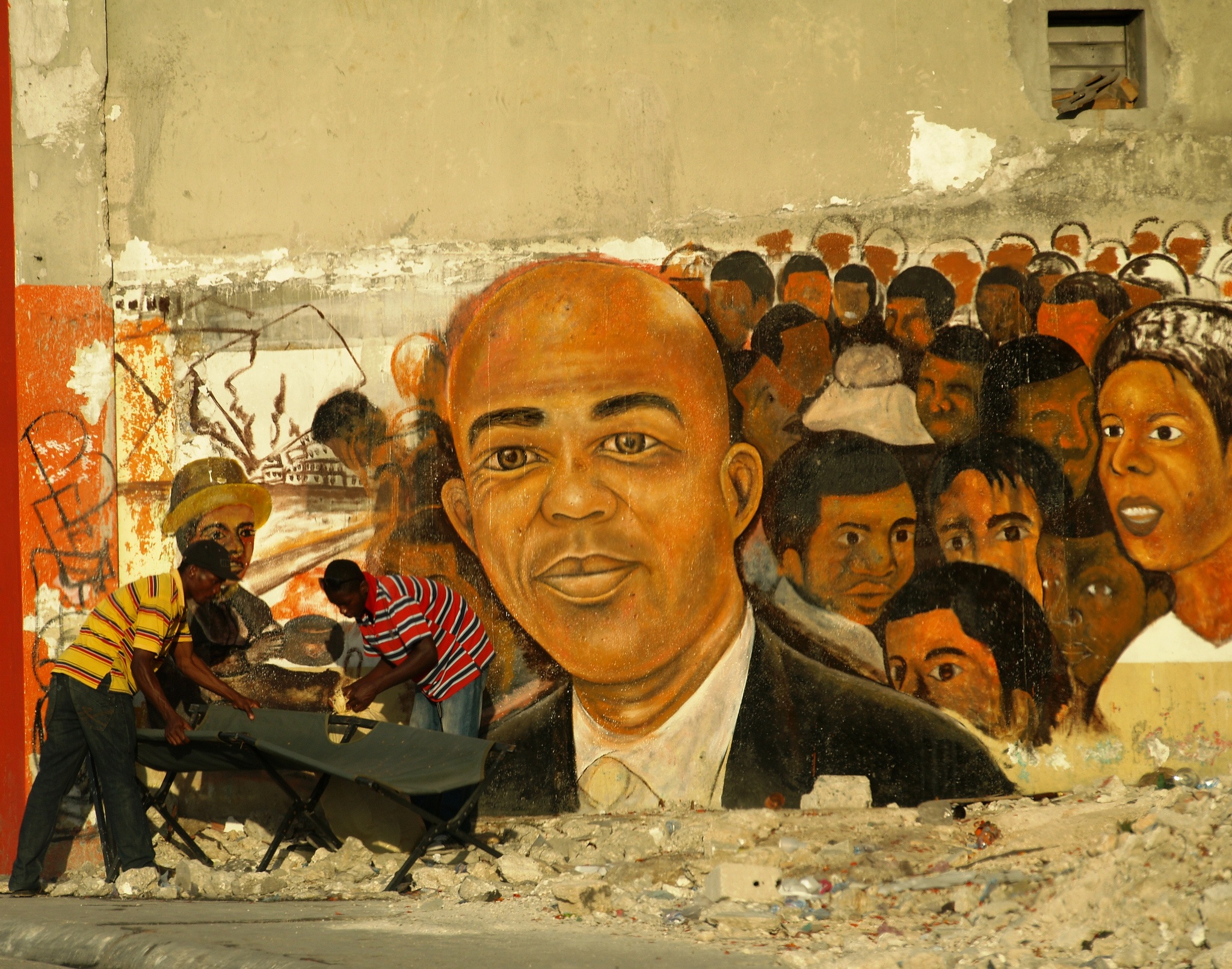
Photo Credit: Nacho Fradejas Garcia / Flickr / Creative Commons

Photo Credit: Nacho Fradejas Garcia / Flickr / Creative Commons

Six months into Haiti’s most recent political crisis, popular uncertainty and frustration are palpable – amid indications that even the Obama Administration may be tiring of corruption and mismanagement under President Martelly.  Officials in Washington in April expressed concerns over the abrupt release of gang leaders alleged to have ties to Martelly who had been held on kidnapping charges.  Recent U.S. Embassy tweets have focused on the importance of press freedom and free and fair elections.  Protests are a regular occurrence, and anti-government graffiti covers buildings throughout Port-au-Prince.  Martelly’s network of old friends – whom some long-time Haiti-watchers have called “nefarious characters” – has been politically useful to him, and various press reports indicate that criminal prosecutions against them for drug trafficking, kidnapping, and worse have mysteriously dropped off the books.  Criticism of his record on other issues is also strong.  A visit from Beyoncé on May 16 led the US Embassy to ask its Facebook followers: “Where should she go to see the progress in Haiti? Let us know!”  Social media users mocked, “What progress?” and derided the embassy for asking.  Washington politics, such as criticism of Bill and Hillary Clinton’s role in Haiti, is further casting a shadow on Martelly and his government.

The country has made partial progress towards holding its long overdue elections, but – if history and Martelly’s record are any guide – obstacles could easily arise.  A list of candidates has been approved, and dates have been set – August 9 for Parliamentary elections (all 118 seats in the Chamber of Deputies and 20 of the 30 seats in the Senate).   Presidential elections will take place on October 25, with a December 27 runoff if necessary.  But the process has not been without controversy: a quarter of the 2,039 who had registered to be candidates have been disqualified for various reasons.  (First Lady Sophia Martelly wanted to run for Senate but was not accepted because she is a U.S. citizen.)  As the government has not provided explanations in most instances, accusations that the exclusions were politically-motivated abound.

Martelly’s carefully calculated consolidation of power over the last four years has led many observers in Haiti to wonder whether he will actually make elections happen and leave office on schedule.  Many of them are perplexed by what they perceive as steadfast U.S. support for him.  Even in January, when an agreement on elections fell through once again and Martelly commenced to rule by decree, the State Department’s admonishment was widely seen as weak.  Rather than building bridges at home, Martelly has often appeared more externally focused – capitalizing on his ties to the Clintons, who along with the OAS helped him secure the contested presidency in the first place; declaring that Haiti is “open for business”; and holding his historic meeting earlier this month with French President Francois Hollande.  Indeed, the Hollande visit resulted in yet more protests in Port-au-Prince’s streets from those frustrated by France’s refusal to pay reparations for past abuses – such as the “independence debt” that France demanded, which consumed 80 percent of Haiti’s budget for 125 years (the equivalent of $17 billion dollars today).  Predictions about the elections and transition of power at the end of the year would be premature, but Martelly already seems to have squandered his chance to leave a legacy of progress, institution-building, and stability for the nascent Haitian democracy. 

June 1, 2015

*Emma Fawcett is a PhD candidate in International Relations at American University.  Her doctoral thesis focuses on the political economy of tourism and development in four Caribbean case studies: Haiti, Dominican Republic, Cuba, and the Mexican Caribbean.

Civics Lessons from Guatemala

By Robert Brenneman*

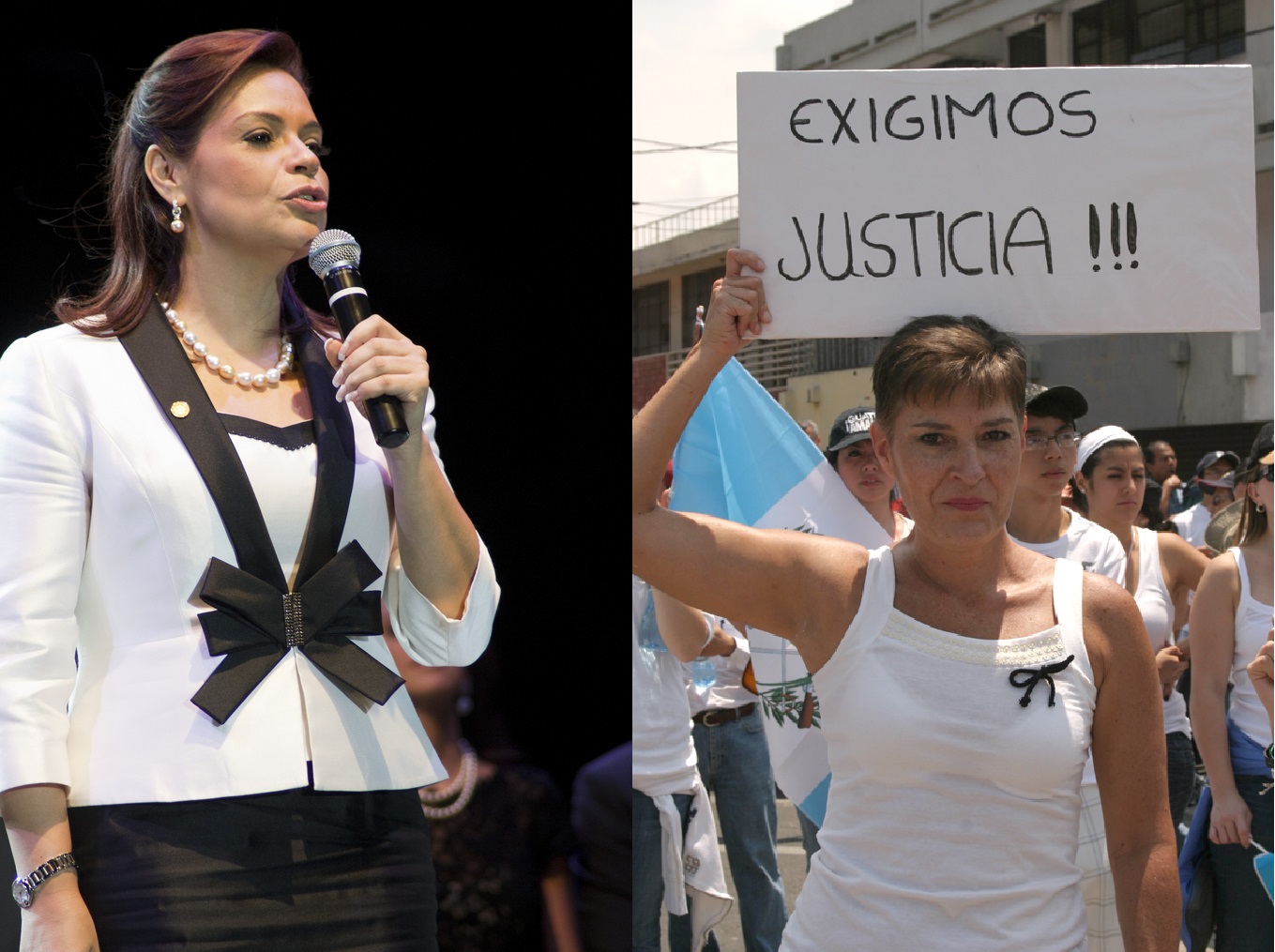
Former Vice President of Guatemala Roxana Baldetti (l) and a protestor with sign "We demand justice" Photo Credits: Surizar / Flickr / Creative Commons

Former Vice President of Guatemala Roxana Baldetti (l) and a protestor holding sign that proclaims “We demand justice.” Photo Credits: Surizar / Flickr / Creative Commons

Guatemala’s popular movement for justice and transparency is suddenly and happily discovering that nothing breeds success like success.  Many Guatemalans have grumbled for years about rampant corruption among the political class, but in recent weeks a surging popular movement has finally emerged giving voice and energy to years of that frustration with impunity and graft.  The movement picked up steam after a public exposé of a shadowy tax fraud and contraband network called “La Línea,” orchestrated out of Vice President Roxana Baldetti’s office by her private secretary.  The report was produced by the International Commission against Impunity in Guatemala (CICIG).  (Click here for analysis of the Commission’s renewal.)  President Pérez Molina not only renewed CICIG’s term until 2017; on May 7 he also accepted the resignation of Baldetti and her secretary, who had served as the key money-raising dealmakers for his administration.  The U.S. Embassy suspended the visas of many of the officials named in the report, including the luckless former vice president herself.

These actions have not been enough to appease the appetite for justice and transparency sought by the growing crowds of flag-waving nonviolent protestors converging each Sunday afternoon in front of the Guatemala City’s Municipal Palace.  An estimated 57,000 gathered under thunder and pouring rain on May 17.  Empowered by the relatively swift impact of their movement, and outraged by the mounting evidence pointing to the president’s personal connections to the corruption network, the crowds of protestors  led principally by students of the public university  have shifted to demanding that the president himself step down.  Pérez Molina, sensing that the wheels are coming off his administration, has requested the resignations of his closest advisors and top officials, including his Interior Minister and his Chief of Strategic Intelligence.  He has revoked or rescinded several of the most lucrative (and obviously corrupt) government contracts that he had vociferously defended only a few weeks ago.

President Pérez Molina’s political future remains up in the air.  Many Guatemalan political analysts believe he should step down.  José Rubén Zamora, founder of Guatemala’s influential daily El Periódico, argues that resigning is “the only way out of an impossible labyrinth” of the president’s own making.  But many others view the president’s fate as less important than whether the country takes advantage of the opportunity to use public pressure to pass sorely needed structural reforms.  For years Congress has ignored several bills that would tighten campaign finance rules and bring transparency to government contracting.  Since pay-to-play politics is not unique to this administration, fixing the problem will require legal and structural changes, not merely changing the nameplate on the presidential suite.  One hopeful sign is that Manuel Baldizón, leader of the opposition Renewed Democratic Liberty Party (LIDER), has not managed to coopt the popular outrage to kickstart his own election campaign.  A popular banner at the protests warns him “¡No te toca!” (“It’s not your turn!”).  The leaders of the movement recognize that Baldizón – who has many skeletons in his own closet and heads another investment-financed party – is hardly the answer.  The protesters’ focus on reform rather than politics suggests that the most certain – and long-lasting – outcome of all is the strengthened civic sphere that appears to have emerged as the protests grow and the newspapers report daily arrests and resignations.  In this civics lesson, the Guatemalan public is both pupil and teacher.

May 26, 2015

*Dr. Brenneman teaches sociology at St. Michael’s College and is author of Homies and Hermanos: God and Gangs in Central America (Oxford University Press 2012).

CICIG: Model for Northern Triangle

By Fulton Armstrong and Héctor Silva

Photo Credit: Mike Gifford and Nicolas Raymond / Flickr / Creative Commons

Photo Credit: Mike Gifford and Nicolas Raymond / Flickr / Creative Commons

Guatemalan President Pérez Molina’s announcement two weeks ago that he would seek another two-year renewal of the Comisión Internacional Contra la Impunidad en Guatemala (CICIG) has been well received everywhere except in neighboring countries, which would benefit greatly from similar outside assistance.  A broad array of leading Guatemalans have welcomed the move, as have the UN and the United States.  U.S. Secretary of State Kerry said it “is a major step forward in the fight against organized crime … and will advance the goals of Guatemala and the United States as articulated in the Plan of the Alliance for Prosperity in the Northern Triangle.”  First created in 2007 to support prosecutions of cases involving corruption and impunity and to strengthen the country’s judicial sector through legal reforms and training, CICIG has been renewed every two years since.  Its commissioner, Colombian jurist Iván Velásquez, said CICIG “commits to the government and society to make every effort in support of Guatemala’s aspirations to consolidate institutions, to offer more analyses, to formulate proposals to strengthen institutions, to continue criminal investigations that we carry out shoulder to shoulder with the Public Ministry, and to continue building the capacity of judicial institutions.”

CICIG’s record shows that, on balance, it has made unique, positive progress to meeting Guatemala’s need for prosecution of impunity and for reform.  The Washington Office on Latin America and other key observers have given CICIG high grades because, as WOLA said in a recent report, it has provided “important investigative tools for the prosecution of organized crime … [and] helped to resolve emblematic cases of corruption and it has dismantled powerful criminal networks deeply embedded in the state.”  Daniel Wilkinson, managing director of the Americas division at Human Rights Watch, told the Guatemalan El Periódico that CICIG has “almost been a miracle.”  While it’s made some mistakes, he said, “The surprising thing is everything that CICIG has achieved in these years” in high-profile cases.  InSight Crime notes that the recent case against extortionist Byron Lima, who had suborned the head of the prison system, was impressive.  InSight Crime and others also say, however, that CICIG “has proved unable to sufficiently reform the country’s judicial system.”  InSight Crime reported that, despite its $12 million a year budget, the body is still struggling to train and foster an independent judiciary – that is, encouraging Guatemalan justice to work on its own.

Velásquez and his team will face tough challenges in the new mandate.  There are rumors that President Pérez Molina – who previously said he wouldn’t extend CICIG under the “threat of blackmail” – intends to rein the body in, and the retrial of former dictator Ríos Montt, currently projected to be in 2017, looms on the horizon as a further test of Guatemalan resolve to deal with impunity.  Nonetheless, CICIG is nearly universally seen as providing assistance that all three countries of the “Northern Triangle” of Central America need – to foment rule of law, build confidence in justice, and clean up state institutions – and it has achieved reforms when the political will was sustained.  CICIG’s status as an advisory body in support of the government has enabled it to finesse the legal and political need to fully respect sovereignty.  Honduran and Salvadoran leaders have made statements suggesting openness to the idea but, apparently for different reasons, don’t want independent investigators upsetting the applecart.  Salvadoran President Sánchez Cerén has less to fear from examination of his administration and his predecessor’s record on impunity and organized crime, but he may be concerned that a CICIG-style unit would dangerously aggravate his opponents, who retain intimidating power through many sectors.  The failure to push for CICIG to realize its full potential in Guatemala and for similar mechanisms in El Salvador and Honduras will only slow the sort of reforms the Northern Triangle needs to overcome its political, social, and economic challenges crises.

May 4, 2015

Honduras: Dare Anyone Criticize?

By Fulton Armstrong

Hernandez Honduras

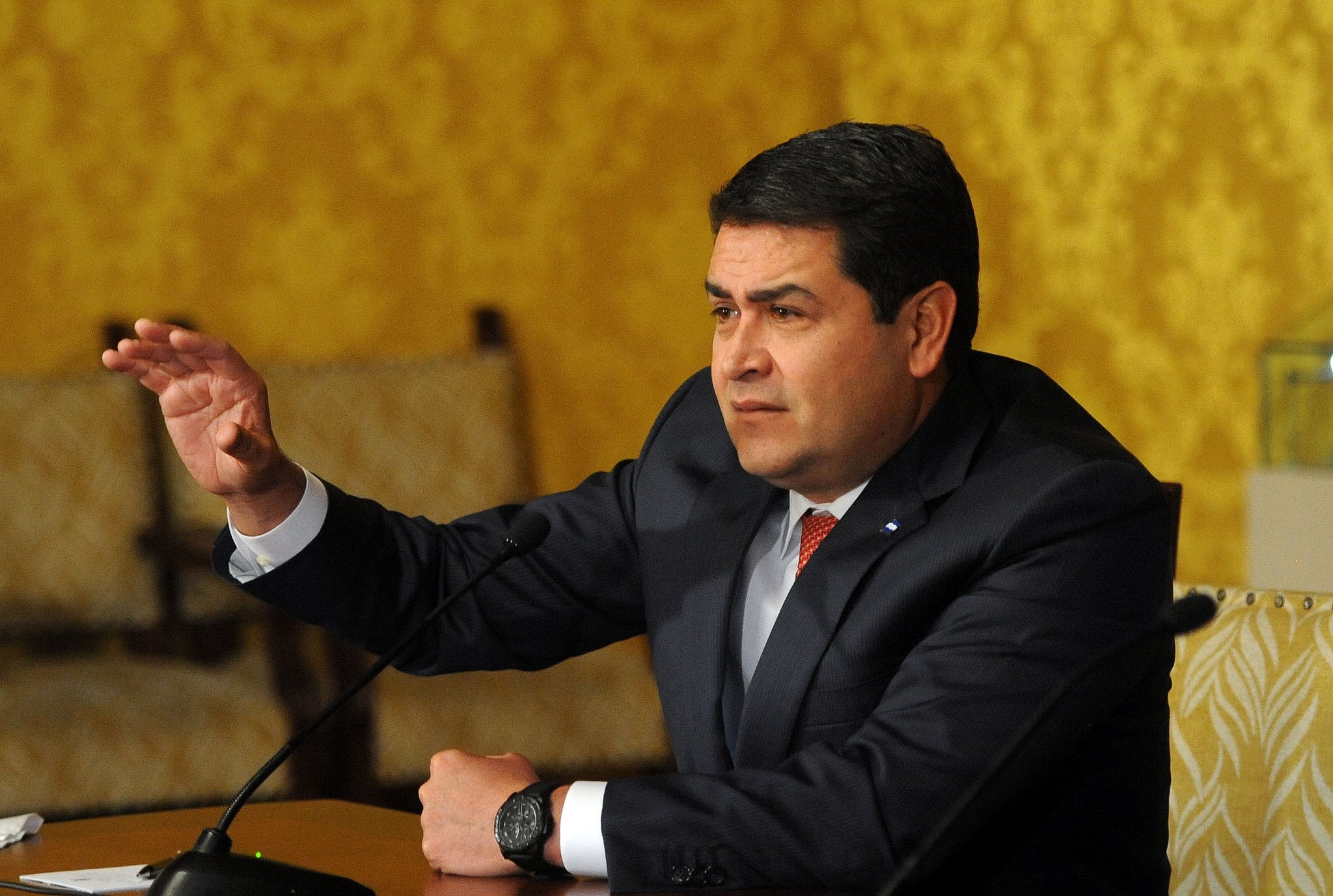
Honduran President Juan Orlando Hernandez. Photo Credit: Presidencia de la Republica del Ecuador / Flickr / Creative Commons

The decision last week by the Constitutional Chamber of the Honduran Supreme Court to legalize presidential reelection appears to have benefited a man – current President Juan Orlando Hernández – whose political fortunes got a shot in the arm from the 2009 coup that removed President Mel Zelaya for proposing a constitutional assembly to consider just such an action.  A Liberal Party magistrate said he wanted to recant his vote the next day, but the ruling party published the decision in the Gaceta Oficial before he could.  The Supreme Court, ruling in favor of petitions by former Nationalist President Rafael Callejas and several members of Hernández’s National Party, repealed two key articles of the Honduran Constitution, including one that says “the citizen who has served as the head of the executive power cannot be president or presidential candidate.”  Callejas immediately announced that he was resurrecting his Callejista movement, called MONARCA, which won him the presidency in 1990, and his campaign literature appeared in the streets of Tegucigalpa soon after.

The Court did not explicitly overturn Article 4 of the Constitution, which states that an “alternation in the exercise of the presidency of the republic is obligatory.”  That action reportedly will fall to the National Party-led Congress, but President Hernández is almost universally seen as the big winner from the Court decision, culminating his effort to continue as President.  After the coup that removed Zelaya from power, Hernández had a hand in congressional strategies to give a constitutional and legal framework – widely debunked – to Zelaya’s military ouster and later, while serving as president of the Honduran Congress and while campaigning for president, Hernández engineered the removal of four of the five justices of the constitutional chamber of the Supreme Court and replaced them with more sympathetic judges.  He subsequently had a role in selecting a replacement for the fifth, who became Attorney General – making for a court unanimously indebted to him.  (He was sworn in as national President in January 2014.)  Reacting to the court decision last week, Hernández noted that “reelection is something that is a general rule around the world … Prohibition of it is the exception … [and] Honduras has to make progress.”  His opponents have vowed to fight the repeal.  Leaders of the Partido de Libertad y Refundación (LIBRE) have accused the justices of “betrayal of the fatherland.”  One said the court “guaranteed the impunity” of the Hernández government, but the opposition’s legislative strategies have failed before.

Representing Central America’s most violent and most corrupt nation, President Hernández is seen in Washington as essential to success of U.S. policy in Central America and initiatives such as the “Alliance for Prosperity of the Northern Triangle.”  With a request for a billion dollars on its way to the U.S. Congress, the Obama administration can ill afford to point out Hernández’s hypocrisy for doing what he condemned former President Zelaya for trying to do in 2009.  Political inconveniences aside, the political cynicism and tensions that his and former President Callejas’s maneuvering will incite in violence-ravaged Honduras can hardly be seen as helpful to the goals of good governance and democratic consolidation that all profess.  When Nicaraguan President Daniel Ortega engineered a similar judgment by his Supreme Court in 2009, allowing him to run for an additional term, the State Department did not mince words about its “concern” for its implications.  Hernández, in contrast, was in Washington securing support for funding when his court announced its decision.  The U.S. Southern Command’s new task force of some 250 Marines is expected to arrive in Honduras and begin training of security forces involved in “fighting the drug traffickers.”

May 1, 2015

Corruption in Chile and Brazil

By Luciano Melo

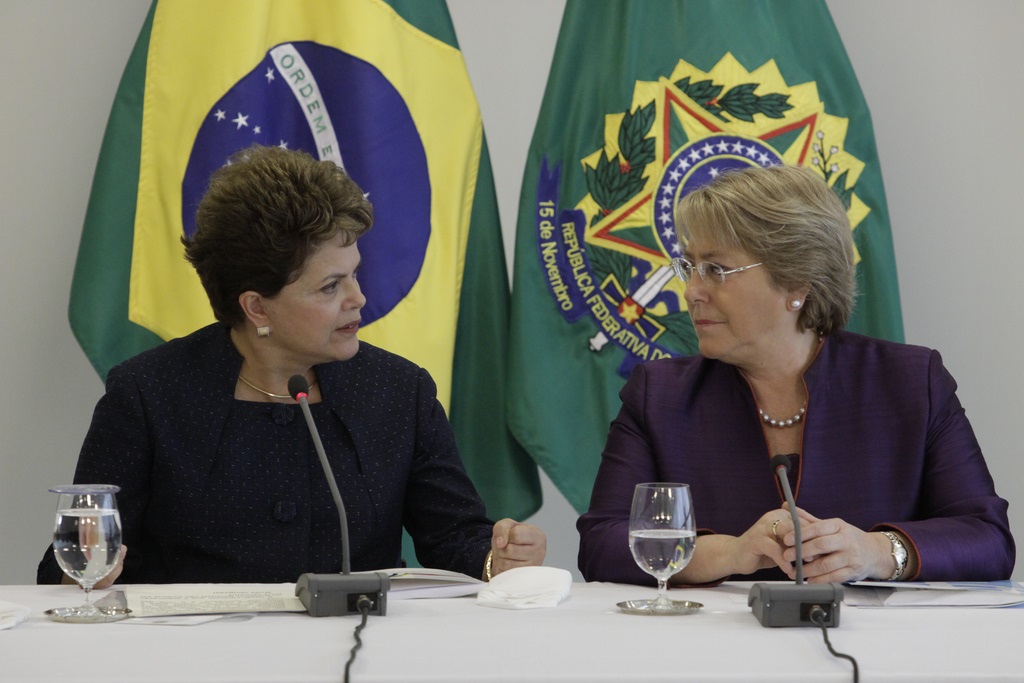
Brazilian Pres. Rousseff (l) and Chilean Pres. Bachelet. Photo Credit: UN Women / Flickr / Creative Commons

Brazilian Pres. Rousseff (l) and Chilean Pres. Bachelet. Photo Credit: UN Women / Flickr / Creative Commons

A growing perception of corruption in Latin America, most recently in Brazil and Chile, is eroding confidence in two of the region’s most dynamic presidents – Dilma Rousseff and Michelle Bachelet.  The Chilean and Brazilian corruption cases are both serious, but differing perceptions and expectations in the two countries suggest the scandals will have different impacts.

  • Chile has long been the darling of economists and political scientists (and U.S. policymakers) in terms of democratic maturity, economic development, and transparency. The use of political influence to secure millions of dollars in sweetheart loans there has pulled the country down from its high perch, and since the issue directly touched President Michelle Bachelet’s own family members, it has become a huge deal in and outside Chile.
  • Although among the six main economies in the world and alone among the BRIC countries in boasting a stable democratic system, Brazil, by contrast, has repeatedly been tainted by corruption scandals that would lead to the fall of most Scandinavian governments in a matter of days. Former President Lula’s son became a millionaire while his father was in power, yet this fact hardly stained the ex-President’s popularity.  The scandals weighing down President Dilma Rousseff are different.  Brazilian citizens customarily have thought of Petrobras, one of the few remaining state enterprises after the wave of privatizations under President Cardoso during the 1990s, as a great source of national pride, and this sentiment was encouraged by the PT government, never a fan of the neoliberal predilections of its predecessor.  So when the scandal touched almost all of the party’s leaders, in addition to the prized national oil company, even Brazilians inured to corruption felt pain. Moreover, Lula and Dilma’s party, the PT, had promised to do politics in a different way.  As a union leader and a woman who fought against the dictatorship, respectively, they represented the rise to power of leaders based entirely outside the traditional parties and their murky ways of doing business.  Now, some of Dilma’s disillusioned supporters are demanding her impeachment, and many famous artists who once endorsed the PT are feeling betrayed.

Latin American voters have long manifested contrasting expectations of their presidents – cynicism about their venal nature coincided, as Latin America specialist Guillermo O’Donnell once said, with hope that they be “acclaimed saviors.”  Within the codependent relationship between citizens and politicians, trust is impaired once betrayal surfaces, but the marriage normally continues.  In some cases of rupture, as happened with impeached President Fernando Collor in 1992, it hasn’t meant the end of the political affair.  In the October 2014 elections Collor was reelected as Senator for the state of Alagoas.  Dilma and Bachelet have already said they will not resign, and that they intend to implement a comprehensive cleanup.  The road will be easier for Bachelet.  The Chilean scandal is still small and remains manageable, and although the decline in commodity prices has already  affected the country’s economy, further taxing Bachelet’s popularity, Chile has a sovereign reserve fund to cushion any blows.  For Dilma the conjuncture is considerably bleaker.  She was on the board of Petrobras while its executives were engaged in costly shenanigans, and it is now known that the fraudulent scheming also involved the Health Ministry and the state-owned bank Caixa Economica Federal.  And in Brazil, in contrast to Chile, the fiscal situation is sufficiently tight as to constrain the president’s room to maneuver as the commodity-driven economy stagnates.  At this point both women appear likely to survive their challenges, but the road ahead looks a lot tougher for Dilma than for Bachelet.

April 16, 2015

Brazilian Truth Commission Looks at Police Violence

By Paula Orlando

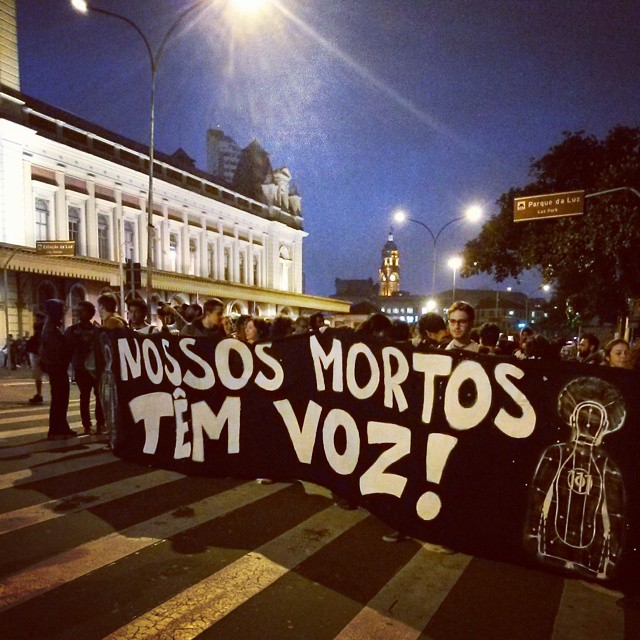
March in commemoration of the 22nd anniversary of the Carandiru massacre in 2014. Photo credit: veredaestreita / Flickr / CC BY-NC-SA

March in commemoration of the 22nd anniversary of the Carandiru massacre in 2014. Photo credit: veredaestreita / Flickr / CC BY-NC-SA

A new truth commission is about to investigate Brazil’s legendary police brutality and, for the first time, attempt to bring some public accountability for the crimes committed by the state. Police kill an estimated six people per day. Civil society organizations persuaded the Sao Paulo Legislative Assembly (ALESP) to establish the commission, the first to focus on human rights violations in the post-dictatorship period. It will hear testimony from witnesses and survivors of police brutality, and examine documents and other evidence related to major cases of police violence in the city and state in the last decades. The initiative follows the recent release of reports by the National and Sao Paulo State Truth Commissions on human rights violations during the military dictatorship (1964-1985). In fact, the reports suggested that present-day violence should be understood as a legacy of the lack of accountability for past violations.

The “Truth Commission of Democracy Maes de Maio” – named after a prominent movement of family members of victims of police violence that fights for justice and changes in security policies – held its first hearing on March 21. Parents of some of those killed in May 2006, when at least 493 civilians were killed in a period of 10 days, testified. (The National Truth Commission had accounted for 434 people killed during the 21 years of military rule.) The violence in May 2006 took place in the context of a conflict between the police forces and the “First Command of the Capital” (PCC) – a criminal organization formed within the detention system, and was justified as part of a “war on crime.” A study conducted by the International Human Rights Clinic of the Harvard Law School and the Brazilian Human Rights Organization Justiça Global contends that at least 122 deaths were directly linked to the police, and many of these bodies showed signs of execution. Four other civilians remain missing after nine years, and nearly all the cases have been archived without a resolution. With the participation of representatives designated by the National Secretariat of Human Rights, legislators, and members of social movements, the new commission will also examine other massacres, such as one at the Carandiru penitentiary in 1992 and the nighttime slaughter – also linked to police officers – of several people who were sleeping near the Sé Cathedral, in downtown Sao Paulo, in August of 2004.

The truth commission is more than a symbolic step towards recognizing and bringing some degree of state accountability in human rights violations; it shows the growing pressure of the movement against anti-police violence and in favor of justice and reparations for victims. Deputy Adriano Diogo, a major proponent of the panel, has warned that the way ahead “will be difficult; this is a discussion that the Brazilian government does not accept to have.” Insofar as the truth commission succeeds, it will not only create an institutional space linked to the state to clarify cases of police violence; it will stimulate an important discussion of the legitimization of police brutality in the context of “fighting crime.” In addition, it could contribute to the understanding that unlawful police violence is a form of political violence that no democratic society should endure.

April 6, 2015

Honduras: Charter Cities Lurch Forward

By Fulton Armstrong

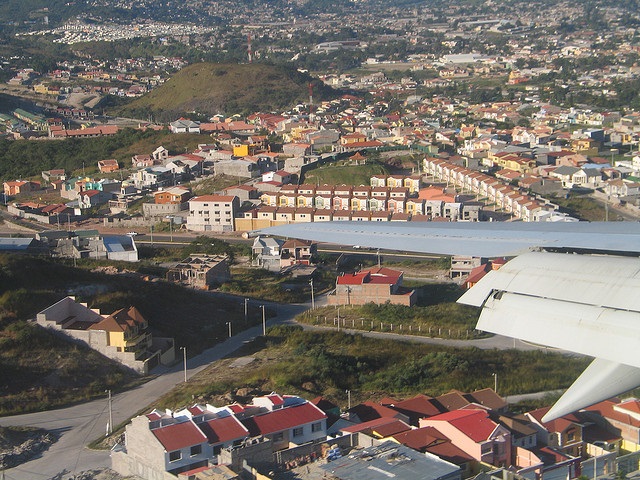
Choluteca, Honduras Photo Credit: Jonathan D. / Flickr / Creative Commons

Choluteca, Honduras Photo Credit: Jonathan D. / Flickr / Creative Commons

The Honduran government expects to get the green light this month from a Korean consulting firm for a master plan to hand governance of several small communities over to private investors to develop them, but concerns about the plan run deep and appear unlikely to fade.  Called ZEDEs – the Spanish acronym for “Employment and Economic Development Zones,” the specially designated areas are also called by their proponents charter cities, model cities, and startup cities.  The first tranche of towns facing conversion are in the southern Honduran departments of Valle and Choluteca, with a new port built on the Gulf of Fonseca.  The government says that the affected communities will remain an “inalienable part of the Honduran state,” but amendments to the Constitution, laws, and regulations permit their governing body – which is unelected – to establish “policies and regulations” and their own police and other public services.  Called the “Committee for the Adoption of Best Practices,” the board is dominated by representatives of Honduran millionaires and an even greater number of non-Hondurans of predominantly libertarian ideology.  Among them are American anti-tax crusader Grover Norquist; former President Reagan’s son Michael; and Michael Strong, chief executive of Radical Social Entrepreneurs.  The ZEDEs’ guiding principle is to liberate communities from government taxation, oversight, and corruption in order to attract investment and stimulate prosperity.

The ZEDEs initiative has been plagued by opposition since its inception, however.  Numerous reports underscore that the affected communities were never consulted, and demands for a referendum have repeatedly been rebuffed.  Honduran implementation of the model has been rejected by the U.S. economist who proposed it, Paul Romer (formerly of Stanford University; currently at New York University).  He withdrew because of the lack of Honduran transparency, including secret deals with interested U.S. parties.  The Honduran Supreme Court initially voted 4-to-1 against a Constitutional amendment allowing creation of ZEDEs in 2012, but the Congress impeached the four dissenters and replaced them with supporters who voted unanimously in favor.  There are numerous reports of intimidation of local civil society leaders, who deem them credible in view of clashes between wealthy businessmen and campesinos in other areas resulting in hundreds of deaths in recent years.

Honduras has a desperate need for economic growth – two-thirds of the population lives below the poverty line – and its model of national governance, riddled with corruption and non-transparency, is indeed in crisis.  But there’s no evidence that fighting one form of corruption with another non-transparent system will help anyone but the big investors.  Indeed, Honduras has ranked among the most violent countries in the world for several years, with the term “failed state” looming darkly over it – making it perhaps the worst place to experiment with provocative new models of governance without popular consultation or support.  Critics seem to have a good case: real reform and economic stimulus would focus on cleaning up the government and holding accountable the elites that have brought the country to ruin and now are trying to impose this model on their fellow citizens, rather than usurping the affected communities’ sovereignty.

March 19, 2015