Guatemala: One Step Forward, Two Steps Backward?

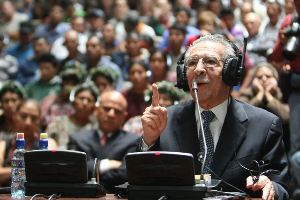
Efrain Rios Montt testifying at his genocide trial | Photo by the Guatemalan government | public domain

Efraín Ríos Montt testifying at his genocide trial | Photo by the Guatemalan government | public domain

The decision of Guatemala’s highest court to overturn the guilty verdict in the trial of former dictator Efraín Ríos Montt – found guilty of genocide and crimes against humanity – has raised serious questions about whether, as many had hoped, the country’s elites will ever allow justice, national reconciliation, and democracy to move forward.  What was a clear victory for many in and outside of Guatemala has evolved into a massive setback, at least for now.  For the victims and survivors of the atrocities, the trial was the first time that their tragic stories got an open and respectful hearing.  For the noble prosecutors and judges who pursued the case despite personal risk and beat back repeated maneuvers by Ríos Montt’s defense team to derail proceedings, it was a solid validation of their commitment to build rule of law.  For Guatemalan society, it meant unprecedented public discussion of the past – and the symbolism of the condemned dictator being taken away by bailiffs promoted closure.  For the international community, it proved that persistence could help a country with chronically weak and politicized institutions become the first in the world to put a former head of state on trial for genocide.  But now the outcome is cloudy.

From the beginning, the long-term impact of the trial would depend on the followup.  Immediately after the verdict was issued, President Pérez Molina, a former military commander, set aside his vehement denials that genocide occurred and said he respected the court’s verdict.  But he conditioned issuance of an official government apology, as ordered by the court, on the exhaustion of all defense appeals – which could take years – and was noncommittal in responding to the court’s call for more investigations of people involved in the atrocities.  While he personally has immunity from prosecution, allegations of his own activities during the Ríos Montt period would obviously be problematic for him.  The powerful business organization CACIF, long aligned with the military, rejected the verdict and began mobilizing resistance to further investigations.  Even moderate politicians, such as former Vice President Eduardo Stein, criticized the genocide ruling and calls for more investigations, apparently fearing that more ethnic groups will stake claims.  Like other dictators facing justice, Ríos Montt has already suffered a supposed health problem requiring that he be moved out of prison and into a military hospital – leaving observers wondering how much of his 80-year sentence he would serve.

The U.S. Government supported the trial process and proclaimed it a victory for Guatemalan judicial institutions.  But it appeared cautious on next steps even before the upper court overturned the verdict (on which U.S. comment is lacking).  Ambassador at Large for War Crimes Issues Stephen J. Rapp who visited Guatemala last month and gave the trial a push, and U.S. Ambassador to Guatemala, Arnold Chacon, attended some proceedings.  The U.S. Embassy pledged its continued support to “credible, independent, transparent, and impartial judicial processes,” but its statement also suggested a lack of enthusiasm for more.  “In these moments it is significant to remember that Guatemala, as a country, was not on trial, but rather two individuals, one of whom was absolved and the other convicted,” it said.  It added that “now is the opportunity to advance to real reconciliation” – a prospect that appeared premature even before the upper court action.  Neither the prosecution nor defense spoke much during the trial of Washington’s direct or indirect role in the 1980s violence – a situation that U.S. policymakers may prefer to continue.  If so, it’s a far cry from the position taken by President Bill Clinton, who during a visit to Guatemala in 1999 apologized for American support for security forces that committed “violent and widespread repression.
Is the Truth Finally Arriving in El Salvador?

By Héctor Silva Ávalos

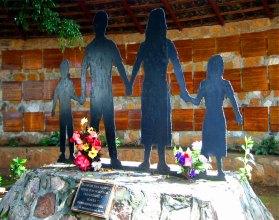
Memorial of massacre site at El Mozote, Morazan, El Salvador | By Efrojas | Wikimedia Commons | public domain

Memorial of massacre site at El Mozote, Morazan, El Salvador | By Efrojas | Wikimedia Commons | public domain

A U.S. court is on the verge of making a major contribution to El Salvador’s struggle to end impunity.  A former Salvadoran military commander six weeks ago admitted in a Miami immigration court that his troops had engaged in human rights violations and extrajudicial killings in the 1980s.  More significantly, he confirmed that the U.S.-trained and -funded Atlacatl Battalion was responsible for the horrendous massacre at El Mozote, a hamlet in which the elite Marine-style battalion killed an estimated one thousand peasants, mostly women and children, over three days in December 1981.  Until recently, current and former military commanders claimed that reports of the bloodbath were communist propaganda.  In his defense, General José Guillermo García, who was defense minister, said he was unaware of the soldiers’ actions at the time.  The judge responded skeptically, saying García “didn’t do what a military officer respectful of the law should have done in order to fully serve his country and his people.”

The General’s confession is no small matter.  An Amnesty Law passed in 1993, pushed by allies of the war-era government, put the lid on many investigations.  Its passage kept two mid-ranking officers convicted of involvement in the 1989 Jesuit massacre from serving their prison sentences, and it paved the way for other military and civilian leaders to cover up that atrocity. The air of impunity has endured for 20 years.  General García’s testimony provides the first real open window for Salvadorans to start learning about what happened despite strong efforts to keep the truth under wraps.  The political and economic elites’ defense of the Amnesty Law has focused on the argument that El Salvador should not be confronting its past if it really wants reconciliation and peace.  But two decades after the peace accord brought the end of the war, that kind of thinking is beginning to fade, and will continue to wane as Salvadoran society is confronted with the naked truth, the naked horrors.

The Obama Administration deserves some credit for advancing the legal case against García and a former colonel facing similar immigration charges in Boston, Inocente Orlando Montano.  Both processes have been encouraged by a U.S. policy of locating and ousting foreigners on U.S. soil who have been credibly accused of human rights violations abroad.  However ironic it is that some of the violations were committed by units receiving U.S. assistance, Washington is promoting an important lesson:  generals who once held in their hands power over citizens’ lives and deaths become common defendants – criminals – when the truth is known.  The impunity enjoyed by the colonels and generals – and their civilian sponsors – has grown roots in Salvadoran institutions and still feeds today a culture of obscurity, injustice and inequity that prevents the country’s progress towards development and modernity.  This vicious cycle will not will not end until they are held accountable.

Read the full text of this essay.

Is Chairman Menendez the Right U.S. Signal for Latin America?

By Eric Hershberg and William M. LeoGrande, Professors of Government, American University School of Public Affairs

U.S. Senator Bob Menendez | by Talk Radio News Service | Flickr | Creative Commons

U.S. Senator Bob Menendez | by Talk Radio News Service | Flickr | Creative Commons

Fresh and credible allegations about U.S. Senator Bob Menendez’s bullying of Latin American governments and influence-peddling for political cronies raise further doubts about what Washington is signaling to the region – and the implications for U.S. relevance in the second Obama Administration.  Secretary of State Kerry’s successor as chairman of the Senate Foreign Relations Committee, Menendez is now a major architect of U.S. policy, and his activities and policies are an indication of U.S. intentions around the world, especially in Latin America, which has been the focus of much of the Senator’s attention.

Media reports have documented well how Menendez persistently intervened on behalf of a wealthy campaign donor to pressure the government of the Dominican Republic to institute port security programs over legitimate objections of local authorities.  When Dominican officials appropriately exercised their duties and pointed out that the donor lacked expertise for the exorbitantly priced contract, Menendez only turned up the heat.  This was consistent with an ongoing pattern of behavior.  In 2011, according to reliable sources, Menendez demanded a U.S. policy of forcing the government of El Salvador to fire a cabinet minister he did not like, clearing the way for the military to capture the position.  Earlier, when the OAS opened discussions on whether to lay out conditions for Cuba’s readmission to the hemispheric body, he threatened to cut all of its U.S. funding.  A self-proclaimed champion of “democracy promotion” and “accountability” in Latin America, the New Jersey Democrat never missed a chance to criticize centrist or left-leaning governments.  Governments in the region are not the sole targets of his interventions:  Menendez has used his influence to intimidate bureaucrats throughout the U.S. foreign policy community into either supporting his initiatives or, at least, turning a blind eye to them.

Latin American opinion-makers grew accustomed to Menendez’s ways during his tenure (2010‑12) as Chairman of the Senate’s subcommittee on the western hemisphere, but his ascension to the chair of the full committee from within Obama’s own party makes his voice – and style – much more important.  His influence-peddling for his buddies’ business interests – at the expense of other U.S. government and foreign partners’ priorities – can only fuel greater cynicism about U.S. preachiness on anticorruption and “democracy promotion.”  It also further risks U.S. relevance at a time that many in the region remain hopeful of a revival of President Obama’s short-lived emphasis on “partnership” in the “neighborhood.”  The investigations into Menendez’s activities may run into serious obstacles – many bureaucrats fear his ire, and will be reluctant to talk – but it’s already clear that his bullying and influence-peddling make him the wrong person for a leadership role in U.S. policy toward Latin America. 

Political Participation in Latin America Expanding

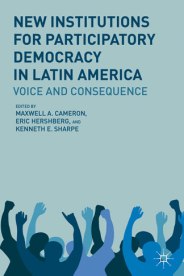
participatory democracy coverFrom local citizen initiatives to national referenda, mechanisms of direct political participation have been spreading with astonishing vigor throughout Latin America in recent years. Some of these mechanisms are new and unprecedented in the way they involve citizens in politics, such as frequently touted participatory budgeting systems at the municipal level in numerous countries.  Other initiatives, such as the National Policy Conferences that consult the citizenry regarding an array of issues in Brazil, are less widely known. In most Andean countries and to some extent elsewhere, these forms of participation often emerge where established representative institutions, such as party systems, have collapsed, or where legislatures have fallen into disrepute.  Yet they also proliferate alongside strong parties, legislatures, and interest associations, as we see in Brazil and Uruguay.

A recent CLALS-sponsored book* examines these new forms of participation and analyzes when they promote, and when not, the consolidation and deepening of representative institutions. The participatory innovations vary along a number of key dimensions, including how they interact with political parties and established institutions, their focus on collective versus individual rights and, perhaps most importantly, their autonomy from political and economic elites.  These differences and their implications are analyzed in detail in case studies on seven Latin American countries: Bolivia, Brazil, El Salvador, Mexico, Nicaragua, Uruguay and Venezuela.

When new forms of political participation emerge spontaneously and independently – as a natural reaction to an unfulfilled need at a local or national level – their voices are authentic and tend to enhance democratic rule.  Brazil’s National Policy Conferences and Uruguay’s referenda to enhance accountability are examples of the incorporation of new voices in policy formulation – to the benefit of the constituencies driving them and the nation as a whole.  We also find instances where participation has exacerbated and reinforced longstanding patterns of clientelism (including in Mexico and Brazil), and autocratic leaders have sought to create or capture such voices to bypass representative institutions (including in Nicaragua and Venezuela).  A valuable lesson of this research, however, is that, once in place, these spaces may become increasingly autonomous. Venezuela’s community councils are an important case to watch: created to reinforce the Chavista project as defined by the Casa Rosada, they may take on a life of their own when the politicians who sponsored them relinquish their positions of power or pass away.

New Institutions of Participatory Democracy: Voice and Consequence, published by Palgrave Macmillan 2012, resulted from a multi-year project co-organized by CLALS and the University of British Columbia’s Andean Democracy Research Network.  More information on the project can be found here .  (The volume has also been published in Spanish by FLACSO-Mexico, Nuevas instituciones de democracia participativa en América Latina: la voz y sus consecuencias)

Honduras: What is U.S. policy?

The sustained surge in crime and violence in Honduras – including more than 60 politically motivated murders in the past year – is raising doubts about the viability of the government and its institutions.  The term “failed state” is often abused, but there’s no doubt that Honduras falls short of the rhetoric about its stability and democracy that the Obama Administration recited when arguing for the country’s readmission to the OAS after the 2009 coup that removed President Mel Zelaya.  Indeed, the coup set the country on a downward spiral from being a weak democracy to one struggling for basic credibility.  The U.N. Office on Drugs and Crime says Honduras has the world’s highest murder rate – 91.6 murders per 100,000 inhabitants in 2011.

Undersecretary of State María Otero has spent time and energy trying to establish a policy toward Honduras.  During a visit to Tegucigalpa last month, she signed an agreement with Foreign Minister Corrales that “sets the stage for results-oriented action towards our shared objective of a safe Honduras that respects the rule of law and human rights,” and she announced that the United States would provide an additional $1.8 million in aid to help counter gang activity in Honduras.  Despite her efforts, the State Department and the U.S. Embassy in Tegucigalpa have failed to go beyond ready-made programs and put in place a framework for a comprehensive policy.  Programs are not policy.  The Administration appears reluctant to admit that its Honduras policy, which has failed, needs an overhaul.

Multimillion-dollar programs will not succeed until they take into account that the Honduran “partners” upon which they depend are themselves at the core of the problem.  Three years after the coup, the Obama Administration still fails to see that its allies in the struggle against transnational and local gangs, as well as its efforts to build judicial institutions, are the same people who mocked the rule of law, overthrew the previous president, and re-politicized the military and police to serve their own purposes.  (The reasons for Washington’s unwillingness to help fund a “Commission for Security Reform” approved by the Honduran Congress are unclear, but this may be a factor.)  There are strong suspicions in many sectors of Honduran society that members of the country’s political-economic elite are the sponsors of the sicarios (hired gunmen) who have killed dozens of citizens whose offense was to demand an end to government impunity.  Given the challenge that the growing popularity of the country’s new political party, LIBRE, poses to traditional powerbrokers, informed observers expect violence to increase in the run-up to elections next year.  Absent public explanation of U.S. policy, it is fair to ask why Washington hasn’t seen these patterns – obvious to Hondurans – and why it hasn’t offered sustained support from the FBI and other U.S. law enforcement to investigate the assassinations and trace them back to the power bosses.  It is also fair to ask Assistant Secretary of State Brownfield and others who espouse the militarized approach to dealing with organized crime how this strategy, which has failed elsewhere, will succeed in Honduras.  Why hasn’t the Obama Administration supported the sort of U.N.-sanctioned investigative capacity that has proven effective with the International Commission Against Impunity in Guatemala?  Why has Washington not even pushed for meaningful implementation of the recommendations of the Truth and Reconciliation Commission released last year?  If Washington wants to make its rhetoric about Honduras into reality, it needs to do more than just to funnel funds into programs run by questionable partners.