Haiti Needs to Lay New Tracks

By Jake Johnston

Research Associate, Center for Economic and Policy Research

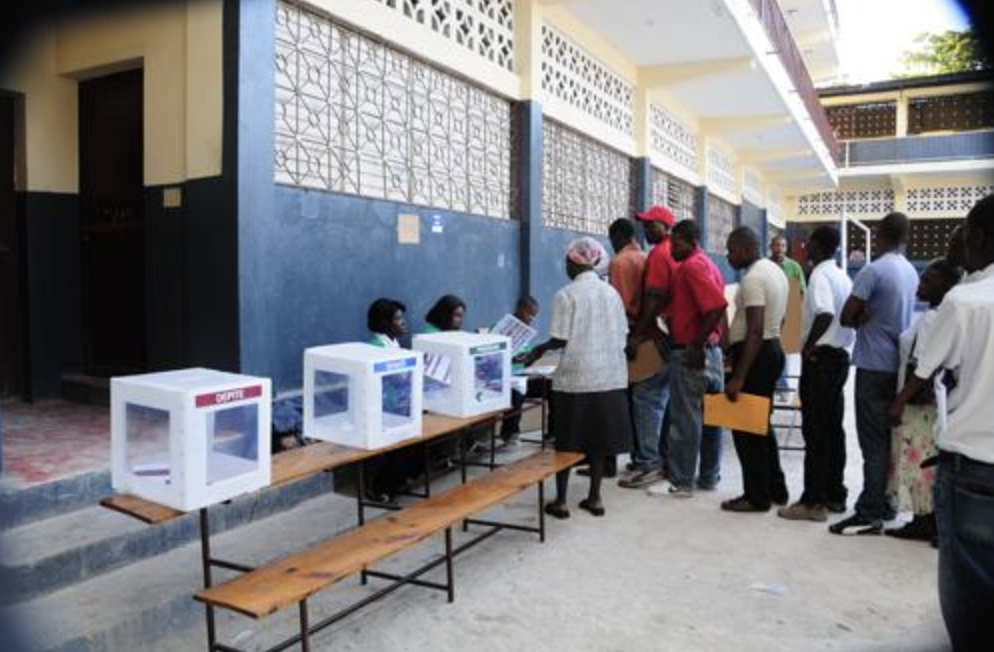
It’s been nearly a decade since Haitians last went to the polls to elect a president. Even then, barely one in five participated. In a country with a majority of the population under 25 years of age, this means that, for most Haitians, voting for one’s leaders is a privilege never before experienced.

Haiti’s transition, precipitated by the assassination of Jovenel Moïse in July 2021, is ongoing. For the better part of four years, progress toward elections has remained elusive. But that all appeared to change this fall.

“The Haitians need to come to an election and elect a president,” the US Charge d’Affaires, Henry Wooster said in September. Security and other challenges must not be a “red herring for taking action,” he continued. Speaking directly to Haiti’s de facto authorities, he warned: “In other words, you can’t stay in those jobs for life.”

The reaction, in a country where the political class remains more responsive to Washington than the population in Haiti, was swift. Two months later, a new electoral law has been established and a vote scheduled for next August. But does this present Haitians with a path out of the multiple, overlaid crises affecting the country? More than half the country is facing food insecurity, the economy is about to wrap up its seventh consecutive year of negative growth, and insecurity continues to dominate daily life.

In 2023, when asked if they had trust in the electoral process, fewer than one in four Haitians responded yes. It is hard to imagine that number is higher today. Though few would be sorry to see the much-loathed leaders atop the transition fall, a vote is not a path out of the current crisis.

The quick response to Wooster’s threats was not so much about elections. It was about a date much closer on the horizon: February 7, 2026. That is when the mandate of the nine-member presidential council — which was put in place with a strong push from the Biden administration, CARICOM, UN, and the OAS 18 months ago — formally ends. For months, debate has raged over what should come next. The political class is auditioning, not with the ten-plus million citizens of Haiti, but with the foreign diplomats and multilateral entities they see as key to their own survival.

And if there was any doubt about who would ultimately decide, it was put to rest in mid-November. Amid an effort from some on the transitional presidential council to, once again, replace the prime minister, the US embassy stepped into the fight.

“If you and your family value your relationship with the United States, I urge you in the strongest terms to desist from initiatives to oust the PM and to instead publish the electoral decree … This is not the time to test U.S. resolve,” Wooster texted Fritz Jean, one of the councilors. Days later, Jean’s US visa was revoked and the State Department publicly accused him, without providing evidence, of supporting armed gangs. The effort to replace the PM was stopped — at least for now. The next week, the electoral decree was published.

The “plan” is coming into focus, and it is a familiar one: stability at all costs, no matter how rotten the foundation. To enforce this notion of stability and allow for elections, the US has been quick to assure that more security support is on the way.

In September, the UN Security Council approved a Gang Suppression Force (GSF). Authorized for up to 5,500 soldiers, it is currently little more than a rebranding of the Kenyan-led Multinational Support Mission (MSS) that the UN authorized in 2024. No new troops have arrived and, while this new mission will have some level of UN support, operationalizing any of it is expected to take the better part of a year. 

The main difference then, for the 1,000 or so mostly Kenyan police on the ground in Haiti is that the rules of engagement have changed. The GSF, as its name suggests, is intended to be more “muscular,” by which its architects mean lethal. The newly drafted Concept of Operations outlines a mission with a simple goal: kill the bandits.

But while few have taken note, that has been the de facto authorities’ strategy for some time. So far this year, police forces have been responsible for well over half of the 4,500-plus killings in Haiti. Hundreds of civilians have been caught in the crossfire as police battle armed groups that exert influence over much of Port-au-Prince and have traumatized a nation. Drone attacks, led by a secretive police unit operating with Blackwater CEO Erik Prince’s private mercenaries, are also racking up civilian casualties and drawing growing condemnation.

The outspoken leaders of Haiti’s armed groups, however, only seem to continue to accumulate more power, political influence, and heavy weaponry. While some areas of the capital have seen tension ease, violence in the provinces is expanding by the day. Armed groups still control all the major arteries of the nation. More people are displaced today than at the height of the post-earthquake recovery.

The US has expressed its goal in Haiti as saving the state from imminent collapse, thereby avoiding mass migration or the further entrenchment of transnational criminal organizations. But while precious oxygen is consumed by raging debates over electoral timelines, transitional governance structures, and how quickly foreign soldiers can arrive, nobody has stopped to ask a basic question: is the current state worth saving?

The root of the tension that has paralyzed the country for much of the last decade is not a fight between violent gangs and the state. Simplistic narratives of good versus evil miss the mark. Rather, it is a fight over putting the train back on the tracks to save a rump state in the name of stability or to lay new tracks to create the foundations for a more representative state to rise from the ashes. It is not elections nor a foreign military force that will resolve this fundamental tension. In fact, history shows those two responses are more likely to consolidate the status quo.

The Haitian people need an opportunity to vote freely. They need to feel safe and secure in their communities. But what is missing is a plan to bring it all together, to begin restoring faith in a state that long ago lost the trust of the population; a plan to achieve peace, which is not just the absence of violence, but the presence of opportunity. What is missing is a vision that can inspire the population and bring the nation together around a common path forward.

A peace process can fill that gap. Such an endeavor does not mean legitimizing armed actors, condoning violence, or accepting impunity; rather, what it should mean is treating the situation holistically while centering the population and in particular victims of both state and non-state violence. A foreign military force and low-turnout elections are tracks Haiti has been down many times before. A peace process offers a chance at laying new ones. But first, what Haiti needs are political leaders responsive to the needs of the people and not simply to foreign embassies.

The Multiple Dimensions of the US-Brazil Relations Crisis

By Lívia Peres Milani

Public Policy and International Relations Institute (IPPRI-Unesp)

National Institute of Science and Technology for the Studies of the United States (INCT-INEU)

President Donald Trump meets with Brazilian President Luís Inácio Lula da Silva during the ASEAN Summit at the Kuala Lumpur Convention Center. (Source: Wikimedia Commons)

On November 11th, the US announced a withdraw of the additional 40% tariffs it had imposed on many goods of Brazilian origin, including coffee, fruit, and beef. The tariffs, initially imposed on July 30th, are one among multiple dimensions of the current bilateral crisis. Besides commerce, the crisis also has a political dimension, initiated by the recent US decision to invoke the Magnitsky Act – an instrument ostensibly used to sanction corruption and human rights violations – against Alexandre de Moraes, one of the Brazilian Justices responsible for the conviction  of ex-president Jair Bolsonaro over his attempted  coup d’état. While the recent White House decision does not necessarily represent an end of the crisis, it represents a pause of sorts, and so, a timely moment to assess the relationship.  

The imposition of tariffs  

The White House’s initial imposition of tariffs may at first glance make little sense, since it appears to disregard its economic interests. The US enjoys a trade surplus with Brazil, and there is not sufficient production in the US of many of the tariffed products to meet national demand. That is the case for coffee, fruit, and a variety of industrial supplies. However, to understand the source of the crisis, it is necessary to consider its non-commercial dimensions. These include i) the transnational articulation of far-right movements, ii) Big Tech’s economic interests, and iii) US geostrategic considerations.  

Brazilian and US far-right currents are deeply connected. Eduardo Bolsonaro, son of the former president, has worked to promote the Brazilian radical right abroad. During his father’s trial, he took a leave from Congress to launch a pressure campaign in the US against the Brazilian Supreme Court (STF) and the Lula government. With cooperation from sympathetic US leaders, he lobbied against the Lula administration, claiming that the trial was a “witch hunt,” his father was the victim of political persecution, and asking that the US government impose penalties on the Brazilian authorities responsible. This effort complicated Brazil’s relation with Foggy Bottom and the White House. Much of the language used by the White House to justify the new round of tariffs reflected this lobbying effort. 

Another factor that explains US policy toward Brazil are the interests of Big Tech companies. Brazil’s Supreme Federal Court took up a case relating to the responsibilities of social media platforms for user-posted content, ruling that social media platforms should be civilly liable if they failed to remove undemocratic, discriminatory, or crime-inciting content. In response, the US Computer and Communication Industry Association (CCIA) welcomed the imposition of sanctions against Moraes. They argued that the ruling in Brazil violated “free expression,” a strategy often used by Big Tech actors, in conjunction with far-right political leaders, to oppose the regulation of social media in Brazil and elsewhere.  

Finally, larger geostrategic considerations are also in play. The current US administration seeks to reassert US regional and global hegemony. Brazil, for its part, wants to promote its Global South leadership, framed as part of a “multipolar world order.” Promoting the BRICS forum is an important component of Brazil’s approach. The new tariffs were announced a few days after the BRICS summit in Rio de Janeiro, with the US president also threatening to impose tariffs on other countries that associate themselves with the BRICS+ group. This timing illustrates US opposition to the BRICS and pressure on Brazil to align with Western countries instead of its Global South partners. 

Tariffs backfire and the future of US-Brazil relations 

However, the Trump administration’s aggressive strategy against Brazil has not led to the expected results. Brazil’s government managed to control the domestic narrative, framing US tariffs as an attack on Brazilian sovereignty, a strategy supported by public opinion, as polls show. The US approach also became an incentive for Brazil to shore up its relations with Global South leaders. Following the tariffs, Lula reached out to the presidents of China and India to discuss the expansion of trade relations. The tariffs also proved unpopular in the US, and harmful for the White House, since they drove up the cost of coffee and other products. 

These several factors explain Trump’s subsequent decision to change direction. He opened a dialogue with Brazil, first announced at the UN General Assembly, and then confirmed his goodwill in a bilateral meeting in Malaysia. High-level negotiations, and the unpopular inflationary trend in the US, led to the recent removal of tariffs from many Brazilian products. It also signals an end to this most recent period of bilateral crisis. 

Nevertheless, there might still be consequences over the middle and long term. US sanctions communicate to the Brazilian government that, while a global power, the US is not a trustworthy partner, even when it comes to such non-strategic, everyday issues as the export of coffee and fruit. At the same time recent events have helped to cement the transnational partnerships of far-right leaders while also serving to illustrate how these relationships are impacting US government decision-making.  

On the other hand, the recent US decision to alleviate the tariffs is a signal for both partners that the US-Brazil bilateral relationship is an important one. Even if this relationship is imbalanced, given the US’s economy and global influence, the recent tariff episode illustrates that the US cannot simply dictate policy to Brazil, and that the two countries’ economic interdependence can function as a structural constraint upon the political will of far-right political actors.   

Latino Sense of Belonging Decreases amid Racial Profiling, Detention, and a Fading American Dream

By Anjini K. Patel

Source: Encuesta de Ipsos para Axios/Noticias Telemundo

A recent Telemundo survey reveals increasing pessimism from Latinos in the United States regarding their sense of belonging. Telemundo, in collaboration with Axios and Ipsos, surveyed a nationally representative sample of over 1,100 U.S. Latino adults from October 21 to 27, 2025. Conducted in both English and Spanish, the survey asked a variety of questions about their views on the American Dream, their sense of belonging in the US, and their optimism about the future of the country. Only 44% of respondents described the American Dream as achievable in 2025, a decrease from 61% in 2023. Similarly, 40% of 2025 respondents affirmed that the US makes them feel like they belong, and only 36% felt optimistic about the future of the US. This ​compares​ to 57% and 52%, respectively, in 2022. This survey provides an insight into the feelings of Latinos as they navigate the uncertainty of the current American political landscape.  

The survey also asked respondents about their anxieties related to being Latino/Hispanic in the United States. Compared with 39% in June 2022, 53% of respondents in 2025 reported feeling worried about themselves or a loved one being attacked because of their ethnicity. Two out of three (2/3) Latinos who identify as Republicans say it is a good time to be a Latino in the United States, while only one in ten (1/10) Latino Democrats agree. Seventy-one percent (71%) of those aged between 18 and 29 and 57% of those who are 50 and older, said it is a bad time to be Latino. 

Most respondents indicate that the Democratic Party, as compared to the Republican Party, better represents Latinos, cares more about them, and is better on economic and immigration policy. Additionally, most respondents agreed that the Republican Party takes Latino Americans for granted (39%) as compared to the Democratic Party (22%). Interestingly, more respondents describe the Republican Party as a good option for public safety compared to the Democratic Party, even in the face of increased fear and anxiety over being attacked for being Latino.  

What do experts say? 

Dr. Ernesto Castañeda, Director of the Center for Latin American and Latino Studies at American University, discussed this survey on Telemundo. As he states, the data from this poll are unsurprising given the very strong anti-immigrant rhetoric that Donald Trump and the Republican Party campaigned with and continue to use. Rather than focusing on people with violent criminal records, ICE raids and subsequent deportation, often without due process, have detained and deported people with all types of immigration statuses, and thus increased fear among Latinos. Castañeda points to comments by Justice Cavanagh and decisions by the conservative majority in the Supreme Court that made detaining someone based on their appearance and manner of speaking permissible, further blurring the lines between individuals with papers and those who are undocumented. In light of these violent mass deportations and detentions happening in public places, following stereotypes and racial profiling, it is no wonder that many Latinos report a decreased feeling of belonging in the United States. 

Regarding the impacts of these recent events, Dr. Castañeda explains that the feasibility of immigrants achieving the American Dream is decreasing. While people still arrive in the United States with high hopes that “they can come and work hard, send remittances, enjoy a better life, and that their children can go to university, in the United States right now, we see high underemployment rates, and many people are afraid to go to work because of mass raids. We are seeing inflation. It is harder to pay for health insurance, housing, and to save.” In this way, the American Dream is stalled. Since the end of the pandemic, the U.S. had seen a rapid and strong economic recovery, which Dr. Castañeda attributes largely “to the people arriving, especially from Latin America, seeking asylum—Venezuelans, Cubans, Haitians, Nicaraguans, and others—which increased the US population by 1%, which was very significant.” With the border closing under the current administration and deportations by the dozens of thousands, businesses are unable to grow at the same rate. Dr. Castañeda underlines: “If there’s less migration, it doesn’t mean there will be more jobs for locals. It means there will be less work for everyone, and more people will lose their jobs because the demand for goods and services decreases, businesses cannot hire and grow, and therefore they stop hiring and start firing workers.” 

Additionally, research shows that immigrants are much more likely to start businesses and hire more workers than businesses started by native-born citizens. Therefore, the lack of immigration has a negative impact on the overall economic growth of the United States. As Dr. Castañeda describes, “the fact that Latinos aren’t going to work here means there are fewer nannies. There are fewer construction workers, fewer lawyers, fewer nurses… it also makes many Latinos afraid. They don’t go to the markets, they don’t go to the malls, they are spending less, which has an impact, and many immigrants, seeing that there’s no American Dream anymore, aren’t going to bring their families or many of them are thinking about returning to their country.” 

The decreased sense of belonging by the Latino/Hispanic community has affected numerous outlets that embrace these cultures. Some events honoring Hispanic Heritage Month were canceled. This hurt artists, folk dancers, and musicians, as well as the larger public, who did not have the opportunity to engage with these rich cultural traditions. “Latin restaurants are struggling,” Dr. Castañeda says. “Hundreds are closing because they can’t hire enough people; workers are afraid to go to work because food is so expensive. So, it’s no longer a profitable business for them. The decline of the Latino food business also means fewer dining options, fewer cultural spaces, and fewer opportunities for communities to enjoy Latino cuisine. This is a loss for the United States as a whole.” 

Hope and Resilience in the Face of Uncertainty 

How should the Latino community respond to the ever-changing political landscape in the United States? Dr. Castañeda urges people to “stay calm and continue with their daily lives. We often do this for our children and grandchildren​,​ who, I truly believe, will have a good future. This storm is temporary. This will pass.” Importantly, he points out that nearly 80% of Americans view immigration positively. Mass raids are not popular​, ​and vulnerable​​ communities are​ witnessing​ peaceful protests carried out by citizens who are physically placing their bodies between immigration agents and migrants ​​who are in the process of being​​ detained. The November 2025 elections indicate that a majority of Americans reject the current administration’s extreme policies on immigration and the mismanagement of the economy. The anti-immigrant sentiment is ​driven ​primarily by​​ the federal government under Donald Trump, not the American people. With a hopeful outlook, Dr. Castañeda says, “I think that once this nightmare is over, there will be a greater sense of belonging, so we have to have patience, have faith in your fellow citizens, and I do truly believe that this will pass and the future will be better for U.S.-born Latinos and those immigrants who are able to stay. There will be concrete actions that will tell Latinos that they belong because this is their home.” 

Anjini K. Patel is a Sociology Research & Practice MA candidate at American University (AU) and works as a graduate research assistant at the AU Inequality, Social Justice, & Health Lab. Her research interests include immigration, criminal legal system & housing justice, and artivism & community building.

Can Peru’s Democracy Recover?

By Cynthia McClintock*

Photographs from the early hours of the Generation Z protest in Peru, 2025
(Source: Wikimedia Commons)

Since 2021, democratic backsliding has been severe in Peru, and Peruvians are furious. Peru’s Congress is loathed. In 2025, the approval rating for Peru’s President, Dina Boluarte, fell below 3 percent and she became the most unpopular president on the planet. Finally, in October, Boluarte was impeached on the grounds of “permanent moral incapacity”; it was the fifth time since 2018 that a president had been impeached or had resigned upon imminent impeachment.  Per Peru’s constitution, Boluarte was succeeded by the Congress Speaker, José Jerí. Presidential and Congressional elections are scheduled for early 2026.

Why are Peruvians so angry? What does their anger mean for the 2026 elections (with the Congressional elections and the first round of the presidential elections scheduled for April 12 and a likely runoff on June 7)? Is it possible that the elections can lead to a democratic recovery?

Why are Peruvians So Angry?

The key reason is not “the economy stupid,” but an escalation of organized crime and the perception that Peru’s political leaders are part of the problem rather than part of the solution.

Between 2019 and 2024 the number of homicides doubled and the number of reported extortions jumped sixfold. Extortion is hurting huge swathes of lower-middle class Peruvians. Transport workers have been particularly vulnerable; so far in 2025, approximately 50 bus drivers have been killed for refusing to make extortion payments.

The reasons behind the crime escalation are various. Demand for cocaine remains high and, over the last decade, Peru’s coca cultivation has increased. As the price for gold jumped, so did illegal gold mining. Peru’s gangs are fragmented—and therefore hard to track—and they have developed nefarious new strategies such as using WhatsApp for extortion.

But, Peruvians believe, the reasons also include the government’s complicity. In part because illicit operators have provided campaign finance, in 2024 approximately half of Peru’s legislators were under criminal investigation; these same legislators have passed laws to impede investigations and prosecutions. Boluarte herself is under investigation for various crimes, including illicit enrichment. She sported a Rolex watch priced at $19,000, despite no evident financial means for such extravagance.

Further, from the start large percentages of Peruvians did not deem Boluarte a legitimate president. In 2021-2022, Boluarte was Vice President under President Pedro Castillo. Leading a far-left party in fraught elections during COVID, Castillo was an accidental, unprepared president. He was virulently opposed by the dominant right-wing forces in Congress, in particular Fuerza Popular, the party of Keiko Fujimori, the daughter of former authoritarian President Alberto Fujimori. As Vice President, Boluarte had said that, if Castillo were impeached, she too would resign, triggering new elections. However, in the event of Castillo’s December 2022 impeachment, Boluarte stayed on, despite massive protests and ubiquitous calls for new elections.

As President, Boluarte appeared indifferent to Peruvians’ concerns. Between December 2022 and February 2023, 49 civilian protesters were killed by the security forces. Boluarte’s response was support for an amnesty law. And, amid an October 2025 transport workers’ strike, Boluarte’s advice to Peruvians worried about crime was that they should not open text messages from unfamiliar people—placing blame for crimes on the victims.

What Does Peruvians’ Anger Mean for the 2026 Elections?

Peruvians’ anger spells difficulties for its incumbent parties and advantages for parties that can claim an “outsider” mantle. Fujimori’s Fuerza Popular is widely considered the dominant party in the Congress, and it will struggle against this perception. Its presidential candidate, Fujimori, is running for the fourth time and is likely to have worn out her welcome.

Not surprisingly, demands for an “iron fist” against crime are strong. The current presidential frontrunner is Renovación Popular’s Rafael López Aliaga (aka “Porky”), a Trump-like far-rightist who placed third in the 2021 election and was subsequently elected Lima’s mayor. López Aliaga promises a hardline strategy against organized crime, including implementing similar imprisonment policies to those of El Salvador’s Nayib Bukele. But Renovación Popular holds the fourth largest number of seats in Congress and it will be difficult for López Aliaga to claim an “outsider” mantle.

A candidate likely to claim an “outsider” mantle is Mario Vizcarra, running as a proxy for his brother, former President Martín Vizcarra. As President in 2018-2020, Vizcarra confronted the dominant parties in Peru’s Congress, building his popularity but ultimately catalyzing his impeachment. After a strong showing in Peru’s 2021 legislative elections, he was disqualified from holding elected office for ten years. Yet, Vizcarra’s government was far from without fault. There are other candidates, including the popular former clown, Carlos Álvarez, who could seize the “outsider” mantle.

Can Peru’s 2026 Elections Lead to Democratic Recovery?

The challenges to Peru’s elections are serious. In recent years Fuerza Popular and other illiberal parties in Peru’s Congress have allied to skew the electoral playing field in their favor.  Interim President Jerí is, of course, new to his position and his possible impact on the elections is unclear. (His first-month record was better than was first expected.)

As elsewhere in Latin America, Peru’s illiberal parties have strategized to achieve the disqualification of viable candidates. As indicated, this strategy is currently being used against Vizcarra; it could also be used against a rising new candidate.

Peru’s illiberal parties have calculated that a plethora of candidates is in their interest. Currently, 39 party lists are registered. Such a head-spinning number is problematic for journalists trying to cover the campaign and problematic for voters trying to identify their preferred candidate, especially because pre-election polls are more likely to be inaccurate. Yet, Peru’s Congress cancelled a provision for a preliminary round of voting, in which parties would have been required to secure 1.5 percent of the vote in order to qualify for the “first round.”

Still, there are grounds for optimism. The massive protests of recent years have shown that Peruvians want their political views heard. Peruvians recognize the importance of honest, capable leadership and want to find it.

*Cynthia McClintock is Professor of Political Science and International Affairs at George Washington University.

Bolivia Decisively Enters New If Unknown Political Territory

By Robert Albro, Associate Director, CLALS

Rodrigo Paz is sworn in as president of Bolivia, 2025
(Source: Wikimedia Commons)

Centrist Rodrigo Paz’s victory in October’s runoff election signals a dramatic change of direction for Bolivian politics. The era of dominance of the Movement Toward Socialism (MAS) party, led by ex-president Evo Morales, is definitively over. For only the second time since 2006 the MAS will not control the presidency. As a result of the recent election, it now has a mere two representatives in the legislature’s lower house, and no one in the upper house. Though it does not hold an outright majority, Paz’s Christian Democratic Party is now the single largest presence in both legislative chambers. How did Bolivia get here?

Twenty years ago, the leftist-populist MAS swept into power, as a new and energetic grassroots alternative to the elite-run traditional parties that had traded off governing Bolivia since the end of dictatorship in 1982, or one could even argue, since the 1952 Revolution. The MAS’s popularity sprung largely from the dynamism of Morales, himself, then a coca grower union leader adept at organizing and leading large-scale protests in opposition to prevailing Washington Consensus policies and government efforts to sell off Bolivia’s non-renewable resources to transnational corporate interests. The MAS styled itself a bottom-up social movement and not a party. Its participatory “lead by following” approach to governance appealed to a great majority of indigenous voters and working-class people of indigenous descent.

Morales and the MAS proved historically consequential in undertaking a contentious but innovative rewrite of the country’s Constitution, which went into force in 2009. It fully embraced Bolivia’s “plurinational” identity and incorporated an unprecedented variety of collective indigenous rights of consultation, to their traditional territories, and perhaps most controversially, of judicial autonomy. The Morales administration also used a large surplus from the country’s extractive boom to finance a wide range of new social safety net provisions that halved the number of people living in poverty, including cash transfers to families, a pension program, minimum wage increase, as well as public investments in schools, hospitals, and other infrastructure. Perhaps most importantly, his presidency raised the public visibility of Bolivia’s indigenous majority, no longer as second class citizens but as political protagonists of their own present and future.

Morales and the MAS were immensely popular. But then cracks began to appear. In 2011 a plan to build a controversial highway through a protected indigenous reserve brought the MAS government into direct conflict with the reserve’s residents, damaging its support among some indigenous groups. When the extractive boom ended around 2014, Bolivia’s economy slowed considerably, and the MAS fiscal policies that had lifted so many out of poverty became increasingly unsustainable. Part of the problem was Morales, who served two presidential terms and aspired to another, without any thought to a succession plan. Constitutionally limited to two terms, in 2016 he soundly lost a national referendum in a bid for a third and then ignored the result, further alienating many former supporters.

The upheaval around the contested 2019 election, which eventuated in Morales going into exile in Mexico and the persecution of MAS loyalists by a rightwing caretaker government, set the stage for the party’s eventual fall from grace. The 2020 election restored the MAS to power. But soon Morales and the new president, his ex-finance minister Luis Arce, were in a pitched battle for control over the party, a bitter and increasingly personal rivalry that fatally fragmented the MAS into opposed camps. Their protracted feud, which paralyzed congress, strayed into surreal territory, with accusations of a staged coup and mutual assassination attempts. The credibility of the MAS was so fundamentally damaged that the incumbent Arce, with his poll numbers plummeting, suspended his campaign. Morales, meanwhile, remains holed up in his coca grower redoubt to avoid criminal charges.

The MAS-led government’s political fragmentation, and its ineffectual response to Bolivia’s increasingly disastrous economy, have left the party deeply unpopular. The country is currently floundering amid its worst economic crisis in 40 years. Its natural gas production is half of what it was in 2014, with nothing to replace it. Bolivia has failed to develop its large reserves of lithium. Depleted currency reserves and a scarcity of US dollars have driven up inflation, creating severe shortages of fuel and basic goods. Over the past year, ordinary Bolivians have angrily expressed their discontent with the country’s economic collapse through repeated strikes and protest actions.

Emerging from this bleak political and economic state-of-affairs is the surprise election winner, Rodrigo Paz. Son of onetime leftist president Jaime Paz Zamora, former mayor of Tarija, and recently a senator, Paz’s campaign focused on restoring Bolivia’s economy, but gradually rather than by instituting sweeping fiscal austerity measures as his rival in the run-off proposed. Non-indigenous, pro-business, and ideology averse, Paz successfully positioned himself as a pragmatic reformer. He has delivered a strong anti-corruption message, pledged to restore relations with the US and bring back foreign investment. His populist call for a “capitalism for all” hopes to thread the needle by mixing decentralization, lower taxes, support for small businesses, and greater fiscal discipline, with continued spending on popular MAS-era social programs.

Paz’s critics argue that what he proposes is an impossible fiscal balancing act. Desperate and impatient Bolivians will expect immediate results. But it remains far from clear whether Paz will be able to overcome likely regional opposition to at least some of his policies. And if he does not stabilize the country’s dysfunctional economy quickly, Paz’s political honeymoon might be brief.

The Rise, Decline, and Crisis of Ecuador’s Indigenous Movement

By Dr. Pablo Andrade Andrade

October 17 Demonstrations (Manifestaciones del 17 de Octubre)
(Source: Wikimedia Commons)

Just six years ago, in 2019, the three major organizations of the Ecuadorian indigenous movement were on the rise. CONAIE (the Confederación de Nacionalidades Indígenas del Ecuador) led the charge against Lenin Moreno’s government. For eleven days their widespread demonstrations posed a serious threat to the government’s stability. The “Paro Nacional” (Nationwide Strike) not only facilitated CONAIE’s alliances with the other two indigenous organizations (FENOCIN, the Federación Nacional de Organizaciones Campesinas, Indígenas y Negras, and FEINE, the Federación Ecuatoriana de Indígenas Evangélicos) but also broadened its coalition with a diverse range of civil society organizations, marking a significant shift in Ecuadorian politics. The impact of the indigenous movement on Ecuadorian politics was profound, as Moreno´s government was seriously weakened. Two years later, in 2021, CONAIE’s political party, Pachakutik, won substantial representation in the National Assembly and placed third in the Presidential elections.

In 2022 CONAIE’s president, Leonidas Iza, led a successful national strike against Guillermo Lasso’s right-wing government. His leadership, bolstered by unity among indigenous communities and their allies, made it the most powerful leftist organization. Newfound solidarity among indigenous communities and stronger ties with student, feminist, and environmental movements, enhanced Iza’s national and international reputation. Less than a year later, President Lasso had to end his term and called for early general elections. However, at that moment Iza´s radical wing of CONAIE also attempted to impose its agenda over Pachakutik and the Amazonian federation CONFENIAE, which proved to be a high-cost strategy. The internal conflicts that followed led, in 2025, to the most serious electoral defeats that both organizations had suffered in decades.

The 2023 general elections were marred by prison massacres and political assassinations, including that of presidential candidate Fernando Villavicencio and the mayor of Manta, among numerous other government officials. Amid this unprecedented turmoil, a young center-right candidate, Daniel Noboa, emerged victorious as interim president. His win signaled yet another shift in Ecuador’s political landscape, with the country’s fragile democracy once again at the mercy of a personalist, plebiscitarian president.

The first warning sign of the current political turn to populist rule came with the 2025 regular election. The President’s party (Alianza Democrática Nacional, ADN) and the opposition party (Revolución Ciudadana, RC) totalled over 80 percent of National Assembly representatives. Noboa won his first five-year mandate. Pachakutik saw its representation shrink to five members, who the government rapidly coopted. Free from legislative checks, Noboa advanced his economic adjustment program. In addition, amid the ongoing public security crisis, Noboa expanded the military’s role in maintaining domestic order. Although assassinations have risen since 2023, militarization has strengthened Noboa’s control over organized violence, boosting political support for his government.

As part of its economic program, in September 2025, the Noboa administration raised diesel prices, a decision that in 2021 and 2022 sparked the wrath of CONAIE. But the leaders misjudged the lasting strength gained in 2021 and 2022, failing to account for damage from the 2023 and 2025 leadership races. As a result, they  rushed to emulate the apparent successes of the past. This time, however, CONAIE was at its lowest point. Unable to coordinate a nationwide strike, organizations in the northern province of Imbabura were left to their fate. The indigenous peoples of Cotacachi, Ilumán, Peguche, and Otavalo sustained demonstrations for a month. Still, they paid a high price in lost lives, injured people, and detainees due to systematic and brutal repression at the hands of the Armed Forces and the Police. This time, the government did not back down; the solidarity of  allied urban groups was, in this case, mostly symbolic and ineffective.

If CONAIE’s crisis should not be seen as the end of the indigenous movement, its significance cannot be overlooked. While grassroots mobilization once seemed effective, Noboa’s strong appeal and military support present new challenges. The aftermath of the national strike has called into question CONAIE’s representativeness and capacity to organize. An emboldened Noboa is now proposing a national plebiscite, in which he will likely be victorious, while Ecuador’s civil society appears weaker than ever. The challenges ahead are complex. The failed challenge to Noboa´s government could herald a new era of competitive authoritarianism, a scenario made even more likely by renewed international tolerance of hybrid forms of democracy. The lost battle left the indigenous organizations of Imbabura with wounds that could be challenging to heal, and racism lurks underneath the surface of Ecuador’s still young experiment with intercultural co-governance.

Pablo Andrade Andrade is Professor and Chair of the Germánico Salgado Lectures, Universidad Andina Simón Bolívar

*This post continues an ongoing series, as part of CLALS’s Ecuador Initiative, examining the country’s economic, governance, security, and societal challenges, made possible with generous support from Dr. Maria Donoso Clark, CAS/PhD ’91.

Bolsonaro’s Long Shadow and Brazil’s Ongoing Democratic Crisis

by Fernando Medici, Mackenzie Presbyterian University

Photo Credit to Amauri Nehn/NurPhoto via AP

Few people outside of Brazil are likely aware that this South American country endured its own version of a Capitol attack. On January 8th, 2023 — two years after the infamous U.S. incident — a mob of supporters of former president Bolsonaro stormed government buildings, including Congress and the Supreme Court. This brazen assault on democratic institutions highlights the dangerous influence of right-wing radicalization and rampant social mediatized fake news, which continue to undermine the nation’s fragile democracy by amplifying a hate campaign against Brazil’s Supreme Court, and pleas for military intervention, while  celebrating the insurrection that ended with Bolsonaro’s followers storming the Supreme Court Building.

Like its American counterpart, the unrest was fueled by unsubstantiated claims of election fraud following Bolsonaro’s defeat at the polls. However, what set Brazil’s crisis apart was the additional troubling involvement and support of several high-profile military figures.

Subsequently many of the insurgents were indicted, but until recently little had been done regarding the still unknown leadership of the movement.

That changed this past November as former President Jair Bolsonaro and 36 others were indicted by Brazil’s Federal Police for crimes including an attempted coup d’état, violent abolition of the democratic rule of law, and involvement in an alleged attempt on the lives of President Lula, Vice-President Geraldo Alckmin, and Supreme Court Minister Alexandre de Moraes.

Of course, despite the political weight of these charges, an indictment is not equivalent to a conviction and does not automatically lead to a trial. It only provides evidence for the Prosecutor General’s Office to decide whether to proceed with the case or not. This is not the first time Bolsonaro has been indicted. He was previously implicated in investigations for fraudulent vaccine records and for trying to conceal Saudi Jewelry he was gifted as president, which, according to Brazilian Law, belongs to the government. Both criminal proceedings are currently underway, and Bolsonaro is prohibited from leaving the country.

Regarding the coup d’état-related indictments, after an extensive investigation, the Brazilian Federal Police concluded that the alleged coup attempt was supposed take place in late 2022, after Bolsonaro’s election defeat and led by prominent military figures, including General and formal State-Secretary Mario Fernandes and General Braga Netto, Bolsonaro’s vice president candidate in the most recent election. According to the investigators, Bolsonaro was aware of and supported the coup efforts.

This case underscores the frail state of Brazilian Democracy after years of political radicalization and the unchecked spread of rampant fake news. In large part the proliferation of fake news has been fueled by Bolsonaro’s “Hate Cabinet”, a group led Bolsonaro’s sons Flávio and Eduardo and responsible for managing far-right social networks, the spread of misinformation, and promotion of hate campaigns against Bolsonaro’s political adversaries.  

Now, Brazilians await conclusion of the legal process. Expectations are that at the soonest a possible legal action could be filed next year, since the General Prosecutor’s Office will need months to go through the evidence.

Uncertainty surrounding the legal process and the timeline for potential action reflect the broader challenges facing Brazilian institutions and democracy. While the indictments represent a significant step toward accountability, the slow pace of the justice system underscores deeper institutional challenges, exacerbating political polarization and social mistrust. It also feeds narratives of persecution and bias, particularly among Bolsonaro’s far-right supporters, who often portray the judiciary as politically motivated. The credibility of the Brazilian Supreme Court, already eroded by its controversial role in the Lava Jato operation and its perceived partisanship during past political crises, now faces renewed scrutiny. In a country already deeply divided along ideological lines, its lack of perceived impartiality risks intensifying public skepticism, further destabilizing Brazil’s fragile democratic institutions.

It is not a surprise that Bolsonaro supporters have dismissed the allegations against him as political persecution and remain entrenched in their views, further deepening political rifts in Brazilian society. When large segments of the population operate under different understandings of reality, it becomes nearly impossible to foster the trust needed for a healthy democracy.

This scenario places Brazil’s democratic institutions under considerable strain. The 2023 storming of Congress and the Supreme Court demonstrated the vulnerability of these institutions when confronted with coordinated antidemocratic efforts. Now, with claims of military involvement, the alleged coup raises serious questions about how long Brazilian democracy can continue to withstand such blows.

The problem is made worse by Bolsonaro’s hate campaign against the Supreme Court, which has eroded trust in the institution, guaranteeing that any legal decision against him will be seen by a large subset of Brazilians as corrupt and politically motivated.

If Brazilian democracy is to survive, it will require more than just the prosecution of a few individuals, even if they are high-profile. A broader effort to rebuild trust in democratic institutions and to reduce the spread of misinformation will also be necessary. Without addressing the root causes of radicalization and polarization, Brazilian Democracy will continue to be vulnerable, whether to attacks by Bolsonaro’s followers or other political groups.

This piece can be reproduced completely or partially with proper attribution to its author.

Colombia: Will New Drug Policies Damage U.S. Ties?

By Pedro Arenas*

Colombian President Gustavo Petro and Vice President Francia Márquez meeting with United States Secretary of State Antony Blinken / U.S. Department of State / Flickr / Creative Commons License

Colombian President Gustavo Petro’s push for a major overhaul of the “war on drugs” is likely to cause tensions with Washington, but both sides appear to be proceeding with caution. Like its predecessors, the Biden Administration is reluctant to acknowledge the failure of the old tactics, but the burden will be on Petro to make the case that new approaches will work better.

  • Colombia has agreed with the United States on drug policies since the 1970s, with a focus on the Colombian Police and, later, the National Army. In 1996, the U.S. State Department said that the Fuerzas Armadas Revolucionarias de Colombia (FARC) were directly engaged in narco-trafficking, which opened the door for deeper cooperation. With “Plan Colombia” in the 2000s, Bogotá made the war on drugs a central element of its counterinsurgency – and Washington became deeply involved despite the implications for human rights in affected regions.
  • The two countries put aerial eradication of coca crops and extradition of traffickers at the center of the relationship, even though the initiatives did not significantly reduce the production or flows of the narcotic into the United States. The cartels fragmented and grew more violent as they fought for control of the trade.

President Petro’s proposed reform is not the first challenge to the decades-old approach. A peace agreement between President Juan Manuel Santos and the FARC in 2016 challenged the nature and depth of cooperation. The accord included commitments in four areas: incentivizing coca growers to change crops (through agrarian reform and secure access to markets); stopping the traffic (through interdiction); eliminating money-laundering; and getting transit and consumer countries to do more to reduce demand. The goal was to reduce the trade and demand more than to criminalize the production of raw material.

  • Little progress was made before President Iván Duque (2018-2022) put the emphasis back onto classic supply reduction. (The Constitutional Court would not allow the resumption of aerial spraying for environmental and health reasons, but ground-based operations increased.) The United States continued to demand increased eradication of coca, while continuing to reinforce police and military bases and cooperating in narco arrests.
  • Petro argues that peace in Colombia should start with the reform of these policies. (Colombia has suffered a conflict with 9 million victims.) He has proposed a permanent end to aerial spraying and an emphasis on crop substitution in coca-producing communities; expanded interdiction in the air, at sea, and on rivers; and greater efforts to bring all illegal armed groups, including narco-traffickers, into the national judicial system with assurances that they will not be extradited if they cooperate, compensate victims, and do not repeat their crimes.

Six Colombian think tanks (including the one I cofounded) have given the President recommendations on how to implement his priorities. The recommendations stress the need for internal Colombian reforms, most of which can be made without the permission of the United States. Important ones include ending the excessive use of criminal law in non-violent drug cases; suspending the use of force against communities in coca-producing areas; implementing the Peace Accord (including promised investments to fund alternative crops); permitting a regulated cannabis market; and opening markets of food products, with appropriate protection for users, derived from coca leaf.

Despite his progressive international discourse on the need to end the war on drugs, Petro’s opponents say that his proposals would make Colombia a narco-state, and peasant organizations are concerned that land eradication by the military and police forces will continue. The State Department’s top drug official initially said publicly that he saw “a problem” in Petro’s proposals, but Secretary of State Blinken at a press conference with Petro on Monday said he “strongly supports the holistic approach that President Petro’s administration is taking,” and that the two administrations are “largely in sync” on drugs policy. They did not publicly address the thorny issue of extradition.

  • Washington will probably have difficulty making deep changes to policy, particularly as U.S. mid-term elections approach. In addition to competing perspectives on how to deal with crime, there are political sectors, bureaucracies, and powerful business interests that have benefited greatly from the past policy emphasis on criminalizing peasant production of coca leaf – even if the results have been questionable. Their justification is that the drug problem “would be worse if we didn’t do it.”
  • Petro surely knows he will have to be creative and patient with Washington. For instance, recently the Colombian Police chief received two U.S. helicopters, the first of 12, for protecting the forests in Colombia, suggesting the new President will seek common ground with the United States. He wants to avoid provoking Washington to use its anachronistic “decertification” process to punish him for showing insufficient commitment.

The six think tanks believe that Petro can thread the needle in the U.S. relationship and that, if implemented correctly, the reforms of drug policies will bring Colombia in line with international norms, including the protection of human rights, and win broad international support. A frank conversation among Latin America, Africa, Oceania, and Europe within the OAS or UN would benefit all.

* Pedro Arenas is cofounder of Corporación Viso Mutop, a Bogotá-based organization that facilities dialogue on sensitive issues among diverse social, political, and institutional actors.

OAS Continues to Dodge Accountability for Actions in the 2019 Bolivian Election

By Francisco Rodríguez and Jake Johnston*

A march in favor of Evo Morales / Santiago Sito / Flickr / Creative Commons license

The failure of the Organization of American States (OAS) to explain false claims of fraud it made during the Bolivian elections in 2019 – allegations that played a key role in the military ouster of President Evo Morales – continues to fuel doubts about its ability to monitor elections fairly and objectively.

  • Shortly after Bolivian electoral authorities announced preliminary first-round results showing that Morales had surpassed the 10 percentage point margin of victory necessary to avoid a runoff, an OAS electoral observation mission released a statement expressing “deep concern and surprise at the drastic and hard-to-explain change in trend.” It said the updated vote count “drastically modifies the fate of the election and generates a loss of confidence in the electoral process.” An audit report later published by the OAS claimed to uncover evidence of “a massive and unexplainable surge in the final 5 percent of the vote count” without which Morales would not have crossed the 10 percent margin. 
  • OAS Secretary General Luis Almagro publicly supported the Bolivian Army’s decision, after three weeks of civil protests, to coerce Morales and much of his government into resigning, paving the way for a caretaker government of questionable legitimacy. Almagro stated that “Yes, there was a coup d’état in Bolivia; it occurred on the 20th of October when electoral fraud was committed.” He said, “The Army must act in accordance with its mandate. No one has exceeded their power so far.” 

The OAS has not responded to requests for information about its analysis. Academic and media studies, however, have shown that the OAS analysis was marred by incorrect methods, coding errors, and misrepresentation of results. In a peer-reviewed paper forthcoming in the Journal of Politics, Nicolás Idrobo, Dorothy Kronick, and Francisco Rodríguez (a co-author of this post) show that, rather than “inexplicable” as the OAS alleged, the final results were predictable. They identified mistakes that, if corrected, would have erased the alleged “surge in the final 5 percent of the vote count.”

  • The “change in trend” the OAS claimed to have identified was essentially a matter of votes from certain geographic areas being processed and counted before votes from other areas that were more favorable to Morales. The OAS finding was due to a statistical method that misrepresents data at the “breakpoint” at which fraud is tested for. 
  • When it released its final audit a month after the election, the OAS claimed it confirmed evidence of fraud, but it did not reveal that its calculation excluded the last 4 percent of tallies. These votes were presumably the most likely to be tampered with, but they were among the less pro-Morales. If included, there is no “break in trend” as alleged.
  • Research by David Rosnick of the Center for Economic and Policy Research (CEPR) shows that a coding error caused the OAS to incorrectly sort time stamps by alphabetical instead of chronological order. An earlier CEPR study showed that the OAS audit withheld information from its comparison of physical vote tallies with those in the online database that did not support the allegations of fraud. 

These mistakes would have likely been identified rapidly by experts had the OAS followed basic standards of transparency. The OAS’s lead researcher has acknowledged at least some of these mistakes, but the flawed analysis remains on the OAS website, and the OAS has not issued a retraction nor amended the sections of the report that present the incorrect results. Mexico and Argentina have tried to discuss the issue within the organization, but Almagro’s office has refused to address the rebuttals. 

  • In March, the U.S. Congress, which provides the majority of the OAS’s budget, passed language in an omnibus spending package that requires the State Department to consult with independent experts and produce a report on the “legitimacy and transparency” of the 2019 Bolivian election within 120 days. The report, due last month, is expected to address the role of the OAS in that election.

OAS technical experts and political leaders’ role in what amounted to a military coup against a democratically elected president has raised questions about their competence and commitment to the democratic values the organization espouses. Errors in coding and calculations may have been merely technical, but political interference cannot be ruled out without a proper investigation. The Secretary General’s explicit support for the removal of Morales was clearly a political decision. 

  • With threats against democratic processes intensifying in many countries, the need for truly independent and neutral observer missions has never been greater. The lack of OAS accountability in Bolivia opens the door for others in the region to levy false allegations of electoral fraud in hopes of receiving international support.  

August 18, 2022

*Francisco Rodríguez is a visiting senior economist at the Center for Economic and Policy Research (CEPR) in Washington, DC, and Professor at the Korbel School of International Studies of the University of Denver. Jake Johnston is a Senior Research Associate at CEPR. 

U.S.-Guatemala: What does Washington Really Want?

by Ricardo Barrientos*

Guatemalan President Alejandro Giammattei and Attorney General Consuelo Porras / Government of Guatemala / Flickr / Creative Commons license

Central America’s ongoing political, economic, migration, and narcotics-trafficking crises would normally allow a potential ally like Guatemalan President Alejandro Giammattei to wriggle his way into Washington’s good graces, but his repeated efforts to thwart scrutiny of his and his allies’ corruption have been so blatant that the United States can no longer keep turning a blind eye.

  • Daniel Ortega’s Nicaragua is now clearly authoritarian – elected fraudulently, arresting opponents, and openly supporting Russia’s invasion of Ukraine. In El Salvador, Nayib Bukele is increasingly aggressive in his anti-democratic and authoritarian actions, and explicitly defiant of the United States. Honduran Juan Orlando Hernández is in jail, but Xiomara Castro faces the monumental task of rebuilding the state – in the face of doubts, if not opposition, from many in Washington concerned about her supposed leftist views. All this comes against a backdrop of surging migration, massive drug-trafficking, and a hemisphere-wide “great powers competition” with China and some Russian advances in the region. Until recently, Guatemala could have put itself forward as a partner that, while regional problems festered, could – even if not as a friend – help the U.S. pursue its interests.

Nevertheless, Guatemala is now far from the ideal U.S. partner in Central America. In an explicitly defiant action, Giammattei reappointed Consuelo Porras as Attorney General in spite of the U.S. State Department’s inclusion of her on the so-called Engel List, because of her involvement in significant corruption. She has been blocking investigations of corrupt acts and allowed impunity by several individuals, including Giammattei himself. 

  • Giammattei has been unable to give Washington even the minimum image as a credible and reliable ally as his two most recent corrupt predecessors managed to do. Weak from the start, his presidency has been wracked by mismanagement of the pandemic, persistent scandals, and anti-democratic actions. Lacking the popularity levels of Bukele or even Ortega, he has had to purchase political support from tainted sponsors including former military officers accused of committing crimes against humanity and genocide during the civil war; businesspeople accused of tax fraud or illicit electoral campaign financing; and corrupt officials – in return for promises that he preserve the impunity mechanisms that have so effectively protected them in the past. (Neo-Pentecostal groups are also an important part of his base.) For Giammattei, keeping control of the Attorney General’s office was paramount to fulfill that promise.
  • Under Giammattei, moreover, the government is failing in areas of direct interest to Washington, particularly addressing the “root causes” of the migration that ranks high on the U.S. agenda. Men widely suspected of collaborating with the drug cartels occupy high-ranking positions in Congress and government, making Guatemala a highway for drugs heading north. Cartel allies stand to increase their power in elections scheduled for June 2023.

Washington’s frustration with Giammattei is understandable, even though inconsistencies and favoritism in its own Central America policies have contributed to the estrangement. Guatemala’s democracy appears to be in its death throes – full of desperate people eager to risk their lives at the hands of a human-trafficking coyotes. While it remains high season for corruption, the government gives scant attention to public health (with the lowest vaccination rate and highest child malnutrition rate in Central America), and education. For many Guatemalans, the only hope of finding a better life is trying to reach the United States or cooperate with the burgeoning drug cartels.

  • Washington’s pressure on Giammattei (or any Guatemalan president) is long overdue, but it’s unclear whether it is driven by U.S. hubris at his failure to dump a corrupt Attorney General, or whether it represents a strategic shift toward a policy based on democratic values, wisdom, and prudence. Whatever the reason, the Biden Administration doesn’t seem to have learned the lessons of the failed Alliance for Prosperity that he strongly supported as Obama’s Vice President, appealing to Central American leaders to clean up their acts. A passive, laissez faire stand on Guatemala is not the proper way to address complex issues like the cartels, corruption, poverty, violence, and the other “root causes” of migration that Vice President Kamala Harris pledged to combat.
  • The day after Giammattei announced that he would not attend the Summit of the Americas in Los Angeles next month, Washington sent his formal invitation – adding to the confusion about U.S. intentions toward him. Many Guatemalans wonder if the Biden Administration puts issues like migration and drug trafficking before democracy and combatting impunity.

May 25, 2022

Ricardo Barrientos is a senior economist at the Central American Institute for Fiscal Studies (ICEFI).