What Does It Mean to Belong?

By S. Shrestha

Belonging refers to the feeling of being accepted and emotionally connected to a group. It involves feeling included, valued, and recognized for one’s identity, culture, background, and contributions.

The need to belong is deeply human. For migrants and refugees, a sense of belonging can take many forms—legal recognition, cultural connection, and feeling seen and accepted in a new place. But belonging looks different for everyone and is shaped by a mix of personal identity, emotional attachment, and broader social and political realities.
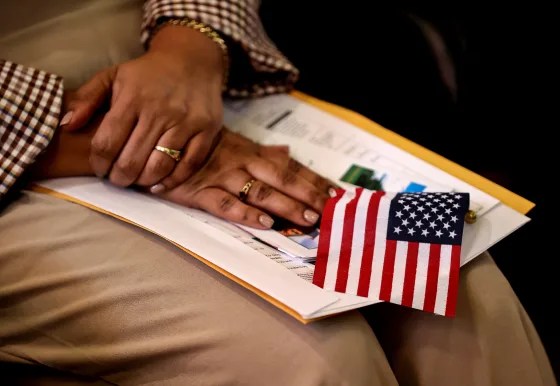
Image of new citizen holding an American flag during a Naturalization ceremony. Retrieved from Getty Images.

From Fall 2022 to 2024, the Immigration Lab at American University conducted interviews with 39 Afghan immigrants and refugees in the United States. These interviews highlighted the emotional, legal, and political liminality many were experiencing as they navigated unfamiliar environments, language barriers, cultural dissonance, and labor market exclusion.

For many, the question of whether they truly belonged remained unanswered. Their testimonies revealed that belonging is often shaped by, and sometimes denied through, seemingly small but powerful experiences: a comment on one’s accent, a name questioned, struggles in finding jobs, or the lack of recognition for past professional experience.

Understanding what shapes belonging is so important—because it directly impacts how immigrants adjust and feel supported. One powerful influence is social location: a person’s layered identities, like race, gender, class, religion, and language, and how those identities are treated by a society. These factors play a huge role in how people are perceived, welcomed, or integrated into their host countries.

Social Location also shapes the practical, everyday decisions migrants make, mainly around where to live and how to build support systems in unfamiliar places. Approximately 19,000 Afghan immigrants reside in the Washington D.C., Maryland, and Virginia (DMV) metro area, and many of those interviewed echoed this sentiment—citing pre-existing social networks, including family members, as key reasons for settling in the region.

Even in areas where they had a social support network, Afghan immigrants encountered a range of emotional and structural challenges as they navigated life in the U.S. While many expressed a strong desire to adapt to new cultural norms and expectations, they faced obstacles that affected both their personal lives and their careers. For many, starting over professionally proved to be one of the hardest adjustments. They spoke about the struggle to find work, the need for personal referrals to secure a job, and the challenge of seeing their education or experience devalued in the U.S. job market.

The biggest challenge not only for me, but for all Afghans––almost for everyone––is referrals. If you have a referral, you can easily find a job. If you have experience but no one has referred you, no one will select you.”

––Abdul, Afghan Man, 44 years old

“When I came to the U.S. and learned that my education was not valid, especially in media or journalism, it was devastating. It’s such a high-level profession here. But with my limited English, I can’t find a job…”

––Saabir, Afghan Man, 45 years old

Others described how bias and assumptions about their race, religion, or accent shaped how they were treated and limited their opportunities. They reflected on moments when their identity was questioned before their abilities were even considered.

“I am being discriminated [against] because of my accent…. I’m getting assigned some projects because of my background. Like, ‘Oh, you’re Afghan, so you’ll talk to Afghan clients.’”

––Amina, Afghan Woman, 32 years old

“I think it’s a little bit negative because I have a Muslim name. I am Muslim, but I don’t practice Islam, but I think some people, when they don’t meet me, they just see my name and think, “Oh she’s very restrictive, I don’t know if she’s going to be a team player or not,” so l think it plays like a… preventive… or not really positive for the job market.”

––Zahra, Afghan Woman, 39 years old

Acculturation & Belonging

Belonging isn’t just social; it is also extremely personal, influenced by emotional attachment and one’s individual identity. In this case, migration involves more than the physical journey from one place to another. It involves the loss of familiar social structures, language, cultural values, and a sense of community. Many migrants experience this as a disconnection from their cultural roots.

Language, in particular, becomes a powerful tool for preserving identity and transmitting culture to the next generation, even while living far from one’s place of birth. For many Afghan families, speaking Dari or Pashto at home is more than just a way to communicate; it’s a deliberate effort to preserve cultural identity. Parents often worry that their children, surrounded by English at school and in public life, may lose touch with their native language and, in turn, their heritage. Several interviewees emphasized this concern, sharing how they actively maintain multilingual households to keep that connection alive. As one parent explained:

I am speaking three languages with my children. My first language, Pashto. Pashto is my first language, as it used to be my dad’s language. Farsi, we are talking at home, and also English.”

––Darya, Afghan Woman, 40 years old

Similarly, food and festivals also remain a resilient and deeply symbolic aspect of identity. When asked whether they still eat Afghan food, most participants said they cook traditional meals two or three times a week, preserving their cultural connection through taste, routine, and memory. However, maintaining other cultural traditions in a new country can be more complicated. One participant shared:

A number of our close relatives is not here, so and even if we have some relatives [here], they are all busy working, so we do not have the time to celebrate, and for example if we have Eid, then during Eid the American government, unlike the government in Afghanistan will not give a holiday so….

––Sayyid, Afghan Man, 27 years old

Political Exclusion

The political climate and policies of a host country also play a critical role in shaping an immigrant’s sense of belonging. Citizenship and permanent residency function not only as legal statuses but as forms of membership, paving a path to societal recognition and stability. For many immigrants, gaining these statuses marks a turning point in feeling fully included.

These policies do more than determine who can enter the country; they influence how immigrants integrate, participate, and whether they feel accepted in their host country. When one Afghan interviewee was asked whether he felt like he belonged in the U.S., he responded:

“I like it now…. I trust that people are kind…”

––Amir, Afghan Man, 38 years old

While answering the question, he paused several times—searching for the right words or grappling with what “belonging” truly means. These pauses reveal an internal struggle: he wants to build a life and trust in a new community, but the uncertainty of his legal status keeps him from fully embracing that sense of home. It’s not a lack of desire to belong, but a fear that this “new home” could be taken away at any moment. His unfinished sentence reveals a common thread among many Afghan refugees: a hope tempered by legal uncertainty and the fragility of temporary status. Indeed, in recent months, many have lost their Temporary Protective Status (TPS)  and may face deportation.

Uncertainty is also influenced by experiences of exclusion. As another Afghan interviewee noted:


We can face the racism… while you know we are immigrants: they don’t give us homes or the rent, not only because of credit scores. But because they don’t want to give homes to the immigrants.

––Darya, Afghan Woman, 40 years old

In 2021, following the withdrawal of US and allied troops from Afghanistan, the Biden administration launched Operation Allies Welcome (OAW), granting temporary humanitarian parole to over 76,000 Afghans. While parole allowed them to enter and remain in the U.S., it offered no pathway to permanent residency or citizenship, leaving thousands in legal uncertainty. In response to the ongoing armed conflict and humanitarian crisis in Afghanistan, Temporary Protected Status (TPS) was granted on May 20, 2022. However, that protection expired on May 20, 2025, and terminations began as early as July 14—deepening the fear and instability for so many who are seeking safety and a chance to rebuild their lives.

The Afghan Adjustment Act, introduced in August 2022, aimed to address legal gaps and offer a pathway to permanent status for Afghans paroled in the U.S. Despite bipartisan support, the bill failed to pass. Opponents expressed concerns about the rigor of vetting procedures and the cost of implementation. However, advocates argue that the bill’s failure has more to do with the absence of a strong lobbying effort to push it through. Further compounding the uncertainty, earlier this year, President Trump ordered a pause on the US Refugee Admission Program, suspending aspects of the Afghan resettlement program, leaving thousands of eligible refugees in limbo even before the U.S. withdrawal.

“Some people were evacuated from Afghanistan, but they couldn’t find a job, or they were just on parole. Their situation is not clear—what will happen? Parole is for two years, I think. After that, I don’t know…”

––Abdul, Afghan Man, 44 years old

Key Takeaways

Belonging is an evolving process shaped by emotional ties, cultural identity, social reception, and political structures. For Afghan immigrants and refugees in the US, the journey of acculturation is not only about learning a new language, cooking familiar food, and celebrating their traditions. It is also about navigating legal precarity, confronting exclusion while holding onto hope.

“I’m not generalizing, but for most Americans here, I will still be an immigrant that wouldn’t fit into this community because of my skin, maybe because of my race, or maybe because of where I came from

––Iman, Afghan Man, 34 years old

These testimonies remind us that belonging isn’t just about arriving, but about being accepted, able to build a life, contribute, and thrive. The personal assessments shared are those of individuals who had arrived recently and lived in the U.S. for less than a couple of years. Indicators of integration and feelings of belonging vary with time; feeling at home takes years. Full integration is measured in generations, so it is too early to tell how these Afghans and especially their children will fare in the United States. They will likely find a way to keep what they most important to their identity while finding ways to contribute to the United States. These early assessments show the importance of legal certainty regarding the ability to remain in the United States and the key roles that work plays in the integration of adults and schools in the case of minors. Afghans were able to enroll their children in school and find jobs, often with long hours, low pay, and below their educational credentials and skills —but these entry-level positions can serve as a first step as they navigate U.S. society, culture, and labor markets.

S. Shrestha is a Research Assistant at the Immigration Lab.

Edited by Ernesto Castañeda, Director of the Immigration Lab and the Center for Latin American and Latino Studies (CLALS), Katheryn Olmos, Research & Data Coordinator, Noah Green, Research Intern at CLALS and the Immigration Lab.

The First Freedom

The First Freedom: How We Lost Sight of Our Oldest Right—The Freedom of Movement

By Bashir Mobasher  

Image: David Peinado Romero / shutterstock.com

Today, when we speak of migration, we no longer picture the awe-inspiring journeys of Herodotus, Xuanzang, Marco Polo, Ibn Battuta, or James Cook, men who ventured across oceans and deserts, through empires and unknown lands without needing a permit to enter and sometimes even received an audience with curious royalties.[1] We forget that their stories represent countless others, unnamed, unrecorded. We overlook the migration of the earliest human, homo erectus and homo sapiens, those bold crossings over mountains and plains, rivers and seas, islands and continents, by people who knew no boundaries, only the pull of necessity, survival, and discovery. They exercised the most ancient human freedom: the freedom to migrate.

Now, when we hear the word migration, our minds leap not to the journey, but to borders, passports, patrols, visas. We ask whether someone’s movement is legal or illegal, allowed or forbidden. We debate thresholds and quotas, risks and threats. Rarely do we ask the more human question: Does a person have the right to move freely? Doesn’t a person have the right to seek safety, pursue happiness, or simply adventure elsewhere?

What once seemed instinctive is now seen as impermissible, unnatural, even immoral. But this distorted view of movement is astonishingly new. It is newer than carriages and clocks, than spectacles and telescopes. For most of human history, the idea that one needed permission to move would have been absurd. Questioning human migration was questioning human nature—it still is. For over 90% of our existence as hunter-gatherers, humans were entirely dependent on movement.

Even with the rise of agriculture and the building of cities, migration between spaces remained natural to individual and social life. Entire communities shifted with the seasons. Trade and travel routes like the Silk Road, the trans-Saharan highways were arteries of constant movement. Nomadic peoples endured. Even the settled recognized migration as a response to drought, war, or opportunity. One needed no reason, or any reason would suffice.

This right to move is older than nearly all others. It predates the right to property, that most revered right in American political mythology. Property only became relevant when humans began to fence off land. Even the American settlers who enshrined property rights had to first migrate across oceans and continents to claim the land often by force. The right to the ‘pursuit of happiness’, enshrined in the US Declaration of Independence (1776), presupposes freedom of movement. Before there was freedom of speech, freedom of religion, the right to vote, or the right to due process, there was the right to migrate. Kings and empires might silence your tongue, outlaw your prayers, chain your thoughts, but they rarely questioned your decision to migrate. To migrate was beyond question. Often, it was the only freedom you could use to protect other personal rights by going to a new place. As the most respected freedom, it was the guardian of all other rights and freedoms.

Ancient thinkers, and traditions revered it as a sacred endeavour. Herodotus wrote, “Human prosperity never abides long in one place.” Aristotle saw migration as part of the natural order, while Socrates found it preceded new polities and civilizations. Religious traditions elevated migration into a moral duty: Abraham’s journey across deserts, the Exodus of the Israelites, the disciples’ missions across lands and cultures, and the Prophet Muhammad’s Hijra from Mecca to Medina were not mere detours or escapes. They were profound tales of faith, survival, and liberation in these traditions. Similarly, the Buddha’s Great Renunciation, the exiles in the Ramayana and Mahabharata, and the Anishinaabe migration were considered sacred journeys in these traditions shaping both the self and the world.

And yet today, that great engine of human history has been stalled. The rise of modern nation-states, colonial cartographies, and rigid immigration regimes has replaced this freedom with control. The invention of passports, visa systems, and surveillance bureaucracies has shackled what was once humanity’s most basic instinct. A species that roamed the earth for millennia now finds itself trapped inside boxes, walled by citizenship papers, embassies, fences, and checkpoints.

Ironically, it was the very colonial powers who once championed expeditions, economic and political adventurism, and settlement expansion that later rebranded rather more peaceful and kinder versions as a threat. The same empires that moved freely across oceans and continents in search of resources and dominion turned around to criminalize movement when it came from the margins. They eagerly promoted a pantheon of liberal rights, including free speech, religion, property, and even humanitarian intervention, but withheld the most ancient and universal of them all: the freedom of movement.

When the Universal Declaration of Human Rights was adopted, freedom of movement was included but subtly severed from the act of migration. A quiet sleight of hand. The right to leave was affirmed; the right to enter was not. It was a masterstroke of legal illusion, a political magic trick from the Western sleeve that has since cast a spell over global consciousness. A disillusion so complete, we forgot that the right to move was indeed the right to migrate; and it was never theirs to define, give or take. It was ours all along.

They even manufactured some baseless rights like preemptive self-defence, preemptive strikes, trade liberalization, and economic embargo, but somehow framed the right to migrate as too unrealistic, too disruptive, too dangerous to recognize. Denying the right to free movement has never been merely a matter of security or order; it reflects much deeper structural concerns. Facilitating and even coercing the flow of capital and resources from the Global South while restricting the movement of people ensures that global inequality remains entrenched, locking entire populations into structural disadvantage. These deeply embedded, often racialized, immigration systems have historically privileged certain regions and populations over others.

This redefinition has traveled far beyond its Western origins. For example, it is not only the United States or Germany that now deport Afghans, the very people they once claimed to protect. So too does Pakistan, Iran, and Tajikistan, who call Afghans their ‘Muslim brethren’, their ‘cultural kin’, their ‘linguistic neighbours’. Yet all these words evaporate at the border. Solidarity collapses at the gate.
Today, we no longer speak of migration as a right. We speak of it as a problem. A crime, a disruption to be managed. The image of the migrant has shifted from that of a seeker or survivor to that of an invader. We no longer greet them with wonder. We do not ask about their journeys, their struggles, their dreams. We fear them. Our attention has shifted from people to policies, from humanity to geography. We have created a world where those most in need of movement are the most forbidden to move. People are trapped in war zones, failing economies, and ecological disasters, not because they cannot escape, but because they are not allowed to. The powerful still glide across borders with ease; the vulnerable are held hostage by the coordinates of their birth. Worse still, this system has seeded hatred and xenophobia, nationalism, and exploitation. It has enabled trafficking where safe passage is denied. It has weaponized difference and built moral hierarchies out of geography. Borders are no longer lines; they are Great Walls of China, dividing people, excluding them.

To forget this freedom is not only to forget our past; it is to endanger our future. In boxing humanity into artificial lines, we have betrayed the very idea of freedom. We have turned a natural preservation instinct, a birthright, into a crime. We have silenced the journey. And in doing so, we have not only lost sight of our first freedom; we have lost a piece of what it means to be human.
 

[1] The empires were, however, hesitant to let Ibn Battuta and Marco Polo leave because they needed their services, not because they had some random law about migrations.

Dr. Bashir Mobasher teaches at the American University (DC) Department of Sociology, New York University DC, and the American University of Afghanistan Departments of Political Science. Dr. Bashir is the current President of Afghanistan Law and Political Science Association (in Exile). He is an expert in comparative constitutional law, identity politics, and human rights. He has authored, reviewed, and supervised numerous research projects on constitutional law, electoral systems, and identity politics. His recent research projects are centered around decentralization, social justice, and orientalism. Bashir obtained his B.A. (2007) from the School of Law and Political Science at Kabul University and his LLM (2010) and PhD (2017) from the University of Washington School of Law.

Faustian Bargain

Giving up democracy for the promise of security

By Ernesto Castañeda

September 1, 2025

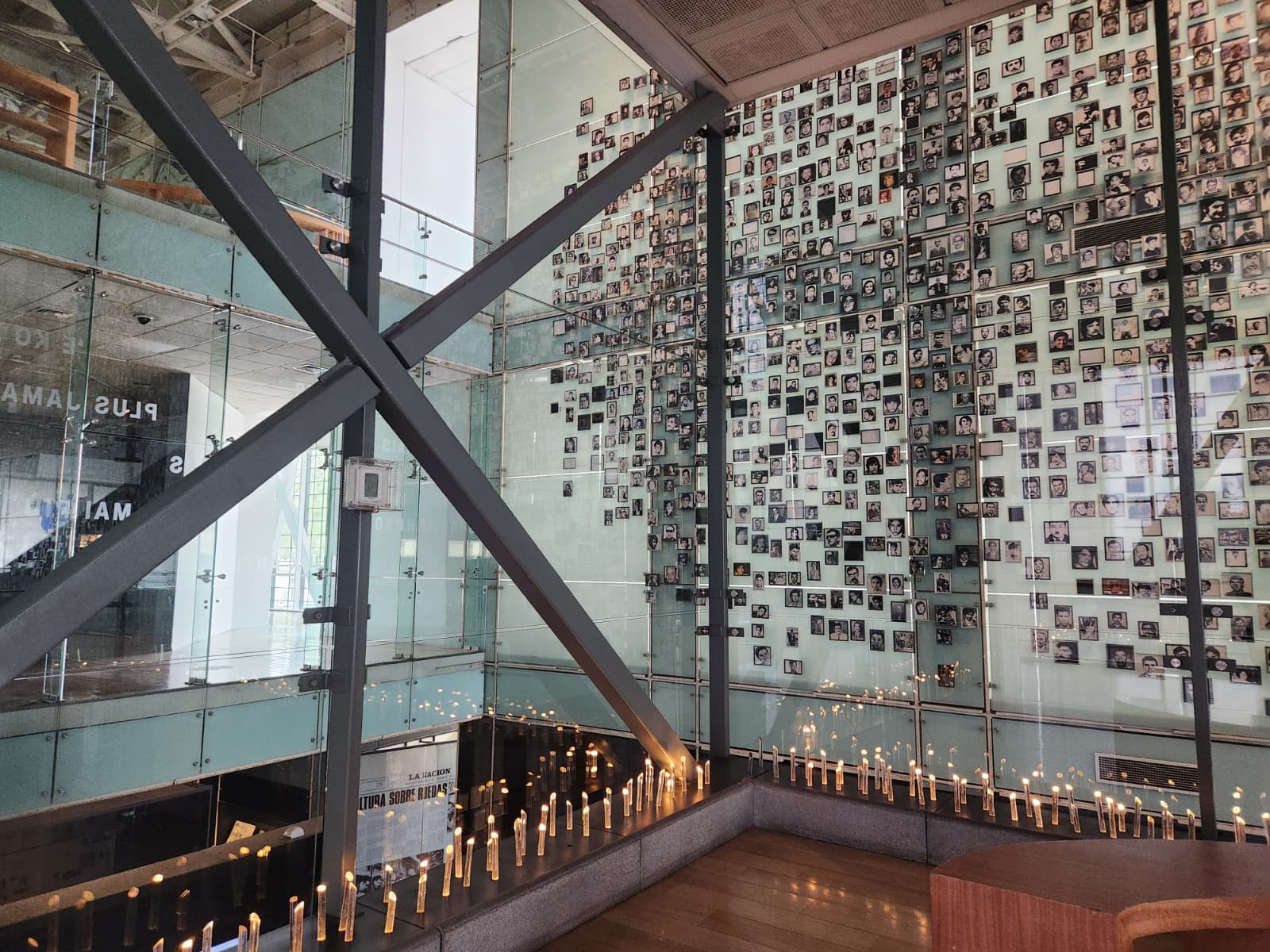
Last year, my wife and I traveled to Santiago de Chile. On our last day in town, we went to a museum dedicated to maintaining the historical memory of the human rights violations and violence against citizens perpetrated by the Dictatorship of Augusto Pinochet and his government (1973-1990). This is an important museum to visit, but one that is difficult to digest, as it clearly illustrates the extent to which state violence can go in targeting political enemies. The materials, stories, and evidence showcased — just a fraction of the many cases and events — were clear and abundant; the listing and witnessing of documented abuses were nauseating. One can spend a whole day learning about how the regime came to power, what it did to dissidents, why many had to go into exile, and how the regime came to an end. We were able to take only a few hours at a time because we had to head to the airport a bit later. After gathering our luggage, we got into a taxi and asked the taxi driver to avoid the highway and instead use local routes. We got into talking a bit.

Museum exhibit honoring some of the victims of the Pinochet regime. Museo de la Memoria  y los Derechos Humanos, Santiago de Chile. Photo by Ernesto Castañeda
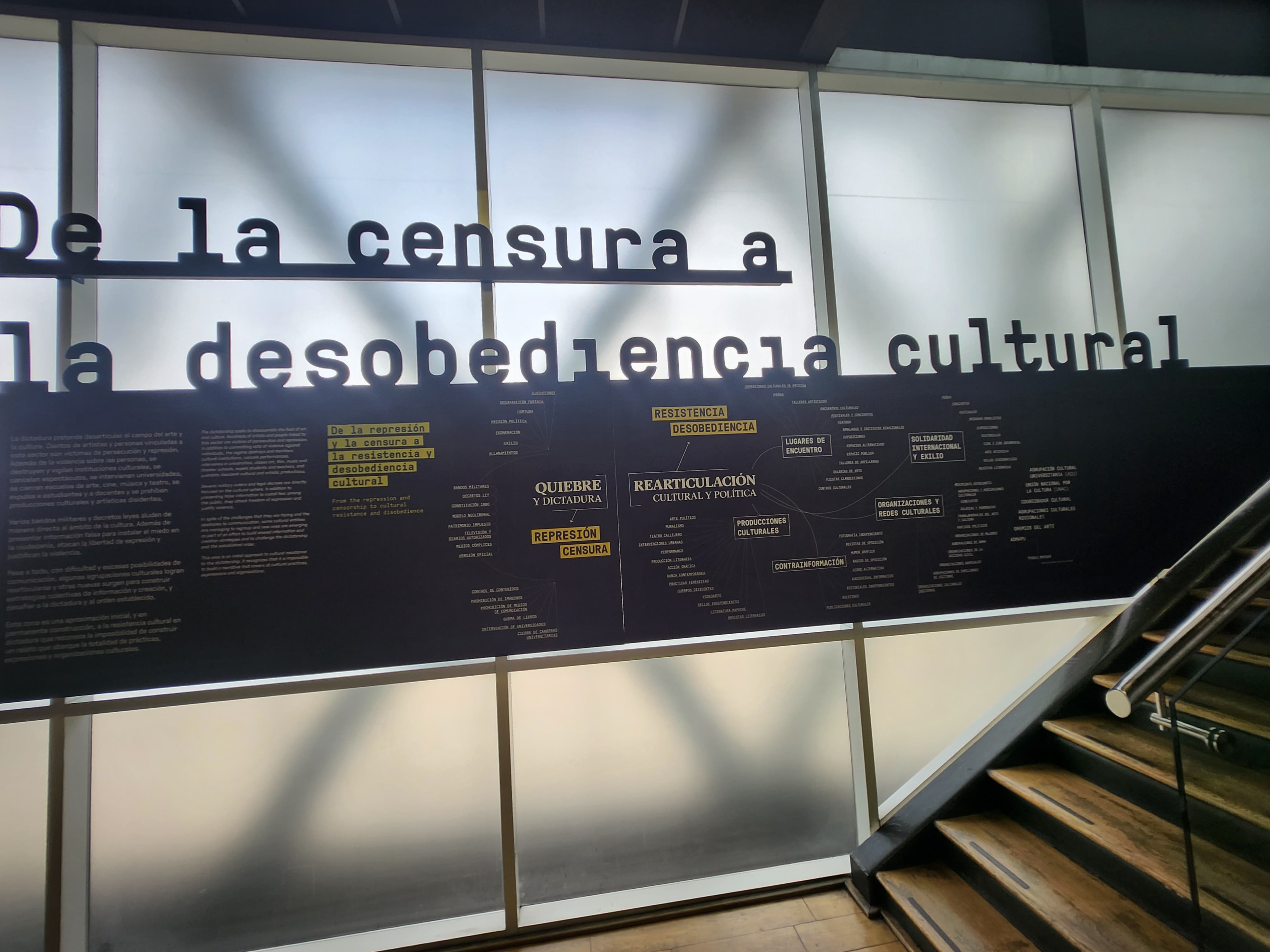
Title reads “From Censorship to Cultural Disobedience.” Museo de la Memoria  y los Derechos Humanos, Santiago de Chile. Photo by Ernesto Castañeda

After driving through downtown, we passed a few large tower buildings in the corner of a large roundabout. The driver, a man a few decades older than us, pointed to them and said that the area was dangerous because many immigrants lived there. He was referring to immigrants from other South American countries. To me, the neighborhood did not look any different from the ones next to it. But he used a derogatory name to refer to the immigrants and wished they would leave because they were “criminals.” When I prompted him for data on this, he said he had never been a victim of crime at the hands of an immigrant, nor knew anyone personally who had, but referred to the news stating so.

              He then moved to blame the so-called leftist government of President Gabriel Boric. And without any prompt, he started to reminisce about the times of Pinochet. He said that in those years he was able to buy a car and a house. He said things were better back then.

We briefly mentioned that we had just come from the historical memory museum, but he dismissed it, saying that rabble-rousers were dealt with, crime was low during the dictatorship, and there was almost no immigration. My wife and I looked at each other, but as professionals, we were in listening- and not in debate- mode.

              Only a few minutes later, without any sense of contradiction, he said how much he liked Chile and how he would not live anywhere else. He then stated that due to the challenging economic conditions during some years of the Pinochet dictatorship, he had to migrate to Argentina to find work. He went without a work permit and worked in painting and construction, saving money for years and eventually returning to Chile. The car he bought and the initial capital to get a house came from the work he did as a clandestine, low-skilled immigrant in the neighboring country. Yet, he showed no empathy for contemporary immigrants from Venezuela, Bolivia, Peru, and credited his ability to buy a taxi and work it now not to his years working abroad but to the Dictator Pinochet.

              We arrived at the airport, paid, thanked him, and went inside. He was very nice and not xenophobic with us. My wife and I discussed his level of mental gymnastics needed to avoid cognitive dissonance.

              Just a few days after Chile, I traveled to El Salvador for work. It was much safer to walk in the streets and go out at night than just a year prior when I visited. People walked with a sense of relief and talked about it. Parks and areas that were once quiet because they were under the control of gangs are now places where families can spend their evenings and engage in leisure activities. President Nayib Bukele was proactive during the pandemic, providing healthcare, vaccines, and financial subsidies to help people navigate the pandemic as well as possible.

              People locally known to be part of gangs, as well as people suspected of being part of gangs, because of where they were, with whom, or how they looked, had been getting locked up in large numbers without any due process or access to lawyers or even family members. I asked many taxi drivers and people I talked to about this. The great majority were supportive of the aggressive crackdown on gangs, felt the difference, and celebrated. When pushed further, most accepted knowing of people, sometimes even close family members, who were not gang members or criminals but were incarcerated because they were “in the wrong place, at the wrong time.” Sometimes, non-gang members would just be talking socially to gang members who were neighbors, or who were interrogating or extorting them, but if they were physically next to them when the Salvadoran army arrived, they would be taken along as potential gang members: guilty by association.

Few felt a sense of urgency or ability to do something about it. Cousins, close friends, even young fathers were afraid to go to the authorities and advocate for the innocent individuals imprisoned because they were afraid, they told me they could also be associated with the gangs just for advocating and asking questions, and could also be locked in. Early on during the “State of Exception” declared in March 2022, with zero-tolerance policies towards organized crime and the suspension of certain constitutional rights, many people were supportive of the measures. People were afraid of publicly opposing them. People pointed fingers at those gang members who created fear and extorted them for years, and asked for no mercy, and were supportive of those detained not coming back. There was shame and stigma cast on families who had family members arrested, as those taken away were immediately assumed guilty, and the government, and many in civil society, saw friends and family of those detained as having “harbored terrorists for years.” Thus, the pressure and strategic need to stay silent even if they had taken an innocent person. The detention center they were taken to, the CECOT, was a large, impressive building with the words terrorism and confinement in its name.

              Some said that if the government took people who were not guilty, it was because they were keeping ‘bad company.’ Many others justified the situation by resorting to religious sayings, such as “God knows why things happen,” “God will say,” and “The innocent will be set free, God willing.” 

              Some people started to comment on the growing inflation in El Salvador following the pandemic. This was a global phenomenon. But many taxi drivers saw inflation as the “price” to pay for increased security. They were willing to pay it in the short term, but noted that if inflation became too high and persisted for too long, the President’s popularity would decrease. As one person told me, people would forget about their previous insecurity, but would be very conscious of having a hard time buying groceries, and would go back to trying to migrate north.

              Indeed, a few months prior, I had traveled to Cuba for academic reasons. The country was facing blackouts, hunger, and mass emigration. Besides attributing some blame to the U.S.-based embargo, few members of the public failed to attribute some portion of the blame to the government for the weak state of the Cuban economy.

Exhibition at the museum’s plaza of an airplane staircase without an airplane, reminiscent of political exile and seeking asylum abroad without a dated return ticket. Photo by Ernesto Castañeda @2024.

Many in El Salvador saw the benefits of being able to walk the streets without fear of being targeted by the gangs as worth the few innocent people that were wrongly detained for life with no due process, even with the chance that the army could take other people like them in the future. In past years, when I asked about the threats to democracy that the president’s ambition revealed about staying in power, most people shrugged or showed resignation. Bukele’s local approval and among the diaspora have been large. Thus, consent was created for someone who made everything to be re-elected and who has now called for no limits on reelection, proudly calling himself the “coolest dictator” and now a “Philosopher King” on the bio of his X/Twitter account.

              Given his actual success in reducing homicide rates, many spoke with envy about a “Bukele Model” in other parts of Latin America and even the United States. Indeed, Rubio, Vance, and Trump spoke publicly about imitating this approach. They did so in 2025 by naming gangs as terrorist groups, by skipping due process protections, and indefinitely detaining people. Their emphasis was always on immigrants, so they added a new dimension to this: deportations. To countries of origin, when possible, and when not to third countries, starting with El Salvador, and holding them in CECOT by force. A coming together of extreme-right authoritarian and securitarian fantasies, but this model could not be sustainable given the immigration laws and constitutional provisions still applicable in the United States. Thus, the men the U.S. sent to CECOT have been freed or sent to Venezuela (see story about Julio Zambrano Perez here). The case of Kilmar Abrego Garcia, who was born in El Salvador and had legal protection from deportation to El Salvador, attracted a lot of media and public attention to the terrible conditions in the CECOT and the fact that innocent people and those who were never declared guilty are held under inhumane conditions. Those guilty of homicide and other major crimes are held under the same conditions and serving the same de facto life sentences as people who never committed any violence. The support from El Salvador endeared MAGA to Bukele, but it also further diminished his credibility internationally and among some Salvadoran immigrants abroad.

              Some still call for “the Bukele Model” in Mexico to get rid of the cartel violence. But the cartels are wealthier, and more organized and powerful than the Salvadoran gangs. Furthermore, using the army to confront them is what President Felipe Calderon did in 2006, ever since increasing the levels of violence and deaths.

Furthermore, it is not the case that there is no petty crime or drug trafficking in authoritarian regimes, just that the top authorities are more likely to be involved.  Thus, the Faustian bargain of surrendering democracy in exchange for security is a false pretense and an excuse to gain and concentrate power.

              On August 26, 2025, Trump said in his Oval Office chats, “So the line is that I’m a dictator, but I stop crime. So, a lot of people say, ‘If that’s the case, I’d rather have a dictator.’ Not clear who he is, hypothetically talking about beyond the MAGA base.               Some citizens in many places prefer to ignore the abuses of totalitarian regimes rather than allow a democracy to prosper where politicians more to the left can be elected and actually try to help workers and the middle class. Others prefer to live in what Kant called intellectual immaturity and let a parental figure make all decisions about public affairs. Likewise, many MAGA believers put their faith in Trump and do not want to carry any mental load for politics or governing. Nevertheless, there may be a high cost in the long term for this complete delegation of decision-making and responsibility because, despite promises to help the nation or members of a particular race, ethnicity, religion, or class, authoritarians only care about themselves.

Many historians of the Weimar era in Germany disagree that economic crisis or crime led to the popularity of Hitler and the National Socialist Party. He made an emotional appeal to ethno-nationalism, even though Hitler, who was born in Austria, became a German citizen only in 1932, a year before being named Chancellor by President Hindenburg in 1933. According to the work of Frank McDonough and others, Hitler claimed he alone could Make Germany Great Again. He also framed women as important because they would be the mothers of “racially appropriate children” to grow the German population. Once in power, his violent persecution was not limited to Jewish people, despite early antisemitism and conspiracy theories using them as scapegoats. He started going after communists, who included his most active and organized political opponents, and then included any political opponents and members of groups seen as deviant or inferior.

              Rural residents, small business owners, and middle-class members voted for the Nazi party, hoping their economic fortune might improve along the way as the international respect for Germany returned from the humiliations of losing World War I. Once in power, the industrialists supported the Hitler regime, but after a boost from the rearmament campaign, many people lost their shirts and their lives in the Nazi Imperial experiment. The rebuilding of postwar Germany was largely due to the Marshall Plan and subsequently the European Union.

Dictatorships, Empires, and totalitarian regimes overreach, crush opposition, and create political violence. They eventually fall from within or without. However, many lose their lives and liberties along the way if not stopped early on. A functioning social democracy is generally more peaceful and delivers most material goods to the majority of people most of the time.

Democracy is the best political system, not because it is perfect, but because it puts an expiration date on a specific regime. No government can stay popular, effective, or altruistic for long. It is healthy for a new administration to come in and so on.

It Cannot Be about Immigration

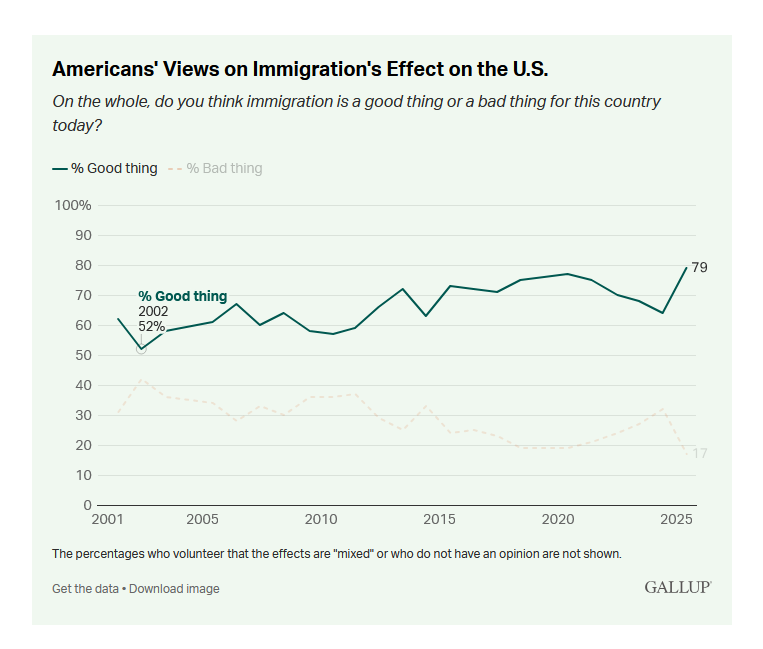
Despite the majority of U.S. public opinion being in favor of immigration for decades, we have been made to believe by extreme right-wing immigration restrictionist groups, and the media repeating their claims, taking them in good faith, and then sometimes believing them through repetition, that immigration is unpopular and dangerous. Some even believe, without any systematic evidence beyond that circular narrative, that immigration is a threat to democracy. To the contrary, immigrant scapegoating is most dangerous and a possible threat to democracy when accompanied by a state framing the issue as one of national security and survival, pairing it with aggressive policies targeting minorities and political opponents. Securitization against immigrants can be used to legitimize the adoption of “emergency” or exceptional measures that lead to increasing authoritarianism and concentration of power on the executive and military.

Source: Gallup 2025

In other words, misinformation and securitization discourses from politicians and state actors, especially those with anti-democratic tendencies, construct immigration as a threat. Some parties and citizens may buy into this rhetoric for political, self-serving reasons, out of fear, or due to a lack of information. MAGA’s misleading statements distort immigration realities and result in increased immigrant precarity and heightened state violence. They create a circular logic based on lies and promises that are impossible to fulfill. So, the bubbles they create eventually burst for most followers, enablers, and observers.

Immigration, including undocumented immigration as well as receiving refugees and asylum seekers, is not incompatible with democracy. To the contrary, newcomers are one of the reasons why wealthy plural democracies can remain so. It takes a totalitarian regime to fully control borders, enforce population registries, and remove unwanted people from spaces such as street encampments and cities. While some may find it alluring initially, the offer is not worth a soul.

Ernesto Castañeda, PhD is the Director of the Immigration Lab, and the Center for Latin American and Latino Studies, and Professor at American University. Opinions his own.

Land, Lives, and Liberation

Land, Lives, and Liberation: Resisting Alligator Alcatraz in the Everglades 

By Blanca Martinez 

The controversial immigrant detention camp in the Everglades, Alligator Alcatraz, has been holding immigrant detainees for over a month. Since the camp’s inception, it has faced widespread opposition from various groups, including environmental advocates, immigrants’ rights activists, and the local Miccosukee Tribe. 

Image of a crocodile in a swamp. Retrieved from Pexels

Environmentalists 

The Everglades, a vast ecosystem of wetlands referred to as the “river of grass,” is the only location in the world where crocodiles and alligators live alongside each other. For the Trump administration, the presence of large predators is one of the benefits of building an immigrant detention center in the Everglades, as the administration claims that immigrants will be deterred from escaping detention in such harsh conditions. However, for environmental advocates, the detention center represents a severe threat to the local wildlife and ecosystem.  

The new detention center is situated within the Cypress National Park Reserve in Ochopee, Florida, adjacent to the Everglades National Park. Environmentalists have fought for the protection of the Everglades for decades, as there have been several attempts to disturb the ecosystem. The new detention center currently sits on a failed government project called the Everglades Jetport, which was once expected to be the largest airport in the world. In the late 60s, Boeing was in the process of developing the Boeing 2707, a supersonic commercial aircraft. In support of the project, Congress considered the funding of the Everglades Jetport, which would provide a vast and remote area for the Boeing 2707 to break the sound barrier without disturbing civilians. The airport was expected to be five times the size of JFK airport, with six runways and connections to high-speed rail.  

However, the plans to build the airport were interrupted after environmental conservationists wrote a report that outlined how the airport would destroy the ecosystem. Together, conservationists, activists, and hunters deterred Congress from funding the construction of the major airport in the Everglades. The unfinished Everglades Jetport was instead turned into the Dade-Collier Transition and Training Airport, which has a single runway occasionally used to train new pilots.  

Now, environmentalists are fighting an old battle to protect the Everglades from the environmental impacts of “Alligator Alcatraz,” another controversial government project. Along with protesting and expressing their opposition through the media, environmental advocates have taken legal action. On June 27th, 2025, two prominent non-profit conservationist organizations, Friends of the Everglades, Inc., and the Center for Biological Diversity, filed a lawsuit against the head of the Department of Homeland Security, Kristi Noem, on the grounds that the government did not conduct a proper assessment of the environmental impacts as required by the National Environmental Policy Act (NEPA), 42 U.S.C. In their brief, the plaintiff emphasizes the vulnerability of the Everglades ecosystem, highlighting several endangered species in the area, including the Florida panther, Florida bonneted bat, Everglade Snail kite, and wood stork. 

Immigrants’ Rights Movement  

Immigrants’ Rights advocates have been active in opposing the over-criminalization and unjust treatment of undocumented people in the United States. The new detention camp has particularly raised alarms for civil rights and immigrant rights organizations as detainees have reported inhumane conditions inside the camp, including worms in the food, mosquito infestations, and dysfunctional plumbing resulting in flooding and the spread of fecal matter. Furthermore, detainees are not receiving adequate medical treatment in the face of unsanitary living conditions.  

As Immigration lawyers are fighting to win freedom for their clients inside the detention center, they report a severe lack of due process offered to those inside the detention center. For example, an attorney from Dubrule & Nowel told Forbes that when her client was transferred there, she was unable to schedule contact or track her client’s condition. Many immigration attorneys have reported similar instances of injustice, resulting in a class-action lawsuit against the detention center. In their complaint, Attorneys from the American Civil Liberties Union and Americans for Immigrant Justice claim that “no protocols exist at this facility for providing standard means of confidential attorney-client communication, such as in-person attorney visitation and phone or video calls that are available at any other detention facility, jail, or prison.” 

Miccosukee Tribe 

Before the time of Columbus, the Miccosukee Tribe primarily lived in Northern Florida, Georgia, and Alabama, among the Appalachian Mountains extending south to the Florida Keys. However, European colonization pushed the Miccosukee Tribe to the southernmost tribal land known as the Everglades. The Tribe was forced to adapt to the swampland by living in small groups called “hammock style” camps across the Everglades. In 1962, the United States government recognized the Miccosukee Tribe of Indians of Florida as a sovereign nation with the right to self-governance. Today, the Miccosukee Tribe is a thriving community that owns and operates various businesses and public services, including the Miccosukee Casino and Resort and an independent police department.  

Having based their livelihood in the Everglades, the Miccosukee tribe claims that the recent construction and operation of Florida’s new Alligator Alcatraz infringe on the cherished land and culture of the Miccosukee Tribe. The detention center is located 900 feet from the Miccosukee “Panther Camp” village, where youth are brought to participate in traditional activities. In total, there are ten tribal villages within a three-mile radius of the camp. In an interview with ABC News, William Osceola says that Alligator Alcatraz is a reminder that, “We are not done trying to secure our future like we thought we were.”   

Since July 1, the members of the Miccosukee Tribe have joined environmentalists and immigration activists in demonstrations at the entrance of Alligator Alcatraz to express ecological, ethical, and economic concerns about the facility. On July 14, the Miccosukee Tribe asked to join as a plaintiff in the Friends of the Everglades, Inc. v. Noem lawsuit, stating that “it is our constitutional duty to conserve the Everglades, and ensure the health, welfare, and rights of our people.” 

The Miccosukee Tribe remains hopeful in the fight against Alligator Alcatraz and is calling for peace and open-mindedness during an interfaith prayer service outside the detention center. 

Beyond these three local groups’ active opposition, groups outside of Florida have also shown their opposition to the difficult conditions under which immigrants, who often have not been found guilty of any crime or even immigration violation, are held for long periods without access to legal counsel. 

__ 

Blanca Martinez is a Research Assistant at The Immigration Lab and Center for Latin American and Latino Studies at American University, and a rising senior in American University’s Politics, Policy, and Law program. 

Edited by Ernesto Castañeda, Director, and Katheryn Olmos, Research & Data Coordinator at the Center for Latin American and Latino Studies and the Immigration Lab.   
Walls, Fear, and Misinformation

Walls, Fear, and Misinformation: How the Securitization of Immigration in the US Fuels Xenophobia

By Lauro Accioly

Public perceptions in the U. S. regarding Latin American immigrants sometimes reflect historical traits of xenophobia. Some surveys and studies suggest that individuals who perceive Latin American immigrants as threats to cultural identity, public safety, or job security are significantly more likely to support hardline immigration measures, including the construction of a wall along the U.S.-Mexico border—a costly and symbolically charged project. This negative perception can be exacerbated by misinformation, which reinforces such misconceptions about immigration.

The construction of a border wall was one of Donald Trump’s flagship political promises and a pillar of his broader migration agenda during his 2016 presidential campaign. He largely promoted his political agenda via Twitter, while spreading misinformation and distortions on immigration and many other topics. Research shows that many of the negative perceptions of immigrants, regardless of legal status, are highly distorted. When it comes to crime in the U.S., for instance, there is ample evidence that immigrants – both documented and undocumented – are less likely to commit crimes than native-born citizens. Nonetheless, a substantial number of Americans still believe that immigration increases criminality. This phenomenon is borne out in data indicating that during Trump’s first administration, the majority of crimes were committed by native-born Americans, and their crime rate was higher than that of the foreign-born. Nationally, the crime rate among undocumented immigrants has historically been low. Since 1980, immigrants have exhibited lower incarceration rates than native citizens – a pattern sustained for over 150 years.

Image of Construction at the U.S.-Mexico Border Wall. Retrieved from DVIDS.

Given these facts, is misinformation the primary factor shaping the negative perceptions about immigrants? I argue that although misinformation does play an important role, it is the most dangerous when accompanied by a state framing of insecurity and aggressive policies. A concept widely discussed in International Relations – securitization – has gained relevance in this debate. This concept explores how certain issues are strategically framed as matters of national security or threats, thus legitimizing the adoption of emergency and exceptional measures. Some scholars have argued that this process results in the social engineering of insecurity, wherein certain topics are repeatedly framed as security problems to justify restrictive policy responses. Doing so often creates more issues than it solves, such as the rising death toll among migrants who, in an effort to bypass highly securitized zones, are forced to take more dangerous and often deadly routes.

This scenario directly applies to the issue of the US-Mexico border. Heavy investment in surveillance and enforcement infrastructure has led to additional challenges, such as increased migrant mortality. As migrants are forced to seek out more dangerous routes, their lives are placed at greater risk. This reflects a deterrence-based strategy.  The intention is to discourage irregular migration, rather than completely prevent individuals traveling through Mexico — including, but not limited to, Mexican nationals—from entering the country. The strategy of prevention through deterrence, first institutionalized during the Clinton administration, was strengthened under George W. Bush in the context of the Global War on Terror and later became a central pillar of Donald Trump’s hardline immigration agenda.

This logic of deterrence is deeply embedded in the broader process of securitization, which has become a recurring reference point in U.S. politics—especially following the attacks of September 11, 2001. In the post-9/11 era, the U.S. government expanded the national security paradigm to encompass irregular migration, portraying it as a potential threat akin to terrorism. This discursive and policy shift helped to legitimize a range of exceptional measures, including militarized borders, the use of surveillance technologies, and increased detention. In this way, the logic of securitization that shaped the U.S. response to 9/11 continues to inform and justify current immigration enforcement practices.

The US-Mexico border wall – one of Trump’s main campaign promises – exemplifies how securitization and misinformation go hand in hand in shaping immigration policy. Particularly among groups who believe that immigration worsens crime and harms the economy, there is a tendency to support border-closing policies, such as the wall, and who further amplify false and distorted information about immigration. His repeated attacks on the character of immigrants strengthened the belief that immigrants pose an immediate threat to the country. His statements, combined with the dissemination of misleading data, not only distorted the reality of immigration in the U.S. but also resulted in policies that increased precarity for migrants and heightened state violence along the border.

Beyond the political and social consequences, the securitization of immigration directly affects the lives of migrants, rendering their conditions in the U.S. increasingly precarious. Border militarization, for instance, does not fully prevent irregular immigration. It simply makes migration more dangerous. The criminalization of migration leads to detention, family separation, mass deportation, and the marginalization of entire groups of people. This process fuels restrictive policies, deepens migrant marginalization, and sustains a distorted view of the migratory reality.

Misinformation and securitization discourses from politicians and state actors construct immigration as a threat. Parties and citizens may buy into this rhetoric for political and self-serving reasons.

The broader context of insecurity is reinforced by both real and manufactured crises. This politically manufactured sense of insecurity aims to legitimize tougher border policies and reinforces a cycle of exclusion: the more immigrants are framed as dangerous or destabilizing, the more justification arises for restricting their rights and intensifying control measures. This is circular logic and justification that only breaks once reality intrudes to break the spell.

Lauro Accioly Filho is a PhD candidate at the Interinstitutional Graduate Program in International Relations – San Tiago Dantas and a Visiting Scholar at American University (Washington, D.C.).

Edited by Rob Albro, Associate Director, and Ernesto Castañeda, Director, at the Center for Latin American and Latino Studies 

Trapped by Debt? China’s Role in Ecuador Oil Dilemma

Photo credit: Xinhua, https://images.app.goo.gl/rBnL1kuwMixrzmCh7

Ecuador’s struggle to move beyond oil is deeply tied to its financial obligations—especially to China. Over the past 15 years, oil revenues have not only funded public spending but also serviced billions in external debt, locking the country into a path of continued extraction. This tension was already visible when the Yasuní-ITT Initiative collapsed in 2013: efforts to protect the rainforest were ultimately sidelined as social spending and budgetary needs remained—if not deepened—the country’s dependence on oil income. A decade later, Ecuadorians voted to halt drilling in the same region, but implementation has slowed. While officials have cited fiscal pressures and legal complexities, it is also clear that a significant portion of Ecuador’s oil production remains tied up in long-term prepayment arrangements—including those linked to past oil-for-loan agreements with Chinese lenders. 

Following Ecuador’s 2008 debt default, China quickly emerged as the country’s primary financier. According to the China-Latin America Finance Database, since 2010 Chinese policy banks—primarily China Development Bank and Eximbank—provided over $18 billion in loans to Ecuador. Many of these were backed by future oil shipments. The structure followed a two-track model: financial agreements with policy banks, and parallel supply contracts with PetroChina or Unipec. In practice, this meant that while Chinese banks lent Ecuador billions in cash, PetroEcuador committed to deliver oil to Chinese traders as repayment—regardless of market prices at the time of shipment. This arrangement locked in large volumes of crude in exchange for upfront cash. By 2013, nearly 90% of Ecuador’s oil exports were committed under term contracts with Chinese buyers, giving Beijing outsized leverage over the country’s oil trade. 

These deals have had long-lasting implications. By committing barrels years in advance, they reduced Ecuador’s ability to adjust production in response to new priorities—such as conservation mandates or global price shifts. Pricing terms further undercut the country’s earnings. Although contracts referenced international benchmarks like West Texas Intermediate (WTI) or Brent, additional fees, quality discounts, and opaque delivery terms often meant Ecuador received significantly less than market value. In fact, in 2017 Petroecuador sought to renegotiate oil-for-loan contracts with Chinese firms precisely to secure better pricing and reduce the volume of barrels exported under onerous terms. A 2022 audit cited by Infobae estimated that Ecuador lost nearly $5 billion in revenue due to oil sold at below-market prices under those contracts; up to 87% of crude exports were tied to formulas that paid less than the spot market could have yielded. 

Independent investigations by journalists have also found that Chinese firms profited by reselling Ecuadorian crude at higher prices, while Petroecuador captured only a portion of the potential revenue. Contractual provisions—such as repayment accounts held abroad and sovereign immunity waivers—further limited Ecuador’s flexibility to renegotiate terms without risking legal or financial penalties. 

In this context, many of the barrels extracted today are already earmarked through older pre-sale deals. This complicates efforts to curb drilling, even when doing so in response to a clear public mandate. Contractual rigidity—not just fiscal reliance—has narrowed the government’s policy space. Reversing course isn’t just a matter of political will; it requires untangling years of embedded financial commitments. 

The 2022 debt restructuring with China offered a glimpse of what greater flexibility can unlock. By renegotiating loan maturities and rescheduling oil deliveries, Ecuador freed up dozens of cargoes that had been tied to repayment. Instead of shipping them under discounted terms, the government was able to sell them on the open market—during a favorable price window—generating millions in additional revenue. The volume of oil remained the same. What changed was when and how it could be sold. This shift in marketing autonomy directly expanded Ecuador’s fiscal space, without requiring increased production or new drilling. 

While extractive arrangements remain deeply entangled with prior commitments, recent developments suggest Ecuador is gaining modest room to pursue a different path. In mid-2025, the country secured $400 million from China’s PowerChina—part of a broader $1 billion renewable energy package that also included Spanish financing—to support solar and energy storage projects. This marks a shift in Chinese engagement away from fossil-backed infrastructure toward cleaner investments. At the same time, Ecuador has turned to debt-for-nature swaps to ease financial pressures without expanding oil production. Although these were led primarily by multilateral lenders and NGOs, they reflect a broader shift. The 2023 Galápagos blue bond refinanced $1.6 billion in debt to fund long-term marine conservation, while a second swap in 2024 unlocked $460 million for Amazon protection. Together, these efforts point to the possibility of more climate-aligned partnerships—offering early glimpses of how Ecuador, with support from external actors, including China, might gradually move beyond extractive dependence. 

Three lessons stand out. First, oil-for-loan deals may offer quick liquidity, but they impose long-term constraints that complicate democratic and environmental decision-making. Second, transparent and flexible oil sales consistently outperform opaque pre-sale contracts weighed down by discounts and delivery restrictions. And third, while China’s engagement has historically centered on extractive finance, recent shifts—such as investment in renewable infrastructure—suggest there is room for more climate-aligned and cooperative models. Deepening this kind of engagement, alongside support for flexible financing tools like debt-for-nature swaps, in line with its constitutional commitments, could help Ecuador reduce oil dependence.  

There is no easy path out of an oil-dependent economy for Ecuador. Oil still plays a major role in the country’s budget. But the choice is no longer between drilling or defaulting. The 2022 restructuring showed that smarter financing—focused on freeing future production from rigid terms—can create space to act on social and environmental goals. Greater control over the extractive model would not mean extending Ecuador’s reliance on oil, but rather using what production remains in a more strategic and limited way. This includes regaining flexibility over how and when oil is sold and ensuring that any revenues are used to actively support, rather than delay, the transition toward a more diversified and sustainable economy. The 2023 vote to halt oil drilling in the Yasuní reserve signaled a shift in public priorities. Whether Ecuador—and its partners—can align financing with that vision will determine whether Yasuní becomes a turning point or just another deferred promise. 

Edgar Aguilar is a Researcher at the Center for Latin American and Latino Studies and a graduate student in International Economics at American University 

Edited by Rob Albro, Associate Director, Research, at the Center for Latin American and Latino Studies 

*This post continues an ongoing series, as part of CLALS’s Ecuador Initiative, examining the country’s economic, governance, security, and societal challenges, made possible with generous support from Dr. Maria Donoso Clark, CAS/PhD ’91. 

“No es miedo, es terror:” Alligator Alcatraz, terror in the Everglades

By Katheryn Olmos

Edited by Noah Green, Caryalyn Jean, Saedra Gurfinkel

“Ya no es miedo, es terror,” said the Mexican migrant woman who has been living in Northern Florida for over 20 years when asked about how she feels about the recently enacted anti-immigrant policies. Immigrants in Florida have long feared deportation. ICE has had full jurisdiction to expedite removals within the 100-mile border zone, which includes the whole state of Florida. While it’s not unusual for Floridians to encounter ICE, since January 2025, sightings have increased dramatically. Now, with the newly built detention center known as Alligator Alcatraz, sightings and fear have escalated even further.

Built in just 8 days, Alligator Alcatraz sits deep in the Florida Everglades, on the grounds of the abandoned Dade-Collier Training and Transition Airport—an area infested with alligators and pythons. The plastic detention center consists of several tents, each containing metal cages and stacked bunk beds designed to contain 5,000 people. The first wave of migrants, whose exact number remains undisclosed, arrived during the first week of July 2025.

Where is the money coming from?

According to Homeland Security Secretary Kristi Noem, Alligator Alcatraz is funded “largely” by the Federal Emergency Management Agency’s (FEMA) Shelter and Services Program (SSP). In 2023, the SSP was created to support asylum seekers and refugees with emergency and short-term needs upon arrival in the U.S., including food and shelter.

Although funding for the new detention center does not come from FEMA’s disaster relief program, the sheer amount of money being funneled into facilities that subject migrants to torturous conditions has left many Americans outraged. In light of recent FEMA budget cuts under Trump’s “Big Beautiful Bill”, the federal government’s slow response to the devastating flood in Texas has only added fuel to the fire.

Meanwhile, Florida Governor Ron DeSantis has slashed funding for essential social programs while intensifying anti-immigrant policies. As the state’s housing crisis deepens, Floridians are responding with growing outrage, organizing protests and speaking out through public forums, media, and direct action. 

One Florida construction worker stated, “With $450 million, we could have created 350,000 family homes.” For him, such an investment would not only boost the state’s economy but also strengthen its social infrastructure. Building more homes would not only create jobs, but it would also increase government revenue through increased property taxes and consumer spending. 

Inhumane Conditions & Death

Within seven days of Alligator Alcatraz‘s “grand opening”, the surrounding Miccosukee Tribe reported seeing an ambulance leave the facility. Since there have been several reports of temperatures shifting from freezing to hot. Congressman Maxwell Frost (FL 10th district) visited Alligator Alcatraz alongside several other Florida representatives. He described the “cages” as “very hot,” and the only drinking water available came from the toilet. Frost describes the numerous yells for help coming from the encaged, even mentioning the yell from an “American citizen” which is to be investigated.

Those held in these cages are subjected to inhumane conditions—denied basic hygiene, forced to eat spoiled food, and drink toilet water—all while enduring the scorching heat of the Everglades. Our community members are being degraded and mistreated. At one point, a 15-year-old boy with no criminal record was briefly detained in “Alligator Alcatraz.” “That is no place for anyone, let alone a young boy,” said a Mexican migrant living in Florida.

The experiences at Alligator Alcatraz reflect similar conditions to those reported at Krome. Krome, a well-known detention center in South Florida, has experienced several deaths and reports of “inhumane conditions.”

A Mexican man detained in Florida described being forced to eat moldy, worm-infested food, with the only available water—used for both drinking and showering—scalding hot.

A Mexican man who was detained in Florida reported eating moldy, worm-infested foods, with the only water available for drinking and showering being scalding hot. These conditions, he said, weren’t just unsanitary—they were meant to humiliate. Stripped of any privacy, he was forced to defecate in plain view of fifty other men, all caged together like animals. He recalled how some tried to “hold it in” to avoid the humiliation, but eventually had no choice, risking illness if they didn’t. He was held for over 30 days. “I can’t imagine holding it in for a month,” he said.

Environmental Concerns

Alligator Alcatraz poses serious environmental and humanitarian risks. Built in the heart of the Everglades, a fragile and legally protected ecosystem, Alligator Alcatraz and its detainees faced harsh conditions from the start.. As the state continues to push forward, the environment will eventually bite back. The Everglades is home to many of Florida’s wild predators, including alligators, crocodiles, pythons, and venomous snakes. With its thick humidity it creates the perfect breeding ground for mosquitoes, raising public health concerns about disease transmission. While facility staff reportedly receive personal bottles of mosquito repellent, detained individuals are only sprayed once upon arrival, leaving them vulnerable for the duration of their internment.

The heat in the Everglades is relentless. Temperatures regularly climb between 90 to 100 degrees Fahrenheit. One Central Florida resident described it plainly: “It’s so humid, it’s suffocating. We are in sauna status. It is so thick outside, it’s bad.” They continued, “I can’t imagine what it feels like in the Everglades—it’s literally a swamp.” 

Among all U.S. states, Florida consistently reports the highest number of heat-related illnesses in the country, many of which result in emergency room visits and in some cases, death. Even without factoring in any other risks associated with the structure of Alligator Alcatraz, the heat alone within the Everglades has raised serious concerns. Governor Ron DeSantis stated that the camp includes a few large portable AC units, yet reports and first-hand accounts from Florida politicians who visited the camp measured temperatures of 83 degrees.

The Everglades is prone to hurricanes due to its location. Flooding issues from small amounts of rain occurred on opening day. As we approach another hurricane season, concerns are raised about the weather’s impact on the camp due to its location and weak foundation. One individual who has resided in Florida for over 20 years states, “Un huracan pasa y se lleva todo el campo con personas y todo” (“It takes one hurricane to hit and take the whole camp with people and everything”).

Image of Alligator and Python in Florida Everglades. Image from boudewijnhuijgens.getarchive.net

Conclusion

The Everglades is no place to hold individuals in detention—especially under the aggressive supervision of ICE. Built hastily in a fragile ecosystem, the facility cages thousands in brutal, sweltering conditions with little oversight and even less accountability. The risk of natural disasters, heat-related illness, and environmental degradation is imminent.

The damage extends beyond the fences of Alligator Alcatraz. Latinos and migrant residents who have not been detained live with constant psychological strain under the current anti-immigrant policies. A Mexican man in Florida described feeling constant paranoia in his day-to-day, including going to work, grocery shopping, and even just dining out. His friend recognized his symptoms of paranoia when he appeared visibly unsettled by a stranger glancing at him from across the room in a restaurant.

A Mexican woman in Florida stated, “Cuando pienso que ya esta lo peor, pasa otra cosa. Ahora ni nos podemos defender.” Migrant detainment in Florida has spiraled into unchecked lawlessness, with no regard for humanity or due process.

ICE and Florida officials are ripping communities and families apart, fueling public tensions and mass hysteria. As Florida residents face housing foreclosures, job insecurity, and climate disasters, they are left asking: How can hundreds of millions of dollars be poured into detaining community members, while the rest of the state crumbles?


Katheryn Olmos is the Research and Data Coordinator at the Center for Latin American and Latino Studies and a graduate student at the Sociology Research and Practice (SORP) program at American University. 

Edited by Ernesto Castañeda, Director, and Saedra Gurfinkel, Carylyn Jean, and Noah Green, Research Interns at the Center for Latin American and Latino Studies and the Immigration Lab.

Fleeing Collapse, Facing Barriers

Fleeing Collapse, Facing Barriers: The Venezuelan Crisis and U.S. Immigration Hurdles 

By Katheryn Olmos, Emma Wyler, & Isabella Serra

Photo of popular Venezuelan activist, Rafael Araujo, holding a sign that says, “Feb 12th 2014-2015 Impunity Persecution and Torture,” at a protest in Caracas, Venezuela on February 12, 2015. Image retrieved from Wikimedia Commons.

Severe Humanitarian Emergency in Venezuela

Just a few decades ago, Venezuela stood as a beacon of economic prosperity and oil wealth on the Caribbean coast of South America. However, the rise of authoritarian rule led to economic collapse, widespread corruption, and rampant inflation, creating a dangerous political climate that forced millions to flee their homes.

For many Venezuelans, including the 48 living in the Washington Metropolitan region (DMV) whom we interviewed, migrating to the U.S. was not their first choice when pursuing a more stable life. Previously, many Venezuelans migrated to and were displaced from places closer to home, from neighboring countries such as Venezuela, Colombia, Peru, Chile, and Brazil.

Venezuelan displacement is driven by a myriad of circumstances. Almost all of the Venezuelans we interviewed expressed that the economic situation in their home country, including hyperinflation, food scarcity, and inadequate wages, is not viable to sustain themselves or their families.

“No hay trabajo. [Cuando] hay trabajo y te quieren pagar, son 20 dólares semanales. Sí, y eso es muy poco dinero para los consumos de mi mamá, mis hijas. Nada más un bote de leche son 10 dólares. ¿Y me quedan 10 dólares para qué?”

“There’s no work. When there is work and they want to pay you, it’s 20 dollars a week. Yes, and that’s very little money for my mom and daughters’ basic needs. Just one gallon of milk costs 10 dollars. That leaves me 10 dollars for what?”

— Gabriel, Venezuelan Man, 28

When asked about corruption and impunity playing a role in the reason they migrated, the answer is almost always “yes.” Many of our participants experience corruption and political persecution from their government.

“Pues primero por la escasez de comida, y segundo, el barrio donde yo vivía era uno de los barrios más peligrosos de Venezuela… No tanto por parte de los que te roban sino más que todo por la policía. A la policía no importa si eres sano, si eres delincuente, igualito te extorsionaban, te sembraban drogas, de todo… nada más por el hecho de que uno perteneciera a La Cota 905 pensaban que ya uno estaba relacionado con [la pandilla]. Sí a todo el mundo que agarraron o sembraron le daban golpe, lo metieron preso, lo desaparecía… Te mataban y te ponían un arma, y ponían carajo de la banda de La Cota 905, cuando no es así. Entonces esa fue uno de los principales motivos porque me vine: La policía.”

“Well, first, because of the scarcity of food, and second, the neighborhood where I lived was one of the most dangerous neighborhoods in Venezuela…Not so much by people who rob you, but mostly by the police. It doesn’t matter to the police if you’re normal or if you’re a criminal; they still extorted you, planted drugs, everything. Just because you belonged to La Cota 905, they thought you were part of the gang. Everyone they grabbed or planted on was beaten, imprisoned, disappeared… They’d kill you and put a gun on you, and they’d say you were from La Cota 905 gang, when that’s not true. So that was one of the main reasons why I left: The police.”

— Andres, Venezuelan Man, 25

Humanitarian Protection Terminated

Given the unsafe conditions back home, many of the interviewees entered the United States under humanitarian parole, a common pathway to seek protection. The discriminatory attempt by the second Trump administration (now being blocked in federal court) to terminate humanitarian parole for Venezuelans, Cubans, Haitians, and Nicaraguans (CHNV) has upended the legal status for over half a million immigrants, and threatens to block all new applicants from these countries from receiving humanitarian protection. As of December 2024, 117,330 Venezuelan nationals had entered the U.S. under humanitarian parole. As Nicolas, a 29-year-old Venezuelan man, described:

“Entré con un permiso humanitario… A través de la aplicación [CBP One]. Ahorita no tengo los papeles, pero estoy en Estados Unidos gracias al permiso humanitario que ofrece Estados Unidos. Me lo aprobaron. … Cuando estaba en Chile, me aprobaron la entrada legal.”

“I came in with a humanitarian parole… Through the [CBP One] application. Right now, I don’t have the papers, but I’m in the United States because of the humanitarian parole that the United States offers. They approved me. … When I was in Chile, they approved me for legal entry.”

— Nicolas, Venezuelan Man, 29

In the appointment-making process for their asylum cases and legal processing, many interviewees used the CBP One app.

“Había hecho varios registros [en la aplicación CBP One] y todo eso, y no salía nada… Y trabajé hasta que me salió la cita… Estuve casi 12 meses, 11 meses [en México esperando la cita]… Entonces, de ahí, me dieron [la cita] para San Ysidro… Cuando por fin crucé, pues, solo la felicidad de estar aquí, todo fue, bueno, incluso mejor. Y de ahí llegué, compré [un boleto], tomé mi vuelo, y luego volé hasta aquí.”

“I had done several registrations [on the CBP One app] and all that, and nothing came up… And I worked until I got the appointment… I spent almost 12 months, 11 months [in Mexico waiting for the appointment]… So, from there, I got [the appointment] for San Ysidro… When I finally crossed, well, just the happiness of being here, everything was, well, even better. And from there, I arrived, bought [a ticket], I got my flight, and then I flew here.”

— Diego, Venezuelan Man, 19

The CBP One app, once a tool to schedule asylum appointments, was shut down by Trump and transformed “self-deportation” tool. This effectively weaponizes one of the only services for Venezuelans to legally process their asylum applications.

Venezuelans we spoke to often had experience with the Temporary Protected Status (TPS) program. TPS provides temporary protection and work permits to individuals who are unable to safely return to their home countries.

In February of 2025, President Trump announced his intentions to upend TPS for Venezuelans, stripping the 700,000 who would have been eligible for the program. While ending TPS for Venezuelans backpedals on basic humanitarian protection policy, our interviews shine a more nuanced light on the program’s existing limitations. TPS was too temporary to be a pathway.

“Ah sí, porque con el estatus temporal, o sea, lo dan solo por 18 meses. Y el asunto es que, para cuando lo recibes, ya casi se está acabando, así que nadie te va a dar un trabajo por un mes y luego te quedarás, ya sabes, sin los papeles legales.”

“Oh yeah, because with the temporary status, I mean they give it for only 18 months. And the scene is by the time you receive it. It’s almost already sparse, so I mean, nobody will go in to give you a job for a month, and then you will be, you know, without the legal paper.”

— Alejandra, Venezuelan Woman, 73

Despite its limitations, now that TPS is terminated, Venezuelans in the U.S. have lost their temporary work authorizations and currently risk deportation. The sensationalization of Venezuelan deportations by the Trump administration is an escalation of racial profiling experiences that interviewees previously reported.

Experiences in the U.S.

The hardships Venezuelans face do not end at the border. Our team looked deeper into the immigrant experiences of Venezuelans upon entering the U.S.

Many of our interviews uncovered further obstacles, including racial profiling, political persecution, labor exploitation, health implications, and detainment.

A commonality we discovered within our interviews is that people who seek refuge in the United States are criminalized based on their country of origin. Many Venezuelans interviewed experienced racial profiling committed by American police enforcement. The following interview, along with several others, reported job exploitation and unlivable wages. Racial profiling by police is a common thread among our interviews.

In our interviews with Venezuelans who had been detained in the United States, there were reports of close confinement and stress leading to health issues. On his experience being detained, a young man shared:

“Hubo un momento en que, prácticamente por tanto encierro, se me estaba cayendo el cabello del estrés y de tanto pensar. A veces quería pedir la deportación, y a veces me decía a mí mismo, ‘No estoy aquí, ya no estoy aquí’… Entonces aguanté, y cuando salí, me rapé la cabeza porque se me estaba cayendo el cabello.”

“There was a moment when, practically from so much confinement, my hair was falling out from the stress and the thinking. Sometimes I wanted to ask for deportation, and sometimes I said [to myself], I’m not here, I’m not already here… Then, I held on, and when I came out, I shaved my head because my hair was falling out.”

— Jose, Venezuelan Man, 23

U.S. Border Patrol agents process migrants at the Central Processing Center in McAllen, Texas, Sunday, June 17, 2018. Retrieved from picryl.

Key Takeaways

Venezuelans had to leave their worlds behind to escape the humanitarian crisis, just to face repeated struggles in an escalating authoritarian regime seizing power in the United States. Daniel, a 46-year-old Venezuelan man, described that throughout the difficult journey across the Americas, all he was doing was:

“Buscando una oportunidad de vida y una mejor calidad de vida, buscando una forma en la que me puedan dar una oportunidad o de tener mis documentos. Buscar un estatus.”

“Looking for an opportunity and a better quality of life, searching for a way in which they can give me the opportunity of having documents… a chance to have a status.”

— Daniel, Venezuelan Man, 46

ICE now weaponizes these discriminatory views of Venezuelans, painting them as gang members or terrorists. These are not unlike the claims with which the government in Venezuela used to persecute normal citizens back home.

The rampant political corruption, lack of transparency and due process, and smothering of dissent are escalating in the United States. This is a story Venezuelans know because they have already witnessed the fall of a functioning democracy to authoritarian excesses.

At the end of the day, a Venezuelan man responds to the question of whether he sees himself as an immigrant, saying:

“Yo le digo una cosa, todos somos iguales porque somos personas, somos seres humanos [a pesar de haber] nacido aquí y allá en diferentes ciudades. O sea, no quiere decir que seas tú más que el otro porque tengas más dinero. Todos vamos a morir, vamos a un solo hueco.”

“I’ll tell you what, we’re all the same because we’re people, we’re human beings [despite being]… born in different cities. In other words, just because you have more money doesn’t mean you’re more than everyone else. We’re all going to die; we’re going to the same hole.”

— Liam, Venezuelan Man, 29


Katheryn Olmos, Research and Data Coordinator at the Immigration Lab and graduate student in the Sociology Research and Practice program at American University.

Emma Wyler, Research Assistant at the Immigration Lab and undergraduate student at American University.

Isabella Serra, Research Assistant at the Immigration Lab and recent graduate of American University.

Edited by Jacqueline Aguirre De La O, Noah Green & Ernesto Castañeda

Detention Inc: A Private Industry of Immigrant Detention Centers

How the Private Immigration Detention Industry Functions and Thrives in the US

By Tazreena Sajjad, PhD and Jack Spehn

The United States is home to the oldest and largest immigration detention system in North America and arguably, in the world. As of June 24, 2025, approximately 59,000 immigrants are being detained across the country under the jurisdiction of Immigration and Customs Enforcement (ICE), the federal agency responsible for enforcing immigration law within the United States, with roughly 46,000 being detained on an average day since January 26. These numbers, significant as they are, are still notably below the Trump administration’s April claim that the government had “surpassed the entirety of Fiscal Year 2024” in immigration enforcement, with over 151,000 arrests and 135,000 deportations. As of late June, ICE’s detention level is at over 140% capacity.

Furthermore, despite the claims that these arrests —and even the most recent travel ban on 19 countries and counting— are a response to a dangerous invasion and a threat to the US, there is little empirical evidence to suggest that the vast number of detained immigrants present a “clear and present danger” to either US national security interests or to the American public. In fact, approximately 47%  of those currently detained by ICE lack a criminal record, and less than 30% have been convicted of crimes that constitute minor offenses, including traffic violations. Meanwhile, the immigration detention business is only slated to expand – the new budget (OBBBA) approved by Congressional Republicans has allocated $45 billion for the construction of new immigrant detention centers alone, including facilities for family detention.

 A growing number of immigrants are being incarcerated in the US in the private immigration detention industry, on which the US government increasingly relies for immigration enforcement. In recent years, it is estimated that as many as 90% of ICE detainees in the US have been incarcerated in facilities operated by private immigration detention companies. 

The discussion below provides an overview of the US immigration detention system’s growing reliance on the private sector, the extent to which these companies continue to derive enormous profits from immigration imprisonment, and how they navigate the US political landscape. Despite widespread allegations and documentation of abuse in these private detention centers, the industry continues to generate significant profits and thrive on support from different public and private actors.

Understanding US Immigration Detention 

In the US, immigration detention refers to the federal government’s ongoing practice of confining individuals in a range of facilities for violating immigration law. Confinement may last the duration of an individual’s immigration proceedings and, in certain situations, even after their immigration proceedings have been completed. While lacking a current immigration status is a civil violation and immigration detention under the law should be “nonpunitive and preventative,” many of its aspects are indiscernible from criminal incarceration. Detained immigrants are incarcerated in prisons and prison-like facilities; required to wear government-issued uniforms and wristbands with identifying information at all times; and have highly regimented lives under constant surveillance. Detainees are also subjected to discipline and segregation, with very limited access or contact with the world outside. Furthermore, immigrant detainees do not receive the same legal protections as criminal defendants, i.e., they do not have the right to government-appointed counsel. They also do not have the privilege against self-incrimination, the right to a speedy trial, nor are they protected from the ban on cruel and unusual punishment.

Over the past several decades, changes in the federal immigration enforcement policy paved the way for an expansive rise in detention rates. For instance, in 1973, the U.S. government detained a daily average of 2,370 migrants and increased to 5,532 by 1994. By 2009, the numbers had surged to 34,000; by 2019, the numbers had risen to a record 55,000.

Chart: Austin Kocher Source: ICE Get the data Embed Download image Created with Datawrapper

Chart: Austin Kocher Source: ICE Get the data Embed Download image Created with Datawrapper

What is clearly notable in these numbers is that since the 1990s, the US immigration policy has relied extensively on detention as a primary means of immigration enforcement. The 1988 Anti-Drug Abuse Act and the 1994 Violent Crime Control and Law Enforcement Act increased the incarceration of  U.S. citizens, particularly the Black population. In addition, the 1996 enactment of the Antiterrorism and Effective Death Penalty Act (AEDPA) and the Illegal Immigration Reform and Immigrant Responsibility Act (IIRIRA) ushered in a new era of U.S. immigration detention. Succinctly, these two latter laws not only broadened the types of criminal offenses that could trigger removal proceedings but also expanded the categories of noncitizens — including legal permanent residents — who could be detained without the possibility of release pending the completion of their removal proceedings, and even be subjected to deportation.

Following 9/11, immigration transformed into a national security concern, evidenced by the US Patriot Act, conflating terrorism with the arrival of people at US shores, while drawing on long-standing anti-immigrant sentiments and rhetoric. Under President George W. Bush, the immigration system underwent dramatic changes with Immigration Naturalization Service (INS) being replaced by the U.S. Citizenship and Immigration Service (USCIS), Immigration and Customs Enforcement (ICE), Customs and Border Protection (CBP), and the creation of the Department of Homeland Security (DHS), which housed all these agencies. DHS’ 2003 Operation Endgame used ICE to detain and deport all “removable aliens by 2012” –possibly the largest police operation in US history– was particularly instrumental in expanding immigration detention and deportation. During Obama’s presidency, the implementation of the detention bed quota (later removed in 2017) and the expansion of deportation programs such as the Secure Communities and the Criminal Alien Program resulted in thousands of immigrants being incarcerated in detention centers. Following the significant number of Central American arrivals in 2014, immigration detention —particularly family detention— expanded further.

Under the first Trump administration, the deportation dragnet became more extensive with increasing number of 278 g agreements – which allow for state and local law enforcement to work collaboratively for “protecting the homeland” – subsequent community raids, elimination of policies that prioritized detention and deportation of “criminal immigrants,” mandatory detention, and a skyrocketing detention budget that produced a growing system of mass incarceration. In FY 2019 alone, the detention system held more than 500,000 immigrants.

President Biden further funded the increase in the number of detention beds, broadened the 287(g) program, and pursued new and expanded detention facility contracts. Biden’s 2021 executive order directing the Department of Justice to phase out its contracts with private prison companies did include ICE contracts, since the agency is part of the Department of Homeland Security. Indeed, at the beginning of Biden’s presidency, there were fewer than 15,000 in ICE detention, yet the FY2024 spending bill he signed just a few years later provided funding to detain a daily average of 41,500 immigrants. While years of local organizing to end ICE contracts bore fruit along with the growth of pro-immigrant state legislation in multiple places like Irwin County, Georgia, the pipeline to detention has consequently grown, largely as a result of arrested migrants funneled through border apprehensions.

The Private Immigration Detention Industry: Growth and Expansion

The private detention industry plays a critical role in enabling immigration detention in the US. In August 2023, the American Civil Liberties Union (ACLU) reported that more than 9 out of 10 immigrant detainees were held in private prison facilities. Such corporations argue that private prisons are important in immigration management due to their cost-effectiveness, increased safety, and the humane treatment of inmates. In particular, GEO Group and CoreCivic (formerly the Corrections Corporation of America) are two companies responsible for the largest number of private immigration detention facilities in the country. Since the early 1980s, both companies have played a significant role in dominating the private prison industry to satisfy the growing demand for prisons. With the shrinking of the prison population in recent years, GEO Group and CoreCivic adapted their prison facilities to incarcerate noncriminal immigrants in the civil immigration system. In 2020, CoreCivic and GEO Group held half of all ICE detainees while bringing in billions of dollars in revenue through ICE detention contracts. As of December 31, 2024, CoreCivic operated 69 correctional, detention, and reentry facilities domestically, with a total capacity of roughly 76,000 beds. As of the same date, the GEO Group operated 99 facilities worldwide in 2024, with a total capacity of approximately 79,000 beds, the majority of which are located in the US.

The use of private immigration detention companies is by no means limited to Republican administrations; Democratic administrations have also increasingly relied on this industry for immigration enforcement. In fact, in July 2023, more than 90 percent of the average 30,000 people held daily in ICE detention were housed in private facilities.

The profit margins of the most prominent private detention centers have also been notable. From 2000 to 2020, the combined annual revenue of just the GEO Group and CoreCivic rose from well under half a billion dollars to around $4.5 billion. In 2022, GEO Group, which operates internationally as well as domestically, had $1.05 billion in revenue —43.9% of its total revenue from ICE contracts alone. This included $408 million, a significant 17%, on programs involving electronic monitoring of immigrants. In the same year, CoreCivic made $552.2 million (i.e., 30% of its total revenue) from ICE detention contracts. For FY 2023, the US Congress also appropriated $2.9 billion dollars to hold 34,000 people in ICE detention each day.

In 2024, CoreCivic reported a total revenue of $2 billion, up from $1.9 billion in 2023. A little over $1 billion came from federal contracts. Revenues from ICE  totaled $564.8 million in 2024, and $565.5 million in 2023. Meanwhile, GEO Group reported consolidated revenues of roughly $2.4 billion in 2024, 91% of which came from domestic contracts. ICE accounted for 41.5% of the company’s total 2024 revenues.

Both CoreCivic and GEO Group state plainly that their ability to grow is dependent on their ability to secure contracts to develop and manage new facilities. In turn, ICE has a heavy reliance on these private companies and their subcontractors.

Photograph of a CoreCivic Detention Center by Patrick Feller. Retrieved from Flickr.

Photograph of a CoreCivic Detention Center by Patrick Feller. Retrieved from Flickr.

The second Trump administration, with its overt commitment to an anti-immigrant agenda and increase in detention and deportations, has continued to be a boon for the private immigration detention industry. ICE plans to spend as much as $45 billion over the next two years on immigration detention. CoreCivic, in its end-of-2024 financial disclosures, stated “[we] expect demand from the federal government for our correctional and detention facilities to increase under the new presidential administration, particularly from ICE, as a result of anticipated changes in immigration policy.” Meanwhile, GEO Group said, “[we] continue to be encouraged by the current landscape of growth opportunities” and are “preparing for what we believe is an unprecedented opportunity…” Their excitement is evidently shared by their investors; both companies’ stock prices increased dramatically in the aftermath of the November 2024 election and remain well above their average pre-election value.

Questions for the Private Immigration Industry

The U.S. private immigration detention industry —like the private prison industrial complex— has long thrived based on the argument that its existence is necessary to reduce the costs of incarceration to state and federal correctional agencies and the burden on taxpayers. In fact, privatized companies have cut corners, such as reducing basic facilities for detainees and cutting back on their wages, in order to deliver on their promise of cutting government costs while maximizing profits for their shareholders.

While these measures may deliver in the short run, existing research shows they are far more likely to be more expensive in the long run. In addition to the reduction of services and reduced wages that negatively impact imprisoned immigrants, the U.S. immigration detention has long continued to be subject to intense scrutiny for human rights abuses, including verbal and physical assault, sexual harassment, insufficient food and nutrition provision, mistreatment of marginalized communities, insufficient access to medical care, negligence, lack of transparency and accountability alleged by many detainees. In May 2024, a group of U.S. Senators wrote to the Department of Homeland Security and ICE about “well-documented horrific conditions, such as ‘yellow drinking water,’ forced sleep deprivation, prolonged solitary confinement, inadequate medical care, limited access to legal counsel, and violent retaliation against those who complain.” A joint report by the ACLU, Physicians for Human Rights, and American Oversight found that 49 out of 52 deaths during detention ICE reported between January 2017 and December 2021 were “preventable or possibly preventable if appropriate medical care had been provided.” In certain cases reviewed in the report, medical staff vacancies and other health care deficiencies were found to have contributed to deaths. Groups such as Human Rights Watch have also documented multiple instances of substandard medical practices, including “unreasonable delays, poor practitioner and nursing care, and botched emergency response,” contributing to deaths in both publicly- and privately-operated facilities. Government oversight and regulatory bodies have consistently failed to anticipate, mitigate, identify, and rectify the conditions that enable such abuses. 

Private Immigration Detention Companies’ Successful Navigation of Criticisms

During President Obama’s time in office, the 2016 Inspector General report led to a directive to phase out private prisons, causing the stocks of private detention firms to tumble. However, this trend did not translate into significant economic damage for the private immigration detention industry or dampen enthusiasm for its existence. Instead, companies such as Geo Group and Core Civic, continued to develop and expand their public lobby efforts, including making donations to political campaigns. CoreCivic spent $3.7 million in lobbying throughout 2014 and 2015, with nearly $2 million in additional political donations. During Trump’s first presidential run for office, GEO Group donated US$100,000 to his 2016 campaign, and CoreCivic made large contributions to support his inaugural activities. Following President Trump’s 2016 electoral win, both firms’ stocks soared. Soon after, Trump’s Attorney General Jeff Sessions rescinded the Obama directive, citing concern that it would impair “the Bureau’s ability to meet the future needs of the federal correctional system.” In 2017, Texas State Representative John Raney told the Associated Press that a GEO Group lobbyist directly authored legislation that sought to lower childcare standards for private detention centers and extend the amount of time immigrant children could be detained.

Political contributions and lobbying funds remained high throughout the Biden administration. In 2022, GEO Group reported spending more than $4 million on political contributions and $3.1 million on lobbying expenditures, while CoreCivic cited more than $1 million in political contributions and $2.2 million in lobbying fees. Existing research suggests a possible connection between the political contributions made by these companies and their sponsorship of legislation in Congress that benefits the private detention industry. Their methods of influence can also take less overt forms. For example, the contracts these companies sign with governments often include “mandatory minimum” provisions, which guarantee payment for a set number of beds and thus create a financial incentive for governments to fill these spaces. A January 2021 review by the Government Accountability Office (GAO) found that “ICE has increasingly incorporated guaranteed minimum payments into its contracts and agreements … [but] has not taken a strategic approach to these decisions and has spent millions of dollars a month on unused detention space. Some immigrant rights groups have argued that this creates a waste of resources and a financial incentive to keep more immigrants detained within private facilities.

In 2023 alone, CoreCivic reported $983,250 in total political contributions and approximately $2 million in total direct lobbying expenditures at the federal, state, and local levels. In February 2025, GEO Group, along with its associated political action committee, reported a total of $4.02 million in political contributions alongside $3.97 million in direct lobbying expenditures. The company states that their efforts “are focused on promoting the benefits of public-private partnerships in the delivery of support services for secure facilities and processing centers…”, but that they “have not advocated for or against … criminal justice or immigration enforcement policies, such as whether to criminalize behavior, the length of criminal sentences, or the basis for or length of an individual’s incarceration or detention.” CoreCivic also reported donating half a million dollars to the Trump-Vance inaugural committee in December 2024. CoreCivic states that its lobbying efforts are “designed to educate” government officials about “the benefits of partnership corrections”, and that they avoid advocating “for or against policies or legislation that would determine the basis for or duration of an individual’s incarceration or detention.” 

Conclusion

The United States’ growing reliance on the private immigration detention industry has little to do with the country’s national security interests or protecting the American public; but it has consistently been about maximizing the profit margin through the imprisonment of some immigrants with criminal records, but many undocumented immigrants, asylum-seekers, and even lawful permanent residents. Existing research has repeatedly underscored that the private immigration detention system is costly and unsafe, and in several instances, in violation of U.S. and international human rights laws. Yet, the system persists, bolstered by both Democratic and Republican administrations. Under President Trump’s second term, the anti-immigrant agenda has ushered in a time of even more ICE raids, detention, deportation, violent family separations, and human rights violations. All of this leads to a more extensive reliance on private detention centers, which stand to benefit financially from these incarcerations, so much so that CoreCivic’s CEO Damon Hininger describes the present times as “truly one of the most exciting periods in my career.”

For more you can listen to Nancy Hiemstra and Deirdre Conlon, and Austin Kocher ICE Detention Numbers Explained

“I was extorted, not a gang member”

How the United States Classification of MS-13 as a Terrorist Organization Complicates Immigration for Salvadorans

By Edwin Santos

El Salvador has long struggled with the legacy of organized violence, most notoriously through gangs like Mara Salvatrucha (MS-13) and Barrio 18. Until recently, these gangs wielded near-total control over neighborhoods, operating extortion rackets that shaped the daily lives of ordinary Salvadorans. While recent efforts by President Nayib Bukele’s administration have dramatically curtailed gang activity, the effects of past criminal governance continue to haunt Salvadorans, especially those navigating the United States immigration system. The 2025 executive order issued under the Trump administration, classifying MS-13 as a terrorist organization, may have aimed to combat transnational crime, but it also intensified the exclusion of Salvadorans in and from the United States. This designation renders many Salvadorans inadmissible to the United States and ineligible to receive immigration benefits—not because they pose a threat, but because they were once forced to “pay rent” to survive.

Photograph of Federal Court by Carol M. Highsmith. Retrieved from Raw Pixel.

Before El Salvador’s recent crackdown, gang extortion was a widespread and normalized form of criminal taxation. For years, MS-13 and Barrio 18 demanded weekly or monthly payments from residents, street vendors, and business owners. Refusal to pay often led to harassment, violent retaliation, or even death. This practice was not a matter of choice—it was a matter of survival. Victims lived in a state of constant psychological distress, stripped of agency and decreasing trust in institutions.

Extensive journalistic investigations documented this grim reality. The 2020 VICE documentary Pay Up or Die: The Gangs Extorting a Nation featured firsthand accounts from Salvadorans who, to stay alive, had to close businesses, relocate, or pay gangs what they could. Similarly, Killers on a Shoestring: Inside the Gangs of El Salvador, a 2016 report by The New York Times, illustrated the staggering scale of gang influence, which, according to this article, once spanned 94 percent of El Salvador’s municipalities. These criminal groups extracted payments from nearly 70 percent of small businesses at their peak. For many Salvadorans, paying rent to a gang was not collaboration—it was a survival mechanism.

In January 2025, the Trump administration issued an executive order that allowed criminal organizations to be designated as Foreign Terrorist Organizations (FTOs) or Specially Designated Global Terrorists (SDGTs). A month later, the U.S. Department of State officially designated MS-13 as such. While this classification may have served political objectives and enhanced the United States government’s ability to prosecute gang leaders, it also marginalizes Salvadoran nationals who were once coerced into coming into contact with the gang. This classification now has serious repercussions for Salvadorans navigating the United States immigration system.

Creative Commons Licenses.

Under Section 1182 of the Immigration and Nationality Act (INA), individuals who have provided “material support” to terrorist organizations are considered inadmissible to the United States. This includes anyone who has paid money, offered food, or given shelter to a designated group. Crucially, the Board of Immigration Appeals (BIA) case, Matter of M-H-Z, 26 I&N Dec. 757, established that even when providing material support to a terrorist organization is done under duress, it still constitutes a bar to admissibility under the INA. Thus, Salvadorans who previously paid extortion fees to MS-13 to protect themselves and their families could still be barred from entering the United States. As such, a Salvadoran street vendor who once paid $10 a week to avoid being killed by MS-13 may be barred from entering the United States to visit a loved one on a tourist visa or to come to our border and seek asylum the “legal way”—even if they are fleeing the very violence the United States condemns.

This legal rigidity is not only unjust—it is blind to the realities that Salvadorans have endured and the lives they now wish to lead. The landscape in El Salvador changed significantly in the last few years due to mass incarcerations under the Bukele government’s state of exception. Today, many Salvadorans are not fleeing imminent violence, but wish to reunite with their loved ones who once fled the Civil War or gang violence that once terrorized the country. Many may seek to travel to the United States to participate in their loved ones’ most important moments: meeting a newborn grandchild, attending a sibling’s wedding, or celebrating a child’s graduation.

For Salvadorans in the United States with deep transnational ties to El Salvador—especially in cities like Los Angeles, Washington, D.C., and Houston—these visits are acts of love and family unity, not security risks. Yet the application of terrorism-related inadmissibility rules still casts a wide and indiscriminate net, making it nearly impossible for some to obtain even a tourist visa if they had any past contact with MS-13, regardless of context. Not to mention those who have legitimate persecution claims and are fleeing from violence. This legal structure contradicts both humanitarian principles and the reality of criminal governance in El Salvador. The majority of those who interacted with MS-13 did so under threat, not allegiance.

There is no doubt that MS-13 committed acts of brutality. Their transnational reach and harm are undeniable. However, the blanket classification of the organization as a terrorist entity, combined with a rigid application of immigration law, fails to account for the nuance of civilian life under criminal regimes. Salvadorans who were extorted by gangs are not terrorist sympathizers or supporters; they are victims. Continuing to penalize them under blanket statutes undermines the humanitarian values the United States claims to uphold.  This United States policy punishes those who suffer, treating survivors of violence as security threats rather than individuals in need of protection.

United States policymakers must revise the implementation of immigration statutes, such as Section 1182, to recognize the lived experiences of those under criminal control. Anything less is a failure to distinguish oppressors from the oppressed. This includes incorporating mandatory exemptions for individuals who acted under duress and updating the waiver process to be transparent, accessible, and timely. Additionally, it means recognizing that people migrate not only to flee but to connect—to love, to celebrate, to live. Salvadorans deserve the chance to do so without being condemned for surviving a past they never chose.