U.S. Fails to Consider “Best Interests” of Child Migrants

By Eric Hershberg*

Child sitting down on a grass field

The lack of a “best interests” standard in the U.S. Government’s handling of child migrants subjects the children to enduring harm and skews their chances of fair adjudication of their immigration cases. Its absence is aggravated by recent U.S. policies under which a majority of children and families are unable to present protection claims which they are legally entitled to make.

  • The best interests principle is nearly universally accepted. It is enshrined in a vast body of domestic law, such as when determining the home in which to place a child, and in various international human rights instruments. The UN Convention on the Rights of the Child (CRC), which has the force of law in the 196 countries that have ratified it, states that “in all actions concerning children … the best interests of the child shall be a primary consideration.”

The United States is the sole country not to ratify the CRC, but – as a signatory – it pledged not to act in a manner that undermines the best interests principle. Since the late 1990s, the U.S. Government has, on the whole, allowed practices incorporating best interests principles to gain considerable momentum – until the Administration of President Donald Trump brought such efforts to an abrupt halt. Soon after taking office in 2017, the Administration began stripping away the limited safeguards that leaders of both political parties had, albeit sometimes reluctantly, allowed to emerge over the previous two decades.

  • Trump Administration policies have aimed to deter child and family migrants by forcing them either to suffer confinement in increasingly inhumane conditions in detention facilities or await their case outcomes in Mexico. The Administration has steadily sought to erode the baseline protections in the 1997 “Flores Settlement,” which set standards for the detention, release, and treatment of minors. It has ignored the Flores provisions that detained children be held only in “safe and sanitary” facilities and within strict time limits. (U.S. courts having stymied the Administration’s efforts to detain children and families indefinitely.) Other policies have limited the number of migrants allowed to enter the United States each day and have forced families to wait out the immigration process in Mexico rather than be released into local communities.
  • For those children and families undeterred by these obstacles, another set of policies has stacked on requirements that effectively zero out their ability to prevail on their claims for protection. The effort began as a narrowing of the substantive criteria for asylum but, over the last year, has become a de facto ban on asylum for Central American children. Though courts again have played a critical role in thwarting many Administration’s efforts, one failed policy is quickly replaced with another even more drastic attempt to shut off all avenues for relief.

While the Trump Administration has taken rejection of the best interests principle to an extreme, no U.S. President has been willing or able to provide strong leadership in guaranteeing the protections to migrant children that U.S. domestic law affords citizens and residents. Widespread perceptions fed by the Administration that migrants are gaming the system make serious discussion of solutions extremely difficult. Policymakers and immigration officials often claim that embracing the best interests principle would create an open border. But respect for children’s best interests can co-exist with a full and fair adjudicative process. It simply guarantees children’s protection, family integrity, and wellbeing during and after a just determination process – even in the face of rejection of their petitions. Rather than updating the U.S. immigration infrastructure and building regional cooperation ensuring children’s well-being, the Trump Administration has further widened the divide between international and domestic child protection laws and U.S. immigration policy.

  • With the underlying drivers of migration remaining strong and likely to spike as the economic impact of the COVID-19 pandemic hits Central America, the gap between principle and policy will have ever greater consequences for children, whose best interests are increasingly trampled. The repercussions are enormous, according to numerous studies. For children who are already vulnerable, ongoing family separations are traumatic experiences with potentially long-term implications for their physical and mental health. Unsanitary conditions in detention centers were dangerous even before the pandemic. Inadequate access to food, drinking water, clean clothing, and daily necessities – soap, toothbrushes, and towels – has been well documented. Psychologists fear that these children will struggle throughout their lives, be it in the United States or in their native countries.

July 6, 2020

* Eric Hershberg is the Director of CLALS. The report In Children’s Best Interests: Charting a Child-Sensitive Approach to U.S. Immigration Policy (click here for the full report), based on a joint symposium held in February with over 300 participants. The full program and video recordings are here.

U.S.-Latin America Policy According to John Bolton

By Eric Hershberg and Fulton Armstrong

John Bolton

John Bolton/ Gage Skidmore/ Flickr/ Creative Commons License (not modified)

Former U.S. National Security Advisor John Bolton’s memoir highlights his differences with President Trump and several government agencies over tactics for achieving regime change in Venezuela. It confirms, however, that they share an embrace of the Monroe Doctrine that has survived his departure from government. The book, published this week, is Bolton’s version of his 17 months in the Trump Administration. The chapter on Venezuela is 34 pages long and, while confirming much about the Administration’s disdain for the law and longstanding practices in U.S. foreign policy, provides new insights.

  • Bolton’s pledge in November 2018 to rid the hemisphere of the “Troika of Tyranny” – Cuba, Venezuela, and Nicaragua – reflected a consensus in the Administration, and he attributes the alliterative trope to a Trump speechwriter. But as the policy gained momentum, the Treasury Department and State Department wanted to go slow on some of the more draconian sanctions against Venezuela that he pushed.
  • Bolton puts the best face possible on Venezuelan National Assembly President Juan Guaidó and his claim to the national presidency in January 2019. He credits the Venezuelan opposition entirely for conceiving and initiating the maneuver, even though circumstantial evidence, including the advanced U.S. efforts to build international support for it, suggests otherwise.
  • Tellingly, he says his initial reaction to the country’s repeated waves of electricity outages was that it was the opposition’s work, although he then posits that they resulted from government incompetence and underinvestment, leaving open the possibility that they resulted from an intelligence operation. (Bolton would be violating his secrecy commitments if he admitted as much.)
  • Bolton reports that President Trump consistently argued that Guaidó – whom he called “this kid” – was a lightweight incapable of wrestling control from Venezuelan President Nicolás Maduro.
  • Trump was the strongest proponent of military intervention to remove the Venezuelan from office. But Trump also felt he could deal with Maduro as he did with Vladimir Putin, Xi Jinping, and Kim Jong-un. He flip-flopped again last weekend. On Friday he told Axios that he “would maybe think about [meeting Maduro],” suggesting openness to dialogue, but on Monday he tweeted that he “would only meet with Maduro to discuss one thing: a peaceful exit from power!”

Bolton barely registers the contributions of Latin American and European governments in support of the American position on the Venezuela issue or the advancement of a negotiated solution.

  • The position of the “Lima Group” on Venezuela gets only a passing mention, although the group’s support was arguably a historic signal of Latin American acquiescence in Washington intervention in the region. The OAS got a backhanded compliment: “Even the Organization of American States, one of the most moribund international organizations (and that’s saying something), was roused to help Guaidó.”
  • Although Norway had been arranging negotiations between Maduro and Guaidó representatives for eight months by the time Bolton resigned as National Security Advisor in September 2019, the book makes little mention of the effort. Nor does it mention U.S. actions that – by design or not – obstructed the talks. The work of Elliott Abrams, the Administration’s special envoy for Venezuela, also gets no serious treatment.

Bolton is gone, but his vision for U.S.-Latin America relations, including revival of the Monroe Doctrine as rationale for Washington’s actions, remains robust. The Administration has nominated the senior director that Bolton brought to the NSC to work on the region, a protégé of Florida Senator Marco Rubio, to be President of the Inter-American Development Bank, a perch from which he can exercise influence for five years even if Trump leaves office in January 2021. If the aide is elected, it would break with the tradition of having non-U.S. presidents at the Bank. A half dozen retired Latin American presidents have expressed opposition to that, but Ecuador’s government has labeled the nomination as “very positive,” and Bolivian President Jeanine Áñez, who took office with U.S. approval after the military forced out President Evo Morales last November, has welcomed it enthusiastically.

  • The Pentagon will not be enthusiastic about military action to remove President Maduro. But some officials have referred to the two paramilitary contractors captured seven weeks ago during the ill-fated “invasion” of Venezuela and six dual-national CITGO employees arrested in 2017 for alleged corruption as “hostages” – a possible pretext for some sort of action that, as Bolton so fervently hoped during his tenure, would prompt the Venezuelan military to finally switch sides.

June 23, 2020

The Other Pandemic

By Alan M. Kraut*

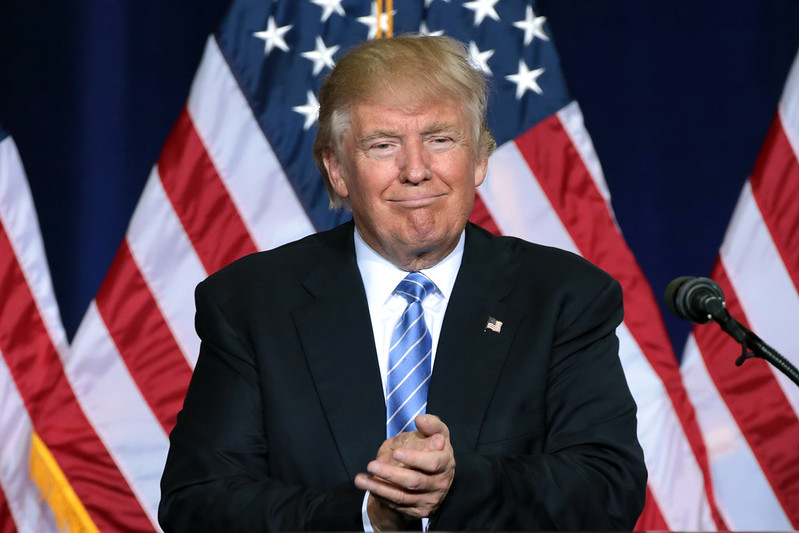
Donald Trump speaking to supporters

Donald Trump speaking to supporters at an immigration policy speech at the Phoenix Convention Center in Phoenix, Arizona. / Flickr / Creative Commons License

The coronavirus has sparked a virulent wave of racism and intolerance in the United States – as seen in past pandemics – but strong leadership can blunt or even stop it. The current wave echoes a contemporary ethnocentric nationalism that has infected many societies and political leaders around the world.

  • U.S. President Donald Trump denounced the anti-Asian prejudices – including epithets and, at times, spit and punishing blows against Chinese-Americans – that were stirred by his own use of the terms “foreign virus” and “Chinese virus,” but the damage was done. A community was put on notice, “You are the ‘other’ and you endanger us all by your presence.”

Throughout human history, groups defined by race or religion have been persecuted because of their association with disease. The Black Death of the Middle Ages was blamed on Jews, triggering ferocious physical persecution that resulted in tens of thousands of deaths, often by torture. Sociologist Erving Goffman observed that the most essential version of stigma was the abomination of the body – because the disease-causing contagion cannot be detected with the naked eye or easily avoided.

  • Throughout American history, epidemics have often been blamed on a specific immigrant or ethnic group and triggered anti-migrant policies. A cholera epidemic in 1832 was blamed on Irish Catholic newcomers who were poor and lived in congested conditions. The anti-Catholic passions of Protestant evangelicals were a factor.
  • Before the Quarantine Act of 1878 quarantine powers shifted from the states to the federal government. Each state had its own laws and immigration depots, such as Castle Garden in New York, which opened in 1855. Later, at federal depots, physicians used increasingly sophisticated medical instrumentation and diagnostic techniques to admit the healthy and those sufficiently robust to support themselves, but their expertise did not curb xenophobic hysteria or the association of immigrant groups and their behaviors with specific diseases. Chinese laborers were blamed for bubonic plague in the San Francisco area in the 1880s, and Italians were blamed for a polio epidemic that swept through the east coast of the United States in 1916. Anti-Semitic xenophobes dubbed tuberculosis the “Tailor’s Disease” or the “Jewish Disease” despite the lower rates of the disease in Jewish communities than in many non-Jewish communities in the United States.

Xenophobia and racism have not always surged in the United States during pandemics – thanks to greater public awareness of immigrants’ contributions and to strong political leadership.

  • There were fewer incidents of xenophobia during the 1918 influenza pandemic because immigration declined dramatically (from 1,218,480 a year in 1914 to 110,618 in 1918), and critics found it awkward to blame newcomers because over half a million foreign-born soldiers of 46 different nationalities were serving in the U.S. military.
  • Many Presidents of both parties since then have not hesitated to encourage Americans to call upon the better angels of their nature with respect to the foreign-born. Sitting in the shadow of the Statue of Liberty, Democratic President Lyndon Johnson signed an immigration act in 1965 that abandoned the most restrictive immigration policy in American history and replaced it with a more welcoming policy. Years later, former Republican President George W. Bush echoed those sentiments, noting that “America’s immigrant history made us who we are.”
  • Xenophobia during an epidemic may be a “social ritual” that reaffirms a hypernationalism in the native-born, but when the drama concludes and the curtain descends, the prejudice and acts of discrimination can either transfer to a different stage or leaders can lead us away from them.

Little such leadership has come from the current occupants of the White House. Presidential advisor Stephen Miller and his allies claim that stopping new arrivals crossing the country’s southern border is necessary to preserve public health from illnesses borne by migrants. In 2018, the surge of migrants toward the border led to inquiries that Miller hoped would reveal – but did not – the spread of highly contagious diseases that endangered residents of states where they settled. More recently, Miller has encouraged the President to use his public health powers to seal the borders. One such federal law, the Public Health Service Act of 1944, allows the Surgeon General and the President to exclude from the U.S. individuals who might pose a danger because they could bring in “communicable diseases.” Ironically, while it has been Miller’s intention to target Latinos, many of them are doing the “essential work” that has kept the nation going during the crisis – in meat processing plants, grocery stores, and hospitals, where they are involved directly in the care of Covid-19 patients. Many thousands of those providing patient care are Latino “Dreamers” protected by the Deferred Action for Childhood Arrivals (DACA) program that the White House wants to end.

May 12, 2020

* Alan M. Kraut teaches history at American University.

Lessons Learned from Last Century’s Climate Change Migration

By Elizabeth Keyes*

Then and Now

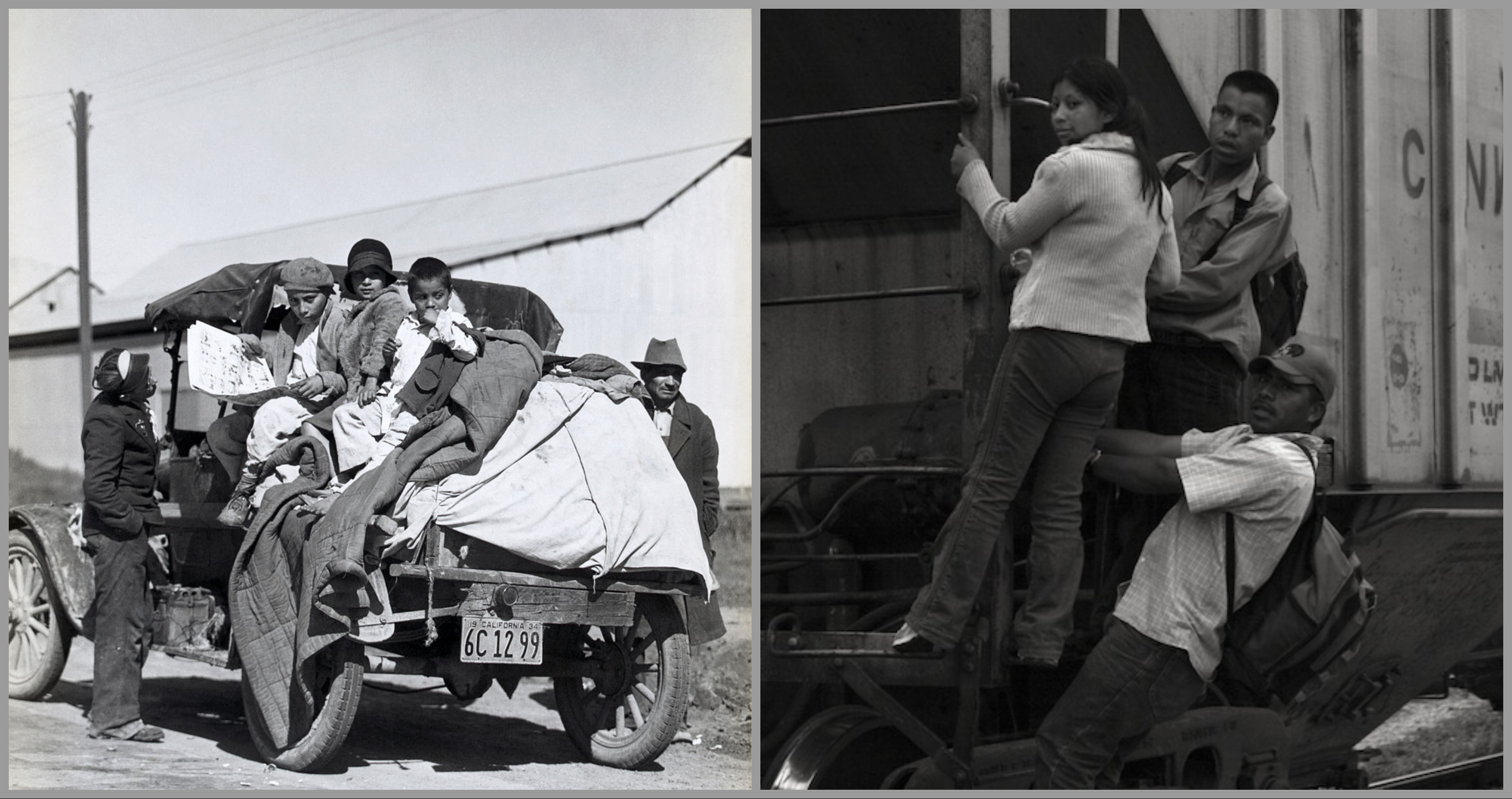
Left: Migrant Workers in California, 1935/ Dorothea Lange/ U.S. Library of Congress/ Wikimedia Commons (modified)// Right: Central American migrants find quarter in southern Mexico/ Peter Haden/ Wikimedia Commons (modified)

Central Americans seeking asylum in the United States are not the first victims of government policies that discourage migration, send law enforcement to turn them away at a border, ban them from receiving public benefits, and pass laws seeking their immediate repatriation: the Dust Bowl migrants, almost 100 years ago, faced the same fate. Their story is more complex than that of John Steinbeck’s Joad family turning to labor in California’s “factories in the field.”

  • Drought came to Oklahoma and other Dust Bowl states after decades of agricultural practices that prioritized heavy production at the expense of land management and conservation. Corporate farmers favored practices maximizing short-term yield over long-term sustainability. The New Deal bought up farmland, displacing tenant farmers. Relief at the peak of the Dust Bowl in 1934 was mismanaged, and it did not help people stay.
  • Affected residents headed to California, which during a previous economic boom had sought out “migrant” labor from elsewhere in the United States. Many had a relative or friend already in California who could provide a migration pathway, just as happens with migration in 2020. Those with friends or family in the cities fared relatively well, but those who ended up in the labor camps of California’s valleys fared extremely poorly.

As the state’s boom ended in the Great Depression, California made efforts to discourage the migrants, erecting billboards along Route 66 warning would-be migrants that California was no longer an ideal destination. The state criminalized the act of helping indigents migrate, and the Los Angeles Police Department set up “bum blockades” to refuse them entry.

  • California’s responses looked a lot like current efforts to stop migrants seeking to enter along the U.S. border with Mexico: criminalization and walls. Internally displaced persons in the 1930s faced the same kinds of xenophobia that the migrants from outside the United States do today, defining “Okies” as a problematic “other” as if from a foreign country. Although they were, indeed, “fellow Americans” and driven from the land by environmental disaster, it took almost a decade for the U.S. Supreme Court – in Edwards v. California – to clarify that states could not bar migration from other states, and to affirm an ethic of sharing hardships across state lines.
  • The Dust Bowl migrants entered a labor market with strong racial and class inequities. As the United States deported roughly a million Mexican and Mexican-American farmworkers between 1929 and 1936 (with an estimated 60 percent of those being U.S. citizens wrongfully deported), the new migrants took over those jobs.

State and international borders differ legally, of course, in critical ways, but the experience of Dust Bowl migrants nonetheless sheds light on the possibilities for Central American and Mexican migrants today. Climate change is again increasing the drivers of environmental displacement, both internal and international, both slow-onset and acute. Just as a focus on environmental justice and sustainable agriculture would have reduced the need for migration out of the Plains in the 1930s, work done now to mitigate and adapt to climate change would help Central American and Mexican farmers stay in place. And in the communities receiving migrants, we see that California adapted and accommodated them once the Supreme Court refused to endorse California’s deterrent strategies. The Court recognized in the strongest terms that California was enduring great upheaval but determined that it could not use its state border to limit that upheaval.

The same Court also routinely upheld the federal government’s right to use the national border to inoculate the country “from difficulties common to all.” International immigration is legally, if not dynamically, morally or philosophically, different from internal migration.

  • Nonetheless, the Edwards decision provides a wonderful exercise in “what if” thinking. Because of the decision, those suffering in Oklahoma and Kansas had a place to go and could build new lives in California, changing the state but not ending it. Indeed, the state has the largest economy of all 50 states and by one measure is the “14th happiest” in the nation. California is an example of state resilience to migration, even dramatic levels of migration.
  • Perhaps the pain of the Dust Bowl – the forces that sent people migrating and the realities they faced in their new homes – offer us important lessons for international migrations caused by climate. There is no international-style Edwards approach, and refugee law offers no good answers. But the full, complicated Dust Bowl history encourages us to move beyond fear and xenophobia to face the challenges forthrightly, knowing that we do have a remarkable capacity for adaptation.

April 15, 2020

* Elizabeth Keyes teaches law and directs the Immigrant Rights Clinic at the University of Baltimore School of Law.

United States: Putting the Hammer to Venezuela

By Fulton Armstrong and Eric Hershberg

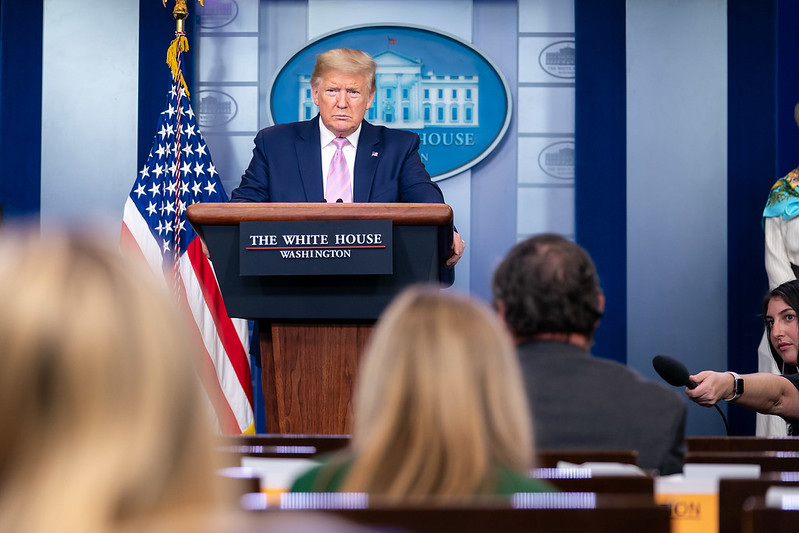
Trump press conference

Trump at a briefing on April 4th, 2020/ The White House/ Flickr/ Public Domain

The Trump administration’s increasingly aggressive actions to drive regime change in Venezuela – at a time that the already-desperate country, weakened by its incompetent government and U.S. sanctions, faces a potentially massive COVID-19 crisis – reflect Washington’s favoring of ends over means, with little concern for corollary damage. Regardless of whether President Nicolás Maduro survives the challenge, the country’s massive humanitarian and social disaster is likely to grow worse during the weeks and months ahead. At this point, there is no plausible scenario in which Washington can achieve what it claims is its desired outcome – a stable, democratic government – without a negotiated settlement.

  • The March 26 indictment of Maduro and other senior Venezuelan officials on charges of narcotics-trafficking and support for terrorism against the United States underscored the administration’s commitment to removing a government it calls a “threat to the hemisphere.” The U.S. Department of Justice asserted that Maduro “expressly intended to flood the United States with cocaine in order to undermine the health and wellbeing of our nation.” The indictment forced an end to preliminary talks between Maduro and his opponents over a partial truce that would allow them to make a joint appeal for international aid to deal with COVID‑19.
  • On March 31, the administration announced a “Democratic Transition Framework” for Venezuela. The plan called for Maduro to step down immediately and yield to a “Council of State” to govern until new elections. National Assembly President Juan Guaidó, whom the United States and more than 50 other countries recognize as Acting President, would surrender his claim as well, but American officials made clear he had their full support in any upcoming campaign. Coming on the heels of the indictments, the framework was quickly rejected by the government.
  • The announcement on April 1 that the United States and 22 allies were launching “enhanced counternarcotics operations” in the Caribbean near Venezuela – with large-scale military assets rarely seen in such missions – was another prong of what U.S. National Security Advisor Robert O’Brien called “our maximum pressure policy to counter the Maduro regime’s malign activities.” Maduro cited these threats and indications of mysterious arms movements in Colombia – reported by a former Venezuelan general who some observers say turned collaborator with the U.S. DEA – as reasons for putting the country on military alert last weekend.

The U.S. actions appear to reflect a calculation that the Venezuelan government is so vulnerable that Maduro’s “former regime” will collapse and, somehow, a more sympathetic successor will emerge. U.S. sanctions over the past year-plus have effectively starved the economy, and the recent crash in oil prices has reduced revenues to a trickle. Observers in Caracas report that fear of COVID-19, in a country without medical supplies or even clean water in many parts, is intense.

  • The administration insists it desires a negotiated settlement, but these enhanced pressures, particularly the indictments, greatly complicate any effort to revive talks as Norway had configured them. Similar to last year’s efforts to provoke a coup against Maduro, this year’s “maximum pressure” seems premised on creating a collapse on a scale that forces the military’s hand. But the task of overthrowing Maduro would fall to an exhausted citizenry and field-grade officers not indicted or otherwise targeted by the United States government.

Whether Washington has a comprehensive strategy, is just taking ad hoc steps to force regime change, or is merely looking to wreak havoc at a time that its handling of the COVID‑19 crisis at home is falling under intense criticism, there is precious little historical evidence that its tactics will work in Venezuela. The movement of warships to the Venezuelan coast may only be a publicity stunt, with the support of some countries in the region, but it entails diplomatic and operational risks. It also is not beyond the pale to suppose that the administration, long frustrated in its regime-change efforts, will begin to believe its hyperbole about Maduro as a narco-terrorist poisoning drug-consuming U.S. youth, and be tempted to deploy measures even more drastic than those taken to date.

  • Negotiations, although difficult, are not impossible. When U.S. opposition to diplomatic efforts to resolve the wars in Central America reached a certain point, regional governments met behind Washington’s back and produced a historic plan – the “Esquipulas Accord” – that led to peace processes in each affected country. This situation is, of course, different, but Esquipulas showed that moving the U.S. to the side can work.
  • The indictments are reminiscent of U.S. tactics to overthrow General Manuel Noriega in Panama in 1988-89 – resulting in a massive invasion to arrest that one man. Venezuela is different in many ways, and all parties should heed the adage of former U.S. military commander and Secretary of State Colin Powell, who said, “You break it, you own it.”

April 7, 2020

Haiti: Is Anyone Listening?

By Fulton Armstrong

Protesters take to the streets in 2018 over the government's misuse of funds from PetroCaribe.

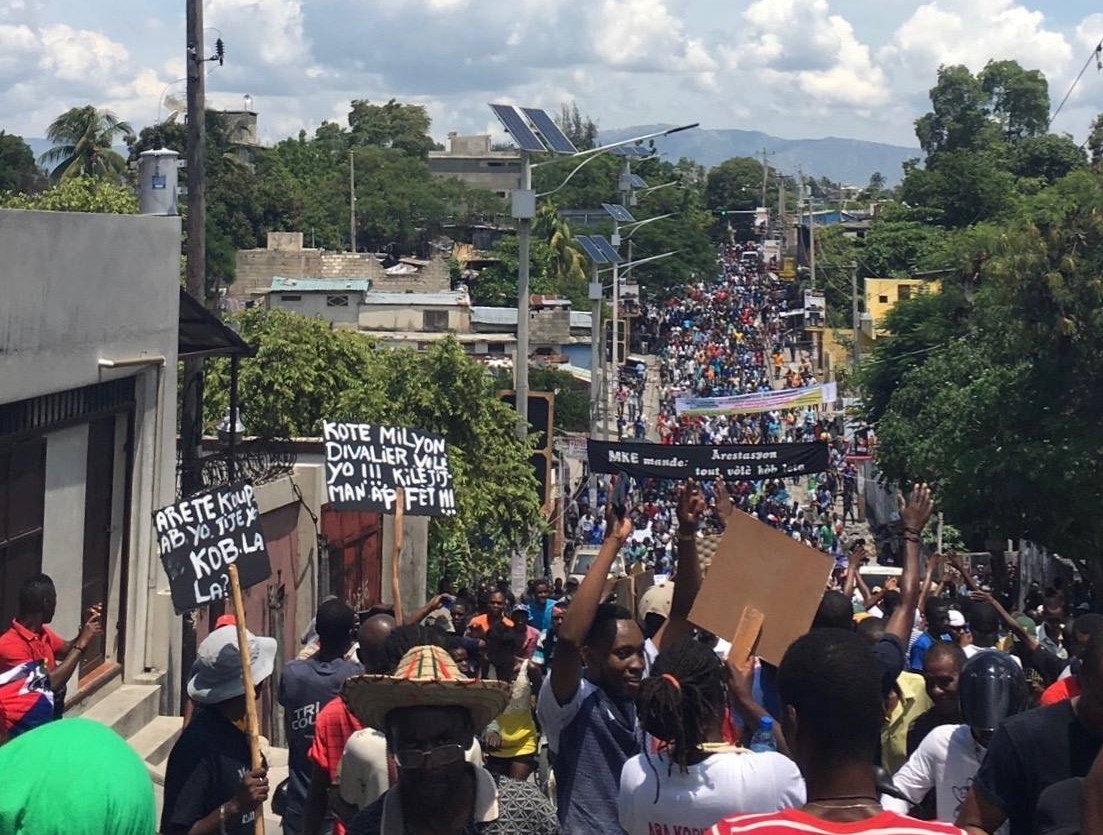
Protesters take to the streets in 2018 over the government’s misuse of funds from PetroCaribe– once again the subject of public anger/ Rony D’Haiti/ Wikimedia Commons/ https://commons.wikimedia.org/wiki/File:Manifestation_Haiti.jpg

As Haiti enters a fifth week of protests, President Jovenel Moïse’s support for U.S. policies on Venezuela and Taiwan appears to have secured him Washington’s backing, but his government is in tatters and his opponents don’t look likely to fold soon. For weeks, tens of thousands of protesters have held targeted marches in Port-au-Prince and provincial cities across the country demanding Moïse’s resignation. Violence by demonstrators and police has caused 17 deaths and hundreds of injuries, including the shooting of several journalists, according to human rights monitors. School closures have left up to 2 million children without class and the food supplements they receive there.

  • Protesters originally took to the streets to protest fuel shortages caused by government insolvency, but corruption – including the misappropriation of an estimated $2 billion dollars in profits from the sale of fuel under Venezuela’s previous PetroCaribe program – has become the overwhelming issue. Opposition leaders cite Superior Court audits implicating Moïse and other government officials past and present in schemes to personally profit from PetroCaribe security forces’ use of clubs and tear gas (and unconfirmed use of live ammunition) against demonstrators has further fueled anger in the streets. Haiti’s Catholic Bishops have blamed Moïse for the showdown, and their “Justice and Peace Commission” has publicly called for his resignation.
  • Moïse’s leadership has been unsteady throughout the crisis. He was out of public view entirely for one week, returning only in a pre-recorded radio address broadcast at 2:00 am on September 25 that called for calm and dangled the prospect of a “government of national unity.” Since his inauguration in January 2017, he has lived under the shadow of suspicious vote counts and has either failed to get Prime Ministers confirmed by Parliament or to build a good working relationship with them. The country hasn’t had a budget for two years, and a projected 20 percent inflation during 2019 and mere 1.5 percent growth further drive popular fury.

Moïse is clearly winning the competition for international support. However, he has gained U.S. silence about the evidence of his and senior allies’ involvement in PetroCaribe under Venezuelan Presidents Chávez and Maduro. During the UN General Assembly two weeks ago, U.S. Deputy Secretary of State John Sullivan met with Moïse’s Foreign Minister, Bocchit Edmond, with whom he “reaffirmed the strength of the U.S.-Haiti partnership and shared hope that Haiti’s political stakeholders would soon identify a path to forming a government that remains firmly rooted in democracy and the rule of law.”

  • The opposition’s calls for support have been much less successful. U.S. Senator Marco Rubio, a Republican widely seen as President Trump’s top advisor on hemispheric affairs, said it was not the “proper job of the United States to call on a democratically elected President [Moïse] to step down.” (Rubio had praised Moïse for supporting U.S. sanctions to remove Maduro and for preserving diplomatic relations with Taiwan.) The senior Democrat in the U.S. Congress, House Speaker Nancy Pelosi, last week also cited Moïse’s position on Maduro as important.
  • UN officials last week issued a “statement of concern,” noting that the protests were hindering aid deliveries and could lead to a humanitarian crisis. The UN remained neutral, however, and called on “everyone” to refrain from the use of violence. An unofficial OAS delegation to Haiti organized by individuals close to Senator Rubio in June told the opposition to “back off,” according to press reports, and reportedly told Moïse that he should “start governing” but it was “not going to ask him to resign.” Overall, however, the OAS has kept a very low profile, especially during the current crisis.

Haitian politicians have often turned to foreign friends and multilateral organizations to rescue them from crises – which they surely stir up themselves – but the international community, rather than addressing fundamental problems, often tries to paper over highly contested elections (like Moïse’s) and institutional weaknesses. The billions in PetroCaribe revenues that have vanished during the past two presidencies – including that of Moïse’s mentor, Michel Martelly – is strong circumstantial evidence that the opposition’s calls for investigation of the current administration have merit. But Moïse seems to be betting – correctly so far – that support for Washington’s priorities, such as condemning alleged corruption and undemocratic practices in other countries, buys him space to snub opponents’ demands. The UN and OAS just don’t seem to want to get more deeply involved, but the opposition, which has surprised many with the length and level of protests, doesn’t seem ready to give up.

October 11, 2019

U.S.- Latin America: Policy Shifts Ahead?

By Fulton Armstrong

Former White House National Security Adviser John Bolton speaks to reporters on events occurring in Venezuela Tuesday, April 30, 2019, outside the West Wing entrance of the White House.

Former National Security Advisor John Bolton speaks to reporters on Venezuela in April 2019/ Tia Dufour/ White House/ Wikimedia Commons

The sudden departure of President Trump’s outspoken national security advisor, John Bolton, is unlikely to result in changes in U.S. policy objectives in Latin America but could lead to the same sort of swings in tactics – harder or softer – that characterize other U.S. policies around the world. The continued weakness of the State Department’s input, aggravated by erratic staffing in its Latin America offices, further suggests that it will not play a balancing role.

Trump and Bolton’s statements over their 17 months together indicated no disagreement on objectives and tactics in Latin America, including immigration, close relations with Brazilian President Bolsonaro, efforts to rescue the Argentine economy, and Venezuela. They had identical positions on the waves of sanctions against Venezuela, U.S. commitment to remove President Nicolás Maduro, and unstinting support for National Assembly President Juan Guaidó’s claim to the Presidency, including backing Guaidó’s flopped coup in April. They both also explicitly linked taking down Maduro with achieving regime change in Cuba.

  • Trump and U.S. Senator Marco Rubio, widely seen as his top referent on Latin America and related political matters, are trying to signal that after Bolton’s departure the Administration is going to turn up the heat on Venezuela and Cuba. In apparently coordinated tweets between them, Trump said, “In fact, my views on Venezuela, and especially Cuba, were far stronger than those of John Bolton. He was holding me back!” This complements rumors that Trump has been frustrated that Bolton’s strategy in Venezuela, particularly the fact that Maduro supporters had tricked him into false confidence in Guaidó’s failed coup, has not removed Maduro from office. (It is unclear if one of his concerns is that U.S. sanctions are worsening the refugee flow challenging neighboring countries.)

Most Washington-based observers believe, however, that Latin America is the least important of the five issues that, according to press, caused friction between Trump and Bolton. The President’s personal involvement has been much greater with North Korean leader Kim Jong Un, in efforts to achieve regime change in Iran, in talks with the Taliban for withdrawal of U.S. troops from Afghanistan, and in maintaining good relations with Moscow despite the complex situation in Ukraine.

  • Trump has appeared to lack deep interest in Latin America policy and sees it as primarily a domestic political tool for consolidating his base – among anti-Maduro and anti-Cuba voters in Florida, an important state in his re-election calculus, and among supporters for his wall on the Mexico border and other anti-migration measures. Long ago he essentially handed the Venezuela and Cuba issues over to Senator Rubio, and the National Security Council brought a Rubio ally, lobbyist, and blogger, Mauricio Claver-Carone, to the White House to work the issue. They appointed Elliot Abrams, despite baggage from the Iran-Contra era and the Bush-Cheney Administration, to handle diplomatic operations on Venezuela for them.
  • By all appearances, Secretary of State Michael Pompeo has subordinated his own Latin America team to the White House operators, essentially stifling a traditionally important voice at the policy table. When Assistant Secretary Kimberly Breier resigned last month, only nine months after being confirmed by the U.S. Senate, she said it was to spend more time with her family, but her bureau’s marginalization left questions about her policy impact. Her acting successor, veteran State Department lawyer Michael Kozak, who has spent much of the last 10 years managing “democracy promotion” programs in Latin America and elsewhere, is not likely to challenge Rubio and Claver-Carone unless Pompeo takes the lead, which he shows no sign of doing.

The new national security advisor will have more urgent problems to deal with than wrestling with Rubio, Claver-Carone, and their allies. Indeed, Trump may even give them a green light to escalate provocations even further. For example, Administration allegations that Colombian guerrillas and narcotics-traffickers receive crucial aid from Caracas – buttressed by invocation of the Rio Treaty last week – are logical ways of laying the political groundwork for some sort of military action, perhaps jointly with Colombia, against alleged camps in hopes that the Venezuelan military finally tells Maduro that it’s time to go. 

  • President Trump’s trademark approach to thorny problems has been unpredictability and experimentation with wide-ranging alternatives, including face-to-face negotiations and deal-making with opponents that pose much tougher challenges to U.S. interests than do Venezuela and Cuba. Such flexibility notwithstanding, with the U.S. elections just 14 months off, Trump’s electoral calculus strongly suggests he’s going to stay the course with policies toward Latin America that he’s told are popular in South Florida.

September 17, 2019

Puerto Rico: A Mess with Structural Causes

By Eric Hershberg and Fulton Armstrong

Roselló and Trump

Puerto Rico Gov. Ricardo Roselló, U.S. President Donald Trump and First Lady Melania Trump discuss relief efforts during a cabinet meeting at Muñiz Air National Guard Base, Carolina, Puerto Rico, Oct. 3, 2017 / U.S. Air National Guard photo by Staff Sgt Michelle Y. Alvarez-Rea / Public Domain

Puerto Rico’s ongoing political and economic crises are similar to those in many other Latin American systems – but with the additional burden of lacking the sovereignty or U.S. support to act independently in pursuit of solutions. Two weeks of spontaneous, massive protests over vulgar on-line chats and evidence of corruption forced Governor Ricardo Rosselló to resign on August 2. In the nearly 900 pages of “Rickyleaks” published by Puerto Rico’s Center for Investigative Journalism, Rosselló and his aides are quoted as exchanging misogynistic and homophobic messages about fellow politicians and leaders across society. Protestors accused him of mismanagement and malfeasance in the wake of Hurricane María, which devastated the island in September 2017 (nine months into his term), and of mishandling the territory’s relationship with Washington. The Puerto Rican Supreme Court found his hand-picked successor, Pedro Pierluisi, constitutionally ineligible to take the job, and Justice Secretary Wanda Vázquez was sworn in on August 7.

The success of the mobilization in the streets and in social media is a hopeful sign for democracy and good governance in Puerto Rico, according to many observers. But the island’s complex economic challenges, including a massive debt crisis, and a legal relationship with the mainland United States that is vulnerable to shifting political trends make attaining that vision especially hard.

  • The island’s economy has been in recession for 13 years and is severely handicapped by a $124 billion debt crisis caused by irresponsible decisions by its government, private lenders, and Washington policies – driving a loss of productive population, erosion of the tax base, and a downward spiral of public finance and services, akin to that seen in U.S. cities such as Detroit. Hurricane María further plunged the island into misery. An estimated 3,000 people died directly or indirectly because of the storm, often because poor maintenance resulted in much of the island’s electricity and water supplies being disrupted for many months. (Carpetbaggers from the mainland are reestablishing some basic services but at exorbitant prices.) A fundamental problem for the island is that in the 1990s Washington took away tax incentives, such as for the island’s formidable pharmaceutical industry, that had fueled strong growth for several decades. These conditions have accelerated the outflow of citizens to the mainland – an estimated 4 percent of the island’s 3.5 million inhabitants in just 2018.
  • Further complicating matters, the Governor must submit all budget decisions to a Financial Oversight and Management Board established by the U.S. Government in 2016, which has seven members appointed by the U.S. President and one non-voting member appointed by the Governor. The board can block spending, institute hiring freezes, and take other measures when it does not approve of an expenditure. Puerto Rico’s proposed package of measures to climb out from under the debt, result of three years of negotiations, has been derailed by the political crisis.
  • Numerous experts have demonstrated that the U.S. Administration’s claim that it has sent $91 billion of aid to the island is false. As of early this summer, about $11.4 billion in Federal Emergency Management Agency funds had been approved, and only about $5.72 billion disbursed (including assistance to individuals and families). Puerto Rico has only a single representative in the U.S. Congress – a non-voting delegate – and its relations with Washington depend on the goodwill and expertise of a host of bureaucracies that often have conflicting agendas. As a U.S. territory, it cannot easily receive international assistance directly.

Corruption, bad policies, weak institutions, and vulgar leaders are obviously not unique to Puerto Rico (or Latin America), but the behavior that resulted in Rossello’s ouster underscores the toxic, bankrupt nature of much of Puerto Rico’s political class despite years of lip-service to democracy, transparency, and accountability. Full sovereignty, of course, is no guarantee that any of the territories, protectorates, and “special” jurisdictions in the Caribbean would fare better if they weren’t dependent on a protector nation. But Washington’s ability to give – and take away – benefits without dealing with San Juan as an equal partner, and then judging the island’s performance and meting out sanctions, further complicates efforts to find solutions to Puerto Rico’s many problems. Puerto Ricans have shown that they can take to the streets to dump venal leaders, but, made vulnerable by multiple crises, there’s little they can do to wake up the U.S. Congress from its neglectful slumber.

August 14, 2019

Domestic Politics and U.S.-Colombia Relations 

By Sebastian Bitar and Tom Long*

duque and pompeo

Secretary Pompeo and Colombia President Ivan Duque Marquez Visit the Migration Transition Assistance Center in Bogota. U.S. Department of State / U.S. Government Works

Colombian domestic politics and institutions have created obstacles for President Iván Duque during his first year in office, complicating efforts to meet demands from U.S. President Donald Trump and reestablish close bilateral cooperation with the United States. As the hand-picked successor of former President Álvaro Uribe, long Washington’s closest ally in Latin America, Duque was widely expected by many in the United States to fully align Colombia with U.S. priorities. Like his mentor, Duque criticized the Colombian peace process as prolonging drug trafficking, raising Washington’s hopes that he would aggressively confront a spike in coca production that started in 2016.

  • In September 2017, nine months before Duque’s election, Trump publicly threatened to “decertify” Colombia for inadequate cooperation on counternarcotics – almost unthinkable in the Plan Colombia era. Despite efforts, the new government has not delivered to Trump’s satisfaction. Opponents blocked resumption of aerial spraying of coca fields with glyphosate – an herbicide linked to cancer. The new transitional justice high court, known as JEP, refused U.S. requests to extradite a high-profile former guerrilla leader, “Jesús Santrich,” to face drug trafficking charges in the United States, reversing a decades-long tradition of requiring only a U.S. indictment with no judicial process in Colombia. The Trump administration retaliated by suspending the visas of some Colombian justices, provoking a domestic political backlash that has further hemmed in Duque.

The U.S. actions emerge from the inaccurate assumption that Colombian presidents can make foreign policy without regard for domestic opposition and institutions. Much U.S. scholarship and policy commentary on the Andean nation’s foreign policy is marked by a near-exclusive focus on the person of the president on the one hand, and on the role of the United States on the other. In our recent article, “Domestic Contestation and Presidential Prerogative in Colombian Foreign Policy,” we demonstrate the limits of these commonly held views of Colombian foreign policymaking. While U.S. pressure is indeed a heavy constraint and Colombian Presidents, constitutionally and institutionally, enjoy wide latitude in foreign policy, we show that Colombian foreign policy increasingly responds to domestic pressures.

  • The Constitutional Court has emerged as a surprising constraint even on very strong presidents’ foreign policies. In 2009-2010, it was mostly an afterthought for the powerful and popular Álvaro Uribe when he prioritized an expansion of the U.S. military presence in the country through the establishment of military bases – largely ignoring South American opposition. The court’s veto, along with strong public opposition, came as a surprise to the President. Its mandate to go through Congress risked political costs that Uribe’s successor, President Juan Manuel Santos, was unwilling to pay.
  • Colombian presidents have also adapted their foreign policies in the face of potential electoral and Congressional costs. In 2012, during the height of the “China boom,” Santos proposed free trade negotiations with China as a top priority, but manufacturing interest groups – including some of Santos’s close allies – turned the Congress against the President. Santos backed away and embraced a face-saving investment agreement. Perhaps more embarrassingly, when the International Court of Justice issued a ruling on a maritime dispute with Nicaragua that gave Colombia sovereignty over disputed islands but forced a compromise on territorial waters, Santos was faced with electoral political mobilization from his former patron, Uribe. Despite explicit promises to abide by the ruling, Santos revoked recognition of compulsory jurisdiction – long a cornerstone of Colombian diplomatic tradition.

While critiques that Plan Colombia (2001-15) was cooked up by the State Department without deep Colombian involvement are false, Colombian domestic politics were secondary to those of the U.S. Congress. An unpopular Colombian President, Andrés Pastrana, was able to sideline domestic opponents and affect the internationalization of the Colombian conflict – shaping the view of Presidential power over Colombian foreign policy. However, in many ways, that was both an outlier and a turning point.

  • Exaggerated presidentialism, linked to tropes of caudillos and strongmen presidents, can lead to one-dimensional analysis and unfulfillable policy expectations. While domestic dynamics are often considered when discussing U.S. foreign policy, they get little attention in the Latin American context. As the recent episodes above reflect, these domestic constraints have caught Colombian presidents themselves off guard, and the presidentialist assumption can lead U.S. policymakers to make demands that assume Colombian presidents are pliable in the face of U.S. pressure but omnipotent domestically. Contested presidentialism is here to stay. 


July 31, 2019

* Sebastian Bitar is Associate Professor in the School of Government at Universidad de los Andes. He is author of US Military Bases, Quasi-bases, and Domestic Politics in Latin America. Tom Long is Associate Professor at the University of Warwick and Affiliate Professor at CIDE, Mexico City. He is the author of Latin America Confronts the United States: Asymmetry and Influence. Their full article was published by the Bulletin of Latin American Research and was co-authored with Gabriel Jiménez-Peña.


New Leadership in El Salvador: Breaking from the Past?

By Eric Hershberg*

U.S. Air Force Chief of Staff Gen. David L. Goldfein meets with El Salvador’s newly elected President Nayib Bukele

U.S. Air Force Chief of Staff Gen. David L. Goldfein meets with El Salvador’s newly elected President Nayib Bukele / Joint Base San Antonio / Public Domain

Salvadoran President Nayib Bukele’s stunning defeat of both of his country’s two dominant parties in February was propelled by promises of change and new approaches to challenges that vexed his predecessors. His initial six weeks in office have featured notable gestures toward fresh directions but also grounds for concern. The country’s problems are many and severe. Decades of paltry private investment has produced anemic economic growth, worsened in recent years by a devastating internal security situation. The limited economic growth that has occurred relies disproportionately on remittances from migrants – the value of which exceeds that of exports – but the circumstances of Salvadorans in the United States are growing more precarious, potentially eroding future transfers. In addition, plausible shifts in trade policy by an erratic U.S. administration could undermine the U.S.-CAFTA-DR trade agreement, threatening critical manufacturing jobs. Corruption, meanwhile, is perceived by the population as no less urgent a challenge as joblessness and impunity for the gangs whose extortion and violence torment much of the population.

Bukele’s winning campaign formula was to promise to turn things around with a new vision and new people. One important signal of change was the President’s order to immediately remove the big block letters “Monterrosa” from the barracks of the armed forces 3rd brigade, in San Miguel, and his hosting a dinner at the Presidential residence for family of the victims of the El Mozote massacre that Lt. Col. Monterrosa had overseen. A handful of initial cabinet appointments signaled an inclination toward meritocracy and gender balance. Yet Bukele has more recently appointed to key positions dodgy veterans of the administration of former President Tony Saca (2004-09), who split (and was later expelled from) his ARENA Party to form a new party, GANA. While Saca is serving a 10-year prison sentence for corruption, Bukele, who was expelled from the FMLN in 2017 and thus lacked a vehicle of his own with which to seek the presidency, opted to run on the vacant GANA ticket. The appearance of figures from Saca’s inner circle is thus not entirely a surprise, but it stands out given the degree that Bukele’s largely platform-less campaign highlighted the battle against corruption.

  • One of his pledges was to create a hybrid (national-international) anti-corruption commission – adapted from the experiences of CICIG in Guatemala and MACCIH in Honduras – to hold accountable political elites suspected of extraordinary levels of malfeasance. Yet both domestic and external constraints make such an effort less likely than Bukele might have imagined while on the campaign trail, and the Comisión Internacional contra la Impunidad en El Salvador (CICIES) seems to have been relegated to a back burner.
  • Equally striking is the new President’s doubling down on militarized responses to gang violence, departing from both his campaign rhetoric and his mode of governance as mayor of Nuevo Cuscatlán (2012-15) and San Salvador (2015-18). Whereas he had entered into pragmatic if unspoken accommodations with the gangs in order to secure governability at the municipal level, he’s now declaring all-out war against the maras, sending the military into gang-ridden communities and clamping down on communication from the prisons from which gang leaders continue to direct operations. During the first week of July – a month after assuming office – he asserted that repression was but the first phase of a comprehensive anti-gang strategy, promising a second phase, focused on social opportunity, that would address the structural factors that draw youth toward lives of criminal violence. But details remain thin, and whether funds will be appropriated by a legislature in which GANA has only a small minority of seats remains to be seen.

Bukele represents El Salvador’s first Instagram and Twitter president – with a penchant for announcing sweeping personnel changes without having informed affected staff in advance. His recourse to social media for proclaiming “you’re fired” aligns him with other western hemisphere presidents eschewing traditional channels of communication with public employees and the citizenry, but in El Salvador as elsewhere this justifies concern over how governance through a cacophony of tweets may affect the quality of democracy.

Meanwhile, the new president has wisely emphasized that cordial relations with the United States are an imperative for his government. More than a third of his compatriots reside there, and he has already taken steps to gain Washington’s blessing for his administration. At U.S. urging, he invited the representative of Venezuelan assembly president Juan Guaidó to his inaugural, and when a Salvadoran father and daughter drowned in the Rio Grande, Bukele exonerated President Trump’s border policies, saying “La culpa es nuestra.” Nonethelesss, he has been critical not only of Venezuelan dictators who Washington abhors but also Honduran ones who the Americans enable. Meanwhile, observers in San Salvador opine that, contrary to Washington’s wishes, he will not reverse his FMLN predecessor’s decision to deepen relations with China – he needs Chinese investment and recent history offers little reason for expecting analogous resources to arrive from the U.S. Finding the money needed to provide jobs, security and social welfare to the vast majority of Salvadorans who have lacked them may prove as vexing for the outsider president as it was for leaders of the dominant parties of the post-war period.

July 16, 2019

* Eric Hershberg is Professor of Government and Director of CLALS at American University. He took part in a delegation of AU experts for a weeklong visit to El Salvador in June, during which they met with political leaders across the political spectrum, as well as leading journalists, scholars, NGO leaders, policymakers and diplomats.