Transportation Barriers Hinder New Asylum Seekers in NYC
By Caryalyn Jean*
October 16, 2024
Photo by the Rockaway Times/ Rockawaytimes.com
In September 2023, the City of New York finalized a leasewith the United States Department of the Interior National Park Service to house asylum seekers in tents within the Floyd Bennett Field, located in Marine Park, Brooklyn as part of New York’s Humanitarian Emergency Response and Relief Centers. Floyd Bennett Field is a part of Gateway National Recreation Area and is known for being New York’s first municipal airport and for its use by the Navy during World War II. Despite growing up about 15 minutes from the airfield, I never gave the space much thought and neither did my neighbors as it was left abandoned serving as a desolate area. With the renewal of the lease, I reflect on the transportation issue migrants have faced for the last year.
Despite the lack of direct subway access, growing up on the cusp of Marine Park, Mill Basin, and Flatlands in southeast Brooklyn always felt accessible due to the multitude of bus routes that ran through these neighborhoods.
MTA Brooklyn Bus Map of the Marine Park, Mill Basin, and Flatlands Area.
Bus routes such as the B100, B41, and B46 gave me access to not only other neighborhoods in Brooklyn but also an easy way to transfer to the B, Q, 2, and 5 trains to enter Manhattan. Another bus I frequently rode was the Q35. Despite only 9 of its 29 stops being in Brooklyn, the Q35 serves as a convenient alternative for Brooklyn residents looking to access connections to Kings Highway, Brooklyn College, and the 2 and 5 trains going to Manhattan. Although the Floyd Bennett Field is also located in the seemingly accessible Marine Park area, the Q35 is the only bus route that directly connects migrants living at the site to the rest of the transportation system.
Transit App, MTA Queens Bus Stop (Q35) at the Floyd Bennett Field
Since the arrival of asylum seekers in November of 2023, I have noticed many changes to the experience of riding the Q35. One observation was the change in the bus model used for the route. Since the 2010s, the Q35 used the Orion VII bus model. According to the NREL Fleet Test & Evaluation Team, this model has seats for between 38 and 44 passengers and has a width of 8.5 feet. During the spring of 2024, I slowly noticed these models were being phased out and replaced with the Nova LFSd bus model. This model also seats around 40 passengers and has the same width. Despite the similarity in the number of seats and bus width, the arrangement of seating created less space for standing passengers, making accessibility for passengers with strollers and shopping carts more difficult. This is an extreme disadvantage to migrant passengers riding the bus since many of them are parents with young children.
One attempt to address the lack of transportation options to and from Floyd Bennett is riding shuttle buses provided by Accord through the Department of Education. These shuttle buses provide those living in the Floyd Bennett shelters access to the rest of Brooklyn so that teenagers and parents with younger children can get to and from school. As of November 2023, it cost the Department of Education $625,000 to run this transportation program. The December 2023 City Limits article by Daniel Parra, highlights the transportation issues faced by migrants residing at the Floyd Bennett Field shelters. The article states, “Families who spoke with City Limits reported delays at the end of November with the buses that were supposed to take children to school first thing in the morning.” Parra also noted that shuttle buses should run every 90 minutes, but “…during City Limits’ visit…buses took an average of two hours to complete the route.” As of December 2023, there is no published available information about whether the city has made any attempts to improve the shuttle system or additional firsthand accounts from migrants. However, from my observation, this seems to be an ongoing issue.
The unreliability of shuttle buses and changes in bus models have made transportation difficult for migrants living in this isolated area. These issues are affecting parents’ ability to find work and children’s ability to attend school consistently, causing them to miss crucial learning time. The city must take real steps to improve public transportation for Floyd Bennett residents to ensure they have the opportunity to thrive. With the recent renewal of the Floyd Bennett lease, it is my hope that the city works towards better transportation accessibility that creates an environment where the new bus riders are not othered by the surrounding community by impacting their ability to access job and educational opportunities that would provide stability. Comprehensive public transportation accessibility is at the core of navigating New York City, and everyone deserves to experience it.
Caryalyn Jean is a Research Assistant at the Center for Latin American and Latino Studies and the Immigration Lab. She is in the Master’s program in Sociology, Research, and Practice at American University.
Edited by Erica Criollo, Research and Data Coordinator at the Immigration Lab.
Anti-Immigration Rhetoric: Winning Campaign Strategy or Coin Toss?
By Joseph Fournier and Ernesto Castaneda
October 10, 2024
With the U.S. presidential election drawing nearer, many Kamala Harris supporters fear a perceived weakness on the border “crisis” may cost her the election to Donald J. Trump. Trump has championed himself as the figurehead for tough border policy. Restricting immigration has been associated with Trump. An NBC poll showed that 89% of people who identify as conservative point to the situation at the U.S.-Mexico border as a major factor in their vote for president, while only 25% of those who identify as liberal do so, and 52% among moderates. Therefore, we are not witnessing an anti-immigrant turn in public opinion but a further polarization by political ideology.
Trump has been capitalizing on this perceived base of support by making even more extreme comments regarding the issue, most recently employing race pseudo-science in claiming that recent migrants possess “bad genes.”
In the past, Harris and the Democrats have painted themselves in clear opposition to his cruel immigration policies, such as family separation. When on the campaign trail in 2019, Harris’s rhetoric focused on pathways to citizenship and the plight of migrants. This strategy worked as Biden and Harris defeated Trump in 2020.
There was a slight rightward shift from Harris and the DNC on immigration. This was probably in reaction to an increase in the visibility of border crossings after the pandemic. Trump has framed these increases as a “border crisis.”
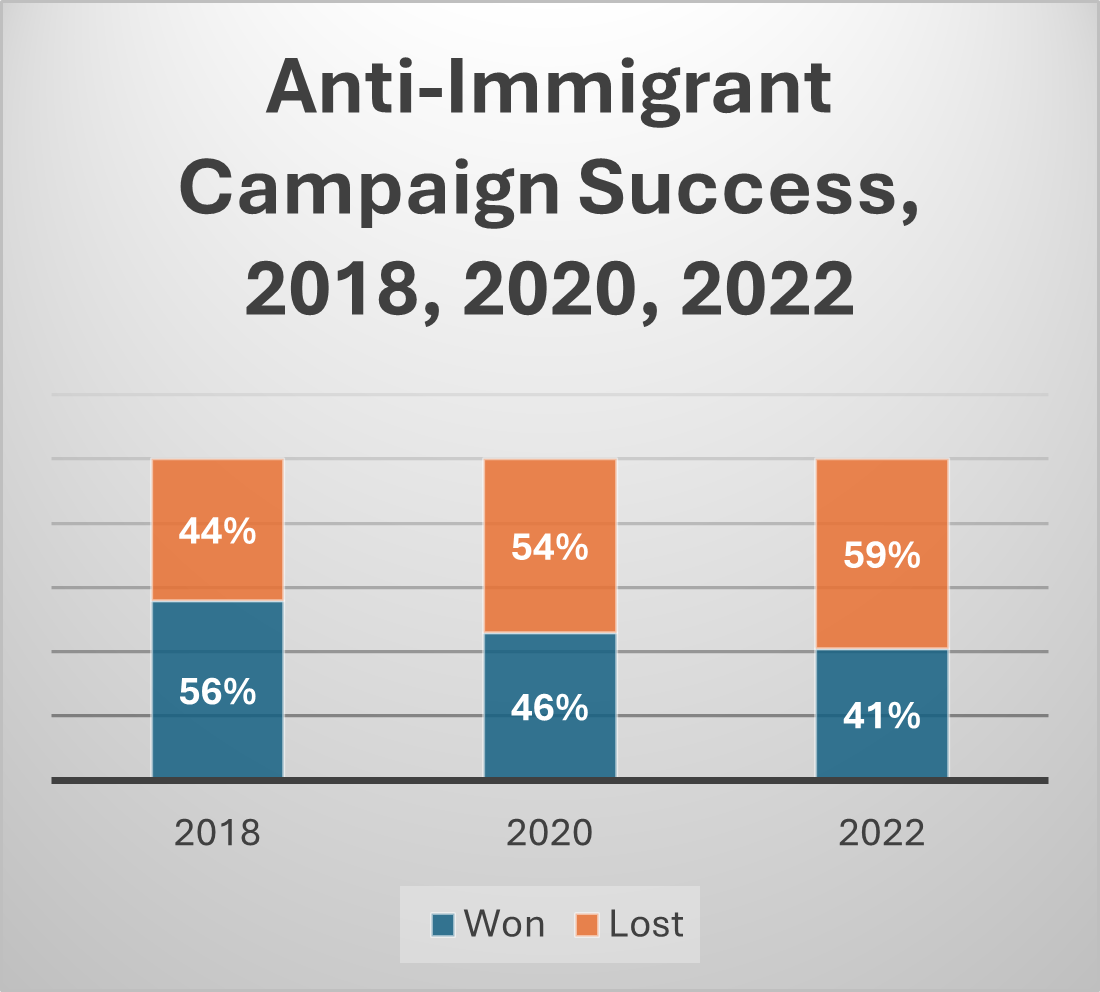
But do Democrats need to get harsher on immigration if they want to win? Data shown in Figure 1 demonstrates a phenomenon that may surprise political strategists on both sides of the aisle. Research from The Immigration Lab analyzing congressional and gubernatorial elections in 2018, 2020, and 2022 has shown that these anti-immigrant campaign victories have decreased by about 15%. This data was pulled from online campaign material from every election result with a 10% margin between the two major candidates.
Successes of anti-immigrant campaigns in competitive elections, 2018-2022 by the authors.
In 2018, businessman and former state senator Brian Kemp ran for governor in Georgia. His campaign epitomized the culture wars that the GOP included as part of their messaging strategy. Kemp styled himself as a “politically incorrect conservative” and filmed himself touting chainsaws and shotguns in service of this persona. He ended one of his ads by showcasing him in his truck, threatening to “round up criminal illegals myself.” On November 8, 2018, Kemp defeated his opponent in the closest Georgia gubernatorial race since 1966.
In 2022, Kemp ran for re-election against the same opponent. With essentially the same election conditions, Kemp’s strategy radically changed. His new primary TV ad, titled “Stronger Georgia,” listed a myriad of his accomplishments as governor. Many of his themes continued from his 2018 ads, including his support of decreased government regulation. Nonetheless, a notable point missing from his 2022 ad, however, was immigration. Kemp made no mention of the issue, making only a brief note of him “fighting human trafficking.” In softening his tone on migration, Kemp nearly tripled his margin of victory in 2022 in comparison to 2018.
Even while encounters at the border today are as low as during the pandemic when Title 42 was in effect closing the border to asylum-seekers, many think that long lines of people asking for asylum at the U.S.-Mexico border is a political liability for the Biden-Harris administration. However, when Americans in these competitive elections have shown up to the polls in the last six years, running an anti-immigrant campaign has demonstrated itself to be well short of the secure victory strategy that many seem to think it is.
Joseph Fournier is a Research Assistant at the Immigration Lab and a senior at American University.
Ernesto Castañeda is the Director of the Immigration Lab and the Center for Latin American Studies.
Starting in 2022, the Immigration Lab at American University began interviewing recent migrant and refugee arrivals to the DMV. So far, we have interviewed 181 from a variety of origins. The interviews aim to understand the experiences of refugees and migrants before, during, and after their entrance into the United States. Interviewers asked participants to reflect on their immigration journey and classify their immigration status. Self-perception, specifically individual understanding of immigration status, varied depending on the respondents’ country of origin, with particular uncertainty for migrants coming from South and Central America. Out of the fifty-nine respondents who were asked to classify their immigration status, eight were uncertain, seven of these were from El Salvador and one from Venezuela.
This broad range of understanding can be partly attributed to the higher clarity in legal definitions for refugee status and recipients of asylum or humanitarian parole versus migrants who have come without papers or who are in the middle of requesting asylum or other humanitarian relief. Refugees and asylum seekers qualify for legal residence based on proving a “well-founded fear of persecution for reasons of race, religion, nationality, political opinion or membership in a particular social group” (UNHCR). Refugees are vetted, approved, and brought to the U.S. through international refugee organizations and the U.S. government. They receive specific resettlement services and benefits through sponsoring resettlement agencies in the U.S. under the program known as Reception and Placement. These services are usually limited to the first 90 days after arrival and include necessities such as securing and setting up housing and rent assistance. Other services are provided by case managers, such as cash assistance, cultural orientations, school enrollment, benefit application assistance, employment support, and aid in navigating medical and legal services in their new communities. The goal of these services is for refugees to be economically self-sufficient as soon as possible. The number of refugees allowed in the U.S. is capped each year by the president and Congress. The current admissions cap for FY 2024 is 125,000 and 100,000 were resettled.
Asylum seekers must also prove they meet the conditions set by UNHCR but apply for asylum upon their arrival to the United States. They can apply affirmatively either at the point of entry or within a year of arriving in the U.S., or defensively once they receive notice of removal proceedings. Once granted asylum, they are known as asylees and gain access to government benefits and services similar to refugees like cash assistance and medical assistance, but do not have the same level of support as refugees do through case management. The are no numerical caps on how many asylum seekers can be granted that status but rather are decided on an individual case through immigration courts. This process can be lengthy and has a very significant backlog. According to TRAC, 1,101,819 asylum applicants currently have a pending case with U.S. immigration courts. This number translates into an average wait time of 1,424 days, a wait of almost four years for their case to be heard and decided.
For individuals who do not qualify for legal permanent residency as refugees or asylees, the definitions and processes become more complicated. Unlike for refugees and asylum seekers, there is no legal definition of a ‘migrant.’ A variety of programs/statuses exist for migrants including, but not limited to Humanitarian Parole (HP), Temporary Protected Status (TPS), work permits/visas, student visas, and green card applications, all of which have strict eligibility requirements and timelines.
Social services and benefits available to asylum seekers and migrants are limited. According to the National Immigration Forum, federal benefits such as the Supplemental Nutrition Assistance Program (SNAP), Temporary Assistance for Needy Families (TANF), Supplemental Security Income (SSI), and Medicare are not available for these immigrants. These benefits are only available to immigrants who have been granted asylum or become lawful permanent residents (LPR) and lived in the U.S. for a minimum of 5 years. Some states offer limited cash, food, and healthcare assistance, however, most of the services available are provided by local nonprofits which face similar barriers to resources and visibility. Accordingly, research shows that immigrants use less government services than the U.S.-born.
In addition to limited social benefits, legal status designations are complex to navigate, often requiring legal guidance and representation to get one’s status adjusted and obtain permanent residency. The interviews conducted by the Immigration Lab highlight this confusion and uncertainty and the need for better and more accessible resources and legal guidance for migrants.
Among respondents who did not classify themselves with a concrete immigration status in the interviews, two main groups emerged, those with some form of legal guidance and those without. Respondents without any form of legal guidance were quick to classify themselves originally as undocumented or express complete uncertainty as to their status. When prompted further during the interviews, many respondents clarified that they were uncertain about their status, not undocumented.
In other cases, individuals thought they may be out of status but in reality, they were pending a decision by migrant courts. In one instance, a respondent from a woman from Colombia stated, “Let’s say right now I don’t have status. I don’t have documentation. I am undocumented.” However, further discussion revealed that she had been processed and released by U.S. immigration and had been allowed to stay in the U.S. on legal grounds, which she did not fully understand. This response highlights how a self-classification as “undocumented” is used as a way to express initial uncertainty. While this response pattern emerged in a few cases, one example of complete uncertainty came from a Honduran male respondent. When we asked about his immigration status, he responded “What can you call it?” The interviewer then went on to explain different avenues of immigration: asylum, visa, and entry without inspection. In response, the man once again affirmed that “I don’t know…” The man explained that he was interested in getting a work permit but had no avenues through whichto obtain one. This shows that they do not know how the U.S. immigration system works, much less how to navigate it.
For those who expressed having legal guidance or representation, a theme of classifying as “in-process” was common. These respondents understood that there was a process that they were going through to get documentation but could not specifically articulate what that process was. For example, when asked to identify her immigration status, one El Salvadorian female explained that she and her family had found a lawyer to represent them. But never articulated what legal avenue was lawyer pursuing. Similarly, an El Salvadorian male expressed confusion over his next court date, not knowing when or what the court appearance was for.
In a working paper written by the American University’s Center for Latin American and Latino Studies on Newcomer Central American Immigrants’ Access to Legal Services, researchers found that less than half of Central American immigrants have access to legal services because low-income and pro bono services are hard to find. Additionally, this affordable representation often only takes on limited cases, specifically focusing on the cases that are more likely to be won in court. This has resulted in more legal referrals to private firms, and despite these firms providing high-quality services, they are very expensive. Immigrants may be tempted to work with notary generals confusing them with notarios, who in Latin America are highly influential lawyers. This creates a higher degree of fraud risk. Therefore, these Central American immigrants either avoid, don’t have access to, or cannot afford legal services. This means that they must rely on their knowledge or the knowledge of family and friends. In the context of the complex and process-oriented immigration legal system, this information is often not enough and may lead to them losing their immigration case to remain in the U.S.
The analysis of these interviews uncovered the important reality that migrants are often uncertain about their immigration status in the U.S., even when they have access to legal representation or guidance. Volunteers, legal offices that do pro-bono immigration work, and non-profits that have this as their mission are overburdened by caseloads and don’t receive enough funding and donations to expand. People come to the United States for a variety of reasons and often must take timely action to secure their legal statuses. It is crucial that theyhave access to resources that can help guide and support them through the various processes available to them, both legal and non-legal. It is not enough to ensure basic access to these resources; efforts must be made to make information about immigration statuses accessible and understandable for migrants.
Mackenzie Hoekstra is a senior majoring in Sociology at American University and a member of the Immigration Lab.
Edited by Dr. Ernesto Castañeda, CLALS, and Immigration Lab Director.
Mexico City has seen a rise in digital nomads, individuals who work remotely while exploring low-cost international destinations. Sofia Guerra, along with a colleague, conducted fieldwork during the summer of 2024 to study this phenomenon. One finding showcased a significant increase in tourism in Tepito, one of Mexico City’s most dangerous neighborhoods. There has been an attempt to rebrand it as ‘Reforma Norte’ to mitigate its notorious reputation. Despite these efforts, Tepito residents report little to no improvement in the safety of the area, which remains heavily associated with crime and gang activity. Digital nomads generally avoid living in Tepito, visiting only its markets with local guides during the day.
Mexico City has experienced a notable increase in the number of digital nomads from around the globe. Digital nomads are individuals who can work remotely, using their flexibility to explore and reside in different countries. This lifestyle allows them to earn a living while working away from their home base. Typically, they choose destinations with a lower cost of living compared to their hometowns, which results in them earning in one currency and spending in another. This constructs economic growth by attracting investment in the area but raises local prices.
I have been studying this social phenomenon through research conducted with my colleague Montse Hernandez by interviewing locals and digital nomads to gather data. One theme that impressed us the most was that, due to gentrification, Tepito—a neighborhood known as one of the six most dangerous barrios in Mexico—is now becoming an intriguing destination for digital nomads. One of our participants even claimed that tourism led to increased security in the area.
Being born and raised in Mexico City and always hearing about the crime surrounding Tepito, made this theme catch my attention and I decided to explore it further. Kristýna Omastová, conducted research to understand Tepito’s transformation from the 1960s to the present day. She describes how Tepito, initially known for its informal commerce, evolved into a major drug distribution hub in the heart of Mexico City. With the rise of the informal economy and growing demand for illegal goods, Tepito solidified its reputation as a place where illicit products were easily accessible. Tepito became a key center for drug distribution, and violence peaked and fell under gang control. To this day, remains a hub for drug trafficking operations, dominated by gangs like “La Unión Tepito,” which control not only the drug trade, but also other illegal activities such as extortion, kidnapping, and theft.
So, why has Tepito become a target for digital nomads? The real estate company Grupo UBK launched a new remarketing campaign for the area, driven by the rising demand for apartments in Mexico City. Tepito is being promoted as an affordable investment opportunity,making the rent prices in the area rise. A rebranding effort has emerged, and it involves renaming it ‘Reforma Norte’ to mitigate its reputation for insecurity. It’s important to note that the buildings are not located in the heart of Tepito, but rather on the outside of the neighborhood. Some locals don’t even know that the area is now being called Reforma Norte and believe that the promotion of Reform Norte will not change or affect the prices of the heart of Tepito, although they have seen an increase in foreign-born visitors in some of the busiest market areas. This showcases that the marketing strategy has digital nomads as their target, therefore causing an increase in tourists in that area.
Although there has been an increase in foreign-born visitors in Tepito, the area is still known for delinquency, drug trafficking, and informal commerce. Digital nomads are mostly living in safer neighborhoods such as Condesa, Roma, Polanco, and Juárez. In Tepito, tourists often visit for the day and go to the markets in the heart of the barrio, usually accompanied by a tour guide or locals who know the area. This suggests that the rebranding strategy by the real estate company has led them to believe that Tepito is becoming safer, although locals from Tepito themselves do not perceive any significant changes in the Barrio Bravo safety.
Sofia Guerra is a sociology graduate student at American University. She is a research assistant at the Immigration Lab and Center of Latin American and Latino Studies at American University. She has conducted research on migration, gender studies, and the bilateral relationship between Mexico and the United States. She has an interest in policy-making, migration studies, criminology, and academia. She currently working on her research regarding migration and interpersonal violence.
By Ernesto Castañeda, Joseph Fournier, and Mary Capone
October 1, 2024
Graph elaborated by the authors with data collected from CNN Politics’ Midterm Election Results.
The above graph represents the proportional success of candidates who used anti-immigration sentiment in their campaigns for the 2022 midterm elections. Results data was taken from CNN Politics. Anti-immigration rhetoric was found in campaign material through Meta Ad Library, X (formerly Twitter), debate responses, campaign website archives, YouTube ad searches, and general Google searches. We focused on competitive elections defined as having electoral results within a 10% margin between candidates. Candidates in these competitive elections who used ani-immigrant sentiment were no more likely to win the election than those who did not; in fact, more candidates who campaigned on anti-immigration lost than won in 2022. This data provides evidence that not being anti-immigration is not a hindering campaign decision. It may be quite the opposite.
Immigration often emerges as a prominent talking point among candidates in presidential, congressional, and gubernatorial elections. Former President Donald Trump frequently employs anti-immigration rhetoric and continues to campaign under similar sentiments about the allegedly dangerous porosity of the southern U.S. border. In the presidential debate in June of 2024 against President Joe Biden, Trump mentioned immigration in 42% of the 38 times he spoke while Biden mentioned immigration 13% of the time. In the subsequent debate against Vice President Kamala Harris, out of 38 times when Trump spoke for more than two sentences, he incorporated immigration 10 times (26% of the time). In comparison, Harris did so 4 out of 27 times (15% of the time).
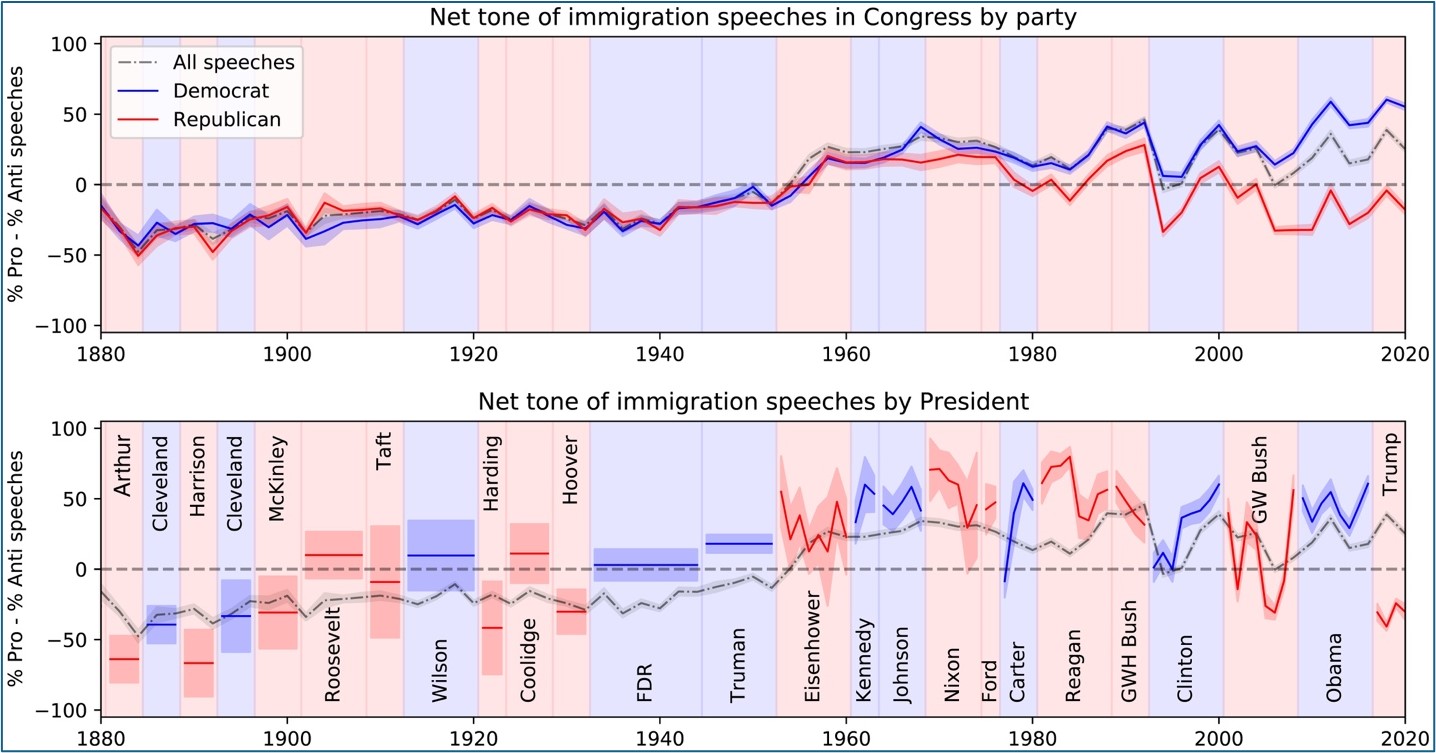
Anti-immigration rhetoric has become practically synonymous with the Republican Party as these candidates often use immigrants as scapegoats for shortcomings in national security, economics, and crime control. While several Democratic candidates support anti-immigration policies as well, it is less commonly a key aspect of their campaigns. The graphic below indicates the overall tone of immigration speeches in Congress and the president by party from the late nineteenth century until 2020. While the data excludes 2022, it encapsulates the general trends of immigration sentiments over time.
Source: Card et al., 2022 published by the Proceedings of the National Academy of Sciences.
The top of the graph shows that trends in the rhetoric of Republican and Democratic congressional representatives were negative before the 1950s and became positive in both parties in the late 1950s and through the 1960s and 1970s. The divergence in sentiments is clearest in the early 1980s and beyond, with the greatest points of divergence occurring between 2000 and 2020. Card et al. acknowledge that the divergence also represents other trends in the polarization of other issues. However, they find that immigration polarization predated the rise in generic political polarization observed in Gentzkow et al. by more than a decade.
The lower part of the graph shows the variation in presidential sentiments through positive and negative language employed to discuss immigration. The anti-immigrant rhetoric of President Trump has been unseen since the presidency of Herbert Hoover. Overall, the graph represents the rise in anti-immigration rhetoric in congressional and presidential speeches by Republicans in recent years as it has become more of a political talking point.
Discourse gathered from the campaign sites and social media accounts of Republican candidates who ran in competitive elections in 2022 with anti-immigration campaigns includes several instances of strongly prejudiced statements. Republican Mark Robertson (Nevada District 1) sought to “turn off the illegal flow of people coming into our country… end chain-migration, visa lotteries and vacation-birth citizenship.” Ending “vacation-birth citizenship” implies a possible erasure of birthright citizenship. Anti-immigrant candidates describe policies like these in misleading ways to garner political support, despite understanding the implausibility of such a policy.
Numerous other candidates posit a link between undocumented immigration and drug cartels. Republican Congressman Bryan Steil, who won in Wisconsin District 1, claimed on his campaign website that “drug dealers (and) human traffickers” are crossing the border, framing it in such a way that implies the two are intertwined in their business dealings. Republican Congressman John James, who won reelection in 2022 for Michigan District 10, conducts a similar framing in a tweet highlighting “millions of illegal border crossings, millions of lethal doses of Chinese fentanyl.”
A more brazen example of such framing can be found in campaign material from Blake Masters’ failed bid for Arizona Senate, which shamelessly claims that “More than 225,000 illegal aliens pour into our country every month. And they bring enough fentanyl over each month to kill every American twice over.” In a recent conference on immigration at American University, Dr. Andrew Selee, head of the Migration Policy Institute, notes that these organizations are separate entities. Though they sometimes do collaborate, they are by no means the same and have independent organizational structures. This is a subtle yet important distinction that has been masked to criminalize migrants and conflate them with criminal enterprises such as drug cartels.
The criminalization of migrants was certainly not limited to linking them to cartels. Many candidates rely upon preconceived racist notions of immigrant populations (mostly Latinos) in making generalizations. Such candidates keep their statements on immigration vague, like Nevada Republican Senate hopeful Adam Laxalt: “[the] crisis at the border that has put communities across Nevada in danger…. [Laxalt] fought against dangerous sanctuary city policies and worked to help stop their spread.” The advantages yielded by anti-immigrant candidates in utilizing this sort of vagueness are twofold. The first is that it appeals to a voter base that has already constructed a negative bias toward immigrant populations, and it is this sort of rhetoric that energizes these voters. The second advantage of such vagueness is the removal of the burden of proof from Laxalt or other candidates. Because of this vagueness, the claim becomes difficult to disprove because the meaning can be fluid and easily manipulated at the whim of the candidate.
Overall, anti-immigration statements like those highlighted in the 2022 midterm election campaigns are prevalent across Republican candidates. Trends indicate a rise in such rhetoric in congressional and presidential speeches with a partisan divergence as Republican candidates are more likely to employ this as a strategy in campaigning. Nonetheless, there was limited success for anti-immigrant campaigns in the 2022 midterm elections. The data shows that anti-immigration rhetoric is not a guarantee for winning elections; in fact, it may be an electoral vulnerability as it does not lead to more success in competitive elections.
Ernesto Castañeda PhD, Director of the Immigration Lab and the Center for Latin American and Latino Studies, American University in Washington DC.
Joseph Fournier and Mary Capone are research assistants at the Immigration Lab and the Center for Latin American and Latino Studies at American University.
Card, D., Chang, S., Becker, C., Mendelsohn, J., Voigt, R., Boustan, L., Abramitzky, R., & Jurafsky, D. (2022). Computational analysis of 140 years of us political speeches reveals more positive but increasingly polarized framing of immigration. Proceedings of the National Academy of Sciences, 119(31). https://doi.org/10.1073/pnas.2120510119
Gentzkow, M., Shapiro, J. M., & Taddy, M. (2019). Measuring group differences in high dimensional choices: Method and application to congressional speech. Econometrica, 87(4), 1307–1340. https://doi.org/10.3982/ECTA16566
James, John. (JohnJamesMI). “Our border is plagued with chaos – millions of illegal border crossings, millions of lethal doses of Chinese fentanyl & incompetence from the White House. I’m glad to support the House GOP’s Commitment to America to fund border security & put an end to human & drug trafficking.” September 26, 2022. 3:10 PM. Tweet. https://x.com/JohnJamesMI/status/1574476402392457217.
On the morning of September 9, 2024, a Republican voter called into C-SPAN’s Washington Journal and said, “Democrats used to be all about the workers, but now it’s just socialism.” This short piece is respectfully directed to those who may share that sentiment. First, it’s important to note that, in principle, socialism is centered around workers, but it asks that workers own the companies they work at. Democrats are not socialists. Even the party’s most progressive figures, like Bernie Sanders and Alexandria Ocasio-Cortez (AOC), identify as Democratic Socialists and advocate for the U.S. to adopt some of the social safety nets seen in Northern European countries and fight monopolies and for workers’ rights to create a tempered capitalism. Now, let’s turn to the real concerns about the economy as we approach the upcoming elections.
The economy is doing well
The U.S. economy is objectively performing very well, largely due to the Biden-Harris administration’s adoption and successful implementation of policies championed by figures like Sanders, Warren, and AOC. Compared to other countries, the U.S. has recovered more quickly from the pandemic’s effects, which were driven by lockdowns, labor shortages, and disruptions to global supply chains—all of which contributed to inflation. These policies, alongside immigration, have supported healthy economic growth. Notably, inflation and interest rates are decreasing without the economy slipping into a recession—an almost ideal outcome often referred to as a “soft landing.”
Nonetheless, some citizens and commentators still insist that the economy is weak, and voters often mention “the economy” as their main concern.
A shift in expectations on the economy
Before the COVID-19 pandemic, it was already common for millions of Americans to live paycheck to paycheck and carry significant debt. The pandemic, however, reshaped Americans economic expectations in at least three important ways: 1) The imminent threat to life placed greater value on human life and people’s time; 2) It exposed our heavy dependence on foreign producers, global supply chains, and essential local workers; and 3) It led to a bipartisan recognition that the government can and should take action to address hunger, unemployment, public wellbeing, inequality and support the working and middle class, as well as small and large business and postpone evictions in times of collective suffering.
Let me elaborate on point three. The economic policies and incentives—such as support for businesses both large and small, direct checks to families, and the child tax credit—implemented in a bipartisan effort during the pandemic by both the Trump-Pence and Biden-Harris administrations significantly raised economic standards and cut child poverty in half. These policies also reflected what C. Wright Mills advocated in the 1960s: when unemployment is widespread, it should be viewed as a social issue rather than a matter of personal responsibility, worth, or morality. In contrast to the neoliberal focus on market fundamentalism, these pandemic-era measures revived Keynesian principles, emphasizing a return to full employment and expanding support for policies reminiscent of FDR’s New Deal—where the government plays a role in reducing inequality and supporting the working and middle class.
The real cause of frustration
One of Joe Biden’s boldest and most significant accomplishments may have been his repeated assertion that “trickle-down economics has never worked. It’s time to grow the economy from the bottom up and the middle out.” This is a change in the long-held belief in individualistic ideologies, such as the notion of “pulling yourself up by your bootstraps.” Stemming from this ideological shift, I believe much of the unease felt by the working and lower-middle class about “the economy” stems from frustration over the end of many pandemic-era cash transfers and stimulus checks, which were initiated by both the Trump and Biden administrations. These transfers and the forced savings due to the lockdowns allowed some families to pay credit card debt and even increase their savings, which for many are now depleted again.
Ironically, it was the Republican Party that blocked the extension of the child tax credit, a key measure backed by Democrats to support working families. Yet, many voters remain unaware of this. Meanwhile, tax-evading billionaires, including figures like Trump, exacerbate the economic challenges rather than providing solutions. A modest increase in taxes on billionaires would help fund essential programs like the child tax credit, and contrary to popular rhetoric, this is not socialism—it’s a practical approach to ensuring fair contributions from the wealthiest.
Outdated and Misguided Economic Narratives
Trump has attempted to link his scapegoating of immigrants to the current economic challenges, falsely claiming that immigrants are taking jobs from those most in need, particularly African Americans, Hispanics, and union workers. However, this argument does not hold up—unemployment rates are low, and wages are rising. As a result, most people are unlikely to be swayed by this rhetoric. Those who do buy into it likely already held anti-immigration views prior to the pandemic and/or are victims of structural changes stemming from Reaganomics.
By invoking fears that the U.S. could become “like Venezuela,” Trump taps into concerns among immigrants who lived Venezuela’s prosperity before Chavismo or those fleeing other authoritarian regimes. However, Republicans risk losing these voters by frequently portraying Venezuelan immigrants as criminals—members of the Tren de Aragua gang—or as individuals released from prisons and mental institutions by Maduro and sent to the U.S. This narrative echoes real historical events such as Cuba’s Marielitos or British prisoners sent to Australia as settlers, as well as xenophobic stereotypes and prejudices once directed at Irish, Italian, and Mexican immigrants. History, however, shows that the children of immigrants often experience rapid social mobility and thus contribute as much, if not more, to society than the children of native-born citizens.
Some attempt to alarm undecided voters by claiming that Harris is advocating for price controls. In reality, she is focused on preventing monopolies and negotiating better prices when the government buys in bulk, as demonstrated successfully with insulin. This pragmatic approach has broad support across Republicans, Democrats, and Independents. Harris and Walz are not pushing radical leftist ideas; rather, they are promoting a moderate populism that is not linked to exclusionary Christian nationalism.
“Opportunity economy”
In her speech at the Economic Club of Pittsburgh on September 25, 2024, Harris stated:
“The American economy is the most powerful force for innovation and wealth creation in human history. We just need to move past the failed policies that have proven not to work. And like generations before us, let us be inspired by what is possible. As president, I will be guided by my core values of fairness, dignity, and opportunity. I promise you I will take a pragmatic approach. I will engage in what Franklin Roosevelt called bold, persistent experimentation, because I believe we shouldn’t be constrained by ideology but instead pursue practical solutions to problems.”
With this statement, she invoked FDR’s legacy while offering a centrist, pragmatic vision for addressing the economic challenges facing Americans.
While some commentators argue that Harris and Walz haven’t provided enough details on their economic policy, they are actually offering a balanced approach that appeals to both corporations and small businesses. Their plan promotes U.S. manufacturing and nearshoring, aims to reduce the climate impact of production and consumption, and provides much-needed support to the low and middle class in regions hit hardest by deindustrialization. Trump talks much about caring about the working class but did little to benefit them structurally and long-term while in the White House. Policies like exempting tips and overtime from taxation fit within Harris’ framework, but Harris also advocates for more ambitious measures to really level the economic playing field a bit more. Harris calls this vision the ‘opportunity economy,’ a pragmatic approach to economic and industrial policy that many former Bernie and Trump supporters could, in principle, support.
Ernesto Castañeda PhD, Director of the Immigration Lab and the Center for Latin American and Latino Studies, American University in Washington DC.
Edited by Robert Albro, CLALS Associate Director of Research, and Edgar Aguilar, International Economics master’s student at American University.
This piece can be reproduced completely or partially with proper attribution to its author.
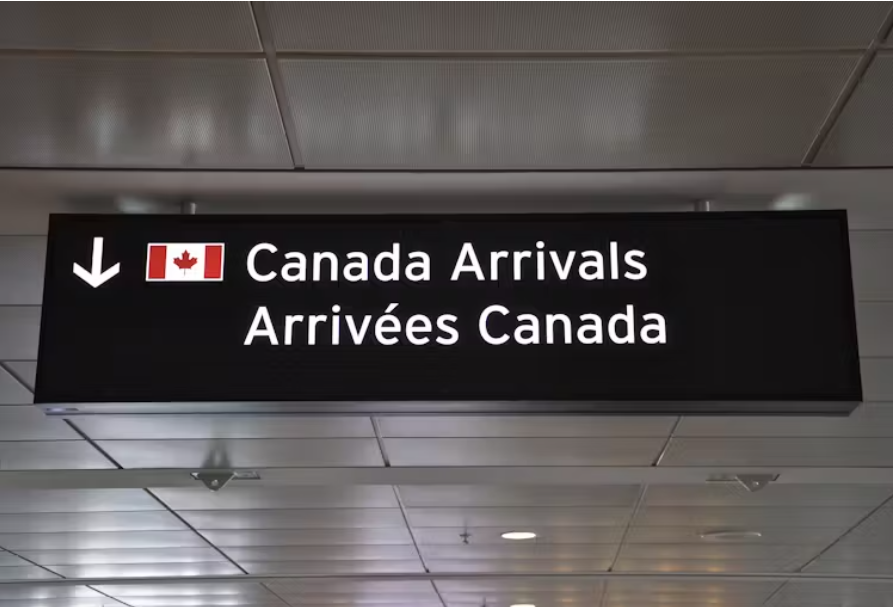
For those looking to immigrate to North America, Canada has long been seen as the easier, friendlier path to naturalization. But that perception may have changed this week as the Canadian government rolled out a series of restrictive anti-immigration policies.
Recent policies reduce and limit the arrival of temporary foreign workers into Canada. These measures include tightening the Temporary Foreign Worker Program (TFWP), which is similar to the US H-1B visa, allowing companies to hire non-Canadians for limited periods. A cap has also been placed on student visas, and the option to receive a Post-Graduation Work Permit (similar to the F-1 OPT in the US) has been revoked for those enrolled in a program using a curriculum licensing arrangement, which allow private institutions to use public colleges curricula but without the same quality controls. Concerns arose that some private institutions used these arrangements to attract international students without providing a quality education, later pushing them into the Canadian workforce.
Immigration has been a cornerstone of Canada’s economic growth. Foreign nationals contribute significantly to the labor market, especially in understaffed sectors such as healthcare, agriculture, and construction. In 2022, nearly 120,000 workers held a TFWP, filling essential roles that the domestic workforce could not. International students, who numbered over 800,000 in 2022, contribute billions of dollars to the education sector and the broader economy through tuition, living expenses, and occasional work.
Canada has an aging population, and with declining birth rates and an increasing number of retirees, immigration has been crucial in addressing these challenges. The need for a young, skilled workforce is more critical than ever. Additionally, international students pay millions in tuition and taxes that fund programs that they may not legally access, such as Canada’s renowned free healthcare, which is exclusive to citizens and residents in provinces like Ontario.
Working off-campus as an international student in Canada has minimal requirements, making the country an appealing destination for foreign students. If there are opportunities to partially support themselves while studying, working also exposes foreign students to significant risks of exploitation. Many are underpaid and overworked, yet hesitate to voice their concerns due to fears of deportation or the bureaucratic hurdles involved in holding employers accountable. For students from economically disadvantaged countries like India or Bangladesh, the need to continue working, even under unfair conditions, is often a matter of survival, as they cannot afford to lose their income despite rights violations. The tuition at many schools can be four times more expensive for foreign students than for Canadians, making these schools partly reliant on them. This was evidenced in 2018, when a diplomatic conflict with Saudi Arabia led to the sudden departure of 6,000 students and the loss of $140 million in revenue.
Despite the economic benefits foreign nationals bring, among Canadians there is growing concern about the rapid increase in immigration and its social impacts. Policymakers are focusing more on societal rather than economic concerns. One of the most pressing issues is the housing crisis. Rent prices have soared, and buying a home is nearly impossible. Many blame foreign nationals for this situation. The reality is that temporary workers and international students increase housing demand, and without a corresponding increase in supply, this leads to higher rent prices. The Canadian government issued a new housing plan in April 2024, but it is yet to be realized. Meanwhile, major cities are under strain, with public services like transportation and healthcare struggling to keep up with population growth.
A balanced approach is needed—one that addresses the immediate challenges posed by high immigration, leverages the economic benefits foreign nationals provide, and sees the humanity in every newcomer. These newcomers have worked hard and invested significant resources to live, study, and work in Canada. The emotional and financial toll on these would-be immigrants is significant, as many have left behind families, jobs, and a sense of security in their home countries, betting on the promise of a better life in Canada. Yet, they face uncertainty navigating a system that seems to be shutting them out more than ever before.
Pablo Landsmanasis an international affairs student at American University’s School of International Service. He currently serves as executive aide at the Center for Latin American & Latino Studies and is a political affairs intern at the Embassy of Mexico in the United States.
This piece can be reproduced completely or partially with proper attribution to its author.
Ernesto Castañeda, Edgar Aguilar and Oscar Alberto Ibarra*
20 de Septiembre de 2024
Edificio nuevo en Rosslyn, Arlington, Virginia construido en gran medida por mano de obra Centro Americana. Foto tomada por Ernesto Castañeda.
Más allá de contribuir a la economía en su país de origen, los migrantes salvadoreños impulsan la economía estadounidense.
El Salvador es uno de los países más pequeños de América Latina, con una población de 6.3 millones de habitantes y en pocos años la población empezará a decrecer. En Estados Unidos viven más de 1.3 millones de personas nacidas en El Salvador y más de 1.2 millones de personas nacidas en EE. UU. de al menos un padre salvadoreño. Las más de 2.5 millones de personas de origen salvadoreño viviendo en EE. UU. equivalen al 40% de la población qué habita en El Salvador. De acuerdo con nuestros cálculos hay alrededor de 1.8 millones de salvadoreños qué trabajan en Estados Unidos que envían remesas. Estas personas son parte importante de ambas economías.
Solo en 2023, El Salvador recibió $8,181 millones de dólares en remesas. Esa cantidad representó el 24% del Producto Interno Bruto (PIB) del país.
Algunos piensan que las remesas son una fuga de efectivo para la economía estadounidense. Sin embargo, un cálculo novedoso realizado por el Centro de Estudios de Latinoamérica y Latinos (CLALS) y el Laboratorio de Inmigración de la Universidad American en Washington, DC ha demostrado que las remesas son un indicador importante de las contribuciones que los migrantes hacen a la economía estadounidense. Siguiendo el mismo cálculo encontramos que los migrantes salvadoreños en Estados Unidos que enviaron remesas, solo en 2023 contribuyeron con $223,468 millones de dólares a la economía estadounidense. Los migrantes salvadoreños contribuyen significativamente en sectores como la construcción, restaurantes, jardinería, agricultura, servicios domésticos, y mecánica automotriz, salud, ciencia y educación, entre otros.
En este documento presentamos otro ejercicio novedoso para calcular el aporte económico de todos los inmigrantes salvadoreños en Estados Unidos, no solo los que mandan remesas. Para este análisis, también se partió del total de remesas enviadas a El Salvador en 2023, que fue de 8,181.8 millones de dólares, y en base en el promedio mensual de 330.3 dólares por remesa y la frecuencia estimada de 14 remesas anuales, una por mes más una adicional durante el día de la madre y navidad, se calculó el número de migrantes que remiten en aproximadamente 1,769,344 migrantes que envían dinero.
De acuerdo con un estudio del USAID, OIM y el Banco Central de Reserva de El Salvador alrededor del 79.7% de migrantes salvadoreños envía remesas, así que en total podemos estimar que hay más de 2.2 millones de salvadoreños que trabajan en EE. UU. Este estimado es mayor al de la oficina del censo americano, esto no es sorprendente ya que muchos migrantes no participan en el censo. Multiplicando la cantidad de migrantes (tanto los qué envían remesas como los qué no) por el salario promedio anual de $26,523 dólares, estimado por la oficina del censo, se calculó el ingreso agregado de estos migrantes como cerca de $59 mil millones de dólares. Finalmente, al considerar que los salarios recibidos por los migrantes después de impuestos y deducciones representan el 21% de su productividad, se estimó su contribución al PIB de Estados Unidos, de más $280 mil millones. Lo que revela el profundo impacto de los migrantes salvadoreños en la economía estadounidense. En la gráfica anterior se presentó únicamente el impacto de los migrantes que envían remesas. En la siguiente gráfica, se muestra la contribución económica de todos los migrantes salvadoreños en Estados Unidos que perciben un ingreso.
La contribución de los migrantes salvadoreños que remiten a la economía de Estados Unidos es superior a las contribuciones de estados enteros. Si todos los migrantes salvadoreños que mandan remesas fueran un estado, este tendría un PIB cinco veces más grande que el de Vermont y más de dos veces más alto que el de Delaware.
Conclusión
Los 1.8 millones de migrantes salvadoreños en Estados Unidos que enviaron remesas, solo en 2023 contribuyeron con $223,468 millones de dólares a la economía estadounidense. Los 2.2 millones de salvadoreños que trabajan en EE. UU. generaron más de $280 mil millones dólares, dado que el PIB de El Salvador es de US$34,015.62 millones. Este estimado muestra que los migrantes salvadoreños, mediante su mano de obra, generan 8 veces más valor económico en su país de residencia (EE. UU.) que todos los habitantes en su país de origen. Tambien encontramos que los migrantes salvadoreños y sus hijos generaron alreadedor del 1% del GDP de Estados Unidos en 2023.
Más allá del envío de remesas, los migrantes salvadoreños también desempeñan un papel crucial en el crecimiento económico de Estados Unidos a través de su participación en diversos sectores productivos. Además de su impacto en la producción, los migrantes salvadoreños contribuyen a la economía mediante el pago de impuestos y, sobre todo, al suplir la demanda laboral en áreas clave que el país requiere. En general, estudios demuestran que los inmigrantes no solo apoyan las economías de sus países de origen, sino que también son un motor en las economías de sus países de residencia.
Ernesto Castañeda PhD, Director del Laboratorio de Inmigración y el Centro de Estudios Latino Americanos y Latinos (CLALS), Profesor,American University en Washington DC.
Edgar AguilarEstudiante de Maestría en Economía Internacional de American University y asistente de investigación en el Centro de Estudios Latinoamericanos y Latinos (CLALS) y consultor para el Banco Mundial. Se especializa en migración, seguridad humana, energía sostenible, finanzas y política ambiental.
Oscar Alberto Ibarra Coordinador del Observatorio de Migración y Transparencia del Centro de Investigación para la Democracia (CIDEMO) de la Universidad de Oriente (UNIVO), en el marco del Proyecto de Sociedad Civil y Democracia en la Región Oriental.
Esta pieza puede reproducirse total o parcialmente con la debida atribución a su autor.
Ernesto Castañeda, Edgar Aguilar and Oscar Alberto Ibarra*
September 20, 2024
Photo of a new building built largely by Central American labor in Rosslyn, Arlington, Virginia by Ernesto Castañeda
In addition to contributing to the economy in their home country, Salvadoran migrants also boost the U.S. economy.
El Salvador is one of the smallest countries in Latin America, with a population of 6.3 million inhabitants, which is expected to decrease in the next few years. More than 1.3 million people born in El Salvador live in the United States, along with more than 1.2 million born to at least one Salvadoran parent. The more than 2.5 million people of Salvadoran origin living in the U.S. are equivalent to 40 percent of El Salvador’s total population. According to our calculations, there are around 1.8 million Salvadorans who work in the United States and send remittances. These people are an important part of both economies.
In 2023 alone, El Salvador received $8.18 billion dollars in remittances, which represented 24 percent of the country’s Gross Domestic Product (GDP).
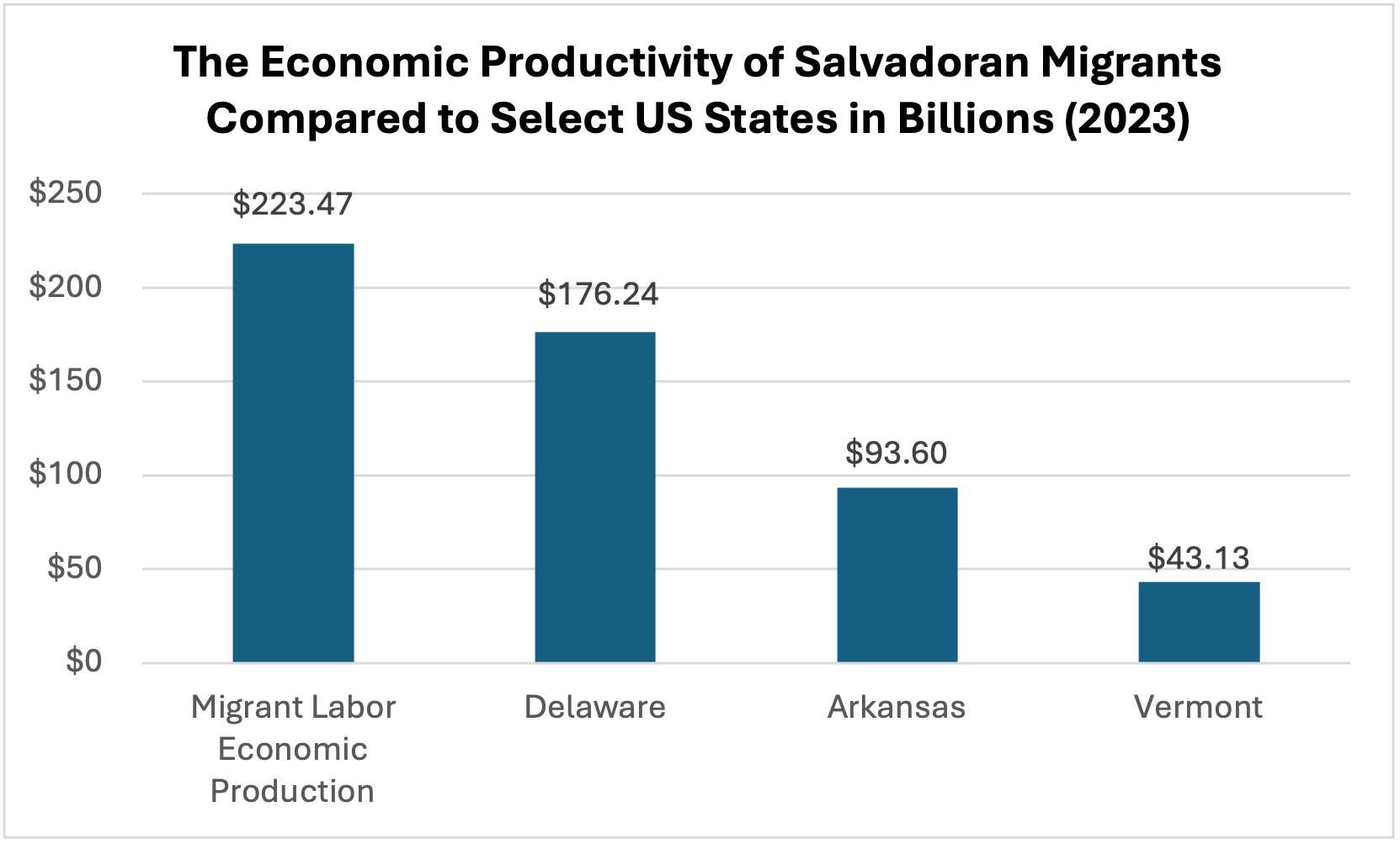
Some believe that remittances are a cash drain on the U.S. economy. However, a novel calculation by the Center for Latin American and Latino Studies (CLALS) and Immigration Laboratory at American University in Washington, DC, demonstrates that remittances are an important indicator of the contributions that migrants make to the US economy. Based on this calculation, we find that just in 2023, Salvadoran migrants in the United States who sent remittances contributed $223.47 billion dollars to the US economy, including significant contributions to such industries as construction, restaurants, gardening, agriculture, and domestic services, as well as automotive mechanics, health, science, and education, among others.
Here, we also offer an additional novel means of calculating the economic contribution of all Salvadoran immigrants in the United States, not just those who send remittances. For this analysis, we started again with the total remittances sent to El Salvador in 2023, which was $8.18 billion. Using a monthly average of $330.30 dollars per remittance and an estimated frequency of 14 annual remittances, one per month plus additional ones for both Mother’s Day and Christmas, we calculated the number of migrants who send money to be approximately 1,769,344.
According to a study by USAID, IOM, and the Central Reserve Bank of El Salvador, around 79.7 percent of Salvadoran migrants send remittances. Therefore, we can estimate that there are more than 2.2 million Salvadorans working in the United States. This estimate is higher than that of the American Census Bureau, which is not surprising since many migrants do not participate in the census. Multiplying the number of migrants (both those who send remittances and those who do not) by the average annual salary of $26,523.00 estimated by the Census Bureau, the aggregate income of these migrants was calculated to be about $59 billion. Finally, considering that the salaries received by migrants after taxes and deductions represent 21 percent of their productivity, we estimated their contribution to the GDP of the United States to be more than $280 billion. This reveals the profound impact Salvadoran migrants have on the U.S. economy. In the previous graph, only the impact of migrants who send remittances was presented. The following graph shows the economic contribution of all Salvadoran migrants in the United States who earn an income.
The contribution of Salvadoran migrants to the United States economy is greater than that of entire states. If all the Salvadoran migrants who send remittances were a state, it would have a GDP five times larger than that of Vermont and more than twice as big as that of Delaware.
Conclusion
The 1.8 million Salvadoran migrants in the United States who sent remittances in 2023 contributed $223.47 billion to the US economy. The 2.2 million Salvadorans working in the US generated more than $280 billion dollars. Given that El Salvador’s GDP is US $34.02 billion, our estimate demonstrates that Salvadoran migrants, through their economic activity, generate eight times more economic value in their country of residence (that is, the U.S.) than does the entire population in their country of origin. This also means that Salvadorean immigrants and their adult children contributed around 1% of the United States GDP in 2023.
Beyond sending remittances, Salvadoran migrants also play a crucial role in the economic growth of the United States through their participation in various productive sectors. In addition to their impact on production, Salvadoran migrants contribute to the economy by paying taxes and, above all, by meeting labor demand in key areas of need for the US. In general, studies show that immigrants not only support the economies of their countries of origin, but also function as economic engines for their countries of residence.
Ernesto Castañeda PhD, Director of The Immigration Lab and Center for Latin American and Latino Studies (CLALS), Professor, American University in Washington DC.
Edgar Aguilar is an International Economics Master’s student at American University, a research assistant at the Center for Latin America and Latino Studies, and a consultant for the World Bank. He specializes in migration, human security, sustainable energy, finance, and environmental policy.
Oscar Alberto Ibarra Coordinator of the Migration and Transparency Observatory of the Research Center for Democracy (CIDEMO) of the University of Oriente (UNIVO), El Salvador.
This piece can be reproduced completely or partially with proper attribution to its authors.
Entrevista de Diana Castrillón a Ernesto Castañeda publicada por Stornia 13 de agosto de 2024 editada y expandida por Castañeda.
Diana Castrillón: “La inmigración irregular es uno de los temas más importantes de las campañas presidenciales de los candidatos, el republicano Donald Trump y la demócrata Kamala Harris. Por un lado, la administración de Biden-Harris restringió el número de solicitantes de asilo que pueden ingresar al país. Por otro lado, los republicanos están prometiendo el “mayor programa de deportación masiva en la historia de Estados Unidos” si es que ganan la Casa Blanca este otoño.
El sentimiento antiinmigrante en Estados Unidos está en aumento. Este año, el 55% de los estadounidenses dijeron que les gustaría ver una disminución de la inmigración, una novedad desde el 2001. Esto se debe en parte a la creencia que los inmigrantes, en particular los indocumentados, son una carga para los recursos del gobierno y no contribuyen en nada.
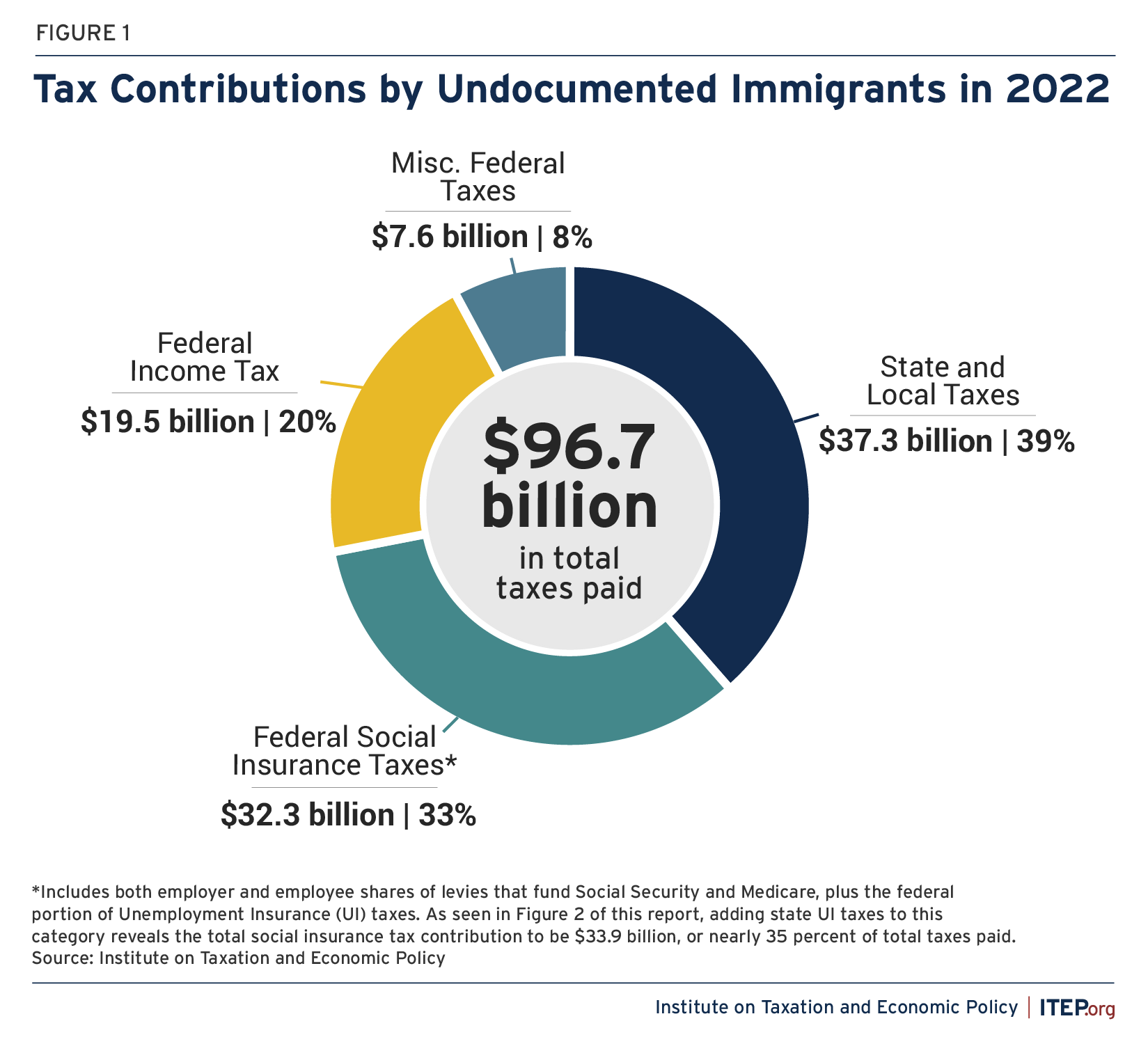
Sin embargo, un nuevo estudio del Instituto de Política Fiscal y Económica muestra que es todo lo contrario. Según el informe, los inmigrantes indocumentados contribuyeron con casi $100 mil millones de dólares en impuestos durante 2022 y a su vez, no pudieron acceder a muchos de los programas que financiaron sus dólares de impuestos.
De esos casi $100 mil millones, $60 mil millones se destinaron al gobierno federal. Por cada millón de inmigrantes indocumentados, los servicios federales reciben $8.900 millones de dólares adicionales en ingresos fiscales. Más de un tercio de los impuestos que pagan estos inmigrantes se destinan a programas a los que no pueden acceder, como la Seguridad Social ($25,700 millones de dólares), salud Medicare ($6,400 millones de dólares) y el seguro de desempleo ($1,800 millones de dólares).
Los indocumentados suelen pagar tasas impositivas más altas que los ciudadanos estadounidenses. En 40 de los 50 estados del país, los inmigrantes irregulares pagan tasas de impuestos estatales y locales más altos que el 1% de los hogares con mayores ingresos. Además, no pueden recibir muchos créditos fiscales. No se dan cuenta que pueden reclamar reembolsos y tampoco tienen acceso a ayuda fiscal.
“En total, la contribución fiscal federal de los inmigrantes indocumentados ascendió a $59,400 millones de dólares en 2022, mientras que la contribución fiscal estatal y local se situó en 37,300 millones de dólares”, escribieron los autores del estudio. “Estas cifras dejan claro que las decisiones sobre política migratoria tienen implicaciones sustanciales para los ingresos públicos en todos los niveles de gobierno”, menciona el informe.”
En entrevista con Stornia, Ernesto Castañeda PhD, Director del Laboratorio de la Inmigración y el Centro de Estudios Latino Americanos y Latinos de American University en Washington DC, aseguró que los inmigrantes son necesarios y esenciales para el crecimiento económico de Estados Unidos.
Diana Castrillón: ¿Cómo paga un inmigrante indocumentado impuestos, si como su nombre lo dice, son migrantes irregulares?
Ernesto Castañeda: Los indocumentados pagan impuestos cada vez que compran algo, está el impuesto a la compra, el porcentaje depende de cada localidad. Si compran casas, que lo pueden hacer, también pagan impuestos, si rentan o pagan renta, también hay un porcentaje que se debe pagar en impuestos al gobierno local y federal. La gente indocumentada que trabaja en compañías formales, que son muchos, pueden tener una identificación temporal para pagar impuestos (ITIN), que funciona de manera similar al número de Seguridad Social, entonces pagan impuestos a la nómina como cualquier otra persona trabajando en Estados Unidos. Hay gente que usa documentos de identidad falsos o que no les corresponden, pero alguien se los presta, y así pagan a las arcas de Seguro Social y programas de retiro y de salud, pero como el número es falso o no es de ellos, no tienen acceso a esos beneficios.
Entonces, no solo pagan a estos servicios, sino que muchos inmigrantes no piden ese apoyo. Por lo tanto, tienen una contribución mayor a los ciudadanos que pagan, pero quien luego si retiran esas ayudas. Es una ganancia que el Gobierno Federal y el Tesoro aceptan abiertamente que sucede.
¿Entonces los inmigrantes indocumentados están pagando más impuestos que los mismos ciudadanos americanos?
Si, la tasa de muchos indocumentados que pagan impuestos es más alta que las tasas que paga la gente más rica del país. Claro, los ingresos son diferentes pero la tasa es a veces mayor o muy similar, a la de los ciudadanos. Los ciudadanos llenan sus declaraciones de impuestos y muchas veces piden reembolsos, por ejemplo, por gastos de negocios o les dan un crédito por tener hijos, pero muchos de los indocumentados no hacen esos reclamos porque no quieren que más adelante se les niegue la ciudadanía por haber pedido ayudas o servicios. Por ese temor, tampoco piden programas de apoyo para sus hijos, que ya son ciudadanos y tienen derecho a esos servicios. Hemos comprobado en nuestras investigaciones en el Laboratorio de Inmigración que los inmigrantes usan menos servicios sociales que los nacionales (Castañeda y Cione, 2024).
Pareciera que los indocumentados están entre la espada y la pared ahora con la campaña electoral tanto por el lado de los republicanos como por el lado de los demócratas, ¿hay preocupación en la comunidad?
Algunos políticos usan a los inmigrantes indocumentados como chivos expiatorios en tiempos electorales. Por un lado, Trump hace esta amenaza de deportaciones masivas, pero es poco probable que lo haga, eso mismo lo había prometido anteriormente y cuando fue presidente no deportó a tanta gente. Eso no significa que la gente no tenga miedo ahora y si gana creará un terror real entre la población que ya de por sí vive con mucho miedo a que los encuentren como indocumentados a ellos o a alguien cercano.
En cuanto situaciones de asilo, en efecto, mucha gente está escapando de situaciones difíciles en Afganistán, Ucrania, Cuba, Venezuela, Haití o Nicaragua. Muchos con pruebas de persecución, y ahora el gobierno ha cambiado cómo tramita buscar asilo. La frontera está cerrada a muchas de esas peticiones de asilo como se hizo durante la pandemia. Por ende, estamos viendo menos cruces irregulares en la frontera. La administración Biden-Harris piensa que eso les puedes ayudar electoralmente para que los republicanos no les hagan la crítica de que la frontera está supuestamente abierta y los que indocumentados o quienes piden asilo están recibiendo comida y vivienda en algunas ciudades. Es un momento difícil, y no es sostenible. En algún momento van a tener que reabrir la frontera al asilo humanitario, porque a lo que llaman el derecho nacional e internacional es a recibir a la gente que está pidiendo asilo. Tras procesar sus aplicaciones, a unos los aceptarán a otros no.
Trump necesitaría mucho dinero y mucha policía, casi tendría que crear un estado totalitario para poder deportar a toda la gente que está aquí sin papeles migratorios en regla. Muchas de estas personas tienen más de 10 años aquí, tienen hijos ciudadanos, trabajan, contribuyen, por lo cual, deportar masivamente o dejar de recibir inmigrantes es un gran ataque a Estados Unidos. La economía se podría contraer. Se podría crear una recesión porque como mencionamos anteriormente, los migrantes pagan miles de millones en impuestos, pero los impuestos son un porcentaje pequeño de lo que la gente gana. La mayoría de los inmigrantes ganan, lo gastan en las ciudades donde viven, y con el trabajo que hacen generan crecimiento económico, servicios, entretenimiento y hacen que la economía crezca.
Hace algunos días JD Vance, la fórmula vicepresidencial de Donald Trump justificaba el plan de deportación masiva y decía que los indocumentados le están robando plazas de trabajo a los ciudadanos americanos. ¿Existe esa fila de estadounidenses esperando a que deporten inmigrantes para tomar sus puestos de trabajo?
Esto no funciona así. Trump y Vance están equivocados sobre que los inmigrantes les quitan trabajos a los afroamericanos o a otros ciudadanos. Es un estereotipo fácil de vender, algún votante pudo haber tenido una experiencia donde pareciera que pudo ser el caso, sin embargo, si vemos a la economía en general, la inmigración genera nuevos empleos.
En Florida, está en efecto la ley anti-inmigrante más estricta del país. De hecho, han salido muchos indocumentados del estado, y hoy no hay suficiente mano de obra para la construcción, para servicios como hoteles, para la agricultura en los cultivos de naranjas. Entonces los negocios que necesitaban esa mano de obra para generar riqueza ahora no pueden tener su negocio al 100%. Propietarios de granjas han tenido que cerrar porque les falta mano de obra para trabajar, algunos negocios pequeños han tenido que limitar sus horas de servicios. Si no hay construcción no hay viviendas, seguirá habiendo inflación por las viviendas existentes. Los inmigrantes llegan y necesitan un lugar donde vivir, quien les corte el pelo, quien les venda comida, entonces generan trabajo e ingreso para los comerciantes.
Los migrantes emprenden con más negocios (desde pequeños negocios hasta las grandes empresas) que los nacidos en Estados Unidos. También sabemos que los inmigrantes emplean más gente que los dueños de negocios del país. No es que haya un pastel que esté limitado y se lo reparta el número de gente que llega, entre más personas lleguen, incrementa el tamaño del pastel entonces hay más pastel para todos. No es una competencia desleal y eso se ve en las tasas de desempleo.
Ahora bajo la administración Biden-Harris tenemos una tasa de desempleo para afroamericanos históricamente baja, una tasa de desempleo de latinos muy baja y no hay muchos ciudadanos de origen europeo que están desempleados porque algún migrante esté tomando su trabajo, si noq que usualmente no encuentran trabajo porque no los estudios o capacitación suficiente para tomar un empleo bien pagado, o por el contrario, porque tienen demasiada educación y no hay un empleo con alto ingreso que les convenga tomar. O porque se rehúsan a mudarse dentro del país para buscar trabajo. Las tasas de desempleo son bajas en general y de lo que se quejan los empresarios es que no tienen suficiente personal para expandir sus negocios. Esto también afecta a los ciudadanos buscando servicios, teniendo que esperar más en restaurantes porque no hay suficientes meseros o cocineros.
¿Cuál es la respuesta para el manejo de inmigración, más visas temporales de empleos, legalizar a los indocumentados o hacer más muro en la frontera?
La solución a los casos de inmigración irregular a largo plazo es aumentar las visas temporales de empleo para que la gente venga de manera legal. Existen programas como la Visa H2A, H2B son ejemplos de visas que funciona muy bien, la gente viene, trabaja y se regresa a su país, porque ya ganaron ingresos en dólares pudieron ahorrar suficiente y ahora quieren estar con su familia.
El problema es que hay límites, hay cuotas para esas visas, son para cierto tipo de empleos, y hay más demanda de esa gente trabajadora temporal de lo que la que la ley permite. Para que aumenten los topes, los números de esas visas, el Congreso tiene que actuar. Tiene que actuar la Cámara de Representantes y el Senado, y tienen que estar de acuerdo los demócratas, de que es lo que harían, y un número suficiente de republicanos. Pero ellos se niegan a hacerlo, porque parece que no quieren solucionar el tema, solo lo quieren usar de manera electoral.
Para las personas que ya están aquí, la solución es legalizarlos. Al darle papeles o permisos laborales a quienes están aquí, de esa manera muchos ganarían más dinero, tendrían más confianza de invertir, pagarían más impuestos. Esto sería una inyección a la economía americana, y podrían traer a sus familiares de manera legal y expandir la base trabajadora un poco más.
Y eso es algo que ni Trump ni Vance entienden, nunca lo harán. A diferencia del presidente Ronald Reagan, quien sí firmó una ley como esa, aunque a regañadientes. Tampoco es algo sobre lo que han querido hablar mucho Kamala Harris ni Tim Walz en la campaña porque la gente lo usa como un ataque muy simple con ellos, pero los dos tienen un historial político de apoyar este tipo de medidas.
¿Y con esta legalización de indocumentados en Estados Unidos ganan países de América Latina o pierden?
Las remesas representan solo el 4% de lo que los inmigrantes generan en Estados Unidos. Un migrante que está más establecido o es profesional, manda remesas menos seguido, entonces son ayudas a familias en pobreza. Las remesas representan separaciones familiares por años hasta que el migrante termina regresando o trata de traer a la familia entera. Es una ayuda a corto plazo, pero pone a las familias que se dividen en dificultad emocional y cualquier país que pierde migrantes, desde agricultores hasta científicos, médicos, como en Cuba que ha perdido un par de millones de migrantes profesionales durante el último par de años debilita cada vez más su economía. También pasa en la economía venezolana, que ha sido debilitada entre otras muchas cosas por la emigración. Las remesas son ayudas de corto plazo, pero la verdadera ayuda económica se da en donde llegan los migrantes, en este caso Estados Unidos.
De acuerdo con el estudio de Instituto de Política Fiscal y Económica, la autorización de trabajo sería beneficiosa para todos, pues otorgar a los inmigrantes indocumentados una autorización de trabajo resultaría en un aumento de sus contribuciones fiscales de $40,000 millones de dólares a $137,000 millones de dólares por año, ya que la autorización de trabajo aumentaría los salarios.
Ernesto Castañeda PhD, Director del Laboratorio de Inmigración y el Centro de Estudios Latino Americanos y Latinos, American University en Washington DC.
This piece can be reproduced completely or partially with proper attribution to its author.












 AULA Blog