Deportaciones Masivas Podrían Crear una Recesión en EE.UU

Ernesto Castañeda

Entrevista de Diana Castrillón a Ernesto Castañeda publicada por Stornia 13 de agosto de 2024 editada y expandida por Castañeda.

Diana Castrillón: “La inmigración irregular es uno de los temas más importantes de las campañas presidenciales de los candidatos, el republicano Donald Trump y la demócrata Kamala Harris. Por un lado, la administración de Biden-Harris restringió el número de solicitantes de asilo que pueden ingresar al país. Por otro lado, los republicanos están prometiendo el “mayor programa de deportación masiva en la historia de Estados Unidos” si es que ganan la Casa Blanca este otoño.

El sentimiento antiinmigrante en Estados Unidos está en aumento. Este año, el 55% de los estadounidenses dijeron que les gustaría ver una disminución de la inmigración, una novedad desde el 2001. Esto se debe en parte a la creencia que los inmigrantes, en particular los indocumentados, son una carga para los recursos del gobierno y no contribuyen en nada.

Sin embargo, un nuevo estudio del Instituto de Política Fiscal y Económica muestra que es todo lo contrario. Según el informe, los inmigrantes indocumentados contribuyeron con casi $100 mil millones de dólares en impuestos durante 2022 y a su vez, no pudieron acceder a muchos de los programas que financiaron sus dólares de impuestos.

De esos casi $100 mil millones, $60 mil millones se destinaron al gobierno federal. Por cada millón de inmigrantes indocumentados, los servicios federales reciben $8.900 millones de dólares adicionales en ingresos fiscales. Más de un tercio de los impuestos que pagan estos inmigrantes se destinan a programas a los que no pueden acceder, como la Seguridad Social ($25,700 millones de dólares), salud Medicare ($6,400 millones de dólares) y el seguro de desempleo ($1,800 millones de dólares).

Los indocumentados suelen pagar tasas impositivas más altas que los ciudadanos estadounidenses. En 40 de los 50 estados del país, los inmigrantes irregulares pagan tasas de impuestos estatales y locales más altos que el 1% de los hogares con mayores ingresos. Además, no pueden recibir muchos créditos fiscales. No se dan cuenta que pueden reclamar reembolsos y tampoco tienen acceso a ayuda fiscal.

“En total, la contribución fiscal federal de los inmigrantes indocumentados ascendió a $59,400 millones de dólares en 2022, mientras que la contribución fiscal estatal y local se situó en 37,300 millones de dólares”, escribieron los autores del estudio. “Estas cifras dejan claro que las decisiones sobre política migratoria tienen implicaciones sustanciales para los ingresos públicos en todos los niveles de gobierno”, menciona el informe.”

En entrevista con Stornia, Ernesto Castañeda PhD, Director del Laboratorio de la Inmigración y el Centro de Estudios Latino Americanos y Latinos de American University en Washington DC, aseguró que los inmigrantes son necesarios y esenciales para el crecimiento económico de Estados Unidos.

Diana Castrillón: ¿Cómo paga un inmigrante indocumentado impuestos, si como su nombre lo dice, son migrantes irregulares?

Ernesto Castañeda: Los indocumentados pagan impuestos cada vez que compran algo, está el impuesto a la compra, el porcentaje depende de cada localidad. Si compran casas, que lo pueden hacer, también pagan impuestos, si rentan o pagan renta, también hay un porcentaje que se debe pagar en impuestos al gobierno local y federal. La gente indocumentada que trabaja en compañías formales, que son muchos, pueden tener una identificación temporal para pagar impuestos (ITIN), que funciona de manera similar al número de Seguridad Social, entonces pagan impuestos a la nómina como cualquier otra persona trabajando en Estados Unidos. Hay gente que usa documentos de identidad falsos o que no les corresponden, pero alguien se los presta, y así pagan a las arcas de Seguro Social y programas de retiro y de salud, pero como el número es falso o no es de ellos, no tienen acceso a esos beneficios.

Entonces, no solo pagan a estos servicios, sino que muchos inmigrantes no piden ese apoyo. Por lo tanto, tienen una contribución mayor a los ciudadanos que pagan, pero quien luego si retiran esas ayudas. Es una ganancia que el Gobierno Federal y el Tesoro aceptan abiertamente que sucede.

¿Entonces los inmigrantes indocumentados están pagando más impuestos que los mismos ciudadanos americanos?

Si, la tasa de muchos indocumentados que pagan impuestos es más alta que las tasas que paga la gente más rica del país. Claro, los ingresos son diferentes pero la tasa es a veces mayor o muy similar, a la de los ciudadanos. Los ciudadanos llenan sus declaraciones de impuestos y muchas veces piden reembolsos, por ejemplo, por gastos de negocios o les dan un crédito por tener hijos, pero muchos de los indocumentados no hacen esos reclamos porque no quieren que más adelante se les niegue la ciudadanía por haber pedido ayudas o servicios. Por ese temor, tampoco piden programas de apoyo para sus hijos, que ya son ciudadanos y tienen derecho a esos servicios. Hemos comprobado en nuestras investigaciones en el Laboratorio de Inmigración que los inmigrantes usan menos servicios sociales que los nacionales (Castañeda y Cione, 2024).

Pareciera que los indocumentados están entre la espada y la pared ahora con la campaña electoral tanto por el lado de los republicanos como por el lado de los demócratas, ¿hay preocupación en la comunidad?

Algunos políticos usan a los inmigrantes indocumentados como chivos expiatorios en tiempos electorales. Por un lado, Trump hace esta amenaza de deportaciones masivas, pero es poco probable que lo haga, eso mismo lo había prometido anteriormente y cuando fue presidente no deportó a tanta gente. Eso no significa que la gente no tenga miedo ahora y si gana creará un terror real entre la población que ya de por sí vive con mucho miedo a que los encuentren como indocumentados a ellos o a alguien cercano.

En cuanto situaciones de asilo, en efecto, mucha gente está escapando de situaciones difíciles en Afganistán, Ucrania, Cuba, Venezuela, Haití o Nicaragua.  Muchos con pruebas de persecución, y ahora el gobierno ha cambiado cómo tramita buscar asilo.  La frontera está cerrada a muchas de esas peticiones de asilo como se hizo durante la pandemia. Por ende, estamos viendo menos cruces irregulares en la frontera. La administración Biden-Harris piensa que eso les puedes ayudar electoralmente para que los republicanos no les hagan la crítica de que la frontera está supuestamente abierta y los que indocumentados o quienes piden asilo están recibiendo comida y vivienda en algunas ciudades. Es un momento difícil, y no es sostenible. En algún momento van a tener que reabrir la frontera al asilo humanitario, porque a lo que llaman el derecho nacional e internacional es a recibir a la gente que está pidiendo asilo. Tras procesar sus aplicaciones, a unos los aceptarán a otros no.

Trump necesitaría mucho dinero y mucha policía, casi tendría que crear un estado totalitario para poder deportar a toda la gente que está aquí sin papeles migratorios en regla. Muchas de estas personas tienen más de 10 años aquí, tienen hijos ciudadanos, trabajan, contribuyen, por lo cual, deportar masivamente o dejar de recibir inmigrantes es un gran ataque a Estados Unidos. La economía se podría contraer. Se podría crear una recesión porque como mencionamos anteriormente, los migrantes pagan miles de millones en impuestos, pero los impuestos son un porcentaje pequeño de lo que la gente gana. La mayoría de los inmigrantes ganan, lo gastan en las ciudades donde viven, y con el trabajo que hacen generan crecimiento económico, servicios, entretenimiento y hacen que la economía crezca.

Hace algunos días JD Vance, la fórmula vicepresidencial de Donald Trump justificaba el plan de deportación masiva y decía que los indocumentados le están robando plazas de trabajo a los ciudadanos americanos. ¿Existe esa fila de estadounidenses esperando a que deporten inmigrantes para tomar sus puestos de trabajo?

Esto no funciona así. Trump y Vance están equivocados sobre que los inmigrantes les quitan trabajos a los afroamericanos o a otros ciudadanos. Es un estereotipo fácil de vender, algún votante pudo haber tenido una experiencia donde pareciera que pudo ser el caso, sin embargo, si vemos a la economía en general, la inmigración genera nuevos empleos.

En Florida, está en efecto la ley anti-inmigrante más estricta del país. De hecho, han salido muchos indocumentados del estado, y hoy no hay suficiente mano de obra para la construcción, para servicios como hoteles, para la agricultura en los cultivos de naranjas. Entonces los negocios que necesitaban esa mano de obra para generar riqueza ahora no pueden tener su negocio al 100%. Propietarios de granjas han tenido que cerrar porque les falta mano de obra para trabajar, algunos negocios pequeños han tenido que limitar sus horas de servicios. Si no hay construcción no hay viviendas, seguirá habiendo inflación por las viviendas existentes. Los inmigrantes llegan y necesitan un lugar donde vivir, quien les corte el pelo, quien les venda comida, entonces generan trabajo e ingreso para los comerciantes.

Los migrantes emprenden con más negocios (desde pequeños negocios hasta las grandes empresas) que los nacidos en Estados Unidos. También sabemos que los inmigrantes emplean más gente que los dueños de negocios del país. No es que haya un pastel que esté limitado y se lo reparta el número de gente que llega, entre más personas lleguen, incrementa el tamaño del pastel entonces hay más pastel para todos. No es una competencia desleal y eso se ve en las tasas de desempleo.

Ahora bajo la administración Biden-Harris tenemos una tasa de desempleo para afroamericanos históricamente baja, una tasa de desempleo de latinos muy baja y no hay muchos ciudadanos de origen europeo que están desempleados porque algún migrante esté tomando su trabajo, si noq que usualmente no encuentran trabajo porque no los estudios o capacitación suficiente para tomar un empleo bien pagado, o por el contrario, porque tienen demasiada educación y no hay un empleo con alto ingreso que les convenga tomar. O porque se rehúsan a mudarse dentro del país para buscar trabajo. Las tasas de desempleo son bajas en general y de lo que se quejan los empresarios es que no tienen suficiente personal para expandir sus negocios. Esto también afecta a los ciudadanos buscando servicios, teniendo que esperar más en restaurantes porque no hay suficientes meseros o cocineros.

¿Cuál es la respuesta para el manejo de inmigración, más visas temporales de empleos, legalizar a los indocumentados o hacer más muro en la frontera?

La solución a los casos de inmigración irregular a largo plazo es aumentar las visas temporales de empleo para que la gente venga de manera legal. Existen programas como la Visa H2A, H2B son ejemplos de visas que funciona muy bien, la gente viene, trabaja y se regresa a su país, porque ya ganaron ingresos en dólares pudieron ahorrar suficiente y ahora quieren estar con su familia.

El problema es que hay límites, hay cuotas para esas visas, son para cierto tipo de empleos, y hay más demanda de esa gente trabajadora temporal de lo que la que la ley permite. Para que aumenten los topes, los números de esas visas, el Congreso tiene que actuar. Tiene que actuar la Cámara de Representantes y el Senado, y tienen que estar de acuerdo los demócratas, de que es lo que harían, y un número suficiente de republicanos. Pero ellos se niegan a hacerlo, porque parece que no quieren solucionar el tema, solo lo quieren usar de manera electoral.

Para las personas que ya están aquí, la solución es legalizarlos. Al darle papeles o permisos laborales a quienes están aquí, de esa manera muchos ganarían más dinero, tendrían más confianza de invertir, pagarían más impuestos. Esto sería una inyección a la economía americana, y podrían traer a sus familiares de manera legal y expandir la base trabajadora un poco más.

Y eso es algo que ni Trump ni Vance entienden, nunca lo harán. A diferencia del presidente Ronald Reagan, quien sí firmó una ley como esa, aunque a regañadientes. Tampoco es algo sobre lo que han querido hablar mucho Kamala Harris ni Tim Walz en la campaña porque la gente lo usa como un ataque muy simple con ellos, pero los dos tienen un historial político de apoyar este tipo de medidas.

¿Y con esta legalización de indocumentados en Estados Unidos ganan países de América Latina o pierden?

Las remesas representan solo el 4% de lo que los inmigrantes generan en Estados Unidos. Un migrante que está más establecido o es profesional, manda remesas menos seguido, entonces son ayudas a familias en pobreza. Las remesas representan separaciones familiares por años hasta que el migrante termina regresando o trata de traer a la familia entera. Es una ayuda a corto plazo, pero pone a las familias que se dividen en dificultad emocional y cualquier país que pierde migrantes, desde agricultores hasta científicos, médicos, como en Cuba que ha perdido un par de millones de migrantes profesionales durante el último par de años debilita cada vez más su economía. También pasa en la economía venezolana, que ha sido debilitada entre otras muchas cosas por la emigración. Las remesas son ayudas de corto plazo, pero la verdadera ayuda económica se da en donde llegan los migrantes, en este caso Estados Unidos.

De acuerdo con el estudio de Instituto de Política Fiscal y Económica, la autorización de trabajo sería beneficiosa para todos, pues otorgar a los inmigrantes indocumentados una autorización de trabajo resultaría en un aumento de sus contribuciones fiscales de $40,000 millones de dólares a $137,000 millones de dólares por año, ya que la autorización de trabajo aumentaría los salarios.

Ernesto Castañeda PhD, Director del Laboratorio de Inmigración y el Centro de Estudios Latino Americanos y Latinos, American University en Washington DC.

This piece can be reproduced completely or partially with proper attribution to its author.

The English version of this text is available at the following link: https://aulablog.net/2024/08/26/mass-deportations-could-create-a-us-recession/

Mass Deportations Could Create a US Recession

By Ernesto Castañeda

Interview by Diana Castrillon with Ernesto Castañeda published in Stornia August 13, 2024. Edited and expanded by Castañeda. Original in Spanish. Translated by Castañeda.

Diana Castrillon: “Irregular immigration is one of the most important issues in the presidential campaigns of the candidates, Republican Donald Trump and Democrat Kamala Harris. On the one hand, the Biden administration, of which Vice President Harris is part, restricted the number of asylum seekers entering the country, and on the other hand, Republicans are promising the “largest mass deportation program in US history” if they win the White House this fall.

Anti-immigrant sentiment in the United States is on the rise, with more than half (55%) of Americans this year saying they would like to see a decrease in immigration, a first since 2001. This is partly due to the belief that immigrants, particularly undocumented immigrants, are a burden on government resources and contribute nothing to the economy.

However, a new study from the Institute on Taxation and Economic Policy shows that the opposite is true. According to the report, undocumented immigrants contributed nearly $100 billion in taxes during 2022, while being unable to access many of the programs their tax dollars funded. Of that nearly $100 billion, $60 billion went to the federal government. For every million undocumented immigrants, federal services receive an additional $8.9 billion in tax revenue. More than a third of the taxes paid by these immigrants go to programs they cannot access, such as Social Security ($25.7 billion), Medicare ($6.4 billion), and unemployment insurance ($1.8 billion).

In addition, undocumented immigrants often pay higher tax rates than American citizens: in 40 of the 50 U.S. states, illegal immigrants pay higher state and local tax rates than the 1% of households with the highest incomes. In addition, they cannot receive many tax credits and often do not realize that they can claim refunds or prefer not to. “In total, the federal tax contribution of undocumented immigrants amounted to $59.4 billion in 2022, while the state and local tax contribution stood at $37.3 billion,” the authors of the study wrote. “These figures make it clear that decisions on immigration policy have substantial implications for public revenues at all levels of government,” the report says.

In an interview with Stornia, Ernesto Castañeda PhD, Director of the Immigration Lab and the Center for Latin American and Latino Studies at American University in Washington DC, said that immigrants are necessary and essential for the economic growth of the United States.

Diana Castrillon: How does an undocumented immigrant pay taxes, if as their name suggests, they are irregular migrants?

Ernesto Castañeda: Undocumented immigrants pay taxes every time they buy something; there is a sales tax, and the percentage depends on each locality. If they buy houses, they also pay taxes, or if they rent, there is a percentage that must be paid in taxes to the local and federal governments. Undocumented people who work in formal companies, which are many, can have a temporary identification to pay taxes (ITIN), which works in a similar way to a Social Security number, so they pay payroll taxes like any other person working in the United States. There are some undocumented people who use false or incorrect identification documents, but someone lends them one, and so they pay into the Social Security and retirement and health programs. However, since the number is false or does not belong to them, they do not have access to those benefits when they retire. So, not only do they pay for these services, but many immigrants do not ask for these benefits. Therefore, they have a net or even greater contribution than the citizens who pay, but then they withdraw those benefits such as social security after retirement. It is a gain that the federal government and the Treasury openly accept that happens.

So, are undocumented immigrants paying more taxes than American citizens themselves?

Yes—the rate of many undocumented people who pay taxes is higher than the rates paid by the richest people in the country. Of course, their incomes are different, but the rate is sometimes higher or very similar to that of citizens. Citizens fill out their tax returns and often ask for tax returns and reimbursements, for example, they get a credit for having children, but many undocumented taxpayers do not make these claims because they do not want to be denied citizenship in the future for having asked for aid. Nor do they ask for support programs for their children, who are already citizens and have the right to those services, out of fear. We have documented that, indeed, immigrants use fewer social services than U.S.-born citizens (Castañeda and Cione, 2024).

It seems that undocumented immigrants are between a rock and a hard place now with the electoral campaign on both the Republican and Democratic sides. Is there concern in the community?

Some politicians use undocumented immigrants as scapegoats. On the one hand, Trump makes this threat of mass deportations, but it is unlikely that he will do it. He had promised that before, and when he was president, he did not deport as many people. That doesn’t mean that people aren’t scared now, and if he wins, he’s going to create real terror among the people who already live in fear of themselves or their family members being found. That’s a reality that undocumented immigrants have been living with for many years.

As for asylum, in fact, many people are fleeing Cuba, Venezuela, Nicaragua, and Haiti, many with proof of persecution, and now the government has changed how it processes these asylum cases. The border is closed to many of these asylum requests as it was during the pandemic, so we’re seeing fewer people let in through the wall in between ports of entry. The Biden-Harris administration thinks that this can help them electorally so that Republicans don’t criticize them about the border supposedly being open or about undocumented individuals or those seeking asylum temporarily receiving food and housing in some cities. At some point, they will have to reopen the border to asylum seekers because national and international law calls to receive people who are asking for asylum. Some will be accepted, others will not after processing their applications.

Trump would need a lot of money and policing. He would have to create a totalitarian state to be able to deport all the people who are here. Many of these people have been here for more than 10 years. Their children are citizens. They work, and they contribute. So, deporting in massive numbers or stopping receiving immigrants and asylum seekers is a great attack on the United States and the economy could contract. Massive deportations from the interior could create a recession because, as we indicated, migrants pay billions in taxes. However, taxes are a small percentage of what people earn, and most of what immigrants earn is spent in the cities where they live. With the work they do, they generate economic growth, services, and entertainment.

A few days ago, JD Vance, Donald Trump’s vice-presidential candidate, justified the mass deportation plan and said that undocumented immigrants are stealing jobs from American citizens. Is there a line of Americans waiting for immigrants to be deported to take their jobs?

It doesn’t work like that. Trump and Vance are wrong about immigrants taking jobs from citizens or African Americans. It’s an easy stereotype to sell. Some voters may have had an experience where it seemed that could be the case. However, if we look at the economy in general, immigration generates new jobs. In Florida, the strictest anti-immigrant law in the country is in effect. In fact, many undocumented immigrants have left the state, and today, there is not enough labor for construction, services such as hotels, or even to pick oranges. So, the businesses that needed that labor to generate wealth now do not have their business functioning 100%. Middle-sized farm owners have had to close because they lack the labor, and some small businesses have had to limit their service hours. If there is no construction, there is no housing, and there is more inflation for existing housing. Immigrants arrive and need a place to live, someone to cut their hair, and someone to sell them food, so they generate work and income for merchants. Immigrants start more service businesses, as well as large companies, than those born in the United States. We also know that in general, immigrants employ more people than business owners who are from the country.

It is not like there is an economic pie that is shared by the number of people who are here plus those who arrive. Indeed, the more people arrive, the bigger the pie becomes, so there will be more pie for everyone to share. It is not unfair competition, and that is seen in the unemployment rates. Under the Biden-Harris administration, we have a historically low unemployment rate for African Americans and for Latinos. There are very few citizens of European origin who are unemployed because some immigrants are taking their jobs. They usually do not find work because they do not have enough education to take a job or, on the contrary, because they have too much education and there is no high-income job that they can take. Or because they refuse to move to look for work. Unemployment rates are low and what business owners complain about is that they do not have enough staff in organizations to expand their businesses. This also affects citizens looking for services and having to wait longer in restaurants because there are not enough waiters or cooks.

What is the answer to immigration management, more temporary employment visas, legalizing undocumented immigrants, or building more walls on the border?

The solution to long-term cases of irregular immigration is to increase temporary employment visas so that people can migrate legally. There are programs such as the H2A and H2B visas, which are examples of visas that work very well. People come, work, and return to their country because they have already earned income in dollars and want to be with their families. The problem is that there are limits, there are quotas for these visas, they are for certain types of jobs, and there is more demand for these temporary workers than the law allows. Congress has to pass legislation to increase the number of these visas. Thus, the House of Representatives and the Senate, along with enough members from both parties, have to agree. Many Republicans refuse to reform immigration because they want to use it for electoral purposes rather than solve the issue.

For the people who are already here, the solution is to legalize them. By giving papers or work permits to those who are here, many would earn more money, have more confidence to invest, and pay more taxes. This would be an injection into the American economy, and they could bring their relatives legally and expand the worker base a little more. That is something that neither Trump nor Vance understands, and they would never do it. Unlike President Ronald Reagan, who did sign a law like that, although reluctantly. It is not something that Kamala Harris or Tim Walz have wanted to talk about much in the campaign either because people use it as a very simple attack, but they have a political history of supporting these types of measures.

And with this legalization of undocumented immigrants in the United States, do Latin American countries win or lose?

Remittances represent only 4% of the wealth that immigrants generate in the United States, and a migrant who is more established sends remittances less often. Remittances help support families in economic need, but they represent long family separations until the migrant ends up returning or tries to bring the entire family. So, it is short-term help, but it puts families that are divided in emotional difficulty. In any country that loses migrants, from farmers to scientists, from teachers to doctors —like Cuba which loses a couple of million professional migrants every year for the last couple of years— and increasingly weakens its economy. The same is true of the Venezuelan economy, which, among other things, has been weakened by emigration.

Remittances are short-term aid, but the real economic growth happens where the migrants live, in this case, the United States.

According to the study by the Institute for Fiscal and Economic Policy, work authorization would be beneficial for everyone since granting undocumented immigrants a work authorization would result in an increase in their tax contributions from $40 billion to $137 billion per year since the work authorization would increase salaries.

Ernesto Castañeda PhD, Director of the Immigration Lab and the Center for Latin American and Latino Studies, American University in Washington DC.

This piece can be reproduced completely or partially with proper attribution to its author.

The Spanish version of this text is available at the following link: https://aulablog.net/2024/08/26/deportaciones-masivas-podrian-crear-una-recesion-en-ee-uu/

Venezuela: Authoritarian Election Aftermath

By Michael McCarthy

Photo credit to Matias Delacroix /AP

In the wake of a sham Presidential election event, Venezuela’s complex crisis appears to be deepening. Marked by electoral authorities’ apocryphal claims of a government victory, Maduro’s iron-fisted post-election crackdown against the opposition, and thus far unsuccessful efforts at international mediation from Brazil, Colombia, and Mexico, the ongoing electoral episode has placed the government and opposition in an increasingly bitter conflict.

Stuck in between stands the population, a large portion of which may migrate unless hope for political change can be revitalized. The region should brace itself for a new movement of Venezuelans abroad.   

The opposition coalition continues to press its case. The opposition is led by María Corina Machado, the winner of open primaries who was forced to endorse Edmundo González Urrutia after the government-controlled courts banned her candidacy. Their election witnesses documented a landslide victory — 67% to 31% for González Urrutia. Due to both the total lack of transparency by the electoral authorities (disaggregated precinct-level data has still not been published though that was the norm in previous Maduro-era elections) and the validity of election witness tally sheets consolidated by the González Urrutia campaign, opposition claims have resonated widely. The Biden administration and multiple Latin American governments recognized González Urrutia as the winner of the election, while even historical Left-wing allies of the chavista political movement, such as former President of Argentina Cristina Fernández de Kirchner, cast serious doubts on Maduro´s claim to victory.

Privately, numerous pro-government voices have admitted they cannot attest to the credibility of the official results, which state that Maduro won with 51% of the vote, a telling admission that no independent checks on executive power grabs exist. However, despite Maduro´s most acute crisis of legitimacy yet, no highly influential ruling party official or strategic international ally (Bolivia, China, Cuba, Russia) has publicly aired such concerns. Maduro seems more influenced by the hard line elements in his government and, amid his intransigence toward calls for releasing credible electoral data, his government seems headed for greater international isolation. Meanwhile, the opposition — though strengthened by its impressive organizational effort to retrieve over 80% of the tally sheets from voting centers — is struggling to capitalize on its status as the electoral majority.

The Biden administration is losing patience with the situation. Following a period of pre-election diplomatic engagement with Maduro, Washington is strongly considering the imposition of new individual sanctions against government authorities involved in engineering the fraudulent election results and responsible for recent human rights violations. According to Venezuelan human rights groups, Maduro’s security forces have arbitrarily detained over 1,500 persons since the July 28 vote, including activists and leaders from the different opposition coalition partners, as well as one hundred and thirty adolescents. Over 20 demonstrators died amid state repression against post-election protests held to contest the official results.

As this dark post-election period continues to unfold, Maduro not only has a corrupt and ideologically conditioned army but also time on his side. The regime´s cohesion, while lower than in previous moments of chavismo´s 25 years of rule, appears to be sufficiently strong for Maduro to hold power until the new presidential period begins in January 2025. Maduro holding power does not guarantee Venezuela’s stability. Rather, the electoral crisis is likely to translate into weaker than previously forecast economic growth (4% according to Spring 2024 projections by the IMF), a scenario that could, in turn prompt Maduro to panic and forsake the more pragmatic economic policies he’s been pursuing to contain inflation. Indeed, Maduro has never articulated an overarching vision to unify the movement the way Chávez did. While his ongoing use of coercion and repression has helped him secure loyalties among ruling party power brokers, those tools cannot fix the underlying problem of internal political fragmentations, some of which grew more salient during the multi-billion corruption scandal that resulted in Maduro jailing his oil czar Tareck El-Aissami, among others.

Thus, while the return to democracy in Venezuela still seems far off, it is also true that Maduro´s leadership has never been under as much pressure as it is today. His ability to deliver economic gains from the oil sector is likely to decline, with historical investors such as China likely to take a wait-and-see approach and Maduro´s ambition to join the BRICs+ and obtain New Development Bank financing likely to go unfulfilled. If the economy spirals downward, then Maduro will face tougher questions from his own coalition’s strategic players in the military. In this respect, Maduro’s blatant rigging of the vote count opens a new, highly uncertain chapter in chavismo’s already stressful history of losing popular legitimacy.

Over sixty years ago, a previous Venezuelan dictator, Marco Pérez Jíménez, lost power months after holding a fraudulent plebiscite on his rule. A general uprising catalyzed a coup against Pérez Jiménez, which in turn yielded a caretaker transition government that later paved the way for restoring democratic rule. History may not repeat itself, but if one is searching for reasons to believe Maduro has not consolidated power for good, Venezuela’s past has plenty to offer.

Michael McCarthy is President of Caracas Wire, and Adjunct Professor of International Affairs at George Washington University

Edited by Ernesto Castaneda, Director of the Center for Latin America and Latino Studies

This piece can be reproduced completely or partially with proper attribution to its author.

The Ongoing Saga of a Chinese Infrastructure Project in Ecuador

By Julie Radomski, American University

Photo credit to Julie Radomski

Ecuador’s Coca Codo Sinclair (CCS) hydroelectric plant has become an infamous symbol of the controversies associated with Chinese development finance in Latin America. As such, the project’s performance has outsized implications for China-Latin America relations. At the same time, CCS illustrates the inherent complexities of large infrastructure projects, where political, environmental, and technical issues can blur the lines between success and failure.

When it was inaugurated by Presidents Rafael Correa and Xi Jinping in 2016, CCS was celebrated as a triumph of South-South cooperation between Ecuador and China, and a contribution to sustainable green growth in Ecuador. Yet nearly eight years after this inauguration, the project has yet to be formally “received” by the Ecuadorian government from the contractor, Chinese state-owned enterprise Sinohydro. The reason for this prolonged state of limbo comes down primarily to fissures present in the powerhouse distributor pipes: despite repeated welding, they have yet to be fully repaired, and a durable fix may not be possible. In addition, the project’s sediment removal mechanisms have proven dysfunctional, leading to frequent pauses in the project’s operation over the past year. Separately, severe regressive erosion on the Coca River is advancing towards the dam and may trigger its collapse. The erosion advanced 1.2 kilometers upriver over the course of three days last month, and is currently located 6 kilometers from the dam.

For these reasons CCS is frequently cited by U.S. media and politicians as evidence of the threat posed by Chinese development cooperation, namely that it will saddle countries with debt, corruption, low-quality projects, and environmental damage. Meanwhile, the project’s protagonists point out that CCS produces 20-30% of Ecuador’s energy consumption on a daily basis, rendering it indispensable — hardly a white elephant. But closer examination of the details of this behemoth project makes clear that neither pro- nor anti-Chinese discourses on “China in Latin America” ring perfectly true.

Negotiations are reportedly underway between the Ecuadorian government and Sinohydro to conclude a deal in which Ecuador would sign over operation of CCS to Sinohydro in exchange for “liquidity.” Under such a deal, Sinohydro would be responsible for CCS’s repair, operations, and administration and would sell electricity back to the Ecuadorian grid. The concessioning of CCS to Sinohydro is just one of the many loose ends that could once again rewrite the story of this contentious megaproject. Beyond this hypothetical deal, the international arbitration case between the Ecuadorian state and Sinohydro has yet to reach a conclusion. The regressive erosion of the Coca River is anticipated to progress further upriver towards the diversion dam within the next five years. A corruption case initiated by the Attorney General’s office could result in the conviction of four Sinohydro representatives and a former Chinese Ambassador, as well as former Ecuadorian President Lenin Moreno. Some combination of these various developments will continue to make CCS headline news in Ecuador and abroad — and in so doing, they will rely upon prevailing narratives about China-Latin America relations.

CCS provides a vantage point for considering the longer-term effects of development cooperation between China and the region. Looking forward, while the outcomes of CCS are as of yet indeterminate, the project itself has had important implications both for Ecuadorians and for “China’s rise in Latin America” writ large. Chinese economic relations with Latin America have moved away from large state-to-state loans backed by the policy banks. This is due at least in part to the high reputational costs of scandals associated with projects like CCS. While the influence of Chinese actors on Latin American political economies has by no means waned, it now takes the form of Chinese companies’ direct investments or bidding on project contracts instead of by securing market access through granting large loans.

Nevertheless, even with the China-Latin America development relationship moving on from big infrastructure projects like CCS, the project’s politics still hold considerable weight. CCS demonstrates that infrastructure is enduring even as geopolitics can be fickle; its fate will continue to shape China-Latin America relations as a function of the still-ongoing natural and political processes enumerated above. Reductive pro- and anti-China discourses are only one part of the many factors shaping the outcomes of projects like CCS, including continuously evolving local ecologies and domestic political dynamics. In an age of great power competition and the “infrastructure state,” we must pay attention not only to the politics and capital that bring projects into being but also to how they evolve after they are ostensibly completed.

This piece can be reproduced completely or partially with proper attribution to its author.

First Presidential Debate Was Mainly about Immigration, Few Noted

By Ernesto Castañeda

Photo credit to Justin Sullivan/Getty Images

Trump announced his candidacy in 2015 by viciously attacking immigrants, Mexicans, in particular. Many spectators and commentators waved it off, focusing on other aspects of his candidacy. Nonetheless, immigration restrictionism became the core of his campaign and an area of strong policy action during his presidency (the Zero Tolerance policy that led to forced family separations at the border, Muslim asylum bans, and Title 42, to name a few).

During the Presidential Debate on June 27, 2024, besides a coarse voice and low energy from Joe Biden, what stood out to me was Trump’s obsession with immigrants and his purposeful scapegoating of them in trying to create a wedge between the many voting subgroups.

Few analyses have underlined this, so I went back and analyzed the debate from two weeks ago, question by question, answer by answer. We have replicated the analyses, and it holds.

We found that 55% of the answers to all questions and follow-ups included mentions of immigration, even though there were only three explicit sections where the moderators brought up the topic. Trump was the main culprit, mentioning immigration in 42% of his interventions during the debate on June 27, 2024. See our tally below.

In terms of substance, some of the most dangerous statements include:

Trump stating confidently that, “As sure as you’re sitting there, the fact is that his big kill on the black people is the millions of people that he’s allowed to come in through the border. They’re taking black jobs now and it could be 18. It could be 19 and even 20 million people. They’re taking black jobs and they’re taking Hispanic jobs, and you haven’t seen it yet, but you’re going to see something that’s going to be the worst in our history. “

Factcheck: There are not 18, 19, nor 20 new million undocumented immigrants in the country since Biden took office. Contrary to stereotypes, immigrants create jobs by allowing restaurants and businesses to stay open and expand, they increase demand for goods and services, they start their own businesses and hire citizens and other migrants. There is no such a thing as a “black job” anymore, and black unemployment is at one of its lowest rates. Same with Hispanics. This answer is clearly trying to pit Blacks and Hispanics against recent arrivals and increase the optics of chaos created by the lack of overall housing and the busing of immigrants to certain cities.

TRUMP: “These millions and millions of people coming in, they’re trying to put them on Social Security. He will wipe out Social Security. He will wipe out Medicare.” 

Undocumented immigrants do not qualify for many of these programs, although many of them contribute to them with their paychecks. Immigrant families use fewer welfare programs than they are eligible for, as we discuss in detail in a chapter of “Immigration Realities: Challenging Common Misperceptions.”

TRUMP: “We have a border that’s the most dangerous place anywhere in the world – considered the most dangerous place anywhere in the world.” 

As we discuss in the book, the US southern border region is one of the safest places in the country for citizens.

Maybe one of the most obvious time Trump used immigration to deflect critiques was his answer to the political violence incited on January 6, “And let me tell you about January 6th, on January 6th, we had a great border, nobody coming through, very few. On January 6th, we were energy independent. On January 6th, we had the lowest taxes ever, we had the lowest regulations ever. On January 6th, we were respected all over the world.”

Immigration-Specific Questions and Answers

I. Initial Immigration Question

“President Biden, a record number of migrants have illegally crossed the southern border on your watch, overwhelming border states and overburdening cities such as New York and Chicago, and in some cases causing real safety and security concerns. Given that, why should voters trust you to solve this crisis?”

Biden: 

Discussed his administration’s efforts to manage the border crisis. Biden highlighted:

· Efforts to get a bipartisan agreement to change the situation, which -among other things- would have funded an increase in the number of border police and asylum officers.

o These efforts were explicitly blocked by Trump for electoral concerns. 

· A reduction of 40% in the number of people arriving between ports of entry.

True, largely due to creating new avenues for legal immigration, processing asylum seekers differently, and increasing dependence on Mexico to settle, manage, and deport migrants. Now, some put it at 50%.

· Criticism of Trump’s family separation policy, referring to babies being separated from their mothers and put in cages.

Trump:

Criticized Biden’s handling of the border, claiming:

· The border was the safest in history during his administration.

o Untrue. The border was closed to asylum seekers and others towards the end of the Trump administration because of the pandemic and the related Title 42.

· Biden opened the borders, allowing dangerous individuals, including those from prisons, mental institutions, and terrorists, to enter the country.

o False. The U.S. does not have an open border. Many now need appointments to even apply for asylum through the CBPOne App. Others need to prove they can afford to live in the U.S. or have established family members who can support and be responsible for them. The number of deportations under Biden is largerin many months than during the Trump administration.

· Biden’s policies have led to increased chaos and danger.

o That is a common perception, but it is not backed by the facts. There have been logistic issues for emergency housing and support, which is new for non-refugees but has become the de facto way to manage unaccompanied minors who are not from Mexico and asylum-seekers without established family members in the U.S. This is a short-term budgetary issue for some cities but will lead to an economic boom in coming years.

I. Follow-up Immigration Question

“President Trump, staying on the topic of immigration, you’ve said that you’re going to carry out, quote, ‘the largest domestic deportation operation in American history.’ Does that mean that you will deport every undocumented immigrant in America, including those who have jobs, including those whose spouses are citizens, and including those who have lived here for decades? And if so, how will you do it?”

Trump: 

Detailed his plans for immigration enforcement, stating:

· His administration will deport undocumented immigrants, especially those who are criminals or dangerous.

· Accusations of Biden of allowing criminals into the country.

· Emphasized the need to remove dangerous individuals to protect American citizens.

Biden: 

Responded to Trump’s accusations, stating: 

· Every claim made by Trump was a lie.

· Defense for the Biden administration’s handling of immigration and border security.

· Emphasis on efforts to reduce illegal crossings and improve the system.

Donald Trump

· Trump’s Statement: “The only jobs he created are for illegal immigrants and bounce-back jobs; they’re bounced back from the COVID.”

· Context: Biden was bragging about creating a large amount of jobs. Yes, many of the jobs created are those lost during the pandemic and could be called “bounce-back” jobs, but the number of jobs in June 2024 is higher than before the pandemic. The employment rate of the native-born is back to pre-pandemic levels. The labor force and, therefore, the economy have grown because of new immigrants.

· Statement: “We’re like a Third World nation. Between weaponization of his election, trying to go after his political opponent, all of the things he’s done, we’ve become like a Third World nation. And it’s a shame the damage he’s done to our country. And I’d love to ask him, and will, why he allowed millions of people to come in here from prisons, jails and mental institutions to come into our country and destroy our country.”

· Context: When answering a question about the deficit, Trump pivoted to criticize Biden’s policies, including those on immigration, that have led to the deterioration of the country while likening it to a third-world country. He specifically accused Biden of allowing large numbers of dangerous individuals into the country. The mention of prisons and mental institutions is likely a reference to people who came largely to Miami through the port of Mariel, Cuba, as described in works of fiction like Scarface. Those coming were less wealthy Cubans than in the first waves and included a few that may have been political prisoners or LGTBQ. A few could have engaged in crime, but the minority did not, and most of them have become part of middle-class families. 

· Statement: “He has killed so many people at our border by allowing… all of these people to come in.”

· Context: Trump made this statement while discussing Biden’s immigration policies. Yes, some immigrants have committed heinous crimes, but they are closer to the exception; undocumented immigrants’ crime rates are around half of those of U.S. citizens, so it is unfair to highlight crimes just from this group. 

Joe Biden

· Biden’s statement: “We found ourselves in a situation where, when he was president, he was taking – separating babies from their mothers, putting them in cages, making sure the families were separated. That’s not the right way to go.”

· Context: Biden said this when asked about immigration and border security. It was criticism of Trump’s zero-tolerance policy that separated families arriving between ports of entry at the US-Mexico border. 

· Statement: “Every single thing he said is a lie, every single one. For example, veterans are a hell of a lot better off since I passed the PACT Act. One million of them now have insurance, and their families have it – and their families have it. Because what happened, whether was Agent Orange or burn pits, they’re all being covered now. And he opposed – his group opposed that.”

· Context: Biden was responding to Trump’s critique of the administration’s handling of many issues, among them immigration. Biden was fact-checking Trump and later bragged about his administration’s achievements. While not directly about immigration, it was part of a defense against Trump’s allegations, which included criticisms of Biden’s immigration policies leading to some veterans being homeless, a sad issue and policy concern that predates Biden’s presidency and is not directly related to immigration. I have conducted research on the subject.

Glossary of Immigration-Related Terms Used by Candidates

Biden:

· Immigrant

· Migrants

· Border

· Illegally crossed

· Border police

· Asylum officers

· Separating babies

· Putting them in cages

· Families separated

· Illegal crossings

Trump: 

· Illegal immigrants

· Migrants

· Border

· Mental institutions

· Prisons

· Criminals

· Domestic deportation

· Undocumented immigrant

· Illegal crossings

· Immigration enforcement

· Open borders

· Criminals

· Dangerous individuals

Terms used solely by Biden: 

· Immigrant

· Asylum officers

· Separating babies

· Putting them in cages

· Families separated

Terms used solely by Trump:

· Illegal immigrants

· Mental institutions

· Prisons

· Criminals

· Domestic deportation

· Undocumented immigrant

· Immigration enforcement

· Open borders

· Dangerous individuals

As this glossary of terms used shows, the way that Trump discusses immigration is incendiary and aims to create a sense of fear of immigrants.

For more context on family separation read Reunited. For the truth behind immigration processes pre-order Immigration Realities

Parts or the whole of this piece can be republished with acknowledgment of the author.
I acknowledge the help of Pablo Landsmanas Gary and Alexander Castañeda to conduct this analysis. Isabel Leong helped with copy-editing.

The debate transcript can be found at: https://www.cnn.com/2024/06/27/politics/read-biden-trump-debate-rush-transcript/index.html 

The Specter of Coups, Autogolpes, and Political Disillusionment in Bolivia

By Robert Albro, Associate Director, CLALS

A supporter of Bolivian President Luis Arce holds a sign reading “Democracy Yes, Dictatorship No” during a demonstration after the attempted coup d’état. © June 28, 2024. Aizar Raldes, AFPfrom France24.

On June 26th, recently fired Bolivian general Juan José Zúñiga attempted an ill-conceived coup supposedly in the name of “restoring democracy.” If coups were once a fact of life in Latin America, that is no longer the case. Yet, this short-lived failed attempt highlights a brewing institutional crisis in Bolivia: growing improvisation and confusion around the institutionalized transfer of power through elections, and declining public confidence in the results. The origins of this crisis can be traced to efforts by Evo Morales, head of the Movement Toward Socialism (MAS) party and long-time president, to remain in power, and the perceived illegitimacy of the judiciary, as it has been caught up in the politics of these efforts. 

Zúñiga’s attempted coup consisted of ramming the door of the traditional presidential palace, located in the historic Plaza Murillo in the capital city of La Paz, with an armored vehicle. The poorly executed coup attempt lasted all of three hours, appeared to have no political support, and ended when Bolivia’s president Luis Arce personally confronted Zúñiga inside the palace and ordered him to withdraw. Soon thereafter, Zúñiga was under arrest, and Arce thanked Bolivians for helping to thwart the coup amid cheering supporters while insisting that “democracy must be respected.” In the days following dozens of identified “coup plotters” have also been arrested.

The coup attempt received broad international condemnation. And initially Bolivian politicians across the spectrum rejected the attempted mutiny. This included Morales, ex-president turned bitter rival of Arce, who decried any attempt by the armed forces to “violate democracy.” It also included members of Bolivia’s fragmented opposition, such as imprisoned caretaker president Jeanine Añez, who tweeted that Bolivians will “defend democracy.” The attempt was likewise immediately condemned by the country’s powerful union movements, with the Unified Syndical Confederation of Rural Workers of Bolivia (CSUTCB) declaring a strike in opposition. 

However, evident unity regarding the need to defend Bolivian democracy quickly gave way to a much stranger fog of contradictory accounts. Once in custody, Zúñiga – previously known as a stalwart Arce loyalist – insisted that Arce had ordered the coup attempt as a ruse to bolster his flagging popularity. The beleaguered president’s approval ratings have gone into freefall amid a worsening economic crisis caused by dwindling foreign reserves, declining gas exports, fuel and dollar shortages, and the specter of inflation, provoking rounds of protests and strikes. 

Morales amplified the “self-coup” theory on his radio program, a claim that the ex-president’s supporters have seized on and perpetuated. Argentina’s president Javier Milei echoed the charge. The fact that Bolivian political analysts have taken Zúñiga’s story seriously points to a deeper distrust, shared by many ordinary Bolivians, of the country’s political and military authorities. Such distrust is partly a result of the unresolved circumstances and resulting enmities around Morales’s ouster in 2019, under military pressure, and ongoing heated national and international debate about whether those events constituted electoral fraud or a coup. Scholars still can’t agree. 

The question of whether a coup – a sudden, overt, unlawful, and often violent seizure of power – has occurred is seldom a source of confusion. But both in 2019 and in 2024 in Bolivia, whether a “coup,” “self-coup,” or something else, took place have been questions of ongoing fierce and partisan debate and wellsprings for conspiracy theories. The mystery around Zúñiga’s actions led Bolivia’s minister of government to hold a press conference to take reporters through the failed coup step by step, with diagrams. And yet, many ordinary Bolivians don’t know who or what to believe.

Growing doubt around transitions of power can be traced at least to 2016, when Morales ignored the result of a national referendum he himself had called that rejected his intention to stand for a third term, despite being constitutionally limited to two. Then followed the confusion and conflicting narratives around 2019’s election results, Morales’s exit, and subsequent partisan violence and security crackdown. Añez’s caretaker government then compounded a perception of illegitimacy by repeatedly delaying new elections while going after MAS opponents. 

If Arce’s 2020 election was without major controversy, last month’s failed coup – if that is what it was – has become additional fuel in a rancorous and personalistic rivalry between Arce and Morales for control over the MAS. The lead-up to 2025 has seen MAS loyalists divided into hostile camps that threaten to fracture the once dominant party. Perhaps more importantly, who gets to claim party leadership has become a legal squabble, with Morales attempting to throw the president out of the party, competing party congresses, and courts weighing in to determine the legitimate leader. It is increasingly likely that whoever runs for president on the MAS ticket will also be an internally contested candidate. 

Finally, during the second half of his presidency, and not entirely without justification, Morales was accused by opponents of stacking the judiciary. This appeared to pay off in 2017 when the country’s electoral court ruled that, despite term limits, Morales could run in 2019 because doing so was a “human right.” In turn, this decision was overturned in late 2023 by the same court, a ruling Morales has rejected while he continues to run. But that tribunal is viewed by many as illegitimate, since its members previously delayed constitutionally mandated judicial elections and reappointed themselves indefinitely, before issuing a string of rulings in the Arce government’s favor. Both rivals are perceived as trying to manipulate the courts to decide the outcome of their personal political contest to control the MAS and emerge as the party’s anointed presidential candidate. 

As the 2025 elections loom, Bolivia seems to be playing out its own post-truth political drama, characterized by increasingly frequent disruptions of, confusion around, and conflicts over, the institutionalized transfer of power through elections, which is not good news for public confidence in the country’s political and electoral institutions.

“Keeping Families Together” Should Apply to All Families

By Marina Lambrinou


On June 24, 2024, President Biden signed a flurry of executive orders providing renewed hope to the immigrant community and its allies. The highlight of these was providing a pathway, also known as “parole in place” to legalized status for the undocumented spouses and children of U.S. citizens, opening the door for around 500,000 mixed-status families to sponsor their undocumented family members without having to leave the country for a protracted period of time. Additionally, the administration moved to facilitate the work permit acquisition process for DACA recipients and other Dreamers who earned a degree at an accredited higher education institution in the United States and received an offer of employment in their field of study. 

These measures have been promoted as a strategy to “keep families together” amid longstanding policies resulting in migrant family separations. However, even though these developments should be applauded and celebrated, concerns remain for segments of the non-citizen population left out of these status relief granting actions, notably, the undocumented parents of U.S. citizens. 

As mixed-status families composed of undocumented parents and U.S. born children continue to proliferate across the United States, the policy generated dichotomies of citizen/non-citizen and undocumented/documented, which also give rise to binary premised discourses of deservingness, are rendered not only morally bankrupt, but also completely misaligned with the realities of people’s lives. People as young as adolescents and children born in the United States are subjected to the ripple effects of illegality experienced by their parents as a result of non-status. In most U.S. states, undocumented people are banned from driving, accessing Medicaid, CHIP benefits, and other forms of public assistance. Moreover, a multitude of U.S. states block undocumented students from accessing in-state tuition and financial aid at public universities, severely impeding their upward social mobility and ensuring that they remain trapped in low-wage, low-skill, and physically arduous jobs that offer no benefits or health coverage. 

All of these issues do not only impact undocumented individuals themselves; they profoundly affect their families, including U.S. born children who experience these challenges alongside their parents and have to live with the looming fear and trauma of parental loss due to deportation. For example, the U.S. Department of Housing and Urban Development (HUD) under the Trump Administration proposed a ruleprohibiting access to public and subsidized housing for mixed-status families. While the rule was subsequently rescinded by the Biden administration, it is an illustration of some of the ways in which federal, state, and local governments routinely discriminate against mixed-status families. Additionally, during the pandemic, which has had more adverse impacts on communities of color and minoritized people, mixed-status families were excluded from federal pandemic stimulus checks designed to provide relief under the Congressional CARES Act. 

Given that mixed-status families will continue to increase, immigrant community activists and policy advocates need to spotlight these families’ experiences and particular challenges to illustrate the arbitrary distinction between citizenship status. Focusing on immigration status to judge the worth of a person is not only morally wrong but also no longer a pragmatic notion. Additionally, these reductionist frameworks give rise to hierarchies. Zeroing in on the distinctions between citizens and the undocumented makes invisible mixed-status households.

Thus, it is paramount that allies to the immigrant community shift the migrant policy discourse to focus more on mixed-status households. Shifting the focus to these families will help combat one-sided discourses praising young people demonstrating high-achieving academic ability while vilifying their parents, siblings, or other members of their communities. Highlighting the existence of mixed-status households demonstrates that young people do not exist in isolation from their parents, siblings, or other family members and that their experiences and challenges are organically interconnected in ways that current policy does not reflect. If rhetorically pro-immigrant politicians and the majority of the American public truly wish for these young people to become integrated into U.S. society as recent polls suggest, then we cannot, as a country, allow for family separation to be the price to pay for segmented integration. We also cannot allow the status quo, where these policies continue to affect a score of children who are U.S. citizens with deported parents.

The first and only time that status relief for the parents of U.S. citizens or legal permanent residents was addressed was in 2014 when the Obama administration designed the Deferred Action for Parents of Americans and Lawful Permanent Residents Act (DAPA) policy, a policy that was fought by the courts and buried by the Trump administration. If we are to truly uphold this administration’s promise to keep families together, then we need to do more, and we need to do better for immigrant families. A DAPA-type policy would extend the kinds of protections afforded under President Biden’s recent executive order to many more immigrant families and further shield immigrant communities from deportation and secure their future so that they can keep contributing to American society.

Marina Lambrinou, Ph.D. 
Postdoctoral Research Fellow
Center for Equity, Leadership, and Social Justice in Education (CELSJE)
School of Education 
Loyola University Maryland

mlambrinou@loyola.edu
Twitter/X | LinkedIn

On Biden’s Executive Order on Asylum Seekers at the Border

By Ernesto Castañeda

The Executive Order announced on June 18, 2024, is another action taken due to Congress’s lack of legislative action. Several proposals were on the table, but Republicans did not want to support any bill. The new program is political in the sense that it helps Biden fulfill campaign promises not to separate migrant families and to find ways to regularize people without papers. It is not a universal amnesty, but rather a particular regularization for very established people and part of our communities. It could help up to 500,000 adults and 50,000 children.

These new measures also help several DACA recipients who are married to U.S. citizens. Part of the measures announced concern the individuals known as “dreamers,” minors who arrive to the U.S. undocumented. It would even make it easier for some who could not apply for the DACA program to obtain a work permit if they have higher education, and it would finally open a path to citizenship after holding a green card for some years. Twelve years ago, President Obama launched the DACA program to protect these young people from deportation. The DACA program has been a great success and is quite popular with the American population. With these measures, the Biden-Harris administration marks a clear contrast with their electoral rival, Donald Trump, who has promised mass deportations if he becomes president again.

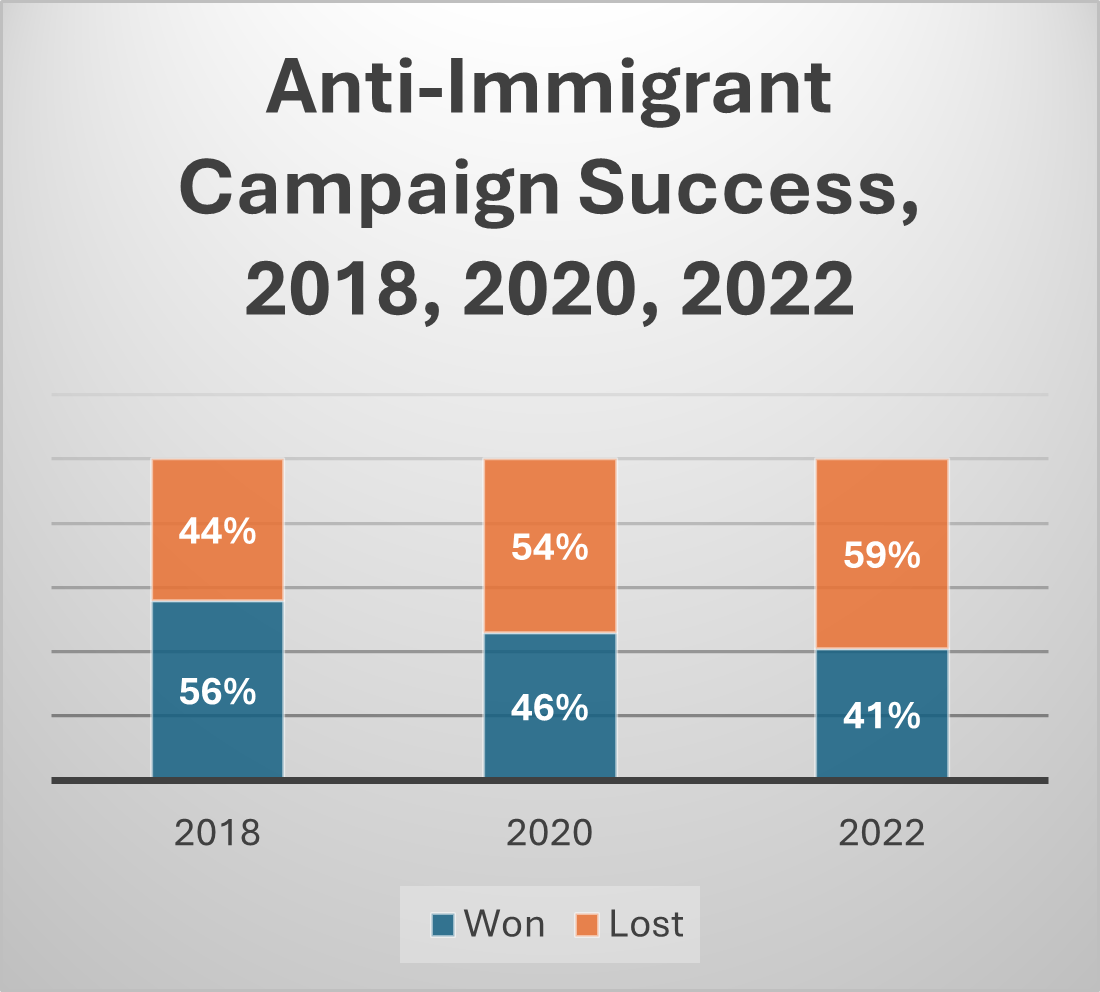
Trump’s base is quite anti-immigrant, but not Biden’s base, nor are most independent voters who will be key to winning the election in November. The Latino vote is also key. Latinos, especially Mexican and Central Americans would mostly benefit from these programs. In addition, people from Asia, Africa, Canada, and Europe, as well as their citizen families, will benefit from the measure. To clarify, the direct beneficiaries will NOT be able to vote this November, but their family members, employers, customers, and neighbors will. As anti-immigrant as Biden has become (e.g., numerical limits on asylum applications between ports of entry at the border), he will not take away Trump’s hard vote. This is a better route. The Immigration Lab’s analysis of elections since 2018 shows that being anti-immigrant does not help win elections in competitive elections and swing states.

The Executive Order on numerical caps to asylum-seeking in between ports of entry establishes a negative practical precedent where a President tries to unilaterally limit the asylum-seeking process in a situation not related to public health concerns (as was the supposed rationale for the use of Title 42 of the Code of Federal Regulations during the COVID-19 pandemic). It gives tacit bipartisan support to Trump’s campaign threat of completely ending asylum in the U.S. if elected. This executive order does not help the Biden-Harris campaign to differentiate itself from Trump on migration. Agreeing with MAGA Republicans about border arrivals being a top issue helps Republican candidates––not Democrats. It also alienates voters with undocumented family members and those who are sympathetic to those in need of asylum because they are escaping war, armed conflict, or religious or political persecution. The Executive Order on spouses and Dreamers does the opposite because it positively connects the government with many members of society.

The Border Executive Order will affect future asylum-seekers including those who are already on their way to the U.S. southern border. The public tends to equate asylum seekers arriving between ports of entry at the wall or river with people trying to enter undetected. Asylum seekers look for Border Patrol and other officials to be processed and start their legal process to request asylum. The government, therefore, knows who they are and where they are located. Some of them will be allowed in, others will be returned quickly or later deported to their countries, or asked to leave if they are refused asylum. Hopefully, they can find safety in Mexico, Colombia, Costa Rica, or other countries in the region. 

Some pundits argued that this move on limiting asylum would silence the criticisms that Biden was ‘weak’ on border security. The executive action limiting asylum-seekers was supposed to convince independent and conservative voters to vote for Biden. However, those criticisms have not ended––nor will they partly because they are political and not based on facts. Even if some conservative voters in, Montana, for example, were happy with this partial ‘border closure,’ they would probably disagree with Biden on contraception and reproductive health, taxes for billionaires, climate change, etc. Most people are not single-issue voters. Their values and position on the ‘culture wars’ framed by Republicans and the media tend to cluster into particular groups. Independents are unlikely to vote solely on perceptions about border security. Many of the people who are worried about immigration are worried about a hypothetical fear around the great replacement conspiracy theory. They may be worried about demographic changes in the short term, forgetting that immigrants in the past became integrated into the U.S. majority culture; they are doing so now and will continue in the future. The main issues on the ballot are about policy and protecting democratic institutions, not the less than 3.3 percent of residents in the country who are currently undocumented. 

Ernesto Castañeda is Director of the Center for Latin American and Latino Studies, the Immigration Lab, and the Masters in Sociology, Research, and Practice at American University in Washington, D.C. 

This piece can be reproduced completely or partially with proper attribution to its author.

New Wave of Salvadoran Immigrants in the DMV

By Hanseul Cho, Washington College of Law ’23

Based on data from the Immigration Lab’s Immigration to the DMV (DC, Maryland, and Virginia) project, there is a new wave of immigration from El Salvador, even though people from this country have sought refuge in the U.S. for decades. Despite being better educated, many Salvadoran immigrants work in lower-income, service-oriented jobs due to credential recognition issues and language barriers. Addressing integration challenges through inclusive policies for immigrants is crucial for harnessing their full potential and strengthening society.

El Salvador is similar in size to New Jersey and has a population like Tennessee. Although a relatively small country, Salvadorans are the biggest immigrant group in Washington, DC. Seventeen percent of the population in DC is immigrants, 11% of which are from El Salvador. 

Individuals from El Salvador ranked fourth in the number of refugeeslocated in the United States, and a significant number concentrated in the DMV. Although Los Angeles has the biggest Salvadoran migrant population, DC has the second largest group. Although when combined with Maryland and Virginia, the DMV has the largest Salvadoran population in the U.S.

Salvadorans rank fifth among the largest immigrant populations in the United States, behind China, India, Mexico, and the Philippines. 

Why did they choose to migrate? El Salvador experienced right-wing military regimes seizing power through rigged elections in the 1950s. The failure of land reform and political turmoil led to a civil war from 1979 to 1992, causing a 21.5% drop in GDP.

The United States justified its intervention in the Salvadorean civil war as preventing a left-wing party from taking power within the context of the Cold War. The conflict led to many refugees moving to the United States. A few of them formed gangs in Los Angeles, who were incarcerated and later deported, leading to the emergence of gangs in El Salvador, including MS-13. These gangs focused on territorial control and their violence caused some targeted people to look for safety in the United States.

Among the immigrants interviewed in the Immigration to the DMV project, 95% answered that El Salvador’s violence, climate, and economic difficulties influenced their decision to immigrate to the U.S. Our interviewees cite a bad economic situation, a serious lack of security, and corruption as the reasons they left.

Female immigrants make up a significant portion of the sample in this interview. The data indicates an increasing trend of more female migrants, which aligns with previous research. Some of the factors contributing to this include the demand for care and domestic work in the U.S. and an increased probability for women to pursue higher in the United States. A young woman who came to Washington, D.C. in 2022 mentioned that she migrated for a better chance at self-development, to study college, and to become a nurse. 

Even though the female participants in this study faced danger, including receiving contraceptive injections to avoid pregnancies during the arduous journey and threats of sexual violence, they desperately wanted to find long-term security and a chance to study.

New Generation of Salvadoran Immigrants

We interviewed Salvadoran immigrants who arrived in the U.S. fleeing the aftermath of the civil war, which they saw as a truly traumatic event. Political violence contributed to political corruption, economic failure, and widespread violence. Interviewers coming later also came looking for safety and economic opportunity.

People who arrived after 2019 are relatively proficient in English and more educated. Interviewees are from a country where only 33% of the population graduated from middle school, but 80% of the interviewees from this generation graduated middle school, and 60% graduated high school or with their GED. All of them had a better education than their parents. They had much better education and skills than their parents, but still, even though they are minors and part-timers, most still tend to work in lower-income jobs in the service sector. What causes this tendency? 

Two main challenges face this group: language barriers and lack of recognition of relevant training and job experience. These factors hinder their integration into the U.S. job market and society.

One of the main challenges that Salvadoran immigrants face is credential recognition. The skills and experiences they obtain in their home country may need to be properly evaluated or acknowledged in the United States. This includes the requirement for a GED, a U.S. high school diploma, or a U.S.-specific certificate. This can prevent immigrants from utilizing their previous experience and instead require them to start from scratch.

A 24-year-old Salvadoran man who lives in DC has been certified in forklift management in El Salvador. Another former electric technician also mentioned a similar experience. Still, those certifications needed to be recognized in the U.S., and ultimately, their professional experience was dismissed. So, in this case, the electrician became a cook even though electricians and forklift drivers are in high demand and are well-paying jobs.

This experience can lead to immigrants’ struggle with “imposter syndrome,” which negatively affects their self-image and makes it harder to derive self-esteem from their work. Furthermore, it can be argued that language barriers are a significant obstacle for immigrants to fully participate in the labor market.

The pandemic’s profound economic repercussions severely impacted El Salvador, exacerbating the country’s preexisting high crime rates. Interestingly, statistical data indicates that language barriers among Salvadoran immigrants do not immediately result in income disparities. Their incomes are quite similar when comparing Spanish-speaking immigrants who arrived recently with English-speaking immigrants who arrived in 2010 (Median is $30,000 for English speakers versus $35,000 for Spanish speakers, and the average is $36,430 versus $37,000). Most interviewees noted that their ability to speak only Spanish did not pose a significant challenge in assimilating into society. Spanish speakers might even have an advantage when seeking certain jobs.

However, English-speaking individuals tend to have a wider range of job opportunities, which can influence their assimilation and long-term settlement. While Spanish-speaking immigrants typically work in service-oriented roles, English speakers often have access to a broader spectrum of employment options, including management positions and roles in non-governmental organizations. Language proficiency plays a crucial role in the employment opportunities available to immigrants, affecting their ability to assimilate and succeed long-term.

Although immigrants from El Salvador could get jobs with the help of friends and relatives, there is a risk that the occupation will be limited to the service industry only. A Salvadoran woman in her 20s who wants to be a Spanish teacher faced challenges getting information about how to become one due to language barriers. 

In the DMV area, organizations like Northern Virginia Family Service, Maryland Multicultural Youth Centers, and DC Central Kitchen’s Culinary Job Training Program are available in multiple languages for immigrants. However, these services are decentralized and challenging for immigrants to access due to lack of time and transportation, creating barriers to utilization. In the data analyzed, almost none of the participants reported being part of a community organization, but most of them stated they were interested in learning opportunities and cultural activities.

It would be helpful to create a centralized portal that provides professional skills enhancement and digital-based social networking, integrating Salvadoran cultural influences.

It is important to acknowledge that immigrants, specifically Salvadorans, contribute to diverse cultural environments and enrich communities economically and socially. Addressing their integration challenges through inclusive policies and accessible support systems is crucial for developing a united and strong society.

Biden’s executive order to protect immigrant spouses of citizens from deportation will benefit their families and communities

by Jane Lilly López, Kristina Fullerton Rico*

President Joe Biden prepares to board Air Force One in California on June 16, 2024. Mandel Ngan/AFP via Getty Images/ Creative Commons License

Rodrigo Salazar is a man who entered the U.S. without a visa and has been living in the country without legal status ever since. Because of this, Rodrigo, who asked that we not use his or his wife’s real names in order to protect their identity, cannot advance from low-paying jobs at restaurants and car washes. 

His wife, Carmela, is a U.S. citizen, but she is also facing career limitations. Carmela doesn’t feel safe moving to a place where she could get a higher-paying job. She worries that Rodrigo’s lack of legal status would be more obvious in a city with a smaller Latino population, which would put him at risk for arrest and deportation.

The entire Salazar family, including their two children, live with the constant fear of family separation if Rodrigo is deported.

Immigrants like Rodrigo, who are living in the U.S. without legal status but are married to U.S. citizens, will now have protectionfrom deportation, President Joe Biden announced on June 18, 2024. In order to qualify, they must have arrived 10 or more years ago and be married to a U.S. citizen. Those who meet these criteria will be able to get work permits and can get on the pathway to citizenship while working and living in the U.S. legally. 

The Biden administration estimates that about 500,000 immigrant spouses of citizens will be protected from deportation with this policy change. The policy will also apply to approximately 50,000 U.S. citizens’ stepchildren who are living in the U.S. without legal immigration status.

We are migration scholars who study mixed-citizenship marriages – meaning some family members are citizens or have the legal right to stay in the U.S., while others do not – and the consequences of being undocumented. Our research shows that when one family member lacks legal immigration status in the U.S., the family as a whole assumes an undocumented status. 

When one family member cannot safely travel, work or access health careall family members suffer. The opposite is also true. When a family member is able to shift from living without legal status in the U.S. to getting legal status, the lives of the entire family improve.

A shift in immigration policy in the 1990s

Generally, having an immediate family member who is a U.S. citizen gives a foreign citizen the chance to live legally in the U.S. with permanent residency and a pathway to citizenship. 

For most of the 20th century, all spouses of U.S. citizens who met the legal standards for qualified marital relationships were able to become citizens through a relatively straightforward process, but that changed in 1996

A 1996 law called the Illegal Immigration Reform and Immigrant Responsibility Act imposed harsh penalties for people living in the U.S. without legal immigration status. One of the penalties is a 10-year “bar to re-entry” for anyone who has lived without a visa in the U.S. for one year or more. This ban goes into effect as soon as that individual leaves U.S. territory.

Technicalities create a divide

A consequence of this 1996 law was that getting a green card, which is an identity document that gives someone legal permanent residency in the country, became dependent on whether an immigrant entered – and remained in – the U.S. with or without a visa. 

This change in the law produced a stark inequality in U.S. citizens’ ability to legally sponsor their immigrant spouses for permanent residency.

If an immigrant spouse of a U.S. citizen has overstayed a visa, this person can apply for legal immigration status – through their spouse – from within the U.S. In these cases, the spouse does not have to leave U.S. territory and is not subject to the 10-year ban. 

In contrast, if a U.S. citizen’s spouse entered the U.S. without a visa or other legal permission, they must leave the country for the final step in their legal immigration application process. But when they leave the country, their 10-year ban automatically goes into effect. 

This means that although every U.S. citizen’s spouse, including those lacking legal immigration status, technically qualifies for legal permanent residency, some of them will have to spend a decade or more outside the country before they can actually get a green card.

As a result, over the past few decades, millions of immigrants who were living in the U.S. without legal permission but were married to U.S. citizens have not gotten legal immigration status

While the 10-year bar applies only to immigrants without legal status, in practice it also profoundly affects their citizen spouses, too

In these cases, citizens married to immigrants without legal permission to be in the U.S. have two difficult options. They can resign themselves to a life of fear and limitations in the U.S., including the ever-present threat of their spouse’s deportation, or they can give up living in the U.S. altogether for a decade or more.

A new U.S. citizen, originally from Mexico, poses with his family after a naturalization ceremony in November 2023 in Long Beach, Calif. Biden’s new policy will make it easier for undocumented immigrants with citizen spouses to become citizens. Mario Tama/Getty Images

The impacts of Biden’s immigration policy changes

The Biden administration has connected this new executive action on families to its recent announcement that it will heighten restrictions for seeking asylum, which scholars have called a ban on asylum.

The administration said in a press release that it both wants to “secure the border” and expand “lawful pathways to keep families together.” 

Under this new policy, immigrant spouses who entered the country without a visa before June 17, 2014, will be allowed to “parole in place,” which is similar to a policy that benefitsmilitary veterans’ immigrant spouses who lack legal immigration status in the U.S. Parole in place means that these immigrants will have authorization to work and increased protection from deportation. 

Parole in place will also allow immigrant spouses of U.S. citizens to have their immigration applications processed within the U.S., whether they arrived with or without a visa. This means they will no longer need to leave the country for 10 years or more if they entered the U.S. without a visa.

Having the legal right to work in the U.S. will allow these immigrant spouses to find jobs that better match their education and skills. Some estimates suggest that this could increase an immigrant’s wages anywhere from 14% to 40% more than what they currently earn

The executive action will also yield economic benefits for the communities where mixed-citizenship families live.

Economic analyses measuring the impact of expanding work authorization and access to citizenship predict that this will create new jobs, boost incomes across communities, increase local and federal tax revenues and encourage ongoing economic growth.

As scholars of migration, we believe that this executive action is an important step toward guaranteeing that U.S. citizens who marry immigrants do not end up experiencing negative consequences because their spouses cannot legally live, work or vote in the U.S. It will also prevent the de facto deportation of U.S. citizens alongside their noncitizen spouses.

In essence, this policy change benefits American families and protects the rights of U.S. citizens to marry the person they love, keep their families together and even live in their own country. Beyond helping families, this change will have far-reaching economic benefits for the communities – and country – where they live.

Copyleft Creative Commons. Reproduction with full attribution is possible by news media and for not-for profit and educational purposes. Minor modifications, such as not including the “About the Study” section, are permitted. 

*Jane Lilly López is an Assistant Professor of Sociology, Brigham Young University. Jane Lilly López’s research on mixed-citizenship couples has received funding from the National Science Foundation, UC MEXUS, and the Center for US-Mexican Studies.

*Kristina Fullerton Rico is a Research Fellow, Center for Racial Justice, Ford School of Public Policy, University of Michigan. Kristina Fullerton Rico’s research on the impact of long-term undocumented immigration status has received funding from the Russell Sage Foundation and Sociologists for Women in Society. 

This is reproduced from The Conversation with the authors’ permission.

https://theconversation.com/how-bidens-executive-order-to-protect-immigrant-spouses-of-citizens-from-deportation-will-benefit-their-families-and-communities-231651