Guatemala: Simmering Under the Surface

By Ricardo Barrientos*

Three people stand on a dias with Guatemalan flags in the background

New U.S. Ambassador to Guatemala Luis Arreaga is officially welcomed to the country by President Jimmy Morales. / Flickr / Creative Commons

Guatemalan President Jimmy Morales has survived the backlash against his efforts in August to shut down corruption investigations by the Attorney General and the Comisión Internacional Contra la Impunidad en Guatemala (CICIG), but tensions remain intense.  Two days after Attorney General Thelma Aldana filed papers to suspend the President’s immunity from prosecution on campaign finance corruption charges in late August, Morales declared CICIG Commissioner Iván Velásquez “persona non grata” and ordered his expulsion from the country.  (The expulsion order was blocked by the Constitutional Court.)

  • On September 13th, more than two thirds of the Congress – driven by most of Morales’s party as well as opposition members accused of corruption – voted in favor of altering the Penal Code in ways that weakened accountability for all politicians (including Morales and themselves). Two days later, after massive protests akin La Plaza, the civic movement that achieved the removal of former President Pérez Molina and most of his administration in 2015, Congress backtracked.
  • The Morales Administration tried to curtail the CICIG’s activities again in October, when the Foreign Ministry renewed the Commissioner’s visa for one year with a stern warning to “refrain from interfering in the internal affairs” of the country. The Constitutional Court again intervened, ordering the Ministry to revoke the warning.

Despite the attacks, Commissioner Velásquez and Attorney General Aldana continue their efforts.  Last week Velásquez said publicly that illicit campaign finance is “the ‘original sin’ of the system of corruption that has captured the Guatemalan state … and the distortion of the democratic model.”  He and Aldana keep scoring points: former President Pérez Molina, his vice president, Roxanna Baldetti, and two dozen others were sent to trial last week on corruption charges originally brought to light by CICIG – the now-famous Customs corruption scheme called La Línea. 

  • They’ve also presented a new corruption case, nicknamed Pandora’s Box, which links Guatemala City Mayor and former President Álvaro Arzú Irigoyen with an illicit campaign financing network, speculation, misuse of public funds, and dirty business with former “King” of the Guatemalan prison system, Byron Lima Oliva. This news re-opened old wounds over issues such as the assassination of Bishop Juan Gerardi Conedera in 1998, when Arzú was President and Lima a member of the Presidential General Staff.  Arzú has been one of Morales’s most fierce defenders, so his travails hurt the President – even if it is uncertain that the Guatemalan justice system will withstand Arzú’s counteroffensive against CICIG, the Attorney General and La Plaza.

The arrival of a new U.S. Ambassador may be contributing to a momentary drop in open political warfare between reformers and corrupt politicians.  Compared to former Ambassador Robinson, incoming Ambassador Luis Arreaga has kept a low profile on the issue.  During his confirmation hearing last July, he restated “a commitment by both governments to fight corruption and build upon the successful efforts by President Morales, CICIG, and the Attorney General to end impunity.”  Since presenting his credentials in Guatemala last month, he has held familiarization meetings with a broad array of Guatemalan leaders in the executive, legislative and judicial branches, emphasizing the themes of friendship and partnership.  Meeting with Velásquez and Aldana together, he confirmed the “U.S. commitment to their efforts to fight corruption and impunity,” according to the Embassy’s website.  Arreaga’s honeymoon – during which he has the luxury of being friends to both reformers and their corrupt targets – will endure only until CICIG uncovers more blockbuster evidence of corruption or Morales, sensing his political support sinking with his credibility, tries to capture the hearts of other vulnerable politicians to further hem in the meddlesome reformers.

November 9, 2017

*Ricardo Barrientos is a senior economist at the Central American Institute for Fiscal Studies (ICEFI).

The Anticorruption Imperative for Latin America

By Matthew Taylor*

Bar graph showing accountability in Latin America

Graphic courtesy of author. For a larger version, please click here.

Latin America’s reactions to the massive transnational scandals involving the Brazilian construction giant Odebrecht and its subsidiary Braskem are an important sign of progress in anticorruption efforts.  But across the region, courts’ reluctance to challenge elites remains a major obstacle to deeper accountability.  Brazilian, Swiss, and U.S. authorities’ announcement in December 2016 of a multibillion dollar global corruption settlement with the Brazilian firms – valued at $3.5 to 4.5 billion – was remarkable for being the largest in history.  It was also shocking for its revelations: Odebrecht admitted using a variety of elaborate subterfuges to launder bribe payments and corrupt proceeds, including by setting up a bribe department and buying an offshore bank.  Graft allowed executives to rewrite laws in their own favor, and guaranteed that the right officials were in the right place when public contracts were up for bidding.  The firms netted $3.60 for every $1 they spent on bribes in Brazil, and admitted to paying $788 million in bribes across twelve countries, including ten in Latin America.

The political salience of the charges is roughly similar in all ten Latin countries, muddying the reputations of presidents or former presidents in Argentina, Colombia, the Dominican Republic, Peru, Panama, Venezuela and, of course, Brazil.  Ministers and high-level officials have been implicated in the remaining countries: Ecuador, Guatemala, and Mexico.  Nearly one year after the settlement, it is time to ask how well law enforcement and judicial processes are resolving the allegations against these high-powered public and private sector elites.

  • In a paper forthcoming in Daedalus, I argue that accountability can be thought of as the outcome of a basic equation – A = (T + O + S) * (E – D) – combining transparency (T), defined in its most essential sense as public access to information about the government’s work; oversight (O), meaning that government functions are susceptible to surveillance that gives public or private agents the right to intensively evaluate the government’s performance; and sanction (S), effectively punishing wrongdoing and establishing societal norms to their rightful place. These are tempered by institutional effectiveness (E) – understood as the outcome of state capacity, relevant laws and procedures, and citizen engagement – and political dominance (D), which diminishes the incentives for active oversight or energetic sanction.  The graph above uses a combination of data points from the World Justice Project to measure each of the five variables.
  • The comparison yields mixed findings. On average, the nations implicated in the Odebrecht settlement do quite well on transparency, effectiveness, and political dominance – the outcome of a generation of democratic rule (with Venezuela being the obvious outlier).  But all ten countries perform comparatively poorly when it comes to oversight, and abysmally when the criterion is sanction.  This does not bode well for accountability, especially if we consider that among the Odebrecht Latin Ten, the highest-scoring country on the sanction criteria is Argentina, whose score is still below the middle-income country average.  In Brazil, where trial courts have led the way in imposing sanctions on business elites, political leaders are nonetheless protected against meaningful sanctions by an arcane system of privileged standing in the high courts.

Latin American judicial systems – long rigged to protect local economic and political elites – remain the principal obstacle to accountability.  The Odebrecht settlement signaled that a new day has arrived: new international norms and law enforcement across multiple jurisdictions are likely to continue to upset the cozy arrangements that have protected the region’s elites from corruption revelations for decades.  But true accountability will only come when local courts and prosecutors are empowered to effectively punish corrupt elites.  That implies changes in legal procedure, new laws, and most importantly, political will.  Perhaps the Odebrecht case will galvanize domestic public opinion and mobilize policymakers about the need to improve local justice systems.  The enormous costs of corruption revealed by the Odebrecht settlement suggest that change cannot come soon enough.

November 6, 2017

* Matthew Taylor is Associate Professor at the School of International Service at American University.  His forthcoming article in Daedalus is entitled “Getting to Accountability: A Framework for Planning and Implementing Anticorruption Strategies.”

Chile: Election Likely to Show Big Political Shifts

By Kenneth Roberts and Eduardo Silva*

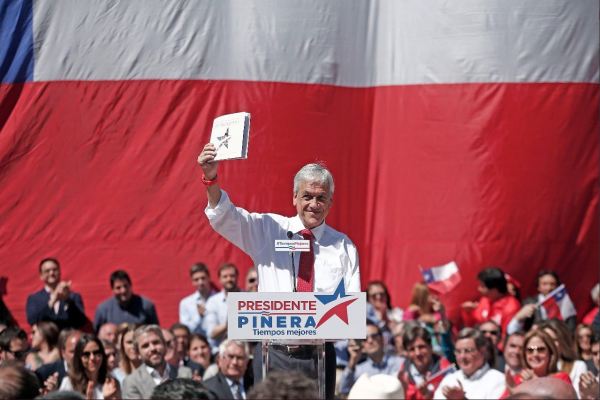
A presidential candidate stands in front of a crowd and a large Chilean flag

Ex-president Sebastián Piñera addresses his supporters at a campaign rally last month. / Twitter: @sebastianpinera

Chilean politics in the run-up to national presidential and legislative elections on November 19 have revealed that – within major lines of continuity – significant changes in the political alignments that have structured the country’s democracy since the end of the Pinochet dictatorship in 1990 are taking place.

  • Continuity is most pronounced on the conservative side of the political spectrum, where the two main conservative parties, Renovación Nacional (RN) and Unión Demócrata Independiente (UDI), have joined forces with smaller parties to sponsor the presidential candidacy of billionaire business mogul and former President Sebastián Piñera. In public opinion surveys of voter intentions, Piñera has maintained a healthy lead over a collection of centrist and leftist candidates.  He appears likely to come out on top in the first round of voting – and significant abstention (if fewer than 5.5 million registered voters vote) could push him over the top.  If he is forced into a run-off, the final outcome will rest heavily on the ability of his opponents in the divided center-left bloc to coalesce forces.
  • The center-left space is where most change is concentrated. The core parties in the Nueva Mayoría coalition that backed incumbent Socialist President Michelle Bachelet have won five of Chile’s six presidential elections since the transition to democracy in 1990.  For the first time, however, the main centrist party, the Partido Demócrata Cristiano (PDC), has opted out of the alliance to run its own candidate, Senator Carolina Goic.  With Goic languishing in the polls, however, the primary challengers to Piñera are located further to the left, including the Nueva Mayoría’s favorite, Senator Alejandro Guillier.  Although early speculation pegged him as an outsider, he is now firmly identified with the moderate reformist left and represents continuity with the current government.

A new left-leaning group, the Frente Amplio, has nominated Beatriz Sánchez, an independent journalist.  She arguably represents a larger challenge to the status quo, as her candidacy gives political expression to social actors who are sharply critical of Chile’s political establishment and the neoliberal economic model.  Even though the Broad Front’s electoral strength is untested, it brings together a number of small parties alienated from Nueva Mayoría and inspired by Chile’s massive student protest movement and other activist networks that have mobilized around labor, environmental, and pension reform issues in recent years.  Sánchez favors more redistributive taxation and greater state intervention in strategic enterprises and utilities, as well as in water property rights and forestry where social conflict has been high.  She is also for replacing the private pensions system with a mixed public-private one and getting private banking out of the student loan business.

This election will likely show that the broad center-left coalition that dominated Chilean politics since the 1990 transition has effectively splintered, with the Christian Democrats seeking to carve out an independent space in the political center and a movement-based alternative emerging on the mainstream parties’ left flank.  Uniting such disparate forces to compete against Piñera in a run-off election, should one be required, will clearly be a formidable task.  Nueva Mayoría candidate Alejandro Guillier, considered the strongest run-off candidate to take on Piñera, is already in conversation with Christian Democrats and Sánchez’s Frente Amplio.  In a run-off, he is thought likely to get around 60 percent of the Christian Democratic vote, with more conservative Christian Democrats voting for Piñera.  His appeal to Frente Amplio voters could suffer because of their unhappiness with Nueva Mayoría.

  •  The specter of high abstention looms large for second-round voting, too. President Bachelet’s low approval ratings for most of her second term in office, although recently reversed, signaled low enthusiasm despite her successful pushing through a series of major reforms, including a reform of the electoral law to enhance proportional representation, a tax reform to increase revenues for social programs, the initiation of free university education for low-income students, and a much-debated law to legalize abortions in limited circumstances.  Last, but not least, mainstream parties across the board have been weakened by a series of corruption and campaign finance scandals, leaving many citizens alienated from parties.

November 2, 2017

*Eduardo Silva is Professor of Political Science at Tulane University, and Kenneth Roberts is Professor of Government at Cornell University.

The “Invisibility Bargain” Constrains Migrants’ Identities and Rights

By Jeffrey D. Pugh*

Colombian refugees carry groceries

Colombian migrants in Ecuador carry home groceries. / Michelle Snow / USAID / Flickr / Creative Commons

Migrants win tolerance for their presence in host countries by striking an “invisibility bargain” with local citizens – contributing labor but settling for constraints on their identities and political participation – that slows their integration and leaves them vulnerable to discrimination and violence.  Through surveys of Colombians forced into Ecuador by conflict and violence, I have found that migrants feel pressure to conform to host communities’ expectations of their economic contribution and political and social “invisibility.”  (Full text of my recent article in International Migration Review is here.)  Migrants whose visible characteristics and practices violate norms that the host society deems to be unacceptable or who engage in overt political claim-making on the state often risk sparking a nativist backlash.  In response, Colombian migrants have employed a range of survival strategies:

  • Many who seek to integrate into Ecuadorian society sacrifice important elements of their Colombian identity, making a conscious effort to “unlearn” their accent, speak more softly and slowly, and use diminutive forms of speech to fit in better with Ecuadorians. Those who blend in better tend to have an easier time finding a job, getting housing, and building constructive relationships with Ecuadorians.
  • Others, particularly racial minority migrants, often choose to avoid contact with Ecuadorians, but this strategy of self-isolation removes them from potential spaces where they can negotiate access to rights, protection, and resources. Afro-Colombians are less likely than mestizo Colombians, for instance, to live in neighborhoods with mostly Ecuadorian neighbors.  As a result, they are less resilient against attacks or discriminatory behavior because they lack a support network in the host society.
  • Yet others employ a strategy that emphasizes the similarity between the experiences of Ecuadorian emigrants to Europe and Colombian immigrants in Ecuador. They propose a boundary-blurring strategy recognizing migrant rights everywhere and legitimizing migrants’ political participation in countries of both origin and residence.

The rhetoric of “universal citizenship” of former Ecuadorian President Correa (2007-2017) – a concept in which every person has a right to migrate and should therefore have access to basic rights – appeared to offer escape from the invisibility bargain and its consequences.  The 2008 Ecuadorian Constitution prohibited discrimination based on migration status and guaranteed refugees many of the same rights as Ecuadorians.  This “open borders” rhetoric promised a commitment to human security above national security and promoted a reciprocal protection to Ecuador’s large diaspora in Spain and the United States.  Crafted to undergird politically beneficial policies, however, Correa’s approach faced political constraints and was undercut by the populist nature of his government style – and made only limited progress at the level of implementation.  Surveys show that the legal distinction between refugees and other migrants is still lost in practice in Ecuador.  The formal institutions of democratic states fail to provide security for everyone living in their territory in their responses to constituent pressure to scapegoat migrants.

In the absence of concrete progress toward concepts like universal citizenship, migrants will continue to face the trade-off between maintaining their identities and customs and successfully integrating into host communities and gaining political rights and participation.  Although informal mechanisms of political participation pale in comparison to the exercise of full citizen rights, they can be important sources of protection and assistance.  The evidence from Ecuador shows that the frequency and quality of interaction between Ecuadorians and Colombians seem to influence their attitudes toward one another.  Migrants reporting daily interaction with Ecuadorians had nearly double the level of positive perceptions of the native population compared to those who interacted less frequently – and broader acceptance by local communities at least offers a glimmer of hope of liberating other migrants from the pain of the invisibility bargain in the future.

 October 25, 2017

*Jeffrey D. Pugh is an Assistant Professor of conflict resolution at the University of Massachusetts, Boston, and executive director of the Center for Mediation, Peace, and Resolution Conflict (CEMPROC).

And the Winner is… Trump in Latin America

By Nicolás Comini*

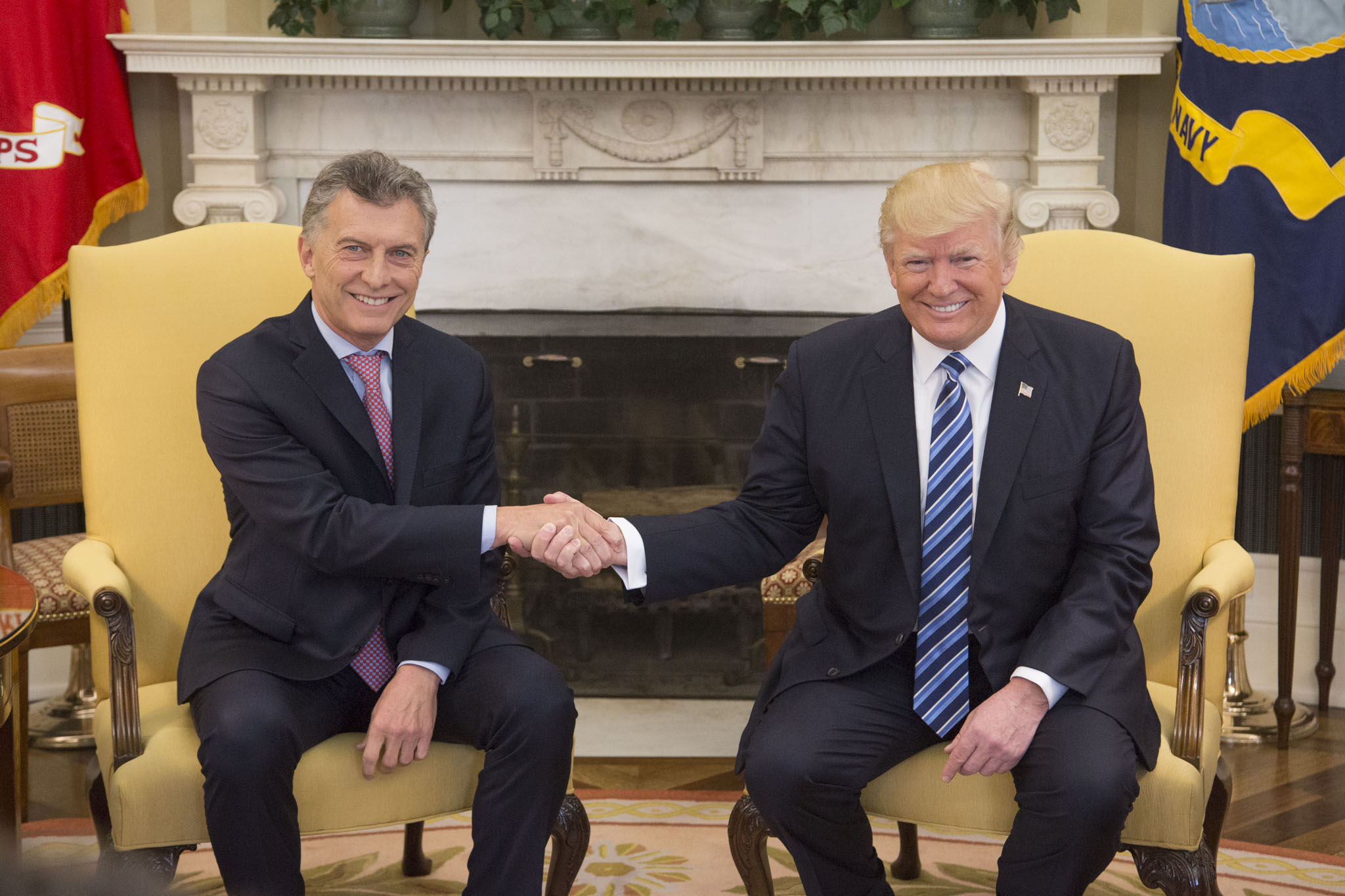
Donald_Trump_and_Mauricio_Macri_in_the_Oval_Office,_April_27,_2017

U.S. President Trump and Argentine President Macri meet in the Oval Office. / Official White House Photo by Shealah Craighead / Wikimedia / Creative Commons

Criticism of U.S. President Donald Trump’s policies toward Latin America ranges from mild to furious in the region and among many U.S. Latin America watchers, but that anger is not likely to drive greater regional unity and demands for a more balanced relationship.  Trump’s rhetoric – emphasizing sovereignty, nationalism, and protectionism – have long been popular concepts in many countries of the region.  During Latin America’s recent “turn to the left,” for example, political leaders embraced a developmentalist emphasis on using tariffs and non-tariff trade barriers to give domestic industries an advantage in national economic expansion strategies.  But the U.S. President’s statements have generally infuriated not only the left as reflecting bias on an array of issues, such as immigration, but also the right.

  • Trump’s policies contradict the prescriptions that Washington has been advocating – and most conservative politicians have embraced – for Latin America for many years. Those prescriptions have emphasized free trade but touched on other issues as well, such as the shift (symbolic and material) of resources from traditional national defense to the “war on drugs.”  Trump’s “America First” approach undercuts his natural allies in Argentina, Brazil, Mexico, and elsewhere.  It has also given their leftist opponents a sense of legitimization of their anti-Americanism speeches, something that is surging also because of Washington’s new policies toward Cuba.
  • The U.S. summary abandonment of the Trans-Pacific Partnership (TPP), conservatives’ last great hope for deeper trade integration with the United States, left them angry. According to the ECLAC, 73 percent of all FDI in Latin America in 2016 came from the United States (20 percent) and the European Union (53 percent).  Individuals with strong anti-Communist credentials in Colombia, Chile, and Peru are all flirting with joining China’s Regional Comprehensive Economic Partnership (RCEP).

Regional organizations show no sign of providing leadership in how to respond to U.S. policy.  UNASUR is fading rapidly, in part, because it was labeled by the new conservative governments as too Bolivarian and anti-American.  Something similar is happening with the CELAC.  MERCOSUR is struggling, in part, because of the political tumult in Brazil.  Indeed, most governments are trying to remain friends with Washington, prioritizing bilateral agendas in detriment of regional (multilateral) institutions and mechanisms.

The surge in resentment toward Washington – within and among Latin American countries – is unlikely to lead to increased regional unity.  Internally, the left and right may agree that Trump is harming their interests, but their reasons are different and prescriptions for dealing with it are far apart.  On a regional basis as well, the current context accelerates the atomization of the region – and threatens to expand the bargaining power of the great powers of the United States, China, Germany, or Israel.  Although China is making inroads, in the end the United States has, and will retain, the greatest influence in Latin America – and the lack of efficient regional decision-making will prolong that situation.  Latin American fragmentation will create an image of acquiescence – and President Trump will think he is not doing so badly in the region.

October 18, 2017

* Nicolás Comini is Director of the Bachelor and Master Programs in International Relations at the Universidad del Salvador (Buenos Aires) and Professor at the New York University-Buenos Aires.  He was Research Fellow at CLALS.

Laudato Si:  Support for the Indigenous of the Amazon Benefits Us All

By Birgit Weiler*

Group of men and women stand behind a banner

Members of the Awajún community mobilize in Peru. / Andina Archivo / Creative Commons

Issuing his Laudato Si encyclical in 2015, Pope Francis put himself on the side of Latin America’s original peoples in protecting the environment in their ancestral lands, in what will be a long struggle to counteract climate change and safeguard the earth.  Laudato Si emphasized that different religions, including the indigenous peoples’, can make “rich contributions … towards an integral ecology.”  Francis wrote:  “Given the complexity of the ecological crisis and its multiple causes, we need to realize that the solutions will not emerge from just one way of interpreting and transforming reality.  Respect must also be shown for the various cultural riches of different peoples … their interior life and spirituality.”   He spoke of their wisdom especially in dealing with the earth and all the living beings.

  • For the Awajún and Wampis in Amazonas Department in northern Peru, their cosmovisión (world view) and traditional religion are an important source of inspiration and endurance in their struggle for safeguarding their living space. In the integral vision of the world they share with other indigenous peoples, all living beings – not only human beings – are considered agents within a single big energy.  Everything is connected – similar to the “integral ecology” mentioned in Laudato Si.
  • Highlighting the urgent need of a “bold cultural revolution,” the encyclical implicitly embraces the indigenous people’s concept of “Buen Vivir,” an alternative way of life based on respect for the earth and on living in relationships of interconnectedness and interdependence. This demands a change in lifestyle reducing significantly our negative impact on our planet; caring for the integrity of the ecosystems and of human life; and a real change in our way of understanding and practicing economy, “progress,” and “development.”

Governments have been slow to respond to these calls – which threaten to disrupt longstanding arrangements between the extraction industry, regulators, and legislators – but there have been some significant public signs of progress.  Last March, for example, the Fourth Constitutional Court in Lima declared that the Awajún and Wampis have the right to approve oil exploration in their ancestral lands, particularly an area known as “Lot 116.”  The court ordered exploration activities to cease and withdraw from the region until full consultation with local indigenous groups was completed.  In another case, in the Iquitos–Pucallpa region, a court ordered that the state consult with respect the indigenous people’s right to a full consultation, forcing the government to step back and begin the process anew.

 Despite this halting progress, the environment and cultures that Laudato Si reveres are under constant and, in some cases, worsening threat.  Illegal deforestation of precious tropical lumber is reaching alarming levels.  An explosion in new oil palm farms, the construction of hydroelectric power stations, and the expansion of roads and other infrastructure to facilitate extractive industries are all inflicting permanent damage.  Scientists have repeatedly pointed out that the ecosystems of the Amazon won’t be able to bear much longer the devastating impact of these activities.  As the Pope wrote, loss of the region’s tropical forests – the biggest lung of our world – and the vanquishing of peoples like the Awajún and Wampis would be a tragic loss for us all.

October 11, 2017

* Birgit Weiler is Director of the Area of Research at the University Antonio Ruiz de Montoya in Lima; collaborates closely with the Vicariate of Jaén (Catholic Church) and with the Awajún and Wampis; and contributes to CLALS’s project on religion and climate change.

Brazil: Surge in Divisive Politics

By Marcus Vinicius Rossi da Rocha*

Two politicians debate

Brazilian right-wing politician Jair Bolsonaro disparages fellow politician Maria do Rosário during a debate on violence against women. / Marcelo Camargo / Agência Brasil / Wikimedia / Creative Commons

Political tumult, constant corruption scandals, and widespread popular loss of confidence in political institutions have given rise to divisive right-wing movements that, although not poised to win office in the 2018 elections, are laying the groundwork to have an impact on Brazilian politics in coming years.  Brazil will elect a president and both houses of Congress in October 2018, after five years of economic crisis (3.6 percent contraction in 2016); corruption scandals (President Michel Temer is still under investigation in the Lava Jato probe); low confidence in government (Temer has 3 percent approval); and political instability.  Many observers believe Brazilian democracy could be in peril.

Two factors in particular – the economic decline and the odor of taint surrounding Temer and the political class – are fueling a surge in right-wing and populist politics.  Conservative and market-oriented agendas are, unsurprisingly, gaining momentum, but also are challenges to the country’s three decades of democracy, including the defense of torture and military dictatorship.  The surge is seen in three main areas:

  • The Free Brazil Movement (Movimento Brasil Livre, MBL) is a youth libertarian movement born in early 2014 following the mass street protests of 2013, which its leaders helped organize. While promoting free speech, less government, individual liberty, and market-oriented reforms, its agenda emphasizes moral issues as an electoral strategy.  It mobilizes protesters against left-leaning politicians and gay art exhibits and succeeded in shutting one event down on spurious grounds.
  • Jair Bolsonaro, a former army captain turned lawmaker, is famous for his defense of torture and the death penalty, his opposition to human rights protections, and his praise for the military dictatorship that ruled Brazil in 1964-85. Proud of his lack of political correctness, he compares himself to U.S. President Donald Trump, and he casts himself as engaged in a moral struggle to save the nation.  He promises to withdraw Brazil from international human rights agreements; opposes gay marriage; and wants to adopt the death penalty and loosen gun laws.  In a speech on the House floor one time, he told a female legislator and human rights defender, “I do not rape you because you are not worth it.” He was reprimanded by the courts for this and other statements, but a leading public opinion institute Datafolha shows him with almost 20 percent of popular support.
  • A handful of senior active-duty and reservist military officers also seem to be crossing the line with greater frequency, openly speaking about “constitutional military intervention.” These officers espouse a highly disputed interpretation of Article 142 of the Constitution – which states that the “Armed Forces aims … to defend the homeland, to assure the constitutional powers, and, by initiative of any of these powers, to assure law and order” – to argue that the Constitution gives the Armed Forces authorization to intervene in politics.  At an event a few weeks ago, General Antonio Hamilton Mourão said that if the judiciary does not fix the government’s corruption problem, the Armed Forces could.  The high command remained silent.

Few analysts believe that the 2018 elections will be obstructed in any way, but the years of crisis, compounded by the polarizing rhetoric and activities of frustrated conservatives, will put checks and balances to test.  A military coup is highly unlikely – the Army is not eager to run the state again – but the apparent politicization of institutions sworn to defend the rule of law could cause others to flout the Constitution.  Congressman Bolsonaro does not appear likely to score big in 2018.  His party is small, but his popularity could very well give a boost to similarly minded groups poised to gain ground in Congress. This could lead to more than a continued shift toward the interests of construction firms, financial system, and agriculture sector that support them; it could portend a dismantling of decades of work to build democratic institutions; end torture and police brutality; and protect citizens’ rights to choice, freedom from discrimination based on sex or sexual orientation; pro-choice laws, gay rights, and indigenous rights.  Three decades of democracy won’t be reversed easily, but the next several years call for healing, not a new politics of division.

 October 5, 2017

* Marcus Rocha is a Ph.D. Candidate in Public Policy at the Federal University of Rio Grande do Sul (Brazil) and a CLALS Research Fellow specializing in the Brazilian executive branch and corruption in municipalities.

U.S.-Cuba: New Challenge to Normalization

By Fulton Armstrong

Tillerson US embassy in Cuba

U.S. Secretary of State Rex Tillerson addresses State Department employees. / U.S. Embassy in Cuba / Creative Commons

The Trump Administration’s decision to sharply reduce staff at the U.S. embassy in Havana and to warn U.S. travelers to avoid travel to Cuba is a major blow to U.S.-Cuba normalization – and a sign that Washington’s policy is once again dictated by politics rather than reality.  Announcing the measures, Secretary of State Rex Tillerson last Friday admitted that “investigators have been unable to determine who is responsible or what is causing these attacks,” but he still said that more than half of U.S. diplomats will be withdrawn “until the Government of Cuba can ensure [their] safety.”  Washington is also suspending the processing of tens of thousands of visas for Cubans seeking to visit or migrate to the United States.  Most travel to the island by U.S. officials will also cease; bilateral meetings will continue only in U.S. territory.

  • As the State Department itself has admitted, the “sonic attacks” – which have not been proven to be either sonic or attacks – remain a total mystery. No agency of the U.S. or Cuban governments is aware of a technology that fits the victims’ description of what they experienced, and non-government scientists have been equally puzzled.  Doctors analyzing the victims’ symptoms (headaches, hearing loss, memory loss, confusion) do not see a common cause.  Moreover, no one has been able to ascertain that the incidents amount to deliberate, premeditated attacks.  No one has produced any evidence to support speculation that “rogue” elements of the Cuban government or a third country even possess, let alone have used these unknown technologies.  President Trump said on Friday, “Some very bad things happened in Cuba.  They did some bad things” – without saying who “they” are.
  • Leaks over the weekend that the diplomats suffering the worst symptoms have been U.S. intelligence officers seem intended to rationalize allegations of targeted attacks. But the Associated Press, which reported the leaks and other key aspects of the story, noted with irony: “Almost nothing about what has transpired in Havana is perfectly clear.  But this is Cuba.”

Even though none of the more than 600,000 U.S. travelers to the island each year has reported any of the symptoms experienced by the U.S. diplomats, Washington also issued a statement that “warns U.S. citizens not to travel to Cuba.”  The State Department has provided no evidence that visitors are in danger.  Travel warnings are a powerful political signal of low confidence in host governments and can have a huge impact on local businesses – including many thousands in Cuba’s nascent private sector.

The Administration deserves credit for resisting the temptation to blame the Cubans for the attacks, but it fell prey to its own mindset about “sonic attacks” and – under political pressure –got stuck reacting to an incredible scenario with a counterproductive set of measures.  While the State Department was right to admit its ignorance, a handful of legislators in Washington – a small group that had forcefully opposed normalization all along – filled the information void and corralled Tillerson into a policy prescription that undoes mainstays of the bilateral relationship, including visas, reciprocal meetings in each capital, and other cooperation that requires a robust presence in Havana.  By trying to scare away travelers, moreover, Tillerson threatens to take crucial business away from private entrepreneurs.

  •  The scope of the Administration’s measures – including discouraging non-governmental travel – contradict the leaks suggesting that the incidents are part of a spy war between the two countries. A full epidemiological study about everything the victims had in common – food, drink, habits, and workspaces within the embassy building itself – conducted months ago, when evidence and memories were fresh, would have helped inform these decisions.  To accuse Cuba now, almost a year after the first incident, of failing to meet Vienna Convention obligations to protect diplomats rings hollow since the United States has accepted the sincerity of Havana’s efforts – from President Raúl Castro down to the working-level experts – to resolve the mystery and address its causes.  Having achieved the practical shutdown of the U.S. Embassy in Havana, opponents of normalization are now demanding total closure of Cuba’s embassy in Washington.  Politics is once again in danger of becoming the main driver of U.S.-Cuba bilateral relations.

October 2, 2017

The Caribbean After the Hurricanes: What Path for Recovery?

By Daniel P. Erikson*

A group of man clear debris

Residents and volunteers begin clearing debris from Hurricane Irma on St. Maarten. / NLRC / Flickr / Creative Commons

This fall’s historically fierce hurricane season reminds us once again that the Caribbean remains extraordinarily vulnerable to natural disasters – especially in the lucrative tourist sectors – and needs to move beyond tourism.  The services sector in the Caribbean may serve as an important source of economic growth, but only if the region begins to take advantage of opportunities in banking and financial services; call centers and information and communication technology; off-shore education and health services; and transportation.

  • While the impact of Harvey, Irma, Jose, Katia, and Maria in U.S. states like Texas and Florida has received wide attention, the small island nations of the Caribbean have also been left to contend with extensive damage to infrastructure and loss of life that has resulted in thousands of newly homeless and dozens of deaths. Irma struck the tiny nation of Antigua and Barbuda as a peak-strength Category 5 storm, and Prime Minister Gaston Browne estimated that 95 percent of the properties on the smaller island of Barbuda were destroyed.  Irma then raked across the U.K. territories of Anguilla, the British Virgin Islands, and the Turks and Caicos, the French territories of St. Bart’s, Guadeloupe and St. Martin (including the Dutch half of St. Maarten).  Cuba also suffered as the storm swept across its northern coast and ravaged the third-largest city, Camaguey.  Then, just as Hurricanes Jose and Katia rattled the islands only to retreat as minor threats, Hurricane Maria strengthened into a Category 4 storm that ravaged Dominica and the U.S. territory of Puerto Rico with winds exceeding 150 mph, devastating local infrastructure and knocking out the power grid, possibly for months to come.

Clearly, the focus of the near-term will be relief and recovery efforts, as these small islands seek to cope with the enormous damage.  But rebuilding a stronger and more diversified service sector may offer the best path towards a sustainable and much-deserved recovery for the people of the region.  Several years ago, the Centre for International Governance and Innovation in Waterloo, Canada, asked me to assess what steps the Caribbean islands could take to diversify their economies away from an over-reliance on tourism to create a more sustainable future.  The lessons of that study, Beyond Tourism: The Future of the Service Industry in the Caribbean, remain relevant today.  The bottom line:  Expanding the competitiveness of the Caribbean services sector beyond tourism is a way to draw on regional strengths and broaden the basis for economic growth.

The hurricanes have dealt a tragic and costly blow to the Caribbean, but the reconstruction efforts may also provide an opportunity to build back stronger and more resilient economies.  While the damage is still being assessed, it is already clear that the lives of tens of thousands of people who live on these islands will never be the same and that property damage will extend into the billions.  The recent damage to Puerto Rico from Hurricane Maria will likely jolt those figures substantially higher, while some of the smaller, remote islands hurt by earlier storms may be uninhabitable for weeks to come.  French President Emmanuel Macron and the King of the Netherlands traveled to the region to show solidarity with their afflicted citizens, while the United States deployed teams to assist in disaster relief and deployed over $1 million in aid to the smaller affected islands – and is beginning to launch a major relief effort in Puerto Rico as well.  Once the challenges of treating the injured and assisting with basic human needs are met, much of the early reconstruction effort is likely to focus on rebuilding tourist infrastructure.  This will be necessary, but not sufficient, to create a full recovery.  Caribbean leaders have increasingly recognized that developing globally competitive services industries offers one way to retain high-skilled workers and mitigate the risk of external shocks to the tourist sector. During the Obama administration, Vice President Biden made a major effort to deepen U.S. investments in the Caribbean’s energy sector, and new sources of financing through the Inter-American Development Bank, the Overseas Private Investment Corporation, and private U.S. companies could similarly lead to a major push to modernize services-related infrastructure throughout the islands.  Future storms cannot be prevented, but a more diversified services sector will help the islands to navigate the challenge of reconstruction more effectively.

September 28, 2017

* Daniel P. Erikson is managing director at Blue Star Strategies in Washington, DC, and previously served as a White House and State Department advisor on Latin America during the Obama Administration.

Colombia: Did Pope Francis Sway Opponents of Peace Accord?

By Ana Isabel Rodríguez Iglesias*

Composite image of Santos, Uribe, and Pope Francis

Ex-president Álvaro Uribe (bottom left) continues to be at odds with current president Juan Manuel Santos (top left) over the government’s peace accords, despite Pope Francis’s call for putting peace above politics. / Santos: UNESCO/ Christelle ALIX / Flickr / Uribe: Centro Democrático / Flickr / Pope Francis: Mazur / Catholic News / Flickr / All: Modified / Creative Commons

Pope Francis’s recent visit to Colombia included a powerful message to the people, but overcoming the country’s deep polarization and high level of uncertainty around implementation of the government’s peace accords with the FARC will remain difficult as national elections next May 2018 approach.  Massive crowds assembled peacefully and homicides plummeted during his visit, and he is credited with facilitating a ceasefire between the government and the country’s other leftist insurgency, the Ejército de Liberación Nacional (ELN), in force from October 1 to January 12.  The Pontiff’s reflections about peace, forgiveness, and reconciliation were seen in Colombia not only as a prayer but also as a political message to both the Catholic Church hierarchy and the country’s political leaders to unify behind a commitment to peace.

  • Divisions within the Church over the peace process will be difficult to heal. While many clergy have allied the political elite and its more conservative views about the FARC guerrilla movement, many others, such as the Archbishop of Cali, have supported approval of the resulting accords and their implementation.  The Conference of Bishops encouraged participation in last December’s plebiscite, but has remained neutral – despite the Pope’s prodding.  When President Santos and former President Uribe, a strident opponent of the accords, met with Francis in the Vatican in December, the Pope pushed hard for them to find common ground, but they left the meeting without white smoke emerging from the chimney.

Not surprisingly, Santos and Uribe don’t appear any closer to agreement after the Pope’s visit either.  Santos deeply thanked the Pope for his support of the peace process and after his departure, echoed the Pope’s main call to “to build bridges,” to “deactivate hatred,” to renounce vengeance, and to “reconcile ourselves in a fraternal encounter.”  Francis didn’t meet with Uribe (and there’s no indication that the former President requested a meeting) and spent his time in Antioquia meeting with the poor.  Uribe and his Centro Democrático party reiterated their discrepancies with the agreement.  In a public letter to the Pope, the former president said he had never opposed peace, but he forcefully rejected the political character of the war and, claiming the FARC was merely a narcoterrorist organization, and he denied their eligibility to participate in Colombian democracy.  “The legal authorization they have received to spend illicit money on their political activities, and other points, constitute incentives for crime,” he said.  Parties aligned with Uribe in opposition to the accords – Cambio Radical and the Conservative Party – have also tried to delink the Pope’s message about peace from the peace agreement itself.  They advocate a new peace agreement.

Even though the Pope hasn’t helped the two presidents mend fences yet, his concept of peace has resonated with the country’s social and political movements, ethnic groups, victims, and intellectuals.  A nascent coalition of left-leaning minority parties, called Ni-Ni’s, could give voice and organization to them and – perhaps in the future – bring some pressure to bear on opponents of the accords to come toward the middle.  Congressional elections next March and Presidential elections two months later guarantee that implementation of the peace accords will remain front and center in Colombian politics.  The national debate may be politically satisfying to some, but it will essentially preclude the sort of renegotiation that Uribe’s forces demand while also forcing delays in important national reconciliation measures.  Even if he wanted to, Santos doesn’t have the authority to jettison one of the measures most neuralgic for his opponents – the idea that a Truth Commission will bring to justice military officers accused of abuses during Uribe’s presidency and politicians linked to paramilitary forces – and, even if he could, it would not guarantee a strong enough consensus to plow ahead with the peace plan.  Pope Francis may have sown the mustard seeds of a popular movement to press conservatives to compromise, but many challenges remain.

 September 26, 2017

* Ana Isabel Rodríguez Iglesias is a Ph.D. Candidate in International Politics and Conflict Studies at the University of Coimbra (Portugal) and a CLALS Fellow.