Venezuela: Implications of the Opposition’s Landslide Victory

By Michael McCarthy*

Venezuela Elections 2015

Photo Credits: Nicolas Raymond and 2 dvx ve (modified) / Flickr and Wikimedia Commons, respectively / Creative Commons

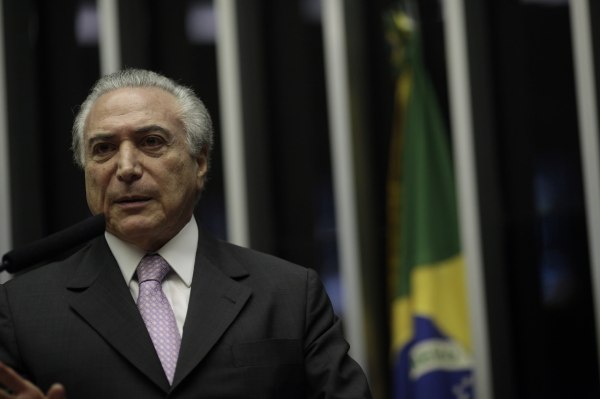
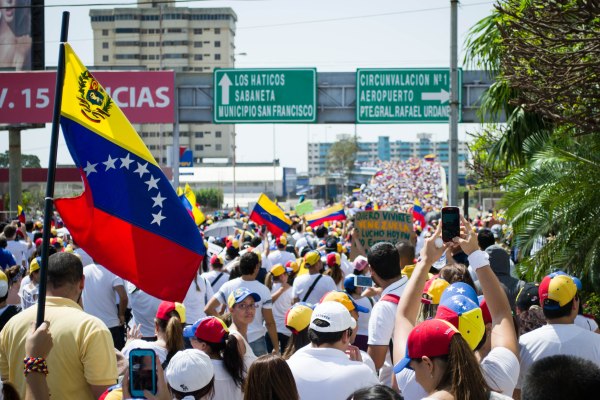
Venezuela is just beginning to feel the shock waves of the opposition’s landslide victory and humbling defeat of President Nicolás Maduro’s PSUV.  Riding a wave of discontent with the Maduro government’s management of the economy and political repression, the opposition Mesa de Unidad (MUD) coalition won at least 112 seats in the 167-seat parliament, giving it a commanding two-thirds majority.  The MUD won the popular vote 56-41.  The political scenarios are wide open.  Some preliminary analytical judgments follow:

  • Maduro has accepted the election results, but serious questions remain whether he and his advisors will engage in the give-and-take necessary to make divided government work. He is restructuring his cabinet and has called on supporters to “relaunch” the Bolivarian Revolution.  He says he will strenuously oppose any amnesty law for imprisoned opposition members – a top MUD priority – and that he will “go to combat” if the opposition tries to remove him from office.
  • Despite its historic achievement, the opposition will face challenges to build sustainable unity. The MUD is a heterogeneous electoral alliance, and the hardline and moderate factions are likely to disagree about strategy – whether the time is ripe for pressing for Maduro’s resignation or for cultivating support from disaffected chavistas.
    • The opposition faces the challenge of demonstrating a commitment to what they have criticized most about chavismo – democratic inclusion.  If they want to put Venezuela back together, for example, the MUD will have to decide how to provide PSUV officials guarantees of political inclusion.
    • Passing an amnesty law for political prisoners and addressing the dire economic situation are high on the MUD’s unified agenda – and probably will remain part of a consensus platform.
    • Less clear is how aggressively the opposition will push its agenda from the National Assembly.  Most in the MUD are more closely aligned with the moderate strategy of former presidential candidate Henrique Capriles, but others will want to push harder.  They may try to remove chavista-appointed Supreme Court judges likely to oppose Constitutional changes that would curtail Maduro’s powers.
    • The forced resignation of Guatemalan President Pérez Molina and the recent opening of an impeachment process against Brazilian President Dilma Rousseff may embolden similar initiatives in Venezuela.
  • The country’s tarnished election system functioned better than many critics had predicted. The 74 percent voter turnout was eight points higher than the last legislative elections.  Reports of violence and irregularities were few.  The Armed Forces provided effective security at the polls, and behaved in a manner that suggests an interest in defending their institutional reputation.  The National Electoral Council (CNE) disappointed many by issuing an unprecedented call for voting centers to remain open even if there were no voters in line, and for delaying reporting the final results, but the voting process was clean enough.
  • Outside Venezuela, chavismo’s loss may be a setback from some leftists – but a relief for most others. Maduro’s defeat is a potential liberation from the albatross that the disastrous Venezuelan regime has become.  For most left-leaning leaders, chavismo had become a deeply flawed project that has, for several years, been toxic.
  • For anti-chavistas outside Venezuela (including some in Washington), the election results indicate that the way to overcome the catastrophe over which Maduro presided was not to threaten the regime with sanctions and encourage extremists in the opposition, but instead to push for the election to take place, with the most safeguards possible. There is precedent for Latin American dictatorships falling in elections that they put on the agenda and then could not stop.
  • Although Maduro’s saber-rattling along the Colombian and Guyanese borders failed to divert attention from his internal mess, his rhetoric of resistance to yielding power suggests the international community should keep an eye on him in case he tries again.
  • The Venezuelan victors should also understand the anxiety of their neighbors over the future of Petrocaribe and other initiatives. Venezuela under Chavez did an enormous service to the region by subsidizing oil in ways that helping governments achieve important social advances.  Long before Chavez, Venezuela used its oil wealth to support allies.  Such assistance is as important now as it has been for decades.

December 9, 2015

* Michael McCarthy is a Research Fellow with the Center for Latin American and Latino Studies.

What Does Macri’s Victory Mean for Latin America’s Left Turns?

By Eric Hershberg and Fulton Armstrong

South America right

Photo Credits: Douglas Fernandes and _Butte_ / Flickr / Creative Commons

Argentine President-elect Mauricio Macri’s actions since his historic victory last week indicate a rightward shift in domestic and foreign policy that some observers are tempted to proclaim as part of a broader Latin American trend.  He has reiterated promises of broad economic reforms and appointed a cabinet – including former JP Morgan executive and ex-Central Bank chief Alfonso Prat-Gay as his finance minister – to implement them.  He has further pledged to reverse outgoing President Fernández de Kirchner’s protectionist trade policies.  (During the campaign, advocates of unbound capitalism cheered when he named Ayn Rand’s “The Fountainhead” as one of his favorite books.)  Macri has named Susana Malcorra, a senior aide to UN Secretary General Ban Ki-moon with strong diplomatic credentials, to be his foreign minister and, for starters, directed her to reverse policies he judged to coddle Venezuela. The President-elect, who takes office on December 10, is speaking with the confidence of a President elected with more than a 3-point margin over Kirchnerista candidate Daniel Scioli and with control over more than the 91 seats (one third of the total 257 seats) that his Cambiemos coalition won in the lower house of Congress.  (His party is the first, however, to control simultaneously the Province of Buenos Aires, the City of Buenos Aires, and presidency.)

The temptation in some quarters to declare Macri’s victory as the beginning of the end for Latin America’s “Left Turns” is understandable but nonetheless premature.  To be sure, the Argentine electoral results coincide with other major setbacks for various currents of the Latin American left:  The Chavista project in Venezuela is crashing; Brazilian President Rousseff and her party are mired in a corruption morass and economic crisis whose combined effects may cut short her time in office; President Correa, facing a dire economic situation in Ecuador, is increasingly talking about abandoning efforts to run yet again in 2017.  Chilean President Bachelet’s low popularity and declining public support for the Vázquez government in Uruguay may be additional signs that the prospects for the “pink tide” are very much in doubt.

But in Argentina and beyond, the jury is still out.  Through no action of its own, the South American left enjoyed the multiple benefits of the decade-long commodity boom that began in 2003.  Just as its electoral successes did not indicate wholesale shifts to the left in the region – indeed political scientists have long questioned whether the evidence supports claims of a leftward shift in popular preferences – today’s parallel crises may reflect the end of of the boom rather than a rejection of left-leaning governments.  Many of the policies advanced by various currents of the “pink tide” may remain highly popular, even while they are no longer affordable.  Another tempting explanation is that Latin Americans are rejecting leaders who they perceive as corrupt, irrespective of their placement on the left-right spectrum.  In Argentina, notably, Macri hasn’t rejected the Kirchneristas’ redistributive agenda but has instead emphasized the confusing, corrupt way it has been pursued for the past 12 years.  (Never before has an Argentine rightist portrayed eliminating poverty as a core priority.)  It may well be that voters understand economic slowdowns and dysfunction as a product of corruption rather than the fallout from declines in historically high commodity prices.

Regardless of the underlying drivers of electoral change and public disillusion with incumbents, it’s fair to ask if the left’s current travails and the right’s resurgence will open the way toward more accountable political leadership, whatever its ideological proclivities, or just signal an alternation of power.  Like Macri in Argentina, a new cohort of Latin American leaders will have to prove that they are more than outsiders drawing on sentiment to throw out the incumbent rascals.  The question is whether they pursue policies that make democracy more transparent, expand meaningful political participation, and sustain the social gains that have been achieved by the pink tide governments that now appear to be on the ropes.

December 2, 2015

Dilma – and Brazil – in Crisis

By Eric Hershberg

Photo Credit: Ministério da Ciência, Tecnologia e Inovação / Flickr / Creative Commons

Photo Credit: Ministério da Ciência, Tecnologia e Inovação / Flickr / Creative Commons

Brazil’s corruption scandals and deepening recession have raised doubts about not only the viability of President Dilma Rouseff’s government, but also about the national renaissance and global role that Brazilians have long strived for and seemed only recently to have achieved.  The commodity boom of the past decade propelled Brazil to become the world’s sixth largest economy and make major inroads against its historically obscene levels of poverty and inequality.  Often working in tandem, Brazil’s leading public and private enterprises, assisted by the generous state development bank, prospered immensely and fueled growth in Brazil itself and elsewhere in Latin America, building infrastructure from Ecuador to Cuba.  Four Partido dos Trabalhadores (PT) presidential victories in a row (two each for President Lula da Silva and for Dilma) appeared to validate a development strategy built upon government alliances with ambitious large firms and generous cash-transfer programs for needy segments of the population, which became reliable sources of electoral support.  Brazil, the country that skeptics considered unlikely to ever fulfill its aspiration of becoming more than “the country of the future,” seemed to have turned a historic corner – until it all came crashing down.

With the commodity boom now over, the economy is contracting at an annual rate of more than 2 percent, and a Central Bank survey released last week forecast that the recession will continue into 2016.  The past decade’s extraordinary gains in formal sector employment and wage rates are being rapidly eroded.  The dire macro-economic situation forced Dilma to shift course earlier this year, when to the dismay of her PT base, she appointed pro-austerity economist Joaquim Levy as Finance Minister.  His mandate – to tackle fiscal deficits – required dealing with the end of the commodity-driven cycle of growth and problems with the state capitalist model pursued by the PT since 2004.  Levy’s strategy will take time to bear fruit, probably through most of Dilma’s term, and will be painful.

But the President’s biggest challenges stem from the vast corruption scandals that have devastated her credibility and the reputation of the enormous companies that were the protagonists of Brazil’s latest miracle.  Although Dilma has not been charged with any wrongdoing, the scandalous actions at state oil firm Petrobras, which at its height accounted for as much as 10 percent of Brazil’s GDP, were in full flourish when she was Lula’s Energy Minister and nominally in charge.  Prosecutors have filed evidence of bribery and kickback schemes that bilked billions of dollars from the company’s coffers, and officials in both the PT and allied parties have been charged with serious crimes.  Dilma’s popularity ratings are now in single digits, with little prospect of improvement.  Street protests calling for her impeachment are more focused than those that tormented her in 2013 and 2014, when popular discontent focused less on corruption than on the poor quality of transportation, education, health care, and other public services at a time when the government was making huge investments to prepare for the 2014 World Cup and the 2016 Olympic games.

Further damaging revelations are likely as investigations continue, and they will affect an ever-wider array of political actors and major economic enterprises.  Many of the president’s political foes support either impeachment or resignation, while others are inclined to let her government wither in place.  The key alternative parties – the PSDB of former President Cardoso and the PMDB (the latter rumored to be closer than ever to breaking its tenuous alliance with the President) – are not aligned in a way that establishes a clear path to push Dilma out.  The most optimistic scenario for the President entails remaining, terribly wounded, in office, but this could change if, as many observers believe, the Auditing Court (TCU) determines that Dilma has misused public funds, or if the TSE should press forward with investigations of illegal financing of Dilma’s campaign.  

If two or three years ago it seemed plausible that history would credit the PT for having transformed Brazil into a high-quality democracy with improved social inclusion, today that appears to have been a pipe dream.  Beyond the immediate factor of Dilma’s ineffectual leadership, there are broader, systemic reasons for this tragedy.  Brazil’s fractured party system and the coalition-building it requires engenders corruption-fueled legislative bargaining, as evidenced by the Mensalão scandal.  Brazilian state capitalism has blurred lines between state economic policies and corporate beneficiaries, further fueling a culture of corruption evident by the fact that roughly 40 percent of members of Congress are under investigation, according to the New York Times.  Regardless of whether Dilma survives in office, the current moment has drawn Brazilians’ attention to the deep political and economic roots of their current situation, and dashed their hopes of soon becoming “O País do Futuro.” 

August 24, 2015 

Mexico Elections: Successful Balloting, Mixed Results

By Eric Hershberg and Fulton Armstrong

Preparing for elections in Chiapas, Mexico last week.  Photo Credit: Dimitri dF / Flickr / Creative Commons

Preparing for elections in Chiapas, Mexico last week. Photo Credit: Dimitri dF / Flickr / Creative Commons

Mexico’s mid-term elections last Sunday to select governors, mayors, and local and federal legislators confirmed popular engagement in the democratic process, but deep frustration with the country’s political parties.  Voter turnout – 47 percent of eligible voters cast ballots – was high  despite violence, isolated ballot-burnings, attacks on election board offices, and calls for boycotts.  The elections were carried out under highly adverse conditions. Some 1,400 murders were recorded nationwide in April – the highest rate in a year – and a clash between privately supported vigilantes and suspected cartel members left 13 dead in Guerrero state the day before voting.  Four assassinated candidates remained on Sunday’s ballots (and at least one won).  Pre-election polls showed that some 90 percent of citizens distrusted the political parties, and over half expressed disapproval for President Peña Nieto half-way into his six-year term.  According to press reports, voters were motivated by concern about the government’s inability to deal with the resurgence of violence or even satisfactorily explain massacres, such as the disappearance last September of 43 students who were last seen in police custody.  Mexico’s sluggish economy may have driven people to the polls as well; the government cut growth estimates in May because of lower than expected oil revenues and U.S. growth.

As predicted, the President’s Institutional Revolutionary Party (PRI) and its partners won a parliamentary majority – winning about 40 percent of the votes and, as a coalition, 260-plus seats in the 500-member Congress.  The PRI and the Party of Democratic Revolution (PRD) lost governorships in the country’s two most violent states – Guerrero and Michoacán – in what’s widely seen as a rebuke to both.  The opposition National Action Party (PAN) held largely steady, garnering about 20 percent of the votes.  By most accounts, the big winner on Sunday is Governor-elect Jaime Rodríguez of Mexico’s second-richest state, Nuevo León.  Running as an outsider, El Bronco took advantage of an electoral reform allowing independent candidacies and waltzed to victory with 48 percent of the vote despite a modest campaign and opposition from local media.  He has pledged that his election marks “the start of a second Mexican Revolution.”

El Bronco can legitimately claim to embody rejection of the traditional parties, and in that respect his rise to prominence is not unlike that of many charismatic politicians in Latin America’s recent and not-so-recent past.  Given his campaign’s lack of programmatic clarity, it is not clear that he or the votes cast in his favor represent anything more than that.  President Peña Nieto achieved important reforms during his first three years in office, particularly in energy and education, but these have neither generated enthusiastic support nor their anticipated benefits.  Whether the President has any new compelling ideas to offer for the remainder of his term remains to be seen.  The relatively high turnout last Sunday despite popular cynicism toward the parties and myriad security challenges does testify to Mexicans’ resilient democratic aspirations, but the election also reflects widespread public disillusion with the available options – incumbent as well as opposition.  The ruling PRI failed to offer (or even project) a credible agenda for Mexico during what are clearly times of trouble, and the country suffers from a lack of coherent alternative visions for either conservative modernization (the PAN) or progressive transformation (PRD or its former standard-bearer, Andrés Manuel López Obrador, with his newly established Morena party).  Across the ideological spectrum, Mexico’s politics are stuck, and it’s going to take more than one Bronco to drive out the dinosaurs.

June 11, 2015

The Venezuelan Opposition: Can the Center Hold?

By Michael M. McCarthy*

Leopoldo Lopez (R) being escorted by the National Guard after turning himself in on February 18, 2014.  Photo Credit: Juan Barreto via Globovisión / Flickr / Creative Commons

Leopoldo Lopez (R) being escorted by the National Guard after turning himself in on February 18, 2014. Photo Credit: Juan Barreto via Globovisión / Flickr / Creative Commons

The leaked video of jailed Venezuelan opposition leader Leopoldo López declaring a hunger strike and calling for a renewal of street demonstrations this Saturday threatens to reopen splits within the Venezuelan political opposition.  With Venezuela experiencing an economic crisis – the bolívar lost a quarter of its value on the black market last week and shortages of basic goods plague daily life – the opposition, a disparate group of 29 political parties organized under the Mesa de Unidad Democrática (MUD), seems poised to score a pivotal victory in this year’s legislative election.  But López’s call to protests could renew divisions between those supportive of last year’s La Salida street demonstrations and the moderate camp, led by Governor Henrique Capriles, eager to punish the government at the polls for its poor management of the economy.

  • On May 17 the MUD held open primaries for 37 candidacies, and turnout (8 percent of all registered voters) exceeded expectations, despite very little media attention being devoted to the races. Capriles’s First Justice (PJ) and López’s Popular Will (VP) parties won 13 and 10 candidacies with 19.7 percent and 18.2 percent of the votes, respectively.  Regionally-based parties Democratic Action, strong in rural areas, and A New Time, strong in western Zulia state, performed well, with other small parties winning the remaining candidacies. The results consolidated the negotiating leverage of the PJ and VP as the MUD began internal talks about selecting the remainder of its candidates by consensus and campaign tactics – whether to use a tarjeta única ticket or let individual parties be listed on the ballot on voting day.  (The National Election Council has yet to announce the date.)

The López video, first leaked on government media outlets before going viral on social media late last Saturday, was forceful.  It emerged after news broke that López’s cellmate, VP politician Daniel Ceballos – the former mayor of San Cristobal, an epicenter of the street demonstrations last year – would be transferred to a public jail for common criminals where security guarantees are considerably weaker.  In the video, López mentions the U.S. investigation into chavista National Assembly President Diosdado Cabello for alleged involvement in narco-trafficking; condemns the “permanent repression of our rights”; and demands “the liberation of all political prisoners,” the “halt to persecution, repression, and censorship,” and the setting of an official date for the legislative elections, with OAS and European Union observers.  On Monday, a leader of López’s party endorsed his call for a rally on Saturday, and Lopez’s wife and spokeswoman declared that Venezuela is entering “a new stage of struggle.”

The countrys situation is palpably worse than a year ago, when López went to jail, but opening a new front is not what most of the opposition had in mind.  Capriles and the MUD have issued statements of support since the video leaked, and the MUDs Executive Secretary Jesus Chuo” Torrealba posted a call for unity on Twitter.  Going to the elections divided is a loss, he said.  Going to the street divided is suicide.  Will we learn?  Unanswered, however, is the question of the oppositions ability to avoid becoming bogged down in a leadership struggle just as the campaign season kicks off.  Oppositionists had finally found a political middle ground based on prioritizing the elections and the narrative of ordinary Venezuelans facing daily hardships to find food and other basic necessities.  However legitimate the oppositions fury at the governments repression and mismanagement, the call to the streets risks changing that narrative and diminishing prospects of opposition unity going into the election season. 

May 27, 2015

* Michael McCarthy is a Research Fellow with the Center for Latin American and Latino Studies.

Peru: The Shuffling Continues

By Eric Hershberg and Fulton Armstrong

Pedro Cateriano (l) and President Humala Ollanta. Photo Credit: Galería del Ministerio de Defensa de Perú

Pedro Cateriano (l) and President Humala Ollanta. Photo Credit: Galería del Ministerio de Defensa de Perú

President Humala Ollanta’s new prime minister – his seventh in less than four years – won a vote of confidence in Congress two weeks ago, but odds are that his government won’t be much more popular than those of his six predecessors.  Pedro Cateriano, who had served for three years as Humala’s Minister of Defense, was sworn in on April 2, after the Congress turned against Prime Minister Ana Jara over a spy scandal involving Chile.  (The Chileans, whose intelligence service allegedly recruited several Peruvian Marines in 2005-2012, ended the crisis last week after providing what the Peruvians said were “satisfactory explanations” and pledges to “cease old practices” that have been negative for bilateral relations.)  Fulfilling constitutional requirements, Cateriano and his cabinet presented their program to the Congress on April 28 for the vote of confidence, in which there were 73 votes in favor, 10 against, and 39 abstentions.  The government team reiterated a commitment to reduce inequality, remove obstacles to investment, and improve education, health care, and other social services.

Like Humala’s first four years in office, his remaining 14 months (he can’t run again) appear likely to feature a mix of successes and stubborn challenges.

  • Peru’s economy is doing better than most others in Latin America – 2.4 percent growth in 2014 and slightly more than 3 percent projected for this year – but a drop in Chinese demand for Peruvian copper has depressed prices 6.4 percent last year and more than 13 percent this. (Metals account for 60 percent of Peru’s export earnings.)  This has been a drag on growth and caused the trade deficit to rise to $2.5 billion in 2014 and even higher in 2015.  Humala has increased spending, and poverty reduction programs have lifted about a million Peruvians out of “extreme poverty” since he took office, while inflation remains low – about 3 percent a year.
  • Under Humala, Peru is also grappling with image problems abroad. His administration has strenuously rejected a decision by the Inter-American Commission on Human Rights to take up the cases of 64 persons tried for terrorism during previous governments – a process that threatens to disrupt delicate political balances in Peru.  Press freedom in Peru was also downgraded in Freedom House’s most recent report.  With a score of 47, the country is still ranked ahead of others in the region (Ecuador has 64; Bolivia 47; Honduras 68; and Venezuela 81), but it slipped three points because of “an increase in death threats and violence against journalists, ongoing impunity for past crimes, and a lack of political will to address the problem.”
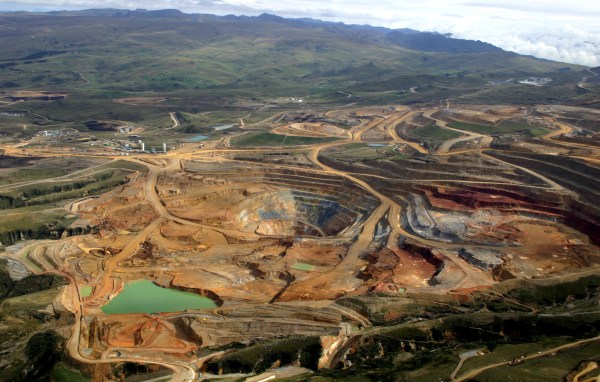
  • The decline in metals earnings has fueled internal tensions as the government has attempted increasingly aggressive policies to open new areas to mining and accelerate mining projects in the pipeline. The mobilization of military troops last week to quell protests over a new $1.4 billion mining project in the south, which have already resulted in the death of three police and several civilians, poses a real problem.

Humala is by no means unique in suffering a contradiction between basically sound economic performance and chronic inability to sustain domestic political support.  His predecessors have suffered variations of the same malady, rooted in part in the country’s notorious lack of a functioning political party system.  But with seven different prime ministers, his government has looked particularly disorganized.  He has arguably been a competent manager but an ineffective leader – muddling through rather than executing a vision for a better future for Peru.  In the runup to winning his vote of confidence, Cateriano showed strong, consultative political skills in garnering the support of most former Peruvian Presidents, but overcoming the administration’s lame-duck status amidst growing conflict over metals extraction and the beginning of campaigning for the 2016 election will be a constant challenge.  And this government’s experience, like that of its predecessors, suggests that his successor will also face powerful headwinds in a persistently fragmented political landscape.

May 11, 2015

Venezuela: More of the Same Tragedy

By Michael McCarthy*

Embed from Getty Images

The gruesome murder of a pro-government Socialist Party deputy and the decision by the opposition coalition’s Mesa de Unidad Democrática (MUD) to suspend a rally in light of the tragedy foretold an opportunity to restart a national dialogue.  But unlike in January 2014, when the murder of beauty queen Monica Spears and her family created momentum for talks on security between the government and opposition, an unfortunate and familiar downward spiral has begun.  High-level government officials’ provocative accusations that the murder of Robert Serra, one of the Venezuelan Parliament’s youngest members, was the work of right-wing actors have deepened yet again the political polarization in Venezuela.  UNASUR’s new Secretary General, former Colombian President Ernesto Samper, surprisingly weighed in, strongly implying that Colombian paramilitaries were involved in Serra’s murder.  The government has long attempted to link members of Venezuela’s opposition with paramilitary groups, and Samper’s impartiality will forever be questioned by the opposition if the allegation is not proven. At Serra’s funeral, President Maduro described the MUD’s new Executive Secretary, Jesús “Chuo” Torrealba, as a piece of “garbage.”  Maduro’s name-calling is another example of the government using polarization as a tool to encourage supporters to close ranks.

Before the stabbing deaths of Serra and his female companion by unidentified assailants, the government was attempting to build momentum to resume the UNASUR-sponsored talks that had been frozen since May 3.  Samper had informed the MUD and opposition members of his intention to restart talks, and had described Maduro as “a man of dialogue, a man of peace,” adding that there were good prospects for “working a lot of things for the good of the region.”  But at this point any good will among the parties seems to have evaporated.  Moreover, for MUD secretary Torrealba, who originally said his goal was to change the MUD’s profile to mobilize a wider base of support, the primary task remains building MUD unity at a moment when different factions of the opposition are promoting widely varying initiatives.  Torrealba has little negotiating experience and does not enjoy the same access to elite sectors as his predecessor did.  His precarious position calls into question whether the MUD could negotiate as a coalition even if talks restarted.

Once again, centrifugal forces seem to be prevailing in Venezuela.  This trend raises the question of whether Venezuelan society is not only “wounded and resentful,” as Jesuit Political Scientist Arturo Sosa says, but on the verge of an estallido social – social explosion.  Mechanisms for mediating conflict through political discussion remain in place and appear unlikely to disappear completely, but confrontations are likely to continue flaring up regularly.

*Michael McCarthy is a CLALS Research Fellow.

October 7, 2014

Bolivia: Lessons from the MAS

By Santiago Anria*

Joaquín Eguren / Flickr / Creative Commons Attribution-NonCommercial 2.0 Generic (CC BY-NC 2.0)

Joaquín Eguren / Flickr / Creative Commons Attribution-NonCommercial 2.0 Generic (CC BY-NC 2.0)

As Bolivian President Evo Morales’s Movimiento al Socialismo (MAS) prepares for the October 12 general election – which opinion polls indicate it will win by wide margins – the MAS appears to be a remarkably diverse organization capable of adapting operations to different regions of the country.  It fits neither the typical journalistic portrayal of Latin American social and political movements as clashing with political parties and elected governments, nor political scientists’ characterization of parties as unitary actors under the control of a unified leadership.  Founded by coca growers in the mid-1990s as their “political instrument” to contest power, the MAS has become the collective political expression of grassroots organizations now in power – to this day having diffuse boundaries and multiple faces, combining features of a grassroots movement and a party, and being a remarkably successful instrument for exercising rule.

The MAS’s regional diversity is one of its greatest strengths.  As an organizational actor, it looks and operates differently in different contexts depending on how the political space is structured.  In the Bolivian central region of the Chapare, where strong peasant unions are aligned with the MAS and control the territory, civil society and party are fused.  Grassroots organizations monopolize the political space, and local decision-making structures are embedded in the union structure.  Their success is rooted in “agrarian union democracy,” which emphasizes that “bases” exert control on the leadership – that the rank and file should lead and leaders should follow.  In the eastern city of Santa Cruz, on the other hand, the MAS has made inroads in traditionally hostile territory by developing an unusually strong local party organization with remarkable mobilization capacity, and that capacity gives it a central role in local governance.  As in other cities with large informal economies, the local structure draws support from two powerful urban sectors – transportation workers and street venders – and is organized territorially in districts that operate both during and between elections.  Rather than having the features of a movement, in Santa Cruz the MAS looks and works more like a conventional political party.  In the Chapare, Santa Cruz and elsewhere, the MAS organization has considerable latitude to operate locally within alliances and policies usually defined at the national level.  As a result, the MAS and its governmental counterparts are not often, or by necessity, in tension.

Latin American history offers many examples of political movements becoming personalistic vehicles for charismatic leaders.  More than 10 years since it became a credible electoral vehicle, the MAS may offer a more promising organizational alternative.  Morales is certainly a charismatic leader, with significant popular legitimacy and authority within the MAS.  His leadership cannot be overstated, and he is the dominant figure binding a wide array of grassroots movements and organizations.  Yet, the MAS has remained permeable to popular input in areas where civil society is strong and has mechanisms to arrive at collective decisions.  In the last general elections in 2009, grassroots influence was consequential: it led to the massive entrance of individuals and members of allied grassroots organizations into the highest level of political representation.  Their participation in Congress (the Plurinational Legislative Assembly) has pushed to diversify the legislative agenda still largely subordinated to the executive.  New MAS leaders willing or able to challenge Morales’s leadership have not emerged but, as the candidacies for the upcoming elections are defined, the strong regional dynamics could alter the composition of the new parliamentary group.  Whether the MAS will remain open, and whether it will manage to outgrow its dominant leader figure, will depend on the continuing strength of allied groups in civil society.

*Santiago Anria is a Ph.D candidate in political science at the University of North Carolina at Chapel Hill.

Mujica’s Liberal Experiment: Model for the Latin American Left?

By Robert Albro

President José Mujica on stage with SIS Dean James Goldgeier

President José Mujica on stage with SIS Dean James Goldgeier

Uruguayan President José “Pepe” Mujica, whose recent trip to Washington included a stop at American University, is doubtless Latin America’s most unconventional president.  A former leftist guerrilla who spent 14 years in prison, Mujica gives away 90 percent of his salary, refuses to live in the presidential mansion, grows chrysanthemums, and has twice been nominated for the Nobel Peace Prize.  He was elected in 2009 as candidate of the center-left Frente Amplio, and his accomplishments have transformed him into an international figure – and turned Uruguay into an intriguing experiment in social liberalism.  He has avoided the populist tendencies and overt anti-Americanism of other Latin American leftists, while promoting programs of social inclusion alongside a pro-business economic agenda.  Under Mujica, Uruguay has enacted an affirmative action law, legalized abortion in the first trimester, and legalized gay marriage. Most discussed has been his administration’s controversial launch this year of a legal government-licensed and -regulated marijuana market.

Mujica is notably less popular at home than abroad, however.  After plunging to 36 percent in late 2012, his approval rating has since hovered around 47 percent.  With national elections (in which he cannot run) looming in October, a poll last month showed the Frente Amplio losing significant ground to the opposition.  Mujica has consistently dismissed the polls.  He went ahead with legalizing pot, for example, despite a September 2013 poll indicating that 63 percent of Uruguayans still did not support the measure.  His asylum offer for up to six Guantanamo detainees, based on humanitarian concerns, has also not been popular, with only 23 percent of Uruguayans approving.  Uruguay ranks among the safest countries in the Americas, with 5.9 homicides per 100,000 people, and yet the perception of insecurity is widespread.  In a 2012 poll 56 percent of Uruguayans still reported crime and violence to be the country’s most pressing problem.  If celebrated by advocates of social liberalism, Mujica’s policy measures often appear out of kilter with popular perceptions and priorities.

Mujica is often cited as offering a potential alternative to the Bolivarian brand of “21st century socialism.”  But, in what is arguably Latin America’s most socially liberal country, the former Marxist has governed as a pragmatist.  Uruguay has a lot going for it, including: a stable banking system, free and secular education, low levels of corruption and social inequality, robust press freedoms, and stable governance with functional political parties.  It is second in South America behind Argentina on International Living’s quality of life index.  It has the third highest GDP per capita – triple that of Ecuador and Bolivia – and under Mujica has sustained stable economic and wage growth, and increased foreign investment in farming, forestry and pulp mills.  However, while he gets points for his international celebrity, austere lifestyle, and colorful persona, Mujica risks alienating the many citizens who care more about unemployment, inflation, crime and insecurity than about the environment, cannabis and gay marriage.  It is not clear whether over time Uruguayans will support Mujica’s particular left-liberal pragmatic brand of governance and whether his is a model embraced by other Latin American leaders. 

Colombian President Santos’s Challenges Now … and Later

By Fulton Armstrong
Embed from Getty Images
Colombian polls continue to give President Santos a comfortable margin in a second-round re-election victory, but the gap is closing – and an array of issues plaguing his campaign suggest serious challenges ahead for a second term.  The economy grew 4.3 percent last year, and optimism about future growth is so strong that the central bank is implementing measures to keep inflation under control.  The peace process with the FARC has been tedious – yielding agreements on only two of five main agenda items over 17 months of talks – but the fundamental drivers of the talks, including fatigue on both sides, remain strong.  But a number of political messes are swirling around the President:

  • The Army was caught red-handed spying on Santos’s top advisors in the FARC negotiations, suggesting disloyalty to him as Commander in Chief.  (The intercept center that police last week [6 May] raided was not the Army’s.  It was staffed by contractors reporting to the Centro Democrático, the party of former President Uribe and Santo’s leading rival in the election, Óscar Iván Zuluaga.)
  • Uribe, who in March won a seat in the Colombian Senate, has been a relentless critic and drawn Santos into public spats.  Santos recently called on the former President to “stop causing the country harm” and to stop politicizing the Armed Forces.
  • An agricultural strike launched in late April has revived memories of a nasty confrontation last year and threatens food supplies in the run-up to the election.  Santos has mobilized police and military assets to keep highways open, but a political solution has eluded him.
  • In late April, the courts forced Santos to reinstate Bogotá mayor Gustavo Petro, whom he had removed a month earlier because the nation’s inspector general, an Uribe partisan, found that the mayor’s decision to cancel private garbage-collection contracts did not follow proper procedure.  Santos had gone ahead with the firing over the objections of a unanimous Inter-American Human Rights Commission.
  • Santos’s political message has been off target.  He has made the peace talks his top priority and proclaimed that “the second term will be about peace,” but polls indicate that only 5 percent of voters say the peace process is their top concern.

If the polls are correct, Colombians voting in the first round on May 25 and second round on June 15 feel little enthusiasm for Santos, but even less for Zuluaga and Uribe’s party.  A recent surge in support for former Bogota mayor Enrique Peñalosa suggests, on the other hand, that voters could turn on both candidates.  Behind the numbers is a country eager to consolidate its democracy, maintain stability and – probably – end the 50-year insurgency.  But the red flags – such as the security service’s continued penchant for spying on government officials – are not inconsequential.  Santos, who was Defense Minister during Uribe’s presidency, should have earned the military’s confidence, will have to decide how far to push the military to respect democratically elected civilian leadership.  The farmers’ demands, including relief from low-priced, low-quality imports facilitated by Colombia’s free trade agreements, will also be difficult to satisfy.  A peace deal with the FARC will be an historic achievement, but the political reality is probably that any assistance to demobilized combatants will be minuscule compared to that given to the former paramilitaries – increasing the likelihood that ex-insurgents, like the paramilitaries, will join the bandas criminales (BACRIM) who continue to maraud throughout large swaths of the country.  Santos’s second term, should he win one, will not be easy.