Bolivia: Prospects for Post-Evo Transition

By Robert Albro*

Crowd march with boy holding the pan-indigenous flag

March in favor of Evo Morales /Flickr/ Creative Commons/ https://www.flickr.com/photos/santiagosuburbano/49098960458/

Bolivia’s streets have been calmer in recent days, but actions by self-proclaimed President Jeanine Áñez have raised legitimate concerns about what sort of transition Bolivians face after the almost 14-year presidency of Evo Morales. The protests, marches, and violence that have characterized the aftermath of the disputed presidential election on October 20 have left at least 33 people dead – including 30 since Áñez took office and soon thereafter issued a presidential decree (since rescinded) giving security forces immunity from prosecution when engaged in restoring “order.” While Áñez has claimed she is a caretaker whose only charge is to organize new elections within 90 days, she has not behaved like one.

  • Previously an obscure backbencher and opposition senator from an inconsequential political party representing remote Beni, Áñez had planned to retire from politics at the end of her term. Her position as second vice-president of the Senate was largely ceremonial, with little control over budgets. Down the list of constitutional succession, she became acting president only after multiple Morales administration officials resigned.
  • Although unelected and lacking a mandate, Áñez has taken a series of decisive steps to undo Morales’s legacy. A conservative Christian and Morales critic, she has proclaimed Bolivia a “Catholic country” and disparaged its Indigenous majority as “irrational.” She has surrounded herself with a cabinet composed of like-minded critics from Bolivia’s eastern lowlands. This region includes the departments of Santa Cruz, Tarija, Pando and Beni, together often called the Media Luna (Half Moon), and is the heartland of economic elites whose political power was substantially diminished by Morales’s rise. In 2008 the Media Luna was for months in open revolt against Morales and his government, contending for control of the country’s considerable natural gas revenues. Often cast in racist terms, these elites consistently and categorically rejected Morales’s presidency.

As interim president, Áñez has replaced the military’s leadership, cabinet ministers, and heads of major state-owned companies with her own appointees. She reestablished ties with Washington, severed relations with Venezuela, kicked out Cuban doctors working in the country, and is considering Bolivia’s withdrawal from the largely-defunct UNASUR. Áñez has not sought conciliation with lawmakers from Morales’s MAS party, who still command a legislative majority. Instead, seeming to turn to the playbook of the country’s and the region’s dictatorial past, her administration has accused Venezuela and Cuba of supporting subversive groups in Bolivia, threatening to prosecute former government officials now in hiding and to charge MAS lawmakers and journalists critical of her policies with “sedition.”

These moves do not bode well for an orderly electoral do-over. Luis Fernando Camacho, the Santa Cruz civic committee leader who has emerged as Áñez’s vocal and controversial far-right supporter, already seems to be in campaign mode, despite his scant political credentials. Political moderate and second-place finisher in last month’s election, Carlos Mesa, appears to be largely sidelined. Morales himself has been legally barred from participating, and MAS, while still a political force in Bolivia, lacks an obvious figure to replace him. Meanwhile, Áñez and the far-right cabal gathering around her appear to be gearing up for hardball politics, although they lack legitimacy among Morales’s supporters and the many citizens who might have grown tired of Morales but view with alarm the actions and tone of the new caretaker government. The election may be technically wide open, but Bolivia’s far-right appears intent on seizing this opportunity to restore its influence.

  • By alienating the country’s Indigenous majority and exacerbating latent ethnic and class tensions, while signaling a commitment to reverse the gains made during the Morales years, Áñez is setting up conditions for a period of intense social conflict. If present trends continue, it is hard to imagine that in 90 days, and perhaps for a lengthy period thereafter, Bolivia won’t again experience more paroxysms comparable to what it has endured since October’s contested election.

December 6, 2019

* Robert Albro is the Research Associate Professor at CLALS.

Haiti: Is Anyone Listening?

By Fulton Armstrong

Protesters take to the streets in 2018 over the government's misuse of funds from PetroCaribe.

Protesters take to the streets in 2018 over the government’s misuse of funds from PetroCaribe– once again the subject of public anger/ Rony D’Haiti/ Wikimedia Commons/ https://commons.wikimedia.org/wiki/File:Manifestation_Haiti.jpg

As Haiti enters a fifth week of protests, President Jovenel Moïse’s support for U.S. policies on Venezuela and Taiwan appears to have secured him Washington’s backing, but his government is in tatters and his opponents don’t look likely to fold soon. For weeks, tens of thousands of protesters have held targeted marches in Port-au-Prince and provincial cities across the country demanding Moïse’s resignation. Violence by demonstrators and police has caused 17 deaths and hundreds of injuries, including the shooting of several journalists, according to human rights monitors. School closures have left up to 2 million children without class and the food supplements they receive there.

  • Protesters originally took to the streets to protest fuel shortages caused by government insolvency, but corruption – including the misappropriation of an estimated $2 billion dollars in profits from the sale of fuel under Venezuela’s previous PetroCaribe program – has become the overwhelming issue. Opposition leaders cite Superior Court audits implicating Moïse and other government officials past and present in schemes to personally profit from PetroCaribe security forces’ use of clubs and tear gas (and unconfirmed use of live ammunition) against demonstrators has further fueled anger in the streets. Haiti’s Catholic Bishops have blamed Moïse for the showdown, and their “Justice and Peace Commission” has publicly called for his resignation.
  • Moïse’s leadership has been unsteady throughout the crisis. He was out of public view entirely for one week, returning only in a pre-recorded radio address broadcast at 2:00 am on September 25 that called for calm and dangled the prospect of a “government of national unity.” Since his inauguration in January 2017, he has lived under the shadow of suspicious vote counts and has either failed to get Prime Ministers confirmed by Parliament or to build a good working relationship with them. The country hasn’t had a budget for two years, and a projected 20 percent inflation during 2019 and mere 1.5 percent growth further drive popular fury.

Moïse is clearly winning the competition for international support. However, he has gained U.S. silence about the evidence of his and senior allies’ involvement in PetroCaribe under Venezuelan Presidents Chávez and Maduro. During the UN General Assembly two weeks ago, U.S. Deputy Secretary of State John Sullivan met with Moïse’s Foreign Minister, Bocchit Edmond, with whom he “reaffirmed the strength of the U.S.-Haiti partnership and shared hope that Haiti’s political stakeholders would soon identify a path to forming a government that remains firmly rooted in democracy and the rule of law.”

  • The opposition’s calls for support have been much less successful. U.S. Senator Marco Rubio, a Republican widely seen as President Trump’s top advisor on hemispheric affairs, said it was not the “proper job of the United States to call on a democratically elected President [Moïse] to step down.” (Rubio had praised Moïse for supporting U.S. sanctions to remove Maduro and for preserving diplomatic relations with Taiwan.) The senior Democrat in the U.S. Congress, House Speaker Nancy Pelosi, last week also cited Moïse’s position on Maduro as important.
  • UN officials last week issued a “statement of concern,” noting that the protests were hindering aid deliveries and could lead to a humanitarian crisis. The UN remained neutral, however, and called on “everyone” to refrain from the use of violence. An unofficial OAS delegation to Haiti organized by individuals close to Senator Rubio in June told the opposition to “back off,” according to press reports, and reportedly told Moïse that he should “start governing” but it was “not going to ask him to resign.” Overall, however, the OAS has kept a very low profile, especially during the current crisis.

Haitian politicians have often turned to foreign friends and multilateral organizations to rescue them from crises – which they surely stir up themselves – but the international community, rather than addressing fundamental problems, often tries to paper over highly contested elections (like Moïse’s) and institutional weaknesses. The billions in PetroCaribe revenues that have vanished during the past two presidencies – including that of Moïse’s mentor, Michel Martelly – is strong circumstantial evidence that the opposition’s calls for investigation of the current administration have merit. But Moïse seems to be betting – correctly so far – that support for Washington’s priorities, such as condemning alleged corruption and undemocratic practices in other countries, buys him space to snub opponents’ demands. The UN and OAS just don’t seem to want to get more deeply involved, but the opposition, which has surprised many with the length and level of protests, doesn’t seem ready to give up.

October 11, 2019

Argentina: Market Meltdown Can Be Halted

By Arturo Porzecanski*

From right to left, then-president Cristina Ferdandez de Kirchner, then-minister Alberto Fernandez, and other then-ministers

Ministers of Cristina de Kirchner / Wikipedia / Creative Commons / https://es.wikipedia.org/wiki/Archivo:Ministros_de_Cristina.jpg

The unexpectedly strong performance of the Alberto Fernández-Cristina Fernández de Kirchner (FF) ticket in Argentina’s August 11 presidential primaries has triggered a stampede out of the country’s currency, stocks, and bonds, but FF hold the key to staving off a full-fledged crisis. If the confidence of local and foreign investors is not recovered soon, the market rout has the potential to induce runaway inflation, plunge the economy into a deep recession, and cut off domestic and international financing for both the outgoing and incoming governments, potentially leading to a default.

  • The FF Peronist ticket’s 15.6 percentage-point margin of victory over President Mauricio Macri and his companion was foreseen by none of the pre-election polls. The wide gap shocked investors because it indicates the Fernández duo could win in the first round in the October 27 general election, avoiding a second-round ballot on November 24 in which the pro-market Macri was thought to have a better chance. The coattail effect of FF helped allies in provincial and local primaries around the country. With likely majorities in one or possibly both houses of congress, FF would have a powerful government that could implement much of its agenda, for better and for worse.

Now the challenge is to stop the vicious cycle of capital flight, currency depreciation, accelerating inflation, and plunging economic activity sparked by the electoral results. Failure to do so sooner rather than later will make it very difficult for the government to refinance its maturing short-term debts, and the Central Bank will likely experience a steady drain of its international reserves. In that scenario, the IMF, which has been sending big checks to Argentina every three months, would probably not send the next one in late September.

  • The Macri administration has announced some palliative measures (e.g., a 90-day freeze in gasoline prices and a tax exemption for food purchases), and the Central Bank has tightened marginally monetary conditions. But the government leadership team is powerless to restore the investor confidence that has evaporated.

Given his clear frontrunner status, Alberto Fernández could play a crucial role in reversing the trend. During eerily reminiscent circumstances in Brazil in mid-2002, local and foreign investors were increasingly worried that Luiz Inácio “Lula” da Silva, who was running strong in the polls in his fourth presidential campaign, would end the market-friendly policies of the outgoing Fernando Henrique Cardoso – including a break with the IMF, from which Brazil had been borrowing.

  • Worried about potentially inheriting an economic and financial mess, Lula made a public statement – he called it a “Letter to the People” – making clear his commitment to sound fiscal and monetary policies and the rule of law. He wrote about a “new social contract capable of assuring economic growth with stability,” one of whose premises was “naturally, a respect for the country’s contracts and obligations.” He followed those words with concrete actions. Two months before the elections, he gave his blessing to a new IMF program committing the next government to maintain, with minor modifications, Cardoso’s austere fiscal and monetary policies.

Lula’s actions after his election, including putting a market-friendly and popular mayor in charge of his transition team and choosing a career private-sector banker to run the Central Bank, provide a path that Alberto Fernández could follow as well. Under Lula, the Brazilian Central Bank felt supported in its all-out effort to extinguish the flames of inflation and to buttress the currency. Interest rates were thus hiked as needed before and after the October 2002 elections. He initiated confidence-building meetings with investors before taking office and reassured lenders and investors, both in Brazil and abroad.

  • So far, Alberto Fernández is denying any responsibility for the developing financial and economic crisis, blaming Macri for all that’s gone wrong. But unless he makes announcements that give confidence to local and foreign investors, he will inherit a mess.

August, 22, 2019

*Dr. Arturo C. Porzecanski is the Distinguished Economist in Residence at American University and a member of the faculty of the International Economic Relations Program at its School of International Service. This article is adapted from an essay he wrote in Americas Quarterly.

Nicaragua: Can Ortega Circumvent the Talks?

By Fulton Armstrong

Presidente de El Salvador participa en Cumbre SICA-Nicaragua.

President of Nicaragua Daniel Ortega / https://www.flickr.com/photos/fotospresidencia_sv/30962278823 / Flickr / Creative Commons

While the Nicaraguan government continues to stonewall in negotiations with its broad-based opposition, it is taking a series of unilateral actions that seem intended to preempt the talks – and leave the opposition behind. President Daniel Ortega and his team have flatly rejected key opposition demands, including early elections to replace him (instead of waiting for general elections in 2021) and the immediate, unconditional release of hundreds of political prisoners. They have, however, issued declarations pledging several actions on their own terms.

  • Last week, the Foreign Minister said the government “is complying, and will continue to comply, with all of [its] commitments toward understanding and peace.” Calling itself the “Government of Reconciliation and National Unity,” Managua has issued a “work program” that includes the “definitive release” by June 18 of 100-plus more political prisoners and several hundred others under house arrest. It pledged to work toward a “culture of peace” and “cooperate” with the OAS on reforms of the Supreme Electoral Tribunal to prepare for the 2021 elections. It promised legislation that supposedly will help victims of government violence during the April 2018 protests, although apparently with conditions that offend opposition leaders.

The opposition Civic Alliance for Justice and Democracy, which left the negotiating table last week, continues to enjoy widespread support, but press reports suggest mobilization fatigue is undermining its effectiveness and unity. Sympathetic media judged a hastily called national strike last week – protesting government intransigence in the talks – as effective, but they hinted at reduced enthusiasm. The Superior Council of Private Business (COSEP), a leading opposition force, recently released its assessment that the economy is “in a free fall,” with plummeting domestic and foreign investment. COSEP analysts note that the loss of 100,000 private-sector jobs and a similar number of informal-sector jobs is taking a heavy toll on society. The Catholic Church, which remains consistently critical of the Ortega government, has had a lower political profile since Pope Francis reassigned Managua Auxiliary Bishop Silvio Báez, its most outspoken critic of the government, to a Vatican job.

  • The opposition has also been stung by criticism from OAS Secretary General Luis Almagro, who’s led diplomatic pressure on Ortega to loosen up. In April, Almagro accused both sides in the negotiations of “lying” but listed untruths he attributed specifically to the opposition, claiming that “lying is the most antidemocratic practice.” Although the OAS last week approved a resolution, drafted by Canada with Almagro’s support, calling for Ortega to take concrete steps on human rights and election preparations, some 14 small opposition groups the day after accused the Secretary General of a “double standard” – allegedly being lenient toward Ortega but tough of Venezuelan President Maduro.

Government repression and intransigence in the negotiations are the primary causes of the crisis, but the opposition is, once again, showing a lack of focus and discipline. Ortega’s unilateral moves on political prisoners and electoral reform, after the opposition left the negotiation, suggest an effort to render the opposition and negotiation process irrelevant. By making the release of political prisoners its top priority in recent rounds of talks, opponents have given Ortega an area in which concrete and relatively cost-free steps can give the government momentum. Last week’s strike may have done more to show opponents’ weakness than strength inside Nicaragua, and Almagro’s swipe at “liars” – while possibly a reflection of his own personality and personal beliefs – cannot be helping outside. Some of the “liars” that have irritated him may indeed be mere troublemakers or government shills, but any dilution of international interest will be a victory for the government. The Trump Administration, which has pledged regime change in Nicaragua as well as Venezuela and Cuba, has been relatively quiet. Diplomats at the OAS are working hard to muster the four additional votes to reach the 24 necessary to invoke the Democratic Charter against Nicaragua, but Ortega seems to think he can end-run a negotiated settlement and undermine his opponents at home and abroad.

May 29, 2019

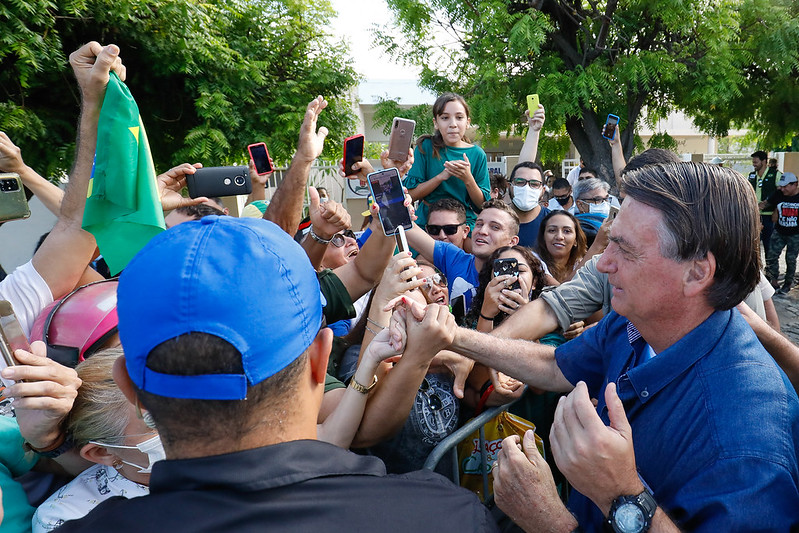
Brazil: Bolsonaro Targeting Political Participation

By Paulo Castro*

President Jair Bolsonaro of Brazil looking pensive

Jair Bolsonaro / Fabio Rodrigues Pozzebom – Agência Brasil / https://flickr.com/photos/129729681@N06/35164638165/ Wikimedia Commons

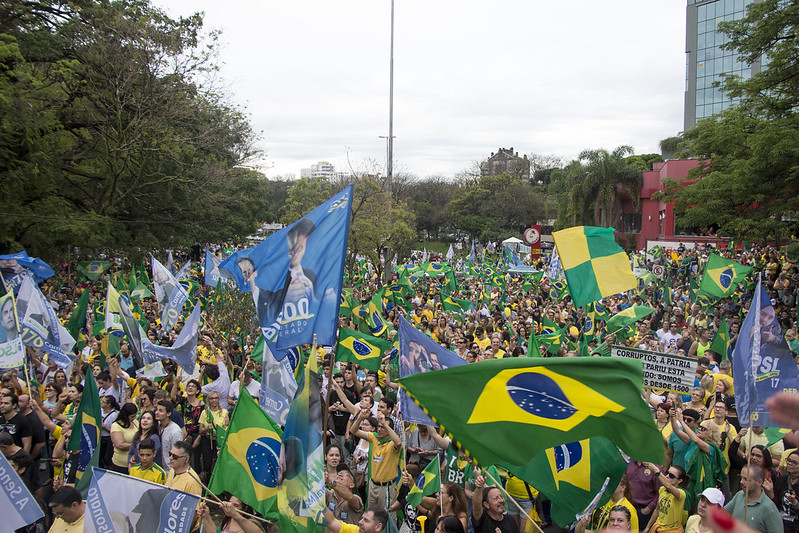
Brazilian President Jair Bolsonaro – unwilling or unable to engage in the coalition-building necessary to pass legislation – has focused an important part of his first 100 days in office on social policies that he can dominate with executive power while reducing citizen participation in policy formation. Elected in one of the most polarized elections in Brazilian history, Bolsonaro ran a campaign focused on fighting corruption and implementing a market-oriented economic agenda that would lead to GDP growth, with pension reform as its main pillar. His first months have been far from a “honeymoon” with Congress; a wide array of problems add up to a legislative inertia as seldom seen in contemporary Brazil.

  • Lacking a strong base in the House and Senate – and facing dissidence even within his own Partido Social Liberal – Bolsonaro has relied on the risky strategy of ignoring the nature of the Brazilian political system, which includes building support for his agenda in Congress, and is focusing instead on attacking adversaries and what he calls the “ideological agenda” of the Workers Party (PT). Meanwhile, key ministries have yet to announce even general policy goals. The Ministry of Education, which has the second largest budget in the federal government and is responsible for one of the most deficient areas of the country, has been largely silent even though reform of the early education system was one of Bolsonaro’s main campaign promises. The President has issued executive measures, such as the bureaucracy reduction decree this week to help business owners and start-ups, but has introduced no relevant legislative agenda.

Shifting social issues is the one area in which the government is running at full throttle. Social accountability, gender equality, and broader human rights initiatives have experienced budget cuts. Because many PT-era policies were implemented by presidential decree or ministerial order, the Bolsonaro administration can cancel or alter them without Legislative Branch approval. (Many changes in the economic area require amending the Constitution, with a three-fifths majority of both houses of Congress.) Far from the prying eyes of the press and markets, small changes in the government processes threaten to increase the country’s democratic deficit.

  • An executive order signed by Bolsonaro abolished more than 600 civil society participation councils that promoted transparency and accountability by bringing civil society into policy discussions. Bolsonaro has eliminated the National Environment Council, the National Council of People with Disabilities, National Council for the Promotion of LGBT Rights, National Commission for the Eradication of Slave Labor, and National Commission for the Eradication of Child Labor, among others. The Ministry of Women, Family and Human Rights, headed by conservative religious leader Damares Alves, has announced it will limit the number of requests analyzed by its Amnesty Committee, created in 2002 to promote remedial actions for victims of the military dictatorship in Brazil.
  • On the environmental front, conflict between farmers and indigenous people has escalated since Bolsonaro limited the powers of the Fundação Nacional do Índio (FUNAI). Along with the National Forest Service, he transferred FUNAIS’s responsibility for the demarcation of new indigenous lands to the Ministry of Agriculture, which is headed by Congresswoman Tereza Cristina, a former leader in agribusiness.

Bolsonaro is trying to appear confident, but the consequences of his inaction on big-picture items such as pension reform – which will affect economic performance and public perceptions of his effectiveness – will reach a point at which his emphasis on social, cultural, and symbolic matters will not be sufficient to maintain his position. By deinstitutionalizing democratic participation on these important social issues, Bolsonaro is further reducing the country’s ability to take up tough issues, such as the priority reforms awaiting Executive and Legislative Branch attention. When it comes to education and health policies, civil society organizations and union representatives have important roles in mobilizing the interests of beneficiaries. While it is natural that opposing governments have opposing political views, Bolsonaro’s actions don’t only reflect policy shifts; they amount to a substantive reduction in accountability and government responsiveness, closing important doors that enable citizens to influence public policy and make political processes more inclusive.

May 3, 2019

* Paulo Castro is Ph.D. Candidate in Political Science at the University of Brasilia and professor at the Brasilia Institute for Public Law. He has worked as an advisor and analyst in the Ministry of Justice and private sector organizations. He was a CLALS Research Fellow.

Haiti: Building Democratic Institutions?

By Fulton Armstrong

A bus burning with thick clouds of black smoke billowing above it, and two men on a motorcycle riding by.

Riots in Haiti, February 2019 / AP/ Wiki Images / Creative Commons

Haitian President Jovenel Moïse is trying to end a months-long political crisis by dumping his Prime Minister, but he doesn’t seem to be addressing the underlying causes of last month’s violent protests, and scandal continues to swirl around his apparent role in a bizarre operation involving heavily armed U.S. “security specialists.” Protesters who took the streets in early February accused Moïse and close allies, including former President Michel Martelly, of diverting billions of dollars gained from the sale of fuel under Venezuela’s Petrocaribe program – money that should have gone to development programs – before he took office in 2017. They also complained about the continued economic decline under Moïse. Roadblocks around Port-au-Prince and elsewhere brought the country to a halt. Some 41 deaths were reported. The U.S. Embassy evacuated non-emergency personnel and warned persons “not travel to Haiti due to crime and civil unrest.”

  • Moïse made no public statements until after eight days of rioting, when he said, “I hear you.” Reiterating his pledge to resist opponents calling for him to step down, he said, “I will not leave the country in the hands of armed gangs and drug traffickers.” He mobilized supporters in Congress to pass a no-confidence resolution removing Prime Minister Jean-Henry Céant, with whom he had been publicly feuding, just days after the six-month anniversary of his appointment, at which point he could legally be removed from office. But Moïse has not addressed the corruption charges, nor announced any plans to revitalize the economy except by negotiating a new loan from the IMF.

The appearance and disappearance of U.S. operations specialists, who were armed with assault weapons, drones, satellite phones, and other equipment, remain a mystery. Members of the team have offered different versions of the purpose of their mission, perhaps reflecting different cover stories they’d been given, but several scenarios involve moving something sensitive – money, people, or computer technology – out of or into the Central Bank, with Moïse seemingly at the heart of the mission. The team was arrested before the operation could be completed, and Moïse and his Justice Minister got them released. The U.S. Embassy helped spring them from police custody and helped them depart the country even before they could be arraigned. U.S. authorities, after meeting them planeside in Miami, released them without charge. (The Embassy reportedly told the Minister of Justice that the U.S. Government would bring arms trafficking charges against them.)

  • Moïse’s opponents claim that Washington aided the exfiltration in return for his increasingly close alignment with President Trump and U.S. Senator Marco Rubio’s priorities, including Haiti’s first-ever vote in January on a resolution rejecting the legitimacy of Venezuelan President Maduro’s second term. Perhaps related: U.S. support was important in the IMF decision earlier this month to extend loans for $229 million at 0 percent interest. The deal will move ahead after Moïse gets a new Prime Minister confirmed. Rubio visited Moïse in Haiti last week, and Trump met the Haitian President, along with other Caribbean leaders who voted with the United States on Venezuela, last Friday at Mar-a-Lago.

If precedent is any guide, Prime Minister Céant almost certainly had a hand in stimulating the February riots, and his accusation that the U.S. security team members were “terrorists” seems far-fetched and politically motivated. But he may have correctly sensed that the armed operations team’s purpose involved an effort by Moïse or his powerful mentor, former President Michel Martelly, to shut down any additional snooping into their activities and the whereabouts of the Petrocaribe profits. Moïse appears likely to continue looking for ways to curry favor with Washington as a means of gaining U.S. support and forbearance. Indeed, U.S. willingness to hustle the security team out of the country before they could face a judge would suggest that Moïse knows how to poke holes in the United States’ stated commitment to the rule of law and democratic institutions.

Peru: President Vizcarra Surprisingly Paves the Way for Liberal Project

By Carlos Monge*

actualidad-salvador-solar-y-su-nuevo-gabinete-juran-al-cargo-esta-tarde-n362718-603x339-558655

Prime Minister Salvador del Solar and President Martin Vizcarra / canaln.pe / Creative Commons

One year in office, Peruvian President Martín Vizcarra has made significant strides toward strengthening neoliberal economic policies and opening the way for a liberal project in Peru – while maintaining 50 percent popular support.  Prime Minister César Villanueva took the hit for a fall in the polls last week, setting the stage for Vizcarra to name a new cabinet this week to give a push to his agenda.  The new Prime Minister – lawyer, actor, and film director Salvador del Solar – espouses a market economy with strong state regulations against corruption, tax evasion, and monopolies, while defending human, women’s, and LGTIBQ+ rights.

  • His opponents have been weakened. Former President Alberto Fujimori is back in jail, his presidential pardon revoked.  His older daughter, Keiko, is in prison, while awaiting trial on corruption charges, and his younger son, Kenji, is under investigation for links to drug trafficking.  Fujimori family long-time confidant Jaime Yoshiyama returned from the United States directly to prison for violations of campaign finance laws.

None of this seemed remotely possible only a year ago when Vizcarra, a Vice President, returned to Peru from his posting as Ambassador to Canada and, on March 23, was sworn in as President, after President Kuczynski resigned amid serious corruption charges.  Indeed, Vizcarra appeared destined to be a weak president facing a strong and ruthless parliamentary opposition.  The question then was if he would last or, rather, when he would fall.  Vizcarra initially seemed to follow his predecessor’s appeasement policies, attempting to govern without the permanent obstruction of a Congress dominated by Keiko Fujimori’s Fuerza Popular and its close ally, APRA.  He even consulted with Keiko about potential cabinet members and important policy matters.  Keiko, on the other hand, remained convinced that she should have won the 2016 elections and sought to govern the country through her control of the Congress, even hoping to generate a political crisis leading to new national elections that she was sure she would win.

  • Vizcarra soon grasped Keiko’s intentions and sided with citizens’ widespread indignation caused by the leak of audio recordings that confirmed enormous levels of corruption in the judiciary and its connections to political parties such as Keiko’s Fuerza Popular and APRA. Despite desperate efforts by these parties and their allies in both the judiciary and the General Attorney’s office to block ongoing investigations, both Keiko and Alán García, the APRA leader and former national president, were in serious trouble.  Vizcarra embraced the anti-corruption platform and confronted head-on the same leaders and parties he had initially tried to appease.
  • Bypassing the Fuerza Popular and APRA’s domination in Congress, Vizcarra succeeded in organizing a referendum last December that approved a package of reforms he proposed to reduce corruption. (He even convinced citizens to vote NO on one of his four reform proposals – the return to a two-chamber parliament – after Fuerza Popular and APRA introduced a provision that would open the way for parliamentary re-election in 2021, which another reform prohibited.)  With an average of 80 percent of voters supporting his position on all four measures, Vizcarra scored a huge victory– clearing the way for him to move forthrightly on his political and economic agenda.

Early posturing for the 2021 elections shows that Vizcarra may have opened a previously nonexistent space for liberal politics in the country.  In fact, his new Prime Minister has presidential aspirations and Julio Guzmán and his Partido Morado have recently registered, and they are –as Vizcarra is – – a “liberal” or “sort of liberal” politician.  The traditional right, including Fuerza Popular, APRA, the CONFIEP business guild, and others, have strongly criticized the values and economic views of the new Prime Minister, but the days that the only face of the right was a mix of state capture by large economic groups and conservative values and policies – a mix Alán García and Keiko Fujimori represent so well– seem to be over.  The emergence of a liberal project also represents a challenge for the left, traditional champion of liberal values.  If those liberal values now find liberal champions, the left will have to remain true to them while – at the same time – displaying its total opposition to the continuity of neoliberal economic policies and pushing for a set of distinctly leftist policies in the social, environmental and cultural realms.

March 15, 2019

* Carlos Monge is Latin America Director at the Natural Resource Governance Institute in Lima.

Venezuela: Is Guaidó the Knight in Shining Armor?

By Fulton Armstrong

Guaidó and Maduro image

Guaido and Maduro / Wikimedia Commons

The OAS, United States, and a number of Latin American governments are pinning high hopes that newly inaugurated National Assembly President Juan Guaidó will lead Venezuela out of its crisis and “back to democracy,” but the opposition needs much more than foreign support to achieve its goal of ousting President Nicolás Maduro.  The 35-year-old Guaidó, an engineer with eight years of political experience, proclaimed last Friday that “we will oust Maduro and his gang from power” and that he had the right to call new Presidential elections and to serve as Interim President while they are prepared.  He called on the military, which has shown some small fissures but so far appears to remain overwhelmingly loyal to President Nicolás Maduro, to “assume its responsibility … and remove the usurper [Maduro].”  He is organizing a national march on January 23 that, according to observers, he hopes will show the military the strength of his support.  (Maduro’s party, the PSUV, has announced its own demonstration that day.)

  • International reaction came fast and strong. OAS Secretary General Luis Almagro, who calls the Maduro government a “narco-dictadura,” immediately started referring to Guaidó in Tweets and public statements as “interim president” of the republic.  Brazilian President Jair Bolsonaro’s son sent a congratulatory message also recognizing Guaidó in that capacity.  The dozen predominantly conservative governments speaking as the Grupo de Lima have declared Maduro illegitimate and embraced Guaidó’s leadership if not the title.  President Trump’s National Security Advisor, John Bolton, praised the leader’s “courageous decision” to challenge the Maduro government without explicitly recognizing him as Interim President.

Inside Venezuela, reactions to Guaidó’s power play reflected longstanding political alignments.

  • Maduro, who refers to Guaidó as un muchacho, has ridiculed his statements as a “Twitter coup,” and his political machine has followed with the usual attacks. Maduro has reiterated his call for negotiations with leaders of the opposition.  He has distanced himself from the embarrassing arrest of Guaidó last Sunday, claiming that it was made possible by “the corrupt and traitorous cooperation of a group of officials” in his intelligence service, SEBIN.
  • Guaidó’s party, Voluntad Popular (VP), is solidly behind him. Its founder, Leopoldo López, who is under house arrest, has led the charge in his defense, and their key allies – including María Corina Machado (Súmate), former Attorney General Luisa Ortega Díaz, and many leading Venezuelans in the United States – are supporting him too.
  • The party’s splits with opposition moderates remain deep, however. Henrique Capriles (Primero Justicia) issued a scathing critique of Guaidó’s strategy.  He accused VP of sponsoring violence that will use “the people of Venezuela as cannon fodder,” and he has called them “saboteurs” blocking serious talks and feeding the people unrealistic expectations.”  Other moderates have also recoiled from Guaidó’s approach and are reportedly bewildered by the OAS Secretary General and others’ support for direct confrontation.

As the political class engages in yet another cycle of struggles, the military, once again, is seen as the ultimate arbiter that all sides want to influence.  Maduro’s punishment of seemingly disloyal officers recently has probably been a double-edged sword – feeding resentment while instilling discipline – but unhappiness with Maduro does not translate into support for the opposition.  There appears to be no love between the military and the Voluntad Popular leadership, whose confrontational tactics almost certainly concern the military and whose political program and popular base remain unclear.  Despite deep corruption in the officer corps, moreover, most officers probably see themselves as nationalists and might chafe at the idea of the OAS or regional governments trying to be the kingmakers.  Strange things can always happen, but celebration of the Interim President seems premature and even counterproductive.

 January 17, 2019

A Right Turn in Latin America?

By Santiago Anria and Kenneth Roberts*

Jair Bolsonaro

Brazilian President Jair Bolsonaro in January 2019. / Marcos Brandão / Agência Senado / Flickr / Creative Commons

After a long winning streak, the left in Latin America has experienced electoral defeats in a number of former strongholds since 2015 – including Argentina, Chile, and Brazil – but the trend is not unidirectional and so far falls short of being a regional “right turn.”

  • Right wing presidents govern today in those three countries as well as Colombia, Guatemala, Paraguay, Honduras, Panama, and Peru – a scenario that is quite different from 2010, when about two-thirds of Latin Americans lived under some form of leftist government. Democratization, financial crises, and market liberalization shaped the 1980s-90s, while mounting social discontent against neoliberal market reforms helped to produce a “left turn” that spread across the region following the election of Hugo Chávez in 1998.  Leftist candidates won 30 presidential elections in 11 different Latin American countries between 1998 and 2014.

The current trend lines are hardly unidirectional across the region.  Mexico, which remained under conservative government when most of the region turned toward the left after 1998, has recently elected long-time leftist leader Andrés Manuel López Obrador to the presidency.  Incumbent leftist parties have been re-elected one or more times in Uruguay, Bolivia, Costa Rica, and El Salvador.  Notably, leftist parties in some countries where they have been historically weak, such as Colombia and Honduras, have strengthened electorally and organizationally, laying the groundwork for further growth.  Leftists’ records elsewhere are mixed.  Rivalries among Ecuadorean leftists make their future uncertain.  Venezuelan President Maduro and Nicaraguan President Ortega have resorted to increasingly repressive and authoritarian measures to maintain their grip on power.

  • With the possible exception of Brazil, the right’s surge is not the result of the sort of social backlash that brought the left to power. In general, the right’s victories appear to be a routine alternation of power rather than a regional wave with common starting points and driving forces.  Argentina and Chile are the two clearest examples of routine electoral alternation of power explained by retrospective, anti-incumbency voting in contexts of economic slow-downs, corruption scandals, and social policy discontent.  In countries like Paraguay and Honduras, on the other hand, the shifts were initiated by non-electoral means – a politically motivated presidential impeachment in the former and a military coup in the latter – and then consolidated through elections after the fact.  In Brazil, the right turn can be traced back to the social protests that broke out against Dilma Rousseff’s leftist PT government in June 2013, but former conservative allies’ opportunistic impeachment of Rousseff, along with their imprisonment of former President and PT founder Lula, seriously weakened her party – paving the way for the election of anti-establishment candidate Jair Bolsonaro.

The left in power is still strong, though probably not unbeatable today, in countries like Bolivia and Uruguay, at least in part because of their roots in and strong connections with social movements.  Unlike the PT, both Bolivia’s MAS and Uruguay’s FA have managed to preserve more of their movement character and to avoid extreme forms of top-down control and professionalization.  The ability of mass popular constituencies and grass-roots activism to hold party leaders accountable and steer public policies in desired directions—a condition largely absent in countries like Brazil, Ecuador, and Venezuela—has helped the left maintain cohesion in Bolivia and Uruguay.  This cohesion, accompanied by significant reductions of inequality, helps to explain the continued vitality of left parties in these countries.  The recent strengthening of leftist alternatives in Mexico and Colombia, moreover, should guard against facile assumptions that a region wide right turn is underway.  Conservative forces’ recent victories are better understood as a reinforcement of the post-neoliberal left-right programmatic structuring of political competition in Latin America than a unidirectional political shift to the right.  That said, Brazil wields significant political and economic influence in the region and, traditionally seen as an “early mover” in the region, may be a bellwether of the future.  The ability of President Bolsonaro and his model of governance to deliver the results that Brazilians want—and to operate within the parameters of democratic institutions—will be key factors in determining the direction and strength of the region’s rightist wave.

January 9, 2019

*Santiago Anria is Assistant Professor of Political Science and Latin American Studies at Dickinson College, and Kenneth Roberts is Professor of Government and Director of Latin American Studies at Cornell University.

Bolivia: The Exceptional Case of the MAS

By Santiago Anria*

MAS rally in Bolivia

A rally celebrating the nineteenth anniversary of the MAS in Bolivia. / Tercera Información / Wikimedia Commons

Bolivia’s Movement Toward Socialism (MAS) is one of the most important and electorally successful new parties in Latin America because it has succeeded in achieving and maintaining high levels of internal grassroots participation and bottom-up influence, even after assuming national power.  Unlike the ad hoc electoral vehicles created to sustain the support of a single charismatic leader like Hugo Chávez in Venezuela or Rafael Correa in Ecuador, the MAS has maintained autonomous forms of social mobilization by popular constituencies that have contributed to keeping party vibrancy and served as a check on concentrated executive power.

  • A “party of movements,” the MAS began as a largely indigenous coca growers’ union, but after 20 years of existence and more than a decade in power, it still deviates from the conventional wisdom that such parties inevitably become oligarchic in their operation. Compared to most other movement-based parties, the MAS remains responsive to the interests, demands, and preferences of its social bases – propelling its leader, Evo Morales, to the presidency but also, at times, limiting his authoritarian tendencies.  My research, recently published in a book entitled When Movements Become Parties, reveals that Bolivia is a rare example in which a party’s social movement origin not only facilitated party-building but also enabled the party to preserve high levels of grassroots participation in the selection of candidates and the crafting of public policies, with “bottom-up” correctives to hierarchy and concentrated executive authority.
  • While institutional checks and balances can be (and have been) weakened by an ambitious leader like Morales, governing parties more open to bottom-up input preserve opportunities to establish checks on decisions and constrain strategic behavior and hierarchical control. Channels to exert “voice” provide incentives for the social bases to shape important decisions, as these bases become de facto veto actors within the organization.  At the broader regime level, when a governing party establishes and upholds well-developed opportunities for bottom-up grass-roots participation, instances of bait-and-switch policy-making are less likely – a condition conducive to policy stability and ensuring the “continued responsiveness” that is central to democratic representation in between election cycles.  Finally, when governing parties are more open, they may generate opportunities and incentives for the political empowerment of traditionally marginalized groups by boosting the input that those groups have in the political power game.

The MAS has avoided extreme forms of professionalism and “top-down” control.  While the party as a bureaucratic organization remains weak after 20 years, that reality has allowed the social bases to act autonomously and continue to influence, constrain, and hold the party’s leadership accountable.  This has enabled the party to maintain unusually strong ties with the country’s major popular movements, which still provide a formidable mass base and coalition of support.  Today, 12 years after it gained power for the first time, the MAS remains the only truly national party in Bolivia and is that country’s dominant party.  The ongoing strength and relative autonomy of social mobilization in Bolivia not only explains much of the MAS’s continued success but also sets the Bolivian case apart from the Brazilian PT, where social mobilization withered, and from Venezuela under Chávez and Nicolás Maduro, where mobilization is strong but largely controlled from above.

The system is far from perfect.  Poised to seek a fourth term in 2019 after a legally dubious maneuver, polls show that Morales may not be unbeatable.  The party lacks a viable successor, and another reelection can open the door to further abuses and greater personalization of power – all of which can undermine the development of the democratic regime.  This could also atrophy the links between the party and segments of its movement base, a process already under way.  Power is already concentrated in an executive administration that too often treats opponents and the press with raw hostility.  Institutions are inefficient, liberal rights are poorly safeguarded, and courts are feeble and politicized.  Even if checks and balances on presidential authority have weakened, however, autonomous grassroots participation, inclusion, and accountability are highly robust.  Inclusion has created a “new normal” in the Bolivian political arena, with larger numbers of Bolivians enjoying rights of citizenship and greater input into political decision-making and into determining who gets what, when, and how – with the MAS at the center.  Seen from the long arc of Bolivian history, this is an exceptional change in a society characterized by social and political exclusion.

November 14, 2018

*Santiago Anria is Assistant Professor of Political Science and Latin American Studies at Dickinson College.  His new book, When Movements Become Parties: The Bolivian MAS in Comparative Perspective (Cambridge Studies in Comparative Politics, 2018), studies the internal politics of Latin America’s three most innovative leftist parties: Bolivia’s MAS, Brazil’s PT, and Uruguay’s FA.