Anti-immigrant sentiment has been a salient theme in both American political and social discourse. Nativism enjoys periodic spikes in popularity. Legislation such as the draconian Immigration Act of 1924 dot the immigration policy landscape. One hundred years later, we find ourselves in an eerily similar position.
A successful political party, movement, or organization must have clear messaging in order to garner public support. Republicans have incarnated themselves as the party of contemporary nativism. This has resulted in a shift rightward regarding public discourse on immigration. Some Democrats have followed suit, with for example, some candidates supporting border wall construction as elections drew nearer.
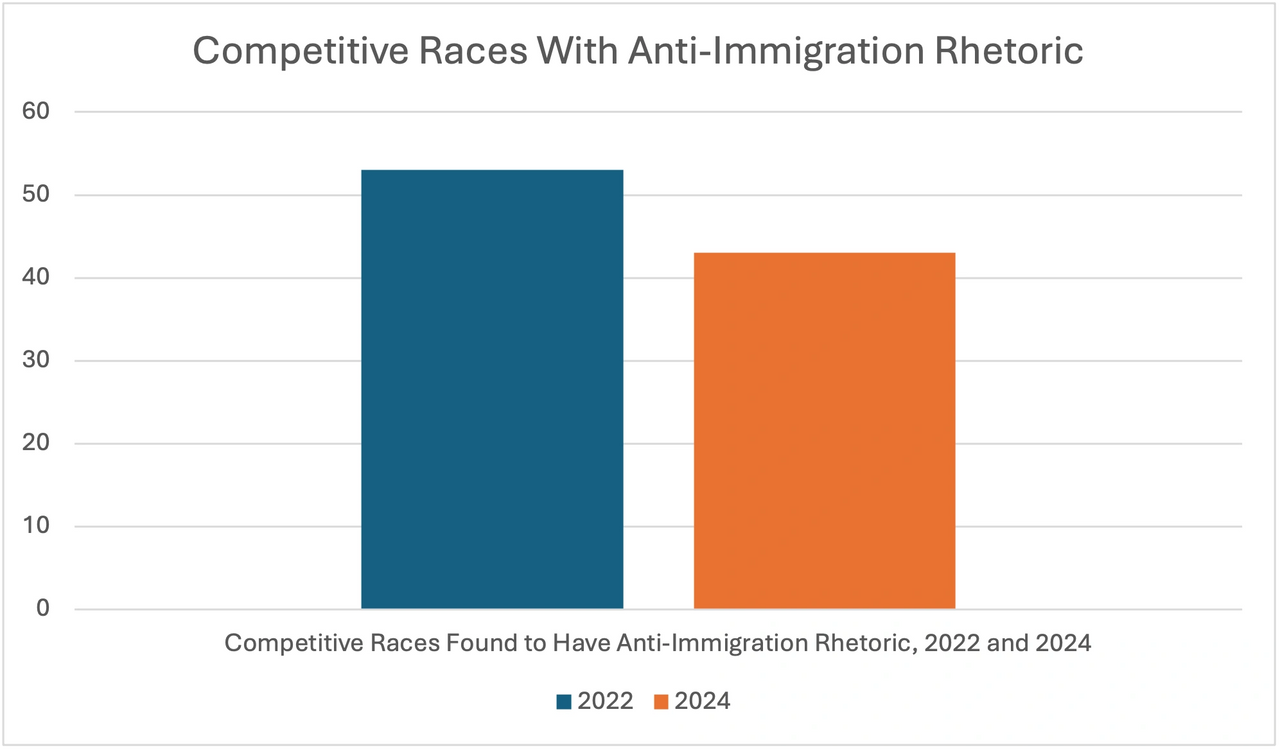
In 2022, there were 77 competitive races (where either party won by less than 10%). In 2022, there were 53 campaigns with anti-immigrant rhetoric in their official materials (campaign websites, social media posts, and TV and YouTube ads). In 2024, there were also 77 competitive elections, with 43 having anti-immigrant rhetoric in their campaign materials. So, anti-immigrant discourse as a main campaign issue dropped from 69% to 56% among Republican candidates in competitive races (see Figure 1).
Figure 1. “Anti-Immigration Rhetoric in Republican Campaigns in Competitive Races”
In 2024, campaigns that employed anti-immigrant rhetoric had a win-loss ratio similar to 2022.
The presence of anti-immigrant sentiment among Republican campaigns fell from 2022 to 2024. While such rhetoric flourished in Trump’s presidential campaign, it was less present in House, Senate, and gubernatorial races. When anti-immigrant rhetoric was present, it ended in failure more often than victory. From this, we could deduce that people are less concerned about immigrants in their communities. Instead, they seem to be more concerned about border security and immigration on the national scale.
Figure 2, “Republicans Who Used Anti-Immigration Rhetoric with Election Results, 2022 and 2024”
In 2024, the Republican message emphasized migration as a security issue, rather than an economic or humanitarian one, arguing that immigration should be treated with the same urgency as any other potential foreign enemy. Migration is framed as a security issue through negative rhetoric surrounding the supposed criminality of migrants, such as the newly coined term “migrant crime,” used extensively by Republicans on the campaign trail. This term is a clear attempt to predetermine the culpability of migrants coming into the US and frame them as criminals, or even as invaders and terrorists, though not so much in competitive races.
Many Republican campaigns may disguise nativist sentiments under the guise of national security concerns. Border security narratives help reinforce anti-immigrant ideas that historically portray migrants, especially Latinos, as criminals or invaders. This ambiguous messaging may explain why many Trump voters did not believe he would legitimately carry out many of his campaign promises regarding mass deportations.
Republican parties promote border security and anti-immigrant discourse from the top down, reducing the need for individual House candidates to explicitly state their views towards immigration. With border securitization becoming a mainstream policy promoted by figureheads on both sides, down-ballot candidates can avoid directly addressing issues like immigration and border walls in their campaigns. By aiming to associate immigration with national defense, the “border crisis” is fabricated to be an existential threat. Oftentimes incendiary rhetoric is used to obfuscate what is real from unreal.
We identify a pattern across the Republican tickets, where candidates with military backgrounds tend to use anti-immigrant rhetoric justified by their experience in the military as evidence for their security concerns (Jay Furman TX–28, Laurie Buckhout NC–1, Mike Garcia CA-27). Evidently, using the facilities at Guantanamo Bay to house migrants reinforces the misconception many Republican candidates echo in their campaigns that migrants are security threats. This also contributes to why top party members, such as Ted Cruz and Donald Trump, used exceptionally strong anti-immigrant rhetoric to make down-ballot candidates more acceptable and mainstream where necessary, while maintaining the same broader party message.
For moral, ethical, and strategic reasons, Democrats should speak openly against anti-immigrant rhetoric. The threat of anti-immigrant rhetoric itself is a real threat, but data shows that the average American voter tends to be indifferent or in favor of immigration, especially at the local and state levels. The political mechanisms that produce this rhetoric have a firm grip on the mediascape that influences national elections, but when it comes to their own communities, voters trust their own eyes and lived experiences about how the immigrants they know are not that much different from themselves.
Joseph Fournier and Bennett Donnelly are Research Assistants at the Immigration Lab. Ernesto Castañeda, PhD is the Director of the Immigration Lab at American University.
Neither Walls nor Deportations Can Stop Mobility and the Search for Asylum and Shelter
by Ernesto Castañeda
Question by Patricia Caro: Your book with Carina Cione, “Immigration Realities,”contradicts many of the ideas circulating about immigrants. Did you feel like it was time to write a book like this?
Answer by Ernesto Castañeda: Yes, the lies about migration have been going on for many years, but Trump placed immigration as the number one issue of his campaign, and he has spread many falsehoods. The public has many misunderstandings about who immigrants are, why they come, and what are the real economic, social, and cultural effects of immigration.
Q. What do you think is the stereotype about immigrants that has caused the most damage?
A. That immigrants are a threat. In many countries, people think that immigrants are taking jobs and houses from the locals. When moving to a new place, it is true that they need a job, but they also pay rent and thus generate more economic wealth. Also, as they are new, they are more likely to create innovations, start businesses, and generate more jobs for locals hiring them directly or through the goods and services they need. But that is something that is not visible to everyone, it is not immediate, and people find it very hard to imagine something they don’t see. However, research and the data clearly show that immigrants and refugees are net contributions in terms of fiscal taxes, economic output, as well as social, intellectual, culinary, and cultural contributions.
The other dangerous myth is that immigrants are a cultural threat. That, if they hear you speaking Spanish, it is because you may not speak English. But many people are bilingual. American culture can be respected and understood very well without immigrants having to forget their own culture. Teachers and administrators in public schools worry when newcomers who do not speak Spanish arrive, but young immigrants pick up English relatively quickly. So do their parents, if they have the time to learn or access to programs to help them do so. History and social science research show clearly that the children and grandchildren of immigrants are culturally indistinguishable from the locals’ descendants. We see this itself with Donald Trump. His paternal grandfather was an immigrant born in Germany, his mom was an immigrant born in Scotland and a native Gaelic speaker, and now DJT thinks he’s the most American of all.
Q. In your book, “Immigration Realities,” you argue that the border area is one of the safest places. It is surprising because the authorities denounce the insecurity of the area.
A. Yes, I was surprised, too. Northern Mexico has become dangerous in the last two decades. Many people think that the border region —on the U.S. side— is dangerous because of the immigrants who arrive, but as we did research for years for this chapter, we found that for an American citizen, especially middle-class white men, it is one of the safest places in the country. However, if you are a newly arrived immigrant, woman, LGBTQ, undocumented, of Indigenous origin, or someone who does not speak Spanish, you may indeed lose your life in the area. For an average citizen, being in El Paso, San Diego, Arizona, or any city, town, or border state, is very safe, and official data shows that crime rates are among the lowest in the United States. The immigrant who arrives at the border wall, asks for asylum, surrenders to the authorities. Those who have escaped the violence of their countries or come looking for work and try to pass through the desert without being arrested or found may indeed die trying. Nonetheless, there are no cases of someone who has committed a terrorist act within the United States who has crossed undocumented across the border with Mexico. The main concern is political violence among citizens and domestic terrorism.
Q. Is there a migration crisis or not?
A. No, no, no. The focus must be on crises abroad. There are crises in Haiti and Venezuela. An invasion of Ukraine, and a civil war ending in Syria. There are wars and tragedies in those and other countries. The displacement of Ukrainian women and children to save their own lives is a humanitarian problem but the main issue is the continued bombing of cities. Conflict-related displacement is not a permanent state. E.g., now with the fall of Assad, we are seeing that many Syrians immediately are returning home. More will do so if things get stabilized there. If Russia ended the war tomorrow, Ukrainians would look forward to returning if their houses were still standing or if they could afford to rebuild. So, it is not a migration crisis first and foremost; it is an armed conflict, it is a genocide, a civil war, a famine, or climate change, that makes people move. Some say people go to other countries because they are rich, but another way of seeing it is that rich countries are rich because they have relatively a lot of migration.
Japan and China are in relative economic decline because of population decline and too little immigration. Japan does not find a way to attract international people, because it has no tradition nor a good record of receiving immigrants. America has been very successful in turning into American people coming from around the world, something that Trump wants to change. Nevertheless, these trends and traditions are difficult to do away with. But if successful, it would be a real decline for the American economy. It is a wish of MAGA people, but if it comes true, it is not going to make America Great Again, it is going to create some of the weakest America in history.
This interview is an edited and extended translation of the interview with Patricia Caro for El País U.S. Spanish edition published here on January 1, 2025.
By Ernesto Castañeda, Joseph Fournier, and Mary Capone
October 1, 2024
Graph elaborated by the authors with data collected from CNN Politics’ Midterm Election Results.
The above graph represents the proportional success of candidates who used anti-immigration sentiment in their campaigns for the 2022 midterm elections. Results data was taken from CNN Politics. Anti-immigration rhetoric was found in campaign material through Meta Ad Library, X (formerly Twitter), debate responses, campaign website archives, YouTube ad searches, and general Google searches. We focused on competitive elections defined as having electoral results within a 10% margin between candidates. Candidates in these competitive elections who used ani-immigrant sentiment were no more likely to win the election than those who did not; in fact, more candidates who campaigned on anti-immigration lost than won in 2022. This data provides evidence that not being anti-immigration is not a hindering campaign decision. It may be quite the opposite.
Immigration often emerges as a prominent talking point among candidates in presidential, congressional, and gubernatorial elections. Former President Donald Trump frequently employs anti-immigration rhetoric and continues to campaign under similar sentiments about the allegedly dangerous porosity of the southern U.S. border. In the presidential debate in June of 2024 against President Joe Biden, Trump mentioned immigration in 42% of the 38 times he spoke while Biden mentioned immigration 13% of the time. In the subsequent debate against Vice President Kamala Harris, out of 38 times when Trump spoke for more than two sentences, he incorporated immigration 10 times (26% of the time). In comparison, Harris did so 4 out of 27 times (15% of the time).
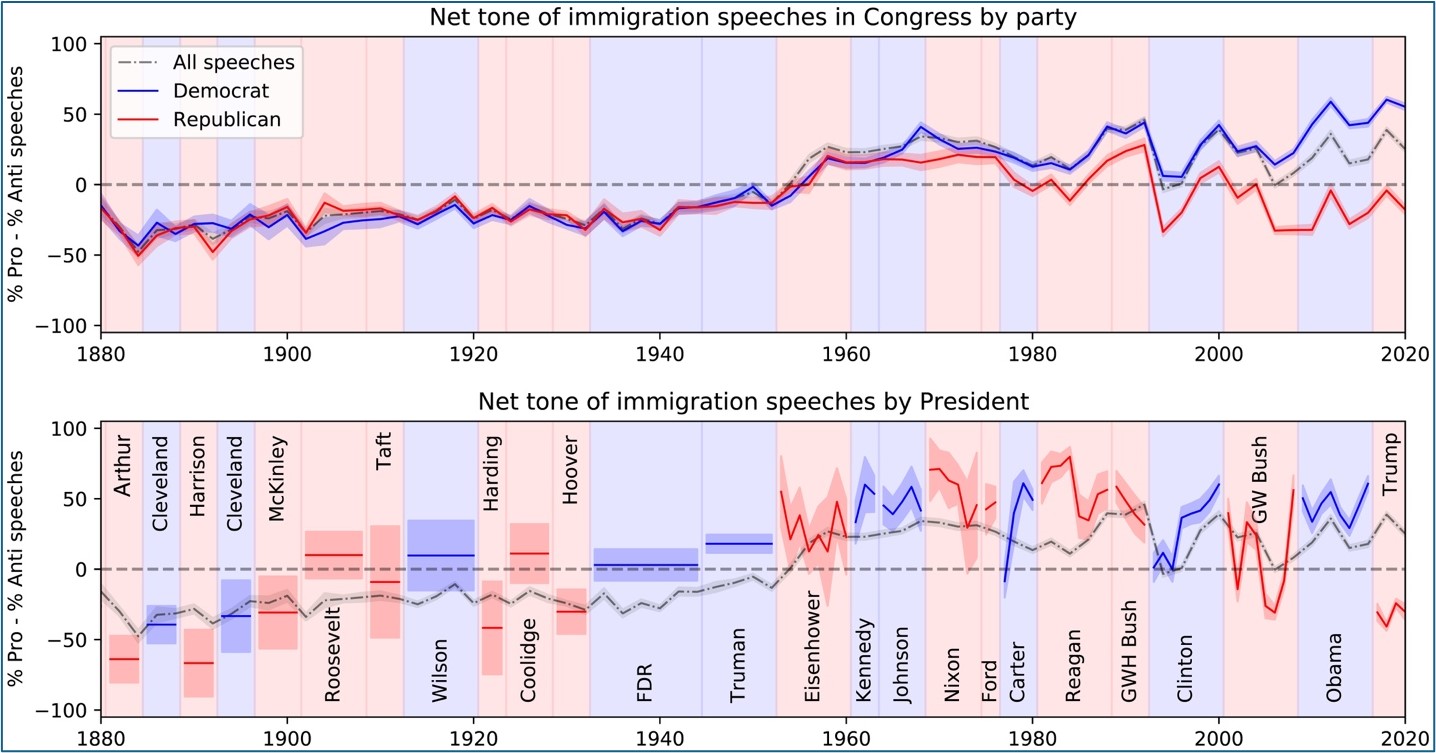
Anti-immigration rhetoric has become practically synonymous with the Republican Party as these candidates often use immigrants as scapegoats for shortcomings in national security, economics, and crime control. While several Democratic candidates support anti-immigration policies as well, it is less commonly a key aspect of their campaigns. The graphic below indicates the overall tone of immigration speeches in Congress and the president by party from the late nineteenth century until 2020. While the data excludes 2022, it encapsulates the general trends of immigration sentiments over time.
Source: Card et al., 2022 published by the Proceedings of the National Academy of Sciences.
The top of the graph shows that trends in the rhetoric of Republican and Democratic congressional representatives were negative before the 1950s and became positive in both parties in the late 1950s and through the 1960s and 1970s. The divergence in sentiments is clearest in the early 1980s and beyond, with the greatest points of divergence occurring between 2000 and 2020. Card et al. acknowledge that the divergence also represents other trends in the polarization of other issues. However, they find that immigration polarization predated the rise in generic political polarization observed in Gentzkow et al. by more than a decade.
The lower part of the graph shows the variation in presidential sentiments through positive and negative language employed to discuss immigration. The anti-immigrant rhetoric of President Trump has been unseen since the presidency of Herbert Hoover. Overall, the graph represents the rise in anti-immigration rhetoric in congressional and presidential speeches by Republicans in recent years as it has become more of a political talking point.
Discourse gathered from the campaign sites and social media accounts of Republican candidates who ran in competitive elections in 2022 with anti-immigration campaigns includes several instances of strongly prejudiced statements. Republican Mark Robertson (Nevada District 1) sought to “turn off the illegal flow of people coming into our country… end chain-migration, visa lotteries and vacation-birth citizenship.” Ending “vacation-birth citizenship” implies a possible erasure of birthright citizenship. Anti-immigrant candidates describe policies like these in misleading ways to garner political support, despite understanding the implausibility of such a policy.
Numerous other candidates posit a link between undocumented immigration and drug cartels. Republican Congressman Bryan Steil, who won in Wisconsin District 1, claimed on his campaign website that “drug dealers (and) human traffickers” are crossing the border, framing it in such a way that implies the two are intertwined in their business dealings. Republican Congressman John James, who won reelection in 2022 for Michigan District 10, conducts a similar framing in a tweet highlighting “millions of illegal border crossings, millions of lethal doses of Chinese fentanyl.”
A more brazen example of such framing can be found in campaign material from Blake Masters’ failed bid for Arizona Senate, which shamelessly claims that “More than 225,000 illegal aliens pour into our country every month. And they bring enough fentanyl over each month to kill every American twice over.” In a recent conference on immigration at American University, Dr. Andrew Selee, head of the Migration Policy Institute, notes that these organizations are separate entities. Though they sometimes do collaborate, they are by no means the same and have independent organizational structures. This is a subtle yet important distinction that has been masked to criminalize migrants and conflate them with criminal enterprises such as drug cartels.
The criminalization of migrants was certainly not limited to linking them to cartels. Many candidates rely upon preconceived racist notions of immigrant populations (mostly Latinos) in making generalizations. Such candidates keep their statements on immigration vague, like Nevada Republican Senate hopeful Adam Laxalt: “[the] crisis at the border that has put communities across Nevada in danger…. [Laxalt] fought against dangerous sanctuary city policies and worked to help stop their spread.” The advantages yielded by anti-immigrant candidates in utilizing this sort of vagueness are twofold. The first is that it appeals to a voter base that has already constructed a negative bias toward immigrant populations, and it is this sort of rhetoric that energizes these voters. The second advantage of such vagueness is the removal of the burden of proof from Laxalt or other candidates. Because of this vagueness, the claim becomes difficult to disprove because the meaning can be fluid and easily manipulated at the whim of the candidate.
Overall, anti-immigration statements like those highlighted in the 2022 midterm election campaigns are prevalent across Republican candidates. Trends indicate a rise in such rhetoric in congressional and presidential speeches with a partisan divergence as Republican candidates are more likely to employ this as a strategy in campaigning. Nonetheless, there was limited success for anti-immigrant campaigns in the 2022 midterm elections. The data shows that anti-immigration rhetoric is not a guarantee for winning elections; in fact, it may be an electoral vulnerability as it does not lead to more success in competitive elections.
Ernesto Castañeda PhD, Director of the Immigration Lab and the Center for Latin American and Latino Studies, American University in Washington DC.
Joseph Fournier and Mary Capone are research assistants at the Immigration Lab and the Center for Latin American and Latino Studies at American University.
Card, D., Chang, S., Becker, C., Mendelsohn, J., Voigt, R., Boustan, L., Abramitzky, R., & Jurafsky, D. (2022). Computational analysis of 140 years of us political speeches reveals more positive but increasingly polarized framing of immigration. Proceedings of the National Academy of Sciences, 119(31). https://doi.org/10.1073/pnas.2120510119
Gentzkow, M., Shapiro, J. M., & Taddy, M. (2019). Measuring group differences in high dimensional choices: Method and application to congressional speech. Econometrica, 87(4), 1307–1340. https://doi.org/10.3982/ECTA16566
James, John. (JohnJamesMI). “Our border is plagued with chaos – millions of illegal border crossings, millions of lethal doses of Chinese fentanyl & incompetence from the White House. I’m glad to support the House GOP’s Commitment to America to fund border security & put an end to human & drug trafficking.” September 26, 2022. 3:10 PM. Tweet. https://x.com/JohnJamesMI/status/1574476402392457217.
On the morning of September 9, 2024, a Republican voter called into C-SPAN’s Washington Journal and said, “Democrats used to be all about the workers, but now it’s just socialism.” This short piece is respectfully directed to those who may share that sentiment. First, it’s important to note that, in principle, socialism is centered around workers, but it asks that workers own the companies they work at. Democrats are not socialists. Even the party’s most progressive figures, like Bernie Sanders and Alexandria Ocasio-Cortez (AOC), identify as Democratic Socialists and advocate for the U.S. to adopt some of the social safety nets seen in Northern European countries and fight monopolies and for workers’ rights to create a tempered capitalism. Now, let’s turn to the real concerns about the economy as we approach the upcoming elections.
The economy is doing well
The U.S. economy is objectively performing very well, largely due to the Biden-Harris administration’s adoption and successful implementation of policies championed by figures like Sanders, Warren, and AOC. Compared to other countries, the U.S. has recovered more quickly from the pandemic’s effects, which were driven by lockdowns, labor shortages, and disruptions to global supply chains—all of which contributed to inflation. These policies, alongside immigration, have supported healthy economic growth. Notably, inflation and interest rates are decreasing without the economy slipping into a recession—an almost ideal outcome often referred to as a “soft landing.”
Nonetheless, some citizens and commentators still insist that the economy is weak, and voters often mention “the economy” as their main concern.
A shift in expectations on the economy
Before the COVID-19 pandemic, it was already common for millions of Americans to live paycheck to paycheck and carry significant debt. The pandemic, however, reshaped Americans economic expectations in at least three important ways: 1) The imminent threat to life placed greater value on human life and people’s time; 2) It exposed our heavy dependence on foreign producers, global supply chains, and essential local workers; and 3) It led to a bipartisan recognition that the government can and should take action to address hunger, unemployment, public wellbeing, inequality and support the working and middle class, as well as small and large business and postpone evictions in times of collective suffering.
Let me elaborate on point three. The economic policies and incentives—such as support for businesses both large and small, direct checks to families, and the child tax credit—implemented in a bipartisan effort during the pandemic by both the Trump-Pence and Biden-Harris administrations significantly raised economic standards and cut child poverty in half. These policies also reflected what C. Wright Mills advocated in the 1960s: when unemployment is widespread, it should be viewed as a social issue rather than a matter of personal responsibility, worth, or morality. In contrast to the neoliberal focus on market fundamentalism, these pandemic-era measures revived Keynesian principles, emphasizing a return to full employment and expanding support for policies reminiscent of FDR’s New Deal—where the government plays a role in reducing inequality and supporting the working and middle class.
The real cause of frustration
One of Joe Biden’s boldest and most significant accomplishments may have been his repeated assertion that “trickle-down economics has never worked. It’s time to grow the economy from the bottom up and the middle out.” This is a change in the long-held belief in individualistic ideologies, such as the notion of “pulling yourself up by your bootstraps.” Stemming from this ideological shift, I believe much of the unease felt by the working and lower-middle class about “the economy” stems from frustration over the end of many pandemic-era cash transfers and stimulus checks, which were initiated by both the Trump and Biden administrations. These transfers and the forced savings due to the lockdowns allowed some families to pay credit card debt and even increase their savings, which for many are now depleted again.
Ironically, it was the Republican Party that blocked the extension of the child tax credit, a key measure backed by Democrats to support working families. Yet, many voters remain unaware of this. Meanwhile, tax-evading billionaires, including figures like Trump, exacerbate the economic challenges rather than providing solutions. A modest increase in taxes on billionaires would help fund essential programs like the child tax credit, and contrary to popular rhetoric, this is not socialism—it’s a practical approach to ensuring fair contributions from the wealthiest.
Outdated and Misguided Economic Narratives
Trump has attempted to link his scapegoating of immigrants to the current economic challenges, falsely claiming that immigrants are taking jobs from those most in need, particularly African Americans, Hispanics, and union workers. However, this argument does not hold up—unemployment rates are low, and wages are rising. As a result, most people are unlikely to be swayed by this rhetoric. Those who do buy into it likely already held anti-immigration views prior to the pandemic and/or are victims of structural changes stemming from Reaganomics.
By invoking fears that the U.S. could become “like Venezuela,” Trump taps into concerns among immigrants who lived Venezuela’s prosperity before Chavismo or those fleeing other authoritarian regimes. However, Republicans risk losing these voters by frequently portraying Venezuelan immigrants as criminals—members of the Tren de Aragua gang—or as individuals released from prisons and mental institutions by Maduro and sent to the U.S. This narrative echoes real historical events such as Cuba’s Marielitos or British prisoners sent to Australia as settlers, as well as xenophobic stereotypes and prejudices once directed at Irish, Italian, and Mexican immigrants. History, however, shows that the children of immigrants often experience rapid social mobility and thus contribute as much, if not more, to society than the children of native-born citizens.
Some attempt to alarm undecided voters by claiming that Harris is advocating for price controls. In reality, she is focused on preventing monopolies and negotiating better prices when the government buys in bulk, as demonstrated successfully with insulin. This pragmatic approach has broad support across Republicans, Democrats, and Independents. Harris and Walz are not pushing radical leftist ideas; rather, they are promoting a moderate populism that is not linked to exclusionary Christian nationalism.
“Opportunity economy”
In her speech at the Economic Club of Pittsburgh on September 25, 2024, Harris stated:
“The American economy is the most powerful force for innovation and wealth creation in human history. We just need to move past the failed policies that have proven not to work. And like generations before us, let us be inspired by what is possible. As president, I will be guided by my core values of fairness, dignity, and opportunity. I promise you I will take a pragmatic approach. I will engage in what Franklin Roosevelt called bold, persistent experimentation, because I believe we shouldn’t be constrained by ideology but instead pursue practical solutions to problems.”
With this statement, she invoked FDR’s legacy while offering a centrist, pragmatic vision for addressing the economic challenges facing Americans.
While some commentators argue that Harris and Walz haven’t provided enough details on their economic policy, they are actually offering a balanced approach that appeals to both corporations and small businesses. Their plan promotes U.S. manufacturing and nearshoring, aims to reduce the climate impact of production and consumption, and provides much-needed support to the low and middle class in regions hit hardest by deindustrialization. Trump talks much about caring about the working class but did little to benefit them structurally and long-term while in the White House. Policies like exempting tips and overtime from taxation fit within Harris’ framework, but Harris also advocates for more ambitious measures to really level the economic playing field a bit more. Harris calls this vision the ‘opportunity economy,’ a pragmatic approach to economic and industrial policy that many former Bernie and Trump supporters could, in principle, support.
Ernesto Castañeda PhD, Director of the Immigration Lab and the Center for Latin American and Latino Studies, American University in Washington DC.
Edited by Robert Albro, CLALS Associate Director of Research, and Edgar Aguilar, International Economics master’s student at American University.
This piece can be reproduced completely or partially with proper attribution to its author.





 AULA Blog