Seeking Rights from the Left

By Elisabeth Jay Friedman and Constanza Tabbush*
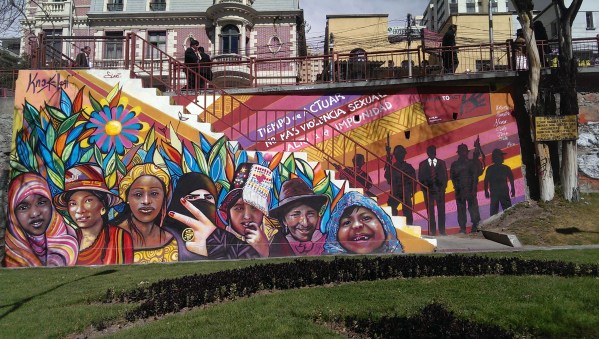
Image of colorful mural with diverse images of women. Text in the mural says: "It is time to act, no more sexual violence. No more impunity"

#TimeToAct Mural in La Paz, Bolivia, by artist Knorke Leaf/ ph: Shawnna Mullenax

The “Pink Tide” of left-leaning governments that came to power in Latin America at the beginning of the 21st century made a significant difference in the lives of women and LGBT people in the region, but its reliance on traditional gendered relations of power and strategic trade-offs among gender and sexual rights reduced its impact.  In a collaborative study we conducted with 12 other scholars from South and North America, we examined the issues of social welfare, political representation, violence against women, women’s bodily autonomy, and LGBT relationship and identity recognition across eight case studies – Argentina, Bolivia, Brazil, Chile, Ecuador, Nicaragua, Uruguay, and Venezuela.

  • We found significant progress under the Pink Tide. Most governments improved the basic economic conditions of poor women and their families, often through providing cash transfers.  In many cases, women’s representation in national legislatures advanced to some of the highest global ranks.  Some countries legalized same-sex relationships and enabled their citizens to claim their own gender identity.  They also opened up opportunities for feminist and queer movements to engage state actors and press forward their demands.

At the same time, many of these governments relied on heteropatriarchal relations of power – ones that privilege heterosexual men – thus ignoring, rejecting, or sidelining the more transformative elements of feminist, women’s, and LGBT advocates’ demands.  They also made strategic trade-offs among gender and sexual rights, such as promoting the rights of LGBT people or women’s political representation while denying reproductive health rights for women.  Moreover, the left’s more general political and economic projects have been profoundly, if at times unintentionally, informed by traditional understandings of gender and sexuality.  As a central example across most cases, not only did poor women’s unpaid care work fuel the much-celebrated social programs that reduced extreme poverty, but their unpaid community work undergirded the left political project as a whole.

  • The possibilities for gender and sexual justice seem to depend on institutional contexts as well as the organization and actions of collective actors seeking rights from the left. The degree of state institutionalization, particularly the effectiveness of checks on executive power, is critical in determining the ultimate impact of the left in power.  Moreover, the largely under-analyzed alliances that progressive political forces struck up with conservative religious ones in order to gain or hold onto power play a central role in determining the fate of policy issues – such as abortion – that touch traditional or cultural norms in Latin America.

As the pendulum swings back towards the right, the relationships among political and religious authorities which undergirded some of the challenges to gender and sexual justice under left governance appear likely to continue strengthening.  Indeed, insofar as right-wing nationalists and populists seek to redefine a national project as a counter to the ideals of the Pink Tide, they are deliberately targeting the ideas and people who seek to transform fundamental inequalities, such as those based on gender, sexuality, class, race, and ethnicity.  However, experiences under both the Pink Tide and the rise of the Right have led to alliances among those who continue to seek more just and equitable societies.  For example, consider the broad-based coalitions that undergirded massive mobilizations for legal abortion in Argentina and against Bolsonaro’s election in Brazil. 

February 4, 2019

*  Elisabeth Jay Friedman is professor of politics and Latin American studies at the University of San Francisco (on leave) and visiting scholar at the Interdisciplinary Center for the Study of Global Change, University of Minnesota.  Constanza Tabbush is research associate at Consejo Nacional de Investigaciones Científicas y Técnicas and the Interdisciplinary Institute of Gender Studies, University of Buenos Aires (on leave) and research specialist at UN Women.  Dr. Friedman edited and co-wrote the introduction of Seeking Rights from the Left: Gender, Sexuality, and the Latin American Pink Tide, published by Duke University Press and available here.  Dr. Tabbush co-wrote the introduction and the chapter on Argentina.

Mexican Government Under Attack for Electronic Spying

By Fulton Armstrong

34318983244_1716737126_k

Mexican President Enrique Peña Nieto. / Presidencia de la Republica Mexicana / Flickr / Creative Commons

Revelations of Mexico’s use of state-of-the-art software to spy on domestic critics and OAS human rights experts have dealt another devastating blow to the credibility of President Enrique Peña Nieto and the Mexican government.  Targeted in the cyberattacks were dozens of individuals and nongovernmental groups from various backgrounds, including leaders of the opposition PAN party investigating corruption allegations; anti-obesity activists lobbying for a tax on sweet carbonated soft drinks that the government opposed; and the Interdisciplinary Group of Independent Experts (GIEI) sent by the Inter-American Commission on Human Rights (IACHR) to investigate the disappearance of the 43 students in Iguala in 2014.

  • The software – known as Pegasus and estimated to cost between $32 million and $80 million – sent the targets personalized text messages with links that, when pressed, led to the total compromise of their smart phones. The messages falsely alerted victims to family emergencies, for example, and said further information was available at a link in the text.  Some purported to be from the U.S. Embassy, providing a link for updates on visa applications.  The link downloaded spyware that allowed the perpetrators full access to all voice and data communications and allowed remote control over the microphone and camera on the affected device.

Confronted with evidence developed by University of Toronto-based Citizen Lab and corroborated by the New York Times, Peña Nieto admitted in late June that his government purchased Pegasus but denied that it was used to target opponents and investigators.  He said that all of the government’s efforts have been “to maintain the internal security of the nation, fight organized crime, to generate security for all Mexicans.”  The Israeli company NSO Group, producer of Pegasus, claims it sells the software only to governments and only for specific anti-terrorism, anti-crime purposes.  The President threatened to investigate those who “have raised false accusations” – a statement his spokesman retracted several hours later – but he did acknowledge the need for an investigation.  The office of the Attorney General (PGR), which was involved in the Pegasus program, was charged with looking into the matter, drawing cries of foul from critics.

  • Officials at the UN Office of the High Commissioner on Human Rights have called on Mexico to allow a full investigation by independent experts. For the same agency that bought Pegasus to investigate its use, they said, was not credible.  An OAS official has stated publicly that the allegations “should be investigated.”

The internal spying scandal is yet another blow to the credibility of the Mexican government on human rights – whether the spying and harassment was approved by Peña Nieto or was the work of rogue agencies.  The President’s credibility has been battered by scandals involving his family and administration, and corruption by state governors from his ruling Institutional Revolutionary Party (PRI) has deepened perceptions of impunity at all levels.  Violence is also creeping back to levels experienced during the term of Peña Nieto’s predecessor, Felipe Calderón.  Among his most corrosive failures, however, has been the lack any progress investigating the brutal killing of the Iguala students.  The government’s claims that it was unable to bring anyone to justice for Iguala – while spending tens of millions of dollars to spy on and harass international experts investigating the incident – has deepened popular cynicism about the President.  Even if he accedes to an independent inquiry, the damage has been done, and he seems likely to limp, at best, toward general elections scheduled for mid-2018.  InSight Crime (a CLALS-sponsored foundation) has also called the scandal “a massive self-inflicted wound in [Mexico’s] fight against organized crime” because it compromised anti-crime operations and undermined the government’s credibility.

July 24, 2017

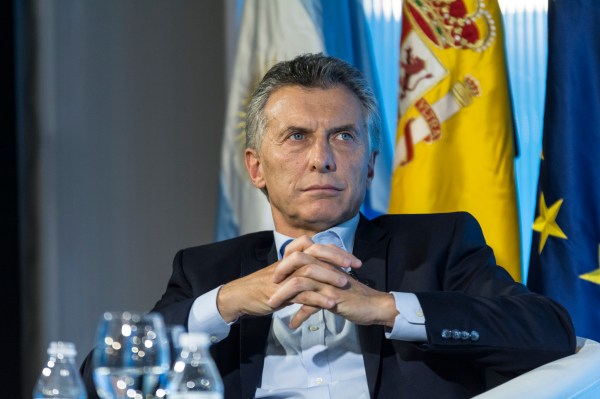
Macri in the Next 100 Days

By Nicolás Comini*

32919903642_2bd30877a1_k

Argentine President Mauricio Macri. / Casa de América / Flickr / Creative Commons

Everybody seems to love President Mauricio Macri outside Argentina – it’s not hard to understand why – but he faces tough challenges at home.  Foreign supporters have plenty of reasons to believe in him.  First, he is not Cristina Fernández de Kirchner, the former president whom they branded a populist too close to Venezuela, Bolivia, or Ecuador.  Like many conservatives inside Argentina itself, they see Macri as the person who avoided the “Venezuelization” of the country, and his market-friendly credentials were sealed through his campaign promise of a “rain of investment” and his government’s implementation of a package of measures aimed at financial liberalization, regulatory flexibility, liberalization of foreign trade, and stronger fiscal discipline.  He has been less confrontational in diplomacy.  “Return to the world,” “de-ideologization,” “pragmatism,” and “transparency” are the continuous slogans that draw the foreign accolades.

Things look different at home, however.  The federal government confronts a convoluted scenario in the next 100 days, during which it will face at least three sets of sensitive issues in the run-up to Legislative primaries in August and elections in October.

  • Domestic issues. The government will have to deal with a hostile internal front.  One challenge will be resolving a long-running pay dispute with teacher unions – especially in the province of Buenos Aires.  Another is quelling complaints about steep increases in the costs of government services and deep slashes in funding for Science and Technology, Culture, Human Rights, Health, Production, and Energy.  Macri’s failure to meet inflation reduction targets (prices rose by 40 percent in 2016); the need to stimulate the economy; and debates on tax reform are a daunting agenda.
  • Controversy over human rights and immigration. One of the Achilles’ heels of the current administration is the imprisonment of social activist Milagro Sala in the northwestern province of Jujuy.  An ally of former President Fernández de Kirchner, Sala was arrested in January 2016 – one month after Macri took office – on highly contested charges: initially of “instigate criminal activity disorder” and later of “illicit association, fraud, and extortion.”  Pope Francis, Canadian Prime Minister Trudeau, and UN officials have expressed concern, fueling tensions inside Argentina.  An immigration reform decree facilitating deportations and restricting access at border crossings has been rejected by social movements, international organizations, and much of the Argentine political opposition.  The repudiation is not only felt in the formal political arena but also on the streets.
  • External dynamics with internal consequences. Brazil’s Lava Jato scandal is splashing as much onto Macri’s government as his predecessor’s.  Officials from both administrations are being accused of receiving bribes from Odebrecht, the largest Brazilian construction company, and no one knows how this process will develop hereafter.  Congresswoman and Macri ally Elisa Carrió claims the whole political elite is complicit in the Odebrecht mess.  The “Panama Papers” – leaked from the law firm Mossack Fonseca, which allegedly was involved in helping companies hide bribes paid to a number of South American leaders – has so far not touched Macri, whose family has links to firms cited in the documents.

The August primaries, followed by full legislative elections in October, are a potential inflection point for both Macri and his opponents.  Neither side has yet announced its slate of candidates, but one essential factor is already clear: the candidacy (or not) of Cristina Fernández de Kirchner.  The primary election will define how the pieces of the political chessboard are placed, and Macri’s handling of his economic, political, and social challenges will be decisive.  Achievement of his reform agenda – including the overhauling the National Institute of Statistics and Census (INDEC, accused of cooking data during previous governments), an ambitious “Plan Belgrano” infrastructure program, and the end of currency controls – may not be enough.  The potential reunification of his key Peronist opponents, increased social unrest, splits in his own coalition, and the spillover from the Brazilian crisis suggest a sobering future.  True love cannot be achieved from one day to the next, but in the domestic political arena it is simple to lose it suddenly.

June 8, 2017

* Nicolás Comini is Research Fellow at CLALS; Director of the Bachelor and Master Programs in International Relations (Universidad del Salvador, Argentina); and Professor at the New York University-Buenos Aires.

Nicaragua: Shirking Obligations on Gender-based Violence

By Pamela Neumann*


15265768473_2316590a31_k

March against violence in Managua, November 2014. Oxfam en Nicaragua / Flickr / Creative Commons

Recent actions by the Nicaraguan government directly conflict with its obligations under accords on gender-based violence, but regional mechanisms, including the OAS, have not been effective at holding Managua to account. The 1994 Inter-American Convention on the Prevention, Punishment, and Eradication of Violence against Women (Belém do Pará), which Nicaragua ratified in 1995, defines violence against women as any act of physical, sexual, or psychological violence occurring in either the public or private sphere (Article I, III) and obligated state signatories to establish fair and effective legal procedures to address crimes against women (Article VII). The Convention also stipulated that States report steps taken to prevent and prohibit gender-based violence (Article X). In 2004, the OAS introduced a Follow-up Mechanism (MESECVI) to provide additional technical assistance and more closely monitor state actions.

Nicaragua has not submitted information to MESECVI since 2008, and its performance has become even more problematic in subsequent years. In 2012, the government passed a comprehensive law on gender-based violence (Law 779), which significantly advanced women’s legal rights and protections. Over the last three years, however, the law has been substantially undermined by legislative reforms and executive decrees. For example, mediation, an informal practice police historically used to resolve cases, was first eliminated and then reinstated. Mediation puts women’s lives at significant risk because there are no legal consequences for violating the non-binding agreements it produces. In addition, beginning in 2014, women seeking to file a legal complaint for gender-based violence were sent to neighborhood councils or the Ministry of the Family for counseling instead. Police units charged with handling domestic violence cases have been closed for over a year.

The OAS has been leaning hard on Nicaragua to address threats to its electoral process – forging an agreement last month allowing the OAS to send a team to observe municipal elections in November – but its performance as arbiter of signatories’ adherence to the Belém do Pará Convention has been less effective. The convention’s enforcement mechanisms are limited; the main recourse that individuals or organizations have is to submit a petition to the Inter-American Commission on Human Rights, which can forward it to the Inter-American Court of Human Rights (IACHR). But action is inhibited by the stipulation that cases are only admissible when “remedies under domestic law have been pursued and exhausted” and because current regional agreements do not allow for any specific OAS-IACHR action to be taken on the basis of legislative action or inaction. The OAS’s existing instruments, moreover, put the burden on individual aggrieved parties to demonstrate the state’s intentional complicity in denying women due process. This requires showing evidence of state officials actively impeding one particular investigation or engaging in violent acts themselves. Numerous studies, including my own research, have shown that such behavior is in fact ubiquitous, but less than 1 percent of cases even make it to trial. Despite good intentions, the legal remedies afforded by the OAS tend to individualize and privatize the problem of gender-based violence – and the Nicaraguan government is not being held accountable for its failure to prevent or punish fundamental violations of women’s human rights.

March 30, 2017

*Pamela Neumann is a Post-Doctoral Fellow at the Stone Center for Latin American Studies, Tulane University.

Brazil’s Prison Violence Reflects Deeper Social Problem

By Andrew Johnson*

pinheiros_iii_05

An interim detention center in São Paulo, Brazil. / Rovena Rosa / Agência Brasil / Wikimedia / Creative Commons

It has been a horrific start to 2017 in the Brazilian prison system, and reversing the trend will take much more than increased public funding.  A wave of violence began on New Year’s Day when 56 inmates were killed during a riot inside of a penitentiary in Manaus.  A series of deadly inmate uprisings followed that massacre, bringing the number of inmates killed this month to 120.  Macabre images of inmates’ decapitated corpses strewn about prison yards captured on cellphone cameras and posted to the internet reminded Brazilians that overcrowding, a weak state presence, and institutionalized gang power have combined to make Brazilian prisons – with over 600,000 inmates – tinderboxes ready to ignite at almost any time.

  • During a year I spent conducting fieldwork inside jails and prisons in Rio de Janeiro for a book and documentary film in 2011, I saw inmates crammed into cells at three and four times their intended capacity. On the worst nights, men unable to find space on the floor or a concrete bunk tied their torsos to the steel gates with t-shirts and attempted to sleep while standing.
  • The Comando Vermelho and other gangs controlled entire cellblocks and used smuggled cell phones and strategic visitors to maintain regular contact with leadership. This communications capability and weapons caches inside the cellblocks enabled them to act as the de facto government. Prison guards knew that they were outgunned and outnumbered, and they knew their off-duty lives could be easily extinguished by an order initiated inside the prison.  January’s riots revealed how thin the veneer of state control really is inside.

Impassioned pleas, prompted by the riots, to reduce overcrowding and provide more resources to Brazil’s prison system are being launched in a time of austerity.  The Brazilian Senate recently approved legislation that could freeze public spending for the next 20 years.  Public investment would certainly reduce the likelihood of future riots, but the crisis in Brazil’s jails and penitentiaries is not caused simply by underfunding.  It is the result of decades of the state treating inmates, and the residents of the neighborhoods where most of them were born, as less than full citizens.  Pastor Antonio Carlos Costa, leader of the human rights organization Rio de Paz, told me the state and public’s reactions to the many thousands killed by the police and hundreds murdered in prisons each year were limited because “they are poor people, people with dark skin, people considered killable.  These are deaths that don’t shock us, they don’t make the Brazilian cry.”

There is no excuse or justifiable defense for the inmates involved in the 120 murders that occurred inside Brazilian prisons this month.  It was an inhumane slaughter propelled by gangs, greed, and a power grab.  But the solution to Brazil’s profoundly troubled prison system lies much deeper than increasing public spending or reducing overcrowding.  Refusing to treat people as killable, gang-affiliated or not, is a goal that may take decades and will require a commitment that is much costlier than any public spending intervention or new legislation.  Laws protecting human rights would have to be enforced for all Brazilians, including prisoners.  Law abiding middle and upper-class citizens would have to push back and no longer tolerate some of the world’s highest murder rates and jails where 80 men squeeze into a cell built for 20.  Transformation this profound would be a difficult message to sell on the campaign trail, but anything less than that sort of social and cultural change from the government and the public will fall short of fixing the deeply rooted problems with Brazil’s prison system.

January 27, 2017

*Andrew Johnson is a Research Associate with the Center for Religion and Civic Culture’s Religious Competition and Creative Innovation (RCCI) initiative at the University of Southern California.

NiUnaMenos Gains Momentum

By Brenda Werth* and Fulton Armstrong

marcha_ni_una_menos_1

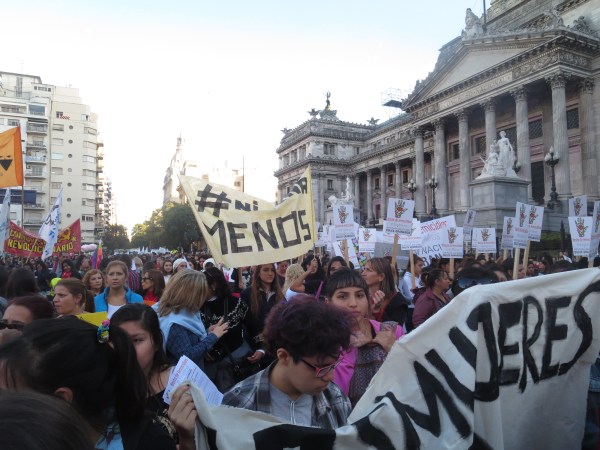
Protesters gather in Buenos Aires, Argentina as part of the NiUnaMenos movement, which has sparked mobilizations across the country and in many other Latin American cities. / Wikimedia / Creative Commons

Protesters have taken to the streets in Argentina and elsewhere in Latin America to raise awareness about violence against women and girls, pushing for an end to machista culture.  News media estimate that a demonstration under the banner of NiUnaMenos – “not one less woman” due to femicide – in Buenos Aires last Wednesday drew tens of thousands of supporters dressed in black, despite freezing rain.  Other banners declared “We want to live” and demanded “No more machista violence.”  The immediate issue driving the protest was the brutal attack earlier this month on a schoolgirl in Mar del Plata – 16-year-old Lucía Pérez – who was drugged, raped, and tortured to the point of suffering cardiac arrest and died from internal injuries.

  • Argentina passed laws between 2008 and 2012 protecting a range of rights relating to human trafficking, violence against women, marriage equality, and gender and sexual identity, creating new space for discussion of the issue. But the Casa del Encuentro, an NGO that helps victims of gender violence, says that data through 2015 indicate that somewhere in Argentina a woman is killed every 30 hours.  The government’s Secretariat of Human Rights says that 19 women and girls were murdered in the first 18 days of October.  Argentine President Macri, challenged since early days of his administration to address the problem, has reiterated pledges to push legislation that would establish a hotline for reporting abuse and create more shelters for abused women as well as better ways of monitoring abusers.

Similar protests were held in Peru, Mexico, Bolivia, Chile, Paraguay, Uruguay, and El Salvador – with thousands of protesters in capital cities demanding an end to the systematic violation of women’s rights.  Chilean President Michelle Bachelet announced last week that she was joining the NiUnaMenos movement.  She condemned the murder of a 10-year-old girl asphyxiated, burned, and buried by her step-father.  Movement organizers cite research showing that violence against women is a serious problem in much of Latin America.  The Mapa da Violencia published by FLACSO Brazil last year shows that seven of the 10 countries with the highest female murder rate are in this region – with El Salvador (8.9 homicides per 100,000 women), Colombia (6.3), Guatemala (6.2), and Brazil (4.8) near the top of the list.

The demonstrations reflect growing global awareness of gender violence as a violation of human rights and that legislation, while helpful, is not enough.  NiUnaMenos and other groups are also rewriting the traditional definition of violence against women as attacks perpetrated by strangers rather than boyfriends, husbands, or family members – just as coverage of femicide in Mexico in the 1990s raised public awareness of gender violence as systematic and deeply structural as opposed to “every-day,” “familial,” and “private.”  NiUnaMenos is challenging “the culture of violence against women” in machista societies and condemning “the men who think that a woman is their property and they have rights over her and can do whatever they want.”  In Argentina, the mainstream media have stimulated much of the backlash, with reporting that exploits private details of victims’ lives and portrays victims in a manner that suggests responsibility for the crimes committed against them.  This recycling of the “algo habrá hecho” logic that circulated freely during the dictatorship coincides with a renewed focus in Argentine society on cases of torture during those years, treating them specifically as acts of sexual violence.  A week or two of protests obviously will not change ingrained culture, but the burgeoning movement highlighted by NiUnaMenos offers hope of continued progress in protecting the fundamental rights of women throughout the hemisphere.

October 24, 2016

* Brenda Werth is Associate Professor of World Languages and Cultures at American University.

Mexico: Repressing Organized Dissent

By Marcie Neil*

Mexico teacher protest

A photo from the protest on June 19. Credit: LibreRed / Google / Creative Commons

The Mexican government’s latest reaction to the country’s largest teachers union’s challenge to education reform is triggering accusations of gross human rights violations at a time that President Enrique Peña Nieto is already under severe pressure over the case of the missing 43 students from Ayotzinapa, even if the union’s reputation – and the government’s historical demonization of it – may undercut the teachers’ cause.  Protesters associated with the Coordinadora Nacional de Trabajadores de la Educación (CNTE) clashed with state and federal police in Nochixtlán, Oaxaca, on June 19, leaving eight dead, more than 100 wounded, and at least 25 detained.  The clashes culminated a series of CNTE-led protests over a 2013 reform that puts the onus on teachers for student success through government-mandated tests and teacher evaluations – akin to the U.S. “No Child Left Behind Act.”  CNTE members consider the reform disconnected from the realities of teaching in Mexico’s underprivileged, indigenous, and rural environments, and view it as a threat to their collective decision-making authority and hard-won benefits from the 1980s and 1990s.

  • The CNTE denounced Nochixtlán as another example of excessive police force, and press reports and citizen testimony have refuted the President’s claim that police met protesters unarmed. The administration subsequently offered to meet with union leaders to discuss the reform, but it was seen as offering too little too late.

The CNTE is not the country’s most respected institution, but its complaints about the brutal police reactions to its protests have merit and have stimulated a national debate on Mexico’s commitment to human rights.  The union’s reputation has been tarnished by repeated disruption of school schedules, internecine strife, recent arrests of leaders on corruption charges, and a recently eliminated, but oft-cited, benefit that allowed union members’ children to inherit their jobs regardless of merit.  But the state’s implicit culpability in the disappearance of the 43 students in Ayotzinapa and the death toll on June 19 seems to have tipped the perceptions of its dispute with the state momentarily in favor of CNTE.  That dispute and others with popular organizations have deep roots – going back to mobilizations in the 1960s, including the Tlateloco Massacre in 1968, and the brutal repression of a 2006 teachers strike in Oaxaca.  The historical pattern is one of state abuse against mostly harmless citizens who feel denied democratic participation.

The Peña Nieto administration’s reactions thus far do not suggest a desire to break with that pattern, even in the face of public outrage over this month’s killings.  The Mexico representative of the United Nations High Commissioner for Human Rights and others have called for an independent investigation into the Nochixtlán violence, but the government’s stonewalling of the Ayotzinapa investigation suggests these attempts at overcoming impunity face dim prospects.  Education Minister Aurelio Nuño’s statement the day after the confrontation confirming the government’s commitment to uphold the education reforms further fueled public anger.  Absent an independent evaluation, the bloody events of June 19 could remain as evidence that the Mexican government is simply unwilling to overcome its historical tendency to attack those it considers subversive. 

July 1, 2016

* Marcie Neil received her Masters in Latin American Studies at American University in 2015 and served as a Graduate Assistant at the Center for Latin American and Latino Studies.

El Salvador: Dual Crackdowns Raise Questions

By Fulton Armstrong

El Salvador Seguro

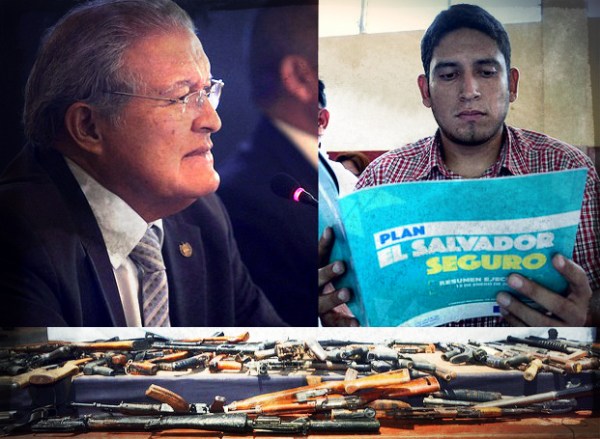
Photo Credits: Presidencia El Salvador and Departamento de Seguridad Pública OEA (modified) / Flickr / Creative Commons

Salvadoran President Sánchez Cerén’s months-long crackdown on gangs has broadened into a crackdown on proponents of negotiations with them.  Upon orders of Attorney General Meléndez, 18 former officials involved in the past truce (covering two periods in 2012-2014) have been arrested, among them a principal mediator, former FMLN Congressman Raúl Mijango.  Three others, including the former head of prisons, are on the run.  Meléndez claims that the recent passage of legislation outlawing negotiations with gangs was not a factor, and that the detainees are not being held for their role negotiating the previous truce, but rather for violations of laws in place during the truce.  They are accused of “dereliction of duty,” “illicit association,” smuggling mobile phones into prisons, and possible misuse of US$2 million for truce implementation.  Meléndez said the government-gang pact “was not illegal” and he noted that it did help reduce reported murders, but he has asserted that it gave rise to disappearances and other violence, and allowed the gangs to re-arm and consolidate their control in some sectors.

The campaign against pro-dialogue voices has left several prominent players untouched.  The government has distanced itself from the activities of current Interior Minister Arístides Valencia, whose taped conversations with gangs have been revealed by the media, but he has been neither fired nor arrested.  Former Security Minister (and current Defense Minister) David Munguía is widely seen as the principal architect of the previous truce (securing essential cover from the Church for it), but he too remains in place.  Munguía’s name is prominent in Meléndez’s report, according to press accounts, but the Attorney General said that he lacks evidence of his involvement in wrongdoing.  Paolo Luers of El Diario de Hoy (himself a secret negotiator in 2012) and others are severely criticizing the lack of charges against Munguía while others, whom they call “political prisoners,” are detained.

  • Meanwhile, the government is deploying elite joint Army-Police units to hunt down alleged gang members in the countryside, amid growing unconfirmed reports of human rights violations.  The Office of the Human Rights Ombudsman has identified 13 cases of extrajudicial killings in two operations last year.

The recent arrests have caused debate to flare over the costs and benefits of the past truce and any future agreements with the gangs – as well as the efficacy of the mano dura approach. The crackdown on advocates of negotiations and the simultaneous emerging signs of death squad operations could threaten the credibility of the Sánchez Cerén government’s El Salvador Seguro strategy, which entails an array of efforts requiring political agreement on how to address the violence crisis.  Amidst mounting concern about the implications of the police and army crackdown on gangs, Washington has kept a low profile on these developments.  If current trends continue, however, the dual crackdowns could potentially raise doubts about the Administration’s ability to meet the human rights and other conditions that the U.S. Congress has put on the Alliance for Prosperity under which El Salvador, Guatemala, and Honduras have agreed to form and execute a common strategy against violence and other problems in Central America’s northern triangle.

May 16, 2016

For previous AULABLOG items on the impact of the Salvadoran truce, click here (January 2013), here (November 2014), and here (April 2015).

*This version of the blog was updated May 16, 2016 at 10:25 a.m.

Mexico: Deepening Credibility Crisis

By Fulton Armstrong

Buitrago GIEI

Expert Angela Buitrago during the presentation of the initial GIEI report last October. Photo Credit: Comisión Interamericana de Derechos Humanos / Flickr / Creative Commons

Last week’s report on the disappearance of 43 Mexican students from the tiny village of Ayotzinapa left many questions unanswered about events on the bloody night of September 26-27, 2014, but it left no doubts about the depth of the corruption at the local and national level swirling around the youths’ tragic deaths.  The Mexican government – recipient of more than $2 billion in U.S. security assistance in the last eight years – not only produced a bogus report last year, based on tortured and otherwise impugnable sources, to divert attention from the tragedy; it also actively impeded the work of the Interdisciplinary Group of Independent Experts (GIEI), operating under the aegis of the Inter-American Commission on Human Rights, that produced the new report.  GIEI members documented the witness-tampering, obstructionism, and overall lack of cooperation of the administration of President Enrique Peña Nieto.  As the public presentation of the report wrapped up, the massacre victims’ families and supporters – some holding signs demanding to know ¿Dónde están?” – made clear their fear that the government will again sweep the case under the carpet and chanted to the experts, ¡No se vayan!”

Many details of the kidnapping, torture, and execution of the 43 youths, who were studying to be teachers, probably will never be known because much of the evidence has been tainted or destroyed.  The GIEI, however, pieced together a largely verifiable explanation of events in which local police, Federal Police, and the Army went on a bloody rampage after the students commandeered buses, as they had on other occasions with the tolerance of their owners, to transport classmates to a protest the following day.  The authorities tracked the students’ movements, set up roadblocks, systematically terrorized them, and summarily executed those who escaped and tried to tell of the atrocities.  The cover-up started immediately, culminating four months later in a report by the Office of the Attorney General (PGR) – one of Washington’s closest partners in curbing narcotics-related crime and violence – falsely claiming the students were mixed up in struggles among narcotraffickers.  The GIEI demonstrates that there is no way a serious PGR investigation did not know otherwise.

  • International and domestic reaction to the report has been strong, but Peña Nieto’s reaction has been low-key. (He also made headlines last week in proposing the decriminalization of marijuana.)  In several Tweets, the President thanked the GIEI; promised that the PGR will “analyze the complete report to improve its investigation of the tragic events”; and pledged that the PGR “will continue working so that there is justice.”  The U.S. Department of State issued a statement saying that “we trust the Mexican authorities will carefully consider the report’s recommendations.”

Peña Nieto cannot escape personal responsibility for the scandalous cover-up and obstructionism – he promised a full accounting long ago – but the GIEI report indicts much more than the presidency.  From the rural police and Army officers on the scene to the highest levels of law enforcement and the military command in Mexico City, the violence against the students has been neither admitted, condemned, nor punished, reinforcing Mexico’s longstanding culture of impunity.  The PGR’s report was tainted by deliberate falsehoods as well as the vicious forms of torture employed to exact false testimony from “witnesses.”  (Other torture stories, including an incident in which the Minister of Defense apologized for Army and Police torture of a woman in prison, are increasing in frequency.)  The U.S. Department of State’s human rights report, released two weeks ago, criticizes Mexico for its “impunity for human rights abuses,” but Washington also needs to ask whether the $2.1 billion of “Mérida Initiative” assistance it has provided to “help Mexico train and equip its law enforcement agencies, promote a culture of lawfulness, [and] implement key justice reforms” has been a good investment.  The U.S. Senate has finally confirmed the new U.S. Ambassador to Mexico, one of the architects of State Department’s implementation of the Mérida Initiative, and it stands to reason that she will demand some accountability.

May 2, 2016

President Obama’s Visit to Buenos Aires: An Important Gesture

By Katherine Hite*

Parque de la memoria Argentina

Parque de la Memoria, Argentina. Photo Credit: Jennifer Yin / Flickr / Creative Commons

While most eyes are on U.S. President Obama’s historic visit to Cuba, the timing and agenda of his follow-on travel to Argentina – while controversial – also is a significant opportunity for the United States to burnish its image in Latin America.  Obama arrives in Buenos Aires on the 40th anniversary of Argentina’s military coup d’etat, marking a brutal period of systematic human rights violations in which the United States lent tacit support.  In an important attempt to ameliorate the controversy over his timing, Obama will be delivering a cache of declassified documents on both what the U.S. knew regarding the 1976-1983 repression and on the green light that Secretary of State Henry Kissinger gave the dictatorship’s dirty war against political opponents during the final year of the Ford presidency.  In addition, the President will visit the Parque de la Memoria, site of a memorial to the thousands of victims of the military regime.  He’d expressed interest in a visit to the ex-Navy Mechanics School (ESMA), notorious former clandestine detention site where an estimated 5,000 Argentines were imprisoned, 90 percent of whom were murdered, but political sensitivities in Buenos Aires precluded it.

Argentina has pioneered efforts to come to terms with the past, from prosecuting and jailing former military officers guilty of violations, to “recuperating” former clandestine detention centers, where citizens were tortured, executed, and made to “disappear.”  Human rights activists have converted several of these former centers, such as the ex-ESMA, into spaces to remember and to educate the public with a message of accountability and of “never again.”  Some memory sites also seek to connect human rights violations of the past to ongoing violations, including police brutality and the abuse of the incarcerated, as well as to present-day struggles for social justice.  Argentine school children learn about their past and study the Universal Declaration of Human Rights.

It is an important moment for the U.S. president publicly to recognize the U.S. historic role in Argentina’s tragic past – and for Argentines to show Washington, itself accused of torture and clandestine detention in recent years within its “War on Terror,” that such abuses can never be tolerated and that perpetrators must be brought to justice for a democracy to be healthy and stable.  Countries throughout the region, including Chile, Uruguay, Peru, Colombia, El Salvador, and Guatemala, have similarly created memorials and museums of memory.  Chile’s Museum of Memory and Human Rights gets over 10,000 visitors a month.  It houses a large permanent display documenting the 1973-1990 dictatorship, and like the ex-ESMA, opens its spaces to human rights organizations, artists, theater groups, and others for workshops, plays, movie series, and more.  In El Salvador, the Museum of the Word and the Image sponsors an exhibit on the roots of the country’s civil war as well as memories of the suffering and resistance.  It has also sponsored exhibits on Salvadoran migration to the United States during the war and connects past to current violence, both within El Salvador and in close relation to the United States.  Together these efforts invite acknowledgment, reflection, and dialogue.  President Obama’s activities in Argentina, like President Clinton’s apology in Guatemala for the U.S. role in past violations in that country, are an important gesture that, within a broader U.S. commitment, could help facilitate a less tarnished image for Washington in Latin America along with his historic shift in policy toward Cuba.

March 21, 2016

* Katherine Hite is professor of political science at Vassar, with special interest in Latin American politics, social movements, and the legacies of violence for governments and societies throughout the Americas.