Chilean Watershed?


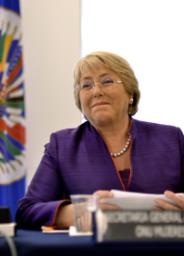
Michelle Bachelet / Photo credit: OEA - OAS / Foter.com / CC BY-NC-ND

Michelle Bachelet / Photo credit: OEA – OAS / Foter.com / CC BY-NC-ND

Sunday’s presidential primaries in Chile – the country’s first ever –reaffirmed former President Michelle Bachelet’s leadership of Concertación and cleared the way for a faceoff in November between herself and the Conservative candidate, Economy Minister Pablo Longueira.  Bachelet trounced challengers within her center-left coalition, winning 74 percent of the primary vote, and seems poised to build on the astounding 81 percent approval rating she had in 2010 when her first term ended.  (Current President Sebastián Piñera’s approval rating now hovers around 40 percent, a two-year high for him.)  Conservative Longueira will have the advantage of Piñera’s incumbency, but his party’s somewhat weaker performance on Sunday – with about 27 percent of all votes cast – and his slim 3 percent margin within the coalition suggest a tough campaign ahead for him.  Most observers deem Longueira’s performance in Piñera’s cabinet to have been competent but unexciting, and they predict an easy Bachelet victory in November.

Whichever candidate wins, Chile faces an evolving set of challenges.  Its commodities-driven economy is slowing down, and a stubborn gap between rich and poor is fueling demands for tax and education reforms.  Chile is ranked the most unequal country of the 34-member Organization for Economic Cooperation and Development (OECD).  Widespread demonstrations by students, teachers and professors have been demanding free tuition from preschool through university, and key labor unions are increasingly joining these mobilizations for reform.  Accepting her primary victory on Sunday night, Bachelet said voters were motivated by a desire for tax and education reform as well as a new constitution to replace the one created under dictator Pinochet in 1980.  She has also said that if elected she will halt the controversial HydroAysén project, which would build five mega-dams on two of Chilean Patagonia’s rivers.  Despite this rhetorical shift leftward and her role as the leader of the Socialist Party, such statements are not expected to lead to significant policy shifts; Chilean observers say she will continue to hew closely to the market-friendly policies that helped make Chile one of the region’s most stable countries during her first term.

Bachelet’s and Longueira’s competition may fail to excite the electorate in November, when voting will not be obligatory for the first time, and low turnout could deprive the victor of the mandate needed to lead thorough change, an arguable requisite  to increase the credibility of democratic institutions.  Empowered by two years of protests, student leaders are not leaving things entirely up to political elites.  Many are also running for office and aspire to bring a new perspective and direction to reforms in Chile.  International attention has focused in recent weeks on popular mobilizations in Brazil, but as recently as last week, tens of thousands of Chileans marched through the streets of Santiago and other major cities, challenging the credibility of the existing political order.  Bachelet has made deals with some of the protest leaders – agreeing, for example, not to run a Concertación candidate against one of them in a congressional race – but their demands are unremitting and strategic, and the winner of the upcoming election faces  a real challenge in trying to satisfy them. 
Brazil Protests: Amorphous Causes, Unpredictable Consequences

By Matthew M. Taylor

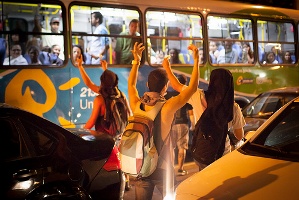
Protestors in Brazil / Photo credit: Izaias Buson / Foter.com / CC BY-NC

Protestors in Brazil / Photo credit: Izaias Buson / Foter.com / CC BY-NC

Hundreds of thousands of Brazilians hit the streets of a dozen state capitals this past week.  The initial trigger was a proposed hike in São Paulo bus fares, already among the world’s most expensive, but news media soon reported that the protests reflected anger with the rising cost of living, crime, corruption, impunity, and the high costs of hosting the World Cup. Lackluster public services haven’t helped, and widely televised police violence last week provided another rallying cry.  Polling by Datafolha shows that the protest is a middle class phenomenon, with 77 percent of the marchers in São Paulo claiming a university degree.  This growing demographic group is turning against President Dilma Roussef’s Worker’s Party (PT) but it is also weary of the opposition PSDB, especially in São Paulo state.

So far, the protests have been difficult for political parties to harness for their own ends.  Partisans who showed up at the marches on Monday waving party flags were reportedly forced to pull them down by indignant protestors.  Dilma’s popularity has been falling – she was recently booed at the opening match of the Confederations Cup – but the marchers don’t seem collectively exercised about her policies or those of any single party or politician.  Aecio Neves, Marina Silva and Eduardo Paes, her potential opponents in elections scheduled for late 2014, have yet to capitalize on her vulnerabilities, as the protestors seem to be casting “a pox on all their houses.”  An outside candidacy is a rising possibility, but Brazilians have been wary of supposed political saviors after the rapid rise and fall of Fernando Collor in 1990‑92.  Anger is directed at the political class as a whole because it is incapable of responding to public disgust with Brazil’s unsatisfactory public services.

It is quite possible that the protests may peter out on their own, especially if the renewed violence seen in São Paulo on Tuesday night alienates supporters.  If the protests continue and remain peaceful, they may result in increased social solidarity and a shared sense of patriotism in the face of an unsatisfactory political system.  Something similar happened during other mass protests in the past, especially the Diretas Já marches of 1985.  A renewed consensus in favor of a more robust and effective democracy would be salutary, but the concrete results arising from the protestors’ demands are difficult to predict.  One thing to be sure of: withdrawing the proposed bus fare increase proposal is too little, too late.

Venezuela Update: Confusion in Caracas…and Washington

Photo credit: INTERNATIONAL REALTOR / Foter.com / CC BY

Photo credit: INTERNATIONAL REALTOR | Foter.com | CC-BY

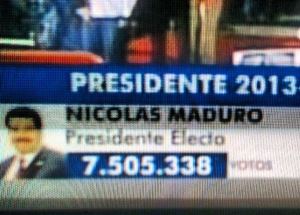
Three weeks after elections to choose Hugo Chávez’s successor, confusion still reigns in both Caracas and Washington.  The Venezuelan opposition has rejected the results of the election, which the electoral tribunal says Chávez’s handpicked man – Nicolás Maduro – won by only 1.8 percent.  Opposition candidate Henrique Capriles originally asked only for a vote recount – considered reasonable by many because of the narrow margin – but his lawyers upped the ante on 2 May when they officially demanded that the vote be invalidated and new elections be held.  Isolated incidents of political violence turned up the heat in Caracas, although the Götterdämmerung scenarios in the streets that some analysts predicted have not yet materialized.

Every major country of the hemisphere has recognized Maduro as President – except the United States.  (Canada wavered at first but seems to have moved on.)  Washington has invested millions of dollars in “democracy promotion” programs over the years and has provided Capriles and the opposition enduring political support in their efforts to beat Chávez at the polls and later to beat Maduro as his hand-picked successor.  Since the April election, the U.S. government has endorsed the opposition’s call for a vote recount.  So has the OAS, which offered experts to assist in the process.  But only Washington has said that while it is “working with” the Maduro Government, it doesn’t recognize its legitimacy.  The State Department spokesman dodged the issue repeatedly last week, and in an interview with Univisión broadcast at the conclusion of his visit to Mexico last Friday, President Obama himself refused to say whether his Administration officially recognized Maduro as President.  He left little doubt as to his real position, however, when he said that basic principles of human rights, democracy, press freedom and freedom of assembly were not observed in Venezuela following the election.

As AULABLOG pointed out on 23 April, the irony of the United States demanding a hand-count of the ballots is not lost on millions of Latin Americans who remember Washington’s performance in the 2000 Bush-Gore vote – and that it was a politically divided Supreme Court that made the final decision.  The tightness of the vote, Venezuelan electoral realities (past and present), and President Maduro’s over-the-top rhetoric – last week he again accused Washington of backing “neo-Nazis” allegedly trying to overthrow his government and accused a filmmaker of being a spy – make it hard for observers to argue that the elections are legitimate.  President Obama’s statements, including his remark that the spying charge was “ridiculous,” have been measured and continue a noteworthy shift since the near-hysteria about Venezuela during the Bush Administration.  But the fact remains that the U.S. Government’s posture on Venezuela – perhaps unique in its bilateral relations with Latin America since the Cold War – has made it once again the outrider and, among people who remember the Bush-Gore decision, the butt of many jokes.  Importantly, Capriles may be reading Washington’s stance as an endorsement of his own increasingly puzzling demands.  As our 23 April post suggested, Capriles ought to see himself as having a historic chance to lead, poised to challenge Chavismo easily at the polls the next time around.  Yet, like Mexico’s Andrés Manuel López Obrador in 2006, he may be squandering an opportunity to present himself to the Venezuelan electorate as the responsible grownup in the room.

Chavismo Wins a Battle But the Tide May Have Turned

By Eric Hershberg

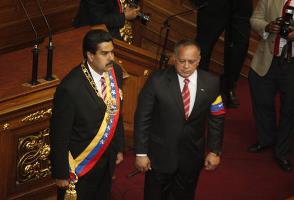
Inauguration of Nicolás Maduro | Photo credit: Presidencia de la República del Ecuador / Foter.com / CC BY-NC-SA

Inauguration of Nicolás Maduro | Photo credit: Presidencia de la República del Ecuador / Foter.com / CC BY-NC-SA

President Nicolás Maduro’s inauguration last Friday marked a new stage in the contest between chavistas and the Venezuelan opposition.  Maduro’s surprisingly weak showing at the polls – winning by a meager 1.8 percent margin despite the huge (and abused) advantages of incumbency – plus tensions within his party and his own rhetorical excesses, suggest that chavismo without Chávez confronts challenging odds.  Chávez attracted more votes alive than he could in death, as his hand-picked successor could not match his patron’s appeal at the ballot box.  Looking forward, Maduro and the Partido Unido Socialista de Venezuela (PSUV) will be judged on the basis of their performance.  The road ahead will not be easy for Maduro, as the government  confronts growing economic and security problems, and his ineffective campaign may energize potential competitors from within Chavismo.

Henrique Capriles’s strong showing in the election bodes well for the opposition.  However, athough Maduro’s blanket reference to them as “fascists” is absurd, their apparent eagerness to use the vote recount – reluctantly agreed to by the electoral council hours before Maduro’s inauguration – to remove him from office could breathe life into his allegation that the opposition consists of  golpistas obsessed with taking power.  Overreaching could be their undoing, as it has been in the past.

Latin American presidents, through a UNASUR statement of support and participation in the inauguration, have endorsed Maduro’s ascendance to the Presidency.  Their strong interest, for a variety of reasons, is in a balance between continuity and change in Venezuela. Although there are signs that both Chile and Colombia wavered momentarily, South American governments overall were united in their preference for a chavista government, as this would favor both  internal and regional stability.The United States, on the other hand, has appeared timid.  Maduro’s accusations of U.S. attacks on him and the presence of Iranian leader Ahmadinejad at the inauguration made it impossible for Washington to send a senior emissary to the swearing-in.  Yet the evident absence of the United States, even after the UNASUR endorsement, was petty.  Through statements calling for a recount of 100 percent of the votes both the State Department and the U.S. Ambassador to the United Nations came across as unable to outgrow a grudge match with Chávez or to grasp that the American position would isolate Washington once again from prevailing sentiment in South America.

There were two winners in the Venezuelan election:  Maduro, who is now the elected President, and Capriles, who managed to secure nearly half the votes in the face of overwhelming odds.  The latter comes out ahead in the long run, but only if he manages his cards wisely.  Washington, meanwhile, seems still not to understand two things:  First, after Bush v. Gore, it will be at least another generation until Americans can say anything about how to count votes.  It was legitimate and appropriate for the OAS to demand a recount, as its record in election monitoring is impeccable.  Secretary General Insulza achieved the core objective of the Organization and should be recognized for having done so.  For the American government to have taken the position that it did suggests an inability to understand the consequences of the 2000 election in Florida for its credibility in election-related issues in the region.  Second, democratic change in Latin America is typically an evolutionary process.  This may be less satisfying to some policymakers who would prefer to see a foe’s outright defeat, but it may be better, for Chavismo’s enemies in both Washington and Caracas, than having their favorite step in at this particular time of high tensions.  If Capriles and his coalition can brand themselves as democratic reformists rather than golpistas, they have a good chance of coming to power when Maduro’s six-year term is exhausted, or even before, and if they convey a message of responsible opposition, key South American governments might well approve of an alternation in power the next time around.

The Overlooked Dimension of U.S. Immigration Reform

By Eric Hershberg

Immigration reform rally | by Anuska Sampedro | Flickr | Creative Commons

Immigration reform rally | by Anuska Sampedro | Flickr | Creative Commons

The 2012 U.S. presidential elections brought national attention to the Latino vote and, with it, immigration reform.  Embarking on his second term, President Obama immediately labeled the matter a priority, and some but not all of the Republican leadership is eager to reach a deal.  Beyond electoral calculations, there are many good reasons for Washington to finally resolve the status of roughly 11 million people living in the United States without legal documentation.  The border with Mexico has become increasingly impermeable, stripping critics of reform of one of their principal talking points.  Virtually all credible studies demonstrate that immigrants contribute more to the tax base than they receive from public expenditures, and they are a crucial source of community revitalization in some of the nation’s depressed cities and towns.  Meanwhile, a generation of youth brought to the country as young children – the “Dreamers” – languishes without recognition of their de facto status as Americans.  There are also humanitarian issues: families and neighborhoods are torn apart by the more than 400,000 deportations in each of the past several years.

Immigration reform matters to Latin America as well.  With millions of Latin Americans residing in the United States, several of the region’s economies are highly dependent on a steady flow of remittances, which are destined to increase if undocumented workers come out of the shadows.  In 2012, Mexico and Central America received more than $35 billion from migrants in the U.S.  Particularly striking is the case of El Salvador, a U.S. ally.  Nearly a third of its population lives in the U.S., and remittances surpass all other sources of revenue – now 16 percent of GDP.  For several Central American governments the welfare of migrants working in the U.S. is not only a humanitarian concern: these citizens are a crucial foundation for economic viability – and thus nothing less than a national security priority.

Yet remarkably absent from the U.S. immigration debate are the implications of a comprehensive reform for the eroded credibility of the U.S. in Latin America.  Virtually alone among senior officials, former Secretary of State Hillary Clinton acknowledged soon before leaving her post that creating a pathway to citizenship “will be a huge benefit to us in the region, not just in Mexico, but further south.”  The point merits emphasis.  The failure to enact comprehensive immigration reform, the result of domestic policy shortcomings, has serious consequences for U.S. standing in the region – as serious as other policy failures such as Washington’s continued inability to normalize relations with Cuba, to stop illicit gun exports, or to stem the demand for illicit drugs that is fueling violence and corruption across the region.  If the new administration wishes to avoid a replay of the open rebellion by Latin American governments against U.S. policy that emerged at last year’s Summit of the Americas in Cartagena, it would do well to show the region that it is willing and able to enact comprehensive immigration reform.

Correa’s Second Term

By Rob Albro, CLALS Faculty Affiliate

President Rafael Correa, Ecuador | by: "el quinto infierno" | Flickr | Creative Commons

President Rafael Correa, Ecuador | by: “el quinto infierno” | Flickr | Creative Commons

Little drama accompanied results of the February 17 election in Ecuador, where center-left incumbent Rafael Correa retained the presidency by a wide margin. Correa enjoys the highest approval rating – nearly 80% late last year – of any Latin American head of state. He will be the first Ecuadoran president to complete his term since 1996, and his resounding victory at the polls will in principle keep him in office until 2017. Most pre-election polls had projected Correa to win decisively, and he did just that with 56.7% of the popular vote. The opposition is fractured, with seven different candidates running against him. His nearest rival, banker Guillermo Lasso, garnered only 23.3% of the vote. A testament to Correa’s dominance is that the right-leaning Lasso offered a vision little different from the president’s own policies and even adopted key elements of Correa’s discourse. The title of Lasso’s recent book, Another Ecuador is Possible, references the World Social Forum.

Correa’s political base was consolidated during the anti-neoliberal protests of 2005, and his “citizen’s revolution” represents an unorthodox combination of nationalist populism, robust social welfare spending and rhetorical flourishes in defense of Ecuador’s national sovereignty. Correa’s social spending – increasing the health budget, minimum wage, pensions, and access to medical care; offering micro-credit and free school lunches; providing new housing and anti-poverty subsidies –is highly popular, especially with the urban poor. These programs, dependent upon a commodity-led export strategy, have enabled Correa to marginalize once important political actors of the left and right. Organized labor and indigenous movements on the left, like economic and media elites on the right, have picked fights with Correa, objecting to his authoritarian style, attacks on the press, petroleum policies in the Amazon, poor record on crime, and outbursts directed toward foreign investors. But this has made little dent in his popularity.

If Correa is certain to face resistance to his agenda in his new term, the political fragmentation and lack of dramatic choices evident during the campaign suggest that it will not necessarily be effective.  Despite potential fiscal headwinds, redistributive social welfare policies are likely to continue to expand. Questions do remain: regular social investment has been enabled by ramping up an extraction-based economy dependent on oil, which has also generated some social conflict.  But there is mounting evidence that aside from being popular these policies are also measurably successful. Ecuador’s election comes on the heels of Venezuela’s, where opposition candidates also found it necessary to tout redistributive policies. If the economy turns south, a splintered opposition might find common cause. But as in a number of other South American countries, the redistributive politics of an incipient social welfare state will inform the agenda of Correa’s eventual successor. The long-term management of these policies, and whether the President will seek to alter the Constitution to permit indefinite re-election, are matters that could prove vexing during the coming years.

Top Five Events of 2012

A poll of contributors to AULABLOG identified the following five events (listed below in no particular order) as the most important in Latin America in 2012.  We welcome you to post your own list using the Leave a Comment link below.

By: Matt Westgate "Mettamatt" | Flickr | Creative Commons

By: Matt Westgate “Mettamatt” | Flickr | Creative Commons

Venezuelan President Hugo Chavez’s third major cancer surgery signaled that change – probably profound – will come to Venezuela much faster than his presidential campaign let on.  We expect growing tensions among his aides, none of whom has his charisma or base, as they jockey in a succession scenario.  We’ll be watching whether the PSUV can become an institutionalized mechanism for channeling Chavismo’s support into a governing project in the post-Chavez era.

The election and inauguration of Mexican President Enrique Peña Nieto signals a natural swing back to PRI leadership after 12 years of PAN governments.  Differences over the approach to counternarcotics might flare up in an overall smooth relationship with the United States, but the new president’s biggest challenge is going to be overcoming the persistent economic backwardness that has kept Mexico from achieving the economic growth of others since the turn of the century.

The ouster of Paraguayan President Fernando Lugo last June – as well as the United States and Latin America’s ambivalent reaction to it – was a dramatic illustration that democracy in the region rests on a tenuous foundation of sometimes contradictory constitutions and weak institutions.  The continuing struggle of Honduran President Pepe Lobo, three-plus years after the coup that removed President Mel Zelaya, shows that failure to bring those whose power grabs violate laws and the spirit of law to account sows the seeds of long-term instability and even greater threats to democracy.

The Colombian peace talks, the first serious attempt in 10 years at resolving the decades-old conflict, could lead to a watershed in that country’s development.  President Juan Manuel Santos has shown strong leadership, despite incessant carping from his predecessor, Alvaro Uribe, and has smartly acknowledged that success in the talks is far from certain.  If the talks are successful, 2013 could be a defining moment for a country already experiencing strong economic growth and an important degree of social progress.

Washington continued to sit on the sidelines on most regional issues.  President Obama got a spanking at the Summit of Americas from even perennially friendly governments for Washington’s approach to counternarcotics (overly militarized) and Cuba (stuck in the Cold War).  He was silent on Latin America during the campaign, and his rhetoric of “partnership” and “neighborhood” remained unfulfilled.  Although the President won kudos for implementing elements of the Dream Act by Presidential Directive, the Administration boasted of deporting more than 400,000 illegal immigrants in 2012, the most of any year in the nation’s history.  The region is likely to remain eager for U.S. leadership on issues of mutual interest in 2013, but most countries’ blossoming dealings with Europe, Asia and even Africa suggest they’re not going to sit around waiting for the U.S. to take up the challenge.

After Chávez?

Photo by:     UKBERRI.NET Uribe Kosta eta Erandioko agerkari digitala | Flickr | Creative Commons

Photo by: UKBERRI.NET Uribe Kosta eta Erandioko agerkari digitala | Flickr | Creative Commons

Venezuelan President Hugo Chávez’s solemn appearance on national television on December 8 may have marked more than his departure for a fourth round of cancer treatment in Cuba.  His designation of Vice President and former Foreign Minister Nicolás Maduro as his successor in the event he could not continue his duties indicated an initial farewell from politics as well – with wide-ranging implications in- and outside Venezuela.  Chávez asked “with all my heart” that his supporters elect Maduro to continue the Bolivarian revolution in the event of his death or inability to continue his mandate, with a clear eye to the constitutional requirement for emergency elections to be held within just 30 days should the president die or become incapacitated within the first four years of the term.  On Tuesday, Maduro announced that the president was recuperating after a six-hour procedure in Havana.  He did not declare a sure and speedy recovery but rather asked for Venezuelans’ prayers.

Speculation about the domestic scenario, including struggles within the ruling party, is intense.  Maduro’s most frequently mentioned rival to succeed Chávez is Diosdado Cabello, who was also alongside Chávez as he made the announcement last week.  While Maduro and Cabello both have had years of government experience and demonstrated political loyalty, questions remain about whether they – or anyone else – could replicate Chávez’s connection with poor voters and keep their weak political party together.  Informed speculation about the long-term impact on the region, if the succession stumbles, ranges from predictions of a cutoff of subsidies and subsidized oil, that would destabilize Cuba, Nicaragua and others to, among those who never saw Chávez as effective regionally, shrugged shoulders.

An even greater unknown is how well the opposition would do in the event of a snap election.  It is far from certain that these forces would re-unite around former candidate Henrique Capriles so shortly after he lost the October 2012 election.  The new system of primary elections that produced the single candidate last year would be difficult to replicate so quickly.  With both the ruling and opposition parties vulnerable to tensions and splits, a scenario of instability could easily result.  If Chávez’s health permits, he could conceivably resign the presidency and oversee elections that, although probably skewed, will help maintain the institutional order. If Venezuela is indeed on the brink of a succession process, the fortunes of both Chavismo and the opposition, and indeed of the Venezuelan population, will depend in large part on the capacity of both sides to maintain unity around alternative candidates for the Presidency.

Ecuador Elections: Four More Years for Correa?

Photo by: Rinaldo Wurglitsch “Rinaldo W.” | Flickr | Creative Commons

Like him or not, President Rafael Correa has done what few recent Ecuadorean presidents have done – complete a term in office.  When he announced on November 10 his intent to run for re-election, observers in and outside Ecuador immediately declared him the favorite.  (Correa ran a second time in 2009, without completing his first term, under the rules of a new Constitution.)  Such predictions make it easy to forget how uncertain Correa’s presidency looked when he started it in 2007 – as a 43-year-old, U.S.-educated economist – and how few expected him to succeed.  In the ten years prior, social movements led by workers and indigenous peoples toppled a succession of seven presidents.  Rejection of IMF-led reforms had been both deep and broad in Ecuador, and it was hard for a president to complete a year, let alone a term.

High oil prices have helped Correa succeed by facilitating visible public spending, but that is not the whole story.  By almost all accounts, Correa has been far from perfect – his treatment of the press has particularly troubled rights experts – but he has provided some stability and halted the cycle of mass protests, strikes, and presidential turnover.  With a blend of economic populism and nationalist rhetoric, Correa has turned the same social movements that were once the scourge of Ecuadorean presidents into a base of support.  He has incorporated formerly marginalized people into the “nation” that he claims to defend – what academic Steven Ellner called “a new narrative of nationhood that challenges long-held assumptions.”  He has unified policies such as ending the U.S. lease of the Manta airbase with resource-based economic nationalism.

Though Correa’s reelection next February 17 looks easy, he will face increased tensions in his third term.  Government revenues remain dependent on oil and mining, which are susceptible to price fluctuations.  The expansion of extractive activities in areas inhabited by Correa’s indigenous base could strain his coalition – it has already stirred environmental concerns – and government spending has neglected the need to diversify the economy and reduce its reliance on the extractive industry.  In addition, Correa has benefited from the generosity of Venezuela, but that support could wane as President Hugo Chávez turns inward to deal with domestic challenges.  The opposition, which has continued to present half a dozen candidates for the presidency, will likely begin to unify if it feels threatened by a further concentration of power in the Executive.  To win reelection and govern effectively, Correa will need to maintain the unity of an uneasy coalition, without riding roughshod over the opposition and press freedom. 

The U.S. Election: A Sigh of Relief, A Moment of Hope?

Photo by: Hanoian | Flickr | Creative Commons

Latin American media see a glimmer of hope in President Obama’s reelection that was largely absent during the campaign.  The breadth and composition of the coalition that carried Obama to victory appears to have impressed commentators, and some believe that Obama might be freer of political constraints in a second term.  In Mexico, undergoing its own presidential transition, there is expectation that continuity in Washington will facilitate a smoother transition there.  The prospect that Obama will be willing, and perhaps more able, to press for additional stimulus measures to jumpstart the U.S. economy – with obvious benefit for interdependent Mexico – may also be a factor.  El Tiempo in Colombia noted that “with Obama, there won’t be surprises,” and that stability is welcome during the difficult peace talks.  The ALBA countries generally welcomed Obama’s reelection, and – probably reflecting a wider view – Cuban media proclaimed: “U.S. elections: the worst one did not win.”  Some media, such as Brazil’s O Globo, reminded readers that the U.S. House of Representatives remains under Republican control, and that the GOP “had been kidnapped” by the Tea Party.

A quick review of regional commentary reveals interest in the fact that Latino voters, more than 70 percent of whom opted for the President, were an important part of his coalition in Virginia, Colorado, and New Mexico.  Despite the Obama administration’s record number of deportations and its failure to introduce comprehensive immigration reform during its first term, there is little doubt that the President’s June 2012 decision to implement provisions of the Dream Act increased enthusiasm.  Challenger Mitt Romney’s tough talk on Cuba and Venezuela did not win over South Florida, suggesting that demographic change is undermining support there for hardline policies.  Bolivian President Evo Morales said, “Obama needs to recognize and pay that debt to the Latinos.”

No one so far has dared to expect a major shift in emphasis toward Latin America during Obama’s second term, but reelection gives the President another opportunity to make good on his vision for “partnership” in our hemispheric “neighborhood.”  Early analysis of the voting, particularly in Florida and in Latino communities, suggests that he will have the political space to live up to the expectations created by his soaring rhetoric during his first Summit of the Americas in 2009.  Not only can he explore reasonable approaches to longstanding issues such as Cuba, which will improve the U.S. image throughout the region; he can reengineer Washington’s relations with Central and South America in ways that reflect the region’s own evolution and ambitions – enhancing and facilitating them, rather than fearing or even resisting change.  If Latin America is ready to move into the future with a new, constructive interaction with the United States, now is the time to give it a try.